Localized Patterns in Periodically Forced Systems: II. Patterns with Nonzero Wavenumber∗ A. S. Alnahdi†, J. Niesen‡, and A. M. Rucklidge†
Abstract. In pattern-forming systems, localized patterns are readily found when stable patterns exist at the same parameter values as the stable unpatterned state. Oscillons are spatially localized, time-periodic structures, which have been found experimentally in systems that are driven by a time-periodic force, for example, in the Faraday wave experiment. This paper examines the existence of oscillatory lo-calized states in a PDE model with single-frequency time-dependent forcing, introduced in [A. M. Rucklidge and M. Silber,SIAM J. Appl. Dyn. Syst., 8 (2009), pp. 298–347] as a phenomenological model of the Faraday wave experiment. We choose parameters so that patterns set in with non-zero wavenumber (in contrast to [A. S. Alnahdi, J. Niesen, and A. M. Rucklidge, SIAM J. Appl. Dyn. Syst., 13 (2014), pp. 1311–1327]). In the limit of weak damping, weak detuning, weak forcing, small group velocity, and small amplitude, we reduce the model PDE to the coupled forced com-plex Ginzburg–Landau equations. We find localized solutions and snaking behavior in the coupled forced complex Ginzburg–Landau equations and relate these to oscillons that we find in the model PDE. Close to onset, the agreement is excellent. The periodic forcing for the PDE and the ex-plicit derivation of the amplitude equations make our work relevant to the experimentally observed oscillons.
Key words. pattern formation, oscillons, localized states, coupled forced complex Ginzburg–Landau equations
AMS subject classifications. 35B36, 35B32, 35Q35, 37L05
DOI. 10.1137/17M1162330
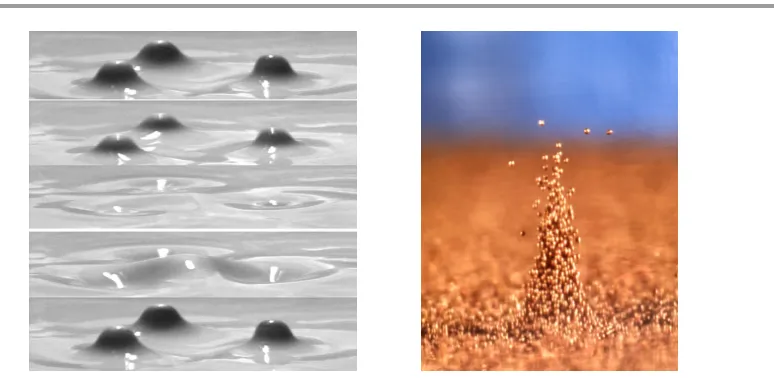
1. Introduction. Spatially localized structures are common in pattern-forming systems, appearing in fluid mechanics, chemical reactions, optics, and granular media [15, 22]. Much progress has been made on the analysis of steady problems, where bistability between a steady pattern and the zero state leads to steady localized patterns bounded by stationary fronts between these two states [9,14]. In contrast, oscillons, which are oscillating localized struc-tures in a stationary background in periodically forced dissipative systems, are relatively less well understood. Oscillons have been found experimentally in fluid surface wave experiments [5,19,24,25,35,40], chemical reactions [31], optical systems [26], and vibrated granular me-dia problems [8,37,39]. In the surface wave experiments (see the left panel of Figure1), the fluid container is driven by vertical vibrations. When these are strong enough, the surface of the system becomes unstable (the Faraday instability) [20], and standing waves are found on the surface of the fluid. Oscillons have been found when this primary bifurcation is subcritical
∗
Received by the editors December 20, 2017; accepted for publication (in revised form) by M. Book April 5, 2018; published electronically May 22, 2018.
http://www.siam.org/journals/siads/17-2/M116233.html †
Department of Mathematics & Statistics, College of Science, Al Imam Mohammad Ibn Saud Islamic University, PO Box 240455, Riyadh 11322, KSA ([email protected]).
‡
School of Mathematics, University of Leeds, Leeds LS2 9JT, UK ([email protected], a.m.rucklidge@ leeds.ac.uk).
Figure 1. Left: A triad of oscillons in a vertically vibrated colloidal suspension, with time running from top to bottom (taken from[25]). Right: An oscillon in a vertically vibrated layer of bronze beads (courtesy of Paul Umbanhowar, Northwestern University).
[13], and these take the form of alternating conical peaks and craters against a stationary background. A second striking example of oscillons was found in a vertically vibrated thin layer of granular particles [39], as depicted in the right panel of Figure1. As with the surface wave experiments, oscillons take the shape of alternating peaks and craters. The observation of oscillons in these experiments has motivated our theoretical investigation into the existence of these states and their stability in a model PDE with explicit time-dependent forcing. In both of these experiments, the forcing (vertical vibration) is time-periodic with frequency 2Ω, and the oscillons themselves vibrate either with the same frequency (2Ω) as the forcing (harmonic) or with half the frequency (Ω) of the forcing (subharmonic). We focus on the subharmonic case because this is the most relevant for single-frequency forcing as considered here; in contrast, harmonic oscillations play an important role in the presence of multifrequency forcing [38].
A subharmonic standing wave modulated slowly in time is described by an ansatz of the form
(1) U(t, x) =A(T)eiΩtcos(kx) + c.c.
for a real scalar variable U depending on a (fast) time variable t and a spatial variable x. Here,Ais a complex amplitude depending on a slow time scaleT; also,kis the wavenumber, and c.c. stands for complex conjugate. Phase shifts in A correspond to translations in time. Symmetry considerations then lead to an amplitude equation of the form
(2) AT = (ρ+iν)A+C|A|2A+iΓ ¯A,
where the real parameter Γ describes the strength of the forcing. The parametersρandν are real, butC is complex. The last term (with ¯A) breaks the phase symmetry ofA and thus the corresponding time-translation symmetry: the phase ofA is not arbitrary because the forcing in the original system is time dependent. The factor i in the last term can be removed by applying a phase shift. See [17] for a discussion of this (and related) amplitude equations.
In the case of spatially localized oscillons, we also have to include spatial modulations, so that the amplitudeA in (1)depends not only on T but also on a slow spatial variable X. It would seem logical that this ansatz would lead to a diffusion term to (2), yielding a forced complex Ginzburg–Landau (FCGL) equation which is typically written down without deriva-tion [16,28,30,41]:
(3) AT = (ρ+iν)A−2(α+iβ)AXX+C|A|2A+iΓ ¯A.
Here,α andβ are real parameters; the factor−2 is included for comparison with the results that we will derive in this paper. Burke, Yochelis, and Knobloch [10] showed that this equation admits localized solutions. In [2], the FCGL equation was derived from a model PDE in which patterns are formed with zero wavenumber at onset; the agreement between the localized solutions in the model PDE and those in(3) was excellent.
However, in the Faraday wave experiment, the preferred wavenumber is nonzero at on-set [6]. Nevertheless, the FCGL equation has sometimes been used as an amplitude equation for Faraday wave and granular oscillons [4,16,37,42]. In this paper, we argue that this is not appropriate; instead, a system of two coupled FCGL equations should be used, as was done in [27,33].
In order to demonstrate explicitly the origin and correctness of the coupled FCGL equa-tions as amplitude equaequa-tions for oscillons, we use a PDE model with single-frequency time-dependent forcing, introduced in [34] as a phenomenological model of the Faraday wave ex-periment. We simplify the PDE by removing quadratic terms and by taking the parametric forcing to be cos(2t), wheret is the fast time scale. The resulting model PDE is then
(4) Ut= (µ+iω)U+ (α+iβ)Uxx+ (γ+iδ)Uxxxx+C|U|2U +iRe (U)Fcos(2t),
where U(x, t) is a complex function; µ < 0 is the distance from onset of the oscillatory instability; ω, α, β, γ, δ, and F are real parameters; and C is a complex parameter. The cos(2t) term makes this PDE nonautonomous. In this model, the dispersion relation can be readily controlled so the wavenumber at onset can be chosen be zero or nonzero, and the nonlinear terms are chosen to be simple in order that the weakly nonlinear theory and numerical solutions can be computed easily. In [2], the wavenumber at the onset of pattern formation was zero, and the FCGL equation was derived as a description of the localized solution. There, we did not require the fourth-order derivatives in (4). In contrast, in the current study we use the dispersion relation to set the wavenumber to be 1 at onset, and therefore we need to retain the term (γ+iδ)Uxxxx with the fourth-order spatial derivatives.
Our aim is to find and analyze spatially localized oscillons with nonzero wavenumber in the PDE model(4)theoretically and numerically in one dimension and numerically in two di-mensions. The approach will be similar to that in [2], though conceptionally more complicated since we have to consider the interaction between left- and right-traveling waves and the effect of a nonzero group velocity, leading to coupled amplitude equations. Although we will work with a model PDE, our approach will show how localized solutions might be studied in PDEs more directly connected to the Faraday wave experiment, such as the Zhang–Vi˜nals model [43], and how weakly nonlinear calculations from the Navier–Stokes equations [36] might be extended to the oscillons observed in the Faraday wave experiment.
In this case, we can model waves with a slowly varying envelope in one spatial dimension by looking at solutions of the form
(5) U(x, t) =A(X, T)ei(t+x)+B(X, T)ei(t−x),
whereXandT are slow scales andxandtare scaled so that the wave has critical wavenumber kc = 1 and critical frequency Ωc = 1. Commonly, the complex conjugate is added to an
ansatz of the form (5) in order to make U real, but our PDE (4) admits complex solutions (we argue in the conclusion that this does not make a material difference). In order to cover the symmetries of the PDE model, we include both the left- and the right-traveling waves (with amplitudes A and B, respectively), but the time dependence will be eit only, without
e−it. In subsection3.1, we explain in detail how the solution of the linear operator, which we
will define later, involves eit only. The +1 frequency dominates at leading order because of
our choice of dispersion relation. Here, we will focus primarily on the one-dimensional case. Two-dimensional localized oscillons are discussed briefly at the end and studied numerically in more detail in [1].
We start by showing some numerical examples of oscillons in the model PDE (4) and bifurcation diagrams exhibiting snaking, where branches of solutions go back and forth as pa-rameters are varied and the width of the localized pattern increases. We will do an asymptotic reduction of the model PDE to the coupled FCGL equations in the limit of weak damping, weak detuning, weak forcing, small group velocity, and small amplitude, and we will study the properties of the coupled FCGL equations. Some numerical examples of spatially localized oscillons in the coupled FCGL equations will be given. We will also investigate the effect of changing the group velocity. Furthermore, we will reduce the coupled FCGL equations to the real Ginzburg–Landau equation in a further limit of weak forcing and small amplitude close to onset. The real Ginzburg–Landau equation has exact localized sech solutions. Throughout, we will use weakly nonlinear theory by introducing a multiple scale expansion to do the reduc-tion to the amplitude equareduc-tions. We conclude with numerical examples of strongly localized oscillons in one and two dimensions.
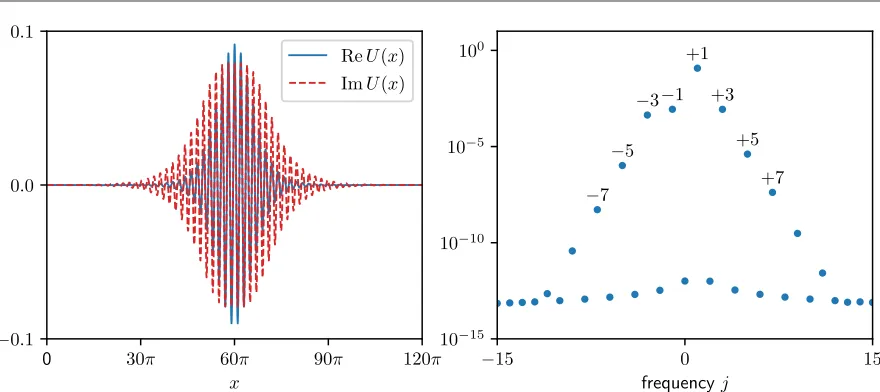
2. Numerical results for the model PDE. Similar to the methodology that was used in [2], we present numerical simulations of the PDE model(4)by time-stepping and continuation. The choice of parameters is guided by the asymptotic analysis in the remainder of the paper: All modes are damped in the absence of forcing, but the modes with wavenumberk' ±1 are only weakly damped, the forcing is also weak, and the group velocity is small. We discretize the PDE using a Fourier pseudospectral method, and the resulting system of ODEs is solved with a fourth-order exponential time-differencing method [12]. Most experiments are done on a domain of size L= 120π (60 wavelengths), in which case we use 2048 grid points. Solving the PDE from an appropriate initial condition, we find the localized solution plotted in the left panel of Figure 2.
To do continuation from this localized solution, we represent solutions by a truncated Fourier series in time with frequencies −3, −1, 1, and 3. The choice of these frequencies comes from the choice of parameters: The linearized PDE at wavenumber ±1 looks like
∂u
∂t = iu (writing U = u(t)eix), so the strongest Fourier component of u looks like eit; then
puttingu=eit into the forcing Re(eit) cos(2t) generates the frequencies−3,−1, 1, and 3, as
0 30π 60π 90π 120π x
−0.1 0.0 0.1
ReU(x) ImU(x)
−15 0 15
frequencyj 10−15
10−10
10−5
100
−7 −5
−3−1 +1
+3 +5
[image:5.612.74.514.84.280.2]+7
Figure 2. Left: Stable oscillon solution of (4) found by time-stepping, withµ = −0.255, ω = 1.5325,
α=−0.5,β = 1, γ =−0.25, δ = 0.4875,C =−1−2.5i, andF = 0.0585. The solution is plotted att= 0. Right: Amplitude of the eijt mode with frequency j when expanding the solution in the left panel atx= 60π as a Fourier series in time: The frequency+1component is the strongest, followed by frequencies−3,−1, and
+3, as expected, with the other frequencies at least two orders of magnitude weaker.
described in [2]. We also checked numerically that the frequencies ±1 and ±3 dominate (see the right panel of Figure 2).
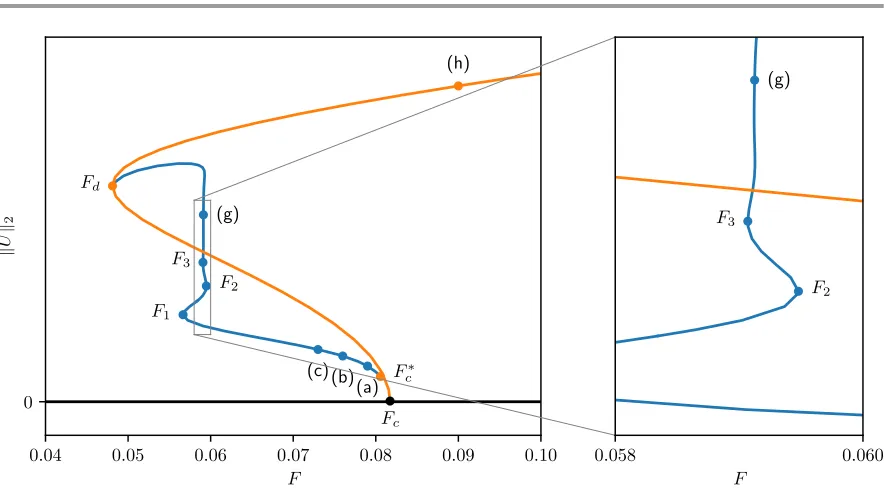
The bifurcation diagram of (4) as computed by AUTO [18] is given in Figure 3. The subcritical transition from the zero state to the pattern occurs at the bifurcation point Fc =
0.08173. The saddle-node point where the unstable periodic pattern becomes stable is at Fd = 0.04811. The bistability region where we look for the branch of localized states is
betweenFc and Fd. The branch of localized solutions bifurcates from the branch of periodic
patterns atF∗
c = 0.08056, which is away fromFcbecause of the finite domain. Stable localized
solutions are located between F1 = 0.05666 andF2= 0.05948.
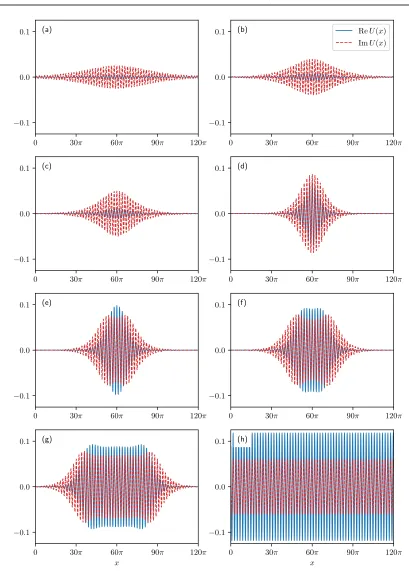
Examples of solutions along the branch of localized solutions in Figure 3 are given in Figure 4. Near the point F∗
c where the branch of localized solutions bifurcates, the localized
solutions look like the periodic patterns: small amplitude oscillations which are not very localized (see Figure 4(a)). As we go along the branch of localized solutions, the amplitude increases and the unstable oscillons become more localized (Figure4(b)–(c)). AtF1 = 0.05695,
the localized oscillons stabilize (Figure4(d)), and then they lose stability again atF2= 0.05987
(Figure 4(e)) as the branch of solutions snakes back and forth. The next saddle-node point is at F3 = 0.05912 (Figure 4(f)). It appears from the numerical results that the parameter
intervals between successive saddle-node points shrinks to zero as we continue on the branch with localized solutions; this is called collapsed snaking in [28]. However, we suspect that our numerics are misleading, partially because the domain size is too small, and that, in fact, the odd and even saddle-node points asymptote to parameter values which are close to each other but not equal. The branch of localized solution connects to the pattern branch close to the saddle-node point Fd. Figure 4(h) shows a typical periodic pattern. All solutions in
0.04 0.05 0.06 0.07 0.08 0.09 0.10
F
0
k
U
k2
Fc Fd
F∗ c F1
F2 F3
(g)
(h)
(a) (b) (c)
0.058 0.060
F
F2 F3
[image:6.612.73.519.81.326.2](g)
Figure 3. Bifurcation diagram of (4) in the weak damping limit in a domain of size Lx = 120π with parameters as in Figure2. The branch with periodic solutions is plotted in red. The bistability region is between
Fd = 0.04811and Fc = 0.08173. The branch with localized solutions (blue) starts at Fc∗ = 0.08056 and has folds atF1= 0.05666,F2= 0.05948, andF3= 0.05912. Solutions at(a), (b), (c),F1, F2,F3,(g), and(h) are shown in Figure4.
Figures 3 and 4 satisfy U(x, t) = U(−x, t) for a suitably chosen origin. We have not found solutions with any other symmetry.
In the remainder of the paper, we will analyze these oscillons and derive an asymptotic expression for their amplitude, which will be compared to the numerical solutions in Figure9.
3. Derivation of the coupled FCGL equation. In this section, we will study the PDE model (4) in the limit of weak damping, weak detuning, weak forcing, and small amplitude in order to derive its amplitude equation. In addition, we will need to assume that the group velocity is small. We start with linearizing (4) about zero, and we consider solutions of the form U(x, t) = eσt+ikx, where σ is the complex growth rate of a mode with wavenumber k.
Without taking any limits and without considering the forcing, the growth rate is given by
σ =µ−αk2+γk4+i(ω−βk2+δk4), (6)
so σr = µ−αk2 +γk4 gives the damping rate of modes with wavenumber k, and σi =
ω−βk2+δk4 gives the frequency of oscillation. We will also need the group velocity of the
waves, which isdσi(k)/dk=−2βk+ 4δk3.
We will choose parameters so that we are in a weak damping, weak detuning, and small group velocity limit for modes with wavenumberk= 1. Specifically, in order to find spatially localized oscillons and to do the reduction to the amplitude equation, we will impose the following.
0 30π 60π 90π 120π −0.1
0.0 0.1 (a)
0 30π 60π 90π 120π
−0.1 0.0
0.1 (b) ReU(x)
ImU(x)
0 30π 60π 90π 120π
−0.1 0.0 0.1 (c)
0 30π 60π 90π 120π
−0.1 0.0 0.1 (d)
0 30π 60π 90π 120π
−0.1 0.0 0.1 (e)
0 30π 60π 90π 120π
−0.1 0.0 0.1 (f)
0 30π 60π 90π 120π
x −0.1
0.0 0.1 (g)
0 30π 60π 90π 120π
x −0.1
[image:7.612.84.493.79.650.2]0.0 0.1 (h)
Figure 4. Solutions along the branch of localized solutions in the bifurcation diagram in Figure 3 at
(a)F = 0.079,(b)F= 0.076,(c)F= 0.073,(d)the fold atF1 = 0.05666,(e)the fold atF2= 0.05948,(f)the fold atF3= 0.05912, and the point(g). Solution(h)is on the periodic branch atF = 0.09.
0 1 2 k
0
µ
-0.5 σr
0 1 2
k 0
1 2 3 4
σi
Figure 5. The growth rate (left panel) and dispersion relation (right panel) of (4) with µ = −0.255,
ω= 1.5325, α=−0.5, β= 1, γ =−0.25, andδ= 0.4875. In this case, the group velocity is small at k= 1
because this is close to the minimum of the dispersion relation.
Stability in the absence of forcing. To have waves with all wavenumbers linearly damped, we require that σr(k) < 0 for all k. It follows that µ < 0, α > −2√µγ, and γ < 0. With
α <0, we have a nonmonotonic growth rate.
Preferred wavenumber. We want the damping to be weakest fork=±1. Thus, we require that the growth rateσr achieves a maximum when the wavenumber kis 1, so dkdσr(k= 1) = −2α+ 4γ = 0. This gives the conditionα= 2γ.
Weak damping. We also need to make the growth rate σr be close to zero when k=±1.
Therefore, we introduce a small parameter 1 and a new parameter ρ, so that we have σr(k= 1) =µ−α+γ=2ρ, whereρ <0. Thus,µ= 12α+2ρ. Figure5(a) shows an example
of the real part of the growth rate.
Weak detuning. We want waves with k ' ±1 to be subharmonically driven by cos(2t), so the frequency of the oscillation σi should be close to 1 at k = 1. Therefore, we write
σi(k= 1) =ω−β+δ= 1 +2ν, whereν is the detuning. Small group velocity. We require the group velocity dσi
dk = −2kβ + 4δk3 to be O() at
k = ±1, so we have −2β + 4δ = vg. This is needed to allow the group velocity in the
subsequent amplitude equations to appear at the same order as all the other terms. We discuss the consequences of choosing a small group velocity in section 6. Figure 5(b) shows an example of the dispersion relation σi(k).
Weak forcing. To perform the weakly nonlinear theory, we assume that the forcing is weak, and so we scale the forcing amplitude to be O(2), writingF = 42Γ.
We relate the parameters in the PDE model with the parameters in the amplitude equa-tions in a way that we can connect examples of localized oscillons in both equaequa-tions. In Table1, all PDE parameters are defined in terms of parameters that will appear in the coupled FCGL equations and vice versa.
Table 1
Relationships between parameters(µ, ω, α, β, γ, δ, F)of the PDE model and the parameters(ρ, ν, α, β, vg,Γ) of the coupled FCGL equations. Note that these relationships depend on the choice of. The parametersαand
βare the same in both models.
The PDE model(4) The coupled FCGL(14) Physical meaning
µ=α−γ+2ρ=12α+2ρ ρ= µ−α+γ
2 ρ= damping (ρ <0) γ=12α
δ=1 2β+
1
4vg vg=
−2β+ 4δ
vg= group velocity
ω= 1 +12β−1 4vg+
2
ν ν=ω−1−β+δ
2 ν= detuning
F= 42Γ Γ = F
42
Γ = strength of parametric forcing
3.1. Linear theory. With the parameters as in Table1, the linear theory of the PDE(4)
at leading order is given by
Ut=
α 2 +i
β 2 + 1
U+ (α+iβ)Uxx+
α 2 +i
β 2
Uxxxx,
(7)
which defines a linear operator Las
LU =
−∂
∂t+i
U +
α 2 +i
β
2 1 + ∂2
∂x2
2
U.
This is essentially the linear part of the complex Swift–Hohenberg equation [3], which has appeared in the context of nonlinear optics [23] and Taylor–Couette flows [7]. To find all solutions, we substitute U =eσt+ikx into the above equation to get the dispersion relation
σ =i+
α 2 +i
β 2
1−k22
.
We assume that our problem has periodic boundary conditions, which implies thatk∈R.
Fur-thermore, we require σr= 0 since we are considering neutral modes. The real and imaginary
parts of this equation give
k=±1 and σ=i.
Therefore, LU = 0, equivalent to (7), implies that neutral modes are linear combinations of U(x, t) = ei(t+x) and U(x, t) = ei(t−x). Note that our choice of dispersion relation leads to
positive frequency solutions. This is not a severe restriction, as discussed in section6.
3.2. Weakly nonlinear theory. In order to apply the standard weakly nonlinear theory, we need the adjoint linear operator L†. Therefore, we define an inner product between two functions f(x, t) and g(x, t) by
f(x, t), g(x, t) = 1
4π2 Z 2π
0 Z 2π
0
¯
f(x, t)g(x, t)dt dx, (8)
where ¯f is the complex conjugate of f. The adjoint linear operator L† is defined by the relation
f(x, t), Lg(x, t) =
L†f(x, t), g(x, t)
for all f and g,
and so, using integration by parts,
L†f = ∂ ∂t−i+
α 2 −i
β
2 1 + ∂2
∂x2
2!
f.
Taking the adjoint changes the sign of the ∂t∂ term and takes the complex conjugate of other terms of L. The adjoint eigenfunctions are then given by solving L†f = 0; the solutions are also linear combinations of ei(t±x).
We expandU in powers of the small parameter :
U =U1+2U2+3U3+· · · ,
(9)
where U1,U2,U3, . . . are O(1) complex functions. We will derive solutions U1, U2,U3, . . . at
each order of.
At O(), the linear theory arises, and we findLU1 = 0. The solution U1 takes the form
U1 =A(X, T)ei(t+x)+B(X, T)ei(t−x),
(10)
where A and B represent the amplitudes of the left- and right-traveling waves. They are functions ofX and T, the long and slow scale modulations of space and time variables:
T =2t and X=x.
The multiple scale expansion below will determine the evolution equations for A(X, T) and B(X, T).
At second order in , we get LU2 = 0: The ∂
2U 1
∂x∂X term cancels with the ∂4U1
∂x3∂X term. We
would have had a forcing term at this order if we had not ensured that the group velocity is O(). The equation at this order is solved by settingU2= 0.
At third order in, we get
∂U1
∂T =LU3+ (ρ+iν)U1+ (α+iβ) ∂2U
1
∂X2 + 3(α+iβ)
∂4U 1
∂x2∂X2
(11)
+ivg
∂4U 1
∂x3∂X + 4iΓ cos(2t) Re(U1) +C|U1| 2U
1.
The linear operatorLis singular, so we must apply a solvability condition: We take the inner product between the adjoint eigenfunction ei(t+x) and (11), which gives
(12)
ei(t+x),∂U1
∂T
=Dei(t+x), LU 3
E
+ (ρ+iν)Dei(t+x), U 1
E
+ (α+iβ)
ei(t+x),∂2U1
∂X2
+ 3(α+iβ)
ei(t+x), ∂
4U 1
∂x2∂X2
+ivg
ei(t+x), ∂
4U 1
∂x3∂X
+ 4iΓDei(t+x),cos(2t) Re(U1) E
+CDei(t+x),|U1|2U1 E
.
We have hei(t+x), LU
3i = hL†ei(t+x), U3i = 0, so U3 is removed, and the above equation
becomes an equation in U1 only. Substituting the solution U1 leads to
(13)
ei(t+x), ∂ ∂T(Ae
i(t+x)+Bei(t−x))
= (ρ+iν)Dei(t+x), Aei(t+x)+Bei(t−x)E
+ (α+iβ)
ei(t+x), ∂
2
∂X2(Ae
i(t+x)+Bei(t−x))
+ 3(α+iβ)
ei(t+x), ∂
4
∂x2∂X2(Ae
i(t+x)+Bei(t−x))
+ivg
ei(t+x), ∂4
∂x3∂X(Ae
i(t+x)+Bei(t−x))
+ 4iΓDei(t+x),21cos(2t)(Aei(x+t)+Bei(t−x)+ ¯Ae−i(t+x)+ ¯Be−i(t−x))E
+CDei(t+x),(|A|2+ABe¯ 2ix+ ¯ABe−2ix+|B|2)(Aei(t+x)+Bei(t−x))E.
After we compute the left- and right-hand sides of the above equation term by term, we get equations for the amplitudesA(X, T) and B(X, T):
(14)
∂A
∂T = (ρ+iν)A−2(α+iβ) ∂2A
∂X2 +vg
∂A
∂X +C(|A|
2+ 2|B|2)A+iΓ ¯B,
∂B
∂T = (ρ+iν)B−2(α+iβ) ∂2B
∂X2 −vg
∂B
∂X +C(2|A|
2+|B|2)B+iΓ ¯A.
Thus, the PDE model has been reduced to the coupled FCGL equations in the weak damping, weak detuning, small group velocity, and small amplitude limit. In (14), the group velocity terms have different signs, which makes the envelopes travel in opposite directions. The
−2α∂2A
∂X2 may make the above equations look like they are ill posed, but recall that α <0.
4. Properties of the coupled FCGL equations. Following [21], we can identify the sym-metries and how they affect the structure of (14). The original system is invariant under translations inx: Replacingx by x+φ∗, whereφ∗ is arbitrary, we get
U(x+φ∗, t) =A(X+φ∗, T)ei(t+x+φ∗)+B(X+φ∗, T)ei(t−x−φ∗),
which is also a solution of the problem. This translation has the effect of shiftingXtoX+φ∗ and changing the phase of Aand B: If we suppress the change fromX toX+φ∗, then(14)
is equivariant under
A→Aeiφ∗, B →Be−iφ∗,
which is therefore a symmetry of (14). Equations (14) are also invariant under translations in X, but this is an artifact of the truncation at cubic order [29]. Similarly, we can reflect inx, which leads to the symmetry A↔B,∂x↔ −∂x.
Amplitude equations associated with a Hopf bifurcation (a weakly damped Hopf bifur-cation in this case) usually have time translation symmetry, which manifests as equivariance
under phase shifts of the amplitudes. However, the underlying PDE is nonautonomous, and so rotatingAandB by a common phase is not a symmetry of(14). Equations(14)do possess T-translation symmetry, but this is also an artifact.
The parametric forcing provides an interesting coupling between the left- and right-traveling waves with amplitudes A and B, which means that solutions or symmetries that one might expect at first glance are in fact not present. For example, the coupling terms in the coupled FCGL equations make it impossible to find pure traveling waves; i.e., A 6= 0, B = 0 is not a solution of (14). Also, solutions with A = B exist only if vg is zero, which
generically it is not. Finally, steady standing wave solutions (which are typically seen in Fara-day wave experiments) have B(X) = A(−X); substituting this into (14) yields a nonlocal equation that is not a PDE, though all solutions we present in this paper are in this category.
4.1. The zero solution. The stability of the zero state under small perturbations with complex growth rate s and real wavenumber q can be studied by linearizing (14), writing A and B as
A= ˆAesT+iqX and B = ˆBesT¯ −iqX,
where |Aˆ| 1, |Bˆ| 1, and ˆA,Bˆ ∈C. We choose ˆBesT¯ −iqX in order that the exponential
term will cancel in the next step. Substituting this into (14), linearizing, and taking the complex conjugate of the second equation gives
sAˆ= (ρ+iν) ˆA+ 2(α+iβ)q2Aˆ+ivgqAˆ+iΓB,¯ˆ
sB¯ˆ = (ρ−iν)B¯ˆ+ 2(α−iβ)q2B¯ˆ−ivgqB¯ˆ−iΓ ˆA.
(15)
This is a linear homogeneous system of equations, so there is a nontrivial solution only when its determinant is zero. The imaginary part of the determinant equals 2si(ρ+ 2αq2 −sr),
where sr and si denote the real and imaginary part of s. We are interested in locating the
bifurcation where zero solution is neutrally stable, so sr = 0. Sinceρ andα are negative, the
determinant can only be zero if si = 0. Thus, there is no Hopf bifurcation, and the neutral
stability condition is s = 0. Setting the real part of the determinant of (15) equal to zero leads to
(ρ+ 2αq2)2+ (ν+ 2βq2+vgq)2= Γ2.
(16)
The stability of the zero state changes when Γ = Γc, the minimum of the neutral stability
curve, and the nonzero flat state is created withq=qc. This corresponds to a uniform pattern
in the PDE(4) with wavenumberkc= 1 +qc. The critical wavenumberqccan be computed
by minimizing the left-hand side of (16). Differentiating with respect toq yields the following cubic equation in q:
4αq(ρ+ 2αq2) + (4βq+v
g)(ν+ 2βq2+vgq) = 0.
(17)
Solving this gives qc, the critical wavenumber, which is positive if νvg < 0 and negative if
νvg >0. Substituting q=qc into(16)gives Γc.
4.2. Standing waves. Now we look at steady equal-amplitude states of the form A = R0ei(qX+φ1) and B = R0ei(−qX+φ2), where R0 and q are real and φ1 and φ2 are the phases.
These represent uniform standing wave patterns with wavenumber 1 +q in U(x). We sub-stitute this into (14), which yields, assuming thatR0 is not zero,
0 = (ρ+iν) + 2(α+iβ)q2+iv
gq+ 3CR20+iΓe−iΦ,
where Φ =φ1+φ2. This is the same equation obtained for steady constant-amplitude solutions
of the single FCGL equation(3)but with a group velocity term. The real and imaginary parts of the above equation are
Re: 0 =ρ+ 2αq2+ 3CrR20+ Γ sin Φ,
Im: 0 =ν+ 2βq2+vgq+ 3CiR20+ Γ cos Φ.
(18)
We eliminate Φ by using the identity cos2Φ + sin2Φ = 1 to give the following polynomial
equation for R0:
0 = 9(Cr2+Ci2)R40+ 6 (ρ+ 2αq2)Cr+ (ν+vgq+ 2βq2)Ci
R20 (19)
+ (ρ+ 2αq2)2+ (ν+vgq+ 2βq2)2−Γ2.
This is a quadratic equation in R2
0, and its discriminant is given by
∆ = 36 (ρ+ 2αq2)Cr+ (ν+vgq+ 2βq2)Ci
2
−36 (ρ+ 2αq2)2+ (ν+vgq+ 2βq2)2−Γ2
(Cr2+Ci2).
Examination of the polynomial (19) shows that when the forcing amplitude Γ reaches ((ρ + 2αq2)2 + (ν +v
gq + 2βq2)2)1/2, a subcritical bifurcation occurs provided that (ρ +
2αq2)C
r+ (ν+vgq+ 2βq2)Ci <0. Spatially oscillatory statesA−sp andB−sp are created, which
turn into A+
sp and B+sp states at a saddle-node (∆ = 0) bifurcation at Γ = Γd, with
Γd=
s
(ρ+ 2αq2)2+ (ν+v
gq+ 2βq2)2−
((ρ+ 2αq2)C
r+ (ν+vgq+ 2βq2)Ci)2
C2 r +Ci2
. (20)
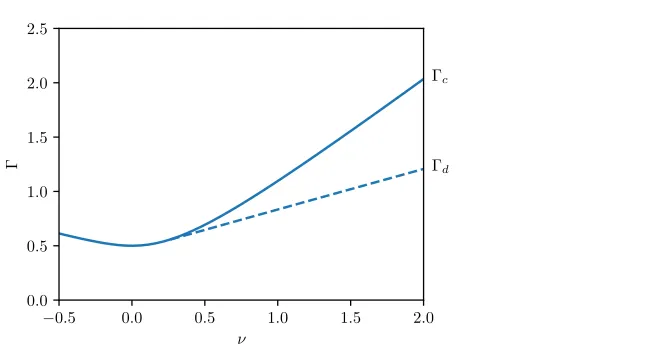
Figure 6 shows (16) and (20) in the (ν,Γ) parameter plane, where we have taken q = qc
from (17). The values of the parameters ρ,α, β, vg, Cr, and Ci in the figure correspond to
the parameters in the figures in section2 with= 0.1. The primary bifurcation changes from supercritical to subcritical when (ρ+ 2αq2)C
r+ (ν+vgq+ 2βq2)Ci= 0, which is atν = 0.2228
for the parameter values in Figure6. Localized solutions can be found in the bistability region between Γc and Γd.
4.3. Localized solutions. In order to find localized solutions of the coupled FCGL equa-tions(14), one might attempt an ansatz of the form
A=R0(X, T)ei(qX+φ1) and B = ¯R0(X, T)ei(−qX+φ2)
−0.5 0.0 0.5 1.0 1.5 2.0
ν
0.0 0.5 1.0 1.5 2.0 2.5
Γ
Γc
[image:14.612.178.508.85.258.2]Γd
Figure 6. The(ν,Γ)parameter plane of the coupled FCGL equations (14)withρ=−0.5,α=−0.5,β= 1,
vg = −0.5, and C = −1−2.5i. These parameters with = 0.1 correspond to the prameters of the model PDE (4)used in the figures in section 2. The solid line shows the primary pitchfork bifurcation at Γc, where the zero state becomes unstable to perturbations with wavenumber qc. The dash line shows the saddle-node bifurcation atΓd.
withR0 complex andq, φ1, φ2 real. This is a spatially modulated version of the standing wave
studied in the previous section. However, the coupled FCGL equations admit no solution of this form, even ifvg = 0. Other standing wave ansatzes are possible, e.g.,A=R0(X)ei(qX+φ1)
and B = ¯R0(−X)ei(−qX+φ2), but we have not explored these further.
We were able to find analytic expressions for localized solutions of the coupled FCGL equations by taking further asymptotic limits (see section 5). To motivate the subsequent calculations, we present some numerical examples of stable spatially localized oscillons in the coupled FCGL equations found by using the same numerical method as in section 2 on a periodic domain of size 20π. We take the same parameter values as before: ρ=−0.5, ν = 2, α=−0.5,β = 1, andC=−1−2.5i.
The top row of Figure 7 shows an example of a localized oscillon in the coupled FCGL equations withvg=−0.2. As we increase the magnitude of the group velocityvg tovg=−0.5
(second row) and vg =−1 (third row) and change the forcing strength Γ so that we are still
in the region where the localized solution is stable, we can see that A and B start to move apart, pulled in opposite directions by the group velocity term. We can use these solutions to the coupled FCGL equations to reconstruct first-order approximations to solutions of the PDE model (4)with the help of (9)and (10); this is shown in the bottom row of Figure 7.
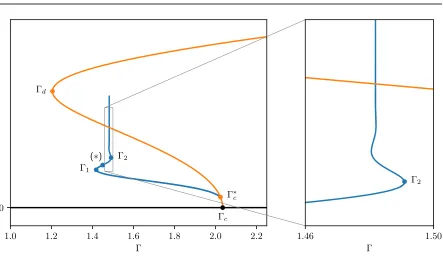
We also computed the bifurcation diagram of the coupled FCGL equations on a domain of size 20π using AUTO [18]. The critical wavenumber with the above parameter values is qc = 0.09950 ≈ 101 , so the periodic solution fits almost perfectly in this domain. The result
is shown in Figure 8. The branch of periodic solution bifurcates from the zero solution at Γc = 2.035 and has a fold at Γd = 1.206. Using the relationF = 42Γ, we can compute the
corresponding values of forcing in the model PDE (4) as 0.08140 and 0.04820, which agree well with the values of Fc = 0.08173 and Fd = 0.04811 found in Figure 3 when we applied
AUTO directly to the model PDE.
0 10π 20π −0.1
0.0 0.1 0.2 0.3 0.4 0.5
ReA(X) ReB(X)
0 10π 20π
−0.1 0.0 0.1 0.2 0.3 0.4 0.5
ImA(X) ImB(X)
0 10π 20π
−0.1 0.0 0.1 0.2 0.3 0.4 0.5
0 10π 20π
−0.1 0.0 0.1 0.2 0.3 0.4 0.5
0 10π 20π
X −0.1
0.0 0.1 0.2 0.3 0.4 0.5
0 10π 20π
X −0.1
0.0 0.1 0.2 0.3 0.4 0.5
50π 100π 150π
x −0.10
−0.05 0.00 0.05 0.10
ReU(x) ImU(x)
50π 100π 150π
x −0.10
−0.05 0.00 0.05 0.10
[image:15.612.89.484.80.626.2]ReU(x) ImU(x)
Figure 7. Stationary solutions to the coupled FCGL equations(14)withρ=−0.5,ν= 2,α=−0.5,β= 1, and C =−1−2.5i. Top row: vg =−0.2and Γ = 1.46. Second row: vg =−0.5 andΓ = 1.45. Third row:
vg=−1andΓ = 1.43. Bottom row: Approximate solutionsU(x)of the PDE model (4)reconstructed from the solutionsA(X), B(X)to the coupled FCGL equations assuming = 0.1; the left and right plots correspond to the top and third rows, respectively.
1.0 1.2 1.4 1.6 1.8 2.0 2.2 Γ
0
Γc Γd
Γ∗ c Γ1
Γ2
(∗)
1.46 1.50
Γ
[image:16.612.73.516.80.337.2]Γ2
Figure 8. Bifurcation diagram of the coupled FCGL equations with parametersρ=−0.5,ν= 2,α=−0.5,
β = 1, C = −1−2.5i, and vg = −0.5 (corresponding to Figure 3). The bifurcations are at Γc = 2.035,
Γd= 1.206, Γ∗c = 2.024,Γ1= 1.418, and Γ2 = 1.491. The solution marked (∗) is shown in the middle row of
Figure7. Numerical results with AUTO suggest that snaking continues beyondΓ2, but it is too small to see.
Going back to the coupled FCGL equations, we see a secondary bifurcation at Γ = 2.024, where a branch of localized solutions bifurcates from the branch of periodic solutions. The localized branch has folds at Γ1 = 1.418 and Γ2 = 1.491. The correspondingF values in terms
of the parameters of the model PDE are 0.05673 and 0.05964, which again agree well with the values ofF1 = 0.05666 andF2 = 0.05948 found in Figure3.
As shown in Figure8, the localized branch in the bifurcation diagram of the coupled FCGL equations continues to snake upwards after Γ2. We believe that these exhibit collapsed snaking,
where the saddle-node points asymptote to one value of Γ as one goes up the branch [28]. However, the bifurcation diagram shows that the branch of localized solutions suddenly stops. In fact, AUTO turns around at that point. We believe that this may be caused by AUTO having difficulty handling the phase symmetry in the coupled FCGL equations and that in reality the branch of localized solutions joins with the branch of periodic solutions near the fold at Γd, as it does in the bifurcation diagram of the model PDE in Figure 3.
5. Reduction to the real Ginzburg–Landau equation. In this section, we will reduce the coupled FCGL equations to the real Ginzburg–Landau equation close to the subcritical bifurcation from the zero solution to the constant amplitude state. The reduction was done by Riecke [33] in the supercritical case.
We take the complex conjugate of the second equation of (14), so the coupled FCGL equations become
∂A
∂T =D1A+D2 ∂2A
∂X2 +vg
∂A
∂X +C(|A|
2+ 2
|B|2)A+iΓ ¯B, ∂B¯
∂T = ¯D1B¯+ ¯D2 ∂B¯ ∂X2 −vg
∂B¯
∂X + ¯C(2|A|
2+|B|2) ¯B−iΓA.
(21)
For simplicity, we write
D1=ρ+iν and D2=−2(α+iβ).
(22)
In order to reduce the coupled FCGL equation to the real Ginzburg–Landau equation, we apply weakly nonlinear theory close to onset, writing
Γ = Γc(1 +22Γ2),
where 0 < 2 1, Γc is the critical forcing at critical wavenumber qc, and Γ2 is the new
bifurcation parameter. We expand the solution in powers of the new small parameter 2 as
follows:
A ¯ B
=
2A1+22A2+32A3+· · ·
2B¯1+22B¯2+32B¯3+· · ·
.
From subsection4.1, the growth rate is real with frequency zero (locked to the forcing), so we scale
∂ ∂T →
2 2
∂ ∂T˜ and the preferred wavenumber qc6= 0, so
∂ ∂X →
∂ ∂X +2
∂ ∂X˜,
where ˜X and ˜T are very long space and slow time scales. At O(2), we have
0 =D1A1+D2
∂2A 1
∂X2 +vg
∂A1
∂X +iΓcB¯1,
0 = ¯D1B¯1+ ¯D2
∂B¯1
∂X2 −vg
∂B¯1
∂X −iΓcA1.
We can solve the above system by assuming that
A1 =P( ˜X,T˜)eiqcX and B1=Q( ˜X,T˜)e−iqcX.
(23)
At this order of2, the coupled FCGL equations become
0 =D1P−D2qc2P+ivgqcP+iΓcQ,¯
0 = ¯D1Q¯−D¯2qc2Q¯−ivgqcQ¯−iΓcP.
(24)
These can be solved as in subsection4.1.
Additionally, from the first equation of (24) we get a phase relation betweenP andQ:
¯
Q=P eiφ, where eiφ=−D1+ivgqc−D2q2c
iΓc
. (25)
The fraction in the above equation has modulus 1, so the phase φis real. At O(2
2), equations(21) become
0 =D1A2+D2
∂2A 2
∂X2 +vg
∂A2
∂X +iΓcB¯2+vg ∂A ∂X˜e
iqcX + 2iD
2qc
∂A ∂X˜e
iqcX,
0 = ¯D1B¯2+ ¯D2
∂2B¯ 2
∂X2 −vg
∂B¯2
∂X −iΓcA2−vg ∂B¯ ∂X˜e
iqcX + 2iD¯
2qc
∂B¯ ∂X˜e
iqcX. (26)
At this stage, we would normally define a linear operator in order to impose a solvability condition. In this case, the solvability condition can be deduced directly by setting
A2=P2eiqcX +· · · and B¯2 = ¯Q2eiqcX+· · ·,
(27)
where the dots stand for the other Fourier components. This focuses the attention on the eiqcX component of (26), which is the only component to have an inhomogeneous part and for which the linear operator is singular. Substituting these expressions for A2 and ¯B2 into(26)
and using (25)leads to the following:
(28)
D1+ivgqc−D2qc2 iΓc
−iΓc D¯1−ivgqc−D¯2q2c
P2 ¯ Q2 +
vg+ 2iqcD2
(−vg+ 2iqcD¯2)eiφ
∂P ∂X˜ =
0 0
,
where eiφ is defined in (25). The square matrix is singular since it is the same one that
appears in the linear theory; see(15). We multiply the first line by iΓcand the second line by
D1+ivgqc−D2q2c, which is effectively the left eigenvector of the matrix, and then add both
lines and use(16) and (25), ending up with
iΓc(vg+ 2iqcD2) +
(vg−2iqcD¯2)(D1+ivgqc−D2q2c)2
iΓc
∂P ∂X˜ = 0.
Since ∂P
∂X˜ 6= 0, we need
−Γ2c(vg+ 2iqcD2) + (vg−2iqcD¯2)(D1+ivgqc−D2q2c)2 = 0.
After substituting (16), we find that this is the same as (17), which is satisfied since qc is at
the minimum of the neutral stability curve.
From the top line of (28), we have the solution
¯ Q2=−
vg+ 2iqcD2
iΓc
∂A ∂X˜ +
D1+ivgqc−D2q2c
iΓc
A2
.
Thus, we have P2 arbitrary at this order of 2; we can set P2 = 0, and so, restoring the
eiqcX factor, we have
(29) A2= 0 and B¯2 =−
vg+ 2iqcD2
iΓc
∂P ∂X˜e
iqcX.
At O(3
2), the problem has the following structure (after usingA2= 0):
∂A1
∂T˜ =D1A3+D2 ∂2A
3
∂X2 +vg
∂A3
∂X +iΓcB¯3
+D2
∂2A 1
∂X˜2 +iΓcΓ2
¯
B1+C(|A1|2+ 2|B1|2)A1,
∂B¯1
∂T˜ = ¯D1 ¯ B3+ ¯D2
∂2B¯ 3
∂X2 −vg
∂B¯3
∂X −iΓcA3+ 2 ¯D2 ∂2B¯
2
∂X∂X˜
−vg
∂B¯2
∂X˜ + ¯D2 ∂2B¯
1
∂X˜2 −iΓcΓ2A1+ ¯C(2|A1| 2+|B
1|2)B1.
(30)
We focus on theeiqcX Fourier modes as before and write
A3=P3eiqcX +· · · and B¯3 = ¯Q3eiqcX+· · ·.
As at order2
2, we multiply the first equation byiΓcand the second equation byD1+ivgqc−
D2qc2 and then add them to eliminate P3 and Q3, finding
iΓc
∂A1
∂T˜ + (D1+ivgqc−D2q
2 c)
∂B¯1
∂T˜
=iΓcD2
∂2A 1
∂X˜2 −Γ 2
cΓ2B¯1+iΓcC(|A1|2+ 2|B1|2)A1
+ 2(D1+ivgqc−D2qc2) ¯D2
∂2
∂X∂X˜ ¯ B2
−(D1+ivgqc−D2qc2)
vg
∂B¯2
∂X˜ − ¯ D2
∂2B¯ 1
∂X˜2
−iΓcΓ2(D1+ivgqc−D2q2c)A1+ ¯C(D1+ivgqc−D2qc2)(2|A1|2+|B1|2)B1.
(31)
We use (23),(25), and (29) to substituteA1,B1, and B2 into the above equation and divide
by the common factor ofeiqcX. After some manipulation with the help of (16)and (22), this gives the real Ginzburg–Landau equation
∂P ∂T˜ =−
Γ2 cΓ2
ρ+ 2αq2 c
P −4ρα+ 4νβ+v
2
g + 12vgβqc+ 24(α2+β2)q2c
2ρ+ 4αq2 c
∂2P
∂X˜2
+ 3
Cr+
ν+vgqc+ 2βq2c
ρ+ 2αq2 c
Ci
|P|2P. (32)
Flat solutions of this equation correspond to the simple constant-amplitude solutions discussed in subsection 4.2. The real Ginzburg–Landau equation also has steady sech solutions, so we can find localized solutions of the FCGL equation (14)in terms of hyperbolic functions. The sech solution of (32)is
P( ˜X) = s
2Γ2 cΓ2
h1 sech s Γ2 cΓ2
h2
˜ X
eiφ1, (33)
whereφ1 is an arbitrary phase and
h1= 3 ρ+ 2αqc2
Cr+ ν+vgqc+ 2βqc2
Ci
, h2=−2 ρα+νβ+14v2g+ 3vgβqc+ 6(α2+β2)q2c
,
and Γ2, h1, andh2 must all have the same sign for the sech solution to exist. From(25), we
have ¯Q( ˜X) =P( ˜X)eiφ.
At leading order,
A(X) =2P(X)eiqcX = s
2Γc(Γ−Γc)
h1
sech
s
Γc(Γ−Γc)
h2
X
ei(qcX+φ1)
provided that Γ <Γc,h1 <0, and h2 < 0. Furthermore, (23) and (25) imply that ¯B(X) =
A(X)eiφ.
Finally, recall that in(5), we wrote the solution to the original PDE(4) as
U =U1 = A(X, T)eix+B(X, T)e−ix
eit.
Substituting the above formulas for A and ¯B, we find that
U = 2
s
2Γc(Γ−Γc)
h1
sech
s
Γc(Γ−Γc)
h2
x
cos
(1 +qc)x+12φ+φ1
ei(t−12φ).
Using Table 1, we return all parameter values to those used in (4). Thus, we conclude that the spatially localized oscillon is given approximately by
Uloc(x, t) =
s
Fc(F−Fc)
2h∗
1
sech s
Fc(F−Fc)
16h∗
2
x
!
cos(kcx+ 12φ+φ1)ei(t−
φ
2),
(34)
wherekc= 1 +qc and h∗1 andh∗2 are given by
h∗1 = 3 µ−α+γ+ 2α(kc−1)2
Cr
+ 3 ω−β+δ−1−2(β−2δ)(kc−1) + 2β(kc−1)2
Ci,
h∗2 =−2α(µ−α+γ)−2β(ω−β+δ−1)
−2(β−2δ)2+ 12β(β−2δ)(kc−1)−12(α2+β2)(kc−1)2.
This solutionUlocgives an approximate oscillon solution of the model PDE(4)valid in the limit
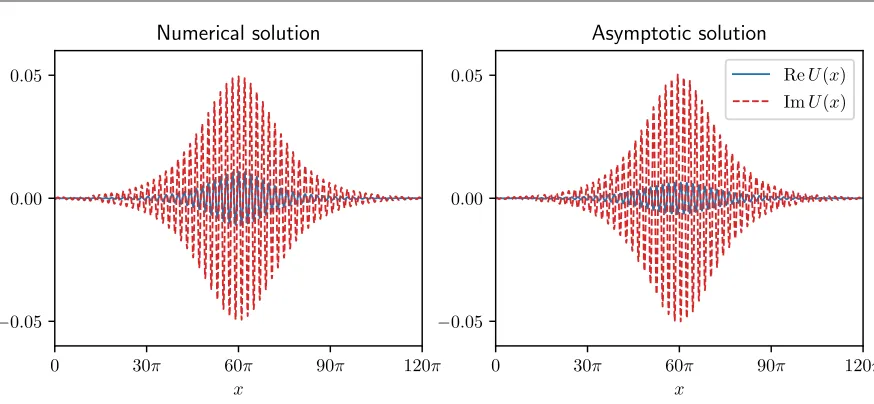
of weak dissipation, weak detuning, weak forcing, small group velocity, and small amplitude. In Figure9, we compare the asymptotic solution(34), with the localized solution from(4), which we found numerically in section2. The similarity betwen the two is quite striking; the main difference is that the real part of the asymptotic solution is somewhat smaller than that of the numerically computed solution, indicating a small error in the phase φ.
At this order, we do not find a connection between the position of the sech envelope and that of the underlying cos(kcx) pattern. The relative position should not be arbitrary and
could presumably be determined using an asymptotic beyond-all-orders theory [11].
0 30π 60π 90π 120π x
−0.05
0.00 0.05
Numerical solution
0 30π 60π 90π 120π
x
−0.05
0.00 0.05
Asymptotic solution
ReU(x)
[image:21.612.74.511.84.286.2]ImU(x)
Figure 9. The left panel is the numerical solution of (4), reproduced from Figure4(c). The right panel shows the asymptotic solution, given in (34). These solutions are atF= 0.073.
6. Discussion. In this article, we have shown the existence of oscillons in the PDE (4), which was proposed as a pheonomenological model for the Faraday wave experiments in [34]. We first used numerical simulation and found that straightforward time-stepping with carefully chosen parameter values and initial conditions leads to a stable oscillon solution, as shown in Figure 2. We then turned to analysis. Assuming that the damping, detuning, and forcing are weak and that the group velocity and amplitude are small, we reduced the PDE (4) to the coupled FCGL equations (14). We stress that we do not get a single FCGL equation with an ¯Aterm; cf. (3), which is commonly used as a starting point in discussions of oscillons in parametrically forced systems [4,16,30]. The single FCGL equation is appropriate when there is a zero-wavenumber bifurcation [2] or if the group velocity is zero. However, if the wavenumber is nonzero (as in Faraday waves) and the group velocity is nonzero but small, the coupled FCGL equations should be used. The coupled FCGL equations and the model PDE both exhibit snaking behavior, though the snaking region is very narrow.
Under the further assumption that the strength of the forcing is close to the onset of instability, we then reduced the coupled FCGL equations to the subcritical real Ginzburg– Landau equation(32). This equation has a sech solution, which, after undoing the reductions, yields an approximate expression for the oscillon; cf. (34). This expression agrees well with the oscillon found numerically (see Figure 9), just as was found in [2], where we studied a zero-wavenumber version of this problem.
One special feature of our model PDE (4)is that the linear terms lead only to positive-frequency oscillations: U ∼ eit. With spatial dependence, we have left- and right-traveling
waves; see (5). In the Faraday wave experiment, as described by the Zhang–Vi˜nals equa-tions [43] or the Navier–Stokes equations [36], the PDEs are real, and so both positive and negative frequency traveling waves can be found. Topaz and Silber [38] wrote down am-plitude equations for these traveling waves in the context of two-frequency forcing, without long length scale modulation. In spite of having only positive frequency, our coupled FCGL
equations (with spatial modulation removed) have the same form as the traveling wave am-plitude equations in [38] (after truncation to cubic order). These traveling wave equations (without modulation terms) can similarly be reduced to standing wave equations [32,38] with a phase relationship like (25) between the complex amplitudes of the traveling wave compo-nents. Therefore, we expect that the fact that the model PDE (4) has eit dominant should
not prevent oscillons being found by the same mechanism in PDEs that are closer to the fluid dynamics because our model PDEs and PDEs for fluid mechanics lead to the same amplitude equation in the absence of spatial modulation.
Since [32,38] did not include spatial modulations, they did not have to consider the group velocity. In the present study, we assumed that the group velocity is small, of the same order as the amplitude of the solution, in order to make progress. This assumption is questionable in the context of fluid mechanics. It would be better to assume that the group velocity is order one, as in [27]. In that case, the left-traveling wave sees only the average of the right-traveling wave and vice versa, leading to (nonlocal) averaged equations. The authors of [27] found spatially uniform and nonuniform solutions with both simple and complex time dependence but did not study spatially localized solutions. Bringing in spatially localized solutions will be the subject of future work. It is possible to go directly from the PDE (4) to the real Ginzburg–Landau equation [1,34], and we expect to be able to do a simular reduction for the Zhang–Vi˜nals or the Navier–Stokes equation for fluid mechanics; cf. [36,43].
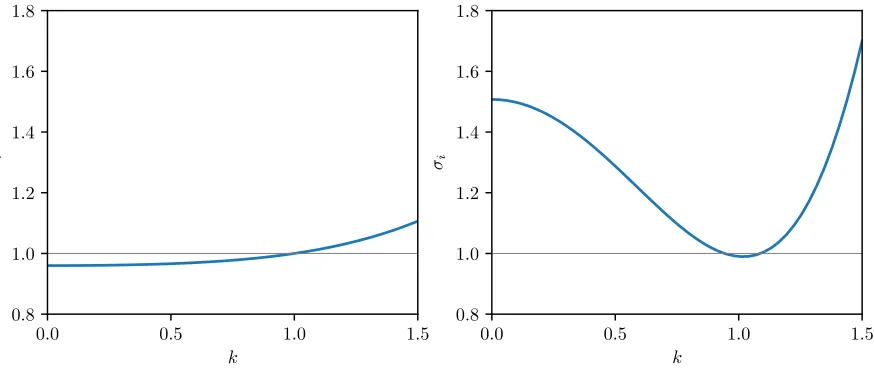
In the model PDE (4), when the group velocity is small, waves with a wide range of wavenumbers may be excited. Figure 10 shows two ways in which we can get a fairly small group velocity. The dispersion curve in the left panel is shallow; in this case, many wavenum-bers are close to resonant (σi is close to 1). Another possibility is to have two resonant
wavenumbers aroundk= 1, so thatσi is close to a minimum (wherevg = 0) atk= 1; see the
right panel for an example. In the latter case, solutions with two nearby wavelengths can be
0.0 0.5 1.0 1.5
k
0.8 1.0 1.2 1.4 1.6 1.8
σi
0.0 0.5 1.0 1.5
k
0.8 1.0 1.2 1.4 1.6 1.8
[image:22.612.78.515.457.643.2]σi
Figure 10. Left panel: The dispersion relation for the PDE model (4)with ω = 0.96, β = −0.02, and
δ = 0.02. The frequency σi(k) is close to 1 over a wide range of k. Right panel: Dispersion relation for
ω= 1.5075,β= 1, andδ= 0.4825. Now, σi(k) is equal to1at two distinct wavenumbers.
0 100π 200π x
[image:23.612.75.514.84.281.2]−0.1 0.0 0.1
Figure 11. Solution of the PDE model (4)with two wavenumbers. The parameter values areµ=−0.255,
ω= 1.5075,α=−0.5,β= 1,γ=−0.25,δ= 0.4825,C=−1−2.5i, andF= 0.15.
0 30π 60π
x −0.4
0.0
0.4 ReU(x)
ImU(x)
20π 30π 40π
20π
30π
40π
−0.4
−0.3
−0.2
[image:23.612.75.515.332.511.2]−0.1 0.0 0.1 0.2 0.3 0.4
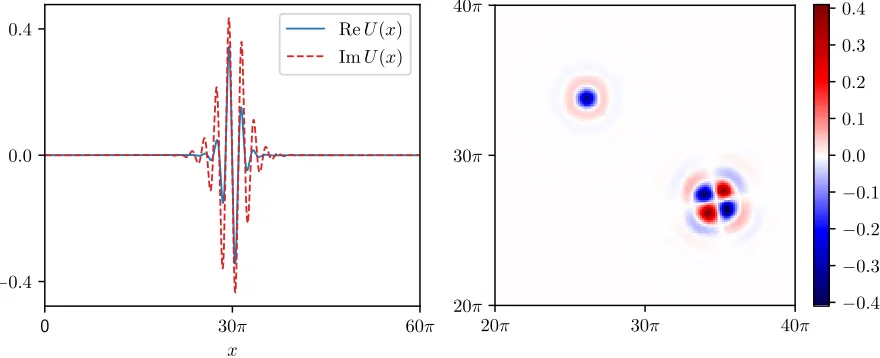
Figure 12. Strongly localized oscillons in the PDE model (4)in one (left) and two (right) dimensions with
µ=−0.375,ω= 1.99,α=−0.5,β= 1,γ=−0.25,δ= 0.4975,C=−1−2.5i, andF = 1.5. The right panel shows the real part ofU on only part of the domain[0,60π]×[0,60π].
expected. Indeed, we did observe such solutions in the PDE model(4); an example is given in Figure11. These states resemble those found by Bentley [7] in an extended Swift–Hohenberg model and by Riecke [33] in the coupled FCGL equations with small group velocity in the supercritical case.
Finally, we have throughout kept our paramtersmall (= 0.1), which is why the oscillons in, e.g., Figure4are so broad, in contrast to the oscillons seen in experiments (see Figure1). As a preliminary exploration of increasing, we set= 0.5, and, after some minor changes to the parameters, we found strongly localized oscillons in one and two dimensions (see Figure 12).
As the picture in two dimensions shows, it is possible for a solution to contain multiple oscillons, which may or may not be axisymmetric. Reference [1] investigates a related PDE:
(4) but with strong damping and with cubic-quintic (rather than simply cubic) nonlinearity, where the coefficient of the cubic term has positive real part in order to make the oscillons more nonlinear. In this case, snaking was found in both one and two dimensions.
Acknowledgments. We are grateful for interesting discussions with E. Knobloch and K. McQuighan. We also acknowledge financial support from Al Imam Mohammad Ibn Saud Islamic University.
REFERENCES
[1] A. S. Alnahdi,Oscillons: Localized Patterns in a Periodically Forced System, PhD thesis, University of
Leeds, 2015.
[2] A. S. Alnahdi, J. Niesen, and A. M. Rucklidge, Localized patterns in periodically forced systems,
SIAM J. Appl. Dyn. Syst., 13 (2014), pp. 1311–1327.
[3] I. S. Aranson and L. S. Tsimring, Domain walls in wave patterns, Phys. Rev. Lett. 75 (1995),
pp. 3273–3276.
[4] I. S. Aranson and L. S. Tsimring,Formation of periodic and localized patterns in an oscillating granular
layer, Phys. A, 249 (1998), pp. 103–110.
[5] H. Arbell and J. Fineberg,Temporally harmonic oscillons in Newtonian fluids, Phys. Rev. Lett., 85
(2000), pp. 756–759.
[6] T. B. Benjamin and F. Ursell, The stability of the plane free surface of a liquid in vertical periodic
motion, Philos. Trans. R. Soc. Lond. A, 225 (1954), pp. 505–515.
[7] D. C. Bentley,Localised Solutions in the Magnetorotational Taylor–Couette Flow with a Quartic Marginal
Stability Curve, PhD thesis, University of Leeds 2012.
[8] C. Bizon, M. D. Shattuck, J. B. Swift, W. D. McCormick, and H. L. Swinney, Patterns in3d
vertically oscillated granular layers: Simulation and experiment, Phys. Rev. Lett., 80 (1998), pp. 57–60.
[9] J. Burke and E. Knobloch,Homoclinic snaking: Structure and stability, Chaos, 17 (2007), 037102.
[10] J. Burke, A. Yochelis, and E. Knobloch,Classification of spatially localized oscillations in periodically
forced dissipative systems, SIAM J. Appl. Dyn. Syst., 7 (2008), pp. 651–711.
[11] S. J. Chapman and G. Kozyreff,Exponential asymptotics of localised patterns and snaking bifurcation
diagrams, Phys. D, 238 (2009), pp. 319–354.
[12] S. M. Cox and P. C. Matthews,Exponential time differencing for stiff systems, J. Comput. Phys., 176
(2002), pp. 430–455.
[13] C. Crawford and H. Riecke,Oscillon-type structures and their interaction in a Swift–Hohenberg model,
Phys. D, 129 (1999), pp. 83–92.
[14] J. H. P. Dawes, Localized pattern formation with a large-scale mode: Slanted snaking, SIAM J. Appl.
Dyn. Syst., 7 (2008), pp. 186–206.
[15] J. H. P. Dawes, The emergence of a coherent structure for coherent structures: Localized states in
nonlinear systems, Philos. Trans. R. Soc. Lond. A, 368 (2010), pp. 3519–3534.
[16] J. H. P. Dawes and S. Lilley,Localized states in a model of pattern formation in a vertically vibrated
layer, SIAM J. Appl. Dyn. Syst., 9 (2010), pp. 238–260.
[17] S. P. Decent and A. D. D. Craik, Hysteresis in Faraday resonance, J. Fluid Mech., 293 (1995),
pp. 237–268.
[18] E. J. Doedel,AUTO-07P: Continuation and Bifurcation Software for Ordinary Differential Equations,
https://sourceforge.net/projects/auto-07p(2012).
[19] W. S. Edwards and S. Fauve,Patterns and quasi-patterns in the Faraday experiment, J. Fluid Mech.,
278 (1994), pp. 123–148.
[20] M. Faraday,On a peculiar class of acoustical figures; and on certain forms assumed by groups of particles
upon vibrating elastic surfaces, Philos. Trans. R. Soc. Lond., 121 (1831), pp. 299–340.
[21] R. B. Hoyle,Pattern formation: An introduction to methods, Cambridge University Press Cambridge,
2006.
[22] E. Knobloch,Spatial localization in dissipative systems, Annu. Rev. Condensed Matter Phys., 6 (2015), pp. 325–359.
[23] J. Lega, J. V. Moloney, and A. C. Newell, Swift–Hohenberg equation for lasers, Phys. Rev. Lett.,
73 (1994), pp. 2978–2981.
[24] O. Lioubashevski, H. Arbell, and J. Fineberg,Dissipative solitary states in driven surface waves,
Phys. Rev. Lett., 76 (1996), pp. 3959–3962.
[25] O. Lioubashevski, Y. Hamiel, A. Agnon, Z. Reches, and J. Fineberg,Oscillons and propagating
solitary waves in a vertically vibrated colloidal suspension, Phys. Rev. Lett., 83 (1999), pp. 3190–3193.
[26] S. Longhi,Spatial solitary waves in nondegenerate optical parametric oscillators near an inverted
bifur-cation, Opt. Commun., 149 (1998), pp. 335–340.
[27] C. Martel, E. Knobloch, and J. M. Vega,Dynamics of counterpropagating waves in parametrically
forced systems, Phys. D, 137 (2000), pp. 94–123.
[28] Y.-P. Ma, J. Burke, and E. Knobloch,Defect-mediated snaking: A new growth mechanism for localized
structures, Phys. D, 239 (2010), pp. 1867–1883.
[29] I. Melbourne,Derivation of the time-dependent Ginzburg–Landau equation on the line, J. Nonlinear Sci.,
8 (1998), pp. 1–15.
[30] K. McQuighan and B. Sandstede,Oscillons in the planar Ginzburg–Landau equation with2:1forcing,
Nonlinearity, 27 (2014), pp. 3073–3116.
[31] V. Petrov, Q. Ouyang, and H. Swinney,Resonant pattern formation in a chemical system, Nature,
388 (1997), pp. 655–657.
[32] J. Porter and M. Silber,Resonant triad dynamics in weakly damped Faraday waves with two-frequency
forcing, Phys. D, 190 (2004), pp. 93–114.
[33] H. Riecke,Stable wave-number kinks in parametrically excited standing waves, Europhys. Lett., 11 (1990),
pp. 213–218.
[34] A. M. Rucklidge and M. Silber, Design of parametrically forced patterns and quasipatterns, SIAM
J. Appl. Dyn. Syst., 8 (2009), pp. 298–347.
[35] M. Shats, H. Xia, and H. Punzmann, Parametrically excited water surface ripples as ensembles of
oscillons, Phys. Rev. Lett., 108 (2012), p. 034502.
[36] A. C. Skeldon and G. Guidoboni,Pattern selection for Faraday waves in an incompressible viscous
fluid, SIAM J Appl. Math., 67 (2007), pp. 1064–1100.
[37] L. Tsimring and I. Aranson, Localized and cellular patterns in a vibrated granular layer, Phys. Rev.
Lett., 79 (1997), pp. 213–216.
[38] C. M. Topaz and M. Silber,Resonances and superlattice pattern stabilization in two-frequency forced
Faraday waves, Phys. D, 172 (2002), pp. 1–29.
[39] P. B. Umbanhowar, F. Melo, and H. L. Swinney,Localized excitations in a vertically vibrated granular
layer, Nature, 382 (1996), pp. 793–796.
[40] J. Wu, R. Keolian, and I. Rudnick, Observation of a non-propagating hydrodynamic soliton, Phys.
Rev. Lett., 52 (1984), pp. 1421–1424.
[41] A. Yochelis, J. Burke, and E. Knobloch, Reciprocal oscillons and nonmonotonic fronts in forced
nonequilibrium systems, Phys. Rev. Lett., 97 (2006), p. 254501.
[42] W. Zhang and J. Vi˜nals,Secondary instabilities and spatiotemporal chaos in parametric surface waves,
Phys. Rev. Lett., 74 (1995), pp. 690–693.
[43] W. Zhang and J. Vi˜nals,Pattern formation in weakly damped parametric surface waves, J. Fluid Mech.,
336 (1996), pp. 301–330.