City, University of London Institutional Repository
Citation
: Cherla, S (2016). Neural ProbabilisticModels for Melody Prediction, Sequence
Labelling and Classification. (Unpublished Doctoral thesis, City, University of London)This is the accepted version of the paper.
This version of the publication may differ from the final published
version.
Permanent repository link:
http://openaccess.city.ac.uk/17444/Link to published version
:
Copyright and reuse:
City Research Online aims to make research
outputs of City, University of London available to a wider audience.
Copyright and Moral Rights remain with the author(s) and/or copyright
holders. URLs from City Research Online may be freely distributed and
linked to.
Neural Probabilistic Models for
Melody Prediction, Sequence
Labelling and Classification
Srikanth Cherla
Department of Computer Science
City University London
This report is submitted for the purpose of
Doctor of Philosophy
Contents
Contents iii
List of Figures vii
List of Tables xi
1 Introduction 1
1.1 Problem Overview . . . 1
1.1.1 What to Predict? . . . 2
1.1.2 How to Predict? . . . 3
1.1.3 Why Predict? . . . 5
1.2 Objectives . . . 7
1.2.1 Research Questions . . . 8
1.3 Original Contributions . . . 8
1.4 Publications . . . 10
1.5 Software . . . 11
1.6 Dissertation Outline . . . 11
2 Related Work 13 2.1 Music in the Symbolic Form . . . 14
2.1.1 The Musical Score . . . 15
2.1.2 Digital Representations of the Musical Score . . . 16
2.1.3 The**kernformat andmusic21Python Library . . . 16
2.2 Music and Information Theory . . . 18
2.2.1 Early Work . . . 19
2.2.2 Multiple Viewpoint Systems and Related Work . . . 23
2.3 Music and Connectionism . . . 24
2.3.1 The First Wave . . . 25
2.3.2 The Second Wave . . . 29
3 Preliminaries 37
3.1 Representation . . . 38
3.1.1 Relevant Viewpoints and Viewpoint Categories . . . 39
3.1.2 One-Hot Encoding of Viewpoint Features . . . 42
3.2 Corpus . . . 43
3.3 Gradient-based Machine Learning for Prediction . . . 44
3.3.1 Error Estimation . . . 45
3.3.2 Gradient Computation . . . 47
3.3.3 Parameter Optimisation . . . 48
3.4 Model Selection . . . 50
3.4.1 Cross-Validation . . . 52
3.5 Prediction Task . . . 53
3.6 Evaluation . . . 55
3.7 Summary . . . 56
4 Non-recurrent Melody Models 57 4.1 Representing Sequences . . . 58
4.2 Feed-forward Neural Network . . . 59
4.2.1 Learning . . . 61
4.3 Restricted Boltzmann Machine . . . 62
4.3.1 Learning . . . 63
4.4 Experiments . . . 66
4.4.1 Feed-forward Neural Networks . . . 69
4.4.2 Restricted Boltzmann Machines . . . 70
4.4.3 Discussion . . . 72
4.5 Summary . . . 76
5 Recurrent Melody Models 77 5.1 Recurrent Neural Network . . . 78
5.1.1 Learning . . . 80
5.2 Recurrent Temporal Restricted Boltzmann Machine . . . 81
5.2.1 Learning . . . 83
5.2.2 Discriminative Inference in the RTRBM . . . 83
5.3 Recurrent Temporal Discriminative RBM . . . 84
5.3.1 Learning . . . 86
5.4 Experiments . . . 86
Contents
5.4.2 Discussion . . . 89
5.5 Summary . . . 90
6 Ensembles of Melody Models 93 6.1 Ensembles . . . 94
6.2 The Mean and Product Combination Rules . . . 95
6.3 Combining Models that Utilise Different Features . . . 96
6.3.1 Experiments . . . 98
6.3.2 Results & Discussion . . . 102
6.4 Summary . . . 105
7 Extending the DRBM and RTDRBM 107 7.1 Generalising the RTDRBM . . . 108
7.1.1 Sequence Labelling . . . 108
7.1.2 The RTDRBM for Segment Labelling . . . 109
7.1.3 Experiments: Optical Character Recognition . . . 110
7.2 Extensions to the DRBM . . . 113
7.2.1 Generalising the Conditional Probability . . . 114
7.2.2 Extensions to other Hidden Layer Types . . . 115
7.2.3 Experiments: Handwritten Digit Recognition . . . 117
7.3 Summary . . . 120
8 Conclusions & Future Work 123 8.1 Conclusions . . . 123
8.2 Future Work . . . 125
8.2.1 Experiments with Other Melodic Features . . . 126
8.2.2 Experiments with Models Updated During Prediction . . . 126
8.2.3 Further Experiments with the DRBM . . . 128
8.2.4 Folk Melody Classification . . . 129
8.2.5 Multiple Type Prediction . . . 130
8.3 Reflections . . . 133
References 135 Appendix A Detailed Results for Chapters 4 and 5 151 A.1 Feed-forward Neural Network . . . 151
A.2 Restricted Boltzmann Machines . . . 151
A.3 Recurrent Neural Networks . . . 152
A.5 Recurrent Temporal Discriminative Restricted Boltzmann Machine . 153
List of Figures
2.1 The musical score of the first four measures from the four-part
har-monised hymn “Auf, auf, mein Herz, und du mein ganzer Sinn” writ-ten by Sigmund von Birken, and harmonised by Johann Sebastian
Bach. . . 15
2.2 The Kern file corresponding to the score in Figure 2.1 (“Auf, auf, mein Herz, und du mein ganzer Sinn” by Johann Sebastian Bach). . . 17
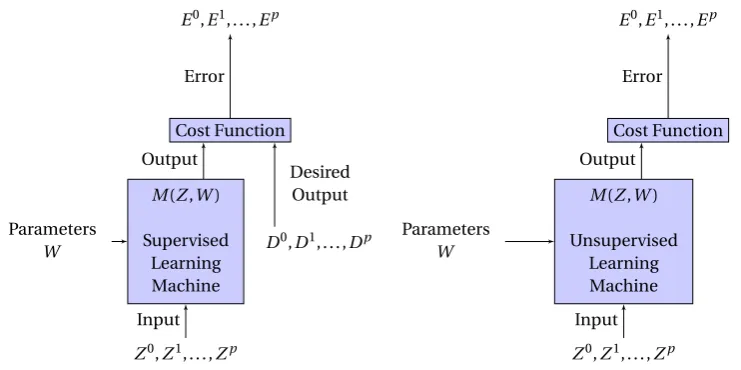
3.1 Block-diagrams of supervised (left) and unsupervised (right) machine
learning models (LeCun et al., 2012), with the key distinction between
the two being the knowledge of theDesired Outputin the former but not in the latter. . . 45
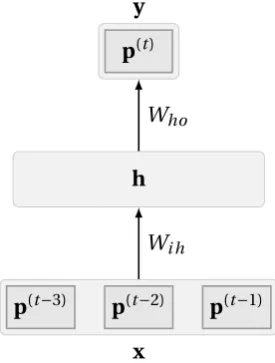
4.1 Illustration of the feature representation used as input with non-recurrent
connectionist architectures for sequences. Here, feature vectors
cor-responding to three time-stepsp(t−3),p(t−2)andp(t)are concatenated into a single vector which serves as the input to the model which
pre-dicts the event at time-stept. . . 58 4.2 The architecture of a feed-forward neural network melody model with
a single hidden layer. It models sequences of 4 musical events so as
to predict the fourth event in the output layer on top, given the first
three in the input layer at the bottom. . . 60
4.3 The architecture of a Restricted Boltzmann Machine. It models a
se-quence of 4 musical events so as to predict the fourth event given the
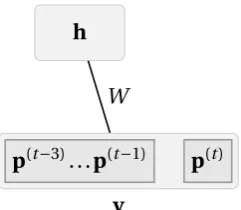
first three. The visible layer of the model contains both the inputs to
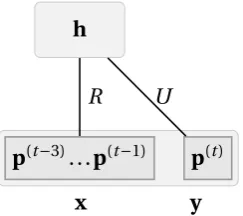
4.4 The architecture of a discriminative RBM melody model. It models a sequence of 4 musical events so as to predict the fourth event given
the first three. While its structure is identical to that of the RBM, the
difference in its learning algorithm leads to the split of the weight
matrix W of the RBM into matrices R and U. . . 65
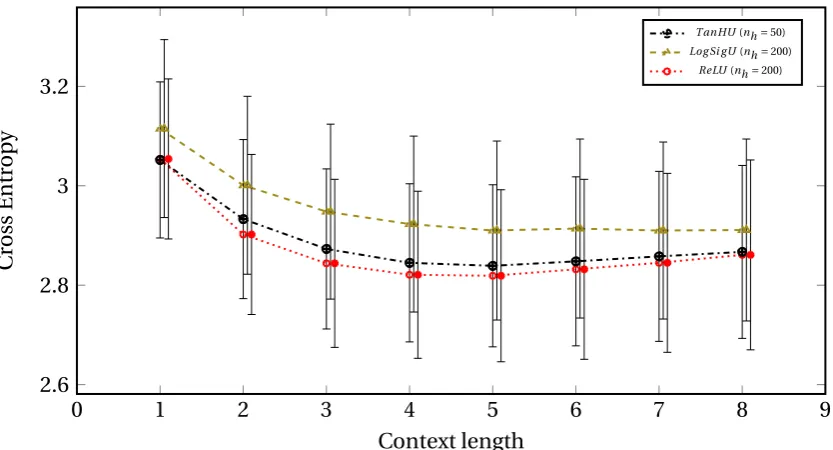
4.5 Figure with plots corresponding to the performance of feed-forward
neural networks with different types of hidden layer activations, at
different context lengths. Each plot corresponds to the best number of hidden units for that type of activation. The vertical error bars
rep-resent standard deviation of the cross entropies. . . 69
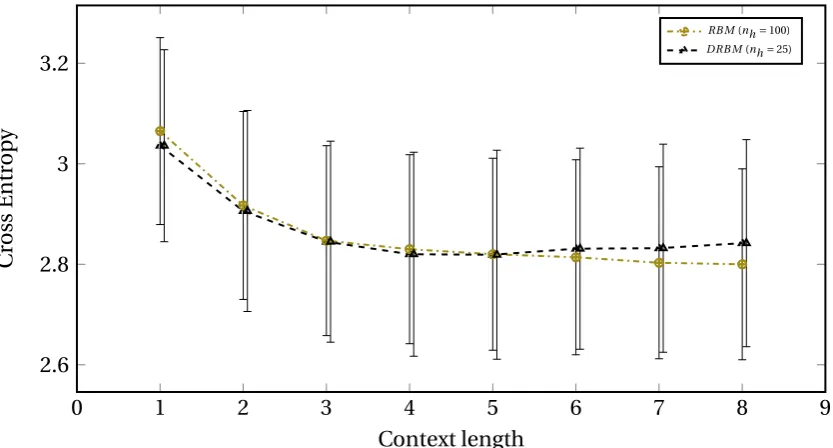
4.6 Figure with plots corresponding to the performance of Restricted
Boltz-mann Machines with different types of hidden layer activations, at
different context lengths. Each plot corresponds to the best number
of hidden units for that type of activation. The vertical error bars
rep-resent standard deviation of the cross entropies. . . 71
4.7 Figure comparing the predictive performance of the different
con-nectionst models of melody with that of the two best equivalentn -gram models of bounded and unbouded order in (Pearce and
Wig-gins, 2004). The vertical error bars represent standard deviation of
the cross entropies. . . 73
5.1 An illustration of the passing of state information from previous
time-steps to the future in a simple recurrent neural network. The figure
on the right shows how the recurrent connection in the hidden layer
betweenh(t−1)andh(t) in the compact representation of the model on the left can be unfolded in time to better illustrate the passage of
temporal state information in it. . . 78
5.2 Architecture of the RNN unfolded in time. At a given time-stept, the state of the hidden layer from the previous time-steph(t−1)is respon-sible for propagating the information pertaining to the model’s state
List of Figures
5.3 Architecture of the RTRBM unfolded in time. At any given time-step
t, the mean-field state of the hidden layer from the previous time-step ˆh(t−1)contributes to the dynamic biasesb(t) andc(t)of the visi-ble and hidden layers respectively, and is responsivisi-ble for propagating
information pertaining to the model’s state in previous time-steps
forward in time. In the melody modelling application, it models the
joint probability of eventsp(t−1)andp(t)at any time-stept. . . 82 5.4 Architecture of the RTDRBM unfolded in time, in which
discrimina-tive learning and inference is carried out for classification under the
assumption that one set of visible units y(t) represents a multino-mial distribution in the number of classes, and the rest are the
in-putsx(t). It is equivalent to the RTRBM used for the same task when learned generatively. At any given time-stept, the mean-field state of the hidden layer from the previous time-step ˆh(t−1)contributes to the dynamic biasesb(t) andc(t) of the visible and hidden layers re-spectively, and is responsible for propagating information pertain-ing to the model’s state in previous time-steps forward in time. In
the melody modelling application, it models the joint probability of
eventsp(t−1)andp(t)at any time-stept. . . 84
6.1 The architecture of the feed-forward neural network with an
embed-ding layer vand hidden layer h. It models sequences of 4 musical events at a time so as to predict the fourth event given the first three. 100
6.2 Comparison between the predictive performances, on the Chinese
folk melody dataset, of the pitch-only NPMM (InstanceA), its exten-sions which use theintfref type (InstanceB) andioitype (InstanceC) as additional input, and both these types together in a single model
(InstanceD). . . 103 6.3 Comparison between the predictive performances, on the Chinese
folk melody dataset, of the three models that incorporate the types
pitch, ioiand intfrefas inputs to a single model (Instance D), and as ensembles of multiple models using the mean and product
combination rules (InstanceEm and InstanceEp respectively). . . 104
8.2 Adaptation of a model predicting a single typepitchto one that pre-dicts bothpitchandioi. It involves the addition of a second set of softmax units in the output layer. This approach can be extended to
other types of interest. . . 131
8.3 A plot comparing the performance in predicting the typepitchby a model predicting only this type (STL model), and another predicting
bothpitchandioi(MTL model). . . 132 8.4 A plot comparing the performance in predicting the type ioiby a
model predicting only this type (STL model), and another predicting
List of Tables
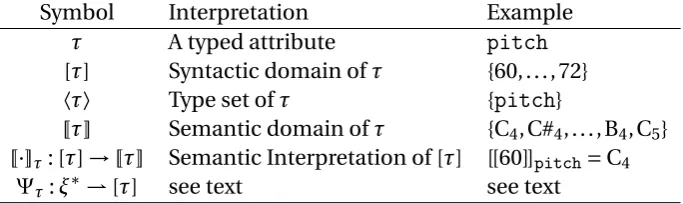
3.1 Sets and functions associated with types (Pearce, 2005). . . 40
3.2 The various basic and derived types relevant to the present work, with their categorisation, syntactic and semantic domains, and type
sets. . . 41
3.3 The folk and chorale melody datasets used in the present work with their respective total number of musical events and number of
pre-diction categories. . . 44
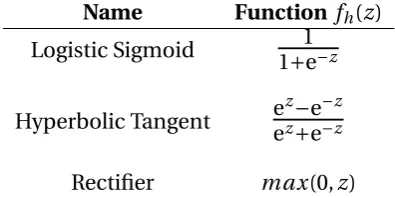
4.1 Different types of activation fh(z) for the hidden layer of the feed-forward neural network (also applicable to the recurrent neural
net-works of Section 5.1), together with their defining functions. . . 61
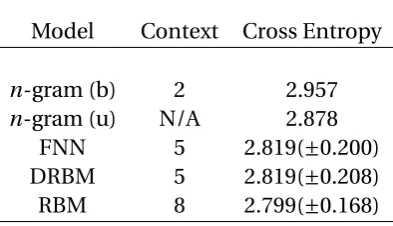
4.2 Table comparing the best predictive performance of the different mod-els in the evaluation. . . 72
5.1 A comparison between the best predictive cross entropy scores of each type of recurrent and non-recurrent model examined in the present
work, andn-gram models from previous work. . . 88 5.2 Cross entropies of the best instance of each model class on the
differ-ent datasets, and the average of these values in the bottom row. The
rightmost column lists the average cross-entropy of all the models on
each of the datasets. . . 90
7.1 Comparison between the prediction error (%) of the RTDRBM
(con-taining 400 hidden units and trained with a learning rate of 0.05 and
weight-decay of 0.0001) and models evaluated in (Nguyen and Guo,
7.2 Comparison between the prediction error (%) of the RTDRBM (con-taining 400 hidden units and trained with a learning rate of 0.05 and
weight-decay of 0.0001) and state-of-the-art on the OCR dataset which
use Neural Conditional Random Fields (NCRF) (Do et al., 2010) and
Gradient Boosted Conditional Random Fields (Chen et al., 2015). . . 113
7.3 A comparison between the originally proposed DRBM in (Larochelle
and Bengio, 2008) and two of the three extensions proposed in the
present work. The BinU-DRBM in this table is the one withnbi ns=2. 120 7.4 Classification performance of the BinU-DRBM with different values
ofnbi ns. All the models listed in the table use a hidden layer size of 500.120 8.1 Predictive performance of the LTM and LTM+ (left) and the STM (right)
implemented using the RTDRBM, and their comparison with the
cor-responding best LTM, LTM+ and STM in the work of (Pearce and Wig-gins, 2004). As one will observe, both the LTM+ and the STM which
are updated during prediction fall short of achieving a performance
competitive to then-gram models as the case is with the LTM. . . 128 A.1 Prediction cross-entropy of Feed-forward Neural Networks with 200
hidden units, and Logistic Sigmoid activations on each of the 8 datasets
of the folk and chorale melody corpus. . . 152
A.2 Prediction cross-entropy of Feed-forward Neural Networks with 50
hidden units, and Hyperbolic Tangent activations on each of the 8
datasets of the folk and chorale melody corpus. . . 152
A.3 Prediction cross-entropy of Feed-forward Neural Networks with 200
hidden units, and Rectified Linear activations on each of the 8 datasets of the folk and chorale melody corpus. . . 153
A.4 Prediction cross-entropy of generatively trained Restricted Boltzmann
Machines with 100 hidden units, and Logistic Sigmoid hidden layer
activations on each of the 8 datasets of the folk and chorale melody
corpus. . . 153
A.5 Prediction cross-entropy of discriminatively trained Restricted
Boltz-mann Machines with 25 hidden units, and Logistic Sigmoid hidden
layer activations on each of the 8 datasets of the folk and chorale
List of Tables
A.6 Prediction cross-entropy of the best cases of Recurrent Neural Net-works with three different types of hidden-layer activations, on each
of the 8 datasets of the folk and chorale melody corpus. . . 154
A.7 Prediction cross-entropy of the best cases of Recurrent Temporal
Re-stricted Boltzmann Machine with logistic sigmoid hidden layer
acti-vations on each of the 8 datasets of the folk and chorale melody corpus.155
A.8 Prediction cross-entropy of the best cases of Recurrent Temporal
Dis-criminative Restricted Boltzmann Machine with logistic sigmoid
ac-tivations on each of the 8 datasets of the folk and chorale melody
cor-pus. . . 155
B.1 Numerical values corresponding to the plots in Figures 6.2 and 6.3.
The reader is referred to Section 6.3.1 for descriptions of the model
in each row of the table. The columns correspond to the different
context length at which the model was evaluated as it is a variant of
I would like to dedicate this thesis to my loving parents, whose unwavering
support and faith in me have seen me through the hardest of times. This work
Acknowledgements
I would, first and foremost, like to extend my sincerest gratitude to my supervisors
Tillman Weyde and Artur Garcez, who gave me the opportunity to work on a topic
of my choice and offered me advice and support whenever needed. I would like to extend a special thanks to Son Tran and Emmanouil Benetos, from whom I have
learned a lot and without whose collaboration and regular feedback on my work,
this dissertation would not be anywhere as good as it is. And I am also grateful
to Daniel Wolff, Reinier de Valk and Siddharth Sigtia for the many interesting and
enriching discussions on music and machine learning during the PhD. I would like
to thank my examiners José Manuel Iñesta Quereda and Eduardo Alonso for their
time and interest in my work, and their feedback which greatly helped improve the
quality of the dissertation. I would like to thank Gregory Slabaugh and Emmanouil
Benetos for reading and approving my MPhil-PhD transfer report. Darrell Conklin, Marcus Pearce and Tom Collins offered me very insightful advice at various stages
of this work and I thank them for it.
It has been a pleasure to work and interact with some excellent people at City
— senior tutor for research Stephanie Wilson, my colleagues Luca Pino, Andy
Lam-bert, Muhammad Asad, Rishi Tank. I am also very appreciative of the staff at City
University London for ensuring smooth sailing when it came to various forms of
support — Mark Firman for being a good friend and an excellent department
ad-ministrator, Gill Smith and Nathalie Chatelain for their help on many occasions,
Chris Marshall and Shafiq Mundiya for their prompt response to any technical sup-port requests, and Rapidity for printing all my posters.
I am grateful to my uncle Sita Rama Kumar, his wife Pavani and their daughter
Trishala for so graciously welcoming me to live with them during the last months
of the PhD. Thanks to Nina for her love and companionship, and to my friends
Katerina, Jan, Maria, Carlos, Juanjo, Margarita, Dimitris, Mikhail, Georgios, Victor,
and Mary for reminding me to take the much needed breaks from work.
I’m grateful for the financial support offered to me by City University London
Declaration
I hereby declare that except where specific reference is made to the work of others,
the contents of this dissertation are original and have not been submitted in whole
or in part for consideration for any other degree or qualification in this, or any other University. This dissertation is the result of my own work and includes
noth-ing which is the outcome of work done in collaboration, except where specifically
indicated in the text. This dissertation contains less than 65,000 words including
appendices, bibliography, footnotes, tables and equations and has less than 150
figures. I grant powers of discretion to the City University London librarian to
al-low the thesis to be copied in whole or in part without further reference to myself
(the author). This permission covers only single copies made for study purposes,
subject to normal conditions of acknowledgement.
Srikanth Cherla
Abstract
Data-driven sequence models have long played a role in the analysis and
genera-tion of musical informagenera-tion. Such models are of interest in computagenera-tional
musi-cology, computer-aided music composition, and tools for music education among other applications. This dissertation begins with an experiment to model sequences
of musical pitch in melodies with a class of purely data-driven predictive
mod-els collectively known as Connectionist modmod-els. It was demonstrated that a set of
six such models could perform on par with, or better than state-of-the-artn-gram models previously evaluated in an identical setting. A new model known as the
Re-current Temporal Discriminative Restricted Boltzmann Machine (RTDRBM), was
introduced in the process and found to outperform the rest of the models. A
gen-eralisation of this modelling task was also explored, and involved extending the
set of musical features used as input by the models while still predicting pitch as before. The improvement in predictive performance which resulted from adding
these new input features is encouraging for future work in this direction.
Based on the above success of the RTDRBM, its application was extended to a
non-musical sequence labelling task, namely Optical Character Recognition. This
extension involved a modification to the model’s original prediction algorithm as
a result of relaxing an assumption specific to the melody modelling task. The
gen-eralised model was evaluated on a benchmark dataset and compared against a set
of 8 baseline models where it faired better than all of them. Furthermore, a
theo-retical extension to an existing model which was also employed in the above pitch prediction task - the Discriminative Restricted Boltzmann Machine (DRBM) - was
proposed. This led to three new variants of the DRBM (which originally contained
Logistic Sigmoid hidden layer activations), with Hyperbolic Tangent, Binomial and
Rectified Linear hidden layer activations respectively. The first two of these have
been evaluated here on the benchmark MNIST dataset and shown to perform on
Chapter 1
Introduction
This chapter begins with an overview of the main task that is to be addressed in
this dissertation — that of modelling sequential patterns in monophonic music.
This task is of interest in several applications, many of which will be mentioned
here to explain the relevance of this work, its goals, approach and results. The main
objectives and research questions will be stated, and the extent to which these have been accomplished will be discussed. This will be followed by a list of original
contributions proposed in this dissertation, published work, software developed
in the process, and an outline of the rest of the document.
1.1 Problem Overview
Predictions can be made about anything that changes with time. Various natural phenomena exhibit perceivable patterns in time that allow one to make
predic-tions about their evolution. For example, we are able to make in some cases, quite
reliable predictions about the weather, the stock market, etc. either intuitively or
by measurement. Music is one such phenomenon that is inherently temporal in
nature and thus a candidate for the same predictive mechanisms that we apply to
other time-varying phenomena. The interest in modelling the temporal properties
of music using computers, both for analysis and synthesis, dates back to the 1950s
with its roots in disciplines like language modelling and signal processing (Hiller
and Isaacson, 1957). Computer Music, as it is commonly known, and the tech-niques employed in it have also evolved ever since. This section introduces the
goals, methodology and motivation for music modelling by considering three key
questions (1) What to predict? (2) How to predict? (3) Why predict?. The answers
1.1.1 What to Predict?
Music, as considered in this dissertation, is a time-varying auditory phenomenon
which exhibits structure and organisation. For example, a regular rhythmic
pat-tern of “tick” sounds is musical although it does not have any variation in pitch.
Likewise, a series of notes of equal-length (in time) and varying pitch is musical
even though it does not have any rhythmic variation. In richer examples of music,
structured variations across several such properties come together at any point in
time to result in a range of musical forms that together make up a piece of mu-sic. These variations occur across different frequencies and at different temporal
resolutions. They are perceived as variations in melody (pitch, scale-degree, etc.),
harmony (chord type, chord voicing, etc.), rhythm (time-signature, metrical
posi-tion, etc.) and timbre (zero-crossing rate, harmonicity, etc.). In this dissertaposi-tion,
we limit our attention to music in the form of melodies.
A system for modelling music is one that is able to take advantage of the said
structural regularities and makereasonablepredictions regarding the evolution in time of any musical property such as those mentioned earlier. The simplest case,
involving the prediction of a single property is considered in (Pearce and Wiggins,
2004). There, the task is to predict a probability distribution over the possible
val-ues of pitch of the next note, given a sequence of pitches of notes that precede
it. This was accomplished usingn-gram models of varying context lengths (Man-ning and Schütze, 1999). A system which deals with a slightly more complex case
is presented in (Cherla et al., 2013) (this author’s MSc dissertation), where both
note pitches and the corresponding note durations are taken together as a(pitch, duration)tuple to train a variable order Markov model (Begleiter et al., 2004) on sequences of such tuples. Given a recent history of tuples, the model makes
pre-dictions about the pitch and duration of the next note. A very similar approach was
adopted for generating variations of drum loops in (Marchini and Purwins, 2010).
There, the musical properties to be predicted are related to timbre and rhythm.
In a different prediction scenario which goes beyond just melodies, Toiviainen
(1995) uses an auto-associator neural network for generating jazz solos of the style
of Charlie Parker using the target-note technique. While the predicted musical properties here are purely melodic in nature (pitch, note duration, phrasing and dynamics), both melodic as well as harmonic information is used to make
predic-tions. A different goal is considered in (Allan and Williams, 2004), where a Hidden
Markov Model (Rabiner, 1989) is employed for harmonizing Bach chorales. Given
1.1 Problem Overview
suggests possible harmonisations with up to three voices at each time-step.
Thus, one can see how music is rich in internal structure and contains a
multi-tude of properties that can be predicted and themselves be used for making
accu-rate predictions about other properties. In the work presented in this dissertation,
the task of interest is that of predicting musical pitch.This dissertation focuses on models that predict the pitch of the next note in a melody given either just the pitch, or other melodic features of notes that precede it.
1.1.2 How to Predict?
Once the musical properties of interest have been determined, the next choice is
that of the prediction model. The idea is to view music as a programmable
pro-cess and to have computers predict according to the propro-cess. One has to specify
the class of the model, its parameters (which can often belearned from data), a way in which to input the musical properties of interest to the model and what it
is expected to predict. These choices are influenced by the nature of the music modelling task of interest, and in turn influence the quality of predictions made.
Probably the most popular example where this is done is David Cope’s
sys-tem calledExperiments in Musical Intelligence(EMI). EMI generates new music by analysing the score structure of a MIDI sequence in terms of recurring patterns (a
signature), creating a database of the meaningful segments, and learning the style
of a composer, given a certain number of pieces (Cope, 1996). Another example
is evolutionary music - the audio counterpart of evolutionary art, which is based
on the fundamental idea of a genetic algorithm. Here one starts with some initial
music data (a piece, melody, or loop in audio or symbolic representation) which is initialised either randomly or based on human input. Then through the repeated
application of computational steps analogous to biological selection,
recombina-tion and mutarecombina-tion, the aim is to produce more musical data.GenJam(Biles, 1994) is one such system developed for composing Jazz solos.
A dictionary-based prediction for automatic composition is discussed in
(As-sayag et al., 1999). Two dictionaries, namely, theMotif Dictionaryand the Contin-uation Dictionary are used to represent and continue a given melody. A genera-tion algorithm is used for continuagenera-tion of a (so far) predicted sequence. A context variable is maintained which determines the maximum previous sequence to
sider while making the prediction. The prediction is based on whether the
con-text matches any of the motifs in the motif dictionary. The continuation dictionary
sym-bol. Probabilistic context-free grammars are proposed for generating jazz solos in (Keller and Morrison, 2007). The process is divided into two stages — rhythm
gen-eration and melody gengen-eration on top of the generated rhythm. A grammar is first
used to generate a coherent skeletal rhythmic sequence, which is then filled with
notes. In order to connect pitch classes to underlying chord progressions, terminal
symbols of the context-free grammar are interpreted as chord tones, colour tones,
approach tones, and so on which are common in jazz parlance. Thus, a pitch is
generated according to the chord with which it co-occurs.
Markov models have been very popular in research owing to the highly
intu-itive (and indeed simple) manner in which they model sequences as the ratio of
the number of instances of a symbol following a given context and the number
of instances of the context itself, given the sequence data. They are based on the
simplifying assumption, known as the Markov assumption, that in a sequence of
symbols where the probability of occurrence of the symbol at a certain time-step
depends on those that have occurred before it, the influence of only those belong-ing to its immediate past (a “context”) needs to be considered and not that of the
entire sequence until the beginning. This assumption is introduced in greater
tail in Section 3.5. It greatly simplifies the number of model parameters to be
de-termined. Markov models happen to be one of the first class of models to be
em-ployed in modelling musical sequences in the early 1950s by Olson (1967) and were
subsequently popularized as a model for music composition by Hiller & Isaacson
(1979) in the fourth movement (also known as“Experiment Four”) of theirIlliac Suite. Ever since these early applications, there have been several others using this method in a variety of ways (Ames, 1989). However, the number of parameters to be determined for Markov models increases exponentially with the length of the
context in the model. A solution to this problem is proposed inThe Continua-tor (Pachet, 2003), which operates mainly on short melodic phrases. Sequences of symbols interpreted from MIDI input are parsed using an incremental parsing
algorithm to train a variable-order Markov model (Ron et al., 1996) that maintains
various possible sequences of symbols and their probabilities of occurrence. The
system progressively learns new phrases from a musician to eventually develop
a more accurate representation of her/his style. A variant of the basic Markov
model is the Hidden Markov Model (HMM). In the work of Paiement (2008), a to-tal of three interdependent HMMs are used to break down the process of music
generation into sub-tasks. The first one models the underlying rhythm of a MIDI
melody, the second the intervallic variations given the rhythm, and the third
1.1 Problem Overview
the intervals predicted by the second HMM.
This dissertation explores Connectionist models (Rumelhart et al., 1986) for music prediction. These have been successfully applied in the past to learning harmonic style (Bellgard and Tsang, 1994; Hörnel and Menzel, 1998), Jazz solo
gen-eration (Toiviainen, 1995), rhythm analysis (Weyde and Dalinghaus, 2003;
Batten-berg and Wessel, 2012), music composition (Todd, 1989; Mozer, 1991), and
poly-phonic music generation (Boulanger-Lewandowski et al., 2012). Among these the
relevant approaches will be reviewed in greater detail in Chapter 2.
1.1.3 Why Predict?
Meyer (1956) hypothesised in his influential theory on musical expectation that
prediction is at the very heart of music cognition, and involves the listener
gener-ating expectations about the evolution of a given piece of music which are either
satisfied, delayed or thwarted as determined by the composer and the performer. This results in the range of emotions and notions of musical style that is
avail-able to us. Other theoretical expositions building upon and refining this idea have
also been proposed over the years (Narmour, 1992; Huron, 2006). Musical
expec-tation has been studied using any of three different means (1) behavioural
find-ings (2) computational modelling, and (3) neuroscientific evidence (Rohrmeier
and Koelsch, 2012). Predictive models of music cognition, which belong to the
second category, allow the verification of theoretical accounts of expectation and
their consequences in novel contexts through a concrete realisation of the
under-lying theory (Wiggins et al., 2011). Studies in music cognition research require the generation of specific types of stimuli in order to verify a certain hypothesis
re-garding music cognition (Omigie et al., 2013; Egermann et al., 2013). The more
comprehensive these stimuli, the greater the confidence one can achieve in the
results of an experiment. In such situations, generative models which can learn
structure in music to produce such stimuli accurately on demand serve as
valu-able tools. They have the potential to provide a link between theoretical, neural
and behavioural accounts of music prediction (Rohrmeier and Koelsch, 2012).
An-other potential application of predictive models of music is inspired by the role of
language models in Speech Recognition (Rabiner, 1989). Automatic Music Tran-scription (AMT) (Klapuri and Davy, 2007) involves transcribing music given as an
music audio signal into an equivalent digital representation of its musical score,
much as Speech Recognition involves transcribing a given audio signal of a spoken
as amusic language model, that captures sequential structure in collections of mu-sical scores is used to augment the predictions of an acoustic model (that relies
purely on the instantaneous musical signal) with those of its own to determine the
musical notes occurring at each time-instant. This has been successfully
demon-strated in the context of music with the help of Hidden Markov Models (Ryynänen
and Klapuri, 2008) and more recently, recurrent Connectionist models
(Boulanger-Lewandowski et al., 2012; Sigtia et al., 2014).
Models for predicting music can be employed in generating ambient music
in shopping malls, restaurants, museums and other private/public venues (Moo;
Amb; Hol). The aim is to create a pleasant and welcoming environment for visitors
to such places in the hope of improving their overall aesthetic experience there. A
very similar idea is also applicable to context-sensitive music generation in com-puter games (Land and McConnell, 1994; Casella and Paiva, 2001; Brown, 2012).
Given parameters that define various instantaneous situational variables during
gameplay, predictive models of music can be triggered to generate appropriate
background music that can make the game more engaging and immersive for a
player.
Algorithmic composition tools that employ predictive models of music can also
facilitate a shift of focus of the composer from fine details to the bigger picture. It
is sufficient if there exists an idea in the mind of a composer about what she/he
wishes the composition to convey and how it should sound, in a broad sense
with-out attention to the finer details, as long as there is a suitable means (an interface) for her/him to communicate this to a machine. A system that is able to generate
musical ideas in the form of a score can be of use in compositional assistance for
amateur musicians and students of music. Rapid compositional prototyping tools
such asRapidComposer (Mus) already allow for such possibilities with computer programs for tasks like automatic phrase, rhythm and chord generation. Other
sys-tems allow the creation of royalty-free music on demand for video content creators
with the aid of predictive models of music (Juk).
Another possible, and little explored application area for predictive models of
music is in medicine. Music therapy uses music for achieving certain therapeutic
objectives in order to meet an individual’s physical, emotional, mental, social and
cognitive needs. It aims to develop potentials and/or restore functions of the indi-vidual which will improve her/his quality of life through prevention, rehabilitation
or treatment (Darnley-Smith and Patey, 2003). The use ofintelligent systems in music therapy has received very limited attention in the past (Erkkilä et al., 2004).
1.2 Objectives
generation have great potential to assist music therapy practitioners and empower individuals undergoing rehabilitation.
1.2 Objectives
While the various tasks in music modelling are indeed diverse just as the range of
techniques available to address these tasks as described above, the work presented
in this dissertation commenced with the goal to extend that which originated in
the framework for music analysis and generation known as Multiple Viewpoints for Music Prediction (Conklin and Witten, 1995). The key characteristics of this approach are (1) an event-based representation of music, (2) the use of statistical
modelling techniques proven to be successful in natural language processing and text compression to model musical structure, and (3) combining multiple models
to incorporate information from several musical features to predict a chosen
fea-ture. This work was originally introduced in (Conklin, 1990) and further extended
in (Pearce, 2005; Whorley et al., 2013). As much as there exist provisions within
the multiple viewpoints approach to deal with polyphonic music, the focus in the
present work is limited only to monophonic music modelling.
In the original work on multiple viewpoints and that which followed, Markov
models were exclusively employed for music modelling using this framework. While
this is a reasonable choice, Markov models are often faced with a problem related
to data sparsity known as the curse of dimensionality (Bengio et al., 2003). This refers to the exponential rise in the number of model parameters to be estimated
with the length of the modelled sequences as a result of treating each probability
distribution that can be predicted by the model as one of its parameters. Models
belonging to the Connectionist class (such as neural networks) bypass this
prob-lem, as they do not require enumerating all state transition probabilities and rely
on a set of abstract parameters from which these probabilities can be derived.
The aforementioned lure of connectionist models motivated their adoption
into language modelling during the past decade (Bengio et al., 2003; Mnih and
Hin-ton, 2008; Collobert et al., 2011; Socher et al., 2011; Mikolov and Zweig, 2012), and
the result of this was a demonstration of their superiority over the prevailing state-of-the-artn-gram models in word prediction tasks. It was thus decided at the out-set of the present work to study the efficacy of connectionist models in mirroring
this success in the domain of monophonic music modelling as defined within the
1988; Whorley et al., 2013) that neural networks might be suitable alternatives ton -gram models for music modelling with multiple viewpoints but very little research
in this direction has ensued (Cox, 2010). This led to the three research questions
listed below.
1.2.1 Research Questions
1. Given a previous study that evaluated severaln-gram and variable order Markov models at a pitch prediction task (Pearce and Wiggins, 2004) (cf.Section 3.5) on a corpus of monophonic music, how do common connectionist
architec-tures compare with them? This question is explored in Chapters 4 and 5.
2. How does combining multiple connectionist models each of which relies on
different sets of melodic features as input compare with a single model that
incorporates all these features, on the same pitch prediction task. This
ques-tion is explored in Chapter 6.
3. Can the above questions lead to novel contributions that go beyond the said
application domain into the area of machine learning, which the modelling
approach in this dissertation is based on? The answer to this question is in
Chapters 5 and 7.
1.3 Original Contributions
The following are the key contributions of the work presented in this dissertation:
1. Demonstration of the efficacy of a set of non-recurrent and recurrent
con-nectionist models in outperforming n-gram models on the task of mono-phonic music modelling and prediction, following an approach inspired by
language modelling.
2. Proposal of a new machine learning model known as the Recurrent
Tempo-ral Discriminative Restricted Boltzmann Machine and its application to both
musical and non-musical sequence learning tasks.
3. Extension of the theory underlying an existing model, known as the
Dis-criminative Restricted Boltzmann Machine, and experiments to evaluate the
1.3 Original Contributions
At the outset, the goal of this dissertation was to demonstrate the efficacy of connectionist models at modelling sequences of pitch in monophonic music in
the context of an information theoretic approach that was previously
exempli-fied through the use ofn-gram models in (Conklin and Witten, 1995; Pearce, 2005; Whorley et al., 2013). During the first phase of the work summarised in this thesis
(Chapters 4 and 5), a comparative evaluation of six different connectionist models
was carried out, namely the Feed-forward Neural Network (FNN), the Restricted
Boltzmann Machine (RBM), the discriminative RBM (DRBM), the Recurrent
Neu-ral Network (RNN), the Recurrent TempoNeu-ral Restricted Boltzmann machine (RTRBM)
and the Recurrent Temporal Discriminative Restricted Boltzmann Machine
(RT-DRBM). It was demonstrated through this evaluation that these connectionist ar-chitectures can perform on par with, or better than the best ofn-gram models pre-viously evaluated on a corpus of folk and chorale melodies (Pearce and Wiggins,
2004).
The last of the models listed above — the RTDRBM, is a novel contribution of
the present work. While the RTDRBM and RTRBM have the same structure, the two
differ in how the values of their respective parameters are determined. As it shall
be explained in Chapter 5, the RTRBM is what is known as agenerativemodel, and the RTDRBM is itsdiscriminativecounterpart. In practice, the choice of either is determined by the application and the amount of data available to estimate their
parameters (Ng and Jordan, 2001; Bishop and Lasserre, 2007). While the former
was originally introduced to generate sequences, the intended purpose of the lat-ter is to label sequences. The difference between the RTRBM and the RTDRBM is
also akin to that between the RBM and DRBM which are also structurally
identi-cal, but have different modelling goals. The RTDRBM was shown to outperform all
other models evaluated in the above mentioned pitch prediction task (cf.Chapter 5), and also a set of baseline models evaluated in (Nguyen and Guo, 2007) on the
benchmark OCR dataset (Kassel, 1995; Taskar et al., 2004).
Another novel contribution of the present work is in relation to a previously
proposed classification model, namely the Discriminative Restricted Boltzmann
Machine (DRBM). This was based on the observation that while the performance
of a variety of hidden layer activations (Logistic Sigmoid, Hyperbolic Tangent, etc.)
has been explored with other connectionist models and their validity theoretically or empirically verified, the same had not been done with the DRBM which relied
only on Logistic Sigmoid activations. On further investigation into the
possibil-ity of making the same extensions to the DRBM, it could be proved in theory that
activations in the DRBM are all special cases of the same general form and can be derived in a very similar manner using this underlying form. The first two out of
these three theoretical extensions were also experimentally evaluated, and it was
found that DRBMs containing either Hyperbolic Tangent or Binomial hidden
lay-ers performed on par with that containing a Logistic Sigmoid hidden layer.
1.4 Publications
Below is a list of research papers published during the past three years in
confer-ences. Parts of this dissertation are based on some of these:
1. Cherla S., Tran S.N., Weyde T. and d’Avila Garcez A.,“Hybrid Long- and Short-Term Models of Folk Melodies”. In: Proc. International Society for Music In-formation Retrieval Conference, 2015.
2. Cherla S., Tran S.N., d’Avila Garcez A. and Weyde T.,“Discriminative Learn-ing and Inference in the Recurrent Temporal RBM for Melody ModellLearn-ing”. In: Proc. International Joint Conference on Neural Networks, 2015.
3. Tidhar D., Benetos E., Wolff D., Dumon E., Cherla S. and Weyde T., “Incre-mental Dataset Definitions for Large Scale Musicological Research”. In: Proc. Digital Libraries for Musicology Workshop, 2014.
4. Cherla S., Weyde T. and d’Avila Garcez A.,“Multiple Viewpoint Melodic Pre-diction with Fixed-Context Neural Networks”. In: Proc. International Society for Music Information Retrieval Conference, 2014.
5. Sigtia S., Cherla S., Benetos E., Dixon S., Weyde T., and d’Avila Garcez A.,
“RNN-based Music Language Models for Improving Automatic Music Tran-scription”. In: Proc. International Society for Music Information Retrieval, 2014.
6. Cherla S., Weyde T. and d’Avila Garcez A.,“MIR in Music Education Wiki". In: DMRN+8: Digital Music Research Network One-day Workshop, 2013.
7. Cherla S., Weyde T., d’Avila Garcez A. and Pearce M.,“A Distributed Model for Multiple Viewpoint Melodic Prediction". In: Proc. International Society for Music Information Retrieval Conference, pp. 15-21, 2013. (Best Student
1.5 Software
8. Cherla S., d’Avila Garcez A. and Weyde T., “A Neural Probabilistic Model for Predicting Melodic Sequences". In: Proc. 6th International Workshop on Ma-chine Learning and Music, 2013.
9. Benetos E., Cherla S. and Weyde T., “An Efficient Shift-Invariant Model for Polyphonic Music Transcription". In: Proc. 6th International Workshop on Machine Learning and Music, 2013.
1.5 Software
The following code, related to the work presented in this dissertation is available
on Bitbucket (https://bitbucket.org):
1. Connectionist Melody Models:A library for training and evaluating connec-tionist models for modelling sequences in musical melodies through
predic-tion implemented in Python (Chapters 4 and 5).
Link:https://bitbucket.org/freakanth/connectionist-melody-models.git
2. Recurrent Temporal Discriminative RBM:An implementation in Python of the Recurrent Temporal Discriminative Restricted Boltzmann Machine
in-troduced in this dissertation (Chapters 5 and 7).
Link:https://bitbucket.org/freakanth/drbm-generalisation.git
3. Discriminative RBM:An implementation in Python of the extensions pro-posed in this dissertation to the Discriminative Restricted Boltzmann
Ma-chine (Chapter 7).
Link:https://bitbucket.org/freakanth/drbm-generalisation.git
1.6 Dissertation Outline
The next chapter presents a review of literature on music modelling relevant to the
present work. It contains an introduction to music in the symbolic form,
previ-ous work in information theoretic music modelling and connectionist models for
learning structure in music. This is followed by an overview of various concepts and definitions in Chapter 3, which will help the reader better understand the
de-scription of the connectionist melody models described in Chapters 4 and 5.
Chap-ter 6 presents the techniques and results of combining the models presented in the
extends a novel connectionist architecture (the RTDRBM) first introduced in Chap-ter 5 for melody prediction, and carries out an evaluation of this model on a more
general sequence labelling tasks. This chapter also presents theoretical extensions
proposed in the present work to one of the models employed for melody
predic-tion in Chapter 4, and experiments to evaluate the significance of these proposals.
This leads to the conclusions of the dissertation in Chapter 8 with comments on
Chapter 2
Related Work
The inspiration for the work reported in this dissertation, at the outset, came from
an existing body of literature on information theoretic methods for modelling
mu-sical structure where the interest is in establishing a connection between math-ematical quantities that measure the amount of information and redundancy in
musical structure with elements of musical style, mood and the cognition of
mu-sic (Meyer, 1957; Youngblood, 1958; Conklin and Witten, 1995; Huron, 2006). The
final goal of such work is generally two-fold — the analysis of existing pieces of
music and also the synthesis of new music by example. Based on the observation
that the use of connectionist models for information theoretic music modelling
has received little attention in recent years, with the majority turning ton-gram and variable order Markov models for addressing this task, the present work
com-menced with a comparative study between the predictive performance ofn-gram models and their connectionist counterparts for sequences of musical pitch. This
prediction task is analogous to the better known word prediction task in language
modelling (Brown et al., 1992), and the evaluated melody modelsare inspired by literature on connectionist language models (Schwenk and Gauvain, 2002). An
added motivation for exploring connectionist models in the present work stems
from the increased interest in connectionist research during the past decade,
as-sociated with theDeep Learningmovement (Lecun et al., 2015), which has led to new and interesting insights and architectures implementing these insights for
ad-dressing various tasks, not excluding music and language modelling. The review of literature presented in this chapter begins with an overview of music in the
sym-bolic form, which the data used in the present work is comprised of. This is
fol-lowed by a review of the information theoretic roots of the music modelling task
and architectures which have also been employed here.
2.1 Music in the Symbolic Form
The symbolic form is one of the many ways in which music may be represented. In
the field of Music Information Retrieval, it serves to complement the musical
infor-mation contained in the audio form. The preference of one over the other is
deter-mined mainly by the end goal as each is more suitable than the other for extracting
certain kinds of information. The audio form is mainly intended for acoustic
anal-ysis of the musical signal, while the symbolic form is oriented towards
musicologi-cal analysis of the musimusicologi-cal score. The symbolic form is closer to the composer and
serves as a means for her/him to express musical ideas. And the audio form is what
is heard by the listener. In between the two is the performer who interprets what the composer has written down in the score and creates music which is recorded
as a signal and perceived by the listener. An audio recording of a performance
thus contains all the information about a musical work that is carried by a
sym-bolic score, and additionally, new information corresponding to the performer’s
personal interpretation according to the degrees of freedom left by the symbolic
score which, more often than not, involves remaining faithful to dimensions like
rhythm, melody, and harmony. Analysis of audio data begins with the musical
sig-nal, which is transformed into a more informative numerical representation such
as the spectrogram before any analysis is carried out on it. On the other hand, the analysis of symbolic data begins with an explicit knowledge of basic musicological
information (contained in the corresponding musical score) which can be used as
is or other information derived from it. There exist special file-types and
corre-sponding algorithms to parse these file-types for both audio and symbolic music
data. While the gap between applications relying on one or the other type of data
representation is indeed diminishing, some typical applications where
predomi-nantly audio data is used, are music classification (Scaringella et al., 2006; Fu et al.,
2011) and audio cover song identification (Serra et al., 2010), whereas in the case
of symbolic data typical applications are algorithmic composition (Nierhaus, 2009) and predictive modelling of music (Rohrmeier and Koelsch, 2012). There also
ex-ist applications in between, such as automatic music transcription (Klapuri and
Davy, 2007) which deal with both symbolic and audio data. This dissertation deals
2.1 Music in the Symbolic Form
2.1.1 The Musical Score
Music in the symbolic form essentially refers to the content of a musical score. The
musical score is a representation by means of which the composer communicates
to the musicians, which musical gestures have to be performed. It is a structured
organization of symbols which describe acoustic events and the gestures needed
for their production, and is the form for representing a musical work as a composi-tion. The score is thus a symbolic description of a musical work that allows
musi-cians to produce a correct performance, and serves as the ideal version of a musical
work. The central role played by this symbolic representation, which is the main
tool used by musicologists in their research, is to provide ready access to musical
parameters that are easily and directly represented in symbolic notation. These
parameters can range from global ones such as key- and time-signature, tempo,
repetitions, etc. to local ones such as musical pitches and durations of notes, their
intensities, etc (Orio, 2006a). From local parameters it is possible to extract
infor-mation about the melody, harmony, and the rhythm. Inforinfor-mation about sound intensity, or loudness, is usually vague and expressed in a subjective scale from
very soft (ppp) to very loud (fff) sound. The symbolic score carries almost no
in-formation about certain other relevant musical dimensions, in particular timbre,
orchestration and arrangement, articulation, room acoustics, and spatialization of
sound sources, which all play a fundamental role in the experience of music
listen-ing and are related to music as a performlisten-ing art. Figure 2.1 illustrates an example
[image:38.595.120.506.541.666.2]musical score of the four-part harmonisation of a hymn.
2.1.2 Digital Representations of the Musical Score
The motivations for digitising musical scores, which were originally available as
hand-written or printed text, is to facilitate wider access through (online) digital
libraries, compatibility with computer programs for music analysis and synthesis,
and large scale dissemination of musical information (Orio, 2006b). Digital
repre-sentations of musical notation are of value to students learning music using
com-puter software (Dittmar et al., 2012), musicologists interested in the computational
analysis of music (Huron, 2002), and music composers of the Western tradition
(Mak). They are also of use to composers dealing with the automatic generation of music with the aid of computers, as seen in the prolific area of Algorithmic
Compo-sition (Nierhaus, 2009). The fact that various musicological features are explicitly
represented in these formats (unlike audio where they must be obtained through
analysis of the signal), makes them suitable for this purpose.
Examples of well-known formats for digitally representing musical scores are
ABC (Walshaw), which is mainly used to code simple monophonic scores of
tra-ditional music, GUIDO and MuseData (Hewlett, 1997), Lilypond (Nienhuys and
Nieuwenhuizen, 2003) which is an open source project, and Kern (Huron, 2002).
An interesting effort in music representation, which partially builds upon Muse-Data, is MusicXML (Good, 2001) that exploits the powerful features of XML as a
portable format for information exchange. MusicXML is supported both by
com-mercial software and by open source projects. The Music Encoding Initiative (MEI)
(Roland, 2002) is a parallel open source project that also adopts XML as the schema
of choice in order to represent musical documents. It aims to mirror the success
of the Text Encoding Initiative (TEI) whose goal was to create a comprehensive
yet extensible standard for the encoding and transmission of textual documents in
electronic form. Other popular symbolic data formats which are more oriented
to-wards synthesis, rather than analysis, are MIDI and Guitar Pro (Bellini et al., 2005). Using the appropriate parser for a file-type one can retrieve this information for
playback or computational analysis from file encoded in the above formats.
2.1.3 The
**kern
format and
music21
Python Library
The data used in the present work is represented in**kernfiles. The**kern rep-resentation format is designed to encode purely syntactic information contained
2.1 Music in the Symbolic Form
and tempo), articulation (e.g.,fermata, trills, accents), timbre (e.g.,instrument and instrument class), and many other structural components of a score (e.g.,phrase markings, bar lines, repetitions, etc.) (Huron, 1997; Pearce, 2005). Figure 2.2 shows
the**kernfile corresponding to the score in Figure 2.1. !!!COM: Bach, Johann Sebastian
!!!CDT: 1685/02/21/-1750/07/28/
!!!OTL@@DE: Auf, auf, mein Herz, und du mein ganzer Sinn !!!AGN: chorale
**kern **kern **kern **kern *ICvox *ICvox *ICvox *ICvox *Ibass *Itenor *Ialto *Isoprn *I"Bass *I"Tenor *I"Alto *I"Soprano *clefF4 *clefGv2 *clefG2 *clefG2 *k[f#] *k[f#] *k[f#] *k[f#] *G: *G: *G: *G:
*M4/4 *M4/4 *M4/4 *M4/4 *met(c) *met(c) *met(c) *met(c) *MM100 *MM100 *MM100 *MM100 8GL 4d 4g 4b
8F#J . . . =1 =1 =1 =1 4G 8dL 8gL 4b . 8eJ 8eJ . 4D# 4f# 8bL 4b . . 8aJ . 4E; 4e; 4g; 4b; 4C 4e 8aL 4ee . . 8gJ . =2 =2 =2 =2 4.C 8AL 8f#L 4ddnX . 8G 8e .
. 8A 8f# 4dd 8BB 8BJ 8g#J . 8AAL 8cL 4a 4cc 8GGJ 8BJ . . 4AA 4A 8eL 4cc . . 8f#J . =3 =3 =3 =3
4GG; 4d; 4gnX; 4b; 4G 4B 4d 4g
8F#L 4A 8dL 4a 8EJ . 8eJ . 4D 8dL 8f#L 4a . 8cJ 8eJ . == == == ==
!!!YOR1: 371 vierstimmige Choralgesänge von Johann Sebastian Bach, !!!EED: Craig Stuart Sapp
!!!EEV: 2009/05/22
Fig. 2.2 The Kern file corresponding to the score in Figure 2.1 (“Auf, auf, mein Herz, und du mein ganzer Sinn” by Johann Sebastian Bach).
The musical information contained in these**kernfiles is extracted using the
music21Python library (Cuthbert and Ariza, 2010). As stated by its creators,music21
is an “object-oriented toolkit for analysing, searching, and transforming music in
symbolic (score-based) forms”. This library provides users with a common
inter-face for parsing a variety of symbolic music file-types. There exist functions in the
while others (cf.Section 3.1) can be extracted with additional scripts written using this library.
2.2 Music and Information Theory
The foundations of modern information theory were laid in the seminal work of
Shannon (1948). The key idea that led to it influencing a range of disciplines, not
excluding music, was concerned with the measurement of information content
and uncertainty through a quantity known asentropy. This quantity can be de-fined in the context of acommunication systemconsisting of a source that encodes and transmits information as a time-varying signal across a channel to a receiver which then decodes the signal. In the literature pertaining to music and
infor-mation theory reviewed below, of interest is what is known as a discrete noiseless
system which assumes that (1) the signal is a sequence of discrete symbols, each
chosen from a finite set (such as characters in the English language, words in a
dic-tionary, or tones in the chromatic scale), (2) that the channel does not contribute
noise that in any way modifies the signals, and (3) the signal is generated by a
prob-abilistic Markov process at the source such that the probability of a certain symbol
occurring at each location in the sequence depends on those that have occurred
prior to it. Given these assumptions, the entropy at a certain location in the se-quence quantifies the uncertainty regarding the value of the symbol that could
oc-cur at that location. Entropy is highest when one has no information regarding the
next symbol, i.e. all symbols are equally likely to occur with the same probability.
On the contrary, it is lowest when it can be determined exactly which symbol will
occur i.e., that symbol will occur with a probability of 1. The value of entropy
typi-cally lies between 0 and an upper limit which is determined by, and increases with,
the number of possible symbols.
Shannon demonstrated these ideas in the context of sequences of characters
of the English language where, by increasing the number of immediately
preced-ing symbols which are considered while speculatpreced-ing about the next symbol, one
can reduce the entropy or equivalently make more informed predictions about the
next symbol (Shannon, 1951). One can analogously replace the said characters of the English alphabet with musical symbols corresponding to pitches in the
chro-matic scale, durations of notes, or combinations of these and other musical
di-mensions thus opening up various analytical possibilities of music with the help
2.2 Music and Information Theory
to undertake the information theoretic analysis of music. Early interdisciplinary work in music and information theory (Meyer, 1957; Youngblood, 1958; Cohen,
1962) attempted to quantify various musical phenomena such as style, genre and
emotion with the help of information theoretic quantities such as entropy and
mu-tual information. These techniques evolved through the years both in terms of the
questions they intended to answer, as well as the techniques employed in order
to answer these questions more precisely. In this section, we review some notable
early information theoretic approaches for music analysis followed by a review of
the Multiple Viewpoints approach and two of its derivatives that are relevant to the
present work.
2.2.1 Early Work
One of the first scholars to discuss the potential importance of information theory
in the study of music was Meyer (1957), best known for his exposition on the the-ory which relates musical expectation with emotion and meaning in music (Meyer,
1956). In a philosophical discourse on theMeaning in Music and Information The-ory, he developed an analogy wherein the process of performance, propagation and perception of music can be viewed as a communication system. According to
Meyer, a piece of music contains information that is propagated between a source
(the performer) and a receiver (the listener) through a channel (the acoustic space
through which music propagates). The composer can be seen as the
probabilis-tic process that generates the sequence of musical symbols. Musical style, in this
context, is regarded as a sequence of probabilities belonging not just to the music, but to the habit responses of the composer, performer and the practiced listener
as well. Expectations are elicited in the listener by music of a certain style only
when it deviates from the “norms” that contain the former’s habit responses,
Oth-erwise the music tends to go unnoticed, and the expectations are said to belatent. Meaning is conveyed through these expectations when they are satisfied, delayed
or thwarted at the will of the composer. It is this that creates an uncertainty in the
listener that entropy can be associated with. Meyer claimed that music
communi-cates what is known asembodied meaningthrough this uncertainty. Two different sources of musical noise are discussed in the exposition - the first is physical noise which relates to sounds that might mask the music itself from being heard by the
listener, while the second is cultural noise which refers to the disparities between
the habit responses required by the musical style and those which a given listener
Another early theoretical account on the subject was provided by Cohen (1962), whose view of both the composer and the listener as probability systems is very
similar to that of Meyer (1957) but is expressed with greater emphasis on the
in-fluence of culture on the creation and assimilation of music. In this respect, it
also highlights a distinction akin to Meyer’sembodiedanddesignativemeanings of music. This account, having been published a few years following (Meyer, 1957),
presents a review of analysis-synthesis work in music and information theory
car-ried out in this period in order to illustrate the theoretical ideas. It also highlights
the limiting assumptions of the information theoretic approach for music analysis
and synthesis.
An abstract, more mathematical and intuitive interpretation of information
theory in the context of music was presented in (Coons and Kraehenbuehl, 1958).
Their conclusion regarding the purpose of structural organisation in music echoes that of Meyer, that music is to contain patterns that will first attract a listener’s
attention by presenting patterns which are informative (or contain some degree
of surprise) and thus eliciting expectations regarding what is to ensue, and then
reward this attention by satisfying these expectations with patterns of lower
infor-mation content (or lesser degree of surprise). This variety is to be achieved while
still maintaining a unity across a composition, to measure which they propose two
information theoretic quantities —index of articulatenessandindex of hierarchy. The former is the average change in information over the course of a musical
pat-tern. It measures how neatly the conditions of unity and variety have been ar-ranged so that the force of neither is dulled (Coons and Kraehenbuehl, 1958). The
latter is given by the average reduction of information by a pattern from beginning
to end. It also assigns a higher score to patterns where the reduction is sudden as
opposed to gradual. As stated by the authors, the index of hierarchy is a measure
of how successfully a variety of events has been arranged to leave an impression
of unity. Their claims are accompanied by numerical interpretations and simple
examples wherever applicable.
In a continuation of the above work (Kraehenbuehl and Coons, 1959),
informa-tion theoretic justificainforma-tions for various commonly adopted composiinforma-tional
prac-tices are provided. Different sequences of three or less symbols (A A AB, A AB A,
AB AC, etc.) are rank-ordered according to their two indices of hierarchy and ar-ticulatedness. Assuming that these symbol sequences reflect song structures and
set out to explain how their positions in the rank-ordering might reflect their
his-toric use in composition, and also suggest in which contexts other less occurring