City, University of London Institutional Repository
Citation:
Olander, E. K., Fletcher, H., Williams, S., Atkinson, L., Turner, A. and French, D.
P. (2013). What are the most effective techniques in changing obese individuals' physical
activity self-efficacy and behaviour: a systematic review and meta-analysis. International
Journal of Behavioral Nutrition and Physical Activity, 10(29), doi: 10.1186/1479-5868-10-29
This is the unspecified version of the paper.
This version of the publication may differ from the final published
version.
Permanent repository link:
http://openaccess.city.ac.uk/2409/
Link to published version:
http://dx.doi.org/10.1186/1479-5868-10-29
Copyright and reuse: City Research Online aims to make research
outputs of City, University of London available to a wider audience.
Copyright and Moral Rights remain with the author(s) and/or copyright
holders. URLs from City Research Online may be freely distributed and
linked to.
R E V I E W
Open Access
What are the most effective techniques in
changing obese individuals
’
physical activity
self-efficacy and behaviour: a systematic review
and meta-analysis
Ellinor K Olander
1*, Helen Fletcher
1, Stefanie Williams
1, Lou Atkinson
1, Andrew Turner
1and David P French
2Abstract
Increasing self-efficacy is generally considered to be an important mediator of the effects of physical activity
interventions. A previous review identified which behaviour change techniques (BCTs) were associated with increases in self-efficacy and physical activity for healthy non-obese adults. The aim of the current review was to identify which BCTs increase the self-efficacy and physical activity behaviour of obese adults. A systematic search identified 61 comparisons with obese adults reporting changes in self-efficacy towards engaging in physical activity following interventions. Of those comparisons, 42 also reported changes in physical activity behaviour. All intervention
descriptions were coded using Michie et al’s (2011) 40 item CALO-RE taxonomy of BCTs. Meta-analysis was conducted with moderator analyses to examine the association between whether or not each BCT was included in interventions, and size of changes in both self-efficacy and physical activity behaviour. Overall, a small effect of the interventions was found on self-efficacy (d= 0.23, 95% confidence interval (CI): 0.16-0.29, p < 0.001) and a medium sized effect on physical activity behaviour (d= 0.50, 95% CI 0.38-0.63, p < 0.001). Four BCTs were significantly associated with positive changes in self-efficacy;‘action planning’,‘time management’,‘prompt self-monitoring of behavioural outcome’and‘plan social support/social change’. These latter two BCTs were also associated with positive changes in physical activity. An additional 19 BCTs were associated with positive changes in physical activity. The largest effects for physical activity were found where interventions contained‘teach to use prompts/cues’,‘prompt practice’or‘prompt rewards
contingent on effort or progress towards behaviour’. Overall, a non-significant relationship was found between change in self-efficacy and change in physical activity (Spearman’s Rho =−0.18 p = 0.72). In summary, the majority of
techniques increased physical activity behaviour, without having discernible effects on self-efficacy. Only two BCTs were associated with positive changes in both physical activity self-efficacy and behaviour. This is in contrast to the earlier review which found a strong relationship between changes in physical activity self-efficacy and behaviour. Mechanisms other than self-efficacy may be more important for increasing the physical activity of obese individuals compared with non-obese individuals.
Keywords:Obesity, Self-efficacy, Physical activity, Behaviour change techniques
* Correspondence:[email protected]
1
Applied Research Centre in Health and Lifestyle Interventions, Coventry University, Priory Street, Coventry CV1 5FB, UK
Full list of author information is available at the end of the article
Introduction
Approximately 200 million men and 300 million women are currently obese worldwide [1], with prevalence increas-ing [2]. Obesity is associated with numerous health risks, including an elevated risk of diabetes [3], heart failure [4], and depression [5]. Consequently, it has been argued that obesity is now the second largest modifiable cause of pre-ventable death [6]. To alleviate these health risks in obese adults, physical activity has been recommended [7].
Self-efficacy has been identified as a key determinant in increasing physical activity [8]. Self-efficacy is the be-lief that one has the ability to successfully engage in a specific behaviour, such as physical activity. Findings from experimental studies show that self-efficacy can mediate the effects of interventions on physical activity behaviour. For example, Darker and colleagues found that the participants who showed largest changes in walking self-efficacy following a single session walking intervention were also the ones who showed the largest increases in objectively assessed walking behaviour [9].
Given that self-efficacy for physical activity is an import-ant determinimport-ant of physical activity, it becomes essential to identify the best methods of increasing self-efficacy for physical activity. A recent systematic review and meta-analysis identified which behaviour change techniques (BCTs) were associated with an increase in self-efficacy for physical activity and physical activity behaviour [10,11]. This review identified intervention studies targeting physical activity in‘healthy’adults that also measured self-efficacy for physical activity. All interventions were coded using a standardised taxonomy of behaviour change techniques [12] to assess which BCTs were present in each intervention. Small significant effects of interventions were found on self-efficacy (d= 0.16, 95% confidence interval [CI]: 0.08-0.24, P < .001) and physical activity (d =0.21, 95% CI 0.11-0.31, P < 0.001) and a significant large relationship between change in self-efficacy and change in physical activity behaviour was observed (Spearman’s Rho = 0.69, p < 0.001) [10]. Three BCTs were associated with significant increases in both self-efficacy and physical activity behaviour; ‘action planning’,‘reinforcing effort or progress towards behaviour’ and ‘provide instruction’. These findings are important as they provide researchers as well as practitioners with information regarding which
intervention components may increase intervention
efficacy [12].
However, the Williams and French [10] review only in-cluded‘healthy’(i.e. participant groups not characterised by a common diagnosis) and non-obese individuals (BMI <30) and it is uncertain if the same BCTs would be effective in increasing self-efficacy and physical activ-ity behaviour in other populations. For example, another recent systematic review did not find any effective be-haviour change techniques for changing physical activity
behaviour in obese adults with obesity-related co-morbidities or risk factors [13], suggesting that different BCTs may be effective at changing physical activity in different populations.
The aim of the present review was to identify which be-haviour change techniques were associated with increases or decreases in self-efficacy for physical activity and phys-ical activity behaviour in obese adults. A secondary aim of this review was to assess if the same techniques which were effective at changing self-efficacy were also effective at changing physical activity in this population.
Methods Inclusion criteria
Eligible study designs included randomised controlled tri-als, non-randomised controlled tritri-als, quasi-experimental studies or studies with pre-post design. Studies which used qualitative methods, a correlational design or used self-efficacy as a predictor only were excluded. Only English language reports were included for pragmatic reasons.
To be included in the review, the sample had to have a mean BMI of 30 or above (i.e. obese) and a mean of 18 years or more.
One of the intervention aims had to be to increase physical activity. Hence interventions which aimed to alter physical activity and eating behaviour were in-cluded. Interventions that focused on sport performance or were laboratory-based and did not aim to increase frequency or duration of physical activity behaviour were excluded.
All included studies had to report an experimentally induced change in physical activity self-efficacy. That is, physical activity self-efficacy had to be measured pre and post intervention when there was no comparison group or be measured for both intervention and comparison groups at least once following the end of the interven-tion. Where identified studies otherwise satisfied the in-clusion criteria, but the report lacked this self-efficacy data the corresponding author was contacted for add-itional information.
Search method
The electronic databases PsycInfo (1966–2011) and
Scopus (1960–2011) were searched using a broad search
Data extraction
Relevant papers were entered into EndNote X3, and study and intervention characteristics as well as sample sizes, means and standard deviations were extracted by the first author. Effect size estimates (standardised mean difference or Cohen’sd[14]), were calculated by the same author. All intervention descriptions were double coded for behaviour change techniques using the Coventry Aberdeen LOndon REfined (CALO-RE) taxonomy [12] by the first author and either the second or third author. The CALO-RE xonomy is an updated and expanded version of the ta-xonomy developed by Abraham and Michie [15], and was developed to identify BCTs used in physical activity or healthy eating interventions. Interrater reliability as as-sessed by kappa, corrected for chance agreement, was 0.68. This was calculated based on double coding of 23% of the intervention descriptions. Any disagreements bet-ween coders were resolved by discussion.
Data analysis
The effect sizes and meta-analyses for self-efficacy and physical activity were conducted separately. The meta-analytic calculations were performed using Schwarzer’s (1987) Meta computer program [16], using a random-effects model. When studies reported more than one ex-perimental group, each exex-perimental group was compared to the control group to yield effect size estimates. When a
study reported data at several time points post interven-tion, the one most immediately after the intervention end was used as this is when the largest effect attributable to the intervention should have occurred. When a compari-son group had a mean BMI below 30, baseline and post intervention scores for the intervention group (with a BMI above 30) were analysed as a pre-post design. Het-erogeneity was assessed using theQcoefficient. Moderator analyses investigated causes of heterogeneity, by compar-ing effect size estimates for groups of studies characterised by the presence or not of each behaviour change technique. Pairwise Z tests were conducted for each inter-vention technique to assess whether two groups had significantly different effect size estimates.
Spearman’s Rho correlation coefficient was used to as-sess whether change in self-efficacy was associated with change in physical activity behaviour. For each BCT the effect size estimate where the technique was not present was subtracted from the effect size estimate where the technique was present to calculate a difference score for both self-efficacy and physical activity behaviour. These differences were then correlated across BCTs.
Results
The electronic search identified 4485 potential publica-tions, of which 641 were retrieved for full text examina-tion (some of these were retrieved with another search Potentially relevant publications identified and screened for retrieval
(N = 4,485)
Publications excluded on the basis of duplication (N = 503)
Publications excluded because they did not meet inclusion criteria. Excluded on the basis of title or abstract (N = 3341)
Full text publications retrieved for more detailed evaluation (N = 641)a
Publications excluded because they did not meet inclusion criteria (N = 428)
Publications to be included in the review (N = 45)
Forward and backward search of included publications yielded an additional 13 publications
[image:4.595.55.541.90.373.2]Papers included in the review (N = 58)
criteria in mind see [17])1. Of those, data from 45 publi-cations were included in the review. Forward and back-ward searches identified another 13 eligible publications (see Figure 1). A total of 61 comparisons (58 publica-tions) were included for the self-efficacy analyses [18-75] and 42 comparisons (39 publications either linked to or the same as the original 58 publications) were included for the physical activity behaviour analyses [18,19,24-26,28,35,36,38,40-43,45,47-50,52,54,56-59,61,63,65-68,70, 71,73,75-81].
Study characteristics
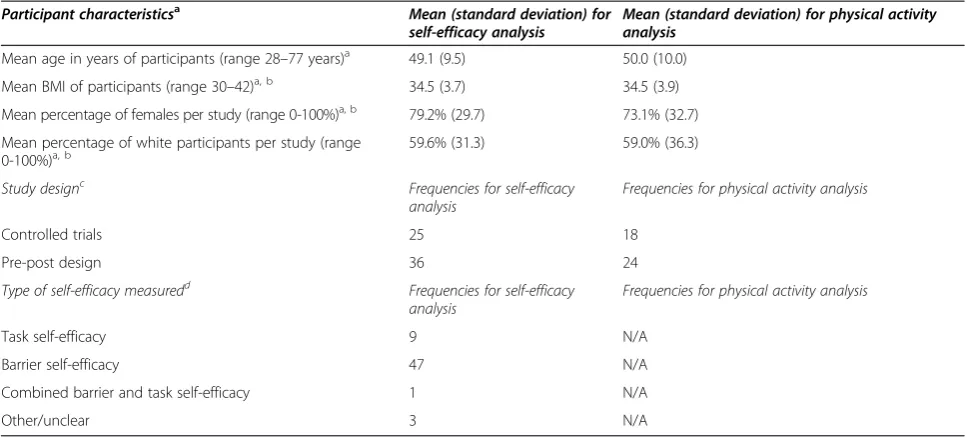
The mean number of participants in the comparisons in-cluded in the self-efficacy analysis was 181 and 170 (range 21 to 860 for both analyses) for the studies only included in the physical activity behaviour analysis. Overall, 25 of the comparisons employed a controlled design, and 36 used a pre-post design (see Table 1). Barrier self-efficacy was most commonly assessed (77% of all comparisons), with task self-efficacy assessed in 14% of comparisons (see Table 1).
Intervention characteristics
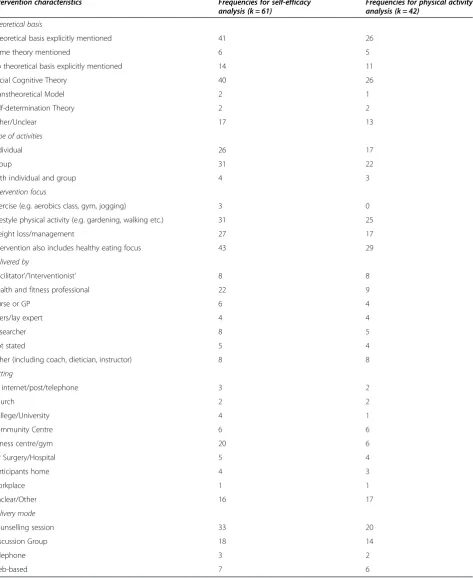
Despite assessing self-efficacy, an explicit theoretical basis was mentioned for only two thirds of studies, with the most frequent being Social Cognitive Theory [82] (see Table 2). Interventions were delivered by a wide va-riety of people and in a vava-riety of locations, but most commonly a health and fitness professional in a fitness centre or gym (see Table 2). Almost half of interventions had an explicit focus on weight loss or weight main-tenance, and two thirds focused on healthy eating in addition to physical activity (see Table 2).
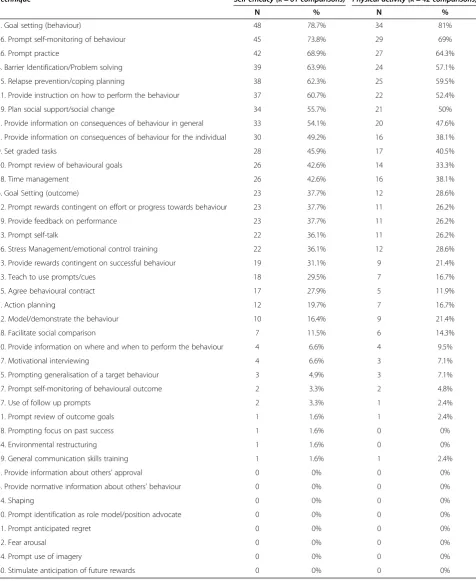
A mean of 10.5 (SD = 6.4) BCTs were identified for the 61 comparisons included in the self-efficacy analysis. The control group interventions had a mean of 0.8 BCTs (SD = 1.5). A mean of 9.0 (SD = 5.3) BCTs were identified for the 42 comparisons included in the physical activity behaviour analysis. The control group interventions had a mean of 0.7 BCTs (SD = 1.5). The most commonly used BCTs in both analyses were ‘goal setting (behaviour)’,
‘prompt self-monitoring of behaviour’and ‘prompt prac-tice’(see Table 3).
Changes in self-efficacy
For the analysis of changes in self-efficacy, 61 compari-sons were included, indicating a small effect of the
inter-ventions on self-efficacy (d= 0.23, 95% confidence
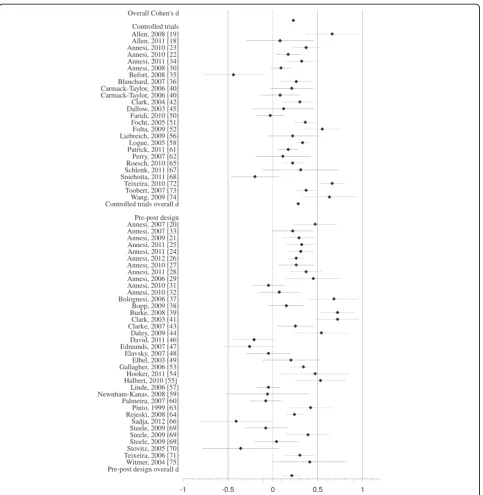
interval (CI): 0.16-0.29, p < 0.001). Fail-safe N (p = 0.05) was large: it would require an additional 2113 studies showing a zero effect not included in the present ana-lysis for the relationship between interventions and self-efficacy to become statistically non significant [83]. A forest plot showing self-efficacy effect sizes with 95% CI
for each study ordered by research design is given in Figure 2. A greater variability in effect size estimates existed than could be explained by random sampling error alone (Q= 129.27, p < 0.001). The amount of variance at-tributable to sampling error was 58.29%. Effect sizes for self-efficacy ranged fromd =−0.44 [35] tod =0.72 [39,41]. In total, 28 moderator analyses were conducted to in-vestigate differences in self-efficacy according to pres-ence or abspres-ence of BCTs (see Table 4). Moderator analyses were not conducted for those BCTs that were not coded as present in any (BCT: 3, 4, 14, 30, 31, 32, 34 and 40, as listed in Table 3) or in only one intervention group (BCT: 11, 18, 24 and 39, as listed in Table 3).
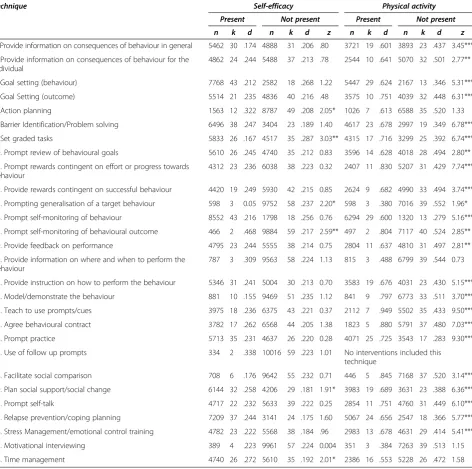
Four BCTs were significantly associated with higher self-efficacy effect sizes when present (all; p < .05);‘action plan-ning’, ‘prompt self-monitoring of behavioural outcome’,
‘plan social support/social change’and‘time management’. Two BCTs were significantly associated with lower self-efficacy effect sizes when present ‘set graded tasks’ and
‘prompting generalisation of a target behaviour’. The pres-ence or abspres-ence of the remaining 23 behaviour change techniques was not significantly associated with self-efficacy effect size estimates (see Table 4).
Changes in physical activity
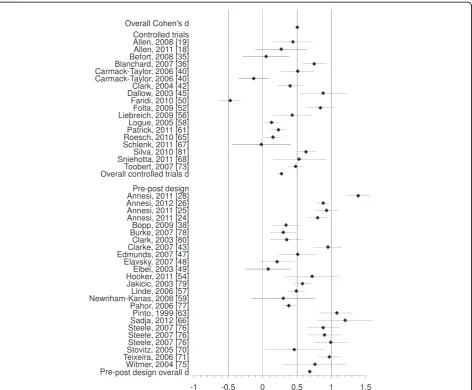
For the analysis of changes in physical activity behaviour, 42 comparisons were included indicating a significant medium effect of the interventions on physical activity be-haviour (d= 0.50, 95% CI 0.38-0.63, p < 0.001). Fail-safe N (p = 0.05) was large: it would require an additional 5789 studies showing a zero effect not included in the present analysis for the relationship between interventions and physical activity to become statistically non significant [83]. A forest plot showing physical activity effect sizes with 95% CI for each study ordered by research design is given in Figure 3. A greater variability in effect size esti-mates existed than could be explained by random sam-pling error alone (Q= 293.86, p < 0.001). The amount of variance explained by sampling error was notably lower than was the case for self-efficacy at 31.75%. Effect sizes ranged fromd =−0.47 [50] tod =1.2 [66].
In total, 27 moderator analyses were conducted to inves-tigate differences in physical activity behaviour according to presence or absence of BCTs. Moderator analyses were not conducted for those BCTs which were not coded as present in any (BCT: 3, 4, 14, 27, 30, 31, 32, 34 and 40 as listed in Table 3) or in only one intervention group (BCT: 11, 18, 24 and 39 as listed in Table 3).
were present; ‘teach to use prompts/cues’,‘prompt prac-tice’ and ‘prompt rewards contingent on effort or
pro-gress towards behaviour’. There were no significant
differences in physical activity effect size estimates be-tween interventions that included the remaining four BCTs and interventions that did not.
Comparison of techniques associated with self-efficacy and physical activity
A negative non-significant relationship was found between the change in self-efficacy and the change in physical activity for the 27 behaviour change techniques included in at least two interventions (Spearman’s Rho =−0.18 p = 0.72). Of the 27 techniques included in both moder-ator analyses, only six did not show an increase in effect size when the technique was present for physical activity and of these two were associated with an increase in self-efficacy.
Discussion
This meta-analysis of physical activity interventions for obese adults found a small (d= 0.23) but significant effect of interventions on self-efficacy and a significant effect of interventions on physical activity behaviour (d= 0.50) of medium size. The moderator analyses identified four behaviour change techniques that were associated with a higher self-efficacy effect size estimate. Only two of these techniques; ‘prompt self-monitoring of behavioural
out-come’ and ‘plan social support/social change’, were also associated with higher effect size estimate for physical ac-tivity behaviour. In addition, two techniques were found to be associated with a lower self-efficacy effect size esti-mates;‘set graded tasks’and‘prompting generalisation of a target behaviour’. The latter technique was also associated with a lower physical activity behaviour effect size esti-mate. For physical activity behaviour, 21 techniques in total were found to be associated with a higher effect size estimate. The largest effects were found for‘teach to use prompts/cues’,‘prompt practice’and‘prompt rewards con-tingent on effort or progress towards behaviour’. The asso-ciation between the changes in self-efficacy and physical activity behaviour was small and not statistically signifi-cant (Spearman’s Rho =−0.18).
Strengths and limitations
There are several strengths of this systematic review and meta-analysis. Firstly, we conducted a systematic review using broad search terms to increase the probability of identifying all eligible publications, and which yielded a good sized (k = 61) evidence base. Secondly, we used the same methods and analysis as a previous review [10], allowing for a comparison of effective BCTs between
‘healthy’non-obese adults and obese adults. Thirdly, inter-vention contents were reliably coded using a standardised taxonomy for BCT’s [12].
[image:6.595.56.540.100.319.2]There are a few limitations associated with this review. There were numerous BCTs examined as independent
Table 1 Summary of the participant and study characteristics of included publications
Participant characteristicsa Mean (standard deviation) for
self-efficacy analysis Mean (standard deviation) for physical activityanalysis
Mean age in years of participants (range 28–77 years)a 49.1 (9.5) 50.0 (10.0)
Mean BMI of participants (range 30–42)a, b 34.5 (3.7) 34.5 (3.9)
Mean percentage of females per study (range 0-100%)a, b 79.2% (29.7) 73.1% (32.7)
Mean percentage of white participants per study (range 0-100%)a, b
59.6% (31.3) 59.0% (36.3)
Study designc Frequencies for self-efficacy
analysis
Frequencies for physical activity analysis
Controlled trials 25 18
Pre-post design 36 24
Type of self-efficacy measuredd Frequencies for self-efficacy
analysis
Frequencies for physical activity analysis
Task self-efficacy 9 N/A
Barrier self-efficacy 47 N/A
Combined barrier and task self-efficacy 1 N/A
Other/unclear 3 N/A
a
Data on age, exact BMI, gender and ethnicity was not provided by all studies. b
This is the range for both the self-efficacy and physical activity studies. c
This data is for the statistical analyses conducted, some of the studies were RCT’s but were analysed as pre-post studies. d
Table 2 Summary of intervention characteristics of included publications for self-efficacy analysis
Intervention characteristics Frequencies for self-efficacy
analysis (k = 61) Frequencies for physical activityanalysis (k = 42)
Theoretical basis
Theoretical basis explicitly mentioned 41 26
Some theory mentioned 6 5
No theoretical basis explicitly mentioned 14 11
Social Cognitive Theory 40 26
Transtheoretical Model 2 1
Self-determination Theory 2 2
Other/Unclear 17 13
Type of activities
Individual 26 17
Group 31 22
Both individual and group 4 3
Intervention focus
Exercise (e.g. aerobics class, gym, jogging) 3 0
Lifestyle physical activity (e.g. gardening, walking etc.) 31 25
Weight loss/management 27 17
Intervention also includes healthy eating focus 43 29
Delivered by
‘Facilitator’/’Interventionist’ 8 8
Health and fitness professional 22 9
Nurse or GP 6 4
Peers/lay expert 4 4
Researcher 8 5
Not stated 5 4
Other (including coach, dietician, instructor) 8 8
Setting
By internet/post/telephone 3 2
Church 2 2
College/University 4 1
Community Centre 6 6
Fitness centre/gym 20 6
GP Surgery/Hospital 5 4
Participants home 4 3
Workplace 1 1
Unclear/Other 16 17
Delivery mode
Counselling session 33 20
Discussion Group 18 14
Telephone 3 2
Table 3 Frequencies of behaviour change techniques that were used in the interventions
Technique Self-efficacy (k = 61 comparisons) Physical activity (k = 42 comparisons)
N % N %
5. Goal setting (behaviour) 48 78.7% 34 81%
16. Prompt self-monitoring of behaviour 45 73.8% 29 69%
26. Prompt practice 42 68.9% 27 64.3%
8. Barrier Identification/Problem solving 39 63.9% 24 57.1%
35. Relapse prevention/coping planning 38 62.3% 25 59.5%
21. Provide instruction on how to perform the behaviour 37 60.7% 22 52.4%
29. Plan social support/social change 34 55.7% 21 50%
1. Provide information on consequences of behaviour in general 33 54.1% 20 47.6%
2. Provide information on consequences of behaviour for the individual 30 49.2% 16 38.1%
9. Set graded tasks 28 45.9% 17 40.5%
10. Prompt review of behavioural goals 26 42.6% 14 33.3%
38. Time management 26 42.6% 16 38.1%
6. Goal Setting (outcome) 23 37.7% 12 28.6%
12. Prompt rewards contingent on effort or progress towards behaviour 23 37.7% 11 26.2%
19. Provide feedback on performance 23 37.7% 11 26.2%
33. Prompt self-talk 22 36.1% 11 26.2%
36. Stress Management/emotional control training 22 36.1% 12 28.6%
13. Provide rewards contingent on successful behaviour 19 31.1% 9 21.4%
23. Teach to use prompts/cues 18 29.5% 7 16.7%
25. Agree behavioural contract 17 27.9% 5 11.9%
7. Action planning 12 19.7% 7 16.7%
22. Model/demonstrate the behaviour 10 16.4% 9 21.4%
28. Facilitate social comparison 7 11.5% 6 14.3%
20. Provide information on where and when to perform the behaviour 4 6.6% 4 9.5%
37. Motivational interviewing 4 6.6% 3 7.1%
15. Prompting generalisation of a target behaviour 3 4.9% 3 7.1%
17. Prompt self-monitoring of behavioural outcome 2 3.3% 2 4.8%
27. Use of follow up prompts 2 3.3% 1 2.4%
11. Prompt review of outcome goals 1 1.6% 1 2.4%
18. Prompting focus on past success 1 1.6% 0 0%
24. Environmental restructuring 1 1.6% 0 0%
39. General communication skills training 1 1.6% 1 2.4%
3. Provide information about others’approval 0 0% 0 0%
4. Provide normative information about others’behaviour 0 0% 0 0%
14. Shaping 0 0% 0 0%
30. Prompt identification as role model/position advocate 0 0% 0 0%
31. Prompt anticipated regret 0 0% 0 0%
32. Fear arousal 0 0% 0 0%
34. Prompt use of imagery 0 0% 0 0%
moderators leading to a large number of comparisons conducted. Thus, it is entirely possible that some of the significant effects were identified due to chance alone: there was an inflation of risk of type 1 error. The analyses were based on identifying associations between interven-tions which contained specific BCTs and two outcome vari-ables. It is entirely possible that some of these associations identified are due to confounding variables, i.e. characteris-tics of population, intervention other than BCTs or type of self-efficacy measured2. The current analyses also only
[image:9.595.58.542.86.582.2]techniques. This is something that needs further investiga-tion in future research.
Furthermore, coding interventions was at times difficult due to the lack of precision and detail provided, as men-tioned previously by other research groups [13]. Based on this, we were only able to code intervention techniques that were explicitly stated and strongly suggest that authors describe their interventions using terms from the behaviour change taxonomy in the future. Encouragingly, some researchers do this [26], which makes these type
[image:10.595.64.537.112.581.2]of reviews more accurate. Additionally, this review is concerned with summarising existing evidence, thereby generating new hypotheses for future research to test using experimental designs without such potential con-founders. Lastly, more studies could have been inclu-ded if the focus of this review had solely been on what BCTs increase physical activity [84]. However, a strength of this review is that it investigates both phys-ical activity behaviour and self-efficacy which allows examination of theoretical determinants of physical
Table 4 Comparison between self-efficacy and physical activity behaviour, according to whether specific techniques are present in the physical activity intervention and when the technique is not present
Technique Self-efficacy Physical activity
Present Not present Present Not present
n k d n k d z n k d n k d z
1. Provide information on consequences of behaviour in general 5462 30 .174 4888 31 .206 .80 3721 19 .601 3893 23 .437 3.45***
2. Provide information on consequences of behaviour for the individual
4862 24 .244 5488 37 .213 .78 2544 10 .641 5070 32 .501 2.77**
5. Goal setting (behaviour) 7768 43 .212 2582 18 .268 1.22 5447 29 .624 2167 13 .346 5.31***
6. Goal Setting (outcome) 5514 21 .235 4836 40 .216 .48 3575 10 .751 4039 32 .448 6.31***
7. Action planning 1563 12 .322 8787 49 .208 2.05* 1026 7 .613 6588 35 .520 1.33
8. Barrier Identification/Problem solving 6496 38 .247 3404 23 .189 1.40 4617 23 .678 2997 19 .349 6.78***
9. Set graded tasks 5833 26 .167 4517 35 .287 3.03** 4315 17 .716 3299 25 .392 6.74***
10. Prompt review of behavioural goals 5610 26 .245 4740 35 .212 0.83 3596 14 .628 4018 28 .494 2.80**
12. Prompt rewards contingent on effort or progress towards behaviour
4312 23 .236 6038 38 .223 0.32 2407 11 .830 5207 31 .429 7.74***
13. Provide rewards contingent on successful behaviour 4420 19 .249 5930 42 .215 0.85 2624 9 .682 4990 33 .494 3.74***
15. Prompting generalisation of a target behaviour 598 3 0.05 9752 58 .237 2.20* 598 3 .380 7016 39 .552 1.96*
16. Prompt self-monitoring of behaviour 8552 43 .216 1798 18 .256 0.76 6294 29 .600 1320 13 .279 5.16***
17. Prompt self-monitoring of behavioural outcome 466 2 .468 9884 59 .217 2.59** 497 2 .804 7117 40 .524 2.85**
19. Provide feedback on performance 4795 23 .244 5555 38 .214 0.75 2804 11 .637 4810 31 .497 2.81**
20. Provide information on where and when to perform the behaviour
787 3 .309 9563 58 .224 1.13 815 3 .488 6799 39 .544 0.73
21. Provide instruction on how to perform the behaviour 5346 31 .241 5004 30 .213 0.70 3583 19 .676 4031 23 .430 5.15***
22. Model/demonstrate the behaviour 881 10 .155 9469 51 .235 1.12 841 9 .797 6773 33 .511 3.70***
23. Teach to use prompts/cues 3975 18 .236 6375 43 .221 0.37 2112 7 .949 5502 35 .433 9.50***
25. Agree behavioural contract 3782 17 .262 6568 44 .205 1.38 1823 5 .880 5791 37 .480 7.03***
26. Prompt practice 5713 35 .231 4637 26 .220 0.28 4071 25 .725 3543 17 .283 9.30***
27. Use of follow up prompts 334 2 .338 10016 59 .223 1.01 No interventions included this
technique
28. Facilitate social comparison 708 6 .176 9642 55 .232 0.71 446 5 .845 7168 37 .520 3.14***
29. Plan social support/social change 6144 32 .258 4206 29 .181 1.91* 3983 19 .689 3631 23 .388 6.36***
33. Prompt self-talk 4717 22 .232 5633 39 .222 0.25 2854 11 .751 4760 31 .449 6.10***
35. Relapse prevention/coping planning 7209 37 .244 3141 24 .175 1.60 5067 24 .656 2547 18 .366 5.77***
36. Stress Management/emotional control training 4782 23 .222 5568 38 .184 .96 2983 13 .678 4631 29 .414 5.41***
37. Motivational interviewing 389 4 .223 9961 57 .224 0.004 351 3 .384 7263 39 .513 1.15
38. Time management 4740 26 .272 5610 35 .192 2.01* 2386 16 .553 5228 26 .472 1.58
activity in this population for whom physical activity should be a priority.
Which behaviour change techniques are associated with changes in self-efficacy for physical activity and physical activity behaviour in obese adults?
This review adds to the current literature by identifying which behaviour change techniques are associated with changes in self-efficacy and physical activity behaviour in an
obesepopulation. Previous reviews have identified BCTs ef-fective in increasing this behaviour in other populations [10,84] including obese individuals with additional risk fac-tors [13]. Similarly, the previous review concerning which BCTs were associated with self-efficacy was conducted in an explicitly non-obese population [10].
Four behaviour change techniques were found to be as-sociated with increased self-efficacy. These involved plan-ning, prompting and practical skills. ‘Action planning’,
involves planning where and when to act and in which situation and it seems likely that greater goal specification, i.e. knowing what to do where and when, may encourage the belief that engaging in physical activity is feasible. Similarly, time management is a practical skill that may in-crease individuals’belief that they can perform the behav-iour by helping them feel they can better control potential obstacles. Neither of these BCTs however were associated with an increase in physical activity behaviour.
[image:11.595.66.539.88.478.2]‘Planning social support/social change’i.e. planning how to elicit social support for the target behaviour from other individuals may also help people feel more in control over the performance of physical activity by receiving greater practical support with obstacles such as family or work commitments. This is supported by an association be-tween the presence of this BCT and behaviour. In addition, feeling supported may help this population cope with setbacks and relapses in physical activity.
‘Prompting self-monitoring of behavioural outcome’, is defined as keeping a record of a specific outcome expected to be influenced by the behaviour change. In the two in-stances where this technique was identified, the outcome was weight loss [71,72]. It may be that self-monitoring one’s weight and seeing a change in weight enhanced the individuals’feelings of being in control of physical activity, assuming they attributed any weight changes to their physical activity behaviour.
Two behaviour change techniques were associated with decreased self-efficacy; ‘set graded tasks’ and ‘prompting generalisation of a target behaviour’. The first technique involves breaking down the behaviour into smaller, more achievable tasks, and is thought to enable the individual to build on small successes [12].‘Prompting generalisation of a target behaviour’encourages the individual to try the be-haviour in a different setting/situation, after first mastering it in one situation [12]. Both of these BCTs are based on the idea of breaking overall behaviour change into smaller achievable goals. However, to participants these BCTs may make the goals seem large, unmanageable and unattain-able, and possibly seem to involve‘moving the goalposts’. Both of these techniques are used in skilled approaches such as cognitive behaviour therapy [85]. However, they may be poorly implemented within the studies included in this review, as many interventions were delivered by people such as fitness professionals that have not necessar-ily been trained to deliver behaviour change interventions.
‘Prompting generalisation of a target behaviour’ was the only technique that was associated with lower physical ac-tivity behaviour.
Overall, the most commonly used techniques were not found to be the techniques that may be most effective in increasing self-efficacy or physical activity (see Table 3 and 4). One of the potentially most effective BCTs was
‘teach to use prompts/cues’and was used in only 16% of all physical activity comparisons. The second potentially most effective technique‘prompt practice’was identified in almost two thirds of all the interventions. It appears that the use of BCTs such as‘teach to use prompts/cues’ and‘prompt practice’which involve prompting self regu-lation may potentially be particularly effective in helping obese individuals engage in physical activity. This finding is in line with a previous review of general physical ac-tivity interventions [84].
Another technique, ‘prompt rewards contingent on
effort or progress towards behaviour’ involves the
in-dividual using self-reward or praise for attempts at achieving the behaviour. It may be that this popula-tion particularly needs encouragement as they try to change their physical activity behaviour. This is in
line with the BCT ‘plan social support/social change’
which was associated with increased self-efficacy and physical activity.
Are the same techniques which are associated with increased self-efficacy also associated with increased physical activity? Are they the same as in the review of non-obese adults?
A negative and non-significant association (rho =−0.18) between changes in self-efficacy and changes in physical activity was observed across BCTs. Of the 28 techniques in the moderator analysis, only three BCTs were associ-ated with the same result (increase or decrease in effect size for when the technique was present/not present) for both self-efficacy and physical activity behaviour. Two of these techniques,‘prompt self-monitoring of behavioural outcome’ and ‘plan social support/social change’, were associated with a higher effect size estimate when the intervention included this technique. The third tech-nique, ‘prompting generalisation of a target behaviour’, was associated with a lower effect size estimate when the interventions included this technique for both self-efficacy and physical activity behaviour. The majority of techniques included in moderator analyses (19/28) were associated with larger physical activity behaviour effect sizes but not self-efficacy effect sizes.
Taken together, these findings clearly suggest that there are many other routes apart from increasing self-efficacy that can help obese adults become more physically active. There were larger changes brought about in physical activ-ity than for self-efficacy. Also, more BCT’s were associated with increases in physical activity than increases in self-efficacy. The conclusion that self-efficacy is not the only route to behaviour change is in line with a recent review update which concluded that there is currently limited sup-port for self-efficacy to act as a mediator of physical activity changes [86], in contrast to a commonly held view [8].
On the contrary, there may be something about an obese population that results in self-efficacy not being an important route to changing physical activity. The re-sults of the present review stand in striking contrast to those of a previous review of non-obese adults, which found a strong and significant (r = 0.69) relationship be-tween change in self-efficacy and change in physical ac-tivity behaviour.
weight loss, which presumably would be a highly valued goal. There is evidence that the relationship between in-creased physical activity and weight loss is far from straightforward [87], so this would be a reasonable out-come expectancy for many obese people. Thus, this popu-lation may be convinced by an intervention that they can increase their physical activity, but if they were not con-vinced that this would result in the salient outcome of weight loss, it would not necessarily result in increased physical activity.
The techniques associated with increasing obese adults’ self-efficacy and physical activity were generally not the same as the BCTs associated with such change in non-obese adults. For self-efficacy, the current review identified four techniques that were associated with increasing adults’ self-efficacy where a review focusing on non-obese adults found three such techniques [10]. The only BCT that was found to be associated with increased self-efficacy in both populations was‘action planning’[10]. The current review identified 21 BCTs that were associated with increased physical activity behaviour, whilst the review that focused on non-obese adults identified six BCTs [10]. Out of these six BCTs, four techniques were found to be associated with an increase in physical activity in both non-obese and obese adults (‘provide information on consequences of behaviour in general’,‘prompt rewards contingent on effort or progress towards behaviour,’‘provide instruction on how to perform the behaviour’and‘facilitate social comparison’). These re-sults highlight the importance of selecting appropriate BCTs for each population, and not assuming that BCTs will be uniformly effective, assuming these associations repre-sent unique causal effects of each BCT.
Implications and future directions
If the associations identified in this review are shown to reflect causal effects of BCTs on physical activity, future interventions with this population should be able to bring about change in physical activity using approximately half the techniques examined: most techniques appear to be effective. However, greater change is likely with tech-niques concerned with self-regulation, replicating previous findings with a general population [84]. Furthermore, this review has identified some possibly effective yet seldom
used BCTs such as ‘teach to use prompts/cues’. We
suggest future interventions include the BCTs that this re-view has identified as possibly effective, to maximize the intervention’s potential to be effective. Unlike interven-tions with non-obese adults [10], it does not seem to be important to specifically target obese individuals’ self-efficacy for physical activity in order to change their phys-ical activity behaviour.
The present review has suggested a number of tech-niques are effective at increasing physical activity in obese individuals. Future research should test whether these
associations reflect causal processes by using the present evidence base to develop interventions and then test their efficacy. Future research should also test whether increas-ing physical activity through increasincreas-ing individuals’ self-efficacy is the best route to increase physical activity behaviour in this population. The current findings suggest that there are alternative mechanisms for increasing obese individuals’physical activity behaviour, and there is a need for future research to identify these.
A strong test of the causal nature of the relationships identified in the present review, and a previous one involv-ing non-obese adults [10] is also required. This would in-volve developing two interventions, each based on the BCTs identified as most associated with change in each population. A comparison would then be made of the rela-tive efficacy of interventions which are ‘matched’ to the population for whom the intervention was developed, and
‘mismatched’i.e. delivered to the other population.
Conclusion
In summary, this review and meta-analysis has identified several behaviour change techniques that are associated with increased self-efficacy and physical activity. Some of these techniques supported previous findings from a review with healthy and overweight adults [10], whilst other tech-niques may be effective in an obese population only. Thus, to develop effective physical activity interventions it may be important to consider tailoring intervention techniques to populations to a greater extent than is commonly the case.
Endnotes
1
This search aimed to identify studies with obese people and older (>60 years) adults. This was in line with objec-tives of the research commissioned by Macmillan Cancer Support [17]. Hence the number of publications retrieved reported here includes some that were retrieved with the older adults search criteria in mind.
2
In this review the effect sizes for task and barrier self-efficacy respectively was not significantly different (taskd =0.26, barrierd =0.22, p = 0.23).
Appendix 1
Scopus (1960–2011)
Terms in title, abstract or keyword.
Self-efficacy or Bandura or social cognitive theory. OR
Theory of planned behaviour or theory of planned be-havior or theory of reasoned action or perceived behav-ioural control or perceived behavioral control.
AND
Blind or Controlled clinical trial or Mask or Random al-location or Double blind method or Intervention or Evaluation or Progra* or Follow-up study or Experiment. AND
Physical activity or exercise or fitness or exertion. PsycInfo (1966–2011).
Search terms.
Self-efficacy or Bandura or social cognitive theory. OR
Theory of planned behaviour or theory of planned be-havior or theory of reasoned action or perceived behav-ioural control or perceived behavioral control.
AND
Clinica* tria* or Randomised controlled trial or Random-ized controlled trial or.
Blind or Controlled clinical trial or Mask or Random al-location or Double blind method or Intervention or Evaluation or Progra* or Follow-up study.
AND
Physical activity or exercise or sport or fitness.
Competing interests
The authors declare that they have no competing interests.
Authors’contributions
DPF had the original idea for this review, which he developed with the input of EKO and AT. EKO and DPF developed the review protocol and EKO conducted the literature searches. EKO and LA were responsible for the title and abstract screening and full text assessment (with help from DPF). EKO, HF and SW coded the interventions, and did the data extraction together with LA. EKO conducted all statistical analysis with support from DPF and wrote the manuscript with help from DPF. All authors read and approved the final manuscript.
Acknowledgements
The authors would like to thank Debbie Shearring, research assistant, for her help with identifying papers for this review. They would also like to thank the following authors’for providing additional data used in this review; Nancy Allen, James Annesi, Cindy Carmack, Stephan Dombrowski, Kate Edwards, Steriani Elavsky, Russ Elbel, Everett Logue, Greg Norman, Falko Sniehotta, Pedro Teixeira and Deborah Toobert. This review was funded by Macmillan Cancer Support. We are grateful to Lynn Batehup of Macmillan Cancer Support for her support with this review. The funder was not involved in the design, data collection, analysis or interpretation of data, in the writing of the manuscript or in the decision to submit the manuscript for publication.
Author details
1Applied Research Centre in Health and Lifestyle Interventions, Coventry
University, Priory Street, Coventry CV1 5FB, UK.2School of Psychological
Sciences, University of Manchester, Oxford Road, Manchester M13 9PL, UK.
Received: 14 September 2012 Accepted: 26 February 2013 Published: 3 March 2013
References
1. World Health Organization:Obesity and overweight.www.who.int/ mediacentre/factsheets/fs311/en.
2. Zaninotto P, Head J, Stamatakis E, Wardle H, Mindell J:Trends in obesity among adults in England from 1993 to 2004 by age and social class and projections of prevalence to 2012.J Epidemiol Community Health2009,
63:140–146.
3. Mokdad AH, Ford ES, Bowman BA, Dietz WH, Vinicor F, Bales VS, Marks JS:
Prevalence of obesity, diabetes, and obesity-related health risk factors, 2001.JAMA2003,289:76–79.
4. Kenchaiah S, Evans JC, Levy D, Wilson PWF, Benjamin EJ, Larson MG, Kannel WB, Vasan RS:Obesity and the risk of heart failure.N Engl J Med2002,
347:305–313.
5. Luppino FS, de Wit LM, Bouvy PF, Stijnen T, Cuijpers P, Penninx BWJH, Zitman FG:Overweight, obesity, and depression: a systematic review and meta-analysis of longitudinal studies.Arch Gen Psychiatry2010,
67:220–229.
6. Mokdad AH, Marks JS, Stroup DF, Gerberding JL:Actual causes of death in the United States, 2000.JAMA2004,291:1238–1245.
7. Jakicic JM, Otto AD:Treatment and prevention of obesity: what is the role of exercise?Nutr Rev2006,64:S57–S61.
8. Bauman AE, Reis RS, Sallis JF, Wells JC, Loos RJF, Martin BW:Correlates of physical activity: why are some people physically active and others not?
Lancet2012,380:258–271.
9. Darker CD, French DP, Eves FF, Sniehotta FF:An intervention to promote walking amongst the general population based on an‘extended’theory of planned behaviour: a waiting list randomised controlled trial.
Psychol Health2010,25:71–88.
10. Williams SL, French DP:What are the most effective intervention techniques for changing physical activity self-efficacy and physical activity behaviour– and are they the same?Health Educ Res2011,26:308–322.
11. Ashford S, Edmunds J, French DP:What is the best way to change self-efficacy to promote lifestyle and recreational physical activity? A systematic review with meta-analysis.Br J Health Psychol2010,15:265–288.
12. Michie S, Ashford S, Sniehotta FF, Dombrowski SU, Bishop A, French DP:A refined taxonomy of behaviour change techniques to help people change their physical activity and healthy eating behaviours: the CALO-RE taxonomy.Psychol Health2011,26:1479–1498.
13. Dombrowski SU, Sniehotta FF, Avenell A, Johnston M, MacLennan G, Araújo-Soares V:Identifying active ingredients in complex behavioural interventions for obese adults with obesity-related co-morbidities or additional risk factors for co-morbidities: a systematic review.
Health Psychol Rev2012,6:7–32.
14. Cohen J:A power primer.Psychol Bull1992,112:155–159.
15. Abraham C, Michie S:A taxonomy of behavior change techniques used in interventions.Health Psychol2008,27:379–387.
16. Schwarzer R:Statistics software for meta-analysis.http://userpage.fu-berlin. de/health/meta_e.htm.
17. French DP, Olander EK, Williams S, Fletcher H, Atkinson L, Turner A:, Building an evidence base for skills development training for cancer clinicians to support lifestyle behaviour change and self-management with cancer survivors; 2011. http://www.ncsi.org.uk/wp-content/uploads/Coventry-PA-interventions-FINAL-report-16dec2011PDF.pdf.
18. Allen N, Whittemore R, Melkus G:A continuous glucose monitoring and problem-solving intervention to change physical activity behavior in women with type 2 diabetes: a pilot study.Diabetes Technol Ther2011,13:1091–1099. 19. Allen NA, Fain JA, Braun B, Chipkin SR:Continuous glucose monitoring
counseling improves physical activity behaviors of individuals with type 2 diabetes: a randomized clinical trial.Diabetes Res Clin Pract2008,80:371–379. 20. Annesi JJ:Relations of changes in exercise self-efficacy, physical self-concept,
and body satisfaction with weight changes in obese white and African American women initiating a physical activity program.Ethn Dis2007,17:19–22. 21. Annesi JJ:Predictors of exercise-induced mood change during a
6-month exercise and nutrition education program with obese women.
Percept Mot Skills2009,109:931–940.
22. Annesi JJ:Dose–response and self-efficacy effects of an exercise program on vigor change in obese women.Am J Med Sci2010,339:127–132. 23. Annesi JJ:Relations of changes in regulatory efficacy and physical
self-concept with improvements in body satisfaction in obese women initiating exercise with cognitive-behavioral support.Body Image2010,7:356–359. 24. Annesi JJ:Self-regulatory skills usage strengthens the relations of
self-efficacy for improved eating, exercise, and weight in the severely obese: toward an explanatory model.Behav Med2011,37:71–76.
25. Annesi JJ:Behaviorally supported exercise predicts weight loss in obese adults through improvements in mood, self-efficacy, and self-regulation, rather than by caloric expenditure.Perm J2011,15:23–27.
28. Annesi JJ, Marti CN:Path analysis of exercise treatment-induced changes in psychological factors leading to weight loss.Psychol Health2011,
26:1081–1098.
29. Annesi JJ, Unruh JL:Correlates of mood changes in obese women initiating a moderate exercise and nutrition information program.
Psychol Rep2006,99:225–229.
30. Annesi JJ, Whitaker AC:Weight loss and psychologic gain in obese women-participants in a supported exercise intervention.Perm J2008,
12:36–45.
31. Annesi JJ, Whitaker AC:Psychological factors associated with weight loss in obese and severely obese women in a behavioral physical activity intervention.Health Educ Behav2010,37:593–606.
32. Annesi JJ, Whitaker AC:Psychological factors discriminating between successful and unsuccessful weight loss in a behavioral exercise and nutrition education treatment.Int J Behav Med2010,17:168–175. 33. Annesi JJ, Unruh JL, Whitaker AC:Relations of changes in self-efficacy,
exercise attendance, mood, and perceived and actual physical changes in obese women: assessing treatment effects using tenets of self-efficacy theory.J Soc Behav Health Sci2007,1:72–85.
34. Annesi JJ, Unruh JL, Marti CN, Gorjala S, Tennant G:Effects of the coach approach intervention on adherence to exercise in obese women: assessing mediation of social cognitive theory factors.Res Q Exerc Sport2011,82:99–108. 35. Befort CA, Nollen N, Ellerbeck EF, Sullivan DK, Thomas JL, Ahluwalia JS:
Motivational interviewing fails to improve outcomes of a behavioral weight loss program for obese African American women: a pilot randomized trial.J Behav Med2008,31:367–377.
36. Blanchard CM, Fortier M, Sweet S, O’Sullivan T, Hogg W, Reid RD, Sigal RJ:
Explaining physical activity levels from a self-efficacy perspective: the physical activity counseling trial.Ann Behav Med2007,34:323–328. 37. Bolognesi M, Nigg CR, Massarini M, Lippke S:Reducing obesity indicators
through brief physical activity counseling (PACE) in Italian primary care settings.Ann Behav Med2006,31:179–185.
38. Bopp M, Wilcox S, Laken M, Hooker SP, Parra-Medina D, Saunders R, Butler K, Fallon EA, McClorin L:8 Steps to fitness: a faith-based, behavior change physical activity intervention for African Americans.J Phys Act Health
2009,6:568–577.
39. Burke V, Beilin LJ, Cutt HE, Mansour J, Mori TA:Moderators and mediators of behaviour change in a lifestyle program for treated hypertensives: a randomized controlled trial (ADAPT).Health Educ Res2008,23:583–591. 40. Carmack Taylor CL, Demoor C, Smith MA, Dunn AL, Basen-Engquist K,
Nielsen I, Pettaway C, Sellin R, Massey P, Gritz ER:Active for life after cancer: a randomized trial examining a lifestyle physical activity program for prostate cancer patients.Psychooncol2006,15:847–862.
41. Clark DO, Stump TE, Damush TM:Outcomes of an exercise program for older women recruited through primary care.J Aging Health2003,15:567–585. 42. Clark M, Hampson SE, Avery L, Simpson R:Effects of a brief tailored
intervention on the process and predictors of lifestyle behaviour change in patients with type 2 diabetes.Psychol Health Med2004,9:440–449. 43. Clarke KK, Freeland-Graves J, Klohe-Lehman DM, Milani TJ, Nuss HJ, Laffrey S:
Promotion of physical activity in low-income mothers using pedometers.
J Am Diet Assoc2007,107:962–967.
44. Daley LK, Fish AF, Frid DJ, Mitchell GL:Stage-specific education/counseling intervention in women with elevated blood pressure.Prog Cardiovasc Nurs2009,24:45–52.
45. Dallow CB, Anderson J:Using self-efficacy and a transtheoretical model to develop a physical activity intervention for obese women.Am J Health Promot2003,17:373–381.
46. David P, Buckworth J, Pennell ML, Katz ML, DeGraffinreid CR, Paskett ED:A walking intervention for postmenopausal women using mobile phones and interactive voice response.J Telemed Telecare2012,18:20–25. 47. Edmunds J, Ntoumanis N, Duda JL:Adherence and well-being in overweight
and obese patients referred to an exercise on prescription scheme: a self-determination theory perspective.Psychol Sport Exerc2007,8:722–740. 48. Elavsky S, McAuley E:Exercise and self-esteem in menopausal women: a
randomized controlled trial involving walking and yoga.Am J Health Promot2007,22:83–92.
49. Elbel R, Aldana S, Bloswick D, Lyon JL:A pilot study evaluating a peer led and professional led physical activity intervention with blue-collar employees.Work2003,21:199–210.
50. Faridi Z, Shuval K, Njike VY, Katz JA, Jennings G, Williams M, Katz DL:
Partners reducing effects of diabetes (PREDICT): a diabetes prevention
physical activity and dietary intervention through African-American churches.Health Educ Res2010,25:306–315.
51. Focht BC, Rejeski WJ, Ambrosius WT, Katula JA, Messier SP:Exercise, self-efficacy, and mobility performance in overweight and obese older adults with knee osteoarthritis.Arthritis Rheum2005,53:659–665.
52. Folta SC, Lichtenstein AH, Seguin RA, Goldberg JP, Kuder JF, Nelson ME:The strongwomen-healthy hearts program: reducing cardiovascular disease risk factors in rural sedentary, overweight, and obese midlife and older women.Am J Public Health2009,99:1271–1277.
53. Gallagher KI, Jakicic JM, Napolitano MA, Marcus BH:Psychosocial factors related to physical activity and weight loss in overweight women.
Med Sci Sports Exerc2006,38:971–980.
54. Hooker SP, Harmon B, Burroughs EL, Rheaume CE, Wilcox S:Exploring the feasibility of a physical activity intervention for midlife African American men.Health Educ Res2011,26:732–738.
55. Halbert CH, Bellamy S, Bowman M, Briggs V, Delmoor E, Purnell J, Rogers R, Weathers B, Kumanyika S:Effects of integrated risk counseling for cancer and cardiovascular disease in African Americans.J Natl Med Assoc2010,
102:396–402.
56. Liebreich T, Plotnikoff RC, Courneya KS, Boulé N:Diabetes NetPLAY: a physical activity website and linked email counselling randomized intervention for individuals with type 2 diabetes.Intl J Behav Nutr Phys Act2009,6:18.
57. Linde JA, Rothman AJ, Baldwin AS, Jeffery RW:The impact of self-efficacy on behavior change and weight change among overweight participants in a weight loss trial.Health Psychol2006,25:282–291.
58. Logue E, Sutton K, Jarjoura D, Smucker W, Baughman K, Capers C:
Transtheoretical model-chronic disease care for obesity in primary care: a randomized trial.Obes Res2005,13:917–927.
59. Newnham-Kanas C, Irwin JD, Morrow D:Co-active life coaching as a treatment for adults with obesity.Intl J Evidence Based Coach Mentoring
2008,6:1–12.
60. Palmeira AL, Teixeira PJ, Branco TL, Martins SS, Minderico CS, Barata JT, Serpa SO, Sardinha LB:Predicting short-term weight loss using four leading health behavior change theories.Int J Behav Nutr Phys Act2007,4. 61. Patrick K, Calfas KJ, Norman GJ, Rosenberg D, Zabinski MF, Sallis JF, Rock CL,
Dillon LW:Outcomes of a 12-month web-based intervention for overweight and obese men.Ann Behav Med2011,42:391–401.
62. Perry CK, Rosenfeld AG, Bennett JA, Potempa K:Promoting walking in rural women through motivational interviewing and group support.
J Cardiovasc Nurs2007,22:304–312.
63. Pinto BM, Clark MM, Cruess DG, Szymanski L, Pera V:Changes in self-efficacy and decisional balance for exercise among obese women in a weight management program.Obes Res1999,7:288–292.
64. Rejeski WJ, King AC, Katula JA, Kritchevsky S, Miller ME, Walkup MP, Glynn NW, Pahor M:Physical activity in prefrail older adults: confidence and satisfaction related to physical function.J Gerontol B Psychol Sci Soc Sci
2008,63B:P19–P26.
65. Roesch SC, Norman GJ, Villodas F, Sallis JF, Patrick K:Intervention-mediated effects for adult physical activity: a latent growth curve analysis.Soc Sci Med2010,71:494–501.
66. Sadja J, Tomfohr L, Jimenez JA, Edwards KM, Rock CL, Calfas K, Mills PJ:Higher physical fatigue predicts adherence to a 12-week exercise intervention in women with elevated blood pressure.Health Psychol2012,31:156–163. 67. Schlenk EA, Lias JL, Sereika SM, Dunbar-Jacob J, Kwoh CK:Improving
physical activity and function in overweight and obese older adults with osteoarthritis of the knee: a feasibility study.Rehabil Nurs2011,36:32–42. 68. Sniehotta FF, Dombrowski SU, Avenell A, Johnston M, McDonald S, Murchie
P, Ramsay CR, Robertson K, Araujo-Soares V:Randomised controlled feasibility trial of an evidence-informed behavioural intervention for obese adults with additional risk factors.PLoS One2011,6:e23040. 69. Steele RM, Mummery WK, Dwyer T:A comparison of face-to-face or
internet-delivered physical activity intervention on targeted determinants.Health Educ Behav2009,36:1051–1064.
70. Stovitz SD, VanWormer JJ, Center BA, Bremer KL:Pedometers as a means to increase ambulatory activity for patients seen at a family medicine clinic.J Am Board Fam Pract2005,18:335–343.
71. Teixeira PJ, Going SB, Houtkooper LB, Cussler EC, Metcalfe LL, Blew RM, Sardinha LB, Lohman TG:Exercise motivation, eating, and body image variables as predictors of weight control.Med Sci Sports Exerc2006,
72. Teixeira PJ, Silva MN, Coutinho SR, Palmeira AL, Mata J, Vieira PN, Carraça EV, Santos TC, Sardinha LB:Mediators of weight loss and weight loss maintenance in middle-aged women.Obesity2010,18:725–735. 73. Toobert DJ, Glasgow RE, Strycker LA, Barrera M Jr, Ritzwoller DP, Weidner G:
Long-term effects of the mediterranean lifestyle program: a randomized clinical trial for postmenopausal women with type 2 diabetes.Int J Behav Nutr Phys Act2007,4:1.
74. Wang C, Schmid CH, Hibberd PL, Kalish R, Roubenoff R, Rones R, McAlindon T:Tai Chi is effective in treating knee osteoarthritis: a randomized controlled trial.Arthritis Rheum2009,61:1545–1553.
75. Witmer JM, Hensel MR, Holck PS, Ammerman AS, Will JC:Heart disease prevention for Alaska native women: a review of pilot study findings.
J Womens Health (Larchmt)2004,13:569–578.
76. Steele R, Mummery WK, Dwyer T:Using the Internet to promote physical activity: a randomized trial of intervention delivery modes.J Phys Act Health2007,4:245–260.
77. Pahor M, Blair SN, Espeland M, Fielding R, Gill TM, Guralnik JM, Hadley EC, King AC, Kritchevsky SB, Maraldi C,et al:Effects of a physical activity intervention on measures of physical performance: results of the lifestyle interventions and independence for elders pilot (LIFE-P) study.J Gerontol A Biol Sci Med Sci2006,61:1157–1165.
78. Burke V, Beilin LJ, Cutt HE, Mansour J, Williams A, Mori TA:A lifestyle program for treated hypertensives improved health-related behaviors and cardiovascular risk factors, a randomized controlled trial.J Clin Epidemiol2007,60:133–141.
79. Jakicic JM, Marcus BH, Gallagher KI, Napolitano M, Lang W:Effect of exercise duration and intensity on weight loss in overweight, sedentary women: a randomized trial.JAMA2003,290:1323–1330.
80. Clark M, Hampson SE, Avery L, Simpson R:Effects of a tailored lifestyle self-management intervention in patients with type 2 diabetes.
Br J Health Psychol2004,9:365–379.
81. Silva MN, Vieira PN, Coutinho SR, Minderico CS, Matos MG, Sardinha LB, Teixeira PJ:Using self-determination theory to promote physical activity and weight control: a randomized controlled trial in women.J Behav Med
2010,33:110–122.
82. Bandura A:Self-efficacy: the exercise of control.New York: W.H. Freeman and Company; 1997.
83. Rosenthal R:Meta-analytic procedures for social research.Beverly Hills, CA: Sage; 1984.
84. Michie S, Abraham C, Whittington C, McAteer J, Gupta S:Effective techniques in healthy eating and physical activity interventions: a meta-regression.Health Psychol2009,28:690–701.
85. Beck AT, Rush AJ, Shaw BF, Emery G:Cognitive therapy of depression.New York: The Guilford Press; 1987.
86. Rhodes RE, Pfaeffli LA:Mediators of physical activity behaviour change among adult non-clinical populations: a review update.Int J Behav Nutr Phys Act2010,7:37.
87. Ebersole K, Dugas L, Durazo-Arvizu RA, Adeyemo AA, Tayo BO, Omotade OO, Brieger W, Schoeller DA, Cooper RS, Luke A:Energy expenditure and adiposity in Nigerian and African American women.Obesity2008,
16:2148–2154.
doi:10.1186/1479-5868-10-29
Cite this article as:Olanderet al.:What are the most effective
techniques in changing obese individuals’physical activity self-efficacy and behaviour: a systematic review and meta-analysis.
International Journal of Behavioral Nutrition and Physical Activity201310:29.
Submit your next manuscript to BioMed Central and take full advantage of:
• Convenient online submission
• Thorough peer review
• No space constraints or color figure charges
• Immediate publication on acceptance
• Inclusion in PubMed, CAS, Scopus and Google Scholar
• Research which is freely available for redistribution
![Figure 1 Flowchart describing the number of articles retrieved, and included and excluded at each stage of the review process.aThis number includes studies that were retrieved with another search criteria in mind see [17].1](https://thumb-us.123doks.com/thumbv2/123dok_us/1552757.107824/4.595.55.541.90.373/flowchart-describing-articles-retrieved-included-includes-retrieved-criteria.webp)