City, University of London Institutional Repository
Citation
:
McDowall, A., Freemann, K. and Marshall, K. (2014). Is FeedForward the way forward? A comparison of the effects of FeedForward coaching and Feedback.. International Coaching Psychology Review, 9(2), pp. 135-146.This is the accepted version of the paper.
This version of the publication may differ from the final published
version.
Permanent repository link: http://openaccess.city.ac.uk/4872/
Link to published version
:
Copyright and reuse:
City Research Online aims to make research
outputs of City, University of London available to a wider audience.
Copyright and Moral Rights remain with the author(s) and/or copyright
holders. URLs from City Research Online may be freely distributed and
linked to.
Please do not cite without the authors’ permission – paper in publication.
The reference is:
McDowall, A., Freeman, K. & Marshall, S. (accepted). Is Feedforward the
Way Forward? A comparison of the Effects of Feedforward Coaching and
Feedback. Paper accepted by the International Coaching Psychology
Review.
Is Feedforward the Way Forward? A comparison of the Effects of
Feedforward Coaching and Feedback.
Strength-based psychological approaches are taking hold in diverse domains,
including performance appraisals (Bouskila-Yam & Kluger, 2011), employee selection and
also coaching (Linley, Woolston & Bieswas-Diener, 2009; Oades, Crowe, & Nguyen, 2009).
Such positive approaches underpin a shift from being ‘problem-focused [italics added] to
potential-guided and solution-focused’ (Linley & Harrington, 2006). Sharpe (2011) talks
about the “primacy of positivity”, arguing that positivity in coaching should always precede
other activities such as goal setting. We now turn to a specific technique which encompasses
relevant principles. Situated in a positive psychological paradigm, the Feedforward Interview
(FFI) (Kluger & Nir, 2006) is a structured conversation asking individuals to focus on their
strengths by recounting a distinct positive experience and exploring the conditions necessary
for this before turning to goal setting and action planning. The FFI thus encourages reflection
on positive experiences and strengths, to induce positive emotions and provides a ‘safe’
context for information sharing and self-evaluation of current behaviours in relation to one’s
strengths. Whilst the individual FFI components have a comprehensive theoretical rationale
and case studies provide some insight into potential FFI mechanisms, (Kluger & Nir, 2006;
2010), concrete evidence about any positive effects deriving from FFI for individuals
warrants further investigation taking a rigorous quasi-experimental field approach is still
sparse. This apparent need for more research is in contrast to the large body of research on
feedback processes which focus on past experience and information and learning and
long been noted, as have the complexities of feedback processes (McDowall, 2012). The
psychological evidence is inconclusive about which feedback conditions facilities positive
outcomes, and potentially detrimental effects (Kluger & DeNisi, 1996). As there appears to
be a need to apply and study strengths-based and positive activities, we now introduce FFI
compared to Feedback in some detail, offering our rationale for studying its effectiveness as
part of a coaching session.
What is Feedforward?
Kluger and Nir (2006) developed the Feedfoward Interview (FFI) from (a)
Appreciative Inquiry, an organisational development technique to structure organisational
conversations around strengths (Cooperrider & Srivastva, 1987) and (b) Feedback
Intervention Theory (Kluger & DeNisi, 1996) which spells out principles to explain feedback
effects. Further theoretical considerations guiding the FFI approach are the utilisation of
episodic memory for story elicitation, active listening and cognitive comparisons to facilitate
motivation and change, as well as goal setting. In essence, the FFI is a semi-structured
interview technique where the interviewer facilitates a loose script, where the interviewee is
given space to share their story, through gentle questioning and prompting. In sequence, the
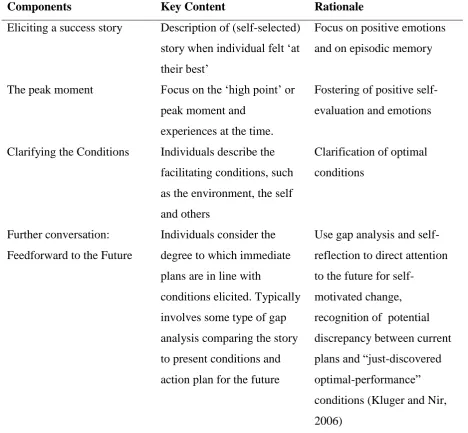
FFI focuses on a (1) elicitation of a key event during which the interviewee felt at their best,
(b) clarifying the conditions which allowed this event to happen, (c) the ‘high point’ of this
event and the emotional experience thereof and finally future plans or actions. These
principles are set out in Table 1, and lend themselves to be used flexibly in interviews,
appraisals and coaching.
Note to editor: insert Table 1 about here.
In essence then, FFI sets out to facilitate learning from the experience of past success through
cognitive comparisons (Carver & Scheier, 1981) by asking interviewees to note the
conditions and compare these to the present time, in order to initiate behavioural changes
through the setting of goals (Kluger & Nir, 2006).
Feedforward compared to Feedback
Feedforward clearly then has a future focus, where the onus rests with the interviewee
to open up and share their success story. Feedback in contrast is focused on information from
the past, and discussion thereof, and can, although does not have to be, deficit and
any feedback to individuals? Kluger and Nir (2006; 2010) propose just this, stressing the
positive effects of FFI compared to potentially harmful feedback. Whilst the use of
information as feedback is part of self-regulation processes (Carver & Scheier, 1981),
literature has yielded variable data about the consequences of feedback (see also McDowall
& Millward, 2010). Kluger and DeNisi’s (1996) meta-analysis of 607 effect sizes and 22,663
observations unravelled that Feedback improves performance moderately (d = .41), however
for one third of observations there was a deterioration in performance, so individuals were in
fact worse off having feedback than not having any feedback at all. Clearly, feedback
processes are and remain complex despite the considerable research evidence (McDowall,
2012). One common observation appears to be that content matters, where positive feedback
is recalled better and accepted more favourably by recipients than negative information
(Snyder & Cowles, 1979) increases motivation to reach a desired goal, more so than negative
feedback (Van-Dijk & Kluger, 2004). As individuals are overall motivated to see themselves
in a positive light (Anseel & Lievens, 2006), there appears to be a case to generate evidence
for positively focused and psychologically safe interventions. We now turn to the purported
‘active ingredients’ of FFI.
The ‘active ingredients’ of the FeedForward Interview
With regards to the emotional valence, recalling a “full of life, at best” experience
during FFI is purported to foster positive emotions (Kluger & Nir, 2006. Retcher (2009)
compared FFI to other conditions or interventions using a between-subjects experimental
design involving; FFI, a neutral interview and a no interview condition. The results indicated
that those who experienced FFI reported the most positive emotions.
FFI also focuses on internal discrepancy between the standards identified from
discovering the conditions for success, and other internal information such as current plans
for the future in contrast to potential discrepancies between external information and external
ideas and self-referent information derived from Feedback (Kluger & DeNisi, 1996). This
internal comparison is the essence of FFI, purportedly making it more difficult to give up the
internal standards following recollection of success. Kluger and Nir (2006) suggest that the
success story augments self-efficacy, induces positive emotions and hence increases the
likelihood of behaviour change in light of the just-discovered conditions for success.
People’s strengths appear difficult to define, as they areare potentially unconscious
there is perhaps an overall need for further research as to how strengths can be made
conscious and salient, and FFI integrated into coaching may be one way of doing so.
Research to date indicates that strengths-use or knowledge can lead to a variety of positive
outcomes including; heightened self-efficacy, self-esteem, well-being, goal-attainment,
work-engagement and work performance (Harter et al., 2002; Govindji & Linley, 2007; Smedley,
2007; Proctor et al., 2009; Linley et al., 2010; Minhas, 2010).
As alluded to above, FFI’s appreciative component, involving story-telling about a
positive experience, has been suggested to evoke positive emotions and mood states, by
bringing positive experiences to the forefront (Hermans et al., 1992). The experience of a
positive mood state is linked to a number of positive outcomes, including increased creativity
and willingness to co-operate (Fredrickson, 2001). Participants induced in a good mood are
also more willing to accept negative feedback as shown in a laboratory experiment delivering
either positive or negative feedback about achieving life goals (Trope & Pomerantz, 1998).
In terms of potentially underlying mechanisms, Barsade (2002) suggested that positive
emotions, which are also facilitated by FFI as discussed above, lead to an increased openness
to new information, through introspective reflection on individuals’ capabilities and their
strengths.
Self-efficacy and goal attainment
Self-efficacy is the belief in one’s own capabilities to execute an action in response to
a prospective situation (Bandura, 1977; 1986). Social cognitive theory holds that levels of
influences decisions to perform certain behaviours, effort and persistence during undesired
situations, where a set of expectations, based on past experiences, are carried forward to
future situations (Schwarzer, 1993; Sherer et al., 1982). Whilst the literature on FFI does not
directly discuss efficacy overtly as a construct, FFI’s positive, internal and
self-enhancing focus may allow individuals to become more to likely to become aware of their
strengths (Govindji & Linley, 2007) and thus strengthen self-belief in their capabilities. The
effects of feedback appear to run counter positive effects. In particularly predominantly
negative feedback may lower self-efficacy through the potential discrepancy between the
self-view (which may be positive) and ‘feedback givers’ view (which may be negative)
(Bandura, 1986; Dweck, 1986: McDowall & Kurz, 2008).
Goals and their attainment are another motivational aspect, in addition to augmented
goals direct attention and provides motivational focus (Locke & Latham, 1990). Goals are a
habitual element of many coaching and feedback processes, providing focus and a referent
benchmark for coach and coachee alike (McDowall & Millward, 2010) to map out action
plans and track what has and has not been achieved, and also where goals need to be revised.
Goals and an associated cognitive comparison is also part of the FFI process, where
individuals compare their current state and experience with any goals or future plans. Whilst
there are many studies on goal setting, there remains a need to research under what conditions
goals are best achieved.
Study rationale and hypotheses
In summary then, there appears some evidence for certain mechanisms of FFI, in that
it appears to raise positive emotions. However, the other ‘ingredients’ merit further
experimental investigation to test out a predominantly theory-driven tool which is purported
to reside in a strengths-focused and positive paradigm, to enable participants to work towards
their goals. To this extent, we set out to investigate to what extent such a positively focused
activity raises strengths-confidence and also facilitates goal achievement. As it is also
purported that the FFI works more effectively than a purely feedback based approach.
However, the evidence base for feedback is in comparison much larger but also more
disparate; whilst feedback remains a core activity in coaching (McDowall, 2012). To this
extent, the current study investigated to what extent coaching sessions using feedback or FFI
affect strengths-confidence, mood and self-efficacy at two time intervals as compared to any
observed effects for a feedback condition. More specifically, our hypotheses were:
H1: Participants will have higher self-efficacy following FFI than following feedback
H2: Positive mood will increase more following FFI than following feedback
H3: Strengths-confidence will increase more following FFI than following feedback
H4: There will be higher goal attainment following FFI than following feedback.
Method
Participants
We recruited fifty four fulltime employees across a range of job roles and
age range: 20 - 67 and 92% declared White British) through personal contacts and
snowballing strategies to participate in this research, all had considerable work experience
and none had previous experience of coaching.
Design
Participants were randomly assigned to either FFI (N = 32) or feedback coaching (N = 221) in
using a between participants design. We took measures before and after each coaching
intervention, the dependent variables were generalised self-efficacy, positive mood,
strengths-confidence measured 1 week after participation, and goal attainment measured one
month after participation as outlined below.
Measures
Generalised Self-Efficacy. We used the Generalized Self-Efficacy Scale (GSES, Schwarzer & Jerusalem, in Schwarzer, 1992); which contains ten items rated on a 4-point
scale (1 = not at all true, 2 = hardly true, 3 = moderately true, 4 = exactly true), a sample
item was “I am certain I can accomplish my goals”. Coefficient alpha was consistent with α =
.83 before and after coaching.
Mood. We utilised thePositive and Negative Affect Schedule (PANAS, Watson et
al., (1988); measuring positive affect (PA) and negative affect (NA) respectively by
participant rating of 10 adjectives each using a 5-point scale (1 = very slightly or not at all, 2
= a little, 3 = moderately, 4 = quite a bit, 5 = extremely). Alphas varied somewhat, for PA,
the Cronbach alpha statistic was α = .53 before coaching, and α = .85 after coaching, and for
NA α = .77 before coaching, and α = .76 after coaching.
Both GSES and Mood were measured before and after coaching.
Strengths-confidence. We asked participants to list their three key strengths to set a context for the subsequent discussion and facilitate ratings of the strengths confidence items.
Participants listed a wide range of aspects such as organisation (10.6%), commitment/
determination (7.5%), .communication skills (5%) and work ethic (4%). We then asked
participants to rate how confident they felt that the three strengths listed were indeed their
key strengths; using an 11-point percentage scale (ranging from 0% to 100% both) before and
after coaching. We also wrote items specifically for this study, asking participants to rate five
items tapping into strengths-confidence using a 5-point scale (1 = strongly disagree, 2 =
disagree, 3 = neither disagree nor agree, 4 = agree, 5 = strongly agree), at time interval two
in questionnaire 2 only (after coaching), an example item was “The coaching session has
helped me clarify what I think my strengths at work are”. Cronbach alpha was recorded as α
= .63.
Goal attainment. We used Goal Attainment Scaling (GAS) which whilst initially
developed in the mental health field has applicability in coaching ton determine goal change
(Kiresuk & Sherman, 1968; Ottenbacher & Cusick, 1990). Participants first agreed a specific
goal during the respective session and discussed what attainment of this goal would look like.
At the time of the follow up one month later, they then self-rated their attainment using a
5-point scale (+2 = Much more than expected learning outcome, +1 = Somewhat more than
expected learning outcome, 0 = Expected level of learning outcome, -1 = Somewhat less than
expected learning outcome, -2 = Much less than expected learning outcome.)
Finally, we included an open-ended item to allow participants to share their perceptions
of the study experience.
The FFI and Feedback Interventions
Following a favourable ethical opinion from the researchers’ institutions and
participants’ informed consent to participate, we agreed mutually times and locations for each
coaching session, usually at the participants’ place of work. The second and third author
(MSc students at the time) were trained in the respective coaching, feedback and FFI
techniques and delivered the sessions. Each had undertaken a five - lecture module focused
on coaching, and was trained specifically in the technique by the first author. All researchers
had also trained in the certificates of competence for both ability and personality assessments
in the workplace (as regulated by the British Psychological Society) to equip them to deliver
the feedback sessions. Following consent and allocation to condition, we provided all
participants with an information sheet about the respective condition. Each session took about
45-60 minutes, the FFI sessions slightly longer than the Feedback sessions on average; we
counter balanced how many feedback and FFI sessions each researcher undertook. The
Indepth Pathfinder Inventory statements (SHL, ND), discussing the participants’ career
preferences and plans. The FFI followed the script as outlined above, including the discussion
of a ‘success story’, the conditions therefore, the high point, and the emotional experience
and plans for the future. Participants recounted a range of differing experiences, all from a
work context, including success around mastering a newly learned task or role or interactions
with others.
Results
All variables were checked for normality and outliers, and missing data for one
participant (who submitted a partially completed follow up questionnaire) was substituted
with means as appropriate.
Testing H1, we conducted a mixed ANOVA to address the 2 x 2 (condition: FFI and
Feedback, and time: pre and post coaching) mixed-research design. The mean scores for
self-efficacy were higher after coaching (M = 32.63, SD = 3.7) compared to before coaching (M =
31.5, SD = 3.65), a statistically significant difference F(1,52) = 5.40, p = .02, ƞ²= .09. There
was a highly significant interaction between condition and time F(1,52) = 57.89, p < .001,
ƞ²= .24. Figure 1 shows that whilst self-efficacy increased for FFI, it decreased for feedback.
Note to editor: insert Figure 1 about here
We compared self-efficacy post FFI compared to Feedback using an independent
t-test, revealing that participants reported greater generalised self-efficacy after FFI coaching
(M = 33.81, SD = 3.05) compared to feedback coaching (M = 30.91, SD = 3.95), with a
significant difference t(52) = 3.04, p =.004, d = .73.
Testing H2, we conducted another mixed ANOVA. The results of the main effect of
condition revealed no overall significant difference for mood F(1, 52) = 0.28, p = .129, ƞ²=
.001; there was also no significant main effect for time F(1,52) = .00, p = .98, ƞ²= .00 and no significant interaction effect, F(1,52) = .77, p = .77, ƞ²= .02, we noted that positive affect
increased following FFI, but decreased after Feedback.
Testing H3, a third mixed ANOVA elicited no overall significant difference for
strengths confidence between FFI and feedback conditions F(1, 52) = .00, p = .99, ƞ²= .00, or
F(1,52) = 5.16, p = .027, ƞ²= .09. Figure 2 reveals that whilst strengths-confidence increased
for FFI, it dropped in the feedback condition.
Note to editor: insert Figure 2 about here
We then conducted an independent samples t-test showing that whilst participants
reported somewhat greater strengths-confidence following FFI (M = 80%, SD = 13.68)
compared to feedback coaching (M = 77.27%, SD = 10.77), this was statistically not
significant.
Testing H4, we first explored the data. In the FFI condition, all 32 participants met
or exceeded the goal they had set after one month, with 5 of them greatly exceeding the
achievement of the goal, by scoring themselves as +2 in Goal Attainment; 21 participants
scoring their goal attainment as a somewhat more than the expected learning outcome, and
6 participants scoring themselves as having met the expected level of learning outcome (0.)
In the Feedback condition, 13 participants met or exceeded the goal they had set
after one month, with 3 participants having a somewhat higher than expected learning
outcome and 10 participants scoring themselves as having met the expected level of
learning outcome (0.) In contrast to the FFI group, 9 participants had a somewhat less than
expected learning outcome after their coaching session (-1.)
We used an Independent Samples T-Test to measure the difference in goal
attainment. The results indicated a statistically significant difference, with the FFI group
significantly achieving more goals (M = 0.97, SD = 0.59) than the Feedback group (M =
-0.27 SD = 0.70), T(52) = 6.99, p = <0.005.
Discussion
This research set out to investigate to what extent self-efficacy, positive mood,
strengths confidence and goal attainment change following FFI as compared to feedback as
part of a one off coaching session. To our knowledge, this is the first quasi-experimental
study comparing FFI to feedback. We gathered support for H1, as taking part in FFI increased
self-efficacy more than for the feedback condition, with a significant main effect for time and
significant interaction, where self-efficacy dropped in the feedback condition. Whilst there
either the main or interaction effects; hence there was no direct support for H2. With regards
to H3, whilst participation in FFI did increase strengths-confidence, the main effects for time
and condition were not significant, there was however a significant interaction, showing that
strengths confidence dropped in the feedback condition. Finally, participants in the FFI
condition were far more likely to attain self-set goals than those who had participated in
Feedback, lending supporting to H4.
Taken together, our study provides quasi-experimental evidence that participation in
FFI may indeed facilitate positive psychological change, and in particular affects individuals’
belief in their respective capability as well as positive goal change (Kluger & Nir, 2006). In
other words, the findings indicate that FFI might provide a valuable technique to facilitate
goal attainment as well as increased belief in one’s capability. It is likely that the self-directed
and positive Focus of FFI accounts for these effects. Our findings extend the coaching
literature. Whilst a previous study has shown that using ones strengths heighten levels of
self-efficacy (Govindji & Linley, 2007), our findings show that the mere discussion and reflection
on such strengths and good experiences during FFI also glean positive effects. Of course, it
needs to be acknowledged that FFI may also play to general human preference, given that
individuals are motivated to view themselves as in a positive light (Anseel & Lievens, 2006).
We observed no difference for positive mood following FFI or feedback. This is
somewhat surprising given that the rationale for FFI includes the deliberate induction of
positive emotions (Retcher, 2009). We content that a potential explanation for is observation
is that there might be individual differences in the responses to FFI and in individual capacity
to gain immediate benefits from a single interview (Kluger & Nir, 2006). Individuals may
vary in their ‘FFI curve’, where any effects may take longer for some participants than for
others. Given the explorative nature of the current study, we confined the process to one
coaching study in each condition, but future research should take a more longitudinal
approach. Additionally, there is the possibility that extraneous factors may have influenced
reported mood when measured one week after the coaching sessions, including physical,
psychological, social, environmental, stress and demographic variables (Taenzer et al, 1985;
Teychenne, 2008; Bolger et al., 1989), and we recognise the difficult in accounting for these.
Indeed, we cannot discount that any effects of FFI s may have diminished after that week,
On average, participants did have greater strengths-e confidence after FFI; however
this was not statistically significant in the comparison to Feedback. Again, this finding is
surprising given that FFI focuses on and positively reinforces the elicitation of strengths
through active listening and facilitating reflection. In the qualitative comments, participants
agreed that taking part in FFI indeed helped to clarify their respective strengths at work.
Whilst uncovering and reflecting on such strengths is a core component of the technique,
improved strengths-confidence may require deeper reflection, and also embedding through
additional coaching sessions.
Participants attained significantly more goals following FFI compared to Feedback, and we endeavor here to offer an explanation for these effects. Kluger and DeNisi (1996) argue that individual motivation is facilitated when there is a discrepancy between any goals and their current state, but that different responses can occur, depending on the route of highest benefits and lowest cost. It is tenable, as feedback is more externally driven than FFI, that participants may be more likely to agree with self-referenced information, resulting in a lower motivational impetus. FFI directs attention to the participant, and internal standards and comparison processes (Kluger and Nir, 2006) and allowing increased control over the coaching process. Given that the process is focused on eliciting a story of success, FFI may create a discrepancy between how the individual currently feels about future plans, and their ideas of what conditions can enable success. Reflection on this discrepancy reduces the chances of the participant rejecting or ‘escaping from’ their goals, and therefore it is more likely that behavior will change as internal standards are renegotiated, as a result of the new internal knowledge.
We had not predicted the negative changes in self-efficacy or strengths- confidence in
the feedback condition, or indeed the significant interactions. Previous literature has
demonstrated lowered self-efficacy following negative feedback, whereby the process may
have induced a discrepancy between the belief of the individual and the content of the
feedback (Bandura, 1986; Dweck, 1986). Our research pointed to deleterious effects even for
a positively framed feedback intervention, and deleterious effects for perceived strengths, too.
Whilst not predicted as such, these results nevertheless call for further discussion and
exploration in subsequent studies, given also that we observed a clear impact on behaviour –
Feedback participants set fewer goals.
Controlled experimental research including thorough baseline measures in coaching is
still rare. We had deliberately used a longitudinal design however to test our hypotheses.
Whilst we offer our quasi-experimental approach as a contribution on a potentially interesting
and relevant but still relatively sparsely researched technique, we also acknowledge some of
the methodological limitations. These include potentially fluctuating effects which our design
may not have captured at the follow up interval. Whilst in an ideal world we may have
wished to take measurements at additional intervals, our participants volunteered their
participation, meaning that we did not want to impose unduly on their time, and hence kept
the intervention groups to one session each. We also recognise that that the feedback group
was somewhat smaller than the FFI group, which, although outside our control, nevertheless
impacted the power of our design. Finally, we cannot preclude experimenter effects as it was
not possible to conduct a double-blind experiment when the researchers themselves are
involved in delivering the interventions. To render follow up research more robust, we would
use an external practitioner to deliver the sessions to minimise such effects.
Proposed Future Research
Whilst we stress that researching one coaching session at a time can provide
valuable insight, we recommend research into long-term effects and learning transfer of FFI
in the workplace as a valuable next step, to investigate long term effects more fully over time.
The goal setting element in itself also merits further follow up. Whilst we know that more
goals were obtained in FFI, it would be helpful to ascertain how these may link to
overarching plans and changes, for instance in relation to careers, well-being or other
outcomes. In addition, further research adopting a formal measurement of the suggested
‘positive spiral’ (Kluger & Nir, 2006), perhaps even including observational techniques and
subsequent coding of behaviour, would provide support for any positive emotions
unconsciously displayed by the interviewee during FFI. Such an approach would allow
additional insight into the immediate effects of FFI, for instance focused on emotion and
mood experiences. Lastly, future research should also consider coach effects in more detail
by obtaining data from coachees to determine which exact facilitation and questioning
techniques (which FFI elements?) work best from their point of view.
Implications for Practice
Our evidence shows that a positive and future focused approach, as in FFI, reaps
context, FFI is a simple, flexible and accessible technique which can be adapted for other
contexts. Research associates high self-efficacy with setting and achieving more challenging
goals, optimism, increased effort, persistence and recovery (Schwarzer et al., 1996), our
research showing that FFI has positive effects on self-efficacy, beliefs, and behaviour, as
evident in goal attainment.
Conclusion
We report controlled quasi-experimental research showing that FFI affects
self-efficacy and goal attainment, and an interaction for strengths-confidence. The findings thus
indicate that taking part in the FFI prompts positive psychological change through a
strengths-focused approach, whilst also indicating caution about the potentially deleterious
effects of solely feedback-based interventions. Future research should focus on transfer of
learning, consider coach effects and more detailed data from coachees. We hope that
practitioners and researchers alike may adapt our approach and adopt FFI in their own
References
Anseel, F., & Lievens, F. (2006). Certainty as a moderator of feedback reactions? A test of the
strength of the self-verification motive. Journal of Occupational and Organizational
Psychology, 79, 533-551.
Aspinwall, L & Staudinger, U. M. (2003). A psychology of human strength: Fundamental questions
and future directions for a positive psychology. Towards a psychology of human strengths.
Washington DC: APA Books.
Bandura, A. (1977). Self-efficacy: toward a unifying theory of behavioural change. Psychology
Review, 84, 191-215.
Bandura A. (1986). Social foundations of thought and action: a social cognitive theory. New Jersey:
Prentice Hall.
Barsade, S. G. (2002). The ripple effect: Emotional contagion and its influence on group behaviour.
Administrative Science Quarterly, 47, 644-675.
Bolger, N., DeLongis, A., Kessler, R. C., & Schilling, E. A. (1989). Effects of daily stress on
negative mood. Journal of Personality and Social Psychology, 57(5), 808-818.
Bouskila-Yam, O. & Kluger, A.N. (2011). Strength-based performance appraisal and goal setting. Human Resource Management Review, 21(2), 137-147. DOI
http://dx.doi.org/10.1016/j.hrmr.2010.09.001
Carver, C. S., & Scheier, M. F. (1981). Attention and self-regulation: A control theory to human
behaviour. New York: Springer-Verlag.
Cooperrider, D. L., & Srivastva, S. (1987). Appreciative Inquiry in Organizational Life. In Passmore,
W. & Woodman, R. (Eds.), Research in Organizational Chance and Development.
Greenwich, CT: JAI Press.
Dweck, C. S. (1986). Motivational Processes Affecting Learning. American Psychologist, 41(10),
1040-1048.
Fredrickson, B. L. (2001). The role of positive emotions in positive psychology – The broaden and
built theory of positive emotions. American Psychologist, 56, 218-226.
Govindji, R. & Linley, P. A. (2007). Strengths use, self-concordance and well-bring: Implications for
strengths coaching and coaching psychologists. International Coaching Psychology
Harter, J. K., Schmidt, F. L., Hayes, T. L. (2002). Business-unit-level relationship between employee
satisfaction, employee engagement, and business outcomes: A meta- analysis. Journal
of Applied Psychology, 87, 268-279.
Hermans, H. J. M., Kempen, H. J. G., & Van Loon, R. J. P. (1992). The dialogue self: Beyond
individualism and rationalism. American Psychologist, 47, 23-33.
Kluger, A. N., & DeNisi, A. (1996). The effects of Interventions and Performance: A Historical
review, a meta-analyses, and a preliminary Feedback Intervention Theory. Psychological
Bulletin, 119, 2, 254-284.
Kluger, N. K., & Nir, D. (2006). Feedforward first – feedback later. Keynote lecture delivered at the
26th International Congress of Applied Psychology. Athens, Greece.
Kluger, N. K., & Nir, D. (2010). The Feedforward interview. Human Resource Management Review,
20, 235-246.
Linley, P. A., Garcea, N., Hill, J., Minhas, G., Trenier, E. & Willars, J. (2010). Strengthspotting in
coaching: Conceptualisation and development of theStrengthspotting Scale. International
Coaching Psychology Review, 5(2), 165-176.
Linley, P.A. & Harrington, S. (2006). Strengths Coaching: A potential-guided approach to coaching
psychology. International Coaching Psychology Review, 1(1), 37-36
Linley, P.A., Wollston, L. & Biswas-Diener, R. (2009). Strengths Coaching with leaders.
International Coaching Psychology Review, 4(1), 37-46
Locke, E.A. & Latham, G.P. (1990). Work Motivation and Satisfaction: Light at the End of
the Tunnel. Psychological Science, 240-246, doi:
10.1111/j.1467-9280.1990.tb00207.x
McDowall, A. ( 2012). Using Feedback in Coaching. In Passmore, J. (Eed, 2nd Ed.).
Psychometrics in Coaching. London: Kogan Page
Palmer, S. & McDowall, A. (2010). The Coaching Relationship. Putting people first. An
introduction. In Palmer, S. & McDowall, A. (2010). Putting People First.
McDowall, A. & Millward, L. (2010). Feeding back, feeding forward and setting goals. In
Palmer, S. & McDowall, A. (2010). Putting People First. Understanding Interpersonal
Relationships in Coaching. London: Routledge
McDowall, A. & Mabey, C (2008). Developing a framework for assessing effective
development activities. Personnel Review, 37(6), 629-646
McDowall, A. & Kurz. R. (2008). How to get the best out of 360 degree feedback in
coaching. The Coaching Psychologist, 4 (1), 7-19
Minhas, G. (2010). Developing realised and unrealised strengths: Implications for engagement,
self-esteem, life satisfaction and well-being. Assessment and Development Matters, 2(1),
12-16.
Nir, D. (2008). Thriving through inner conflict: The negotiational-self theory and its application for
reaching integrative solutions to inner conflict. Paper presented at the 4th European
Conference on Positive Psychology, Rijeka, Croatia.
Oades, L.G., Crowe, T.P & Nguyen, M. (2009). Leadership coaching transforming metnal
health systems from the inside out: The Collaborate Recovery Model as
person-centred strengths based coaching psychology. International Coaching Psychology
Review, 4(1), 25-31
Proctor, C., Maltby, J. & Linley, P. A. (2009). Strengths use as a predictor of well-bring and
health-related quality of life. Journal of Happiness Studies, 10, 583-630.
Roberts, L. M., Dutton, J. E., Spreitzer, C. M., Heaphy, E. D., & Quinn, R. E. (2005). Composing the
reflected best-self-portrait: Building pathways for becoming extraordinary in work
organizations. Academy of Management Review, 30, 712-736.
Russell, J. A., & Carroll, J. M. (1999). On the bipolarity of positive and negative affect.
Psychological Bulletin, 125, 3-30.
Scholz, U., Dona, B, G., Sud, S., & Schwarzer R. (2002). Is general self-efficacy a universal
construct? Psychometric findings from 25 different countries. European Journal of
Psychological Assessment, 18(3), 242-251.
Schwarzer, R. (1993). Measurement of perceived self-efficacy: Psychometric scales for
Schwarzer, R., Babler, J., Kwiatek, P., & Schroder, K. (1996). The assessment of optimistic beliefs:
Comparison of the German, Spanish and Chinese versions of the General Self-efficacy
scale. Applied Psychology: An International Review, 46(1), 69-88.
Sherer, M., Maddux, J. E., Mercandante, B., Prentice-Dunn, A., Jacobs, B. (1982). The self efficacy
scale: Construction and validation. Psychology Review, 51, 663-71.
Seligman, M. E. P., & Csikszentmihalyi, M. (2000). Positive psychology: An introduction. American
Psychologist, 55, 5-14.
Sharpe, T. (2011). The primacy of positivity – applications in a coaching context. Coaching: An International Journal of Theory, Research and Practice. 4(1), 42-49. DOI:
10.1080/17521882.2010.550897
Smedley, T. (2007). The powers that BAE. People Management, 13(22), 40-43.
Snyder, C. R., & Cowles, C. (1979). Impact of positive and negative feedback based onpersonality
and intellectual assessment. Journal of Consulting and Clinical Psychology, 47(1), 207-209.
Taenzer, P., Melzack, R., & Jeans, M. E. (1985). Influence of psychological factors onpostoperative
pain, mood and analgesic requirements. Pain, 3, 331-342.
Teychenne, P. (2008). Social factors affect mood-exercise link for women. InternationalJournal of
Behavioural Nutrition and Physical Activity, 1-13.
Trope, Y., & Pomerantz, E. M. (1998). Resolving conflicts among self-evaluative motives: Positive
experiences as a resource from overcoming defensiveness. Motivation and Emotion, 22,
53-72.
Van-Dijk, D., & Kluger, A. N. (2004). Feedback sign effect on motivation: Is it moderated by
regulatory focus? Applied Psychology: An international Review, 53, 113–135.
Watson, D. & Clark, L. A. (1988). Development and validation of brief measures of positive and
negative affect: The PANAS scale. Journal of Personality and Social Psychology, 54(6),
Table 1: Key components of the FeedForward Interview (FFI)
Components Key Content Rationale
Eliciting a success story Description of (self-selected)
story when individual felt ‘at their best’
Focus on positive emotions
and on episodic memory
The peak moment Focus on the ‘high point’ or
peak moment and
experiences at the time.
Fostering of positive
self-evaluation and emotions
Clarifying the Conditions Individuals describe the
facilitating conditions, such
as the environment, the self
and others
Clarification of optimal
conditions
Further conversation:
Feedforward to the Future
Individuals consider the
degree to which immediate
plans are in line with
conditions elicited. Typically
involves some type of gap
analysis comparing the story
to present conditions and
action plan for the future
Use gap analysis and
self-reflection to direct attention
to the future for
self-motivated change,
recognition of potential
discrepancy between current
plans and “just-discovered
optimal-performance”
conditions (Kluger and Nir,
Figure 1. Self-efficacy before and after FFI and Feedback.
29
30
31
32
33
34
35
Sel
f-ef
fi
cacy
Mean
Sco
res
Figure 2. Strengths confidence following FFI and Feedback.