This work is licensed under a Creative Commons Attribution-NonCommercial 4.0 International License.
Externalising, sharing and comparing
perceptions in engineering design
HIRD AbiDepartment of Design, Manufacture and Engineering Management * [email protected]
124
There is a need for organisations and the leaders within them to explore, recognise, build and exploit new capabilities. Some of this ‘new’ capability could be better utilisation of the resources already at their disposal. For example, highly skilled designers and engineers. This paper explores the notion of knowledge models in design with two driving motivations. Firstly, a new urgency in the light of the forth industrial revolution, from a digitisation perspective: can we integrate designer’s thoughts with AI. Secondly, a longer-standing concern, from the point of view of the inherent need to communicate and express and model clearly in achieve the objective of design. A conceptual analysis of the role of models in design is presented before a potential new approach is proposed.
keywords: digitisation, knowledge models, communication, perceptions
Introduction
Engineering design is uniquely valuable as a creative and inherently uncertain activity within a world that has become increasingly automated and, in many senses, predictable. It is a valuable and precious resource. However, the outputs generated, the thoughts and ideas produced, often disappear into the ether. The opportunity for interrogation, deeper understanding, comparison and analysis is lost. In a more practical sense, the meaning and intent and perception informing a decision is gone. Those later in the product life-cycle are left to guess and those present in the decision making process are forced to make
Digitisation is increasingly central to the process of manufacturing and through-life management of products. Whilst we explore the possibilities for capturing knowledge and perceptions from a digitisation perspective, the same end-goal of externalising
perceptions so they can be shared and communicated spans across traditional, non-digitised design practice.
Digitisation
Improvements in technologies relating to measurement, communication and isolation have enabled a step-change from the automation ‘Industry 3.0’ of cyber-physical systems working semi-independently to a paradigm that interconnects the physical and virtual in a type of ‘social manufacturing’ where customer needs and behaviours are directly linked to industry production and where machines to machine communication and closed loop decision making enable autonomous decision making (Wang, 2015). This shift in paradigm coined as ‘Digital Manufacturing’, ‘Smart Manufacturing’ and ‘Industry 4.0’ represents a significant conceptual and practical transition in Manufacturing practice. Through-life intelligence of smart products is integral to realising the full advantages of such
paradigms. Increasingly, emphasis is placed on embedded intelligence within the life-cycle phases and within the product itself (Duffy et al. 2016).
Machines can manufacture, monitor manufacture and make decisions about the design of manufacturing process parameters. Although there are still technical challenges within manufacture (limitations of sensors, etc.) the actual management of information, the management of information through control loops and mechanisms for autonomous decision making are relatively well developed and, to some extent, realised in practice. In a manufacturing domain, data describing processes exists in abundance: providing it can be measured it can be modelled mathematically.
During design, the product or system is in the process of being realised. Therefore, parameters cannot be definitely quantified, they must be modelled (an approximation of reality). Sensors can collect data of machine temperatures or the path of material through a supply chain but until a design is realised there is nothing tangible to measure. Design involves creating new value. To do so knowledge tied to experiences, intuition,
unarticulated models or implicit rules of thumb is required. This is known as tacit knowledge.
Tacit knowledge is gained over a long period of time. It is difficult to express and can only be transferred with willingness (Nonaka, 1991). Because it isn't readily explicit and is challenging to model, we are some way off creating it in a format that is that is intelligible by machines.
The role of models in engineering design
used to predict the outcomes, models in design are most often used to demonstrate that time and money can be invested with reasonable confidence because the predicted outcome can be trusted (Simon, 1996). Achievement of confidence is not binary. Through skilled modelling of the problem and corresponding solutions, confidence can grow whilst ambiguity and uncertainty decrease. Usually, absolute certainty will not be possible prior to the product being realised but it is the role of the Design Engineer to reduce and manage risk.
The integration and balancing of an array of design requirements and, the setting-out, communication and specification of this balance in a plan for realisation of an artefact or process is the focus on design and design management activity. This is a non-trivial matter: a whole plethora of requirements must be considered. From business objectives, manufacturing constraints and through-life considerations to the performance objectives of the system: somehow harmony must be obtained.
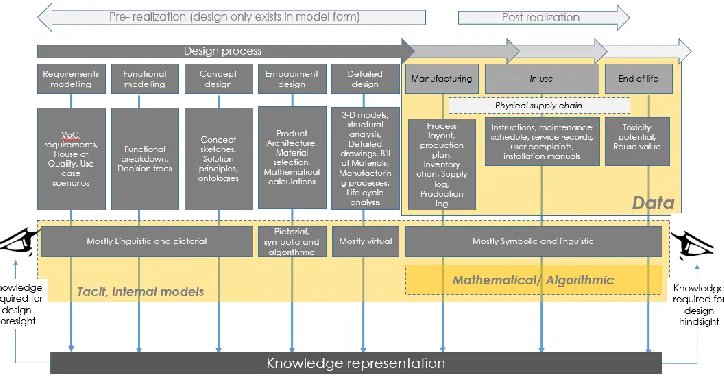
A plethora of literature describes endeavours to facilitate and manage the integration and balance of requirements but the art and science of design remains subject and skill dependant. Much of the contextual and expert knowledge resides in the minds of designers (Lawson, 2006; Cross, 2008). Horvath (2004) suggests that the function of engineering design is to transform rational and empirical knowledge in a form that can be used for practical realisation of a system. The design takes from through the process of creating models. Designers don’t just exchange geometric and mathematical data. Modelling involves general knowledge of design and of the product development process including specifications, design rules, constraints and rationale. Chandrasgaran et al (2013) present a detailed and useful model of Knowledge representation in product design. The model elegantly illustrates the important concept of design foresight as well as the range of modelling methods used at each design phase. For the purposes of illustrating some additional concepts Chandrasgaran et al (2013) model has been adapted.
1. Firstly, the in use phase is an important consideration and receiving increasing attention as Smart Products become operational and big-data influenced design decision making. The integration of through-life data into design decision making is one area that requires further exploration.
2. As products and processes become smarter, reflection upon design decision making becomes as important as foresight. What are the implications of changing the system? What are the limitations of the design? The Knowledge required for design insight is a new addition to the model. Supply chain data and traceability becomes increasingly important. This is also true from a sustainability
perspective.
3. Internal, tacit knowledge models are not included in Chandrasgaran et al (2013) original model (by definition, they aren’t representations of knowledge). However, internal models do influence how knowledge models are created and interpreted and are of significant to foresight; retrospective insight and sharing within teams as such, they shouldn’t be discounted in efforts to improve
Although unrepresented in Figure 1, within a single design activity sharing information and knowledge is critical. A great deal of effort is required for designers to communicate their rationale and perceptions about design parameters and the impact of parameters upon the design objectives (Klein, 1993).
Figure 1 Knowledge models through-life. Adapted from Chandrasgaran et al..(2013) to show the
influence of data; tacit, internal knowledge models and the reflective perspective.
Clarity of shared information is critical within design: from an end of life to design perspective looking back to design; from design looking forward anticipating future life cycles phases (manufacturing or end of life, for example) and; within a design phase (between members of a cross-functional design team). Ambiguity is ubiquitous in subjective expert perceptions and interpretation within an immediate context and time. This is amplified across geographical, contextual and temporal chasms. As products and systems become more complex or have longer life-in service this is an increasingly pressing challenge. In order to address this challenge it is essential that we develop ways of sharing expert and tacit knowledge objectively. In addition to improving design practice as it stands, it is essential that new and intuitive tools for knowledge acquisition are developed if we are to move toward digitisation of design or AI supported design. This is not to say that design would or should ever become fully autonomous, but that there is room to improve upon the design process as it stands by modelling expert knowledge in digitised and AI supportable form.
under increasing pressure to innovate. AI decision support could be revolutionary in enabling comprehensive through-life decision making, reducing lead times and cost and waste associated with unplanned rework.
Physical models
Physical models, for example prototypes, create a visual replica of the system being designed. The appearance often corresponds to some aspect of the intended physical reality of the object of design. Physical models may also allow some or all of the product functionality to be tested by may have less emphasis on aesthetics of equality. A scaled version of an object can enable aesthetic of aerodynamic evaluation, for example, without the invest in a full expression of functionality and detail. Physical models are tangible and enable clear communication of some aspects of a single implementation scenario. That is to say, a physical model cannot simultaneously represent two solutions and does not represent the design space. Although the physical model is tangible, the manufacturability knowledge relating to the rationale driving the radius of a specific curve remains in the mind of the designer. Physical models can be accompanied by a linguistic description or a schematic model and may be underpinned by (or underpin) mathematical analysis.
Schematic and pictorial models
Pictorial model represents the aesthetic qualities of a single implementation scenario. Quite often they are a two dimensional version of a physical model. They might include users and may illustrate the system being used in practice. They make it easy to envisage the design or an aspect of the design in practice although they may be completely fantastical and misleading in terms of viable functionality. They are often used to engage customers and non-technical stakeholders. For the purposes of technical design, they are more often integrated with a schematic model. Something of the internal and tacit is represented in a sketch. They contain an idiosyncratic style associated with a designer and may intangible aspects of personality, mood and character but these aspects remain subjective even when externalised. Schematic models tend to be more abstract than physical models. They are a pictorial representation so relationships between spatial, functional and non-functional parameters. Although they can correspond to reality, they don’t attempt to represent the literal visual appearance of the system they allude to. Schematic models represent an abstracted reality (a map, a flow chart, an electrical schematic) or, may be a more tangible representation of a mathematical model (graphs, histograms and infographics, for example).
Linguistic models
scenario descriptions are one example of this. Verbal models enable detail of the context to be communicated however, they are subjective in nature and meaning can be
ambiguous. When verbal models are used to describe a specific relationship between parameters i.e. a 'word equation' (Kieras, 1978) they can easily be translated into mathematical models (Gorzalczany, 1988).
Mathematical models
Mathematical models use a structured and specific language to describe an abstraction of an intended reality. They represent aspects of the real world through symbols which comprise of equations which detail relationships between variables. Although they are the most abstract type of model they provide a precise description of relationships and can be used to describe 'design space' as opposed to a single implementation scenario. Their unambiguous structure enables clarity and insight to be gained without the distraction of complex or superfluous information. A variety of different types of mathematical model exist. Each type of model will use a specific set of rules to construct representations of reality. Linear models, for example, can be used to represent time-series relationships or correlations between parameters. Stochastic models are able to capture randomness and, depending upon the methods used, a given set of inputs can result in a range of solutions (Buzacott, 1992). Deterministic models are used to describe solutions without randomness but which are challenging to solve or describe. For example, the transportation problem (Dantzig, 1951) or Knapsack algorithms (Cohen, 2006).
Mathematical models simultaneously offer the most abstract and most objective representation of knowledge, it follows that mathematical models might offer a useful way of sharing knowledge within and between life-cycle phases and disciplines and across space and time. Whilst subjective models are open to misinterpretation. The abstract nature of mathematical models allows them to describe a whole design solution space rather than just single implementation scenarios. The challenge with creating
mathematical models that describe general relationships is that they invariably require a large volume of data and this is contrary to the fundamental definition of tacit knowledge.
Combinations of models
Frequently, design crosses the boundaries of model types. A single model may contain aspects of model than one type. And, certainly, more than one type of model will be used in the process of realising a design. This combination approach is especially useful when considering abstract mathematical relationships. Categorisation and Regression Trees (CART) are built on a foundation of mathematical models but are presented schematically. Computer Aided Design systems couple mathematical relationships and schematic on-screen models.
Digitising expert knowledge
modelled objectively, shared understanding would be unambiguously achieved and relationships could be interrogated through discussion. There are four broad schools of thought regarding digitisation of expert knowledge: design rational capture methods (an approach emerging from the field of design); Semantic web methods (an approach inspired by the development of World Wide Web languages); Conjoint analysis (a method used primarily to understand perceptions for marketing purposes) and; a new method proposed by Hird (2016) which stems from resource forecasting in the absence of data.
Design rationale capture methods
Design Rationale capture is a field of study which has existed for several decades (Morgan,1996). Regli (2000) provides a comprehensive review of existing methods and defines Design Rational as “an explanation of why an artefact or part of an artefact is designed the way it is”. Although this definition doesn’t encompass systems or processes, it is considerable that, in principle, the concept could be extended include. This
explanation includes logic knowledge, deliberation and details of decision making pertaining to the creation of the design. This information can be useful to people involve with the artefact (or system or process) later in its lifecycle as well as other designers.
Despite the widely accepted importance, Design rationale capture tools are rarely used in practice: they are onerous and unwieldy and fail to inform the process of design or aid communication and collaboration. They are a formality and, when they are used, it is usually to record rationale post event. DRedwhich has been incorporated into Rolls-Royce PLM system (Bracewell, 2009) is an exception to lack of adoption.
Rationale Capture tools combinations of modelling methods, largely in their standard format but organised through software packages. Tools are generally either process oriented or feature oriented and can be argumentation-based or descriptive.
Process oriented methods are usually descriptive. Examples include IBIS (Kunz, 1970), DRL (Lee, 1991), PHI (Shipman, 1997). The description is represented through a graph like schema where each branch represents a specific implantation scenario. Nodes are usually questions which link out to various options. Links can be made between multiple nodes and options and, there is also the advantage that various types of multi-media models can be included – models could be schematic, verbal, virtual prototypes or mathematical. The issue with this approach is its unwieldy nature and, is difficult to represent using
computers (Fischer, 1989). Although it can help designers formalise progress, it does not lend itself to provoking additional insights.
Design rationale capture systems are used to aid communication within teams and Lee (1991) lists the benefits of such systems: better support for redesign and reuse; collaboration, dependency and constraint management; design maintenance; learning; documentation. Detailed documentation of design rationale contributions towards alleviating the problem of knowledge leaving and organisation when an employee leaves. Rationale capture systems tend to be intrusive. Capturing the rationale and is a significant challenge. In addition to being intrusive, the inherently structured approach imposed on the designer isn’t conducive with capturing tacit knowledge and as such, has not been widely adopted in practice.
Ontology and semantic web models
Ontology and semantic web models offer a primarily symbolic, linguistic architecture-based approach to modelling systems knowledge using formal modelling methods such as Unified Modelling Language (UML). When a formal modelling language is used, these models can be machine readable. This method is used to model product platforms and product families for information and design retrieval purposes. Providing expert knowledge is externalised, this is a useful way to make subjective knowledge explicit enabling objective discussion.
The semantic web approach offers models that can be queried and examined objectively. They are advantageous, especially in complex systems design and have demonstrated significant benefits in practice (Van der Vegte, 2002). These models represent an
expression of design knowledge that can be computer readable and as such are pertinent to the digitisation agenda. Furthermore, the process of creating the models compliments the design activity and contributes to removing ambiguity and uncertainty from complex through-life decision making. They structure and organise information for easy retrieval and reuse. However, they don’t lend themselves to articulating tacit knowledge and percived relationships clearly as neither the mind of a designer or the design process has a fixed order.
Conjoint analysis
Perception modelling
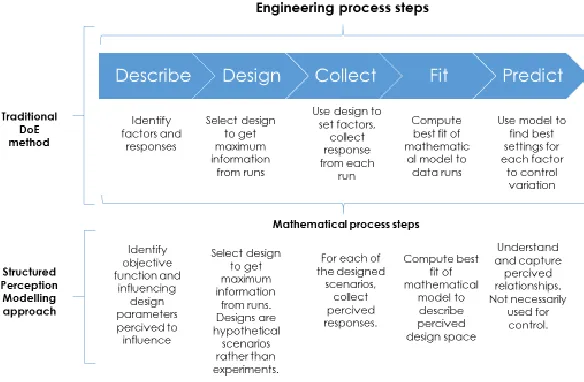
[image:9.482.94.386.180.371.2]Based on Design of Experiments method (Fisher, 1949), Hird (2016) proposes a method for modelling tacit expert knowledge without an abundance of historical data. This modelling method allows percived relationships to be represented as regression equations. We propose that there may be potential for a similar method to be used to model expert knowledge within the context of design.
Figure 2 Structured Perception modelling method (adapted from Hird, 2016)
Perception modelling method has so far only been applied to resource forecasting. In a resource forecasting context, the process of creating the models is integrated into the planning activity. From a design perspective, if the activity of creating the models can be integrated and can provides value to the designers rather than being an administrative burden, this should provide incentive for use in practice contrary to current rationale capture methods.
Conclusions and future work
Digitising expert knowledge is increasingly important. Design is essentially the process of creating models with a view to reducing risk and increasing confidence that the desired outcome can be realised. As such, one might expect that Engineering design would be exemplary in terms of knowledge representation (which also involve modelling). However, design currently involves a heavy reliance on internal mental models which, by definition, are not explicitly represented.
relationships could be presented in mathematical models they could be clearly articulated and examined leading to fuller understanding and better decision making through-life. They could be stored for future evaluation; complex inter-dependencies could be studied and their evolution could be quantified.
Information and knowledge management are central to the progression of design practice and digital manufacture. Although are long-standing challenges, the implications and opportunities that would emerge as a result of the ability to model tacit knowledge are incentive to revisit capturing and modelling tacit knowledge in design. The structured perception modelling method proposed by Hird (2016) could provide an interesting line of enquiry. In addition to improving design practice, applying such a method could also offer opportunities for understanding perceptions within design, communication within teams and knowledge evolution through-life.
The next step will be to explore the possibilities for creating structured perception models through studies with designers and, to evaluate what insights can be gleaned from analysising the models.
References
Bracewell, R., Wallace, K., Moss, M. and Knott, D., 2009. Capturing design rationale.
Computer-Aided Design, 41(3), pp.173-186.
Buzacott, J.A. and Shanthikumar, J.G., 1992. Design of manufacturing systems using queueing models. Queueing Systems, 12(1-2), pp.135-213. http://doi.org/ 10.1007/BF01158638
Chandrasegaran, S.K., Ramani, K., Sriram, R.D., HorváTh, I., Bernard, A., Harik, R.F. and Gao, W., 2013. The evolution, challenges, and future of knowledge representation in product design systems. Computer-aided design, 45(2), pp.204-228. http:doi.org/ 10.1016/j.cad.2012.08.006
Cohen, R., Katzir, L. and Raz, D., 2006. An efficient approximation for the generalized assignment problem. Information Processing Letters, 100(4), pp.162-166. http://doi.org/10.1016/j.ipl.2006.06.003
Cross, N., 2004. Expertise in design: an overview. Design studies, 25(5), pp.427-441. http:/ doi.org/10.1016/j.destud.2004.06.002
Dantzig, G.B., 1951. Application of the simplex method to a transportation problem.
Activity analysis of production and allocation, 13, pp.359-373.
Duffy, A; Whitfield, I; Ion, B; Vuletic, T; 2016. Smart Products Through-Life: Research
Roadmap. University of Strathclyde Publishing, Glasgow, ISBN 978-1-909522-17-6
Fischer, G., 1989. Human-computer interaction software: lessons learned, challenges ahead. IEEE Software, 6(1), pp.44-52. http://doi.org/ 10.1109/52.16901 Fisher, R.A., 1949. The design of experiments. The design of experiments., (5th ed). Gorzałczany, M.B., 1988. Interval-valued fuzzy controller based on verbal model of object.
Fuzzy Sets and Systems, 28(1), pp.45-53. http:// doi.org/
doi:10.1016/0165-0114(88)90115-7
Horvath, I., 2004. A treatise on order in engineering design research. Research in
Engineering Design, 15(3), pp.155-181.http:/doi.org/10.1007/s00163-004-0052-x
Kieras, D.E., 1982. A model of reader strategy for abstracting main ideas from simple technical prose. Text-Interdisciplinary Journal for the Study of Discourse, 2(1-3), pp.47-82. https://doi.org/10.1515/text.1.1982.2.1-3.47
Klein, M., 1993. Capturing design rationale in concurrent engineering teams. Computer,
26(1), pp.39-47. http://doi.org/ 10.1109/2.179154
Kunz, W. and Rittel, H.W., 1970. Issues as elements of information systems (Vol. 131). Berkeley, California: Institute of Urban and Regional Development, University of California. http://doi.org/ 10.1016/0164-1212(93)90083-A
Lawson, B., 2006. How designers think: The design process demystified. Routledge. Lee, J. and Lai, K.Y., 1991. What's in design rationale?. Human–Computer Interaction,
6(3-4), pp.251-280.
MacDonald, E.F., Gonzalez, R. and Papalambros, P.Y., 2009. Preference inconsistency in multidisciplinary design decision making. Journal of Mechanical Design, 131(3), p.031009. http://doi.org/ 10.1115/1.3066526
Nonaka, I. and Toyama, R., 2003. The knowledge-creating theory revisited: knowledge creation as a synthesizing process. Knowledge management research & practice,
1(1), pp.2-10. http://doi.org/ 10.1057/palgrave.kmrp.8500001
Moran, T.P. and Carroll, J.M., 1996. Design rationale: concepts, techniques, and use. L. Erlbaum Associates Inc..
Regli, W.C., Hu, X., Atwood, M. and Sun, W., 2000. A survey of design rationale systems: approaches, representation, capture and retrieval. Engineering with computers,
16(3-4), pp.209-235. http://doi.org/ 10.1007/PL00013715
Ren, Y. and Papalambros, P.Y., 2011. A design preference elicitation query as an optimization process. Journal of Mechanical Design, 133(11), p.111004. http://doi.org/10.1115/1.4005104
Simon, H.A., 1996. The sciences of the artificial. MIT press.
Shipman, F.M. and McCall, R.J., 1997. Integrating different perspectives on design rationale: Supporting the emergence of design rationale from design communication. Artificial Intelligence for Engineering, Design, Analysis and
Manufacturing, 11(02), pp.141-154. https://doi.org/10.1017/S089006040000192X
Van der Vegte, W.F., Kitamura, Y., Mizoguchi, R. and Horváth, I., 2002. Ontology-based
modeling of product functionality and use part 2: considering use and unintended behavior. University ofZielona Góra.
Wang, S., Wan, J., Li, D. and Zhang, C., 2016. Implementing smart factory of industrie 4.0: an outlook. International Journal of Distributed Sensor Networks, 2016, p.7 http: doi.org/ 10.1155/2016/3159805