City, University of London Institutional Repository
Citation
:
Glock, C.H., Grosse, E.H. & Ries, J.M. (2014). The lot sizing problem: A tertiary study. International Journal of Production Economics, 155, pp. 39-51. doi:10.1016/j.ijpe.2013.12.009
This is the accepted version of the paper.
This version of the publication may differ from the final published
version.
Permanent repository link:
http://openaccess.city.ac.uk/17124/Link to published version
:
http://dx.doi.org/10.1016/j.ijpe.2013.12.009Copyright and reuse:
City Research Online aims to make research
outputs of City, University of London available to a wider audience.
Copyright and Moral Rights remain with the author(s) and/or copyright
holders. URLs from City Research Online may be freely distributed and
linked to.
1
The Lot Sizing Problem: A Tertiary Study
Christoph H. Glock
Department of Law and Economics, Technische Universität Darmstadt ([email protected])
Eric H. Grosse
Department of Law and Economics, Technische Universität Darmstadt ([email protected])
Jörg M. Ries
Department of Law and Economics, Technische Universität Darmstadt ([email protected])
Abstract: This paper provides a survey of literature reviews in the area of lot sizing. Its inten-tion is to show which streams of research emerged from Harris’ seminal lot size model, and which major achievements have been accomplished in the respective areas. We first develop the methodology of this review and then descriptively analyze the sample. Subsequently, a content-related classification scheme for lot sizing models is developed, and the reviews con-tained in our sample are discussed in light of this classification scheme. Our analysis shows that various extensions of Harris’ lot size model were developed over the years, such as lot sizing models that include multi-stage inventory systems, incentives, or productivity issues. The aims of our tertiary study are the following: firstly, it helps primary researchers to position their own work in the literature, to reproduce the development of different types of lot sizing problems, and to find starting points if they intend to work in a new research direction. Sec-ondly, the study identifies several topics that offer opportunities for future secondary research.
Keywords: systematic literature review; tertiary study; lot sizing; lot size; economic order quantity; economic production quantity
Introduction
Since the publishing of Ford Whitman Harris’ (1913) seminal paper, the lot sizing problem, which aims at determining economic batch sizes by balancing inventory and setup or order costs, has received wide attention both in the academic literature and in practice. According to Google Scholar, the reprint of the original article that appeared in Operations Research in 1990 has been cited 660 times, while Scopus lists 214 citations of the original article. The search term “lot size” (“EOQ”, “EPQ”) results in more than 40,300 (34,100, 32,000) hits in Google Scholar and more than 2,400 (1,450, 1,070) document results in Scopus.1 These numbers illus-trate impressively how the results of Harris’ work have disseminated over the last 100 years.2
Curiously enough, Harris’ paper was cited with an incorrect year of publication for many years, and further it was only very infrequently considered in the literature for almost 70 years after its appearance (cf. Erlenkotter, 1989; 1990). For a comparison between Harris’ lot size formula and Kelvin’s Law that was published already in 1881, the reader is referred to Roach (2005). The attention the lot sizing problem received is not surprising given the importance of inven-tories in the global economy. The management of inveninven-tories is among the most important operational activities of industrial and trading companies. Inventory levels and structures may
1 All numbers effective September 2013. Note that some of the hits that were obtained in the search for “EPQ” in
Google Scholar and Scopus correspond to the “Eysenck Personality Questionnaire” and the “revised Eysenck Personality Questionnaire”.
2For comparison, a similar citation search for other important operations management problems revealed the
2 directly influence customer service in terms of product availability and delivery speed, which are both indispensable elements for competitiveness in developed economies (see Vastag and Montabon, 2001). In addition, managing inventories efficiently may lead to significant cost reductions. According to the US Census Bureau (2013), the present value of inventory in the United States exceeds $1.6 trillion, which illustrates the enormous potential a reduction in in-ventories may have on individual companies and an economy as a whole.
The Economic Order Quantity (EOQ) model proposed by Harris is a simple and efficient tool to avoid excessive inventory build-up in companies, and its robustness has frequently been confirmed in the literature (e.g., Lowe and Schwarz, 1983; Dobson, 1988; Stadtler, 2007). An almost uncountable number of extensions of the basic model exists, which include multi-stage production systems (e.g., Bogaschewsky et al., 2001; Glock, 2011), worker learning (see Jaber and Bonney, 1999; Glock and Jaber, 2013), or the determination of safety stocks (e.g., Hadley and Whitin, 1963; Glock and Ries, 2013), among others. A comprehensive review on the lot sizing problem has not been conducted so far. The lack of such an overview is, according to Williams and Tokar (2008), ”a handicap to the advancement of theory and practice in inventory management“.
Although reviewing all extensions of Harris’ model would be a project too ambitious to ac-complish, the existing literature permits the identification of popular research streams, whose analysis and synthesis may help researchers to identify relevant works in the area of lot sizing. In this line of thought, this paper presents the results of a tertiary study on the lot sizing prob-lem. In this study, review papers on lot sizing-related topics are identified in a systematic liter-ature review process and evaluated in a structured framework. The intention of this paper is to show which streams of research emerged from Harris’ seminal lot size model, and which major achievements have been accomplished in the respective areas. Thus, this tertiary study presents an overview that may support primary researchers in positioning their own work in the litera-ture, in reproducing the development of different types of lot sizing problems, and in finding starting points if they intend to work in a new research direction. In addition, this study also derives suggestions for reviewing the literature in the area of inventory management, which may be of great help for future secondary research.
The remainder of the paper is structured as follows: The next section describes the methodol-ogy of the tertiary study and descriptively evaluates the sample. Subsequently, the seminal lot size model is presented and a classification scheme for lot sizing models is developed. This is followed by a detailed content analysis in Section 3 that assigns the reviews that were identified in this survey to the categories of the presented framework and discusses major findings. Sec-tion 4 concludes this paper and provides suggesSec-tions for future research.
The tertiary study
Literature search and selection strategy
3 In a first step, keywords were defined that were later used to identify relevant works in the literature. First, two groups of keywords were defined, where group A contained keywords related to the lot sizing problem (“Economic order quantity”, “EOQ”, “Economic production quantity”, “EPQ”, “Lot streaming”, “Economic lot scheduling problem”, “ELSP”, “Lot size”, “Lot sizing”, “Inventory management”, “inventory model”, “lot”, “inventory”) and group B keywords related to literature reviews (“review”, “overview”, “survey”, “literature”). The final keyword list was generated by combining each keyword from group A with each keyword from group B. Subsequently, two databases, namely Scopus and Ebsco Host, were searched for works that contain a keyword from the final keyword list either in their title, abstract or key-words. The database search was complemented by a forward and backward snowball search, where the references of papers contained in the sample were checked, and where works that cited papers contained in the sample were evaluated for possible relevance. After an initial sample had been generated based on the database and snowball searches, all pre-selected works were independently checked for relevance by all authors of this paper. Besides, to be included in the final sample, works had to show the following characteristics:
The focus of the paper had to be on reviewing the literature. Thus, papers that contain an overview of the literature, but whose focus is on the development of a model or an empirical analysis, for example, were not included in the sample.
The literature reviewed in the respective papers had to be predominantly on models that contain the original lot sizing problem, i.e. on models that include the problem of balancing inventory and order/setup costs. Thus, supply chain design problems that can also contain the assignment of order quantities to locations, for example, were not included in the sam-ple.
Descriptive analysis and general results
The results of our literature search have been documented in a so-called review protocol that can be found in Appendix A. As can be seen, the database search provided 330 initial hits (after duplicate articles had been eliminated), which were complemented by 45 additional hits from the snowball search. Subsequently, a manual analysis of the abstracts of all papers led to a working sample of 94 papers. Papers contained in the working sample were completely read to examine their content, which led to an exclusion of 42 papers and a final sample that consisted of 52 works.
4
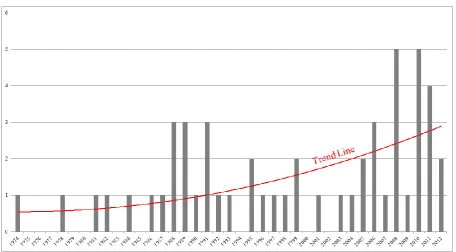
[image:5.595.72.559.416.649.2]Figure 1: Number of reviews published per year
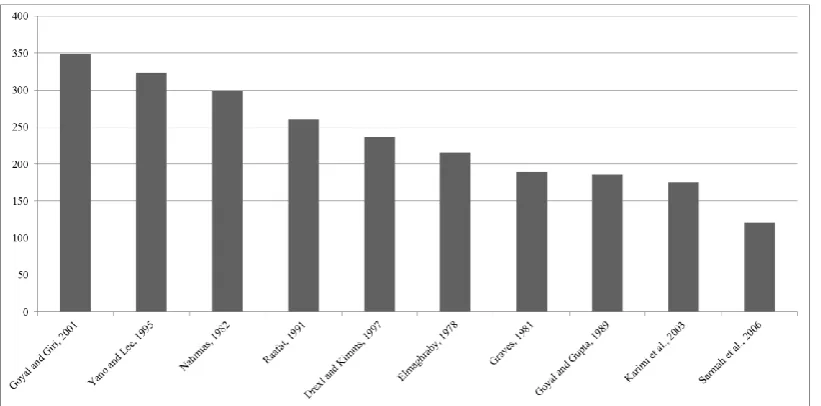
Figure 2 provides an overview of academic journals that published the highest number of re-view papers on lot sizing problems. As can be seen, the European Journal of Operational Re-search, the International Journal of Production Economics, Operations Research and Omega have been the four most popular outlets for review papers in this area.
Figure 2: Number of reviews published per journal
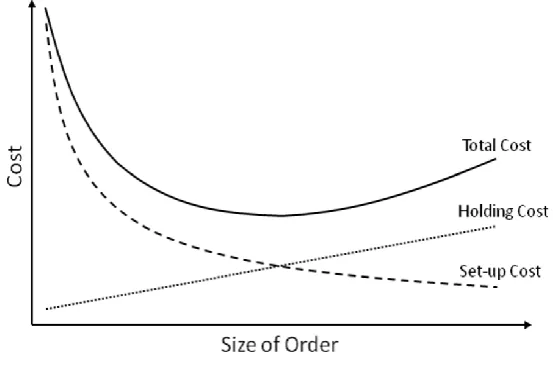
5 overview. An analysis of the review papers listed in Figure 3 revealed that, concluding from the number of citations, some topics have been especially popular in reviewing the literature, namely productivity issues in lot sizing decisions due to deterioration (cf. Goyal and Giri, 2001, Yano and Lee, 1995; Nahmias, 1982 or Rafaat, 1991) and the combination of lot sizing and scheduling issues (cf. Drexl and Kimms, 1997; Elmaghraby, 1978 or Graves, 1981). In addi-tion, two frequently cited reviews dealt with coordinated lot sizing decisions in supply chains (cf. Goyal and Gupta, 1989 and Sarmah et al., 2006), which could be an indicator for the on-going relevance of this topic.
Figure 3: Most frequently cited literature reviews in lot sizing
Problem description and conceptual framework The basic lot sizing approach of Harris
Determining the most economical inventory levels by balancing its positive and negative con-sequences in terms of cost has become one of the most influential research areas in operations management literature (see Grubbström, 1995). In its basic form, the first modern lot size model proposed by Harris (1913) aims at determining “the most economical quantity to man-ufacture in putting through an order”. In other words, it determines a replenishment quantity Q
that minimizes inventory carrying cost and costs that arise due to setup or order processes for an infinite planning horizon. The model assumes that all parameters, such as the average de-mand per unit of time D, ordering/setup cost per batch S, and holding cost per item and unit of time h, which includes physical cost of keeping items in stock as well as interest and depreci-ation, are constant and deterministic. Moreover, replenishment is instantaneous and shortages as well as constraints are neglected. Given an average inventory level of Q/2 and an average consumption time per batch of Q/D, the annual total relevant cost TC can be formulated as:
𝑇𝐶 = 𝑆𝐷 𝑄+ ℎ
𝑄 2
Finding the economic lot size that minimizes total relevant cost leads to the following well-known square-root formula that defines the most economical batch quantity Q* as a function of setup cost, inventory holding cost and average product demand:
6 It can easily been shown that the second order condition is satisfied for all positive values of
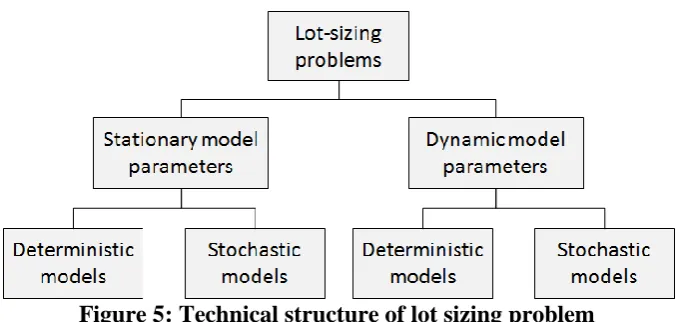
Q. The minimal costs, TCmin 2SDh, occur if the economic order quantity is realized. In this
case, the average setup/ordering cost equals the average holding cost, which is illustrated in Figure 4.
Figure 4: Relevant cost curves for Harris’ lot size model
The basic EOQ scenario described in this section has frequently been extended in the past, which will be shown in the following.
Conceptual framework of lot size models
From an analysis of our final sample, we concluded that works on the lot sizing problem can be categorized along several dimensions. The literature contains a plethora of classification schemes for lot sizing problems, which in most cases consider specific aspects of a certain type of inventory model, instead of a universal synopsis (cf. Prasad, 1994). The framework pre-sented here consists of two dimensions and aims at providing a comprehensive description of generic modeling approaches. This approach facilitates illustrating the main features that dis-tinguish the respective models and helps researchers and practitioners in assigning models to main classes, which are based on a subset of models with similar assumptions.
[image:7.595.159.436.151.336.2]7
Figure 5: Technical structure of lot sizing problem
In addition, a content-related categorization is presented in Figure 6. As can be seen, we dif-ferentiated lot sizing models into “classical models” and “extended models”. We define clas-sical lot sizing models as works whose objective is the determination of optimal production, order and shipment quantities. These models are variants of the basic EOQ model with a similar model structure, and they typically consider only inventory, order/setup and transportation costs. Extended lot sizing models, in contrast, consider additional aspects related to the lot sizing problem, such as worker learning in production, quantity discounts or trade credits. The model structure of works in this category may be (significantly) different as compared to the EOQ. Classical models can further be categorized into two-stage, multi-stage and integrated production systems. If a paper studies lot sizing within a single company, then the paper is assigned to the two-stage- or multi-stage category, depending on the number of stages consid-ered in the model. If, in contrast, lot sizing decisions are investigated on a supply chain level, the paper is assigned to the integrated models category. In the extended models category, we found models that studied scheduling problems in addition to the determination of optimal lot sizes, as well as works that focused on incentive systems, namely discounts and trade credits. Finally, research also focused on productivity issues in lot sizing models by studying worker learning, storage of items with limited shelf-lives and the production of defective items, which led to another model category. Extended models are typically based on classical models, such that the respective extension is studied in a two-stage, multi-stage or integrated setting. Alter-native classification schemes for lot sizing models can be found in Silver (1981), Aksoy and Erenguc (1988), Kuik et al. (1994), and Prasad (1994), among others. A different approach to reviewing inventory models can also be found in Williams and Tokar (2008), who restricted their analysis to major logistics journals. Their review showed that logistics researchers have directed considerable attention towards integrating traditional logistics decisions, such as trans-portation and warehousing, with inventory management decisions by using traditional inven-tory control models. Secondly, logistics researchers have more recently focused on examining inventory management through collaborative models.
.
Lot-sizing problems
Classical models
Extended models
Multi-stage models Two-stage
models Scheduling Incentives
Integrated
8
Figure 6: Content-related classification of lot sizing problems
In the following, the reviews contained in our sample will be discussed according to the con-tent-specific classification presented in Figure 6. In addition, Appendix B contains an overview of the major topics (content-related classification) discussed in each review paper and the tech-nical structure of the major works discussed in the reviews.
Content analysis Classical models Two-stage models
Two-stage inventory models typically consist of a producing and a consuming stage, where the second stage could either represent the customer or another producing stage. Inventory models assume that a buffer exists between both stages, which is fed by the first stage and which feeds products to the second stage. The objective of models in this category is to balance inventory carrying and setup costs by determining an optimal lot size. Inventory between successive stages can often be reduced significantly if partial lots, so-called batches, are transported be-tween the stages. This leads to an earlier start of the consumption process, which reduces av-erage inventory in the system. Subsequent batches may either be of equal or unequal sizes or include a combination of both alternatives. Unequal-sized batches usually lead to lower inven-tory levels than equal-sized ones, but are more difficult to implement in practice. A combina-tion of both types of batches is used if the transportacombina-tion capacity is limited. A review on the use of batches in inventory models can be found in Chang and Chiu (2005).
If the quantity ordered or produced in a certain period is not sufficient to satisfy customer demand, shortages occur. In such a situation, some customers may be willing to wait until their demand is satisfied in the next cycle, which leads to backorders, while other customer may not be willing to wait, which results in lost sales. Pentico and Drake (2011) provided a survey of inventory models with partial backordering. Their review illustrates that one stream of research assumed that the fraction of customers who are willing to wait for a replenishment depends on the waiting time. In this case, the fraction of demand that gets backordered increases as the waiting time gets shorter, which implies that a higher fraction of demand is backordered at the end of a shortage period than at its beginning. Another research stream assumed that the frac-tion of the shortage that is backordered depends on the size of the backlog. Works in this area assumed that if the existing backlog is small at the time demand occurs, then the probability that the demand gets backordered will be high, and vice versa. This reflects that customers may not be willing to wait if they are aware of a large number of unsatisfied customer orders, which might result in long waiting times until their request is satisfied.
9 overviews of optimal and heuristic solution procedures. Since the CLSP is NP-hard, heuristics are the dominant class of solution procedures. Another review of the CLSP is the one of Maes and van Wassenhove (1988), which focused on heuristic solution procedures that were also compared in extensive numerical studies. The authors classified existing approaches into sin-gle-resource heuristics and mathematical-programming-based heuristics. In the first category, heuristics mainly adopted one of two approaches: Period-by-period heuristics are essentially single-pass constructive algorithms that work through the planning horizon from the first to the last period and solve the problem period-wise. Improvement heuristics, in contrast, start with a solution for the entire horizon and then try to improve this solution with the help of some local improvement steps. The second category includes optimum-seeking mathematical gramming methods that mostly rely upon the relaxation of a constraint, branch-and-bound pro-cedures or relaxations to linear programs. Similar classifications of heuristics than in the work of Maes and van Wassenhove (1988) can be found in the papers of de Bodt et al. (1984) and Karimi et al. (2003). Another overview is contained in Bahl et al. (1987). Buschkühl et al. (2010) differentiated solution procedures for the CLSP into mathematical programming-based approached, Lagrangean heuristics, decomposition and aggregation heuristics, metaheuristics and problem-specific greedy heuristics. A variation of the CLSP is the discrete lot sizing and scheduling problem (DLSSP), where the planning horizon is divided into small periods which permit only the production of a single product. Quadt and Kuhn (2008) and Jans and Degraeve (2008) provided reviews of extensions of the basic CLSP, which included parallel machines, backorders, and setup times, among others. The capacitated single item lot sizing problem was finally reviewed in Brahimi et al. (2006).
If a product is produced in a certain period, then the CLSP requires that the entire production capacity available in this period is used. A relaxation of this assumption leads to the continuous setup lot sizing problem (CSLSP), which permits that the available capacity is not fully utilized in a period where a product is produced. Extensions of the CSLSP are the proportional lot sizing and scheduling problem (PLSSP), which permits that two products are produced per period, and the general lot sizing and scheduling problem (GLSSP), which permits that multi-ple products are produced per period. In the GLSSP, there may be an upper limit on the number of items that can be produced per period. In contrast to the CSLSP, the PLSSP and the GLSSP allow utilizing unused capacity in a certain period for producing additional products. A review of these models can be found in Drexl and Kimms (1997).
Since some dynamic lot sizing problems may be difficult to solve, several authors have devel-oped meta-heuristics to find good solutions to these problems. Jans and Degraeve (2007) gave an overview of meta-heuristics for dynamic lot sizing and showed that especially simulated annealing, tabu search and genetic algorithms have frequently been used to solve this type of lot sizing problem. Neural networks and threshold accepting, in contrast, have only been used very infrequently in this domain. A related review is the one of Goren et al. (2010), who made a survey on the use of genetic algorithms in lot sizing models. The authors showed that genetic algorithms have been used as solution procedures in almost all types of inventory models, but that the focus of the literature has been on combinatorial lot sizing problems.
Multi-stage models
10 respect to the type of demand considered (static vs. dynamic) and the solution methodology used (optimization approach vs. single-/pass heuristics). Since solving a dynamic multi-stage problem optimally is very difficult for large problems, many authors focused on devel-oping heuristic solution procedures. Single-pass heuristics apply a single-stage lot sizing heu-ristic once to every stage with or without considering information on the other stages. This approach is especially popular for large-scale problems, although it ignores interdependencies between the stages and may thus result in a poor solution. In contrast to single-pass heuristics, multi-pass heuristics apply single-stage lot sizing heuristics multiple times to each stage until no further improvement of the solution is possible. Other surveys of dynamic multi-stage in-ventory models are contained in Aggarwal (1974), de Bodt et al. (1984) and Bahl et al. (1987). A review of the multi-stage CLSP is the one of Buschkühl et al. (2010), who classified solution procedures into mathematical programming-based approached, Lagrangean heuristics, decom-position and aggregation heuristics, meta-heuristics and problem-specific greedy heuristics. Goyal and Deshmukh (1992) reviewed models of integrated procurement-production (IPP) sys-tems, which study combined decisions on the optimal procurement lot size of raw material and the optimal production lot size of finished products. The authors differentiated IPP systems according to the number of products or stages and the length of the planning horizon consid-ered, the solution method employed, and the question whether algorithmic issues have been addressed or not. One major result of this research stream is that in case inventory carrying and setup costs of procurement and production processes differ significantly, the total costs of the system can be reduced by assuming different cycles for both types of processes. The cycle of raw material orders, for example, could be an integer multiple of the production cycle if the cost of carrying raw material in inventory are lower than the inventory carrying cost of finished products.
Chang and Chiu (2005) provided a review on the use of batch shipments in multi-stage inven-tory models. The author differentiated works according to whether they consider an equal num-ber of batches between stages, or whether a varying numnum-ber of batches is permitted or not. The latter model class includes the former one and proved to be more efficient. Another review of batch shipment policies can be found in Goyal et al. (1993). A review on the use of genetic algorithms to solve multi-stage lot sizing problems can finally be found in Goren et al. (2010).
Integrated models
Integrated inventory models study interdependencies between the lot sizing decisions of dif-ferent stages of a supply chain. The general problem considered in this category of lot sizing models is that the members of the supply chain often do not belong to the same company, which is why they usually try to find an optimal inventory policy for their own company, instead of a supply chain optimum. As a result, lot sizing decisions that are made independently by the supply chain members are only compatible to each other in exceptional cases, which may lead to order quantities that do not match production quantities, and vice versa.
11 from the supplier to the buyer. As in the case of two- and multi-stage models, forwarding prod-ucts to the buyer before the production process at the supplier has been finished leads to an earlier initiation of the consumption process, which reduces total system inventory. Batch ship-ment policies that have been discussed in the literature include equal-sized batch shipship-ments, unequal-sized batch shipments, and a mixture of these two policies. Glock (2012) further dif-ferentiated integrated inventory models according to the number of actors that are considered on each stage. If a system includes multiple suppliers or multiple buyers, for example, then additional planning problems related to the coordination of deliveries arise.
Extended models
Models that consider scheduling issues
Lot sizing decisions and scheduling issues influence each other, which is why both problems have often been studied in combination. Production scheduling can be defined as the determi-nation of production sequences in due consideration of available production resources over time (Graves, 1981).
Graves (1981) reviewed combined lot sizing and scheduling problems and differentiated works in this area with respect to the number of stages and the number of machines that are consid-ered. Single stage single machine-models include the economic lot scheduling problem (ELSP), where multiple products are produced on a single machine in a cyclic pattern, as well as the joint replenishment problem, where economies of scale arise from the joint replenish-ment of several items. In the case of single stage parallel machine-models, the problem is to determine lot sizes and a production schedule for each product and to assign products to the available production facilities. The latter may impact setup and changeover costs. Multi-stage systems finally consider a sequence of machines on which products have to be processed. If multiple products are produced in lots on a single facility, then production needs to be sched-uled in such a way that the machine is never required to produce more than a single product at a time. If an individual optimization of lot sizes does not lead to a feasible schedule, then the production cycle of the products needs to be modified to avoid overlaps in the schedule. This problem is referred to as the Economic Lot Scheduling Problem (ELSP) in the literature. An early literature review in this area is the one of Elmaghraby (1978), who differentiated between analytical and heuristic approaches addressing the ELSP. According to the author, analytical approaches determine the optimum of a restricted version of the original problem, whereas heuristic approaches try to find a solution that is close to the optimum of the original problem. Lopez and Kingsman (1991) differentiated existing approaches into two categories: The first category assumes that a cycle common to all products exists that is long enough to permit the production of each product exactly once in a cycle. This assumption proved to be very restric-tive, which is why the common cycle approach is often used as an upper bound to evaluate the quality of other approaches. The second category establishes a basic period and assumes that the cycle time of each product is an integer multiple of the basic period. This approach includes the common cycle approach and leads to better solutions in most cases.
12 demand. While approaches that belong to the first class do not utilize the benefits joint optimi-zation offers, models that fall along the second class lack a structured approach for determining safety stocks. The methods applied within the two model classes include the use of discrete decision epochs and queuing systems. Another review of the SELSP is the one of Winands et al. (2011), which classified works according to the way the production sequence is constructed and the way lot sizes are calculated. The authors differentiated between a dynamic production sequence and a fixed production sequence with dynamic or fixed cycle length as well as be-tween global and local lot sizing policies.
In the joint replenishment problem (JRP), major setups occur if production is initiated, and minor setups are necessary if the processor switches from one item to the next (Graves, 1981). The literature discusses several variants of the JRP. One stream of research, for example, as-sumes that minor setup costs depend on the order frequency of the items, whereas a second stream assumes that minor setup costs are a function of the number of items that are ordered in a single order. A review of the JRP was provided by Goyal and Satir (1989), who differentiated between a deterministic and a stochastic version of the problem. In the deterministic JRP, the problem is to determine the frequency of replenishment cycles and the frequency of replenish-ing individual items. Since findreplenish-ing an optimal solution via enumeration may lead to prohibitive computational effort, several heuristics have been developed to solve the problem. In the sto-chastic JRP where demand is usually treated as the source of uncertainty, authors differentiated between a “must-order” and a “can-order” point. If the inventory position of a certain item reaches the “must-order” point, then an order for this product is issued. The problem then is to decide which of the items whose inventory position has reached or fallen below its “can-order” point should be included in the replenishment. An overview of the JRP and solution methods is also contained in Goyal and Deshmukh (1992). Another review of the JRP is the one of Aksoy and Erenguc (1988), who differentiated between deterministic and stochastic and be-tween static and dynamic joint replenishment problems. For the static-dynamic case, dynamic programming approaches have been developed, which are, however, only applicable to small family sizes. For larger problems, heuristics are dominant. The dynamic JRP is also reviewed in Robinson et al. (2009), who referred to the problem as the coordinated deterministic dynamic demand lot sizing problem. The authors showed that there are different ways to formulate the problem mathematically. In the uncapacitated case, product unit formulations, shortest path formulations, arborescent network formulations, and exact requirements formulations have been used. The first formulation models product unit flows, while the second formulation mod-els the problem as a collection of independent uncapacitated lot sizing problems that are cou-pled by the joint setup decision variable. The latter formulation leads to a more compact model structure. The arborescent network formulation has the advantage of hierarchically linked de-cision variables, which leads to a tight constraint on the setup variables. The exact requirements formulation finally views the problems as a collection of linked Wagner/Whitin-problems, which also results in a tighter upper bound than the first two problem formulations. In the capacitated case, product unit and arborescent network formulations have also been used. Game-theoretic treatments of the JRP are reviewed in Dror and Hartman (2011). If the JRP is studied from the perspective of game theory, different players decide about the order frequency of individual products and the division of the cooperation gain. The resulting game is a single-stage, stationary, infinitely repeated game. Dror and Hartman showed in their review that de-spite basic JRP games, also some extensions have been studied, such as JRP games with coa-lition manipulation, where a group of players can achieve a cost advantage by merging into a single actor.
13 from one batch to the next results in sequence-dependent setup costs, while shifting from item to item within a batch does not require a setup. The major difference between the BSP and the JRP is that minor setups are not considered in the BSP, and that the BSP considers individual items, instead of production lots.
Reviews of works that consider scheduling-issues in the CLSP can be found in Quadt and Kuhn (2008) and Jans and Degreave (2008). The sequence in which products are produced becomes important in this model if setup times and/or costs are sequence-dependent. Another schedul-ing-problem arises if setup carryover is possible, i.e. if the setup state of the machine can be maintained between two subsequent periods. In this case, setup costs can be reduced in case the same product is produced in two or more subsequent periods. A review on lot sizing models with sequence-dependent setup costs was finally proposed by Zhu and Wilhelm (2006). The authors showed that sequence-dependent setup costs have been considered in different types of lot size models, namely the ELSP, the CLSP, the DLSSP, and the GLSSP.
Models that consider incentive systems
Incentive systems are implemented in supply chains if one member of the supply chain wants to influence the behavior of other supply chain members. Incentive systems that have been discussed in the literature include discounts and trade credit policies.
One of the most frequently discussed incentive systems in lot sizing models are quantity dis-counts. The literature discusses several reasons that may motivate a supplier to offer a quantity discount to its buyers. For instance, if customer demand is not fixed, then offering a discount on the total quantity ordered may induce the buyer to increase the order quantity of a given period. If the buyer orders smaller lot sizes than preferred by the supplier, then offering a dis-count on the order quantity may induce the buyer to order larger lots less frequently.
A review of models that considered quantity discounts and lot sizing was provided by Benton and Park (1996). The authors showed that two types of quantity discounts have frequently been discussed in the literature: In the case of an all-unit quantity discount, the unit price of the entire lot decreases if the order quantity exceeds a certain price break quantity. In the case of an incremental discount, the lower price applies only to the units purchased above the price break quantity. Benton and Park also showed that the problem has been approached from two differ-ent viewpoints: from the perspective of the buyer, who has to decide on how to react to a given price schedule, and from the perspective of the supplier, who has to decide on the price break quantity (or quantities) and the magnitude of the discount. In the latter case, the reaction of the buyer has to be taken into account. Another review in this area is the one of Goyal and Gupta (1989), who reviewed works that studied the coordination of buyer-supplier-relationships with the help of discounts. Again, works were classified according to the type of discount used. Another review of works that use quantity discounts in inventory models is the one of Sarmah et al. (2006). Existing works were grouped into four categories in this review: a) works that focus either on the supplier’s or the buyer’s perspective by developing optimal pricing sched-ules or by calculating optimal order quantities for given pricing schedsched-ules, b) models that use quantity discounts to maximize the joint profit of supplier and buyer, c) works that study quan-tity discounts in inventory models from a game-theoretic perspective where supplier and buyer try to maximize their individual profits, and d) single supplier-multiple buyer inventory mod-els. In the last case, developing a discount scheme is challenging since many legal regulations require companies to offer only a single discount scheme, which has to be valid for all custom-ers. In this case, finding a discount scheme that maximizes the suppliers profit is difficult es-pecially in case the buyers are heterogeneous.
14 immediately to encourage them to wait for the next delivery. Works in this area showed that by offering a discount, the supplier can increase backorders and reduce lost sales. The magni-tude of the discount is usually considered as a decision variable in these works.
A second incentive system that has frequently been discussed are trade credits. When the sup-plier offers a trade credit, the buyer is allowed to delay the payment to the supsup-plier for a certain time period. During the credit period, the supplier charges no interest or a small interest on the outstanding payment. As a result, the buyer can earn interest on the outstanding payment by depositing it in an interest-bearing account or by investing it elsewhere. In addition, the trade credit reduces the buyer’s cost of holding stock because it reduces the amount of capital in-vested in stock for the duration of the trade credit period. Extensions consider cash discounts for prompt payment or progressive interest schemes. The trade credit is consequently a mar-keting tool for the supplier to attract new customers by offering alternative funding arrange-ments, and it may lead to larger order quantities if the buyer has limited capital available for ordering products.
A review of inventory models with trade credits was provided by Chang et al. (2008). The authors differentiated existing works into different categories. Basic models with trade credits extend the classical EOQ/EPQ model to take account of a permissible delay in payments. Some authors in this stream of research assumed that the supplier first offers a payment delay of a certain length, which is followed by a trade credit period with a reduced interest rate. If the buyer does not pay within the trade credit period, then a higher interest rate is charged. Models that consider more than a single trade credit period are commonly referred to as progressive trade credit models (Soni et al., 2010). A second set of models assumed that the trade credit is linked to the order quantity. Models that belong to this research stream assumed that the sup-plier offers the trade credit only in case the order exceeds a certain minimum quantity. A third research stream finally considered both trade credits and inflation in lot sizing models. Another review of inventory models with trade credits is the one of Soni et al. (2010), who grouped the existing literature similarly than Chang et al. (2008).
A review of incentive systems that are valid only for a limited time span was provided by Goyal et al. (1991). Incentives with a limited validity period are sometimes offered by suppliers if they have an unanticipated surplus in a certain period which they want to sell off, or if a need arises to change the production runs, for example. Goyal et al. (1991) differentiated between models that consider price discounts, price increases, and credit periods. In the case of a price discount of limited validity, it may be optimal for the buyer to increase the order quantity while the discount is valid, and then to return to the original order quantity again. Similarly, in the case of a price increase, the buyer has the opportunity to buy the product at a lower price at the beginning. The key feature of the optimal lot sizing policy in this case is to place a larger order than usual just before the price increase becomes effective (Ramasesh, 2010). Implementing credit periods that permit credit savings that are equal to a fixed proportion of the purchase price has the same effect than a discount. The benefit of credits, however, diminishes if the order quantity exceeds demand during the credit period. Another review of limited-time price incentives in inventory models is the one of Ramasesh (2010). The author differentiated works according to the type of incentive offered into price discounts (including temporary price de-creases and advance notification of price inde-creases), trade credits, and special incentives. The latter category includes discounts that are proportional to the order quantity and offers where the buyer has to pay only for a fraction of the order quantity. As a second dimension of analysis, the window of opportunity was used: If the incentive is valid for less than an order cycle, then only one order can be made under the price incentive. If the incentive is valid for more than one order cycle, then multiple orders may be placed under the price incentive.
15 Several researchers have argued that high inventory levels give the customer a wider selection and increase the probability of making a sale. A review in this area is the one of Urban (2005), who made a survey of inventory models that consider customer demand as a function of the inventory level. In this case, companies have an incentive to increase inventory levels to induce additional sales. The author differentiated between two model classes, one where the demand rate is a function of the initial inventory level in the cycle, and one where it is a function of the instantaneous inventory level. In the first case, only the initial lot size (or reorder point) is important for the demand rate, while in the second case, demand decreases while the inventory is depleted.
Models that consider productivity issues
Lot sizing models derive optimal order and/or production quantities, which determine inven-tory levels and therewith the responsiveness of a company. As these decisions are influenced by the effects of production, transportation and storage of items, it is straightforward that fac-tors affecting the productivity of inventory system should also be taken into consideration, as they directly affect the way inventory is built up and maintained over time. The productivity of inventory systems has been analyzed from a variety of different perspectives by considering learning effects, random yield or deterioration.
Learning effects occur if the performance of human workers, a team or an organization im-proves with time. The performance improvement may be due to a more effective use of tools and machines, increased familiarity with operational tasks and the work environment, and en-hanced management efficiency, for example (Jaber and Bonney, 1999). To model worker im-provement in consequence of learning, so-called learning curves have been developed, which assume that learning results in lower costs per item produced as the cumulative production output increases. A review of inventory models that consider learning curves is the one of Jaber and Bonney (1999). According to their review, learning (and in some cases the opposite phe-nomenon, forgetting) has been considered in production, which reduces the time that is neces-sary to produce one unit of output. In addition, some authors studied learning in setups, which reduces the time that is required to perform a setup (and consequently setup costs) over time. Learning in production reduces inventory in the system, which leads to larger lot sizes, while learning in setups leads to lower setup costs and consequently smaller lots and more frequent setups.
16 of these types of random yield and classified them according to the type of demand (determin-istic vs. stochastic) and the type of planning horizon (continuous vs. discrete periods) consid-ered as well as the number of production stages taken into consideration (single stage vs. mul-tiple stages). In the case of discrete time models, both the cases of a single period and mulmul-tiple periods were discussed. Another review of inventory models with random yield is the one of Grosfeld-Nir and Gerchak (2004), who concentrated on the case where a given order quantity has to be met in a single or multiple production runs. Production costs were assumed to consist of a fixed component and a variable component depending on the lot size in this setting. Grosfeld-Nir and Gerchak differentiated works that studied this scenario according to the num-ber of stages considered (single- vs. multi-stage models) and showed that despite basic models that study general interdependencies in this scenario, the focus of the literature has been on different types of inspection policies, multiple grades (where a grade refers to the level of de-fectiveness of a product), and rework. In the multi-stage setting, different types of bottleneck problems have been studied in addition. Another review on lot sizing models that consider product quality issues is the one of Khan et al. (2011). The authors reviewed extensions of a paper of Salameh and Jaber (2000), who had studied a situation where a buyer receives lots that contain a constant fraction of defective items with known probability density function. Defective items that are found during a 100% screening process were assumed to be sold on a secondary market at a reduced price. Khan et al. (2011) showed that the Salameh and Jaber paper had frequently been extended in the past, and that extensions included backordering, fuzzy model parameters, learning, and buyer-supplier interactions.
A further review of quality-related issues in inventory models is the one of Goyal et al. (1993). The authors surveyed works that integrated rework, inspection, or quality control into lot sizing models. In the first category, authors have studied batch sizing policies for defective items given that rework facilities encounter setup costs. Works that belong to the second category studied were inspection stations should be located in a multi-stage production system and which inspectors should be assigned to which stations. In addition, some authors integrated type I and type II errors in their models, which take account of the fact that good quality items might be rejected or poor quality items accepted by the inspector. Papers that fall along the third category assumed that the quality of the production process may be improved at an in-vestment, which reduces the probability that a defective item is produced, or by performing an additional setup, which gives operators the chance to restore a machine whose process quality has deteriorated. A related review is the one of Wright and Mehrez (1998), who also made a survey of inventory models that consider quality-issues. They categorized the literature accord-ing to the methodology (optimization vs. simulation) used, the model assumptions (stationary demand vs. non-stationary demand and single item vs. multiple items) made and the quality-aspects (scrap/yield, inspection, maintenance, warranty, process improvement) considered, among others.
17 scenario. For the case of a random lifetime, Nahmias (1982) showed that exponential decay functions have been used to approximate the deterioration process. Another review of inven-tory models that consider deterioration is the one of Rafaat (1991), who focused on models where deterioration is a function of the on-hand inventory level. The author differentiated ex-isting models according to the following attributes: number of items (single vs. multiple items), type of demand (deterministic vs. stochastic and static vs. dynamic demand), number of periods (single vs. multiple periods), the type of inventory process (purchase vs. production), and short-ages (shortshort-ages vs. no shortshort-ages). In addition, the author distinguished between a constant and a changing deterioration rate. In the first case, it is assumed that the deterioration rate is a constant fraction of the on-hand inventory, while in the second case, the relationship between deterioration and on-hand inventory is modeled differently, for example by assuming a Weibull distribution. Goyal and Giri (2001) provided another review of inventory models with deterio-rating products and differentiated the literature into models with fixed product lifetime, models with random product lifetime, and models where deterioration corresponds to the proportional inventory decrease. The authors showed that inventory models that considered deteriorating items often took additional aspects into consideration, such as trade credits, quantity discounts, or inflation. Bakker et al. (2012) revisited Goyal and Giri’s (2001) review and gave an overview of inventory models with deteriorating items that were published since 2001. The classification used in their review was the one proposed by Goyal and Giri. Inventory models with deterio-rating products and trade credits were further reviewed by Chang et al. (2008) and Soni et al. (2010), while Ramasesh et al. (2010) gave an overview of inventory models with deteriorating products and limited-time price incentives and Pentico and Drake (2011) an overview of in-ventory models with deteriorating products and backordering. In addition, the reader is referred to Li et al. (2010) for a review of inventory models with deteriorating items that groups existing works into single company- and supply chain-models, and to Brahimi et al. (2006) for an over-view of dynamic lot sizing models with deteriorating items.
Conclusion
The intention of this paper was to develop an overview of major streams of research that emerged from Harris’ (1913) seminal lot size model and to highlight major advances that were made in the respective research streams. For this purpose, we conducted a tertiary study on the lot sizing problem by systematically reviewing and evaluating literature reviews that appeared in this area. Since many different technical classification schemes of lot sizing models were suggested in the literature, we deductively derived a content-related classification scheme from our sample. This could be interpreted as a comprehensive description of generic modeling ap-proaches, which facilitates illustrating the main features of different models from a content-related perspective. Our analysis showed that various extensions of Harris’ model were devel-oped over the years, such as lot sizing models that include scheduling, incentives or productiv-ity issues. Another aspect that became apparent from our review is that recent research seems to have a special focus on the modeling of complex inventory systems. These systems, which may include multiple producing stages within or across company borders, parallel machines, or capacity constraints, are difficult to model and therefore require sophisticated solution pro-cedures. Some authors have laid a focus on the development of meta-heuristics, which proved to be suitable methods for solving such inventory systems in many cases. Moreover, the con-sideration of uncertainty and other performance-related factors in inventory management be-comes more apparent by using dynamic or stochastic approaches and developing extended models.
The results of this tertiary study can be summarized as follows:
18 literature on lot sizing by giving a broad overview of the research field and by synthesizing findings of reviews (secondary research) that have been published in this field of research. In addition, a content-related and technical classification of lot sizing problems was developed and major achievements that have been accomplished in lot sizing were discussed.
This paper may support both primary and secondary researchers in future works. Our review of literature reviews gives guidance to primary researchers as it helps researchers in position-ing their own work in the literature and in findposition-ing startposition-ing points if they intend to work in a new research direction. It facilitates getting access to a certain research topic, in this case the area of lot sizing, as it identifies different streams of research that emerged from the seminal lot size model proposed by Harris. This paper further contributes to the development of sec-ondary research as it allows assessing the status quo of lot sizing reviews, and it classifies existing reviews and synthesizes their findings. In addition, the content discussion shows which major achievements have been accomplished in the respective areas of lot sizing research, which helps scientists in identifying which topics should be addressed in future secondary stud-ies. For example, our review methodology did not find a review that focuses on sustainability or pricing issues in lot sizing, although we can observe an increasing number of primary works on this topic. In addition, only one review focusing on learning and forgetting in lot sizing could be found, which was published in 1999 (Jaber and Bonney, 1999). This indicates that both topics may be worth being investigated in a secondary study.
Finally, an evaluation of the sample showed that most of the reviews that have been published on lot sizing problems did not use an established methodology for conducting reviews, and that sample generation and selection could not be reproduced in many cases. In fact, only 3 out of 52 reviews could be categorized as systematic reviews (Bakker et al. 2012, Glock 2012, Wil-liams and Tokar 2008). We therefore recommend that future research in this area should be oriented at established methodologies for systematic literature reviews and meta-analyses, such as the one of Cooper (2010), Tranfield et al. (2003) or Rhoades (2011). This tertiary study could also serve as a guideline for the application of systematic reviewing techniques in the area of inventory modeling which, is of increasing relevance in the scientific literature.
This review also has limitations. First, the search strategy was limited to articles published in peer-reviewed journals, which may have led to publication bias as well as overestimation ef-fects (Neely et al., 2010). Including other types of publications, such as conference proceedings or books, could result in a broader picture of developments in the area of lot sizing. Secondly, the review was restricted to literature reviews, and primary studies were excluded from the survey. As a result, only research streams have been discussed in this paper that have been evaluated in literature reviews before. Finally, assigning the literature reviews to content cate-gories and technical catecate-gories involved some amount of judgment, which might have biased the analysis. These and other limiting factors could be addressed in an extension of this paper.
Appendix A: Review protocol
Filter type Descriptions and guidelines Results BSP Scopus
Inclusion criteria
Peer-reviewed journals: Articles that: 1. were identified during the database
search
2. appeared in the reference lists of one of the selected papers by a forward and backward snowball search.
Topic: Only articles with a focus on reviewing the literature on problems that contain the original lot sizing problem were in-cluded.
19
Time span: 1960 to 2013.
Review type: All
Keywords Group A: "Economic order quantity”, “EOQ”, “Economic production
quan-tity”, “EPQ”, “Lot streaming”, “Economic lot scheduling problem”, “ELSP”, “Lot size”, “Lot sizing”, “Inventory management”, “inventory model”, “lot” and “inventory"
Group B: “review”, “overview”,
“sur-vey” and “literature"
Keyword search
Search selected online databases with the keywords de-fined above.
Ensure substantive relevance by requiring that all arti-cles contain at least one of the keywords from group A
and B either in their title, abstract or keywords. 72 310
Consolidation Consolidation of articles
Results from selected databases were consolidated and duplicate articles were
eliminated. 330
First content analysis of the articles by defined criteria
Ensure relevance of content by subjecting all papers to a manual analysis of their
ab-stracts. 49
Snowball approach
Search for additional articles by back-ward/ forward search based on all
previ-ously selected articles. 45
Working
sample size 94
Content analysis
Second content analysis of the articles by defined criteria
Ensure relevance of content by requiring that the selected articles meet the criteria for inclusion and focus on the research topic. All articles in the work-ing sample were completely read to examine their content.
Final sample
20
Appendix B: Overview of reviews discussed in this paper
No. Authors Year Technical classification Content-related classification
SDLS SSLS DDLS DSLS Two Multi Integrated Scheduling Incentives Productivity
1 Aggarwal 1974 X X X X X X
2 Aksoy and Erenguc 1988 X X X X
3 Bahl et al. 1987 X X X
4 Baker 1990 X X
5 Bakker et al. 2012 X X X
6 Ben-Daya et al. 2008 X X
7 Benton and Park 1996 X X X
8 Brahimi 2006 X X X
9 Buschkühl et al. 2010 X X X
10 Chang and Chiu 2005 X X X
11 Chang et al. 2008 X X X
12 De Bodt et al. 1984 X X X X
13 Drexl and Kimms 1997 X X X
14 Dror and Hartman 2011 X X X
15 Elmaghraby 1978 X X
16 Glock 2012 X X X
17 Goren et al. 2010 X X X X X
18 Goyal and Deshmukh 1992 X X X
19 Goyal and Giri 2001 X X X X
20 Goyal and Gupta 1989 X X X
21 Goyal and Satir 1989 X X X
22 Goyal et al. 1991 X X
23 Goyal et al. 1993 X X X
24 Graves 1981 X X
25 Grosfeld-Nir and Gerchak 2004 X X X
26 Gupta and Keung 1990 X X X
21
28 Jans and Degraeve 2007 X X
29 Jans and Degraeve 2008 X X
30 Karimi et al. 2003 X X
31 Khan et al. 2011 X X
32 Li et al. 2010 X X X
33 Lopez and Kingsman 1991 X X
34 Maes and van
Wassenhove 1988 X X
35 Nahmias 1982 X X X X X
36 Pentico and Drake 2011 X X X X
37 Quadt and Kuhn 2008 X X X
38 Raafat 1991 X X X X X
39 Ramaseh 2010 X X X X
40 Ritchie and Tsado 1986 X X
41 Robinson et al. 2009 X X
42 Sarmah et al. 2006 X X
43 Soni et al. 2010 X X X
44 Sox et al. 1999 X X X
45 Urban 2005 X X X
46 Williams and Tokar 2008 X X X
47 Winands et al. 2011 X X
48 Wolsey 1995 X X
49 Wright and Mehrez 1998 X X X
50 Yano and Lee 1995 X X X
51 Zhu and Wilhelm 2006 X X X
52 Zoller and Robrade 1988 X X
22
Acknowledgements
The authors wish to thank the special issue editors and the anonymous referees for their valuable suggestions that helped to improve an earlier version of this paper.
References
Aggarwal, S.C. (1974). A review of current inventory theory and its applications. International Journal of Production Research, 12 (4), 443-482.
Aksoy, Y.; Erenguc, S.S. (1988). Multi-item inventory model swith co-ordinated replenishments: A survey. International Journal of Operations and Production Management, 8 (1), 63-73.
Bahl, H.C.; Ritzman, L.P.; Gupta, J.N.D. (1987). Determining lot sizes and resource requirements: A review. Operations Research, 35 (3), 329-345.
Baker, K.R. (1989). Lot-sizing procedures and a standard data set: A reconciliation of the literature. Journal of Manufacturing and Operations Management, 2 (3), 199-221.
Bakker, M.; Riezebos, J.; Teunter, R.H. (2012). Review of inventory systems with deterioration since 2001. European Journal of Operational Research, 221 (2), 275-284.
Ben-Daya, M.; Darwish, M.; Ertogral, K. (2008). The joint economic lot sizing problem: Re-view and extensions. European Journal of Operational Research, 185 (2), 726-742.
Benton, W.C.; Park, S. (1996). A classification of literature on determining the lot size under quantity discounts. European Journal of Operational Research, 92 (2), 219-238.
Bogaschewsky, R.W.; Buscher, U.D.; Lindner, G. (2001). Optimizing multi-stage production with constant lot size and varying number of unequal sized batches. Omega, 29 (2), 183-191.
Brahimi, N.; Dauzere-Prese, S.; Najid, N.M.; Nordli, A. (2006). Single item lot sizing problems. European Journal of Operational Research, 168 (1), 1-16.
Buschkühl, L.; Sahling, F.; Helber, S.; Tempelmeier, H. (2010). Dynamic capacitated lot-sizing problems: A classification and review of solution approaches. OR Spectrum, 32 (2), 231-261.
Chang, J.H.; Chiu, H.N. (2005). A comprehensive review of lot streaming. International Journal of Production Research, 43 (8), 1515-1536.
Chang, C.-T.; Teng, J.-T.; Goyal, S.K. (2008). Inventory lot-size models under trade credits: A review. Asia-Pacific Journal of Operational Research, 25 (1), 89-112.
Cooper, H.M. (2010) Research Synthesis and Meta-Analysis: A Step-By-Step Approach, 4th ed., Sage Publications, Thousand Oaks.
De Bodt, M.A.; Gelders, L.F.; Van Wassenhove, L.N. (1984). Lot sizing under dynamic de-mand conditions: A review. Engineering Costs and Production Economics, 8 (3), 165-187. Dobson, G. (1988). Sensitivity of the EOQ model to parameter estimates. Operations Research,
36 (4), 570-574.
Drexl, A.; Kimms, A. (1997). Lot sizing and scheduling – Survey and extensions. European Journal of Operational Research, 99 (2), 221-235.
Dror, M.; Hartmann, B.C. (2011). Survey of cooperative inventory games and extensions. Jour-nal of the OperatioJour-nal Research Society, 62 (4), 565-580.
Elmaghraby, S.E. (1978). The economic lot scheduling problem (ELSP): Review and exten-sions. Management Science, 24 (6), 587-598.
Erlenkotter, D. (1989). An early classic misplaced: Ford W. Harris’s economic order quantity model of 1915. Management Science, 35 (7), 898-900.
Erlenkotter, D. (1990). Ford Whitman Harris and the economic order quantity model. Opera-tions Research, 38 (6), 937-946.
23 Glock, C.H. (2012). The joint economic lot size problem: A review. International Journal of
Production Economics, 135 (2), 671-686.
Glock, C.H.; Jaber, M.Y. (2013). A multi-stage production-inventory model with learning and forgetting effects, rework and scrap. Computers & Industrial Engineering, 64 (2), 708-720. Glock, C.H.; Ries, J.M. (2013). Reducing led time risk through multiple sourcing: the case of
stochastic demand and variable lead time. International Journal of Production Research, 51 (1), 43-56.
Goren, H.G.; Tunali, S.; Jans, R. (2010). A review of applications of genetic algorithms in lot sizing. Journal of Intelligent Manufacturing, 21 (4), 575-590.
Goyal, S.K.; Deshmukh, S.G. (1992). Integrated procurement-production systems: A review. European Journal of Operational Research, 62 (1), 1-10.
Goyal, S.K.; Giri, B.C. (2011). Recent trends in modeling of deteriorating inventory. European Journal of Operational Research, 134 (1), 1-16.
Goyal, S.K.; Gunasekaran, A.; Martikainen, T.; Yli-Olli, P. (1993). Integrating production and quality control issues: A survey. European Journal of Operational Research, 69 (1), 1-13. Goyal, S.K.; Gupta, Y.P. (1989). Integrated inventory models: The buyer-vendor coordination.
European Journal of Operational Research, 41 (3), 261-269.
Goyal, S.K.; Satir, A.T. (1989). Joint replenishment inventory control: Deterministic and sto-chastic models. European Journal of Operational Research, 38 (1), 2-13.
Goyal, S.K.; Srinivasan, G.; Arcelus, F.J. (1991). One time only incentives and inventory poli-cies. European Journal of Operational Research, 54 (1), 1-6.
Graves, S.C. (1981). A review of production scheduling. Operations Research, 29 (4), 646-675. Grosfeld-Nir, A.; Gerchak, Y. (2004). Multiple Lotsizing in Production to Order with Random
Yields: Review of Recent Advances. Annals of Operations Research, 126 (1-4), 43-69. Grubbström, R.W. (1995). Modelling production opportunities — an historical overview.
In-ternational Journal of Production Economics, 41 (1-3), 1-14.
Gupta, Y.P.; Keung, Y. (1990). A review of multi-stage lot-sizing models. International Journal of Operations and Production Management, 10 (9), 57-73.
Hadley, G.; Whitin, T.M. (1963). Analysis of inventory systems. Englewood Cliffs, NJ: Pren-tice Hall.
Harris, F.W. (1913). How many parts to make at once. Factory - The Magazine of Management, 10 (2), 135-136, 152.
Hochrein, S.; Glock, C.H. (2012). Systematic literature reviews in purchasing and supply man-agement research: a tertiary study. International Journal of Integrated Supply Manman-agement, 7 (4), 215-245.
Jaber, M.Y.; Bonney, M. (1999). The economic manufacture/order quantity (EMQ/EOQ) and the learning curve: Past, present, and future. International Journal of Production Economics, 59 (1-3), 93-102.
Jans, R.; Degraeve, Z. (2007). Meta-heuristics for dynamic lot sizing: A review and comparison of solution approaches. European Journal of Operational Research, 177 (3), 1855-1875. Jans, R.; Degraeve, Z. (2008). Modeling industrial lot sizing problems: A review. International
Journal of Production Research, 46 (6), 1619-1643.
Karimi, B.; Fatemi Ghomi, S.M.T.; Wilson, J.M. (2003). The capacitated lot sizing problem: a review of models and algorithms. Omega, 31 (5), 365-378.
Khan, M.; Jaber, M.Y.; Guiffrida, A.L.; Zolfaghari, S. (2011). A review of the extensions of a modified EOQ model for imperfect quality items. International Journal of Production Eco-nomics, 132 (1), 1-12.
Li, R.; Lan, H.; Mawhinney, J.R. (2010). A review on deteriorating inventory study. Journal of Service Science and Management, 3 (1), 117-129.
24 Lowe, T.J.; Schwarz, L.B. (1983). Parameter estimation for the EOQ lot size model: Minmax
and expected value choices. Naval Research Logistics, 30 (2), 367-376.
Maes, J.; van Wassenhove, L. (1988). Multi-Item Single-Level Capacitated Dynamic Lot-Siz-ing Heuristics: A General Review. Journal of the Operational Research Society, 39 (11), 991-1004.
Nahmias, S. (1982). Perishable inventory theory: A review. Operations Research, 30 (4), 680-708.
Neely, J.G., Magit, A.E., Rich, J.T., Voelker, C.C.J., Wang, E.W., Paniello, R.C., Nussenbaum, B. and Bradley, J.P. (2010) ‘A practical guide to understanding systematic reviews and meta-analyses’, Otolaryngology – Head and Neck Surgery, 142 (1), 6–14.
Pentico, D.W.; Drake, M.J. (2011). A survey of deterministic models for the EOQ and EPQ with partial backordering. European Journal of Operational Research, 214 (2), 179-198. Prasad, S. (1994). Classification of inventory models and systems. International Journal of
Pro-duction Economics, 34 (2), 209-222.
Quadt, D.; Kuhn, H. (2008). Capacitated lot-sizing with extensions: a review. 4OR, 6 (1), 61-83.
Rafaat, F. (1991). Survey of literature on continuously deteriorating inventory models. Journal of the Operational Research Society, 42 (1), 27-37.
Ramasesh, R.V. (2010). Lot-sizing decisions under limited-time price incentives: A review. Omega, 38 (3-4), 118-135.
Ritchie, E.; Tsado, A.K. (1986). A review of lot-sizing techniques for deterministic time-vary-ing demand. Production and Inventory Management, 27 (3), 65-79.
Roach, B. (2005). Origin of the economic order quantity formula; transcription or transfor-mation? Management Decision, 43 (9), 1262-1268.
Rhoades, E.A. (2011). Literature Reviews. The Volta Review 111 (1), 61-71.
Robinson, P.; Narayanan, A.; Sahin, F. (2009). Coordinated deterministic dynamic demand lot-sizing problem: A review of models and algorithms. Omega, 37 (1), 3-15.
Salameh, M.K.; Jaber, M.Y. (2000). Economic production quantity model for items with im-perfect quality. International Journal of Production Economics, 64 (1), 59-64.
Sarmah, S.P.; Acharya, D.; Goyal, S.K. (2006). Buyer vendor coordination models in supply chain management. European Journal of Operational Research, 175 (1), 1-15.
Silver, E.A. (1981). Operations research in inventory management: A review and critique. Op-erations Research, 29 (4), 628-645.
Soni, H.; Shah, N.H.; Jaggi, C.K. (2010). Inventory models and trade credit: a review. Control and Cybernetics, 39 (3), 867-882.
Sox, C.R.; Jackson, P.L.; Bowman, A.; Muchstadt, J.A. (1999). A review of the stochastic lot scheduling problem. International Journal of Production Economics, 62 (3), 181-200. Stadtler, H. (2007). How important is it to get the lot size right?. Zeitschrift für
Be-triebswirtschaft, 77 (4), 407-416.
Tranfield, D.; Denyer, D.; Smart, P. (2003). Towards a methodology for developing evidence-informed management knowledge by means of systematic review. British Journal of Man-agement, 14 (3), 207–222.
Urban, T.L. (2005). Inventory models with inventory-level-dependent demand: A comprehen-sive review and unifying theory. European Journal of Operational Research, 162 (3), 791-804.
US Census Bureau (2013). Manufacturing and trade inventories and sales. http://www.cen-sus.gov/mtis/www/data/pdf/mtis_current.pdf, Accessed May 07, 2013.
25 Verner, J.M.; Brereton, O.P.; Kitchenham, B.A.; Turner, M.; Niazi, M. (in Press). Risks and risk mitigation in global software development: A tertiary study. Information and Software Technology, http://dx.doi.org/10.1016/j.infsof.2013.06.005.
Williams, B.D.; Tokar, T. (2008). A review of inventory management research in major logis-tics journals – Themes and future directions. International Journal of Logislogis-tics Management, 19 (2), 212-232.
Winands, E.M.M.; Adan, I.J.B.F.; van Houtum, G.J. (2011). The stochastic economic lot sched-uling problem: A survey. European Journal of Operational Research, 210 (1), 1-9.
Wolsey, L.A. (1995). Progress with single-item lot sizing. European Journal of Operational Research, 86 (3), 395-401.
Wright, C.M.; Mehrez, A. (1998). An overview of representative research of the relationships between quality and inventory. Omega, 26 (1), 29-47.
Yano, C.A.; Lee, H.L. (1995). Lot sizing with random yields: A review. Operations Research, 43 (2), 311-334.
Zhu, X.; Wilhelm, W.E. (2006). Scheduling and lot sizing with sequence-dependent setup: A literature review. IIE Transactions, 38 (11), 987-1007.