CHAPTER THIRTY
ROMANIA
Gabriela Borz
-Figure 30.1. Map of Romania JUST ABOUT HERE-
-Table 30.1. Romania Profile JUST ABOUT HERE-
1. Geographical Position
Romania is the largest country in southeastern Europe, bordered by Ukraine in the north, Moldova in the east, Bulgaria in the south, and Hungary and Serbia in the west and southwest, respectively. The country has an exit to the Black Sea and is situated on the lower course of the Danube River. The landscape is diverse and includes the Carpathian Mountains, hills, plateaus, plains and meadows. Romania covers 238.4 square kilometresand its administrative territory is divided into 41 counties plus the Bucharest municipality, 319 towns, and 2,686 communes. It has a population of 21.5 million and 57 per cent of the population live in urban centres.
2. Historical Background
The Kingdom of Romania, which emerged in 1859 under Alexandru Ioan Cuza who united the principalities of Moldova and Valahia was later incorporated into the Ottoman Empire until 1877 when it gained its independence, which was internationally recognized by the Treaty of Berlin the following year. During the World War I, Romania joined the allied side. This resulted in regaining Pre-print version of: Borz, G. (2015). Romania. In D. M. Viola (Ed.), Routledge Handbook of
Transylvania, Bessarabia, Bukovina and Dobruja, which, by 1 December 1918, all (re)united with the ‘Old Kingdom’ of Romania and formed the Romanian nation-state (Constantiniu, 2008). The inter-war period was marked by authoritarian King Carol II, who through his constitution of 1938 banned political parties. During the World War II, his son, Michael, with the backing of the opposition parties, put an end to Ion Antonescu’s fascist government and switched sides in the war.
Following the 1944 armistice, Romania became a socialist republic and parts of its eastern territory, including Bessarabia, now the Republic of Moldova, were occupied by the Soviet Union. King Michael was forced to abdicate, and in 1947 the communists came to power, proclaiming Romania a ‘People’s Republic’. After the fall of communism with the 1989 revolution, Romania began its transition to democracy.
3. Geopolitical Profile
During communism, President Nicolae Ceuşescu tried to pursue a political strategy independent from Moscow and Romania was the only Warsaw Pact country that denounced the Soviet invasion of Czechoslovakia in 1968 (Swain and Swain, 1993). He maintained diplomatic relations with Israel, West Germany, and several Arab countries. In the early 1970s, the country became member of the International Monetary Fund and the General Agreement on Trade and Tariffs. In 1975 Romania was granted most favoured nation status by the United States. Ceuşescu’s autocratic policies as well as his ambition to pay all the country’s foreign debts generated poverty and discontent which culminated in the 1989 revolution and led to his execution. The immediate post-communist years were focussed on democratic and economic reforms. The country joined NATO in 2004 and the European Union in 2007.
The 1991 Romanian Constitution, later amended in 2003, established a semi-presidential system of government based on the French model. The president, as head of state, and the prime minister, as head of government, share executive functions, although it is not clear who prevails and in practice, it resembles more a parliamentary regime with an elected president.
The president is elected by popular vote for a five-year term. The prime minister is appointed by the president and approved by the Parliament. The Parliament is bicameral and consists of the Senate and the Chamber of Deputies, with 137 and 334 members, respectively, which enjoy equal powers. The constitution was amended in 2003 with the aim of complying with European regulations. The two chambers of the Romanian Parliament maintained equal powers, minority rights were strengthened, the financing of political parties became more transparent and the presidential mandate was extended from four to five years. On the basis of the latest referendum held at the time of the presidential elections in 2009, the constitution will be further amended in order to reduce the number of MPs and the number of parliamentary chambers. If approved by two-thirds of MPs, this proposal will lead to a unicameral parliament as opposed to the current bicameral format. Such a discussion has not taken place yet.
5. Brief Account of the Political Parties
-Table 30.2. JUST ABOUT HERE-
Romania started out with a very high party replacement score of 41.7 per cent for the first two elections, reduced to 14.7 per cent for the second and third elections, which then increased again to 32.9 per cent for the third and fourth elections (Birch, 2003, 126). This trend has, however, declined over time. After the 2008 parliamentary elections, only five parties entered Parliament. The number of parties which entered the electoral contest also decreased when compared to 2004. The decrease in political fragmentation is partly due to the fact that the electoral threshold has been raised from three per cent in 1990 to five per cent in 2000, and also partly due to the fact that parties have slowly crystallized their programmes. The number of party splits has diminished and they were compensated by a similar number of party mergers (Borz, 2009a).
The governing party in 2009, the Democratic Liberal Party (PD-L) has moved its policies towards the centre and more towards conservatism. As an early 2001 party convention stated, they favour ‘a market economy but not a market society’. The current statute defines PD-L as a party of the centre-right, and a member of the European People’s Party group committed to the creation of a modern society and a social market economy. Following a process of programmatic clarification, PD, before becoming PD-L at the end of 2007, changed its European Parliament membership from the European Socialists to the European People’s Party (see table 30.3).
-Table 30.3. JUST ABOUT HERE-
electoral alliance with PSD in the 2009 EP elections is a relatively small party, committed to conservative values. It started in 1991 with the name Humanist Party of Romania, changed its name to the Conservative Party in 2005 and has no connection to the historic Conservative Party that existed before the World War I. The party is committed to European integration and to national values. It was part of the governing coalition with the Social Democrats after 2000, part of the coalition formed by DA (PD and PNL) after 2004 and part of a second alliance with PSD in 2008. This shift was also reflected in its European affiliation, which changed from ALDE in 2007 to the Alliance of Socialists and Democrats in 2009.
The third strongest party, in opposition in 2009, the Liberal Party (PNL) dates back to 1875 and has a strong commitment to liberal values and policies as proven by its affiliation to the Liberal International, and its membership in the Alliance of Liberals and Democrats for Europe Group in the EP. They are also affiliated with the European Liberal Democrat and Reform Party, a confederation of 56 national liberal parties across Europe.
5.1. Party Attitudes towards the European Union
Across EU member-states European Union issues have been amongst those which have caused few internal party conflicts (Borz, 2009b). Likewise in Romania, the level of party programmatic cohesion was slightly affected by issues of European enlargement and integration. According to experts, parties like PRM and PC especially had internal tensions over these subjects. The PRM approached the idea of the EU with caution and manifested opposition. Due to electoral reasons however, their discourse changed into a more positive one, as soon as the EP elections approached. The rest of the Romanian parliamentary parties agreed on the importance of EU membership and of complying with post-accession EU requirements.
Accession to the European Union, integration and enlargement, have not caused the deepest intra-party conflicts. More important issues stressed by parties during the campaigns were related to the state of the economy, to redistribution issues, or to the consolidation of democratic institutions. All these topics were ultimately more likely to cause dissent within parties than EU issues.
6. Public Opinion and the European Union
membership, high identification with Europe, and a willingness to be part of Europe have been constant attitudes since the collapse of communism. Prior to the 2007 accession, 75 per cent of Romanian respondents declared in 2004 that the country would benefit from joining the EU. Public support for and positive opinions about the EU were not reflected in and did not stem from a high level of knowledge about the EU. Only 11 per cent of Romanians had a high level of knowledge about the EU in 2004, and in 2009, a high 42 per cent of respondents declared that they did not understand how the EU worked. Rather the public’s positive endorsement of the EU was the result of the overthrow of communism and of the hope that the EU would become a means of escaping the totalitarian past.
Not only was the vote preference in the EU elections predicted to be influenced by national issues, so was the turnout. Across new member-states and likewise in Romania, national politics related to post-communist legacies and public perceptions of high corruption depressed turnout. Besides these issues, factors such as turnout in the last national election are all more important in influencing turnout than EU-level measures (Rose and Borz, 2010).
A Eurobarometer study (no. 70, 2009) carried out in October-November 2008, half a year before
themes on which the EP elections would be decided were economic growth, unemployment, and inflation (see Table 30.4).
-Table 30.4. JUST ABOUT HERE-
When asked the same question, ‘what are the two most important issues you are facing at the moment?’, a few months later, the January–February 2009 Eurobarometer (no. 71, 2009) confirmed a general European as well as Romanian interest for economic issues. Compared to the previous survey, economic growth (+1 per cent), inflation (+4 per cent), and unemployment (+9 per cent) were again considered major issues for citizens before the EP 2009 elections in Romania. This upward trend was similarly confirmed across all EU-27 member-states.
7. National and EP Electoral Systems
For the European elections however, the electoral system at work is proportional representation based on closed party lists. Electoral law no.33/2007 regulating the European elections was adopted by the Romanian Parliament immediately after accession. Party lists and independent candidates have to be supported by 200,000 and 100,000 signatures, respectively. The lists can accommodate a maximum of 43 candidates which will enter the electoral battle for the 33 seats allocated to Romania at the European Parliament (EP) in 2009. The whole country is considered to be one electoral district and the allocation of mandates is done according to the d’Hondt method. As in the case of national elections, the electoral campaign lasts one month with a break of two days before polling day. Opinion polls are also forbidden 48 hours prior to election day. Media access (television, radio, and printed media) is granted proportionally to the number of candidates a party, political alliance, or electoral alliance has on the list. The electoral threshold is five-per-cent out of the total valid votes. An independent candidate can only be elected if he or she polls at least the national electoral coefficient. The latter is calculated by dividing the total valid votes at the national level by the number of Euro mandates (35 in 2007 and 33 in 2009). The right to candidature in elections is given to any Romanian citizen over the age of 23.
8. A Glance at EP and National Elections
obtained ten seats, the National Liberal Party won six seats, and the Hungarian Democratic Union of Romania, two seats.
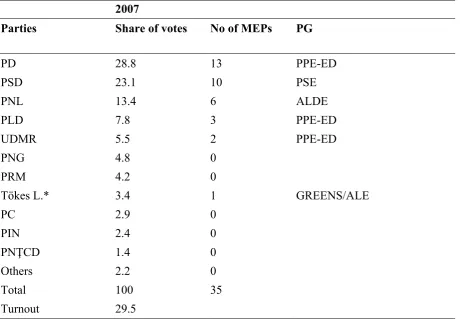
As shown in Table 30.5, when one compares the electoral success of parties in the European and national elections, in a relatively young and unstable party system, the parties which were successful in both elections were those which had a high level of institutionalization by early 2000. As in the 2009 elections, the focus of the campaign was mainly on national issues. However, some of the election themes revolved around the topic of how and what Romania could add to regional security. Parties also aimed to make electors aware of the fact that MEPs would contribute to decisions that would affect all 27 member-states. They also stressed the importance of mobilizing the electorate to understand the transition from being a candidate to being a member-state of the European Union.
Table 30.5. JUST ABOUT HERE
Party manifestos in 2007 were not focussed on important issues for Romanian citizens such as the Common Agricultural Policy or commercial policy, but mainly on energy and environmental policies or EU institutional reform. Romanian parties justified the focus on internal issues during the electoral campaign as a strategy used in order to attract voters to the polls. Turnout for the 2007 European elections however was only 29.4 per cent, about 10 percentage points lower than for the 2008 national elections and almost half of the turnout registered in the 2004 national elections.
9. The 2009 European Elections 9.1 Party Lists and Manifestos
decreased in 2009, when only seven parties and two independent candidates participated in the EP electoral campaign starting on the 8 May 2009 The lists proposed by the Green Party and the Ecologist party and the candidature of one independent were rejected by the Romanian Central Electoral Bureau after the signatures associated with the party lists and the independent candidate were verified. Also, two relatively small parties, PIN and PNG, did not run in the European elections in 2009. PNG leader George Becali signed an electoral pact with the PRM and was considered on the list of the Greater Romania Party.
PD-L’s programme for the 2009 European elections called for a country without corruption, for solidarity, for joining the Schengen zone, for better status for Romanian workers in the European labour market, for measures to overcome the economic crisis, for an improved agricultural sector, and for helping Moldova with the process of joining the EU. The opposition party, PSD, focussed its discourseduring the EP elections campaign on the necessity of increasing pensions, salaries in the public sector, and on European funds to help the agriculture industry and other industrial sectors. The PNL electoral manifesto for the 2009 EP elections was called: ‘Liberal Europe works for Romania’. The main objectives highlighted in the document were support for small- and medium-sized businesses, the necessity of subsidies for agriculture, the status of Romanians abroad and the their right to work, politics towards Moldova, and perspectives on European integration. The PRM is the only Romanian party which openly speaks about the negative effects of European integration and which also has an anti-immigrant policy stance. In comparison with the other non-attached parties in the EP they are more pro-welfare state, advocate more strongly the necessity of law and order and the role of religious values in politics, and are against permissive attitudes towards same sex marriages or legalizing soft drugs.
unemployment, living standards, salaries and pensions, and housing for young couples. Pensions and increased salaries in the public sector were issues raised by the PSD, all associated with the message ‘Choose well’. Starting with a motto ‘For better or worse’, the PD-L used the idea of family in order to suggest the representation of Romanian families in the big European family at the EP. Its candidates, along with those of the PSD and PNL, promised European funds and a continuing fight against corruption. The UDMR detached themselves from the forthcoming presidential campaign and promoted themselves as the ambassadors of Transylvania in relation to Europe. The Greater Romania Party had an expected and unsurprising anti-corruption and justice-oriented campaign with the motto ‘Down with the mafia and up with the country’. After losing their national parliamentary seats in 2008, the party leader, Vadim managed to revitalize the party by bringing in businessman George Becali, the former president of PNG, on their list of Euro-candidates. When compared to other members inside their European party group, in the ALDE group for example, the PNL did not put too much emphasis on green issues, did not oppose immigration, and was about average with its position towards European integration. Whilst PSD MEPs were about average in their S&D group, although slightly less permissive, the PD-L was more pro-immigration than the vast majority of parties forming the EPP group.
9.2 Electoral Campaign
capital Bucharest and in Cluj-Napoca. The advertising posters were launched on 1 April 2009 and were active for about one month.
In 2009, the mass media’s interest in the electoral campaign was lower. Radio and television debates were organized as designated by law, but several local experts noted that the campaign prepared by the parties was not as aggressive as in previous national elections. Non-governmental organizations organized a common front under the name Coalition for a Clean Parliament– European Elections (CPC-AE) and monitored 100 candidates for the EP. At the end of the process, the coalition made public a list of 11 names, two representatives of PSD, PNL, PD, three candidates of PRM, one candidate of PNG and UDMR, who, according to them, did not fulfil the integrity criteria for becoming an MEP.
In order to mobilize citizens, the Romanian government also publicized the elections for one week at the end of the electoral campaign. Civil society was involved in monitoring the electoral campaign in various ways. The foundation Civil Society for Moral Reform made public a black list of candidates for the European Parliament. The list included 17 names of people who, according to the foundation, could not ethically and morally represent the interests of Romanians and of the European Parliament. Academia Caţavencu, a well-known satirical magazine, also made public a list of names drawn from amongst the Euro candidates which the publication did not believe should represent Romania in the EP. Besides these actions, the non-governmental association Pro Democracy ran a project in partnership with the Ministry of Education which involved 45 high schools to inform and stimulate the pupils to participate in the June EP elections.
EU-related slogans. The electoral campaigning included some social issues not necessarily EU-related to the specifics of the EP elections. The European dimension of the elections and in particular their impact on the political future of Romania were almost absent from the video messages of the Romanian candidates. As noted by the Romanian press, parties used the same populist messages (România
Liberă, 27 May 2009) in the EP campaign as in the national election campaign. Their main
messages related to employment, salaries, increase of child benefits, modernisation of transport, and housing for young couples. The campaign was a bit disconnected from the reality of the economic crisis and did not emphasize what role Romanian representatives should play in the EP. Most of the candidates did not explain in detail why they wanted to go to Brussels or what kind of projects they planned to develop once arrived in the European legislative arena. The media also affirmed the use of the June 2009 campaign for the European elections as a rehearsal for the November 2009 presidential elections (România Liberă, 11 May 2009). Most parties took the opportunity to announce their candidates for the presidential election and to communicate their message against the incumbent President Băsescu.
9.3. Electoral Results
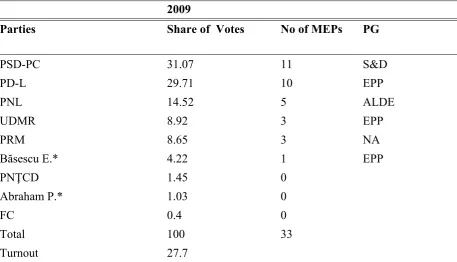
Table 30. 6 illustrates the results of the European elections in 2007 and 2009. Compared to 2007, in 2009 the Social Democrats who were in opposition gained slightly more popularity, but they obtained about the same percentage of the vote as the Democratic Liberals. Whilst in 2007, the incumbent PD had 13 MEPs, and the PSD had only ten, in 2009 their fortunes balanced and the PSD received 11 EP seats, compared to ten obtained by the PD-L. The seats won by the Liberal Party had been reduced by one, from six in 2007 to five in 2009. The Hungarian minority party gained three seats in 2009, one more as compared to 2007.
-Table 30.6. JUST ABOUT HERE-
-Table 30.7. JUST ABOUT HERE-
Towards the party group configuration in the EP in 2007, Romania contributed 18 MEPs to the PPE-ED group, ten to the PSE group; six to the ALDE group and one MEP to the Greens/ALE group. This distribution was relatively the same in 2009. The only groups which received fewer MEPs were the EPP and the S&D (14 EPP, 11 S&D, five ALDE, three NA). In 2009, however, due to the mandates won by the Greater Romania Party, three of the newly-elected MEPs from PRM did not join any political group and remained non-affiliated.
coalitions PSD-PC and PNL-PD. In the following 2008 national elections the party lost all seats won in 2004 and experienced a slight upward trend in the 2009 EP elections.
Romanian MEPs range from high-profile career politicians who previously had party, governmental, or parliamentary positions to young politicians who can use the EP mandate to enhance their national political career, and a few amateur politicians as well, who previously had little or no experience of high-profile elected public positions. With an average age of 46, the vast majority of Romanian MEPs have previously held a party position. Some of them have been involved in politics since 1990 or earlier and some held ministerial positions in previous governments. Professionally, the predominant vocation is economist, followed by engineer or lawyer (see Table 30.8).
-Table 30.7. JUST ABOUT HERE-
fifth places on the list. Likewise, eight of the PDL candidates had already represented Romania in the EP from 2007-2009. They were placed in between the first and fourteenth places on the party list. The electoral alliance PSD+PC had 43 candidates on their list like all the other parties, out of which nine, former MEPs in 2007, have been placed in between the first and sixteenth position on the list.
The MEPs’ committee memberships are mostly assigned according to their professions. In terms of allocation of committee chairs, Romania was given five vice-chair positions in the Committees on Transport and Tourism, Development, the Subcommittee on Security and Defence, the Delegation for relations with the countries of the Andean Community, the Committee on Economic and Monetary Affairs, and the Committee on Transport and Tourism. The chair position was given for the delegation to the EU-Moldova Parliamentary Cooperation Committee.
9.4 Campaign Finance
proportionally in the level of donations received. Total campaign financing for 2007 was around € 5.5 million (22,908,144 lei) whilst total party revenue for the campaign was € 3.4 million (14,178,388 lei). The difference (38.2 per cent) was attributed to donations. By comparison, according to the report of the Romanian permanent electoral authority total campaign spending for the national parliamentary elections in 2008 was about the equivalent of €17 million (70,371,819 lei) out of which 45 per cent came from the parties’ budgets and 55 per cent came from donations.
10. Theoretical Interpretation of Euro-elections
10.1 Second-Order Election Theory
In a context so supportive of the EU, Romanian turnout in the European elections was quite low. As Table 30.6 shows, only 29.5 per cent of Romanians turned out to vote in 2007 and even fewer, 27.7 per cent in 2009. Romanian participation in the Euro-elections was well below 45.4 and 43 per cent, which were the European mean in 2007 and 2009, respectively. Low participation in Euro-elections went hand in hand with the low interest shown in these elections. Eurobarometer figures from autumn 2008 show that only 19 per cent of Romanians knew that the next EP elections would take place in 2009. A majority of 53 per cent, however, declared themselves interested in these elections. In January-February 2009, the percentage of Romanians who knew about the 2009 EP elections rose to 30 per cent, and so did their interest, to 56 per cent. The intention not to vote in elections was underreported, seven per cent in autumn 2008 and of eight per cent in January-February 2009. The percentage of those who definitely intended to vote was 20 per cent in autumn 2008 and 26 per cent in January-February 2009, figures that were very close to the actual turnout.
When one compares the 2009 Euro-elections to the 2008 national election results, the governing parties (PD-L and UDMR) did not lose votes to the opposition parties and the PD-L vote share was almost identical with that of PSD-PC. The independent candidate Elena Băsescu (daughter of President Traian Băsescu) re-joined the PD-L after the election, which established equality between the EP mandates won by the Social Democrats and the Democratic Liberals. Lower turnout in European elections did not necessarily affect the supporters of parties in government more as opposed to those in opposition. The vast majority of those who voted for the opposition or the incumbent parties in the 2008 national elections, also voted in the 2009 European elections. Out of the PSD voters in 2008, 70 per cent of them voted in the EP elections as well, against 30 per cent who did not vote. Similar participation was registered from amongst the PD-L voters, 66 per cent of them participated in the EP elections against 34 per cent who did not; and from the PNL voters as well, 71 per cent against 29 per cent. The most mobilized and constant voters are those of the UDMR; 78 per cent of its voters in the national elections also voted in the European elections.
Large parties did not lose a large percentage of votes to smaller parties. The Hungarian minority party maintained a constant vote share across all the national and European elections. Because of the high mobilization of the Hungarian minority and given the low turnout of the Romanian population, compared to the 2008 national elections the UDMR increased their vote share by two per cent. There is no strong Green Party on the Romanian political landscape. The vote share of other small parties such as the Green Party at the 2007 European elections was very low, below one per cent, and they did not participate in the 2009 elections. The far right, Greater Romania Party, did not gain national parliamentary representation in 2008 but won three MEPs seats in the 2009 EP elections.
approaching), the 2009 EP elections took place at the beginning of the electoral cycle (with next parliamentary elections held at the end of 2012) and the turnout in both elections was very similar (29.5 per cent and 27.7 per cent in 2007 and 2009 respectively).
10.2 Europe Salience Theory
The complementary ‘Europe Salience’ theory does not find support for the majority of its predictions in the Romanian case. The theory posits that Europe matters in European elections through party policy positioning, low turnout should go hand-in hand with declining support for European integration, and as a consequence extreme parties should do better in European elections than in national elections (Hix and Marsh, 2007). In the case of the 2007 and 2009 EP elections in Romania, low turnout did not go hand in hand with low support for European integration. A large majority of Romanians who did not vote in the Euro-elections still thought that EU membership was a good thing.
The far-right Greater Romania Party won three seats in the European Parliament in the 2009 Euro elections. The party opposed the country’s accession to the EU in the 1990s, then changed its discourse due to electoral reasons, and in 2009 went back to an anti-EU integration stance (Borz and Rose, 2010, 1). Two-thirds of its party’s voters were however pro-integration, suggesting that the party’s position on the EU was not decisive when they cast their vote. There was no strong Green Party on the Romanian political landscape. The vote share of the Green Party in the 2007 European elections was very low, below one per cent and their lists were not accepted in the 2009 elections due to a lack of sufficient signatures.
CHAPTER 30
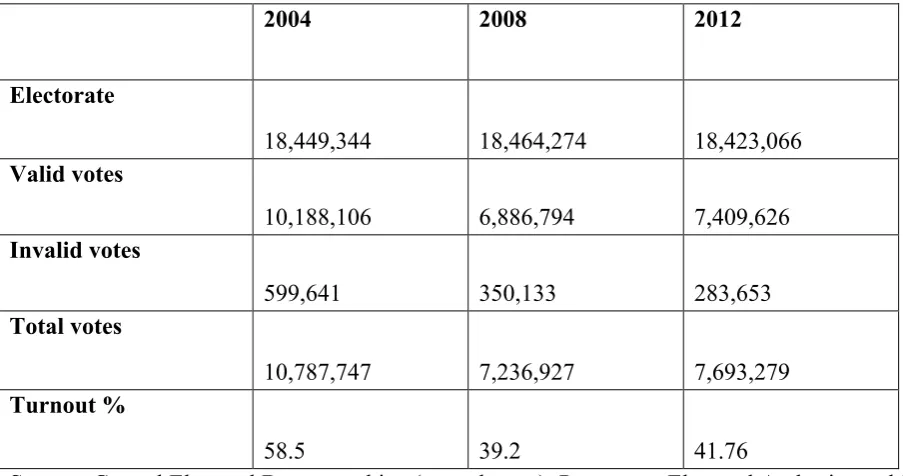
Table 30.4. Turnout in National Elections in Romania: 2004-2012
2004 2008 2012
Electorate
18,449,344 18,464,274 18,423,066 Valid votes
10,188,106 6,886,794 7,409,626 Invalid votes
599,641 350,133 283,653
Total votes
10,787,747 7,236,927 7,693,279 Turnout %
58.5 39.2 41.76
Table 30.5 EP Election Results in Romania: 2007
Source: Central Electoral Bureau , Romanian Permanent Electoral Authority, accessed 2 June 2010;
http://www.roaep.ro/bec_eu_07/wp-content/uploads/2013/10/reultate_finale_pe.pdf Notes:
* independent candidate;
Others in 2007 include: Pro-Europe Roma Party (Partida Romilor Pro-Europa) 1.14%; Socialist Alliance Party (Partidul Alianţa Socialistă) (0.55%), Green Party (Partidul Verde) 0.33%;
2007
Parties Share of votes No of MEPs PG
PD 28.8 13 PPE-ED
PSD 23.1 10 PSE
PNL 13.4 6 ALDE
PLD 7.8 3 PPE-ED
UDMR 5.5 2 PPE-ED
PNG 4.8 0
PRM 4.2 0
Tökes L.* 3.4 1 GREENS/ALE
PC 2.9 0
PIN 2.4 0
PNŢCD 1.4 0
Others 2.2 0
Total 100 35
Table 30.6 EP Election Results in Romania: 2009
Source: Central Electoral Bureau , Romanian Permanent Electoral Authority,
http://www.bec2009pe.ro/Documente%20PDF/Rezultate/Rezultate%20finale/Proces%20verbal%20 centralizare%20voturi.pdf, accessed 2 June 2010;
Note: * independent candidates; 2009
Parties Share of Votes No of MEPs PG
PSD-PC 31.07 11 S&D
PD-L 29.71 10 EPP
PNL 14.52 5 ALDE
UDMR 8.92 3 EPP
PRM 8.65 3 NA
Băsescu E.* 4.22 1 EPP
PNŢCD 1.45 0
Abraham P.* 1.03 0
FC 0.4 0
Total 100 33