City, University of London Institutional Repository
Citation
:
Ahmad, R., Kyratsis, Y. and Holmes, A. H. (2012). When the user is not the chooser: learning from stakeholder involvement in technology adoption decisions in infection control.. Journal of Hospital Infection, 81(3), pp. 163-168. doi: 10.1016/j.jhin.2012.04.014This is the accepted version of the paper.
This version of the publication may differ from the final published
version.
Permanent repository link:
http://openaccess.city.ac.uk/13517/Link to published version
:
http://dx.doi.org/10.1016/j.jhin.2012.04.014Copyright and reuse:
City Research Online aims to make research
outputs of City, University of London available to a wider audience.
Copyright and Moral Rights remain with the author(s) and/or copyright
holders. URLs from City Research Online may be freely distributed and
linked to.
1
When the user is not the chooser: learning from stakeholder involvement in
technology adoption decisions
Dr Raheelah Ahmad (corresponding author)
Research Associate, National Centre for Infection Prevention and Management
Faculty of Medicine, Imperial College London, United Kingdom
Level 2 Infection Control, Hammersmith House, Hammersmith Hospital campus
Du Cane Road, W12 0HS, London, United Kingdom
Email: [email protected]
Tel: 0044 20 8383 3277; M: 07962320404; Fax: 0044 20 8383 3235
Dr Yiannis Kyratsis
Research Fellow, National Centre for Infection Prevention and Management
Faculty of Medicine, Imperial College London
Level 2 Infection Control, Hammersmith House, Hammersmith Hospital campus
Du Cane Road, W12 0HS, London, United Kingdom
Professor Alison Holmes
Professor in Infectious Diseases & Director of Infection Prevention and Control
National Centre for Infection Prevention and Management
Faculty of Medicine, Imperial College London, United Kingdom
Level 2 Infection Control, Hammersmith House, Hammersmith Hospital campus
2 Summary
Background: Health systems need efficient innovation decisions to provide maximum benefit to patients, particularly in a climate of financial constraints. Whilst evidence based innovations exist for helping to address Healthcare Associated Infections, the uptake and implementation of these is highly variable and in some cases very slow.
Aim: To investigate innovation adoption decisions and implementation processes from an organisational perspective, focussing on the implications of stakeholder involvement during the innovation process.
Methods: Thirty five technology adoption decisions and implementation processes were examined through 121 qualitative interviews in 12 NHS health care organisations across England.
Findings: Stakeholder involvement varied across organisations with decisions highly exclusive to the infection prevention & control (IPC) team, to highly inclusive of wider organisational members. The context, including organisational culture, previous experience, and logistical factors influenced the level of stakeholder engagement. The timing of stakeholder involvement impacted on: 1. the range of innovations considered; 2. innovations selected, and 3. success of implementation. Cases of non-adoption, discontinued adoption, and of successful implementation are presented to share learning. The potential benefits of stakeholder involvement for 'successful' innovation adoption are presented including a goal orientated framework for involvement.
Conclusion: Key stakeholder involvement can lead to innovation adoption decisions compatible with structural and cultural contexts, particularly when involvement crosses the phases of initiation, decision making and implementation. Involving members of the wider health care organisation can raise the profile of IPC and reinforce efforts to make IPC everybody’s business.
3 Introduction:
Delivering quality and efficiency gains in health care is becoming increasingly important
worldwide and innovation is key for any such goal. In infection control, healthcare organisations
potentially face a double financial burden if unsustainable innovation decisions are made,
leaving less resources for patient protection and benefit12. In England, the Department of Health
recently completed a consultation to learn from national and international best practice to
accelerate the pace and scale of innovation adoption in the NHS3. This latest activity builds on
the drive over the last decade to encourage innovative thinking across the NHS and promote
the use of evidence-based innovations4. Despite the development of an innovation
dissemination infrastructure, the challenges of adopting novel technologies persist5. The
Department of Health in England specifically initiated the Healthcare Associated Infection
(HCAI) Technology Innovation Programme in 2008. Initiatives have included an expert panel
which rates new technologies giving recommendations6, trial and evaluation of reviewed
technologies, sourcing design ideas from front-line staff and fast tracking them to development.
Case studies within this environment provide opportunities for infection prevention and control
(IPC) as well for healthcare systems nationally and internationally7. IPC has been cited as an ‘early adopter’ of the patient safety agenda8 and therefore a natural candidate to lead on
sustainable innovation adoption9.With the success of IPC contingent on a range of stakeholders
including patients, carers, clinicians and management, the role of these stakeholders in the
innovation process also requires exploration.
Healthcare innovation literature has examined the involvement of ‘users’ in the innovation
process, but focusses either on the development or assessment of innovations, with less
attention on decision making10 11. In addition, decision making at the organisational level is not
well understood12 13. Previous work does not fully explore the heterogeneity of ‘users’ and their
degree of involvement in decision making, or the implications of this14. This paper makes two
contributions to empirical research regards innovation adoption in IPC: first, consideration of
diverse stakeholders and their involvement in innovation, including intermediate and end-users;
second, the critical timing of this involvement and implications for the healthcare organisation
4 Methods:
The sample included eleven acute hospitals and one primary care organisation from ten regions
across England, recipients of the Healthcare Associated Infection (HCAI) Technology Innovation
Award (2009). In one region the £150,000 award was split equally amongst two hospitals (Trust
8 and 9) and one primary care organisation (Trust 12). The study design was a multi-level,
multiple case study employing well established qualitative methods for primary data collection15.
Seventy four individual face-to-face, semi-structured interviews, with 62 informants were
conducted; group interviews with an additional 36 informants and telephone or electronic
interviews with 11 informants were completed. Data collection was scheduled at the beginning,
middle and end of the project at each case study site from July 2009 to August 2010. In the first
visit the ongoing decision making process was captured and in the follow up visits the
technology selection outcome and implementation experiences were explored. Field notes were
taken from observation of meetings and by observing the selected technologies in use.
Participants included clinical and non-clinical managers, members of executive boards, health
professionals including nurses, doctors (within IPC) and ward staff involved in the
implementation of the selected technologies, clinical biochemists, clinical microbiologists, and
staff from domestic services, estates and facilities departments. Data was systematically
analysed, specifically an integrated approach16; combining inductive development of codes as
well as a deductive organising framework15 17. Stakeholder involvement was mapped to the
various stages of the innovation process.
Results:
The organisational technology adoption decisions (or non-adoption / rejection decisions)
evolved in a sequence of three main stages: 1) initiation; 2) adoption or non-adoption decision;
and 3) implementation18. We identified involvement in this process by looking at three main
groups of stakeholders; a) the IPC team; b) staff within the wider organisation c) stakeholders
from outside of organisation (including patients, public and other healthcare organisations). The
professional composition of the IPC team varied across the organisations. The majority of IPC
teams comprised: director of infection prevention and control (DIPC), Deputy DIPC, medical
microbiologist, infection doctor, infection control nurses, surveillance nurses, decontamination
lead. Some teams included a pharmacist or infection control matrons. The level of involvement
5
identified above (initiation, adoption or non-adoption decision, implementation) and are mapped
out below (Table 1). The outputs from the decision making process are also included. Details of
the technologies are reported elsewhere17.
What was considered and selected
Forty nine technologies were considered, from which thirty eight were selected. The
technologies spanned a range of IPC areas: environmental hygiene; catheter care; medical
devices hygiene; diagnostics; hand hygiene; information management & communication; patient
hygiene; and training. The majority of technologies (20) were categorised as environmental
hygiene technologies. Catheter care received least attention with one technology selection to
improve urinary catheter care (Trust 1). Two of the hospitals committed all of the funds to one
technology selection; Trust 1 and Trust 2.
Stakeholder involvement at initiation impacted on which technologies and IPC areas were
considered, which in turn influenced technologies critiqued by organisational members involved
in decision making. Those involved in the decision making influenced how the technologies were critiqued and what was selected. In the organisations where wider consultation occurred
early, more diverse approaches to IPC were considered. The critical role of timing is described
below.
Who was involved and when?
Processes across the organisations varied along a continuum from highly exclusive to the IPC
team to highly inclusive of the wider organisation. Some organisations changed their strategy
starting with an exclusive approach and then opening up to staff outside of the IPC team in later
iterations of bids for funding. Conversely, one organisation moved from an inclusive approach to
an IPC led approach:
“So I just took an executive decision to do what was worrying me...” [Medical microbiologist].
As expected the IPC team were involved most of the time across the organisations. Overall,
there was low level of involvement of members outside of the IPC team at the stage of
6
taking a targeted approach of one or two key individuals outside of IPC; the remainder taking
an information giving approach:
“People were aware we’d won the award if you like and the money because it went out at … team brief and it was briefed to senior nurses and so there was an opportunity for people to say, well, I’ve got an idea or a thought, but we didn’t actually actively canvas” [Senior IPC nurse].
The reasons for non-involvement at this stage were logistical as well as cultural. The task of
consulting particularly in a larger organisation was deemed to be an administrative burden.
None of the larger organisations (with sizeable IPC teams) consulted with staff outside of the
IPC team to generate ideas for consideration, as they felt they had appropriate capacity and
expertise to do this. Conversely, smaller organisations with small IPC teams relied on
cooperation of directorate/ward staff for generation of ideas and technology implementation. In
addition the ‘specialist’ knowledge held by the IPC team and perceived lack of knowledge of
other organisational members was the rationale provided for an exclusive approach at initiation
by many respondents. There were differences in perceptions across these organisations:
“...but we have got the backing of the clinicians and the Medical Director for the way that we’ve progressed with this, and the clinicians, general nursing and medical staff out there respect our views and we haven’t felt necessary to seek any formal process really for decision making”,
[Medical microbiologist].
“We do get a lot of brochures through the post, and they do send them to the wrong people as far as they get to the Chief Exec and get to the Chief Nurse, and they just all look wonderful, and I think it’s a real, real problem for trusts that perhaps have a DIPC who’s not a microbiologist.” [Director of IPC].
These are in contrast to a cultural and strategic approach which defines IPC as everybody’s
business:
7
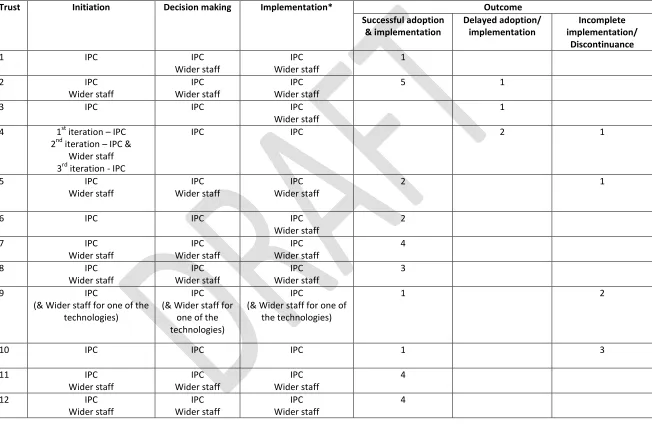
Trust 2 adopted a highly inclusive approach which resulted in over 300 initial ideas, and 100
outline proposals generated through three iterations/calls for ideas until the monies had been
spent. The resulting technologies came from four directorates and implementation of
technologies in seven different departments. The technologies spanned four IPC priority areas;
environmental hygiene, diagnostics, hand hygiene, and medical devices hygiene. Positive
implications of this approach included the generation of cross cutting approaches to IPC through
linkages with other core performance targets. The technologies were adopted and implemented
within planned timelines; the most efficient innovation process was the identification,
procurement, installation and routine use of endoscopy sinks by November 2009 in Trust 2.
Involvement of the clinical innovations coordinator and feedback from technicians resulted in
ergonomic design of the equipment. Clinicians were assured of safety standards and the
endoscopy centre achieved external accreditation.
For some trusts preparatory work for technologies considered before the award informed
decision making, whilst others viewed the award as a starting point. Those organisations with
pre-determined decisions consequently took a less inclusive approach. For example Trust 1
took a highly ‘exclusive’ approach guided by previous audit work. The organisation had been in
the process of locating funding for this technology and therefore did not consider other
technologies or seek further ideas for the £150,000 award.
No trust involved stakeholders outside of the trust in the initiation phase of the process. So, the
wider health economy (primary or social care), patients and public were excluded at this stage
in the eleven acute hospitals. The primary care organisation did not involve the acute care
organisation at initiation. All trusts informed the public through newsletters or other media
(websites) about receipt of the award usually once a technology had been procured. Whilst
views were not sought from patients, patient perceptions did feature in selection decisions:
“It’ll be soft data like, well, if the ultrasonic tanks clean things better we’ll get less complaints from patients because things will look less dirty even if they’re not microbiologically clean or dirty. So we get less complaints so that makes everybody feel better but does that save you money? It might do. It might not.” [Senior IPC nurse].
In implementation planning, Trust 11 invested significantly in patient communication when
8
informed patients, and as reported by staff, less patients “blaming the hospital for catching
MRSA”. In contrast, Trust 7 did not invest in patient communication activities and in retrospect realised that patients “took the new technologies for granted” and did not appreciate the extra effort and resources invested by the organisation for patient benefit.
Looking at the decision making phase, six of the organisations made decisions within the IPC
team. Three organisations involved a few key individuals from outside of the IPC team (ward
managers, nurses, research & development and procurement.), whilst three organisations
involved wider staff. The reasons for wider involvement were generally linked to the specific
technologies. In Trust 1, the involvement of procurement and R&D was due to the financial
constraints being faced by the hospital which meant that in comparison to other organisations
there was more scrutiny of all procurement. In one trust (Trust 2) final decisions were taken
conjointly by the DIPC (medical director of the trust) and the associate director for clinical quality
assurance. This approach was used as the medical director was described as ‘one of the most credible people in the hospital’ and hence decisions would be seen as fair.
table 1 here
Across the cases, support by senior management at the point of decision making facilitated
implementation by mobilising resources and providing increased legitimacy to the initiatives.
Within the IPC team senior involvement took various forms. The professional background of the
DIPC influenced the decision making process in different ways. Our sample of DIPCs included
six medical microbiologists, four directors of nursing, one consultant urologist, and one
consultant radiologist. In the technology selections the DIPC did not always lead the decision
making process. We found that the leadership role adopted by the DIPC provided useful insight
to the process of decision making which led to technology selections. In one organisation the
DIPC was clear about differentiating organisational roles from professional training as a
microbiologist, whereas in another, the DIPC (also a microbiologist), took a lead role at each
stage at initiation and decision making.
Early involvement of the intended technology ‘users’ in the decision making process helped to
obtain “buy-in”. Early engagement of frontline clinical staff as technology users, also led to
9
procurement of computer devices consistent with working practices as well as compliant with
infection prevention guidelines. In addition, the presence of an IPC matron in the decision
making team facilitated communication and smooth implementation:
“Inclusivity, that’s the way we try to work,...especially with our 2 clinical matrons, because they are members of a group of 25 and so therefore they can spread the information as well, right across our organisation. It’s a big organisation” [Estates & facilities manager].
An example of users being excluded at the decision making phase is that of hotel services staff.
They were excluded in the design and testing of the Adenosine triphosphate hygiene monitoring
system. The project lead later appreciated that earlier involvement of this group would have
saved time and effort for training during the hospital-wide roll out of the technology.
Most of the organisations involved wider stakeholders at the implementation phase. Important
engagement at the implementation planning phase was however missing in four of the
organisations. This had a significant negative impact on implementation.
Involvement of the procurement team varied, from up front and early involvement in one trust
only, and delayed involvement in six of the trusts. Where procurement links were made late, the
process was protracted as important considerations had been overlooked. Late involvement
was due to inexperience of IPC staff regards procuring products, or the perception that the
procurement team would act as a barrier to innovation. The hospital under significant financial
pressure, involved procurement earliest, and viewed this expertise as a facilitator to innovative
practice. Other respondents later appreciated earlier involvement would have been beneficial for
the process, as well as strategically for IPC:
“They [procurement] should have been involved from the very early stages. And I think if they were, maybe things would have gone a bit smoother, maybe it would have been a high profile thing for them [procurement]. Because this whole technologies award is a really big deal for the trust, you have such a good thing to say, you’ve won an award because of your turnaround of your infections…maybe communications between us would have been a bit more open and freer. So I think possibly if I could have the time over again I think possibly best to involve them in the early stage” [Senior IPC nurse].
10
Implications of involvement across phases of initiation, decision making and
implementation:
In those organisations where involvement from members outside of the IPC team was low,
technologies were not implemented within the life of the study (Trust 2, Trust 10); that is 16
months from the date of the award. Further, involvement of the IPC team as well as wider staff in more than one phase (initiation, decision, implementation) led to successful adoption decisions and implementation. Notably the organisations taking the latter approach (Trusts 7, 8,
11 and 12) had a 100% success record in terms of adoption and implementation. Trust 6 did not
involve wider trust staff yet achieved successful adoption of two technologies. This was
attributed to the long development history of the IT package which had input from wider staff
during the course of development. Other organisations that took an exclusive approach at two
stages of the innovation process, performed poorly in terms of adoption and implementation.
Notably Trust 10 implemented only one out the four technologies. Stakeholder involvement in
the later stages of implementation only, with little or no involvement in implementation planning,
gave rise to challenges in implementation.
Early engagement of frontline clinical staff and technology users in decision making led to
technology modification and adaptation to fit the local context which helped at implementation
stage. Early engagement and regular steer of the process by a core group of managers,
responsible for the service areas, facilitated the implementation process. Cross departmental
team working, champions and endorsement from senior management were evident to varying
degrees across the trusts, but all helped implementation.
Discussion
Previous studies have focussed on stakeholder engagement in the innovation process with end
users in mind whereas here a broad set of stakeholders has been considered including strategic
and operational managers, frontline health professionals, and patients. These findings suggest
that ‘who’ is involved and ‘when’ they are involved matters, with consequences for informed
adoption decisions and successful implementation19. In addition, involvement has important
11
responsibility and ownership of IPC (Table 2). The involvement of procurement early in the
process can potentially maximise budgets for maximum patient benefit, at the same time
providing a better understanding of IPC for procurement teams and opportunities to identify
synergies with innovation activities across the hospital or primary care organisation.
Professional backgrounds and organisational roles influence perceptions of innovativeness and
perceptions of effectiveness. This study shows how involvement/non-involvement has direct
implications for what is considered and selected. If stakeholder involvement is delayed to the
final phase of implementation, opportunities to incorporate feedback are missed. Involvement of
users can lead to modification of technology or opportunities for reinvention, for example
complex innovations can be simplified13. Involvement of wider staff can lead to better user
buy-in. Involvement of senior management can help to mobilise resources as well as raise the
strategic importance of IPC. As patients are ‘temporary members’ of health care organisations20
and recent literature suggests a role for patients in decision making regards IPC21 22, earlier
involvement in the technology adoption process may encourage patients and carers realise their
role in co-creating a safer environment. Depending on the organisational context and wider
health system, different levels and methods of involvement are appropriate and feasible.
table 2 here
The predefined sample in this study has some limitations as organisational type was not
exhaustive. A strength of the sample is that the initial barrier to adoption (funding) was
‘controlled’ for, allowing other factors at play during decision making to be explored.
In conclusion, appropriate stakeholder involvement can lead to innovation adoption decisions
compatible with structural and cultural contexts. There are potential synergies through
stakeholder engagement across the phases of initiation, decision making and implementation.
As IPC requires a strategic and general management approach23, this also needs to be
reflected in how adoption decisions are made, who is involved, and implications for
implementation need to be considered early on. A goal orientated framework has useful
application as a strategic and operational toolkit for IPC and application more widely in health
12 Acknowledgements:
We would like to acknowledge all respondents in the study, funding for the project by DH and on
project support from Sue Smalley. The authors acknowledge the UKCRC who fund the National
13 References
1. The Research Committee of the Society of Healthcare Epidemiology of America. Enhancing patient safety by reducing healthcare-sssociated infections: the role of discovery and dissemination. Infection Control and Hospital Epidemiology 2010; 31(2): 2118-123
2. AS. Walker, D. Spiegelhalter, DW. Crook, D. Wyllie, J. Morris, TEA Peto, Fairness of financial penalties to improve control of Clostridium difficile. British Medical Journal
2008; 337:2097
3. NHS Chief Executive Innovation Review - Call for evidence and ideas, DH 2011 4. Cooksey D.A Review of UK Health Research Funding. In: Treasury H, editor: HM
Treasury, December 2006.
5. T.Greenhalgh, G. Robert, F. Macfarlane, P.Bate, O. Kyriakidou Diffusion of Innovations in Service Organizations: Systematic Review and Recommendations. Milbank Quarterly
2004; 82(4):581-629.
6. C. Gush, P. Borriello An overview of the UK Department of Health’s Rapid Review Panel. Journal of Hospital Infection.2007;65(S2) 27–29
7. Gabbay J, Le May A, Bate P, Pope C, Robert G, Elston MA. Organisational innovation in health services: lessons from the NHS treatment. Bristol: The Policy Press; 2011
8. JP.Burke, Infection control - a problem for patient safety. New England Journal of Medicine 2003;348(7):651-656
9. Vincent C. Patient safety. 2nd ed. Oxford: Wiley-Blackwell/BMJ Books; 2010
10. Shah SGS, I.Robinson. User involvement in healthcare technology development and assessment – structured literature review. International Journal of Health Care Quality Assurance 2006;19(6):500-515.
11. Achterkamp M & Vos JFJ A framework for making sense of sustainable innovation through stakeholder involvement International Journal of Environmental Technology and Management 2006 6 525-538
12. King N. Involvement in innovation: the role of identity In Shavinina Eds The International Handbook of Innovation Part VIII. Elservier Science 2003.
13. Rogers EM.Diffusion of Innovations. 5th ed. New York: Free Press, 2003 14. Van De Ven AH, Scott Poole, M, 2010 Alternative Approaches for Studying
Organizational Change. Organisation Studies 2010 26(9): 1377–1404
15. Kyratsis Y, Ahmad R, Alison H. Understanding the Process of Innovation Adoption in 12 NHS trusts – technology selection, procurement and implementation to help reduce HCAIs. London: Department of Health, 2010:331
16. Bradley EH, Curry LA, Devers KJ. Qualitative Data Analysis for Health Services Research: Developing Taxonomy, Themes, and Theory. Health Services Research
2007;42(4):1758-72
17. RA. Atun, I. Kyratsis, G. Jelic, D. Rados-Malicbegovic, I. Gurol-Urganci. Diffusion of complex health innovations - implementation of primary health care reforms in Bosnia and Herzegovina, Health Policy and Planning 2007; 22; 28-39
14
19. M. Dettenkofera, A. Ammonb, P. Astagneauc, S.J. Dancerd, P. Gastmeiere, S.
Harbarthf, et al. Infection control – a European research perspective for the next decade.
Journal of Hospital Infection.2011 77: 7-10
20. Ovretveit, J. Organisational behaviour research in health care: an overview. In Ashburner, L. Eds. Organisational behaviour and organisational studies in health care: Reflections on the future. Palgrave.2001.
21. National Institute for Health and Clinical Excellence and Health Protection Agency. Prevention and control of healthcareassociated infections quality improvement guide. London: NICE/ HPA; November 2011D.
22. Pittet, S.S. Panesar, K. Wilson, Y. Longtin , T. Morris , V. Allan , J. Storr , K. Cleary , L. Donaldson Involving the patient to ask about hospital hand hygiene: a National Patient Safety Agency feasibility study. Journal of Hospital Infection 2011;77: 299-303
15
Table 1Stakeholder involvement at initiation, adoption decision and implementation for the twelve trusts and associated outcome
Trust Initiation Decision making Implementation* Outcome
Successful adoption & implementation Delayed adoption/ implementation Incomplete implementation/ Discontinuance
1 IPC IPC Wider staff
IPC Wider staff
1 2 IPC
Wider staff
IPC Wider staff
IPC Wider staff
5 1
3 IPC IPC IPC
Wider staff
1 4 1st iteration – IPC
2nd iteration – IPC & Wider staff 3rd iteration - IPC
IPC IPC 2 1
5 IPC Wider staff
IPC Wider staff
IPC Wider staff
2 1
6 IPC IPC IPC
Wider staff
2 7 IPC
Wider staff IPC Wider staff IPC Wider staff 4 8 IPC
Wider staff IPC Wider staff IPC Wider staff 3 9 IPC
(& Wider staff for one of the technologies)
IPC (& Wider staff for
one of the technologies)
IPC
(& Wider staff for one of the technologies)
1 2
10 IPC IPC IPC 1 3
11 IPC Wider staff IPC Wider staff IPC Wider staff 4 12 IPC
16 Table 2 Goal orientated approach to stakeholder involvement
Goal When to involve?
(during the innovation process)
Who to involve?
Informed adoption decision
Initiation IPC
essential
Wider Trust
best practice
Outside Trust
no clear benefit/logistically challenging
Decision making IPC
essential
Wider Trust
essential
Outside Trust
no clear benefit/logistically challenging
Successful implementation
Implementation
Implementation planning IPC
essential
Wider Trust
essential
Outside Trust
best practice
Implementation IPC
essential
Wider Trust
essential
Outside Trust
best practice/essential*
Raising profile of IPC
Initiation IPC
essential
Wider Trust
essential
Outside Trust
best practice
Decision making IPC
essential
Wider Trust
essential
Outside Trust
no clear benefit/logistically challenging
Implementation IPC
essential
Wider Trust
essential
Outside Trust