RESEARCH NOTE
Polymorphisms rs693421 and rs2499601
at locus 1q43 and their haplotypes are
not associated with primary open-angle
glaucoma: a case–control study
Altaf A. Kondkar
1,2*, Taif A. Azad
1, Tahira Sultan
1, Faisal A. Al‑Mobarak
1,2, Hatem Kalantan
1and Saleh A. Al‑Obeidan
1,2Abstract
Objective: The genetic spectrum of primary open‑angle glaucoma (POAG) in middle‑eastern Saudi’s is still elusive. To this end, we investigated an association between rs693421, rs2499601 and their haplotypes at chromosome 1q43 locus with POAG and its related clinical phenotypes. Genotyping was performed with TaqMan® assays. Haplotypes and their interaction analysis were carried out by SHEsis and SNPStats online tools.
Results: The minor “T” allele frequency of rs693421 was 0.48 in controls and 0.52 in cases (odds ratio (OR) = 1.15, 95% confidence interval (CI) 0.85–1.54, p = 0.368). Similarly, for rs2499601, the minor “C” allele frequency was 0.49 in controls as compared to 0.53 in cases (OR = 1.19, 95% CI 0.89–1.60, p = 0.236). Besides, genotype distribution for both these polymorphisms was also not significant in additive, dominant and recessive models. rs693421 and rs2499601, showed significant linkage disequilibrium (D’ statistics = 0.69, p < 0.001) but haplotype association was non‑significant (p = 0.698). The significance did not vary after adjustment to age and sex. No significant genotype association was observed with intraocular pressure, cup/disc ratio and number of anti‑glaucoma medication in POAG group. Fur‑ thermore, age, sex and genotypes did not contribute any significant risk of POAG in regression analysis. We report no association between rs693421, rs2499601 and their haplotypes with POAG and related phenotypes.
Keywords: Chromosome 1q43, Genetic association, Glaucoma, Haplotype, rs693421, rs2499601, Saudi
© The Author(s) 2019. This article is distributed under the terms of the Creative Commons Attribution 4.0 International License (http://creat iveco mmons .org/licen ses/by/4.0/), which permits unrestricted use, distribution, and reproduction in any medium, provided you give appropriate credit to the original author(s) and the source, provide a link to the Creative Commons license, and indicate if changes were made. The Creative Commons Public Domain Dedication waiver (http://creat iveco mmons .org/ publi cdoma in/zero/1.0/) applies to the data made available in this article, unless otherwise stated.
Introduction
Epidemiological studies in the past suggest that pri-mary open-angle glaucoma (POAG), at least in part, can be caused by heritable factors [1–3], with five to tenfold increased risk in the first-degree relatives and an estimated heritability of 0.81 [4]. However, given the polygenic nature of POAG, its exact genetic etiology still remains elusive. Genetic studies are a critical tool to identify genes and molecular pathways in complex human diseases. Likewise, using a similar approach, pop-ulation-based genome-wide and candidate gene studies
have reported a number of polymorphic variations or loci that have been associated with POAG and/or its quanti-tative endophenotyes [5, 6].
In an initial study, using a 2-stage genome-wide approach in a group of Japanese POAG patients, Nakano et al. [7] reported 3 genetic loci, harboring six single nucleotide polymorphisms (SNPs), of hav-ing significant association with the disease. Of these, 4 intergenic polymorphisms such as rs540782, rs540784, rs693421 and rs2499601 are located on chromosome 1q43. The genes flanking the locus 1q43 include Zona Pellucida glycoprotein 4 (ZP4) and Ryanodine Recep-tor 2 (RYR2). ZP4 plays a role in fertilization and pre-implantation development; and genetic variations in
ZP4 are reported to be associated with ovarian disease
Open Access
*Correspondence: [email protected]
1 Department of Ophthalmology, College of Medicine, King Saud
University, P.O. Box 245, Riyadh 11411, Saudi Arabia
[8] and glaucoma [7]. Ryanodine receptors (RyRs) are ubiquitous intracellular calcium (Ca2+) release
chan-nels localized in the plasma membrane of endoplasmic or sarcoplasmic reticulum of many organs, including retina [9]. Given the important physiological role of RyR channel, defect(s) in RyR function, either due to oxidative stress or genetic mutations can render these channels leaky to Ca2+ influx. These may thereby
pro-duce disease-causing signals and contribute to severe pathologies as those observed in heart failure, muscu-lar dystrophy, diabetes, or neurodegenerative diseases [10, 11]. Also, considering the potential role of calcium channel blockers in treatment of glaucoma [12], RYR2
may be a potential candidate in POAG.
Replication of case–control association studies in vari-ous ethnicities has genetic epidemiological importance, so as to enable future utilization of these genetic bio-markers in evaluation of the disease risk. Association studies using candidate gene approach are a useful tool to identify the genetic contribution of SNPs/loci, each of which may exhibit a relatively small risk but have a sig-nificant impact in a population. The genetic spectrum of POAG, especially in middle-eastern Saudi POAG patients, is still unclear. We have previously reported a lack of association between SNPs rs540782 and rs540784 with POAG in a small group of Saudi patients [13, 14]. The present study investigated an association between rs693421, rs2499601 and their haplotypes with POAG or its clinical indices in a much larger and different set of sample cohort of Saudi origin. Besides, there are no other published reports of association of these SNPs (rs693421 and rs2499601) in this population.
Main text Methods
Study design and participants
We conducted a retrospective case–control genetic asso-ciation study. The study followed the principles of the Declaration of Helsinki and had an institutional review board ethics committee approval (# 08-657). Patients (n = 185) and controls (n = 171) were recruited at King
Abdul-Aziz University Hospital in Riyadh, Saudi Arabia. The inclusion–exclusion criteria for patients and controls have been detailed elsewhere [15]. Briefly, POAG patients showed (i) optic disk or retinal nerve fiber layer changes; (ii) visual field abnormalities; (iii) bilateral open anterior chamber angles; and (iv) adult onset. Secondary forms of glaucoma and history of steroid usage or ocular trauma were excluded. Controls were > 20 years of age with normal IOP, normal optic disk, open anterior chamber angles and no history of ocular disease(s) or eye surger-ies. Subjects refusing to participate were also excluded.
Genotyping of rs693421 and rs2499601 at Chr.1q43
DNA samples were genotyped for rs693421 and rs2499601using the TaqMan® genotyping assays
C_80796_20 and C__26180887_10, respectively (Applied Biosystems Inc., Foster City, CA, USA; Cat#: 4351379) as described previously [13].
Statistical analysis
SPSS version 22 (IBM Inc. Chicago, IIinois, USA) was used to perform statistical tests as indicated. Linkage disequilibrium analysis was conducted using SHEsis online software (http://analy sis.bio-x.cn/myAna lysis .php). SNPStats online software (http://bioin fo.iconc ologi a.net/snpst ats/start .htm) was used to construct haplotypes and analyze the interactions with related factors. p < 0.05 (2-sided) was considered statistically significant.
Results
Demographic and clinical characteristics
Except for family history of glaucoma (p= 0.019), there
was no significant difference in age, gender, systemic co-morbidities and smoking habit between POAG cases and controls (Additional file 1: Table S1).
Genotype and allele frequency
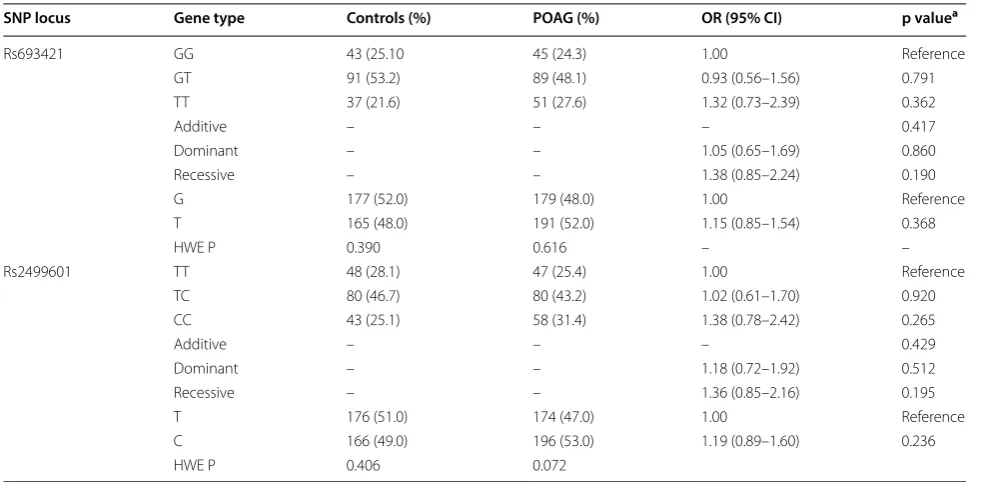
rs693421 and rs2499601 did not deviate significantly from the HWE (p > 0.05). For rs693421, the minor “T” allele frequency was 0.48 in controls and 0.52 in cases, but non-significant (OR =1.15, 95% CI 0.85–1.54,
p = 0.368). Besides, genotype distribution was also not
significant in additive (Chi2= 1.74, df = 2, p = 0.417),
dominant (p = 0.860) and recessive (p = 0.190) models
(Table 1). Similarly, for rs2499601, the minor “C” allele frequency was 0.49 in controls as compared to 0.53 in cases (OR = 1.19, 95% CI 0.89–1.60, p = 0.236) with no
significant genotype effect in additive (Chi2= 1.69, df = 2,
p = 0.429), dominant (p = 0.512) and recessive (p = 0.195)
models. In addition, for both the SNPs, the genotype/ allele distribution between POAG cases and controls was also non-significant after adjustment for age and sex. There was no significant interaction with sex for rs693421 (p = 0.83) and rs2499601 (p = 0.83); and the
sig-nificance did not vary after adjustment for age.
Linkage disequilibrium and haplotype association
rs693421 and rs2499601 showed significant linkage dis-equilibrium as reflected by D’ value (D’ statistics = 0.69,
The significance did not vary after adjustment to age and sex (p = 0.750).
Genotype effect on demographic and clinical phenotypes in POAG
Age and gender distribution was not significant for both rs693241 and rs2499601 genotypes. In addition, phenotypes such as intraocular pressure (IOP), cup/ disc ratio and number of antiglaucoma medication showed no significant genotype effect (Additional file 1: Table S2). Besides, logistic regression showed that age, sex, rs693241 and rs2496601 could not significantly explain the likelihood of having POAG (Additional file 1: Table S3).
Discussion
POAG is the second most common type of glaucoma in Saudi Arabia [16]. Despite its high prevalence, the role of genetic factors contributing to the progression and/ or development of POAG are largely unknown and thus warrants genetic investigation(s) to identify these factors that may plausibly be associated or contribute to POAG pathogenesis. To this end, evaluation of an association between rs693421, rs2496601 and their haplotypes in a Saudi POAG cohort in this study did not yield any signifi-cant relationship with the disease.
Nakano et al. [7] have previously reported a moderate association of polymorphisms rs693241 (OR = 1.48, 95% CI 1.20–1.83, p = 0.00029) and rs2499601 (OR = 1.45, 95% CI 1.17–1.79, p = 0.000589) at locus 1q43 in 1575 Japanese POAG patients. The findings were success-fully replicated in stage-2 GWA study. However, except for rs693421 (OR = 1.4 (1.1–1.7), p = 0.0082) in Korean subjects, subsequent studies in a South Indian [17], Afro-Caribbean [18], Japanese [19], the Hong Kong cohort [20], Korean (for SNP rs2499601) [21] and very recently in the Han Chinese population [22] have failed to repli-cate this association between rs693241, rs2499601 and POAG. Besides, the functional significance of these SNPs or locus to POAG development remains unknown. In contrast to the findings of Nakano et al. [7] and consist-ent with the findings reported in other population [17,
19–21], no significant genotype/allelic effect of these
Table 1 Association analysis of allele frequency and genotype distribution between POAG cases and controls
OR (95% CI): Odds ratio (95% confidence interval), HWE P: Hardy–Weinberg equilibrium p value
a Pearson Chi2 test
SNP locus Gene type Controls (%) POAG (%) OR (95% CI) p valuea
Rs693421 GG 43 (25.10 45 (24.3) 1.00 Reference GT 91 (53.2) 89 (48.1) 0.93 (0.56–1.56) 0.791 TT 37 (21.6) 51 (27.6) 1.32 (0.73–2.39) 0.362
Additive – – – 0.417
Dominant – – 1.05 (0.65–1.69) 0.860 Recessive – – 1.38 (0.85–2.24) 0.190 G 177 (52.0) 179 (48.0) 1.00 Reference T 165 (48.0) 191 (52.0) 1.15 (0.85–1.54) 0.368
HWE P 0.390 0.616 – –
Rs2499601 TT 48 (28.1) 47 (25.4) 1.00 Reference TC 80 (46.7) 80 (43.2) 1.02 (0.61–1.70) 0.920 CC 43 (25.1) 58 (31.4) 1.38 (0.78–2.42) 0.265
Additive – – – 0.429
Dominant – – 1.18 (0.72–1.92) 0.512 Recessive – – 1.36 (0.85–2.16) 0.195 T 176 (51.0) 174 (47.0) 1.00 Reference C 166 (49.0) 196 (53.0) 1.19 (0.89–1.60) 0.236 HWE P 0.406 0.072
Table 2 Haplotype frequencies and association with POAG
Global haplotype association X2= 1.43, df = 3, p = 0.698 (Pearson’s) a Haplotypes were sorted in the order of rs693421 and rs2499601 Haplotypea Frequency
controls Frequency POAG Odds ratio (95% confidence interval)
p value
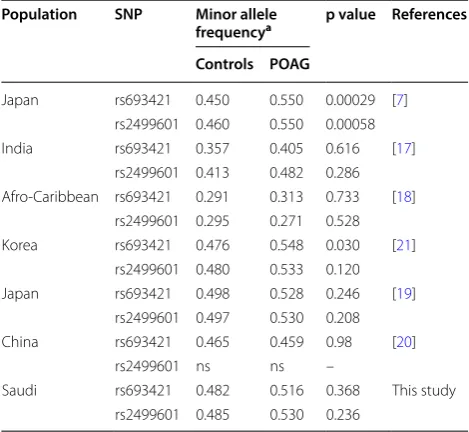
[image:3.595.55.546.100.341.2] [image:3.595.56.290.402.499.2]SNPs in POAG was observed in our study. These con-flicting results can be ascribed to factors such as differ-ences in sample size, lack of adequate statistical power or differences in the phenotypes of the sample popula-tion included in the study. A comparison of minor allele frequencies of these SNPs in different ethnic groups is shown in Table 3. The minor allele frequencies observed for these variants in the Saudi population (controls) was comparable to the Oriental population’s [7, 19–21], but higher than that reported among the Indian [17] and Afro-Caribbean ethnic groups [18].
The genotypes of adjacent polymorphisms are often highly correlated, referred to as being in linkage dise-quilibrium, and could be inherited as haplotypes. Hap-lotypes display an interaction of these polymorphisms and can serve as a maker of disease susceptibility [23]. In complex multifactorial diseases, such as POAG, multiple polymorphisms/loci in the form of haplo-types can be more informative as compared to single allele polymorphism analysis. Hence, to gain additional information we performed association between 1q43 locus haplotypes (for polymorphisms rs693421 and rs2499601) and POAG. The four SNPs (rs540782, rs540784, rs693421 and rs2499601) at chromosome 1q43 have been reported to exhibit strong linkage dis-equilibrium (D’ = 0.90–1.0) [7, 17], but data on hap-lotypes with these did not indicate any association with POAG among Indians [17] as opposed to signifi-cant association (p < 0.05) among Han Chinese POAG
subjects [22]. In our study, significant linkage disequi-librium between rs693421 and rs2499601 was found (D’ = 0.69) but analysis of distribution differences of the four haplotypes in the POAG cases and controls did not show any significant association with the dis-ease. Unfortunately, genotype data for two other SNPs rs540782 and rs540784 at 1q43 were not available for all the subjects included in this study to assess their linkage and/or haplotype association.
Association analysis for any genotype effect of rs693421 and rs2499601 on clinical phenotypes did not provide any significant link. Age and gender showed no significant distribution and clinical phenotypes for glaucoma such as IOP, cup/disc ratio and number of anti-glaucoma medication that serves as markers of disease severity also showed no significant genotype effects in the POAG group.
Similar to Nakano et al. study in 2009, many other recent GWA-studies have reported numerous SNPs in multiple loci/genes in association with POAG and its endophenotypes among European, African and Asian ethnic groups (as reviewed elsewhere [5, 6]). In another recent large-scale study by Shiga et al. [24] in the Japa-nese population, variants near cyclin-dependent kinase inhibitor 2B-antisense 1 (CDKN2B-AS1, rs2157719), SIX Homeobox 6 (SIX6, rs33912345) and growth arrest-specific 7 (GAS7, rs9913911) were found to be associated with POAG. In contrast, with the exception of variant rs10483727 in (SIX1/SIX6) gene locus [25], our previous studies to identify genetic polymorphisms associated with Saudi POAG patients in genes includ-ing caveolin 1/caveolin 2 (CAV1/CAV2) [26], atonal homolog 7 (ATOH7) [27], (CDKN2B) [28], transmem-brane and coiled-coil domain 1(TMCO1) [29], (GAS7) [30] and ZP4 [13, 14], have yielded negative results indicating that the plausible causal genetic defect(s) in POAG cases of Saudi origin may be different than those from European, African and Asian descents, including the Japanese population. There can be several poten-tial reasons for differences in association findings. The differences could reflect an ethnic-specific genetic eti-ology of POAG. Furthermore, the differences could be attributed to variations in environmental expo-sures, clinical variability observed in patients with POAG, variations in the endophenotypic traits related to POAG or other epistatic interactions. Nonetheless, based on our findings and that of reported in other eth-nic groups, it appears that polymorphisms rs693421 and rs2499601 at chromosome 1q43 (near ZP4/RYR2
[image:4.595.56.291.489.705.2]genes), may not have a significant role in POAG patho-genesis and hence, cannot serve as genetic markers to assess the disease risk.
Table 3 Comparison of rs693421 and rs2499601 minor allele frequency distribution among different ethnic group
ns: Not studied
a rs693421[T] and rs2499601[C]
Population SNP Minor allele
frequencya p value References
Controls POAG
Japan rs693421 0.450 0.550 0.00029 [7] rs2499601 0.460 0.550 0.00058 India rs693421 0.357 0.405 0.616 [17]
rs2499601 0.413 0.482 0.286 Afro‑Caribbean rs693421 0.291 0.313 0.733 [18]
rs2499601 0.295 0.271 0.528 Korea rs693421 0.476 0.548 0.030 [21]
rs2499601 0.480 0.533 0.120 Japan rs693421 0.498 0.528 0.246 [19]
rs2499601 0.497 0.530 0.208 China rs693421 0.465 0.459 0.98 [20]
rs2499601 ns ns –
Limitations
Our study could not replicate the previously observed association of rs693421 and rs2499601 in POAG. The results suggest that these SNPs and their haplotypes at locus 1q43, independently or in relation to other clinical phenotypes, are not associated with POAG and hence may not pose a significant risk of POAG in individuals of Saudi origin. However, the lack of asso-ciation needs cautious interpretation since the study is limited by its sample size, performed in specific eth-nicity and their interaction with other genetic or non-genetic factors cannot be ruled out. Nonetheless, based on the minor allele frequency from 1000 Genomes database or that observed in our current study, the sample size used, showed an estimated power of 90% with a detectable odds per allele of 1.60 (2-sided test) and 1.53 (one-sided test). However, assuming an OR of 1.45 as observed in the Japanese POAG patients [7], our study had only 70% and 71% powers (2-sided test) to detect any significant associations between POAG and rs693421 and rs2499601 polymorphisms, respec-tively. As in most genetic association studies, in order to detect an odds of ≤ 1.5-fold a much larger sample
size would be needed.
Additional file
Additional file 1: Table S1. Demographic and clinical characteristics of
POAG cases and controls genotyped for polymorphism rs693421 and rs2499601 included in this study. Figure S1. Linkage disequilibrium plot between the two loci. Table S2. Genotype effect of rs693421 and rs2499601 on glaucoma specific clinical indices in PAOG cases. Table S3.
Logistic regression analysis to assess the effect of age, sex, rs693421 and rs2499601 genotypes on POAG outcome.
Abbreviations
ATOH7: atonal homolog 7; CAV1/CAV2: caveolin 1/caveolin 2; CDKN2B: cyclin‑ dependent kinase inhibitor 2B; CI: confidence interval; GWAS: genome‑wide association study; GAS7: growth arrest‑specific 7; HWE: Hardy–Weinberg Equi‑ librium; IOP: intraocular pressure; OR: odds ratio; POAG: primary open angle glaucoma; RYR2: ryanodine receptor 2; SNP: single nucleotide polymorphism; SIX1/SIX6: SIX Homeobox 1/SIX Homeobox 6; TMCO1: transmembrane and coiled‑coil domain 1; ZP4: zona pellucida glycoprotein 4.
Acknowledgements
The authors would like to thank the Vice Deanship of Scientific Research Chair, Glaucoma Research Chair in Ophthalmology at the King Saud University for supporting this study.
Authors’ contributions
AAK: Study design, analysis, interpretations, manuscript preparation; TAA, TS: sample preparation, genotyping; FAM, HK: subject recruitment, clinical diag‑ nosis, clinical data. SAA: study design, recruitment, clinical diagnosis and data. All authors read and approved the final manuscript.
Funding
This work was supported by King Saud University through Vice Deanship of Scientific Research Chair, Glaucoma Research Chair in Ophthalmology but had
no role in the design of the study and collection, analysis, and interpretation of data and in writing the manuscript.
Availability of data
The data supporting the conclusions of this article are all presented within the article.
Ethics approval and consent to participate
The study adhered to the tenets of the Declaration of Helsinki and had received approval from the Institutional Review Board and Research Ethics Committee of College of Medicine, King Saud University, Riyadh, Saudi Arabia (approval number # 08‑657). Written, informed consent was obtained from all participants prior to their inclusion in this study.
Consent for publication
Not applicable.
Competing interests
The authors declare that they have no competing interests.
Author details
1 Department of Ophthalmology, College of Medicine, King Saud University,
P.O. Box 245, Riyadh 11411, Saudi Arabia. 2 Glaucoma Research Chair in Oph‑
thalmology, College of Medicine, King Saud University, Riyadh, Saudi Arabia.
Received: 13 June 2019 Accepted: 17 July 2019
References
1. Weih LM, Nanjan M, McCarty CA, Taylor HR. Prevalence and predictors of open‑angle glaucoma: results from the visual impairment project. Ophthalmology. 2001;108(11):1966–72.
2. Carbonaro F, Andrew T, Mackey DA, Spector TD, Hammond CJ. Herit‑ ability of intraocular pressure: a classical twin study. Br J Ophthalmol. 2008;92(8):1125–8.
3. Healey P, Carbonaro F, Taylor B, Spector TD, Mitchell P, Hammond CJ. The heritability of optic disc parameters: a classic twin study. Invest Ophthal‑ mol Vis Sci. 2008;49(1):77–80.
4. Charlesworth J, Kramer PL, Dyer T, Diego V, Samples JR, Craig JE, Mackey DA, Hewitt AW, Blangero J, Wirtz MK. The path to open‑angle glaucoma gene discovery: endophenotypic status of intraocular pressure, cup‑ to‑disc ratio, and central corneal thickness. Invest Ophthalmol Vis Sci. 2010;51(7):3509–14.
5. Abu‑Amero K, Kondkar AA, Chalam KV. An updated review on the genet‑ ics of primary open angle glaucoma. Int J Mol Sci. 2015;16(12):28886–911. 6. Wiggs JL, Pasquale LR. Genetics of glaucoma. Hum Mol Genet.
2017;26(R1):R21–7.
7. Nakano M, Ikeda Y, Taniguchi T, Yagi T, Fuwa M, Omi N, Tokuda Y, Tanaka M, Yoshii K, Kageyama M, et al. Three susceptible loci associ‑ ated with primary open‑angle glaucoma identified by genome‑wide association study in a Japanese population. Proc Natl Acad Sci USA. 2009;106(31):12838–42.
8. Meczekalski B, Nawrot R, Nowak W, Czyzyk A, Kedzia H, Gozdzicka‑ Jozefiak A. Study on the zona pellucida 4 (ZP4) gene sequence and its expression in the ovaries of patients with polycystic ovary syndrome. J Endocrinol Invest. 2015;38(7):791–7.
9. Shoshan‑Barmatz V, Zakar M, Shmuelivich F, Nahon E, Vardi N. Retina expresses a novel variant of the ryanodine receptor. Eur J Neurosci. 2007;26(11):3113–25.
10. Santulli G, Lewis D, des Georges A, Marks AR, Frank J. Ryanodine recep‑ tor structure and function in health and disease. Subcell Biochem. 2018;87:329–52.
11. Lanner JT. Ryanodine receptor physiology and its role in disease. Adv Exp Med Biol. 2012;740:217–34.
12. Ganekal S, Dorairaj S, Jhanji V, Kudlu K. Effect of topical calcium channel blockers on intraocular pressure in steroid‑induced glaucoma. J Curr Glaucoma Pract. 2014;8(1):15–9.
•fast, convenient online submission
•
thorough peer review by experienced researchers in your field
• rapid publication on acceptance
• support for research data, including large and complex data types
•
gold Open Access which fosters wider collaboration and increased citations maximum visibility for your research: over 100M website views per year
•
At BMC, research is always in progress.
Learn more biomedcentral.com/submissions
Ready to submit your research? Choose BMC and benefit from: between polymorphism rs540782 and primary open angle glaucoma in
Saudi patients. J Negat Results Biomed. 2017;16(1):3.
14. Azad TA, Edward NB, Kondkar AA, Kalantan H, Altuwaijri S, Sultan T, Al‑ Mobarak FA, Al‑Obeidan SA, Abu‑Amero KK. Polymorphism rs547984 on human chromosome 1q43 is not associated with primary open angle glaucoma in a Saudi cohort. J Negat Results Biomed. 2017;16(1):12. 15. Kondkar AA, Azad TA, Almobarak FA, Bahabri IM, Kalantan H, Abu‑Amero
KK, Al‑Obeidan SA. Lack of association between variant rs7916697 in ATOH7 and primary open angle glaucoma in a Saudi cohort. Genet Res Int. 2018;2018:2148056.
16. Al Obeidan SA, Dewedar A, Osman EA, Mousa A. The profile of glaucoma in a tertiary ophthalmic University Center in Riyadh, Saudi Arabia. Saudi J Ophthalmol. 2011;25(4):373–9.
17. Rao KN, Kaur I, Chakrabarti S. Lack of association of three primary open‑ angle glaucoma‑susceptible loci with primary glaucomas in an Indian population. Proc Natl Acad Sci USA. 2009;106(44):E125–6 (author reply E127).
18. Cao D, Jiao X, Liu X, Hennis A, Leske MC, Nemesure B, Hejtmancik JF. CDKN2B polymorphism is associated with primary open‑angle glaucoma (POAG) in the Afro‑Caribbean population of Barbados, West Indies. PLoS ONE. 2012;7(6):e39278.
19. Takamoto M, Kaburaki T, Mabuchi A, Araie M, Amano S, Aihara M, Tomi‑ dokoro A, Iwase A, Mabuchi F, Kashiwagi K, et al. Common variants on chromosome 9p21 are associated with normal tension glaucoma. PLoS ONE. 2012;7(7):e40107.
20. Chen LJ, Tam PO, Leung DY, Fan AH, Zhang M, Tham CC, Chiang SW, Fan BJ, Wang N, Pang CP. SNP rs1533428 at 2p16.3 as a marker for late‑onset primary open‑angle glaucoma. Mol Vis. 2012;18:1629–39.
21. Kim K, Heo DW, Kim S, Kim JS, Kim CS, Kang C. Expansive marker analysis replicating the association of glaucoma susceptibility with human chro‑ mosome loci 1q43 and 10p12.31. Eur J Hum Genet. 2014;22(3):409–13. 22. Tan Y, Zhang D, Gong B, Zhang X, Jiang L, Lin Y. Association of ZP4 gene
polymorphism with primary open‑angle glaucoma in an ethnic Chinese population from Sichuan province. Zhonghua Yi Xue Yi Chuan Xue Za Zhi. 2018;35(5):737–40.
23. Zintzaras E, Lau J. Synthesis of genetic association studies for pertinent gene‑disease associations requires appropriate methodological and statistical approaches. J Clin Epidemiol. 2008;61(7):634–45.
24. Shiga Y, Nishiguchi KM, Kawai Y, Kojima K, Sato K, Fujita K, Taka‑ hashi M, Omodaka K, Araie M, Kashiwagi K, et al. Genetic analysis of Japanese primary open‑angle glaucoma patients and clinical charac‑ terization of risk alleles near CDKN2B‑AS1, SIX6 and GAS7. PLoS ONE. 2017;12(12):e0186678.
25. Kondkar AA, Azad TA, Almobarak FA, Kalantan H, Sultan T, Alsabaani NA, Al‑Obeidan SA, Abu‑Amero KK. Polymorphism rs10483727 in the SIX1/ SIX6 gene locus is a risk factor for primary open angle glaucoma in a Saudi cohort. Genet Test Mol Biomarkers. 2018;22(1):74–8.
26. Abu‑Amero KK, Kondkar AA, Mousa A, Osman EA, Al‑Obeidan SA. Lack of association of SNP rs4236601 near CAV1 and CAV2 with POAG in a Saudi cohort. Mol Vis. 2012;18:1960–5.
27. Kondkar AA, Mousa A, Azad TA, Sultan T, Almobarak FA, Alawad A, Altuwaijri S, Al‑Obeidan SA, Abu‑Amero KK. Analysis of polymorphism rs1900004 in atonal bHLH transcription factor 7 in Saudi patients with primary open angle glaucoma. Genet Test Mol Biomarkers. 2016;20(11):715–8.
28. Abu‑Amero KK, Kondkar AA, Mousa A, Almobarak FA, Alawad A, Altuwaijri S, Sultan T, Azad TA, Al‑Obeidan SA. Analysis of cyclin‑dependent kinase inhibitor‑2B rs1063192 polymorphism in Saudi patients with primary open‑angle glaucoma. Genet Test Mol Biomarkers. 2016;20(10):637–41. 29. Kondkar AA, Mousa A, Azad TA, Sultan T, Alawad A, Altuwaijri S, Al‑
Obeidan SA, Abu‑Amero KK. Polymorphism rs7555523 in transmembrane and coiled‑coil domain 1 (TMCO1) is not a risk factor for primary open angle glaucoma in a Saudi cohort. J Negat Results Biomed. 2016;15(1):17. 30. Kondkar AA, Azad TA, Almobarak FA, Kalantan H, Sultan T, Al‑Obeidan SA, Abu‑Amero KK. Polymorphism rs11656696 in GAS7 is not associated with primary open angle glaucoma in a Saudi cohort. Genet Test Mol Biomark‑ ers. 2017;21(12):754–8.
Publisher’s Note