RESEARCH NOTE
A structural equation modelling
of the buffering effect of social support
on the report of common mental disorders
in Zimbabwean women in the postnatal period
Tanaka Kaseke
1, James January
2, Catherine Tadyanemhandu
1,3, Matthew Chiwaridzo
1,4and Jermaine M. Dambi
1,4*Abstract
Objective:
Globally, 13–20% of women experience a common mental disorder (CMD) postnatally. Unfortunately,
the burden of CMDs is disproportionally substantial in women from low-income countries. Nevertheless, there is a
growing recognition of the buffering effect of social support (SS) on psychiatric morbidity and the need for mental
well-being support services/interventions. This study evaluated the relationship between psychiatric morbidity and SS
levels, and factors influencing the mental health functioning of Zimbabwean women postnatally. Data were collected
from 340 mothers and were analysed through structural equation modelling.
Results:
The mothers’ mean age was 26.6 (SD 5.6) years. The mean Multidimensional Scale of Perceived Social
Sup-port score was 42.7 (SD 10.8), denoting high levels of SS. Additionally, 29.1% of the population reSup-ported excessive
psychiatric morbidity, the median Shona Symptoms Questionnaire score was 5 (IQR: 2–8). The structural equation
model demonstrated the buffering effects of SS on psychiatric morbidity (r
=
−
0.585, p
=
0.01), and accounted for
70% of the variance. Being unmarried, increased maternal age, lower educational and income levels were associated
with poorer maternal mental health. There is a need for routine; surveillance and treatment of CMDs in women in the
postnatal period, including integration of low-cost, evidenced-based and task-shifting SS interventions.
Keywords:
Women, Postnatal, Social support, Mental health, Zimbabwe
© The Author(s) 2019. This article is distributed under the terms of the Creative Commons Attribution 4.0 International License (http://creat iveco mmons .org/licen ses/by/4.0/), which permits unrestricted use, distribution, and reproduction in any medium, provided you give appropriate credit to the original author(s) and the source, provide a link to the Creative Commons license, and indicate if changes were made. The Creative Commons Public Domain Dedication waiver (http://creat iveco mmons .org/ publi cdoma in/zero/1.0/) applies to the data made available in this article, unless otherwise stated.
Introduction
Globally, between 13 and 20% of women who have just
given birth experience a mental disorder [
1
]. Postnatal
depression is particularly endemic and is a leading cause
of disability in child-bearing women [
2
]. Other
postna-tal menpostna-tal disorders such as anxiety, postnapostna-tal blues and
psychosis are also prevalent [
3
]. Unfortunately, the
bur-den of common mental disorders (CMDs) such as
mater-nal depression is disproportiomater-nally higher in low-income
countries as opposed to high-income countries with
estimated prevalence rates of 19.8% and 10% respectively
[
4
]. For example, 30–34.2% of urban-dwelling,
Zimba-bwean women suffer from postnatal depression (PND)
[
5
–
7
]. Poverty, lower education, compromised physical
health, a history of a CMD, intimate partner violence,
inadequate social support, and changing cultural
prac-tices are important predictors to poor mental health
sta-tus in women who have just given birth [
6
,
8
–
11
].
Despite the significant burden of CMDs among women
in Sub-Saharan Africa, in-depth information on
men-tal health issues in the postnamen-tal period is limited [
7
,
12
]. Nevertheless, there is a growing recognition of the
importance of social support (SS) in improving the
men-tal health of women in the postnamen-tal period [
11
,
13
].
For instance, the buffering hypothesis postulates that
Open Access
effective psychological and social resources, particularly
social stability, social participation, adequate emotional
and instrumental support, can be considered protective,
i.e. they buffer the impact of life stress on the
psychologi-cal well-being of the mother [
14
,
15
]. On the contrary,
a lack of SS can lead to adverse outcomes such as; low
birth weight, preterm labour, foetal neural tube defects,
depression and anxiety [
16
]. However, there is a
pau-city of information on the extent to which SS influences
maternal mental health in low resource-settings [
7
]. The
current study therefore set out to identify sources of SS
and evaluate the buffering effects of SS on the report of
CMDs in urban-dwelling, Zimbabwean women in the
postnatal period.
Main text
Study design, research setting and participants
We conducted a cross-sectional study at Harare City
Council primary health centres. The clinics offer a variety
of health services including: curative, maternity and
post-natal care. Six clinics were purposively selected to ensure
recruitment of participants across the socio-economic
continuum. Two of the six clinics were in low to medium
density catchment areas with four clinics being located
in high-density suburbs [
17
]. Assuming a 33% prevalence
of PND in urban-dwelling, Zimbabwean women [
6
], the
minimal sample size was 340 at 95% confidence interval
and 80% goal power. Women who were seeking postnatal
services and willing to participate on the day of data
col-lection were conveniently selected. Included were
biolog-ical mothers
≥
18 years with children aged 52 weeks and
below. Mothers with a confirmed diagnosis of a mental
health disorder and or suffering from long-term health
conditions such as HIV/AIDS, cancer, among others were
similarly excluded as this could have confounded the
study outcomes. Mothers not proficient in either English
or Shona languages were similarly excluded due to lack
of financial resources for translating study outcomes into
other languages.
Study instruments
A purpose-built questionnaire was used to capture the
participants’ age, gender, marital status, educational level,
employment status and perceived level(s) of income. The
Shona Symptom Questionnaire (SSQ), an indigenous
generic screen, was used to evaluate the report of CMDs
in the past 7 days. The SSQ is a binary outcome i.e. “yes”
and “no” responses are scored as one and zero
respec-tively. The score range is 0–14 and scores
≥
8 indicate
risk of CMDs. The SSQ is especially sensitive in
screen-ing for depression and anxiety and has been extensively
validated in the research setting [
18
,
19
]. The
Multidi-mensional Scale of Perceived Social Support (MSPSS),
a 12-item outcome was used to measure SS.
Respond-ents rate the extent of satisfaction with the SS received
from friends, family and significant other. Responses are
ranked on a five-point Likert scale which ranges from
“strongly disagree
=
1” to “strongly agree
=
5”. The MSPSS
is one of the extensively used SS outcomes [
20
] and has
been translated and validated into Shona (a Zimbabwean
native language) [
21
,
22
].
Procedure
After receiving ethical and institutional approvals, the
principal investigator (TK) approached prospective
par-ticipants in the treatment waiting area(s). The researcher
explained the study rationale, applied the selection
cri-teria in recruiting participants and afterwards issued a
detailed information sheet to mothers meeting the
inclu-sion criteria. Mothers were obliged to provide written
consent to participate in the study. All outcomes were
primarily self-administered, however, the principal
inves-tigator aided participants where necessary.
Data analysis and management
Data were entered into Microsoft Excel and analysed
using STATA (Version 15). Normality was checked using
the Shapiro–Wilk Test. Descriptive statistics
(frequen-cies and means) were used to describe participants’
soci-odemographics and responses on the SSQ and MSPSS.
Thereafter, univariate analysis (t-tests, relation
co-efficiencies and analysis of variance tests) was applied to
determine factors influencing mothers’ mental health.
Contextual factors (patients characteristics) and study
primary outcomes (SSQ and MSPSS sub-scores) were
then entered into the structural equation model as
endogenous and exogenous variables respectively. The
following parameters were set as a minimum criterion for
model fit; Likelihood Ratio Chi squared Test (
χms
2)—cri-terial value: p > 0.05, root mean square error of
approxi-mation (RMSEA)—criterial value:
≤
0.06, Comparative
Fit Index (CFI)—criterial value:
≥
0.90, Tucker–Lewis
Index (TLI)—criterial value:
≥
0.90 and the
standard-ized root mean square residual (SRMR)—criterial value:
≤
0.06 [
23
].
Results
the median SSQ score was 5 (IQR: 2–8) (Table
1
). See
Additional files
1
and
2
for frequencies of reported
prob-lems on the MSPSS and SSQ respectively.
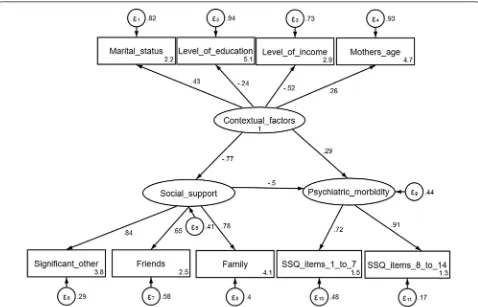
Illustrated in Fig.
1
is the model explaining the
buff-ering effects of social support on psychiatric morbidity
(
r
=
−
0.585, p
=
0.01) and the associated contextual
fac-tors. The model accounted for 70% of the variance (See
Additional file
3
) and displayed excellent fit as outlined in
Table
2
. Being unmarried, lower education status, lower
income level, and increased maternal age were associated
with poorer maternal mental health.
Discussion
Consistent with previous studies, outcomes from the
pre-sent study suggests that mothers who received a greater
amount of SS were likely to have optimal mental health
[
11
,
13
]. Lack of SS is a demonstrated risk factor for
psy-chiatric symptomatology in the postnatal period [
24
,
25
].
Significant others and family were cited as the greatest
sources of SS with friends providing the least support.
Previous studies have shown that it is not always
possi-ble for women to differentiate the effects of spousal
sup-port from other kinship members. In collectivist cultures
like Zimbabwe, the terms husband/significant other and
family are habitually used interchangeably [
26
]. Further,
mothers were likely to have decreased networking
oppor-tunities due to the demands of caring for the new infant,
and this may further explain the discrepancies in sources
of SS [
25
,
27
].
The prevalence of CMDs (29.1%) was relatively higher
compared to the global lifetime prevalence of 18% [
28
],
and a 16% prevalence yielded from an almost similar,
previous local study [
29
]. The changing patterns of
men-tal health symptomatology in Zimbabwe especially given
the advent of the HIV/AIDS pandemic and the
worsen-ing economic challenges the country has been facworsen-ing
may account for the dissimilarity [
7
]. Poverty, poor
nutri-tion, inmate partner violence, history of depression, lack
of spousal support, unstable marital status, unplanned
pregnancies and increased social responsibilities are risk
factors for increased psychiatric morbidity in the
post-natal period for women residing in low-resource settings
[
11
,
13
,
24
,
30
–
33
].
In our study, having fewer resources (lower education
and lower income), small social network (being
unmar-ried) and maternal characteristics (increased maternal
age) negatively influenced maternal mental health.
Mar-ried and cohabiting mothers showed the least risk of
psychiatric morbidity. Traumatic experiences such as
the death of a loved one, losing a job and relationship
Table 1 Participants descriptive statistics, N = 340
a Results not presented in the n (%) format
Variable Attribute Frequency, n (%)
Age of child in weeksa Mean (SD) 22.6 (SD 13.0)
Gender of child Female 167 (49.1)
Male 173 (50.9)
Mother’s agea Mean (SD) 26.6 (5.6)
Marital status Married 193 (56.8)
Co-habiting 101 (29.7)
Other 46 (13.5)
Level of education Primary 20 (5.8)
Secondary 286 (83.4)
Tertiary 34 (9.9)
Employment status Formally employed 40 (11.8) Self-employed 77 (22.6) Unemployed 223 (65.0) Perceived level of income Below average 88 (24.1)
Average 188 (55.3)
Above average 70 (20.6) Social support (MSPSS) scoresa Family [mean (SD)] 3.8 (SD 0.9)
Friends [mean (SD)] 3.1 (SD 1.2) Significant other [mean (SD)] 3.8 (SD 1.0) Summative score [mean (SD)] 42.7 (SD 10.8) Psychiatric morbidity (SSQ) scoresa SSQ scores ≥ 8 [n (%)] 99 (29.1%)
[image:3.595.58.539.426.718.2]breakdown or divorce are associated with poor mental
health functioning [
34
–
36
]. These events are suggested to
reflect additional stress after childbirth, at a time during
which women are especially vulnerable [
36
,
37
]. Mothers
with higher levels of education reported higher levels of
SS. Being educated is an important predictor to greater
political and social engagement [
38
]. Education increases
the sense of control that an individual feel over their life
and concomitantly increases the chances of accessing
stable relationships and expanded social networks which
ultimately enhances the amount of the SS received [
36
,
38
]. Further, educated mothers are highly likely to be
employed and our findings also revealed that mothers
with higher levels of perceived income indicated the least
risk of psychiatric morbidity. These findings are in
keep-ing with a previous systematic review which revealed that
socio-economic disadvantaged women are five times
pre-disposed to CMDs in the perinatal period [
1
].
Fig. 1 Mothers’ mental health model showing the relationship between perceived levels of social support, report of common mental disorders and contextual/demographic factors
Table 2 Model fit indices, N = 340
Fit statistic Index Criterion for fit Result-interpretation
Likelihood ratio Chi squared test (χms2) p > 0.05 χ2 (df 24) = 84.87, p < 0.001—misfit
Normed Chi square [χ2/df] χ2/df < 2 3.5—misfit
Population error Root mean squared error of approximation (RMSEA)-(90% CI) RMSEA ≤ 0.06 0.054 (0.026: 0.080)—good fit Information criteria Akaike’s information criterion (AIC) The smaller, the better 8965.5—best fit
Bayesian information criterion (BIC) The smaller, the better 9080.32—best fit Baseline comparison Comparative Fit Index (CFI) CFI ≥ 0.90 0.928—good fit
[image:4.595.59.537.87.394.2] [image:4.595.56.543.455.587.2]Current evidence also suggests that increased
mater-nal age is a risk factor for CMDs and this is in
contra-diction to previous studies [
6
,
24
,
30
,
32
,
33
]. It has been
previously hypothesized that younger mothers are at an
increased risk for CMDs as they may not be fully
pre-pared for the parenting role. Further, in certain instances,
the lack of SS especially spousal support, may
predis-pose younger mothers to poor mental health
function-ing as some of the pregnancies maybe unplanned [
24
,
30
]. Older mothers are likely to have greater financial
resources, greater education and more likely to be mature
and these are protective factors against CMDs according
to the buffering hypothesis [
39
]. On the contrary, fertility
problems, delayed parity, and prior obstetric
complica-tions are likely to predispose older mothers to CMDs [
31
,
40
]. Further, older mothers may not receive adequate SS
in comparison to first-time mothers, older mothers may
be deemed “proficient” in infant care, and this
predis-poses them to an increased risk of CMDs [
31
,
40
]. Other
studies did not find any association between maternal age
and CMDs [
6
,
35
,
39
,
41
]. Considering the inconclusive
evidence from literature, there is a need for further
lon-gitudinal and qualitative studies to understand the effects
of maternal age on the prevalence of CMDs further.
Collectively, our study outcomes point out the need
for the provision of support services such as professional
counselling for the improvement of the mental health
of mothers in the postnatal period. However, the lack of
human resources is a massive threat towards the closure
of the huge mental health treatment gap in low-resource
settings [
42
]. This therefore calls for the integration of
low-cost, evidenced-based and task-shifting
interven-tions such as the Friendship Bench (FB) [
43
] in mitigating
the burden of CMDs in this populace. The FB concept is
centred on the use of trained, lay-persons
(grandmoth-ers) in providing standardised, problem-solving therapy
(psycho-social support intervention) to persons in need
of mental health services. The FB concept is in
keep-ing with the bufferkeep-ing hypothesis which postulates that
increased SS is associated with improved mental health
[
14
,
15
]. The FB has been successfully implemented in
mitigating the effects of social stigma in individuals
suf-fering from CMDs in the Zimbabwean context [
44
], and
we believe the concept can be successfully integrated into
routine postnatal care.
Conclusion
The prevalence of CMDs was 29.1% and mothers who
received an adequate amount of SS showed optimal
mental health. Being unmarried, lower education
sta-tus, lower income level, and increased maternal age were
associated with poorer maternal mental health. There is
need for routine surveillance and treatment of CMDs in
women in the postnatal period. More importantly, there
is also need for integration of low-cost, evidenced-based
and task-shifting interventions such as the Friendship
Bench [
44
] in mitigating the burden of CMDs in this
populace.
Limitations
• Causality cannot be inferred as data were collected
cross-sectionally.
• Purposively selection of study sites and participants
may have introduced selection bias.
• Clinical data used in applying the selection criterion
were self-reported.
• Institution-based participant recruitment may have
precluded selection of community-dwelling mothers
at risk of poor mental health.
Additional files
Additional file 1. Frequencies of responses on the MSPSS, N = 340. Table
denotes frequencies of responses on the MSPSS, a 12-item social support outcome measure. Responses are rated on a five-point Likert scale, rang-ing from “strongly disagree = 1” to “strongly agree = 5”.
Additional file 2. Frequencies of responses on the SSQ, N = 340. Table
denotes frequencies of responses on the SSQ, a 14-item, binary common mental disorders (CMDs) screen. Respondents indicate if they had experi-enced any of the enlisted symptoms in the last seven days. A yes response is scored as “one” and no as “zero”, a score ≥ 8 is indicative of risk of CMD.
Additional file 3. Variance explained by the model. Table denotes the
variance accounted by the variables and the total model expressing the relationship between contextual factors, levels of perceived social support and report of common mental disorders.
Abbreviations
AIDS: acquired immune deficiency syndrome; CFI: Comparative Fit Index; CMDs: common mental disorders; HIV: human immunodeficiency virus; JREC: Joint Research and Ethics Committee for the University of Zimbabwe, College of Health Sciences & Parirenyatwa Group of Hospitals; MSPSS: Multidimen-sional Scale of Perceived Social Support; PND: postnatal depression; RMSEA: root mean square error of approximation; SD: standard deviation; SRMR: stand-ardized root mean square residual; SS: social support; SSQ: Shona Symptom Questionnaire; TLI: Tucker–Lewis Index.
Authors’ contributions
Author details
1 Department of Rehabilitation, University of Zimbabwe, College of Health Sciences, P.O Box A178, Avondale, Harare, Zimbabwe. 2 Department of Com-munity Medicine, University of Zimbabwe, College of Health Sciences, P.O Box A178, Avondale, Harare, Zimbabwe. 3 Department of Physiotherapy, School of Therapeutic Sciences, Faculty of Health Sciences, University of the Witwa-tersrand, Johannesburg, South Africa. 4 School of Health and Rehabilitation Sciences, Faculty of Health Sciences, University of Cape Town Observatory, Cape Town 7700, South Africa.
Acknowledgements
We would want to acknowledge participants for their invaluable participa-tion especially. The data were collected as part of TK’s undergraduate thesis which JMD supervised her. Appreciation also goes to the AMARI consortium for various capacity building initiatives which facilitated the writing of the present manuscript. The manuscript is a product of the manuscript writing and systematic review workshops facilitated by Dr. Helen Jack (Harvard University/Kings College London). Further, the manuscript is also a practical application of the Academic Career Enhancement Series (ACES) program led by Dr. Christopher Merritt (Kings College London). The senior author utilized the skills acquired through the ACES program in both thesis supervision and mentoring of the first author in producing the first draft of the manuscript. Statistical skills learnt from the data analysis workshops by Dr. Lorna Gibson and Professor Helen Weiss (London School of Hygiene and Tropical Medicine) were also fundamental in enhancing the senior authors’ statistical analysis and interpretation skills.
Competing interests
The authors declare that they have no competing interests.
Availability of data and materials
The datasets used and/or analysed during the current study are available from the corresponding author on reasonable request. The datasets will be availed onto online repositories once all manuscripts related to the study have been published online.
Consent for publication
Not applicable as the manuscript does not contain any data from any indi-vidual person.
Ethics approval and consent to participate
Ethical approval for the study was granted by the City of Harare Health Department and the Joint Research and Ethics Committee for the University of Zimbabwe, College of Health Sciences & Parirenyatwa Group of Hospitals (Ref: JREC/362/17). Participants were treated as autonomous agents and were requested to sign written consent before participation. Pseudo-names were used to preserve confidentiality, data were stored securely, and only the researchers had access to the information gathered, and participants could voluntarily withdraw from the study at any time without any consequences.
Funding
The MSPSS was adapted, translated and validated into Shona as part of the senior authors’ Ph.D. work at the University of Cape Town. The work is being funded by The African Mental Health Research Initiative (AMARI). AMARI is a consortium of four African universities whose overall goal is to build excel-lence in leadership, training and science amongst African scholars in mental, neurological and substance use (MNS) research in Ethiopia, Malawi, South Africa and Zimbabwe. AMARI, at the University of Zimbabwe College of Health Sciences (UZCHS), secured funding from the Wellcome Trust through the Developing Excellence in Leadership and Science (DELTAS) Africa initiative. The DELTAS Africa Initiative is an independent funding scheme of the African Academy of Sciences (AAS)’s Alliance for Accelerating Excellence in Science in Africa (AESA) and supported by the New Partnership for Africa’s Development Planning and Coordinating Agency (NEPAD Agency) with funding from the Wellcome Trust [DEL-15-01] and the UK government. The views expressed in this publication are those of the author(s) and not necessarily those of AAS, NEPAD Agency, Wellcome Trust, or the UK government. The funding agency had no role in the design of the study and collection, analysis, interpretation of data, or in writing the manuscript.
Publisher’s Note
Springer Nature remains neutral with regard to jurisdictional claims in pub-lished maps and institutional affiliations.
Received: 7 November 2018 Accepted: 22 February 2019
References
1. Fisher J, de Mello MC, Patel V, Rahman A, Tran T, Holton S, et al. Prevalence and determinants of common perinatal mental disorders in women in low-and lower-middle-income countries: a systematic review. Bull World Health Organ. 2012;90:139–49.
2. Keynejad RC, Dua T, Barbui C, Thornicroft G. WHO Mental Health Gap Action Programme (mhGAP) Intervention Guide: a systematic review of evidence from low and middle-income countries. Evid Based Ment Health. 2018;21:30–4.
3. Sockol LE, Epperson CN, Barber JP. The relationship between maternal attitudes and symptoms of depression and anxiety among preg-nant and postnatal first-time mothers. Arch Womens Ment Health. 2014;17:199–212.
4. Gelaye B, Rondon M, Araya R, Williams MA. Epidemiology of maternal depression, risk factors, and child outcomes in low-income and middle-income countries. Lancet Psychiatry. 2016;3:973–82.
5. January J, Mutamba N, Maradzika J. Correlates of postnatal depression among women in Zimbabwean semi-urban and rural settings. J Psychol Afr. 2017;27:93–6.
6. January J, Chivanhu H, Chiwara J, Denga T, Dera K, Dube T, et al. Preva-lence and corelates of postnatal depression in an urban high density surburb of Harare. Cent Afr J Med. 2015;61:1–4.
7. Chibanda D, Mangezi W, Tshimanga M, Woelk G, Rusakaniko P, Stranix-Chibanda L, et al. Validation of the Edinburgh postnatal depression scale among women in a high HIV prevalence area in urban Zimbabwe. Arch Womens Ment Health. 2010;13:201–6.
8. Negron R, Martin A, Almog M, Balbierz A, Howell EA. Social support during the postnatal period: mothers’ views on needs, expectations, and mobilization of support. Matern Child Health J. 2013;17:616–23. 9. Campbell-grossman C, Brage D, Kevin H, Brown SE, Hanna KM, Yates
BC. Low-income, African American, adolescent mothers’ depressive symptoms, perceived stress, and social support. J Child Fam Stud. 2016;25:2306–14.
10. Lancaster CA, Gold KJ, Flynn HA, Yoo H, Marcus SM, Davis MM. Reviews risk factors for depressive symptoms during pregnancy: a systematic review. Am J Obstet Gynecol. 2010;202:5–14. https ://doi.org/10.1016/j. ajog.2009.09.007.
11. Stewart RC, Umar E, Tomenson B, Creed F. Validation of the multi-dimen-sional scale of perceived social support (MSPSS) and the relationship between social support, intimate partner violence and antenatal depres-sion in Malawi. BMC Psychiatry. 2014;14:180.
12. Chibanda D, Mangezi W, Tshimanga M, Woelk G, Rusakaniko S, Stranix-Chibanda L, et al. Postnatal depression by HIV status among women in Zimbabwe. J Womens Health. 2010;19:2071–7.
13. Stewart RC, Umar E, Tomenson B, Creed F. A cross-sectional study of ante-natal depression and associated factors in Malawi. Arch Womens Ment Health. 2014;17:145–54.
14. Glazier RH, Elgar FJ, Goel V, Holzapfel S. Stress, social support, and emo-tional distress in a community sample of pregnant women. J Psychosom Obstet Gynaecol. 2004;25:247–55.
15. Hayakawa N, Koide T, Okada T, Murase S, Aleksic B. The postnatal depres-sive state in relation to perceived rearing : a prospective cohort study. PLoS ONE. 2012;7:1–6.
16. Da Costa D, Larouche J, Dritsa M, Brender W. Psychosocial corre-lates of prepartum and postnatal depressed mood. J Affect Disord. 2000;59:31–40.
17. Zimbabwe National Statistic Agency. Zimbabwe population census 2012.
www.zimst at.co.zw/…/Censu s/Censu sResu lts20 12/Natio nal_Repor t.pdf. Accessed 25 Aug 2018.
•fast, convenient online submission •
thorough peer review by experienced researchers in your field • rapid publication on acceptance
• support for research data, including large and complex data types •
gold Open Access which fosters wider collaboration and increased citations maximum visibility for your research: over 100M website views per year •
At BMC, research is always in progress.
Learn more biomedcentral.com/submissions
Ready to submit your research? Choose BMC and benefit from:
Questionnaire (SSQ) among adolescents and young adults in Zimbabwe. J Affect Disord. 2014;167:358–67.
19. Chibanda D, Verhey R, Gibson LJ, Munetsi E, Machando D, Rusakaniko S, et al. Validation of screening tools for depression and anxiety disorders in a primary care population with high HIV prevalence in Zimbabwe. J Affect Disord. 2016;198:50–5.
20. Dambi J, Corten L, Chiwaridzo M, Jack H, Jelsma J, Mlambo T. A systematic review of the psychometric properties of the cross-cultural translations and adaptations of the multidimensional perceived social support scale (MSPSS). Health Qual Life Outcomes. 2018;16:1–19.
21. Dambi JM, Tapera L, Chiwaridzo M, Tadyanemhandu C, Nhunzvi C. Psychometric evaluation of the Shona version of the multidimensional scale of perceived social support scale (MSPSS—Shona) in adult informal caregivers of patients with cancer in Harare, Zimbabwe. Malawi Med J. 2017;29:89–96.
22. Nyoni AM, Chiwaridzo M, Tadyanemhandu C, January J, Dambi JM. Profil-ing the mental health of diabetic patients : a cross-sectional survey of Zimbabwean patients. BMC Res Notes. 2018;11:1–7.
23. Goodboy AK, Kline RB. Statistical and practical concerns with published communication research featuring structural equation modeling. Com-mun Res Rep. 2017;34:68–77.
24. Liu S, Yan Y, Gao X, Xiang S, Sha T, Zeng G, et al. Risk factors for postnatal depression among Chinese women: path model analysis. BMC Pregnancy Childbirth. 2017;17:1–7.
25. Miller ML, Kroska EB, Grekin R. Immediate postnatal mood assessment and postnatal depressive symptoms. J Affect Disord. 2017;207:69–75. 26. Lund L, Ross L, Petersen MA, Groenvold M. Cancer caregiving tasks and
consequences and their associations with caregiver status and the car-egiver’ s relationship to the patient : a survey. BMC Cancer. 2014;14:1–13. 27. Coates R, Ayers S, de Visser R. Women’s experiences of postnatal distress:
a qualitative study. BMC Pregnancy Childbirth. 2014;14:1–14. 28. Steel Z, Marnane C, Iranpour C, Chey T, Jackson JW, Patel V, et al. The
global prevalence of common mental disorders: a systematic review and meta-analysis 1980–2013. Int J Epidemiol. 2014;43:476–93.
29. Nhiwatiwa S, Patel V, Acuda W. Predicting postnatal mental disorder with a screening questionnaire: a prospective cohort study from Zimbabwe. J Epidemiol Community Health. 1998;52:262–6.
30. Khalifa DS, Glavin K, Bjertness E, Lien L. Determinants of postnatal depres-sion in Sudanese women at 3 months postnatal: a cross-sectional study. BMJ Open. 2016;6:e009443.
31. McMahon CA, Boivin J, Gibson FL, Hammarberg K, Wynter K, Fisher JRW. Older maternal age and major depressive episodes in the first two years after birth: findings from the parental age and transition to parenthood Australia (PATPA) study. J Affect Disord. 2015;175:454–62.
32. Bottino MN, Nadanovsky P, Moraes CL, Reichenheim ME, Lobato G. Reap-praising the relationship between maternal age and postnatal depression
according to the evolutionary theory: empirical evidence from a survey in primary health services. J Affect Disord. 2012;142:219–24.
33. Petrosyan D, Armenian HK, Arzoumanian K. Interaction of maternal age and mode of delivery in the development of postnatal depression in Yerevan, Armenia. J Affect Disord. 2011;135:77–81.
34. Małus A, Szyluk J, Galińska-Skok B, Konarzewska B. Incidence of postnatal depression and couple relationship quality. Psychiatr Pol. 2016;50:1135–46.
35. Kim Y, Dee V. Sociodemographic and obstetric factors related to symp-toms of postnatal depression in hispanic women in rural California. J Obstet Gynecol Neonatal Nurs. 2018;47:23–31.
36. Lewis BA, Billing L, Schuver K, Gjerdingen D, Avery M, Marcus BH. The relationship between employment status and depression symptomatol-ogy among women at risk for postnatal depression. Women’s Health. 2017;13:3–9.
37. DeJong H, Fox E, Stein A. Rumination and postnatal depression: a system-atic review and a cognitive model. Behav Res Ther. 2016;82:38–49. 38. Amoah PA. Social participation, health literacy, and health and well-being:
a cross-sectional study in Ghana. SSM Popul Health. 2018;4:263–70. 39. McMahon CA, Boivin J, Gibson FL, Fisher JRW, Hammarberg K, Wynter K,
et al. Older first-time mothers and early postnatal depression: a prospec-tive cohort study of women conceiving spontaneously or with assisted reproductive technologies. Fertil Steril. 2011;96:1218–24.
40. Morgan PA, Merrell JA, Rentschler D, Chadderton H. Triple whammy: women’s perceptions of midlife mothering. Am J Matern Nurs. 2012;37:156–62.
41. Iwata H, Mori E, Sakajo A, Aoki K, Maehara K, Tamakoshi K. Prevalence of postnatal depressive symptoms during the first 6 months postnatal: asso-ciation with maternal age and parity. J Affect Disord. 2016;203:227–32. 42. Roberts T, Esponda GM, Krupchanka D, Shidhaye R, Patel V, Rathod S.
Factors associated with health service utilisation for common mental disorders: a systematic review. BMC Psychiatry. 2018;18:1–19.
43. Chibanda D, Weiss HA, Verhey R, Simms V, Munjoma R, Rusakaniko S, et al. Effect of a primary care-based psychological intervention on symptoms of common mental disorders in Zimbabwe: a randomized clinical trial. J Am Med Assoc. 2016;316:2618–26.