D A T A N O T E
Open Access
An efficient algorithm for systematic analysis of
nucleotide strings suitable for siRNA design
Ancha Baranova
1,2*, Jonathan Bode
3, Ganiraju Manyam
1,4and Maria Emelianenko
3Abstract
Background:The“off-target”silencing effect hinders the development of siRNA-based therapeutic and research applications. Existing solutions for finding possible locations of siRNA seats within a large database of genes are either too slow, miss a portion of the targets, or are simply not designed to handle a very large number of queries. We propose a new approach that reduces the computational time as compared to existing techniques.
Findings:The proposed method employs tree-based storage in a form of a modified truncated suffix tree to sort all possible short string substrings within given set of strings (i.e. transcriptome). Using the new algorithm, we pre-computed a list of the best siRNA locations within each human gene ("siRNA seats”). siRNAs designed to reside within siRNA seats are less likely to hybridize off-target. These siRNA seats could be used as an input for the traditional“set-of-rules”type of siRNA designing software. The list of siRNA seats is available through a publicly available database located at http://web.cos.gmu.edu/~gmanyam/siRNA_db/search.php
Conclusions:In attempt to perform top-down prediction of the human siRNA with minimized off-target hybridization, we developed an efficient algorithm that employs suffix tree based storage of the substrings. Applications of this approach are not limited to optimal siRNA design, but can also be useful for other tasks involving selection of the characteristic strings specific to individual genes. These strings could then be used as siRNA seats, as specific probes for gene expression studies by oligonucleotide-based microarrays, for the design of molecular beacon probes for Real-Time PCR and, generally, any type of PCR primers.
Background
siRNA-based silencing of the gene expression involves homology-dependent suppression of the cognate mRNA either at the transcriptional or post-transcriptional level [1]. Most important part of this process involves an interaction of target mRNA with string-specific double-strand RNA molecules (siRNAs) of about 21 nt with 3’-overhangs [2]. An annealing of siRNA to unrelated but partially homologous mRNAs produces interference with the silencing process leading to a diminished efficiency [3]. Additionally, mRNAs with partial homol-ogy to siRNA molecules may also be degraded to some extent, evoking unwanted physiological effects [4]. In the clinical settings, e.g. when siRNA is applied as an antiviral treatment, it may lead to imbalance of the nor-mal cellular functions that could, in turn, manifests as side effects of the therapy. This phenomenon, called
‘off-target’ silencing, is known as one of the most serious problems in RNA interference (RNAi) [3,5]. Until major improvement in siRNA design occurs, both the development of siRNA-based therapeutic applica-tions and interpretation of gene function and pheno-types resulting from RNAi experiments will be hindered. When testedin vivo, about 80% of theoretically possi-ble mammalian siRNAs were shown to be not functional or suboptimal [6]. To improve siRNA design, a set of rules for detecting 21-mer target sites was proposed, including a low G+C content, a lack of internal repeats and an A/U-rich 5’ end [7]. The importance of certain secondary structures at the siRNA target site [8] and the absence of the short string matches to the 3’areas of other human genes [9] were emphasized. A number of reliable algorithms for the prediction of highly specific and efficient siRNAs have been published [Rev. in [10]]. Nevertheless, minimization of the siRNA off-target effects still needs major improvement.
* Correspondence: [email protected]
1School of Systems Biology, George Mason University, Fairfax VA, USA
Full list of author information is available at the end of the article
A typical approach for off-target effects reduction is by the similarity search with the basic local alignment search tool (BLAST) using the organism-specific tran-scriptome dataset [11]. Use of the BLAST algorithm promptly returns possible secondary targets, but a pro-portion of the significant alignments may be missed [12]. On the other hand, an exhaustive Smith-Waterman local alignment algorithm [13] returns accurate answers but is so time-consuming that it often requires hardware augmentation [14,15]. Several authors proposed adjust-ments for mismatch tolerance [12,16] that may lower the effectiveness of siRNA found and, again, are costly to calculate.
One of the possible ways to increase the speed of calculations without losing its specificity and sensitivity is to pre-compute transcriptome-specific sets of gene-specific strings with decreased redundancy ("siRNA seats”). For example, Naito et al. aligned all the human RefSeq and UniGene strings onto the human genomic strings, and retrieved duplicate-free exons and strings over exon-exon junctions and pre-computed gene-speci-fic 19-nt strings with a smaller number of collaborative off-target hits, defined as complete or partial matches of multiple 19 nt substrings [12]. Although representing an important step forward, this approach yields siRNA candidates that may still cause an off-target effect as the stretches of as few as 11-to-15 consecutive nts are enough to produce unwanted silencing [17].
Next improvement has been made by the Comprehen-sive Redundancy Minimizer (CRM) algorithm that allows one to map all unique short-string strings ("ker-nels”) 9-to-15 nt in size (length“N”) within large sets of strings, e.g. an entire transcriptome [18]. CRM algo-rithm ensures that every predicted siRNA seat of length 21 is comprised of overlapping kernels of length N, where N is between 9 and 17. The CRM-based filtering was tested on two complete transcriptomes, human and murine, and proven efficient using the collection of published sets of siRNAs with known efficacies [19].
Here we suggest an alternative to CRM algorithm that highlights gene-specific siRNA seats with minimized off-target annealing in a cost-efficient way. Our algorithm relies on a search efficient truncated suffix tree data structure. The tree-based organization provides for the saving of the computation time when it comes to both storage and searching for substrings within the gene. The algorithm outputs results in an easily reusable tab-delimited form.
The idea of suffix trees dates back to the concept of a position treeintroduced in [20]. The construction was greatly simplified by McCreight [21], and also by Ukko-nen [22]. UkkoUkko-nen provided the first linear-time online construction of suffix trees, now known as Ukkonen’s algorithm. This data structure is reminiscent of the
binary trees widely used in computer science and in fact suffix trees have been used in the information science literature [23]. In recent years, the concept has found numerous applications in computational biology [24-27]. The data structure we used in this work is closely related to the truncated suffix trees utilized in [25-27]; however, it contains the information about the positions of the substrings in the database and lacks horizontal links which make it more suitable for the siRNA application at hand.
Using the new algorithm, we pre-computed a list of the best siRNA locations within each human gene ("siRNA seats”). The complete list of siRNA locations with minimized off-target hybridization is available at http://web.cos.gmu.edu/~gmanyam/siRNA_db/search. php). These siRNA seats could be used as an input for the traditional“set-of-rules” type of siRNA designing software.
Main text
Data structure and problem formulation
Let us now explain in details the type of structure our algorithm for sorting and analyzing the substrings within the entire transcriptome is based on. Each substring of a certain length n is stored in a modified n-truncated suffix tree with each node having 4 pointers associated with the nucleotides A,C,G or T, so each string is represented by a unique path from the root of the tree to its leaf. The string storing procedure is carried out in the following way.
Procedure 1 [String Storage Procedure]We create a branch from the root of the tree to a vertex in the first level of the tree corresponding to the first charac-ter in the string (A,C,G or T). We then create a branch from this vertex to a vertex in the second level corresponding to the second character, and so on until we have reached the nth level of the tree, where n is the total number of characters in the string.If a certain branch of the tree already exists, we simply follow that branch to the next level of the tree without the need to create a new branch.
In the tree, each string is accompanied by certain information, such as its frequency, gene of origin and the position within the gene. String-specific information is stored in each of the leaves, allowing one to avoid unnecessary string comparisons. Furthermore, the storage space is generated on demand, so that no mem-ory is wasted. We call the resulting tree structure with all the information stored in the leaves a modified n-truncated suffix tree.
introduced in [26]. However, instead of connecting nodes at the same depth within the tree with “side links”, we simply store the location of each substring within the database which enables us to save on storage and to “sweep”through the siRNA seat computation as quickly as possible. To explain this distinction, let us formalize some important notions to be used in the description of the proposed algorithm.
Definition 1.
Denote G a set of genes, represented as strings. Consider two integers n and N, with n < N, with n playing a role of a threshold. Let be the set of all substrings of length N in the set G(referred to as N-strings). Two strings x and y in U are called duplicate N-strings if and only if they belong to dif-ferent genes and contain at least one pair of substrings of length n (referred to as n-strings) which are equal (i.e. there is a substring of x of length which is equal to some substring of y of the same length).A string x is called a unique N-stringif it is not a duplicate of any other string in U.Any unique N-string x in U forms asiRNA seat.
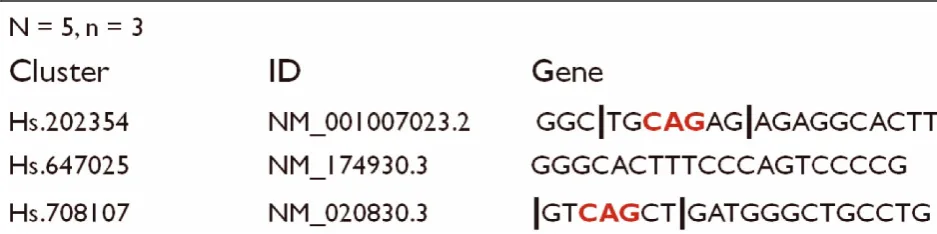
Consider an example given in Figure 1. Given n= 3 andN= 5, the motif CAG (for instance) present in the first and the third gene leads to the following N-strings being duplicates according to the above definition: TGCAG, GCAGA, CAGAG from gene 1 and GTCAG, TCAGC, CAGCT from gene 2 respectively. In the meantime, theN-string GAGAG from gene 1 is unique since there is no substring of length 3 in either gene 2 or 3 equal to GAG or AGA.
The problem to be solved by means of these tools can be formally described as follows:
Problem formulation.
Given a gene belonging to G find, from left to right, all maximal substrings of length N that are unique according to the threshold n. Generate a database
consisting of these unique strings (siRNA seats) col-lected from all genes in G.
Notice that all seats are of the same length Nunless they happen to be on the boundary of the original gene, in which case they can be as short asncharacters. The minimal length of a siRNA seat isn.
Algorithm description
[image:3.595.60.529.586.703.2]Given a database of genes and a fixed positive integer n, the algorithm stores alln-substrings for the entire collection of genes. Additionally, for any n-string, we store the location of each occurrence of thisn-string under the same index of the tree. Sorting the strings facilitates downstream analysis on the data. More precisely, the tree-sort algorithm takes as input a database of genes, comprised of the nucleotides A, C, G, and T. To store all possible n-strings, we need a full tree with n+1 levels (counting the root), labelled 0 through n. Since there are four types of nucleotides, thekthlevel has at most 4kvertices. Each vertex in the kth level has branches to four vertices in the (k+1)th level. In order to locate siRNA seats once the suffix tree has been built, we first print the list of all unique substrings in the list UNIQUE_n, which also contains the associated gene symbol and the location of the substring within that gene. After the unique strings have been identified in this fashion, the siRNA“seats” can be generated on-the-fly without re-reading the transcriptome. Indeed, for each unique subsequence specified in the list UNIQUE_n, we need to look at theN- ncharacters succeeding it in the original gene. If not all of the N - n characters are available due to the proximity of the gene boundary, only available characters are taken into consideration. All strings of length N in the resulting set are checked for unique-ness. Each unique string found this way forms a new siRNA seat. Algorithm 1 formalizes the steps described above.
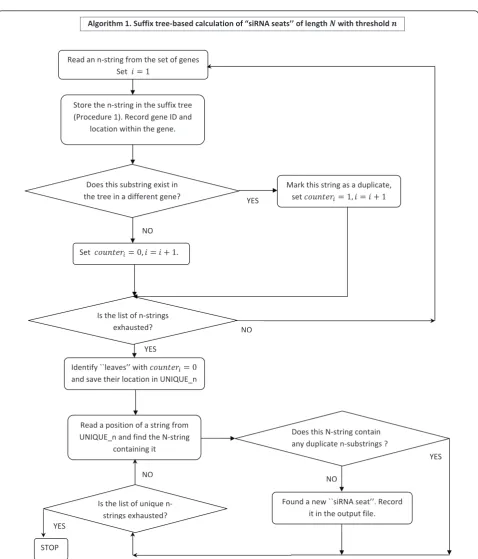
Algorithm 1.Suffix tree-based calculation of siRNA seats of length N with threshold n
Input: G - the set of all genes in the database, a threshold value n and the siRNA length N.
Output:siRNA seats of length N with threshold value n.
Put i =1.Initialize the vector[0, ..., 0].
While (the set of remaining n-strings in G is non-empty)
Read an n-string from and denote it si.Store siin the
suffix tree according to Procedure 1.Store the corre-sponding gene ID and the location of the string within that gene in the leaf.If the substring sialready
exists in the tree and belongs to a different gene, set counteri=1to reflect the fact it is a duplicate.
i=i+ 1
End while
Identify leaves with counteri= 0 (unique n-strings) and
save their location in UNIQUE_n.
Let nuniquebe the total number of n-strings in
UNIQUE_n.
For(j from1to nunique)
For the j-th n-string in the list UNIQUE_n, find a (larger) N-string containing it by scanning all avail-able N - n characters to the right of it in the same gene (found by gene ID).Mark the resulting N-string as unique if all of its n-substrings exist in the list UNIQUE_n (Definition 1).
End for
Returnall unique N-strings - these represent all siRNA seats found in G.
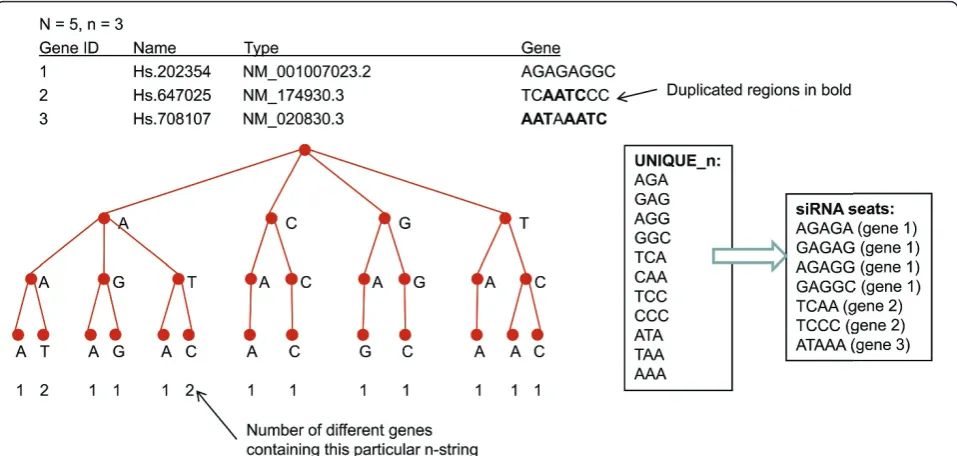
The flowchart description of this algorithm is given in Figure 2. In Figure 3 we provide an illustration of the steps the algorithm performs to store each of the input nucleotide strings and to identify the corresponding siRNA seats for some sample data. In this simple exam-ple with only 3 genes present, the suffix tree generated at Step 3 has 13 leaves with 11 of them correspond to unique n-strings recorded in the list UNIQUE_n. The output is given in a form of 7 unique N-strings which we refer to as‘’siRNA seats’’.
It is worth noting that the tree construction utilized by Algorithm 1 allows for quick modification of the results in case new genes are added to the database, with no need to re-create the suffix tree. The new gene information in the form of a collection of -strings will be recorded in the tree based on Procedure 1 and which will result in incremental changes to the list UNIQUE_n. Any possible duplicates arising from this change will be immediately detected when performing
Steps 4-5 of the Algorithm and will allow for fast recalculation of the siRNA seats.
Memory requirements
The new algorithm requires the following four main types of memory: character arrays to store the gene strings, gene structures containing pointers to the each field in the gene strings, storage structures to track the location of eachn-string, and the tree structures to sort the n -strings. Suppose our database of genes has G genes with average lengthL. Then the memory for the gene structures isGΔL. Each gene structure contains a pointer to the gene cluster, a pointer to the gene ID, a pointer to the actual gene string, and an integer contain-ing the length of the strcontain-ing. Uscontain-ing 32-bit pointers, each gene structure requires 16 bytes of memory, and we needGgene structures. Thus the total memory for the gene structures is 16Gbytes. We need a storage struc-ture for eachN-string in the database. That number is equal to G(ΔL+ 1-n). Sincen≪ ΔL, we useGΔL. The storage structure contains a pointer to the associated gene, an integer specifying the location of theN-string in the gene, and a pointer to another storage structure containing the previous occurrence of this exact N-length string. So the total memory for the storage structures is approximately 12GΔLbytes.
For the character arrays, gene structures, and storage structures, we need a combinedG(13ΔL+ 16) bytes of memory, which amounts to 700 MB of RAM. The tree structures contain four pointers to the next level of the tree, a pointer to a storage structure, and an integer to count the occurrences of the associatedn-string. Thus, each tree structure requires 24 bytes of memory. The exact number of tree structures necessary depends onn and the types ofn-strings in the database. Table I shows how many branches were used for each value ofn. The right column is the tree memory plus 700 MB from the other three main components. For larger values of n, the full tree requires a significant amount of storage space. However, as the algorithm generates storage space on demand, we only need to create branches and vertices in the tree to store the n-strings that are actually present in the transcriptome. Interestingly, we noted that asngets larger, the ratio of present n-strings to all possiblen-strings decreases. In fact, forn= 16, we utilized only 3% of the theoretically complete exhaustive tree to store all 16-length strings present in human transcriptome, as demonstrated in Table 1.
Implementation and testing
ReadannͲstringfromthesetofgenes
Set݅ ൌ ͳ
Doesthissubstringexistin
thetreeinadifferentgene?
StorethenͲstringinthesuffixtree
(Procedure1).RecordgeneIDand
locationwithinthegene.
Markthisstringasaduplicate,
setܿݑ݊ݐ݁ݎൌ ͳǡ ݅ ൌ ݅ ͳ
YES
Setܿݑ݊ݐ݁ݎൌ Ͳǡ ݅ ൌ ݅ ͳǤ
NO
IsthelistofnͲstrings
exhausted?
YES
NO Identify``leaves’’withܿݑ݊ݐ݁ݎൌ Ͳ
andsavetheirlocationinUNIQUE_n
Readapositionofastringfrom
UNIQUE_nandfindtheNͲstring
containingit
DoesthisNͲstringcontain
anyduplicatenͲsubstrings?
Foundanew``siRNAseat’’.Record
itintheoutputfile.
IsthelistofuniquenͲ
stringsexhausted?
YES
STOP
YES
NO
Algorithm1.SuffixtreeͲbasedcalculationof“siRNAseats’’oflengthࡺwiththreshold
[image:5.595.59.538.79.639.2]NO
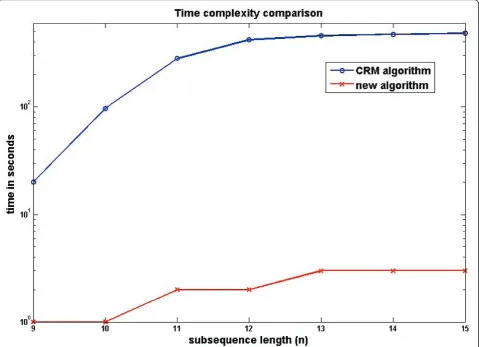
Figure 4. The new algorithm was able to retrieve the list of unique substrings of lengthn, where 9 <n < 15 on average 100 times faster than the CRM. The time required for the generation of CRM input, the string pre-sorting time, is not reflected in the efficiency com-parison, while the new algorithm has a built-in sorting routine whose execution time was taken into account. The advantage of the new method would be even more visible had the time to pre-sort the list been counted as part of the CRM execution time too.
Practical application
To demonstrate the utility of the novel algorithm, we applied it to parse a non-redundant set of human tran-scripts onto the 11 to 17 nucleotides substring and extract the sets of siRNA seats comprised of substrings with given length (Figure 3).
Human mRNA strings were extracted from the NCBI Unigene dataset (build #219). For each gene, the longest reference mRNA string with NM identified was extracted and further processed using the new algorithm.
[image:6.595.59.538.89.317.2]Predicted siRNA seats were placed in a mySQL data-base. To provide an access to the siRNA seats stored in this database, a web interface was built using PHP. User-friendly interface of the database allows the search with the HUGO approved Gene Symbol, NCBI Entrez Gene ID, Genbank Acession or Unigene cluster ID for siRNA seats comprised of unique oligonucleotides with selected length. As an output, siRNA seat database lists all seats with lengths equal or larger than 19 nucleo-tides, with their relative positions within respective mRNA string. For the convenience of the user, each siRNA seat search also returns the string of the mRNA template used for the tree parsing and some general
[image:6.595.58.541.618.731.2]Figure 3Generation of the storage of all substrings. This example illustrates the steps of Algorithm 1 for the input consisting of 3 genes AGAGAGGC, TCAATCCC and AATAAATC. All of the corresponding n-strings are identified with the number of occurrences stored in the leaf. The list of unique n-strings is provided, and the“siRNA seats”resulting from this computation are specified.
Table 1 The size and fill-in of the tree needed to store the initial dataset and the memory consumption
N Branches in Full Tree Branches Used % Branches Used Full Tree Memory Actual Tree Memory Total Memory
9 349525 349519 99.998% 8 MB 8 MB 708 MB
10 1398101 1395271 99.798% 32 MB 31.94 MB 731.94 MB
11 5592405 5366925 95.968% 128 MB 122.84 MB 822.84 MB
12 22369621 17849905 79.795% 512 MB 408.55 MB 1.08 GB
13 89478485 45717780 51.094% 2 GB 1.02 GB 1.70 GB
14 357913941 88264307 24.661% 8 GB 1.97 GB 2.65 GB
15 1431655765 138965433 9.707% 32 GB 3.11 GB 3.79 GB
information about the gene of query including its exon/ intron structure. We envision that users may consult siRNA seats database before embarking on siRNA design as gene-specific lists of siRNA seats with mini-mized off-target hybridization may be used as input for any conventional siRNA designing software instead of the entire string corresponding to the gene of interest. The searchable database of all possible human siRNA seats is available at http://web.cos.gmu.edu/~gmanyam/ siRNA_db/search.php.
Discussion
String-specific small interfering RNAs (siRNAs) could be used both as therapeutic molecules and as a new instru-ment for a drug target discovery. Cellular and animal models already demonstrated the potential of siRNA-based treatments for cancer, viral infections and inflam-matory diseases. However, the development of siRNA based therapeutics is hampered by‘off-target’ silencing effects that have to be minimized in order to diminish the possibility of the side effects.
One relatively straightforward approach to ‘off-target’ minimization is to design siRNA molecules for pairing up with unique locations within mRNA targets. The traditional “bottom-up” approach to siRNA design implies an exclusion of any possible short string matches using BLAST or Smith-Waterman algorithm. On the other hand, one may employ “top-down” approach by using a pre-computed set of least redun-dant locations within the entire transcriptome (siRNA seats) as input for the traditional siRNA designing soft-ware.“Top down”approach requires less siRNA design-ing skills form a novice researcher and limits the set of gene-specific candidate siRNAs to a smaller number of molecules in need of experimental verification. However, the transcriptome-wide extraction of the least redundant substrings is not a trivial task. The first algorithm of this kind, CRM [18] that successfully completed the task, was far from efficient.
[image:7.595.59.539.90.437.2]Here we propose a substantially more efficient algo-rithm that employs tree based storage of the substrings, which is the first application of this mathematical
concept in this context. The approach developed here is not limited to optimal siRNA design, but can also be useful for other tasks, such as selecting characteristic strings specific to individual genes in certain organisms. These strings could then be used as siRNA seats, as specific probes for gene expression studies by oligonu-cleotide-based microarrays, for the design of molecular beacon probes for Real-Time PCR and, generally, any type of PCR primers.
Another important advantage of the new algorithm over CRM is that the storage structure created by the new algorithm automatically records the frequency for each substring. Therefore, this suffix tree based approach can be easily utilized to perform other types of transcriptome analysis, including a search for unique substrings and absent substrings, analysis of distribu-tions of the substrings associated with various biological features, e.g. promoters, 3’ untranslated regions and open reading frames. This further analysis is the subject of an ongoing study.
Among the limitations of the proposed algorithm are 1) the necessity of the periodical re-analysis of the avail-able siRNA seats within transcriptome in order to incor-porate newly discovered functional RNA transcripts; and 2) inevitable miss of the imperfect siRNA seats that might couple with respective siRNA and act as “seed rule”violation but nonetheless efficient miRNAs instead. Latter possibility needs to be studied experimentally by systematic analysis of the rejected siRNA seats using miRNA recognizing algorithms, and is included in the plan for the future development.
Conclusions
Here we present a new efficient suffix tree-based algorithm that delivers a comprehensive and systematic analysis of substrings within an arbitrary set of biological strings. The proposed algorithm may help to find biologically significant features within large gene data-bases. In this paper, we described an application of this algorithm to exhaustive search for the “siRNA seats” in entire human transcriptome. Resulting database of siRNA seats is available at http://web.cos.gmu.edu/ ~gmanyam/siRNA_db/search.php.
Acknowledgements
Authors are grateful to Dr. Tariq Alsheddi for making the CRM code available for the comparative study and to Dr. Maria Stepanova for insightful discussions. We would also like to gratefully acknowledge the input provided by anonymous referees which greatly improved the quality of this publication.
This research was partially covered by Russian Ministry of Science grant 02.512.12.2060“Development of efficient approaches for in vivo delivery of the genetic information into target cells for the therapy of socially important diseases”.
Author details
1School of Systems Biology, George Mason University, Fairfax VA, USA. 2
Research Center for Medical Genetics, RAMS, Moskvorechie Str., 1, Moscow, Russian Federation.3Department of Mathematical Sciences, George Mason University, Fairfax VA 22030, USA.4Bioinformatics & Computational Biology Dept, The UT MD Anderson Cancer Center, Houston, TX, USA.
Authors’contributions
AB conceived the ideas of the top-down screening for siRNA seats and the necessity of the high-throughput analysis of the string substrings; she also contributed to the manuscript writing. JB developed and implemented the suffix-tree based algorithm under the guidance of ME. GM developed mySQL database and the web site for siRNA search. ME advised on the development of the new algorithm, its analysis and implementation, and contributed to the manuscript writing. All authors read and approved the final manuscript.
Competing interests
The authors declare that they have no competing interests.
Received: 5 November 2010 Accepted: 27 May 2011 Published: 27 May 2011
References
1. Verdel A, Vavasseur A, Le Gorrec M, Touat-Todeschini L:Common themes in siRNA-mediated epigenetic silencing pathways.Int J Dev Biol2009, 53:245-257.
2. Scherr M, Morgan MA, Eder M:Gene silencing mediated by small interfering RNAs in mammalian cells.Curr Med Chem2003,10:245-256. 3. Svoboda P:Off-targeting and other non-specific effects of RNAi
experiments in mammalian cells.Curr Opin Mol Ther2007,9:248-257. 4. Scacheri PC, Rozenblatt-Rosen O, Caplen NJ, Wolfsberg TG, Umayam L,
Lee JC, Hughes CM, Shanmugam KS, Bhattacharjee A, Meyerson M, Collins FS:Short interfering RNAs can induce unexpected and divergent changes in the levels of untargeted proteins in mammalian cells.Proc Natl Acad Sci USA2004,101:1892-1897.
5. Hajeri PB, Singh SK:siRNAs: their potential as therapeutic agents - Part I. Designing of siRNAs.Drug Discov Today2009,14:851-858.
6. Ui-Tei K, Naito Y, Takahashi F, Haraguchi T, Ohki-Hamazaki H, Juni A, Ueda R, Saigo K:Guidelines for the selection of highly effective siRNA strings for mammalian and chick RNA interference.Nucleic Acids Res 2004,32:936-948.
7. Hsieh AC, Bo R, Manola J, Vazquez F, Bare O, Khvorova A, Scaringe S, Sellers WR:A library of siRNA duplexes targeting the phosphoinositide 3-kinase pathway: determinants of gene silencing for use in cell-based screens.Nucleic Acids Res2004,32:893-901.
8. Hung CF, Lu KC, Cheng TL, Wu RH, Huang LY, Teng CF, Chang WT:A novel siRNA validation system for functional screening and identification of effective RNAi probes in mammalian cells.Biochem Biophys Res Commun 2006,346:707-720.
9. Jackson AL, Linsley PS:Noise amidst the silence: off-target effects of siRNAs?Trends Genet2004,20:521-524.
10. Tilesi F, Fradiani P, Socci V, Willems D, Ascenzioni F:Design and validation of siRNAs and shRNAs.Curr Opin Mol Ther2009,11:156-164.
11. Cui W, Ning J, Naik UP, Duncan MK:OptiRNAi, an RNAi design tool. Comput Methods Programs Biomed2004,75:67-73.
12. Naito Y, Yamada T, Matsumiya T, Ui-Tei K, Morishita S:dsCheck: highly sensitive off-target search software for double-stranded RNA-mediated RNA interference.Nucleic Acids Res2005,33:W589-W591.
13. Dai X, Zhao PX:pssRNAMiner: a plant short small RNA regulatory cascade analysis server.Nucleic Acids Res2008,6:W114-11.
14. Li IT, Shum W, Truong K:160-fold acceleration of the Smith-Waterman algorithm using a field programmable gate array (FPGA).BMC Bioinformatics2007,8:185.
15. Manavski SA, Valle G:CUDA compatible GPU cards as efficient hardware accelerators for Smith-Waterman string alignment.BMC Bioinformatics 2008,9:S10.
17. Jackson AL, Bartz SR, Schelter J, Burchard J, Mao M, Li B, Cavet G, Linsley PS: Expression profiling reveals off-target gene regulation by RNAi.Nat Biotechnol2003,21:635-637.
18. Alsheddi T, Vasin L, Meduri R, Randhawa M, Glazko G, Baranova A:siRNAs with high specificity to the target: a systematic design by CRM algorithm.Mol Biol (Mosk)2008,42:163-171.
19. Saetrom P, Snove O Jr:A comparison of siRNA efficacy predictors. Biochem Biophys Res Commun2004,321:247-253.
20. Weiner P:Linear pattern matching algorithm.14th Annual IEEE Symposium on Switching and Automata Theory1973, 1-11.
21. McCreight EM:A space-economical suffix tree construction algorithm. Journal of the ACM1976,23:262-272.
22. Ukkonen E:On-line construction of suffix trees.Algorithmica1995, 14(3):249-260.
23. Na J, Apostolico A, Iliopoulos CS, Park K:Truncated suffix trees and their application to data compression.Theoretical Computer Science2003, 304:87-101.
24. Giegerich R, Kurtz S:From Ukkonen to McCreight and Weiner: A Unifying View of Linear-Time Suffix Tree Construction.Algorithmica1997, 19(3):331-353.
25. Schulz MH, Bauer S, Robinson PN:The generalised k-Truncated Suffix Tree for time-and space-efficient searches in multiple DNA or protein sequences.International journal of bioinformatics research and applications 2008,4:81-95.
26. Fernandes F, Freitas AT, Almeida JS, Vinga S:Entropic Profiler - detection of conservation in genomes using information theory.BMC Research Notes2009,2:72.
27. Apostolico A, Denas O:Fast algorithms for computing sequence distances by exhaustive substring composition.Algorithms for Molecular Biology2008,3:13.
doi:10.1186/1756-0500-4-168
Cite this article as:Baranovaet al.:An efficient algorithm for systematic analysis of nucleotide strings suitable for siRNA design.BMC Research Notes20114:168.
Submit your next manuscript to BioMed Central and take full advantage of:
• Convenient online submission
• Thorough peer review
• No space constraints or color figure charges
• Immediate publication on acceptance
• Inclusion in PubMed, CAS, Scopus and Google Scholar
• Research which is freely available for redistribution