Why loose rings can be tight: The role of learned object knowledge in the
development of Korean spatial fit terms
Franklin Chang University of Liverpool
Youngon Choi Yeonjung Ko Chung-Ang University
Abstract
The Korean fit distinction has been at the center of a debate about whether language can influence spatial concepts. Most research on this issue has largely assumed that the concepts that supports Korean fit terms are universal and abstract, signaled by visual cues (e.g., relative shape of objects), while linguistic studies in Korean suggest that fit terms are object-specific. To examine this issue, Korean-speaking three- to six year-old children and adults were asked to describe spatial scenes, which varied in object type/relations and visual cues for fit. Both groups relied on the prototypical relation between pairs of objects (e.g., rings tend to fit tightly on fingers) in selecting tight-fit terms, and this dependence increased with age. In contrast to Whorfian and Conceptual tuning accounts (Bowerman & Choi, 2003;Hespos & Spelke, 2004), these results suggest that the concepts that supports Korean fit terms are not entirely innate or abstract.
Keywords: Spatial relations; Korean; Language Development; Cognitive Development; Fit; Object knowledge
Introduction
The fit distinctions encoded by Korean spatial terms have played a significant role in debates about whether language can influence the non-linguistic spatial relations (Whorfian hypothesis, Whorf, 1956). For example, Korean verbs distinguish tight-fit (e.g., kkita for a ring on a finger) from loose-fit support relations (e.g., nohta for a ring on a table), while both of these events are described by the same word on in
[image:1.612.335.516.296.446.2]that pre-linguistic infants, regardless of the input language, distinguish tight from loose fit, but English adults do not maintain this distinction, unlike Korean adults (Casasola & Cohen, 2002; Choi, McDonough, Bowerman, & Mandler, 1999; Hespos & Spelke, 2004; McDonough, Choi, & Mandler, 2003). This developmental pattern has been explained by a conceptual tuning mechanism (Hespos & Spelke, 2004), which is similar to the mechanism that supports perceptual tuning for speech (Werker & Tees, 1984). That is, infants are initially sensitive to a universal set of innate spatial categories, but language experience tunes these categories and this causes some distinctions to be diminished.
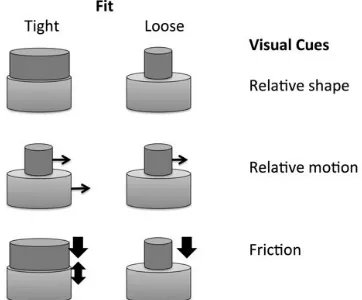
Figure 1: Three visual cues for fit
fit in infants and adults, there is a lack of evidence showing that these cues are directly linked to Korean fit terms (Kawachi, 2007). This is problematic for the conceptual tuning hypothesis, which assumes that early associations between Korean fit terms and visually-cued fit concepts are needed to maintain innate fit concepts.
If Korean fit terms are not selected by visual cues, then what could explain the divergent development in English and Korean learners? One type of information that could explain this divergence is learned object knowledge. For example, English speakers typically understand in front of a painting as being parallel to the widest surface, while in front of a car as the side that the driver faces. This understanding cannot depend on innate concepts, since one must learn about these artifacts and their prototypical interactions with other objects. Support for this change in object knowledge is found in Tanz’s (1980) study, where 2-5-year-old English children became more adult-like in their use of in front of over time. Similarly, Korean fit terms tend to correlate with particular pairs of objects and their relations (e.g., ring + finger -> kkita; Bowerman & Choi, 2003). In this account, what changes over development is object knowledge (e.g., children learn that rings are defined as objects that typically fit tightly on fingers) and their links to the labels. Innate visual cues are also involved in identifying these spatial relations, but the object knowledge determines the nature of the relation/concept (e.g., a candle on a table is tightly attached if it has melted to the table). The conceptual tuning and object knowledge accounts both explain the developmental changes, but the object knowledge account predicts growth in object-specific fit term use over development. The present study is the first to contrast these accounts by examining the relationship between Korean linguistic choices and visual cues (as in the infant literature) across multiple objects in development
The present study
To determine whether learned object knowledge or visual fit cues select Korean fit terms over development, we manipulated visual fit cues across multiple events with different object pairs and elicited descriptions from 3-, 4-,
5-, and 6-year-old children and adults. Object pairs were selected which had associations with particular Korean tight fit terms (e.g., kkita, kkocta), and their matching loose versions were created. If visual fit cues activate innate concepts that support fit term use, then tight events should elicit more tight-fit terms than the loose versions and this distinction should not vary across different object pairs. If object knowledge is critical for fit term selection, then fit term use should vary across object pairs but would be insensitive to visual cues. Furthermore, if this knowledge grows over development, then the use of the object-pair-specific tight-fit terms should increase with age. It is difficult to identify the role of visual cues in fit term use because most studies used real physical events where multiple cues are conflated. For example, Hespos and Spelke’s (2004) study manipulated relative shape, but the tight condition also had more friction and restricted motion due to real-world constraints. To examine the role of visual cues in isolation, we obtained descriptions for four single-cue spatial events, where a robot placed objects in a 3D computer-animated world. Three of these four artificial scenes independently manipulated a single visual cue for fit: relative motion, relative shape, and friction/effort along the path. The fourth scene only changed the type of object (flat block versus Lego block), while controlling for the other three visual cues.
Methods Participants
Thirty-two monolingual Korean-speaking adults, 20 3-year-olds (M=42 months, SD=3.7, F=10), 23 4-year-olds (M=54 months, SD=3.4, F=12), 24 5-year-olds (M=66 months, SD=3.1, F=13), and 20 6-year-olds (M=78 months, SD=2.6, F=10) from the vicinity of Seoul, South Korea, participated in the study.
Materials
created video stimuli that sampled a range of
tight fit events and created matching loose versions. The videos were placed into four lists where the item order and
fit condition were
counterbalanced (fit condition alternated and participants only saw one version for each item).
Robot Events. Computer
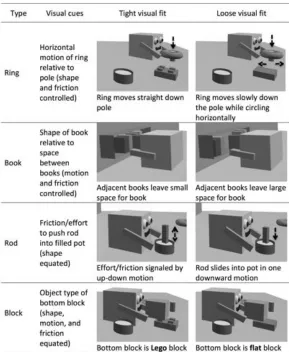
animations were created where a robot performed four support/containment events (Figure 3). Each action involved the robot moving from a start location to pick up an object and then moving to the end location where the action took place. The ring item placed a ring on a pole using horizontal motion around the pole to signal tight or loose fit. The book item involved the placement of a book into a bookcase that either contains adjacent books or not. The rod item placed a rod into a pot and tight fit was shown by an up-and-down motion that signaled friction/effort in placing the object into the pot. The block item involved the stacking of two blocks with the bottom block having Lego-like nodes on the top or not. The tight and loose-fit scenes were equated in terms of relative motion, relative shape, friction, and object type except for the single cue changes. Two lists were created with visual fit counterbalanced across a fixed order of actions (fit alternated with each trial and they only saw one version of each scene).
Procedure
Participants described each scene displayed on a laptop while being audio-recorded. When children produced
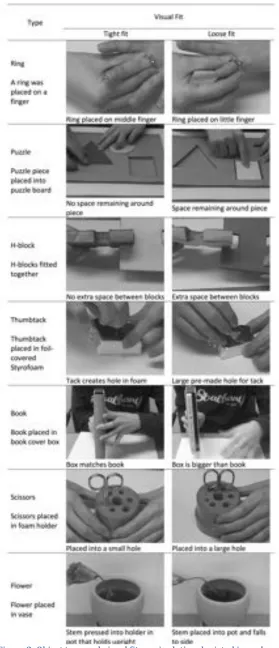
[image:3.612.92.371.58.706.2]utterances that were not about the target scene, the Figure 2: Object type and visual fit manipulation depicted in real-world
experimenter prompted with a phrase that mentioned the target object (What was done with the ring?). These prompts were done until the experimenter judged that the target action had been described or a maximum of five prompts were produced.
Coding
Linguistic descriptions were transcribed off-line. When multiple descriptions were produced, the last description was used since they involved the target action. Verbs were classified into tight and loose fit (linguistic fit) based on dictionary definitions and synonyms. Elicited descriptions involved a variety of verbs, 26 of which were tight terms and 32 loose terms. However, the majority (78%) of the descriptions involved kkita, kkocta, nehta, and nohta verbs. In 6 cases, participants used a loose verb with adverbial phrases that encoded tightness (e.g., put tightly in) and these utterances were also
classified as tight descriptions. The robot descriptions of ten 3-year-olds and five 5-year-3-year-olds were excluded due to not resetting the robot’s position on each trial. The data from nine participants was fully double-coded and the coders agreed 96% of the time on average. Since the robot items were in a fixed order (due to a technical reason to reset the robot’s position), we tested for a tendency to persist in linguistic fit terms across adults, but found no correlation between adjacent items (rod à block r=0.01, block à book r=-0.14, book à ring r=0.02).
Results
A logistic mixed model examined how linguistic fit (tight=1, loose=0) changed with visual fit (tight, loose), age (3, 4, 5, 6, adult), and stimulus type (real/robot) crossed. Visual fit and stimulus type were effect-coded and age was coded in years (adults were coded as year 7) and then centered. Subject was included as a random variable and maximal models were fitted with random by-subject slopes for visual fit crossed with stimulus type (Barr, Levy, Scheepers, & Tily, 2013). As illustrated in the mean proportion of tight fit terms in Figure 4, tight linguistic terms were used to describe tight visual fit more than loose visual fit ( = 1.0, SE = 0.21, χ2(1) = 19.8, p < 0.001), and tight fit terms increased with age ( = 0.33, SE = 0.11, χ2(1) = 8.8, p < 0.004). Further, real object events yielded more tight descriptions than robot object scenes ( = 1.38, SE = 0.17, χ2(1) = 49.5, p < 0.001).
[image:4.612.96.385.52.404.2]Although there is an effect of visual fit, the adult participants were not categorical in their use of fit terms and exhibited a difference of only .17 in the proportion of tight fit descriptions for tight and loose visual fit. One Figure 3: Types of artificial objects and visual cues used to depict fit
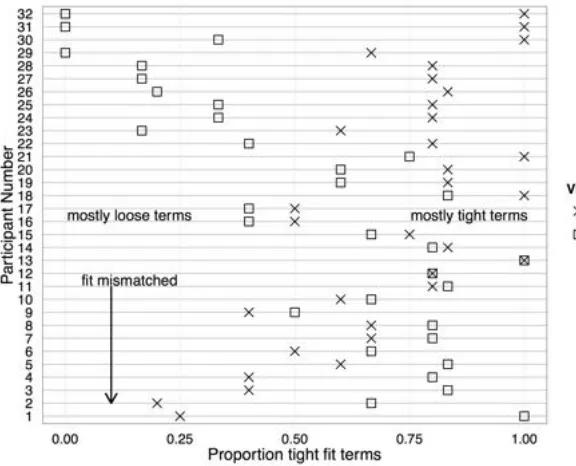
possible reason for this small difference is that the visual cue manipulation was subtle, predicting that the difference in tight and loose visual fit would be consistently small across participants. To examine this, the proportion of tight-fit terms was computed for each adult participant in each visual fit condition. Figure 5 shows that overall, adults distinguished loose from tight visual fit (mean absolute value difference in tight descriptions is .35). However, 11 adults mismatched fit terms with visual fit, meaning that 37% used tight-fit terms more for loose events. This indicates that the visual cue effect was not subtle, but attenuated when
averaged across participants because some Korean adults did not match their terms with the visually-cued fit in these scenes.
Why were
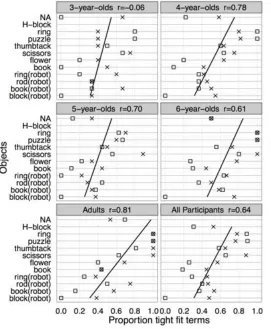
[image:5.612.97.393.83.230.2]some adults unable to use visual fit cues? One reason is that Korean speakers were ignoring visual cues for fit and instead selecting fit terms based on the objects in the event. To explore this possibility, we examined linguistic choices made for each object in each age group (Figure 6). If participants were using visual cues for fit, a negative correlation is expected in the proportion of tight-fit terms between tight and loose visual fit conditions. However, we found a strong positive correlation (r = 0.64, t(53) = 6.1, p < 0.001), meaning that our Korean participants tended to use similar descriptions for particular objects regardless of the visual fit. This is evident in the fact that the H-block and ring were always described with tight-fit terms even when the visual fit was loose. Flower and book were more likely to be described with loose-fit terms even when the visual event was a tight fit. Furthermore, this object dependency was present in development. To quantify this, the objects were ranked in terms of the adult tight fit proportion (from H-block = 11 to block(robot) = 1, the rank is shown by the order of objects in Figure 6). If the associations between fit terms and objects are consistent over development, then it should be possible Figure 4: Mean proportion tight fit terms produced split by age, visual fit, and
stimulus type
[image:5.612.97.385.457.690.2]to predict children’s proportion of fit term production using adult object rank. A regression analysis that crossed the adult object rank with centered age found that adult object rank significantly predicted the proportion of tight-fit terms ( = 0.029, t(51) = 2.11, p = 0.04) and object-sensitivity increased over age ( = 0.009, t(51) = 2.27, p < 0.03, see the changing slope of the regression lines in Figure 6). This shows that Korean fit terms are sensitive to the object being described and that this sensitivity increases over development as can be seen in the greater object-based correlation in adults (r = 0.81, t(9) = 4.2, p < 0.003) compared to 3-year-olds (r = -0.06, p = 0.8, Figure 6).
If the linguistic concept of fit were signaled by innate visual cues that have been used in infant studies, then participants should vary their descriptions in the robot conditions, where individual visual cues were varied (Figure 6). Our adult participants distinguished visual fit
in the robot book item (chi-squared test of association, χ2(1) = 5.0, p <0.03), which demonstrated that relative shape alone can be used to distinguish fit term use (there was no friction in the event and relative motion was the same for both tight and loose fit). The rod and ring items did not show a significant difference from chance, meaning that relative motion
(ring) and
friction/effort (rod) were not sufficient within these animations to distinguish fit. In the block item, adults distinguished fit based purely on
the object
properties (nodes on the top signaled that it was a tight fitting Lego block; χ2(1) = 7, p < 0.007), even though relative motion, shape, and friction were equated for tight and loose versions. Children showed a weaker association between visual cues and fit term use for the robot items, except for the object cues in the block object (χ2(1) = 24, p < 0.001) and the ring object (χ2(1) = 4, p < 0.05). Together with the weak overall effect of visual fit, the results suggest that Korean fit terms are not strongly signaled by visual cues such as those used in infant studies, except when those cues cause people to change their object classification.
Discussion
[image:6.612.99.370.82.411.2]
These results demonstrate that object type and their prototypical relations play a key role in the spatial concepts that support Korean fit terms. Korean speakers varied in their use of Figure 6: Average proportion tight-fit descriptions for each object separated by
tight- and loose-fit terms for different objects, but the use within each object was highly correlated, regardless of visual fit cues. While Infants are known to distinguish fit using visual cues (Hespos & Spelke, 2004), our Korean children and adults were not always able to select fit terms that matched the visual cues. While the presentation of a single visual cue in the robot events did not reliably elicit a matching term (except for relative shape in adults), the change in the object type allowed both adults and children to generalize appropriately. Together, these results suggest that Korean spatial terms, as in English terms like in front of, encodes object-specific relational information. Verbs and prepositions are often thought to encode object-independent relational information (e.g., Choi & Hattrup, 2012) and we found some support for this in the sensitivity to visual fit in our Korean participants. But in contrast to this standard view, we also found that these linguistic terms were like nouns in their dependence on object knowledge.
Our results also demonstrate that experience influence the use of tight-fit terms. We found that tight terms were used more often with the real stimuli than with the novel robot stimuli, and this mirrors the effects of familiarity found in the infant fit studies (Casasola & Cohen, 2002). If the greater use of tight terms with real stimuli is due to the complex motion of the hand with real objects, then one might expect a greater difference between tight and loose visual fit with real videos, because real-world interactions provide more visual cues. But the interaction between visual fit and stimulus type was not significant, suggesting that participants didn’t differ in their visual fit distinctions for both stimulus type. In fact, the lack of this interaction suggests a simpler explanation, where participants could not apply their object knowledge as easily in the novel robot scenes and hence they were less willing to use tight-fit terms.
[image:7.612.132.482.108.324.2]than in children (Figure 6). This is in line with the Casasola, Bhagwat, & Burke (2009) study which showed that hearing a linguistic label can help 18-month-olds to generalize a fit concept. In contrast, the conceptual tuning account (Hespos & Spelke, 2004) assumes that fit is an innate abstract concept, which is maintained throughout development among Korean learners (Figure 7, top). The hypothesis thus fails to account for the effect of object type and slow growth in tight term use demonstrated in our study. Alternatively, if tight fit is supported by a range of object-specific concepts and these concepts only become linked together through linguistic experience, then it is expected that an abstract object-general concept of fit would be slow to develop, as proposed in Object knowledge learning account (Figure 7, bottom).
The Whorfian hypothesis claims that language can change abstract spatial concepts that we use to view the world. The conceptual tuning accounts explains these apparent language-related changes in spatial concepts by arguing that language input tunes a universal set of a priori spatial concepts (Kant, 1791). Our data, on the other hand, suggest that spatial concepts may not always encode abstract visual distinctions, or as Wittgenstein (1953, #182) aptly said the concept of fit is actually “much more complicated than might appear at first sight.” The difficulty in defining fit visually is due in part to its object specificity and to the fact that it changes with experience. Korean speakers are experts at classifying fit relations and, like experts in other domains (e.g., Johnson & Mervis, 1997), they see exemplars in their domain of expertise differently from novices such as English speakers. But in contrast with the assumptions of Whorfian and conceptual tuning accounts, this expertise does not require that innate abstract spatial concepts are changed by language experience.
Author Note
Franklin Chang, Psychology, University of Liverpool, Liverpool, United Kingdom
Youngon Choi, Psychology, Chung-Ang University, Seoul, South Korea
Yeonjung Ko, Psychology, Chung-Ang University, Seoul, South Korea
* The authors would like to thank Narae Joo, Ji-eun Bang, Hwa-in Lee for their help in collecting data and coding, and also thank Julian Pine,
Caroline Rowland, and Kathryn Twomney for helpful comments on this work.
* This research was supported by Korea Research Foundation grant (2011-0014928) to Youngon Choi.
* Correspondence concerning this article should be addressed to Youngon Choi, Dept. of Psychology, Chung-Ang University, 84 Heukseok-ro, Dongjak-gu, Seoul, Korea 156-756
Email: [email protected]
References
Barr, D. J., Levy, R., Scheepers, C., & Tily, H. J. (2013). Random effects structure for confirmatory hypothesis testing: Keep it maximal. Journal of Memory and Language, 68(3), 255–278. doi:10.1016/j.jml.2012.11.001
Bowerman, M., & Choi, S. (2003). Space under construction: Language-specific spatial categorization in first language acquisition. In D. Gentner & S. Goldin-Meadow (Eds.), Language in mind: Advances in the study of language and thought (pp. 387–427). Cambridge, MA: A Bradford Book.
Casasola, M., Bhagwat, J., & Burke, A. S. (2009). Learning to form a spatial category of tight-fit relations: How experience with a label can give a boost. Developmental Psychology, 45(3), 711–723. doi:10.1037/a0015475
Casasola, M., & Cohen, L. B. (2002). Infant categorization of containment, support and tight-fit spatial relationships. Developmental Science, 5(2), 247–264. Choi, S., & Hattrup, K. (2012). Relative
contribution of perception/cognition and language on spatial categorization. Cognitive Science, 36(1), 102–129. doi:10.1111/j.1551-6709.2011.01201.x Choi, S., McDonough, L., Bowerman, M., &
Mandler, J. M. (1999). Early sensitivity to language-specific spatial categories in English and Korean. Cognitive Development, 14(2), 241–268.
Hespos, S. J., & Spelke, E. S. (2004). Conceptual precursors to language. Nature, 430(6998), 453–456.
Experimental Psychology. General, 126(3), 248–277.
Kant, I. (1791). Critique of pure reason. (P. Guyer & A. W. Wood, Trans.). Cambridge, UK: Cambridge University Press. (Translation 1998).
Kawachi, K. (2007). Korean putting verbs do not categorize space contrastively in terms of “tightness of fit.” Lingua, 117(10), 1801–1820.
McDonough, L., Choi, S., & Mandler, J. M. (2003). Understanding spatial relations: Flexible infants, lexical adults. Cognitive Psychology, 46(3), 229–259.
Norbury, H. M., Waxman, S. R., & Song, H. J. (2008). Tight and loose are not created equal: An asymmetry underlying the representation of fit in English-and Korean-speakers. Cognition, 109(3), 316–325.
Tanz, C. (1980). Studies in the acquisition of deictic terms. Cambridge: Cambridge University Press.
Werker, J. F., & Tees, R. C. (1984). Cross-language speech perception: Evidence for perceptual reorganization during the first year of life. Infant Behavior and Development, 7(1), 49–63.
Whorf, B. L. (1956). Language, thought, and reality: Selected writings of Benjamin Lee Whorf. Cambridge: The MIT Press. Wittgenstein, L. (1953). Philosophical