Advice
.
White Rose Research Online URL for this paper:
http://eprints.whiterose.ac.uk/74796/
Proceedings Paper:
Beyersdorff, O, Koebler, J and Mueller, S (2009) Nondeterministic Instance Complexity
and Proof Systems with Advice. In: Dediu, AH, Ionescu, AM and Martin-Vide, C, (eds.)
Language and Automata Theory and Applications. Third International Conference, LATA
2009, 2-8 April 2009, Tarragona, Spain. Lecture Notes in Computer Science, 5457 .
Springer Verlag , 164 - 175 . ISBN 978-3-642-00981-5
https://doi.org/10.1007/978-3-642-00982-2_14
[email protected] https://eprints.whiterose.ac.uk/ Reuse
See Attached
Takedown
If you consider content in White Rose Research Online to be in breach of UK law, please notify us by
Proof Systems with Advice
Olaf Beyersdorff1, Johannes K¨obler2, and Sebastian M¨uller2⋆
1 Institut f¨ur Theoretische Informatik, Leibniz-Universit¨at Hannover, Germany
2 Institut f¨ur Informatik, Humboldt-Universit¨at zu Berlin, Germany
{koebler,smueller}@informatik.hu-berlin.de
Abstract. Motivated by strong Karp-Lipton collapse results in bounded arithmetic, Cook and Kraj´ıˇcek [1] have recently introduced the notion of propositional proof systems with advice. In this paper we investigate the following question:Given a languageL, do there exist polynomially bounded proof systems with advice forL? Depending on the complexity of the underlying languageLand the amount and type of the advice used by the proof system, we obtain different characterizations for this prob-lem. In particular, we show that the above question is tightly linked with the question whetherLhas small nondeterministic instance complexity.
1
Introduction
The classical Cook-Reckhow Theorem states thatNP=coNP if and only if the set of all tautologies TAUT has a polynomially bounded proof system, i.e., there exists a polynomial p such that every tautologyϕhas a proof of size ≤p(|ϕ|) in the system. Consequently, showing super-polynomial lower bounds to the proof size in propositional proof systems of increasing strength provides one way to attack the P/NPproblem. This approach, also known as the Cook-Reckhow program, has lead to a very fruitful research on the length of propositional proofs. Motivated by strong Karp-Lipton collapse results in bounded arithmetic, Cook and Kraj´ıˇcek [1] have recently introduced the notion of propositional proof systems using advice. This model seems to be strictly more powerful than clas-sical proof systems, as long-standing open problems, such as the existence of optimal proof systems, receive affirmative answers in this setting [1, 2].
In the present paper we focus on the question whether there exist polynomi-ally bounded proof systems with advice. We do not only consider propositional proof systems, but investigate this question for arbitrary proof systems and lan-guages. As in the Cook-Reckhow Theorem above, we obtain a series of results which provide a complete complexity-theoretic characterization for this question. In particular, we show a tight connection of this problem to the notion of non-deterministic instance complexity. Similarly as Kolmogorov complexity, instance complexity measures the complexity of individual instances of a language [3]. In
⋆
its nondeterministic version, Arvind, K¨obler, Mundhenk, and Tor´an [4] used this complexity measure to show that, under reasonable complexity-theoretic assumptions, there are infinitely many tautologies that are hard to prove in every propositional proof system. In the light of our present contribution, this connection between nondeterministic instance complexity and proof complexity is strengthened by results of the following form:all elements of a given language
Lhave small instance complexity if and only ifLhas a proof system with advice such that everyx∈L has a short proof.
To achieve these results, we start in Sect. 3 by reviewing the notion of non-deterministic instance complexity of [4]. Instance complexity is measured by two parameters: the size of the machine and its running time. The most interesting choice for these parameters seems to allow logarithmic size programs with poly-nomial running time. We combine all languages admitting such programs in the classNIC[log,poly]. Using a proof idea from [3], we show the class NIC[log,poly] to lie properly between the nonuniform classesNP/logandNP/poly.
In Sect. 4, we generalize the notion of propositional proof systems with advice of Cook and Kraj´ıˇcek [1] to arbitrary languages. For functional proof systems we consider three types of advice selectors: those that match the input length, those that match the output length, and arbitrary. Input advice turns out to be not really restrictive. Similarly as in [1], we show that for every language L, the class of all proof systems for L using logarithmic input advice contains an optimal proof system.
Our main results follow in Sects. 5 and 6 where we consider the plausibility of various languages having polynomially bounded proof systems with advice. In Sect. 5 we investigate this problem for arbitrary languages, whereas in Sect. 6 we focus on TAUT which presents the most interesting case for practical ap-plications. At this point, instead of providing a comprehensive account, we will just explain a few central results from Sects. 5 and 6.
For output advice, the classical Cook-Reckhow Theorem generalizes in a straightforward manner, and thus a language L has a polynomially bounded proof system with logarithmic output advice if and only ifL∈NP/log.
For input advice, which yields a strictly more powerful model, this question is more intricate. Here we establish the connection to nondeterministic instance complexity: a languageL has a polynomially bounded proof system with loga-rithmic input advice if and only if L ∈ NIC[log,poly]. While NIC[log,poly] and NP/logare different classes, we prove that they do not differ on sets fromcoNP. Thus, for any languageL∈coNP, the notion of a polynomially bounded proof system with logarithmic advice is the same when considering advice in terms of per proof length or per instance length.
2
Preliminaries
We assume familiarity with standard complexity classes. In the following we just mention a few classes which occur in this paper. The Boolean hierarchy BH is the closure of NP under union, intersection, and complementation. The levels of BH are denoted BHk, where BH2 is also known as Dp. The Boolean hierarchy coincides withPNP[O(1)]consisting of all languages which can be solved in polynomial time with constantly many queries to an NP oracle. If we allow
O(logn) adaptive queries we get the presumably larger classPNP[log].
Complexity classes with advice were first considered by Karp and Lipton [5]. For each function h : N → Σ∗ and each language L we let L/h = {x |
hx, h(|x|)i ∈ L}. If Cis a complexity class and F is a class of functions, then C/F ={L/h|L∈C, h∈F}.
Cook and Reckhow [6] defined the notion of aproof systemfor an arbitrary language Lquite generally as a partial polynomial-time computable functionf
with rangeL. A stringwwithf(w) =xis called anf-proof forx∈L.
Proof systems are compared according to their strength by simulations as introduced in [6] and [7]. If f and g are proof systems for L, we say that g
simulates f (denoted f ≤ g), if there exists a polynomial p such that for all
x ∈ L and f-proofs w of x there is a g-proof w′ of x with |w′| ≤ p(|w|). If such a proofw′ can even be computed from win polynomial time, we say that
g p-simulates f and denote this by f ≤p g. If the systems f and g mutually
(p-)simulate each other they are called (p-)equivalent. A proof system for L is (p-)optimalif it (p-)simulates all proof systems forL. For a functiont:N→N, a proof systemf forList-boundedif for allx∈Lthere exists anf-proof of size at mostt(|x|). Iftis a polynomial, thenf is called polynomially bounded.
3
Nondeterministic Instance Complexity
While Kolmogorov complexity studies the hardness of individual strings, the notion of instance complexity was introduced by Orponen, Ko, Sch¨oning, and Watanabe [3] to measure the hardness of individual instances of a given lan-guage. The deterministic instance complexity of [3] was later generalized to the nondeterministic setting by Arvind, K¨obler, Mundhenk, and Tor´an [4].
As required for Kolmogorov complexity and instance complexity, we fix a universal Turing machine U(M, x) which executes nondeterministic programs
M on inputs x. In the sequel, we refrain from always mentioning U explicitly. Thus we simply write statements like “M is at-time bounded Turing machine” with the precise meaning thatUalways spends at mostt(n) steps to simulateM
on inputs of length n. Likewise, to “simulate a machine M on input x” always means executingU(M, x).
A nondeterministic Turing machine M is consistent with a language L (or
Definition 1 (Arvind et al. [4]).For a setLand a time boundt, thet -time-bounded nondeterministic instance complexity of xwith respect to L is defined as
nict(x:L) = min{ |M| : M is anL-consistentt-time-bounded
nondeter-ministic machine, andM decides correctly onx} .
Similarly as in the deterministic case in [3], we collect all languages with prescribed upper bounds on the running time and nondeterministic instance complexity in a complexity class.
Definition 2. Let F1 andF2 be two classes of functions. We define
NIC[F1, F2] ={L:there exists∈F1 andt∈F2 such that for all x∈Σ∗ nict(x:L)≤s(|x|)} .
A particularly interesting choice for the classesF1 andF2is to allow polyno-mial running time, but only logarithmic descriptions for the machines. This leads to the class NIC[log,poly] which plays a central role in this paper. Similarly as in the deterministic case (cf. [3]), the next proposition locates this class between the nonuniform classesNP/logandNP/poly.
Proposition 3. NP/log⊆NIC[log,poly]⊆NP/poly.
Proof. For the first inclusion, let L ∈ NP/log. Let M be a nondeterministic Turing machine with logarithmic advice that decidesLand letan be the advice given toM for inputs of lengthn. We define a collection of programsMn,an for Las follows. On input xthe machine Mn,an first checks, whether the length of
the input is n. For this we need to code the number ninto Mn,an. If |x| 6=n,
then Mn,an rejects. Otherwise, Mn,an simulates M on inputx with advice an
which is also coded intoMn,an. Essentially, the machinesMn,an are constructed
by hardwiring nandan intoM, and thus the size ofMn,an is logarithmic in n.
ThereforeL∈NIC[log,poly].
For the second inclusion, letL∈NIC[log,poly]. Then there exist a constant
c and a polynomialpsuch that for allxwe havenicp(x:L)≤clog|x|+c. We
construct a nondeterministic Turing machine M with polynomial advice that accepts exactlyL. The advice ofM for lengthnconsists of all nondeterministic Turing machines M1, . . . , Mm of size at most clogn+c which are consistent with L. Note that for each input length n, there are only polynomially many machines of the appropriate size≤clogn+c. Hence polynomial advice suffices to encode the whole listM1, . . . , Mm. On inputx, the machineM simulates each
Mi on xfor at most p(|x|) steps. If any of the Mi accepts, then M accepts as well, otherwise it rejects.
We claim, that L(M) = L. For, if x∈ L, then there is a nondeterministic
L-consistent Turing machineMisuch thatMi(x) accepts and|Mi| ≤clog|x|+c. Thus, alsoM(x) accepts. If, on the other hand,M acceptsx, then so does some
In fact, the inclusions in Proposition 3 are proper as we will show in Theo-rem 5 below. For the proof we need the following notion:
Definition 4 (Buhrman, Fortnow, Laplante [8]). For a time bound t, the nondeterministic decision complexity ofx, denoted CNDt(x), is the minimal size of a t-time-bounded nondeterministic Turing machine M with L(M) ={x}.
As already noted in [4], theCND measure provides an upper bound to the nicmeasure, i.e., for any languageLand time boundt there is a constantc >0 such that nict(x : L) ≤ CNDt(x) +c for all x ∈ Σ∗. By a simple counting argument, it follows that for any lengthnthere exist stringsxof lengthnwith CND(x)≥n, where CND(x) is the minimal size of a nondeterministic Turing machineM withL(M) ={x}(i.e., the time-unboundedCND measure).
Inspired by a similar result in [3], we now prove the following separations: Theorem 5. 1. For every constantc >0,NP/nc6⊇NIC[log,poly].
2. NIC[log,poly]6⊇P/lin.
Proof. For the first item, let 0 < c < d be natural numbers. Diagonalizing against all NP machines and all advice strings, we inductively define a set A
with A ∈ NIC[log,poly], but A 6∈ NP/nc. Let (Ni)
i∈N be an enumeration of all NP machines, in which every machine occurs infinitely often. In step n we diagonalize against the machineNnand every advice string of length≤ncwhich Nn might use for length n. Letx1, . . . , x2n be the lexicographic enumeration of
all strings in Σn and letSn ={x
1, . . . , xnd} ⊆Σn. For each stringw of length
at most nc, let Aw = {x ∈ Sn : Nn(x) accepts under advicew}. Since there
are only 2nc
such sets, but 2nd
subsets of Sn, there must be one which is not equal to any Aw. For everyn, let An be one such set, and letA=SnAn. By
construction,A6∈NP/nc.
We still have to show A ∈ NIC[log,poly]. For each string s, let se be the substring of swhich has all leading zeros deleted. For eachn and eacha∈An, letMn,ea be the following machine: on inputx, the machineMn,eachecks whether
|x|=nandxe=ea. If this test is positive, thenMn,eaaccepts, otherwise it rejects.
The machine Mn,ea is of size O(logn), as bothn andea are of length O(logn)
(Observe that the firstnd elements in the lexicographic order ofΣn have no 1’s
appearing before the last lognd bits). ThusA∈
NIC[log,poly].
For the second item, letA be a set that contains exactly one elementxper length withCND(x)≥ |x|. Obviously,A∈P/linbecauseAcontains exactly one string per length and this element can be given as advice. On the other hand,
A6∈NIC[log,poly]. Assume on the contrary, thatA∈NIC[log,poly]. Then there are a constant c and a polynomial p, such that for eachx∈A, there is an A -consistentp-time-bounded machineMxof size≤clog|x|+cwhich acceptsx. We modifyMxto a machineM′
xsuch thatL(Mx′) ={x}and|Mx′| ≤c′log|x|+c′for
some constantc′. This machineMx′ works as follows: on inputy, the machineMx′
first checks, whether |y|=|x|. If not, it rejects. Otherwise, it simulatesMx(y). Thus for allx∈A,CND(x)≤c′log|x|+c′, contradicting the choice ofA. ⊓⊔
4
Proof Systems with Advice
Our general model of computation for proof systems f with advice is a poly-nomial-time Turing transducer with several tapes: an input tape containing the proof π, possibly several work tapes for the computation of the machine, an output tape where we output the proven element f(π), and an advice tape containing the advice. We start with a quite flexible definition of proof systems with advice for arbitrary languages, generalizing the notion of propositional proof systems with advice from [1] and [2].
Definition 7. Let k : N→ N be a function on natural numbers. We say that a proof system f for L uses k bits of advice, abbreviated f is a ps/k for L, if there exists an advice function h : N→ Σ∗ and an advice selector function
ℓ:Σ∗→1∗ such that
1. ℓis computable in polynomial time,
2. f(π) is computable in polynomial time with advice h(|ℓ(π)|), i.e., for some fixed polynomial-time computable functiong,f(π) =g(π, h(|ℓ(π)|)), and 3. for allπ, the length of the adviceh(|ℓ(π)|)is bounded byk(|π|).
For a class F of functions, we denote by ps/F the class of all ps/k withk∈F.
We say thatf useskbits of input adviceifℓhas the special formℓ(π) = 1|π|. On the other hand, in caseℓ(π) = 1|f(π)|, thenf is said touse k bits of output advice. The latter notion is only well-defined if we assume that the length of the outputf(π) (in casef(π) is defined) does not depend on the advice.
We note that proof systems with advice are a quite powerful concept, as for every language L⊆Σ∗ there exists a proof system forL with only one bit of advice. In contrast, the class of all languages for which proof systems without advice exist coincides with the class of all recursively enumerable languages.
The above definition of a proof system with advice allows a very liberal use of advice, in the sense that for each input, the advice string used is determined by the advice selector functionℓ. ForL = TAUT this general definition coincides with our definition of propositional proof systems with advice from [2]. In [1] and [2], concrete proof systems arising from extensions ofEF were investigated, which indeed require this general framework with respect to the advice.
In the next proposition we observe that proof systems with input advice are already as powerful as our general model of proof systems with advice.
Proposition 8. Let k : N→ N be a monotone function,L ⊆Σ∗, and f be a ps/k forL. Then there exists a proof systemf′ forLwith kbits of input advice such that f andf′ are p-equivalent.
Proof. We choose a polynomial-time computable bijective pairing functionh·,·i
interprets the first n1 bits π′1. . . πn′1 of π′ as anf-proof π and checks whether ℓ(π) = 1n2. If this is the case, f′(π′) = f(π), otherwise f′ outputs a fixed element x0 ∈L. Obviously, f′(π′) is computable with adviceh(|ℓ(π)|) = h(n2) whose length is bounded by k(n1)≤k(n). This shows that f′ is a ps/k for L with input advice.
The p-simulation of f by f′ is computed by the function π 7→ π′ = π1m
wherem=h|π|,|ℓ(π)|i − |π|. The converse simulationf′≤
pf is given by
π′7→
( π=π′
1. . . πn′1 if|π′|=hn1, n2iandℓ(π) = 1n2
π0 otherwise,
whereπ0 is a fixedf-proof ofx0. ⊓⊔
Cook and Kraj´ıˇcek [1] showed, that TAUT has a ps/1 with input advice which p-simulates everyps/log for TAUT, where the p-simulation is computed by a polynomial-time algorithm usingO(logn) bits of advice. The proof of this result easily generalizes to arbitrary languagesL, thus yielding:
Theorem 9. For every languageL there exists a proof system P with 1 bit of input advice such thatP simulates all ps/logforL. Moreover,P p-simulates all advice-free proof systems forL.
Proof. Let h·, . . . ,·i be a polynomial-time computable tupling function on Σ∗ which is length injective, i.e.,|hx1, . . . , xni|=|hy1, . . . , yni|implies|xi|=|yi|for
i= 1, . . . , n. We define the proof systemP as follows.P-proofs are of the form
w=hπ,1T,1a,1miwithπ, T, a∈Σ∗ andm∈N(here 1T and 1a denote unary
encodings ofT anda, respectively).
The proof systemP uses one bit h(|w|) of advice, where h(|w|) = 1 if and only if the transducer T with advice aonly outputs elements fromLfor inputs of length|π|. Note that by the length injectivity of h·, . . . ,·i, the advice bit can in fact refer toT,a, and|π|. Now, ifh(|w|) = 1 andT on inputπwith advicea
outputsy after at mostmsteps, thenP(w) =y. Otherwise,P(w) is undefined. In caseQis a proof system computed by some polynomial-time transducerT
without (i.e. zero bits of) advice, thenQis p-simulated byPvia the polynomial-time computable functionπ7→ hπ,1T,1ε,1p(|π|)i, wherepis a polynomial bound for the running time ofT (and εis the empty string). On the other hand, ifT
uses advice h(|ℓ(π)|) of at most logarithmic length, then Qis simulated by P
via the functionπ7→ hπ,1T,1h(|ℓ(π)|),1p(|π|)i. ⊓⊔
In contrast, it seems unlikely that a similar result holds for output advice (cf. [2] where we investigated this problem for propositional proof systems).
5
Polynomially Bounded Proof Systems with Advice
– whether we use input or output advice,
– which amount of advice the proof system may use, and – the complexity of the proven languageL.
We first consider proof systems with output advice. Similarly as in the clas-sical result by Cook and Reckhow [6], we obtain the following equivalence:
Theorem 10. LetL⊆Σ∗ be a language and letk:N→Nbe a function. Then
L has a polynomially bounded ps/k with output advice if and only if L∈NP/k.
Proof. For the forward implication, letP be a polynomially boundedps/k with output advice for L and let p be a bounding polynomial forP. We construct anNP/k machineM which uses the same advice asP and decidesL. On input
x, the machine M guesses a P proof w of size ≤ p(|x|) and checks whether
P(w) =x. If so,M accepts, otherwiseM rejects.
For the backward implication, letN be an NP/k machine deciding L with advice functionh. We define a proof systemPforLwithkbits of output advice. Again, bothP andN use the same advice. On inputπ=hw, xithe proof system
P checks, whetherw is an accepting computation ofN on input xwith advice
h(|x|). If so, then P(π) =x. Otherwise,P(π) is undefined. ⊓⊔
Given this result, we can now concentrate on input advice. In view of Theo-rem 9, input advice appears to be a stronger concept than output advice (as we probably cannot expect a similar result as Theorem 9 for output advice, cf. [2] and also Corollary 14 and Proposition 18 below for further results supporting this claim). Surprisingly, the advantage of input advice seems to vanish when we allow a polynomial amount of advice.
Theorem 11. LetL⊆Σ∗be any language. ThenLhas a polynomially bounded ps/polywith output advice if and only if L has a polynomially bounded ps/poly with input advice.
Proof. The forward direction is a simple application of Proposition 8.
For the backward implication, let fin be a ps/poly with input advice for
L bounded by some polynomialp. Let an be the polynomially length-bounded advice used byfin on inputs of lengthn.
We define a polynomially boundedps/polyfout forLwith output advice as follows. Inputsxforfout are interpreted as pairsx=hπ, yi. If |π| ≤p(|y|) and
fin(π) =y, thenfout(x) =y. Otherwise,fout is undefined. The computation of
fout uses all advice strings forfinup to lengthp(|y|) as advice. This still results in polynomial-size output advice forfout.
The system fout is correct, because fin is correct. It is complete, because every y ∈L has a proof πy with |πy| ≤p(|y|), implying that fout(hπy, yi) =y. Hence,fout is a polynomially boundedps/poly with output advice. ⊓⊔
Theorem 12. For every languageL the following conditions are equivalent:
1. Lhas a polynomially bounded ps/1 with input advice. 2. Lhas a polynomially bounded ps/logwith input advice. 3. L∈NIC[log,poly].
Proof. The implication1⇒2follows by definition.
To prove the implication 2 ⇒ 3, let f be a polynomially bounded ps/log with input advice and bounding polynomialp. For eachxwe have to construct a programM which is consistent withLand correctly decidesx. Ifx6∈L, then
M can just always reject. Ifx∈L, then there exists anf-proofπofxof length
≤ p(|x|). Let a be the advice for f on inputs of length |π|. To construct the machineM forx, we hardwire the values of|x|,|π|, and aintoM. On input y
the machineM checks, whether|y|=|x|. If not, it rejects. OtherwiseM guesses anf-proofπ′ of length|π| fory and verifies thatf(π′) =y using the advicea. If this test is positive, thenM accepts, otherwiseM rejects. Clearly,M accepts exactly all elements from L of length|x| which have f-proofs of length |π|. In particular,M acceptsx. Additionally,M is a polynomial-time nondeterministic program of length at mostc+ log|x|+ log|π|+|a|for some constantc. Therefore
L∈NIC[log,poly].
For the remaining implication3⇒1, let us assume that there are a polyno-mialpand a constantc, such that for everyx,nicp(x:L)≤c·log(|x|) +c. We
define a polynomially boundedps/1f forLwith input advice as follows. Proofs in f take the form π = hx, w,1Mi, where h·, . . . ,·i is a polynomial-time
com-putable and length-injective tupling function. The advice forf certifies whether or notM is a polynomial-time Turing machine that is consistent withL. If this is the case andwis an accepting computation of M on inputx, thenf(π) =x. Otherwise,f(π) is undefined. Note that in the proofπwe described the machine
M in tally form. Together with the length-injectivity of the tupling function this allows the advice to refer to the machine M (but not to the input xwhich is given in binary notation).
Now, sinceL∈NIC[log,poly], for everyx∈Lthere is anL-consistent Turing machineMxwith running timepwhich acceptsxand|Mx| ≤c·log|x|+c. Thus every element x ∈ L has a polynomial-size f-proof hx, w,1Mxi where w is an
accepting path ofMx(x). ⊓⊔
In fact, we can prove a more general version of the preceding theorem, where we replace polynomial upper bounds for the proof length by arbitrary upper bounds. In this way we obtain:
Theorem 13. For any languageL and any function t:N→N, t∈nΩ(1), the following conditions are equivalent:
1. Lhas anO(t)-bounded ps/1 with input advice. 2. Lhas anO(t)-bounded ps/O(logt)with input advice. 3. L∈NIC[O(logt), O(t)].
A1: Lhas a polynomially boundedps/logwith output advice. A2: Lhas a polynomially boundedps/logwith input advice. A3: Lhas a polynomially boundedps/poly with output advice.
By our results so far, assertions A1, A2, and A3 are equivalent to the statement that L is contained in the classesNP/log, NIC[log,poly], and NP/poly, respec-tively. As these classes form a chain of inclusions by Proposition 3, we get the implications A1⇒A2⇒A3 for everyL. Moreover, by Corollary 6, the inclusions NP/log(NIC[log,poly](NP/polyare proper. Hence we obtain:
Corollary 14. There exist languages L for which A2 is fulfilled, but A1 fails. Likewise, there exist languages Lfor whichA3is fulfilled, butA2 fails.
6
Polynomially Bounded Proof Systems for TAUT
From a practical point of view, it is most interesting to investigate what precisely happens forL= TAUT (or more generally for problems incoNP). Even though by Corollary 6, NP/logandNIC[log,poly] are distinct, they do not differ inside coNP, as the next theorem shows.
Theorem 15. LetL∈coNP. ThenL∈NP/logif and only ifL∈NIC[log,poly]. Moreover, if L∈NP/log, then the advice can be computed inFPNP[log].
Proof. By Proposition 3 we only have to prove the backward implication. For this let L be a language from coNP. AssumingL ∈ NIC[log,poly], there exists a polynomial p and a constant c such that nicp(x : L) ≤ clog|x|+c for all x ∈ Σ∗. Let Πn be the set of all p-time bounded nondeterministic machines M with|M| ≤clogn+c. Let furtheran be the number of machines fromΠn
that are not consistent withL∩Σ≤n. As the cardinality ofΠnis bounded by a
polynomial inn, the length of the numberan is logarithmic in n.
We now construct a nondeterministic Turing machineN that uses clogn+
c+ 1 bits of advice for inputs of length n and decides L. The advice of N for input length nwill be the number an. On input xof lengthn, the machine N
nondeterministically choosesan pairwise distinct machines M1, . . . , Man ∈Π n
and stringsx1, . . . , xan∈Σ
≤n. Next,N verifies thatx
1, . . . , xan do not belong
toL. AsL∈coNP, this can be done in nondeterministic polynomial time. Then
N checks whether for eachi= 1, . . . , an the machineMiaccepts the inputxi. If any of the tests so far failed,N rejects. Otherwise, if all these tests were positive, we know that every machine inΠn\ {M
1, . . . , Man}is consistent withL∩Σ
≤n.
After this verification has successfully taken place, N simulates all remaining machines M ∈ Πn \ {M
1, . . . , Man} on input x. If one of these simulations
accepts, then alsoN accepts x, otherwiseN rejects.
Since there are only consistent machines left after an machines have been deleted, N never accepts any x 6∈L. On the other hand, the assumption L ∈
NIC[log,poly] guarantees that for everyx ∈L there is a machine in Πn which
is consistent with L and accepts x. Therefore N correctly decides L, and thus
For the additional claim in the theorem, it suffices to observe that using binary search we can compute the advicean with at most logarithmically many queries of the form “Do there exist at leastm logarithmic-size machines which are inconsistent withL∩Σ≤n?” As this is an NP question, the advice can be
computed inFPNP[log]. ⊓⊔
By Theorem 11 we already know that TAUT has a polynomially bounded ps/polywith input advice if and only if it has a polynomially boundedps/poly with output advice. As a corollary to Theorem 15 we obtain the same equivalence for logarithmic advice.
Corollary 16. TAUT has a polynomially bounded ps/log with input advice if and only ifTAUT has a polynomially bounded ps/logwith output advice.
Descending to constant advice, this equivalence seems to fail, as we show below. For this we use a result of Buhrman, Chang, and Fortnow [9]:
Theorem 17 (Buhrman, Chang, Fortnow [9]). For every constant k≥1, coNP⊆NP/k if and only ifPH⊆BH2k.
Using this result we conclude that the assertions of the existence of poly-nomially bounded proof systems with input and output advice appear to be of different strength, as otherwise the equivalence of two collapses of PH of pre-sumably different strength follows.
Proposition 18. Assume that TAUThaving a polynomially bounded ps/1 with input advice implies that TAUT has a polynomially bounded ps/1 with output advice. Then PH⊆BHalready impliesPH⊆Dp.
Proof. If the polynomial hierarchy collapses to the Boolean hierarchy, thenPHin fact collapses to some levelBHk ofBH. By Theorem 17, this means thatcoNP⊆
NP/k′ for some constant k′. Hence by Theorem 10, TAUT has a polynomially bounded ps/k′ P with output advice. By Theorem 9, this proof system P is simulated by a proof system P′ which only uses 1 bit of input advice. As P is polynomially bounded, this is also true forP′. By our assumption, TAUT also has polynomially boundedps/1 with output advice. By Theorem 10 this implies coNP⊆NP/1 and thereforePH⊆Dp by Theorem 17. ⊓⊔
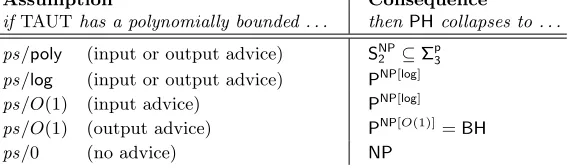
So far we have provided different characterizations of the question whether polynomially bounded proof systems with advice exist. At this point it is natural to ask, how likely these assumptions actually are, i.e., what consequences follow from the assumption that such proof systems exist. For TAUT we obtain a series of collapse consequences of presumably different strength as shown in Table 1.
The first line in Table 1 follows from Theorems 10 and 11 and a result of Cai, Chakaravarthy, Hemaspaandra, and Ogihara [10], who have shown that coNP⊆NP/polyimpliesPH⊆SNP
2 . For the second line, the distinction between
input and output advice is again irrelevant (Corollary 16). Here we use a re-sult of Arvind, K¨obler, Mundhenk, and Tor´an [4], who showed that TAUT ∈
Table 1.Consequences of the existence of polynomially bounded proof systems
Assumption Consequence
if TAUThas a polynomially bounded . . . thenPHcollapses to . . . ps/poly (input or output advice) SNP
2 ⊆Σ p 3
ps/log (input or output advice) PNP[log] ps/O(1) (input advice) PNP[log]
ps/O(1) (output advice) PNP[O(1)]=BH
ps/0 (no advice) NP
and 4), follows from Theorem 17 in conjunction with Theorems 10 and 12. In comparison, the classical Cook-Reckhow Theorem states that TAUT has an advice-free polynomially bounded proof system if and only ifPH⊆NP(line 5).
Acknowledgements. We thank the anonymous referees for helpful comments and detailed suggestions on how to improve this paper.
References
1. Cook, S.A., Kraj´ıˇcek, J.: Consequences of the provability of NP ⊆P/poly. The Journal of Symbolic Logic72(4) (2007) 1353–1371
2. Beyersdorff, O., M¨uller, S.: A tight Karp-Lipton collapse result in bounded arith-metic. In: Proc. 17th Annual Conference on Computer Science Logic. Volume 5213 of Lecture Notes in Computer Science., Springer-Verlag, Berlin Heidelberg (2008) 199 – 214
3. Orponen, P., Ko, K., Sch¨oning, U., Watanabe, O.: Instance complexity. Journal of the ACM41(1) (1994) 96–121
4. Arvind, V., K¨obler, J., Mundhenk, M., Tor´an, J.: Nondeterministic instance com-plexity and hard-to-prove tautologies. In: Proc. 17th Symposium on Theoretical Aspects of Computer Science. Volume 1770 of Lecture Notes in Computer Science., Springer-Verlag, Berlin Heidelberg (2000) 314–323
5. Karp, R.M., Lipton, R.J.: Some connections between nonuniform and uniform complexity classes. In: Proc. 12th ACM Symposium on Theory of Computing, ACM Press (1980) 302–309
6. Cook, S.A., Reckhow, R.A.: The relative efficiency of propositional proof systems. The Journal of Symbolic Logic44(1) (1979) 36–50
7. Kraj´ıˇcek, J., Pudl´ak, P.: Propositional proof systems, the consistency of first order theories and the complexity of computations. The Journal of Symbolic Logic54(3) (1989) 1063–1079
8. Buhrman, H., Fortnow, L., Laplante, S.: Resource-bounded Kolmogorov complex-ity revisited. SIAM Journal on Computing31(3) (2001) 887–905
9. Buhrman, H., Chang, R., Fortnow, L.: One bit of advice. In: Proc. 20th Symposium on Theoretical Aspects of Computer Science. (2003) 547–558
10. Cai, J.Y., Chakaravarthy, V.T., Hemaspaandra, L.A., Ogihara, M.: Competing provers yield improved Karp-Lipton collapse results. Information and Computation