based on constant modulus design for CDMA interference suppression
.
White Rose Research Online URL for this paper:
http://eprints.whiterose.ac.uk/4046/
Version: Submitted Version
Article:
de Lamare, R.C., Haardt, M. and Sampaio-Neto, R. (2008) Blind adaptive constrained
reduced-rank parameter estimation based on constant modulus design for CDMA
interference suppression. IEEE Transactions on Signal Processing. pp. 2470-2482. ISSN
1053-587X
https://doi.org/10.1109/TSP.2007.913161
[email protected] https://eprints.whiterose.ac.uk/
Reuse
Items deposited in White Rose Research Online are protected by copyright, with all rights reserved unless indicated otherwise. They may be downloaded and/or printed for private study, or other acts as permitted by national copyright laws. The publisher or other rights holders may allow further reproduction and re-use of the full text version. This is indicated by the licence information on the White Rose Research Online record for the item.
Takedown
If you consider content in White Rose Research Online to be in breach of UK law, please notify us by
White Rose Research Online
Universities of Leeds, Sheffield and York
http://eprints.whiterose.ac.uk/
White Rose Research Online URL for this paper:
http://eprints.whiterose.ac.uk/4046/
Published paper
de Lamare, R.C., Haardt, M. and Sampaio-Neto, R. (2008) Blind Adaptive
Constrained Reduced-Rank Parameter Estimation Based on Constant
Modulus Design for CDMA Interference Suppression,
IEEE Transactions on
Signals Processing, Volume 56 (6), 2470 - 2482.
Blind Adaptive Constrained Reduced-Rank Parameter
Estimation Based on Constant Modulus Design for
CDMA Interference Suppression
Rodrigo C. de Lamare
, Member, IEEE
, Martin Haardt
, Senior Member, IEEE
, and Raimundo Sampaio-Neto
Abstract—This paper proposes a multistage decomposition for
blind adaptive parameter estimation in the Krylov subspace with the code-constrained constant modulus (CCM) design criterion. Based on constrained optimization of the constant modulus cost function and utilizing the Lanczos algorithm and Arnoldi-like iterations, a multistage decomposition is developed for blind parameter estimation. A family of computationally efficient blind adaptive reduced-rank stochastic gradient (SG) and recursive least squares (RLS) type algorithms along with an automatic rank selection procedure are also devised and evaluated against existing methods. An analysis of the convergence properties of the method is carried out and convergence conditions for the reduced-rank adaptive algorithms are established. Simulation results consider the application of the proposed techniques to the suppression of multiaccess and intersymbol interference in DS-CDMA systems.
Index Terms—Blind adaptive constrained algorithms,
DS-code-division-multiple-access (CDMA) systems, interference suppres-sion, reduced-rank parameter estimation.
I. INTRODUCTION
L
INEARLY constrained blind adaptive estimation algo-rithms are useful in several areas of communications and signal processing such as beamforming and interference sup-pression for code-division-multiple-access (CDMA) systems [1]. In these applications, the linear constraints correspond to prior knowledge of certain parameters such as direction of arrival (DoA) of user signals in antenna array processing [2] and the signature sequence of the desired signal in CDMA interference suppression [3], [4]. With respect to the estimation algorithms, a very popular approach is to deploy stochastic gradient (SG) techniques because they represent simple and low complexity solutions that are preferred for implementation although their convergence depends on the eigenvalue spreadManuscript received January 18, 2007; revised October 14, 2007. This work was presented in part at ICASSP 2007 and ISWCS 2007. The associate editor coordinating the review of this manuscript and approving it for publication was Dr. Kostas Berberidis.
R. C. de Lamare is with the Communications Research Group, Department of Electronics, University of York, Heslington, North Yorkshire, York Y010 5DD, U.K. (e-mail: [email protected]).
M. Haardt is with the Communications Research Laboratory, Ilmenau Univer-sity of Technology, (Fachgebiet Nachrichtentechnik), D-98684 Ilmenau, Ger-many (e-mail: [email protected]).
R. Sampaio-Neto is with the Centre for Telecommunications Studies (CETUC) Pontifical Catholic University of Rio de Janeiro (PUC-RIO), 225 Gavea 22459-103 Rio de Janeiro—RJ, Brazil (e-mail: [email protected]).
Color versions of one or more of the figures in this paper area available online at http://ieeexplore.ieee.org.
Digital Object Identifier 10.1109/TSP.2007.913161
of the covariance matrix of the received vector. Conversely, recursive least-squares (RLS) type algorithms have fast conver-gence, are relatively insensitive to variations in the eigenvalue spread of the covariance matrix of the observation data as compared with the convergence of SG algorithms in stationary scenarios but require a significantly higher complexity than SG recursions [1].
Several attempts to provide cost-effective parameter esti-mators with fast convergence performance have been made in the last few decades through variable step size algorithms [5]–[13], data-reusing [14], [12] averaging methods [15], sub-band and frequency-domain adaptive filters [16]–[18], and RLS type algorithms with linear complexity such as lattice-based implementations [19], [20], fast RLS algorithms [21]–[24], and QR-decomposition-based RLS techniques [25]–[27]. A challenging problem that remains unsolved by conventional techniques [5]–[27] is that when the number of elements in the filter is very large, the algorithm requires a large number of samples (or data record) to reach its steady-state behavior. In these situations, even RLS algorithms require an amount of data proportional to [1], where is the number of elements of the estimator, in order to converge and this may lead to unacceptable convergence performance. Furthermore, in highly dynamic systems such as those found in wireless communications, estimators with a large number of elements usually fail or provide poor performance in tracking signals embedded in interference and noise.
Reduced-rank filtering is a very powerful technique that has gained considerable attention in the last few years due to its ef-fectiveness in low sample support situations where it can offer improved convergence performance at an affordable complexity [28]–[46]. The advantages of reduced-rank adaptive filters are their faster convergence speed and better tracking performance over existing techniques when dealing with large number of weights. Various reduced-rank methods and systems are based on principal components analysis, in which a computationally expensive singular value decomposition (SVD) to extract the signal subspace is required [30]–[32]. Other recent techniques such as the multistage Wiener filter (MWF) of Goldsteinet al.in [35] perform orthogonal decompositions in order to compute its parameters, leading to very good performance and a relatively low complexity. Another technique that resembles the MWF is the auxiliary-vector filtering (AVF) with orthogonal auxiliary vectors (AV) [38], [42]. In this regard, the equivalence between the MWF and the AVF with orthogonal AVs was established in [41]. An AVF structure with non-orthogonal auxiliary vectors
(AV) was reported in [43] and was shown to slightly outperform the MWF at the cost of a higher computational complexity. Ex-isting work on blind reduced-rank parameter estimation is very limited and relies on an MWF [36] or an AVF [43], [44] ver-sion of the constrained minimum variance (CMV) design crite-rion, which are very sensitive to signature mismatch. In addition, prior work on blind constrained parameter estimators with the constant modulus criterion [48]–[50] has shown improved per-formance and increased robustness against signature mismatch over the CMV approach and a reduced-rank version of the CCM is still not available in the literature.
In this paper, we develop a multistage decomposition for blind adaptive parameter estimation in the Krylov subspace with the constrained constant modulus (CCM) design criterion. Based on constrained optimization of the constant modulus cost function and utilizing the Lanczos algorithm and Arnoldi-like iterations, an efficient multistage decomposition is developed for blind pa-rameter estimation. Based on the Krylov subspace projection, we also devise a family of computationally efficient blind adaptive reduced-rank stochastic gradient (SG) and RLS type algorithms along with an automatic rank selection procedure. An analysis of the convergence properties of the method is carried out and shows some mathematical conditions for the method to be glob-ally convergent. We also establish the convergence conditions for the reduced-rank adaptive algorithms. The proposed batch and adaptive algorithms are then extensively studied in simula-tion experiments for CDMA interference suppression.
This paper is structured as follows. Section II describes a DS-CDMA System Model. Section III presents a framework for the CCM linear receiver design, briefly reviews linearly constrained receivers and blind adaptive constrained algo-rithms. Section IV introduces the reduced-rank version of the CCM design for linear receivers and details the multistage decomposition used to compute the reduced-rank projection matrix. Section V is devoted to the derivation of blind adaptive constrained reduced-rank estimation algorithms and the auto-matic rank selection mechanism based on the CCM criterion. Section VI presents and discusses the numerical simulation results, while Section VII gives the conclusions.
II. DS-CDMA SYSTEMMODEL
Let us consider the uplink of a symbol synchronous binary phase-shift keying (BPSK) DS-CDMA system with users, chips per symbol and propagation paths. It should be remarked that a synchronous model is assumed for simplicity, although it captures most of the features of more realistic asynchronous models with small to moderate delay spreads. Although BPSK modulation was adopted in the system model for the sake of simplicity, the techniques presented in this work can be easily extended to other constant modulus modulation formats. The baseband signal transmitted by the th active user to the base station is given by
(1)
where denotes the th symbol for user , the real valued spreading waveform and the amplitude associated
with user are and , respectively. The spreading
wave-forms are expressed by , where
is the chip waverform, is the chip duration and is the processing gain. Assuming that the receiver is synchronized with the main path, the coherently demodulated composite received signal is
(2)
where and are, respectively, the channel coefficient and the delay associated with the th path and the th user and represents the noise at the receiver. Assuming that , that the channel is time-varying but constant during each symbol interval and the spreading codes are repeated from symbol to symbol, the received signal after filtering by a chip-pulse matched filter and sampled at chip rate yields the
-dimensional received vector
(3)
where is
the complex Gaussian noise vector with zero mean and whose components are independent and identically distributed, where and de-note transpose and Hermitian transpose, respectively, and stands for expected value. The user symbol vector is , the ampli-tude of user is is the ISI for user and it should be noted that it is already contained in the first term of the first line of (3) and is the ISI span. The
diagonal matrix with -chips shifted versions of the signa-ture of user is given by
. .. ..
. ... . .. ...
(4)
where is the signature sequence for
the th user, the constraint matrix that contains one-chip shifted versions of the signature sequence for user and the vector with the multipath components are described by
.. . . ..
.. . . ..
..
The channel matrix for user is given by
..
. . .. ... ... (6)
The MAI comes from the non-orthogonality between the re-ceived signature sequences, whereas the ISI span depends on the length of the channel response and how it is related to the length of the chip sequence. For (no ISI), for
, for , and so on.
This means that at time instant we will have ISI coming not only from the previous time instants but also from the next symbols.
III. THECCM LINEARRECEIVERDESIGN
Consider the received vector , the con-straint matrix that contains one-chip shifted versions of the signature sequence for user and the vector with the multipath com-ponents to be estimated. The CCM linear receiver design is equivalent to determining an FIR filter with coefficients that provide an estimate of the desired symbol
, where is the signum func-tion, selects the real component, and is optimized according to the CM cost function
(7)
subject to the constraints given by , where is the vector that contains the multipath gains and is a constant to ensure the convexity of (7), as will be discussed in Appendix I. This approach assumes the knowledge of the channel. However, when multipath is present these pa-rameters are unknown and time-varying, requiring channel es-timation. The CCM filter expression that iteratively solves the constrained optimization problem in (7) is
(8)
where
[image:5.594.306.551.67.160.2]. A detailed derivation of the CCM estimation ap-proach is given in Appendix II. It should be remarked that the expression in (8) is a function of previous values of the filter and therefore must be iterated in order to reach a solution. In addition to this, the iterative method in (8) assumes the knowl-edge of the channel parameters. Since there is a large number of applications that have to deal with unknown multipath prop-agation, it is also important to be able to blindly estimate the multipath components. In this regard, it should be remarked that the approach in (8) can also work without the channel informa-tion by employing the inverse filtering criterion of [51], i.e., by simply setting . However, by exploiting the signal copies of the received signal through some knowledge of the channel it is possible to achieve superior performance.
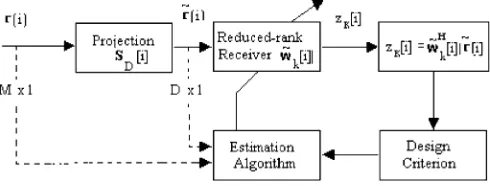
Fig. 1. Reduced-rank processing and receiver design.
In order to blindly estimate the channel, we adopt here the blind channel estimation procedure based on the subspace ap-proach proposed in [51], [47], [53] which is described by
(9)
subject to , where . The solution
is the eigenvector of the matrix corresponding to the minimum eigenvalue of through singular value decomposition (SVD). Here, we use in lieu of to avoid the estimation of both and , and which shows no performance loss as verified in our studies and explained in Appendix III.
IV. THEREDUCED-RANKCCM LINEARRECEIVERDESIGN
In this section, we describe the reduced-rank CCM design based on a multistage decomposition of the expression obtained in the previous section.
A. Reduced-Rank Receiver Design
The filter expression for the CCM design can be estimated by either computing the matrix inversion and the remaining operations in (8) or resorting to SG and RLS type adaptive algorithms. However, whenever the dimension of received data is large, the convergence performance is slow. In this section, we describe a reduced-rank algorithm that reduces the number of adaptive coefficients by projecting the received signal onto a lower dimension subspace. An illustration of reduced-rank signal processing dimensionality reduction and corresponding receiver design is depicted in Fig. 1.
Specifically, let be a -dimensional matrix that accomplishes the dimensionality reduction as given by
(10)
where, in what follows, all -dimensional quantities incorpo-rate a “tilde”. The reduced-rank CCM linear receiver design is equivalent to computing an FIR filter with elements that yield the desired symbol as
(11)
con-straints is , where . The reduced-rank CCM filter expression is
(12)
where
.
B. Multistage Decomposition and Projection Matrix Design
Here we detail the procedure to compute the projection ma-trix and the multistage decomposition. Let us rewrite the CCM expression of (8) in the following alternative form
(13) where
(14)
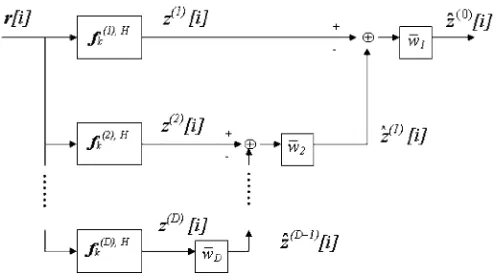
Following the schematic of Fig. 2, we wish to develop a multi-stage decomposition of the expression in (13) that computes the projection matrix . Specifically, the first filter of the struc-ture in Fig. 2, namely , is the normalized version of , i.e., . In this proposed multistage de-composition, the th filter maximizes the real part of the correlation between its output and the output of the pre-vious filters . This optimization problem first appeared in [54], although, in the context of reduced-rank estimation, a similar approach was firstly employed in [39]. Both approaches lead to the computation of Krylov subspaces. By restricting the filters to be orthonormal, the th filter can be computed via the following optimization:
(15)
subject to and ,
for .
A general solution to the optimization problem in (15) can be computed via the Arnoldi iteration [54], [52], which is a numer-ical optimization algorithm to solve linear systems problems, and is described by
(16)
where the matrix has the role of
[image:6.594.303.551.64.204.2]projecting the signal onto the space orthogonal to the filter and is the identity matrix. Because is Hermi-tian, the designer can resort to the Lanczos algorithm, a simpler technique than the Arnoldi recursion and that can be used to solve symmetric systems of linear equations [52]. The reader is
Fig. 2. Proposed reduced-rank CCM filterbank structure.
referred to [52] for further details on the method. The method generates a sequence of tridiagonal matrices and parameters that are gradually better estimates of the desired solution as given by
(17)
The Lanczos method above leads to a tridiagonal co-variance matrix for the projected vector
, where the parameters are obtained after the application of each filter . The scalar filters , where , are utilized to estimate the output of the previous filter from an error signal . Fol-lowing this procedure and Fig. 2, the reduced-rank CCM filter with rank can be obtained by neglecting the signal . In this respect, the procedure described above details the com-putation of the projection matrix for user , which has the following structure
(18)
At this point, we remark the main differences between the eigen-decomposition techniques and the Krylov subspace approaches. Specifically, in the work of Goldstein and Reed [35] an eigen-decomposition approach would require an SVD on the full-rank covariance matrix and the selection of the eigenvectors asso-ciated with the largest eigenvalues. In contrast to that, the Krylov-based approach does not require eigendecomposition and selects the basis vectors which minimize the desired cost function and will form the projection matrix (see also Honig and Goldstein [36]). By using the projection matrix , the -di-mensional observation vector is expressed by
(19)
and the reduced-rank CCM filter with rank is
(20)
cor-TABLE I
BATCHITERATIVEALGORITHM FOR THEDESIGN OF THEPROPOSEDCCM REDUCED-RANKFILTERSCHEME
responds to the -dimensional Krylov subspace ,
where and was
de-fined for the problem at hand in (18). A summary of the batch CCM reduced-rank algorithm is shown in Table I.
V. BLIND ADAPTIVE REDUCED-RANK
ESTIMATIONALGORITHMS
In this section, we derive blind adaptive reduced-rank estima-tion algorithms based on the reduced-rank decomposiestima-tion of the previous section. Specifically, we develop SG and RLS type blind constrained algorithms for reduced-rank parameter estimation. The complexity in terms of arithmetic operations of the new al-gorithms and the existing techniques is included as a function of the number of adaptive elements for comparison purposes.
A. SG Reduced-Rank Algorithm
In order to develop an SG reduced-rank estimation algorithm based on the CCM design, let us consider the following uncon-strained cost function
(21)
where and
.
By taking the gradient terms of (21) with respect to , where stands for complex conjugate, and using instan-taneous estimates of all parameters and , we seek to adaptively minimize . If we consider the set of constraints , we arrive at the update equations for the estimation of
(22)
where and
is a matrix that projects the re-duced-rank receiver’s parameters onto another hyperplane in order to ensure the constraints. The SG channel estimation procedure described in [53] is employed for estimating
and constructing . A summary of the
proposed CCM reduced-rank SG algorithm is shown in Table II.
TABLE II
SG ITERATIVEALGORITHM FOR THEDESIGN OF THEPROPOSEDCCM REDUCED-RANKFILTERSCHEME
B. RLS Reduced-Rank Algorithm
Given the expressions for the reduced-rank CCM linear filter in (12) and the projection matrix , we need to es-timate and recursively to reduce the computa-tional complexity required to invert these matrices. Using the matrix inversion lemma and Kalman RLS recursions [1] we have
(23)
(24) and
(25)
(26)
where is the forgetting factor. The recursions in (23)–(26) correspond to the use of the matrix inversion lemma to reduce the complexity required for estimating the inverse of the full-rank matrix and the inverse of the reduced-rank matrix . The algorithms can be initialized
with and where is a scalar to
ensure numerical stability. Once is updated, it is used for channel estimation, to obtain and to construct an estimate of . The RLS channel estimation procedure described in [53] is employed for estimating . Finally, we construct the CCM reduced-rank linear receiver as described by
(27)
where
(28)
is estimated by
and the reduced-rank
projec-tion matrix is .
TABLE III
RLS ITERATIVEALGORITHM FOR THEDESIGN OF THEPROPOSEDCCM REDUCED-RANKFILTERSCHEME
TABLE IV
COMPUTATIONALCOMPLEXITY OFSG ADAPTATIONALGORITHMS AND THE PROPOSEDMWF-CCM SG ALGORITHM
C. Computational Complexity of Algorithms
In this section, we illustrate the computational complexity of the proposed MWF-CCM-based SG and RLS algorithms and other existing ones, as shown in Tables IV and V. The compu-tational requirements are described in terms of number of arith-metic operations, namely additions and multiplications.
In Fig. 3 we depict curves that describe the computational complexity in terms of the arithmetic operations (additions and multiplications) as a function of the number of parameters . We use the same colors for the corresponding SG techniques in Fig. 3(a) and their associated RLS counterparts in Fig. 3(b). For these curves, we consider and assume that for the MWF-SG based approaches, while for the MWF-RLS techniques and for the AVF-based tech-niques, which are depicted with RLS methods. The curves in Fig. 3(a) show that there is a significant computational advan-tage of the reduced-rank SG recursions over the blind full-rank methods even though the LMS algorithm is still significantly less complex. For the RLS algorithms, as depicted in Fig. 3(b), we verify that the reduced-rank schemes are much simpler than any full-rank RLS algorithm due to the quadratic cost on rather than for the full-rank schemes operating with the RLS algorithm. Amongst the reduced-rank techniques, the blind CMV and CCM algorithms are slightly more complex
TABLE V
COMPUTATIONALCOMPLEXITY OFRLS,THEAVF-BASEDRECURSIONS,AND THEPROPOSEDMWF-CCM RLS-TYPEALGORITHMS
Fig. 3. Complexity in terms of arithmetic operations of (a) SG and (b) RLS algorithms and AVF-based recursions. (a) Complexity of SG Algorithms. (b) Complexity of RLS Algorithms and AVF recursions.
than their supervised counterparts, whereas the proposed CCM recursions are comparable in complexity to the CMV-based estimators (being slightly more complex for SG algorithms). The AVF-based schemes [43], namely the blind AVF-CMV and the supervised AVF, usually imply in extra complexity as they have more operations per auxiliary vector (AV) and also require a higher number of AVs to ensure good performance. The AVF-CMV uses the effective signature sequence as the initial AV, whereas the supervised AVF employs a steering
D. Automatic Rank Selection
The performance of the algorithms described in the previous subsections is indeed a sensitive function of the rank . Unlike prior methods for rank selection which utilize MWF-based al-gorithms [36] or AVF-based recursions [44], we focus on a blind criterion based on the constant modulus criterion. In particular, we present a method for automatically selecting the rank of the algorithms based on the exponentially weigheda posteriori
least-squares type constant modulus cost function described by
(29) where is the forgetting factor, is the reduced-rank filter for user with rank , and is the reduced-rank re-ceived data with rank . For each time interval , we can select which minimizes and the exponential weighting factor is required as the optimal rank varies as a function of the data record. The proposed rank adaptation algo-rithm is given by
(30)
where is an integer, and are the minimum and maximum ranks allowed, respectively. Note that a smaller rank may provide faster adaptation during the initial stages of the estimation procedure and a slightly greater rank usually yields a better steady-state performance. Our studies reveal that the range for which the rank of the proposed algorithms have a positive impact on the performance of the algorithms is very limited, being from 3 to 5 for SG algorithms and from 3 to 8 for RLS recursions. Furthermore, these values are rather insensitive to the system load (number of users), to the processing gain and work very well for all scenarios examined. In the next section, we will illustrate how the proposed rank adaptation algorithm performs.
VI. SIMULATIONEXPERIMENTS
In this section, we assess the bit error rate (BER) and the signal-to-interference-plus-noise ratio (SINR) performance of the receivers designed with the following adaptive parameter estimation criteria, i.e., the least-squares (LS), the constrained minimum variance (CMV) and the proposed CCM. We eval-uate their corresponding full-rank and reduced-rank versions, as well as, adaptive implementations based on batch (that perform matrix inversions), stochastic gradient (SG), and RLS algorithms. In particular, we consider the MWF-based implementations of the CMV, LS, and RLS algorithms [36] and the AVF-based implementations of the CMV and LS methods [43], [44]. The DS-CDMA system employs randomly generated sequences of length . The channels experi-enced by the users are different since we focus on an uplink scenario and the channel coefficients ,
where are obtained with Clarke’s
[image:9.594.305.552.66.241.2]model [55]. We show the results in terms of the normalized Doppler frequency (cycles/symbol) and use three-path channels with relative powers given by 0, 3, and 6 dB,
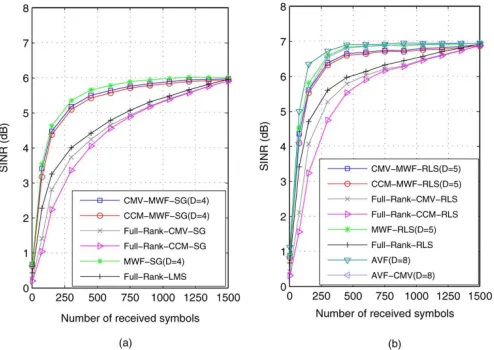
Fig. 4. SINR convergence performance of SG and RLS recursions at
E =N =10 dB when the algorithms converge to the same level of SINR. (a)N = 64; K =16 users,E =N =10 dB; (b)N = 64; K =16 users,
E =N =10 dB.
where in each run the spacing between paths is obtained from a discrete uniform random variable between one and two chips. The channel estimator of [53] models the channel as an FIR filter and we employ a filter with eight taps as an upper bound for the experiments. The phase ambiguity derived from the blind channel estimation method in [53] is eliminated in our simulations by using the phase of as a reference to remove the ambiguity and for fading channels we assume ideal phase tracking and express the results in terms of the normal-ized Doppler frequency (cycles/symbol). Alternatively, differential modulation can be used to account for the phase rotations.
The supervised estimation techniques are adjusted with the aid of a pilot sequence during the training phase, while the blind methods only rely on their knowledge of the signature sequences. For the sake of comparison, we also include the curves for supervised LMS and RLS [1] adaptive algorithms, which are trained with 200 symbols provided by a pilot channel
(at and ) and then switch
to decision-directed mode. It is assumed that the system has a power distribution amongst the users for each run that follows a log-normal distribution with associated standard deviation of 1.5 dB and all experiments are averaged over 200 runs. Note that given the performance of current power control algorithms, this power control scenario is close to a realistic situation. The step size of SG algorithms are optimized for each situation, whereas for RLS recursions we used because it leads to the best performance.
Fig. 5. BER performance versus Rank (D) for (a) SG and (b) RLS algorithms for a data record of 1500 symbols. (a)N = 64; f T = 0:0001; E =N =12 dB,K =16. (b)N = 64; f T = 0:0005,E =N =15 dB,K = 24.
The remaining plots employ the settings described in the pre-vious paragraph. The results indicate that the MWF-based and AVF-based reduced-rank algorithms are substantially faster than full-rank techniques. Amongst SG and RLS recursions, it can be noticed that RLS techniques are faster than SG methods, as expected, and this is verified for both full-rank and reduced-rank schemes.
In the next experiments, we evaluate the BER performance of the proposed and analyzed reduced-rank algorithms versus their associated rank . This experiment is intended for setting the adequate rank of the reduced-rank schemes for the remaining assessments for a given BER and data record. The full-rank per-formance is also included for comparison purposes. The results shown in Fig. 5 indicate that the best performance of the pro-posed reduced-rank CCM scheme with SG and RLS estimation algorithms is obtained with ranks and , respec-tively. For the AVF-based algorithms, the best rank was found to be . It is interesting to note that the best is usually much smaller than the number of elements in the received data , which leads to significant computational savings. These op-timized parameters for will be used for the remaining numer-ical results.
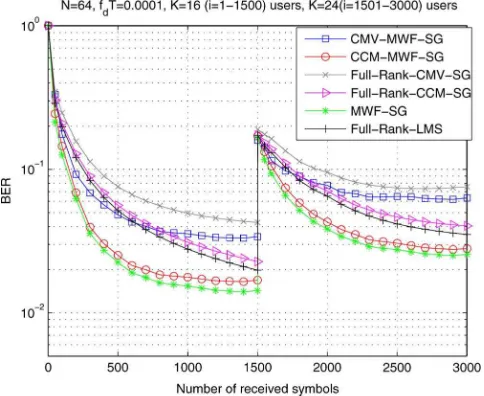
In what follows, we assess the average BER convergence per-formance of the analyzed and proposed algorithms. The BER convergence performance of the receivers is shown for batch and SG and RLS algorithms, in Figs. 6 and 7, respectively. It should be remarked that RLS techniques show a performance extremely close to the batch methods and differ basically due to the use of the matrix inversion lemma [1]. For this reason, we will only show the batch approach in Fig. 6 and in the re-maining plots we will only show the SG and RLS techniques. We consider a non-stationary scenario, where the system starts with users and at time , eight additional users enter the system, totalling users, and the blind adaptive algorithms are subject to new interferers/users in the environment.
[image:10.594.310.546.67.266.2]The results show that the new reduced-rank algorithms based on the CCM design criterion can perform very close to the su-pervised AVF and MWF-based reduced-rank algorithms, while
Fig. 6. BER convergence performance of LS algorithms atE =N =12 dB in a dynamic scenario.
Fig. 7. BER convergence performance of SG algorithms atE =N =15 dB in a dynamic scenario.
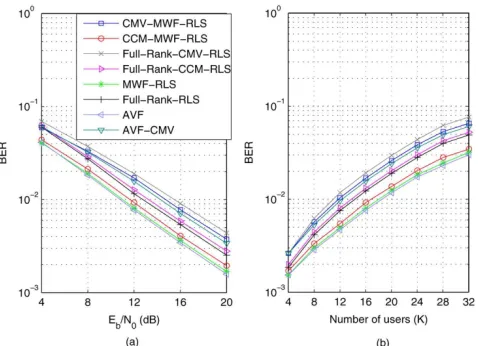
[image:10.594.306.548.317.515.2]Fig. 8. BER performance of SG algorithms versus (a) E =N and (b) number of users (K). (a)N = 64; K = 16 users,f T = 0:0001. (b)N = 64; E =N =12 dB,f T = 0:0001.
Fig. 9. BER performance of RLS algorithms versus (a) E =N and (b) number of users (K). (a)N = 64; K = 16 users,f T = 0:0001. (b)N = 64; E =N =12 dB,f T = 0:0001.
Specifically, when the eigenvalue spread of the covariance ma-trix of the received vector is large SG algorithms perform poorly, whereas the rate of convergence of batch or RLS al-gorithms is invariant to such situation in a stationary scenario [1]. The RLS methods were found to be less susceptible to this phenomenon than SG algorithms in the non-stationary sce-nario considered. Even though the impact of eigenvalue spread is much reduced in the proposed reduced-rank CCM-MWF-SG algorithm due to the dimensionality reduction (the eigenvalue spread has been verified to undergo a major reduction in most scenarios studied), for large systems or those that do not have good power control batch or RLS recursions are the most ap-propriate solutions.
In this part, the BER performance of the analyzed techniques is further investigated and the receivers process 1500 symbols to obtain the curves. In particular, the average BER performance of the receivers versus and number of users is depicted in Figs. 8 and 9 for SG and RLS algorithms, respectively.
[image:11.594.307.550.68.237.2]For the SG algorithms, the curves reveal that the proposed CCM-MWF-SG technique has a performance very close to the
Fig. 10. SINR convergence performance of SG and RLS recursions at
E =N = 10 dB using the proposed automatic rank selection algo-rithm with f T = 0:0001. (a) N = 64; K = 16; E =N =10 dB. (b)N = 64; K = 16; E =N =10 dB.
supervised MWF-SG method. The proposed CCM-MWF-SG algorithm can save up to 4 dB in as compared to the full-rank CCM-SG and LMS for the same BER performance, and up to 8 dB as compared to both the full-rank and MWF approaches designed with the CMV criterion. In terms of system capacity, the proposed CCM-MWF-SG algorithm can accommodate up to eight additional users as compared to the full-rank schemes designed with the MMSE and CCM criteria, and the gains are even more pronounced over CMV-based techniques. The results with RLS algorithms corroborate those obtained with SG recursions, even though the performance gap between the CMV-based algorithms, the full-rank RLS and CCM-RLS and the proposed CCM-MWF-RLS technique is slightly reduced. This is because the RLS algorithms are more powerful and even the full-rank RLS approaches were more capable to deal with the parameter estimation tasks than SG recursions. The AVF-based algorithms with non-orthogonal AVs are slightly better than the MWF-based ones, however, this comes at the expense of a higher complexity. When oper-ating in blind mode with the CMV criterion, neither the AVF nor the MWF yields a performance close to their supervised counterparts. Conversely, the proposed CCM-MWF techniques are able to effectively approach the performance of supervised reduced-rank algorithms with a very good tradeoff between performance and complexity.
[image:11.594.44.283.290.463.2](for prior work on variable step size mechanisms, the reader is referred to [6]–[13]), the forgetting factor of LS and RLS algo-rithms is also adequately chosen and we focus on the proposed automatic rank selection algorithm.
In the plots depicted in Fig. 10, the reduced-rank algorithms utilize different values for their rank and also the proposed automatic rank selection mechanism. The results show that with a lower rank the reduced-rank algorithms usually con-verge faster, however, they achieve a lower steady-state SINR value. Conversely, with a higher rank the proposed algorithms converge relatively slower than with a lower rank but they are able to reach a higher SINR value at steady state. The pro-posed automatic rank selection algorithm allows the propro-posed reduced-rank adaptive estimators to circumvent the tradeoff between convergence and steady-state performance for a given rank, by adaptively selecting the best rank for a given data record which provides both fast convergence and excellent steady-state performance. We remark that the proposed rank adaptation mechanism should be used in a realistic environment to ensure that the best rank is appropriately selected.
VII. CONCLUSION
This paper proposed a multistage decomposition for blind adaptive parameter estimation in the Krylov subspace with the CCM design criterion. Based on constrained optimization of the constant modulus cost function and utilizing the Lanczos algorithm along with Arnoldi-like iterations, we developed a multistage decomposition for blind parameter estimation, a family of computationally efficient blind adaptive reduced-rank SG and RLS type algorithms and an automatic rank adaptation technique. An analysis of the convergence properties of the method was carried out and convergence conditions for the reduced-rank adaptive algorithms were established. Simulation results considered the application of the proposed techniques to the suppression of multiaccess and intersymbol interference in DS-CDMA systems and have shown that the proposed blind algorithms achieve a performance equivalent to the best known supervised reduced-rank approaches without the need for training data.
APPENDIXI CONVERGENCEPROPERTIES
Let us express the cost function in (7) as
, drop the time index [i] for simplicity, assume a stationary scenario and that the are statis-tically independent i.i.d. complex random variables with zero mean and unit variance, and are statistically independent. Let us also define
(31)
(32)
Consider user 1 as the desired one, let and define , where
and . Using
the constraint and the relation
be-tween the filter, the channel and the signature
[47], [49], [50] we have for the desired user the condition . In the absence of noise and neglecting ISI, the (user 1) cost function can be ex-pressed as
(33)
where . To examine the
conver-gence properties of the optimization problem in (3), we proceed as follows. Under the constraint , we have
(34)
where
and . To evaluate the
con-vexity of , we compute its Hessian ) using the rule that yields
(35)
Specifically, is positive definite if for all nonzero [52]. The second, third, and fourth terms of (12) yield the positive definite matrix
(36)
while the first term provides the condition
that ensures the convexity of in the noiseless case. Be-cause is a linear function of then being a convex function of implies that is a convex function of . The same reasoning applies for the reduced-rank CCM design.
Since the extrema of the cost function can be considered for small a slight perturbation of the noise-free case [48], the cost function is also convex for small when . Interestingly, if we assume ideal channel estimation and , our result reduces to , which is the same found in [57]. For larger values of , we remark that the term can be adjusted in order to make the cost function in (3) convex, as pointed out in [48].
APPENDIXII
CCM FILTERDESIGN
Here we show the optimization steps towards the filter design according to the CCM criterion. Let us consider the constraint vector and transform the original constrained optimization problem given by (7) into an unconstrained optimization task by resorting to method of Lagrange multipliers which yield the following unconstrained cost function
(38)
where is a complex Lagrange multiplier. By taking the gra-dient terms of with respect to and setting them to zero we have
(39)
Then, by rearranging the terms we obtain
(40)
and then
(41)
where . Using the
constraint and substituting (41) into it, we arrive at the expression for the Lagrange multiplier
(42)
By substituting into we obtain the
expression for the CCM linear filter
(43)
APPENDIXIII
CHANNEL ANDPARAMETERESTIMATIONWITH
Here, we discuss the suitability of the matrix , that arises from the CCM method and its reduced-rank version, for use in channel estimation. From the analysis in Appendix I for the linear receiver, we have for an ideal and asymptotic
case that , for . Then,
and
. Therefore, we have for the desired user (i.e., user 1)
(44)
where .
From (44), it can be seen that can be approximated by multiplied by a scalar factor plus a noise-like term that for sufficient has an insignificant contribution. In addi-tion, when the symbol estimates are reliable, that is the cost function in (7) is small ), then has small variations around unity for linear detectors, yielding the approximation
(45)
REFERENCES
[1] S. Haykin, Adaptive Filter Theory, 4th ed. Englewood Cliffs, NJ: Prentice- Hall, 2002.
[2] J. C. Liberti and T. S. Rappaport, Smart Antennas for Wireless Commu-nications: IS-95 and Third Generation CDMA Applications. Upper Saddle River, NJ: Prentice-Hall, 1999.
[3] S. Verdu, Multiuser Detection. Cambridge, U.K.: Cambridge Univ. Press, 1998.
[4] M. Honig, U. Madhow, and S. Verdu, “Blind adaptive multiuser detec-tion,”IEEE Trans. Inf. Theory, vol. 41, pp. 944–960, Jul. 1995. [5] V. J. Mathews and Z. Xie, “A stochastic gradient adaptive filter with
gradient adaptive step size,”IEEE Trans. Signal Process., vol. 41, no. 6, pp. 2075–2087, Jun. 1993.
[6] R. W. Harris, D. M. Chabries, and F. A. Bishop, “A variable step size (VS) adaptive filter algorithm,”IEEE Trans. Acoust., Speech, Signal Process., vol. ASSP-34, pp. 309–316, Apr. 1986.
[7] T. J. Shan and T. Kailath, “Adaptive algorithms with an automatic gain control feature,”IEEE Trans. Acoust., Speech, Signal Process., vol. 35, pp. 122–127, Jan. 1988.
[8] R. H. Kwong and E. W. Johnston, “A variable step size LMS algo-rithm,”IEEE Trans. Signal Process., vol. 40, no. 7, pp. 1633–1642, Jul. 1992.
[9] H. J. Kushner and J. Yang, “Analysis of adaptive step-size SA algo-rithms for parameter tracking,”IEEE Trans. Autom. Control, vol. 40, pp. 1403–1410, Aug. 1995.
[10] T. Aboulnasr and K. Mayyas, “A robust variable step-size LMS-type algorithm: Analysis and simulations,”IEEE Trans. Signal Process., vol. 45, no. 3, pp. 631–639, Feb. 1997.
[11] D. I. Pazaitis and A. G. Constantinides, “A novel kurtosis driven vari-able step-size adaptive algorithm,”IEEE Trans. Signal Process., vol. 47, no. 3, pp. 864–872, Mar. 1999.
[12] H.-C. Shin, A. H. Sayed, and W.-J. Song, “Variable step-size NLMS and affine projection algorithms,”IEEE Signal Process. Lett., vol. 11, no. 2, pp. 132–135, Feb. 2004.
[13] R. C. de Lamare and R. Sampaio-Neto, “Low-complexity variable step-size mechanisms for stochastic gradient algorithms in minimum vari-ance CDMA Receivers,”IEEE Trans. Signal Process., vol. 54, no. 6, pp. 2302–2317, Jun. 2006.
[14] K. Ozeki and T. Umeda, “An adaptive filtering algorithm using an or-thogonal projection to an affine subspace and its properties,”Electron. Commun. Japan, vol. 67-A, no. 5, pp. 19–27, 1984.
[15] B. T. Polyak and A. B. Juditsky, “Acceleration of stochastic approxima-tion by averaging,”SIAM J. Contr. Optim., vol. 30, no. 4, pp. 838–855, Jul. 1992.
[16] A. Gilloire and M. Vetterli, “Adaptive filtering in subbands with critical sampling: Analysis, experiments and application to acoustic echo can-cellation,”IEEE Trans. Signal Process., vol. 40, no. 8, pp. 1862–1875, Aug. 1992.
[17] J. J. Shynk, “Frequency-domain and multirate adaptive filtering,”IEEE Signal Process. Mag., vol. 9, no. 1, pp. 15–37, Jan. 1992.
[18] M. Petraglia, R. G. Alves, and P. S. R. Diniz, “New structures for adap-tive filtering in subbands with critical sampling,”IEEE Trans. Signal Process., vol. 48, no. 12, pp. 3316–3327, Dec. 2000.
[19] D. L. Lee, M. Morf, and B. Friedlander, “Recursive least squares ladder estimation algorithms,”IEEE Trans. Acoust., Speech Signal Process., vol. ASSP-29, pp. 627–641, Jun. 1981.
[20] H. Lev-Ari, T. Kailath, and J. M. Cioffi, “Least-squares adaptive lattice and transversal filters: A unified geometric theory,”IEEE Trans. Inf. Theory, vol. IT-30, pp. 222–236, Mar. 1984.
[21] J. M. Cioffi and T. Kailath, “Fast recursive-least-squares transversal fil-ters for adaptive filfil-ters,”IEEE Trans. Acoust., Speech Signal Process., vol. ASSP-32, pp. 304–337, Apr. 1984.
[22] J. M. Cioffi and T. Kailath, “Windowed fast transversal filters adaptive algorithms with normalization,”IEEE Trans. Acoust., Speech Signal Process., vol. ASSP-33, pp. 607–627, Jun. 1985.
[23] D. T. M. Slock and T. Kailath, “Fast transversal filters with data se-quence weighting,”IEEE Trans. Acoust., Speech Signal Process., vol. 37, pp. 346–359, Mar. 1989.
[24] D. T. M. Slock and T. Kailath, “Numerically stable fast transversal filters for recursive least squares adaptive filtering,” IEEE Trans. Acoust., Speech Signal Process., vol. 39, no. 1, pp. 92–113, Jan. 1991.
[25] J. G. McWhirter, “Recursive least-squares minimization using a sys-tolic array,” inProc. SPIE, 1983, vol. 431, pp. 105–112, Real Time Signal Process. VI.
[26] J. M. Cioffi, “The fast adaptive ROTOR’s RLS algorithm,”IEEE Trans. Acoust., Speech Signal Process., vol. 38, pp. 631–653, Apr. 1990. [27] M. G. Bellanger, “The FLS-QR algorithm for adaptive filtering,”Signal
Process., vol. 17, pp. 291–304, Aug. 1984.
[28] L. L. Scharf and D. W. Tufts, “Rank reduction for modeling stationary signals,”IEEE Trans. Acoust., Speech Signal Process., vol. ASSP-35, pp. 350–355, Mar. 1987.
[29] L. L. Scharf and B. van Veen, “Low rank detectors for gaussian random vectors,”IEEE Trans. Acoust., Speech Signal Process., vol. ASSP-35, pp. 1579–1582, Nov. 1987.
[30] A. M. Haimovich and Y. Bar-Ness, “An eigenanalysis interference can-celer,”IEEE Trans. Signal Process., vol. 39, no. 1, pp. 76–84, Jan. 1991. [31] X. Wang and H. V. Poor, “Blind multiuser detection: A subspace
ap-proach,”IEEE Trans. Inf. Theory, vol. 44, pp. 677–690, Mar. 1998. [32] Y. Song and S. Roy, “Blind adaptive reduced-rank detection for
DS-CDMA signals in multipath channels,” IEEE J. Sel. Areas Commun., vol. 17, pp. 1960–1970, Nov. 1999.
[33] R. Singh and L. B. Milstein, “Interference suppression for DS/CDMA,”
IEEE Trans. Commun., vol. 47, pp. 446–453, Mar. 1999.
[34] R. Singh and L. B. Milstein, “Adaptive interference suppression for DS/CDMA,”IEEE Trans. Commun., vol. 50, no. 12, pp. 1902–1905, Nov. 2002.
[35] J. S. Goldstein, I. S. Reed, and L. L. Scharf, “A multistage representa-tion of the Wiener filter based on orthogonal projecrepresenta-tions,”IEEE Trans. Inf. Theory, vol. 44, pp. 2943–2959, Nov. 1998.
[36] M. L. Honig and J. S. Goldstein, “Adaptive reduced-rank interference suppression based on the multistage Wiener filter,” IEEE Trans. Commun., vol. 50, no. 6, pp. 986–994, Jun. 2002.
[37] C. C. Hu and I. S. Reed, “Space-time adaptive reduced-rank multistage Wiener filtering for asynchronous DS-CDMA,”IEEE Trans. Signal Process., vol. 52, no. 7, pp. 1862–1877, Jul. 2004.
[38] D. A. Pados and S. N. Batalama, “Low complexity blind detection of DS/CDMA signals: Auxiliary-vector receivers,” IEEE Trans. Commun., vol. 45, pp. 1586–1594, Dec. 1997.
[39] A. Kansal, S. N. Batalama, and D. A. Pados, “Adaptive maximum SINR RAKE filtering for DS-CDMA multipath fading channels,”IEEE J. Sel. Areas Commun., vol. 16, no. 9, pp. 1765–1773, Dec. 1998. [40] D. A. Pados, F. J. Lombardo, and S. N. Batalama, “Auxiliary vector
fil-ters and adaptive steering for DS-CDMA single-user detection,”IEEE Trans. Veh. Technol., vol. 48, no. 6, pp. 1831–1839, Nov. 1999. [41] W. Chen, U. Mitra, and P. Schniter, “On the equivalence of three
re-duced rank linear estimators with applications to DS-CDMA,”IEEE Trans. Inf. Theory, vol. 48, pp. 2609–2614, Sep. 2002.
[42] D. A. Pados and S. N. Batalama, “Joint space-time auxiliary-vector filtering for DS/CDMA systems with antenna arrays,”IEEE Trans. Commun., vol. 47, no. 9, pp. 1406–1415, Sep. 1999.
[43] D. A. Pados and G. N. Karystinos, “An iterative algorithm for the com-putation of the MVDR filter,”IEEE Trans. Signal Process., vol. 49, no. 2, pp. 290–300, Feb. 2001.
[44] H. Qian and S. N. Batalama, “Data record-based criteria for the selec-tion of an auxiliary vector estimator of the MMSE/MVDR filter,”IEEE Trans. Commun., vol. 51, no. 10, pp. 1700–1708, Oct. 2003. [45] S.-H. Wu, U. Mitra, and C.-C. J. Kuo, “Reduced-rank multistage
re-ceivers for DS-CDMA in frequency-selective fading channels,”IEEE Trans. Commun., vol. 53, no. 2, pp. 2609–2614, Feb. 2005.
[46] R. C. de Lamare and R. Sampaio-Neto, “Reduced-rank interference suppression for DS-CDMA based on interpolated FIR filters,”IEEE Commun. Lett., vol. 9, no. 3, Mar. 2005.
[47] Z. Xu and M. K. Tsatsanis, “Blind adaptive algorithms for minimum variance CDMA receivers,”IEEE Trans. Commun., vol. 49, no. 1, Jan. 2001.
[48] C. Xu, G. Feng, and K. S. Kwak, “A modified constrained constant modulus approach to blind adaptive multiuser detection,”IEEE Trans. Commun., vol. 49, no. 9, pp. 1642–1648, 2001.
[49] Z. Xu and P. Liu, “Code-constrained blind detection of CDMA signals in multipath channels,”IEEE Signal Process. Lett., vol. 9, no. 12, pp. 389–392, Dec. 2002.
[50] R. C. de Lamare and R. S. Neto, “Blind adaptive code-constrained con-stant modulus algorithms for CDMA interference suppression in mul-tipath channels,”IEEE Commun. Lett., vol. 9, no. 4, pp. 334–336, Apr. 2005.
[51] M. K. Tsatsanis and Z. Xu, “Performance analysis of minimum variance CDMA receivers,”IEEE Trans. Signal Process., vol. 46, pp. 3014–3022, Nov. 1998.
[52] G. H. Golub and C. F. van Loan, Matrix Computations, 3rd ed. Bal-timore, MD: The Johns Hopkins Univ. Press, 1996.
[53] X. G. Doukopoulos and G. V. Moustakides, “Adaptive power tech-niques for blind channel estimation in CDMA systems,”IEEE Trans. Signal Process., vol. 53, no. 3, pp. 2330–2334, Mar. 2005.
[54] W. E. Arnoldi, “The principle of minimized iterations in the solution of the matrix eigenvalue problem,”Quart. Appl. Math., vol. 9, pp. 17–29, 1951.
[55] T. S. Rappaport, Wireless Communications. Englewood Cliffs, NJ: Prentice-Hall, 1996.
[56] M. L. Honig and W. Xiao, “Performance of reduced-rank linear in-terference suppression,”IEEE Trans. Inf. Theory, vol. 47, no. 1, pp. 1928–1946, Jul. 2001.
Rodrigo C. de Lamare(S’99–M’04) received the Diploma in electronic engineering from the Federal University of Rio de Janeiro (UFRJ), Brazil, in 1998 and the M.Sc. and Ph.D. degrees, both in electrical engineering, from the Pontifical Catholic University of Rio de Janeiro (PUC-Rio) in 2001 and 2004, respectively.
From January 2004 to June 2005, he was a Postdoctoral Fellow at the Center for Studies in Telecommunications (CETUC) of PUC-Rio and from July 2005 to January 2006, he was a Postdoctoral Fellow at the Signal Processing Laboratory, UFRJ. Since January 2006, he has been with the Communications Research Group, Department of Electronics, University of York, U.K., where he is currently a Lecturer in Communications Engineering. His research interests lie in communications and signal processing.
Martin Haardt(S’90–M’98–SM’99) received the Diplom-Ingenieur (M.S.) degree from the Ruhr-Uni-versity Bochum in 1991 and the Doktor-Ingenieur (Ph.D.) degree from Munich University of Tech-nology, Germany, in 1996. He studied electrical engineering at the Ruhr-University Bochum, Ger-many, and at Purdue University, West Lafayette, IN. In 1997, he joined Siemens Mobile Networks, Munich, Germany, where he was responsible for strategic research for third generation mobile radio systems. From 1998 to 2001, he was the Director for International Projects and University Cooperations in the mobile infrastructure business of Siemens in Munich, where his work focused on mobile communi-cations beyond the third generation. During his time at Siemens, he also taught in the international Master of Science in Communications Engineering program at Munich University of Technology. He has been a Full Professor with the Department of Electrical Engineering and Information Technology and Head of the Communications Research Laboratory, Ilmenau University of Technology, Germany, since 2001. His research interests include wireless communications, array signal processing, high-resolution parameter estimation, and numerical linear algebra.
Dr. Haardt received the Vodafone (formerly Mannesmann Mobilfunk) Innovations-Award for outstanding research in mobile communications, the ITG best paper award from the Association of Electrical Engineering, Electronics, and Information Technology (VDE), and the Rohde and Schwarz Outstanding Dissertation Award. In fall 2006 and fall 2007, he was a visiting professor with the University of Nice in Sophia-Antipolis, France, and with the University of York, U.K., respectively. He has served as an Associate Editor for the IEEE TRANSACTIONS ONSIGNALPROCESSING(2002–2006), the IEEE SIGNALPROCESSINGLETTERS(since 2006), and theResearch Letters in Signal Processing(since 2007). He also served as the technical co-chair of the IEEE International Symposiums on Personal Indoor and Mobile Radio Communications (PIMRC) 2005 in Berlin, Germany.
Raimundo Sampaio-Netoreceived the Diploma and M.Sc. degrees, both in electrical engineering, from Pontificia Universidade Católica do Rio de Janeiro (PUC-Rio), Brazil, in 1975 and 1978, respectively, and the Ph.D. degree in electrical engineering from the University of Southern California (USC), Los An-geles, in 1983.
From 1978 to 1979, he was an Assistant Professor with PUC-Rio, and from 1979 to 1983, he was a doctoral student and a Research Assistant with the Department of Electrical Engineering, USC, with a fellowship from CAPES. From November 1983 to June 1984, he was a Postdoctoral Fellow at the Communication Sciences Institute, Department of Electrical Engineering, USC, and a member of the technical staff of Ax-iomatic Corporation, Los Angeles. He is now a researcher with the Center for Studies in Telecommunications (CETUC) and an Associate Professor with the Department of Electrical Engineering, PUC-Rio, where he has been since July 1984. During 1991, he was a Visiting Professor with the Department of Electrical Engineering, USC. He has participated in various projects and has consulted for several private companies and government agencies. His areas of interest include communication systems theory, digital transmission, satellite communications, and multiuser detection.