
Nucleon PDF separation with the collider and fixed-target data
Sergey Alekhin
Institute for High Energy Physics, Nauki 1, Protvino, Moscow region, 142281 Russia
Johannes Bl¨umlein, Kristin Lohwasser
Deutsches Elektronensynchrotron DESY, Platanenallee 6, D–15738 Zeuthen, Germany
Lea Michaela Caminada
Physik Institut, Universit¨at Z¨urich, Winterthurerstraße 190, CH–8057 Z¨urich, Switzerland
Katerina Lipka, Ringaile Plaˇcakyt˙e
Deutsches Elektronensynchrotron DESY, Notkestraße 85, D–22607 Hamburg, Germany
Sven-Olaf Moch
II. Institut f¨ur Theoretische Physik Universit¨at Hamburg, Luruper Chaussee 149, D-22761 Hamburg, Germany
Roberto Petti
Department of Physics and Astronomy, University of South Carolina 712 Main Street, Columbia, SC 29208, USA
Abstract
We consider the impact of the recent data obtained by the LHC, Tevatron, and fixed-target experiments on the nu-cleon quark distributions with a particular focus on disentangling different quark species. An improved determination of the poorly known strange sea distribution is obtained due to including data from the neutrino-induced deep-inelastic scattering experiments NOMAD and CHORUS. The impact of the associated (W +c) production data by CMS and ATLAS on the strange sea determination is also studied and a comparison with earlier results based on the collider data is discussed. Finally, the recent LHC and Tevatron data on the charged lepton asymmetry are compared to the NNLO ABM predictions and the potential of this input in improving the non-strange sea distributions is evaluated.
Keywords: Parton distributions, strangeness, hadron colliders
1. Introduction
The nucleon quark distributions are important ingre-dients of the high-energy hadron collision phenomenol-ogy, particularly at large Bjorkenx, since these are the quarks, which dominate the partonic content of the nu-cleon for these kinematics. The fixed-target inclusive deep-inelastic scattering (DIS) data, which play a cen-tral role in the determination of the parton distribution
functions (PDFs), provide a constraint only on the lin-ear combinations of the quark distribution. Therefore, the global PDF fits are commonly based on a combina-tion of the DIS data with ones for the Drell-Yan (DY) process, which yield a supplementary constraint on the PDFs. At that the strange sea distribution can be in-dependently determined from the data on the c-quark production in neutrino-nucleon DIS probing the strange sea by the charged-current transition s → c. If the Nuclear and Particle Physics Proceedings 273–275 (2016) 1961–1966
2405-6014/© 2016 Published by Elsevier B.V.
www.elsevier.com/locate/nppp
http://dx.doi.org/10.1016/j.nuclphysbps.2015.09.317
μ
2=1.9 GeV
2, n
f=3
-0.2 0 0.2 0.4 0.6 0.8 1 1.2 1.4 1.6
10-4 10-3 10-2 10-1
x
(s+s
-
)/2/d
-CHORUS + CMS + ATLAS NuTeV/CCFR + NOMAD + CHORUS
ATLAS
[image:2.561.49.257.69.274.2]CMS
Figure 1: The 1σband for the strange sea suppression factor
rs = (s+s¯)/2/d¯as a function of the Bjorkenxobtained in the variant of the present analysis based on a combination of the data by NuTeV/CCFR [1], NOMAD [2], and CHO-RUS [3] (shaded area) in comparison with the results obtained by CMS [10] (hatched area), in the ATLASepWZ-fit [9, 14] (circles), and with the variant of present analysis based on combination of the data by CHORUS [3], CMS [8], and AT-LAS [9] (dashes) at different values ofx. All quantities refer to the factorization scaleμ2=1.9 GeV2.
c-quark produced is detected by its semi-leptonic de-cay into a muon, this process can be triggered by two muons in the final states. This signature was used by the NuTeV/CCFR experiments [1] at Tevatron and the NO-MAD experiment [2] at CERN. Alternatively, the events with ac-quark in the final state can be selected by the hadronic decays of charmed hadrons using the emulsion technique, like in the CHORUS experiment [3]. The NuTeV/CCFR data [1] have been employed to constrain the strange sea in the ABM PDF fit [4, 5, 6]. In the present proceedings we describe how the recent NO-MAD [2] and CHORUS [3] data can further improve the strange sea determination. We also discuss the asso-ciated (W+c) production in the proton-proton collisions measured by the CMS [8] and ATLAS [9] experiments at the LHC. Similarly to the case of neutrino-induced DIS, this process receives essential contributions from the charged-current transitions →c. Therefore, it can be also used to pin down the strangeness contribution to the nucleon. Finally, we check the recent data on the charged lepton asymmetryAlby the CMS [10] and D0 [11] experiments measured in (anti-)proton-proton
CMS (7 TeV, 5 1/fb)
20 25 30 35 40 45 50 55 60
0 0.2 0.4 0.6 0.8 1 1.2 1.4 1.6 1.8 2
η
ld
σ
/d
η
l(pb)
(W+ c-) + (W- c)PTl>35 GeV
ABM12
[image:2.561.292.501.75.276.2]CHORUS + CMS
Figure 2:The CMS data on (W+c) production [8] in compari-son with the ABM12 predictions (shaded area) and the variant of ABM12 fit [6] with only the CHORUS charm [3] and the CMS (W+c) [8] data used to constrain the strange sea.
collisions w.r.t. the ABM12 PDFs [6]. Since theAl mea-surement gives a constraint allowing to separate theu -andd-quark distributions this comparison demonstrates a further trend in determination of the non-strange quark PDFs.
2. Strange sea improvement
The NOMAD experiment collected about 15K dimuon events in the neutrino-nucleon DIS [2] exceed-ing the total statistics of earlier NuTeV/CCFR sam-ples [1] by a factor of 1.5. Furthermore the NOMAD beam energy is essentially lower than the NuTeV/CCFR one that allows to probe the strange sea in the kinematic region inaccessible for NuTeV/CCFR, up to x ∼ 0.5. The strange sea distribution can be extracted from the dimuon data provided the semi-leptonic branching ratio of the produced charmed hadrons is known. Meanwhile, their production rate essentially depends on the beam energy Eν therefore an effective semi-leptonic branch-ing ratioBμ(Eν)=hrh(Eν)Bhμwhererh(Eν) is the rel-ative production rate of hadronh and Bh
μ is its
semi-leptonic branching ratio, also depends onEν. We take into account this dependence employing an empirical parameterization of Ref. [2]
Bμ(Eν)= B (0)
μ
ATLAS (7 TeV, 4.6 1/fb)
η
ld
σ
/d
η
l(pb)
W+ c--jet PTl>20 GeV
ABM12
CHORUS + CMS
CHORUS + CMS + ATLAS
η
l W- c-jet [image:3.561.48.490.82.315.2]PTl>20 GeV
Figure 3:The same as in Fig. 2 for the ATLAS (W++c¯) (left) and (W−+c) (right) data [9]. The variant of the ABM12 fit [6] with only CHORUS charm data [3] in combination with the CMS and ATLAS (W+c) ones [8, 9] used to constrain the strange sea is displayed by dashes.
with the parameters B(0μ,1) constrained by the existing data onBμ [12, 13]. The values ofB(0)μ = 0.0933(25) andB(1)μ =5.6±1.1 obtained in the present analysis are in agreement with the ones obtained by NOMAD [2]. With these values the parameterization Eq. (1) flattens in the beam energy range of NuTeV/CCFR and is con-sistent with the value ofBμused in the earlier ABM12 fit [6].
The CHORUS experiment collected 2013 events with the charmed hadrons produced in the neutrino-nucleon DIS using the emulsion detection technique [3]. This is much smaller than the statistics of the dimuon experi-ments. However, due to the charm-decay vertex recon-struction, the CHORUS data are not sensitive to the cor-responding branching ratios and provide in this way a complementary constraint on the strange sea.
The strange sea distribution obtained in the updated version of the ABM12 fit where the NOMAD and CHO-RUS data included is given in Fig. 1 as a ratio rs = (s+s¯)/2/d¯quantifying the suppression of the strange sea w.r.t. the non-strange one. It is roughly constant in a wide range ofxand consistent with the value obtained earlier in our analysis of the NuTeV/CCFR dimuon data. However, the error in the updated determination of the strange sea at x 0.01 is improved up to a factor 2, mainly due to the impact of the NOMAD data [2] (cf.
more details in Ref. [7]). The CHORUS data [3] some-what overshoot the fit and therefore pull the strange sea up.
The same is valid for the CMS and ATLAS data on (W +c) production [8, 9], cf. Figs. 2, 3, although in this case the tension can be at least partially explained by the impact of the still missing NNLO QCD correc-tions to this process. Note, the ATLAS data are in a good agreement with the predictions based on a vari-ant of the ABM12 fit with only CHORUS and CMS data are used to constrain the strange sea, while the CMS ones are also described very well in this variant of fit. This demonstrates a good agreement between these three samples, which all together prefer enhanced strange sea. To check the upper margin ofrsallowed by this data subset we consider the variant of the fit with the NuTeV/CCFR and NOMAD data dropped and only the CHORUS, CMS, and ATLAS data used to constrain the strange sea. In this case the value ofrsatx∼0.1 is enhanced as compared to the determination based on the combination of the NuTeV/CCFR, NOMAD, and CHO-RUS data. However the difference is within 2σand it does not exceed 20% at maximum.
-0.06 -0.04 -0.02 0 0.02 0.04
0 0.1 0.2 0.3 0.4 0.5 0.6
x
x(d
-
-u
-)
FNAL-E-866
μ2=54 GeV2
ABM12
ATLAS-epWZ12
[image:4.561.293.503.72.276.2]NNPDF2.3coll
Figure 4: The 1σband for the iso-spin asymmetry of the sea
x( ¯d−u¯) at the scale ofμ2 = 54 GeV2
as a function of the Bjorken xobtained in the ABM12 fit [6] (right-tilted hatch) in comparison with the corresponding ones obtained in the ATLAS [14] (left-tilted hatch) and the NNPDF [16] (dashes) analyses using only the LHC and HERA collider data. The values ofx( ¯d−u¯) extracted from the FNAL-E-866 data [15] within the Born approximation are displayed as full circles.
based on the ATLAS data on the inclusive production of theW- andZ-bosons taken in combination with the HERA inclusive DIS data, while all fixed-target DIS and DY data are not considered. However, the result of the ATLAS analysis is in disagreement with the data by the FNAL-E-866 experiment on the ratio of the pro-ton and deuteron DY-process cross sections [15], which are commonly used to constrain the sea iso-spin asym-metry x( ¯d −u¯) in global PDF fits. Indeed, the value of x( ¯d−u¯) extracted from the FNAL-E-866 data in the Born approximation is positive for the whole range of xand in the ATLAS analysis [14] negative values are preferred. This means, the enhancement of the strange sea observed by ATLAS is obtained at the expense of a suppression of thed-quark PDF. Note, that negative values of x( ¯d −u¯) were also observed in the NNPDF fit [16] based on collider data only and a correspond-ing strange sea enhancement appears there, too. Mean-while, the discrepancy between the ATLAS results and the FNAL-E-866 data is not dramatic and amounts to about 2σonly. Moreover, the ATLAS result onrsis in agreement with ours within the errors, cf. Fig. 1. On the other hand, the ATLAS data on theW- andZ-boson production [17] are well described by the PDF set with
CMS (7 TeV, 4.7 1/fb)
0.1 0.125 0.15 0.175 0.2 0.225 0.25 0.275 0.3
0 0.25 0.5 0.75 1 1.25 1.5 1.75 2 2.25 2.5
η
lA
lW
PTμ>35 GeV PTμ>25 GeV
PTe>35 GeV (840 1/pb)
ABM12 NNLO
+ CMS
Figure 5:The CMS data on the muon asymmetry [10] with the cuts ofPTμ >25 GeV (circles) andPTμ >35 GeV (squares) imposed on the transverse muon momentum in comparison with the NNLO ABM12 prediction error band due to the PDF uncertainties (shaded area) and the earlier CMS data on the electron asymmetry [18] with the cut ofPTμ>35 GeV (trian-gles). The curves display the variant of ABM12 fit [6] with the CMS data of Ref. [10] included.
the suppressed strange sea. In particular, in the updated variant of the ABM12 fit with the NOMAD and CHO-RUS data included we get a value ofχ2 = 35 for 30 data points in the combined ATLASW- andZ-data set. In summary, these findings rather point at an insufficient statistical potential of the data used in the ATLAS anal-ysis of Ref. [14] in disentangling the quark PDFs than at a real strange sea enhancement. In this context it is also worth noting that in the analysis of Ref. [10] based on the combination of the CMS and HERA data the strange sea suppression atx0.01 was observed, cf. Fig. 1.
3. Constraints on the non-strange quark PDFs
Recent data on the muon asymmetry Aμ obtained by CMS [10] for the sample with an integrated lumi-nosity of 4.7 1/fb are compared with the predictions based on the NNLO ABM12 PDFs [6] in Fig.5. The predicted central values and their uncertainties due to PDFs are computed withDYNNLO(version 1.3) [19] and
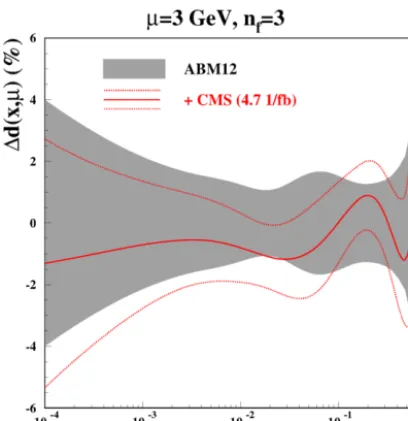
[image:4.561.49.257.73.274.2]Figure 6:The 1σfractional error band for the ABM12d-quark distribution (shaded area) in comparison with the relative vari-ation of its central value due to adding the CMS muon asym-metry data [10] (solid curve). The dotted curves correspond to thed-quark distribution uncertainty in this variant of the ABM12 fit [6].
predictions is in general quite good. For the data sam-ple with PTμ > 35 GeV the predictions do somewhat undershoot the data at the muon pseudo-rapidityημ1 since the ABM12 PDF were tuned to the earlier CMS data on the electron asymmetry [18], which go lower than the muon ones, cf. Fig. 5. However, this tension is within the 1σPDF uncertainties. Furthermore, for the data sample withPTμ>25 GeV a tension does not show up. Therefore the ABM12 fit does not change signifi-cantly due to inclusion of the CMS data on the electron asymmetry. The values ofχ2obtained in the variants of this fit with the data atPTμ>25 GeV andPTμ>35 GeV included are 16 and 10, respectively, for 11 data points. The former value is somewhat worse than the ideal one due to the data fluctuations atημ∼1.5 going beyond the experimental errors quoted. The change in the ABM12 PDFs due to the CMS muon asymmetry data is within 1σ with the most significant impact observed for the d-quark distribution. The uncertainty in the latter at x∼0.1 is also somewhat improved, cf. Fig. 6.
In contrast with the CMS muon asymmetry and the related LHC data in general, the Tevatron data on the charged lepton asymmetry do not demonstrate a good agreement with the ABM12 predictions. In particu-lar, recent D0 results on the muon asymmetry [11] ob-tained with the integral luminosity of 7.3 1/fb
[image:5.561.45.249.68.278.2]signifi-cantly overshoot the ABM12 predictions atημ1, cf. Fig. 7. A discrepancy is especially pronounced for the sample with the cut of PTμ >35 GeV. In this case the shape of the ABM12 predictions differ from the data even qualitatively. The agreement is improved in case the D0 data are added to the ABM12 fit. However, even in this case the profile of data at PTμ >35 GeV is not entirely reproduced and the value ofχ2is 40 for 10 data points. A better value of χ2 = 14 can be achieved in a model-independent fit with a 5-th order polynomial. However, in this case the fitted curve exhibits a step atημ ∼ 1, which evidently cannot be provided with a smooth PDF shape. The same step, although less pro-nounced, appears in the profile of the D0 sample with PTμ > 25 GeV, cf. Fig. 7. It is worth noting that the MSTW08 PDFs being tuned to the earlier Tevatron data also demonstrate poor agreement with the D0 data of Ref. [11]. This may point to a disagreement with the earlier Tevatron data. These issues should evidently be clarified before the recent D0 data can be included into our PDF fit.
4. Conclusion
In conclusion, we find that the ABM strange sea dis-tribution can be essentially improved at x 0.01 by adding to the fit recent NOMAD and CHORUS data on the charm production in the DIS neutrino-nucleon scat-tering. The updated PDFs are in agreement with the ABM12 ones although the CHORUS data obtained on the emulsion target demonstrate a particular trend w.r.t. the results of dimuon experiments NuTev, CCFR, and NOMAD pulling strange sea somewhat up. The CMS and ATLAS data on the associated (W+c) production in the proton-proton collisions, which are also sensitive to the strangeness content of nucleon, overshoot the ABM predictions, however, statistical significance of the dis-crepancy is inessential in view of the large data uncer-tainties and foreseen impact of the NNLO corrections to this process. From the variant of the ABM fit based on the CHORUS, CMS, and ATLAS data preferring en-hanced strange sea we estimate an upper margin of such enhancement as 20%.
D0 (1.96 TeV, 7.3 1/fb)
0 0.05 0.1 0.15 0.2 0.25 0.3
0 0.5 1 1.5 2
η
μA
μW
W± --> μ±ν PTμ>35 GeV
NNLO ABM12
ABM12 + D0 5-th order polyn.
NNLO MSTW08
0 0.02 0.04 0.06 0.08 0.1 0.12 0.14 0.16 0.18
0 0.5 1 1.5 2
η
μA
μW
[image:6.561.64.496.76.283.2]W± --> μ±ν PTμ>25 GeV
Figure 7:The muon asymmetry data obtained by the D0 collaboration [11] for integral luminosity of 7.3 1/fb with the cuts on the muon transverse momentumPTμ>35 GeV (left panel) andPTμ>25 GeV (right panel) in comparison with the NNLO predictions based on the ABM12 PDFs (solid curves: central values, shaded area: the uncertainties due to PDFs) and the central values for the MSTW08 [21] ones (dots). The variant of the ABM12 fit [6] including the D0 data [11] and the model-independent polynomial fit to the D0 data only are displayed by dashes and dotted-dashes, respectively.
quark PDF uncertainties at bigger values of x, demon-strate poor agreement with the ABM12 predictions and cannot be employed in our analysis before clarification of these discrepancies.
Acknowledgments. We would to thank P. Mar-quard for careful reading of the text and valuable comments. This work has been supported in part by Helmholtz Gemeinschaft under contract VH-HA-101 (Alliance Physics at the Terascale), DFG Sonder-forschungsbereich/Transregio 9 and by the European Commission through contract PITN-GA-2010-264564 (LHCPhenoNet). We thank the Galileo Galilei Institute for Theoretical Physica for the hospitality and the INFN for partial support during the completion of this work.
References
[1] M. Goncharovet al.[NuTeV Collaboration], Phys. Rev. D64 (2001) 112006 [hep-ex/0102049].
[2] O. Samoylovet al.[NOMAD Collaboration], Nucl. Phys. B876 (2013) 339 [arXiv:1308.4750 [hep-ex]].
[3] A. Kayis-Topaksu, G. Onengut, R. van Dantzig, M. de Jong, R. G. C. Oldeman, M. Guler, U. Kose and P. Tolunet al., New J. Phys.13(2011) 093002 [arXiv:1107.0613 [hep-ex]]. [4] S. Alekhin, S. A. Kulagin and R. Petti, Phys. Lett. B675(2009)
433 [arXiv:0812.4448 [hep-ph]].
[5] S. Alekhin, J. Bl¨umlein and S. Moch, Phys. Rev. D86(2012) 054009 [arXiv:1202.2281 [hep-ph]].
[6] S. Alekhin, J. Bl¨umlein and S. Moch, Phys. Rev. D89(2014) 054028 [arXiv:1310.3059 [hep-ph]].
[7] S. Alekhin, J. Bl¨umlein, L. Caminada, K. Lipka, K. Lohwasser, S. Moch, R. Petti and R. Placakyte, arXiv:1404.6469 [hep-ph]. [8] S. Chatrchyanet al.[CMS Collaboration], JHEP1402(2014)
013 [arXiv:1310.1138 [hep-ex]].
[9] G. Aadet al.[ATLAS Collaboration], JHEP1405(2014) 068 [arXiv:1402.6263 [hep-ex]].
[10] S. Chatrchyan et al.[CMS Collaboration], arXiv:1312.6283 [hep-ex].
[11] V. M. Abazovet al.[D0 Collaboration], Phys. Rev. D88(2013) 091102 [arXiv:1309.2591 [hep-ex]].
[12] N. Ushidaet al.[Fermilab E531 Collaboration], Phys. Lett. B 206(1988) 375.
[13] A. Kayis-Topaksuet al.[CHORUS Collaboration], Phys. Lett. B626(2005) 24.
[14] G. Aad et al. [ATLAS Collaboration], Phys. Rev. Lett. 109 (2012) 012001 [arXiv:1203.4051 [hep-ex]].
[15] R. S. Towellet al. [NuSea Collaboration], Phys. Rev. D 64 (2001) 052002 [hep-ex/0103030].
[16] R. D. Ball, V. Bertone, S. Carrazza, C. S. Deans, L. Del Debbio, S. Forte, A. Guffanti and N. P. Hartlandet al., Nucl. Phys. B867 (2013) 244 [arXiv:1207.1303 [hep-ph]].
[17] G. Aadet al.[ATLAS Collaboration], Phys. Rev. D85(2012) 072004 [arXiv:1109.5141 [hep-ex]].
[18] S. Chatrchyanet al.[CMS Collaboration], Phys. Rev. Lett.109 (2012) 111806 [arXiv:1206.2598 [hep-ex]].
[19] S. Catani, L.Cieri, G.Ferrera, D.deFlorian, M.Grazzini, Phys.Rev.Lett.103, 082001 (2009), arXiv:0903.2120. [20] Y. Li and F. Petriello, Phys.Rev. D86, 094034 (2012),
arXiv:1208.5967.
![Figure 1: The 1rσ band for the strange sea suppression factors = (s + ¯s)/2/d ¯ as a function of the Bjorken x obtained inthe variant of the present analysis based on a combinationof the data by NuTeV/CCFR [1], NOMAD [2], and CHO-RUS [3] (shaded area) in c](https://thumb-us.123doks.com/thumbv2/123dok_us/7806176.171230/2.561.49.257.69.274/figure-suppression-function-bjorken-obtained-present-analysis-combinationof.webp)
![Figure 3: The same as in Fig. 2 for the ATLAS (W+ + ¯c) (left) and (W− + c) (right) data [9]](https://thumb-us.123doks.com/thumbv2/123dok_us/7806176.171230/3.561.48.490.82.315/figure-fig-atlas-w-left-w-right-data.webp)
![Figure 4: The 1in comparison with the corresponding ones obtained in theATLAS [14] (left-tilted hatch) and the NNPDF [16] (dashes)analyses using only the LHC and HERA collider data](https://thumb-us.123doks.com/thumbv2/123dok_us/7806176.171230/4.561.49.257.73.274/figure-comparison-corresponding-obtained-theatlas-tilted-analyses-collider.webp)
![Figure 7: The muon asymmetry data obtained by the D0 collaboration [11] for integral luminosity of 7.3 1muon transverse momentumbased on the ABM12 PDFs (solid curves: central values, shaded area: the uncertainties due to PDFs) and the central values for th](https://thumb-us.123doks.com/thumbv2/123dok_us/7806176.171230/6.561.64.496.76.283/asymmetry-obtained-collaboration-integral-luminosity-transverse-momentumbased-uncertainties.webp)
