Final Project Report
(Not to be used for LINK projects)
Two hard copies of this form should be returned to:
Research Policy and International Division, Final Reports Unit MAFF, Area 6/01
1A Page Street, London SW1P 4PQ
An electronic version should be e-mailed to [email protected]
Project title
Workshop and desk study to appraise technical difficulties associated with
organic pullet rearing
MAFF project code
OF0192
Contractor organisation
and location
ADAS Gleadthorpe, Meden Vale, Mansfield, Nottinghamshire, NG20 9PF
Total MAFF project costs
£ 29,678
Project start date
01/04/00
Project end date31/10/00
Executive summary (maximum 2 sides A4)
Background To date, Regulation (EC) 1804/1999 and UKROFS Standards allow conventionally reared pullets up to 18 weeks of age to be brought into systems of organic egg production. Pullets must be reared according to the rules laid down in Regulation (EC) 1804/1999 and according to UKROFS Standards for at least six weeks, before the eggs may be sold as organic eggs. The derogation for pullet rearing has been agreed for a transitional period expiring on 31 December 2003. If pullets are to be reared from day old in an organic system in accordance with Regulation (EC) 1804/1999 and UKROFS Standards this may potentially create a number of technical problems, which may disadvantage UK producers considering organic egg production. A series of workshops and a literature review were commissioned by MAFF to provide possible solutions to these technical problems.
Objectives
1. To organise a workshop involving key members of the egg sector of the poultry industry, representatives of organic sector bodies and of MAFF to consider technical problems that may occur when rearing pullets organically, and to identify possible solutions.
2. To address some of the perceived technical problems by reviewing the available literature on conventional pullet rearing and assessing the extent to which published results can be applied to organic systems. 3. To reconvene workshop members to discuss findings from the literature review, to identify research
priorities and to consider mechanisms for technology transfer.
workshop where attendees discussed the findings from the literature, identified research priorities and considered mechanisms for technology transfer.
Results The outcome ofworkshop one was that several likely difficulties associated with rearing pullets in an organic production system were identified and these included; 1) the application of light programmes in pullets receiving natural light when the maximum daily light period is 16 hours; 2) nutrition; 3) housing and pasture management, and; 4) food safety risks. The main findings of the literature review are summarised below.
1. Photoperiodism For UK organic pullet rearers there will be an inability to apply normal step-down light programmes over a small part of the year, and an inability to markedly stimulate sexual maturity over a larger part of the year, this is due to there being a maximum permissible photoperiod of 16 hours. If organic pullet rearers were able to use longer photoperiods than 16 hours then there would be more flexibility. Organic pullet rearers in Southern European countries will be less affected by the Regulation than those in the UK as the daylength during summer remains below 16 hours and step-down light programmes may be applied even for February-hatched chicks.
2. Nutrition Since 24 August 2000 it has not been permissible to include synthetic amino acids in UK organic poultry rations (EC1804/1999). Synthetic methionine has been widely used in conventional poultry rations for the past forty years. Synthetic methionine may be added to the diet so as to optimise dietary methionine content, to optimise the supply of dietary methionine relative to the supply of other dietary amino acids and without significantly increasing the dietary crude content. Methionine-rich ingredients such as fishmeal tend to have a very high crude protein content and their inclusion in a ration even at modest concentrations markedly increases the dietary crude protein content. The over-feeding of crude protein is not desirable in any system of pullet rearing.
If there is a future requirement to rear pullets from day old in an organic system, and to feed organic rations according to Regulation (EC) 1804/1999 then feeds will either be deficient in methionine so as not to over-supply dietary crude protein, or they will be formulated to meet the birds’ methionine requirements. In the latter case, this will mean that the amino acid balance is less than optimal and the dietary crude protein content will be high. This would increase nitrogen excretion compared with conventionally reared pullets.
3. Housing and pasture management Pasture management and rotation will be important if there is a future requirement to rear pullets in an organic system that stipulates access to range during rearing. The optimal age at which pullets should be given access to pasture and the frequency of rotating paddocks may differ according to the parasitic status of the land.
Natural light must be used for organic poultry. Natural light is very bright and bright light has been
associated with injurious feather pecking in hens. As routine beak trimming is not allowed it may be difficult to control injurious feather pecking in organic pullets.
4. Food safety Rigorous biosecurity measures which can be imposed in controlled environments cannot be imposed on free range. Rodents and wild birds present a considerable risk to poultry as they carry
Salmonella enteridis and Salmonella typhimurium. Contaminated drinking water, such as that occurring in
puddles, and from which poultry drink, constitutes a hazard for outdoor systems. Methods of control, such as vaccination or competitive exclusion should be considered by UKROFS.
Implications of findings, future work and policy relevance The implications of the findings are that with current scientific information there will be technical difficulties associated with rearing pullets in an organic system. The most important technical difficulties are to do with photoperiodism, nutrition, pasture
management and rotation, and methods of controlling injurious feather pecking. Also a maximum permissible daylength of 16 hours for rearing organic pullets would mean that producers in Northern European countries may be disadvantaged.
Specific research needs identified at workshop two are detailed below.
sensitivity analyses, should be calculated. A comparison between a standard light programme and that experienced by pullets reared at the least favourable season of the year (winter hatched) under natural light is needed.
2. To determine the effects of low dietary methionine content on pullet growth, behaviour including injurious feather pecking, age at first egg, egg numbers and egg size. Gross margins of pullet price minus chick and feed costs and gross margins of egg income minus pullet and feed costs, including a sensitivity analysis, should be calculated.
3. To identify the optimum colony size and stocking density for organic pullets. This should include
assessments of behaviour, ease of bird management, house environment, feed intake, growth and gross margin of pullet price minus chick and feed costs.
4. To appraise the advantages and disadvantages of allowing pullets access to range during rearing. This should take into account behavioural responses and the need to train pullets to use nest boxes at the onset of lay, thermoregulatory competence with age and under differing weather conditions, disease risks and control strategies and the affects of increasing or decreasing daylight hours on the age at first egg.
Thought should be given to the age at which access to range should be provided, the time of day for access to range, and the duration of daily access to range. Full economic costings would be required.
5. To develop and quantify methods for reducing injurious feather pecking in organic pullets.
Scientific report (maximum 20 sides A4)
BACKGROUNDTo date, Regulation (EC) 1804/1999 and UKROFS Standards allow conventionally reared pullets up to 18 weeks of age to be brought into systems of organic egg production. Pullets must be reared according to the rules laid down in Regulation 1804/1999 and according to UKROFS Standards for at least six weeks, before the eggs may be sold as organic eggs. The derogation for pullet rearing has been agreed for a transitional period expiring on 31 December 2003. If pullets are to be reared from day old in an organic system in
accordance with Regulation (EC) 1804/1999 and UKROFS Standards this may potentially create a number of technical problems, which may disadvantage UK producers considering organic egg production. A series of workshops and a literature review were commissioned by MAFF to provide possible solutions to these technical problems.
OBJECTIVES
1. To organise a workshop involving key members of the egg sector of the poultry industry, representatives of organic sector bodies and of MAFF to consider technical problems that may occur when rearing pullets organically, and to identify possible solutions.
2. To address some of the perceived technical problems by reviewing the available literature on conventional pullet rearing and assessing the extent to which published results can be applied to organic systems. 3. To reconvene workshop members to discuss findings from the literature review, to identify research
priorities and to consider mechanisms for technology transfer.
METHODOLOGY
There were three separate but related stages to the project. At the outset of this work, on 12 July 2000, a MAFF-funded workshop was held at ADAS Gleadthorpe to discuss the technical and scientific issues arising from the proposed changes to the Regulations governing pullet rearing for organic egg production.
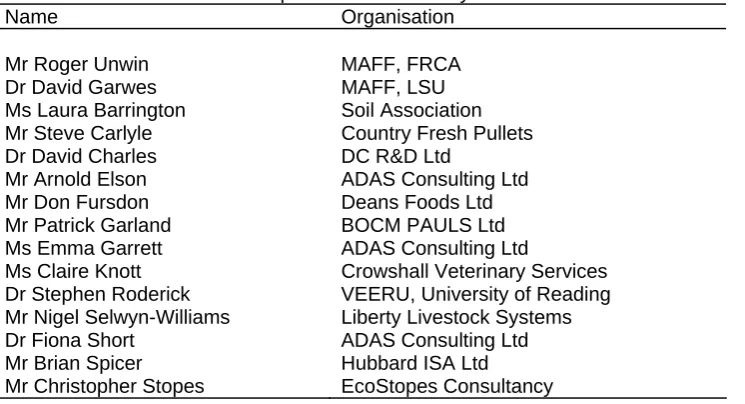
[image:4.595.26.399.510.712.2]The technical workshop comprised representatives of industry (pullet rearers, organic egg producers, breed suppliers, nutritionists, veterinary surgeons), of the Soil Association, of ADAS and of MAFF. A list of attendees and a copy of the workshop agenda are given in Tables 1 and 2 respectively.
Table 1. Attendees of workshop one held on 12 July 2000
Name Organisation
Mr Roger Unwin MAFF, FRCA
Dr David Garwes MAFF, LSU
Ms Laura Barrington Soil Association Mr Steve Carlyle Country Fresh Pullets Dr David Charles DC R&D Ltd
Mr Arnold Elson ADAS Consulting Ltd
Mr Don Fursdon Deans Foods Ltd
Mr Patrick Garland BOCM PAULS Ltd Ms Emma Garrett ADAS Consulting Ltd
Ms Claire Knott Crowshall Veterinary Services Dr Stephen Roderick VEERU, University of Reading Mr Nigel Selwyn-Williams Liberty Livestock Systems Dr Fiona Short ADAS Consulting Ltd Mr Brian Spicer Hubbard ISA Ltd Mr Christopher Stopes EcoStopes Consultancy
Table 2. Agenda for workshop one held on 12 July 2000
1. Chairman’s introduction Roger Unwin, MAFF FRCA
2. Workshop objectives and project details Fiona Short, ADAS
3. Short presentations on:
i. A breeders perspective Brian Spicer, Hubbard ISA
ii. A pullet rearers and egg producers perspective Steve Carlyle, Country Fresh Pullets Ltd & Don Fursdon, Deans Foods Ltd
iii .
A veterinarians perspective Clare Knott, Crowshall Veterinary Services
iv .
A feed manufacturers perspective Patrick Garland, BOCM PAULS Ltd
v. Manure usage and sustainability Christopher Stopes, EcoStopes Consultancy
4. General discussion to include prioritisation of topics for literature review and agree date of final workshop
All
Several short presentations were made at the workshop and these addressed the key aspects of pullet rearing. Speakers were specifically invited to comment on the likely difficulties that might be experienced when attempting to rear pullets in an organic production system. These ‘problems’ have been listed in Table 3 and they provided the topic headings for the subsequent literature review.
Table 3. Technical difficulties that may arise when rearing pullets in an organic system
Main problem Impacting on
1. Application of light programmes in pullets receiving natural light when the maximum daily light period is 16
hours: age at sexual maturity, seasonal effects on
daylength, effect of latitude on daylength and the ability to light programmes
2. Nutrition: protein sources and amino acid supply,
energy balance and the interaction
between nutrition and immunocompetence 3. Housing and pasture management: meeting the birds physical needs,
preventing the build-up of parasites on land
4. Food safety food safety risks
Literature searches of the major international abstracting databases were done using key words related to the technical problems specified in Table 3. Databases selected for scrutiny included agriculture, biology, life sciences, food sciences and medical sciences. Published and on-going European organic research was taken into consideration also and information arising in MAFF-funded project OF0153 (Effect of breed suitability, system design and management on welfare and performance in traditional and organic poultry systems) was used wherever possible. While reviewing the literature an assessment was made of the extent to which published results from conventional production systems may be applied to organic systems. The findings of the literature review were written as a discussion paper and this was circulated to workshop members at the end of September 2000.
A second MAFF-funded workshop was held on 10 October 2000 again at ADAS Gleadthorpe to discuss the findings of the literature review, to identify research priorities and to consider options for technology transfer. A list of attendees and an agenda for the workshop are given in Tables 4 and 5 respectively.
Table 4. Attendees of workshop two held on 10 October 2000
Dr David Garwes MAFF, LSU Dr David Charles DC R&D Ltd
Mr Arnold Elson ADAS Consulting Ltd
Mr Don Fursdon Deans Foods Ltd
Mr Patrick Garland BOCM PAULS Ltd Mrs Sue Gordon ADAS Consulting Ltd
Ms Claire Knott Crowshall Veterinary Services Mr Kenneth McConkey Hubbard ISA Ltd
Mr Christopher Stopes EcoStopes Consultancy
Mr Mike Tyers Deans Foods Ltd
Table 5. Agenda for workshop two held on 10 October 2000
Item Name
Chairman’s introduction and workshop objectives David Garwes
Overview of discussion paper Sue Gordon
Discussion on findings, research needs and priorities All
Several of the attendees of workshop one were unable to attend workshop two. Because of this, the minutes of workshop two were sent to everyone involved in either of the workshops and there was a period of ten days for people to provide any comments on the minutes. In addition, David Spackman (poultry veterinarian) was consulted and given the opportunity to comment on the discussion paper and minutes of workshop two.
A copy of the minutes of the second workshop were also sent to UKROFS to seek clarification on points of interpretation of either Regulation (EC) 1804/1999 or of UKROFS standards for organic livestock products as recorded in the minutes.
RESULTS
All project ‘milestones’ and objectives were delivered in full and in accordance with the agreed timescale.
The main results of this work are the findings of the literature review that was circulated as a discussion paper prior to workshop two. However, additional results have been included to address requests made by
workshop attendees either at workshop two or in writing. The results are presented under the topic headings photoperiodism, nutrition, housing and pasture management, and food safety. In summarising the results emphasis has been placed on the topics photoperiodism and nutrition, as these give rise to the largest technical uncertainties. To assist in the interpretation of the results it is necessary to provide definitions of some of the terms used throughout this section. These definitions are those which were discussed and agreed at workshop one.
Definitions
Organic - is taken to mean conforming to the standards agreed by Directive (EC) 1804/1999, UKROFS and
certification bodies.
Conventional - this term was thought to be appropriate to describe the technology used in main stream UK
commercial poultry industry since 1954.
Traditional - this term has often been used as a synonym for conventional, as defined above, but that is
confusing. It was agreed that it should be used to mean specifically the technology of the period before the advent of conventional technology.
It is sometimes incorrectly assumed that the application of lighting patterns for egg production is part of
conventional technology. While it is true that the definitive understanding of the process, and the application of it in the rearing period of the bird’s life, could be said to date from the late 1950s (i.e. within the conventional period), with such landmark work as that of Morris and Fox (1958a; 1958b) at Reading University, the basic technology is much older than that, and well rooted in the traditional period.
It has been recognised since the 1930s that the seasonality of egg production followed daylength. For
example, Wetham (1933), plotted daylengths and egg production for different latitudes, and concluded that the operative factor was the seasonal change in daylength and not the daylength per se.
Other early authors such as Morris and Fox (1958a;1958b) showed that it is important to avoid a declining daylength during lay, since this depresses ovulation. It was also recommended by these early authors that an increasing daylength during rearing should be avoided, because this brings about a precociously early sexual maturity, which resulted in smaller eggs, reduced yield, and the risk of prolapse, which, in turn, gives a higher risk of pecking, sometimes to the point of cannibalism. Morris, published a series of comprehensive reviews (1968; 1994; 1999) of the work on this topic including the physiological principles underpinning it.
In order to prevent problems associated with precociousness in winter- and spring-hatched conventional pullets the standard recommendation for non-light proofed houses, based on work highlighted in the above references, became a gradual step down in photoperiod from long photoperiods (e.g. 23 hours) at day old, reaching the prevailing natural daily light period at point-of-lay. The exact age at point-of-lay is usually
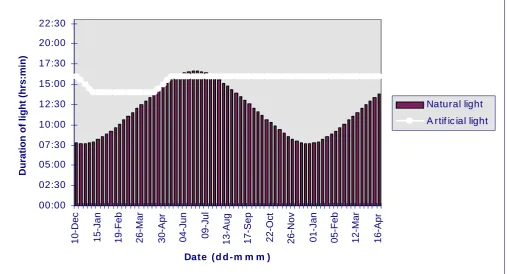
recommended by the breeding company according to constraints such as body weight and frame size. Then, in the laying phase the natural daily light period increases to a maximum of 16 hours and 40 minutes in mid June. The artificial light period is increased so as to either match the increasing natural daily light period or to slightly exceed it. In July, the natural daily light period declines, but the artificial photoperiod remains constant so that the hens do not experience a step-down in lighting during lay. An example, of a step-down light programme for December-hatched conventional pullets receiving natural light is shown in Figure 1.
0 0 :0 0 0 2 :3 0 0 5 :0 0 0 7 :3 0 1 0 :0 0 1 2 :3 0 1 5 :0 0 1 7 :3 0 2 0 :0 0 2 2 :3 0
1 0 -Dec
1 5-Ja n
1 9 -Fe b
2 6 -Ma r
3 0 -A p r
0 4 -Ju n
0 9 -Ju l
1 3 -A u g
1 7 -Se p
22 -Oc t
2 6 -No v
0 1 -Ja n
0 5 -Fe b
1 2 -Ma r
1 6-A p r
Da t e ( d d - m m m )
Duration of light/day (hrs:mins)
Natu r a l lig h t
[image:7.595.33.509.447.688.2]A r tif ic ia l lig ht
Figure 1. Example of a step-down lighting programme for application during rearing in December-hatched conventional pullets
There was a need to assess whether or not step-down light programmes may be applied to organic pullets. It has been assumed that there would be a requirement for organic pullets to be naturally ventilated, and that the natural light period may be supplemented using artificial lighting to provide a maximum of 16 hours of light per day. This was as for organic egg layers according to (EC) 1804/1999 and UKROFS Standards. Thus,
necessary to calculate the duration of the natural light period at point-of-lay. This was because there is a need to match the length of the daily light period during rearing with the length of the daily light period at point-of-lay. For chicks hatched on 10 December and reaching point-of-lay at 18 weeks of age the natural daily light period at point-of-lay would be about 13 hours and 50 minutes. In this example, it would be appropriate to reduce the light period from 16 hours down to 14 hours during brooding, and to then maintain the pullets on a 14 hour daily light period until point-of-lay. At point-of-lay the natural daily light period would be increasing by about 25 to 30 minutes per week to a maximum of 16 hours 40 minutes in mid-late June. It is suggested that the
artificial daily light period should be increased by 30 minutes per week until a maximum of 16 hours light per day is achieved. The artificial light period would then be maintained at 16 hours per day until the hens were depopulated. This example of a step-down light programmes is illustrated in Figure 2. However, the effect of a further 40 minute step-up in natural daylength above that of the artificial light period soon after the start of lay, followed by a 40 minute step-down in natural daylength only a few weeks later, on ovulation rate is not known, though a step down during lay contravenes the recommendations of authorities such as Morris.
00:00 02:30 05:00 07:30 10:00 12:30 15:00 17:30 20:00 22:30
10-Dec 15-J
a
n
19-F
e
b
26-Mar 30-Apr 04-J
u
n
09-J
u
l
13-Aug 17-Sep 22-Oc
t
26-Nov 01-J
a
n
05-F
e
b
12-Mar 16-Apr
Date (d d -m m m )
D
u
ra
tion of light (hrs
:min)
Natural light
[image:8.595.33.541.274.548.2]A rtif ic ial light
Figure 2. An example of a possible step-down light programme for applying during rearing in December-hatched organic pullets
Perhaps a more problematic time-of-year for rearing organic pullets would be when chicks are hatched in early February and they reach point-of-lay in mid-late June when the natural daily light period is greater than 16 hours. For conventional pullets reared in a non-light proof house it would be possible to apply a step-down light programme by reducing the daily light period from 23 hours at day old to 17 hours at point-of-lay. Then to stimulate ovulation, the daily light period may be increased by about 30 minutes each week until a daily light period of 19 hours is achieved. A 19 h daily light period would then be maintained until the hens are
0 0 :0 0 0 2 :3 0 0 5 :0 0 0 7 :3 0 1 0 :0 0 1 2 :3 0 1 5 :0 0 1 7 :3 0 2 0 :0 0 2 2 :3 0
05-Feb 12-Mar 16-Apr 21-May 25-Jun 30-Jul 03-Sep 08-Oct 12-Nov 17-Dec 22-Jan 26-Feb 02-Apr
D a t e ( d d - m m m )
Durat ion of light ( h rs: m in)
N a tu r a l lig h t
[image:9.595.34.533.76.336.2]A r tif ic ia l lig h t
Figure 3. An example of a step-down light programme for application during rearing in February-hatched conventional pullets
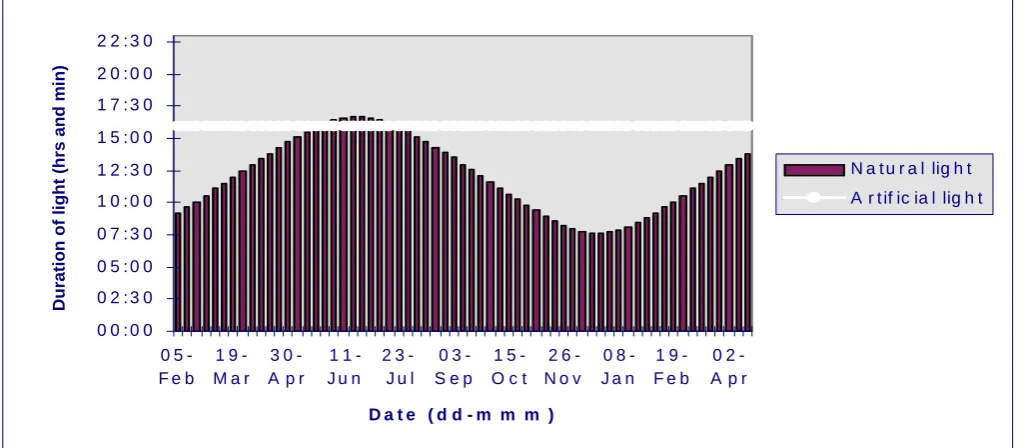
It would not be possible to stimulate ovulation at point-of-lay for February-hatched organic pullets as light periods of greater than 16 hours are not allowed. Furthermore, it is not possible to step-down from 16 hours of light per day at day old because this duration of light would be needed to block the natural increase in light that occurs before the pullets reach point-of-lay. If the daily light period was reduced below 16 hours during
brooding, the natural increment in daylength would stimulate precocious sexual maturity and this would increase the risk of prolapse. In February-hatched organic pullets it would only be possible to apply a 16 hour photoperiod during rearing and beyond (Figure 4), but the effects of maintaining a ‘constant’ light period from day old until depopulation on egg performance in modern hybrids is not known. Furthermore, a 40 minute increase in natural daylength soon after the start of lay, followed by a 40 minute decrease in the natural daylength only a few weeks later may override the ‘constant’ 16 h photoperiod and egg production may fall.
0 0 : 0 0 0 2 : 3 0 0 5 : 0 0 0 7 : 3 0 1 0 : 0 0 1 2 : 3 0 1 5 : 0 0 1 7 : 3 0 2 0 : 0 0 2 2 : 3 0
0 5 -F e b
1 9 -M a r
3 0 -A p r
1 1 -J u n
2 3 -J u l
0 3 -S e p
1 5 -O c t
2 6 -N o v
0 8 -J a n
1 9 -F e b
0 2 -A p r
D a t e ( d d - m m m )
Duration of light (hrs and min)
N a t u r a l lig h t
A r t if ic ia l lig h t
[image:9.595.27.539.518.742.2]Whilst one practical approach may be to try to light-proof the rearing house so that the producer is able to control the duration of light within the range of eight to 16 hours per day this will not be effective as it would be impossible to achieve adequate light exclusion (i.e. below the bird’s published darkness threshold of 0.4 lux to 1.0 lux, see below ) while providing sufficient ventilation to predispose good bird health, performance and welfare, and preventing heat stress in naturally ventilated houses.
Morris and Owen (1966, reviewed by Morris, 1968) published a photoperiodic darkness threshold of 0.4 lux, above which the birds treated a regime as light. This became the target degree of light proofing for many years. However, Emmans (1968) found that the application of light programmes had not completely eliminated effects of hatch date, and Spencer and Charles (1968) demonstrated that this was probably because there were proportions of the houses brighter than 0.4 lux when they were intended to be dark. However, it is possible that the threshold is different from 0.4 lux for modern hybrids. Lewis et al. (1999), working on age at first egg, suggested a cut off point close to 1 lux below which no photoperiodic stimulus occurs, inferring that less stringent light proofing may suffice, yet, paradoxically, they also found that extremely dim light may shift the biological clock with “unexpected consequences”, so that even illumination as dim as 0.05 lux cannot provide equated darkness in all circumstances. Due to phase shifting effects of dim light Lewis et al. (1999) recommended that in order to minimise the effects of stray light in summer in non-fully light proof houses, artificial lighting should be applied at the beginning of the natural day.
In organic egg production, some producers may want to use traditional breeds rather than modern hybrids, especially as UK consumers are increasingly demanding ‘new’ niche products. However, it is possible that the use of traditional breeds in specialist versions of organic production would make the use of supplementary lighting more important rather than less. Practical experience, and experimental evidence from Gleadthorpe (Charles and Tucker, 1993) suggests that modern hybrids are so genetically predisposed to ovulate that they are becoming refractory to lighting treatments. Lewis et al. (1997) also found evidence of genetic differences in photosensitivity. It is also possible that modern hybrids may be less affected by natural lighting than earlier commercial hybrids would have been.
Having said that, and because there are no data for modern hybrids, the work of Morris (1968), in which he related the effect of change in natural daylength between housing at day old and point-of-lay on age at first egg has been included. Morris’s equation given below may be used to calculate the effects of natural daylength on maturity and allows some quantification of the sensitivity of the matter for earlier hybrids.
y = μ - 1.59(ΔD)
where: y = age at first egg (days)
μ = strain mean age at first egg (days)
ΔD = total change in daylength occurring between hatching and the time of sexual maturity (hours).
Using the above equation, age at first egg for December-hatched conventional pullets receiving a step-down in daylength from 23 hours to 14 hours during rearing (example illustrated in Figure 1) has been calculated to be 112 days, when using a strain mean for age at sexual maturity of 126 days. For December-hatched organic pullets the maximum step-down in daylength is from 16 hours to 14 hours during rearing (example illustrated in Figure 2) and the age at first egg has been calculated to be 123 days. For February-hatched organic pullets there can be no step-down in daylength during rearing (example illustrated in Figure 4), and the age at first egg has been calculated to be 126 days. Points that arise from these calculations are; 1) there may be fewer eggs but larger eggs when egg producers use hatched organic pullets, than when using December-hatched conventional pullets, and; 2) the differences between egg performance of conventionally reared pullets and pullets reared in an organic system are expected to be greatest in February-hatched flocks. This may lead to seasonality of demand for pullets reared to point-of-lay at other times of the year, and it may be a complicating factor when fully integrating organic pullet rearing or organic egg production in a whole farm system.
at first egg. Secondly, if modern hybrids are less photoperiodic than earlier hybrids the calculated effect of change in daylength on age at first egg will be over estimated. The effects of photoperiod on age at first egg in modern layers must be determined before accurate costings can be done.
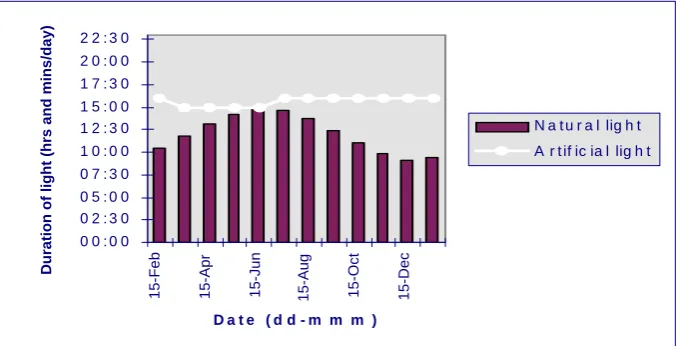
For UK pullet rearers the inability to apply light programmes over a small part of the year, or the inability to markedly stimulate sexual maturity over a larger part of the year, is due to the restriction on daylength. If organic pullet rearers were able to use longer photoperiods than 16 hours then there would be more flexibility. This approach would also benefit organic pullet rearers in other Northern European countries. Organic pullet rearers in some Southern European countries may be less affected by the new Regulations as daylength during summer remains below 16 hours and even for February-hatched flocks a step-down in lighting during rearing would be possible (Figure 5).
0 0 : 0 0 0 2 : 3 0 0 5 : 0 0 0 7 : 3 0 1 0 : 0 0 1 2 : 3 0 1 5 : 0 0 1 7 : 3 0 2 0 : 0 0 2 2 : 3 0
15-F
e
b
15-A
p
r
15-Jun 15-A
u
g
15-Oct 15-Dec
D a t e ( d d - m m m )
Dura
tion of light (hrs
a
n
d mins
/da
y
)
N a t u r a l lig h t
[image:11.595.30.371.258.431.2]A r t if ic ia l lig h t
Figure 5. An example of a step-down lighting programme for February-hatched organic pullets reared at a latitude of 40°27’N 03°35’W (e.g. Madrid)
Thus, if there is a requirement to rear pullets in an organic system there will be difficulties for UK producers in applying normal step-down light programmes over a small part of the year, and an inability to markedly stimulate sexual maturity over a larger part of the year. This is due to there being a maximum permissible photoperiod of 16 hours. Egg mass output of modern hybrids reared from hatch in an organic system may be poorer than when reared in a conventional system and brought into an organic system at 18 weeks of age. It is not possible to quantify the effects of rearing system on egg mass output as there is a lack of scientific information.
2. Nutrition
Protein sources and amino acid supply
For most of the conventional period the dominant protein sources have been based on soya beans from North America. However for reasons such as firstly aspirations for less dependence on imports, and secondly a lack of consumer confidence in the segregation of non-GM soya, there has been interest in the possible use of more European home grown proteins. Therefore, Gordon (1999), in a MAFF-funded literature review (project OF0163), studied the possible sources of home grown proteins, and particularly their suitability for organic poultry.
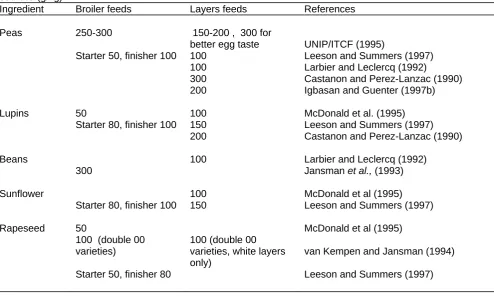
suggested maximum inclusion rates for the aforementioned vegetable protein sources for laying hens and broilers. Unfortunately the literature revealed little about diets for pullets, but since the pullet is a growing bird perhaps the broiler values may be appropriate. Neither the review by Gordon (1999), nor this project
[image:12.595.29.524.177.474.2]considered the agronomic feasibility of growing these crops in an organic farming system.
Table 6. Some published suggested maximum inclusion rates of various vegetable protein sources (g/kg)
Ingredient Broiler feeds Layers feeds References
Peas 250-300
Starter 50, finisher 100
150-200 , 300 for better egg taste 100
100 300 200
UNIP/ITCF (1995)
Leeson and Summers (1997) Larbier and Leclercq (1992)
Castanon and Perez-Lanzac (1990) Igbasan and Guenter (1997b)
Lupins 50
Starter 80, finisher 100 100 150 200
McDonald et al. (1995) Leeson and Summers (1997) Castanon and Perez-Lanzac (1990)
Beans 300
100 Larbier and Leclercq (1992) Jansman et al., (1993)
Sunflower
Starter 80, finisher 100 100 150
McDonald et al (1995) Leeson and Summers (1997)
Rapeseed 50 100 (double 00 varieties)
Starter 50, finisher 80
100 (double 00 varieties, white layers only)
McDonald et al (1995)
van Kempen and Jansman (1994)
Leeson and Summers (1997)
The biggest nutritional problem when formulating rations for organic pullets will be in meeting the birds’
essential amino acid requirements for immunocompetence, maintenance and growth. Since 24 August 2000 it has not been permissible to include synthetic amino acids in organic poultry rations (EC 1804/1999).
Synthetic methionine has been widely used in poultry rations since the 1960s and more recently synthetic lysine has been used. All of the protein sources reviewed by Gordon (1999) have lower lysine concentrations than full fat soya. Whilst rapeseed meal and sunflower meal have higher concentrations of methionine plus cystine than full fat soya, their inclusion rates are limited because of the presence and toxicity of ANFs, and because of low metabolisable energy value, respectively. As solvent extracted feed ingredients are not allowed in organic rations oil seed by-product meals would need to be produced by extrusion.
Oily fishmeal from sustainable sources is listed in the Regulation (EC) 1804/1999 and UKROFS standards Annex II section C ‘Feed materials’ as being a permitted ingredient from animal origin for use in poultry feeds. The interpretation of this by the workshop members was that fishmeal from sustainable sources may be
included in rations for organic pullets, and the Standards do not stipulate a maximum permitted inclusion rate. The use of fishmeal from sustainable sources in rations for pullets may enable feed formulators to almost meet the pullets’ methionine requirements for growth, maintenance and immunocompetence. However, oily
fishmeal has a very high crude protein content (720 g/kg, compared with 545 g/kg in full fat soya, Larbier and Leclercq, 1992), and so even at a modest concentration the crude protein content of the ration may be increased.
6.0 g/kg methionine, and this was comparable to the dietary methionine content of a conventional super chick ration, the crude protein and available lysine contents of the organic ration were much higher (280 g crude protein/kg and 17.4 g/kg available lysine, compared with 230 g/kg crude protein and 11.0 g/kg available lysine in the conventional super chick ration), and the amino acid balance of the organic ration was lost. In the organic ration, the methionine plus cystine content when expressed as a percentage of the available lysine content was only 65%, whereas in the conventional pullet ration the methionine plus cystine content was 92% of the available lysine content. An imbalance of dietary amino acids reduces the efficiency of protein utilisation and increases nitrogen excretion.
If there is a future requirement to rear pullets from day old in an organic system, and to feed organic rations according to Regulation (EC) 1804/1999 then feeds will either be deficient in methionine so as not to
over-supply dietary crude protein, or they will be formulated to meet the birds’ methionine requirements. In the latter case, this will mean that the amino acid balance is less than optimal and the dietary crude protein
content will be high. This would increase nitrogen excretion compared with conventionally reared pullets.
Methionine affects immunocompetence (Tsiagbe et al., 1987), and it is required for maintenance, growth and feathering (Larbier and Leclercq, 1992). There is anecdotal evidence that a low methionine intake may trigger injurious feather pecking, and this may have a scientific basis as feathers are methionine-rich. If organic rations are deficient in methionine this will affect pullet health and welfare. Over-supplying crude protein is also undesirable as pullets will need to drink more water in order to excrete the excess nitrogen. This could lead to poor litter conditions with consequent welfare problems.
Energy balance
The dietary energy requirement for growing conventional leghorn pullets has been given by Leeson and Summers (1997) as 11.5 to 12.3 MJ/kg depending on age and dietary protein content.
It is clear from the calorimetric work that the metabolisable energy (ME) requirement of poultry is profoundly affected by environmental temperature, because of its effect on heat loss. The literature contains many references to the practical effects of this on feeding requirements for layers (e.g. Emmans and Charles, 1977), but there has been very little work examining the effects of temperature on feeding requirements for pullets. An exception was the work of Cowan and Michie (1983) who used high rearing temperatures in order to restrict growth. They compared 15, 20, 25 and 30oC. Body weight at 128 days of age was progressively reduced by increasing rearing temperature, and subsequent egg output was also progressively reduced.
If organic pullets are required to have access to range during rearing then there will be a need to formulate rations which take into account the effect of temperature on energy requirements and feed intake. This may be difficult in light of the lack of information on practical feed requirements under varying temperature
conditions. One possible practical solution to this may be choice feeding. Choice feeding would allow the bird to optimise their nutrient intake, despite changes in appetite of ad libitum fed birds due to factors such as temperature.
Payne (1966) made the important point that there is a need to adjust dietary protein concentrations for ad lib
fed birds following a change in environmental temperature, as well as for different dietary energy levels. This is because temperature affects energy requirement, and thus voluntary feed intake, while protein, vitamin and mineral requirements are, for practical purposes, unchanged by temperature. Morris called this important interaction between environment and nutrition Payne’s hypothesis.
choice feeding, since without sample slaughter it would be difficult to know which parts of the body were experiencing growth spurts.
During the conventional period poultry feeds, including the feeds offered to the birds during brooding and rearing, have nearly always taken the form of complete single ground and mixed feeds, though sometimes fed as pellets or crumbles. During the traditional period the dry feed was often mixed with a little water to form a wet mash, and the term mash was, and sometimes still is, used to include dry feeds.
In the traditional period it was usual to offer laying hens separate feeding of a calcium source, and Howes (1939) went so far as to insist that grit and shell should always be available, but that they should not be mixed with the feed. Formal experiments on choice feeding go back a long time, and Graham (1934) offered caged layers a choice between whole maize, whole oats and a mash, as well as the separate provision of oyster shell. Individual hens laying at high rates chose a higher protein mixture. Dove (1935) found that chicks chose an almost perfectly balanced diet when offered a multiple choice.
During the conventional era serious interest in choice feeding probably dates from the work of Emmans (1977), who found that layers were able to make appropriate choices between a whole feed and ground barley. Several authors found evidence that layers could select for calcium, as well as energy and protein, (e.g. Mongin and Saveur, 1974), but Emmans (1974) and Leeson and Summers (1978) recognised that there may be interference between calcium and protein appetite drives, so that at least three choices may be desirable. A great deal of work on choice feeding in various classes of poultry has continued since the 1970s, (e.g. Cowan and Michie, 1978; Sinurat and Balnave, 1986 and Gous and Swatson, 2000), usually with
encouraging results. MacLeod and Dabutha (1997), working with quail, added the important observation that choice feeding helped to maintain growth rate over a wide range of temperatures, by allowing the birds to maintain protein intake. Forbes and Covasa (1995) have comprehensively studied the use of whole cereals in choice feeding. The use of whole cereals can potentially save milling costs, but because of the need for flint grit the conventional industry has feared problems with abrasion damage to machinery in the slaughter plant.
In the conventional era feed trough design difficulties have usually prevented the successful commercial application of choice feeding, but this may not be the case in organic pullet rearing.
Nutrition and immunocompetence
It is generally recognised that vitamin E, in synergy with the mineral selenium, has a part to play in immunocompetence in young birds (Larbier and Leclercq, 1994). It acts, among other things, as an antioxidant in pathways involving glutathione, and has a role in the synthesis of haem.
However vitamin E is not the nutrient affecting immunocompetence. The n-3 fatty acids in fish oils have been associated with immunocompetence in several species (Prickett et al., 1982). Fritsche et al. (1991) found that 70 g/kg of fish oil in the diet significantly enhanced antibody production in chicks. Korver and Klasing (1995) found that fish oil improved the resistance of broiler chicks to coccidia.
Tsiagbe et al. (1987) showed that high levels of methionine enhanced immune responses. They considered that extra methionine may be important for the synthesis of IgG antibodies, or perhaps as a T cell helper. The methionine requirement for health may be above that for growth. Unfortunately it is more difficult to achieve satisfactory methionine concentrations in organic pullet rations.
The concept of an interaction between nutrition and immunity is not new, but a recent paper offers a radical new aspect of it for very young chicks. Dibner (2000) pointed out that the residual yolk sac of, for example, a 35 g chick weighs only about 6g, and it was argued that the dependence on yolk sac reserves for the
If there is a future requirement to rear pullets from day old in an organic system, and to feed organic rations according to Regulation (EC) 1804/1999 then feeds will either be deficient in methionine so as not to
over-supply dietary crude protein, or they will be formulated to meet the birds’ methionine requirements. In the latter case, this will mean that the amino acid balance is less than optimal and the dietary crude protein
content will be high. This would increase nitrogen excretion compared with conventionally reared pullets.
3. Housing, pasture management and disease
There are two main approaches to housing used by organic producers. These are mobile units which can be moved to utilise the pasture in rotation, and static housing, whereby the birds are allowed access to an outside area covered by vegetation (Lampkin, 1997).
Mobile housing
There are now a number of suppliers offering mobile housing units suitable for organic production. Amongst these are companies such as Patchett, Harlow, Morspan, Liberty and Polybuild. Depending on the type of mobile housing system purchased, equipment such as feeders and drinkers may be included. In other instances these may need to be purchased as extras. There are no common standards for the provision of equipment. However, it is generally recognised that with regard to feeders and drinkers an even distribution is as important as adequate provision (Elson, 1996).
One advantage of mobile housing is that the birds can be moved to fresh grass periodically, thereby reducing the risk of soil-borne parasites in the outside area. However, stock may still be re-infected by parasites from their own droppings if these are retained in the house.
Although not needing planning permission, one of the constraints on these units is their size in order to remain mobile. Units available commercially vary in capacity from 200 to more than 1000 birds. A further
disadvantage is the need for all other production factors (feed, straw, water and electricity) to be transported to and from the moveable units. This increases the need for, and cost of, labour. Overall, the cost per bird of using mobile housing systems is higher than the corresponding costs in static houses.
The design of these houses, and the materials used in their construction, vary. One common important factor is the need for insulation to retain some bird heat during the winter and to prevent condensation occurring on the internal surfaces of the shed. At cleaning out it is necessary to rest the house, to adopt a thorough cleaning programme, and to use an approved disinfectant, or preferably steam cleaning, depending on the construction of the house.
Static housing
An advantage of larger static housing systems is the opportunity to introduce mechanisation (or partial
mechanisation) for the provision of feed, water and collection of droppings. This leads to a lower cost per bird than in mobile systems. Controlled environment housing is not possible because of the provision of pop holes and natural ventilation.
Management of the outside area tends to be more of an issue with static houses (Lampkin, 1997). An element of rotational grazing needs to be adopted in order to reduce the risk of parasites and diseases in the soil, and to maintain the vegetation cover. The area immediately adjacent to the house is utilised to the greatest extent. Hence, there is a need for management practices to be adopted (such as putting straw down in this area) to reduce the amount of mud that is carried into the sheds in wet weather, since the mud may contaminate fittings. Housing is best configured so that the birds enter the pop holes over a perforated floor area, in order to clean their feet before entering the house (Elson, 1995).
For producers wishing to build new Class 3 buildings for organic production, planning permission will be needed (unless the gross floor area is less than 465 m2). Further criteria of distance from roads, other poultry units and dwelling houses will also need to be met.
Natural ventilation, light intensity and feather pecking
In naturally ventilated houses the ventilation inlets and outlets will not be light proof and these will let bright light into the house. This means that in organic pullet rearing there is a risk of injurious feather pecking as the light environment is variable and bright. In conventional pullet rearing houses the light intensity is even throughout the house and not usually more than 10 lux. Bright light is associated with increased aggression and feather pecking, and the risk of cannibalism is greater than in dimmer light (Hughes and Duncan, 1972).
Generally, feather pecking is found to start during the rearing phase (Huber-Eicher, 2000) and this is important in the context of this project. At present it is possible to rear pullets in conventional controlled environment houses where dim lighting may control feather pecking during the establishment of a ‘pecking order’. At about 16 to 18 weeks of age the pullets are then reared to organic standards for six weeks before the eggs may be sold as organic. A requirement for pullets to be reared organically in brighter natural light may mean that feather pecking during rearing becomes more common. Furthermore, beak trimming is not permitted as a routine practice in organic poultry production. A recent workshop held at the University of Bristol School of Veterinary Science explored solutions to the problem of feather pecking in laying hens. The message from the majority of papers was the necessity to avoid high physiological stress. Physiological stress is the main factor that increases feather pecking (Huber-Eicher, 2000). Whether or not organic pullets would be less
physiologically stressed than conventional pullets is not known.
Pasture management, disease and hygiene
The texts of the traditional period stressed the importance of pasture management for nutritional reasons. Practical problems such as crop impaction needed to be avoided by keeping the grass mown short. Chickens do ingest some herbage from pasture and historically it was considered that grass could contribute from 5% (Thompson, 1952) to 10% (Robinson, 1948) of the nutritional needs of the laying hen, provided that young short grasses of appropriate species were provided. Thus, the early poultry text books often recommended specially sown swards rather than permanent pasture.
Modern sward compositions tend to provide ease of management for the producer rather than nutrient value to poultry. The mixture mostly comprises short resilient grasses so that the grass is slow growing but hard
wearing. As the number of poultry housed in extensive systems continue to grow there is greater justification for developing sward which have a composition that better meet the birds’ nutrient requirements, or that provide something extra like microbial activity against enteric bacteria.
Poultry diseases may be classified as enteric and respiratory. In general it is logical to suppose that
intensively housed birds are at greater risk of respiratory diseases while birds on range are at greater risk of enteric diseases.
Knott (2000) pointed out that viruses may be spread by contact or by aerosol, including windborne spread, depending on the type of virus. Some are fragile outside the host, but others can persist for long periods. They can also be introduced onto a site by visitors, rodents, wild birds, pets, insects and equipment. Bacterial infection may be spread similarly, but it is less likely to be windborne, particularly over long distances.
Contaminated feed and water can introduce bacterial contamination. Some bacteria, such as Mycoplasma
(respiratory), survive only a short time outside the host, but others survive for long periods, particularly if protected by organic matter.
Ascaridia. Ascarides occasionally moved from the intestine into the oviduct and worms were sometimes laid in the hen’s egg. The damage done to chickens by Ascaridia lineata is greatest in young birds.
Barger and Card (1949) emphasised the importance of preventing puddles on pasture and maintaining dry litter as a means of controlling the development of worm eggs. Cultivation and rotation of paddocks was also of value in reducing the number of infectious eggs to which free range poultry have access, but except for sunlight Ascaridia eggs have considerable resistance to climatic influences. The age at which pullets have access to pasture will be important in influencing the birds’ susceptibility to disease, but it will also influence the build-up of Ascaridia on the land. Ascaridia eggs passed out of the birds are not infectious, but under favourable conditions of warmth and moisture they embryonate and become infectious in 10 to 16 days. During the period of embryonation a small, coiled worm develops within the egg and if the latter is eaten by a susceptible fowl the young worm is liberated from the shell and it begins to develop in the intestinal tract of the host. A period of 50 to 60 days is required for the young worms to attain maturity, at which time the female worms are capable of laying eggs and starting the cycle over again. Thus, if pullets are brooded and kept indoors until 35 days of age, but then given access to pasture that has previously been used by pullets and infected with Ascaridia, there would be sufficient time for the multiplication of Ascaridia prior to pullets being moved to laying sites. Delaying the age at which pullets are given access to pasture during rearing may mean that the pasture used by young birds does not become increasingly contaminated, but the laying pasture may do so.
Barger and Card (1949) reported that Heterakis gallinae was a common caecal worm in free range chickens of the traditional period. It was frequently found in large numbers in the caeca, particularly in young birds.
Heterakis eggs excreted in the faeces may become infectious under conditions of sufficient warmth and
moisture in about seven to 14 days. The eggs are not readily destroyed by climatic influences and work during the traditional period found that fully developed worm eggs may persist in the soil for greater than eight months (Barger and Card, 1949 citing Graybill 1921). About 65 days are required for the entire cycle from egg to mature worm to be completed. Heterakis also plays a role in the transmission of Blackhead (infectious enterohepatitis caused by Histomonas meleagridis). As for Ascaridia, it is important to prevent puddles
developing on pasture and for the litter to be dry. Treatment for Ascaridia and Heterakis would usually be with anthelmintics under veterinary supervision, and for organic production according to Regulatory requirements and Standards.
Coccidiosis, a disease caused by Eimeria (protozoan parasite) occurs wherever poultry are raised (Barger and Card, 1949). It has devastating effects in chickens and causes high rates of mortality, especially in younger birds. There are eight species of Eimeria capable of infecting chickens, but two are particularly pathogenic these being Eimeria tenella and Eimeria necatrix. A vaccine containing all eight species of Eimeria is available and it is understood that it may be used in organic poultry production. The efficacy of allopathic treatments for coccidia has not been reviewed.
Pasture management and rotation will be important in controlling the build-up of parasites on land used by poultry. Monitoring the build-up of worm eggs on land and periodically sampling some pullets’ to establish the worm burdens within the gut will also be important. A veterinary health plan is a requirement of organic poultry production, but veterinary advice should also be sought on the age at which pullets should be given access to pasture and frequency of rotating paddocks as this may differ according to the parasitic status of the land.
It is not clear whether or not pullets reared in an organic system in accordance with Regulation 1804/1999 and UKROFS Standards would have to be given access to pasture. If access to pasture is a requirement of organic pullet rearing then paddock rotation will be essential in preventing the build-up of parasites on land and in maintaining pullet health.
4. Food safety
Fortunately the microbiological and practical aspects of the safety of poultry products have been well documented, and the following highlights are taken from a review by Mead (1998).
Mead (1998) considered that the most important food safety issues for the poultry industry were related to contamination by Salmonella and Campylobacter species. Eschericia coli 0157 had not been found on poultry meat despite the ability of the organism to colonise the alimentary tract of young chicks in experimental
studies. Application of the Hazard Analysis Critical Control Point (HACCP) principle throughout the food chain was considered the most systematic and effective approach to food safety practice.
Mead (1998) noted that the rigorous biosecurity measures which can be imposed in controlled environments cannot be imposed on free range, though once Salmonella and Campylobacter gain entry spread can be rapid in conventional production systems. It was considered important to minimise visitors and to keep out other livestock and wild animals with a perimeter fence. Rodents present a considerable risk to poultry as they carry
S. enteritidis and S. typhimurium (Wray and Wray, 2000). Wild birds cannot be prevented from landing on
pasture and if poultry are fed outdoors this would attract wild birds onto the pasture. Wild birds are widely recognised as carriers of Salmonella. Although few are infected by Salmonella short-term carriage does occur (Wray and Wray, 2000). Gulls were identified by Wray and Wray (2000) as being more likely to be infected by Salmonella, as opposed to just being short-term carriers. This probably reflects their feeding habits.
Contaminated drinking water, such as that occurring in puddles, and from which poultry will drink, constitutes a hazard for outdoor systems.
It is thought that if there is a future requirement to rear pullets in an outdoor system then there will be a need to consider acceptable means within Regulation 1804/1999 and UKROFS Standards of reducing the risk of
Salmonella and Campylobacter infection.
DISCUSSION
It should be noted that at the time of holding the workshops there were no Standards for organically reared pullets. Thus, the discussion is based on Regulation (EC) 1804/1999 and Standards that existed for laying hens and table birds at the time of the project. It was necessary for workshop attendees to reach a consensus of opinion, and this was done. To ensure that the minutes of workshop two accurately reflected the groups’ views, the minutes were drafted and circulated to attendees for comment before being finalised. The discussion is based on the minutes of workshop two, and it is given under the headings: photoperiodism, nutrition, housing and pasture management, disease and food safety.
1. Photoperiodism
a) Photoperiodism affects the age of the pullet at the onset of lay and subsequent laying performance (egg numbers and egg size). Whilst it is thought that modern prolific hybrids are less sensitive to photoperiod than either traditional breeds or earlier hybrids, breed differences in the effects of seasonal increases or decreases in natural daylight on the age at sexual maturity, and subsequent laying performance and economic performance, are not known in sufficient detail.
b) The UKROFS standards section 8.4.4. state that “In the case of laying hens natural light may be supplemented by artificial means to provide a maximum of 16 hours of light per day with a continuous nocturnal rest period without artificial light of at least eight hours”. If this 16 hours maximum is applied to pullet rearing then it precludes the use of the standard supplementary step down lighting regimes for winter and spring hatched pullets in non-light proofed houses, as described in the results section. The
flocks, unless the daylengths of the rearing and laying flocks were properly co-ordinated at transfer then sudden steps up in daylength at point of lay could cause precociousness with all its associated problems of risk of prolapse, reduced egg size etc. It would be difficult to avoid this problem unless the laying houses were also darkened.
c) Seasonal changes in daylight hours will be of less consequence for European countries further south than the UK, and so egg production may be affected less by season than in the UK. An economic analysis was outside the scope of the work, but it is likely that there may be competitive advantages for southern
European organic egg producers if there is a requirement to rear pullets in an organic system as seasonal changes in egg production will be less pronounced.
2. Nutrition
a) Fishmeal from sustainable sources is listed in the Regulation (EC) 1804/1999 and UKROFS standards Annex II section C ‘Feed materials’ as being a permitted ingredient from animal origin for use in poultry feeds. The interpretation of this by the workshop members was that fishmeal from sustainable sources may be included in rations for organic pullets, and that the Standards do not stipulate a maximum permitted inclusion rate. The use of fishmeal from sustainable sources in rations for pullets may enable feed formulators to almost meet the pullets’ methionine requirements for growth, maintenance and immunocompetence. An adequate dietary supply of methionine was considered to be essential in
maintaining the health of the pullet, and in preventing injurious feather pecking. However, fishmeal has a very high crude protein content and its inclusion in a ration even at a modest concentration is likely to increase the dietary crude protein content.
The potential to include synthetic methionine in Regulation (EC) 1804/1999 Annex II(D)2 for use in rations for pullets was discussed
3. Housing and pasture management
a) Regulation (EC) 1804/1999 and UKROFS standards for organic livestock products sections 8.4.5. state that “Poultry, must have access to an open-air run whenever the weather conditions permit and, whenever possible, must have such access for at least one third of their life”. Workshop members agreed that access to range during rearing could be denied and still remain within the Regulations if access to range was available during the laying period (about 24 to 72 weeks of age) only, as the proportion of the hens’ life over which she is allowed daily access to range would still exceed one-third.
Housing pullets indoors without access to range would reduce the incidence of disease challenges during early life, compared with pullets reared with access to range. However, early access to range may promote better range usage in later life. If access to range must be provided during rearing then the best approach would be to allow pullets access to range during the afternoon. This is because most eggs are laid in the morning and when pullets come into lay they may be trained to lay their eggs indoors in nest boxes and not outdoors on pasture.
b) Regulation (EC) 1804/1999 and UKROFS standards for organic livestock products do not stipulate the maximum colony size or maximum stocking density for pullets. Optimal colony sizes and stocking densities for pullets have not been defined.
4. Disease
a) All rearing units would have a specific bespoke veterinary health plan drafted by the local veterinarian, but it was thought that vaccination for the following diseases would be common to all units: Mareks, Newcastle Disease (ND), Infectious Bronchitis (IB), Turkey Rhino-tracheitis (TRT), Gumboro, Epidemic tremor (ET), Egg drop syndrome (EDS) and coccidia.
5. Food safety
a) Vaccination was thought to offer best practice for the control of Salmonella and, this is a requirement for UK eggs produced and sold according to the Lion Code. The use of vaccines for Salmonella control in organic pullets should be considered by UKROFS.
It was agreed at the workshop that the minutes of the meeting would be sent to UKROFS to seek clarification of points of interpretation of either Regulation (EC) 1804/1999 or of UKROFS standards for organic livestock products as recorded in these minutes. The minutes were sent to UKROFS but to date a reply has not yet been received.
CONCLUSIONS
1. A maximum 16 hour photoperiod would preclude the use of lighting programmes during the rearing of winter-hatched flocks, and because of the requirement to use naturally ventilated houses for organic
production it may not be possible to use lighting programmes during the rearing of summer-hatched flocks. The effects of such aspects of photoperiodism in modern hybrid pullets is not known.
2. In order to formulate rations that have an adequate dietary methionine content for organic pullets and without using synthetic methionine, it is necessary to increase the dietary crude protein content above that usually used for pullets, and in the organic ration the amino acid balance is less favourable. This means that dietary protein utilisation will be reduced and nitrogen excretion will be increased.
3. If access to range is required during rearing, then choice feeding is one possible practical solution to meeting the pullets changing energy requirements in a fluctuating thermal environment.
4. There are advantages and disadvantages associated with either static or mobile housing. A producers’ choice of housing will depend on the site, available land, capital investment and their approach to the whole farm system (i.e. whether there is an intention to fully integrate poultry into a whole farm rotation or not). 5. If access to range is required during rearing, then good pasture management and optimal paddock rotations
will be essential in preventing a high parasite burden on the land. It is not possible to define optimal paddock rotations as it will be influenced by the age at which pullets are given access to range, pasture management, soil characteristics and the parasitic status of the land.
6. If access to range is required during rearing, then it should be during the afternoon as this would enable egg producers to train point of lay pullets to use nest boxes when they come into lay (as the majority of eggs are laid in the morning), and this may prevent hens laying eggs outdoors.
7. Some disease risks will be much greater if pullets are reared with access to range. At workshop two the likely vaccination requirements were listed by a poultry veterinarian and these are detailed in the discussion section. However, a bespoke veterinary health plan is a requirement for each organic production site. 8. The risk of pullets being to exposed to Salmonella enteritidis and Salmonella typhimurium may be greater if
reared with access to range.
IMPLICATIONS OF FINDINGS
POSSIBLE FUTURE WORK
Part of Objective 3 was to identify where scientific or technical information was not available and where the lack of knowledge was likely to lead to difficulties either during rearing or in lay. Workshop members agreed that more information was needed on the following topics; lighting; dietary methionine content; colony size and stocking density, advantages and disadvantages of providing pullets access to pasture and means of
preventing injurious feather pecking. Specific research requirements are detailed below.
1. Photoperiodism
To determine the effects of photoperiodism in modern hybrids and traditional breeds on mortality, feed intake, growth, age at first egg, egg numbers and egg size. Gross margins of pullet price minus chick and feed costs, and gross margins of egg income minus pullet and feed costs, including sensitivity analyses, should be
calculated. A comparison between a standard light programme and that experienced by pullets reared at the least favourable season of the year (winter hatched) under natural light is recommended.
2. Dietary methionine content
To determine the effects of low dietary methionine content on pullet growth, behaviour including injurious feather pecking, age at first egg, egg numbers and egg size. Gross margins of pullet price minus chick and feed costs and gross margins of egg income minus pullet and feed costs, including a sensitivity analysis, should be calculated.
Information collected in this work would be of use in determining whether or not there should be a proposal to the EU Commission Article 14 Organic Committee for synthetic methionine to be included as a permitted feed additive in Annex IID(2) of Regulation 1804/1999. This would require a dossier to be prepared by UKROFS, and would require the support of at least one other member state.
3. Colony size and stocking density
To identify the optimum colony size and stocking density for organic pullets. This should include assessments of behaviour, ease of bird management, house environment, feed intake, growth and gross margin of pullet price minus chick and feed costs.
4. Access to pasture
The research proposal depends on whether UKROFS accepts the workshop members’ interpretation of Regulation 1804/1999 and of their standards for organic livestock products, in that pullets could be housed indoors without access to range.
To appraise the advantages and disadvantages of allowing pullets access to range during rearing. This should take into account behavioural responses and the need to train pullets to use nest boxes at the onset of lay, thermoregulatory competence with age and under differing weather conditions, disease risks and control strategies and the affects of increasing or decreasing daylight hours on the age at first egg. More information is needed to quantify the optimal age at which access to range should be provided, the time of day for access to range, and the duration of daily access to range. Full economic costings would be required.
5. Means of preventing injurious feather pecking.
To develop and quantify methods for reducing injurious feather pecking and cannibalism in organic systems.
IP TECHNOLOGY TRANSFER
Technology transfer to date has been through the two MAFF-funded workshops and the distribution of the discussion paper to workshop attendees. The discussion paper will be updated so as to include information requested at Workshop two and its format will be changed so that it is suitable for publication.
There is not sufficient space to include a reference list, a full reference list is available from the author and this should be requested by email using the following email address, [email protected].