Programmes for the KSS Representatives in Bangladesh
By
Kshanada Mohan Das, B.A. (Hons), M.A.
in the
Department of Political Science
Submitted in fulfilment of the requirements for the
degree of
Doctor of Philosophy
This thesis contains no material which has been accepted for the award of any other higher degree or graduate diploma in any tertiary institution and that, to the best of my knowledge and belief, the thesis contains no material previously published or written by another person, except when due reference is made in the text of the thesis.
anada Mohan Das)
This thesis examines the relationships between training and commitment with reference to the programmes for the KSS representatives in Bangladesh under BRDB. It argues that commitment at the macro and micro levels is essential for the effectiveness of such training. Since there has not been any systematic study of commitment at the macro and micro levels in relation to the training programmes of the KSS representatives, the findings of this study are expected to contribute significantly to the corpus of knowledge concerning training of farmers and other village co-operators in Bangladesh. These findings may also prove useful and beneficial to many third world countries.
Chapter I argues the need for training of village co-operators and shows that the Comilla co-operative model, now replicated by BRDB throughout the country, attached supreme importance to such training. Analysis in Chapters I & II reveals that the training of the KSS representatives in the 1960s had a positive impact on their motivation to adopt improved agricultural practices and to increase production. This was possible because of the commitment of the personnel at the macro and the micro levels to training. Evidence produced in the chapter suggests that the training of the KSS representatives has now become ineffective, lifeless, stereotyped and ritualistic due to the lack of commitment at the macro and the micro levels. Criteria of effective training and commitment are developed to provide a conceptual framework to facilitate subsequent analysis in the thesis. Chapter II, III & IV examine the commitment at the macro level to the training of the KSS representatives. Analysis in Chapter II reveals that the governments were committed to the Comilla model and the training of the KSS representatives in the 1960s. In the 1970s and mid 1980s the governments and BRDB lost their commitment to the training of the KSS representatives. Chapter III shows that the governments and BRDB failed to provide resources for an adequate training and
KSS representatives in the Upazilas. Analysis at the micro level in Chapters V & VI demonstrates that the trainers and the trainees are equally not committed to such training. Chapter VII reviews the evidence of the earlier chapters in relation to the training and learning of the KSS representatives and concludes that no one at either the macro or the micro level was committed to the training of the KSS representataives during the 1970s and mid 1980s.
The thesis argues that effective training of the KSS representatives is essential for the improvement and modernisation of agriculture and co-operatives in Bangladesh. Authorities at the macro level and trainers and trainees at the micro level must be committed to effective training. The study concludes that none of the governments, BRDB, nor the Upazila level trainers and the trainees were committed and that a return to the Comilla model principles of commitment to training is required before training can become effective.
I have acquired many debts of gratitude in completing this thesis. During my Post Graduate Studies in Public Administration in the University of Manchester, England, Professor A. S. Livingstone and Dr. David Winder of the Department of Administrative Studies of the University encouraged me to study for Ph.D. Their inspiration and encouragement contributed to my decision to study for Ph. D. in Administration in the University of Tasmania, Australia.
I am most grateful to my Supervisor Dr. R.J.K. Chapman for his inexhaustible patience, sympathy, scholarly and inspiring guidance in completing this thesis. His incisive criticism, constant aid and stimulation have been of inestimable value. His critical supervision deeply influenced my entire learning process. Without his constant support and encouragement it would be difficult for me to continue this research leaving behind my wife and children in Bangladesh. He will continue as a source of inspiration and an ideal for the rest of my life. Words cannot express the gratitude I feel.
The Upazila level Officers and the UCCA staff of the Upazilas visited did everything possible to meet my requirements in data collection. I must express my special gratitude to the UN0s, URD0s, and UCCA staff of Biswanath, Balaganj, Gabtali, Nandigram, Jhikargachha and Bagherpara Upazilas. They made every effort to provide me with copies of official documents needed for my research. I am extremely grateful to many KSS members and their representatives for sparing time for discussion on various aspects of their training. Members of Daudpur Paschimpara and Faltita Purbapara KSS deserve special thanks.
I must thank A.N.M Hafizul Islam, Shakhawat Hossain and A.M. Chaudhury, Deputy Commissioners of Sylhet, Bogra and Jessore respectively; and Q.M.A.B. Siddiqui, Secretary, BADC who kept on sending numerous reference materials during 1986-87.
I owe a debt of gratitude to Dr. Maria Flutsch for going through the proofs. Special thanks are also due to Lyn Kumpulainen for her enormous patience in typing the drafts and the final copy. I must mention a few words of my gratitude to Roy and Kath Davies - my host family in Tasmania. They absorbed me into their family and offered invaluable support. They consoled me when I missed my family, became emotionally distressed and invited me to their family gatherings. They did every thing possible during my one serious illness and hospitalisation and supplied specially home made food to aid my recovery. My gratitude to them is boundless. Robin Gardiner, formerly an Officer of AIDAB, became a personal friend of mine and was a constant source of encouragement.
I am grateful to Fayezuddin Ahmed, D.S. Yusuf Ryder, Safiur Rahman, Akmal Hossain and Keshab Acharjya for their encouragement and inspiration. I am also grateful to the Government of Bangladesh
the University of Tasmania. J.W. Baker, K. McCourt, Robin Bowden and Patricia Page of AIDAB office, Hobart were always supportive and sympathetic.
Finally, I must thank my family for their support: my mother who constantly encouraged me, my wife accepted the hardship of staying in Bangladesh alone and shouldering the responsibilities of the children, and my brothers who also encouraged me to complete the study and took care of the education of my children in my absence. My father did not live to see the work.
I alone accept full responsibility for any shortcoming in the thesis.
Page
ABSTRACT iii
ACKNOWLEDGEMENT
ABBREVIATION xv
GLOSSARY xxi
MAP OF BANGLADESH xxiii
CHAPTER
INTRODUCTION AND CONCEPTUAL DESIGN 1 Rural Development and the Co-operative Movement
in Bangladesh 2
Evolution of the Comilla Co-operative Model 7 Conceptual Framework and Thesis Organisation 22
Scope of the Study
44
Past Study 45
Methodology of the Study 46
Utility of Study 49
Bangladesh - A Short Introduction 50
Summary 61
Footnotes 63
II THE GOVERNMENTS, BRDB AND THE RURAL DEVELOPMENT
TRAINING IN BANGLADESH 70
Rural Development: A Conceptual Analysis 70 Rural Development Efforts and the Governments
Prior to Comilla Models 75
The Comilla Models and Commitments at various
levels in the 1960s 80
Governments and the BRDB Programmes (1970-1985) 112
Summary 145
Footnotes 150
III TRAINING ENVIRONMENT IN THE UPAZILAS AND INVOLVEMENT
OF GOVERNMENTS AND BRDB 161
Organisational Environment 162 Physical Environment of Training at the
Upazilas 166
- Socio-Psychological Environment 179 Administrative Environment in the Upazilas 182
Summary 189
Footnotes 193
IV BRDB AND THE TRAINING OF THE KSS REPRESENTATIVES 200 BRDB and its Co-ordinative, Promotional and
Educational Roles 201
Commitment of the BRDB Officers at the Greater District (Regional) Level to the Training of
the KSS Representatives 221
Summary 227
Footnotes 231
V THE TRAINERS AND THE TRAINING PROGRAMMES IN THE
UPAZILAS 234
Training, Education and Extension 236 The Trainers of the KSS Representatives in the
Upazilas and their Roles 239
Background of the Upazila Level Officers who are also the Trainers of the KSS Representatives 248 Involvement of Upazila Level Trainers in Various
Training Processes 263
Training Programmes for the KSS Representatives 294 Provision of Rewards and Sanctions for the
Trainers 312
Summary 316
Footnotes 323
VI THE KSS REPRESENTATIVES AND THE TRAINING ACTIVITIES
IN THE UPAZILAS 331
The Number of KSS and other Village Co-operative Representatives to be Trained by BRDB 331 Background of the KSS representatives 335 Organisational Weaknesses in the KSS 346 Rate of Attendance of the KSS Representataives
in the Training Classes 351
The Motivational Climate of the KSS
Representatives in the Upazila Level Training 355 Learning from the Training and use of Training
by the KSS Representatives 368
Summary 370
Footnotes 373
VII ASSESSMENT AND CONCLUSIONS 377
Assessment of Commitment to Training:
Some problems and Issues 377
Commitment at the Macro and Micro Levels to the Training of the KSS Representatives in
the 1960s 380
Commitment at the Macro Level to the Training of the KSS Representataives in the 1970s and mid
1980s 382
Conclusions 404
Footnotes 420
APPENDICES 425
BIBLIOGRAPHY 513
Diagrams
Page V-1 Stages in the Training Process
264
V-2 Training Planning 265
V-3 Grading of [Subject]/Subject-matter of Training .274
Figures
I-1 Units of Administration in Bangladesh 55 V-1 A generalisation of effectiveness of different
teaching methods 278
Tables
I-1 Number of adopters of modern farm practices in
Comilla Kotwali Thana from 1960-1965 14 1-2 Comparison of KSS members' and non-members'
cultivation practices in Comilla Kotwali Thana 14 1-3 Growth in the rate of utilisation of the modern
agriculturalinputs in Comilla Kotwali Thana by KSS
members 15
1-4 Average yield studies on the Comilla Kotwali Thana farms for 1966-67 contrast with 1961-62 (in maunds
and seers) 16
1-5 Increase in productivity of co-operative farmers in Comilla Kotwali Thana 1963-64 to 1969-70 16 1-6 Per acre average yield of rice on the farms of co-
operative members as against the Comilla Thana
average 17
1-7 Budget provision for the training of the village co-operative representatives in Balaganj and
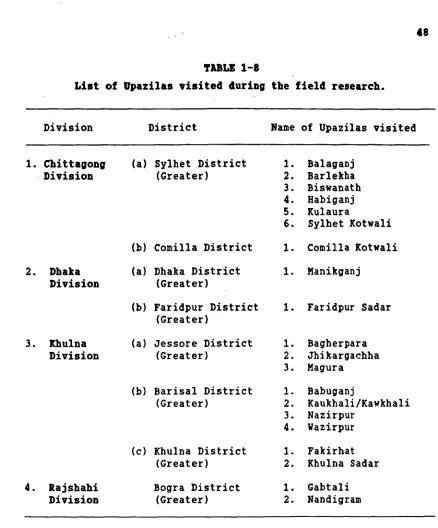
Gabtali Upazilas (1980-81 to 1984-85) 19 1-8 List of Upazilas visited during the field research 48 1-9 Size distribution of total owned land in rural
Bangladesh 52
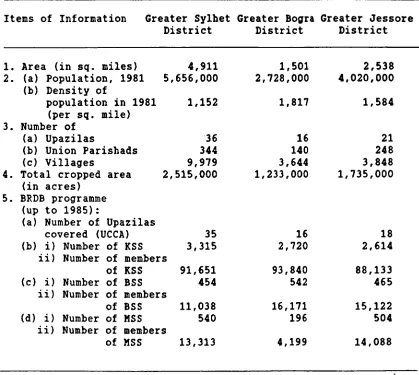
I-10 Basic facts of greater Sylhet, Bogra and Jessore
Districts 57
II-1 Year wise adoption of Thanas under the Comilla
co-operative model 114
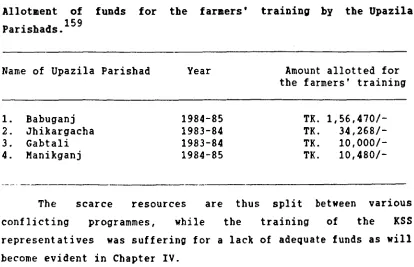
11-2 Allotment of funds for the farmers' training by the
Upazila Parishads 143
III-1 Distance of some of the KSS from UTDC/Upazila
Headquarters 176
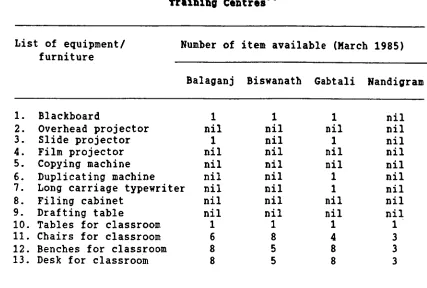
111-2 Availability of training equipment/furniture in the four Upazila Training Centres 178
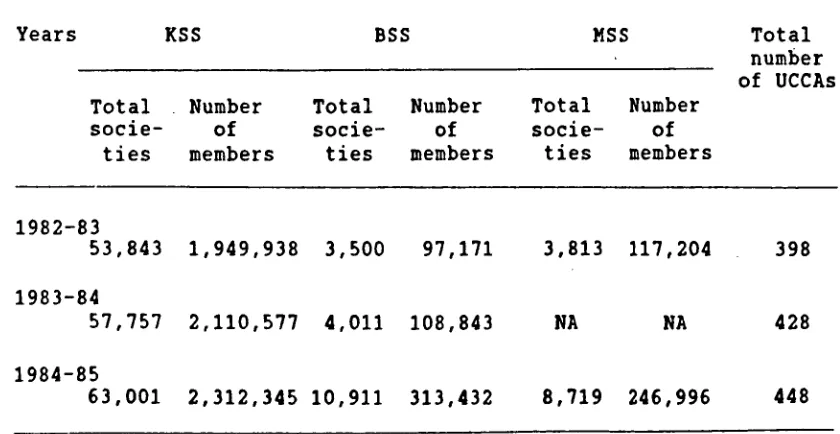
IV-1 Numbers of various village societies including the
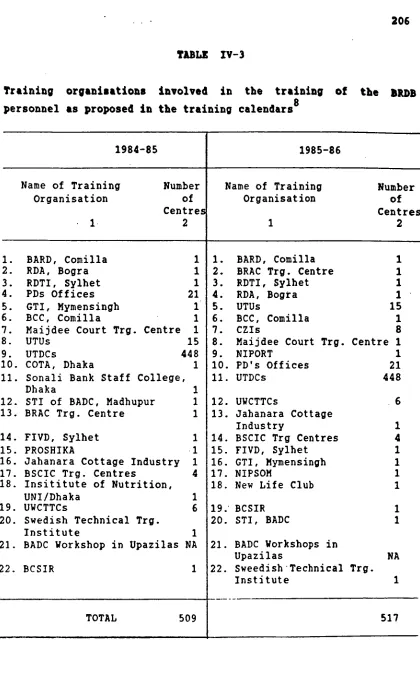
number of their members under BRDB till June, 1985 202 IV-2 Training load of BRDB in 1984-85 and 1985-86 204 IV-3 Training organisations involved in the training of
the BRDB personnel as proposed in the training
calendars 206
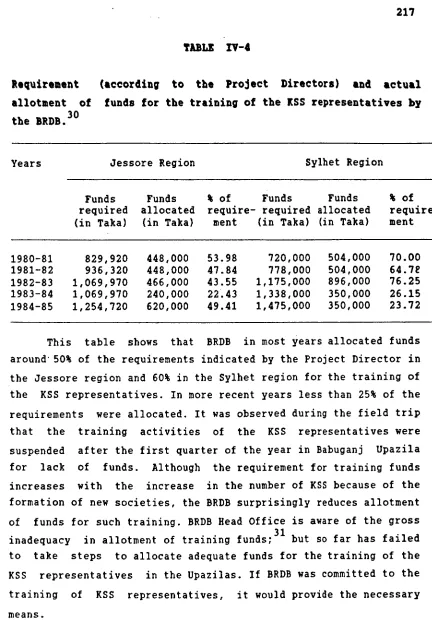
IV-4 Requirement (according to the Project Directors) and actual allotment of funds for the training of
the KSS representatives by BRDB 217 IV-5 Marks allotted to different items and manner of
their assessment 219
IV-6 Number of PDs and DPDs who served at Bogra, Jessore and Sylhet regions of BRDB from July 1980 to June
1985 224
V-1 Distribution of the URDOs according to age 251 V-2 Distribution of Thana Level Officials of Puthia
Thana according to age group 252 V-3 Distribution of URDOs according to academic
qualifications 253
V-4 Distribution of the Deputy Project Officers (now
ARD0s) according to academic qualifications 254 V-5 Distribution of the Thana Level Officers of Puthia
Thana according to academic qualifications 255 V-6 Distribution of the Thana Level Officers of Puthia
VI-4
VI-5
from 1980-81 to 1984-85 261
V-8 How People retain what they learn 279 V-9 Matching methods to desired outcomes 280 V-10 Date of starting of training of the KSS
representatives and the date of circulation of the training programmes among the instructors by the
URDO, Gabtali Upazila 285
V-11 Number of classes allotted to different subjects in the BRDB designed programmes of 1975 for the
Managers of KSS 296
V-12 Distribution of classes to various subject areas for the managers and model farmers in the BRDB
designed training programme (Calendar) of 1982 300 V-13 Distribution of classes among different broad
subject-areas in Fakirhat in 1982 305 V-14 Starting/ending times of training, duration of each
class and the number of classes held on a training
day in the Upazilas 309
V-15 Annual average retail prices of selected consumer
goods in Bangladesh 313
Number of KSS, BSS and MSS in Balaganj and Gabtali
from 1980-81 to 1984-85 333
Distribution of KSS representatives (i.e. the model farmers and managers) of the selected Upazilas on
the basis of age 337
Distribution of the KSS representatives of the selected Upazilas on the basis of their educational
level 339
Distribution of the model farmers and managers on
the basis of size of agricultural land holdings 341 The numbers of months in a year the KSS
represent-atives can feed their families with the crops
produced in their own land 344
VI-6 Rate of participation in subsidiary occupations of
Categorisation of the KSS of Biswanath and Gabtali
Upazilas 349
Ammount of loan awaiting realisation from the
members of the KSS in Bangladesh 362
AC Assistant Commissioner
ACF Agricultural Co-operative Federation Accts. Accounts
AD Assistant Director
ADC Additional Deputy Commissioner ADB Asian Development Bank
ADAB Association of Development Agencies in Bangladesh Admn. Administration/Administrative
ADP Annual Development Plan
AETI Agricultural Extension Training Institute AIO Agricultural Information Officer
AIDAB Australian International Development Assistance Bureau Ag. Agriculture
ARCS Assistant Registrar Co-operative Societies
ARDO Assistant Rural Development Officer formerly DPO ARTI Agrarian Research and Training Institute. (Colombo) BADC Bangladesh Agricultural Development Corporation,
formerly EPADC
BARD Bangladesh Academy for Rural Development formerly PARD BARI Bangladesh Agricultural Research Institue
BASC Bangladesh Administrative Staff College BBS Banglaesh Bureau of Statistics
BCS Bangladesh Civil Service
BCC Bangladesh Co-operative College BDO Block Development Officer (India)
BIDS Bangladesh Institute of Development Studies BPATC Bangladesh Public Administration Training Centre BPUS Bangladesh Palli Unnayan Sangstha
BRAC Bangladesh Rural Advancement Committee
BRDB Bangladesh Rural Development Board formerly IRDP BRRI Bangladesh Rice Research Institute
BS Block Supervisor
BSTD Bangladesh Society for Training and Development BWDB Bangladesh Water Development Board
CARE Committee on American Relief Everywhere
CERDI Central Extension Resource Development Institute CMLA Chief Martial Law Administrator
CO Circle Officer Co-op. Co-operative
COTA Civil Officers Training Academy Co-ord. Co-ordination
Const. Construction
CS? Community School Project CZI Co-operative Zonal Institute
DAE Department of Agricultural Extension DANIDA Danish International Development Agency DC Deputy Commissioner
DD Deputy Director DG Director-General
DPD Deputy Project Director
DPO Deputy Project Officer later ARDO DTO District Training Officer
DTW Deep Tubewell
ECNEC Executive Committee of the National Economic Council EPADC East Pakistan Agricultural Development Corporation later
BADC
ESCAP Economic and Social Commission for Asia and Pacific Extn. Extension
FAO Food and Agriculture Organisation of the United Nations F&A Finance and Accounts
F&B Finance and Budget
FFYP The First Five Year Plan of Bangladesh (1973-78) Fl Fertiliser Inspector
FIVD Friends in Village Development FTC Farmers' Training Centre (India)
GOI Government of India
GTI Graduate Training Institue HQ Headquarters
HSC Higher Secondary Certificate HYV High Yielding Varieties ICS Indian Civil Service
ILO International Labour Organisation
IRDP Integrated Rural Development Programme later BRDB IRRI International Rice Research Institute
IRRIG. Irrigation JD Joint Director
KSS Krishak Samabaya Samity (the Farmers' Co-operative Society). The village level primary co-operative in the Comilla Co-operative System, federated at the Upazila level.
KTCCA Kotwali Thana Central Co-operative Association LLP Low Lift Pump/Landless Programme
LG Local Government Manager
MATCOM Materials and Techniques for Co-operative Management Training (ILO)
MF Model Farmer ML Martial Law Monit. Monitoring
MSS Mahila Samabaya Sanity (the Women's Co-operative Society)
NA Not Available
NCRT National Committee on Rural Training
NCSDT National Council for Skill Development and Training NILG National Institute of Local Government
NIPA National Institute of Public Administration, Dhaka NIPORT National Institute of Population Research & Training
NIRDP Noakhali Integrated Rural Development Programme NGO Non-Government Oragnisations
OVDP Own Village Development Programme OC Officer in Charge
PARD Pakistan Academy for Rural Development (Peshwar) PD Project Director
PDB Power Development Board PRE Public Health Engineering PIU Project Implementation Unit PPA Plant Protection Assistant PS Police Station
R&E Research and Evaluation RD Rural Development
RDA Rural Development Academy, Bogra RDB Rural Development Board
RDTI Rural Development Training Institute, Sylhet REM Research, Evaluation and Monitoring
RMO Resident Medical Officer RWP Rural Works Programme SAE Sub Assistant Engineer SCL Study Circle Leader
SEO Social Education Organiser (India)
SFYP The Second Five Year Plan of Bangladesh (1980-85) SI Seeds Inspector
SIDA Swedish International Development Agency
SIRDP Sirajganj Integrated Rural Development Programme SMO Subject Matter Officer
SO Sectional Officer Spl. Special
Squ. ft. Square feet
SSC Secondary School Certificate STW Shallow Tubewell
TIP Thana Irrigation Programme Trg. Training
TRYSEM Training of Rural Youth for Self-Employment (India) TPO Thana Project Officer later URDO
TTDC Thana Training and Development Centre later UTDC TVD Total Village Development
TYP The Two Year Plan of Bangladesh (1978-80) UAA Union Agriculture Assistant
U Accts. 0 Upazila Accounts Officer UAO Upazila Agriculture Officer
UAVDPO Upazila Ansar and Village Defence Party Officer
UCCA Upazila Central Co-operative Association formerly TCCA UCO Upazila Co-operative Officer
UEO Upazila Education Officer UE Upazila Engineer
UFO Upazila Fisheries Officer U Fd.0 Upazila Food Officer
UHFPO Upazila Health and Family Planning Officer ULO Upazila Livestock Officer
UM Upazila Magistrate
UMPCS Union Multipurpose Co-operative Society UN United Nations
UNIDO United Nations Industrial Development Organisation
UNO Upazila Nirbahi Officer (Sub-District Executive Officer) UP Union Parishad
UP&FO Upazila Planning and Finance Officer URO Upazila Revenue Officer
URDO Upazila Rural Development Officer formerly TPO USO Upazila Statistical Officer
USSO Upazila Social Services Officer UTC Upazila Training Centre
UTDC Upazila Training and Development Centre formerly TTDC UTO Upazila Training Officer
UZP Upazila Parishad
V-AID Village Agricultural and Industrial Development
VAS Veterinary Assistant Surgeon
VDP Village Defence Party
VEA Village Extension Agent
VLW Village Level Worker
VTC Village Training Centre
Academy: Refers to BARD in this thesis. Aman:
Aus:
The rice crop which matures in November/December. It is transplanted in August/September. Broadcast variety is directly broadcast on to the soil in areas subject to deep flooding.
The rice crop which matures in August - September. It is grown on higher level land, not subject to extensive flooding.
Ansar: Irregular Volunteer Police Force.
Bigha: Approximately one-third of one acre of land.
Bittahin: Resourceless.
Boro: The Boro rice crop is a winter crop which generally matures in March/April. It is usually grown in low-lying land but requires irrigation because of lack of rain during that season.
Crore: One hundred lacs or ten million.
Gramsarker: Village Government. The village level institution under the Swanirvar movement.
HYVs: High Yielding Varieties, the crop varieties associated with green revolution, which demands the controlled use of fertiliser and irrigation to achieve greatly increased yields.
Kotwali: Usually refers to the Upazila, located in the District Headquarters.
Krishak: Farmer.
Krishi: Agriculture.
Lac/Lakh: One hundred thousand. Maund: 37.32 kg. (or 82.29 lb). Mahila: Woman.
Mile: 1.61 km.
Paddy: Unhulled rice. Pan shad: Council.
Samity: Society.
Seer: 0.93 kg.
Swanirvar: Self-reliant.
Taka: Unit of currency in Bangladesh. It is made up of 100 Paisa.
Thana/Upazila: Thana literally means a 'Police Station', or the area protected by a Police Station. Thanas correspond in size to an American county, averaging 135 square miles. Thanas have been upgraded in 1982-83 and renamed as
'Upazila', which is the lowest administrative unit in Bangladesh.
ADMINISTRATIVE UNITS
,
LEGEND
11111.1.1■TION•L •0011111•10' WM. 11.11.0.1. WW1 11.C.10•}T LIP•ZE •/114•111• SOL•0•1.7
INDIA
INDIA
INDIA
INDIA
OF BENGAL
CHAPTER1
INTRODUCTION AND CONCEPTUAL DESIGN
The Bangladesh Rural Development Board (BRDB) under its previous name, Integrated Rural Development Programme (IRDP) has been organising training courses for the representatives of the Krishak Samabaya Samity (KSS) (the Farmers' Co-operative Society)
in the Upazila Training and Development Centres (UTDCs) since 1972. In 1982 a few months before BRDB acquired its present name, the Director (Training), found that such training had become ineffective and lifeless. The participants in an ILO organised seminar in 1979 had also come to similar conclusions and concluded that the lack of commitment of the concerned personnel to such training was responsible for its ineffectiveness.
Our concern in this thesis is to explain the causes of the alleged ineffectiveness of these training courses. Research into this question concentrated on an extensive assessment of commitment of the authorities at the macro level and the trainers and the - trainees at the micro level to these training activities. This thesis is based on the perceived link between commitment and effective training as expressed in the assumption that effective training of the KSS representatives is conditional upon the commitment of the authorities at the macro level and the trainers
and the trainees at the micro level.
conceptual framework defining the scope of effective training for the purpose of this study and determining the indicators of commitment, is offered. This frame-work is the basis of analysis in this thesis. The chapter will conclude with a discussion on the scope, methodology and utility of the study along with a brief introduction to Bangladesh, some aspects of her agriculture and the various levels of her administration.
1. RURAL DEVELOPMENT AND THE CO-OPERATIVE MOVEMENT IN BANGLADESH
Co-operatives have been accepted as a vehicle for rural development in Bangladesh since the time of British rule. During the period of colonial rule the reports of three Famine Commissions (1880, 1898 and 1901) called the attention of the rulers to the need for co-ordinated attention to crop yields in order to face famine situations. The Deccan Riots of 1875 and the peasants' fight against money lenders brought the rural problem to the forefront. As a solution to the problem the British government decided to extend credit facilities to the farmers at a low rate of interest. Consequently the Land Improvement Loan Act of 1885 and the Agriculturist Loan Act of 1884 were passed. In 1904 the Co-operative Credit Societies Act was passed and from then onward officials, led by Malcolm Darling and a few others, began to take an interest in and learn about co-operatives for solving the problems of village communities. From the beginning of 1920, comparatively much more direct and concentrated efforts were made in the field of rural development. 1
Co-operative Credit Act of 1912. Village co-operatives with unlimited liability began to be formed throughout the country. These village co-operatives undertook credit business. The Raiffeisen System expected that:
Firstly the bank must provide services to everyone in the village and bring the whole of the village life within its ambit; secondly there must be constant interaction with the members and a genuine adherence to essential co-operative principles; and lastly, concentration on a few selected areas rather than wide multiplicity and diffusion.... Village banks' credit operations and members' thrift depopt programmes were to be supervised and closely linked.
In actual practice no importance was given to the above noted principles. Many borrowing members of the co-operatives failed to repay their loans mainly because the loans distribution was done without attaching due importance to the thrift deposit of the members. Non-observance of the Raiffeisen's principles and default in loan repayment crippled the backbone of the co-operatives in the sub-continent and created a feeling of distrust and disloyalty among the people and in the depositor towards the co-operative movement.
The British government thus tried co-operatives as a means of
combating rural problems from 1904 till the independence of India
in 1947. The results of these efforts were not satisfactory.
Referring to the findings of the Linlithgow Commission Report
(1927), Tepper stated that the said report stressed the need for
sound education in the principles of co-operation and for a high
standard of efficiency in business management. 5
The Bengal Provincial Banking Enquiry Committee (1930)
listed as major defects the illiteracy of the members and their
ignorance of co-operative principles, heterogeneous membership, and
the delay in obtaining loans by the members of the Primary Society.
Unlike most other provinces, Bengal did not conduct an enquiry into the working of co-operatives after the department was transferred
by the central government in 1919. The Co-operative Department
itself, however, presented a long list of perceived defects in the introduction to a bill drafted in 1936. Among other defects the draft bill noted that the organisations were defective with respect to the selection of members signing applications and their subsequent enlistment.
Apart from the question of giving them a sort of preliminary training in co-operative principles and practices, an accurate estimate of their assets, liabilities and repaying capacity was not taken into consideration. 6 The department hoped that training of both members and staff would be forthcoming. The Floud Commission
(1940) also recommended the need for organising education and training in operative principles and practices for the co-operative members and staff.7 Dubhashi, in his paper, held that Sir Edward Maclagan's Report (1914-15) considered lack of teaching both before and after registration of co-operatives as the most serious defect of the co-operative movement in the sub-continent. 8 Thus lack of emphasis on training and education of the co-operative members was identified as one of the most important reasons for the unsatisfactory performance of co-operatives during the British
Co-operative Training Institute at Dumdum in 1936 for training of
co-operative officers, took no serious steps to arrange training of
the co-operators. This continued till the end of colonial rule in
the sub-continent in 1947.
Bengal was partitioned along with India in 1947. Partition of
Bengal reduced the co-operative movement in East Bengal, now called
Bangladesh, to a state of virtual collapse. Large scale migration
of the population took place. 24,675 of the 26,664 societies that
existed in East Bengal on the day of partition were liquidated by
1957.9 The Apex Co-operative Bank of the undivided Bengal fell within Indian territory. The Central Co-operative Banks in East
Bengal became bankrupt. The government of the former East Pakistan,
however, realised the need to strengthen the co-operative movement
in the province. In March 1948 the Provincial Co-operative Bank was
organised. It was also decided to organise multipurpose co-operative societies at Union level with limited liability in place of single purpose Credit Co-operative Societies at village level with unlimited liability.
The Pakistan Agricultural Enquiry Committee Report (1951-52) recommended the formation of the Union Multipurpose Co-operative Societies under government guidance. Ignoring the past experiences, the govenment hastily organised 3949 Union Multipurpose Co-operative Societies (UMPCS) by 1953-54. In 1956, the ILO-Asian Field Mission (Balleudux and Harper Report) offered a critical assessment of co-operatives during the period. Some of their findings were revealing,
- organisation of Union Multipurpose Co-operative Societies (UMPCS) had been hasty. No probation period was observed;
- available facilities for co-operative education and training were obsolete, perfunctory and ineffective and had no relation to the real need of the co-operatives;
Neglect of training of the members was thus identified in the report as one of the major reasons for the unsatisfactory performance of co-operative societies in the region.
BRDB also found the following shortcomings in the co-operative movement since its inception during the British period:
(i) Absence of member education programmes, which did not generate genuine leadership in and loyalty to the co-operatives.
(ii) Too much emphasis on credit without thrift deposits, education or supervision added to it; neglect of other important aspects of economic activities, such as marketing, supply and storage facilities and absence of any programme for the non-agriculturists, e.g. weavers and fishermen etc.
(iii)Little attention on direct production oriented activities.
(iv) Rapid expansion of the movement without experimentation in selected areas.
(v) Lack of adequate training facilities for office bearers and employees of co-operatives and also for departmental officers.
(vi) Absence of clear-cut government policy on co-operation and adequate help and assistance from government and nation building bodies.
(vii)Lack of trained leadership l irom among the people to spear-head the movement.
There were, no doubt, many external factors in the failure of the co-operative movement; poverty and illiteracy of the masses, uneconomic land-holding of the farmers, law of inheritance, joint family system, and opposition from private traders and money lenders are important among them. 12 This short account of the growth of co-operative movements geared to the socio-economic development of the rural people of the empire indicates that inadequate attention was given to training and education of members which, in its turn, seemed responsible for the unsatisfactory performance of co-operative movements during this period.
quoted a 'Swedish co-operative leader on the need for training in
the co-operative movement:
If we had occasion to start our movement afresh, and if we were given the choice between two possibilities - that of starting without capital but with enlightened membership and staff, or, on the contrary, that of starting with a large amount of capital and illinformed members - our Tiperience would incline us to choose the first course".
IRDP Project prof orma (1970-79) prepared for the Planning Commission of Pakistan maintained that "Co-operative mechanism can be effectively used to motivate and mobilise rural people, provided due emphasis is given to training of personnel". 15 Training of the KSS representatives was felt necessary as they ought to gain the ability to decode new information - know why, where, when and how.
The need for the training of the co-operative members was, therefore, considered an important pre-condition for the recovery and success of the co-operative movement in the region. Thus, the Bangladesh Co-operative College was established in 1960 primarily to train the co-operative officers in the country. BARD Comilla however strongly felt the need for training village co-operators and developed the Thana Training and Development Centre (TTDC) model for organising training of village representatives and also for the effective implementation of other rural development programmes at the Thana level in the country.
2. EVOLUTION OF THE COMILLA CO-OPERATIVE MODEL:
programmes (RWP) on the basis of research and experimentation in Comilla.
All except the co-operative model were replicated throughout the country in the 1960s by the then government of Pakistan. The co-operative model was left to expand gradually and carefully. The Thana Training and Development Centres (TTDCs) were established in each Thana (now Upazila) of the country to function as a training centre for the villagers and also to revitalize the rural administration in the country.
The Comilla co-operative model was developed by BARD with the knowledge that farmland in Bangladesh is small and fragmented, resulting in problems in introducing improved or new technology for modernisation of agriculture. Individual farmers find it difficult to buy a tractor, low lift pumps or a tubewell. Moreover, very few have large enough farms to use such equipment economically. Organisation of farmers into small working groups at the village level was, therefore, thought to be pre-requisite for effective action by many government agencies. It is beyond the capacity of any development agency to reach each farmer individually and effectively with essential programmes such as extension and credit services. Once the farmers get organised into appropriate groups, government agencies can work through the group. The group and its elected representatives can gradually take over the last link in the chain of contact between the government agencies and the people. Such grouping was felt essential for measuring the effectiveness of the government agencies.
A. Some aspects of Comilla Co-operative Model:
A Krishak Samabaya Samity (KSS) elects representatives namely, a manager and a model farmer who are to participate in training courses in TTDC (now called, UTDC) once in every week. They learn and then demonstrate appropriate cultivation techniques, procure and distribute inputs, manage credit and keep accounts and records of the Society. They are the grass-root level extension agents.
KSS are grouped at the Thana (now called Upazila) level in a supporting Thana Co-operative Federation which is called Thana Central Co-operative Association (TCCA). A TCCA has to back up the KSS with essential inputs - •credits, supplies and services. A TCCA can employ supervisory and extension personnel to continuously help the KSS in the Thana, procure resources from various agencies, and distribute them among the village societies. Profit out of such trading adds to the financial resources of TCCA. Some of the objectives of the Comilla co-operative model are as follows:
- to create institutional infrastructure for effective utilisation of resources available for development.... Great emphasis should be placed on the training of selected representatives of the societies on a weekly basis in the Thane Training Centres....
- to select agricultural innovations collectively and to promote adoption of innovation by individual members through co-operatives at the village level and supporting co-operative federations at Thana level....
- to develop local leadership through participation in training programmes organised by TCCA ayg by organising group activities in the villages....
The co-operative programme at the initial stage did not contemplate changing directly the lot of landless labourers or of families with extremely small plots of land. These groups were expected to benefit indirectly from the increased demand for agricultural labour and increased welfare around them. 17
the place of training in the Comilla co-operative model, and its impact on Comilla.
(a) Comilla co-operative model and the training of ESS
representatives:
A. Rahim mentions that the founding Director of BARD, A.R. Khan,18 while replying to a question about the Comilla Co-operative model said that it meant, "training, training and training".19 In a seminar on co-operative education and training in 1966, A.H. Khan pointed out that the real cause of the miserable plight of co-operatives was the lack of sincere, honest and skilled management and leadership. Skilled and efficient personnel and leadership, he said, could not grow spontaneously. Training and education imparted through proper methods and techniques can bring forth the qualities needed. Knowledge, techniques and skill need to be disseminated in order to achieve an acceleration in the rate of production in agriculture, and in running industries and business. Such knowledge and skill can only be provided by the farmers' co-operatives under a self-help and mutual help programme guided and assisted by a strong Thana Central Association. "
A.H. Khan further added that to keep the collapsing patient internally warm instead of putting any external blanket over him, co-operatives of the people are the real panacea. The co-operatives are absolutely vital for any sustained effort towards growth. Safdar observed, "Co-operative movement is essentially an educational movement.., success in co-operative can be obtained only through a variety of educational activities". 21 The pivotal role of training of KSS representatives was thus recognised by A.H. Khan who again pointed out "The nerve centre of our movement was the weekly village meeting and the weekly TTDC training class. The former created group-cohesion and the latter gave constant impetus".22
the importance of training of KSS representatives in the Comilla co-operative system. The third annual report of Comilla Kotwali Thana Central Association (KTCCA) (1963) held that,
Having recognised from the inception of the Comilla project the supreme importance of training, we pondered constantly over the problem of widening its scope and effect. Modernisation demands new institutions and new skills in the villages, for they are lagging sadly behind the times. Usurious money lenders, exorbitant middlemen, or fear of government are as much fossils of the past as the wooden plough or fatalism or illiteracy. We must teach new scientific and social skills to the rural people and do it speTiily to save the village from disintegration and ruin".
The fourth annual report of Comilla KTCCA (1964) observed: Since the beginning of the pilot project the organisers [now called managers of KSS] were in need of training of a general nature concerning the organisation and management of co-operatives; whereas specialised type of technical training in improved farming methods, plant protection, animal husbandry etc. were particularly meant for the model farmers. On the basis of this conception, organisHs and model farmers were
trained in separate classes".
The Comilla co-operative model thus attached supreme importance to the weekly training of the KSS representatives in TTDC.
(b) Attendance of trainees at Comilla in the 1960s:
Because of careful planning, design and implementation of the training programmes in Comilla, the trainee (KSS representatives) - acquired new skills and information out of the training activities at the TTDC. They found answers to their problems from the training programme. Follow-up and feedback activities were regular and the training was made relevant by ensuring provision of inputs by KTCCA for immediate application of the acquired knowledge and skill after the training.
training sessions in Comilla which generally varied from 70% to 90%
during the period from 1961-1970.
Table-1 in the appendix demonstrates that the trainee KSS representatives took the weekly TTDC training as a way of life. The
annual average attendance in training session was up to 93%, though
in 1965-66 it went down to 50% because of the indirect consequence
of the Indo-Pak war. In the same year training of model farmers was
reintroduced after a temporary suspension. Unless the trainees were
committed to the training activities their rate of attendance would
not have reached such a high percentage in Comilla during the
1960s.
Thana officers in Comilla were the trainers. They were
assisted by foreign experts and the BARD faculty. Available
literature of the period indicates that a scheduled class was never
suspended for non-attendance of the trainers. Irregularity and
negligence on the part of the trainer were out of the question.
Each week the training activities were evaluated by the Thana
Training Committee and remedial steps were taken. Since all the
Thana level officers were to work under the supervision of BARD,
there was no jealousy or departmentalism. This resulted in
excellent co-operation and co-ordination of activities at the Thana
level. Because the officers functioned as a team for the common
cause under the guidance of BARD, Comilla, they were sincerely
involved in every process of training to make it useful and
interesting to the trainees. The trainees and the trainers thus
participated directly and fruitfully in the training activities it
Comilla.
(c) Impact of Training of the KSS representatives in Comilla i,
the 1960s:
Investigation into the after-effects of training of the KS'
representatives by the Bangladesh Rural Development Board i:
outside the scope of the present study. However, it is interestin
impact of the training during the period was judged on the basis of the rate of adoption of improved practices, comparative levels of achievement by KSS members and non-KSS members, the rate of increase in production in Comilla, and growth in the rate of use of the modern agricultural inputs by the KSS members. Some observations about the impact of such training are made in various annual reports of BARD and the Comilla KTCCA. These have been tabulated in Table-2 in the appendix. This table shows the positive impact of such training in Comilla in the 1960s and indicates that the training contributed to the increase in the number of adopters in Comilla.
14
Zaker Hussain pointed out that the number of adopters of
modern farm practices in Comilla increased steadily during the
period from 1960-65. Training was One of the factors for such a
steady rise in the number of the adopters in Comilla.
TABLE 1-1
Number of adopters of modern farm practices in Comilla Kotwali
Thana from 1960-1965. 25
Name of crops
Years
1960 1961 1962 1963 1964 1965
Boro paddy - 19 60 266 345 1633
Aus paddy 10 31 177 855 1636 2863
Amon Paddy 20 114 1100 1454 1586 2541
Obaidullah Khan showed the rate of adoption of improved
agricultural practices in Comilla by the KSS members compared to
the same with non-co-operative members in the following way:
TABLE 1-2
Comparison of ASS members' and non-members' cultivation practices
in Comilla Kotwali Thana.26
Year % of respondents % of deviation % of respondents using HYV from recommended using insecticide
fertiliser use (in seers)
Member Non- Member Non- Member Non-
member member member
1966 5.5 0 -144 -164 50 15
1969 88.9 64.3 +103 - 15 93 68
Improved knowledge, skill and motivation of the co-operative
members because of their effective training is largely responsible
for their higher rate of adoption of the improved practices.
Similarly KTCCA in their publication in 1970 showed the rate of
growth in use of modern agricultural inputs in Comilla thus:
TABLE 1-3
Growth in the rate of utilisation of the modern agricultural inputs
in Comilla Kotwali Thane by the KSS members. 27
Items of modern Quantity in Quantity in agricultural inputs 1965-66 1969-70 utilised in Comilla
Kotwali Thana
1. Chemical fertilisers 2. Insecticides
3. Deep tubewell 4. Lift pump 5. Irrigated area
6. Cultivation by tractor
27,998 mds 21,926 lbs
25 4 1,305 acres 1,583 acres
103,664 mds 159,164 lbs
169 110
11,231 acres 5,816 acres
16
TABLE 1-4
Average yield studies on the Comilla Kotwali Thana faras for 1966-
67 contrast with 1961-62 (in maunds and seers). 28
Crops 1961-62 1966-67
(per acre) (per acre)
Aus paddy 28.34 34.10
Aman paddy 34.20 38.20
Boro paddy 25.35 47.50
The above table indicates that the rate of yield of crops in Comilla had improved in 1966-67 after the spread of the Comilla Co-operative model compared to 1961-62, when the co-Co-operative model was not expanded widely in the Thana. Training of the KSS representatives was an important factor in the introduction of new information and skill and also in motivating the farmers to adopt the improved methods of cultivation. The positive contribution of such training for the increase in production rate cannot in the circumstances be ignored.
Similarly Obaidullah Khan also showed the rate of increase in yield by co-operative farmers in Comilla,
TABLE 1-5
Increase in productivity of co-operative farmers in Comilla Kotwali
Thana 1963-64 to 1969-70.29
Size of farm Rice yield lbs/acres
1963-64 1969-70 % [increase]
under 2 acres (n54) 2345 4164 78 2.0 - 3.5 acres (n39) 1819 4098 125 over 3.5 acres (n 29) 1424 3193 124
This table also shows that rate of crop yield was steadily
increasing in the farms of the co-operative members because of new
knowledge and skills supported by the provision of modern inputs to
the co-operative farmers in Comilla.
Table 1-6 below, will again show that the per acre average
yield of rice on the farms of co-operative members is much higher
than the Comilla Thana average. This will again substantiate the
findings of Tables 1-5 that the co-operative members are generally
the progressive farmers. The higher rate of yield of crops was made
possible in the 1960s mainly because of their adoption and
application of modern agricultural practices. Training apparently
contributed to motivation of the co-operative members to adopt and apply the improved methods of agriculture.
TABLE 1-6
Per acre average yield of rice on the farms of co-operative members
as against the Comilla Thana average. 30
Years Crops Average yield on the members farms
(in maunds)
Average yield of the Thana (in maunds)
1964 Boro NA NA
Aus 20.60 14.70
Aman 33.00 24.20
1965 Boro 24.75 20.12
Aus 30.09 22.22
Aman 26.14 21.30
Agricultural technology has been changed [in Comilla] through mechanisation, including use of tractor and new irrigation technology and the introduction and diffusion 9
1
new seed varieties and fertilisers and pesticides.Training was the means for utilisation of the improved agricultural technology and methods by the co-operative farmers in Comilla. For the immediate use of training the KTCCA, Comilla made available the agricultural inputs to the KSS representatives. Thus training of the KSS representatives was effective in Comilla and therefore contributed positively to the socio-economic improvement of its members in the 1960s.
B. Bangladesh Rural Development Board (BRDB) and training of the
ESS representatives: the need for research.
Bangladesh Rural Development Board (BRDB) formerly known as Integrated Rural Development Programme (IRDP) replicated the Comilla co-operative model throughout the country. As a component of the model, it organised courses for the representatives of KSS in the Upazila Training and Development Centres (UTDC)
allocation of funds for the training of KSS representatives of
these Upazilas.
TABLE 1-7
Budget provision for the training of the village co-operative
representatives in Balaganj and Gabtali Upazilas (1980-81 to 1984-85) 32
Years Funds provided in the Funds provided in the budgets of Balaganj UCCA budgets of Gabtali UCCA
(in Taka) (in Taka)
1980-81 N.A. 124,190
1981-82 N.A. 144,196
1982-83 31,650 183,135
1983-84 78,860 178,000
1984-85 55,015 180,000
Average fund
provided in a TK 55,175 TK 161,904
year (average of 3 years) (average of 5 years)
(i) Annual average training fund for each UCCA = TK 108,539.50 (ii) Annual Average training fund for 448 UCCAs = TK 4,86,25696.00
training in a poor nation like Bangladesh. Yet the Director (Training) BRDB in 1982 observed,
The TTDC [now UTDC] is a very important forum for educating and training the rural people for rural development. But unfortunately this forum is not properly used. TTDC training generally has become ritualistic, stereotyped and lifeless. Its planning is defective, organisation careless, involvement of Thana officers unsatisfactory and the participation of intended trainees dWouraging. The result is, therefore, disquieting.
This statement of the Director (Training) BRDB is an informed opinion of the existing situation of KSS representatives' training in the UTDCs.
Three years after this observation, we undertook field research in Bangladesh and toured through 20 Upazilas in different parts of the country, where UTDC training networks were functioning. We found Upazila Training Units (UTU) have been constructed by BRDB in some Upazilas in addition to the existing Upazila Training Halls, to provide additional physical facilities for the training activities of KSS representatives. It was noticed that the same programme is repeated year after year. BRDB officers at the Upazilas and also the other Upazila level officers seemed to have given training the lowest priority in their job. The courses were not held regularly. There were instances when the trainees had to go back without receiving any training due to the absence of the scheduled instructor. Training Halls lacked even the minimum training equipment and facilities. Thus participation of the trainees (KSS representatives) was also unsatisfactory. The observation of the Director (Training) BRDB appeared to remain an accurate description of the training situation of KSS representatives now run by BRDB/UCCA in the UTDCs in Bangladesh.
the rate of attendance of the KSS representatives deteriorated after the liberation of Bangladesh. The annual reports for 1972-73 to 1975-76 did not indicate the percentage of attendance of KSS representatives in the training sessions but it was 69% in 1971-72. By June 1979 the average rate of attendance of the trainees had fallen to 19% though in March 1979 it was only 9%. Between 1979-80 and 1982-83 the attendance of the trainees in Comilla varied from as low as about 1% (model farmers) in 1981-82 to as high as 20.85%
(managers) in 1979-80.34 Various annual reports of BARD and Comilla KTCCA for the periods from 1971 to 1984 indicated that stereotyped training programmes, irregular holding of classes by the trainers and absence of provision of inputs with which the KSS representatives can apply their training, were responsible for their poor rate of attendance in the training sessions.
At Comilla Kotwali Upazila the original faculty members of BARD and the Upazila level officers would jointly work as trainers. The 23rd annual report of BARD however stated that the Upazila level officers could take 67.27% of the classes allotted to them, whereas the faculty members of BARD could take only 54% of the classes of the KSS representatives assigned to them. 35 This not only indicates the unsatisfactory state of commitment of Upazila level officers to such training but also illustrates the non-commitment of the present members of BARD faculty. BARD faculty is now far away from its previous involvement in the training activities in Comilla Kotwali Upazila. The 24th annual report of BARD (1982-83) further indicated,
There were irregularities in taking classes by the trainers at the TTDC... of a total of 200 classes assigned to the trainers in 1982-83, only 95 classes were actually taken by the trainers. Irregularities were observed both amongst thuThana level officials and the faculty members of BARD.
22
In an ILO organised Regional Symposium on setting effective co-operative training policies and standards in Asian countries, held in Chiangmai, Thailand, in December 1979, the participants supported the above observations on the existing unsatisfactory situation of training of KSS representatives by BRDB/UCCA in Bangladesh,
From our experience we have, however, noticed that we have failed to achieve desired results from the member education programme due to lack of commitment [italics mine] on the part of government agencies responsible for imparting training. As a result, the programme has lost its initial thrust and vigour. Another major problem hindering the growth of co-operatives in the country is the multiplicity of organisations at the primary level, which37creates confusion rather than serving the community.
They further found the existing training of KSS representatives in Bangladesh ineffective and identified lack of commitment of the concerned agencies to the training of the KSS representative as the reason. This study therefore assesses the assumption that lack of commitment at various levels - the government, BRDB, the trainers and the trainees is responsible for the ineffectiveness of the existing training activities of the KSS representatives by BRDB in the UTDCs.
3. CONCEPTUAL FRAME-WORK AND THESIS ORGANISATION:
The apparently unsatisfactory performance of the co- operatives in the Indo-Bangladesh sub-continent prior to the independence of the sub-continent was blamed on the absence of provision for training as noted above. The Comilla co-operative model developed by BARD in the early 1960s listed training as the central component and it was found effective in Comilla. BRDB has applied the Comilla co-operative model, and is now organising courses for the KSS representatives in the Upazila Training Centres in Bangladesh. Comments noted above by the Director (Training), BRDB and the participants in the ILO organised symposium show that the extension of Comilla model to other Thanas has not been as effective as expected. This thesis therefore, studies the
effectiveness of the present training activities of the KSS
representatives in relation to commitment to it at various levels
to ascertain whether the above comments are valid and, if so to
identify the causes of the alleged ineffectiveness of such training
in the UTDCs.
Empirical research of this kind requires an indication of the
criteria by which assessment is to be made. The two key elements on
which the research focuses are those mentioned in the previous
section as critical for successful co-operative and rural
development - effective training and commitment.
A. Effective training:
Effectiveness is the intended outcome of any training
activity. It may be worthwhile to examine some of the definitions
of the concept of 'training', before going on to examine the
criteria of training effectiveness. Different ideas on the notion
of training will help us to understand what training means to
various authors and what they expect out of training activities.
A survey of various definitions of the concept of training
indicates that some authors in their specific works treated
training as an effort to help the trainees to improve their
performance in the real job situation after the training is over.
Other authors in their specific works tend to treat training as a
forum for mutual learning by the trainers and the trainees. The
latter writers place more emphasis on the effective administration
of the various processes of training. There is however little scope
for any conflict between these two sets of ideas about training.
Effective administration of the training processes is the
pre-condition for the desired after training impact. Achievement of
ultimate training objectives obviously depends on the effective
administration of the training processes. Hence the two sets of
ideas mentioned above are interlinked. Effectiveness of training in
in terms of achievement of training objectives after the training are, therefore, the two aspects of a training activity. However, it may be interesting to survey some of the ideas on training and its effectiveness.
In-Joung Whang for example, treats training as a means to improve the capabilities of the individuals to perform better in their roles and also to change their behaviour to suit changing needs.38 Makhija in the same way mentions that training "aims at enlarging an individual's frontiers of knowledge and at improving his skills - skill in doing his job well or better and skill in better human relations".39 Zarraga and Green link training more directly with the after-training impact. According to them,
rural vocational training is seen as an overall skill formation process aimed at assisting rural workers to increase effectiveness in earning a living, reducing drudgery of work, managing family life and participating in community development. Trainees must actually perform those activities, which are relevant to them within specific ural life conditions and locally available resources.
Otto and Glaser however offers a more comprehensive definition of training. According to them training
refers to the teaching/learning activities, carried on for primary purpose of helping members of an organisation to acquire and apply the knowledge, skills, abilities and attitudes deeded by that organisation to carry out its mission.
This definition of training covers both the training processes by treating training as teaching/learning activities and at the same time emphasises the application of training to help the organisation carry out its mission. The ideas of the above writers tend to relate training mostly to the after-training performance of trainees. Training effectiveness can accordingly be measured on the basis of actual performance of the trainees after the training is over.