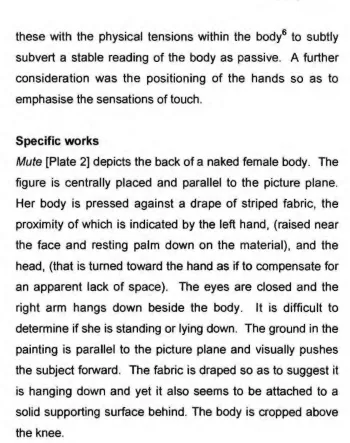
render me naked
the painted self and the
spectator
Celeste Chandler BFA (Hons)
Signed statement of originality
This Thesis contains no material, which has been accepted, for a degree or diploma by the University or any other institution. To the best of my knowledge and belief, no material previously published or written by another person except where d acknowledgement is made in the text.
Signed statement of authority of access to copying
This thesis may be made available for loan and limited copying in accordance with the Copyright Act 1968.
Abstract
The research project investigates the representation of an empirical model of female bodily experience as a formal pictorial project. The aim is to present the spectator with a personal, specific and intimate embodied subjectivity that evokes an awareness of corporeal experience. Further, the project investigates possible avenues for setting up reciprocal feelings of embodiment within the viewer. It explores this through fonns of pictorialism including scale, point of view, pictorial space and the rendering of tactile surfaces.
The project aims to present the spectator with a representational image of a female body that defies objectification and instead evokes the physical and emotional presence of a person beginning to impinge upon the actual space occupied by the viewer.
The project is concerned with formal pictorial construction and parameters were set to enable specific methodologies to be isolated and refined. The focus was on the body, the pose, the space and the rendered surfaces.
The subject is autobiographical, exposed and singular. The paint is a record of my body in the marks that it made and the work is a point of intersection between my body and the body of the viewer.
The pictorial space in the images was deemed to be very shallow, and ambiguous as to its orientation. Thus the spectator is led to resolve the ambiguities as to their spatial orientation within the image, and locate himself or herself physically in relation to the subject.
Acknowledgements
I would like to thank my supervisor Mary Scott for her assistance, support, and astute observations during the course of the research project and in preceding years. I would also like to express my gratitude to my parents, Bev and Brian, for their love, generosity and unquestioning support always.
Thank you to Paul Zika and Jonathan Holmes for those inspired moments of insight over many years and to John Farrow for his help and technical support. Thanks to the library and administrative staff who have been wonderful.
Contents
Chapter one: central argument
The project outline Introduction
Central argument
The background to the project The problem
The proposal The argument
The autobiographical body and the gaze The spectator's perception
The body is everywhere in paint The significance of the project
Major developments within practical research Conclusion
Chapter two: context
1 1 3 5 7 7 9 9 10 11 17 18 20
Introduction 22
Part one 23
The condition of the embodied subject in representation 23
Subjectivity 26
The ambiguous subjectivity of the autobiographical body 28
Part two 31
Rembrandt Van Rijn 32
Jenny Saville 37
Gustave Courbet and Michael Fried 41
Mar1ene Dumas 45
Part three 50
Lucian Freud 51
John Currin 52
Central argument
Chapter one: central argument
The Project Outline
1. A consideration of the embodied subject represented in painting provides the content.
2. The general problem, posed in painting, is to find visual form for the representation of embodied experience and female subjectivity.
3. Through studio based investigations and theoretical reading, a series of methodologies were identified and developed in order to find alternative approaches within the representation of the female body.
4. The outcome is a group of paintings submitted for examination, which contain the substantive original discourse of the project.
Introduction
This research project investigates the representation of an empirical model of female bodily experience as a formal
Central argument
bodily relationship between the subject and the spectator.
The research draws upon theories of visual perception and
proposes a model of pictorial representation within painting
that negotiates alternative approaches for the picturing of
Central argument
Central argument
This research project brings together concerns about the body as self, subject and stimulus. Two initially divergent areas of consideration have motivated the research. The first is the incongruity between my own experiences of embodiment and with both contemporary representations of female subjectivity, and with the experience of being the subject of my own gaze whilst simultaneously the subject of someone else's. The ambivalent experiences of my embodiment found commonality in some feminist dialogues. However, while many were insightful on issues of female subjectivity, most, other than developing critiques or parody, faltered at the point of proposing alternative forms of representation that conveyed embodiment pictorially.
The second motivation is my fascination for representational paintings of people. I specify people, rather than simply the body, as I have always been drawn to images that convey the presence of an individual and to that intimacy which paint can evoke. The sensuality of paint and its ability to emulate the waxy, pliant surfaces of the body while, at the same time, asserting its own stubborn physicality, is a continuing source of fascination.
Central argument
that emphasise tactile bodily sensations. These alternative approaches to the representation of embodiment and subjectivity, have been developed through a consideration of visual theories of perception and the embodied gaze of both the spectator and the subject.
Vv'hile the aim is to subvert the objectifying gaze traditionally associated with images of the naked female body through formal pictorial strategies, the project acknowledges the risk of misinterpretation that is always at stake in such imagery and it observes that the subjective gaze of the viewer is also embodied and particular.
The project utilizes my body as the subject and draws upon my personal experiences as inspiration. I do not, however, define the resulting work as self-portraiture in the traditional sense, as the primary aim is not to generate an accurate representation of my appearance nor provide revelatory insight into my individual psyche. Instead, I prefer the terms 'self-image'1 and the 'autobiographical body', as these emphasise subjective experience. It is important that the subject is presented to the viewer as a specific individual, possessed of her own thoughts and feelings and that her subjectivity is also reflective of the plural and shifting nature of personal identity.
Embodiment describes a position that is a consciously visceral, sensual experience of the world and is internalised within the body. It is the point of intersection between cognition and sensation and a site of identity and subjectivity.
1
Central argument
\M'lile issues of embodiment and subjectivity apply equally to both sexes, it is female embodied experience that is the primary focus of this research.
The background to the project
A consideration of the subjective female body in representation and re-conceptualisations of the subject within philosophy. psychology and art theory, form the background to the research, and will be discussed in detail in chapter two of this exegesis. The key issues that emerged from this contextual research, and that proved to be fundamental to the development of the studio based research, are summarised here in dot point.
• The self-portrait (or self-image) is a point of negotiation between lived experiences and the constructions of female identity in art and society. • Strategies that have emerged in the representation of
female subjectivity by women artists include ambiguity, empathy, gesture, emphasis upon corporeal or sensory experience and self-reflection. • The aim, in subverting stereotypes of the female
subject, has been to find universal points of mediation between lived experiences.
• Subjectivity has recently been conceptualised as decentered, multi-layered, complex, shifting and
Central argument
• Our relationship with our own bodies is ambiguous and images of the body are a means of articulating these ambivalent experiences.
• Artists have employed ambiguity as a representational approach both formally and conceptually, in the
representation of subjectivity.
Central argument
The problem
The difficulties associated with the representation of the female subject have primarily been the objectification and commodification of images of the female body within art and popular culture. These images have defined stereotypes and specified fixed subject positions and identities. In contrast, the experience of embodied subjectivity is ambiguous, plural, sensory, visceral and is internalised within the body.
The problem posed by this project is to find visual form for the representation of embodied experience and to create, in painting, empirical models of subjecthood within the representation of the female body.
The proposal
The project proposes to subvert the objectifying gaze traditionally associated with images of the naked female body. By establishing the physical body of the spectator as the location of visual perception, it becomes possible to consider the formal arrangement of the subject, within the picture, in direct relation to the viewer's body standing before the painting.
The studio-based research has identified and developed a number of approaches to particular aspects of the construction of representational paintings. The research proposes that, through the employment of these strategies, it is possible to create representational images of the naked female body that defy objectification and evoke recollections of the spectator's own sensual embodied experience, thus
Central argument
overcoming the distance between the viewer and the viewed.
Theoretical consideration of the visual perception of images
has provided the groundwork for the fonnal approaches to
image construction.
The project proposes ambiguity as both a conceptual and
formal strategy. Ambiguity is an intrinsic aspect of
embodiment and subjectivity. preventing stable definitions
and fixed identities. As a formal strategy in pictorial
representation, it can destabilize narrative interpretations and
also the logic of pictorial space. (Here I refer to the
expectation that pictorial space is defined as separate from
real space and contained within the frame ofthe picture.)
Embodiment is suggested in both the painting process and in
the experience of perceiving representational images, and
painting is proposed as an appropriate medium for the
communication of embodied sensations, as the research
considers the painting of the self-image as a metaphor for
embodiment and as a point of intersection between one living
body and another. The image/object dichotomy of painting
provides evidence of the painting process, and, by extension,
the body of the painter. In describing the appearance of the
body and, also, in physically evoking the waxy porous
surfaces of flesh, the physical, tactile qualities of paint offer
possibilities for emulating the sensual surfaces of skin in the
Central argument
The argument
The autobiographical body and the gaze
The gaze is the presumed purpose of visual representation
and is also intrinsic to conceptions of personal subjectivity.
Darien Leader observes that turning away one's gaze is a
way of expressing one's own subjectivity and, yet, this does
not make us invisible to the gaze of others. In his terms our
look is linked dynamically to someone else's look. Social
structures exist to mediate the look and allow us to maintain
apparent privacy within public situations. However. despite
social mores, we are always looking and being looked at.
Leader surmises that what we see is mixed up with what
someone else sees and that the way that we are looked at by
others is in built into our own self-image. 2 The irony of this is
that we can only imagine the way that someone else is
looking at us.
So what goes on when an individual looks at another
individual depicted within an image? Instead of positing two
terms - the viewer and the viewed - Leader identifies at least
three: the viewer, the viewed and a third party who is viewing
the viewer. The first two are positions in actual and pictorial
space and the third is suggested by the existence of the
represented subject, thus making the viewer conscious of the
construction of their viewing experience.
Leader's proposal of this third position is illuminating, in
terms of this research project, as it emphasises the role of
the depicted body as representing both its own subjectivity
2
Leader, Darian, Stealing the Mona Lisa -What art stops us from seeing;
Central argument
and the subjectivity of the third position that is viewing the
spectator. (In this case it can be assumed that the painter
occupies this third position.) Within this research the subject
is the body of the painter and therefore the second and third
viewing positions are compounded. This has the potential to
suggest that, although the subject's gaze is turned inward,
the third position of the painter (who is also the subject) is
observing the spectators in their act of looking.
The spectator's perception
A primary aim of this research is to evoke sensations of
embodiment within the viewer that recall tactile and sensory
experiences. Therefore a consideration of the spectator, as
the observer and interpreter of visual images, and as the
embodiment of the gaze, is fundamental to this research. Visual perception is itself a subjective, individual and
embodied position and therefore, the research does not
propose a didactic response from the audience, rather, the
project suggests that the spectator's perception is reflective
of their own sensual and embodied experiences. However, a
consideration of various theories about visual perception,
proposed by Jacques Aumont and Ernst Gombrich, has
facilitated the creation of conceptual and formal approaches
that propose the evocation of the spectator's embodied
experience through pictorial construction and illusionary
representation.
In viewing representational images, we utilize the same
understanding of space, the size of objects, orientation, light,
the qualities of surfaces and so on, that we use to locate
Central argument
perceptions are never entirely visual and, as Jacques
Aumont points out in his book The Image:
The idea of space is fundamentally linked to the body and
its movement: vertically, especially, is a specific immediate
given our experience via the perception of gravity ... The
concept of space is as much derived from tactile and kinetic
data as from the visible. 3
It is by our movement through space and our 'continuous
sampling' of successive view points, that we understand
space and the way objects and spaces appear from a static
point of view. This continuous sampling allows us to
recognise the constancy of certain qualities in the objects
around us and, through repetition, we come to associate
these qualities, such as size, shape, orientation, location,
and surface, with particular objects. Aumont terms this
phenomenon 'perceptual constancy'.4 Through recognition
we utilize this knowledge to locate ourselves and interpret
our surroundings and in visual images, we utilize perceptual
constancy to interpret the pictorial space and identify the
qualities of objects represented.
Gombrich argues that the role of the spectator is projective,
combining recognition and recall in order to interpret. He has
coined the term the 'etcetera law' to describe the idea that
the spectator utilizes prior knowledge to make up for
information that is lacking in the image. Thus the spectator
projects onto the image what is not represented.5 In
3
Aumont, Jacques, The Image, British Film Institute, london, 1997, p20. (First published as L 'Image. Editions Nathan, Paris, 1990.)
4 Aumont. 1997, pp21-22. 5
Central argument
extending Gombrich's discussion, it could be argued that if images, or aspects of images, are made deliberately ambiguous, then we can ensure that the spectator is likely to attempt to create the missing information. This can be a case of inventing the narrative surrounding an image such as the famous smile of the Mona Lisa, or trying to locate an object when the surrounding space in the representation is ambiguous. With regard to the latter, the spectator creates this projected information by recalling perceptual constants and observing visual clues such as light and shadow, indicators of gravity or, (most significantly within this research) by the depicted object or subject's relationship to the body of the spectator in terms of scale and point of view. Therefore, by further extension, this research argues that the viewer can be drawn to use their bodily position in order to locate a subject within a representational image, provided the pictorial space is ambiguous.
The body is everywhere in paint
Leader points out that an artwork shows us not simply a created object, but an object that consists in the act of creation.6 For example a painting, casting the artist's movements and gestures in its surface, conveys a sense of the time spent in making the image. By extension this suggests the absent and imagined body of the painter. In painting this evidence of creation is intimate and visceral, unlike, for example, the factual distance of a photograph, the body of the spectator physically corresponds to the body of the painter. By this I mean that the spectator can stand in
6
Central argument
the same location, in relation to the canvas, that the painter
stood in when rendering the image.
Helen McDonald clarifies this 'act of creation' (in artworks) as
the vehicle for a cognitive and physical relationship between
the painter's body and the viewer's body. She defines art in
the following terms:
As representation, art stands between artist and spectator,
subject and object, form and matter, concept and thing ... If
viewed in psychological terms, it is a point of mediation
between the self and "other". In bodily and social terms, it is
a prosthetic, an extension of the body and a point of
intersection between one living body and another.7
McDonald's view emphasises the reciprocity of the
artist/spectator relationship - via the artwork - a relationship
grounded within both physical bodies.
The experience of painting can also be a metaphor for
embodiment: both encompassing a private and wordless
dialogue between subjective thought and visceral sensation
(an experience of sensual and internalised boundlessness).
Both the act of painting and the experience of embodiment
materialize through someone else's gaze: painting, when it
leaves the closed studio and is exposed to public view, and
embodiment when internalised experience becomes
self-conscious. This moment of materialization within embodied
experience is a point of transcendence between one state
and another.
7
Central argument
An illusion, according to Aumont, is a mistaken perception, a confusion between an image and something other then an image. From a very different perspective, James Elkins describes illusion within painting as a point of transcendence, 'when the paint ceases to be paint and turns into coloured light.. .In that moment the paint distils into light: it moves without my noticing from its base, oily self into an ethereal abstraction .'8
The aim of illusionary representational painting is to transcend its material substance and transform into 'coloured light', to become, as Elkins put it: 'a transparent thing that shimmers in our awareness as we look through it to see what the painter has depicted'. 9 The writer also proposes, however, that perfect painting is imperfect transcendence, when a painting is neither only its substance nor entirely its illusion, but instead pushes the equivocation as far as it can go between earthly substance and 'hovering apparition'. He states that what makes painting compelling is 'not the choice, but the narrowness of the gap'. 10
This 'gap' between object and illusion, occurs within the perception of the spectator, and the idea of it is particularly significant to the aims of this research. The viewer's perception of this gap is bound to the physicality of the body and perceptual constancy allows the spectator to comprehend the tactile qualities of a surface by its appearance. This understanding of texture is particularly important in illusionary paintings, which possess two texture gradients: that of the surfaces represented in the picture and
8
Elkins, James, What Painting Is, p125 9
Elkins, 2000, p45.
Central argument
the surface of the canvas itself.11 Elkin's 'gap' can be directly
related to the space between the perception of these two
textures. So can we perceive both at the same time, or must
we abandon one vision for the sake of the other? Elkins
suggests that the former might be possible in a 'twofoldness'
of attention that takes in both equally in an entrancing
wavering between two possibilities.
These theories: of the spectator's visual perception; of art as
an embodied point of intersection; and of painting as
embodiment, (outlined above), have isolated a range of
significant aspects of pictorial construction. These ideas
emphasise the spectator's active position as viewer, and
suggest ways in which visual images can implicate the
spectator's body.
By a consideration of formal approaches employed by
historical and contemporary artists, in the representation of
subjectivity, specific pictorial strategies for overcoming the
distance between the viewer and the viewed have been
identified.12 These include the creation of shallow pictorial
spaces that serve to position the subject as close as possible
to the spectator; emphasis upon sensations of touch, through
the rendering of tactile surfaces; the emphasis placed upon
the subject's hands to suggest the non-visual experiences of
embodiment; and the arrangement of the subject's body or
hands so as to emulate the orientation of the spectator's
body, standing before the painting. Technical approaches
have included the employment of paint to both pictorially
11 Jacques Aumont in The Image, British Film Institute, London, 1997,
discusses these ideas concerning the perception of space and the texture gradients of images, pp20-23.
12
Central argument
represent surfaces of the body while also emulating the
tactile substance of flesh in the surface of the painting.
The images formed throughout the project employ formal
approaches to image construction in order to defy the
objectifying gaze and evoke sensations of embodied
experiences within the spectator. The paintings attempt to
convey my embodiment as both subject and painter and
through this investigation of the personal, the project aims to
find more universal points of mediation between lived
Central argument
The significance of the project
This research brings together disparate conceptual and
formal concerns in order to propose new approaches for the
pictorial representation of female subjectivity and
embodiment.
These primary concerns are:
• The subversion of the distancing gaze through
emphasis upon touch and embodied perspectives.
• The ambiguous condition of subjectivity as shifting
and perpetually evolving, and the use of ambiguity as
a contemporary strategy within visual art. (Particularly
in the work of women artists concerned with
subjectivity).
• The ambivalent relationship we have with our bodies,
our identity and self-image.
• Illusionary representational painting as a metaphor for
embodiment, a representation of embodied
experience and a vehicle for the implication of the
spectator's physical body and corporeality.
• The substance of paint as simultaneously
representing and simulating the substances of the
body and the tactile sensations of embodiment.
The project's objective has been to find representation for
sensations of embodiment and subjectivity within painting
that acknowledges and navigates historical references and
structures but diverges from these to evoke the perception of
an embodied interaction between the subject and the
spectator; thereby negotiating new forms for the
Central argument
Major developments
within the practical research
The core objective of the research was to find representation
for female embodied experience and subjectivity through the
employment of formal pictorial strategies in painting. The
aim was to subvert the distancing objective view by
implicating the spectator's body and sensory experience
within the image.
The project developed through three major stages.
Stage one
Thinking of the canvas as a means to intimately contain the
subject, led to the development of extremely shallow pictorial
space and the movement of the image to the surface,
brought the subject closer to the spectator. This increased
the tactility of the images, as the surface of the body was
perceived to be in the same place as the surface of the
painting, and suggested the possibility of the paint
simultaneously representing the subject while emulating the
tactile surfaces of the body in the painted marks, therefore
evoking tactile sensations. Closing the subject's eyes
created ambiguities as to the state of consciousness and, by
internal ising the gaze, emphasised sensations of touch.
Stage two
By positioning the subject vertically and parallel to the picture
plane within an ambiguous pictorial space, the subject's body
emulates the spectator's body standing before the canvas.
The scale of the subject and image was enlarged in order to
Central argument
within real space, and the ground was intended to pictorially
push the subject forward so that it is perceived to sit at the
surface of the representational space. Techniques of paint
application were developed in order to create a visceral
surface in the brush marks that is suggestive of the waxy
porous surface of skin. Consideration of the spectator's
position before the painting led to the idea that the subject's
body and/or hands could be arranged to emulate the
orientation of the viewer's body facing into the canvas, thus
generating feelings of empathy and immersion.
Stage three
The figure/ground relationship was identified as a means to
suggest tactile sensations, by drawing attention to the
exchange of touch between the body and the ground. The
location of the spectator within the image was further
destabilized by making the ground more fluid and ambiguous
as to its supporting structure. This was motivated by the idea
that the viewer might be led to resolve the ambiguity of the
subject's location by its relationship to their own body. The
shifting state of subjectivity is inferred by the multiple views
of the subject depicted across the group paintings that
Central argument
Conclusion
In negotiating new representations of female subjectivity
within painting it is important to acknowledge the problems of
the historical constructions of the female body in painting.13
However, rather than considering painting as purely historic
and problematic, this project proposes that the
characteristics of realist painting might be utilized to
reconsider the representation of female experience.
In order to make the pictorial space ambiguous and to focus
attention upon the embodiment of the subject, parameters
were set to limit the representation to the formal arrangement
of the naked body within the space of the canvas. In this
way it was hoped that approaches for the picturing of
embodied experiences could be identified, tested and
refined.
This exegesis brings together ideas about the representation
of the autobiographical female body in contemporary painting
practice. It does not propose that illusionary painting is a
solution to debates and dialogues within feminist practice nor
does it suggest that it presents a new language of
representation. On the contrary it argues that the
conventional language of painting, in combination with
contemporary ideas regarding the representation of female
subjecthood and embodiment, present new areas of
investigation. These import into the language of painting,
13 An important issue, which has been raised by various writers including
Central argument
contemporary feminist conceptualisations of the female and
recent approaches to the representation of subjectivity. This
approach also invites re-interpretations of historical painting;
and specifically, strategies that implicate the body of the
artist and the spectator. This is not to suggest that these
aspects of painting have gone unobserved but perhaps that
they have been overshadowed by the emphasis placed upon
vision, by the appearance of artworks in reproduction
(reducing the painted object to its purely visual
characteristics) and perhaps even by feminism itself which
has often focused its theories of patriarchal structures upon
the visual aspects of painted representation.
The project is not concerned with maintaining a politicised
feminist position, instead feminist dialogues regarding the
representation of the female body and subjectivity provide a
framework for an investigation into the picturing of my own
experiences of embodiment and conception of my
subjectivity. Through this investigation of the personal, the
project aims to find a more universal point of mediation
between lived experiences.
In considering the embodied gaze of the spectator, the
research does not presume a definitive interpretation or
response from the viewer, rather it proposes that the
perception of the image - profoundly linked to the physical
body- is located within the spectator, and is reflective of their
Context
Chapter two
~context
Introduction
Context
Part one
The condition of the embodied subject in representation
Over the past decade there has been a renewed interest in
the representation of the body as subject in visual art,
manifest in exhibitions and publications both in Australia and
overseas. These have generally fallen into the following
areas:
• the use of self-portraiture by women artists 1
• the strategies used by women artists to navigate the
representation of the female body or female
subjectivity, particularly in regard to politicized feminist
practice2 and
• the pictorial representation of the nude or naked
body.3
Thanks to the work of scholars and curators during the past
decade self-portraiture by women artists' has recently been
refigured as a genre in its own right. Through exhibitions,
and a small but significant body of research, the self-portraits
of women artists, since the Renaissance, have been brought
together to illustrate the ways that women have represented
themselves.4 Historically, self-portraits operated within
1
Here I refer to the writings by Marsha Meskimmon; The Art of Reflection, Women Artists' Self-Portraiture in the Twentieth Century, Columbia University Press, 1996, and to Francis Borzello, Seeing Ourselves: women's self-portraits, Thames and Hudson. 1998.
2
McDonald, Helen, Erotic Ambiguities: The female nude in art,
Routledge, 2001; Art and Feminism, edited by Helena Rickitt and Peggy Phelan, Phaidon Press Limited, 2001; The Bad Girts exhibition at The New Museum of Contemporary Art, New York. 1994; and Catherine Lumby's Book Bad Girls, The Media, Sex and Feminism in the 90s, Allen and Urwin Ply Ltd, 1997.
3 The Exhibition BODY, Art Gallery of New South Wales, 1997; and the writings of Helen McDonald, 2001.
4
Context
pictorial and social conventions of art practice and the
contributions of female practitioners were marginalized or
regarded as anomalies or curiosities. From a contemporary
perspective it is possible to observe the diversity and
originality of approaches employed by these artists in order
to undermine conventional pictorial constructions of the
female body and to generate new subjective positions within
representation.5 The self-portrait, therefore, has been
refigured as a point of negotiation between lived experiences
and the constructions of female identity within art and
society.
During the twentieth century many women artists have used
their own image to subvert the genre of autobiography and
question the convention of subjectivity as fully formed, stable
and truthful.6 Features of this work have been the lack of
fixed subject positions, subversion of traditional narrative
structures, and explorations into the provisional nature of
identity.7 The marginalization, within visual arts, of the
depiction of female experience and subjectivity, has, since
the 1960s, led to the development of more overt strategies
that identify and subvert historical and social constructions of
the female body. Identity and subjectivity have been ongoing
concerns for women art practitioners and significant
conceptual and visual practices have appeared. Most recent
approaches to self-representation have included the use of
ambiguity, empathy and the corporeal or sensory experience
Self Portraits of Contemporary Women, Tokyo Metropolitan Museum of
Photography, 1991.
5
Here I refer to artists such as Lavinia Fontana, Sofonisba Anguissola, Artemesia Gentileschi, Elizabeth Vigee-Lebrun, Judith Leyster, Anna Dorothes Therbusch, Anna Blinska, Gwen John, Charlotte Berend-Corinth, Claude Cahun, and Frida Kahle who are among many.
6 Meskimmon, 1996, pp64-73 7
Context
of the body. Another important strategy in defying
objectification has been the use of the particular or personal
body, often the autobiographical body.
In recent decades feminist practitioners explored subjectivity
through performance, time-based media, photography, text,
multimedia and installation. Through parody and
appropriation, painting, and its historical and patriarchal
associations, has often been the subject of critique in these
practices but has seldom been employed as a genuine
strategy in the representation of embodied subjectivity, and
even more rarely within figurative representation. The
exceptions to this have been artists such as Joan Semmel
[Figure 1 ), Jenny Saville-, Alison Watt and Marlene Dumas.
[Figure 1]
While there have been few women painters picturing the
body, there has .been a sustained interest in the realist
Context
significant manifestations of this concern was observed in the
exhibition Body held in Sydney in 1997. The curator Anthony
Bond noted that his selection of works for the exhibition
highlighted critical ideas about realism, empathy, gesture and
self-reflection. In the catalogue essay Bond wrote:
By replacing the objectifying and distancing conventions of
academic painting with an emphasis on sensory and
emotional engagement, the works selected for BODY
lessen the gap between art and life. Making art which
addresses the boundary between representation and lived
experience is an important aspect of realism.8
Another significant aspect of the exhibition was the
juxtaposition of contemporary and past works, an
organization that suggested re-interpretations of many of the
images. Of particular note was the re-figuration of Courbet's
realism as immersive and presenting an emphatic
relationship between the viewer and the viewed. These
discussions, illuminated through the exhibition, are
suggestive of new possibilities in contemporary figurative
representation. 9
Subjectivity
Art theorists including Helen McDonald10, Marsha
Meskimmon11 and Rosi Braidotti12 have discussed feminist
reconceptualisations of the female subject. They have
charted the emergence of new representations that are
8
Bond, 1997, p12
9 These reinterpretations of Courbet's painting will be discussed in the
second part of this chapter. 10
McDonald, 2001, p4 11
Meskimmon, 1996, p201 12
Context
inclusive of difference and that present a conceptual ideal in
place of a representational ideal. McDonald defines this ideal
as an erotically appealing female body, based upon a
principle of inclusiveness.13 In this instance inclusiveness
means that this ideal does not speak about, or for, one
particular group of women - as defined by race, class,
sexuality or disability - but rather seeks to find more universal
points of experience.
The elusive nature of subjectivity and the shifting state of
identity has been at the forefront of much feminist practice
during the 1990s.14 Philosopher Rosi Braidotti has coined
the term 'nomadic subjectivity' to describe the shifting nature
of identity. She states:
... we need to think differently about our historical condition;
we need to re-invent ourselves. This transformative project
begins with relinquishing the historically~stablished, habits
of thought which, until now, have provided the 'standard'
view of human subjectivity ... in favor of a decentered and
multi-layered vision of the subject as a dynamic and
changing entity, situated in a shifting context. 15
Braidotti argues that figurations of mobile, complex and
shifting subjectivity have overturned the idea of subjectivity
as fixed and innate. She describes it as partial, embodied
-and thereby accountable for itself- -and capable of operating
13
McDonald, 2001, p4.
14
Significant also is the emergence of the 'post-human body', the 'post-colonial body', cyber-feminism, hyper-reality and queer theory. Although this project does not address these issues directly, they provide a wider context to the discussion of embodied subjectivity.
15
Braidotli, Rosi, Difference, Diversity and Nomadic Subjectivity, http:l/women.ped.kum.nllcbt/rosilecture.html (developed from an earlier lecture under the title: Figurations of Nomadism; in Cuftures in
Context
within collectively negotiated structures. In other words, the subject is constantly in flux and is an entity negotiating its own path within a shifting context.
The multiplicity and diversity of subjectivity across populations, and with in individuals, underpins representational strategies that employ ambiguity. The shifting nature of subjectivity is not only a matter of external conditions, but is also reflective of the ambivalent relationship individuals have with their own bodies.
The ambiguous subjectivity of the autobiographical body
Our bodies are always with us, though we have always had trouble saying exactly how. We are in various conceptions or metaphors, in our body, or having a body, or at one with our body, or alienated from it. The body is both ourselves and other, and as such the object of emotions from love to disgust. To psychoanalysis, it is the object of primary narcissism. Most of the time, the body maintains an unstable position between such extremes, at once the object of pleasure, the uncontrolled agent of pain and the revolt against reason - and the vehicle of mortality. As such it is always the subject of curiosity, an ever-renewed project of knowing.16
The psychologist Liam Hudson proposes that we make images of the body as a means of articulating our desires and fears about it 17 and that the nude can be viewed as a vehicle, or venue, for the exploration of ambivalence.18 He
16
Brooks, Peter; Body Work- Objects of Desire in Modern Narrative; Harvard University Press, London, 1993, p1.
17
Hudson, Liam; Bodies of Knowledge: The Psychological Significance of the Nude in Art, George Weidenfeld and Nicolson Limited, London, 1982, p1.
18
Context
argues that the difficulties the body presents to us in coming
to terms with our own subjectivity highlights the ambiguities
in our conceptualization of the body. These difficulties
manifest in dichotomies such as internal/external, mind/body
and public/private. Hudson argues that pictures are 'a means
of articulating to ourselves emotions that are of carnal
significance, but on which we can otherwise impose none but
the slipperiest of grips.'19 Hudson's position is similar to
Braidotti's in the sense of foregrounding ambiguity and
ambivalence in subjectivity as a perpetual state.
Their writing on the subject also finds parallels in the writing
of Helen McDonald. McDonald argues that in
re-conceptualizing the female body and subjectivity, many
women artists of the past decade, have used ambiguity as an
approach. She states that this has allowed for the
development of a conceptual ideal for the female subject that
is inclusive of difference. She discusses the use of ambiguity
to blur distinctions of race, class, ethnicity, sexuality and
gender and to resist stereotypes. A significant aspect of her
discussion is the conscious process these artists employ in
constructing this ambiguity for the spectator. The ambiguities
of embodiment, associated with the representation of the
body, exist within the subject but also, McDonald argues,
within the spectator.
In conclusion, the ideas discussed here provide a
background to the research and suggest a range of
approaches to the concept of the subject in representation.
In particular, they focus upon the use of the autobiographical
body and self-portraiture as an approach to considering the
19
Context
Context
Part two
Introduction
The section considers works by Rembrandt van Rijn, Gustave Courbet, Jenny Saville and Marlene Dumas, which have resulted in significant realizations and have, at times, influenced the course of my research. My intention is to create a context for my work based upon the ways that these artists have generated embodied subjectivity within figurative paintings and, further, that this subjectivity implicates the spectator beholding the image. In this section I shall also discuss Michael Fried's reinterpretation of Courbet's realism, specifically his arguments concerning the implication of the artist's and spectator's bodies and the corporeality of painting.2
°
Fried highlights a number of representational strategies that are common to the works of other artists who are concerned with the depiction of embodied experience through figurative painting. The aim, however, is not to transfer his model for reading Cou rbet's work, rather, I propose that he provides a structure through which the intentions of these artists can be considered.Context
Rembrandt van Rijn
In many respects, this project has its origins in my experience of viewing Rembrandt's painting of Bathsheba (1654) [Figure 2] in the Louvre, during a visit to Paris in 1999. I returned to her often and, long since, her presence has remained with me and led me to consider why I felt such an intimate connection with her. At the time I was unaware of the artist's21 or the painting's22 history and it was, therefore, through the pictorial construction and the painterly qualities that Rembrandt conveyed his startling intimacy. Standing before her I felt something I had never experienced before; I felt that somehow I was implicated in her fate, not as a character but as another person. The awareness that this canvas had sat before her in real space and time and that I was standing in the place of the painter, were inseparable from the image itself and seemed, for a moment, to extinguish the centuries between us.
V\lhen, some time later, I did learn of the stories that intersect in Bathsheba, I was enthralled by how skillfully Rembrandt depicted his shamed mistress as his reluctant queen, by the parallel details such as David's letter and Hendrickje's summons from the Chamber of Matrimonial Affairs, and the
21
Bathsheba is a portrait of Rembrandt's maid, lover and companion Hendrickje who poses as the subject of King David's wanton affections.
Rembrandt was unable to many her due to a clause in his deceased wife Saskia's will that would have resulted in his financial ruin. At the time the image was painted, Hendrickje was pregnant with Rembrandt's illegitimate daughter and, soon after, she was banished from her local church and labeled a whore. She lived with Rembrandt throughout the latter years of his life until she died in of plague in 1663.
22
The story of Bathsheba is from the book of David, and describes how King David beds the married Bathsheba after observing her
Context
fact that the letter held by the illiterate Hendrickje, appears
blank.
The naked body of Bathsheba is poised as though lost in her
thoughts, and this state of reverie is emphasized by her
unfocused gaze that travels across the image, and her
darkened eyes diminish the emphasis upon sight and draw
attention to her other senses. Her adornments of jewelry,
her dressed hair and the opulent brocade fabric behind her
suggest she is a woman of some importance, as does the
presence of the servant at her feet. The beautiful rendering
of her body describes its dimpled, pliant surface as well as its
heat and solidity. She supports her weight with her left hand
Context
and her right grasps a sheet of paper. These actions are
important to the narrative of the painting23 but also to the way
in which we relate to the subject, as they suggest the effort
required to maintain her pose and, therefore, her bodily
experience. I believe that this interpretation is supported by
the way in which Rembrandt has rendered the hands which
are enlarged, active and capable, and which become, as I
shall argue later in this chapter, the visual metaphor for the
non-visual experience of her embodiment.
Bathsheba's body is parallel to the picture plane and sits
within a relatively shallow pictorial space. The angle from
which she was painted locates the viewer as slightly above
her hips but level with her breasts and we look up at her tilted
chin. These subtle distortions imitate close proximity, as
does her enlarged left hand, which projects forward while
simultaneously appearing to gather the picture surface back
towards her in the folds of the cloth. In addition to her
nakedness, this positioning of her body within the space of
the canvas, and her almost life-like scale, bring her closer to
us in a bodily sense. By this I mean that the intimacy of her
painted flesh and the manipulation of her body within the
space of the image combine with the pose and gesture to
generate her embodied subjectivity.
Rembrandt implicates the beholder in the voyeurism of
David24, but we are also implicated by our bodily relationship
to the subject, her close proximity and her subjectivity as an
23 The letter depicted is from King David and is weighted with tragic implications, as Rembrandt emphasizes by its central placement in the image and its detailed rendering, casting a shadow across her knee. According to the story, upon this letter rests not only the fate of David and Bathsheba but the whole House of Judah.
24
Context
individual, possessed of her own thoughts and embodied
experience. The tactility of the image in terms of the
surfaces described, the emphasis upon the hands and the
evocative textures, of the paint itself, evoke our own
corporeality. In considering the renderin9 of Bathsheba's
body, I cannot help but draw upon the significance of
Rembrandt's model as someone with whom he was
intimately familiar; and recall that we are seeing her through
his eyes.
Considering Bathsheba, I began to think seriously about the
possibility of constructing an image so as to generate a
relationship between the subject and the beholder. I recalle.d
a painting by David Hackney I had also viewed in Paris,
entitled Play Within a Play (1963) [Figure 3), in which the
Context
artist depicts himself on a stage with his hands and face
pressed against the surface of the painting as if it were a wall
of glass. Attached to the canvas is a piece of Plexiglas
sandwiching him like a specimen in a slide. This image was
significant to the de,velopment of this project as for the first
time I was acutely aware of the subject's relation to the
surface of the image and the space that divides the subject
from the spectator. This work came to mind when I first
viewed Jenny Saville's photographs of her body pressed
(Figure 4) [Figure 5]
against glass, where the surface seems to act not as a
barrier but as though the flesh has been vivisectioned
allowing us more intimate access to the body, (as even the
boundary of skin is transgressed) [Figure 4 and 5]. Saville
achieves this without the self-conscious theatricality of
Hackney's image, which operates more as, a critique of the
apparent impossibility of overcoming the distance between
the viewer and the viewed, rather than a consideration of
Context
Jenny Saville
The enormous paintings of Jenny Saville, do, in a number of
ways, attempt to traverse the divide between subject and
spectator. Her work raises some important issues in terms of
this research, including the significance of the connection
between embodiment and painting, and the possibilities
provided by her approach to corporeal subjectivity as a
transient and shifting state.
Saville's painting has long held a fascination for me and,
although I find her photographs are equally painterly and
impressive, it is her paintings that I find most relevant to my
research project because of the connection they make
between the experience of occupying a body and the
experience of creating that body in paint. She herself has
stated that her photographic experiences have reinstalled her
belief in painting and, since the Closed Contacf5 series, she
has shifted the bodily emphasis to the surface of the canvas
to create a more visceral impact.26 Another crucial
distinction between the photographs and the paintings is the
spectator's experience of occupying the place of the artist in
front of the work, as if witnessing the process of making the
painting.
Saville presents us with women whose skin is no longer able
to contain them; the elasticity has failed physically and
socially. She aims for intimacy through scale and there is the
sense that the subjects' puckered, uneasy skin stretches on
25
Closed Contact, photographic collaboration between Jenny Saville and
Glen Luchford, exhibited at Gagosian Gallery, Los Angeles, January 12-February 9 2002.
26
Context
indefinitely, disappearing between thighs, tucked under
armpits, projecting out into our space and beyond the limits
of the canvas. Her women, conglomerates of her own and
other bodies, exist at the very surface of the image. The
rendered skin and the skin of the painting's surface are one
and the same. Further, Saville's paint both describes flesh
and physically behaves as flesh, stretching and pulling over
the paint beneath, at once covering and revealing the
construction of the body and the painting.
[Figure 6]
The erogenous and most vulnerable parts of the body such
as the lips, nose, eyes, breasts, armpits, groin and hands,
become areas of focus, emphasized by clammy magentas
and the delicate interchange of brush marks. The evocation
of physical experience through touch is vitally important in
the construction and she has stated that this was the primary
motivation for Fulcrum ( 1999) [Figure 6], to emphasize the
touch of one body against another. Similarly, Merleau-Ponty
describes the concept of corporeal reflexivity: that one cannot
touch an object without being touched by it, so the act of
touching evokes an awareness of oneself.27
Context
The depicted women seem absorbed in the experience of
embodiment. their faces revealing internal contemplation,
reverie or semi-consciousness. There is also an acute
awareness, discomfort and anxiety associated with the
experience, both for the subject and the spectator. However,
these paintings are also impassive. Saville does not aim to
reveal the characteristics of her subjects but instead to
emphasize the artist's and the sitter's absorption in their own
embodiment.
Saville's paintings make a strong connection between the
experience of occupying flesh and the immersive process of
creating that flesh in paint. Both experiences are evident to
the viewer who, within the duality of surtace and image, is led
to shift between looking at the object quality of the paint and
at the embodied subjectivity of the figure.
Luce lrigaray wrote that female desire is the very inability to
separate herself from herself,28 and (I propose) it is the
inextricability of immersive experience, female subjectivity
and embodiment that is central to Saville's practice. The
artist states that: 'I want any contradictions I have - feelings
about my body, looking at other flesh - I want that in the
work. I want them to be full of contradictions'; and the
underlying factor in her work is 'an attempt to find out what it
means to be female' .29
Anti-Theatrical Tradition', from Body (catalogue), Art Gallery of New South Wales, 1997. (Referenced from Maurice Merleau-Ponty
Phenomenology of Perception, Routledge, 1992, p90-97.)
28
lrigaray, Luce, The Sex Which is not One, 1985, New York, p206, referenced by Alison Rowley in 'On viewing three painting by Jenny Saville: rethinking a feminist practice of painting', Generations and
Geographies in the Visual Arts: feminist readings, edited by Griselda Pollock, Routledge, 1996, p96.
29
Context
(Figure 7) [Figure 8)
As subjects, Saville's women are decentred, multi-layered,
dynamic, and changing, they have lived a life in and through
their flesh, and the experiences that have formed them are
both individual and collective. The construction of her
subjects from multiple bodies, using both photographic
collages and staged images of bodies piled together, also
contributes to their shifting and multiple identities. Saville,
who spends many months 'layer(ing) the paint like a network,
paint on top of paint', notes that it is as if the painting also
has lived a life of it's own. 30
Saville's pictorial strategies, and the ways in which her
paintings act upon the spectator, find significant parallels in
Michael Fried's consideration of Courbet's realism. In
particular, the implication of the spectator's body, the
corporeality of painting and the subversion of the distancing
gaze.
Context
Gustave Courbet and Michael Fried
Michael Fried wrote that Courbet's self-portrait paintings
establish a relationship between the subject and the
spectator or, as he terms it, the sitter and the beholder. In
this relationship the artist departs from the state of 'mutual
facing' and instead begins to imply that the two bodies, of
sitter and beholder, are made congruent. 31 In other words,
Fried argues that the physical presence of the subject and
the spectator correspond, and that Courbet achieves this
through his careful and particular manipulation of the subject
within the space of the canvas and his employment of
often-ambiguous states of sleep or reverie. In addition, the artist's
rendering of hands forms a metaphor for the non-visual
experience of embodiment.
Fried's phenomenological reading is centered upon the idea
that the immersive experience of embodiment, of beholding
and of painting cannot, for Courbet, be delineated. This is
particularly apparent when considering his collection of
self-portraits from the 1840s in which he is simultaneously the
beholder and the subject of consideration. The experience of
embodiment for the artist exists on both sides of the
painting's surface, which is permeated through the act of
painting.
Fried locates Courbet's aim, of overcoming the distance
between the spectator and the subject, in the emphasis
placed upon the proximity of the figure represented to the
surface of the canvas. And this is further emphasized by the
shallow pictorial space and the placement of the body in
such as way that the part of the body that is not depicted is
31
Context
to be imagined lying 'this' side of the canvas; in other
words, it calls into question the ability of the frame to contain
the representation. Fried claims that Courbet's work
demonstrates a desire to dissolve the distinction between
subject and object, and that the prolongation of the
experience of painting stresses the process of making, rather
than the product.
At this point I would like to draw attention to my earlier
observation concerning Saville's employment of paint to both
describe and behave as flesh, at once covering and
revealing the construction of the body and the painting, and
suggest that this demonstrates that same desire. This close
proximity of the subject to the surface is central to Saville's
methodology and also a significant feature of Rembrandt's
portraits and his narrative paintings where he implicates the
spectator as the witness to the event portrayed. A prime
example are his two paintings of Lucreatia (1664 and 1666)
[Figures 9 and 1 0], in which his subject fills the space and
seems to reach out, as if appealing to us, her body level to
the picture plane and positioned in direct relationship to the
spectator's body.
Context
Courbet's recurring images of himself in a state of reclining
semi-consciousness draw attention to the subject's
absorption in his bodily existence and, interestingly, Fried
also notes that lying down is abandoning 'the upright posture
that establishes us in perceptual opposition to the object
world'. The removal or subversion of the gaze and the close
proximity of the subject's body to the surface of the painting
furthers the aim of overcoming the distance between the
subject and the spectator.
[Figure 11)
In Courbet's The Wounded Man (1844-54) [Figure11 ], the
subject's left hand operates in a similar way to Bathsheba's.
It is composed as if the figure is gathering the surface of the
canvas toward his body, thus the gesture is directed both
outward and inward. The action of the hand also evokes the
sensation of effort and of touch, further emphasizing a sense
of embodiment. The hands in Saville's paintings often fold
away from the viewer into the body as if corresponding with
the hands of the painter/beholder. \Nhen they do appear
Context
Fried observes that Courbet made a significant number of
paintings in which the subject is depict,ed from behind
(Lovers in the Country (1844) for example) [Figure 13] or is
twisted, often improbably, to reveal his back or shoulder,
(such as Man with the Pipe (1849)) [Figure 12]. Through
these observations Fried concludes that Courbet was
[Figure 12] [Figure 13]
replicating his own bodily orientation to the canvas - that of
facing into the picture - as a means of merging with the
subject and thus merging the position of seeing and being
seen. In a similar way, he notes that the position of looking
up the foreshortened body of the subject in paintings such as
The Wounded Man corresponds to the foreshortened view of
the subject regarding their own body. This latter approach
Context
Marlene Dumas
In her representation of the human body, Marlene Dumas
renders what is public and generic in a way that is intimate
and specific.32 The simplicity of her figurative paintings
seems to defy the intimacy they possess; at one moment
graphically describing a body and then dissolving into
abstract marks. Dumas' subjects reveal little character or
personality and focus instead upon the embodiedness of
their being. She has often been quoted as saying she uses
second-hand images and first-hand emotions and her
subjects seem to exist only in their relationship with the
beholder. 33
Dumas' desire for intimacy is the desire to overcome the
distance between the spectator and the subject. She states:
It's as if I can make people think they are so close to me
that they believe I've addressed the painting directly to
them. I give them a false sense of intimacy. I think the
work invites you to have a conversation with it. 34
Dumas removes any information that locates her bodies
within a pictorial space and she passes over individual
details in favor of the pose or gesture. However, it is this very
emphasis upon the action of the body, the internal effort,
which maintains its state of subjectivity.
32
Observed by Mariuccia Caradio in Marlene Dumas, Phaidon, 1999,
~88.
Storsve, Jonas, (Translated from French by Gila Walker), Marlene Dumas- Nom de Personne I Name no Names, 2001, Galerie d'art Graphique, Centre Pompidou,
34