Agile Development Methodology for Embedded Systems: A Platform-Based
Design Approach
Lucas Cordeiro
1,3, Raimundo Barreto
1, Rafael Barcelos
3, Meuse Oliveira
2,
Vicente Lucena
1, and Paulo Maciel
21
Departamento de Ciˆencia da Computac¸˜ao - Universidade Federal do Amazonas (UFAM), Brazil
[email protected] and [email protected]
2
Centro de Inform´atica - Universidade Federal do Pernambuco (UFPE), Brazil
{
mnoj, prmm
}
@cin.ufpe.br
3
BenQ Mobile Phones - Research and Development Center, Brazil
{
lucas.cordeiro, raf ael.barcelos
}
@benq.com
Abstract
This paper describes an agile development methodol-ogy which combines agile principles with organizational patterns and adapts them to build embedded real-time systems focusing on the system’s constraints. The hard-ware/software partitioning and platform-based design are used in the proposed methodology to support the embed-ded system designer meet the system’s constraints in an it-erative and incremental way and to reduce substantially the design time and cost of the product. To discuss the strengths and weakness of this methodology, a case study involving a pulse oximeter is also presented.
1
Introduction
The micro-controllers becoming cheaper, smaller and more reliable make it economically attractive to be used as computer systems in several appliances. Approximately 3 billion of micro-controllers (µC) are sold each year and smaller µC (4-,8-, and 16-bit) are dominating the market and adding value to products [6]. The embedded computer systems are used in a wide range of system from machine condition monitoring to airbag control systems. As the sys-tem complexity increases, its development lifecycle is also affected. Because of that, system development methodolo-gies must be applied in order to manage the team size, to manage the product requirement(scope) and to meet the project’s constraints(time-to-market and costs).
Nevertheless, many development methodologies that are used to produce software that runs on the personal
com-puters (PC’s) are not appropriate for developing embedded real-time systems. This kind of system contains very differ-ent characteristics such as dedicated hardware and software, and constraints that are not commum to PC’s based systems (e.g. energy consumption, execution time, memory foot-print). Moreover, many embedded systems engineers do not have good software engineering skills. They have hardware development skills and often use programming languages to solve the problems at hand in an empirical way [5]. An-other important point is that some classes of embedded real-time systems may put lives or business-critical functions at risk (mission criticality). Therefore, these systems should be treated differently from the case where the only cost of failure is the project’s investment.
Based on this context, we propose a development methodology based on the agile principles such as adap-tive planning, flexibility, iteraadap-tive and incremental approach
in order to make easier the development of embedded real-time systems. To achieve that, this methodology is com-posed by best practices from Software Engineering and Agile methods (Scrum and XP) which aim at minimiz-ing the main problems present on the embedded software development context (i.e. requirement volatility and risk management), and by others practices that are needed to achieve embedded real-time systems(i.e. platform-based design[13]). On this paper, this methodology and its com-ponents (roles, process and tools) are described.
the proposed methodology in the development of the pulse oximeter. Finally, section 6 summarizes this paper and iden-tifies the next steps from this research.
2
Related Works
Embedded software development teams usually do not make use of development methodologies or any other more complex software engineering concept [5]. There are dif-ferent reasons that explain this fact, but the main one is the developers’ lack of maturity related to software engineer-ing practices. Nevertheless, we identified in the literature through a bibliographical review, three different develop-ment methodologies that allowed us to evaluate the state of the art in this context and to support us during the definition of our proposed approach.
One of the results from this review is a paper that de-scribes the experience of applying Agile approaches to the development of firmware for the Intel Itanium processor family [5]. In this paper, Greene identified the agile prac-tices that his team successfully applied, but he did not take into account the hardware related development, one of the main parts of this kind of development. Greene only men-tioned that another Intel team was applying agile concepts and they were having good results. Even so, the comments retrieved from this paper regarding the application of agile concepts were very useful during the definition of our ap-proach since it supports the benefits of using agile concepts in contexts beyond object oriented software development.
The second one is the methodology proposed by Gajski [4] which aims to develop embedded systems by formally describing the system’s functionalities in an exe-cutable language rather than a natural language. The ex-ecutable specification is refined through the system-design tasks of allocation, partition, and refinement. Estimators are also used in order to explore design alternatives. Since the system components are defined formally then components are implemented by just compiling the component’s func-tional description into machine code. This methodology has already been applied to several embedded systems projects and has influenced our proposed methodology. However, this methodology assumes that all requirements are cap-tured before applying the partitioning algorithms.
Finally, Manhart and Schneider [8] related a successful industrial experience when partially adopting agile methods in the production of software for embedded systems. Indeed they made slight modifications in a well established soft-ware development process for the automotive branch adopt-ing some agile elements in order to adequate their process to new needs as flexibility and high speed software produc-tion. As pointed out in the paper many other application ar-eas may benefit from their experiments, nevertheless the au-thors did not presented any measurement results that could
prove their expectations.
The difference of the proposed methodology compared with other methodologies can be described as follows: (i)
our methodology aims to tradeoff flexibility and perfor-mance by adopting highly programmable platforms, (ii)
hardware/software estimation and partitioning techniques are used in order to explore design alternatives and meet the system’s constraints,(iii)by making use of the iterative and incremental approach, the product development can be broken in a sequence of iterations and implemented in an incremental way,(iv)as the system functionalities increases iteration by iteration then the proposed methodology offers clearly an iterative process where the designer can validate the partition of a system specification produced by algo-rithms, (v)and last but not least, the proposed methodol-ogy adopts an adaptive planning which makes it possible to embraces changes even late in the development process.
3
A Brief Look at the Agile Methods and
Pat-terns
In this section, a brief look at the agile principles, meth-ods, and patterns that were used in the proposed methodol-ogy is presented. It identifies the main product development and management practices of the XP and Scrum methods respectively.
3.1
Extreme Programming
The most recognizable agile method is eXtreme Pro-gramming (XP) which is very communication-oriented and team-oriented [1]. XP is composed of 12 core practices and some of its main characteristics that were integrated into the proposed methodology include: Refactoring practice(i)
which is the process of changing a software system in such a way that it does not alter the external behavior of the code and at the same time improves its internal structure.
In the Continuous Integration practice (ii), the code is compiled and tested in an automated process every time it is checked-in. Test-driven development practice(iii)means that the unit tests are written by the developers before cod-ing. These unit tests are automated tests that test the func-tionality of pieces of the code. In the Coding Standard prac-tice(iv), everyone involved in the project needs to follow the same code style. It specifies a consistent format for source code, within the chosen programming language.
3.2
Scrum
Scrum is a simple and straightforward approach to man-age the software development process based on the assump-tion that environmental (i.e. people) and technical (i.e. technologies) variables are likely to change during the pro-cess [12]. Scrum is composed of 14 practices and some of its main characteristics that were integrated into the pro-posed methodology include: Sprint practice(i)is the iter-ation organized in 30-calendar-day. The Sprint Planning practice(ii)consists of two meetings.
In the first meeting, the product backlog which contains a list of features, use cases, enhancements, and defects of the system is refined and re-prioritized by the product owner, stakeholders and goals for the next iteration are chosen. In the second meeting, the Scrum team figures out how to achieve the requests and creates the sprint backlog that con-tains detailed tasks to be accomplished in the current iter-ation. In the Sprint Review practice(iii), the Scrum team presents the results obtained at the end of each iteration by showing the working software for the product owner, cus-tomers and other stakeholders. In the Daily Scrum practice
(iv), daily meetings are held at the same place and time with special questions to be answered by the Scrum team.
Scrum employs the empirical process control model, i.e. the practices aim to inspects the condition of activities and empirically determines what to do next in order to pro-duce the expected outcomes (product). The productivity and quality strongly depend on both skills and motivation of the people involved in the process. Section 4 shows how the Scrum practices were adapted into the proposed methodol-ogy.
3.3
Patterns for Agile Software
Develop-ment
The agile patterns described by [3] can be combined with XP and Scrum agile methods with the purpose of structur-ing the software development process of the organizations. These patterns are split into four different pattern languages as follows: Theproject management pattern language pro-vides a set of patterns that help the organization manage the product development, clarify the product requirements, coordinate project’s activities, generate system’s build, and keep the team focus on the project’s primary goals.
The piecemeal growth pattern languageprovides a set of patterns that help the organization define the high-level management and amount of team members per project, en-sure and maintain customer satisfaction, communicate the system requirements, and ensure a common vision for all people involved in the product development team. The or-ganizational style pattern language provides a set of pat-terns that help the organization eliminate project’s overhead
and latency, ensure that the organization structure is com-patible with the product architecture, organize work to de-velop products by geographically distributed teams, and en-sure that the market needs will be met.
Thepeople and code pattern languageprovides a set of patterns that help the organization define and keep the ar-chitecture style of the product, ensure that the architect is materially involved in implementation, and assign feature development to people in nontrivial projects. Thesoftware configuration management pattern languageis not part of the organizational patterns but they were integrated into the proposed methodology. These patterns were defined by [2] and they offer patterns that help the development team define mechanisms for managing different versions of the work products, develop code in parallel with other de-velopers and join up with the current state of development line, and identify what versions of code make up a particular component.
4
Proposed Agile Development Methodology
The proposed methodology aims to define roles and re-sponsibilities and provide processes, lifecycle, practices and tools to be applied in embedded real-time system projects. It contains three different processes groups that should be used during the system development: system platform, product development and management.
The system platform processes group aims to instantiate the platform for a given product. It means that the system designer must choose the system components that will be part of the architecture and API platforms from a platform library. After that, the system designer has still the pos-sibility to customize the architecture and API platforms in order to meet the application constraints. The customiza-tion process is carried out by programming the designer-configurable processors and runtime-redesigner-configurable logic integrated into the platform. The customization process is carried out by successive refinements in an iterative and in-cremental way into the proposed methodology.
The product development processes group offers prac-tices to develop the application’s components and integrat-ing them into the platform. The functionalities which make up the product are partitioned into either hardware or soft-ware elements of the platform. The partitioning algorithms used to carry out this task take into account the energy con-sumption, execution time, and memory size of the applica-tion’s components. The mechanical design is also part of this processes group, but it is out of the scope of this paper. The partitioning technique is also applied in an iterative and incremental way.
sys-tem platform and product development processes groups. When the project starts with an infeasible project plan which needs corrective actions to be carried out then this processes group aims to get the project back on the track and ensure that the project’s parameters are met. The prod-uct management processes group consists of the practices promoted by the Scrum agile method as well as the agile patterns described in Section 3. The next subsections are concerned with describing the processes groups, roles and responsibilities, and the processes lifecycle of the proposed methodology.
4.1
System Platform Processes Group
The system platform processes group is composed of the following processes:product requirements, system plat-form, product line, and system optimization. Theproduct requirements process aims to obtain the system’s require-ments (functional and non-functional) that are relevant to determine the system platform in which the product will be built. Theplatform instance processhelps the development team define the system platform by making use of a set of design tools and benchmarks.
After defining the system platform, theproduct line pro-cess helps the development team setup the repository in which the system platform components will be available to the product development. This process also allows the de-velopment team to implement and integrate system’s func-tionalities into the system and release new product versions into the market. After implementing and integrating the system’s functionalities into the product development line, thesystem optimization processprovides activities to ensure that system’s variables such as execution time, energy con-sumption, program size and data memory size satisfy the application constraints.
4.2
Product
Development
Processes
Group
The product development processes group is composed of the following processes: functionality implementation, task integration, system refactoring, and system optimiza-tion. Thefunctionality implementation processensures that test cases are created for every product’s functionality. This process helps increase the product quality and reduce the creation of complex functions. Thetask integration process
provides means to integrate new implemented functionali-ties into the development line of the product without forcing the other team members to work around it.
The system refactoring process helps the development team identifies opportunity to improve the code and chang-ing it without alterchang-ing its external behavior. After refactor-ing the code, thesystem optimization processallows the
de-velopment team to optimize small part of the code by mak-ing use of profiler tools that monitor the program and tells where, for instance, it is consuming time, energy, and mem-ory space. This process guarantees that software metrics meets the system constraints.
4.3
Product
Management
Processes
Group
The product management processes group is composed of the following processes: product requirements, project management, bug tracking, sprint requirements, product line, and implementation priority. The product require-ments process (that also belongs to the system platform processes group) aims to obtain the system’s requirements (functional and non-functional) that must be part of the product. Theproject management process allows the de-velopment team to implement the system’s requirements by managing the product and sprint backlog, coordinating ac-tivities, generating system’s build, and tracking the prod-uct’s bug.
The bug tracking process allows the product leader to manage the lifecycle of the project’s issues (bug, task, and enhancement) and provide the needed information about the product quality through the release notes for the end user. Thesprint requirements processallows the develop-ment team to analyze, evaluate, and estimate the system’s functionalities before starting a new project’s sprint. This information is included into the sprint backlog which will help the development team partition the system function-alities into either hardware or software before starting the sprint.
The product line process guarantees that the system functionalities implemented during the sprint will be inte-grated into the product development line. This process also helps the development team to release new product versions into the market. Theimplementation priority processhelps the product leader manage any kind of interruptions that may impact the project’s goals. This process guarantees that the project’s tasks are 100 percent completed after initiated.
4.4
Roles and Responsibilities
The proposed methodology involves four different roles and the responsibility of each role is described as follows:
Product Leader: Product leader is responsible for the implementation, integration and test of the product ensur-ing that quality, schedule, and cost targets defined by the platform owner are met. He/she is also responsible for me-diating between management and development team as well as listening to progress and removes block points.
Feature Leader:Feature leader is responsible for man-aging, controlling and coordinating subsystem projects, pre-integration projects, external suppliers that contribute to a defined set of features. The feature leader also tracks the progress and status of the feature development (deliv-erables, integration and test status, defects, and change re-quests) and reports the status to the product leader.
Development Team:The development team which may consist of programmers, architects, and testers are responsi-ble for working on the product development. They have the authority to make any decisions, do whatever is necessary to do (according to the project’s guidelines), and ask for any block points to be removed.
If the product to be developed is small, i.e. it is com-posed of few components and does not require other de-velopment teams to implement the product’s functionali-ties then one product leader and the development team are enough for the product development. On the other hand, if the product is composed by several components and re-quires other development teams to implement the product’s functionalities then the Feature Leader role must be in-volved in the processes. In this context, one product leader requires feature leaders to manage, control and coordinate components’ projects. Therefore, for medium and larger projects, one product leader and several feature leaders and development teams may be involved in the processes.
4.5
Processes Lifecycle
The proposed agile methodology consists of five phases:
Exploration, Planning, Development, Release, and Mainte-nance. In theExploration phase, the customers provide re-quirements for the first product release. These rere-quirements are included into the product backlog by the platform owner. After that, the platform owner and product leader estimate the requirements with no item larger than 3 person-days of effort. In this phase, the development team identifies the application constraints and estimates the system’s metrics based on the product backlog items. With this information at hand, the development team is able to define the system platform that will be used to develop the product in the next phases.
In thePlanning phase, the platform owner and customers identify more requirements and prioritize the product back-log. After that, the development team spends one day to estimate the sprint backlog items and decompose them into tasks. The tasks that make up the sprint backlog must take
from 1 to 16 hours to be completed. Explanatory design and prototypes may also be developed at this phase in order to help clarify the system’s requirements.
In thedevelopment phase, the team members implement new functionalities and enhance the system based on the items of the sprint backlog. The daily meetings are held at the same time and place with the purpose of monitoring and adapting the activities to produce the desired outcomes. At the end of the each iteration, unit and functional tests are executed in a continuous integration build. System opti-mization also takes place during this phase. The last sprint provides the product to be deployed in the operational envi-ronment.
In the Release phase, the product is installed and put into practical use. During this phase, it usually involves the identification of errors and enhancement in the system ser-vices. Therefore, the platform owner and customers decide if these changes will be included in the current or subse-quent release. This phase aims to deliver the product and the needed documentation to the customer. The Mainte-nance phasemay also require more sprints in order to im-plement new features, enhancement and bug fixes raised in the release phase.
5
Applying the Proposed Methodology
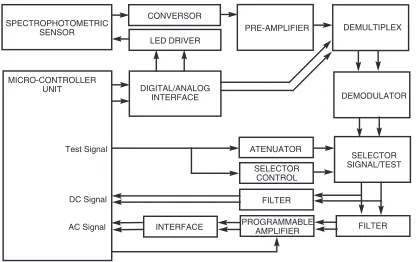
This section is concerned with describing the applica-tion of the proposed methodology in the development of the pulse oximeter equipment. We chose the pulse oximeter as a case study because it was already developed in another work by our research group using an ad hoc development methodology [10]. Therefore, we describe the pulse oxime-ter in this section only as an example of the application of the proposed methodology in the domain of embedded sys-tems. Generally speaking, the pulse oximeter is responsible for measuring the oxygen saturation in the blood system us-ing a non-invasive method. The architecture of this equip-ment is shown in Figure 1.
SPECTROPHOTOMETRIC SENSOR
CONVERSOR LED DRIVER
PRE-AMPLIFIER DEMULTIPLEX
DIGITAL/ANALOG
INTERFACE DEMODULATOR
ATENUATOR SELECTOR CONTROL
SELECTOR SIGNAL/TEST Test Signal
INTERFACE PROGRAMMABLEAMPLIFIER FILTER FILTER
DC Signal AC Signal MICRO-CONTROLLER
[image:5.612.324.532.503.634.2]UNIT
The micro-controller controls the synchronization and amplitude of the led driver, which dispatches non-simultaneous stream pulses to the infrared and red leds. Both leds generate, respectively, infrared and red radiation pulses that cross the finger of a patient. After crossing the finger, a photo-diode catches the radiations level. A se-quence of operations occurs until data reaches the micro-controller. Lastly, the micro-controller performs the calcu-lation related to oxygen saturation level based on data re-ceived, and shows the result on a display. The final product contains about 5000 lines of C code. Due to timing and energy constraints, the sensor signals excitation and con-ditioning were implemented using hardware components while the control algorithm and the signal conversion sys-tem were implemented in software by the micro-controller. The main system’s characteristics are depicted as fol-lows:(i)the level of the oxygen saturation and cardiac fre-quency must be shown every second,(ii)The user must be able to change the alarm configuration,(iii)the user inter-face of the pulse oximeter equipment must have a keyboard and a graphical display,(iv)the design of the system should be highly optimized for life-cycle cost and effectiveness,(v)
the amount of software defects should be as low as possible, and(vi)the power dissipation of the final system should be about 2,35 Watts.
If we develop this product using the proposed methodol-ogy then there would be about three people involved, two developers and one product leader. The product would take approximately four sprints of three weeks to be developed, tested and delivered (rough estimation). The next subsec-tions describe only the processes of the proposed methodol-ogy that focus on achieving the aims of the pulse oximeter equipment.
5.1
Process for Managing the Product
Re-quirements
This process would help us identify the market needs for the pulse oximeter product line and manage the product re-quirements. At the beginning of the project, we could ar-range a brainstorming meeting in order to capture high-level requirements of the product. After that, we could create an initial product backlog with the purpose of capturing more requirements and creating a first product prototype. The first project iteration would allow us to answer questions such as whether the technology needed for the system ex-ists, how difficult it would be, and whether the engineers would have enough experience using that technology.
We could put much emphasis on delivering the system’s functionalities (i), (ii), and (iii) in the beginning of the sprints. Delivering these functionalities with highest busi-ness value (the busibusi-ness value could range from 1 lowest to 5 highest), could help our customer (e.g., a
representa-tive of a hospital) and the product leader get feedback on functionality earlier and allow them to spot any misunder-standing more quickly. At the end of each iteration, the product leader and customer could verify if the product was still feasible or not. If the project was not feasible then it could have been canceled just after the end of the iteration
(risk management).
If we develop a new product in which the requirements cannot be expected to be fully available earlier in the devel-opment then this process would help us identify more re-quirements and update the product backlog as the project evolves. We could start the project with a set of func-tional and non-funcfunc-tional requirements. After running some project’s sprint, our understanding about the product would increase and we could identify the requirements that were not captured at the beginning of the project.
5.2
Process for Managing the Project
This process would help us refine and prioritize the prod-uct backlog that contains the system’s functionalities. In the sprint planning, the product leader and our customer could choose the goals of the next sprint based on the highest busi-ness value and risks of the product backlog items. After that, we could have a meeting to consider how to achieve the sprint’s goals and to create the sprint backlog. The sprint backlog should contain only tasks in the 4-16 hour range.
During the system development, the sprint backlog could be updated on a daily basis as the activities were being ac-complished. The product leader could hold daily meetings at the same place and time with the team members with the purpose of monitoring and controlling the complexity of the tasks. These daily meetings would provide a great feed-back to the product leader and create the habit of sharing the knowledge. After starting the sprint, we could imple-ment first the functional requireimple-ments and then focus on the non-functional requirements of the system. This approach would help us obtain better optimization results because we would be trying to optimize the global system instead of only parts of the system which sometimes could not lead to the global optimization.
5.3
Process for Instantiating the Platform
This process would help us estimate the pulse oximeter metrics in order to define the system platform. To obtain the execution time and energy consumption metrics, we could specify the system’s functionalities in the Unified Modeling Language (UML) by creating the class, collaboration and sequence diagrams. UML 2.0 profile could also be used to specify the system functionalities [7], but at the time we wrote this paper there was no tool available to convert the UML 2.0 diagrams into a programming language. The main benefits of the UML 2.0 is that it uses special stereotypes and design rules for modeling the behavior of the applica-tion and platform components and it also enables their pa-rameterization.
The CASE (Computer Aided Software Engineering) tools like Together and Rational Rose could be used for the entry of the system model. After specifying the sys-tem model in UML using these tools, the code could be generated automatically in the language selected by the sys-tem designer (e.g., Syssys-temC, Java, and C/C++). Nguyen et. al. [9] provides a tool that enables the system designer to specify the system model in UML and automatically con-vert it into SystemC code [9]. After generating the code in the selected language, hardware/software estimation tools could be used to estimate the execution time and energy consumption. We could use the estimation tool developed by our research group that is capable of estimating the ex-ecution time and energy consumption based on Assembly code [11].
Therefore, after estimating the system’s metrics, we could provide this information to our hardware/software partitioning tool that is being developed as an Eclipse plug-in by our research group. This tool looks for the best parti-tioning that meets the design constraints. Since most design decisions are driven by constraints then we should incorpo-rate the application constraints into our objective function so that partitions that met constraints would be considered better than those that did not meet. Finally, after instanti-ating the platform based on the application constraints then we could start developing the product.
5.4
Process for Implementing New
Sys-tems Functionalities
This process would help us implement the system’s tasks of the pulse oximeter in a systematic way. According to the business value of the system’s functionalities defined in the
process for managing product requirements, we could start implementing the tasks responsible for measuring the oxy-gen saturation level in the patient’s blood. In order to im-plement this functionality, we should first write the unit test for this functionality and thereafter we should successfully
compile the unit test before really writing the functionality’s code. If there would be compilation problems then the unit test for this functionality should be fixed.
After successfully compiling the unit test, we could start coding the functionality by following product’s coding stan-dard defined at the beginning of the project. The function-ality’s code would be considered completely implemented only after the team member successfully runs the unit test that was created for the functionality. Therefore, it would ensure that the functionality would be in compliance with its specification and the calculation of the oxygen saturation level in the patient’s blood would be correctly performed. If there would be some need for splitting this functionality into different tasks then there would be the need for creating the unit tests for each code piece of the functionality.
5.5
Process for Refactoring the Code
After implementing the system’s functionalities, we could identify in further sprints opportunities to improve an existing code. For instance, we could identify during the pulse oximeter project that the level of the oxygen satura-tion and cardiac frequency funcsatura-tionalities have some tasks in common. Both functionalities need to collect data from the sensor and identify the maximum and minimum signal pulse. Therefore, the application of this process would lead to elimination of duplicated code, reduction of the amount of system’s functions, and improve the system performance. But before improving the code for those tasks in com-mon, we should first create branches in the system reposi-tory for not breaking an existing working code. After that, we should verify if there is some need for updating the unit test of the functionality. If there is no need to update the unit tests then we could start improving the code without altering its external behavior. After refactoring the code, we could run the unit test in order to verify if the changes are working correctly. If there is no compilation problem and the unit test dos not fail then we could integrate our changes into the product development line.
5.6
Process for Optimizing the System
This process would help us identify system’s variable that could be optimized in order to meet the system’s con-straint. To optimize the system’s variables, we should first establish the metrics and ensure that the refactoring process has already been applied. After that, we could run our pro-filer tool [11] to monitor the program and tell where it would be consuming time and energy. In this way, we could be able to find small parts of the program where these system’s variables could be optimized. Thereafter, we could optimize the variables under attention by hand. As in refactoring, we could also carry out the changes in small steps. After each step, we should compile, test and run the profiler tool again. If the variable has not been optimized then we should re-turn the changes in the version control system and continue the optimization process until the variables could satisfy the constraints.
6
Conclusion
This paper described an agile development methodology and its application in the development of the pulse oxime-ter. In order to create the methodology, we chose two agile methods XP and Scrum as well as organizational patterns named in this paper as agile patterns. Scrum is explicitly intended for the purpose of managing agile software devel-opment projects. On the other hand, XP is a collection of well-known development practices. The agile patterns pro-vide means to structure the software development process of organizations.
When XP, Scrum and agile patterns are combined they cover many areas of the system development life-cycle. However, the combination of Scrum, XP and agile pat-terns does not mean that they can directly be used to de-velop embedded systems. Slightly changes were needed to:
(i)adopt processes and tools to optimize the product’s de-sign rather than take paths that lead to dede-signs that have no chance of satisfying the constraints, (ii) support software and hardware development through a comprehensive flow from specification to implementation, (iii) instantiate the system platform based on the application constraints rather than overdesign a platform instance for a given product, and
(iv)use system platform to conduct various design space ex-ploration analyses for performance.
To illustrate the use of the processes and tools of the pro-posed methodology, we described how it could be applied to develop the pulse oximeter equipment. In this case study, we used UML notation to specify the application function-alities and convert them into programming languages to ap-ply the estimation and partitioning tools. For further steps, we are researching models that can carry enough informa-tion about the ultimate physical implementainforma-tion at a high
abstraction level and planning experimental studies where the methodology will be observed. After that, our goal is to introduce the proposed methodology step-by-step into the industry by using traditional measurement framework.
7
Acknowledgements
This work is partially supported by Brazilian Council of Research CNPq under grant number 55.3164/2005-8.
References
[1] K. Beck and C. Andres.Extreme Programming Explained -Embrace Change. Second Edition, Addison-Wesley, 1999. [2] S. Berczuk and B. Appleton. Software Configuration
Man-agement Patterns. First Edition, Addison-Wesley, 2002. [3] J. O. Coplien and D. Schmidt. Organizational Patterns of
Agile Software Development. First Edition, Prentice Hall, 2004.
[4] D. Gajski, F. Vahid, and S. Narayan. A system-design methodology: Executable-specification refinement. Eu-ropean Conference on Design Automation, Paris, France, 1994.
[5] B. Greene. Agile methods applied to embedded software development.Proceeding of the Agile Development Confer-ence (ADC’04)., 2004.
[6] P. Koopman. Embedded system design issues (the rest of the story). Proceedings of the International Conference on Computer Design (ICCD96), pages 310–317, 1996. [7] P. Kukkala, J. Riihimki, M. Hnnikinen, T. Hmlinen, and
K. Kronlf. Uml 2.0 profile for embedded system design.
Proceedings of the Design, Automation and Test in Europe Conference and Exhibition (DATE’05)., 2005.
[8] P. Manhart and K. Schneider. Breaking the ice for agile de-velopment of embedded software: An industry experience report.Proceedings of the 26th International Conference on Software Engineering (ICSE04), page 3647, 2004.
[9] K. Nguyen, Z. Sun, , and P. Thiagarajan. Model-driven soc design via executable uml to systemc. Proceedings of the 25th IEEE International Symposium on Real-Time Systems, Page(s) 459-468, pages 459–468, 2004.
[10] M. Oliveira.Desenvolvimento de Um Prot´otipo para a Me-dida N˜ao Invasiva da Saturac¸ ˜ao Arterial de Oxigˆenio em Humanos - Ox´ımetro de Pulso. Master thesis, Center for Informatics at Federal University of Pernambuco, 2002. [11] M. J. Oliveira, S. Neto, P. Maciel, R. Lima, A. Ribeiro,
R. Barreto, E. Tavares, and F. Braga. Analyzing software performance and energy consumption of embedded systems by probabilistic modeling: An approach based on coloured petri nets. ICATPN 2006, LNCS 4024, pp. 261281, 2006., page 261281, 2006.
[12] K. Schwaber and M. Beedle. Agile Software Development with Scrum. First Edition, Series in Agile Software Devel-opment, Prentice Hall, 2002.