Copyright © 2002, American Society for Microbiology. All Rights Reserved.
Lack of an Immune Response against the Tetracycline-Dependent
Transactivator Correlates with Long-Term Doxycycline-Regulated
Transgene Expression in Nonhuman Primates after Intramuscular
Injection of Recombinant Adeno-Associated Virus
David Favre,
1Ve´ronique Blouin,
1Nathalie Provost,
1Radec Spisek,
2Franc¸oise Porrot,
3Delphine Bohl,
4Frederic Marme´,
5Yan Che´rel,
6Anna Salvetti,
1Bruno Hurtrel,
3Jean-Michel Heard,
4Yves Rivie`re,
3and Philippe Moullier
1*
INSERM ERM 01051, INSERM U419,2and Laboratoire d’Anatomie Pathologie, INRA UR 703, Ecole Nationale
Ve´te´rinaire,6Nantes, and CNRS URA19303and Laboratoire Re´trovirus et Transfert Ge´ne´tique,4Institut
Pasteur, Paris, France, and ZMBH, Universitaet Heidelberg, D-69120 Heidelberg, Germany5
Received 20 May 2002/Accepted 5 August 2002
We previously documented persistent regulation of erythropoietin (Epo) secretion in mice after a single intramuscular (i.m.) injection of a recombinant adeno-associated virus (rAAV) vector harboring both the tetracycline-dependent transactivator (rtTA) and the Epo cDNA (D. Bohl, A. Salvetti, P. Moullier, and J. M. Heard, Blood 92:1512-1517, 1998). Using the same vector harboring the cynomolgus macaque Epo cDNA instead, the present study evaluated the ability of the tetracycline-regulatable (tetR) system to establish long-term transgene regulation in nonhuman primates. The vector was administered i.m., after which 5-day induction pulses were performed monthly for up to 13 months by using doxycycline (DOX), a tetracycline analog. We show that initial inductions were successful in all individuals and that there was a tight regulation and a rapid deinduction pattern upon DOX withdrawal. For one macaque, regulation of Epo secretion was maintained during the entire experimental period; for the five remaining macaques, secreted Epo became indistinguishable from endogenous Epo upon repeated DOX inductions. We investigated the mechanism involved and showed that, except in the animal in which secretion persisted, delayed humoral and cellular immune responses were directed against the rtTA transactivator protein associated with the reduction of vector DNA in transduced muscles. This study provides some evidence that, when the immune system is not mobilized against the rtTA transactivator, the tetR-regulatable system is able to support long-term transgene regulation in the context of an rAAV in nonhuman primates. In addition, our results suggest potential improvements for vector design.
Recombinant adeno-associated virus (rAAV) vector-medi-ated gene transfer in skeletal muscle of mice (36), dogs (13), nonhuman primates (8, 37), and hemophilia patients (16) is well tolerated and is associated with long-term expression. As such, it becomes possible to evaluate strategies which allow long-term transgene regulation; such strategies are likely to be required for therapeutic applications and in some instances for safety reasons. A rather limited number of clinically translat-able regulatory systems are availtranslat-able. They all have in common the use of chimeric transactivators, the activity of which is controlled by drugs including tetracycline (11), mifepristone (35), ecdysone (23), and rapamycin (25).
The rapamycin-regulatable system uses rapamycin or its an-alog to bring together the functional units of bipartite chimeric transcription factor ZFHD1/FKBP-FRAP/p65 (25). Their cor-responding cDNAs have been included in an rAAV vector and injected intramuscularly (i.m.) in macaques along with a sec-ond rAAV harboring the erythropoietin (Epo) cDNA under the control of a ZFHD1-dependent promoter. This resulted in
long-term regulation of Epo secretion in mice and regulation for up to 3 months in one rhesus macaque out of three (37).
The repressor of the Tn10tetracycline resistance operon of
Escherichia coli(tetR) recognizes its operator (tetO) with high
specificity (14). The interaction between repressor and opera-tor is efficiently prevented by tetracycline and especially by doxycycline (DOX), which binds to tetR with high affinity. A tetR mutant exhibits a reverse phenotype requiring DOX for
binding to thetetOoperator (12). By fusing the latter with the
C-terminal portion of VP16 of herpes simplex virus, the
result-ing transactivator, rtTA, which efficiently trans-activates Ptet,
the minimal promoter fused downstream of an array of tetO
sequences (11), was obtained. The presence of DOX activates transcription.
We and others have found persistent Epo regulation in mice after a single i.m. injection of an rAAV vector harboring the tetracycline-dependent transactivator (rtTA) (3) or the tetra-cycline-repressed transactivator (tTA) (24) and the Epo cDNA.
The present study was designed to evaluate, in nonhuman primates, the ability for the tetracycline regulatable (tetR) system to establish long-term transgene regulation in the con-text of an rAAV vector. Six macaques received i.m. the rAAV vector, harboring simultaneously the rtTA and the homologous
* Corresponding author. Mailing address: Laboratoire de The´rapie Ge´nique, INSERM ERM 0105, Baˆtiment Jean Monnet, CHU Hoˆtel-Dieu, 44035 Nantes Cedex 01, France. Phone: (33) 2 40 08 74 90. Fax: (33) 2 40 08 74 91. E-mail: [email protected].
11605
on November 8, 2019 by guest
http://jvi.asm.org/
Epo cDNA cassettes. This study documents the levels of Epo secretion following DOX, a tetracycline analog, administration for up to 13 months.
MATERIALS AND METHODS
rAAV production and administration.Production of both the construct (Fig. 1) and vector was recently described (8). The number of vector genomes per milliliter was determined by dot blot hybridization as described previously (27). Animal care and i.m. delivery of rAAV were conducted as described previously (8). Six animals, corresponding to Mac 3 through Mac 8 (described in reference 8) (Table 1), were studied.
Epo induction and monitoring.Because we found that water intake varied substantially among the animals, DOX (Vibraveineuse; Pfizer), a tetracycline analog, was given intravenously (i.v.; 10 mg/kg of body weight). The induction protocol started 2 months after vector administration and consisted of a 5-day induction pulse repeated essentially once every month. Serum cynomologus macaque Epo cDNA was measured by enzyme-linked immunosorbent assay (ELISA; Quantikine IVD kit; R&D Systems).
DNA analysis.For Southern blot analysis, 5 or 10g of high-molecular-weight DNA extracted from muscle biopsy samples was digested withBamHI (Fig. 1) and further processed as described previously (3). Blots were hybridized with [32P]dCTP random-primed labeled Epo, rtTA, or tetO-CMV (tetracycline-re-sponsive element reiterated seven times regulating the minimal cytomegalovirus immediate-early promoter) probes (Readiprime II; Amersham).
RNA analysis.Liver and muscle samples (40 mg) were treated with an RNA extraction RNAeasy minikit (Qiagen) according to the manufacturer’s instruc-tions. Total RNA was denatured for 10 min at 70°C and then chilled on ice. First-strand synthesis and subsequent PCR amplification from 1g of total RNA were performed by standard procedures. PCR primers were designed to amplify a 577-bp fragment (upstream primer, 5⬘ -CCACGCTGTTTTGACCTCCATAG-3⬘; downstream primer, 5⬘-GTGTCAGCAGTGATGGTTCGGAG), a 413-bp fragment (upstream primer, 5⬘-CAGAGCCAGCCTTCTTATTCG; downstream primer, 5⬘-ACTCGAAGTCGGCCATATCC), and a 250-bp fragment (upstream primer, 5⬘-CACCAGCAAGCTTGCGACC; downstream primer, 5⬘-TGCTGG ATTACATCAAAGCAC) for Epo, rtTA, and hypoxanthine ribosyltransferase (HPRT), respectively. After 5 min at 94°C, each sample was subjected to the
following amplification cycle: 30 s at 94°C, 30 s at 60°C, and 30 s at 72°C for 40 cycles and then 10 min at 72°C. Negative controls for the reverse transcription (RT) reaction consisted in either omitting reverse transcriptase in the reaction mixture or an RT reaction on mock-transduced muscles. Control for RNA extraction was provided by HPRT RT-PCR.
Humoral immune response.Detection of anti-rtTA antibodies was conducted as follows. Two hundred nanograms of purified tTA2(synth.)-His6protein was subjected to sodium dodecyl sulfate–14% polyacrylamide gel electrophoresis and then transferred to a Hybond ECL nitrocellulose membrane (Amersham). Mem-branes were then saturated and subsequently incubated for 2 h at room temper-ature either with a tetR mouse monoclonal antibody (1:1,000; Clontech) used as a positive control or with the experimental macaque sera (1:100). Detection used a peroxidase-conjugated goat anti-mouse antibody (1:2,000; Dako) or a goat anti-rhesus monkey immunoglobulin G (Southern Biotechnology Associates, Birmingham, Ala.) followed by enhanced chemiluminescence detection.
Cellular immune response. (i) Vectors and cells.Recombinant vaccinia virus (vtetR) and control wild-type vaccinia virus (vWR) were obtained from P. Trak-tamn (Milwaukee, Wis). vtetR encodes the DNA binding domain of rtTA. Recombinant adenoviruses Ad-rtTA (kindly provided by K. Walsh, Boston, Mass.), Ad-GFP, and Ad-LacZ encode rtTA, the green fluorescent protein (GFP), and-galactosidase, respectively. Herpesvirus papio-transformed B lym-phoblastoid cell lines (papio-B) were derived from peripheral blood mononu-clear cells (PBMCs) of Mac 3 through Mac 8 obtained as described previously (8). Immortalized primary fibroblasts were obtained after a cutaneous biopsy on each macaque (except for Mac 6) by using a recombinant Moloney murine leukemia virus encoding the large T antigen of simian virus 40 (SV40) (17). PBMCs and lymph node mononuclear cells (LNMCs) were isolated as described previously (8). Dendritic cells (DCs) were derived from purified CD14⫹cells by using antibody-coated microbeads and magnetic separation (Milteny Biotec). Selected CD14⫹cells were cultured for 6 days in the presence of 1,000 U of granulocyte-macrophage colony-stimulating factor (Leucomax; Novartis)/ml and 50 ng of interleukin-4 (IL-4) (Biosource)/ml in RPMI medium withL-glutamine
(Gibco-BRL) and 1% autologous plasma. On day 6, DCs were transduced with either Ad-rtTA (DC.rtTA) or control Ad-GFP (DC.GFP) or Ad-LacZ (DC.LacZ). DC maturation was then obtained in the presence of 5 ng of tumor necrosis factor alpha (R&D Systems)/ml and 25g of poly(I:C) (Sigma)/ml for 24 h. Monitoring GFP expression indicated that⬎90% of the mature DCs were routinely transduced. Mature DCs were counted, and their viability was assessed either by trypan blue exclusion or by propidium iodide staining. Phenotypic analysis was done by fluorescence-activated cell sorter with monoclonal antibod-ies (MAbs) directed against CD14, CD83, HLA-DR (Immunotech), CD80, and CD86 (Pharmingen) antigens. In vitro stimulation of PBMCs and LNMCs was carried out at a ratio of PBMCs or LNMCs to genetically modified mature DCs of 10 to 1 in 48-well plates for 24 h in RPMI medium–10 ng of IL-7/ml–10 pg of IL-12 (R&D Systems)/ml–5% autologous plasma. Cells were then maintained for 10 days in RPMI medium–20 IU of IL-2 (Chiron)/ml–10% autologous plasma.
(ii) IFN-␥ ELISPOTAn enzyme-linked immunosorbent spot assay (ELIS-POT) as adapted from reference 6 was used to detect rtTA-specific gamma interferon (IFN-␥)-producing T cells from DC.rtTA-stimulated LNMCs. Briefly, nitrocellulose-coated 96-well plates (MAHA N45; Millipore) were coated over-night at 4°C with 50l of MAb MD-1 (anti-IFN-␥MAb; BioSource) at 4g/ml. After being washed and saturated in 5% fetal calf serum, genetically modified DC-stimulated LNMCs were added at 5⫻104, 1⫻104, and 5⫻103cells/well. They were then incubated with 105autologous vWR- (negative control) or vtetR-transduced papio-B (multiplicity of infection, 10). An additional negative control consisted of DC-stimulated LNMCs incubated in medium. Cells incu-bated in the presence of 25 ng of phorbol myristate acetate/ml–100 ng of iono-mycin (Sigma)/ml were used as a positive control. Both mixed-cell populations were maintained overnight at 37°C and then washed and incubated for 2 h with the biotinylated MAb 7-B6-1 (anti-IFN-␥MAb; Mabtech) in phosphate-buffered saline (PBS) at 1g/ml. Wells were washed, and 0.5 U of streptavidin-bound alkaline phosphatase (AP; Boehringer Mannheim) in PBS was added for 90 min. The last step consisted in adding the BCIP (5-bromo-4-chloro-3-indolylphos-phate)-nitroblue tetrazolium color substrate (Promega) for 1 h at room temper-ature. Spots were counted with an automated ELISPOT reader (Zeiss) by using KS-Elispot software. Specific responses against rtTA were considered positive if the number of spots exceeded the mean plus 3 standard deviations of cells incubated with control antigen-presenting cells (APC).
[image:2.603.51.279.70.120.2]Histology.Hematoxylin and eosin staining was performed on paraffin-embed-ded tissue as described previously (8), and immunostaining was done on 6- m-thick cryosections of snap-frozen tissue by using MAbs directed against human CD4 (M-T477 clone; Pharmingen), CD8 (SK1 clone; Becton Dickinson), and FIG. 1. Structure of the AAVcm-ET(CAG) vector. pA,
bidirec-tional SV40 polyadenylation signal; CAG, CAG promoter (22).
BamHI restriction sites and resulting fragments are indicated. The CAG promoter was replaced by the retroviral MFG long terminal repeat (7) in the AAVcm-ET(LTR) vector (not represented). ITR, inverted terminal repeat; Epo, erythropoietin cDNA from Macaca fascicularis.
TABLE 1. Characteristic of the rAAV doses injected and Epo regulation outputs
Animala rAAV Doseb
(i.p./kg)
Peak value of Epoc
(mIU/ml) No. of rEpod
peaks
Detection of anti-rtTA antibodies
Mac 3 cmET (LTR) 2.5⫻109 NDe ND
Mac 4 cmET (LTR) 8.0⫻109 12 4 ⫹
Mac 5 cmET (CAG) 3.0⫻109 13 2 ⫹
Mac 6 cmET (CAG) 1.0⫻1010 65 2 ⫹
Mac 7 cmET (CAG) 4.0⫻109 13 5 ⫹
Mac 8 cmET (CAG) 4.0⫻109 17 Persisting ND
aSee reference 8. bi.p., infectious particles. cFirst induction. drEpo, recombinant Epo. eND, not detectable.
on November 8, 2019 by guest
http://jvi.asm.org/
[image:2.603.43.283.591.688.2]CD68 (PG-M1 clone; Valbiotech); cryosections were subsequently incubated with anti-mouse antibodies by using a horseradish peroxidase- or AP-based EnVision kit (Dako).
Statistical analysis.Statistical analysis of the IFN-␥ELISPOT counts was performed by using the Studentttest. APvalue of less than 0.05 was considered to be statistically significant.
RESULTS AND DISCUSSION
The introduction of the complete tetR system in one single rAAV vector (Fig. 1) (8) provides a unique opportunity to evaluate its full potential in vivo in the context of the AAV inverted terminal repeats (ITRs). The initial DOX pulse dis-played an important and consistent feature: as soon as 48 h after DOX initiation, Epo secretion reached a plateau, return-ing to baseline level in less than 5 days upon DOX withdrawal (Fig. 3). A delayed reticulocyte burst correlated remarkably well with the Epo secretion pattern, confirming the tight reg-ulation achieved (Fig. 2c and d and 3). By comparison, the rapamycin-regulatable system harbored in adenovirus or rAAV vectors displayed a prolonged deinduction (10 to 15 days) of the system to basal expression (26, 37). Possible ex-planations could be a slower degradation of the transgene mRNA molecules or the presence of intracellular rapamycin (1). A similar slow deinduction pattern is obtained by using the progesterone-regulatable system, for which the inducer RU486 exhibits a long half-life and a poor diffusion within tissues (30). Although, for the tetR-regulatable system, the tight degree of regulation was previously noted in vitro (1), our data provide evidence that this feature can be translated in nonhuman pri-mates. Of note, unlike other activators, such as steroids or rapamycin, that have a broad spectrum of activity in mammals, tetracycline’s high affinity for tetR enables the use of this antibiotic at concentrations that cause little adverse effect. The recently described rtTA variant M2 is fully induced in vitro at
about a 10-fold-lower concentration of DOX than the one presently used (33). Therefore, it may represent a more attrac-tive alternaattrac-tive in the future.
[image:3.603.63.528.71.288.2]We next investigated whether the tetR system supports long-term Epo regulation in nonhuman primates. To allow accurate assessment and reproducible DOX intake, animals were sub-jected monthly to a 5-day pulse of DOX i.v. injections. Since they were occasionally bled to avoid high hematocrit discom-fort (Fig. 2c and d), the main outputs considered were serum Epo concentration (Fig. 2a and b) and reticulocyte counts (Fig. 2c and d and Table 1). The data show that induction of Epo secretion and the subsequent reticulocyte burst upon DOX administration vanished with time and were lost after two to five pulses depending on the individual (i.e., 4 to 7 months
FIG. 2. Epo (a and b) and hematocrit (dotted lines) and reticulocyte (solid lines) (c and d) levels in representative animals Mac 6 and Mac 8. Solid arrows (a and b), DOX administration. Animals were occasionally bled (open arrows [c and d]). Ab (rtTA), detection of anti-rtTA antibodies in successive serum samples; c⫹, positive control consisting in a commercial specific MAb against rtTA; c⫺, negative control obtained from sera prior to rAAV administration.
FIG. 3. Epo and reticulocyte levels, obtained from the last induc-tion peak from Mac 8 (Fig. 2a) and determined on a daily basis upon DOX i.v. administration for 5 days (dotted area) and subsequent withdrawal.
on November 8, 2019 by guest
http://jvi.asm.org/
[image:3.603.305.538.536.683.2]after rAAV injection). However, one animal (Mac 8) displayed a remarkably sustained DOX-regulated Epo secretion and he-matocrit elevation during the entire 13-month experimental period corresponding to 11 successive inductions (Fig. 2a and c). In previous studies with mice, long-term DOX-mediated regulation was achieved in the context of an AAV vector ad-ministered i.m. by using either the rapamycin-regulatable sys-tem (26) or a DOX-regulated expression cassette (3, 24). Im-portantly, in none of these studies could cellular or humoral immune responses against the transactivator protein be de-tected. However, this possibility was investigated with our pri-mates since the rtTA transactivator was the sole AAV-encoded heterologous peptide. We incubated serum samples collected at different time intervals from each individual with purified
tTA2(synth.)-His6peptide blotted onto nitrocellulose. Whereas
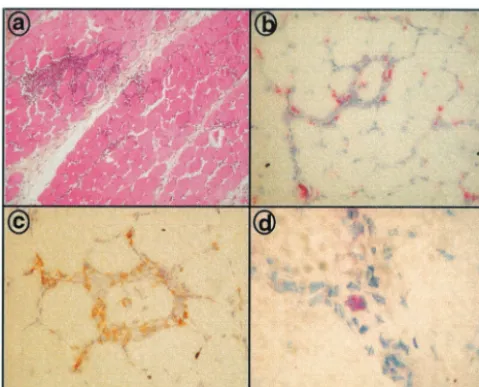
no anti-rtTa antibodies could be detected in Mac 3 or Mac 8 (Fig. 2a), 1/100-diluted sera from Mac 4 through Mac 7 exhib-ited strong positivity against the transactivator protein (Fig. 2b). The positive control consisted of a commercial specific MAb against rtTA. Interestingly, there was a temporal corre-lation between the detection of the humoral immune response and the loss of Epo secretion upon DOX administration for Mac 4, Mac 5, Mac 6, and Mac 7 (Fig. 2b). Furthermore, Mac 5 and Mac 6 were subjected to biopsies at the site of vector administration at different times after vector administration. Control tissue was obtained from each individual and from an uninjected skeletal muscle area. The result showed that, whereas histology was normal 1 month after rAAV injection and at the time of sacrifice (12 months postinjection [p.i.]) (not shown), inflammation was detected in muscle samples ob-tained 6 months after vector injection (Fig. 4). Lymphomono-cytic infiltrates associated with myofiber destruction were found in both Mac 5 and Mac 6 (Fig. 4a). Phenotypic analysis
of the infiltrating cells showed the presence of CD4⫹, CD8⫹,
and CD68⫹cells (Fig. 4b to d), concomitant with the detection
of the humoral immune response (Fig. 2b). The simultaneous development of antibodies against the tetracycline-sensitive transactivator and the delayed and transient occurrence of cellular infiltrates at the sites of vector administration sug-gested that rtTA could be the target of an immune response in nonhuman primates. We further explored the cellular
compo-nent of the rtTA-directed immune response by IFN-␥
ELIS-POT assays. LNMCs from inguinal draining lymph nodes were first stimulated for 10 days in the presence of autologous DCs expressing either the rtTA antigen (DC.rtTA) or one of the two control antigens, GFP (DC.GFP) or LacZ (DC.LacZ). Herpesvirus papio-transformed B lymphoblastoid cell lines (B-papio) were derived from PBMCs of Mac 3 through Mac 8. They were infected with either vaccinia virus vtetR (expressing the DNA binding domain of the rtTA) or control wild-type vaccinia virus vWR and subsequently used as stimulating cells
for the IFN-␥ ELISPOT assay. As shown Fig. 5, 16 months
after vector administration, DC.rtTA-stimulated LNMCs from
Mac 6 exhibited 81⫾18, 23⫾2, and 12⫾4 IFN-␥spots per
5⫻104, 1⫻ 104, and 5⫻103cells, respectively, when
incu-bated in the presence of vtetR-transduced autologous B-papio
as opposed to 22⫾3, 6⫾1, and 3⫾2 IFN-␥spots per 5⫻
104, 1 ⫻ 104, and 5 ⫻ 103 cells, respectively, obtained with
DC.rtTA-stimulated LNMCs incubated in the presence of the
control vWR-transduced autologous B-papio (P ⬍0.05). An
additional control was obtained after incubation of DC.GFP-stimulated LNMCs with either vtetR- or vWR-transduced
au-tologous B-papio, for which 57⫾23, 11⫾4, and 5⫾3 IFN-␥
spots versus 73 ⫾ 1, 14 ⫾ 3, and 4 ⫾ 1 IFN-␥ spots were
[image:4.603.46.286.71.264.2]counted per 5⫻104, 1⫻104, and 5⫻103cells, respectively (P
FIG. 4. Muscle biopsy sample obtained from Mac 6 6 months after rAAV injection. Shown is a phenotypic characterization of the cellular infiltrates. (a) Hematoxylin and eosin staining. Magnification,⫻100. (b) Anti-CD68-AP. Magnification, ⫻200. (c) Anti-CD8-horseradish peroxidase. Magnification, ⫻300. (d) Anti-CD4-AP. Magnification, ⫻400.
FIG. 5. Cytokine production can be measured at the single-cell level by using the ELISPOT technique, allowing calculation of T-cell frequencies. Shown is an IFN-␥ ELISPOT assay using autologous LNMCs from Mac 6 and Mac 8, obtained from inguinal draining lymph nodes in the presence of autologous DCs expressing the rtTA antigen (LNMC/DC-rtTA [a and c]) or GFP (LNMC/DC-GFP [b]). Herpes-virus papio-transformed B lymphoblastoid cell lines (papio B) were derived from PBMCs of Mac 6 and Mac 8 and were then infected with either vaccinia virus vtetR (papio B ⫹ vtetR) or control wild-type vaccinia virus (papio B⫹vWR). Spot quantification is described in Materials and Methods. Eff, effector cells.
on November 8, 2019 by guest
http://jvi.asm.org/
[image:4.603.301.541.72.259.2]⬎ 0.1) (Fig. 5). In contrast, vtetR-transduced autologous
B-papio from Mac 8 was unable to stimulate IFN-␥production
from DC.rtTA-stimulated LNMCs (46⫾6, 11⫾8, and 5⫾2
IFN-␥spots per 5⫻104, 1⫻104, and 5⫻103cells,
respec-tively) compared to the control vWR-transduced autologous
B-papio (34⫾6, 6⫾3, and 1 IFN-␥spots) (P⬎0.1) (Fig. 5).
Identical patterns were obtained by using rtTA or control GFP-expressing immortalized autologous fibroblasts from Mac
8 as stimulating cells for IFN-␥production (41⫾16 and 53⫾
1 IFN-␥spots/5⫻104cells, respectively [P⬎0.1]). The results
obtained with Mac 6 were reproduced 1 month later (i.e., 17 months after vector injection) in a separate set of experiments using various concentrations of autologous B-papio and freshly extracted LNMCs (not shown). Altogether, the data suggested that at least in Mac 6 specific humoral and cellular immune responses correlated with the disappearance of regulated Epo secretion. Conversely, the lack of a detectable immune reac-tion against the rtTA in Mac 8 was associated with the sus-tained transgene regulation. A similar progressive extinction of rapamycin-regulated Epo secretion was found in rhesus mon-keys by Ye et al., but, although they suspected that the highly
antigenic protein domains that were incorporated into the NH2
termini of both transcription factors could be the targets for a destructive immune response, no evidence for this was pro-vided at that time (37).
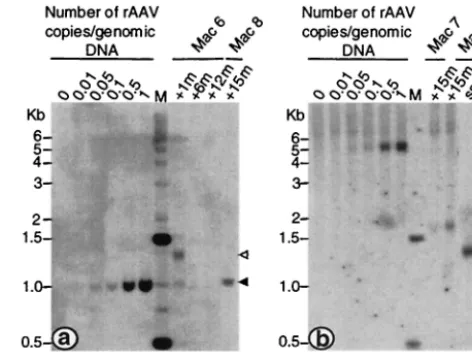
Although we cannot formally rule out the possibility that partial silencing of Epo and rtTA expression occurs in vivo in macaques, in relation to the actual molecular status of the rAAV vector (21), the emerging scenario accounting for the progressive loss of Epo secretion upon DOX administration is the rise of an rtTA-directed immune response responsible for a cell-mediated destruction of the genetically modified myofi-bers. To support this hypothesis, Southern blot analyses were performed on total DNA extracted from muscle biopsy sam-ples obtained from Mac 3, Mac 4, Mac 7, and Mac 8 15 to 18 months p.i. Samples were also collected from Mac 5 (6 and 12 months p.i.) and Mac 6 (1, 6, and 12 months p.i.). Muscle DNA
was digested with BamHI, which releases the Epo,
bidirec-tional SV40 polyadenylation signal, and rtTA sequences (0.6, 0.6, and 1 kb, respectively; Fig. 1). An rtTA probe (Fig. 6a) was used to show that a band of 1 kb was present in Mac 6 1 month p.i. (lane 1), but the band could no longer be detected at 6 and 12 months p.i. (lanes 2 and 3). Similarly, no signal could be found in Mac 3 and Mac 4 18 months p.i. (not shown). A 1.4-kb band, corresponding to the apparent sizes of single-stranded rAAV vector genomes (see control lane corresponding to
⬃109vector genomes, Fig. 6b, lane 7) was consistently detected
by using either rtTA (lane 1) or tetO-CMV (not shown) probes 1 month p.i. in Mac 6 samples but not in subsequent DNA samples. The same observation was also made for Mac 5. Most importantly, a DNA sample collected from Mac 8 15 months p.i. showed the persistence of 0.2 to 0.3 vector copy per equiv-alent haploid cellular genome (Fig. 6a, lane 4). Furthermore, in the same animal and using a tetO-CMV probe (Fig. 6b), a
band of⬃1.8 kb was detected, compatible with a head-to-tail
concatemer with approximately one ITR deleted (lane 6). The same structure could also be seen as a faint signal for Mac 7 15
months p.i., equivalent to ⬃0.05 vector copy per equivalent
haploid cellular genome (lane 5). Despite the lack of interme-diate biopsy samples for all individuals, the molecular status of
vector DNA detected at early and late time points was in agreement with previous reports for mice, in which the input single-stranded DNA is either converted to double-stranded forms (9, 34) or recruited to form duplex structures made of plus and minus single-stranded genomes (20) or both. The detection of head-to-tail junctions was also in agreement with previous reports for mice and dogs (10, 13). Whether the persisting concatemerized vector DNA found in Mac 8 is ep-isomal and/or integrated is another issue which remains to be determined.
[image:5.603.303.539.71.250.2]Altogether, our data show that rAAV administered in Mac 8 (i) failed to elicit a detectable immune reaction against the rtTA transactivator protein, (ii) persisted as head-to-tail con-catemers for at least 16 months, and (iii) was associated with stable regulated Epo expression. Conversely, we found that a humoral response against the rtTA in Mac 4 through Mac 7 and vector DNA in muscle biopsy samples were undetectable 15 months p.i. (except for a faint signal in Mac 7) and that all these animals displayed a transient regulated Epo expression. Mac 6, in which we were able to document humoral and cel-lular immune responses against the rtTA, exhibited at the same time a quantitative reduction of the rAAV copy number at the injection sites. The initial detection of vector DNA 1 month p.i. and its absence 6 and 12 months p.i. (Fig. 6, lanes 1 to 3) correlated with the decline of DOX-regulated Epo secretion, suggesting that one possible mechanism involved was a pro-gressive immune-mediated destruction of the genetically mod-ified myofibers. Although proteins secreted from an ectopic site may have biochemical features different from those of their counterpart produced at the physiological site (2), we
FIG. 6. Southern blot analysis of high-molecular-weight DNA ex-tracted from muscles biopsy samples. (a) rtTA probe; (b) tetO-CMV probe. Muscle samples were obtained at⫹1,⫹6, and⫹12 months for Mac 6 (lanes 1 to 3) and at⫹15 months for Mac 7 (lane 5) and Mac 8 (lanes 4 and 6). Lane 7 corresponds to⬃109single-stranded vector
genomes. Reference copy numbers correspond to high-molecular-weight DNA extracted from normal macaque muscle and run with plasmid DNA corresponding to 0.01 copy (0.25 pg) up to 1 copy (25 pg) of pAAVcm-ET(CAG). Open arrowheads, 1.4-kb single-stranded vector DNA input; filled arrowheads, 1-kb band (a, lanes 1 and 4) and ⬃1.8-kb band compatible with a head-to-tail concatemer (b). Quanti-fication of vector signals relative to the reference copy number signals was done on a phosphorimager.
on November 8, 2019 by guest
http://jvi.asm.org/
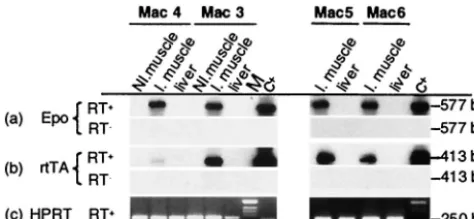
found no evidence for an immune response directed against cynomolgus macaque Epo and none of the primates developed anemia as a result of cross-neutralization, unlike findings de-scribed previously (32). As suspected for the rapamycin-regu-latable system, the heterologous nature of the rtTA makes it a potent candidate for triggering the host immune system, at least in primates but not in the murine model (26, 37). The present study based on (i) our PCR (8) and RT-PCR data (Fig. 7) showing detectable transgenes and transcripts in rAAV-injected muscles from all animals tested at a time when Epo induction is undetectable, (ii) the delayed onset of the immune reaction to the rtTA, and (iii) the mild monolymphocytic
in-filtrates associated with a relatively weak IFN-␥secretion,
de-tectable only when using in vitro-activated LNMCs and not PBMCs, suggests that the immune reaction in this setting takes place at a rather slow pace and is of moderate magnitude. Thus, the complete immune-mediated removal of the trans-duced cells may not be achieved, at least by 15 months p.i., but is sufficient so that the number of transduced cells fall off to a critical threshold where regulated Epo expression becomes indistinguishable from endogenous Epo expression. This sce-nario would reconcile our sensitive RT-PCR and PCR (8) analyses and our Southern blotting data. Furthermore it was proposed that the decline of AAV-transduced gene expression in vivo would occur in a chronic way due to the limited acti-vation of T-cell immunity (38). Whether expression in Mac 8 would follow the same model but at an even slower pace or whether a tolerant status toward the rtTA was achieved in this animal remains unknown. The fact that Mac 7 and Mac 8 developed neutralizing antibodies against the rAAV capsid (not shown) suggests that they were both immunocompetent for other nonself peptides. Nonetheless, they exhibited differ-ent immunological outcomes although they received iddiffer-entical doses or volumes of the same vector stock. Such a discrepancy could be related to individual genetic factors, such as major histocompatibility complex haplotype affinity for rtTA epitopes in the outbred animal. This discrepancy, if valid, underscores the importance of preclinical studies with nonhuman primates as opposed to inbred murine models, where an elaborate
im-mune response against the rtTA was searched for and never found (3, 24).
Previous studies described rAAV vectors as nonimmuno-genic, allowing long-term transgene expression in vivo (for a review, see reference 31). The basis for escape from immune recognition of nonself antigens expressed from rAAV relies, in part, on the observation that these vectors are relatively inef-ficient at transducing mature DCs in vitro (15) and in vivo (28). However, several conflicting reports suggested that the rAAV inability to transduce APC does not necessarily result in stable gene transfer; these reports delineate additional factors impli-cated in the induction of cytotoxic T lymphocyte responses by rAAV vectors. Among them, the route of administration (4), the transgene involved (4, 19), the physiological status of the target tissue at the time of the rAAV injection (5), and whether transgene transcription is ubiquitous or restricted (5) appear as potent factors with respect to the host immune response after rAAV-mediated gene transfer. Recently, extracellular shed-ding of the transgene product and subsequent uptake and cross-presentation by local APC were documented as consti-tuting an additional mechanism for rAAV-mediated antigen-specific T-cell activation and target cell destruction (28, 29). Whether, in our macaques, the priming of the immune re-sponse against rtTA was initiated by direct transduction of APC such as DCs or by cross-priming after recapture of solu-ble rtTA antigens or both is difficult to ascertain. The fact that rAAV vector DNA was found by PCR for several months in
CD2⫹and CD14⫹PBMCs and lymph nodes in all animals (8)
provides a possible experimental link with a recently proposed scenario (5, 38) in which an rAAV vector might be able to initiate a cellular response to the transgene product if enough AAV-transduced monocyte or DC precursors (18) are re-cruited. Additionally, this scenario proposes that the T-cell-mediated immune response to the neoantigen is probably in-duced by a threshold of AAV vector-transin-duced immature DCs. Translated to our study, the AAV vector would concen-trate in the draining lymph nodes after i.m. injection (8), with subsequent transduction of monocyte or DC precursors and/or cross-priming of other APC. Factors such as vector stock im-purities and i.m. injury secondary to vector injection or muscle biopsy could represent effective stimuli for activation of T-cell immunity in a favorable major histocompatibility complex hap-lotype, although activation would possibly be modulated by the slow rise in gene expression in the AAV context (31).
While understanding the mechanism of the AAV vector-mediated immune response in nonhuman primates remains necessary, our current strategy to circumvent the immune sys-tem relies on the tissue-restricted expression of the rtTA. Re-sults for Mac 8 provided the “gold standard” by establishing that a clinically compatible regulatable system can be func-tional in the context of a single AAV vector in nonhuman primates for more than a year.
ACKNOWLEDGMENTS
[image:6.603.45.282.71.180.2]We gratefully acknowledge James Wilson, University of Pennsylva-nia, and members of our laboratory for critically reading the manu-script, the Vector Core at the University Hospital of Nantes supported by the Association Franc¸aise contre les Myopathies (AFM), and Gilles Blancho, INSERM U437, for the use of the Laboratoire des Grands Animaux of Nantes.
FIG. 7. Epo and rtTA RNA expression from rAAV-transduced muscles. Total RNA was extracted and processed as described in Materials and Methods. Samples were separated by electrophoresis, subsequently blotted under alkaline conditions (except for the HPRT control), and then hybridized with [32P]dCTP random-primed labeled
Epo (a) and rtTA (b) probes. (c) Control of RNA extraction. Lack of a DNA contaminant before reverse transcription is shown by the RT⫺ samples. C⫹, control PCR on 50 pg of AAV vector plasmid
[pAAVcm-ET(CAG)]; NI. muscle, noninjected muscle; I. muscle, rAAV-injected muscle; M, marker.
on November 8, 2019 by guest
http://jvi.asm.org/
This work was supported by the AFM, INSERM, the Fondation d’Entreprises pour la The´rapie Ge´nique en Pays-de-Loire, the Asso-ciation Nantaise pour la The´rapie Ge´nique, and the University Hos-pital of Nantes.
REFERENCES
1. Agha-Mohammadi, S., and M. Lotze.2000. Regulatable systems: applica-tions in gene therapy and replicating viruses. J. Clin. Investig.105:1177–1183. 2. Arruda, V. R., J. N. Hagstrom, J. Deitch, T. Heiman-Patterson, R. M. Camire, K. Chu, P. A. Fields, R. W. Herzog, L. B. Couto, P. J. Larson, and K. A. High.2001. Posttranslational modifications of recombinant myotube-synthesized human factor IX. Blood97:130–138.
3. Bohl, D., A. Salvetti, P. Moullier, and J. M. Heard.1998. Control of eryth-ropoietin delivery by doxycycline in mice after intramuscular injection of adeno-associated vector. Blood92:1512–1517.
4. Brockstedt, D. G., G. M. Podsakoff, L. Fong, G. Kurtzman, W. Mueller-Ruchholtz, and E. G. Engleman.1999. Induction of immunity to antigens expressed by recombinant adeno-associated virus depends on the route of administration. Clin. Immunol.92:67–75.
5. Cordier, L., G. P. Gao, A. A. Hack, E. M. McNally, J. M. Wilson, N. Chirmule, and H. L. Sweeney.2001. Muscle-specific promoters may be necessary for adeno-associated virus-mediated gene transfer in the treatment of muscular dystrophies. Hum. Gene Ther.12:205–215.
6. Czerkinsky, C., G. Andersson, H. P. Ekre, L. A. Nilsson, L. Klareskog, and O. Ouchterlony.1988. Reverse ELISPOT assay for clonal analysis of cyto-kine production. I. Enumeration of gamma-interferon-secreting cells. J. Im-munol. Methods110:29–36.
7. Dranoff, G., E. Jafee, A. Lazenby, P. Golumbek, H. Levitsky, K. Brose, V. Jackson, H. Hamada, D. Pardoll, and R. C. Mulligan.1993. Vaccination with irradiated tumor cells engineered to secrete murine granulocyte-macrophage colony-stimulating factor stimulates potent, specific, and long-lasting antitu-mor immunity. Proc. Natl. Acad. Sci. USA90:3539–3543.
8. Favre, D., N. Provost, V. Blouin, G. Blancho, Y. Cherel, A. Salvetti, and P. Moullier.2001. Immediate and long-term safety of recombinant adeno-associated virus injection into the nonhuman primate muscle. Mol. Ther. 4:559–566.
9. Fisher, K. J., G. P. Gao, M. D. Weitzman, R. DeMatteo, J. F. Burda, and J. M. Wilson.1996. Transduction with recombinant adeno-associated virus for gene therapy is limited by leading strand synthesis. J. Virol.70:520–532. 10. Fisher, K. J., K. Jooss, J. Alston, Y. Yang, S. E. Haecker, K. High, R. Pathak, S. E. Raper, and J. M. Wilson.1997. Recombinant adeno-associated virus for muscle directed gene therapy. Nat. Med.3:306–312.
11. Gossen, M., and H. Bujard.1992. Tight control of gene expression in mam-malian cells by tetracycline-responsive promoters. Proc. Natl. Acad. Sci. USA89:5547–5551.
12. Gossen, M., S. Freundlieb, G. Bender, G. Muller, W. Hillen, and H. Bujard. 1995. Transcriptional activation by tetracyclines in mammalian cells. Science 268:1766–1769.
13. Herzog, R. W., E. Y. Yang, L. B. Couto, J. N. Hagstrom, D. Elwell, P. A. Fields, M. Burton, D. A. Bellinger, M. S. Read, K. M. Brinkhous, G. M. Podsakoff, T. C. Nichols, G. J. Kurtzman, and K. A. High.1999. Long-term correction of canine hemophilia B by gene transfer of blood coagulation factor IX mediated by adeno-associated viral vector. Nat. Med.5:56–63. 14. Hillen, W., and C. Berens.1994. Mechanisms underlying expression of Tn10
-encoded tetracycline resistance. Annu. Rev. Microbiol.48:345–369. 15. Jooss, K., Y. Yang, K. J. Fisher, and J. M. Wilson.1998. Transduction of
dendritic cells by DNA viral vectors directs the immune response to trans-gene products in muscle fibers. J. Virol.72:4212–4223.
16. Kay, M. A., C. S. Manno, M. V. Ragni, P. J. Larson, L. B. Couto, A. McClelland, B. Glader, A. J. Chew, S. J. Tai, R. W. Herzog, V. Arruda, F. Johnson, C. Scallan, E. Skarsgard, A. W. Flake, and K. A. High.2000. Evidence for gene transfer and expression of factor IX in haemophilia B patients treated with an AAV vector. Nat. Genet.24:257–261.
17. Ledoux, S., C. Leroy, G. Siegried, D. Prie, P. Moullier, and G. Friedlander. 1997. Overexpression of ecto-5⬘-nucleotidase promotes P-glycoprotein ex-pression in renal epithelial cells. Kidney Int.52:953–961.
18. Liu, Y., A. D. Santin, M. Mane, M. Chiriva-Internati, G. P. Parham, A. Ravaggi, and P. L. Hermonat.2000. Transduction and utility of the
granu-locyte-macrophage colony-stimulating factor gene into monocytes and den-dritic cells by adeno-associated virus. J. Interferon Cytokine Res.20:21–30. 19. Manning, W. C., X. Paliard, S. Zhou, M. P. Bland, A. Y. Lee, K. Hong, C. M. Walker, J. A. Escobedo, and V. Dwarki.1997. Genetic immunization with adeno-associated virus vectors expressing herpes simplex virus type 2 glyco-proteins B and D. J. Virol.71:7960–7962.
20. Nakai, H., T. A. Storm, and M. A. Kay.2000. Recruitment of single-stranded recombinant adeno-associated virus vector genomes and intermolecular re-combination are responsible for stable transduction of liver in vivo. J. Virol. 74:9451–9463.
21. Nakai, H., S. R. Yant, T. A. Storm, S. Fuess, L. Meuse, and M. A. Kay.2001. Extrachromosomal recombinant adeno-associated virus vector genomes are primarily responsible for stable liver transduction in vivo. J. Virol.75:6969– 6976.
22. Niwa, H., K. Yamamura, and J. Miyazaki. 1991. Efficient selection for high-expression transfectants with a novel eukaryotic vector. Gene108:193– 199.
23. No, D., T. P. Yao, and R. M. Evans.1996. Ecdysone-inducible gene expres-sion in mammalian cells and transgenic mice. Proc. Natl. Acad. Sci. USA 93:3346–3351.
24. Rendahl, K. G., S. E. Leff, G. R. Otten, S. K. Spratt, D. Bohl, M. V. Roey, B. A. Donahue, L. K. Cohen, R. J. Mandel, O. Danos, and R. O. Snyder. 1998. Regulation of gene expression in vivo following transduction by two separate rAAV vectors. Nat. Biotechnol.16:757–761.
25. Rivera, V. M., T. Clackson, S. Natesan, R. Pollock, J. F. Amara, T. Keenan, S. R. Magari, T. Phillips, N. L. Courage, F. J. Cerasoli, D. A. Holt, and M. Gilman.1996. A humanized system for pharmacologic control of gene ex-pression. Nat. Med.2:1028–1032.
26. Rivera, V. M., X. Ye, N. L. Courage, J. Sachar, F. Cerasoli, J. M. Wilson, and M. Gilman.1999. Long-term regulated expression of growth hormone in mice after intramuscular gene transfer. Proc. Natl. Acad. Sci. USA96:8657– 8662.
27. Salvetti, A., S. Ore`ve, G. Chadeuf, D. Favre, Y. Cherel, P. Champion-Ar-naud, J. David-Ameline, and P. Moullier.1998. Factors influencing recom-binant adeno-associated virus production. Hum. Gene Ther.9:695–706. 28. Sarukhan, A., S. Camugli, B. Gjata, H. Boehmer, O. Danos, and K. Jooss.
2001. Successful interference with cellular immune responses to immuno-genic proteins encoded by recombinant viral vectors. J. Virol.75:269–277. 29. Sarukhan, A., C. Soudais, O. Danos, and K. Jooss.2001. Factors influencing
cross-presentation of non-self antigens expressed from recombinant adeno-associated virus vectors. J. Gene Med.3:260–270.
30. Serguera, C., D. Bohl, E. Rolland, P. Prevost, and J. M. Heard.1999. Control of erythropoietin secretion by doxycycline or mifepristone in mice bearing polymer-encapsulated engineered cells. Hum. Gene Ther.10:375–383. 31. Snyder, R. O.1999. Adeno-associated virus-mediated gene delivery. J. Gene
Med.1:166–175.
32. Tripathy, S. K., H. B. Black, E. Goldwasser, and J. M. Leiden.1996. Immune responses to transgene-encoded proteins limit the stability of gene expres-sion after injection of replication-defective adenovirus vectors. Nat. Med. 5:545–550.
33. Urlinger, S., U. Baron, M. Thellmann, M. T. Hasan, H. Bujard, and W. Hillen.2000. Exploring the sequence space for tetracycline-dependent tran-scriptional activators: novel mutations yield expanded range and sensitivity. Proc. Natl. Acad. Sci. USA97:7963–7968.
34. Vincent-Lacaze, N., R. O. Snyder, R. Gluzman, D. Bohl, C. Lagarde, and O. Danos.1999. Structure of adeno-associated virus vector DNA following transduction of the skeletal muscle. J. Virol.73:1949–1955.
35. Wang, Y., F. J. DeMayo, S. Y. Tsai, and B. W. O’Malley.1996. Ligand-inducible and liver-specific target gene expression in transgenic mice. Nat. Biotechnol.15:239–243.
36. Xiao, X., J. Li, and R. J. Samulski.1996. Efficient long-term gene transfer into muscle tissue of immunocompetent mice by adeno-associated virus vector. J. Virol.70:8098–8108.
37. Ye, X., V. M. Rivera, P. Zoltick, F. Cerasoli, Jr., M. A. Schnell, G. Gao, J. V. Hughes, M. Gilman, and J. M. Wilson.1999. Regulated delivery of thera-peutic proteins after in vivo somatic cell gene transfer. Science283:88–91. 38. Zhang, Y., N. Chirmule, G. Gao, and J. M. Wilson.2000. CD-40
ligand-dependent activation of cytotoxic T lymphocytes by AAV vector in vivo. J. Virol.74:8003–8010.