Nooriafshar, Mehryar (2007) 'Combining the latest technologies with traditional learning and teaching methods.' In: Wenchang, Fang, (ed.). Business and Information:
proceedings of the International Conference on Business and Information 2007, Academy of Taiwan Information System Research.
( International Conference on Business and Information 2007, 10-13 July 2007, Tokyo, Japan. )
Combining the Latest Technologies with Traditional Learning
and Teaching Methods
Mehryar Nooriafshar
University of Southern Queensland, Toowoomba, Australia [email protected]
ABSTRACT
This paper investigates the use of the latest technology and innovative methods in such a way that the established learning and teaching approaches are taken into consideration in designing teaching materials. In other words, technology is not regarded and used as a substitute but as a complementary component to achieve enhancements. The use of leading edge technologies such as three dimensional (3 D) animation and virtual reality technologies are explored for this purpose. This balanced approach in designing teaching materials is demonstrated through a number of applications in Business related courses. Hence, technology aided teaching methods, which utilize established learning concepts for the purpose of learning enhancement are developed and presented. In order to test this design approach, one of the latest 3D programming tools was adopted. The findings demonstrated that Virtual Reality (VR) technologies, when supported by established learning and teaching concepts, can play a significant role in Business education.
Keywords:Technology, Traditional, Learning and Teaching
INTRODUCTION
After all, the main purpose in teaching any Business topic should be to convey the concepts and ideas to the learners in such a way that they can relate them to real-life situations and applications. According to a survey conducted by the author in 2005, the industries have very practical requirements. In other words, Business graduates are expected by their employers to observe, collect relevant data, analyse using appropriate methods, identify patterns and relationships; and then make recommendations. See Nooriafshar and Maraseni (2007).
Although the latest technologies have been adopted in the project on which this paper is based, traditional concepts have not been sacrificed or overlooked. In using technology, one should not create a situation where one cannot see the wood for the trees. This paper explores the ways of combining virtual reality environments with traditional approaches and concepts in creating a balanced and more effective learning and teaching environments.
Virtual Reality (VR) has been utilized in practical areas such as three dimensional (3D) modeling of human genes, physics experiments, surgical procedures and tours of terrestrial and celestial landscapes. VR can also benefit learning and teaching as it will allow the learners to immerse in and be a part of the learning materials. Although the term virtual reality is used for different purposes, the original concept refers to immersive virtual reality. The general concept of immersive virtual reality was developed back in the late 80s. In immersive virtual reality, participants interact with a world completely generated by computer which is a virtual replica of the actual subject. As suggested by Beier (2004), one of the main characteristics of immersive virtual reality is that the environment is a full scale replica of the real world and it relates to human size. Hence, the participants get the feeling as if they are interacting with the real environment or subject.
There is no doubt that VR and related technologies will play an important role in the development of multimedia systems in the future. As an application of VR in teaching quantitative subjects, a latest 3D development environment called VirtualStage by Dakine Wave Limited (http://www.dakinewave.com/) was adopted to create simulations of classroom sessions in a realistic manner. As part of this project, various learning situations were created and produced as virtual reality productions. Learning and teaching methods which were adopted in these developments are based on established concepts such as learning by guidance, learning by association and modal preferences. It would be relevant to provide a background to these concepts before proceeding any further.
information received from the teacher. This way of learning is known as constructivism, which encourages the learner to construct their own meanings rather than simply memorizing someone else’s. Under constructivism the nature of learning takes a different form. An appropriate definition of learning under constructivism is by Bruner (n.d.) who considers learning as an active process in which the new ideas or concepts are constructed based on the existing ones.
It should be remembered that the general concept of “constructivism” is quite simple and practical and the underlying theory, perhaps, goes back to the Socratic times. This way of learning encourages the learner to construct their own meanings rather than simply memorizing someone else’s. The concept of guiding and leading the learner to find out the solution or the right answer to a problem was discussed by Plato (the ancient scholar) almost 2400 years ago. If we analyse Plato’s famous “dialogue” Meno, we will realise that Socrates demonstrates to Meno how a mathematically ignorant person solves a geometrical problem through a controlled guidance procedure rather than being told directly.
In the dialogue Socrates conducts his geometrical experiment on one of Meno’s retainers who was totally ignorant of mathematics.
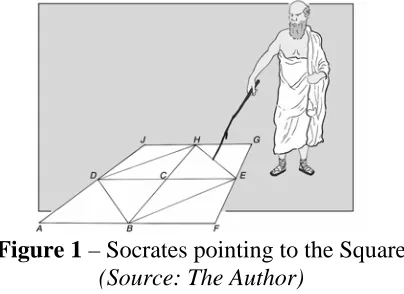
[image:3.595.211.413.437.584.2]In this experiment, Socrates asks the boy to determine the dimensions of a square, which is exactly twice as large as a given square (say, abcd). The boy, eventually, after a series of questions, finds out that the correct solution is obtained by constructing the square (twice as large as abcd) on a diagonal (say, ac) of the given square. See Figure 1 for an illustration.
Figure 1 – Socrates pointing to the Square (Source: The Author)
Even if learning is only the recovery of the pre-existent knowledge in the human soul, as Socrates argues, it can be passed on from teacher to learner by simply guiding the learner to find out for himself.
Learning by association is based on associating a new piece of information with a prompter, which will help us with remembering. The prompter can be an image (actual or virtual), sound, object or word. This way of learning is compatible with the general idea of Dual Coding theory proposed by Pavio (1986). According to this theory, by presenting information in both visual and verbal forms the effectiveness of remembering and recalling is improved.
For instance, when it comes to learning the vocabulary of a new language, we may associate a new word with an image or sound with which we are familiar. Every time, we want to recall the new word, we can simply think of the link, which will prompt us to remember the new word. Gruneberg (2002) approaches language learning in a similar manner. However, the images become virtual rather than actual. In other words, the learner is instructed to use their mind’s eye to visualize an image related to the segment for 10 seconds. For example, in order to learn the word valise (suitcase in French), the learner is asked to visualize the image of suitcases, which are strewn all over the valleys. This is probably more than just the use of the mind’s eye as the “mind’s ear” is also encouraged to associate the sounding (pronunciation) of the word valise with valeez (valleys). Another interesting example presented by Gruneberg is:
Imagine that you are looking at a plate (in French: assiette) and saying to yourself I-see-it.
Learning by association can also be applied to remembering and playing melodies on a musical instrument without sight-reading. We can divide the piece into smaller portions and associate them with some appropriate lyrics/words. We can then be reminded of what should follow by listening to the words in our mind’s ear. Similarly, using the same approach, we may learn how to recognise various celestial objects in the night sky. We can learn the position and features of some key objects and then use them as the base to learn and remember the positions of less visible and hard to spot objects, (Nooriafshar, 2004).
In mathematics, we can associate complex concepts with analogies. For example to learn the concept of recursion in Dynamic Programming, we may use the following analogy: Imagine yourself standing between two facing mirrors and looking at your reflection reflected several times through the mirrors. This analogy becomes the basis of a general purpose recursion formula, see Module 3 at: http://www.usq.edu.au/course/material/MGT2102).
several types of questionnaires, which can determine the learner’s modal preference. Fleming (2001) provides a comprehensive insight into theory and practical uses of learning styles. The chart provided under: Learning Styles (n.d.) at: http://www.chaminade.org/inspire/learnstl.htm is an easy and quick method of getting an indication of leaning style preference. The following section describes how the VirtualStage environment was adopted to develop an immersive virtual reality system for teaching and learning purposes.
VIRTUALSTAGE IN LEANING AND TEACHING MATHEMATICS A series of 3D presentations were developed in VirtualStage. The topics included Decision Theory basics and Introduction to Goal Programming. These presentations demonstrate how the Socratic method of teaching, which usually takes place in a face to face situation, can be simulated, created and captured for replay.
In these presentations, learning is reinforced by the use of specially developed dialogues which is enhanced with audiovisual features. Hence, the user would feel as if they are witnessing and taking part in a real dialogue with the lecturer. Virtual actors play the role of the teacher and students. The people involved and environment are generated by computer and their actions and behaviour are controlled by the designer. All the virtual actors have realistic facial expressions, voices, moving lips, mannerism and movement. They can be viewed in full 3 D from different angles as real actors. These presentations have been deliberately designed in such a way that reliance on text and language-dependent features is kept at minimum. Hence, the learning is re-enforced by the use of specially designed visual and aural features. In these presentations, Mario plays the role of a virtual lecturer who adopts the Socratic method of teaching. He engages in dialogues with his students and encourages them to find the answers and solutions through controlled guidance. Mario’s appearance, facial expressions, mannerism, speech and lip movements are as close as possible to those of a real person. He, his students and the objects around him are also rendered as 3D. Hence, they can be viewed from different angles and distances as if they are being filmed in real life.
The following dialogue is an example of the adopted Socratic approach between the virtual lecturer (Mario) and virtual students (Sally and others):
Sally: “Mario, we would like to learn the basics of Decision Theory.”
Mario: “OK. No problem. But, first of all, let me start by asking you: When do you think we have to make decisions?”
Sally: “When we want to choose the best option out of a number of possibilities?”
Mario: “Exactly. That is when we are faced with a number of alternatives and?”
Mario: “Very good. But, we are sure that we want choose the best one.”
As the dialogue indicates, there is a focus on encouraging a questioning, searching and probing mind instead of simply giving the answers. It demonstrates how Mario (virtual lecturer) is guiding Sally (virtual student) to start thinking along the idea of choosing the best (optimum solution) out of number possibilities (the problem space). And that is the basis of optimization. This kind of controlled and guided questioning approach is continued until the students learn (find out) how to formulate, solve and interpret decision theory problems. In this presentation, the session takes place in Mario’s office. The walls of his office are decorated with the image of Socrates. This image (Figure 1) shows Socrates performing his geometrical experiment.
It should be noted that when a teacher utilises appropriate visual and aural features, complements them with appropriate body language and supports everything with effective teaching approaches, then a multimedia-learning environment is created. Provided this teacher is knowledgeable in the field and possesses patience and is prepared to repeat and explain, as many times as necessary, then we would have an ideal learning environment. So, why do we need to simulate this situation as a 3D multimedia? Some of the reasons could be due to:
• Lack of access to the face-to-face sessions - Unfortunately, not every student has the opportunity to attend a live face-to-face session. This could be due to distance or commitments in life, which make it difficult for the student to attend the face-to-face sessions. It is noteworthy to mention that the market for tertiary distance education has been growing and will continue to become even larger.
• Recording and storing the sessions - A computer-based multimedia teaching material is almost like a movie version of a play. Using computer based multimedia technology (on CD or the Web), we can capture a well rehearsed teaching session, record it and make it available for many students in different geographical locations. The technology can also make it possible for us to simulate some of the teacher-learner interactions too.
select the worst (highest cost) for each option and then choose the best (lowest) of these worst cases. So, in this case we have applied MINMAX. On the other hand, if we have profits, then choose the worst (lowest) profit for each option and finally select the best (highest) of them. Hence, in this case, we have applied MAXMIN.
In order to test the effectiveness of he specially developed 3D presentations, they were demonstrated to a small and selected number of students using the author’s laptop. The students were then tested on the topics by asking them several questions. The students answered every question (ten in total) satisfactorily. It should be noted that due to the licensing restrictions on the voices, the productions cannot be distributed via the internet or other means. Hence, it was not possible to test the presentations with distance education students who would probably benefit from this technology. Future developments and progress in this field will probably consider this need.
CONCLUSION
Although modern computing has made a significant contribution to education, it must not be regarded as a substitute for traditional approaches. As was suggested, it can be argued that the most effective multimedia is probably the experienced and knowledgeable human teacher who possesses the necessary characteristics for catering different needs of students. They include the ability and willingness to utilise various modes such as visual and aural. When these features are complemented with appropriate body language and supported with effective teaching approaches, then an effective multimedia-learning environment is created. Unfortunately, in many instances one cannot see the wood for the trees as the foundations are overlooked or even disregarded.
This paper has demonstrated how the latest technologies such as virtual reality can be married with the established concepts of learning and teaching to produce effective educational materials for face to face and distance modes. Hence, it will be possible to simulate classroom sessions which can be enjoyed by all students regardless of their mode of study and geographical location.
REFERENCES
Beier K.P. 2004 Virtual Reality: A Short Introduction Retrieved February 2, 2004 from http://www-vrl.umich.edu/intro/
Bruner J. n.d., Constructivism Theory Retrieved November 11, 2003 from
http://www.artsined.com/teachingarts/Pedag/Constructivist.html
Fleming N. 2001, VARK –a guide to learning styles Retrieved December 11, 2003 from http://www.artsined.com/teachingarts/Pedag/Constructivist.html
Gruneberg M. 2002, Instant Recall French Vocabulary, McGraw-Hill.
Nooriafshar and Maraseni 2007, “University Graduates’ Quantitative Skills and Industries’ Needs”, Proceedings of the Hawaii International Conference on Statistics, Mathematics and Related Fields, Honolulu, Hawaii, USA, 17th-19th January