RIT Scholar Works
Theses
Thesis/Dissertation Collections
8-1-1964
Marion: a creative expression of personal reactions
to environment
Harold Spencer
Follow this and additional works at:
http://scholarworks.rit.edu/theses
This Thesis is brought to you for free and open access by the Thesis/Dissertation Collections at RIT Scholar Works. It has been accepted for inclusion in Theses by an authorized administrator of RIT Scholar Works. For more information, please [email protected].
Recommended Citation
MARION: A CREATIVE EXPRESSION OF
PERSONAL REACTIONS TO ENVIRONMENT
A Thesis
Presented to
the
Faculty
of the Graduate SchoolCollege of Fine and Applied Arts
Rochester Institute of
Technology
In Partial Fulfillment
of the Requirements for the Degree
Master of Fine Arts
t>7
Harold Franklin Spencer
v>6.
(N.
PAGE
List of Figures
Introduction 1
Part
I. Marion: A
History
4II. The Artist-Teacher: A Biographical Sketch. . . 9
HI. Paintings
*
14
Marion,
Number One: ADiscussion
20Marion,
Number Two: A Discussion 24Marion,
Number Three: A Discussion 28Marion,
Number Four: A Discussion 32Marion,
Number Five: ADiscussion
33Marion,
Number Six: A Discussion 37Conclusion 41
Bibliography. ,46
LIST OF
FIGURES
Figure
Page1. The Artist 2
2.
Watercolor Sketch forMarion,
Number One .183. Felt Pen Sketch for
Marion,
Number One 184. Pencil
Drawing
forMarion,
Number One 185.
Preliminary
Stage ofMarion,
Number One 196.
Preliminary
Stage ofMarion,
Number #One .197.
Marion,
Number One 198,
Watercolor
Sketch forMarion,
Number Two 229. Watercolor Sketch for
Marion,
Number Two 2210. Pen
Drawing
forMarion,
Number Two 2211.
Preliminary
Stage
ofMarion,
Number Two 2312.
Preliminary
Stage
ofMarion,
Number Two 2313.
Marion,
Number Two 2314.
Preliminary
Stage ofMarion,
NumberThree
2615.
Preliminary
Stage
ofMarion,
NumberThree
2616.
Marion,
Number Three 2717.
Preliminary
Stage
ofMarion,
Number Four 3018.
Marion,
Number Four 3119.
Preliminary
Stage
ofMarion,
Number Five 3420.
Preliminary
Stage ofMarion,
Number Five. ... 3421.
Preliminary
Stage ofMarlon,
Number Five 3523.
Preliminary
Stage ofMarion,
Number Six 3824.
Preliminary
Stage ofMarion,
Number Six 3825.
Preliminary
Stage
ofMarlon,
Number Six 3826.
Preliminary
Stage ofMarion,
Number Six 39INTRODUCTION
In
July
of1964,
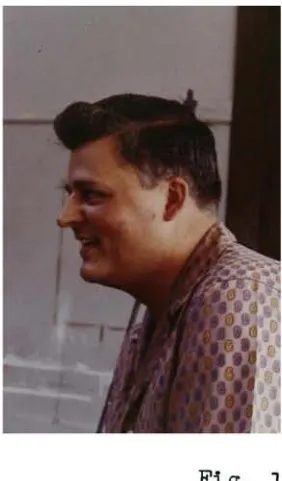
a man stoodlooking
at his surroundings.(Fig.
1)
His thoughtsturned
toterms geographic,
sociological,
cultural,
creative,expressive,
color, and paint. One
hundred
and sixty-nine years
before
in September of1795,
another manstood
looking
at his surroundings,(5:8)*
His thoughts must have
centered around such terms as
shelter,
Indians,
crops, fertile,
forest. These surroundingswere the same only in that it
was the same spot on a sphere
spinning in space and time a
spot called Marion. The 169
years,
time,
form the neucleusof this thesis for it is the
heritage of
Marion,
1964.The purpose of this thesis
Is to creatively express personal
lreactions to environment through
A numbered
bibliography
will ibe found at the back of thebook.
The first number refers to the bibaiflwui'awirf placemfcf|t. The second pamper
give"-"" the'
page ref
Fig.
1the development of a series of
paintings based on
Marion,
NewYork.
It is a visual attempt toshow man at work expressing his
reactions to emotional stimuli.
It contains people and animals,
and is a specific kind of place with the mark of history.
The
intelligence
of man pervades theunchecked emotion of the animal
and the ebb and flow of nature's
fluctuating
elements.Stamped
upon this reaction record Is the
mark of an individual one of the
multiple units of apartness that form existence.
PART I
Marion is a rural community in north western New York
State,
and is six miles due south of
L.ice .ntario. It covers 17,801
acres in the center of Wayne
County.
The
township
contains 2,000 people [image:7.552.31.172.381.622.2]800 people occupying 140
houses.
(5:5)
The public school
annually
serves one thousand students and
provides a community center for
local
gatherings. Five churchestend to spiritual needs for
young and old alike, while three grocery stores and numer
ous small businesses take care
of physical needs.
The land of Marion is the
inheritance of the
Seneca,
oneof the six nations making up the Iroquois Indians. It had
been kept
by
them for centuriesas a
hunting
ground. Streams teemed with fish while woodedhills and valleys abounded with
animals.
(18:1)
Father Dallion
walked intothis Eden in 1625
looking
forlost souls.
He
was the vanguardof the Jesuit missionary coercion
of the wilderness. For over a
traversed
a Christian wastelandpreoccupied with saving the savage.
(18:1)
France
reluctantly withdrewher influence
with the advent ofthe French and Indian
War.
The
Seneca
briefly
settled into Idyllicbliss.
The.
revolution quicklyfollowed and Americans spread out
ward over their land. This mighty and constant thrust penetrated the Seneca hunt land. Mad
Anthony
Wayne's defeat of the Indians in the west secured the land against
savage reprisal.
The
Seneca humbled Intohistory
as Marion's first settler,
Henry Lovell,
arrived.(18:2)
The year was 1795 and this
land held the promise of a resur
rection for settler from the East.
Timothy
Smith and Daniel Powellsoon joined the Lovells to form the
beginning
ofMarion.
(5:8)
The
land was cleared and more folks
came as the years went by. Roads
houses.
The meetinghouse
be
came a school, and churches
were established.
Soon the
second generation supplanted
the first and
traditions
devel
oped through the nineteenth andinto the twentieth century. Marion men always
fought
for their country.
There
wasthe War of
1812;
theCivil
War;
the Spanish American
War;
the First WorldWar;
the Second WorldWar;
and the Korean Conflict.
Marion men always loved
and cherished the land.
They
cleared the
forest.
They
drain ed the swamps.They
revered the nature of the earth.Marion men always followed
their
fathers.
They
lived in their fathers'houses.
They
farmed thehomestead
for fivegenerations.
They
always camehome
after ajourney
or a lifeMarlon men loved
their
Godwith all their might.
They
wentto church three times every
Sunday
and sometimes on Wednesday.
They
went to every social and class
meeting.
They
went to christenings,
weddings, and funerals,Marion .men always loved Marion,
They
wanted it to lead.They
wantedit to be cultural.
They
wanted it to be educational.They
wanted itto
belong,
but yet to be apart.Into the pristine 20th century
came all of the tradition plus the
automobile, the
Kodak,
the airplane, and modern war. Marion clung to tradition.
Change
won, but thevictories were grudgingly granted.
Youth grasped for the new only to
inherit the old. Fifty-four years
of conflict put Marion on the edge.
It was at that precarious moment
when it could
clearly
seeback,
that it catapulted forward.
Tradition was still
available,
of speed intoxicated and
farmers
weren't needed much anymore.
Who
could think about a smalltown
when there was moon
travel?
The
lawn needed mowing onthe
Sunday
morning after
Saturday
night. It was Marlon. It was1954.
PART II
There was an additional
aura of excitement for the
school's new art teacher that year. He was a
beginning
tea cher. He had a first job. He was going to become part of mnemonic Marion.Here his grandparents had
packed their wagon in search
of the Industrial Revolution.
They
had moved out with theease of the new century, but had always longed for home.
It
was this foster remembrancethis umbilication--that flavored
the town
The artist-teacher began a
in
Marion.
Time permittedthe
outgrowth of interests that turned
a job into a position. He devel
oped an affinity for the
community
and
became
a Marion man.There
was a flux and flow to the passage of time. Unfledgedpeople moved* through each school
year with the constancy of auto
mation. Children were born. Life
ebbed from oldness. Faces bared their truths one
by
one as contagious
friendship
effervesced.It was an unfoldment of ten
years
involving
people,ideas,
and a place. The artist identified with these and with the kaleidoscope
of world
influence.
By
nature andtraining
he was a creator and Ident ification wasimportant.
It formedhis orientation for creativity.
''Creation
is led up toby
ea--J moment, every gesture of our lives: not
by
a sudden decision."11
The
artist must need to saysomething
to expressbefore
hecan
bring
about an act of creation.
"These
themesVanGogh
fell on with passionate
inten
sity, as though he could absorb
into his own
being
theassured,
unchanging, sane
there-ness
of the chair, .. .(and) theimmutable
continuity of the seasons."
(10:308)
The need wasinsanity
with
VanGogh,
but normally itis fostered and sustained
by
the mundane life and its spirit
ual repercussions.
Awareness was the vehicle
by
which the artist encompasseshis community and proliferated
his world. He looked and listen
ed. Life was the object of this
attention.
There were many considera
tions. What was the reaction of
man to nature? What relation did
this have to the interaction of
sensitive and receptive to the
human
currents."(21:181)
Wasan
understanding
of self enough to synchronize man and nature?"The
artist is the middle man ina visual communication system. He must fuse
inspiration,
ideas,
and technical ability into a statement."
(21:181)
Consistently
he looked inward to find the Tightness of in
dividuality
and the place for art inlife.
Here the universalquality versus the personal state
ment conflicted. Could locale be used as subject stimuli to gain a
universal concept and an
every-man quality without summoning up
trite emotionalism? Ralph Pearson
says in the Modern Renaissance in
American
Art
that the intellectnu?t rule in a painting emotion
Le-s its place but must be
tempered,
(17:18-20)
Would it be more right13
and
deal
only with a segmented universal? All
Important
art is creative. It is man's
expressive attempt to set
down
a world apart something new,
(17:16-20)
This might sacrifice
spontaneity anddisplace
the concept that each
painting
has a
life-quality
of its owndeveloped
during
thepainting
process,
A ten-year
history
ofen-volvement with Marion as a
community and with the world as
a technological free form was
the primary background for the
artist. His
knowledge,
inventiveness, and sensitivity
were to be the guiding force
behind problem-solving ideas
and materials. His result an
artistic statement is a summation
of his
intellect.
"An
artist'sreality the expression of ideas in form and color that communi
cate in a personal way."
PART III
The
six thesis paintings originated
in Marion and encompasseda period of time that promoted mul
tiple
thought about painter andpainting. A cause and effect re
lationship
of subject, artist, andpainting
became the mainstream fordeliberation.
Marion--Part I was presented
in a manner calculated to produce
a visualization of the place that
served as a subject. This subject area was the
beginning
for each creative effort. It served as astimulus of varying degrees of
intensity
during
the painting process and provided a recognizable
form content. Sir Herbert Read comments on the need for recogni sable form in art. He says that pure composition Is not enough to strike a chord of response in the
artist or observer.
The
work ofsub-15
conscious to stimulate mental im
ages that at best link man with
an explanation of his
destiny.
(19:249)
Expressive form has been
pulled from Marion to summon up
images for thought.
Many
ofthese were found in sketches and
refined to act as a kind of short
hand to say something about the
society of the region.
Color was a careful consid
eration for it served as an in
tegral part of these statements.
The area is rural;
therefore,
thesun plays an important part in
the minds of the people. Sun is
one of the necessities of nature
and in the process of promoting
growth affects the appearance of
everything else. Its effect on
total color
feeling
is one ofbrightness,
cXarliness, and contrast with an encompassing sense
Added
to this considerationis
the
uniqueness of the artist'spersonality. There were
times
when his emotion dominatedthe
subject
to the point where itbecame
almost unimportant.
"Art
is theproduct of spirit, and spirit re
sides not alone in
intellect,
butin the whole of
man."
(17:22)
Charles
Birchfield was oneof the few artists to succeed in
uniting his personality with na
ture as subject. He spoke of
becoming
"'...part
of the elements..."(6:236)
as he painted in a rainstorm. In
fact,
he reached sucha point of unity with his paintings
that
they
seemed to materializeunder their own power.
Xp subject and the artist
became a cause. The effect was
a painting. At this point there
began t) be a complicating force
-the reaction of the artist to the
created material. The effect now
17
This
continual playback
and
forth
gives a quality to thepainting
that can onlybe
termed--a
life
of its own.Jackson
Pollockfelt this to the degree that he had
to work for a physical unity with
the canvas while painting. His
material-centered concept pro
duced art void of subject but
highly
decorative.This idea of artist and ma
terial promotes an
increasingly
important sense of the personal in
art.
"The
cult of theindividual,
the concept of 'genius' was a pro
duct of the Renaissance."
(15:23)
Eric Newton in The Arts of Man
swung this personal back to
humanity
with this statement:"Style...
Is the outward manifestation of [ ersonality. But
personality
is...
the product of acultural environment."
Fig. 2
Fig. 3
MARION,
NUMBER ONEMarion,
NumberOne,
(Fig. 7),
dealt with the overall physical
chracteristics of the land.
The
geological formation of the sur
face
served as a basis for designstructure.
Marion's elongated hills ex
tending
north and south wereglacial deposits of silt left dur
ing
the last ice age. East andwest travel through this country
forces a continual up and down
movement. It is a sensation that
is similar to riding the waves in
a small boat.
A type of double focus re
sults from this motion.
The
crests give an overall view and
the valleys an intimate look. Most
of the painting is composed of
simplified horizontal form to
extend a
feeling
of vastness.(Figs.
5-6)
JohnConstable,
too,
found that simplicity and
direct
ness of approach gave a spacial
[image:21.552.2.210.56.220.2] [image:21.552.35.187.258.513.2]21
quality.
"His
BrightonBeach
hardly
has a subject. Hisspace becomes so vast and sim
ple there is abstraction."
(10:268)
The right center ofMarion,
Number Oneforms
acomplex series of shapes to
give the sensation of closeness.
This area was developed from a
felt pen study made on the spot.
(Fig.
3)
The road shape rising from
behind a simplified foreground
was given the suggestion of per
spective to carry the observer
up and over continuous form into
space. Its dark color was
lightened and the shape lost
some of its vitality.
(Fig.
6)
The final pictuae shows the
road dark once again and acting
as a vibrant thrust into space.
There wat also a direct at
tempt to heighten the
feeling
ofunlimited space in the color con
Fig.
8Fig.
9horizon
line. Samuel Palmer worked to achieve this effect early In
his career and termed it
"...a
mystic glimmer behind the hills..."
(10:260)
The effect of
Marion,
NumberOne is attractiveness. It has a
calmness
that
somewhat defeats itseffectiveness
by
pushing it intothe nice picture category. Perhaps
over-simplification would have
heightened the form contrast to
gain excitement.
MARION,
NUMBER TWOOne of the local land charact
eristics of Marion is a rich earth
called muck. This is swamp land
that has been drained. It Is an
unusually porus black soil that
produces abundant crops.
Marion,
Number Two(Fig.
13)
is a statement about this earth.
There has been an attempt to sug
gest growth through form and color.
The
thrusting
diagonals held downby
the horizon line are form [image:23.552.28.367.60.747.2] [image:23.552.20.232.77.247.2] [image:23.552.18.232.504.721.2]25
ments taken
directly
from
nature.
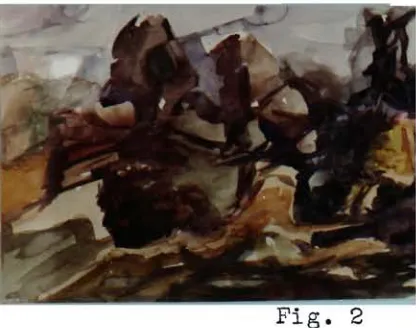
On the spotwatercolor
sketches (Figs.
8-9)
pointup
this
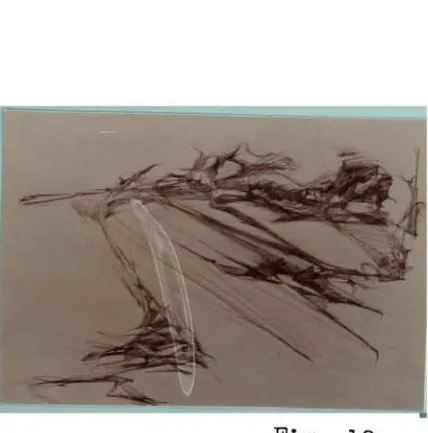
contrast.The
pendrawing
(Fig.
10)
is a linier adaptationof the same forces.
Warm color
dominates
thepainting for heat sun is asso
ciated with growth.
The
skyadds to this sense of richness
with its hot pervading green
tone.
The strong light-darkcontrast adds still more to the
sun quality.
This
is most apparent in the pen
drawing
growthstudy
(Fig.
10).
Gustave Courbetalso used this
"...thunderously
dramatic chiaroseuro. .
(9:284)
to heighten the excitement of his
vigorously
applied paint.(Fig.
11)
shows an earlystage of development in the life
of the painting. At this point
it was much too complicated a
statement to be effective. It
Fig.
14(Fig.
12).
Finally,
more smallshapes were removed to
heighten
the
dramatic
quality of small versus
large
shapes.There
is now a pleasing blendof
landscape
quality with contemporary form and color in this pic
ture.
It
has a boldness of painting
style that heightens the vigorous growth quality. Marlon as
subject has been taken over
by
design and color, and the growth
message.
Fig.
15MARION,
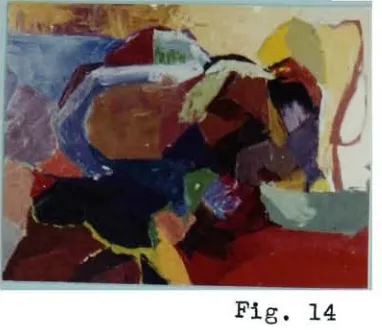
NUMBER THREEThe mass relationship of ani
mal forms is the subject of
Marion,
Number Three
(Fig.
16). Animalsare an important part of the econ
omy of Marion as it is in other
rural communities.
There is only a half-hearted
attempt to designate a certain kind
of animal for the mass relationship
docs not depend on any specific
ones.
(Fig.
14)
shows an earlystage when large block-like areas
[image:25.552.40.231.168.333.2]29
knife.
August Macke ofthe
Blue Rider
group did a picturethat is amazingly similar to
this.
It was titledCows
andCamel,
and showed the same concern for
heavy
colorinter
spersed with
brilliance.
(19:223)
Massed animals
have
apon-derousness that is surfaced over
with
twitching,
wiggling
motion.Tails
swatflies,
earstwitch,
jaws move and skin ripples. An
approach with a small brush
loaded
with thick paint producedthis effect for the placid shapes
seem to shimmer in color movement
reminiscent of Vincent
VanGogh.
"(His
work) .. .liberates colouredpaint; the bright pigments them
selves writhe, as though matter
were on the point of
taking
life."
(10:308)
The message here was simple
and
direct.
The
painting techniqueis
highly
corapatable with the mesFig.
17complicated statement of unlimit
ed
depth.
In their solidity, theanimals are of the earth. In
their shimmer of color and movement
they
personify
life Itself.MARION,
NUMBER FOURThe
family
units in Marionare the regeneration and continu
ation of the community.
(Fig.
18)
shows
Marion,
Number Four as acombination portrait-growth symbol.
The man and woman stand together
as he holds up a series of shapes
representative of germination. It
might be a potted plant or it might
be seedlings.
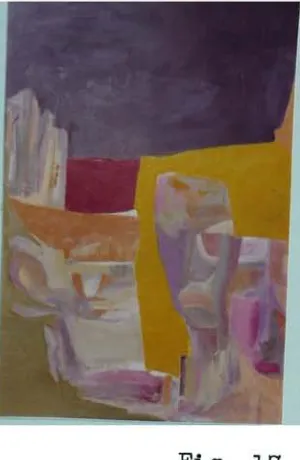
Color play and form were kept
unusual to stress the spirituality
of regeneration. The earliest
stage of
development,
(Fig.
17),
tended toward cubism with definite
geometric structure. The structure
continued but In an almost classi
cal vein.
The
unreal-out-of-thls-world shapes are reminiscent of
[image:27.552.42.192.183.413.2]33
unusual form.
(19:264)
Color
choicebecame fused
with shape design. A
heavy
colorwas required to counteract the
upward push of the arm.
The
male form seemed to demand a
vague coloration and movement
to orient the arm structure and
the frontal female
form.
Background color needed to be flat
but sharp to lend contrast to
the figures.
The
male form seemed stillto be a somewhat unresolved form
in its own right. Perhaps struc
turing
similar to the femaleshould have been used. This
could tend to sharpen the compo
sition and focus toward the
"...visionary
and symbolic humanism..."
(19:240)
of OskarKokoschka.
MARION,
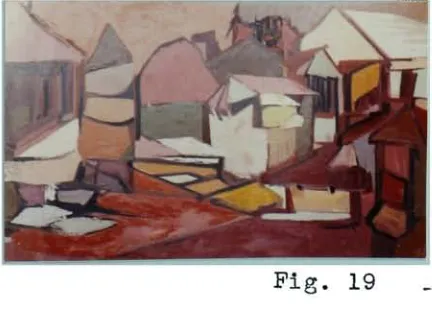
NUMBER FIVEThe fifth painting centers
Fig.
19Fig.
20reactions to nature.
Architectural
form and color were utilized to
emphasize man.
Almost
every form in the picture
(Fig.
22)
is based onman-made surfaces. This form was drawn
from man-made structures in
Marion.
The ruralness of Marion appears in
the barn and silo shape. The lock
ing
together of the forms is meantto suggest the attempted domination
of nature
by
man. Continual simplification
(Figs.
19,
20,
21)
emphasized this solidity of inter
locking
form.The overall color tone is de
rived from the redness that domin
ates the landscape. There is the
ever-present red barn with its out
buildings. In addition to
this,
Marion has an abundance of
red-brown cotolestone houses made of
lake-washed sandstone. Both the
color tone and the closed-in quality
give a strong
feeling
of place to [image:29.552.3.219.193.349.2]37
This
placenessdoesn't
seemto come through as
solely
Marion.It could be any number of places
in the world or even a stage set
lighted for the entrance of act
ors. Regionalism is taken over
by
the universal at this point.MARION,
NUMBER SIXMarion society is the sub
ject of the sixth painting,
(Fig.
27). Here there has beenan attempt to show the interact
ion of human personality. The
compact group of three figures
with its costume effect is
meant to suggest that part of
community life that is domina
ted
by
tradition and convention,and usually associated with older
people.
The
ring-a-round figuresmoving through the landscape
structures were used to suggest
progress, change, and the passage
of
time.
Color and form were once
Fig.
23Fig. 24
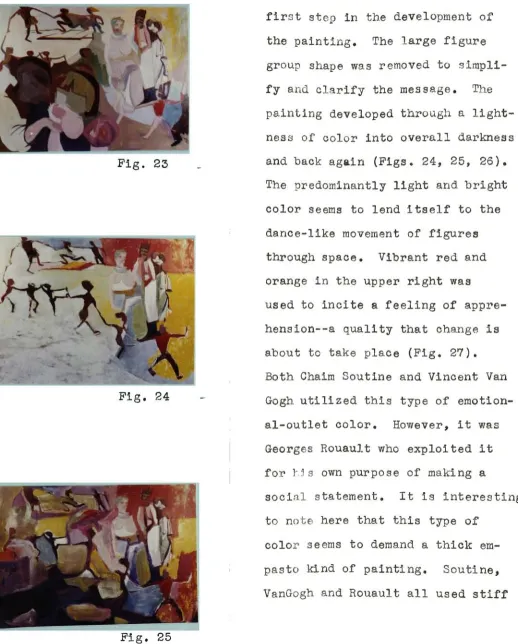
meaning.
(Fig. 23)
shows thefirst step in the development of
the painting. The large
figure
group shape was removed to simpli
fy
and clarify the message.The
painting developed through a light
ness of color into overall darkness
and back again
(Figs.
24,
25,
26).The predominantly light and bright
color seems to lend itself to the
dance-like movement of figures
through space. Vibrant red and
orange in the upper right was
used to incite a
feeling
of apprehensiona quality that change is
about to take place
(Fig.
27).Both Chaim Sou tine and Vincent Van
Gogh utilized this type of emotion
al-outlet color.
However,
it wasGeorges Rouault who exploited it
for hi a own purpose of making a
social statement. It is
interesting
to note here that this type of
color seems to demand a thick
era-pasto kind of painting.
Soutine,
VanGogh and Rouault all used stiff
[image:31.552.11.529.97.741.2] [image:31.552.2.205.100.268.2]41
paint and Marion, Number Six is
layered with heaviness.
(19:238)
This build-up gives a direct
and forceful feel to the painting,
The message incorporated in
the last painting has taken on a
universal quality. It was meant
to have a very regional feeling.
The segmented quality about
the figure group at the
top
ofthe canvas developed with the
painting. There was an unsuc
cessful attempt to exploit its
tension-giving
qualities in thefigure grouping at the lower
right.
CONCLUSION
Time,
place, work and personality have all had their op
portunity to function as the
thesis progressed.
They
haveproduced results that could be
called a synthesis of thought
1964. Interaction of one with
the other, or others, tended to
complexities of Marion and a
space-centered world.
A most important reaffirmation
occurred with the thought that
there are no absolutes. The facets
of
intellect
seem boundless asthey
solve
their
way through the problematical universe. Definitive state
ments
invariably
act as acall-to-arms arousing the singleton of
action.
The
Renaissance
concept ofindividuality
was continued into19th century art
by
Paul Cezannewith his successful attempts to
"...discover
or construct a creditable
world."'
What he saw
"...must
be made real".
(19:13)
Painting
then became the construction of
individual reality and allowed the
artist to lead man into universal
understanding.
Regional art statements that
transgress the literal Interpreta
tion of form and ally with the
43
the colloquialism.
The
excitementgenerated
by Marion,
Number
Two(Fig. 13)
is the direct result ofan expansion of
form,
color, andspace. Because of
this,
thereis an expectancy of growth--the
underlying force of
landscape.
In contrast,
Marion,
NumberOne,
(Fig. 7),
with its more precisetranslation of form emphasizes
the regional spaciousness ef
fectuated
by
thehilly,
opencountry of Marion.
The work process,
too,
helpsto define and universalize form
if the artist is sensitive to his
material.
The
interaction ofcolor and sometimes the very con
sistency of the paint suggest
developments that had not been
considered in the initial ap
proach.
The
play of vibrantred-orange against predominantly
light color in
Marion,
Number Six(Fig.
27)
is an example ofthis.
surrounding
color areas and increased the expectation and ex
citement.
The
total effect of a painting
must be a sense of rightnesssometimes called pictorial quality.
This
does not necessarily dependon total recognition of form in
tent.
It
Is in reality a balancebetween the push and pull of color,
the movement of form or shape and
the control of space.
Graham
Collier
states inForm,
Space andVision that
"...shape
and colorin painting are significant in
two ways.
They
affect our moodand suggest
ideas.
They
strikeat both the head and the heart."
(4:203)
Color
and form are thenactive elements.
Space
Is thecontainerthe controlling area
that prevents or allows movement.
Creativity
in a work of artdepends on the success of Its or
ganization as well as technical
45
extends the natural
feeling
ofthe wholeness of existence to
HI BLI OGRAPHY
1_.
Campbell,
William Gilles . Form and Style inThesis
Writing. Boston: Houghton Mifflin
Company,
1954.114 pp.
2_.
Bothers,
Ray. Pictures Painters and You. New York: PitmanPublishing Corporation, "T.51S".
277 pp.3_.
Blanshard,
Frances MargaretBradshaw.
Retreat Fromlecond
.ty
Press,
Likeness in the
Theory
of_
Painting. SecondEdition. New
York:
CbTumbTaUniversit;
1949.
1178 pp.4.
Collier,
Graham.
Form
Space andVision;
Discovering
Design Through Drawing. Englewood
Cliffs,
New Jersey:Frentice-Hall,
1964(c
1963). 256 pp.5.
Curtis,
Vera.
History
of theTown
of Marion.Cambridge,
Massachusetts: The CosmosPress,
1937. 32 pp.6.
Eliot,
Alexander. Three Hundred Years of AmericanPainting. New York:
Time
Incorporated,
1957.318 pp.
7.
Gardener,
Helen. Art Through the Ages. Fourth Edition.Revised underThe editorship of Sumner M.
Crosby
by
the Department of
History
ofArt,
Yale University.New York:
Harcourt,
Brace,
1959. 840 pp.8.
Gulamerian,
Norman B.Creativity
and the Principles~
of Oil Painting. New York: Utrecht
Linens,
Inc.,1963. 44 pp.
9.
Gulamerian,
NormanB.
TheLanguage,
of a Work ofArt.
~
New York: Utrecht
Linens, Inc.,
1963. 87 pp.10.
Levey,
Michael. A ConciseHistory
ofPainting
FromGiotto to Cezanne^ New York: Frederick A.
Praeger, 1^637
3"24
pp.11.
Lewis,
Norman (ed.). The New Roget's Thesaurus inDictionary
Form. New York: GardenCity
Books,
1'961.
b'52 pp.ip Tindbeck. John R. Design Textbook.
Bloomington,
12. ^ndlnJ0l
MoKHlf^anTiraBSrght, 1963. 163 pp.
(Cont'd.)