
Rochester Institute of Technology
RIT Scholar Works
Theses
12-14-2018
A Method for Use Phase Definition as Integrated
into an Object-Oriented Approach to Life Cycle
Assessment
Alissa Marie Santucci
Follow this and additional works at:https://scholarworks.rit.edu/theses
This Thesis is brought to you for free and open access by RIT Scholar Works. It has been accepted for inclusion in Theses by an authorized administrator of RIT Scholar Works. For more information, please [email protected].
Recommended Citation
A Method for Use Phase Definition as Integrated into
an Object-Oriented Approach to Life Cycle
Assessment
by
Alissa Marie Santucci
A Thesis Submitted in Partial Fulfillment
of the Requirements for the Degree of
Master of Science in Sustainable Engineering
Department of Industrial and Systems Engineering
Kate Gleason College of Engineering
Committee Members
Marcos Esterman, Ph.D.
Advisor
Associate Professor
Industrial and Systems Engineering Department
Kate Gleason College of Engineering
Rochester Institute of Technology
Brian Thorn, Ph.D.
Associate Professor
Industrial and Systems Engineering Department
Kate Gleason College of Engineering
Department of Industrial and Systems Engineering
Kate Gleason College of Engineering
Rochester Institute of Technology
Rochester, NY
CERTIFICATE OF APPROVAL
M.S. Degree Thesis
The M.S. Degree thesis of Alissa Marie Santucci has been
examined and approved by the thesis committee as satisfactory
for the thesis requirements for the Master of Science degree
Approved by:
Marcos Esterman, Ph.D.
i Acknowledgements
I would like to extend my sincerest thank you to all of those who helped and supported
throughout this thesis process. I would especially like to thank my primary advisor Dr. Marcos
Esterman and committee member Dr. Brian Thorn for their inspiration and continuous guidance
on this topic. My thesis and career development in the area of life cycle assessment and design for
the environment would not have been made possible without their invaluable support. I can
earnestly attribute my development in the field of sustainable engineering to both of their support
and mentorship inside and outside of my thesis work. I would also like to express my gratitude to
the RIT Industrial & Systems Engineering department for the scholarship and opportunity to
expand my expertise through the Sustainable Engineering program.
Along with the help of my thesis committee, I could not have completed this accomplishment
without the constant support from my friends and family. No matter where my life has taken me,
my parents have been a resounding source of encouragement and I would not be where I am today
without their motivation and wisdom. Finally, I would like to thank Nick Castronovo for lovingly
ii
Abstract
As global environmental concerns increase, industries continue to respond prominently to
meeting sustainable practice standards through technological innovations and new business
models. However, current sustainability measurement tools, including Life Cycle Assessment
(LCA), do not provide practitioners with sufficiently standardized methodology, which leads to
uncertainty and limited comparability of results. This research develops a systematic
Object-Oriented LCA method to define and quantify the consumed life of a product system during the use
scenario under analysis. In this method, the Cumulative Damage Function (CDF) quantifies the
consumed life of a product by using inputs of total efficiency or damage, scaling parameters and a
use scenario. By adding a systematic methodology around use parameter, scaling parameter,
damage multiplier, and energy definition there can be confidence that the framework’s CDF
accurately represents the product system use phase. In particular, the new contribution of a damage
multiplier creates a model that quantifies the unique aspects of user behavior that are otherwise
not captured by product engineering metrics. The proposed method was applied to a practical case
study to assess the effectiveness of the approach and the feasibility of modeling using SimaPro®
software. The results demonstrate that a systematic approach using common tools, such as
functional decomposition, to define use phase parameters helps remove practitioner variability and
iii
Table of Contents
Abstract ... ii
List of Figures ... v
List of Tables ... vi
1. Introduction ... 1
2. Background ... 3
2.1. ISO Framework ... 3
2.2. Importance of the Goal and Scope Phase ... 5
2.3. Constraints of Current Goal and Scope Phase Definition ... 6
2.4. Current State of Functional Unit Definition and Standardization ... 9
Dynamic LCA Framework ... 9
Literature Support of an Object-Oriented LCA Framework and Current State of Functional Unit Definition ... 16
2.5. Current Use of LCA in Product Design and Development ... 20
3. Motivation ... 23
4. Problem Statement... 25
5. Proposed Methodology ... 26
5.1. Updates to LCA Framework ... 26
Refinement of the ‘Allocation’ function and Cumulative Damage Function ... 27
Systematic Definition of Use Parameters and Scaling Parameters ... 29
Step 2a: Defining Product Use Parameters ... 32
Step 2b: Defining Situational Use Parameters ... 35
Step 2c: Defining Human Use Parameters ... 36
Step 2d: Converting Use Parameters to Scaling Parameters ... 38
Identification of System Damage Multipliers ... 42
Establishing a Methodology Step for Use Phase Energy ... 46
Step 3: Quantifying Use Phase Energy ... 46
6. Case Study ... 48
6.1. Overview and Product System Choice ... 48
6.2. Object-oriented Life Cycle Assessment Application ... 51
Goal and Scope Definition ... 52
Life Cycle Inventory and Impact Assessment ... 77
iv
SimaPro Results and Interpretation... 86
6.3. Sensitivity Analysis ... 90
Regional Use Phase Electricity Sensitivity Analysis ... 91
Use Scenario Inputs Sensitivity Analyses ... 94
Time Factor Sensitivity Analysis ... 96
Damage Multiplier Sensitivity Analysis ... 99
Use Scenario Parameters Sensitivity Analysis... 102
7. Conclusion and Future Research ... 106
7.1. Case Study Conclusions and Significance ... 106
7.2. Future Work ... 110
8. References ... 112
v
List of Figures
Figure 1: ISO 14040 Phases for Completing an LCA ... 3
Figure 2: Visual Representation of How Each Framework Proposition is Implemented through a Methodology Step ... 10
Figure 3: Detailed Use Phase Boundaries within LCA Boundaries Context... 12
Figure 4: Integration of Proposed Methodology Steps to Define Use Parameters and Conversion to Scaling Parameters into the Pre-established Framework Steps ... 31
Figure 5: Example Functional Definition of Nail Clipper Product System ... 31
Figure 6: Example Functional Decomposition of Nail Clipper Product System ... 33
Figure 7: Types of use parameters and which factors they convert to and help quantify ... 39
Figure 8: Eureka Quick Up 2-in-1 Vacuum LCA System Boundaries ... 54
Figure 9: Functional Definition of Eureka Quick Up 2-in-1 Vacuum System ... 55
Figure 10: Functional Decomposition of Vacuum System ... 58
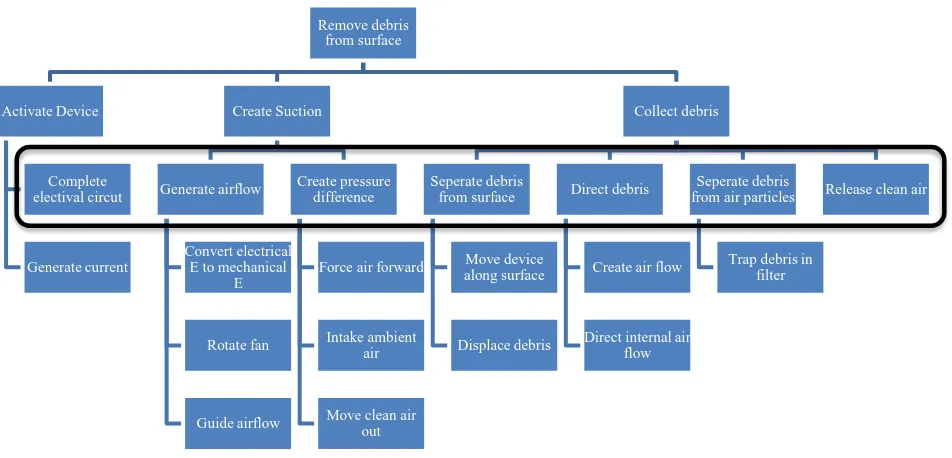
Figure 11: Second Iteration of 'Remove Debris from Surface' Functional Decomposition ... 60
Figure 12: Third Iteration of 'Remove Debris from Surface' Functional Decomposition ... 61
Figure 13: Vacuum Case Study Use Scenario Input Parameters ... 76
Figure 14: Vacuum Case Study Use Scenario Calculated Parameters ... 76
Figure 15: Vacuum Assembly Raw Material Modeling in SimaPro ... 83
Figure 16: Vacuum Distribution Transportation Modeling in SimaPro ... 84
Figure 17: Dust Filter Consumable Life Cycle Modeling in SimaPro ... 84
Figure 18: Vacuum Disposal Scenario Modeling in SimaPro ... 84
Figure 19: Vacuum System Life Cycle Modeling in SimaPro ... 85
Figure 20: Vacuum Life Cycle Global Warming Potential Results ... 88
Figure 21: Vacuum Life Cycle ReCiPe Endpoint H/A Results ... 88
Figure 22: Vacuum Product System ReCiPe Endpoint (H) Results Network ... 89
Figure 23: Germany Use Phase Electricity Sensitivity Analysis Results Shown as the Vacuum Life Cycle Global Warming Potential ... 92
Figure 24: Brazil Use Phase Electricity Sensitivity Analysis Results Shown as the Vacuum Life Cycle Global Warming Potential ... 92
vi
Figure 26: Time Factor Sensitivity Analysis Life Cycle GWP Results... 98
Figure 27: Time Factor Sensitivity Analysis Life Cycle ReCiPe Endpoint H/A Results ... 99
Figure 28: Damage Multiplier Sensitivity Analysis Calculated Parameters ... 100
Figure 29: Damage Multiplier Sensitivity Analysis IPCC GWP 100a Results ... 101
Figure 30: Damage Multiplier Sensitivity Analysis Life Cycle ReCiPe Endpoint H/A Results 102 Figure 31: Use Scenario Parameters Sensitivity Analysis Calculated Parameters ... 103
Figure 32: Use Scenario Parameter Sensitivity Analysis IPCC GWP 100a Results ... 104
Figure 33: Use Scenario Parameter Sensitivity Analysis ReCiPe Endpoint H/A Results ... 104
List of Tables
Table 1: Example Mapping of 2nd Level Decomposition Sub-functions to Use Parameters ... 34Table 2: Example Situational use parameters and the associated interfacing system of the 'remove excess length of fingernail’ system ... 36
Table 3: Example human use parameters and their associated user aspect category of the 'remove excess length of fingernail’ system ... 38
Table 4: Example Use Parameter Conversation to Scaling Parameters and Scaling Unit Definition of the 'remove excess length of fingernail’ system ... 41
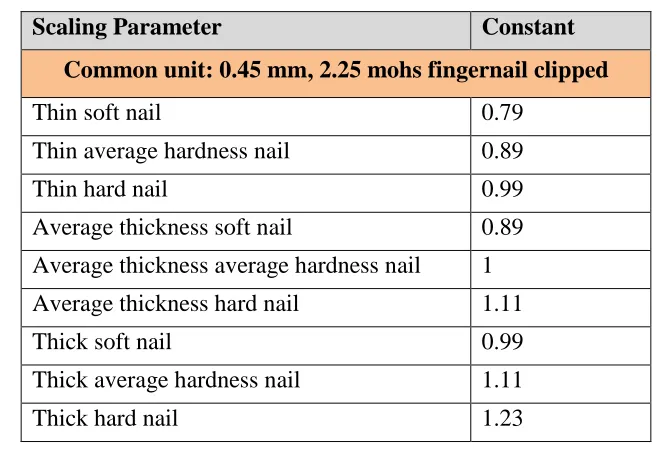
Table 5: Example Constant Scaling Parameter Quantification of the 'remove excess length of fingernail’ system ... 42
Table 6: Example damage multiplier identification of the 'remove excess length of fingernail’ system ... 45
Table 7: Example damage multiplier quantification of the ‘remove excess length of fingernail’ system ... 46
Table 8: Characteristic target criteria for system selection ... 49
Table 9: Characteristic target criteria for final system selection (based on LCA constraints) ... 49
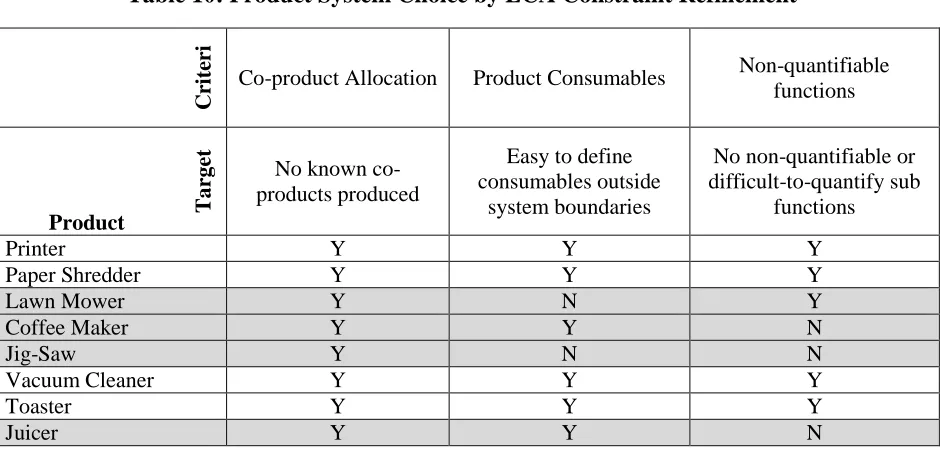
Table 10: Product System Choice by LCA Constraint Refinement ... 50
vii Table 12: Second Iteration Mapping of 3rd Level Decomposition Sub-functions to Product Use
Parameters ... 60
Table 13: Third Iteration Mapping of 3rd Level Decomposition Sub-functions to Product Use Parameters ... 61
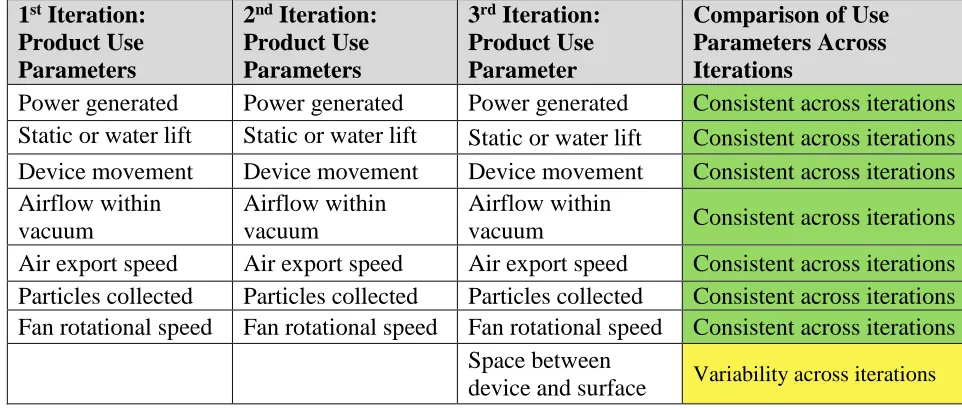
Table 14: Comparison of 3 Iterations of 'Remove Debris from Surface' Functional Decomposition Resulting Product Use Parameters ... 62
Table 15: Situational use parameters and the associated interfacing system of the 'remove debris from surface' system ... 65
Table 16: Use Parameter Conversation to Scaling Parameters and Scaling Unit Definition ... 67
Table 17: Quantification of Scaling Factors and Use Scenario Parameters ... 68
Table 18: Quantification of Time Factors ... 68
Table 19: Quantification of Damage Multiplier Range and Use Scenario Values ... 70
Table 20: Transportation for Eureka Quick Up 2-in-1 Vacuum and Dust Filter ... 74
Table 21: Life Cycle Inventory Data for Eureka Quick Up 2-in-1 Vacuum Cleaner ... 77
Table 22: Life Cycle Assumptions of the Eureka Quick Up 2-in-1 Vacuum Cleaner ... 80
Table 23: IPCC GWP Electricity Use Results Comparison ... 93
Table 24: Quantification of Sensitivity Analysis Use Scenario Parameters ... 94
Table 25: Quantification of Sensitivity Analysis Time Factors ... 95
1
1.
Introduction
Every day companies manufacture and distribute products while customers use and dispose
of products. Companies should consider the environmental impacts throughout the manufacturing,
distribution, use and disposal of a product to minimize negative environmental impacts. There are
many different environmental assessment tools to consider product environmental impacts
including risk assessment, environmental performance evaluation, environmental auditing, and
environmental impact assessment. Most of which implement measurements in terms of relative
ratings that results in shifting of burdens ("ISO 14040," 2006). This is referred to as the “less is
better” approach by which a product system that causes less environmental impact is rated more
positive than an alternative with the same function (Owens, 1997). A Life Cycle Assessment
(LCA) on the other hand, is the only tool which uses quantitatively deterministic measurements to
convey results (Klöpffer, 1997). Even from the start of LCA methodological development around
1970 it was clear that there are many benefits of conducting this type of environmental assessment
over others.
From 1990 to 1993 SETAC (Society of Environmental Toxicology and Chemistry) and
SETAC-Europe developed a “code of practice” as the first effort to regulate the method of
conducting an LCA. This code distinguished four components including goal and scope definition,
life cycle inventory analysis, life cycle impact assessment, and life cycle improvement assessment
(Rebitzer et al., 2004). The overall intent of carrying out an LCA is to determine the environmental
impacts associated with a product system from ‘cradle to grave’, which includes everything from
raw material extraction, energy acquisition, material production, manufacturing, use, recycling,
and the ultimate disposal ("ISO 14040," 2006; Klöpffer, 1997; Rebitzer et al., 2004). This ‘cradle
to grave’ approach is a big part of what makes the LCA tool irreplaceable, because when taking
the entire life cycle into account the problem of shifting environmental impacts to unaddressed life
cycle stages is avoided (Finnveden, 2000).
Another commonly recognized advantage of conducting an LCA is that it is the only tool
that allows for the comparability of environmental consequences that arise from two different
products (Finnveden, 2000). Assessment results could also be used for system optimization,
2 identify trade-offs in materials, energy, and releases (Finnveden, 2000; Klöpffer, 1997; Owens,
1997). While initial LCA studies were mostly concerned with comparing product packaging,
studies have now been applied to numerous systems for many different purposes (Klöpffer, 1997).
LCAs can be applied to the needs of various stakeholders including government organizations,
non-governmental organizations, public policy makers, private industry sectors, and essentially
any other type of decision maker (Finnveden, 2000; Rebitzer et al., 2004).
As the LCA tool became more widely used through the twentieth century it quickly became
evident that analysts would produce different and sometimes conflicting results for the same
system depending on the methodological choices (Russell, Ekvall, & Baumann, 2005). These
discrepancies highlighted the need for a more rigid LCA standardization framework. Based off of
the SETAC “code of practice” the International Organization for Standards (ISO) created the
14040 framework, which outlines the main principles of an LCA for practitioners to use. Later,
the ISO created the 14041 framework, which details the requirements and guidelines to conduct a
more accurate LCA (Klöpffer, 1997). Ultimately the goal was, and continues to be, the
establishment of a set of stringent requirements that help practitioners to develop the most accurate
presentation, assessment, and interpretation of LCA results (Cooper, 2003). This move towards
3
2.
Background
2.1.
ISO Framework
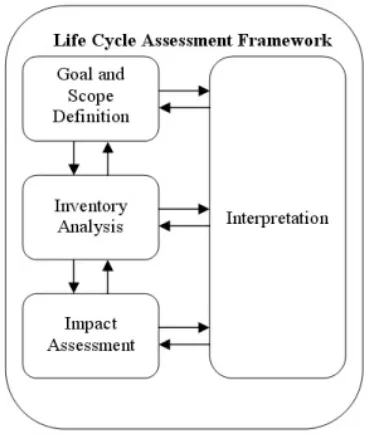
There are four defined phases in the ISO 14040 LCA standard which includes the goal and
scope definition, inventory analysis (LCI), impact assessment (LCIA), and interpretation ("ISO
14040," 2006) (see Error! Reference source not found.). The goal and scope phase describes the product system in terms of system boundaries, a functional unit, reference flows, and defines the
necessary assumptions and methods used in later phases (Klöpffer, 1997; Reap et al., 2008a;
Rebitzer et al., 2004). A functional unit is defined by the ISO as “…a measure of the performance
of the functional outputs of the product system” and its purpose is “to provide a reference to which the inputs and outputs are related…[and]…to ensure comparability of LCA results”. The reference
flows are then defined as the amount of product necessary to complete the assessment per
functional unit including the type and quantity of materials and number of material replacements
during the analysis lifetime (Cooper, 2003; Frijia et al., 2012). When completing the goal and
scope phase the most important factors to consider are the systems unit processes, life cycle stages,
[image:14.612.214.398.419.637.2]impacted geographical area, and the relevant time horizon (Reap et al., 2008a).
4 The thorough definition of the goal and scope phase is critical in order to carry out a
comprehensive assessment and to best identify the impact areas the assessment focuses on
(Bousquin, et al., 2012). The following section will discuss in greater detail why this first phase of
conducting an LCA is so vital to the entire assessment. More specifically, how the choices and
assumptions that the practitioner makes with respect to the goal and scope phase influence the
accuracy, comparability, and credibility of the LCA results (Rebitzer et al., 2004).
The second phase of an LCA is the inventory analysis, which is the compilation, tabulation,
and preliminary analysis of all environmental exchanges associated with the product system in
study (Rebitzer et al., 2004). This phase is the central data component of the whole assessment and
it is the most developed of the four phases (Klöpffer, 1997). Once the flows of material and energy
into, though, and out of the product system are defined and quantified using the most relevant data
sources, the practitioner can proceed to the impact assessment phase (Reap et al., 2008a). While a
study could culminate after the LCI is complete, the results are only useful for a comparative
assessment when the full impact assessment is done. LCI results on their own provide useful
information for product improvements, benchmarking, energy savings, and emission reduction
(Klöpffer, 1997).
During the impact assessment phase the inventory data is converted into environmental
impact estimates using a process of classification, characterization, normalization, and weighting
(Klöpffer, 1997; Reap et al., 2008b). These impact estimates are associated with different classes
of environmental issues, known as impact categories. For each of these categories a life cycle
impact category indicator is selected and the results are calculated in terms of these selected
indicators ("ISO 14040," 2006). Many different impact categories have been created, some more
commonly used than others, but only the categories with indicators of Global Warming Potential
(GWP) and Ozone Depletion (ODP) have international consensus on their use and validity
(Klöpffer, 1997).
The fourth phase of an LCA is known as the Interpretation phase; however this process
usually occurs throughout the assessment ("ISO 14040," 2006; Reap et al., 2008b; Rebitzer et al.,
2004). Based on inventory and impact assessment data the interpretation aims to formulate a
critical evaluation of the whole LCA, link the LCA with external applications and formulate
5 product systems impacts on the environment is a function of a limitless number of variables
including location, medium, time, rate of release, route of exposure, natural environmental process
mechanisms, distribution in environmental media, etc. (Owens, 1997). Overall, interpretation aims
to emphasize the strengths and limits of an LCA study in relation to the goal and scope definition.
In addition, the interpretation should not bias the fact that LCA results are based on a relative
approach that indicate potential environmental effects and do not predict actual impacts ("ISO
14040," 2006).
The ISO 14040 framework explicitly states that “it does not describe the LCA technique in detail, nor does it specify methodologies for the individual phases of the LCA”; rather its
purpose is to describe the essential principles and general guidelines (1). There is no single way to
conduct an LCA as long as the methods are in accordance with the ISO framework, the intended
application as defined in the goal and scope phase, and the requirements of the practitioners’
organization then the study will be generally accepted. However, it is detailed that specific
requirements must be applied to an LCA study when it is intended to be used as a comparison
disclosed to the public ("ISO 14040," 2006). The ISO is continually recognizing the need for
greater standardization in the LCA methodology in order to increase study acceptance and
compatibility, but the actual execution of this standardization has not yet been seen for the goal
and scope phase (Finnveden, 2000; Rebitzer et al., 2004).
2.2.
Importance of the Goal and Scope Phase
Thoroughly completing the goal and scope phase is imperative to an LCA study because
of the implications this phase has on the rest of the study. During the goal and scope phase, the
functional unit defines what is being studied so that all inputs and outputs in the LCI, and
subsequently the entire LCIA, are related to a common unit of measure. Owens 1997 goes as far
as to state that the functional unit is the LCA mathematical “inventory accounting measurement of efficiency”. This unit reference is also necessary to ensure that results are comparable to other
product systems with the same function or other LCA studies (Bousquin et al., 2012; "ISO 14040,"
2006; Judl et al., 2012). Along the same lines, the definition of the system boundaries must be
based on the most repeatable, objective, and scientific based information possible because
6 (Reap et al., 2008a; Rebitzer et al., 2004). The definition of the system boundaries is highly
dependent on the context of the study and the assumptions of the practitioner (Bousquin et al.,
2012). Since the boundary definition is not a standardized process it is an application-dependent
methodology contingent on the environmental, economic, or social consequences of the decisions
and position of the decision makers and study stakeholders (Wenzel, 1998). The goal and scope
phase as a whole is essential as it effects each of the subsequent phases including the raw data
standardization, identification of the impact areas of focus, and the credibility and confidence of
the results (Bousquin et al., 2012; Owens, 1997; Reap et al., 2008a).
Rebitzer et al. (2004) point out that throughout the ISO 14040 framework, statements such
as “…depending on the goal and scope of the LCA” are used without any thorough description of
how to define the goal and scope or how it should ultimately affect the assessment (703,705,709,
714). The ISO 14040 standard states the “the depth and the breadth of LCA can differ considerably
depending on the goal [and scope] of a particular LCA”, which specifically highlights how
important the comprehensive and standardized definition of this phase is to conducting an accurate
LCA (V). Given how involved a full LCA study is in addition to how critical the goal and scope
definition is, the thorough, well-justified, and transparent definition of the study context, functional
unit, and system boundaries can easily add credibility and confidence to the results. While some
argue that a more involved goal and scope definition would require more data and time with little
value added, the implementation of standardized methodology could add significant value to the
assessment while not requiring much more added expenses (Reap et al., 2008a).
2.3.
Constraints of Current Goal and Scope Phase Definition
Methodological standardization is specifically needed for the initial phase of an LCA
because of the impact that the functional unit definition has on the entire assessment. When
establishing the study context and system boundaries, it is important to consider that the scale of
inclusion will directly affect how the product system function is defined. If too narrow of a
perspective is taken there will be variation in the function of a product system as compared to its
alternatives (Rebitzer et al., 2004). Expanding system boundaries can help ensure consistent
function definition of alternative product systems, but this also drastically increases the need for
7 Once again, the ISO 14040 framework remains vague and subjective on this matter by simply
stating that the selection of a system function is dependent on the goals and scope of the study
instead of outlining a reliable method (Cooper, 2003; Hischier & Reichart, 2003; "ISO 14040,"
2006). Once a function is assigned to the product system, the methodological concerns continue,
as the function must be quantifiable in a reliable and scientifically measurable way in terms of the
functional unit and reference flows (Hischier & Reichart, 2003).
In many LCA studies there are complications surrounding the definition of the functional
unit and its associated reference flows. As a result, functional units tend to be over simplified or
insufficient in a way that only the main system function is captured and the parameters do not
represent all of the system effects (Collado-Ruiz & Ostad-Ahmad-Ghorabi, 2010; Finkbeiner et
al., 1997). While following the current LCA methodology framework, there are often many
different functional units a practitioner can choose from, all of which are correct. However,
different functional units for the same product system lead to different and possibly incorrect
results (Finkbeiner et al., 1997; Hischier & Reichart, 2003; Reap et al., 2008a). If an assessment
is vague in its functional unit definition or if there are noted issues, the confidence in the final LCA
results significantly decrease (Reap et al., 2008a). Due to the documented inconsistencies
surrounding functional unit definition, the resulting concentrations of emissions and other
environmental impacts are only potential or hypothetical effects (Klöpffer, 1997).
The most notable sources of functional unit complication or error include:
Missed or wrongly specified or prioritized system functions
Over broadening and simplifying the functional unit
Narrowing the functional unit such that it does not capture the entire system
Assigning functional units to non-quantifiable or difficult-to-quantify functions
Inconsistent methods of dealing with multi-function product systems
Uncertainty in product use scenarios and system dependencies
Making strict, functionally-equivalent system components
Many product systems have functions or components to them that are non-quantifiable or
difficult-to-quantify, but are still important to the product systems life cycle. Some of these
8 proxies or subjective units or measure to define the functional unit and therefore cause a lack of
confidence in the LCA results (Reap et al., 2008a).
Another source of error comes from assessing products that have multiple functions. If a
narrow or limited-in-scope functional unit is used on a multi-functional product system then
relevant environmental impacts will most likely not be captured in the results. However, if the
reference unit is too broad it creates the need for more assumptions and once again will most likely
not appropriately capture the environmental impacts in the results (Bousquin et al., 2012; Hischier
& Reichart, 2003). Consequently the practitioner should identify, decompose, specify, and/or
prioritize the various functions appropriately with respect to the study so that the functional unit
reflects reality as accurately as possible (Reap et al., 2008a). Even with the use of a logical
methodology, functional unit definition remains complicated in a multifunction system because of
the need for an assumption laden goal and scope phase and because of the various outputs that the
single product can produce (Bousquin et al., 2012). There is a great deal of criticism surrounding
the amount of subjectivity that the ISO standards allow, which leads to inaccurate functional unit
definition and little confidence in LCA results.
The use phase of a product’s life cycle is especially biased towards the practitioner’s
assumptions because the use of many products cannot be well generalized to fit all consumer
patterns. When the use scenario and external system dependencies are not certain, functional unit
definition remains ambiguous, as the practitioner must assume what scenario best reflects reality.
If a functional unit is defined in a very ridged manner based on generalized life cycle assumptions
there is a greater chance for error throughout the LCA because there is no scientific standardized
reasoning behind the methodology (Reap et al., 2008a). These general assumptions also lead to
potentially inaccurate comparative life cycle product system assessments. In many cases it cannot
be definitively determined if one product is environmentally preferable over another product
because results and conclusions are not consistently produced (Finnveden, 2000). While this lack
of consistency in results stemming from variable functional unit definition is the main contributor
to lower confidence in comparative LCA studies, it is also difficult to objectively decide which
product system is better because results dependent on the impact category prioritization (Klöpffer,
9 of incomparability between LCA results (Reap et al., 2008b), but will not be addressed in this
study as it is outside of the goal and scope context.
Overall, the lack of structure in functional unit definition during the goal and scope phase
is a critical gap in LCA methodology. If this issue is solved, most all of the discussed limitations
will be resolved and confidence in LCA results will increase significantly (Cooper, 2003; Klöpffer,
1997; Reap et al., 2008a)
2.4.
Current State of Functional Unit Definition and Standardization
With the widely recognized lack of structure in LCA methodology put forth by the ISO
standards, multiple studies have developed and tested methods that attempt to standardize
functional unit definition in the goal and scope phase (Finkbeiner et al., 1997; Frijia et al., 2012;
Judl et al., 2012; Kwak et al., 2012; Ruhland et al., 2000). A comprehensive review of the attempts
to standardized functional unit definition can be found in Fumgalli (2012) and Esterman et al.
(2012). In those same works, a framework for what would ultimately become an
Objected-Oriented approach for LCA was developed (Fumgalli 2012; Esterman et al., 2012). In this section,
the framework developed by Fumagalli (2012) will be critically reviewed. This will be followed
by a review of works that support this approach, as well as a summary of the state of the art in
functional unit definition. This section will close with a review of the role of LCA in product
development. Ultimately, the literature presented in this section reaffirms that while there has been
attention given to developing a more reliable functional unit methodology, no current method has
sufficiently achieved this goal.
Dynamic LCA Framework
Many of the shortcomings that are identified above in the LCA goal and scope phase
definition can be resolved with the implementation of an object-oriented LCA methodology. The
starting point for this framework is derived from the Dynamic LCA methodology works of
Fumagalli (2012) and Esterman et al. (2012). The Dynamic LCA Framework used systems
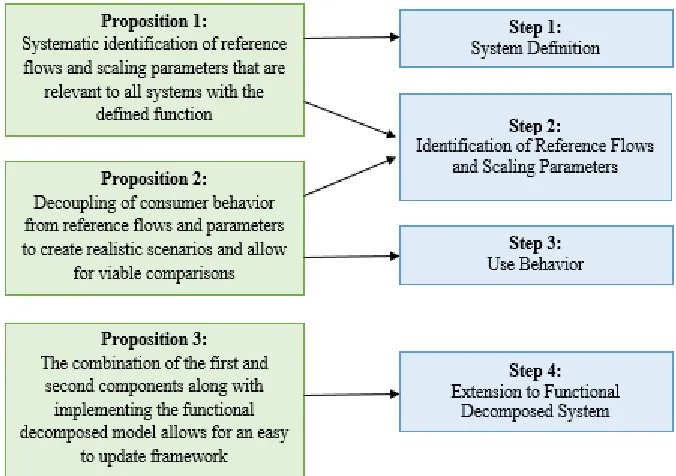
10 implementation steps. Figure 2 shows how each of the three propositions are implanted through
[image:21.612.135.473.157.395.2]methodology steps.
Figure 2: Visual Representation of How Each Framework Proposition is Implemented through a Methodology Step
The first proposition rigorously defines the enclosing system of interest by defining system
inputs and outputs so that LCA reference flows and scaling parameters can be systematically
identified. It should be noted that this process of defining boundaries related to the use phase (as
opposed to the system boundaries of the entire LCA). This process is of great importance because
the failure to fully understand and define what flows are linked to product usage could lead to a
limited object-oriented model and an increase the difficulty of implementing the framework.
The second proposition decouples consumer behavior from the defined LCA reference
flows and scaling parameters so that accurate and complete use scenarios can be constructed. This
allows comparison of LCA results between product systems that may use radically different
11 The third proposition leverages the first two propositions to suggest that a functionally
decomposed model allows for an object-oriented approach where the modeling techniques of
proposition 1 and 2 are recursively applied to the functionally decomposed model. This leads to
an approach that is dynamic in nature and easy to update as data quality improves.
Fumagalli’s (2012) research highlighted the importance of the first two propositions to
ensure that everything that is common to every product in that system class has been set up so that
the appropriate parameters to build complete use scenarios can be defined and derived. The three
propositions are implemented in a cohesive four-step framework in: System definition,
Identification of use and scaling parameters, Use behavior, and replication of these steps on a
functional decomposed system. It should be noted that this last step was the subject of work by
Gadre (2016) and Deo (2016), while the focus of this work is on the use-behavior.
Step 1 – System Definition
In both LCA work and Systems Engineering, establishing the system boundaries is a
well-established principle. According to the ISO 14040 framework, “The system boundary defines the
unit processes to be included in the system.” LCA system boundaries are based on physical aspects
of the system including manufacturing processes (12). In comparison, Systems Engineering
defines system boundaries in a more abstract manner.
This framework adapts a model of system boundary definition from Hull et al. (2005) in
which system functionality is used instead of the traditional use of physical systems or
manufacturing processes (Reference error). While the systems engineering approach is important
to consider in this framework based off of well-established systems concepts, the boundaries are
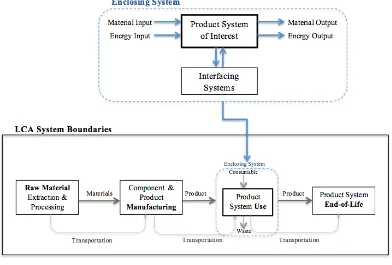
not the same as those defined by an LCA. The ‘Enclosing System’ boundaries shown in Figure 3
represent the life cycle use phase boundaries, which is an integral part of the larger LCA study
system boundaries also shown in Figure 3. It is critical to the object-oriented framework that the
use phase boundaries and the corresponding parameters are well defined. It is worth emphasizing
that the flows that are identified within the enclosing system do represent all flows, but only the
12 By systematically defining the system of interest use phase boundaries the LCA will be
constrained so that the use and parameters can be scaled to use behavior scenarios. This is the
essence of what makes this framework dynamic; enabling comparability and use phase updating
[image:23.612.111.503.175.440.2]of the system analysis without reproducing the entire life cycle inventory
Figure 3: Detailed Use Phase Boundaries within LCA Boundaries Context
The product system of interest as labeled in Figure 3 is described by standard functional
analysis as an active verb-noun pair. The verb describes the principal function of the system and
the noun describes the object flow involved in the defined function (R. Stone & Wood, 2000). The
function must remain at a high level of abstract as to ensure that it is solution independent and can
consider a wide range of scenarios. The three flows considered in functional analysis applications
are energy, material and information. In the case of an environmental impact assessment the
information flow is not relevant in the sense that it is typically encoded with an energy signal and
displayed using material resources so it can be accounted for with these two flows. Within the
13 phase system inputs and outputs. However, this the work will consider this limitation in
standardization.
A critical part of this first framework step is to establish the system material and energy
transformations because these are what help to define the use and scaling parameters for the
established class of systems. While a previous function unit standardization attempt suggests
defining every possible scaling parameter based on all applications (Collado-Ruiz &
Ostad-Ahmad-Ghorabi, 2010) that is not necessary in this object-oriented LCA framework because of
the unique system boundary definition. As stated previously, this framework considers the
common flows to all systems of interest.
The final features to this first framework step of system definition are to identify the
enclosing system and the interfacing systems. Defining the enclosing system (e.g. Earth’s
gravitational field) establishes the context of the system of interest. The context is further refined
when the interfacing systems (e.g. transportation system) common to all systems of interest are
defined.
Step 2 – Identification of Use and Scaling Parameters
After the system boundaries have been defined through the process defined in Step 1, the
system relevant use and scaling parameters must be identified. The use parameters are inherent to
the system thus the system and boundary definition will help to identify them. The parameters
must be in terms of the system use phase input or output flows and must correlate to ultimate
system impacts in order to enable object-oriented modeling. It is important that the practitioner
keeps in mind two aspects when completing this step, first that the relevant parameters must be
abstract enough to remain technology and solution independent. Second, the parameters must be
ultimately scalable by consumer use patterns. If these considerations are neglected the
14 Step 3 – Use Behavior
Use behavior is important to identify for the accuracy of a life cycle assessment because it
reflects the end-user impacts. However, when use behavior is integrated into the functional unit
definition the comparability of LCA study results becomes limited. Fumagalli (2012) points out
that “by decoupling use patterns from the functional unit definition, a more structured inventory and impact analysis can be conducted in terms of the reference flows and scaling parameters…”
(41). The dynamic and object-oriented aspects of this LCA framework is contingent upon the
ability of the defined use and scalable parameters to be changed based on different use scenarios.
Direct and indirect scaling should be considered. Direct scaling refers to the case when the life
cycle inventory (LCI) can be scaled as a direct function of the defined use scenario parameters. In
comparison, indirect scaling requires the flows to be allocated in proportion to the product unit of
interest as a function of the use scenario parameters. In order to systematically account for this
scaling this framework defines a “Cumulative Damage Function”, which considers that as a
function of the system usage parameters, a certain measure of the unit ‘life’ will be consumed.
Equation 1
𝐴𝑙𝑙𝑜𝑐𝑎𝑡𝑖𝑜𝑛 (%) =
𝑐𝑜𝑛𝑠𝑢𝑚𝑒𝑑 𝑙𝑖𝑓𝑒
𝑙𝑖𝑚𝑖𝑡 (𝐿
𝐹, 𝐿
𝑂𝐵𝑆, 𝐿
𝑁𝐸𝐸𝐷)
Where:
Allocation % = gives the total % of the bill of materials to be quantified in the LCI Consumed Life = represents the use scenario under analysis
LF = the limit due to failure
LOBS = the limit due to obsolescence
LNEED = the limit due to the lack of need of the product under analysis
The input variables of the Cumulative Damage Function as outlined in Equation 1 are the
use parameters. It is important to reiterate that these usage parameters are consistent for all systems
that provide the same function regardless of technology. The limit of the product system life is
contingent upon the functional limit of the system, the market obsolesce of the class of systems,
and the actual system end-of-life disposal. The Cumulative Damage Function specifically defines
15 the output of the function indicates how much of the product’s bill of materials is quantified and
allocated in the impact assessment phase.
The dynamic and object-oriented aspect of this framework is permissible through the
representation of different use scenarios, which enables the creation of workflows. It is critical to
the assessment that these workflows represent equivalent tasks completed by the alternative
technologies of interest instead of equivalent “operating regimes”, which are technology
dependent. While the current state of this framework can accommodate the assessment of different
workflows that represent equivalent tasks, there are no guidelines for ensuring this equivalency.
Step 4 –Extension to Functional Decomposed System
Continuing along the same level of abstraction introduced in this framework the
functionality of the product can be further decomposed into sub-functions. The first three steps of
this framework can then be applied to these sub-functions. Functional modeling is a
well-established tool used to decompose the functionality of a product and understand the system in a
manner independent of the physical product structure (R. Stone & Wood, 2000). Building off of
the initial Dynamic LCA Framework, Gadre (2016) and Deo (2016) re-established the framework
title as ‘object-oriented’ to better align with the purpose of the framework. Gadre (2016) then
demonstrated through case study application that when an object-oriented LCA framework is
applied to product sub-functions it successfully creates foundational blocks of the environmental
impact assessment. Further demonstration of the successful implementation of an object-oriented
LCA framework is in Deo’s (2016) work, which develops and implements a framework for
quantifying the Cumulative Damage Function using concepts from Remaining Useful Life (RUL),
16
Literature Support of an Object-Oriented LCA Framework and
Current State of Functional Unit Definition
As described, the proposed object-oriented LCA methodological approach to goal and
scope phase characterization and specifically the functional unit definition has a framework of
three main propositions. These include:
1. Systematic identification of use and scaling parameters that are relevant to all
systems with the defined function
2. Decoupling of consumer behavior from use and scaling parameters to create
realistic scenarios and allow for viable comparisons
3. The combination of the first and second components along with implementing the
functional decomposed model allows for an easy to update framework as data
quality improves
Each of the propositions have been used individually or as two concepts together in LCA studies
in an attempt to create a more methodologically standardized functional unit definition, however
all three have never been implemented into a coherent framework. The integration of this
framework uses an object-oriented LCA model, which allows for the manipulation and subsequent
updating of the model over time. Additionally, dynamic modeling has been cited to improve the
spatial variation and local environmental uniqueness problems often seen in LCA studies (Reap et
al., 2008). The multiple LCA studies presented here reinforce the propositions of the proposed
framework and act as evidence that these individual concepts are justified and useful in their
application to functional unit definition to increase confidence in results and comparability. In
addition, the literature presented here reaffirms that while there has been attention given to
developing a more reliable functional unit methodology, no current method has sufficiently
achieved this goal.
Kwak et al. (2012) conducted a comparative life cycle assessment of complex heavy duty
off road equipment in an attempt to offer an objective means of comparing different product
systems. In essence, this study implements the first framework component in order to more
accurately capture and compare the product systems during assessment. The practitioners define
17 but do not implement any sort of methodical functional analysis. The function definition merely
maintains a relatively high level of abstraction in order to ensure all aspects of the systems are
captured.
The difficulty in their assessment arises during the functional unit definition because the
two products have different levels of productivity, which results in different aging of the machines
and therefore varying lifespans of use. Traditionally with heavy machinery the functional unit
would be defined as the same amount of operation hours, but since that unit would not accurately
capture the comparison of the systems of interest Kwak et al. (2012) implement seven steps to
define the functional unit as the same amount of total production. Ultimately, the functional unit
reflects that one machine conducts the same amount of work with less power in a shorter amount
of time so that it has longer lifetime expectancy. For the machine with a longer lifespan, only a
fraction of the total lifecycle is accounted in order to conduct an equal comparison.
While the system is well defined through this method so that the use and scaling parameters
are systematically identified to reflect reality accurately, consumer behavior remains integrated
into the functional unit definition in a fixed manner so that there is no room for object-oriented
modeling of the use phase. The results of this study support the knowledge that environmental
impacts vary based on different customer use patterns and usage differs widely from customer to
customer (Kwak et al., 2012). While Kwak et al. (2012) state that “Future work will examine how
the benefit of each machine changes if the machine is used differently”, this would not be necessary
if the framework proposed in this work would have been initially implemented to allow for
object-oriented modeling within the life cycle assessment.
Another integral part of the first framework component is the identification of the
appropriate use and scaling parameters that are specific to a particular system’s functionality. In
the LCA case study by Matheys et al. (2007) they identify the most appropriate functional units
for the assessment of different electric and hybrid vehicle batteries and determine the influence of
functional unit choice on the results. While this study lacked a thorough definition of the system
the practitioners did carefully identify the different parameters related to an appropriate functional
18 This study illustrates the critical importance of ensuring that the use and parameters are
abstract enough to remain independent of technology-based solutions. In choosing an appropriate
functional unit Matheys et al. (2007) needed to characterize the defined parameters based on if
they were “equal for all technologies” or not. This required the inclusion of parameters and the functional unit definition to be based mostly on “practical significance” instead of system
functionality.
Additionally, by defining system parameters as technology dependent the functional unit
definition became much more complicated and was most often resolved in literature by
oversimplifying the reference basis. Ultimately, this limitation most likely hindered the accuracy
of defining functional units so that they didn’t truly represented reality well enough to carry out
the goal of the study. The methodology in Matheys et al. (2007) is an example of the possible
issues of not properly implementing the first proposition of the object-oriented LCA framework.
While a relatively unsuccessful attempt was made at formalizing the functional unit definition it
is still important to point out that the practitioners of this study readily site the flaws in ISO
functional unit definition standardization especially in a product comparison assessment (Matheys
et al., 2007).
The comparability of LCAs is limited because the functional unit and system boundaries
are often defined based on generalized and fixed consumer use patterns. The lifespan of a product
system is directly related to the time in use, rate of wearing, and opportunity for repair, among
many other variables. Frijia et al. (2012) conducted a life cycle energy assessment of a building
system in order to propose and develop three aspects of LCA methodology including functional
unit definition, incorporating technological progress, and parameterization. All three of these
aspects that are targeted specifically for the building system are elements of the proposed
object-oriented LCA framework. By looking at the success of these elements in this specific case study
the framework proposed in this work can be refined and implemented with greater confidence.
Most previous LCA studies of energy in building systems take the operational phase to
include all energy use within the residence, which would require a functional unit that captures all
household activities. However, these studies exclude related customer supply chains such as food
production, appliances, and household chemicals. The second framework proposition is
19 for a more complete definition of scaling parameters and functions. While Frijia et al. (2012) points
out the need for “the functional unit and boundaries for reference flows be chosen in a consistent way”, there is no guidance provided for removing the variable of customer behavior.
The high-level function defined in their study is climate-controlled space, which focuses
on the building rather than activities in the building. Associated functional parameters are
categorized as structural, electrical, and/or plumbing components of the system and depending on
the purpose or scope of the study a functional unit can be defined to encompass the appropriate
functions not the operational phase. Results show that using the functional unit decoupled from
customer behavior yields a higher contribution from materials and manufacturing which more
accurately represents reality. This is because when using a functional unit based off the operational
phase the system boundaries were broader and many important supply chains were excluded, thus
causing a skewed perspective of minimalized materials manufacturing impacts. The study
practitioners recognize that while this study only uses an oversimplified parameter model the
implementation of more detailed LCA parameter modeling would allow for object-oriented
assessments customized to a user’s product supply chain, design and operation characteristics of
interest (Frijia et al., 2012).
The LCA methodology that most closely reflects the third proposition of the framework
proposed in this thesis is seen in Ruhland, et al. (2000). The systems function was defined along
with its associated input output flows of material and energy. By defining the functional
relationships between system flows and interacting systems this study considers the function of
metal cleaning processes much more thoroughly than any previously cited studies. The functional
unit was defined as the reference load of metal cleaning process, which is a function of the load
volume and number of loads instead of being a fixed unit. Furthermore, the practitioners used an
empirical process model to quantify the relationship between the functional unit, system
parameters, and the mass and energy flows. The individual functional parameters in this model
depend on the machine type and the technology so for each machine use a new set of coefficients
must be determined.
Similar to the object-oriented LCA framework, this study enables the parameters to be
scaled based on a specific scenario to define a functional unit for assessment. Unlike the
20 enable a practitioner to consider different uses by appropriately scaling the parameters and
allocating them to a functional unit. Additionally, Ruhland et al. (2000) consider the fact that
machines do not all operate equally and so scaled the machines to be equivalent assuming a linear
relationship between load volume and material and energy flows. While the methodology steps
implemented in this case study are object-oriented in nature, it is limited in its specific applicability
to equivalent machining technologies (Ruhland et al., 2000). Comparability between LCA studies
is greater when the modeling remains technology independent and system functionality based.
It is important to note that while the work of Reap et al. (2008a, 2008b) have been cited
over four hundred times in literature, the case studies presented in this section have only been cited
a few times each. This indicates that the issue of LCA standardization is well known, but the
forward progress towards actually standardizing assessments is limited.
2.5.
Current Use of LCA in Product Design and Development
The application of LCAs to product design is of particular interest to many manufacturing
companies because by implementing sustainable practices, companies can create a competitive
advantage and ultimately drive profitability in addition to mitigating environmental impacts. In
order to do so, a number of environmental design tools have been developed, largely categorized
as design for the environment (DFE). While there is a common consensus in industry that
environmental product development is a key issue that needs to be implemented in the early stages
of a product’s life cycle, most methods are extremely complex to understand and implement,
especially at the early design stage (Chang et al., 2014; Chiu & Chu, 2012). Most all DFE methods
integrate life cycle assessment in order to ensure that the product system is fully captured and there
is no shifting of burdens between life cycle phases (Finnveden, 2000). However, the use of full
LCAs is a major contributor to the complexity of DFE methods because LCAs require a large
amount of data, time, and cost input in addition to often producing conflicting results (Chen &
Liau, 2001; Chan et al., 2010; Russell et al., 2005; Park & Seo, 2006; Keoleian, 1993). There is a
trend towards developing simplified LCA-based DFE methods (Chen & Liau, 2001), however
even with a more streamlined approach the underlying limitations of the LCA methodology will
21 The early stages of product development have the most uncertainty because of the lack of
design data, so there is often not enough information to complete the LCA-based approach goal
and scope phase, as the ISO 14040 and 14041 currently outlines it. As a result, simplified LCA
approaches are used, which ultimately contribute to more ambiguity in the results (Keoleian,
1993). As previous sections have pointed out, LCA methodology needs further development when
it applied to an existing system. Furthermore, LCA methodology needs even more development in
order for it to be effectively applied to product design and development so that designers can take
advantage of all that a full LCA has to offer (Chang, Lee, & Chen, 2014; Park & Seo, 2006;
Klöpffer, 1997). Before developing an approach that fully overcomes the limitations and
inaccuracies inherent in LCA methodology, the current state of LCA-based product development
and design tools is considered. More specifically the focus of this review is on the concept phase
focused design tools that have attempted to tackle problems identified with the underlying LCA
methodology.
During the concept design phase of product development there is the greatest opportunity
to affect the final product, because after the concept is decided the environmental impacts are
essentially solidified (Chiu & Chu, 2012). Due to the lack of certain data during the concept
generation phase it requires the greatest amount of assumptions and computations in order to
establish the potential environmental impacts. There are both qualitative and quantitative product
design and development tools that integrate LCA approaches into the method. Generally,
qualitative methods are empirical studies that generate more reliable data collection and data
analysis techniques. Meanwhile, quantitative design tools use statistical or data mining methods
to gather data that lead to more effective environmental product design (Chang et al., 2014). In
Chang et al.’s 2014 review of over 100 LCA-based product development methodological studies care classified into ‘development of eco-concepts’, ‘classification of eco-design’, and ‘exploration
of eco-concepts’. Since this is the most up-to-date and comprehensive text mining based review
paper on the topic at hand, the current state of LCA-based product development during the concept
phase is based on this classification with some additional input.
The ‘development of eco-concepts’ entails the decisions of general product information
including shape, size, materials, function, and complexity. These elements have a relationship to
22 quantitative prediction is often utilized. Chen and Liau (2001) integrated Artificial Neural Network
(ANN) with LCA methodology in order to link conceptual data and environmental impacts.
Telenko and Seepersad (2014) developed an LCA-validated method using reverse engineering
techniques in order to determine eco-design guidelines based on existing products. While this tool
is useful in that is creates a functional basis for assessment, it does not address the underlying
issues of ambiguous functional unit definition when completing the LCA.
The concept design category of ‘classification of eco-design’ general entails methodology
developed to classify design concepts based on LCA results. Park and Seo (2006) proposed a
framework for a knowledge-based approximate life cycle assessment system (KALCAS) for
product concept development. This framework helps to identify environmental impact drivers of
high-level product attributes by grouping whole products based on environmental characteristics.
The limitation of this approach is that it is a physical object-based approach, which limits its ability
to compare products that perform the same function by a different workflow. Sousa and Wallace
(2006) developed a classification method that uses hierarchical clustering to assign products based
on certain features and their association with environmental impacts. However, this method merely
uses “meaningful general product concept descriptors” and thus fails to systematically define what
product attributes should be used in the classification.
The third concept design category of ‘exploration of design environment’ provides limited
methodology development most likely due to its time intensive nature. Heijungs et al. (2010) did
however suggest a general modeling framework or ideology that takes a comprehensive view
including product specific, life style use, and societal structure perspectives. Chang et al. (2014)
suggests “this design process framework can be used to develop more comprehensive theoretical ideas for designers”. In summary, LCA-based concept design methods for product design and
development have seen a lot of attention in recent years, but no studies address the underlying
issues of the LCA methodology.
The methodology developed in this thesis work aims to create a more standardized
approach to LCA goal and scope phase definition as applied to product development. By
establishing a more systematic and reliable assessment approach, the framework creates a method
that is simple for industry users to understand and implement, easy to update as product evolve,
23
3.
Motivation
As worldwide population grows, material needs increase, and resource availability diminishes,
it will become more critical to recognize the environmental impacts of product systems in order to
mitigate the negative effects. Environmental life cycle assessment has the potential to be an
informative tool to many stakeholders. This potential depends on how well the assessment
accurately reflects reality and how much confidence there is in the data, assumptions, results and
conclusions. Most all LCA case studies that recognize that the ambiguity in goal and scope phase
definition leads to a lack of confidence in results make an attempt at formalizing the study
functional unit and system boundary definitions. The goal and scope phase is critical to the
confidence and comparability of LCA results, but because the ISO framework provides little
structure as to how practitioners should progress through this phase, often confidence and accurate
comparability is limited. A framework has been proposed by Fumagalli (2012) and Esterman et
al. (2012) that integrates system engineering and functional decomposition into the goal and scope
phase of an LCA. This framework aims to create an object-oriented LCA model that, when refined
and implemented, will significantly improve the current state of environmental assessment. The
object-oriented LCA model will most importantly allow the possibility of scaling assessments by
user behavior.
In Fumagalli (2012) the proposed framework was applied to existing systems with the
function of ‘destroy information’ to demonstrate its usability, steps of implementation, and
potential for confidence in comparability. A paper shredder, Bunsen burner, and bin and matches
were the systems compared. The initial steps of this study maintain an abstract analysis perspective
to ensure that the technology and customer behavior are independent from functional and
parameter definition. Fumagalli’s (2012) work uses data without any testing or analysis because
the purpose of the work was to illustrate the functionality of the approach and determine potential
limitations. To carry out this purpose two phases were used. The first phase demonstrated that the
proposed framework is compatible with current LCA software (SimaPro®) and that the
methodology is versatile with respect to different use behaviors. The second phase demonstrated
that the proposed framework is compatible with LCAs comparing different technologies with
24 This initial work “consisted of a classification of issues regarding functional unit, refining
the method, developing guidelines and recommended process to be used in the goal and scope
phase of LCA, and lastly the application of the recommended framework on a detailed case study
to identify issues and determine its utility” (Esterman et al., 2012). Overall, Fumagalli’s (2012)
work concluded that the application of the framework was successful in its initial application in
terms of the potential of the methodological tool. While the proposed framework addresses
functional unit definition, boundary selection, special variation, local environmental uniqueness,
and data availability and quality, this work is still at its beginning stages.
Since the proposal of the this goal and scope phase framework, little research has been
done to implement or refine the methodology even with its significant potential to increase
confidence and comparability of LCA results. Fumagalli (2012) presents a few limitations of the
framework implementation, which could present themselves as areas of improvement through
further study. These limitations and areas of improvement include:
Systematic and exhaustive identification of use and scaling parameters
Prioritization of parameters to improve the versatility of the model
Framework for determining equivalence of workflows
Detailed functional decomposition
Application of the framework to lower levels of the decomposed model
The work presented here will explore further into the implementation barriers of the proposed
framework and refine the limitations in order to make the methodology more widely accepted and
25
4.
Problem Statement
The lack of standardization in environmental life cycle assessment methodology as defined
in ISO 14040 is an impediment for accurate results and comparability of products. This gap
provides an opportunity to propose a framework that specifies a structured standardization in
methodology with propositions, which will address current limitations. Since the goal and scope
phase of an LCA is the most critical because it effects each subsequent phase and the credibility
of results, this is the focus for standardization. Fumagalli (2012) established an initial framework
to fill the identified gap in standardization. The initial framework integrates systems engineering
tools into the traditional LCA approach in order to enable the unique abilities of adaptability to
any use scenario and comparability of any products providing the same function. Since the
proposal of this goal and scope phase framework, little work has been done to implement or refine
the methodology even with its significant potential to increase confidence in and comparability of
LCA results. The degree to which the initial framework will standardize assessment
implementation is still limited. These limitations must be thoroughly identified and resolved before
an exhaustive methodology framework can be put forth and accepted in the international LCA
community of practitioners.
The goal of this work is to continue refining and developing the Dynamic LCA framework
as its newly defined object-oriented framework. The primary focus of this study is to establish a
systematic approach to defining use parameters to ensure that the use phase is fully captured by
the Cumulative Damage Function. In addition, this study aims to refine the current framework to
be more precise in terms of terminology and to have a thorough step-by-step implementation guide.
By achieving these goals, the object-oriented LCA framework will be farther along in its
26
5.
Proposed Methodology
While standardized assessment can lead to the ability of decisions makers to better
recognize associations between product system stages and environmental consequences, it is
important to consider that ultimately industry-wide changes along with changes in consumer
behavior are the most crucial factors in reducing the environmental impacts of products (Owens,
1997; Rebitzer et al., 2004). This consideration reinforces the need for an object-oriented LCA
model that readily accounts for varying use scenarios and product workflows. This type of LCA
framework



![The New Ways to Attack AttackApplications On Operating Systems under Execshield [Xpl017Elz].pdf](data:image/gif;base64,R0lGODlhAQABAIAAAP///wAAACH5BAEAAAAALAAAAAABAAEAAAICRAEAOw==)