Theses Thesis/Dissertation Collections
5-2016
The Quality Attribute Design Strategy for a Social
Network Data Analysis System
Ziyi Bai
Follow this and additional works at:http://scholarworks.rit.edu/theses
This Thesis is brought to you for free and open access by the Thesis/Dissertation Collections at RIT Scholar Works. It has been accepted for inclusion in Theses by an authorized administrator of RIT Scholar Works. For more information, please [email protected].
Recommended Citation
A Thesis Submitted
in
Partial Fulfillment of the
Requirements for the Degree of
Master of Science
in
Software Engineering
Supervised by
Dr. Scott Hawker
Department of Software Engineering
B. Thomas Golisano College of Computing and Information Sciences
Rochester Institute of Technology
Rochester, New York
The thesis “The Quality Attribute Design Strategy for a Social Network Data
Analy-sis System” by Ziyi Bai has been examined and approved by the following Examination
Committee:
Dr. Scott Hawker Associate Professor Thesis Committee Chair
Dr. Christopher Homan Associate Professor
Dr.Scott Hawker, I can confidently state that without your guidance I would not have
accomplished my achievement. Your support has impacted my future for the better. Thank
you for everything. Dr. Chris Homan, I am so thankful that you reached out to me and
provided the requirements for this thesis. Your expertise in research, your guidance, and
advice, have all been invaluable to me. Thank you so much. Dr. Mehdi Mirakhorli,
without your help I would not have completed this thesis. Your expertise and great advice
are so invaluable for this thesis. Thank you. Last but not least, I would like to thank all my
Abstract
The Quality Attribute Design Strategy for a Social Network Data
Analysis System
Ziyi Bai
Supervising Professor: Dr. Scott Hawker
An excellent software project can often identify quality attributes, expressed by the
non-functional requirements. Quality attributes include modifiability, performance, availability,
security, and so on. The nonfunctional requirements that address those quality attributes
should be considered during the design phase. The quality attribute design approaches will
be considered to achieve those requirements.
In this thesis, an architecture will be designed for a new social network data analysis
system, is named Trowser, through several architectural approaches. Before starting the
design phase, the source code of an existing social network analysis system, Gephi, is
an-alyzed. The quality attribute design strategies are summarized from the analysis result and
unite with the known design tactics to design the architecture of Trowser. The Architecture
Tradeoff Analysis Method(ATAM) will be used for evaluating the quality of the
Abstract . . . iv
1 Introduction. . . 1
2 Related Works . . . 4
2.1 Trowser . . . 4
2.1.1 Functional Requirement . . . 4
2.1.2 Nonfunctional Requirement . . . 6
2.2 Quality Attribute . . . 8
2.2.1 Modifiability . . . 8
2.2.2 Performance . . . 9
2.2.3 Security . . . 10
3 Literature Review . . . 12
3.1 Software Recovery . . . 12
3.2 Architecture Approaches . . . 13
3.2.1 Design Pattern . . . 13
3.2.2 Performance . . . 13
3.2.3 Security . . . 14
4 Research Question and Methodology . . . 16
4.1 Methodology . . . 16
4.1.1 RQ1 . . . 16
4.1.2 RQ2 . . . 17
4.1.3 RQ3 . . . 19
5 Analysis . . . 21
5.1.1 Modifiability . . . 21
5.1.2 Performance . . . 24
5.1.3 Security . . . 25
5.2 Architecture Techniques for Trowser . . . 26
5.3 Architecture Evaluation . . . 31
5.3.1 Architecture Tradeoff Analysis Method(ATAM) . . . 31
5.3.2 Cache Performance . . . 34
6 Conclusions . . . 37
6.1 Limitations . . . 38
6.2 Future Work . . . 38
List of Figures
2.1 Demo version of Trowser . . . 5
2.2 Quality Utility Tree . . . 7
2.3 Modifiability Tactics[3] . . . 9
2.4 Performance Tactics[3] . . . 10
2.5 Security Tactics[3] . . . 11
4.1 Work Flow of RQ2 . . . 18
4.2 ATAM Work-flow . . . 19
5.1 FilterController . . . 22
5.2 Builder . . . 23
5.3 GraphLimits . . . 25
5.4 Module View . . . 27
5.5 Components and Connectors View . . . 28
5.6 The class diagram of Filter and Query . . . 28
5.7 DataIO Module . . . 30
Social media has become an important part of communication in modern society. Social
networking sites have become an important platform which people communicate. Among
them, micro-blogging is growing rapidly. The microblogging phenomenon began in 2006,
and now millions of users’ microblogs generate massive content every day. Through
mi-croblogging people know the latest news, learn new knowledge, and share their lives.
Twit-ter is a well-known implementation of micro-blogging that started in April 2006. TwitTwit-ter
messages, called tweets, have a maximum length of 140 characters. Relationships between
people with a Twitter account are unidirectional, meaning that one user can follow another,
but the user who is followed does not need to follow back that user. All tweets are public by
default, and interesting tweets can be retweeted so that the original tweet can reach a wider
audience. Through those data and content, the scientists can analyze human behavior or
emotions [3]. In todays field of scientific research, software can help scientists effectively
analyze massive amounts of data, greatly reducing time and labor costs. There are many
data analysis tools available to help researchers analyze huge amounts of social network
data. Some of the tools (Gephi, Graphviz, etc.) can visualize those data and help
re-searchers to understand the relationships among them [4]. In this thesis, we want to design
a new social network data analysis tool, named Trowser and based on Twitter data. The
main goal of Trowser is to help researchers to handle geographic information and Twitter
data.
Trowser is a web application to help navigate geo-socio-temporal activity on Twitter.
can take a graph, where each node represents a collection of Twitter users. It draws each
node at the mean location of all the geotagged tweets made by the members of each node.
Trowser can filter out part of the graph based on graph features. There is a demo version
of Trowser to show the basic features. However, the demo just reveals the functional
re-quirements. The system requirements also include many non-functional requirements and
non-functional requirements often influence the system architecture more than functional
requirements do [22]. These requirements are qualifications of the functional requirements
or of the overall product. Non-functional requirements express desired qualities of the
application which will be developed.
Nonfunctional requirements, which also are called as quality requirements, refer both
to noticeable qualities such as system performance, availability, and dependability, and
also to internal potential problems, e.g., modifiability and security. Quality attributes are
responsible for the quality of the system. The quality also supports the functionality of
that system; the system will be hard to implement and use without a good quality. In
this case, development teams need to achieve these requirements by using various specific
techniques. We call these ”Quality Attribute Techniques.” Since the quality requirements
often affect the system architecture more than the functional requirements do, most of the
architecture design strategies chosen are based on the Quality Attribute Techniques.
In this thesis, we will design the architecture of Trowser follow by Trowser’s
require-ments. These requirements not only include the functional requirements but also those
nonfunctional requirements. In this case, we will think about the architecture techniques
used for Trowser. Our research focus is designing a high quality of architecture for Trowser,
so we need to analyze the nonfunctional requirements of Trowser. The nonfunctional
re-quirements of Trowser will be responsible for the rere-quirements for the quality attributes of
Trowser. However, it is hard to test for an attribute if just provide an abstracted definition.
Since that, we will create the quality attribute scenarios for those quality attributes which
are required on Trowser. Followed by Trowser’s nonfunctional requirements, the quality
Trowser’s quality attribute scenarios [3]. When we have a new architecture, we will use
architecture evaluation techniques to evaluate the new architecture of Trowser.
Most development teams will move to software implementation after the design process
is completed. However, it will be hard to maintain when people evaluate and test the system
after the implementation. More and more teams are going to execute the evaluation before
system implementation to reduce that effect. We will follow on the Architecture Tradeoff
Analysis Method (ATAM) to evaluate Trowser’s architecture. The final goal is to get a new
architecture of Trowser, which maximizes those requirements, especially the nonfunctional
ones. We hope this thesis can help people who want to design a software system which has
Chapter 2
Related Works
2.1
Trowser
This section will introduce the requirement of Trowser, and also the limitation of current
version of Trowser.
2.1.1
Functional Requirement
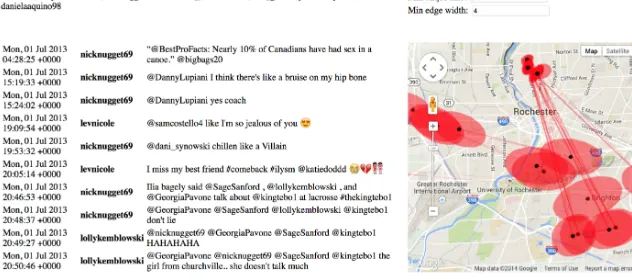
Trowser can show two main types of data as shown in Fiqure 2.1. One is tweet data,
which includes time, user name, tweet text, and the other is the location information and
relationship between Twitter users, which are shown on the map. Each black dot is the
centroid location of all geotagged tweets coming from the members of a maximal clique in
the social graph (this representation is particularly useful for highly-interactive browsing
of at-scale social network data). Red ovals represent spatial deviations from the centroid.
When a user clicks on a node in this clique graph, only the tweets belonging to members
of that clique are shown. The size of minimum clique is the number of users who follow
each other, and the edge width between two cliques is the number of same Twitter users
they share. The line is represented that if two different cliques have a specified number of
Twitter users. The user can change the size of the clique and the width of the line. The list
of tweets shows the messages of tweets that belong to the Twitter users in a clique. The
user names are shown on the top left.
The demo version of Trowser is based on Meteor framework. Meteor is a platform that
Figure 2.1: Demo version of Trowser
developed on Node.js, the client and server side use JavaScript as a development language.
The demo version of Trowser has an architecture just based on the Meteor framework and
Node.js without any other architecture tactics.
In my thesis, we want to design and implement these functional requirements in the
following:
• Filter
• Query
• Visualize geographical information
Filter
The feature of the filter can provide filter the tweets by Twitter user name, date, the number
of followers, and the number of replies. The user can enter specific elements to filter the
tweets so that they can just check those specific information.
Query
Users are able to use database query language to find tweets through Trowser. As a
require-ment, Trowser’s target users are familiar with database query language, and can use SQL
SQL and get the data from database. The data which are queried will display on the list
which is the same place that displays the tweets.
Visualize geographical information
The map in Trowser can show the geographical information base on the tweets which listed
and user relationship. Through setting the number of minimum clique and then number of
minimum edge, the different graph will be displayed on the map. User can click one red
oval and the list of tweets shows the messages of tweets that belong to the Twitter users in
that oval.
2.1.2
Nonfunctional Requirement
Follow on the purpose of Trowser, the researchers who want to analyze Twitter data always
have new features to operate those data. Changes will always happen. Changes happen to
add a new feature, to change or even retire old ones. Also, changes happen to fix defects,
tighten security, or improve performance. The user who will use Trowser to analyze tweets
data wants it is able to add new feature any time due to the scientists requirements. In this
case, Trowser must be easy to change and be added the new feature, and there will be the
lowest cost in the same time. The researchers, who want to put a new feature to Trowser,
just need to change a few line of code to reach their goals. In this case, the new architecture
of Trowser needs to have high modifiability.
Trowser also needs to handle mass Twitter data for querying tweets or visualizing the
tweet location. The current version of Trowser uses MongoDB as the database, database
store all tweets that posted in Rochester since 2014. The user will query tweets through
Trowser, and the result also will merge with geolocation information which will post on the
map. It is hard to operate those data without high performance. In this case, the customer
brings the requirement that the new architecture of Trowser needs to have high
perfor-mance.
Figure 2.2: Quality Utility Tree
controller if the developer does not take care of security issues. And the current architecture
cannot prevent any security issues. One of the goals for using data analysis tool is that reach
the accurate data analysis results, and it is a difficulty that protects the data correct without
high security. Based on those nonfunctional requirements, we can know that we need a
new architecture for Trowser that needs to contain high modifiability, high performance,
and high security.
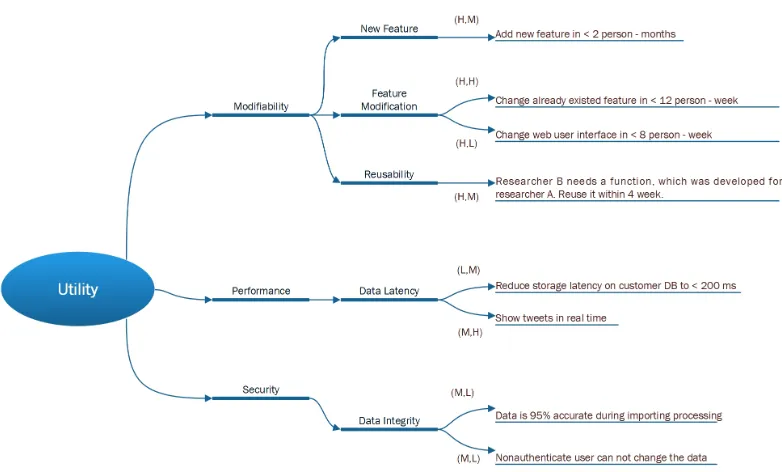
To achieve those qualities, we create a quality utility tree which shown in Figure 2.2.
The quality utility tree describes the quality attributes we can to achieve. Those quality
attributes are described by quality attribute scenarios, those scenarios make the qualities
testable. The quality utility tree also includes the importance of the scenario and the
diffi-culty to implement the scenario. For example, (H, M) in the quality utility tree means that
the importance of this scenario is high level and the difficult of implement this scenario is
middle level. The quality utility tree also will be used to evaluate the architecture during
2.2
Quality Attribute
2.2.1
Modifiability
The quality attribute of modifiability is about change, most of the cost of the typical
soft-ware system occurs after it has been released [3]. Modifiability is one quality attribute of
software architecture that relates to the cost of change and refers to the ease with which
a software system can accommodate the change. Change will happen when to add a new
feature or maintain the old feature. It is very hard to anticipate all of the changes, and most
cost for software will be spent to evolve and maintain the system. All kinds of changes,
which include anticipated and unanticipated, will spend the high cost when the system has
been delivered. Another aspect, there are several platforms, particularly, mobile platform:
many mobile applications have a multiple version for different platforms. In another word,
software always keeps changing for the customers requirements. Development teams aim
to reduce the cost of these adaptations, by addressing modifiability during the development.
The definition of modifiability is that:
The modifiability of a software system is the ease with which it can be modified to
changes in the environment, requirements or functional specification [5].
Through this definition, we realize there are three main aspects in architecture
modifia-bility. For Trowser, the requirement change will be most likely; the user will add or change
the feature based on their new requirements for operating tweets data. Adding a new feature
will just need less than two person-months. The requirement change is the main research
objective during we design the new architecture. The requirement change also includes the
modification of existing features. Base on the requirements, changing already one existed
feature need to spend less than twelve person-weeks and changing web user interface just
need less than eight person-weeks. Also, it is able to reuse a function within four weeks.
To design a software architecture which includes modifiability, there are some tactics
Figure 2.3: Modifiability Tactics[3]
2.2.2
Performance
An important issue for the engineering of complex software systems is determining overall
system performance. Traditional software development methods focus on software
cor-rectness, introducing performance issues later in the development process. This style of
developing has often been referred to as a fix-it-later approach. This approach does not
take into account the fact that performance problems may require considerable changes in
design, for example, at the software architecture level.
As a data analysis tool, Trowser need to process mass tweet data for analysis and
vi-sualization. For the performance of Trowser, data latency is the main problem we need to
consider. In Trowser, it is able to reduce storage latency on the local database to less than
200 ms. Another part of data latency, the tweets are able to display in real time in Trowser.
These two part of performance scenarios are performance requirements of Trowser, and in
this thesis, we need to use some performance tactics to handle those performance
require-ments.
Figure 2.4: Performance Tactics[3]
system within some time-based constraint. The event can be single or a stream and is the
trigger to perform computation. There are two main types of performance tactics: control
resource demand and manage resource, which are shown in Figure 2.4.
2.2.3
Security
In the face of an increasing number of business services on open networks and distributed
platforms, security issues have become critical. Devanbu et al. stated this as follows [10]:
Security concerns must inform every phase of software development, from requirements
engineering to design, implementation, testing, and deployment.
In the design phase of software development, we should design security functions to
satisfy the security properties of assets identified in the requirement phase. Specifically,
we can design such functions using access control, authentication, cryptography, electronic
signatures, and logging components or service. The goal of security is that system is able
to detects, resists, reacts, or recovers attacks [3], as shown in Figure 2.5.
The purpose of considering security is we want to ensure the data accuracy. Users
import their data to Trowser, and any operations can not change the data context from the
Chapter 3
Literature Review
3.1
Software Recovery
Understand a systems software architecture is the important facet of maintenance and
re-search of software architecture. However, the maintenance and rere-search of software
ar-chitecture is challenged by careless, unintended addition, removal, and modification of
architectural design decisions. To deal with that, software engineers are forced to recover
a systems architecture from its implementation. We call them as software architecture
re-covery technology.
In this paper [14], the author compared six existing architecture recovery technologies:
Algorithm for Comprehension-Driven Clustering (ACDC) [26], Architecture Recovery
us-ing Concerns (ARC) [15], Bunch [19], scaLable InforMation BOttleneck (LIMBO) [2],
Weighted Combined Algorithm (WCA) [18], and a technique developed by Corazza et al.
[8]. In this study, the research objects are nine variants of six architecture recovery
tech-niques. The researchers used two different types of dependencies to compare them. There
are several types of dependencies can be used as inputs in software architecture recovery
technologies. Some technologies use control and data dependencies [11] [12] [25]; other
techniques use static and dynamic dependency graphs [2]. In another study [16], the
au-thor pointed out that comparing with include dependencies, symbol dependencies are more
accurate. They define that a symbol can be a function name or a global variable.
There are several more powerful tools with better GUI and more useable. In this study
Jovial, Pascal, PL/M, Python, and others. From this study [17], we know that using
Un-derstand to get several code analysis metrics, for example, Source Lind of Code (SLOC),
Number of Children (NOC), and Response for a Class (RFC).
3.2
Architecture Approaches
3.2.1
Design Pattern
Design patterns are meant to solve recurring problems in software system design and so
to improve the quality of software system [3]. Object-oriented design patterns can provide
modifiability. The book [13] analyzed several design patterns and shown the scenarios how
to use them. In a case study [23], the authors created a variable pattern which made by
reusable feature types. The reusable feature types are belongs to several search techniques.
They used three open source system to evaluate the quality, and the result shows that a
customized pattern can effect high-quality detection results positively.
3.2.2
Performance
For service-oriented web system, there is a design approach which called interface-based
design [7]. Service-oriented architecture is a way of designing a software system to provide
services to either end-user applications or other services through published and
discover-able interfaces [7]. Service-oriented architecture can provide modifiability for the system.
In the study [24], the authors talked about software performance engineering
method-ology. The software performance engineering methodology is the first comprehensive
ap-proach to the performance evaluation during the software development life-cycle. There
are two models used in software performance engineering methodology, which are the
software execution model and the system execution model. The software execution model
can represent the software execution behavior, and the system execution model can
repre-sent the system platform, which includes hardware and software components. The result
of the software performance engineering methodology can understand the whole software
system and hardware system comprehensively.
There are several approach based on the software performance engineering
method-ology. Williams [27] and Smith [24] evaluate the performance of software architecture
through the software performance engineering methodology. In their study, the software
architecture is specified by using the Unified Modeling Language (UML) diagrams. In
ad-dition, the target model of the software architecture is used in the construction and analysis
of the software execution model. Petriu et al. [21] propose several approaches which follow
the software performance engineering methodology. Also, these approaches can help for
building layered queueing network models of software architecture based on combinations
of the design patterns.
3.2.3
Security
Boyd et al. [6] propose a protection mechanism to protect the system from SQL injection
attacks, which can attack and destroy data through a web front-end. The architecture which
based on this protection mechanism have a proxy between database and web server; that
means it will decrease the performance. While we consider those three qualities, we need
to think about the tradeoff between security with another two quality attributes. Dalton
et al. [9] propose that the powerful security technology needs to have four
characteris-tics: robust, flexible, end-to-end, and fast. Among them, flexible means that the security
Chapter 4
Research Question and Methodology
4.1
Methodology
4.1.1
RQ1
For our purpose, we need to design and build an architecture for Trowser, which contain
high modifiability, high performance and high security. The architecture technologies of
those existing social network data analysis tools can inspire us. The software architects
of those data analysis tools also face some problems they need to bring the solutions. In
general, those software architectures include the architecture technique for modifiability,
performance and security. We will choose four social network data analysis tools (Gephi,
Graphviz, networkX, snap) as research objectives. Through architecture recovery
technol-ogy, we can get the architectures of those tools, and find out that:
RQ1: For modifiability, performance and security, which architecture techniques used in
Gephi?
The architecture techniques will contain design pattern, architecture tactics or another
solution on architecture level.
For answering this research question, we need to get the architectures through software
recovery technology. Using Understand and Structure101 to get the architectures of
re-search objectives, and them we can do analysis which of architectures work for specific
up to help to extract architecture. Through Understand, we can easy get the dependency
between files, and view which file depend on that file, this file depends on which file, or
butterfly-dependency(show both of them)
Structure 101 is the tool that is able to help user to understand the source code. We use
it to view to dependency and organize the thousands of source files in our codebase into a
visual and enforceable module hierarchy.
Research Objects
In the thesis, we use architecture recovery tools to extract the system architecture of social
network visualization tool Gephi. Through understanding and analyzing those extracted
architectures, we can understand what architecture technologies they use.
Gephi is an open-source software for visualizing and analyzing large networks graphs.
Gephi uses a 3D render engine to display graphs in real-time and speed up the exploration.
Users can use it to explore, analyze, spatiality, filer, cauterize, manipulate and export all
type of graphs. From the repository of Gephi, we can know that it is developed by 95.0%
Java.
4.1.2
RQ2
There are several architecture technologies we found from those data analysis tools. Since
the requirements are different between Trowser and those data analysis, only using those
Figure 4.1: Work Flow of RQ2
scenarios. In this case, we need to use another known architecture tactics which can fit
Trowser’s requirements. Use those tactics which include what we found from research
ob-jects and known tactics to design Trowser architecture follow by quality attribute scenarios.
Our purpose is to design an architecture which can provide high modifiability,
perfor-mance and security. For this purpose, we use the architecture technologies, which from
research objects and what we know, to design the architecture of Trowser. In the same
time, it will be the answer of our second research question.
RQ2: What architecture techniques can help to build Trowser with high modifiability,
high performance and high security?
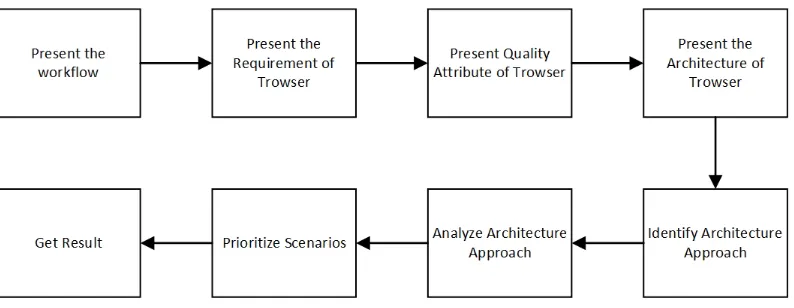
Figure 4.1 shows the work flow how to design the architecture of Trowser. We will
analyze current architecture of Trowser, and combine the result after analyzing those
re-search objects. Based on Trowser’s quality attribute scenarios, we choose which known
architecture technologies we will use into Trowser to design the architecture. After
design-ing the new architecture of Trowser, the architecture evaluation will be used to evaluate the
quality of Trowser. And we will improve the architecture based on the result of evaluation.
After several iteration, we will get the architecture of Trowser which can achieve Trowser’s
Figure 4.2: ATAM Work-flow
4.1.3
RQ3
We design the new architecture of Trowser to satisfy the quality requirements and will
get the answer of the second question. However, there are three main quality attributes
the development team need to satisfy in the nonfunctional requirements. These quality
attributes have different priority based on the requirements. We need to evaluate or test the
architecture to ensure that the new architecture has satisfied the requirements. Therefore,
we have the following question which we want to find the result.
RQ3: Does the architecture we designed satisfy the Trowser’s requirements?
We will evaluate the quality attributes after the architecture designed. The evaluation
will follow the Architecture Tradeoff Analysis Method(ATAM), which shows on Figure
4.2. We choose the ATAM as the architecture evaluation since it not only evaluates an
architecture satisfies particular quality goals but it also provides insight into how those
quality goals interact with each other. Since Trowser has three quality goals with different
priority, the ATAM is the good approach to evaluate how those quality attribute design
strategies trade off against each other.
We will describe the evaluation method to the participants, and try to make them
un-derstand the work-flow. Trowser’s design document will send to each participant before
understand the requirements and architecture clearly. During presenting the requirements
of Trowser, we will describe the features of Trowser to make the participants understand
Trowser’s functionality. It also help to understand the quality attributes of Trowser. We will
focus on the nonfunctional requirements and then move to present the quality attributes of
Trowser. We will show the quality attribute utility tree in this step. The quality attribute
utility tree includes quality attribute scenarios, the priority of that scenarios, and the
diffi-culty of implement. When the participants clearly understand the requirements and quality
attributes of Trowser, we will describe the architecture to them. During this step, we will
focus on how it addresses the quality attributes.
After the participants have a clear understanding of Trowser’s architecture, we will
identify the architecture approaches which are used in Trowser’s architecture. We will
describe each architecture approach and address to each quality attribute. The participants
will analyze those approaches based upon the high-priority scenarios. The architectural
risks, nonrisks, and tradeoff points are identified. However, a set of scenarios may be
elicited from the entire group of participants. We need to prioritize those scenarios via a
voting process, then analyze the architecture approaches again but use the highly ranked
scenarios from the last step. Those scenarios are considered to be test cases to confirm the
analysis performed thus far. We will collect all information during the ATAM evaluation
5.1
Architecture Analysis of Gephi
Gephi is an open-source for visualizing and analyzing large network graphs. Gephi uses a
3D render engine to display graphs in real-time and speed up the exploration. Users can
use it to explore, analyze, specialize, filter, manipulate and export all types of graphs. From
the repository of Gephi, we can know that it is developed by 95.0% java.
5.1.1
Modifiability
According to modifiability tactics, there are four main approaches, which are in the
follow-ing, to provide the modifiabilirt.
1. Reduce Size of a Module
2. Increase Cohesion
3. Recude Coupling
4. Defer Binding
As a software for visualizing and analyzing large networks graphs, Gephi has the ability
for query and filter data. In this case, filter and query data become the common services in
Gephi. So, in the software architecture level, the designers reduced the coupling based on
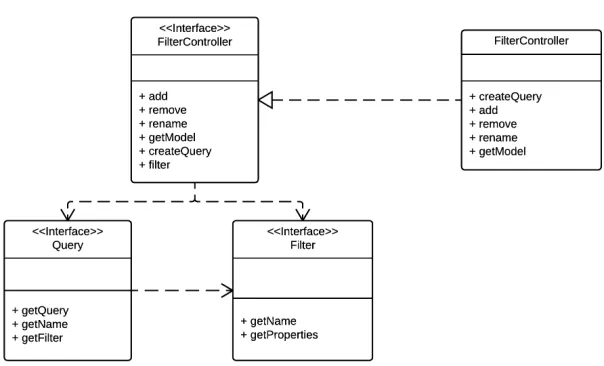
abstract common services. ThroughtUnderstand, we can get the structure of the filter part,
Figure 5.1: FilterController
Abstract Common Service
In this structure, there are several query functions in the FilterController.java. All of those
query functions reference api.Query, which belongs to Query.java. Both of
FilterCon-troller.java and Query.java belong to FilterAPI module. For implementation, there is a
java file named FilterControllerImpl, which reference to FilterController. Meanwhile,
Fil-terControllerImpl references to Query.
Separating the abstract and implementation part, it will reduce the coupling of
archi-tecture. Query, which is used for each filter action is abstracted as a common service.
Abstracting common services may be cost-effective to implement the services just once in
a more general form. Any modification to the service would then need to occur just in one
place., reducing modification costs. From all of the modules’ name, we can know that,
most of functionality modules have one abstract module and one implementation module.
As a data analysis tool, Trowser would be able to query tweets base on several ways.
In this case, abstract filer service as an interface, each query function will be implemented
Figure 5.2: Builder
Builder
Visualization is the important functionality of Gephi, Gephi can display node and line for
visualize the relationship and size of data set. It means that Gephi should be able to convert
the data to many graphic formats. The problem is that the number of possible conversions
is open-ended. So it should be easy to add a new conversion without modifying Gephi. To
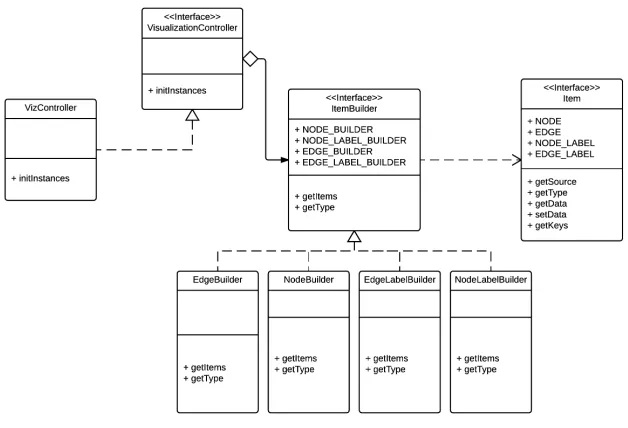
solve this problem and provide modifiability, the Builder pattern [13] is used in Gephi. As
Figure 5.2 shows, there is an abstract interface named ItemBuilder, and there are several
class which implement this interface in the builder package. In the builder package, there
are several concrete builders, each of them created for single format.
The Builder pattern improves modularity by encapsulating the way a complex object is
constructed and represented. Clint needn’t know anything about the classes that define the
product’s internal structure; such classes don’t appear in Builder’s interface. Each concrete
builder classes contains all the code to create and assemble a particular kind of product.
The code is written once; then different Directors can reuse it to build product variants
attributed to abstract common services in modifiability tactics.
5.1.2
Performance
Since processing mass data and visualize them, the software need to provide high
perfor-mance to avoid long waiting process data. As we mentioned in the previous section 2.4,
there are several tactics can be used for performance. We can either reduce demand for
resources or make the resources we have handle the demand more effectively. One of the
ways to increase performance is to carefully manage the demand for resources. This can
be done by reducing the number of events processed by enforcing a sampling rate, or by
limiting the rate at which the system responds to events.
Limit Event Response
As a visualization tool, the graphs are the resource in Gephi. If there are too much data
need to be visualized, there will be too many graphs displayed. This will be a problem
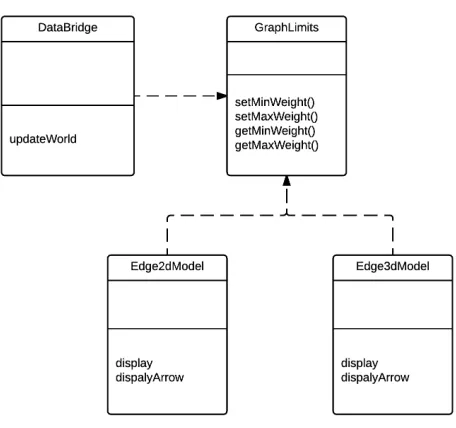
if there is no performance tactic. We recovery the source code of Gephi, and check the
structure and contents of the source code. We find that in the visualization model, there is
a class named GraphLimits and several Graphics-related class import it.
Through limiting the number of graph, the software will bring high performance for
users.
Bound Execution Time
Place a limit on how much execution time is used to respond to an event. For iterative,
data-dependent algorithms, limiting the number of iterations is a method for bounding execution
times. Gephi, as an application to visualize large network data, also have a mechanism to
limit the time of long task.
On LongTaskExecutor.java, we found that there are some operating can interrupt or
cancel those long task. LongTaskExcutor import Timer to implement canceltimer to
Figure 5.3: GraphLimits
then user can interrupt or cancel the task which has token a long time. In this case, this
mechanism limit the task execution time through setting up timer.
5.1.3
Security
Security of software system is the system’s ability of protect data and information from
those unauthorized operators. Security includes three characteristics: confidentiality,
in-tegrity, and availability [3]. The confidentiality is the property that data need to be
pro-tected from unauthorized access. The integrity is the property that data is not subject to
unauthorized operation. The availability is the property that the system will be available
for legitimate use. Through these descriptions of security, we can clearly understand that
the security’s effect in the system. The general security requirement is that data should be
protected and kept the accuracy during data operations. As the research object, data is very
important to keep the accuracy. For protecting the data, the development teams need to
de-sign and actualize the security tactics. We analyze the source code of Gephi and Graphviz,
There is DatabaseDrive module in the architecture of Gephi, which connect with the
lo-cal database. We analyzed the code and find that DatabaseDrive can connect with different
type of database, for example, MySQL, SQLite, and SQLServer. Those databases are local
database, which store all of the data for analysis. Gephi is able to connect several database
and it doesn’t have network feature. In this case, user can operate the system without
net-work. There are several benefits by using this tactic. Data analysis that can be operated
without the Internet is able to protect the data and services from network attack.
Gephi can import data to local database, and process the data for visualization. We
checked the code of Import module and want to find out what security tactics the
devel-opment team used for Gephi. However, we just find out that there is a class neamed as
LongTask. LongTask has a function to set a name for one import task, and there is
an-other function to check the task name to make sure those imported data store to the same
database. Checking long task name can ensure the accuracy during the system importing
data to the local database.
5.2
Architecture Techniques for Trowser
After analyzing the architecture of Gephi, we found out what techniques are fit for social
network data analysis. Abstract common service and using design pattern can improve
modifiability and make reconstruction more easily. Limit event response and bound
exe-cution time are the two main approach to improve software performance. However, it is
not enough for designing the architecture of Trowser, since there are many specific
require-ments only for Trowser users. In this case, we also need to use another tactics for those
requirements.
The module view of the Trowser architecture (see Figure 5.4) shows the main modules
in Trowser, there are three main subsystem which are TweetList, Visualization and DataIO.
All of modules need to access database interface to get data, and there are several
mod-ules in each main modmod-ules. Query module works for query feature, which include getting
Figure 5.4: Module View
for displaying tweets on the list. Visualization model works for the whole visualization
feature, there are two modules in the visualization module. Map will use three part map
API to provide geographic information. GraphBuider module can get the tweet data from
Display module to create graph on the map. DataIO works for data set, there are two
mod-ules in it. Importer module can read JSON file of tweets and import the data to database.
Processor module can process data for visualization. Importer module also is able to access
with Twitter API, so that Trowser can get the newest tweets.
The component-and-connector architecture view, which shows on Figure 5.5, provides
a run-time view of the system. This allows the structure and behavior of processes such
as data stores or authentication to be analyzed and improved. This view also provides an
understanding of quality attributes such as performance and Modifiability. The
compo-nent of Database Interface provides the flexibility for different type of database. It is able
to connect with any type of database or multiple databases. There are three components
Figure 5.5: Components and Connectors View
Figure 5.6: The class diagram of Filter and Query
TweetList Module
The purpose of TweetList module is to process tweets data and display. Follow Trowser’s
requirements, there are Query module and Filter module in TweetList module. Those
mod-ules work for the feature of querying tweets and filtering tweets. Fig 5.6 shows the class
diagram of Filter and Query. Follow by the tactic of abstract common services, there are
two interfaces for query and filter. Several entity classes implement the interface base on
different functions, for example, FilterByTweets, FilterByData, and FilterByUser work for
building those different graphs. VisualizationBuilder is an abstract class, and different
builder will implement VisualizationBuilder for different graph.
Using Builder pattern can provide modifiability for Trowser. When the developer needs
more graph display, he just need to create a new builder for that graph through
implement-ing VisualizationBuilder.
DataIO Module
The function of DataIO is controlling the database for obtaining the data from database.
Simultaneously, DataIO will be responsible for preprocessing data for visualization. Figure
5.7 shows the structure of DataIO on class level.
DatabaseDriver class will connect with the local database, and it inherits Database
in-terface. This strategy can provide modifiability, since it is possible that using a different
kinds of database in the future. There are two processors in this module. Each processor
class works for single metric graph (e.g., edge and cliques). These entity processor classes
can process the data based on some special research requirements. Since the feature of
pro-cessing data will be used in the most time, we create Processor interface following abstract
common service. All of entity processor class should inherit Processor interface.
For Trowser can process huge volume data, we design TweetCache class follow by
cache algorithm. When accessing large amounts of data is deemed too slow, cache is
able to keep a small amount of the data in a more accessible location. Cache algorithm
Figure 5.7: DataIO Module
TweetCache will follow by Least Recently Used (LRU), which discards the least recently
used items first.
Database
User import the data to local database, and then Trowser will access to local database
to process and visualize. Database is an interface which includes functions to connect
with database. The class named DatabaseDriver is an entity class which inherits Database
interface. DatabaseDriver will connect with local database. Different type of database
will have different DatabaseDriver class. However, all of those class need to implement
Database interface since connecting to database is a common service. This structure can
provide modifiability for using different type of database in the future, and this tactic has
used in Gephi.
Although we provide modifiability for using different local database based on the tactic
of abstract common service, we still need to consider about performance. The type of
database affects the performance of the system. We decide to use MongoDB as a default
We create a design document to explain the new architecture of Trowser. However, we do
not ensure the new architecture we design based on several design strategies has satisfied
the quality attribute requirements. We used the Architecture Tradeoff Analysis Method
(ATAM)[3] to evaluate the new architecture we design, and the result will answer the third
research question.
5.3.1
Architecture Tradeoff Analysis Method(ATAM)
We invited some person who have rich experience of designing software system
archi-tecture. The design document was send to each participant before the ATAM meeting.
Therefor, the participants would have a little understanding for Trowser and can prepare
the questions for the designer. During the ATAM meeting, the leader presented the
meet-ing work-flow to make all of the participants have an overall understandmeet-ing of this ATAM
meeting.
Quality Attribute Scenarios
At ”Present Quality Attribute of Trowser” step, the designer presented the quality attribute
of Trowser based on the nonfunctional requirements, and shown the quality utility tree to
the participants. There are eight scenarios in Trowser’s quality utility tree, which show in
the Table 5.1.
Table 5.1 shows the scenarios to describe the quality we want to achieve. The priority
No. Scenario Category Priority Response Measure No.1 A directive to add
func-tionality. (Export selected tweets information from Trowser)
Modifiability (H,M) 2 person- month
No.2 Modify Visualization Fea-ture. Adding new graph and display on the map.
Modifiability (H,H) 12 person-week
No.3 Changing user interface. Overlap ovals can separate when user click on them
Modifiability (H,M) 8 person-week
No.4 Researcher B needs a function, which was de-veloped for researcher A. Reuse it within 4 week.
Modifiability (H, M) 4 week
No.5 Reduce storage latency on customer DB to les than 200 ms.
Performance (L, M) less than 200 ms
No.6 Show tweets less than 50 ms after database get the query
Performance (M, H) Average latency less than 50 ms
No.7 Data is 95% accurate dur-ing importdur-ing processdur-ing.
Security (M, L) Correct Data is Stored.
No.8 Non-authenticate user can not change the data.
[image:41.612.98.523.86.475.2]Security (M, L) The data in database will be not changed by non-authenticate user.
Table 5.1: Quality Attribute Scenarios
scenario. For example, the priority of Scenario #1 is (H, M) in the table, that means the
importance is high level and the difficult to achieve this scenario is middle level. The
participants bring some questions for those scenarios. For Scenario #2 and Scenario #3
which address to feature modification, the response measures are too high. Based on the
participants’ experiences, it is hard to be defined as high modifiability if the system needs
12 person-weeks to change an already existed feature. The response measure of Scenario
#4 is also too hard to achieve since each researcher will has his specific requirement for his
own feature. To reuse other researcher’s feature, there should be an architecture document
sures, we will analyze them again and let the customer review them. Based on new scenario
response measures, we will modify the architecture of Trowser.
Architecture Approaches Analysis
We presented the new architecture of Trowser, and described the architecture approaches
which are used for Trowser.For the modifiability, the participants agreed with using builder
pattern on the visualization feature. Some participants thought there are another pattern
which also are able to provide modifiability for visualization. However, using builder
pat-tern is not a risky approach and can provide modifiability to achieve the modifiability
re-quirement. For the feature of query, the original feature is able to write data to database.
That is a high risk for the security, and it will affect modifiability since it too hard that
abstract query service. The builder pattern provide the modifiability to create more types
of graphs on the map. However, there isn’t any architecture approach to solve the user
interface changing. Furthermore, the frequency of changes in user interface is higher than
the frequency of changes in the underlying logic. All of the design strategies didn’t cover
the modifiability of user interface, so the scenario of changing user interface can not be
achieved.
We used cache to improve the performance of Trowser during query tweets from the
local database. There is a risk that the size of cache affect the performance. If the cache size
is too small, the quality of improvement will not obvious; if the cache size is too large, it
of Trowser, which provides the ability to connect with several different types of database.
This design strategy supports the modifiability of database for Trowser. However, it is
risky to maintain with different database technologies in the same time. Using single best
database technology for Trowser will reduce that risk and provide performance in the same
time. MongoDB is a good option for import and storing data from JSON files.
To achieve the security requirements, we designed that data need to be stored on the
local database and use local-host to access. The participants thought storing data to the
local database in user’s own machine can protect the data from network attack. However, if
a group of users who analyze the same data, how to handle this scenario is a problem that
need to be considered. If the data stored on a server, it is a risk when user access the server
on the outside. The easiest approach to solve this problem is restricting access address and
authentication.
Final Report
Through the Architecture Tradeoff Analysis Method, we analyzed the quality attribute
sce-narios of Trowser. We found that there are several scesce-narios’ response measures that are
too high to achieve. Those measures should be reviewed with the stakeholders and make
those measures more close to the quality attribute requirements. Overall, current design
of Trowser’s architecture can provide modifiability, performance, and security. However,
there are some risk come form those architecture approaches. The tactics for different
quality attribute also affect each other. Table 5.2 shows the outline of ATAM result.
5.3.2
Cache Performance
We create a cache demo to test our cache algorithm for performance. The purpose of this
testing is want to evaluate the effect of cache size on performance. We used a same set of
queries to query data from MongoDB, and the only difference is query data without using
cache algorithm or with using different size of cache. Figure 5.8 shows eight execution
Figure 5.8: Cache Performance
cache.
The result in Figure 5.8 show that the execution time increase as the size of cache
increase. The result shows that the size of cache affect the performance negatively. We
think the reason is the maintain the space will decrease the query performance. In this
Outline of Results
Presentation Explanation
ATAM Steps A viewgraph listing eight steps of ATAM The Requirement
[image:45.612.118.505.231.540.2]of Trowser The description in section 2.1 Utility Tree Figure 2.2
Scenarios Table 5.1
Scenarios Discussions
The response measures of Scenario #2 and #3 are too easy to achieve, and should be reviewed. The detail summary in section of ”Quality Attribute Scenarios”.
Architectural Approaches The summary in section of ”Architecture Approach Analysis”.
Risk, Nonrisks, Tradeoff Points
The size if cache will affect the performance. The feature of Query can write data to the
database will affect the security and modifiability. Using Builder pattern doesn’t have a risk.
Providing database interface for different DB technologies makes the system hard to maintain.
Other Issues For a group of users, need to limit access address for security.
Through analyzing the source code of Gephi and applying architecture tactics described
in the literature, a new architecture of Trowser is designed by using several design tactics
based on the functional requirements and the nonfunctional requirements. The quality of
the new architecture is evaluated by the Architecture Tradeoff Analysis Method.
Analy-ses of Gephi reveal that abstract common service can provide modifiability for the system,
Builder pattern is used for creating different type of graphs. When there are too many
graphs need to be visualized, Trowser will limit the number of graphs to display. Trowser
listen the time of execution, and interrupt or cancel those long executions for system
perfor-mance. We found Gephi support several difference type of database interfaces to connect
different kinds of database. We didn’t find another design tactics for security, the security
may be have a low priority in Gephi’s requirements.
We summary the design tactics used in Gephi through the source code analysis, and
use some of them in the new architecture of Trowser. In addition, we use the architecture
approaches which from known tactics. All of the approaches we used comply with the
requirements of Trowser, especially the nonfunctional requirements.For example, Builder
pattern is used for visualization and provide the modifiability, using cache algorithm to
improve the performance, and using local database and authentication for security. The new
architecture of Trowser is designed based on those approaches for achieving the business
goal. The Architecture Tradeoff Analysis Method is used to evaluate the quality of the new
architecture. We find that there are several scenarios’ response measures that are too easy
quality of the new architecture we designed.
6.1
Limitations
Several limitations are important to be noted and understood in this work.
• Analysis Resource: The source code of Gephi is analyzed to find out the
architec-tural techniques. The techniques are find out by the keyword and module name.
Through this analysis approach, we can not find all of the architectural techniques
used in Gephi. If we have the architecture document, that will be more easy and
comprehensive to analyze the architecture of Gephi.
• Requirements of Trowser: In this design work, we ignore the effect of inaccurate
requirements. In formal software development life-cycle, the requirements should be
evaluated after the requirement phase. When getting the accurate requirements, the
design phase can be allowed. Some of the quality attribute scenarios are not specific,
• Designer’s Experience: Designer’s Experience has a direct impact on the quality
of architecture. Judging the design approaches accurately will make the quality of
architecture batter, so that we can get a better result.
• Programming Language and the Type of Webserver: We just considered the
tech-nologies on architecture level in this thesis. However, the kind of programming
language will affect the quality of architecture, for example the performance.
Ad-ditionally, the different webserver also affect the selection of design strategies.
6.2
Future Work
Significant amounts of future work are possible with the new architecture of Trowser and
• Architecture Evaluation and Implementation: The improved architecture should be
evaluated and improved several time, and Trowser should be implemented for further
testing quality. More detailed and specific test data will be obtained during the test
Bibliography
[1] Documentation - meteor.
[2] Periklis Andritsos and Vassilios Tzerpos. Information-theoretic software clustering.
Software Engineering, IEEE Transactions on, 31(2):150–165, 2005.
[3] Len Bass, Paul Clements, and Rick Kazman. Software Architecture in Practice.
Addison-Wesley Professional, 3rd edition, 2012.
[4] Mathieu Bastian, Sebastien Heymann, Mathieu Jacomy, et al. Gephi: an open source
software for exploring and manipulating networks. ICWSM, 8:361–362, 2009.
[5] PerOlof Bengtsson, Nico Lassing, Jan Bosch, and Hans van Vliet. Architecture-level
modifiability analysis (alma).Journal of Systems and Software, 69(1):129–147, 2004.
[6] Stephen W Boyd and Angelos D Keromytis. Sqlrand: Preventing sql injection attacks.
InApplied Cryptography and Network Security, pages 292–302. Springer, 2004.
[7] Alan Brown, Simon Johnston, and Kevin Kelly. Using service-oriented architecture
and component-based development to build web service applications. Rational
Soft-ware Corporation, page 6, 2002.
[8] Anna Corazza, Sergio Di Martino, Valerio Maggio, and Giuseppe Scanniello.
Inves-tigating the use of lexical information for software system clustering. In Software
Maintenance and Reengineering (CSMR), 2011 15th European Conference on, pages
[11] Roberto Fiutem, Giulio Antoniol, Paolo Tonella, and Ettore Merlo. Art: an
architec-tural reverse engineering environment. Journal of Software Maintenance, 11(5):339–
364, 1999.
[12] Roberto Fiutem, Paolo Tonella, Giuliano Antoniol, and Ettore Merlo. A cliche-based
environment to support architectural reverse engineering. In Software Maintenance
1996, Proceedings., International Conference on, pages 319–328. IEEE, 1996.
[13] Erich Gamma. Design patterns: elements of reusable object-oriented software.
Pear-son Education India, 1995.
[14] Joshua Garcia, Igor Ivkovic, and Nenad Medvidovic. A comparative analysis of
soft-ware architecture recovery techniques. In Automated Software Engineering (ASE),
2013 IEEE/ACM 28th International Conference on, pages 486–496. IEEE, 2013.
[15] Joshua Garcia, Daniel Popescu, Chris Mattmann, Nenad Medvidovic, and
Yuan-fang Cai. Enhancing architectural recovery using concerns. In Proceedings of the
2011 26th IEEE/ACM International Conference on Automated Software Engineering,
pages 552–555. IEEE Computer Society, 2011.
[16] Thibaud Lutellier, Devin Chollak, Joshua Garcia, Lin Tan, Derek Rayside,
Ne-nad Medvidovic, and Robert Kroeger. Comparing software architecture recovery
techniques using accurate dependencies. In Software Engineering (ICSE), 2015
IEEE/ACM 37th IEEE International Conference on, volume 2, pages 69–78. IEEE,
[17] Ravish Malhotra and Megha Khanna. Analyzing software change in open source
projects using artificial immune system algorithms. In Advances in Computing,
Communications and Informatics (ICACCI, 2014 International Conference on, pages
2674–2680. IEEE, 2014.
[18] Onaiza Maqbool and Haroon A Babri. Hierarchical clustering for software
architec-ture recovery. Software Engineering, IEEE Transactions on, 33(11):759–780, 2007.
[19] Brian S Mitchell and Spiros Mancoridis. On the automatic modularization of
soft-ware systems using the bunch tool. Software Engineering, IEEE Transactions on,
32(3):193–208, 2006.
[20] ABM Moniruzzaman and Syed Akhter Hossain. Nosql database: New era of
databases for big data analytics-classification, characteristics and comparison. arXiv
preprint arXiv:1307.0191, 2013.
[21] Dorina C Petriu and Xin Wang. From uml descriptions of high-level software
archi-tectures to lqn performance models. In Applications of Graph Transformations with
Industrial Relevance, pages 47–63. Springer, 1999.
[22] Klaus Pohl. Requirements engineering: fundamentals, principles, and techniques.
Springer Publishing Company, Incorporated, 2010.
[23] Ghulam Rasool and Patrick M¨ader. Flexible design pattern detection based on feature
types. InAutomated Software Engineering (ASE), 2011 26th IEEE/ACM International
Conference on, pages 243–252. IEEE, 2011.
[24] Connie U Smith and Lloyd G Williams. Performance solutions: a practical guide to
creating responsive, scalable software. 2001.
[25] Paolo Tonella, Roberto Fiutem, G Antonio, and Ettore Merlo. Augmenting
pages 164–177. ACM, 1998.
[28] Qifeng Zhang, Dehong Qiu, Qubo Tian, and Lei Sun. Object-oriented software
ar-chitecture recovery using a new hybrid clustering algorithm. InFuzzy Systems and
Knowledge Discovery (FSKD), 2010 Seventh International Conference on, volume 6,
![Figure 2.3: Modifiability Tactics[3]](https://thumb-us.123doks.com/thumbv2/123dok_us/36188.2847/18.612.132.488.90.326/figure-modiability-tactics.webp)
![Figure 2.4: Performance Tactics[3]](https://thumb-us.123doks.com/thumbv2/123dok_us/36188.2847/19.612.153.469.84.283/figure-performance-tactics.webp)
![Figure 2.5: Security Tactics[3]](https://thumb-us.123doks.com/thumbv2/123dok_us/36188.2847/20.612.203.417.284.481/figure-security-tactics.webp)