Parental Bonding and Religiosity as Predictors of Dispositional Forgiveness
1Nola L. Passmore ([email protected])
Vivienne C. Rea ([email protected])
Bronwyn T. Fogarty ([email protected])
Pualani M. L. Zelakiewicz ([email protected])
Department of Psychology
University of Southern Queensland, Toowoomba QLD 4350 Australia
1
Authors‟ final corrected version of: Passmore, Nola L. and Rea, Vivienne C. and Fogarty, Bronwyn T. and Zelakiewicz, Pualani M. L. (2009) Parental bonding and religiosity as predictors of dispositional forgiveness. In: 44th Australian Psychological Society Annual Conference 2009, 30 Sept - 4 Oct 2009, Darwin, Australia. Accessed from USQ ePrints http://eprints.usq.edu.au
Abstract
Eighty-nine Christian adults were surveyed to determine the extent to which religiosity and parental bonding variables (i.e., mother and father care and overprotection) predicted dispositional forgiveness. Care and overprotection were measured by the Parental Bonding Instrument (Parker, Tupling & Brown, 1979), dispositional forgiveness was measured by the Heartland Forgiveness Scale (Thompson et al., 2005), and religiosity was assessed via an item in which participants indicated the extent to which their religious beliefs were important to them. Separate hierarchical regressions were used to predict forgiveness of self, others, and situations. Age and mother care were the strongest predictors of forgiveness of self, such that older participants and those who perceived their mothers as caring were more forgiving. For both forgiveness of others and forgiveness of situations, religiosity was the only variable that made a unique significant contribution to the prediction. These results highlight the importance of considering different aspects of forgiveness. Implications for counselling will be discussed.
Although forgiveness has been conceptualised in a variety of ways, most researchers agree that it is a deliberate process that involves a change of heart towards an offender such that feelings of resentment or revenge are replaced by more positive attitudes and behaviours (Gordon, Hughes, Tomcik, Dixon, & Litzinger, 2009; Maio, Thomas, Fincham, & Carnelley, 2008). Distinctions have also been made between trait forgiveness, which is a person‟s general tendency to forgive various people across different situations, and state or episodic forgiveness which is targeted at a particular offender or transgression (Allemand, Amberg, Zimprich, & Fincham, 2007). Forgiveness has been associated with relationship satisfaction (Allemand et al., 2007) and various measures of well-being such as higher self-esteem and lower depression and anxiety (Maio et al., 2008). Thus, it is important to understand factors that may facilitate forgiveness. The current study will focus on two possible predictors of forgiveness: parental bonding and religiosity.
Well-functioning families are not devoid of interpersonal transgressions and hurts, but differ from dysfunctional families in their willingness to apologise for those hurts and offer forgiveness to offenders (Worthington, 1998). On some forgiveness measures, correlations have been found between young adults‟ scores and those of their parents (e.g., Mullet, Girard, & Bakhshi, 2004; Mullet, Riviere, & Munoz Sastre, 2006). Such results could be explained in terms of social learning theory (Bandura, 1977), in that children may learn from their parents‟ modelling of forgiving or vengeful attitudes and behaviours.
However, few studies have investigated how parenting style or the quality of the parent-child relationship may be related to children‟s forgiveness. In their study of parent-child forgiveness in a sample of Italian adolescents, Paleari, Regalia, and Fincham (2003) found that those with more positive relationships with their fathers were more willing to forgive him for hypothetical transgressions. The association between quality of relationship with mothers and willingness to forgive was in the same direction though not statistically significant. When all of the variables were entered into a path analysis, there was not a direct link between quality of relationship with either parent and willingness to forgive, though there were indirect links via other variables such as negative emotional reactions to the transgression. As the measure of parent-child relationships only focused on degree of positive affect for the parent, more research is needed to determine specific aspects of parenting that may influence children‟s willingness to forgive.
Thompson et al., 2005), which measures forgiveness of self, others, and situations. No significant differences were found between the Christian and non-affiliated groups regarding levels of forgiveness of self, others, or situations. However, Christian ministers scored higher than both groups on all forgiveness scales. Age was also a significant predictor of forgiveness of situations, with older participants being more forgiving. It is perhaps surprising that the Christian community group did not score higher than the no-religion group in terms of forgiveness. However, this may be because the measure used was simply affiliation. If level of involvement or the importance of religious beliefs had been assessed, different results may have emerged.
Fox and Thomas (2008) investigated the relationship between various measures of forgiveness and religiosity among 475 adults in Australia. Participants included members of the three Abrahamic religions (i.e., Christianity, Islam, and Judaism) and a secular group who were not affiliated with a particular religion. Partial correlations were conducted, controlling for age, gender, and social desirability. All relationships between the religiosity and forgiveness measures were significant. Separate hierarchical regression analyses were used to predict forgiveness. Religiosity measures such as faith and prayer were generally stronger predictors of forgiveness than religious affiliation alone. Indeed, Christian affiliation was not a significant predictor in any of the full models, though faith and prayer were significant in all three.
The aim of the current study was to investigate the extent to which parental bonding and religiosity predict forgiveness of self, others, and situations. Parker, Tupling, and Brown (1979) developed a measure of parental bonding based on two dimensions of parental attitudes and behaviour: care, which involves caring, nurturing behaviours; and overprotection which involves controlling behaviours. Optimal parenting involves high care and low overprotection. Although no studies have previously investigated the relationship between parental bonding and forgiveness, Paleari et al. (2003) did find positive correlations between adolescent‟s willingness to forgive and positive parent-child relations (though only the correlation for relationship with father was significant). Thus, we expected that adults who rated their parents as more caring and less overprotective would have higher levels of dispositional forgiveness. In view of Fox and Thomas‟s (2008) findings, we also expected that those who viewed their religious beliefs as more important would be more forgiving. Finally, it was hypothesised that each type of forgiveness would be predicted by higher religiosity, higher parental care, and lower parental overprotection.
Method
Participants
As part of a larger study on interpersonal relationships, 148 questionnaires were completed by an adult sample. Most participants were recruited from networks available to the researchers, though some participants were also recruited from community groups. After data screening, 135 usable questionnaires remained. As religiosity was one of the main variables of interest in the current study, data were further screened for religious affiliation. Ninety-six participants (71.1%) indicated a religious affiliation, 25 indicated they were an atheist or agnostic (18.5%), and 14 indicated „other‟ or did not respond (10.4%). The majority of participants who were religiously affiliated indicated that they were Christian (n = 89). As different religions may hold different views of forgiveness, only data from the Christian participants were included.
The final sample consisted of 59 females and 30 males. Ages ranged from 18 to 66 years, with a mean age of 40.12 years. Ethnicity was primarily Anglo-Australian (75.3%), with the remaining participants indicating that they were European (9.0%), British (6.7%), Aboriginal (1.1%), North American (1.1%), or African (1.1%). Five participants did not indicate their ethnicity. Most participants were affiliated with a Catholic (41.6%) or Protestant (34.7%) denomination. A further 15.7% indicated another Christian group or denomination and 7.9% did not belong to a particular denomination. The sample was fairly well-educated, with 46.1% having completed at least some university study and a further16.8% having completed a technical or trade qualification. Most participants worked full-time (46.1%) or part-full-time (23.6%). Participation was voluntary and all respondents had the option of entering a draw for cash prizes at the completion of the study.
Measures
As part of the larger study, participants completed a demographics questionnaire and various measures of personal and relationship variables. The variables of interest to the current study are described below.
Religiosity As part of the demographics questionnaire, participants indicated their current religion (if any), and their denomination if Christian. Those who nominated a religion were also asked to indicate how important their religious beliefs were to them in their daily life on a scale from 1 (not important) to 4 (extremely important). This item was used as the measure of religiosity.
each parent. The care subscale taps the extent to which respondents believe their parents exhibited caring or nurturing behaviours (e.g., “Spoke to me with a warm and friendly voice”) and the overprotection subscale measures the extent to which participants perceived their parents as controlling (e.g., “Tried to control everything I did”). Mother care and father care scores can range from 0 to 36, with higher scores indicating higher perceived care. Mother and father overprotection can each range from 0 to 39, with higher scores indicating more controlling or intrusiveness attitudes and behaviours. The PBI has been widely used and is regarded as a reliable and valid measure. Numerous studies have found high internal reliabilities for each scale, with alpha coefficients of .88 and above (Hall, Peden, Rayens, & Beebe, 2004; Passmore, Fogarty, Bourke, & Baker-Evans, 2005). Wilhelm and Parker (1990) have also reported good test-retest reliability for the measure.
Forgiveness Dispositional forgiveness was measured via the Heartland Forgiveness Scale (HFS; Thompson et al., 2005). The HFS is an 18-item questionnaire that yields three subscores: forgiveness of self (e.g., “With time I am understanding of myself for mistakes I‟ve made”), others (“When someone disappoints me, I can eventually move past it”), and situations (e.g., “I eventually make peace with bad situations in my life”). Scores on each subscale can range from 6 to 42, with higher scores indicating greater forgiveness. The HFS has satisfactory internal consistency, with alpha coefficients across various studies ranging from .72 to .82 (Macaskill, 2007; Thompson et al., 2005). Concurrent validity has also been demonstrated (Thompson et al., 2005).
Procedure
Participants living in southeast Queensland were recruited via community groups and networks available to the researchers. Those interested in taking part in the study were given a questionnaire package that included (a) a cover letter containing instructions and contact details for the researchers and a relationship counselling service; (b) a consent form, (c) a 10-page questionnaire, and (d) a reply paid envelope. Participants were informed that they could withdraw at any time. Completed questionnaires and consent forms were stored in separate locations so that participants‟ details were not attached to their questionnaire data.
Results
Pearson product-moment correlation coefficients were computed between the three forgiveness measures and age, gender, religiosity, and the parental bonding variables (see Table 1). As gender was not significantly correlated with any of the forgiveness subscales, results
[image:3.595.315.540.203.337.2]for males and females were pooled for the remaining analyses.
Table 1: Bivariate Correlations Between the Forgiveness Measures and Age, Gender, Religiosity, and Parental Bonding.
_____________________________________________ Forgiveness
Self Others Situations _____________________________________________
Age .22* .16 .26*
Gender .05 .10 .08 Religiosity .18 .43*** .35*** Mother Care .35*** .22* .19 Father Care .28** .25* .18 Mother Protect -.14 -.16 -.18 Father Protect -.27* -.27* -.29** __________________________________________ Note. For gender, 1 = male, 2 = female.
* p < .05. **p < .01. ***p < .001.
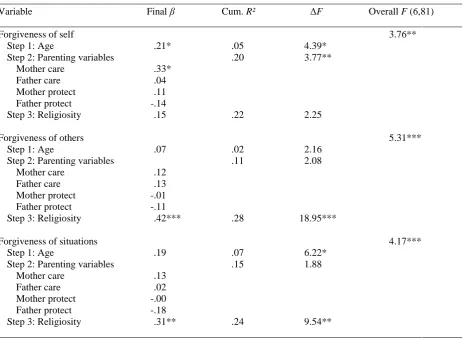
Three separate hierarchical regressions were conducted in order to predict forgiveness of self, others, and situations. As the bivariate correlations indicated that older people were more forgiving of self and situations, age was controlled by entering it at Step 1 in the regression analyses. As people‟s interactions with their parents would be expected to precede the development of religious beliefs, the four parental variables were added at Step 2, followed by the importance of participants‟ religious beliefs at Step 3. The results are shown in Table 2.
For forgiveness of self, both age and the parenting variables were significant contributors to the prediction when entered at Steps 1 and 2 respectively. However, religiosity did not add significantly to the prediction when added at Step 3. The full model explained 21.8% of the variance in forgiveness of self, R = .47, F (6, 81) = 3.76, p < .01. Age and mother care made unique significant contributions to the prediction, such that older participants and those who perceived their mothers as more caring were more forgiving of themselves.
For forgiveness of situations, age explained 6.7% of the variance when entered at Step 1, such that older participants were more likely to be forgiving of situations. The parenting variables did not add significantly to the prediction when added at Step 2. When religiosity was added at Step 3, it explained a further 9.0% of the variance. The full model explained 23.6% of the variance in forgiveness of situations, R =
[image:4.595.74.539.189.530.2].49, F (6, 81) = 4.17, p < .001, with religiosity being the only variable that made a unique significant contribution to the prediction. Although age was no longer a significant predictor once all the variables were entered into the equation, there was a non-significant trend such that older people were more forgiving of situations (β = .19, p < .07).
Table 2: Hierarchical Regression Analyses Predicting Forgiveness of Self, Others, and Situation.
_____________________________________________________________________________________________ Variable Final β Cum. R² ΔF Overall F (6,81) _____________________________________________________________________________________________
Forgiveness of self 3.76**
Step 1: Age .21* .05 4.39*
Step 2: Parenting variables .20 3.77** Mother care .33*
Father care .04 Mother protect .11 Father protect -.14
Step 3: Religiosity .15 .22 2.25
Forgiveness of others 5.31***
Step 1: Age .07 .02 2.16
Step 2: Parenting variables .11 2.08 Mother care .12
Father care .13 Mother protect -.01 Father protect -.11
Step 3: Religiosity .42*** .28 18.95***
Forgiveness of situations 4.17***
Step 1: Age .19 .07 6.22*
Step 2: Parenting variables .15 1.88 Mother care .13
Father care .02 Mother protect -.00 Father protect -.18
Step 3: Religiosity .31** .24 9.54**
_____________________________________________________________________________________________ Note. Cum. R² = cumulative R².
*p < .05. **p < .01. ***p < .001.
Discussion
First, it was predicted that higher levels of dispositional forgiveness would be associated with higher parental care and lower parental overprotection. This hypothesis was partially supported. Both mother care and father care were positively correlated with forgiveness of self and others. Father overprotection was also negatively correlated with all three types of forgiveness. The other correlations between forgiveness and the parenting variables were in the expected direction, though not significant. Although no previous studies have looked at the relationship
between parental bonding and forgiveness, these results are generally consistent with Paleari et al.‟s (2003) finding that adolescents with more positive relationships with their fathers were more willing to forgive.
(2008), in that their religiosity and forgiveness variables were also correlated. However, they did not look specifically at the three types of forgiveness investigated in the current study.
Finally, it was predicted that higher religiosity and parental care and lower parental overprotection would predict all three types of forgiveness. Only partial support was gained for this hypothesis. The parenting variables significantly predicted forgiveness of self, but not forgiveness of others and situations. For forgiveness of self, mother care made a significant unique contribution to the prediction. Conversely, religiosity was a significant predictor of both forgiveness of others and situations, though not a significant predictor of forgiveness of self.
One reason why the parenting variables, particularly mother care, were more important than religiosity in predicting forgiveness of self may be because self-concept or self-esteem is largely shaped by parents‟ attitudes and behaviours toward the developing child. For example, researchers have shown that self-esteem is positively correlated with parental care and negatively correlated with parental overprotection (Hall et al., 2004; Passmore et al., 2005). Hall et al. (2004) also found that maternal care was the strongest predictor of self-esteem among college women. Therefore, it is likely that individuals may find it easier to forgive themselves if they have had caring parents who affirmed them while they were growing up.
It is interesting that religiosity was a significant predictor of forgiveness of others and situations, though not a significant predictor of forgiveness of self. As forgiveness of others is a clear teaching within the Christian tradition, it is not surprising that those whose Christian beliefs were more important to them also indicated a greater willingness to forgive others. Forgiveness of situations may also fall within the general teachings of Christianity. For example, someone may be able to let go of difficult situations if they have a view that those circumstances are part of a higher purpose or if they believe there is a better life awaiting them in eternity.
While forgiveness interventions have long been used in religious settings (e.g., pastoral counselling), such interventions have become increasingly popular in secular domains. The results of this study have implications for the use of such interventions. First, we have shown that different factors predict different types of forgiveness. Therefore, it is important for a therapist to acknowledge these different types. Second, religiosity is an important predictor of forgiveness of others and situations. In particular, people whose Christian beliefs are more important to them, indicate a greater willingness to forgive. If secular therapists do not consider the possible religious beliefs of their clients, they may miss an important aspect that could facilitate or hinder a client‟s willingness to forgive. This does not imply that therapists should become
spiritual advisers to their clients. Indeed, psychologists are bound by the Code of Ethics to not practise beyond their areas of expertise. However, the findings highlight the importance of considering the whole person in counselling, including the religious beliefs and values of clients (Passmore, 2003).
The current study has some limitations. First, some sampling issues may limit the generalisability of the findings. A convenience sample was used, with most participants being Anglo-Australian and fairly well-educated. Thus, it is not clear whether the same pattern of results would be found in a broader community sample. Only participants who were affiliated with the Christian religion were included in the current study. While forgiveness is also an important concept in some other religions, conceptualisations and practices of forgiveness may differ in other religious traditions. It is also possible that there may be differences within the Christian tradition (e.g., among Catholics and Protestants), but it was not possible to explore this possibility in the current study due to sample size. In future research, it would be helpful to investigate forgiveness among other religious groups and denominations to see whether similar or different patterns emerge.
Second, only a single-item measure of religiosity was used in the current study. While single-item measures of the importance of one‟s religious beliefs tend to correlate with other measures such as religious identity and intrinsic religiosity (Cohen & Hill, 2007) and are preferable to religious affiliation alone, they do not allow for more fine-grained analysis of the aspects of religious beliefs and experiences that may be important for forgiveness. Future studies could include standardised measures of religiosity, such as Gorsuch and McPherson‟s (1989) revised Religious Orientation Scale.
Finally, the current study only looked at participants‟ own reports of their willingness to forgive, which could be affected by social desirability. For example, if people‟s Christian beliefs are very important to them, they may be highly motivated to endorse forgiveness items that are in keeping with those religious beliefs. Although research shows that dispositional and episodic forgiveness are positively correlated (Allemand et al., 2007), the findings of the current research would be strengthened if specific measures of episodic forgiveness were included in future studies. Thus, it would be possible to determine whether those with strong religious beliefs „practise what they preach‟ regarding forgiveness.
Acknowledgments
References
Allemand, M., Amberg, I., Zimprich, D., & Fincham, F. D. (2007). The role of trait forgiveness and relationship satisfaction in episodic forgiveness. Journal of Social and Clinical Psychology, 26, 199-217.
Bandura, A. (1977). Social learning theory. Englewood Cliffs, NJ: Prentice Hall.
Cohen, A. B., & Hill, P. C. (2007). Religion as culture: Religious individualism and collectivism among American Catholics, Jews, and Protestants. Journal of Personality, 75, 709-742.
Fox, A., & Thomas, T. (2008). Impact of religious affiliation and religiosity on forgiveness. Australian Psychologist, 43, 175-185.
Gordon, K. C., Hughes, F. M., Tomcik, N. D., Dixon, L. J., & Litzinger, S. C. (2009). Widening spheres of impact: The role of forgiveness in marital and family functioning. Journal of Family Psychology, 23, 1-13. Gorsuch, R. L., & McPherson, S. E. (1989).
Intrinsic/extrinsic measurement: I/E-revised and single-item scales. Journal for the Scientific Study of Religion, 28, 348-354.
Hall, L. A., Peden, A. R., Rayens, M. K., & Beebe, L. H. (2004). Parental bonding: A key factor for mental health of college women. Issues in Mental Health Nursing, 25, 277-291.
Macaskill, A. (2007). Exploring religious involvement, forgiveness, trust, and cynicism. Mental Health, Religion and Culture, 10, 203-218. Maio, G. R., Thomas, G., Fincham, F. D., & Carnelley,
K. B. (2008). Unraveling the role of forgiveness in family relationships. Journal of Personality and Social Psychology, 94, 307-319.
Mullet, E., Girard, M., & Bakhshi, P. (2004). Conceptualizations of forgiveness. European Psychologist, 9, 78-86.
Mullet, E., Riviere, S., & Munoz Sastre, M. T. (2006). Relationships between young adults‟ forgiveness culture and their parents‟ forgiveness culture. Journal of Cultural and Evolutionary Psychology, 4, 159-172.
Paleari, F. G., Regalia, C., & Fincham, F. D. (2003). Adolescents‟ willingness to forgive their parents: An empirical model. Parenting: Science and Practice, 3, 155-174.
Parker, G., Tupling, H., & Brown, L. B. (1979). A Parental Bonding Instrument. British Journal of Medical Psychology, 52, 1-10.
Passmore, N. L. (2003). Religious issues in counselling: Are Australian psychologists „dragging the chain‟? Australian Psychologist, 38, 183-192. Passmore, N. L., Fogarty, G. J., Bourke, C. J., &
Baker-Evans, S. F. (2005). Parental bonding and identity style as correlates of self-esteem among adult adoptees and nonadoptees. Family Relations, 54, 523-534.
Rye, M. S. (2005). The religious path toward forgiveness. Mental Health, Religion and Culture, 8, 205-215.
Thompson, L. Y., Snyder, C. R., Hoffman, L., Michael, S. T., Rasmussen, H. N., Billings, L. S., Heinze, L., Neufeld, J. E., Shorey, H. S., Roberts, J. C., & Roberts, D. E. (2005). Dispositional forgiveness of self, others, and situations. Journal of Personality, 73, 313-359.
Wilhelm, K., & Parker, G. (1990). Reliability of the Parental Bonding Instrument and Intimate Bond Measure scales. Australian and New Zealand Journal of Psychiatry, 24, 199-202.