
Load-deformation behaviour of foundations under vertical and oblique loads
24
0
0
Full text
(2) THESIS JAMES COOK UNIVERSITY. SCHOOL OF ENGINEERING www.eng.jcu.edu.au. LOAD-DEFORMATION BEHAVIOUR OF FOUNDATIONS UNDER VERTICAL AND OBLIQUE LOADS. Kate Johnson. Thesis submitted to the School of Engineering in fulfilment of the requirements for the degree of. Doctor of Philosophy (Civil Engineering) May 2005.
(3) ABSTRACT The work in this thesis explores the load-deformation behaviour of shallow and pile foundations under axial and oblique loads. •. A statistical review was performed on five popular shallow foundation settlement methods, which showed that different prediction methods could give highly variable results for the same foundation and soil conditions. The probability of failure charts allowing direct comparison between methods is presented, based on the statistical work.. There are 40+ settlement methods available for predicting the settlement of shallow foundations in granular soil. There is no way to account for the differences between settlement methods, other than assume one specific design criterion for every method. For example, limiting the settlement of a shallow foundation to 25 mm is a design criterion that is commonly used. From previous statistical work, it is shown that the Terzaghi and Peck method is more conservative than the method developed by Berardi and Lancellotta. The work in this thesis produced ‘probability of failure charts’, and the charts give the probability that the settlement for the commonly used methods will exceed an actual design value in the field. These charts allow users to design shallow foundations on the basis of an acceptable failure probability, instead of using one settlement criterion for every settlement method. •. A finite element analysis was performed on obliquely loaded piles. The analysis showed that the axial and lateral load components, and moment capacity of a pile is reduced if multiple load types act in unison. Combination loading also affects the pile head displacement. The oblique interaction charts herein allow the ultimate capacity and pile head displacement for a pile under combination loading to be estimated.. II.
(4) From the literature review of pile foundations, it is found that the influence due to combination loading is not well defined (i.e. axial loads, lateral loads and moments all acting at once).. Previous work has shown that combination loading reduces the. ultimate capacity of a pile, and the influence on pile head displacement has not been quantified. The influence of combination loading on pile capacity and settlement was explored, with the use of a finite element computer package entitled ABAQUS. The results from the numerical modelling are summarised into easy-to-use design charts, allowing the user to quantify the reduction in ultimate capacity and influence in settlement.. III.
(5) ELECTRONIC COPY AND STATEMENT ON SOURCES DECLARATION. I, the undersigned, the author of this work, declare that the electronic copy of this thesis provided to the James Cook University Library is an accurate copy of the print thesis submitted, within the limits of the technology available. I declare that this thesis is my own work and has not been submitted in any form for another degree or diploma at any university or other institution of tertiary education. Information derived from the published or unpublished work of other has been acknowledged in the text and a list of references is given.. ------Kate Johnson. 1st August 2005 ------------------------------------Date. IV.
(6) STATEMENT OF ACCESS. I, the undersigned, the author of this thesis, understand that James Cook University will make available for use within the University Library and, by microfilm or other means, allow access to other users in other approved libraries. All users consulting this thesis will have to sign the following statement:. In consulting this thesis I agree not to copy or closely paraphrase it in whole or in part without the written consent of the author, and to make proper public written acknowledgement for any assistance, which I have obtained from it.. Beyond this, I do not wish to place any restriction on access to this thesis.. -------Kate Johnson. 1st August 2005 ------------------------------------Date. V.
(7) ACKNOWLEDGEMENTS The journey has been filled with many challenges and personal tests of will. I had the pleasure of working with some interesting people along the way. Firstly, I would like to extend my warm thanks to my supervisor Dr. W. Karunasena.. His kind and. approachable manner was much appreciated. Karu’s patience and ability to reason through problems provided a platform for me to move towards my aims. I would also like to thank my second supervisor Dr. N. Sivakugan. Siva allowed me many opportunities to enhance my skills as a teacher and a consultant. His questioning mind made me pay attention to fine detail. I chose Siva as a supervisor, because he was enthusiastic about the discipline of geotechnical engineering at James Cook University. I liked working with the technical support people at James Cook University. A thankyou to Mr Stuart Petersen, Mr Curt Arrowsmith, Mr Warren O'Donnell, Mr John Ellis, and all the technicians in the laboratory.. Year after year, the technicians make. equipment to help the PhD and undergraduate students in their experimental work. They are inspiring and hard working members of the JCU community. During the course of my research I enlisted the help of two undergraduate students who worked under my direction. The two undergraduate students were: •. Mr Andrew Guazzo worked with me for the experimental pile phase (Chapter 6). Andrew and I spent a great deal of time setting up apparatuses, testing the smallscale piles and analysing the results. Andrew had a very good attitude even when we were shovelling 7 tonne of sand back and forth.. •. Mr Paul Lemcke worked with me exploring the influence of pile shape on the capacity of a pile. Paul was patient while we worked some long days and late nights to obtain a numerical ABAQUS model, which would be suitable for the pile shape research.. VI.
(8) A thank-you to Dr J Eckersley (Coffey). I thank John for his council and guidance, and I liked being challenged by his inquisitive mind. He gave me some good ideas when I have needed them most. My final acknowledgement is to my parents. I thank them for their support during the high and low points throughout the years. I have memories of working through the nights trying to solve problems with the numerical modelling. My mother sat in my office to offer support, and my father rang to see if I was successful. They made me feel part of a team and never gave up on me. THANK-YOU. I think we can have a vacation now… Finally, I have chosen two poems to close the acknowledgement section of this thesis.. Does the road wind up-hill all the way? Yes, to the very end. Will the day’s journey take the whole long day? From morn to night, my friend. Christina Rossetti. “Over the Mountains Of the Moon Down the Valley of the Shadow, Ride, boldly ride,” The shade replied, “If you seek for Eldorado!” Edgar Allan Poe. VII.
(9) CONTENTS Abstract. II. Statement of Sources Declaration. IV. Statement of Access. V. Acknowledgements. VI. Table of Contents. VIII. List of Tables. XIII. List of Figures. XV. Notations. XXI. Chapter 1:. Introduction. 1. 1.1. General. 1. 1.2. History of Shallow and Pile Foundations. 3. 1.3. Research Objectives and Aims. 4. 1.4. Thesis Overview. 8. Chapter 2:. Literature Review – Shallow Foundations. 10. 2.1. General. 10. 2.2. Accuracy and Reliability. 10. 2.3. Shallow Foundation Settlement Prediction Methods. 11. 2.3.1. 12. Terzaghi and Peck Method. 2.3.2 Burland and Burbidge Method. 12. 2.3.3. Berardi and Lancellotta Method. 13. 2.3.4. Schmertmann Method. 13. 2.4. Results from the Reliability Analysis. 13. 2.5. Soil Variability. 15. 2.6. Statistical Review of Settlement for Shallow Footings. 17. Chapter 3:. Settlement Predictions in Granular Soil: A Probabilistic Approach. 23. 3.1. General. 23. 3.2. Statistical Analysis. 23. 3.2.1. Settlement Ratio Probability Density Function. 24. VIII.
(10) 3.2.2. Probabilistic Design Charts. Chapter 4:. Soil Strength and Constitutive Behaviour. 27 34. 4.1. General. 34. 4.2. Constitutive Models. 34. 4.2.1. General Background. 34. 4.2.2. Types of Constitutive Models. 36. 4.2.3. Linear Elastic Constitutive Model. 37. 4.2.4. Non-Linear Elastic Constitutive Model. 38. 4.2.5. Mohr-Coulomb’s Model. 39. 4.2.6. Drucker Prager Model. 41. 4.3. Determination of Sand Constitutive Properties. 42. 4.3.1. Correlations for Friction Angle of Sand. 42. 4.3.2. Correlations for Dilatancy of Sand. 55. 4.3.3. Correlations for Elastic Modulus of Sand. 58. 4.3.4. Poisson’s Ratio (ν) of Sand. 64. Chapter 5:. Estimating Shallow Foundation Behaviour using Numerical Models. 66. 5.1. General. 66. 5.2. Behaviour Criteria and Numerical Model Development. 69. 5.2.1. Shallow Foundation Failure Mechanism. 69. 5.2.2. Development of Shallow Foundation ABAQUS Model. 70. 5.2.2.1 Shallow Foundation Model Types. 71. 5.2.2.2 General Model Characteristics. 74. Prediction of Shallow Foundation Behaviour. 77. 5.3.1. Symposium Footing Size and Soil Profiles. 77. 5.3.2. Prediction of Symposium Footing Behaviour. 80. 5.3. 5.4. Comparison of Symposium Results. Chapter 6:. Literature Review – Piles. 87. 94. 6.1. General. 94. 6.2. Piles Subjected to Oblique Loading. 95. IX.
(11) 6.3. Pile Installation Techniques. 101. 6.4. Current Design Techniques. 103. 6.4.1. Piles subjected to Axially Compressive Loading in Sand. 104. 6.4.2. Piles subjected to Axially Uplift Loading. 106. 6.4.3. Piles subjected to Lateral Loading. 110. 6.5. Finite Element Method (FEM). Chapter 7:. Small-Scale Model Pile Tests. 114. 120. 7.1. General. 120. 7.2. Apparatuses Used for Small-Scale Pile Testing. 120. 7.2.1. Model Piles. 121. 7.2.2. Tank. 121. 7.2.3. Main Loading Frame. 122. 7.2.4. Pile Jacking Frame. 123. 7.2.5. Pile Loading Equipment. 124. 7.2.6. Measuring Devices. 127. 7.3. 7.4. 7.5. Methodology for Model Pile Testing. 128. 7.3.1. Experimental Sand Properties and Sand Placement. 129. 7.3.2. Sand Bed Properties. 132. 7.3.3. Model Pile Placement. 133. 7.3.4. Load-Displacement Testing. 134. Load Settlement Results for Model Piles. 134. 7.4.1. Compressive Axial Load Test Results. 135. 7.4.2. Compressive Oblique Load Test Results. 137. 7.4.3. Horizontal Load Results. 139. Experimental Observations. 141. 7.5.1. Surface Displacement Prior to Loading. 141. 7.5.2. Surface Displacement Post Loading. 143. Numerical Pile Model Development and Verification. 145. Chapter 8: 8.1. General. 145. 8.2. Numerical Model Algorithms and Behaviour Criteria. 145. 8.2.1. 146. General Finite Element Algorithms. X.
(12) 8.2.2. Implementation of Constitutive Model into Finite Element Model 149. 8.2.3. Implementation of Interface Frictional Criteria in Finite. 8.2.4 8.3. 8.4. Element Model. 152. 8.2.3.1 Surface-Based Contact. 153. 8.2.3.2 Contact Elements. 155. 8.2.3.3 Models of Interaction. 155. Initial Stress States. 158. Construction of Finite Element Model in ABAQUS. 161. 8.3.1. Problem Geometry and Boundary Conditions. 161. 8.3.2. Finite Element Pile Mesh. 164. Verification of ABAQUS Pile Model. 166. 8.4.1. Predictions for Cast-In-Place Piles. 166. 8.4.2. Predictions for Impact Driven Piles. 169. 8.4.3. Discussion of Verification Results. 171. Oblique Interaction Charts for Piles. 178. Chapter 9: 9.1. General Introduction. 178. 9.2. Numerical Model Cases. 178. 9.3. Results from Numerical Analysis. 188. 9.4. Comparison of FEM Results with Other Theoretical Methods. 195. 9.5. Development of Three Dimensional Oblique Charts. 198. 9.5.1. General. 198. 9.5.2. Cast-in-Place Pile with Free and Fixed Head, and Up Thrust Combination Loading. 9.5.3. Cast-in-Place Pile with Free and Fixed Head, and Compression Combination Loading. 9.5.4. 9.5.6 9.6. 203. Impact Driven Pile with Free Head and Uplift Combination Loading. 9.5.5. 199. 206. Impact Driven Pile with Free Head and Compression Combination Loading. 209. Three-Dimensional Oblique Interaction Charts. 210. Influence of Oblique Load on Displacement. 216. XI.
(13) Chapter 10: Discussion of Numerical Results for Piles. 219. 10.1. General. 219. 10.2. Oblique Interaction Charts and Comparison with Experimental Data. 219. 10.3. Comparison between Numerical and Theoretical Results. 227. 10.4. Influential Factors on Design Charts. 230. 10.4.1 Soil Properties. 230. 10.4.2 Influence of Pile Installation Technique. 231. 10.4.3 Influence of Vertical Stress Fields. 232. 10.4.4 Pile Head Fixity. 233. 10.5. Influence of Pile Shape. 234. 10.6. Design Examples. 235. 10.6.1 Determining the Ultimate Load of an Example Pile. 235. 10.6.2 Determining the Pile Head Displacement of an Example Pile. 237. Chapter 11: Conclusions and Recommendations. 239. 11.1. Conclusions and Recommendations for Shallow Foundations. 239. 11.2. Conclusions and Recommendations for Pile Foundations. 240. REFERENCES. 243. APPENDIXES Appendix A:. Probability of Failure - Shallow Foundations. 253. Appendix B:. Texas ′94 Symposium SPT Results and Interpretation. 266. Appendix C:. Small Scale Model Test Pile Procedures. 272. Appendix D:. Laboratory Testing Results for Experimental Sand. 278. Appendix E:. Experimental Results from Model Piles. 292. Appendix F:. Mesh Configuration of Constructed Pile. 304. Appendix G:. ABAQUS Code. 307. Appendix H:. Verification Results. 320. Appendix I:. ABAQUS Case Results. 332. Appendix J:. Sample Calculations. 401. Appendix K:. Pile Article. 406. XII.
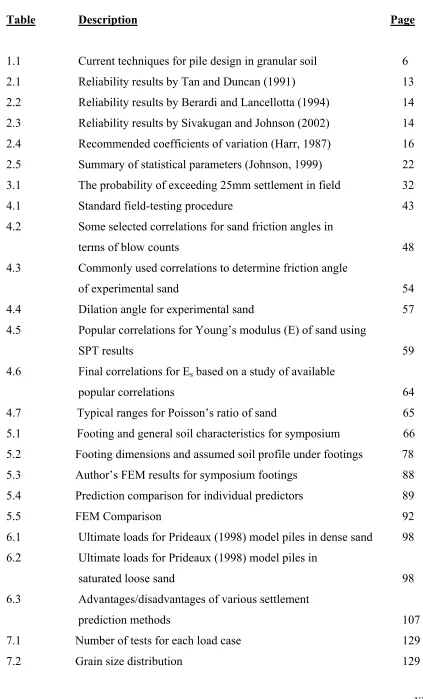
(14) LIST OF TABLES Table. Description. 1.1. Current techniques for pile design in granular soil. 6. 2.1. Reliability results by Tan and Duncan (1991). 13. 2.2. Reliability results by Berardi and Lancellotta (1994). 14. 2.3. Reliability results by Sivakugan and Johnson (2002). 14. 2.4. Recommended coefficients of variation (Harr, 1987). 16. 2.5. Summary of statistical parameters (Johnson, 1999). 22. 3.1. The probability of exceeding 25mm settlement in field. 32. 4.1. Standard field-testing procedure. 43. 4.2. Some selected correlations for sand friction angles in terms of blow counts. 4.3. Page. 48. Commonly used correlations to determine friction angle of experimental sand. 54. 4.4. Dilation angle for experimental sand. 57. 4.5. Popular correlations for Young’s modulus (E) of sand using SPT results. 4.6. 59. Final correlations for Es based on a study of available popular correlations. 64. 4.7. Typical ranges for Poisson’s ratio of sand. 65. 5.1. Footing and general soil characteristics for symposium. 66. 5.2. Footing dimensions and assumed soil profile under footings. 78. 5.3. Author’s FEM results for symposium footings. 88. 5.4. Prediction comparison for individual predictors. 89. 5.5. FEM Comparison. 92. 6.1. Ultimate loads for Prideaux (1998) model piles in dense sand. 98. 6.2. Ultimate loads for Prideaux (1998) model piles in saturated loose sand. 6.3. 98. Advantages/disadvantages of various settlement prediction methods. 107. 7.1. Number of tests for each load case. 129. 7.2. Grain size distribution. 129 XIII.
(15) 7.3. Sand characteristics. 130. 7.4. Experimental sand bed properties. 133. 7.5. Sand material properties. 133. 8.1. Case study results.. 175. 9.1. Results from the numerical modelling of free head, cast-in-place, and uplift combination-loaded piles. 9.2. Results from the numerical modelling of free head, cast-in-place, and compression combination-loaded piles. 9.3. 192. Results from the numerical modelling of free head, impact driven, and uplift combination-loaded piles. 9.5. 191. Results from the numerical modelling of fixed head, cast-in-place, and uplift/compression combination-loaded piles. 9.4. 189. 193. Results from the numerical modelling of free head, impact driven, and compression combination-loaded piles. 194. 9.6. Comparison of numerical results against existing techniques. 196. 9.7. Design ratios for uplift cast-in-place free head piles. 200. 9.8. Design ratios for uplift cast-in-place fixed head pile. 202. 9.9. Design ratios for compression cast-in-place free head piles. 204. 9.10. Design ratios for compression cast-in-place fixed head piles. 205. 9.11. Design ratios for uplift impact driven free head piles. 207. 9.12. Design ratios for down thrust impact driven free head piles. 209. 10.1. Experimental small-scale test pile results conducted as part of current research. 10.2. 221. Experimental small-scale test pile results conducted by Prideaux (1998). 222. XIV.
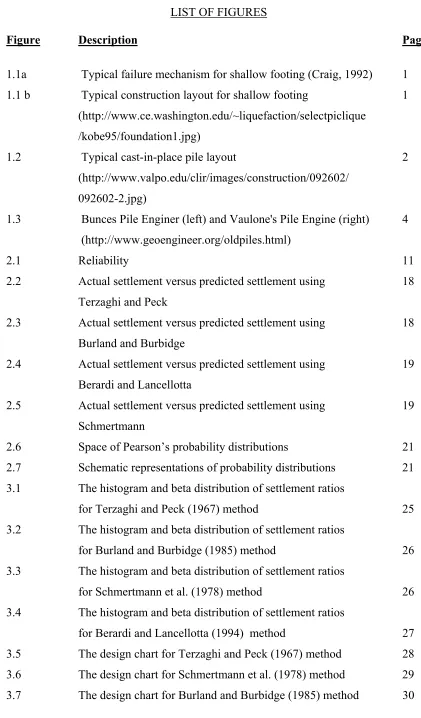
(16) LIST OF FIGURES Figure. Description. Page. 1.1a. Typical failure mechanism for shallow footing (Craig, 1992). 1. 1.1 b. Typical construction layout for shallow footing. 1. (http://www.ce.washington.edu/~liquefaction/selectpiclique /kobe95/foundation1.jpg) 1.2. Typical cast-in-place pile layout. 2. (http://www.valpo.edu/clir/images/construction/092602/ 092602-2.jpg) 1.3. Bunces Pile Enginer (left) and Vaulone's Pile Engine (right). 4. (http://www.geoengineer.org/oldpiles.html) 2.1. Reliability. 11. 2.2. Actual settlement versus predicted settlement using. 18. Terzaghi and Peck 2.3. Actual settlement versus predicted settlement using. 18. Burland and Burbidge 2.4. Actual settlement versus predicted settlement using. 19. Berardi and Lancellotta 2.5. Actual settlement versus predicted settlement using. 19. Schmertmann 2.6. Space of Pearson’s probability distributions. 21. 2.7. Schematic representations of probability distributions. 21. 3.1. The histogram and beta distribution of settlement ratios for Terzaghi and Peck (1967) method. 3.2. The histogram and beta distribution of settlement ratios for Burland and Burbidge (1985) method. 3.3. 26. The histogram and beta distribution of settlement ratios for Schmertmann et al. (1978) method. 3.4. 25. 26. The histogram and beta distribution of settlement ratios for Berardi and Lancellotta (1994) method. 27. 3.5. The design chart for Terzaghi and Peck (1967) method. 28. 3.6. The design chart for Schmertmann et al. (1978) method. 29. 3.7. The design chart for Burland and Burbidge (1985) method. 30 XV.
(17) 3.8. The design chart for Berardi and Lancellotta (1994) method. 31. 4.1. Ideal stress-strain material assumed for most structural materials. 35. 4.2. Stress-strain relationship for elasto-plastic material. 35. 4.3. Typical linear elastic and non-linear elastic soil response. 38. 4.4. Mohr-Coulomb failure line. 39. 4.5. Mohr-Coulomb failure surface (Chen and Saleeb, 1983). 40. 4.6. Drucker-Prager failure surface (Chen and Saleeb, 1983). 41. 4.7. Typical shear stress (τ) vs. effective normal stress (σ’) relation for sand (Craig, 1992). 4.8. 46. Typical shear stress (τ) vs. axial strain (εa) for a sand (Craig, 1992). 47. 4.9. Shear stress vs. axial strain for experimental sand. 50. 4.10. Shear stress vs. effective normal stress for experimental sand. 50. 4.11. Typical plot of void ratio vs. horizontal displacement for sand (Craig, 1992). 51. 4.12. Void ratio vs. axial strain for experimental sand. 51. 4.13. Relationship between vertical effective stress and field blow count N (Alpan, 1967). 4.14. Typical vertical displacement vs. horizontal displacement plot for sand (Yasufuku et al., 2004). 4.15. 53 56. Horizontal displacement vs. vertical displacement for experimental sand. 56. 4.16. Approximation of dilation, ψ (Bolton, 1987). 57. 4.17. Typical stress-strain relationship for sand. 58. 4.18. Non-dimensional Young’s modulus vs. field blow count for normally consolidated sand. 4.19. Non-dimensional Young’s modulus vs. field blow count for preloaded sand or sand exposed to driving forces. 4.20. 62. Line of best fit for non-dimensional Young’s modulus vs. field blow count of normally consolidated sand. 4.21. 62. 63. Line of best fit for non-dimensional Young’s modulus vs. field blow count of preloaded sand or sand exposed to pile driving forces. 63. XVI.
(18) 5.1a. Cross-section A-A. 5.1b. Layout of test footings for Federal Highway Administration Symposium. 5.2. 67 68. The bearing capacity failure diagram from Terzaghi (Cernica, 1995). 70. 5.3. The domain example for finite element problem. 71. 5.4. Idealized sensitivity plot. 72. 5.5. Shallow footing coarse mesh. 72. 5.6. Shallow footing medium mesh. 73. 5.7. Shallow footing fine mesh. 73. 5.8. Shallow footing quadratic mesh. 74. 5.9. Lines of symmetry for square footing. 75. 5.10. Final model boundary conditions. 75. 5.11. Displacement of rigid footing under load. 76. 5.12. Footing 1 load-displacement prediction. 81. 5.13. Footing 2 load-displacement prediction. 82. 5.14. Footing 3 load-displacement prediction. 83. 5.15. Footing 4 load-displacement prediction. 84. 5.16. Footing 5 load-displacement prediction. 85. 5.17. Frequency histogram for techniques in symposium. 87. 5.18. Footing 1 comparative histogram. 90. 5.19. Footing 2 comparative histogram. 90. 5.20. Footing 3 comparative histogram. 91. 5.21. Footing 4 comparative histogram. 91. 5.22. Footing 5 comparative histogram. 92. 6.1. Vertically installed pile subjected to oblique loading. 96. 6.2 a). Experimental results from Eckersley et al. (1996). 99. 6.2 b). Interaction diagram for horizontal and vertical components. 99. 6.3. In-plane and out-of-plane loading of a pile. 100. 6.4. Cast-in-place pile installation process. 101. 6.5. Impact driven pile installation process. 102. 6.6. Forces acting on a single axially loaded pile. 104. 6.7. Pile subjected to uplift forces. 110. 6.8. Generalized forces acting on a laterally loaded short rigid pile. 111 XVII.
(19) 6.9. Typical meshed problem domain for FEM. 116. 7.1. Experimental model pile. 121. 7.2. Influence zone for a typical driven pile. 122. 7.3 (a). Photo of axial loading arrangement. 7.3 (b). Schematic of axial loading arrangement. 7.4. Oblique loading cap, axial loading cap,. 124. horizontal loading saddle, respectively. 125. 7.5 (a). Photo of lateral loading arrangement. 125. 7.5 (b). Schematic of lateral loading arrangement. 126. 7.6 (a). Photo of oblique loading arrangement. 7.6 (b). Schematic of oblique loading arrangement. 127. 7.7. Sieve analysis of experimental sand. 130. 7.8. Vibrating plate for compaction. 132. 7.9. Plan view of sand tank and pile layout Note: All dimensions have units of mm. 134. 7.10. Load-displacement curve for axial load in loose soil. 136. 7.11. Load-displacement curve for axial load in dense soil. 136. 7.12. Load-displacement curve for axial load in layered soil. 137. 7.13. Load-displacement curve for oblique load in loose soil. 138. 7.14. Load-displacement curve for oblique load in dense soil. 138. 7.15. Load-displacement curve for oblique load in layered soil. 139. 7.16. Load-displacement curve for horizontal load in loose soil. 140. 7.17. Load-displacement curve for horizontal load in dense soil. 140. 7.18. Load-displacement curve for horizontal load in layered soil. 141. 7.19. Surface disturbance from placement in loose soil. 142. 7.20. Surface disturbance from placement in dense soil. 143. 7.21. Horizontal load on pile with failed pile in foreground. 144. 7.22. Average surface indentations after pile removal. 144. 8.1 (a). Linear elements. 147. 8.1 (b). Quadratic elements. 148. 8.2. Bending nature of linear elements. 148. 8.3. Penetration restriction between slave and master surfaces (Hibbett et al., 2001). 8.4. 155. Interaction between contact pressure and shear stress at XVIII.
(20) interface surface 8.5. 156. Relative movement between pile and soil due to surface-based contact. 157. 8.6. Influence of initial stress in Mohr-Coulomb failure criterion. 158. 8.7. Initial stress field due to self weight of system. 160. 8.8. Plan view of axially loaded pile showing line of symmetry. 161. 8.9. Plan view of obliquely loaded circular pile showing. 162. 8.10. Boundary conditions for obliquely loaded pile. 163. 8.11(a). Plan view of problem. 163. 8.11(b). Elevation view of pile-soil problem. 163. 8.12. Illustrative view of mesh adopted. 164. 8.13. Case study 1 - large scale, cast-in-place, axial compression loading. 8.14. 167. Case study 2 - large scale, cast-in-place, axial compression loading. 168. 8.15. Case study 3 - large scale, cast-in-place, axial uplift loading. 168. 8.16. Case study 4 - smaller scale, placed in tank, lateral loading. 169. 8.17. Case study 5 - large scale, impact driven, compression loading. 170. 8.18. Case study 6 - large scale, impact driven, compression loading. 170. 8.19. Case study 7 - large scale, impact driven, lateral loading (Hage-Chehade ,1991). 172. 8.20. Load-displacement curve for typical pile. 173. 9.1. The chosen hypothetical numerical modelling cases. 180. 9.2. Example of pile head fixity. 181. 9.3. Pile loading (a) Compression load combination (b) Uplift load combination. 182. 9.4. Typical pile response. 183. 9.5. Graphical representation offload ratio. 185. 9.6. Example of load-displacement curve for pure axial uplift of case pile. 185. 9.7. Example of applied moment. 186. 9.8. Example of non-dimensional behaviour for Case 18. 187. 9.9. Example of how failure loads were approximated from numerical results. 188 XIX.
(21) 9.10. 3D design ratio plot for cast-in-place piles with uplift loading scenarios. 9.11. 3D design ratio plot for cast-in-place piles with compression loading scenarios. 9.12. 206. 3D design ratio plot for impact driven piles with uplift loading scenarios. 9.13. 199. 208. 3D design ratio plot for impact driven piles with compression loading scenarios. 210. 9.14. 2D ratio plots for uplift combination loading scenarios. 211. 9.15. 2D ratio plots for compression combination loading scenarios. 212. 9.16. 2D plot of a cast-in-place lateral pile ratio vs. axial uplift pile ratio. 9.17. Relationship between load ratios and displacement ratios for uplift combination, free/fixed head CIP and ID piles. 9.18. 10.7. 228. Estimated point of contraflexure for a L/d=10 pile in sand, with N=30 based on works by Poulos and Davis (1980). 10.6. 228. Estimated point of contraflexure for a L/d=3 pile in sand, with N=5 based on numerical modelling. 10.5. 224. Estimated point of contraflexure for a L/d=3 pile in sand, with N=5 based on works by Poulos and Davis (1980). 10.4. 224. Comparison between experimental and design surface for compression combination loading. 10.3. 218. Comparison between experimental and design surface for uplift combination loading. 10.2. 217. Relationship between load ratios and displacement ratios for compression combination, free head CIP and ID piles. 10.1. 215. 229. Estimated point of contraflexure for a L/d=10 pile in sand, with N=30 based on numerical modelling. 229. Influence of initial stress in Mohr-Coulomb failure criteria. 233. XX.
(22) NOTATIONS The following symbols have been used in multiple locations throughout the document. Symbol. Definition. Units. a. minimum possible value for x. [-]. b. maximum possible value for x. [-]. B. width of footing. [m]. c. cohesion. [kPa]. C. axial compression component of oblique load. [kN]. CER. hammer efficiency factor. [-]. CIP. cast-in-place pile. [-]. CN. overburden correction factor. [-]. d. pile diameter. [m]. Dr. relative density. [%]. e. void ratio (used in Chapter 4). [-]. e. load eccentricity (used in Chapter 6). [m]. ecv. critical void ratio. [-]. Es. Young’s modulus for sand. [MPa]. FOS. factor of safety. [-]. Hu. ultimate lateral capacity under combined uplift. [kN]. and lateral load Hult. ultimate horizontal load. [kN]. Huo. ultimate lateral capacity under pure lateral load. [kN]. (used by Eckersley et al.(1996)) ID. impact driven pile. [-]. Ko. at rest earth coefficient. [-]. L. lateral load. [kN]. Lb. embedment length of pile. [m]. M. applied moment. [kN.m]. Mult. ultimate moment capacity of the pile. [kN.m]. N. uncorrected blow count or field blow count. [blows/100mm]. N60. blow count corrected for hammer efficiency. [blows/100mm]. XXI.
(23) (N1)60, Ncorr. blow count corrected for hammer efficiency. [blows/100mm]. and overburden pa. atmospheric pressure. [kPa]. pf. probability of failure. [-]. pu. soil pressure at depth z. [kPa]. qf. ultimate failure pressure on footing. [kPa]. qo. surcharge on soil surface. [kPa]. Qb. end bearing load. [kN]. Qf. shaft friction load. [kN]. Qult. ultimate bearing load. [kN]. Sx. standard deviation. [-]. Tun. net uplift capacity. [kN]. Tug. gross uplift capacity. [kN]. u. pore water pressure. [kPa]. ux. displacement of the centre of the pile head. [mm]. in x-direction uy. displacement of the centre of the pile head. [mm]. in y-direction uz. displacement of the centre of the pile head. [mm]. in z-direction U. axial uplift. [kN]. W. effective weight of the pile. [kN]. x. settlement ratio. [-]. x. average settlement ratio. [-]. z. depth from soil surface. [m]. Zr. depth of rotation point. [m]. β(1). coefficient of skewness. [-]. β(2). coefficient of kurtosis. [-]. εa. axial strain. [-]. εx,. normal strain in x direction. [-]. εy. normal strain in y direction. [-]. εz. normal strain in z direction. [-]. φ. friction angle. [°]. XXII.
(24) φ′cv. effective friction angle at critical void. [°]. ≈ residual effective friction angle φ′max. peak effective friction angle. [°]. σ. normal stress. [kPa]. σf. failure normal stress. [kPa]. σ′v. effective vertical stress Overburden Pressure. [kPa]. σx. normal stress in x direction. [kPa]. σy. normal stress in y direction. [kPa]. σz. normal stress in z direction. [kPa]. σ1. major principle stress. [kPa]. σ2. intermediate principle stress. [kPa]. σ3. minor principle stress. [kPa]. τ. shear stress. [kPa]. τf. failure shear stress. [kPa]. ρ. density of sand and pile. µ. coefficient of friction. [-]. ψ. dilation angle (ψ). [°]. [kg/m3]. XXIII.
(25)
Figure
Related documents