Final Project Report
June 2009
Martin Smith, University of Wollongong Sally Brooks, RMIT
Anna Lichtenberg, University of Wollongong Peter McIlveen, University of Southern Queensland Peter Torjul, Flinders University
Joanne Tyler, Monash University
On behalf of the:
National Association of Graduate Careers Advisory Services
Career
Development
Learning:
Maximising the contribution of
work-integrated learning to
Terms and Conditions of Use
Support for this project has been provided by the Australian Learning and Teaching Council, an initiative of the Australian Government Department of Education, Employment and Workplace Relations. The views expressed in this report do not necessarily reflect the views of the Australian Learning and Teaching Council Ltd.
This work is published under the terms of the Creative Commons Attribution- Noncommercial-ShareAlike 2.5 Australia Licence. Under this Licence you are free to copy, distribute, display and perform the work and to make derivative works.
Attribution: You must attribute the work to the original authors and include the following statement: Support for the original work was provided by the Australian Learning and Teaching Council Ltd, an initiative of the Australian Government Department of Education, Employment and Workplace Relations.
Noncommercial: You may not use this work for commercial purposes.
Share Alike: If you alter, transform, or build on this work, you may distribute the resulting work only under a licence identical to this one. For any reuse or distribution, you must make clear to others the licence terms of this work.
Any of these conditions can be waived if you get permission from the copyright holder.
To view a copy of this licence, visit http://creativecommons.org/licenses/by/2.5/au or send a letter to Creative Commons, 543 Howard Street, 5th Floor, San Francisco, California, 94105, USA.
Requests and inquiries concerning these rights should be addressed to the Australian Learning and Teaching Council, PO Box 2375, Strawberry Hills NSW 2012 or through the website: http://www.altc.edu.au
2009
Publication Details
Authors:
Martin Smith (University of Wollongong), Sally Brooks (RMIT),
Anna Lichtenberg (University of Wollongong), Peter McIlveen (University of Southern Queensland), Peter Torjul (Flinders University),
Joanne Tyler, (Monash University)
[On behalf of the: National Association of Graduate Careers Advisory Services]
Title: Career Development Learning: maximising the contribution of work-integrated learning to the student experience. [Australian Learning and Teaching Council] Final Project Report June 2009.
Publisher: University of Wollongong. Careers Central. Academic Services Division.
Publication Year: 2009
Format: book/report (hardcopy and downloadable PDF)
1. Foreword
This project comes at an important time for the higher education sector. As the global financial crisis focuses the attention of governments and policy makers, a consistent theme that emerges is the manner in which the capacity to build and manage skills can maximise the effective use of human capital in a rapidly changing world
Like their international counterparts, Australian universities are engaging their students in the world-of-work through a host of mechanisms including work-integrated learning. Inherent to this challenge is the process of engaging students in their learning outside of the traditional confines of the university so that they may enjoy the full benefits of higher education.
This project has demonstrated the value of career development learning as a vehicle for maximising the contribution of work related learning to the student experience.
The project and the accompanying online Resource Manual, are initiatives of the National Association of Graduate Careers Advisory Services, Australia, Inc. NAGCAS represents the professional interests of career development practitioners and Careers Services within the Australian higher education sector. NAGCAS provides leadership and professional development so that Australian university students and graduates are provided the highest possible quality in career development
services. NAGCAS is a member association of the Career Industry Council of Australia and is a signatory to the Professional Standards for Australian Career Development Practitioners.
The project was managed and delivered by a NAGCAS project team consisting of individuals representing Australian university Careers Services. NAGCAS is grateful for the generous funding provided by the Australian Learning and Teaching Council.
NAGCAS commends the Final Report and Resource Manual to you, We are pleased to bring this service to the higher education community.
Dawn White
2. Table of Contents
1. Foreword . . . . 1
2. Table of Contents . . . . 2
3. Project Personnel . . . . 5
4. Statement of Acknowledgement . . . . 6
5. Acronyms . . . . 7
6. Key Terms and Definitions . . . . 8
7. Executive Summary . . . . 9
7.1. Project Brief . . . . 9
7.2. Significance . . . . 9
7.3. Recommendations. . . . 10
7.3.1. Modes of Practice 7.3.2. Curriculum Reform 7.3.3. Workplace Reform 7.3.4. Diversity and Access 7.3.5. Leadership and Communities of Practice 7.3.6. Resourcing Structural Reform 7.4. Project Methodology . . . . 12
7.4.1. Project Mandate 7.4.2. Stakeholders 7.4.3. Research Process 7.5. Project Deliverable Outcomes . . . . 12
7.5.1. Symposium and Forum 7.5.2. Principles of Practice 7.5.3. Validation of Theoretical Framework 7.5.4. Graphical Model 7.5.5. Guide to Terminology 7.5.6. Resource Manual 7.5.7. Quality Framework 8. Career self-management and Career Development Learning. . . . 14
8.1. A Contemporary View of Career. . . . 14
8.1.1. STF and Work-integrated Learning 8.2. Career Development Learning. . . . 16
8.2.1. Career Development and Career Education 8.3. The Benefits of Career Development Learning . . . . 17
8.4. Career Development Learning and Employability . . . . 18
8.4.1. Defining Graduate Employability 8.4.2. Employability Skills for Career Success 8.4.3. Graduate Attributes 8.4.4. Student Experience of Employability 8.5. Career Development Services in Higher Education . . . . 20
9. Work-integrated Learning . . . . 23
9.1. Defining Work-integrated Learning . . . . 23
9.1.1. Work-integrated Learning is Education 9.2. Students’ Experience of Work-integrated Learning. . . . 24
9.3. Employers’ Views of Work-integrated Learning . . . . 24
10. Frameworks for Career Development Learning and Work-integrated Learning . . . . 26
10.1. Principles of Practice . . . . 26
10.2. Lifelong Career Self-Management . . . . 26
10.3. Learning Domains and Criteria: DOTS . . . . 27
10.4. Language and terminology. . . . 28
10.5. Experiential Learning . . . . 29
10.6. Reflexive Learning: Two-Way Mirror . . . . 30
10.6.1. The Learner’s Perspective 10.6.2. The Workplace Perspective 10.7. Fundamentals of a Quality Framework . . . . 31
10.7.1. Cross-sector Comparison 10.7.2. Career Industry Council of Australia Standards 10.7.3. Standardised Measures 11. Discussion . . . . 34
11.1. Student-Centred Lifelong Learning . . . . 34
11.2. Pedagogical Considerations . . . . 34
11.3. Institutional Support and Funding . . . . 34
11.4. Student Finances and Employment . . . . 35
11.5. Deploying Employment . . . . 35
11.6. Workplace Engagement . . . . 35
11.7. Diversity and Equity . . . . 36
11.8. International Students. . . . 36
11.9. Staff Training and Development . . . . 36
11.10. Cross-sector Linkages . . . . 37
11.11. Themes for Future Research and Development. . . . 37
11.11.1. Multi-level Integration 11.11.2. Employer Interface and Engagement 11.11.3. Quality Standards 12. Appendix A: Project Methodology. . . . 39
12.1. Literature Review . . . . 39
12.2. Project Website . . . . 39
12.3. Group Studies . . . . 39
12.4. Online Surveys . . . . 39
12.5. Interviews and Case Studies . . . . 39
12.6. National Symposium . . . . 40
12.8.1. Events 12.8.2. Media
12.8.3. Sector Magazines
13. Appendix B: Models of Work-integrated Learning . . . . 42
14. Appendix C: Reflections Upon National Symposium . . . . 45
15. Appendix D: Guiding Principles for Career Development Services & Information Products . . . . 47
3. Project Personnel
Project Leaders
Mr Martin Smith, University of Wollongong (Lead Institution)
Ms Sally Brooks, RMIT
Dr Peter McIlveen, University of Southern Queensland
Mr Peter Torjul, Flinders University
Ms Joanne Tyler, Monash University
Project Support Staff
Dr Anna Lichtenberg, Project Manager
Ms Tina Anderson, University of Wollongong (symposium event support)
Mr John Clark, private consultant (report preparation)
Ms Kelly Kenshole, RMIT (symposium event support)
Ms Michelle Maes, RMIT (symposium event support)
Ms Annissa O’Shea, University of Southern Queensland, (report preparation)
Ms Cait Ryan, Monash University (symposium event support)
Ms Katrina Vagg, University of Southern Queensland (project web site)
Steering Committee
Higher Education Representatives
Professor Ian Goulter, Vice Chancellor of Charles Sturt University, and President of the World Association of Co-operative Education
Associate Professor Stephen Billett, Griffith University, and ALTC Fellow
Associate Professor Simon Barrie, University of Sydney
Professor Rob Castle, Deputy Vice-Chancellor (Academic), University of Wollongong
Ms Belinda McLennan, CEO Tasmanian Polytechnic (former Pro Vice-Chancellor (Teaching and Learning), Victoria University)
Professor Joyce Kirk, Pro Vice-Chancellor (Students) RMIT
Professor Barbara Holland, Pro Vice-Chancellor (Engagement) University of Western Sydney
Industry Representatives
Ms Cindy Tilbrook, Executive Director, Graduate Careers Australia
Ms Carolyn Laird, Robert Bosch (Australia) Pty Ltd
Mr Peter Cockbain, Business Industry Higher Education Collaborative Council
International Advisers/Consultants
Ms Val Butcher, United Kingdom4. Statement of Acknowledgement
On behalf of the project leaders, I would like to express our thanks and gratitude for the valuable contribution made by the project support staff, members of the steering committee, and international consultants. Those individuals have been named in the project personnel section of this report. We give special thanks to Dr Anna Lichtenberg, our project manager with extraordinary energy.
We are likewise grateful for the support of the Australian Learning and Teaching Council; firstly, for the project’s funding; and secondly for the contributions made by ALTC staff, including Professor Richard Johnstone and Dr Elizabeth McDonald, whose gracious hosting of the National Symposium on Career Development Learning: Maximising the Contribution of Work-integrated Learning (WIL) to the Student Experience, was most appreciated.
We also acknowledge the many individuals who generously gave their time and effort to support the project, particularly those who completed the online questionnaires; participated in research groups, the national symposium, and the student and employer forum; and provided material for case studies. The national symposium ran smoothly as a result of collaboration amongst all participants and support staff, particularly those who acted as table facilitators.
Thanks also go to Belinda McLennan (Tasmanian Polytechnic), Peter Tatham (Career Industry Council of Australia), and Natalie Lundsteen (University of Oxford), for acting as our “critical friends” in reading drafts of the final reports and manual.
Finally, we thank the management committee and members of the National Association of Graduate Careers Advisory Services for their support and entrusting us with the project.
Martin Smith, Project Leader
5. Acronyms
AAGE
Australian Association of Graduate Employers
ACEN
Australian Collaborative Education Network
ALTC
Australian Learning & Teaching Council
BIHECC
Business, Industry and Higher Education Collaboration Council
CDL
career development learning
CICA
Career Industry Council of Australia
DEEWR
Department of Education, Employment and Workplace Relations
NAGCAS
National Association of Graduate Careers Advisory Services
OECD
Organisation for Economic Cooperation and Development
WIL
6. Key Terms and Definitions
Career
Career can be defined as “a lifestyle concept that involves the sequence of work, learning and leisure activities through a lifetime. Careers are unique to each person and are dynamic: unfolding throughout life. Careers include how persons balance their paid and unpaid work and personal life roles” (Career Industry Council of Australia, 2006, p. 37). Adapted from Canadian National Steering Committee for Career Development Guidelines and Standards (2004).
Career Development
Career development is the “lifelong process of managing learning, work, leisure and transitions in order to moved towards a personally determined and evolving future” (Career Industry Council of Australia, 2006, p. 38).
Career Development Learning
“Career development learning in its broadest form relates to learning about the content and process of career development or life/career management. The content of career development learning in essence represents learning about self and learning about the world of work. Process learning represents the development of the skills necessary to navigate a successful and satisfying life/career” (McMahon, Patton, & Tatham, 2003, p. 6).
Career Education
The development of knowledge, skills and attitudes through a planned program of learning experiences in education and training settings which will assist students to make informed decisions about their study and/or work options and enable effective participation in working life” (Career Industry Council of Australia, 2006, p. 39).
Employability Skills
The attributes, skills, knowledge, and attitudes required in the world-of-work; akin to transferable skills. The term graduate employability skills refers to employability skills developed through higher education; subsumed by the higher order notion of graduate attributes.
Service Learning
Work-integrated learning which is initiated by community organisations, and which provides explicit social benefit to the organisation.
Work-integrated Learning
Learning which is embedded in the experience of work: which may work which is paid or unpaid; or full-time or part-time; or formally endorsed as part of a university course; or extra-curricular and complementary of studies; or totally independent of studies; in the past, present, or future; and which is made meaningful for a student when reflected upon in terms of personal learning and development occurring as part of a career development learning experience or course-related process.
Work related learning
7. Executive Summary
All Australian universities provide work-integrated learning of some type in their academic programs. Universities’ Career Services have historically played a significant role in the delivery of work-integrated learning. However, the extent and manner in which career development learning, as a pedagogical framework, has been embedded in the work-integrated learning experiences of students has been unclear. Furthermore, the extent to which Career Services and other university departments which deliver work-integrated learning interact and cooperate with one another in their separate or joint delivery of work-integrated learning varies across the sector. Accordingly, the National Association of Graduate Careers Advisory Services (NAGCAS) secured project funding from the Australian Learning and Teaching Council (ALTC) to investigate career development learning services and strategies that contribute to and enhance the outcomes of work integrated learning in university programs.
7.1. Project Brief
This project focused on the career development learning experience of Australian university students and graduates, and the provision of educational services and experiences that enhance and improve career development learning. Within this parameter, work-integrated learning is taken to be an educational vehicle or portal for the direct or indirect provision of services and experiences that contribute to career development learning. In summary, the project aims included: 1. scoping the relationship between career development learning and work-integrated learning in higher education; 2. producing an analysis of how the two could be integrated and synergized; and
3. producing learning resources to support university staff and employers in their delivery of career development learning and work-integrated learning.
7.2. Significance
7.3. Recommendations
7.3.1 Curriculum Reform
The literature underpinning this project, and the ongoing stakeholder input, supports the assertion that career development learning enhances: student engagement; the student experience; student transitions; and contributes to workplace productivity.
It is valuable to provide a wide spectrum of workplace experiences to facilitate student participation in work related learning, hence curriculum reform and design across the sector (including learning tools and resources) should enhance this wider access to career development learning and work related learning.
This approach will require increased support for career development learning within the curriculum—made possible through curriculum renewal processes, where career development staff are utilised to provide input to the educational reform processes. Related resourcing issues must be addressed.
Key recommendation for the consideration of deputy vice chancellors (academic), deans, faculty education committees, and ALTC policy makers.
7.3.2 Modes of Practice
The research process has identified the value of providing a wide spectrum of workplace experiences to facilitate student learning.
Opportunities need to be created to embed career development learning and structured work-integrated learning models. The scope of service learning, and many extra-curricular activities, has to be fully optimised and exploited for student learning.
Students’ engagement in paid work roles, such as casual and part time work, also needs to be fully addressed in terms of its capacity to broaden students’ learning opportunities. Including extra-curricular and paid employment will provide a richer source of experiences for transformational learning through reflection and articulation, and for incorporation into future academic, career and life planning.
To facilitate this wider spread of activity and improve student access, consideration needs to be given to strategies to monitor and validate student involvement, such as informal transcripts, or the Australian Higher Education Graduation Statement.
Key recommendation for the consideration of senior university administrators (DVC’S), deans, and DEEWR policy makers.
7.3.3 Workplace Reform
The lack of evidence for explicit processes in workplace settings to support the career development learning of students placed in these settings represents a lost opportunity, and is indicative of a disconnection between career development practice in education and in workplace settings.
Further, the lost opportunity to invigorate career development of individuals engaged in supporting or supervising “placement students” negates an opportunity to value-add from the perspective of the host organisation. There is scope to consider staff career development opportunities through their assisting the career development of students. This has implications for a potential dual role for human resources staff as career development practitioners as well as their traditional operational roles, or alternatively a strengthening of the industry/university nexus to facilitate higher education career development practitioners providing a stronger consultancy role to industry.
Benefits of this would extend beyond the work-related learning context, to supporting industry responsiveness to workforce development needs, particularly in the case of smaller organisations.
For workplaces to obtain the best outcomes from work related learning, career development support needs to be explicit and articulated in the workplace for students and employees.
7.3.4 Diversity and Access
The project has identified significant challenges associated with participation and equitable outcomes for diversity cohorts: specifically for students with a disability and international students.
Whilst good practice was identified in a number of institutions, resourcing issues and a positive approach from employer communities are important factors to consider.
To foster improved inclusion and participation rates, resources need to be identified and allocated to diversity practices which facilitate appropriately designed and embedded career development learning (CDL) in curricula and increased opportunities for placements.
Key recommendation for consideration of senior university administrators (DVC’s), deans, DEEWR/ALTC policy makers, professional associations, industry bodies and HR practitioners.
7.3.5 Leadership and Communities of Practice
The scoping process of the project identified good practice spread across institutions (both in Australia and overseas). However, effective mechanisms for sharing practice are not readily available. Professional bodies (such as NAGCAS, GCA and AAGE) all make worthy contributions in this regard, however the lack of an appropriate resource base (human and financial) hinders their effectiveness.
When the key practitioners have heavy workloads, new measures to support leadership and communities of practice must be explored. Whilst the ALTC Exchange project is designed to foster interaction and sharing of practice, it is only one of a range of such measures.
An associated issue is the pressing need to provide professional development to university staff in the disciplinary fields of career development learning and work-integrated learning.
To enhance further developments, program innovations and development of widespread good practice, funding and recognition programs are required to foster stronger collaboration and sharing processes.
Key recommendation for the consideration of DEEWR/ALTC policy makers, professional associations, industry bodies.
7.3.6 Resources for Structural Reform
This project involved consultations with UK institutions and their recent experience in managing increasing interest in the agendas of employability and career development; and enterprise and workplace learning. The development of Centres of Excellence has highlighted opportunities to recognise higher education Careers Services as equal partners in driving curriculum reform associated with these converging agendas.
Successful practice has resulted when government funding is linked to institutional proposals that reflect collaboration between career development practitioners, academic and professional staff.
Many of the project recommendations point to the need for increasing funding to the sector, to support career development learning, employability enhancement and workplace learning initiatives. Linking external funding to mutually developed targets and measures will underpin good practices across these important agendas.
7.4. Project Methodology
The project methodology is described in further detail in Appendix A. The project was conducted over a period of
approximately 18 months, commencing in October 2007. The project took an applied research and development approach with an emphasis upon action research methods through which knowledge and solutions would be generated by and for the key stakeholders.
7.4.1. Project Mandate
Acting on behalf of NAGCAS, personnel from the Career Services of the University of Wollongong, Monash University, University of Southern Queensland, Flinders University, and RMIT conducted this project, along with support expressed by the Career Services of twenty-seven other universities across Australia. It is important to note that this project was not a broad scoping investigation into work-integrated learning in Australian higher education per se; such an endeavour was addressed in another ALTC project conducted by the Australian Co-operative Education Network: Work Integrated Learning: a national framework for initiatives to support best practice (Patrick, C-J. et al., 2009).
7.4.2. Stakeholders
Whilst not an exhaustive list, the key stakeholders for this project were university staff who provided career development services and/or work-integrated learning (e.g., career development practitioners, placement coordinators, lecturers); organisations that provide paid or unpaid work-integrated learning opportunities (e.g., supervisors, employers, mentors); professional associations which influence degree program requirements pertaining to industry experience; and university students.
7.4.3. Research Process
The research process included:1. A literature review apropos of career development learning and work-integrated learning, particularly in higher education, with literature drawn from Australia and internationally;
2. preliminary group-based research studies involving career development practitioners;
3. online questionnaires administered to distinct stakeholder groups to gather their appraisals of their work-integrated learning programs and their links to career development learning: career services personnel; university academics who are involved with, or coordinate the work integrated learning programs within their program; industry/employer or community providers of places; and a worldwide questionnaire to gather information about work integrated learning and career development practices outside Australia:
4. larger group-based research studies constituting the National Symposium on Career Development Learning and Work-integrated Learning and the Student and Employer Forum; and
5. case study analyses indicative of practices which integrate career development learning and work-integrated learning.
An extended summary of the project methodology is included in the Appendices of this report.
7.5. Project Deliverable Outcomes
7.5.1. Symposium and Forum
The National Symposium on Career Development Learning: Maximising the Contribution of Work-integrated Learning (WIL) to the Student Experience was conducted in Melbourne, June 2008, was a crucial milestone of the project. The symposium was attended by 168 delegates who were representative of the major stakeholder groups. The symposium comprised key note papers and a series of semi-structured group sessions in which participants were set specific questions and problems to be solved. A paper summarising the symposium was produced by Professor Tony Watts (2008b) and is included in the Appendices of this report.
These two major events were inherent to the action research process. The national symposium and forum of students and employers were in themselves significant outcome of the project. These two major national events represented an historical milestone in the enhancement of the delivery of career development learning in Australian higher education.
7.5.2. Principles of Practice
A set of principles for the conceptualisation and delivery of career development learning and work-integrated learning were derived from the action research process and likewise validated by the key stakeholders.
1. Flexible partnerships support effective career development learning
2. Workplace experiences can provide genuine career development learning opportunities for all students. Multiple experiences and contexts enrich this learning.
3. Career Development Learning is student centred, and designed to engage actively students in the workplace experience. 4. Career development learning supports quality student centred learning opportunities across all aspects of students’ lives. 5. Universities encourage students’ career development and workplace learning by supporting their capacity to
systematically reflect, record, and articulate the acquired skills and experience. 6. Quality assurance across the experience contributes to better outcomes.
These principles may be used to inform the design and evaluation of student learning and teaching in the higher education context.
7.5.3. Validation of Theoretical Framework
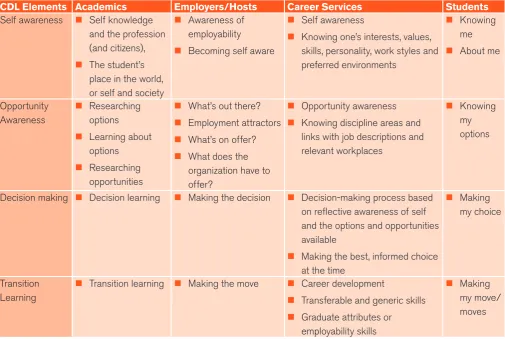
The research process validated the relevance of an international framework of career development learning in higher education in the Australian context. The so-called DOTS framework (Watts, 1977, 2006) conceptualises career
development learning as four key elements: self-awareness, opportunity awareness, transition learning, and decision making. These higher level elements can likewise be decomposed to themes that may inform student learning and teaching.
7.5.4. Graphical Model
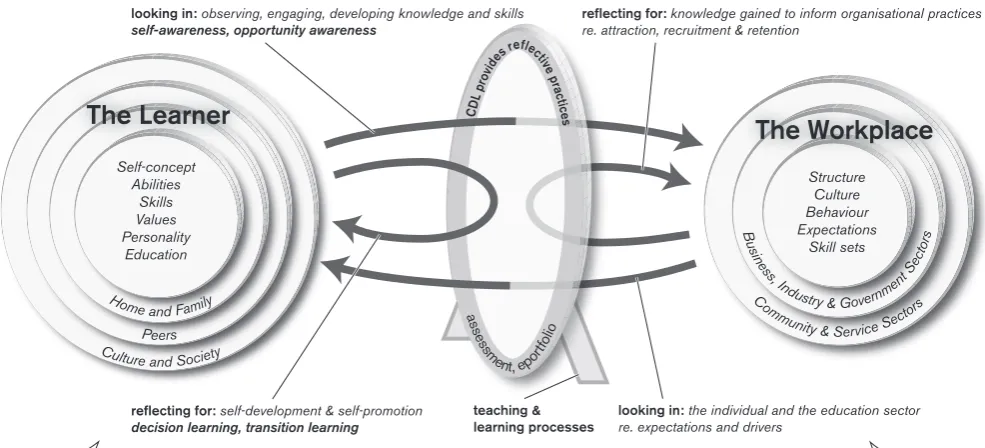
To complement and extend upon the principles of practice, graphical models were developed to assist the conceptualisation of career development learning as a pedagogical framework for reflective practice and work-integrated learning. The model depicts the career development and work integrated learning relationship, and it can be applied in the curriculum in Australian university programs as a learning resource.
7.5.5. Guide to Terminology
It became apparent in the discussions and face-to-face interviews that terminology or language proved a major barrier in effective communication across stakeholder sectors (such as academics, career services personnel and employers and community members). A language/terminology matrix was developed to capture the meaning of the key elements of the career development learning framework DOTS. This serves as a basis for the future development of nationally agreed or understood terminology.
7.5.6. Resource Manual
An online resource manual for staff working in universities, business and industry who facilitate work-integrated learning experiences was developed. The manual provides resources to support student learning and teaching activities (e.g., readings, templates for learning agreements, assessment, case studies). The manual is located within the website of NAGCAS at www.nagcas.org.au.
7.5.7. Quality Framework
8. Career self-management and
Career Development Learning
If “career development is the lifelong process of managing progression in learning and work” (Watts, nd), then how university graduates are prepared to sustain their employability over their lifetimes, in the evolving context of the world-of-work, is a crucial issue pertaining to employability, and, moreover, their lifelong career development. In this report we position career development learning and work-integrated learning as educational vehicles for graduate attributes and graduate employability.
Given that career development for adult Australian citizens has, until relatively recently, been comparatively less developed than that within the compulsory school system (Organisation for Economic Cooperation and Development, 2002; Patton, 2005), how Australian universities prepare their adult students and graduates for the world-of-work should be critically appraised. There is a degree of scepticism among academics about the relationship between career development services and the exigencies of education and industry (e.g., McIlveen, 2007). Yet, the objective of considering the activities of Australian universities necessarily brings the career development services provided by the universities into focus; and requires consideration of how those services contribute to the development of graduate employability through lifelong learning and career development, and can best be enacted to secure all those kind of outcomes.
8.1. A Contemporary View of Career
The meaning of work and career in the contemporary world has undergone significant revision and reformulation within the career development literature (e.g., Blustein, 2006; Collin, 2000; Patton & McMahon, 2006; Watts, 1999b). Within the Australian context, The Professional Standards for Australian Career Development Practitioners (Career Industry Council of Australia, 2006) holds to the definition of career and career development respectively as:
A lifestyle concept that involves the sequence of work, learning and leisure activities through a lifetime. Careers are unique to each person and are dynamic: unfolding throughout life. Careers include how persons balance their paid and unpaid work and personal life roles (p. 37); and
The lifelong process of managing learning, work, leisure and transitions in order to moved towards a personally determined and evolving future (p. 38).
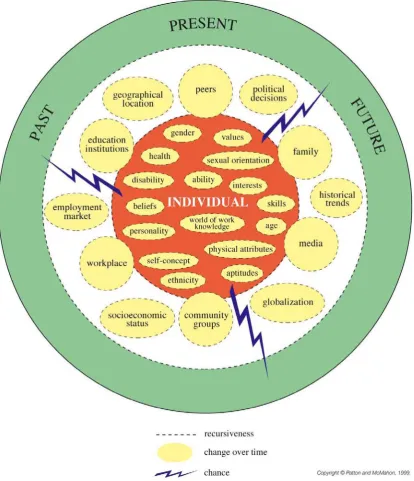
Indeed, career is more than a job (McMahon & Tatham, 2001); and an individual’s career is not simply a function of conscious, free choices and decisions pertaining to his or her interests, and the work opportunities he or she confronts or discovers. Certainly, a clear distinction between what is merely paid work and an occupation (or vocation) is a degree by which individuals identify with that paid work. Career is a multi-faceted, complex, personal process that extends over a lifetime, and is influenced by dynamic personal, interpersonal, societal, economic, and environmental factors (Patton & McMahon, 2006).
Figure 1. Systems Theory Framework (STF). Reproduced with permission.
8.1.1. STF and Work-integrated Learning
This STF is relevant for reconceptualising work-integrated learning through the lens of career development. Firstly, the red centre of the STF highlights the range of personal factors which make up an individual’s career and work-integrated learning is influenced by, or it influences, those personal factors. Work-integrated learning is not just about developing skills—it can be a transformative pedagogy which entails a wider range of personal development and experiential learning. Take self-concept for example: a student’s higher education toward a profession is inherently bound up in notions of professional identity and learning for the profession. Self-concept is in turn influenced by the other factors which make up an individual’s sense of career (e.g., abilities, interests, disability).
development learning and work-integrated learning should take into account if and how broader life and contextual factors impinge upon a student’s experience and learning journey.
The contextual influences present in the STF and most relevant to this project—with respect to the relationship between career development learning and work-integrated learning in higher education—include education institutions (e.g., taught content and access to industry experience), workplaces (e.g., quality and breadth of industry experience), community groups (e.g., acceptance of service learning), geographical location (e.g., difference of accessibility and variety of industry experience across inner, outer metropolitan, and rural and regional centres), employment market (e.g., difficulty in recruiting appropriate staff), socio-economic status (e.g., unfamiliarity and access to networks and opportunities), and globalization (e.g., international learning opportunities). All play a role in the influences that constitute an individual student’s world-of-work and learning that constitute the broader influences of his or her career. Moreover, those influences go toward a student’s experience of higher education and his or her graduate outcomes. Bringing coherence to myriad influences, from the perspective of the student and the university, can be achieved through the lens of career development learning.
8.2. Career Development Learning
If we are to learn from a contextual view of career derived from the Systems Theory Framework (Patton & McMahon, 2006), then career development practitioners, academics, and employers should not consider career as a once-an-a-lifetime decision with a resultant trajectory. That is: school-leavers selecting an undergraduate degree and consequently career is logically determined. Indeed, the purpose of higher education is positioned quite differently when career is viewed as a complex lifelong experience of which higher education is but one moment, although often at the commencement point of engaging in a particular occupation. This critical view brings the experience of higher education into focus and raises questions in terms of its relevance to individuals and their lifelong career, and lifelong learning in and for the world-of-work. It also suggests that part of higher education’s role is to develop capacities that will permit graduates to be proactive and effectively self-directed (i.e., agentic) learners.
Further, according to the STF career development learning should also be considered in the context of organisational learning. Concepts of private and public benefit of career development learning are often considered from the perspective of “public” representing bigger picture, national priorities. However it is reasonable to drill down to consider the direct benefits to the workplace where the learning takes place. The schema of figure 1 can be applied to organisations as well as individuals. While there are many external influences on a learning organisation, an individual experiencing career development learning in the context of a work integrated learning event can potentially “cross the divide” by bringing external influences into the heart of the organisation. These influences have the potential to not only refresh organisational approaches to achieving outcomes, but also the career development of those within the organisation who are assisting the “external” learner, and of those they influence.
8.2.1. Career Development and Career Education
Although the theoretical and professional intent and meaning is shared internationally, the precise terminology of the career development industry is not uniformly defined internationally (Patton & McMahon, 2006). With minor deviations, in this report we prefer the Australian terminology (see Career Industry Council of Australia, 2006) and use career development as the overarching term pertaining to deliberate activities that go toward the improvement of an individual’s career, including securing effective transitions from higher education into work life beyond university. Career development can be conceived as a professional activity performed by Career Development Practitioners and alike. It can also be conceived of as a subjective experience-in-process of developing one’s career. Therefore, it should be emphasized that career development learning is not the sole preserve of formally qualified Career Development Practitioners.
Notwithstanding the Australian definition of career development, the definition of the equivalent term career guidance, which was agreed upon by the Organisation for Economic Cooperation and Development (OECD), European Commission, and the World Bank, is presented here to broadly describe the overall educational activities of career development:
(to help individuals develop their self awareness, opportunity awareness, and career management skills), taster programmes (to sample options before choosing them), work search programmes, and transition services (OECD, 2004b, p. 10).
This definition was again supported by the European Union in its statement affirming the need for states to ensure access to lifelong career guidance (Council of the European Union, 2009). Albeit positioned in the European context, this definition of career guidance succinctly captures the main forms of services that make up career development practice. It also reflects the first part of what Dewey proposed as being to keep purposes of education when associated with vocations. That is, to assist individuals identify to what vocation they are suited. The second, is to assist individuals develop the capacity is for their chosen vocation. Importantly, given the turbulent nature of contemporary work life and the requirement for occupational transitions, career development should not be conceived of as a one-shot intervention limited to young school-leaver, but rather a lifelong service available for all citizens for both private and public good (OECD, 2004a; OECD 2004b; Watts & Sultana, 2004).
Career development learning can be conceived of as:
learning about the content and process of career development or life/career management. The content of career development learning in essence represents learning about self and learning about the world of work. Process learning represents the development of the skills necessary to navigate a successful and satisfying life/ career (McMahon, Patton, & Tatham, 2003, p. 6).
Career development learning, like work-related learning more generally, occurs in a range of contexts and it can be fostered in experiences facilitated by other education and training practitioners.
Whilst the professionalized activities of career counselling, career assessment, and delivery of career information, form important dimensions of the broader discipline and professional activity of career development, career education is a primary vehicle for career development learning and work-integrated learning. Career education is well defined and positioned within Europe (Guichard, 2001) and North America (Hoyt, 2005). Likewise, within the Australian context, (e.g., McCowan & McKenzie, 1997; Morgan & Hart, 1977; Patton & McMahon, 2001), career education aims to assist students to:
develop knowledge and understanding of themselves and others as individuals, including the personal resources both actual and potential they bring to situations (i.e., strengths, limitations, abilities, skills, qualities, needs, attitudes and values);
develop knowledge and understanding of the general structures of [post-university] life, the range of opportunities and alternative pathways, and the demands, rewards and satisfaction associated with each;
learn how to make considered choices and plan options in relation to anticipated careers, occupations, and life roles; and
effectively manage the implementation of the considered choices and the transitions from [university] to [post-university] situations in adult life and work life (McCowan & McKenzie, 1997, p. 17).
8.3. The Benefits of Career Development Learning
Career development also has potential to produce benefits with respect to social equity and human capital (Access
Economics, 2006; Council of the European Union, 2009; Organisation for Economic Cooperation and Development, 2004a; Watts, nd). The benefits of career development learning may be considered at the level of the individual, the organization, and society, over immediate, intermediate and long-term time frames (Watts, 1999a). Whilst there remains some scope to clarify different measures of outcome for each of those levels (Maguire, 2004), there is a considerable and long-standing evidence indicating the benefit of career development to individuals (Brown & Ryan Krane, 2000; Herr, Cramer, & Niles, 2004; Holland, Magoon, & Spokane, 1981; Oliver & Spokane, 1988; Organisation for Economic Cooperation and Development, 2004a; Purcell et al., 2008; Sexton, Whiston, Bleuer, & Walz, 1997; Swanson, 1995). For example, empirical meta-analytic studies of career development have demonstrated it to be an efficacious, useful human service for individuals, with individual face-to-face intervention showing the largest effect, followed by class-based career education, then by services not delivered by personnel (e.g., ICT delivery) (Whiston, Sexton, & Lasoff, 1998). Longitudinal investigations also indicate a sustained positive impact from individual guidance (e.g., Bimrose & Barnes, 2006; Kirschner, Hoffman, & Hill, 1994).
& McMahon, 2006). Specifically, in the career development literature there has been an enhanced focus upon the career development needs of individuals from disadvantaged backgrounds including persons-of-colour, indigenous peoples, women in non-traditional occupations, individuals with variant sexual orientation and expression, mature-age persons, those from culturally and linguistically diverse heritage, and those who have experienced rural isolation or lower socio-economic status (e.g., Brown & Lent, 2005; Diemer, 2009; Diemer & Ali, in press; Diemer & Blustein, 2006, 2007; Diemer & Hsieh, 2008; Herr, Cramer, & Niles, 2004; Niles, 2002; Packard & Babineau, 2009; Patton & McMahon, 2006; Scott & Ciani, 2008). The extensive longitudinal Future Track project in the UK indicated the importance of career guidance in individuals’ choices of university studies, and that issues of access to quality career-related information were an important dimension in decision-making (Purcell et al., 2008).
Within the Australian higher education sector, career development and university career services are seen as pivotal in the work of access, equity and social justice (McIlveen, Everton, & Clarke, 2005). Therefore, there seems to be long-standing and persuasive bases for enacting an effective provision of career development within higher education, and one in which its effectiveness is premised upon engaging in work life experiences that help inform, guide and assist students critically appraise not only the world of work but also the specific occupation they have selected.
8.4. Career Development Learning and Employability
Australian university graduates generally enjoy persistently higher levels of full-time employment (e.g., Graduate Careers Australia, 2005, 2006, 2007a) that are relatively superior to cohorts exiting other levels and types of education (Australian Bureau of Statistics, 2004). These statistics are ostensibly indicative of a higher education system that prepares graduates for the world-of-work. Yet, they may not fully indicate levels of demand and dissatisfaction that impinge upon students’ learning experiences and graduates’ positioning within the world-of-work as an outcome of their university education. This goes to the issue of developing career self-management skills in students and graduates which underpin their lifelong employability.
According to Watts (2008a) career development learning address the to key issues of directionality and sustainability in relation to employability and enterprise. In his paper prepared for the National Symposium on career development learning and work-integrated learning, Watts stated that:
Directionality is important because while some of these competences are generic, others are linked more closely to some career pathways than to others. Career development learning can help students to clarify the path they want to choose, around which they can build their employability and enterprise competences (p. 4).
Moreover, Watts commented that:
Sustainability is arguably even more important because, without it, employability tends to be narrowly defined as ‘work readiness’. It is career development learning that transforms it into a focus not only on securing a first job but on acquiring competences that enable graduates to remain employable throughout life. (p. 4).
Accordingly, notions of graduate employability, employability skills, graduate attributes, and students’ experience of employability are important to the formulation of career development learning and work-integrated learning in higher education.
Career development learning may be deployed variously to raise students’ awareness of employability and how to self-manage their studies and extra-curricular activities to optimise the employability. This approach may, for example, be undertaken through curriculum-integrated strategies in which career development learning is an explicit vehicle for degree or unit-level learning outcomes. Assignments or other assessable course work may require students to engage in reflective activities in relation to their past, current, and lifelong employability using their particular discipline area of interest as a site of personal enquiry, using the DOTS model (Watts, 2006) as a teaching tool to frame students’ conceptualisations of employability.
8.4.1. Defining Graduate Employability
Yorke’s (2006a) definition pertains to the higher education sector and is a useful guide for conceptualising graduate employability:
Employability is taken as a set of achievements – skills, understandings and personal attributes – that makes graduates more likely to gain employment and be successful in their chosen occupations, which benefits themselves, the workforce, the community, and the economy (p. 8).
Despite being conceptually complex, the notion of employability, from either the subjective or objective perspective, provides a useful point of departure for consideration of graduates in the Australia higher education system.
8.4.2. Employability Skills for Career Success
Australian industry demands a flexible workforce with the skills to secure a viable economic future for the nation (Australian Chamber of Commerce and Industry & Business Council of Australia, 2002; Precision Consultancy, 2007). Australian employers seek university graduates who are ‘employable’ through their possession and workplace expression of a host of generic skills in addition to specific professional skills and knowledge (ACNielson Research Services, 2000; Curtis & McKenzie, 2001; Field, 2001; McLeish, 2002). Other OECD nations (McKenzie & Wurzburg, 1997), such as the United Kingdom (Archer & Davison, 2008; Confederation of British Industry, 2009; Harvey, Moon, & Geall, 1997; Herrmann, Hannon, Cox, Ternouth, & Crowley, 2008), have similarly seen employers seeking generic skills within their graduate employees. The composition and definition of employability skills vary (Australian Council for Educational Research, 2002), yet there is clear consistency in purpose: defining a theoretically ideal employee from an employer’s perspective; and self-managing one’s employability as an individual in terms of what employers are seeking.
In the landmark report Graduate Employability Skills, which was prepared for the Business, Industry and Higher Education Collaboration Council (BIHECC, Precision Consultancy, 2007), the sustained employability of Australian graduates was affirmed as a project for government, industry, and universities. The report submitted a number of recommendations to the Australian Government, including those directly targeting the provision of work-integrated learning in the higher education sector.
Research into Australian employers’ views on employability skills (ACNielson Research Services, 2000) found a consistent set of opinions on employability with respect to their satisfaction with graduate employees. This research was extended in subsequent research conducted by the Australian Chamber of Commerce and Industry (ACCI) and the Business Council of Australia (BCA) (2002) on behalf of the Australian Department of Employment, Science and Training, which produced the Employability Skills for the Future Framework. The Framework indicated the generic employability skills required by Australian industry:
communication skills that contribute to productive and harmonious relations between employees and customers;
team work skills that contribute to productive working relationships and outcomes;
problem solving skills that contribute to productive outcomes;
initiative and enterprise skills that contribute to innovative outcomes;
planning and organizing skills that contribute to long-term and short-term strategic planning;
self-management skills that contribute to employee satisfaction and growth;
learning skills that contribute to ongoing improvement and expansion in employee and company operations and outcomes;
technology skills that contribute to effective execution of tasks.
The report also went on to list personal attributes that purportedly contribute to employability (e.g., loyalty, reliability, adaptability).
8.4.3. Graduate Attributes
Nevertheless, there is a public perception that Australian universities are not adequately dealing with the nexus of education and employment (Crebert, Bates, Bell, Patrick, & Cragnolini, 2004b). This perception is reflected within the realm of academia in which some disciplines traditionally eschew overt movements to ‘vocationalise’ university curricula (Bath, Smith, Stein, & Swann, 2004; Harris, Guthrie, Hobart, & Lundberg, 1995; J. O’Brien, 1990), whereas others are bound up with matters of compliance with the standards and accreditation guidelines of professional bodies (e.g., Gilbert, Balatti, Turner, & Whitehouse, 2004; Hager, 1995; Harvey, 1999).
The situation is complicated by the finding that academics of various disciplines may not share a common theoretical view or understanding of generic attributes (S. C. Barrie, 2004). Indeed, it is noteworthy that students, academics and employers may hold different perceptions of generic skills and their relative importance (R. Bennett, 2002; Leggett, Kinnear, & Boyce, 2004; Nicholson & Cushman, 2000; Sinclair, 1997). Despite the proliferation of descriptive terms such as
graduate attributes and/or graduate qualities (and their adoption by universities and industry), there has been limited critical inspection of their conceptual basis and terminology (S. C. Barrie & Prosser, 2004).
Recent Australian research and development within the higher education sector has highlighted the important gains made in establishing the position of graduate attributes within the curricula of various institutions and academic programmes (Australian Council for Educational Research, 2002; S. C. Barrie, 2004; Bath, Smith, Stein, & Swann, 2004; Crebert, Bates, Bell, Patrick, & Cragnolini, 2004a, 2004b; Precision Consultancy, 2007).
Apart from the integration of employability skills into the curriculum of university programmes through top-down policies on graduate attributes, Bath et al. (2004) demonstrated progression from the mapping of attributes in curriculum to the assurance of actually developing the attributes from the learning experiences generated by the teaching of the curriculum. Harvey (1999) differentiated between embedding skill learning into the curriculum or bolting learning on as an adjunct to the core curriculum. Bolting-on learning experiences has received some criticism purported on the basis that it is decontextualised from the discipline under instruction and mechanical (Bath, Smith, Stein, & Swann, 2004). The Student Employability Profile produced by the UK Higher Education Academy (2006) usefully composed graduate attributes for a wide range of disciplines making it easier for academics to conceptualise their discipline-specific content in terms of employability skills.
8.4.4. Student Experience of Employability
In a recent survey of 32 000 students of Australian universities (Graduate Careers Australia, 2007b), students rated the extent to which they had developed generic employability skills using a rating scale from non-existent through to very strong. Focusing on the percentage of students who rated a skill as being fairly strong or very strong, communication (81.7%) and learning ability (80.0%) were the most well-developed skills, followed by self-management (78.1%), technology (74.4%), technical skills results from your course (74.3%), planning and organizing (72.8%), and then by teamwork (65.9%), initiative and enterprise (60.0%), and problem solving (54.2%) being at the lower level of development. The survey found that students’ ratings of a skill being fairly strong or very strong increased over the duration of studies from the beginning, middle, and near completion of a degree course.
Research into university students’ experience found that they generally valued the inclusion of generic skills in the curriculum with respect to their employment prospects, but they sought greater opportunities through which they could learn the skills in practical settings and exposure to industry (e.g., Blackwell, Bowes, Harvey, Hesketh, & Knight, 2001; Crebert, Bates, Bell, Patrick, & Cragnolini, 2004a; Little & Harvey, 2006). Career development learning embedded in work-integrated learning programs can provides opportunities for students to assess their skill development and plan to grow areas needing attention while they are still in a learning environment.
8.5. Career Development Services in Higher Education
in the UK career development learning and work-integrated learning were viewed vehicles for graduate attribute, graduate employability, with particularly emphasis on employer engagement.
The positive effects of career guidance extend to college and university students (Pickering & Vacc, 1984). Take undergraduate coursework career education as an example; this learning experience has been found to produce positive outputs on career-related thoughts, career decision-making skills, career decidedness, and vocational identity (Folsom & Reardon, 2003). Moreover, Folsom and Reardon’s review found significant evidence that career development coursework positively affected job satisfaction, selecting a degree major, course satisfaction, graduation rates, and grade-point average. Given that career-related anxiety in undergraduate students has been found to be a predictor of academic persistence, it was recommended that career guidance be implemented as an additional strategy to address student retention and progression (Kahn, Nauta, Gailbreath, Tipps, & Chartrand, 2002). Moreover, the issue of preparing for lifelong career development (Patton & McMahon, 2006) is brought into sharper focus when students of non-vocational degrees (e.g., humanities) and non-traditional students are brought into the frame; for it is those students who are potentially most vulnerable to the rapidly evolving world of higher education and work.
8.5.1. Career Development Services in Australian Universities
Following a widespread review of OECD member states in the period 2001–2002, it was concluded that career guidance services within many of the tertiary education sectors for each nation were insufficiently prepared to manage the needs of students within increasingly complex and diversified educational systems (OECD, , 2004a). Notwithstanding the inherent economic exigencies of providing career guidance systems within low- and middle-income nations (E. Hansen, 2006), the provision of career guidance within the tertiary education sectors of developing and transitional economies has likewise been found wanting (Watts & Fretwell, 2004).
Within Australia, all universities have a Careers Service of some kind and they were recently reviewed by the Commonwealth Government as part of a broader review of career services provided in the tertiary education sector (Department of
Education Employment & Workplace Relations, 2008). The staffing and resource profiles of those organizations nevertheless vary considerably. Typical career development services offered on a university campus would include:
advice, support and delivery of career development learning into the curriculum;
career assessment and counselling, including selection and change of major;
career education classes;
information services relating to occupations, employers, and educational institutions;
employment placement services for casual, vacation, internship and graduate employment;
co-ordination of employer interviewing;
operating large-scale employment events (e.g., Career Fair);
training on employment application processes (e.g., resumes); and
academic crisis counselling (e.g., considering dropping out).
With the inherent breadth of their service remit, Career Services can therefore play an effective role in supporting students, through intensive one-on-one activities (e.g., counselling), to group or class-based activities (e.g., workshops, service teaching), to mass information delivery (e.g., websites), and functions (e.g., graduate employment fairs).
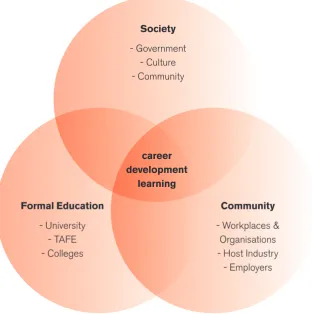
As a conduit between the university and the world-of-work, Career Services are well positioned to provide services to students and employers; and they are equally well positioned to bring academics and employers together into working partnerships for the sake of the students. Thus, Career Services can take on the role of fostering partnerships between the three parties. With respect to this project, we argue that Career Services take on an important role in supporting the necessary logistical requirements of integrated learning (e.g., relationship management) and directly providing work-integrated learning in partnership with academics and employers.
8.5.2. Intersecting Interests
Figure 2. Intersecting Interests
Society
- Government - Culture - Community
career development
learning
Community
- Workplaces & Organisations - Host Industry
- Employers
Formal Education
9. Work-integrated Learning
Universities in the United Kingdom (see N. Bennett, Dunne, & Carre, 2000; Harvey, Locke, & Morey, 2002; Hunt, 2000; Yorke, 2006b; Yorke & Knight, 2006) and North America (National Commission for Co-operative Education, 1999; Sovilla & Varty, 2004) have provided significant international leadership in research into and the pedagogical application of work integrated learning. Australia is no exception with widespread distribution and uptake of work-integrated learning (Martin, 1996; Trigwell & Reid, 1998). Yet, there is, of course, significant variation within the Australian higher education sector (Trigwell & Reid, 1998). The report prepared for Business Industry Higher Education Collaboration Council (Precision Consultancy, 2007) positioned work-integrated learning as an important vehicle for the development of graduate attributes and employability skills and featured as a core recommendation of the report. Universities Australia (2008) has likewise highlighted the importance of work-integrated learning in its statement on establishing a national internship scheme for Australian university students. The Australian Collaborative Education Network (ACEN) also provides leadership on work-integrated learning in the Australian higher education sector and recently completed a major scoping study (Patrick et al., 2008).
The current project was not a study of work-integrated learning per se, rather its focus was on the nexus of work-integrated learning and career development learning. Only a précis of major themes pertaining to work-integrated learning is given in this section of the report. Readers are advised to consult Patrick et al. (2008) for a comprehensive view of work-integrated learning.
9.1. Defining Work-integrated Learning
Internationally (and within Australian higher education) there are many definitions of cooperative education and work-integrated learning (Groenewald, 2004). Within Australia, work-work-integrated learning has been described as “a generic term to subsume a range of programs which provide students with a combination of workplace experience and formal learning which are integrated as part of a course of study in higher education (Precision Consultancy, 2007, p. 29) and “an umbrella term for a range of approaches and strategies that integrate theory with the practice of work within a purposefully designed curriculum” (Patrick et al., 2008, p. iv).
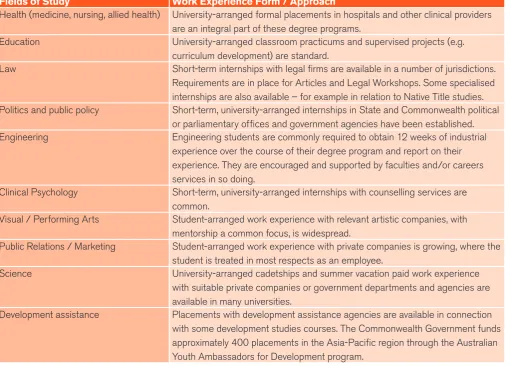
The situation is made complex by an array of terms pertaining to work (e.g. paid and unpaid), learning (e.g. curricula and extra-curricula), and assessment (e.g. formative and summative): for example, work-based learning, work-related learning, industry-related learning, work-based project, industry project, industry experience, work experience, practicum, co-operative education, practicum, sandwich course, internship, or placement; and there are more! There is a range of current interest in work integrated learning, although much of it is motivated by concerns about developing generic employability skills. Models of work-integrated learning, along with discipline-based examples, are presented in Appendix B of this report.
9.1.1. Work-integrated Learning is Education
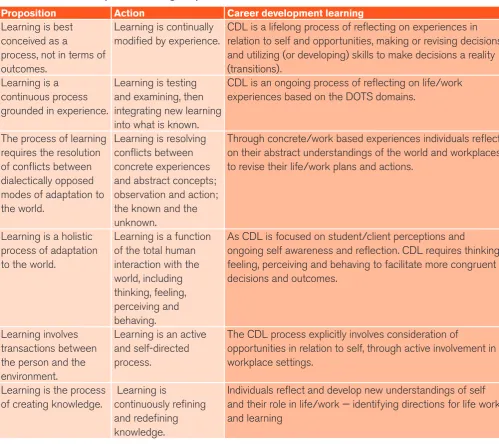
Work-integrated learning is not simply a process of students engaging in work experience with the hope that it will result in employability (Yorke, 2006a). Instead, work-integrated learning is an educational process, service, and experience, with foundational pedagogy and theory (Moreland, 2005; Pedagogy for Employability Group, 2006; Yorke, 2006a; Yorke & Knight, 2006), and can be aligned with the processes and outcomes of experiential learning (Kolb, 1984), which seeks to secure and maximise learning through experience, often outside the education’s tradition.
Cooperative education is perhaps the most long-standing institutional form of this approach to organising experiential learning. Groenewald (2004) suggested that cooperative education consists of four key characteristics:
an integrated curriculum;
learning derived from work experience;
cultivation of a supportive client-base for the availability of quality learning opportunities; and
the proper coordination and organization of the learning experience.
Because of its alignment with career development learning, we considered Moreland’s (2005) description of work-related learning as offered a useful perspective:
Work-related learning involves students learning about themselves and the world-of-work in order to empower them to enter and succeed in the world-of-work and their wider lives. Work-related learning involves:
learning about oneself;
learning and practising skills and personal attributes of value in the world-of-work;
experiencing the world-of-work in order to provide insights and learning into the world-of-work associated with one’s university studies; and
experiencing and learning how to learn and manage oneself in a range of situations, including those found at work (p. 4).
In this description of work-related learning there is a higher-order theme of “learning to learn”. Developing such a metacognitive capacity in students enables them to consider how they learn and make sense of what they learn, and concomitantly optimise both how and what they learn through career development learning and work-integrated learning.
Notwithstanding differences in terminology (i.e. work-based learning versus work-integrated learning), in a review of a sample of British universities Hunt (2000) suggested that the main features of work-based learning (WBL) include:
WBL opportunities can stand-alone or be embedded in university curricula, or a combination of both.
WBL programs are normally accredited components of courses at universities.
WBL programs link theory and practice and are underpinned by appropriate professional knowledge and reflective practice.
WBL provides identifiable learning in the work environment, which enhances on-campus programs, and which can be assessed.
Individual WBL programs are designed collaboratively by the university, the student and the workplace.
The objectives of WBL programs meet the needs of students, relevant university courses, and the workplace.
WBL emphasises student participation in the development and design of appropriate, individualised programs.
The skills developed in WBL may be discipline-specific and may also include globally transferable skills, relevant to lifelong learning requirements, such as: critical thinking; written and oral communication; teamwork; problem-solving; managing; and organizing (p. 2).
9.2. Students’ Experience of Work-integrated Learning
Research into university students’ experience found that they generally valued the inclusion of learning generic, employability skills in the curriculum with respect to their employment prospects, but they sought greater opportunities through which they could learn the skills in practical settings and exposure to industry (e.g., Blackwell, Bowes, Harvey, Hesketh, & Knight, 2001; Crebert, Bates, Bell, Patrick, & Cragnolini, 2004a; Harvey, Moon, & Geall, 1997; Little & Harvey, 2006). Weisz and Smith (2005) summarized the not inconsiderable student-related benefits of work-integrated learning; and these include academic benefits: enhanced thinking, motivation to learn, problem solving skills, ability to apply theory to practice, academic grades; and personal benefits: increased self-esteem and confidence, and improvements in communication, interpersonal and professional skills. In addition, work-integrated learning has a positive impact upon students’ careers (Dressler & Keeling, 2004). These benefits are similarly reflected in the findings of other research into students’ experiences (e.g., Little & Harvey, 2006) and the views of employers (e.g., Harvey, Moon, & Geall, 1997). There is some evidence, however, that the experience is not always positive (e.g., Martin, 1996), as is the case with all kinds of educational and learning experiences. Nevertheless, what is important is to try to improve the quality and maximise the outcomes of these experiences.
9.3. Employers’ Views of Work-integrated Learning
A survey of 175 Australian large corporate or government graduate employers (High Fliers Research, 2007), indicated that cadetship, co-operative employment, and vacation employment programs were used as a means of pre-recruitment: with cadetships highest amongst accounting (54.6%) and State government (23.9%); co-operative programmes highest in motor manufacturing (52.2%), followed accounting (29.7%); and vacation programmes used most in accounting (43.3%), and to a lesser, but significant, extent in law (15.4%) and mining (13.6); all other industry sectors had results under 10% for the three types of employment programme. Universities may elect to allow students to use such employment as a vehicle for fulfilling study and assessment requirements. If, however, the results of this particular survey are indicative of the entire graduate recruitment market in Australia, they may conversely be indicative of limitations in the availability of opportunities for work-integrated learning in terms of the quantum of opportunities and the limitations of industry sectors’ offering of such programmes. These limitations extends to geographical constraints: with New South Wales offering the most cadetships (54.8%), followed by Queensland (15.4%); and a staggering 71% of co-operatives in Victoria, followed by New South Wales (17.1%). Vacation programmes were more evenly distributed: New South Wales (27.7%), Queensland (18.9%), Victoria (23.8%), and Western Australia (21.0%).
10. Frameworks for
Career Development Learning and
Work-integrated Learning
It follows that for work-integrated learning, the delivery of career development learning should be based upon a lifelong learning perspective and framework (Organisation for Economic Cooperation and Development, 2004b; Patton & McMahon, 2001, 2006). Accordingly, work-integrated learning can being subsumed under and serve as a practical vehicle for the broader notion of career development learning. McCowan and McKenzie (1997) argued that career education should be integrated with the curriculum, rather than added as an extraneous service, with its delivery shared by various parties (e.g., educators, employers, parents) and not simply by specialist groups. Watts (2006) suggested that career development learning could be delivered through specific modules, general cross-curriculum integration, or separate from the academic curriculum. The modular approach would entail either delivery of generic content relevant to all, customization of generic modules to suit a department or discipline, or modules that are specifically designed for the needs of a particular discipline. Furthermore, Watts suggested that career development learning could be delivered by the university Career Service independently or in partnership with academic staff. In this section we overview conceptual, educational, and administrative frameworks that can be used to underpin career development learning and work-integrated learning.
10.1. Principles of Practice
Through an iterative process involving stakeholders in various surveys, forums and consultations (see the project methodology in Appendix A), the principles of practice listed below were