Solar UVA exposures
Alfio V. Parisi
a,∗and Michael G. Kimlin
ba
Centre for Astronomy, Solar Radiation and Climate, Faculty of Sciences, University of Southern
Queensland, Toowoomba, AUSTRALIA. 4350
b
Centre for Health Research, School of Public Health, Queensland University of Technology,
Brisbane, QLD, AUSTRALIA.
ABSTRACT
Exposures to UVA radiation (320 – 400 nm) have been linked to increasing the risk of skin cancer, premature skin photoageing and skin wrinkling. The relative proportion of the UVA irradiances in the solar spectrum changes with time of day and season. Material such as window glass found in offices, homes and motor vehicles acts as a barrier to the shorter solar UVB wavelengths (280 - 320 nm) and transmits some of the longer UVA wavelengths (dependent on the type of glass). As a result, the spectrum of the filtered UV transmitted through the material may be substantially different from that of the unfiltered solar UV spectrum. This results in a change in the relative ratio of UVA to UVB irradiances and a consequent change in the biologically damaging UV exposures. For these environments where the UVB wavelengths have been removed and the UVA wavelengths are still present, it is necessary to consider the erythemal irradiances due to these UVA wavelengths only. This paper investigates the times taken for an exposure of 1 SED (standard erythemal dose) due to the UVA wavelengths.
Keywords: UVA, solar, filtered, glass
1. INTRODUCTION
The importance of the UVA wavelengths (320 - 400 nm) for the production of mutations in the basal cell layer of human skin has been reported1. The implication from this is that the longer UVA wavelengths are a potential carcinogen in human skin. Additionally, the UVA wavelengths have also been shown to cause cumulative damage and premature photoageing of human skin2-4. The solar erythemal irradiances due to the UVB wavelengths (280 – 320 nm) are more significant for skin damage as represented by the higher effectiveness of the erythemal action spectrum5 at these wavelengths compared to the effectiveness at the UVA wavelengths. Although the effectiveness of the erythemal action spectrum is reduced by a factor of approximately 1000 at the UVA wavelengths compared to the most effective wavelength of 298 nm, the erythemal irradiances due to the UVA wavelengths may become important for the cases where the UVB wavelengths have been significantly attenuated.
Environments where the UVB wavelengths can be attenuated arise when the solar UV is transmitted through materials such as the glass found in office windows, home windows and greenhouses and the glass in vehicle windows and windscreens6. For untinted glass, the type of glass, thickness of the glass and the angle of transmission of the UV through the glass determines the amount of UV attenuation7,8. The laminated window glass of a vehicle’s windscreen transmits less than the nonlaminated glass of the side windows9. Additionally, whether or not the glass is tinted determines the amount of solar UV transmitted9-11. A number of studies have investigated the filtered UV in different environments of
cars12-14, greenhouses15 and sunrooms16. For example, research using a UV spectroradiometer inside a vehicle with
untinted windows found that the irradiance of all of the shorter UVB wavelengths were negligible, however the UVA irradiances from 340 nm to 400 nm were significant in the vehicles10. Research employing dosimeters for the measurement of the UV exposures in these environments has also been reported12,17.
∗
Correspondence to: Alfio Parisi, Faculty of Sciences, University of Southern Queensland, Toowoomba, 4350, Australia.
The spectrum of the filtered UV transmitted through the material may be substantially different from that of the unfiltered solar UV spectrum. This results in a change in the relative ratio of UVA to UVB irradiances and a consequent change in the biologically damaging UV exposures. For these environments where the UVB wavelengths have been removed and the UVA wavelengths are still present, it is necessary to consider the erythemal irradiances due to these UVA wavelengths only. Consequently, this paper will consider only the UVA wavelengths of the solar UV spectrum and the erythemal exposure resulting from these UVA wavelengths.
2. MATERIALS AND METHODS
2.1 Spectral UV
The spectral UV measurements on a horizontal plane were undertaken with a UV spectroradiometer (model DTM300, Bentham Instruments, Reading, UK) that is configured to automatically collect data on the UV spectrum from 280 to 400 nm in 0.5 nm increments every five minutes. The instrument is located on an unshaded roof of a building at the University of Southern Queensland, Toowoomba, (27.5 oS, 693 m above sea level) Australia. This site is an inland sub-tropical southern Hemisphere site with relatively unpolluted skies. The spectroradiometer is housed in an environmentally sealed container (Figure 1) and solar radiation enters via the input optics based on a diffuser (model D6) and connected by a one metre long, 4 mm diameter optical fibre to the input slit of the monochromator. The instrument employs a double grating monochromator with a pair of holographic gratings with 2400 lines/mm blazed at 250 nm and a 600 mm focal length (model DTMc300F), a UV sensitive detector comprising of a side window photomultiplier tube with a bialkali photocathode (model DH10), amplifier with software variable gain (model 267) and integrating analogue to digital converter with 100 ms integration period (model 228A)18.
[image:2.595.125.507.340.566.2]
Input optics
Figure 1: Automated solar UV spectroradiometer enclosed in the weatherproof container on an unshaded roof.
2.2 Erythemal UV
The data reported in this paper considers the spectral UV at five minute intervals in a summer month (January) and in a winter month (July). The range of solar zenith angles (SZA) during the summer measurement period was from approximately 5o to 80o and the range during the winter period was approximately 45o to 80o. The spectral data, S(λ) was weighted with the erythemal action spectrum, A(λ)5
at each 0.5 nm to produce the spectral erythemal UV irradiances. These were summed over the UVA wavelengths to produce the erythemal irradiances due to this waveband, UVAery as
follows:
W m
λ
λ
λ
Δ
=
∑
A
(
)
S
(
)
UVA
UVA ery
-2
Similarly, the erythemal UV due to the entire UV waveband, UVery was obtained by summing over the wavelengths of
290 to 400 nm.
At each five minute interval, the time taken to receive an exposure of 1 SED (standard erythemal dose)19 was calculated for the UVAery and UVery irradiances at that point. One SED has been defined as equivalent to an erythemal exposure of
100 J m-2.
3. RESULTS
3.1 Erythemal UVA
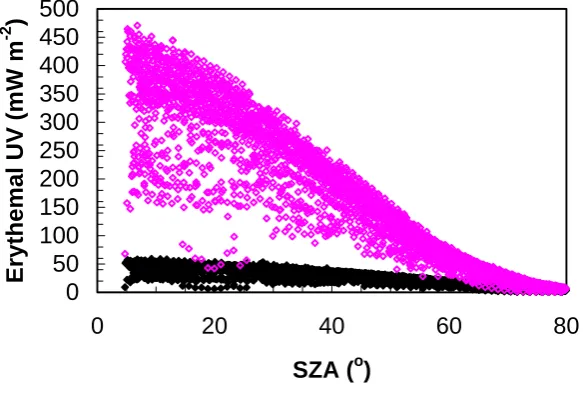
The erythemal UV irradiances for January (summer) at five minute intervals are provided in Figure 2 for all of the cloud conditions encountered during this period. These are provided for all of the UV wavelengths and for the UVA wavelengths. In each case, the clear sky envelope is evident with the variation below this being predominantly due to cloud. The number of five minute irradiance data points is 3145. For the UVery, the maximum is 471 mW m-2 and for the
UVAery, the maximum is 59 mW m-2. The atmospheric ozone values in Dobson Units (DU) obtained through the TOMS
(Total Ozone Mapping Spectrometer) website (http://toms.gsfc.nasa.gov/ozone/ozone.html) ranged from 257 to 290 DU (Dobson units). The effects of ozone changes on the UVAery would be insignificant due to the negligible absorption of
ozone in the UVA20.
0
50
100
150
200
250
300
350
400
450
500
0
20
40
60
8
SZA (
o)
Erythemal UV
(mW m
-2
)
[image:3.595.154.446.448.647.2]0
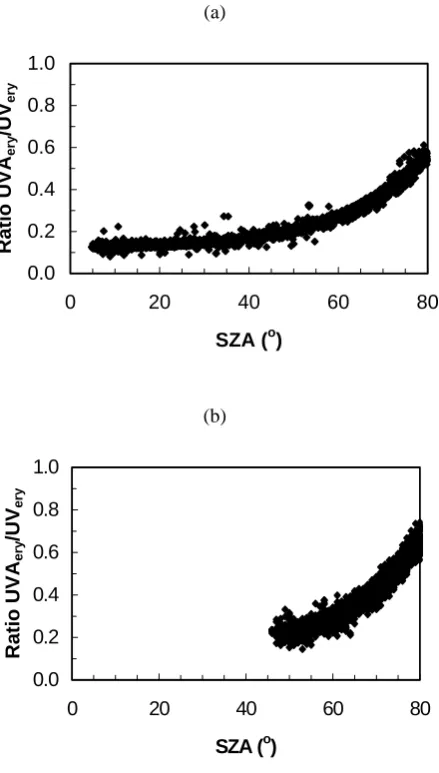
The comparison between the UVAery and the UVery irradiances for the range of SZA encountered in each month is
provided in Figure 3 where the ratio of the two irradiances are plotted for all sky conditions. The plot shows the variation with the SZA. For the smaller SZA, the UVAery is of the order of a tenth of the erythemal UV. In comparison at the
larger SZA of 60o, the UVAery is of the order of a third of the erythemal UV. At the SZA of 80o, the UVAery is of the
order of 50 to 60% of the UVery. This increase in the relative amount of UVAery compared to UVery at the higher SZA is
due to the higher degree of attenuation of the UVB wavelengths for the longer paths through the atmosphere.
(a)
0.0 0.2 0.4 0.6 0.8 1.0
0 20 40 60 80
SZA (o)
Ratio UVA
ery
/UV
ery
(b)
0.0 0.2 0.4 0.6 0.8 1.0
0 20 40 60 80
SZA (o)
Rati
o UVA
ery
/UV
[image:4.595.190.410.164.551.2]ery
Figure 3: The ratio of the erythemal irradiances due to the UVA wavelengths to those due to the total UV waveband as a function of SZA in (a) January (summer) and (b) July (winter).
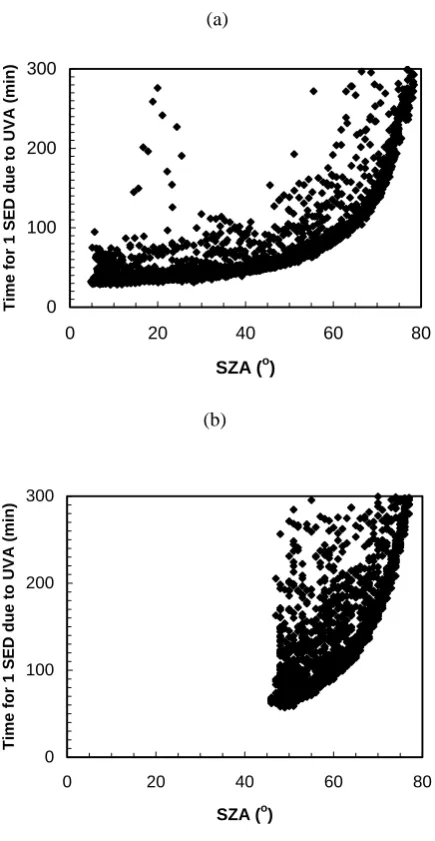
3.1 Exposure times for one SED
during part of or all of the UV spectral scan. For summer the times for an exposure of one SED due to the UVAery are 28
min and higher. For the winter month where the minimum SZA is 46o, the times for an exposure of one SED due to the UVAery are 57 min and higher.
(a)
0 100 200 300
0 20 40 60 80
SZA (o)
Time for 1 SED due to UVA (min)
(b)
0 100 200 300
0 20 40 60 80
SZA (o)
[image:5.595.190.408.126.547.2]Time for 1 SED due to UVA (min)
Figure 4: The times taken for an exposure of 1 SED due to the UVA wavelengths only, on a horizontal plane as a function of SZA in (a) January (summer) and (b) July (winter).
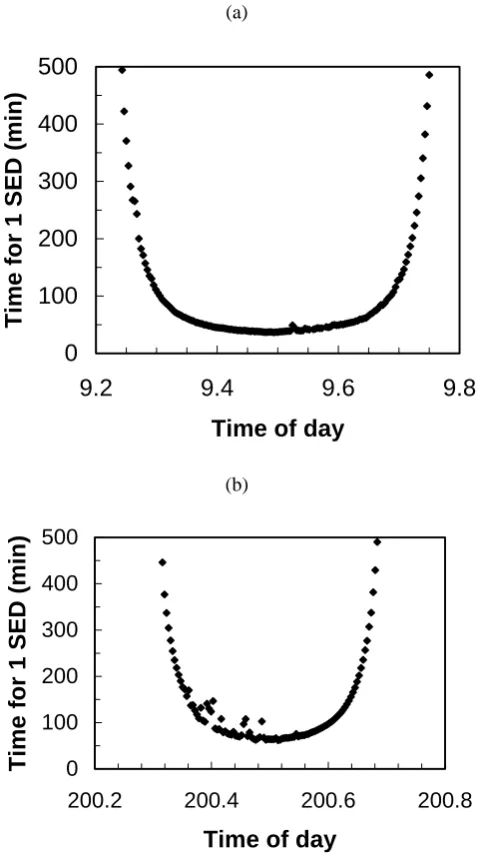
The variation throughout the day of the time taken for an exposure of 1 SED due to the UVAery is provided in Figure 5 for
(a)
0
100
200
300
400
500
9.2
9.4
9.6
9.8
Time of day
Time for 1 SED (min)
(b)
0 100 200 300 400 500
200.2 200.4 200.6 200.8
Time of day
[image:6.595.179.420.72.501.2]Time for 1 SED (min)
Figure 5: The time for an exposure of 1 SED due to the UVAery for the different times of the day on the cloud free day of 9 January
and the relatively cloud free day of 19 July.
4. DISCUSSION
.
For the UVery, the maximum irradiance was 471 mW m-2 and for the UVAery, the maximum was 59 mW m-2. The ratio of
the UVAery to UVery irradiances varied from approximately 0.1 to 0.6 for the small to larger SZA respectively. The
minimum time for an exposure of one SED due to the UVAery was 27 min and 58 min in the summer and winter
respectively. This calculation was based on the assumption that all of the UVA wavelengths are transmitted through the transparent barrier. This is generally not the case, with some attenuation of the UVA wavelengths occurring in the transmission through a barrier, however the results provide an upper limit on the erythemal exposures in these environments. Although the times for an exposure of one SED are reduced compared to those for the entire UV waveband, the exposures due to the UVA wavelengths are important for those population groups that are exposed to these wavelengths for lengthy periods as the results show that for extended periods of time of exposure, it is possible to receive erythemal exposures as a result of the UVA wavelengths. This highlights the importance of the necessity to develop a dosimeter that is sensitive to only the UVA wavelengths to allow the measurement of the UVA exposures to different population groups during normal daily activities.
ACKNOWLEDGMENTS
The research reported in this paper is supported by a US National Institute of Health Grant number R01 CA101602-01A2 and the spectroradiometer was funded by the Australian Research Council.
REFERENCES
1. Agar, N.S., Halliday, G.M., Barnetson, R., Ananthaswamy, H.N., Wheeler, M. & Jones, A.M. “The basal layer in human squamous tumors harbours more UVA than UVB fingerprint mutations: A role for UVA in human skin carcinogenesis,” Proc. Nat. Acad. Sci. 101, 4954-4959, 2004.
2. Lavker, R.M., Gerberick, G.F., Veres, D., Irwin, C.J. & Kaidbey, K.H. “Cumulative effects from repeated exposures to suberythemal doses of UVB and UVA in human skin,” J. Am. Acd. Derm. 32, 53-62, 1995.
3. Lavker, R.M., Veries, D.A., Irwin, C.J. & Kaidbey, K.H. “Quantitive assessment of cumulative damage from repetitive exposures to suberythemogenic doses of UVA in human skin,” Photochem. Photobiol.62, 348-352, 1995. 4. Bissett, D.L., Hannon, D.P., McBride, J.F. & Patrick, L.F. “Photoaging of skin by UVA,” in Biological Responses to
Ultraviolet A Radiation, ed. F. Urbach, pp.181-188, Valdenmar Publishing Co., Kansas, 1992.
5. CIE (International Commission on Illumination) “A reference action spectrum for ultraviolet induced erythema in human skin,” CIE J. 6, 17-22, 1987.
6. Parisi, A.V., Sabburg, J. & Kimlin, M.G. “Scattered and Filtered Solar UV Measurements,” Kluwer Academic Publishers, Dordrecht, 2004.
7. Parisi, A.V. & Wong, C.F. “Erythemal irradiances of filtered ultraviolet radiation,” Phys. Med. Biol.42, 1263-1275, 1997.
8. Bartels, R. & Loxsom, F. “Can you get sunburn through glass?,” The Physics Teacher, 33, 466-470, 1995.
9. Hampton, P.J., Farr, P.M., Diffey, B.L. & Lloyd, J.J. “Implication for photosensitive patients of ultraviolet A exposure in vehicles,” Br. J. Dermatol. DOI:10.1111/j.1365-2133.2004.06098.x, 2004
10. Kimlin, M.G., Parisi, A.V., Carter, B.D. & Turnbull, D. “Comparison of the solar spectral ultraviolet irradiance in motor vehicles with windows in an open and closed position,” Int. J. Biomet.46, 150-156, 2001.
11. Gies, H.P., Roy, C.R. & Zongli, W. “Ultraviolet Radiation Protection Factors for Clear and Tinted Automobile Windscreens,” Rad. Prot. Aust.10, 91-94, 1992.
12. Parisi, A.V. & Wong, C.F. “Quantitative evaluation of the personal erythemal ultraviolet exposure in a car,”
Photodermatol. Photoimmunol. Photomed. 14, 12-16, 1998.
13. Parisi, A.V. & Kimlin, M. “Estimate of annual ultraviolet-A exposures in cars in Australia,” Rad. Prot. Dos.90, 409-416, 2000.
14. Kimlin, M.G. & Parisi, A.V. “Ultraviolet radiation penetrating vehicle glass: A field based comparative study,”
Phys. Med. Biol.44, 917-926, 1998.
15. Parisi, A.V. & Wong, C.F. “The erythemal ultraviolet exposure for humans in greenhouses,” Phys. Med. Biol. 42, 2331-2339, 1997.
17. Moehrle, M., Soballa, M. & Korn, M. “UV exposure in cars,” Photodermatol. Photoimmunol. Photomed.19, 175-181, 2003.
18. Parisi, A.V. & Downs, N. “Cloud cover and eye damaging solar UV exposures,” Int. J. Biomet. 49, 130-136, 2004. 19. Diffey, B.L., Jansen, C.T., Urbach, F. & Wulf, H.C. “The standard erythema dose: a new photobiological concept,”
Photodermatol. Photoimmunol. Photomed. 13, 64-66, 1997.