Rochester Institute of Technology
RIT Scholar Works
Theses
5-2018
Architectural Vulnerabilities in Plug-and-Play
Systems
Taylor Corrello
Follow this and additional works at:https://scholarworks.rit.edu/theses
Recommended Citation
Architectural Vulnerabilities in Plug-and-Play Systems
APPROVED BY
SUPERVISING COMMITTEE:
Dr. Mehdi Mirakhorli, Supervisor
Dr. Pradeep Murukannaiah, Reader
Architectural Vulnerabilities in Plug-and-Play Systems
by
Taylor Corrello
THESIS
Presented to the Faculty of the Department of Software Engineering
Golisano College of Computer and Information Sciences
Rochester Institute of Technology
in Partial Fulfillment
of the Requirements
for the Degree of
Master of Science in Software Engineering
Rochester Institute of Technology
Acknowledgments
I would first and foremost like to thank my thesis advisor, Dr. Mehdi
Mirakhorli of Rochester Institute of Technology. He has consistently provided
me with the resources I needed to succeed.
I would also like to recognize Joanna Cecilia Santos for her guidance
throughout my research. She dependably allowed the work to be my own, but
was a remarkable resource to me in my times of need.
I would also like to thank the experts who were involved in the
anal-ysis of CVEs: Joanna Cecilia Santos, Adriana Seja, Tejal Vishnoi, Smruthi
Gadenkanahall.
I would also like to acknowledge Dr. Pradeep Murukannaiah as the
second reader of this thesis; I am gratefully indebted to him for his very
valuable comments on this thesis.
Finally, I must express my very profound gratitude to someone who has
never given up on me, someone who has been a big influence on making my
dreams a reality, someone who has provided continuous encouragement and
unfailing support not only throughout my journey here at Rochester Institute
of Technology but throughout my 23 years of life: my mom, Tami Corrello.
This accomplishment would have not been possible without her.
Abstract
Architectural Vulnerabilities in Plug-and-Play Systems
Taylor Corrello, M.S.
Rochester Institute of Technology, 2018
Supervisor: Dr. Mehdi Mirakhorli
Plug-and-play architectures enhance systems’ extensibility by providing
a framework that enables additional functionalities to be added or removed
from the system at their runtime. Such frameworks are often implemented
through a set of well-defined interfaces that form the extension points for the
pluggable functionalities. However, the plug-ins can increase the applications
attack surface or introduce untrusted behavior into the system. Designing
a secure plug-and-play architecture is critical and non-trivial as the features
provided by plug-ins are not known in advance. In this paper, we conduct an
in-depth study of seven systems with plug-and-play architectures. In total,
we have analyzed 3,183 vulnerabilities from Chromium, Thunderbird, Firefox,
based on a plug-and-play approach. We have also identified the common
secu-rity vulnerabilities related to the plug-and-play architectures, and mechanisms
to mitigate them by following a grounded theory approach. We found a total
of 303 vulnerabilities that are rooted in extensibility design decisions. We also
observed that these plugin-related vulnerabilities were caused by 15 different
types of problems. We present these 15 types of security issues observed in the
case studies and the design mechanisms that could prevent such
vulnerabili-ties. Finally, as a result of this study, we have used formal modeling in order to
guide developers of plug and play systems in verifying that their architectures
Table of Contents
Acknowledgments iii
Abstract iv
List of Tables ix
List of Figures x
Chapter 1. Introduction 1
Chapter 2. Background 5
Chapter 3. Vulnerability Analysis 9
3.0.1 Limiting the Phenomena Under Study . . . 10
3.0.2 Data Collection: Theoretical Sampling . . . 11
3.0.2.1 Theoretical Sampling . . . 11
3.0.2.2 Data Sources . . . 12
3.0.2.3 Data Fusion . . . 14
3.0.2.4 Data Preprocessing . . . 16
3.0.3 Open Coding . . . 17
3.0.4 Constant Comparison Method . . . 19
3.0.5 Memoing . . . 20
3.0.6 Selecting Coding . . . 21
3.0.6.1 Data Analysis Instrument . . . 22
3.0.7 Memo Sorting . . . 22
3.0.8 Theoretical Coding . . . 22
Chapter 4. Vulnerability Patterns Found 25
4.0.1 Plug-in Install . . . 26 4.0.1.1 Incorrect user notification of plug-in permissions 26 4.0.1.2 Bypassing user confirmation for plug-in installation 27 4.0.1.3 Lack of plug-in’s configuration file sanitization . 28 4.0.1.4 Improperly checking the origin of an install request 29 4.0.2 Plug-in Updates . . . 30 4.0.2.1 Elevation of privilege through a plug-in update 30 4.0.3 Plug-in Registry Management . . . 31
4.0.3.1 Extraction/Storage of Plug-in with world read-able/writable permissions or in unsafe directories 31 4.0.4 Plug-and-Play Execution Environment . . . 32 4.0.4.1 Lack of compartmentalization of plug-ins . . . . 32 4.0.4.2 Lack of fine-grained and modular permission
set-ting . . . 33 4.0.4.3 Allowing a plug-in to elevate its permission by
manipulating (or delegating a task to) a process in the plug-and-play environment that has higher privileges . . . 34 4.0.4.4 Improper object access control and
compartmen-talization enforcement . . . 35 4.0.4.5 Unsanitized plug-in data . . . 36 4.0.4.6 Improper origin check of requests by plug-ins . 37 4.0.4.7 Improper isolation of objects used by plug-ins in
the plug-and-play environment . . . 38 4.0.5 Plug-ins Request Handling . . . 39 4.0.5.1 Reentrant event callbacks . . . 39 4.0.5.2 Plug-ins requests are handled without
authoriz-ing plug-ins that initiate the request . . . 40
Chapter 6. Formal Modeling 43
6.1 Overview of Approach . . . 43
6.1.1 AADL . . . 43
6.1.2 AGREE . . . 44
6.2 Basic Example . . . 45
6.3 Step 1: Model the Plug-in . . . 46
6.4 Step 2: Model the Core . . . 48
6.5 Verification . . . 50
6.5.1 Plug-ins are kept up to date . . . 51
6.5.2 Plug-in Request Handling . . . 52
6.6 Case Study: Modeling a Full System . . . 53
Chapter 7. Threats to Validity 57 Chapter 8. Conclusion and Future Work 59 8.0.1 Future Work . . . 59
8.0.2 Conclusion . . . 59
Appendices 60 Appendix A. Filtered CVE Appendix 61 A.0.1 Model Declarations . . . 61
Bibliography 67
List of Tables
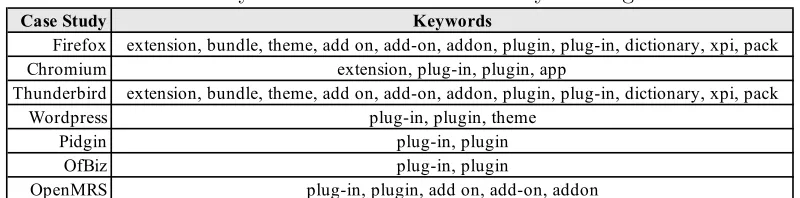
3.1 Keywords used for automatically filtering CVEs . . . 15
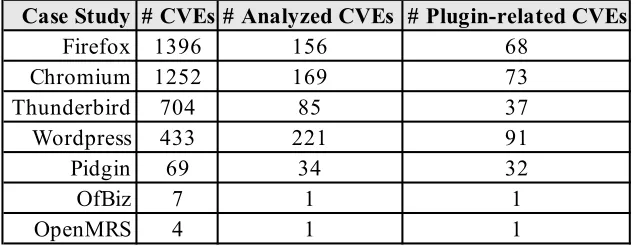
3.2 Statistics of the vulnerability data used in this study. . . 16
3.3 Sample memo . . . 21
List of Figures
3.1 The Grounded Theory Approach Applied to our Work . . . . 9
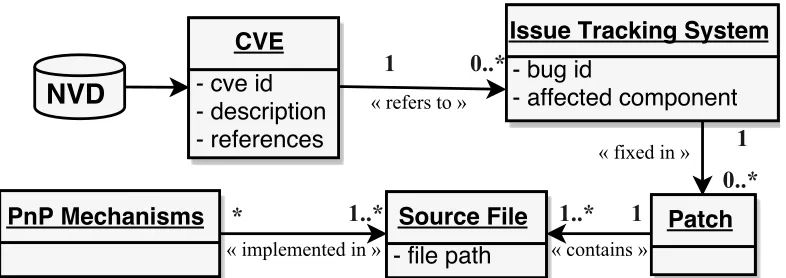
3.2 Information model for the collected data. . . 10
3.3 Examples of open coding of CVEs . . . 18
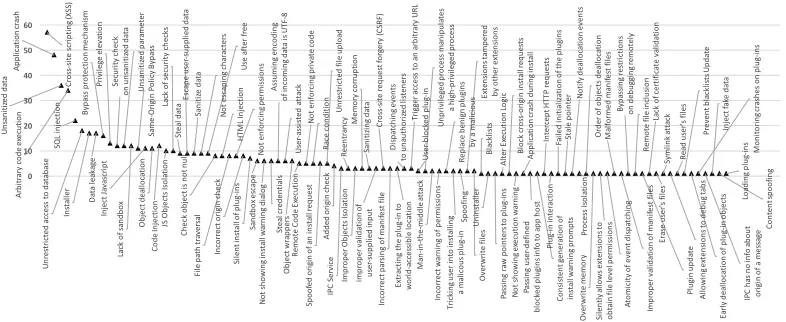
3.4 Codes that resulted from our open coding process . . . 20
6.1 Basic system correctly connected . . . 46
6.2 Basic system correctly connected and verified . . . 47
6.3 Basic System incorrectly connected . . . 48
6.4 Basic System incorrectly connected and verified . . . 49
6.5 Plug-in AADL Model . . . 50
6.6 Core AADL Model . . . 51
6.7 Verification for KarzInc Base Car . . . 54
Chapter 1
Introduction
Plug-and-play architectures are widely adopted in many application
domains to enhance systems’ extensibility, reusability and modifiability [12].
For instance the automotive industry is rapidly creating plug-and-play
archi-tectures where software modules slot into the overall electronic architecture
without unexpectedly disrupting other modules [28]. In the finance domain,
plug-and-play architectures provide universal APIs for in-store point of sale
(POS) systems and enable plugging a variety of different applications into the
POS system at the merchant. In medical device development, the
plug-and-play architectures are used to enhance programs and medical device
interop-erability, where third-party medical applications are plugged into networked
medical devices to provide diagnosis, treatment, research, safety and quality
improvements, and equipment management features[6, 7].
In plug-and-play architectures, the software is decomposed into a “core”
component representing theplug-and-play environment of the host application
and a set of bundles representing “plug-ins”. The plug-and-play environment
provides the software’s main functionalities and a runtime infrastructure for
run-time, making the software customizable and extensible. This means that the
software product can be released early, and new features can be added later
through plug-ins. It also means that the software can be customized to address
specific needs of specific instances. Moreover, plug-and-play architectures can
enable contributions from third-party vendors because extending the
architec-ture does not require access to the source code, but instead, these third-party
developers can implement well-defined public interfaces provided by the
plug-and-play environment.
Although plug-ins are useful for adding new features to the software,
they can increase the application’s attack surface or introduce untrusted
be-havior. Designing a secure plug-and-play architecture is critical and non-trivial
as the features provided by plug-ins are not known in advance and inclusion
of the third party functions can negatively affect the systems security and
trustworthiness [14, 43]. There are numerous vulnerabilities reported for
plug-and-play architectures [38, 44, 49, 56]. For instance, a group of researchers have
demonstrated how hackers can wirelessly access the critical driving functions
of a vehicle through an entire industry of Internet-enabled gadgets plugged
directly into cars’ dashboards to monitor vehicles’ location, speed and
effi-ciency [26]. In this case, the plug-in was insecure, however, severe security
and privacy issues could also occur when the system accepts malicious
plug-ins [37].
Although there are numerous studies in the area of plug-and-play
securing domain-specific examples of such extensible architectures [11, 15], we
currently lack an empirically grounded work that aims to understand common
types of vulnerabilities that are associated with plug-and-play software
archi-tectures as well as novel mitigation techniques to prevent such vulnerabilities.
Therefore, in this paper, we follow a grounded theory approach to derive a
the-ory around the domain of vulnerabilities in plug-and-play software systems1.
We strictly followed the classical version of the grounded theory, and
ana-lyzed vulnerability reports of several open source systems with plug-and-play
architecture.
The contributionsof our work are:
• An in-depth discussion of common types of vulnerabilities in
and-play software architectures based on data from real, widely used
plug-and-play projects.
• An empirically grounded presentation of architectural mitigations that
could prevent or minimize the impacts of common types of security
is-sues.
• A reference security architecture for plug-and-play software systems
ver-ified by formal modeling.
This paper is organized as follows: Chapter 2 presents background on
grounded theory. Chapter 3 provides an overview of our study’s
methodol-1Our data is released at: https://drive.google.com/drive/folders/
ogy. Chapter 4 provides the common types of plug-and-play vulnerabilities
we observed in the case studies. Chapter 5 provides an evaluation of our data
collection approach. Chapter 6 provides the formal modeling of some of our
mitigation strategies. Chapter 7 presents the threats to the validity of this
Chapter 2
Background
Agrounded theory [31] approach is a progressive identification and
inte-gration of concepts from data that leads to the construction of theories directly
supported by empirical data. Grounded Theory is well-known for having
dif-ferent variants [62]. These differences lie on the role of the literature and the
data analysis process. The classical grounded theory[29] encompasses the
following activities: identification of topic of interest,theoretical sampling,data
coding (through open, selective, and theoretical coding),constant comparative
analysis, memo writing, memo sorting and write up & literature review.
Defining the Phenomena Under Study.
Researchers are advised against formulating a specific research question
up-front, but rather, define an area of interest (i.e., the phenomena under
observation) [29]. The idea is that the research question should also emerge
from the data at hand, such that it minimizes the potential biases incurred by
having a pre-defined research question.
Theoretical sampling
Researchers perform their data collection procedures viatheoretical sampling,
de-cide what data needs to be collected next [29]. In conventional sampling
approaches, the data collection is preplanned with the aims of increasing the
statistical generalizability of the results [62]. However, in theoretical
sam-pling, the data collection process is guided by the earlier rounds of sampled
data, which identify knowledge gaps that need further explanation, thereby
requiring more rounds of data collection [31].
Coding of Data
As data is collected, researchers start their data coding processes. In classical
grounded theory there are two types of codes that are resultant of these coding
processes: substantive codes and theoretical codes. Substantive codes are
con-cepts and properties that emerge from the data and reflect the nature of the
phenomena under study. Theoretical codes, on the other hand, integrate the
substantive codes by indicating how they relate with each other, forming the
hypotheses to be integrated into the theory. While substantive codes are the
outcomes of open coding and selective coding, theoretical codes emerge from
the theoretical coding process.
In the initial phases of data analysis, researchers performopen coding
which consists on analyzing each of the incidents (i.e.,, data points) in order to
annotate them with codes (concepts). The open coding can be performed at
different levels of granularity (line-by-line, paragraph-by-paragraph, etc) [30,
31]. These codes are constantly refined throughout the open coding process,
leading to the emergence of a core category and its associated concepts.
under study [29]. As stated by Glaser in his seminal work, the core category
“accounts for a large portion of the variation in a pattern of behaviour” [29].
Once the core category is identified, researchers perform theselective
coding of data, in which further data collection and analysis are delimited
and focused in saturating the core category. This means that the coding
continues until the theory’s concepts are fully supported by the data, and no
new concepts are observed (theoretical saturation is achieved).
The last phase of coding is the theoretical coding phase which
in-volves establishing the relationships between the substantive codes, leading to
the development of hypotheses that would integrate to our theory. Theoretical
coding involves the application of acoding paradigm [31]. Glaser [29] defined
a list of coding families that could help researchers to interconnect concepts
derived from the data during their theoretical coding process.
Memo Writing (or “Memoing”)
Throughout the data analysis, researchers take notes in “memos”. These
memos capture any insights of the researcher and consists of “logs” of the
process of developing the theory.
Constant Comparative Analysis
One crucial aspect in developing a solid theory is to constantly compare
inci-dents and concepts with each other in order to identify similarities and
differ-ences between emerging concepts. This process of comparing back and forth
concepts.
Write Up & Literature Review
The last stage occurs when we achieve atheoretical saturation, in which all the
concepts that are part of the theory are fully supported by the data, and there
is no knowledge gap (i.e., hypotheses that need further clarification through
an additional round of data collection and analysis). At this last stage, the
researcher writes up his/her theory. Subsequently, the researcher performs a
literature review with the aim to compare and augment the originated theory
against the theories described in the literature. The literature review is delayed
until the theory is fully developed to prevent any biases during the analysis [29].
The output of this process is a theory. A theory consists of a series
of interconnected concepts that offers an explanation about a problem (core
category) in a given context and how that main concern is handled [31]. In
other words, it is a narrative based on the evidence from the data that can
Chapter 3
Vulnerability Analysis
Methodology version 11
Topic of Interest (Vulnerabilities in Plug-and-Play Systems) Data Collection (via Theoretical Sampling) (Automated Filtering of CVEs
Related with Plug-and-Play) Open Coding (Coding of CVE Reports) Memo Writing (Rationale & Root Causes) Constant Comparative Analysis (Relating Similar CVEs and Codes) Data Collection (via Theoretical Sampling) (CVEs Related with the Core
Categories) Selective Coding (Refinement of Codes) Memo Writing (Theory Development) Constant Comparative Analysis (Theoretical saturation – violations & mitigations) Sorting (Violations & their Mitigations) Theoretical Coding
(The Six C’s coding family)
Write Up Systematic
[image:20.612.124.507.254.320.2]Literature Review
Figure 3.1: The Grounded Theory Approach Applied to our Work
We used the classical grounded theory [29] as a systematic inductive
method for conducting qualitative research of software vulnerabilities in
plug-and-play architectures, aimed toward theory development for the common
vulnerabilities of plug-and-play architectures, as well as their mitigation
tech-niques. We chose this approach due to its emphasis on the emergence of
concepts [30, 62], i.e., high emphasis on an inductive rather than a deductive
data analysis. Since we do not know in advance the nature of the
vulnera-bilities (except a high-level knowledge that they are rooted in plug-and-play
systems), our goal was to allow the data to drive our process of
discover-ing classes of plug-and-play vulnerabilities (inductive reasondiscover-ing) rather than
formulating hypotheses throughout the analysis process (deductive reasoning).
Figure 3.1 shows how we applied the classical grounded theory to our research.
Figure 3.2: Information model for the collected data.
3.0.1 Limiting the Phenomena Under Study
In following a grounded theory approach, instead of forming initial
research questions we define an area of interest. As illustrated in Figure 3.1,
the focus of this study is vulnerabilities in plug-and-play software systems.
We focused on vulnerabilities specific to the plug-and-play architecture - i.e.,
security issues that are enabled due to the extensibility mechanisms provided
by plug-and-play environments and are specific to such architecture.
These vulnerabilities are a subset of the total vulnerabilities that can be
exploited in the system, because we are only focusing on the ones that result
from including plug-in mechanisms in the architecture. These plug-in related
vulnerabilities can be caused by malicious or benign-but-buggy1 plug-ins.
1Benign-but-buggy plug-ins refers to the plug-ins that have a benign behavior that
3.0.2 Data Collection: Theoretical Sampling
Given the topic of interest of this work, we needed access to software
vulnerability reports, the description of these vulnerabilities, in-depth
discus-sion about how they occurred and were fixed, as well as information about
the architectural decisions of the projects affected by these security problems.
Therefore, we targeted data sources that are freely accessible to us. In this
context, we focused on open source systems with a plug-and-play software
architecture.
3.0.2.1 Theoretical Sampling
We began by sampling two open source projects, Chromium, and
Thunderbird to extract and analyze their vulnerability reports. From an
initial analysis of these reports, we observed that Thunderbird and Chromium
had overlapping concepts since they were from a similar domain. Therefore,
we included more projects in which we extracted and analyzed their
vulner-abilities. The additional projects were Firefox, WordPress, and Pidgin.
AlthoughFirefox andChromiumwere from the same domain, adding them
could help us pinpoint problems that are only applicable to Web browsers and
other concepts that are more generalizable. In the later stages (after we
identi-fied our core categories), we sampled more open source projects from different
domains. We included OpenMRS and Apache OfBiz for further analysis
3.0.2.2 Data Sources
We used theNational Vulnerability Database (NVD) to extract
vulner-ability meta-data, the Issue Tracking Systems to obtain further discussions
about the problem, the Source Code Repositories to identify fixes for these
vulnerabilities andTechnical Documents that explain the underlying
plug-and-play mechanisms of the affected software project. The process of extracting
data from these sources is described below:
• Retrieving vulnerabilities from NVD: We obtained the vulnerability
re-ports from the National Vulnerability Database through parsing their
public data feeds [47]. Vulnerabilities disclosed in NVD are assigned
a unique Common Vulnerabilities and Exposures Identifier (CVE ID).
Along with this identifier, vulnerabilities tracked by NVD contain a
con-cise description of the problem, a list of affected software releases, and
a list of Web sites that can be used as references and can contain more
details about the problem [47].
• Identifying vulnerability details from Issue Tracking Systems: Although
CVE reports provide a brief description of the security problem, they do
not contain a detailed discussion about the vulnerability such that we
could verify its underlying root cause, consequences and other
informa-tion. Therefore, we also identified URLs to the corresponding bug entry
of the issue tracking system of the case study. This way, we could read
to come up with a solution. To do so, we leveraged the list of
“refer-ences” for the CVE and identified which of these links referred to the
issue tracking system of the corresponding case study.
• Collecting vulnerability patches from Source Code Repositories: To
re-trieve patches that fixed vulnerabilities, we extracted the commits that
referred to the corresponding bug entry in the issue tracking systems (i.e.,
commits whose message explicitly mentions the bug id). These patches
contain the files that were affected (i.e., modified, added or removed) in
the fix. The identification of the patches helps us to verify what solution
was applied by developers to repair the software.
• Identification of design decisions for enabling Plug-and-Play: We
re-viewed available literature, existing technical documentation, posts in
the projects issue tracking systems and existing architectural diagrams
of each case study in order to identify their design decisions for
sup-porting plug-and-play feature and any security mechanism adopted for
protecting their plug-and-play environment. We also review their source
code to understand the structure of the application and technical
de-cisions. This review was conducted using a keyword search, manually
browsing the source code, reading any code comments or “readme” files,
as well as the release reports. We compiled our findings in a trace matrix
which enumerates where each plug-and-play mechanism is implemented
in the source code. Each project’s trace matrix of plug-and-play design
3.0.2.3 Data Fusion
By the end of an iterative data collection and theoretical sampling
process, we collected a total of 3,183 vulnerability reports (CVEs) and
as-sociated data. Figure 3.2 shows the information model of the vulnerability
data we have collected after performing the steps enumerated above. We used
three complementary approaches to identify the subset of vulnerabilities (CVE
instances) that were associated with the plug-and-play architecture of these
systems. These approaches were:
• Component-Based Approach: The issue tracking entries to fix CVEs
of-ten have an attribute indicating the affected software component, which
is declared by the original developers of the project. Thus, we
lever-aged this component tag to identify CVEs that are potentially related
to their extensible architecture. To do so, we defined a list ofcomponent
tags that are associated with the plug-and-play architecture of each case
study. This list was established after a careful review of the projects’
technical documents and source code. Next, we filtered all the issue
tracking reports whose bug matched the component tag of our subset.
Lastly, we traced the bug ids of these entries back to their associated
vulnerabilities (CVE instances) in order to identify the subset of CVEs
that are potentially related to securing their extensible architecture.
• Keyword-Based Approach: a list of keywords was established that
plug-and-Table 3.1: Keywords used for automatically filtering CVEs
Case Study Keywords
Firefox extension, bundle, theme, add on, add-on, addon, plugin, plug-in, dictionary, xpi, pack Chromium extension, plug-in, plugin, app
Thunderbird extension, bundle, theme, add on, add-on, addon, plugin, plug-in, dictionary, xpi, pack
Wordpress plug-in, plugin, theme
Pidgin plug-in, plugin
OfBiz plug-in, plugin
OpenMRS plug-in, plugin, add on, add-on, addon
play architecture of each case study. These keywords were searched on
the descriptions of the retrieved CVEs to identify those related to
plug-ins. Table 3.1 enumerates the keywords used per case study.
• File-Based Approach: The traceability matrix of plug-and-play
mecha-nisms to source files, developed during our data collection (Section 3.0.2.2)
was used to locate plug-in related source files. The plug-in related CVEs
were identified by mapping the files in the trace matrix to the source
files affected by CVEs.
The goal of these three complementary approaches was to maximize the
recall of all CVEs related to the plug-and-play architecture. Table 3.2 shows
the total number of retrieved CVEs (column “# CVEs”), how many of these
CVEs were selected after applying the three previous approachs (column “#
Analyzed CVEs”), and lastly the total number of CVEs related to
[image:26.612.115.515.136.235.2]Table 3.2: Statistics of the vulnerability data used in this study.
Case Study # CVEs # Analyzed CVEs # Plugin-related CVEs
Firefox 1396 156 68
Chromium 1252 169 73
Thunderbird 704 85 37
Wordpress 433 221 91
Pidgin 69 34 32
OfBiz 7 1 1
OpenMRS 4 1 1
3.0.2.4 Data Preprocessing
After collection, merging and filtering of the CVE reports,
preprocess-ing was conducted in order to summarize the data for the analysts to start
thecoding of the data based on grounded theory. The data preprocessing was
performed by five individuals with security background, who systematically
scrutinized the subset of CVEs that were identified using the three
complimen-tary automated approaches described in the previous step. These individuals
summarized the vulnerability reports by filling out a form containing specific
sections for the:
• Context: underlying scenario in which the vulnerability occurred;
• Problem: why it occurred (fine-grained root cause);
• Solution: how it was fixed;
These summaries are important for us to minimize the information load when
also released through the link to study package.
3.0.3 Open Coding
After preparation of the data, the first step was the open coding of
the vulnerability summaries. Five security researchers with an average of two
years experience in the security domain conducted the open coding practice.
During this process, they analyzed each of the plugin-related CVE summaries,
reviewed itscontext,problem, andsolution that were collected previously (and
any other details available in the issue tracking system or other sources as
needed). After reviewing the CVE information, researchers collaboratively
highlighted the key points in the summaries, then based on these key points
they assigned codes to the vulnerability. The codes were used as delegates
for concepts and key points involved in vulnerability. Figure 3.3 lists all the
initial codes generated by the analysts through the open coding process and
their frequencies (number of CVEs presented with the code). Please note,
that many of these codes in further iterations have been grouped into core
categories.
Figure 3.3 shows the summary report collected for three CVEs. For
instance, in case of CVE-2015-4498, the key points are highlighted in red
color: add-on installation,allows remote attackers to bypass an intended
user-confirmation,warns the user, bypass this install warning dialog,installation of
the add-on will start without the dialog, and block cross-origin add-on install
CVE-2015-4498
Description:Theadd-on installationfeature in Firefox before 40.0.3allows remote attackers to
bypass an intended user-confirmation
require-ment by constructing a crafted data: URL and trig-gering navigation to an arbitrary http: or https: URL.
Problem: Normally, Firefox warns the user
when trying to install an add-on if this install re-quest was initiated by a We page. This warning needs to be explicitly accepted for the add-on to continue installing. However, there is one excep-tion in which the dialog will not be shown, which is when the user pastes the direct link in the URL bar. An attacker could leverage this exception scenario
to bypass this install warning dialog.
Basi-cally, an attacker could create links to Web pages that redirects to the location of the add-on’s bun-dle (XPI file). When the user clicks on the link, the Web browser will follow the chain of redirects, and the installation of the add-on will start
without the dialog.
Solution: Fix is to block cross-origin add-on
install requests.
Codes: “Not showing install warning dialog”, “Silent install of plug-ins”, and “Block cross-origin install requests”.
CVE-2011-3055
Description: The browser native UI in Google Chrome before 17.0.963.83
does not require user confirmation
before an unpackedextension
instal-lation, which allows user-assisted
re-mote attackers to have an unspecified impact via a crafted extension.
Problem: An attacker was able to gain access to the extensions man-agement page and get it to load an unpacked extension with an NPAPI plugin (see also bug 117715 )
with-out generating a prompt.
Look-ing at the code in UnpackedIn-staller::OnLoaded, it looks like it should generate a prompt in all cases unless the extension is
dis-abled.
Solution:The fix is togenerate the same prompts for packed and
un-packed extensions. This also fixes
an issue where we were not prompting for unpacked extensions with plugins at installation time.
Codes: “Not showing install warn-ing dialog”, “Silent install of plug-ins”, “Consistent generation of install warn-ing prompts”.
CVE-2012-0934
Description: A PHP remote
file inclusion vulnerability in
ajax/savetag.php in the Theme Tuner plugin for WordPress before 0.8 allows remote attackers to
exe-cute arbitrary PHP codevia a
URL in the tt-abspath parameter.
Problem:A remote attacker could send a specially-crafted URL
request to thesavetag.php script
using the tt-abspath parameter to specify a malicious file from a re-mote system. This allows the at-tacker toexecute arbitrary code
on the Web server.
Solution: Fix was toremove the part of the code that leveraged
on user-provided input to
in-clude PHP code.
[image:29.612.142.502.106.667.2]for this summary are: Not showing install warning dialog; Silent install of
plug-ins;Block cross-origin install requests.
3.0.4 Constant Comparison Method
The codes emerging from each CVE summary were constantly
com-pared against the existing codes to observe commonalities and differences
(which could result in further break down of these codes into more fine-grained
levels). Emerging codes were compared against other vulnerability reports in
order to observe their properties (such as potential mitigations and types of
consequences). Furthermore, CVE instances were compared against other
vul-nerability reports to establish uniformity of concepts and identify variations.
Through constant comparison, security researchers observed that some key
points reoccurred, then such key points were used to form the core categories.
For instance, in Figure 3.3 the key points for CVE-2015-4498 and
CVE-2011-3055 are similar, and they have been assigned codes such as “Not showing
install warning dialog”, or “Silent install of plug-ins”.
Then, emerging concepts are compared to more incidents to generate
new theoretical properties of the concepts and more hypotheses. The goal
of the constant comparative method is to ensure that all the concepts are
supported by the data and at the same level of granularity. As the analysts
performed the analysis, they were either annotating the CVEs with existing
tags or creating new codes that emerged (i.e., the existing tags are not suitable
(Fig-ure 3.3) none of existing codes for CVE-2015-4498 and CVE-2011-3055 could
represent it, therefore, we created new codes for it.
The result of thisopen coding andconstant comparative analysis
iteration is the identification core categories [29]. In our study, our core
categories correspond to the types of plug-and-play vulnerabilities and
their correspondingmitigations that we found from the observations.
Cr os s-si te sc rip tin g (X SS ) Ap pl ic at io n cr as h Un sa ni tiz ed d at a Ar bi tr ar y co de e xe cu tio n SQ L in je ct io n Un re st ric te d ac ce ss t o da ta ba se In sta lle r Da ta le ak ag e By pa ss p ro te ct io n m ec ha ni sm Pr iv ile ge e le va tio n Se cu rit y ch ec k on u ns an iti ze d da ta Un sa ni tiz ed p ar am et er La ck o f s an db ox Sa m e-Or ig in P ol ic y By pa ss In je ct Ja va sc rip t Ob je ct d ea llo ca tio n Co de In je ct io n JS O bj ec ts Is ol at ion La ck o f s ec ur ity c he ck s St ea l d at a Es ca pe u se r-su pp lie d da ta Sa ni tiz e da ta No t e sc ap in g ch ar ac te rs Us e af te r f re e Ch ec k ob je ct is n ot n ul l HT M L In jec tio n Fi le p at h tr av er sa l No t e nf or ci ng p er m is si on s In co rr ec t o rig in c he ck Si le nt in st al l o f p lu g-in s Sa nd bo x e sc ap e No t s ho w in g in st al l w ar ni ng d ial og St ea l c re de nt ia ls As su m in g en co di ng of in com in g da ta is U TF -8 Us er -as si st ed at tac k Ob je ct w ra pp er s Re m ote C od e Ex ec uti on No t e nf or ci ng p riv at e co de Ra ce c on di tio n Sp oo fe d or ig in o f a n in st al l r eq ue st Un re st ric te d fil e up lo ad Ad de d or ig in ch ec k IP C Se rv ic e Re en tr an cy Im pr op er O bj ec ts Is ol ati on Me m or y co rr up tio n Sa ni tiz in g da ta im pr op er v alid at io n of us er -su pp lie d in pu t Cr os s-si te re qu est fo rg ery (C SR F) In co rr ec t p ar si ng o f m an ife st fil e Ex tr ac tin g th e pl ug -in to wo rld -ac ce ss ib le lo cat io n Di sp at ch in g ev en ts to u na uth or ize d lis te ne rs Tr ig ge r a cc es s to a n ar bi tr ar y U RL Us er -bl oc ke d pl ug -in Un pr iv ile ge d pr oc es s m an ip ul at es a hi gh -pr iv ile ge d pr oc es s Ma n-in -th e-mi dd le at ta ck In co rr ec t w ar ni ng o f p er m is si on s Re pl ac e be ni gn p lu gi ns by a m al ic io us Tr ic ki ng u se r i nt o in st al lin g a m al ic ou s p lu g-in Sp oo fin g Ex te ns io ns ta m pe re d by o the r e xt ens io ns Ov er w rit e fil es Bl ac kl is ts Un in st al le r Pa ss in g ra w p oi nt er s t o pl ug -in s Al te r E xe cu tio n Lo gi c Bl oc k cr os s-or ig in in st al l r eq ue st s No t s ho w in g ex ec ut io n w ar ni ng Ap pl ic at io n cr as h du rin g in st al l Pa ss in g us er -de fine d bl oc ke d pl ug ins inf o to a pp ho st Co ns is te nt g en er at io n of in st all w ar nin g pr om pt s In te rc ep t H TT P re qu es ts Pl ug -in in te ra ct io n Fa ile d in iti al iz at io n of th e pl ug in s St al e po in te
r Notif
y de al lo cat io n ev en ts Pr oc es s Is ol at io n Or de r o f o bj ec ts d ea llo ca tio n Ov er w rit e m em or y Si le nt ly al lo w s e xt en si on s t o ob ta in fi le le ve l p er m is si on s At om ic ity o f e ve nt d is pa tc hi ng Ma lfo rm ed m an ife st fi le s Im pr op er v al id ati on o f m an ife st fil es By pa ss in g re st ric tio ns on d eb ug gi ng re m ot el y Re m ote fi le in cl us io n Pl ug in u pd at e La ck o f c er tif ic at e va lid at io n Er as e us er 's fil es Sy m lin k at ta ck Al lo w in g e xt en si on s t o de bu g ta bs Re ad u se r's fi le s Pr ev en t b la ck lis ts Up da te Ea rly d ea llo ca tio n of p lu g-in o bj ec ts Mo ni to rin g c ra sh es o n pl ug -in s IP C ha s no in fo a bo ut or ig in of a m es sa ge In je ct fa ke d ata Co nt en t s po of in g Lo ad in g pl ug -in s 0 10 20 30 40 50
[image:31.612.121.514.269.430.2]60 Number of CVEs with the Code
Figure 3.4: Codes that resulted from our open coding process
3.0.5 Memoing
Throughout the iterative process of open coding and constant
com-parative analysis, the researchers captured their insights inmemos. A shared
Google Document with predefined tables was used to to capture early insights.
In these early stages of data analysis, our memos mostly concerned potential
core categories (plug-and-play vulnerabilities) and as the process continued we
mitigation techniques. For these potential core categories, these memos would
capture a summary of the type of architectural violation, associated
conse-quences and how it can be mitigated. Table 3.3 illustrates a sample memo
captured by an analyst during the memoing process.
Table 3.3: Sample memo
Memo#19: Unsanitized plugin data
Problem: The core application interacts with data from the plugins. The problem
arises when this data is not properly sanitized. The application host trusts data from the plug-in when it shouldn't because this data is crossing boundaries.
Mitigation: Introduce mechanisms that sanitize the data flowing from plugins to
the core application.
Consequence(s): Arbitrary code execution, Denial of service
Some observed examples:
- CVE-2005-0752 [Firefox]: The Plugin Finder Service (PFS) in Firefox before 1.0.3 allows remote attackers to execute arbitrary code via a javascript: URL in the PLUGINSPAGE attribute of an EMBED tag.
- CVE-2013-0896 [Chrome]: BrowserPluginGuest trusts the shared memory region sizes passed in messages from renderers. When the browser attaches to these regions it does not sanity check the region sizes and can be made to write beyond the end of the mapped region.
- CVE-2012-5328 [WordPress]: Multiple SQL injection vulnerabilities in the Mingle Forum plugin 1.0.32.1 and other versions before 1.0.33 for WordPress might allow remote authenticated users to execute arbitrary SQL commands.
Event Management
Architectural ConcernsDispatching events to plug-ins is crucial for an extensible architecture. This is the mechanism to which plug-ins are attached.
Security Problems:
Tag #4: Reentrant Event Callbacks
Architectural Violation: Reentrant event callbacks
This problem occurs when extensions can interrupt the execution of the event dispatching mechanism before it has finished, resulting in an unpredictable state.
Architectural Mitigation:
Given that multiple events may arrive and need to be dispatched to many plug-ins, it is important to ensure that the callback mechanism at the application host perform these operations in an atomic fashion. To mitigate the problem: while performing the dispatch of the event to the corresponding extensions this operation is designed to be atomic such that it guarantees the correctness of the initialization (avoid to leave the extension in an invalid state). It can be done so through a locking mechanism.
Consequence(s):
● Availability: it can cause a crash due to this corrupted state
Some observed examples:
● CVE-2016-1635 [Chrome]: Apps & extensions can make the callback routine to be invoked reentrantly, resulting in a crash (use-after-free)
● CVE-2013-2912 [Chrome]: The resource tracker tries to use the object which is half destructed.
● CVE-2015-6772 [Chrome]: Re-entrancy while attaching a new document in a frame when an old document is being detached (use-after-free)
3.0.6 Selecting Coding
The selective coding of our methodology focused on theoretically
saturating the architectural and related concepts. In this step, we go back
to the CVE instances that were associated with these architectural violations
in order to further refine these violations, capturing all possible consequences
observed in the data, and how developers mitigated them. In this and later
stages of our analysis, ourmemosencompassed theory development, in which
we focused on rearranging our core categories for establishing our cohesive
theory.
3.0.6.1 Data Analysis Instrument
It is important to highlight that we used a custom-built Web-based tool
to support our activities of coding the data. This Web tool presents to the
researcher the information retrieved for each vulnerability report (Figure 3.2),
and enables the researcher to annotate the report, and tag codes (i.e., concepts)
to the report.
3.0.7 Memo Sorting
At the ending stages of our data analysis, we conceptually sorted our
memos. By sorting we do not imply a chronological order, instead, the sorting
of our notes based on inter-related concepts. The goal of this sorting is to look
at the data at a higher-level of abstraction.
3.0.8 Theoretical Coding
In the later stages of our analysis, we employed theoretical coding in
order to interconnect substantive codes, leading to the development of
hy-potheses that would integrate to our theory. As explained in Section 2, the
theoretical coding involves the application of a coding paradigm [31]. In this
which are the underlying scenario of the plug-and-play vulnerability, causes,
that are the contributing factors that lead to the vulnerability, and the
conse-quences of the vulnerabilities.
3.0.9 Literature Review & Write Up
The last step of our methodology is writing our theory. In this writing
process, we also performed a Systematic Literature Review (SLR) to compare
and cross-reference findings from our theory with respect previous work.
The search strategy [72] of our literature review consisted in a manual
search for works from four sources: the ACM Digital Library, IEEE Explore
Li-brary, ScienceDirect, and Springer Link. Our inclusion criteria were as follows:
the work was (i) a full paper; and (ii) focused on discussing security problems
on plug-and-play software architectures. Exclusion criteria were (i) position
papers, short papers, tool demo papers, keynotes, reviews, tutorial summaries,
and panel discussions; (ii) not fully written in English; (iii) duplicated study
and (iv) focusing on a research problem not in the domain of plug-and-play
software architectures. In our manual search, we used the following search
query: (plug-in OR plugin OR extension) AND (security OR vulnerability OR vul-nerabilities).
From our manual search we collected a total of 11,053 papers. We
applied our inclusion and exclusion criteria through reading the paper’s title,
abstract and keywords (if existent), resulting in a remainder of 33 papers.
to what extent the findings from our theory were new (the novelty of our
theory). Our theory is presented in Section 4 along with comparisons with the
Chapter 4
Vulnerability Patterns Found
Through this in-depth study, we identified 15 common types of security
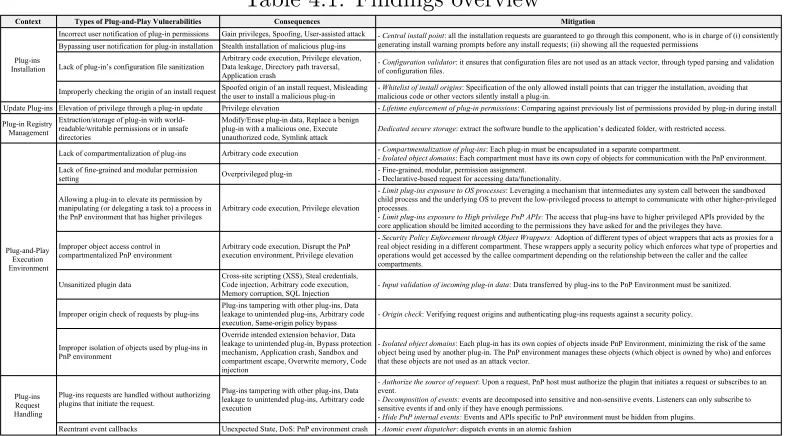
problems that occur in plug-and-play systems. Table 4.1 shows a concise view
of the findings organized with the the types of plug-and-play vulnerabilities,
their context and consequences.
In the following subsections, we describe all the results within their
[image:36.612.119.513.415.633.2]identified context (e.g. plug-and-play functional context )
Table 4.1: Findings overview
Context Types of Plug-and-Play Vulnerabilities Consequences Mitigation
Plug-ins Installation
Incorrect user notification of plug-in permissions Gain privileges, Spoofing, User-assisted attack - Central install point: all the installation requests are guaranteed to go through this component, who is in charge of (i) consistently generating install warning prompts before any install requests; (ii) showing all the requested permissions
Bypassing user notification for plug-in installation Stealth installation of malicious plug-ins
Lack of plug-in’s configuration file sanitization Arbitrary code execution, Privilege elevation, Data leakage, Directory path traversal, Application crash
- Configuration validator: it ensures that configuration files are not used as an attack vector, through typed parsing and validation of configuration files.
Improperly checking the origin of an install request Spoofed origin of an install request, Misleading the user to install a malicious plug-in - malicious code or other vectors silently install a plug-in.Whitelist of install origins: Specification of the only allowed install points that can trigger the installation, avoiding that Update Plug-ins Elevation of privilege through a plug-in update Privilege elevation - Lifetime enforcement of plug-in permissions: Comparing against previously list of permissions provided by plug-in during install Plug-in Registry
Management
Extraction/storage of plug-in with world-readable/writable permissions or in unsafe directories
Modify/Erase plug-in data, Replace a benign plug-in with a malicious one, Execute
unauthorized code, Symlink attack Dedicated secure storage: extract the software bundle to the application’s dedicated folder, with restricted access.
Plug-and-Play Execution Environment
Lack of compartmentalization of plug-ins Arbitrary code execution - Compartmentalization of plug-ins: Each plug-in must be encapsulated in a separate compartment.
- Isolated object domains: Each compartment must have its own copy of objects for communication with the PnP environment. Lack of fine-grained and modular permission
setting Overprivileged plug-in - Fine-grained, modular, permission assignment.- Declarative-based request for accessing data/functionality.
Allowing a plug-in to elevate its permission by manipulating (or delegating a task to) a process in the PnP environment that has higher privileges
Arbitrary code execution, Privilege elevation
- Limit plug-ins exposure to OS processes: Leveraging a mechanism that intermediates any system call between the sandboxed child process and the underlying OS to prevent the low-privileged process to attempt to communicate with other higher-privileged processes.
- Limit plug-ins exposure to High privilege PnP APIs: The access that plug-ins have to higher privileged APIs provided by the core application should be limited according to the permissions they have asked for and the privileges they have.
Improper object access control in compartmentalized PnP environment
Arbitrary code execution, Disrupt the PnP execution environment, Privilege elevation
- Security Policy Enforcement through Object Wrappers: Adoption of different types of object wrappers that acts as proxies for a real object residing in a different compartment. These wrappers apply a security policy which enforces what type of properties and operations would get accessed by the callee compartment depending on the relationship between the caller and the callee compartments.
Unsanitized plugin data
Cross-site scripting (XSS), Steal credentials, Code injection, Arbitrary code execution,
Memory corruption, SQL Injection - Input validation of incoming plug-in data: Data transferred by plug-ins to the PnP Environment must be sanitized. Improper origin check of requests by plug-ins
Plug-ins tampering with other plug-ins, Data leakage to unintended plug-ins, Arbitrary code
execution, Same-origin policy bypass - Origin check: Verifying request origins and authenticating plug-ins requests against a security policy. Improper isolation of objects used by plug-ins in
PnP environment
Override intended extension behavior, Data leakage to unintended plug-in, Bypass protection mechanism, Application crash, Sandbox and compartment escape, Overwrite memory, Code injection
- Isolated object domains: Each plug-in has its own copies of objects inside PnP Environment, minimizing the risk of the same object being used by another plug-in. The PnP environment manages these objects (which object is owned by who) and enforces that these objects are not used as an attack vector.
Plug-ins Request Handling
Plug-ins requests are handled without authorizing plugins that initiate the request.
Plug-ins tampering with other plug-ins, Data leakage to unintended plug-ins, Arbitrary code execution
- Authorize the source of request: Upon a request, PnP host must authorize the plugin that initiates a request or subscribes to an event.
- Decomposition of events: events are decomposed into sensitive and non-sensitive events. Listeners can only subscribe to sensitive events if and only if they have enough permissions.
4.0.1 Plug-in Install
One of the most basic features in a plug-and-play system is toload and
install new plug-ins to the application at runtime. In this context, we found
the following types of problems:
4.0.1.1 Incorrect user notification of plug-in permissions
When a new plug-in is added to the system, it can request access to
certain data/functionality provided by the plug-and-play environment. This
problem occurs when the plug-and-play environment does not (or incorrectly)
shows the list of data and/or functionality that will be accessed by the plug-in
before the plug-in is installed.
– Consequences: It opens space to user-assisted attacks, in which the user
is misled to trust and consequently accept the install of a potentially
over-privileged plug-in. This results in plug-ins being able to gain privileges,
and perform unintended activities, such as access sensitive data (data
leakage).
– Mitigation: Similar to the vulnerability “Bypassing user confirmation
for plug-in installation” (Section 4.0.1.2) the mitigation is to adopt a
Central Install Point that would display a list of all the permissions being
requested by the plug-in (besides consistently generating for mitigating
the problem discussed in Section 4.0.1.2).
analy-sis. In our SLR we found further evidence [65] of this vulnerability, in
which the authors experimented with malicious extensions in Chrome
and developed a “browshing’ (browser + phishing) attack.
4.0.1.2 Bypassing user confirmation for plug-in installation
Whenever a new install is requested, the plug-and-play environment
should ask the user for consent to proceed (or abort) the install. This type
of vulnerability is caused by not strictly enforcing a requirement to have all
install requests mediated by the user.
– Consequences: It can result in stealth installation of malicious plug-ins.
Since these plug-ins were silently installed, an attacker could leverage
this to perform arbitrary malicious activities, such as stealing data.
– Mitigation: It consists of having a Central Install Point in which all the
installation requests, regardless of how initiated, are guaranteed to go
through this central installation component. This component ensures
that the install process of a plug-in is designed to prompt the user for
consent before proceeding with the install.
– Evidence: We found six CVEs that were caused by this type of problem.
Our SLR did not yield any results in this category. As an example,
by design, Firefox does not ask the user to confirm the install of an
add-on if the URL to the add-on was copied and pasted directly into
not represent a risk because the end-user was the one who typed the
URL. Although this design helps to improve usability, attackers could
leverage this design decision to silently install their malicious extensions,
as reported inCVE-2015-4498. They would create a Web page that has a
direct link to the malicious add-on bundle (XPI file), naming it with any
well-known benign extension. Once the user clicks on the link, Firefox
will download and install without any confirmation.
4.0.1.3 Lack of plug-in’s configuration file sanitization
This problem is caused by not validating the plug-in’s configuration file
in order to verify whether it is structurally correct, and also escape/neutralize
any code that is injected into the plug-in’s configuration file.
– Consequences: A malicious extension or a faulty benign plug-in may
contain a malformed configuration file (e.g. omitting required fields or
injecting code in the fields). Such issue could result in various
secu-rity risks such as crash of plug-and-play environment, a directory path
traversal, or data leakage. Malicious extensions could leverage this
vul-nerability to inject arbitrary code and perform numerous unintended
activities (such as installing another plug-in).
– Mitigation: Validating mechanisms must be established and applied
be-fore the plug-in is added to the registry. For instance, the plug-and-play
data type in each field within the configuration file. Each raw field in the
configuration file is converted to the corresponding field in the typed data
structure. This typed data structure is validated, in which a validator
properly escapes and neutralizes any code injected in one of the
config-uration file’s fields. Then, if the validation was successful, this typed
data structure is passed to the initialization routine that will perform
the necessary tasks for adding the plug-in to the plug-in’s registry.
– Evidence: We observed six CVEs that were caused by this problem.
Through our SLR, we did not discover any research paper that identified
this type of vulnerability.
4.0.1.4 Improperly checking the origin of an install request
This vulnerability occurs when the plug-and-play environment accepts
install requests initiated either by the user or an external entity (i.e., a remote
install), but it does not check (or incorrectly checks) the source of an install
request.
– Consequences: A malicious plug-in can be installed in the plug-and-play
environment.
– Mitigation: It can be fixed through defining a white list of the trusted
remote sources that are allowed to trigger an install.
vulnerability type. Through our SLR we did not find any research paper
that identified this type of vulnerability.
4.0.2 Plug-in Updates
Updating plug-insis a basic feature in a plug-and-play system. It allows
third party developers to provide new features and bug fixes for their plug-ins.
In this context, we found the following types of problems:
4.0.2.1 Elevation of privilege through a plug-in update
This vulnerability occurs when plug-ins specify a list of privileges upon
install and the user accepts these permissions. However, the plug-and-play
environment does not check for the changes in privileges of plug-ins after an
update, thus bypassing the user’s consent. Therefore, a plug-in can elevate its
permissions through a plug-in update, and without user consent.
– Consequences: This vulnerability allows users to accept the installation
of a seemingly innocuous extension. However, after an update the
per-missions are elevated, and this can be leveraged to perform malicious
activities.
– Mitigation: Permissions need to be enforced at lifetime: once a user
confirms a set of permissions during install, these cannot be elevated at
any period of time.
prob-lems related to updates have been discussed by other authors in the
lit-erature. In a study of Firefox extensions, the authors point to the fact
that Firefox did not previously perform integrity checks on the
exten-sions after they had been installed, including after updates where these
extensions could elevate their privileges or become malicious in other
ways [56].
4.0.3 Plug-in Registry Management
It is important for a plug-and-play system to keep a registry of installed
plug-ins. However, with this registry, the following types of problems were
found to occur:
4.0.3.1 Extraction/Storage of Plug-in with world readable/writable
permissions or in unsafe directories
In general, plug-ins are released as software bundles (e.g., zip files) that
are extracted by the plug-and-play environment. When the plug-and-play
environment extracts and/or stores these bundles using world-readable (or
writable) permissions (e.g. 777 permissions in Unix-based operating systems),
any other plug-in or potentially external process can alter plug-ins’ data or
code.
– Consequences: An insecure storage of plug-ins means that trojans could
modify plug-in data, alter plug-in functionality, or execute unauthorized
– Mitigation: Each plug-in’s bundles (configurations, scripts, binaries and
other related artifacts) must be stored in a read-only storage dedicated
to that plug-in.
– Evidence: In our analysis we found three cases of unsafe
extraction/s-torage of plug-ins. Through our SLR we found a work by Birsan et al
(pg. 5) [14], that argues that defining a secure shared location can be
particularly challenging in a multi-user environment. “The new plug-ins,
private to that user, cannot be installed in the read-only, shared install
location, so the product should allow users to install and configure extra
plug-ins in a location where they have more privileges.”.
4.0.4 Plug-and-Play Execution Environment
In regards to the plug-and-play execution environment, we found the
following types of problems:
4.0.4.1 Lack of compartmentalization of plug-ins
This vulnerability type is caused by a lack of a well-defined logical
compartment to isolate plug-ins from each other and from the plug-and-play
environment.
– Mitigation: There are two complementary ways of fixing this
vulnerabil-ity. The first one is to create logical compartments and make operations
plug-and-play environment. The second approach is to create isolated object
do-mains, as discussed in Section 4.0.4.7.
– Evidence: This vulnerability type appeared in 23 vulnerability reports.
In our SLR, we found studies that reflected issues related to the lack
of compartmentalization in Telematic Control Units in automobiles[26]
and in extensions of Python [63]. Others [13] developed a tool to detect
such issue.
4.0.4.2 Lack of fine-grained and modular permission setting
Many vulnerabilities observed in our analysis were due to benign
plug-ins that had more privileges than needed to implement their features. A
fine-grained and modular permission setting could have limited the access of
such plug-ins.
– Consequences: Over-privileged plug-ins can expose the plug-and-play
environment to a full compromise. Through a vulnerability in the
plug-in, attackers would have access to any functionality and data of the
plug-and-play environment.
– Mitigation: Modularize the plug-and-play environment into different
fine-grained related functions with specific privileges. Plug-ins will gain
access to specific functions, but not all.
– Evidence: Twenty four vulnerabilities were caused by this lack of a
extensions in Firefox [10, 38, 56]. The lack of fine-grained permissions
rendered the Telematic Control Unit vulnerable to full control from all
attackers that can obtain access to the USB port [26].
4.0.4.3 Allowing a plug-in to elevate its permission by manipulating
(or delegating a task to) a process in the plug-and-play environment that has higher privileges
The vulnerability arises from the scenario in which a plug-in, executing
in a unprivileged process, tampers with a high-privileged process in order to
escape its security boundaries.
– Consequences: A malicious plug-in could execute arbitrary code in higher
privileged context.
– Mitigation: This problem can be mitigated by limiting plug-ins’ exposure
to high privilege plug-and-play APIs. Furthermore, OS system calls
to other processes running in the underlying operating systems must
be prevented. This means leveraging a mechanism that intermediates
any system call between the plug-in and the underlying OS. The second
mitigation technique is to limit the access to higher-privileged APIs.
– Evidence: There were three instances of CVEs in our dataset. In our
4.0.4.4 Improper object access control and compartmentalization enforcement
When plug-ins are isolated in different logical compartments, they
com-municate with each other through object proxies that enforce compartment’s
access policy. Security issues can occur when the plug-and-play environment
uses an incorrect proxy for the inter-compartments communication.
– Consequences: Each plug-in may have a different set of permissions to
use certain functionality; therefore, when their object proxies are
in-correct, a lower privileged plug-in may leverage the proxy of a
higher-privileged plug-in to elevate its privileges and execute arbitrary code. It
can also be used as a mechanism to disrupt the plug-and-play execution
environment.
– Mitigation: The plug-and-play environment enforces security policies
through object wrappers, which act as proxies for a real object residing
in a different compartment. These wrappers are instantiated and used
according to the relationship between the caller and the callee
compart-ments. Each type of object wrapper enforces a different type of security
policy, which indicates the properties and operations would get accessed
by the callee compartment.
– Evidence: We have observed five CVEs caused by the incorrect usage of
object proxies. In our SLR we found a study that used crafted malicious
structure. Authors recommended limiting plug-ins’ DOM access. A
similar solution relying on named-based access control is recommended
in [40] to keep untrusted software, i.e. extensions, from tampering
with the plug-and-play environment. We also encountered studies that
analyzed detection of insecure components in general [39], and studies
that dealt with fine-grained security policy that would limit the access
control of plug-ins specifically [53].
4.0.4.5 Unsanitized plug-in data
The core application interacts with data from the plug-ins. Security
problems arise when the and-play environment trusts data from the
plug-in and, therefore, it does not properly sanitize the data.
– Consequences: this vulnerability results in a number of issues that are
resultant of improper validation of inputs, such as cross-site scripting
(XSS), stealing credentials, code injections (e.g. SQL injection),
arbi-trary code execution, memory corruption, and crashes.
– Mitigation: Adoption of an input validation mechanism that intercepts
and sanitizes the data flowing from plug-ins to the core application.
– Evidence: We found 56 CVEs in this category. In our SLR, we found
sev-eral papers that studied various individual plug-ins of WordPress.
attacks [19, 20, 22, 44, 49, 51, 60, 64, 66]. These papers also discussed
ap-proaches to make each individual plug-in more secure. In contrast, our
approach identified mechanisms to secure the plug-and-play environment
and to lessen the impact of such vulnerable plug-ins.
4.0.4.6 Improper origin check of requests by plug-ins
This problem can result in a security breach when the plug-and-play
environment fails to correctly check the origin of requests (i.e., who was the
plug-in that initiated a call), therefore allowing the elevation of privilege
at-tack.
– Consequences: Since the application failed to verify which plug-in made
a high-privileged API call, the plug-in would be able to perform actions
beyond what should have been allowed. This can result in data leakage to
unintended plug-ins, arbitrary code execution, same-origin policy bypass.
– Mitigation: Each plug-in must be assigned a unique identifier that acts
as an origin identifier. Then, the plug-and-play environment must check
the origin of requests against a security policy whenever a new incoming
request is made to the plug-and-play execution environment.
– Evidence: There were 13 CVEs caused by this issue. The importance of
checking the origin request is emphasized in [50], as a pre-condition to
4.0.4.7 Improper isolation of objects used by ins in the plug-and-play environment
plug-ins attach to the plug-and-play environment through well-defined
public interfaces/APIs provided by the plug-and-play environment. The
inter-action of Plug-ins and the plug-and-play environment is through these APIs.
Security problems can occur when plug-ins and the plug-and-play environment
share the same objects or data structures of these APIs. As a results, plug-ins
can interfere with the plug-and-play environment or other plug-ins.
– Consequences: Since multiple plug-ins can change the properties of these
objects/data structures, it can negatively interfere with other plug-ins
or with the plug-and-play environment. As a result, these shared objects
create a channel that can be used to leak data or to alter the execution
logic of other plug-ins. They can also introduce race condition problems
leading to crashes of the plug-and-play environment.
– Mitigation: The plug-and-play environment can implement an isolated
object domain solution. Each plug-in (and so the plug-and-play
environ-ment) must have its own copies of objects that are passed to or returned
by an API call. Then, the plug-and-play environment manages these
objects, ensuring that pointers or “object references” used by a
plug-in, are not pointing to objects in another compartment (plug-and-play
environment or other plug-ins).