A Practitioner’s Journey Exploring Transformative
Approaches to the Professional Development of Online
Educators
Shirley Reushle ([email protected])
Faculty of Education, University of Southern Queensland, Australia
This article has been anonymously peer-reviewed and accepted for publication in the International Journal of Pedagogies and Learning, an international, peer-reviewed journal that focuses on issues and trends in pedagogies and learning in national and international contexts. ISSN 1833-4105.
© Copyright of articles is retained by authors. As this is an open access journal, articles are free to use, with proper attribution, in educational and other non-commercial settings.
Abstract
In this study, the principles of transformative learning theory, a subset of constructivism within adult education, were applied to the design of professional development experiences for educators in online settings. This study of transformation focused on change existing in two forms: the transforming of perspective (how people view the world and their work); and the transforming of action (how this translates to their practice). Using an action research framework, I investigated how best to prepare tertiary educators to teach (and learn) in online environments. Located at an Australian regional university, I collaborated with teachers from a polytechnic in Singapore to build the professional capacity of the group in online learning and teaching. The challenge for a collaborative practitioner planning and conducting research that enabled informed decisions to be made about action and practice was balanced by the opportunity to trace transformative learning processes through the highly visible online environment. In this paper, I employ the notion of learning as a journey to describe, reflect upon and interrogate my doctoral research design.
Introduction
I commenced the journey towards a Doctorate of Education in 1999 with views about learning, and adult learning in particular, developing to include dimensions of dialogue, reflection, action and social engagement. A strong influence on my thinking at that time was the work of Teilhard de Chardin, particularly his book The Phenomenon of Man (1955). He maintained that evolution had a definite direction, an “Ariadne’s Thread”, and that thread is the increasing complexity of living beings, the focus of which is their nervous systems and more precisely their brains. His opinions about the interconnectivity of mankind and his concern with establishing a global unification of human awareness as a prerequisite to any real future progress of humankind struck a chord with me. His views on the value of reflection – “no longer merely to know, but to know oneself; no longer merely to know, but to know that one knows” (de Chardin, 1955, p. 164) – also resonated with the work that I was doing, or planning to do. The doctoral research emerged from a desire to marry these theories to a practical program of professional learning for higher education online teachers.
and practice rather than merely to describe what was occurring from an outsider’s point of view. The paper explores some of the issues and challenges (for example, ethical and methodological considerations) faced when working primarily with a qualitative study, particularly one that requires a focus on personal experience and introspection. It also highlights the opportunities afforded by working in an (online) environment that makes interaction and reflection visible and accessible, enabling the researcher to trace the change processes more easily.
In the Beginning: Planning the Study
My interest in information and communications technologies began not long after I joined the University of Southern Queensland (USQ). My final paper for a Masters degree (completed part-time, and at a distance) focused on the design considerations for developing hypermedia courseware. This paper represented the start of my journey into academic writing and publishing when I had my first article published in a refereed journal. In the years spanning the completion of the Masters degree and the commencement of a doctorate, I worked extensively with postgraduate adult learners in diverse cultural settings supporting their development of pedagogical approaches to using technology. I saw engagement with a doctoral program as being an opportunity to explore this work in greater depth. As I commenced the coursework component of a Doctor of Education program, a serendipitous incident occurred. I attended a transformative learning conference in New York, and listened to Maxine Greene, Jack Mezirow, Patricia Cranton and many other great names in the field of adult learning. I was surrounded by positive, enthused, transformed educators – it was indeed a transformative learning experience for me as my educational perspectives were both challenged and affirmed. This set me on a path to find out more about transformative learning and how the principles could be applied to my practice. Despite the lack of extant research linking the concept of transformation with learning online, I felt that online settings could provide a ‘friendly’ environment that would support learning contexts promoted by adult education theorists such as Cranton (2003), Jonassen (1998), Dirkx (1998), Knowles (1990) and Mezirow (1991) – collaborative, interactive learning communities that support and promote transformative learning. A thesis topic was born!
Located at an Australian regional university, I collaborated with teachers from a polytechnic in Singapore to build the professional capacity of the group in online learning and teaching. The Singapore polytechnic was selected for the study for the following reasons:
1. The participants were from one teaching context associated with my consulting work. Thus the polytechnic was a convenient location in which to conduct the research.
2. The polytechnic was adopting a blended approach to learning and teaching. In this context, blended was defined as the combination of face-to-face and digitally-based learning experiences for students. USQ continues to trial blended approaches to learning and teaching.
4. The participants had similar characteristics to other clients (or potential clients) of USQ – that is, adult learners teaching in tertiary contexts but whose disciplines are not necessarily in the area of education, thus allowing for a wider application of the findings.
The study built upon extant research into the professional development of educators using technology in educational contexts. The majority of previous studies (for example, Bigum, 2002; Jacobsen, 2002; O’Rourke, 2003) had been situated in classroom environments from schools through to tertiary institutions, in terms of both the focus of the professional development and the means of accomplishing that development. This study added to the body of research into learning and teaching online in that it was conducted predominantly in an online environment. Using an action research framework, the study investigated how best to prepare educators to teach (and learn) in online higher education environments.
The Literature Revealed…
Literature was examined to support the proposition that the online environment could support a process of learning promoted by adult educational theorists (such as Cranton, 2003; Dirkx, 1998; Mezirow, 1991) – learning which Bonk (1999) suggests occurs in collaborative, interactive communities where authentic problems are investigated, meaning is negotiated and learners become apprenticed into their field of expertise. The study was located within a broad structure of existing theory and knowledge relating to three themes evident in the literature:
1. theories of learning, including constructivism, adult learning and, in particular, transformation theory (transformative learning),
2. learning and teaching in online settings (online pedagogy) and 3. professional development for educators.
With the advent of computer-based instruction and the ever growing capabilities of technology, researchers and educators are linking constructivism (where learners actively build from experience and construct their own knowledge and meaning) with the use of technology with learning. Within the field of instructional design and technology, constructivist theory has become popular among theorists and practitioners who are creating and studying its practical applications to learning. The use of technology, particularly the Internet, can provide learning environments, contexts and authentic worlds which learners can experience and explore.
facilitate dialogue to help others, and perhaps themselves, explore beliefs and to move towards a fuller and more dependable understanding of the meaning of experiences. According to the tenets of transformative learning, adult learners need to be reflective, critical thinkers who are open to other perspectives and accepting of new ideas. Dialogue is crucial in this process.
When the literature about transformation theory and the characteristics of transformative learning are taken into account, there is an indication that online settings can offer an environment conducive to this type of learning. King (2003b, p. 33) explains that transformation theory is “an educational theory that explains how adults [can] have learning experiences that profoundly change their frame of reference, or worldview”. The challenge to an individual’s long held beliefs is particularly relevant to this study as it explored the journey of experienced higher education teachers moving into a new realm of learning and teaching: that which occurs in online settings. Support for online education does not imply the end of other approaches to learning and teaching, nor does it suggest that face-to-face learning and “place-bound interactions” should be abolished. The online environment signifies “parallel and alternative forms of human interaction and discourse” (Anderson & Kanuka, 2003, p. 7) and the concept resonates with de Chardin’s (1955) perspectives on interconnectivity and the increasing complexity of human beings. These parallel forms are not essentially better, or worse, that pre-web forms of interaction and education. However, network-enhanced interaction can fulfil some pragmatic human needs at certain points in time by providing access, convenience, flexibility, utility, speed and cost effectiveness. Education is a powerful tool in the global educational environment and the Internet has enabled a new era in human collective activity and human awareness. This has been supported by the work of Gunawardena, Linder-VanBerschot, LaPointe, Barrett, Mummert, Cardiff and Skinner (2007), whose study revealed the learning transformations of e-mentors in the United States and the online tutors and mentors they worked with in the Sri Lankan higher education sector. Matthew and Verner’s (2006) review of their Introduction to Online Teaching program also revealed the value of immersion in an online environment in order to explore and challenge one’s perspectives about online learning and teaching, and pedagogical approaches generally.
Designing and Conducting the Study: Method
The study investigated how best to prepare (develop professionally) educators to teach (and learn) in tertiary online environments. Because the study focused on a relatively new area of research (online education), where literature and related theory are still evolving, there was a need to adopt a research method that was heuristic and creative in design. A qualitative research design with a focus on personal experience and introspection was selected. An action research method was used because its interactive focus and potential for involvement suited the context and objectives of the study. An additional reason was that action research allowed for a strong link between theory and practice. The action research method is participative and grounded in experience, and focuses on action (or change) and research (or understanding) at the same time.
The method allows practitioners to achieve better research outcomes from their practice without undermining the changes that their practice is intended to achieve (Dick, 1993). The aim and the challenge of this research were to enable informed decisions to be made about action and practice rather than merely to describe what was occurring from an outsider’s point of view. As noted by Greene (1988), research of this kind “cannot be carried out by people who see themselves as detached, neutral observers concerned with the kinds of observation, measurement and prediction that are presumed to be unbiased, [and] unaffected by the inquirer’s vantage point or location in the world” (p. 175). This broadly based epistemological position was favoured in this study as it not only embraced both constructivist and critical positions but also left scope to consider new relationships or explanations that might be of a wider perspective and of use to the broader teaching profession. In other words, the process alternates between action and critical reflection and provides a means for professionals to reflect critically on their practice (Denscombe, 2003; Zuber-Skerritt, 1996). Action research has been described as both “an approach to problem-solving and a problem-solving process” and is “adaptive, tentative and evolutionary” (Burns, 1994, pp. 294, 303).
Herein lay ethical and methodological dilemmas. The scientific or positivist research paradigm assumes that the only way to generate valid information is through the application of a rigorous methodology that follows a strict set of established rules and procedures (Kincheloe & McLaren, 1994). In quantitative research, the concepts of reliability and validity are used to judge and evaluate statistical findings. Byrne (2001, p. 1) notes that in qualitative research it is important to assess the findings for “plausibility and believability”. I considered this and, despite this study being primarily qualitative in nature, I found that I was able to reference both the ‘traditional’ concepts and those related to qualitative research. This marrying of the two research paradigms enabled me to review the data collection and analysis methods actively by considering:
1. Validity (am I measuring what I think I am measuring? Are the data accurate and reflecting truth and reality? Are the constructions plausible and believable
to those who constructed them? Is the researcher credible – that is, suitably qualified and experienced to conduct the research?).
3. Generalisability (can the outcomes from this study be replicated in or
transferred to other cases and contexts?). Ensuring generalisability is a challenge when working with a case study within a qualitative research framework.
My role was that of a collaborative practitioner researcher, being the principal teacher in the course and the manager of the project, and actively participating in the process and conducting the research while facilitating the course. Further ethical challenges could have arisen from my dual role as researcher and active participant in the process. To maximise research objectivity, care was taken to ensure that my opinion did not influence outcomes. Validity of the research depended partly on how well results reflected the participants’ meanings and understanding. In order to manage the issue of subjectivity, use was made of:
1. Reflective journals, maintained by myself and by the participants.
2. Peer debriefers, who helped me identify how my own worldview and experiences might be influencing the research. A peer debriefer’s role is to provide a fresh perspective for analysis and critique. This person should be a colleague outside the immediate context of the study but should have some knowledge of the method, content or theory to challenge the researcher’s assumptions regarding the findings (Byrne, 2001). Two colleagues, one familiar with the study and another removed from it, provided this support. 3. Participant (member) checks of transcripts, analyses and interpretations. This
was built into the study, either with follow-up interviews or with questions by email communication.
4. Validity and reliability of the identified themes, trends and understandings were established through the triangulation of the multiple data sources.
In my role, I needed to be a reflective practitioner (Schön, 1991) and my participation in the research was central to the study in that my presence formed part of the research design. To be able to reflect in action (while doing something) and on action (after one has done it) should be important features of any learning activity. Schön (1991) observes that every practitioner continually makes judgments while in action and these judgments are often intuitive and based on a continuously changing set of criteria and circumstances. Critical reflection refers to “questioning the integrity of assumptions and beliefs based on prior experience” (Taylor, 1998, p. 9). Cowan (1997, as cited in Jolly, 1999) extends Schön’s work and also discusses reflection for
action which is anticipatory, where the learner establishes priorities for subsequent learning and action.
Mezirow (1991) sees reflection, critical reflection and critical self-reflection as the distinguishing characteristics of adult learning and central to his theory of transformative learning. Laurillard (2002) believes that teachers have to develop their model of the learning process well beyond the traditional “transmission model” and to be reflective practitioners involved in transformative learning practices. She observes that education has tended toward a skills driven product in the past at the expense of promoting reflective, thoughtful, engaged teachers and learners. The result has been “individuals unprepared to be practical change agents during a time of needed change” (Laurillard, 2002, p. 20). Cranton (1996) suggests that the educator who engages in critical self-reflection on practice and questions that practice almost inevitably modifies that practice. She believes that educators who are not critically self-reflective are not likely to stimulate critical reflection practices among their own students.
It was anticipated that the use of reflective activity would assist the participants and me (as the practitioner) to understand professional practice better by enabling us to understand, research and evaluate practice. The justification for reflection was that it would help avoid the danger of being the servant of routine. It would allow the participants and me to interrogate our practice and to seek inspiration to improve that practice. In keeping with an action research method, the study needed to be practical and personal and related to this reflection on practice. Reflective practitioners challenge assumptions and question existing practices, thereby continuously accessing new lenses to view their practice and alter their perspectives. The use of reflective journals as data gathering instruments by participants and the researcher enabled further reflection to occur. Maintaining a journal, notes King (2003a, p. 93), enables the “self-dialogue that runs across the page [to] bring to our consciousness beliefs, values and assumptions we may never have articulated before”.
Phases of the Study
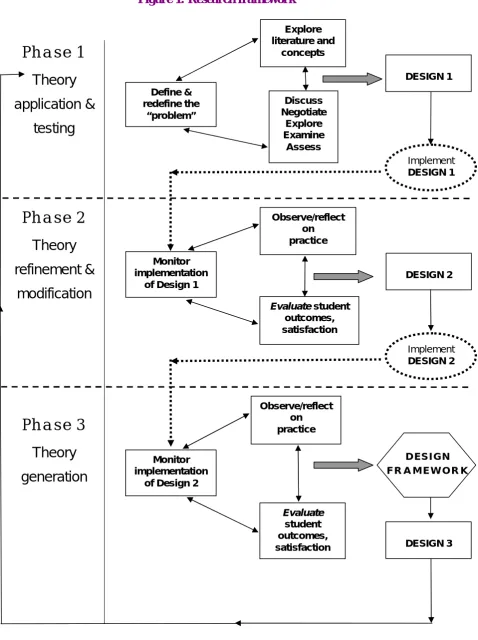
The study consisted of three phases which were exemplified by an adaptation of a qualitative action research method developed by Salmon (2002). This adaptation of Salmon’s framework was considered a suitable basis for this study because it had already been applied successfully to a large-scale online action research study in a higher education business school. The method used an iterative, cyclical process to develop, implement, evaluate and modify a professional development course (see Figure 1). The phases consisted of Phase 1: Theory application and testing (evaluation of Course Design 1), Phase 2: Theory refinement and modification (formulation and implementation of Course Design 2) and Phase 3: Theory generation (evaluation of Design 2, and formulation of a framework for design – Course Design 3).
Figure 1: Research framework
Phase 1
Theory
application &
testing
Phase 2
Theory
refinement &
modification
Phase 3
Theory
generation
Define & redefine the
“problem”
Explore literature and
concepts
Discuss Negotiate
Explore Examine
Assess
Implement
DESIGN 1 DESIGN 1
Monitor implementation
of Design 1
Observe/reflect on practice
Evaluate student
outcomes, satisfaction
DESIGN 2
Implement
DESIGN 2
Monitor implementation
of Design 2
Observe/reflect on practice
DESIGN 3
Evaluate
student outcomes, satisfaction
gathered, the emerging insights and identification of trends shaped and refined the focus of the subsequent course designs. Many authors (for example, Bogdan & Biklen, 2003) support an ongoing process of analysis which is in accordance with the action research method used in this study.
Phase 1 of the study involved the initial definition of the problem, which was to design and deliver a professional development course for a group of tertiary teachers in the area of designing and facilitating online learning and teaching. This phase provided historical data in order to set the scene for the main part of the study and could be regarded as the ‘initial hypothesis’ for the study. For Phase 1, data were gathered from four sources:
1. negotiations with the client (a Singapore polytechnic) to ascertain needs and requirements,
2. a review of the technological infrastructure of USQ, 3. a review of pertinent literature and
4. the experience and reflection on practice of several online teachers at USQ (including the researcher).
The refinement and distillation of the concepts and principles drawn from the analysis of these sources led to Design 1, as illustrated in Figure 1.
Data were gathered throughout the offer of Design 1 and the outcomes from the analyses shaped Design 2. The analyses were presented in several reports and from these reports the researcher presented the findings as pedagogical, administrative and technical recommendations. According to these recommendations and after a further examination of the literature, a refinement and modification of the theoretical basis resulted in Design 2.
Phase 3 included the monitoring of the implementation of Design 2, the analysis of data collected from an evaluation of Design 2, an updated review of current literature and practitioner reflection on practice. This resulted in theory generation, addressed the research objective: “To formulate a framework for the design of transformative professional development for online educators, based on the developmental phases of this study” (Design 3) and constituted the main outcome of the study.
Opportunities and Challenges in the Design of the Research
A number of strengths of and possible challenges to the study have been identified. The study followed an action research method and a common criticism of action research is its lack of generalisability or external validity. To some extent this is a legitimate criticism. The extent to which the outcomes of this study might apply beyond the immediate sample is an important issue. The study was sourced from one institution outside the Australian educational system, a Singapore polytechnic. This is because the cohort needed to be intact and contained. Therefore the application of the findings was restricted to this group. Beyond that, reader generalisability (Merriam, 1998) meant that readers could relate the findings to their own existing picture of online learning and teaching in their own educational institution or other context.
repeated), generalisability (global relevance) and responsiveness (local relevance) at one time: one often needs to trade one off for the others. More traditional methods of research tend to sacrifice responsiveness in the interests of achieving replicability, thus making them unsuitable as a change technique. Action research values responsiveness over replicability; otherwise it is very difficult to achieve action as part of the research. Despite this, the intention in this study was also to achieve some replicability so that the resulting framework could be considered for other contexts. Cultural (including linguistic) differences may have had an impact on the shared understandings and meanings of the participants and must be considered as having some impact on the findings of the study.
Although there was a plan for this research, there had to be opportunity to change or adapt the method to reflect the emerging data. The evolving nature of action research provided this flexibility. The newness and characteristics of online learning and teaching suggested that a research approach that enabled the voices of many participants to be articulated, and that provided opportunities for participants to reflect on their learning and experience, was most appropriate. This again supported the choice of an action research method.
Because the study was focused on the online environment, it was fitting to use the Internet as an integral component of the activities conducted. The Internet enables the tracking and recording of many types of online activity. The main sources of data for this study were text-based discourses and the transcripts of these interactions were readily captured and stored as digital text files. This instant transcription reduced cost and the possibility of error. The use of the Internet also enabled me to reach a diverse population sample that may otherwise have been inaccessible owing to the constraints of time, cost and location. .
Implications of this Study for Doctoral Designers
When qualitative research is being designed and conducted, it is essential to recognise and discuss the challenges that may be encountered and how they might impact on the overall findings of the study. In this study, my multifaceted role of collaborative practitioner and researcher involved designing the research guidelines that were used throughout the project. As the project manager and principal teacher, I was in a position to influence the experiences of the participants (and therefore in a position of power). I had a clear agenda for the project to support and facilitate transformative learning with the aim of participants experiencing the development of a critical perspective, or possible change in perspective of profession and practice. As mentioned previously, ethical dilemmas could have arisen from my dual role as researcher and active participant in the process. In order to manage the challenge of subjectivity, use was made of peer debriefers and participant (member) checks of analyses and interpretations. Member checks were built into the study, either with follow-up interviews with the participants or with questions by email communication.
off-campus. Of the teachers at the polytechnic which was the focus of this study, some teachers were quite prepared to move immediately into a virtual campus environment and to continue to participate online in the USQ study; others were not. The timeframe for the study was extended in order to recognise the possibility of this unplanned disruption being a potential distraction to and interference with the study’s validity and reliability. Interestingly, the occurrence of this unplanned event contributed to some change in perspective when one participant commented on finding the virtual chat facility very useful when it was not possible to have face-to-face classes with the participant’s own students.
The online learning environment established in this study was primarily text-based, where the written word was the principal form of communication. This made interaction and discussion among study participants visible and accessible, a significant advantage in the conduct of the research. The opportunity to use the online facilities (email, synchronous chat and discussion forums) to collect data suggests that using the Internet is a very promising method for conducting research. Using an online learning management system to collect data enabled the researcher to gain easy, secure access to a cross-cultural, remote (as in location) and international sample, and to use the online environment to conduct interviews about online learning experiences. The participants had used this facility to take part in the course and were familiar with it. In addition, it saved the expense and delay of regular postage and other distribution methods. This method of data collection has been well documented by Anderson and Kanuka (2003), who note that, although a benefit of web-based interactions is the elimination of the transcribing process, it must be acknowledged that the transcription task is transferred to the participant.
Conclusion
Throughout the conduct of this study, in my own personal journey as an educator and learner, I experienced “the turmoil, the conflict, the uncertainty, and the chaos” which enabled “personal discovery to emerge” (Larrivee, 2000, p. 306) in terms of transformation as an educator and as a learner. I experienced several “ah ha!” moments, leading me to formulate my own solutions to educational questions. This personal shift can be compared with Larrivee’s (2000) view of critical reflection, where I have been in the process of restructuring my way of thinking and changing my overall perspective of learning and teaching in the online context. My experiences have enabled me to recognise the power of reflection, as described by de Chardin (1955): “…the power acquired by a consciousness to turn in upon itself…no longer merely to know, but to know oneself; no longer merely to know, but to know that one knows” (p. 164).
learning and teaching, developing a critically reflective practice, networking and dialoguing with other educators, and taking an active role in professional development”. The significance of maintaining reflective journals, conducting dialogue with others and actively reflecting on practice emerged from the study. This applies as much to the educators as it does to their students. It has become evident from this study that two key factors form the focus of sound professional development experiences for educators working in online environments: the people – the human element; and the activities – the actions. This moves the emphasis of learning away from what we learn to whom we learn from, and with, and how we learn.
Research studies tend to create as many questions as answers. In the case of online education, many pedagogical questions and issues that have been around for a long time have returned to the surface yet again. The metaphor that illustrates this educational conundrum is that of a journey which never ends – in fact, a journey which appears to have no end, but also no beginning, and which is retraced periodically. As with all eras of educational development, the tension continues between idealism and pragmatism, academic autonomy and economic, political and administrative rationalism, openness and control. However, the focus on online education has brought with it a renewed scrutiny of sound pedagogical practices and the researcher has been able to identify several areas for further study. Although this study aimed to articulate a ‘generic’ model for the provision of transformative approaches to professional development for online educators in tertiary institutions, just how ‘generalisable’ these principles will be is not evident. Future research will be focused on how this generic model might be applied to other contexts not considered in this study, both within USQ and in other educational arenas. In addition, the initial exploration of transformative learning and its effectiveness and appropriateness for online learning environments needs to be extended. The opportunities in the contemporary era for comparative studies among different cultures, genders and ages, and how individuals make meaning in transformative learning environments, are exciting areas to consider. Therefore reaching these conclusions does not suggest that my learning journey is over – it is, I believe, just beginning.
References
Anderson, T., & Kanuka, H. (2003). E-Research: Methods, strategies, and issues. Boston, MA: Pearson Education.
Bigum, C. (2002). Design sensibilities, schools and the new computing and
communication technologies. In I. Snyder (Ed.), Silicon literacies:
Communication, innovation, and education in the electronic age (pp. 130-140). New York: Routledge.
Bogdan, R. C., & Biklen, S. K. (2003). Qualitative research for education (4th ed.). Boston, MA: Allyn & Bacon.
Bonk, C. J. (1999). Breakout from learner issues. International Journal of Educational Communications, 5(4), 387-410.
Boud, D., & Walker, D. (1998). Promoting reflection in professional courses: The challenge of context. Studies in Higher Education, 23(2), 191-206.
Brookfield, S. (1987). Developing critical thinkers: Challenging adults to explore alternative ways of thinking and acting. San Francisco: Jossey-Bass.
Byrne, M. (2001, March). Evaluating the findings of qualitative research. AORN Online. Retrieved January 6, 2005, from http://www.aorn.org/journal/2001/marrc.htm#13
de Chardin, P. T. (1955). The phenomenon of man with an introduction by Sir Julian Huxley. London: Collins.
Cranton, P. (1996). Professional development as transformative learning: New perspectives for teachers of adults. San Francisco: Jossey-Bass.
Cranton, P. (2003). Finding our way: A guide for adult educators. Toronto: Wall & Emerson.
Denscombe, M. (2003). The good research guide for small-scale research projects
(2nd ed.). Maidenhead, UK: Open University Press.
Dick, B. (1993).You want to do an action research thesis? How to conduct and report action research. Retrieved May 10, 2007, from http://www.scu.edu.au/schools/gcm/ar/art/arthesis.html
Dirkx, J. M. (1998). Transformative learning theory in the practice of adult education: An overview. PAACE Journal of Lifelong Learning, 17, 1-14.
Greene, M. (1988). Qualitative research and the uses of literature. In R. R. Sherman & R. B. Webb (Eds.), Qualitative research in education: Focus and methods (pp. 175-189). New York: Falmer Press.
Gunawardena, L., Linder-VanBerschot, J., LaPointe, D., Barrett, K., Mummert, J., Cardiff, M., & Skinner, J. (2007). Learning transformations through cross-cultural e-mentoring: Perspectives from an online faculty development forum. InProceedings of the 7th international transformative learning conference (pp. 162-167). Albuquerque, NM: University of New Mexico.
Jacobsen, D. M. (2002, April 1-5). Building different bridges two: A case study of transformative professional development for student learning with technology.
Paper presented at the 83rd annual meeting of the American Educational Research Association, New Orleans, LA.
Jolly, L. (1999, November 1-2). Challenging hegemony: Reflections on reflections.
Paper presented at the “Effective Courses/Effective Teaching at
University/Reflection on Practice/Practice for Reflection” conference, Teaching and Educational Development Institute, University of Queensland, Brisbane,
Qld. Retrieved May 14, 2007, from
http://www.tedi.uq.edu.au/conferences/teach_conference99/papers/Jolly.html Jonassen, D. H. (1998). Designing constructivist learning environments. In C. M.
Reigeluth (Ed.), Instructional theories and models (2nd ed.). Mahwah, NJ: Erlbaum.
Kincheloe, J. L., & McLaren, P. L. (1994). Rethinking critical theory and qualitative research. In N. Denzin & Y. Lincoln (Eds.), Handbook of qualitative research
(pp. 138-157). Thousand Oaks, CA: Sage.
King, K. P. (2003a). Designing pathways for adult learning: A model for creating transformative learning opportunities. International Journal of Learning. 10, 85-97.
King, K. P. (2003b). Keeping pace with technology: Educational technology that transforms. Cresskill, NJ: Hampton Press.
Knowles, M. S. (1990). The adult learner: A neglected species (4th ed.). Houston, TX: Gulf Publishing Company.
Laurillard, D. (2002, January/February). Rethinking teaching for the knowledge
society. EDUCAUSE, 16-25.
Matthew, V., & Verner, R. E. (2006, October 12-14). Goodbye carrot, hello transformation: Towards a transformational approach to engaging faculty in online learning. Paper presented at the 26th national conference of the Adult Higher Education Alliance, Dallas, TX.
Merriam, S. B. (1998). Qualitative research and case study applications in education. San Francisco: Jossey-Bass.
Mezirow, J. (1991). Transformative dimensions in adult learning. San Francisco: Jossey-Bass.
O’Rourke, M. (2003). Technology and educational change: Making the links. Unpublished doctoral dissertation, Victoria University, Melbourne, Vic.
Retrieved May 10, 2007, from
http://wallaby.vu.edu.au/adt-VVUT/uploads/approved/adt-VVUT20030804.093845/public/
Salmon, G. (2002). Approaches to researching teaching and learning online. In C. Steeples & C. Jones (Eds.), Networked learning: Perspectives and issues (pp. 195-212). London: Springer.
Sandlin, J. A. (2000, August). The politics of consumer education materials used in adult literacy classrooms. Adult Education Quarterly, 50(4), 289-307.
Schön, D. A. (1991). The reflective practitioner: How professionals think in action. Bodmin, UK: Ashgate Publishing.
Sparke, J., & Skoyles, P. (1998, Summer). Analysis of critical incidents: Testing a framework for developing professional judgement and improving practice through reflection. The CANTARNET Journal.
Taylor, E. W. (1998). The theory and practice of transformative learning: A critical review (Information series no. 374). Columbus, OH: ERIC Clearinghouse on Adult, Career, and Vocational Education, Center on Education and Training for Employment, College of Education, Ohio State University.
Tennant, M., & Pogson, P. (1995). Learning and change in the adult years. San Francisco: Jossey-Bass.