Rochester Institute of Technology
RIT Scholar Works
Theses
7-25-2018
Mathematical Model and Parameter Estimation for
Tumor Growth
Lujun Yin
Follow this and additional works at:https://scholarworks.rit.edu/theses
Recommended Citation
Mathematical Model and Parameter Estimation
for Tumor Growth
By
Lujun Yin
A thesis submitted in partial fulfillment of the requirements for the degree of Master of Science
in Applied Mathematics
from the School of Mathematical Sciences Rochester Institute of Technology
25 July 2018
Advisor: Dr. Baasansuren Jadamba Co-advisor: Dr. Akhtar Khan
Abstract
Numerous models in applied mathematics are expressed as a system of partial differential equations involving certain coefficients. In this work, we consider a tumor growth model originally proposed by Ward and King in 1997. Our main goal is to find an efficient and accurate numerical method for identification of parameters in the model (an inverse problem) from measurements of the evolving tumor over time. The so-called direct problem, in this case, is to solve a system of coupled nonlinear partial differential equations for given fixed values of the unknown parameters. We compare several derivative free and gradient based methods for the solution of the inverse problem which is formulated as an optimization problem with a constraint that is a system of partial differential equations (PDEs). Finally, we modify the original model to include a random parameter and solve the new optimization problem using the Monte Carlo method. The thesis is organized as follows. In the first two intro-ductory chapters, we discuss the original model and the non-dimensionalized version of the model equations. The next chapter is devoted to the optimization formulation of the inverse problem. In the following chapters, we compare performances of the optimization methods. In the final chapter, we discuss the performance comparison of the optimization methods for the cases where the random parameter in the model follows either uniform or truncated normal distributions.
Dedication
I would like dedicate this to my family, first for their encouragement through the process, and second, for understanding that I would have to give up a lot of time with them in order to pursue my goals.
Acknowledgement
I would like to thank my family, friends, and mentors for helping me through this learning process, your support was vital to my success.
I am especially grateful for my advisor, Dr. Akhtar Khan and Dr.Baasansuren Jadamba. In the two years I have been their student, he has been patient, kind, and understanding. Dr. Khan and Dr. Jadamba are extremely resourceful and spends much of their valuable time procuring guest speakers and other materials to better aid his students. The multiple viewpoints they provides to each problem is invaluable.
I really love the study experience in RIT. As an international student, I feel different cultures and education there. I am very appreciate to every professor who spent their precious time on teaching me and answering my questions patiently. I will never forget the two years of studying here. I thank everyone in RIT.
Most importantly, I thank my parents for their encouragement for me to complete my degree, they can be most persuasive and motivating. Throughout college, I rarely had the opportunity to visit them for more than a few days at a time, and in a way, they have sacrificed more by having me stay in school. I love my family very much.
Contents
1 Introduction 1
1.1 Partial Differential Equation (PDE) . . . 1
1.2 Optimization . . . 2
1.3 Mathematical Formulation . . . 3
2 A Tumor Growth Model 4 2.1 The Direct Problem . . . 4
2.2 Nondimensionalization and fixed domain method . . . 7
2.3 Numerical solution of the direct problem . . . 8
2.4 Experimental Results . . . 9
3 The Inverse problem 14 3.1 Definition Of Inverse Problem . . . 14
3.2 Formulation Of the Minimization Problem . . . 15
4 Optimization Methods 19 4.1 Gradient Method . . . 19
4.1.1 Gradient Descent . . . 20
4.1.2 Conjugate Gradient Method . . . 21
4.1.3 Nonlinear Conjugate Gradient Method . . . 23
4.2 Optimization Methods Based on Newton’s Method . . . 24
4.2.1 Quasi-Newton Method . . . 24
4.2.2 BFGS . . . 25
4.2.3 L-BFGS . . . 26
4.2.4 Conjugate Gradient Trust Region Method . . . 27
4.3 Derivative Free Methods . . . 30
4.3.1 Pattern Search Method . . . 30
4.3.2 The Nelder Mead Method . . . 31
4.4 Gradient Projection Method . . . 32
5.1.1 Pattern Search Method . . . 34
5.1.2 The Nelder Mead Method . . . 38
5.2 Gradient Method . . . 42
5.2.1 Conjugated Gradient Trust Region Method . . . 42
5.2.2 Gradient Projection Method . . . 46
5.3 Analysis . . . 51
6 Tumor growth model with an uncertain parameter 52 6.1 Inverse problem with an uncertain parameter . . . 53
6.2 Numerical solution of the problem . . . 53
6.2.1 Results of the numerical experiments using derivative free methods . . . 54
6.3 Analysis and Future Work . . . 70
List of Figures
2.1 Microscopic image of neoplastic colonies that grow with an nutrient supply . . . 5
2.2 Direct-fig-radius-1 . . . 9
2.3 Direct-fig-live-cell-density-1 . . . 10
2.4 Direct-fig-concentration-1 . . . 10
2.5 Direct-fig-velocity-1 . . . 11
2.6 Direct-fig-radius-2 . . . 11
2.7 Direct-fig-live-cell-density-2 . . . 12
2.8 Direct-fig-concentration-2 . . . 12
2.9 Direct-fig-velocity-2 . . . 13
5.1 Pattern Search Method Case 1 . . . 35
5.2 Pattern Search Method Case 2 . . . 36
5.3 Pattern Search Method Case 3 . . . 37
5.4 The Nelder Mead Method Case 1 . . . 39
5.5 The Nelder Mead Method Case 2 . . . 40
5.6 The Nelder Mead Method Case 3 . . . 41
5.7 Conjugated Gradient Trust Region Method Case 1 . . . 43
5.8 Conjugated Gradient Trust Region Method Case 2 . . . 44
5.9 Conjugated Gradient Trust Region Method Case 3 . . . 45
5.10 Gradient Projection Method Case 1 . . . 47
5.11 Gradient Projection Method Case 2 . . . 48
5.12 Gradient Projection Method Case 3 . . . 49
6.1 Normal distribution Parameter Pattern Search Method Case 1 . . . 55
6.2 Normal distribution Parameter Pattern Search Method Case 2 . . . 56
6.3 Normal distribution Parameter Pattern Search Method Case 3 . . . 57
6.4 Uniform Distribution Parameter Pattern Search Method Case 1 . . . 59
6.5 Uniform Distribution Parameter Pattern Search Method Case 2 . . . 60
6.6 Uniform Distribution Parameter Pattern Search Method Case 3 . . . 61
6.7 Normal Distribution Parameter The Nelder Mead Method Case 1 . . . 63
6.8 Normal Distribution Parameter The Nelder Mead Method Case 2 . . . 64
6.9 Normal Distribution Parameter The Nelder Mead Method Case 3 . . . 65
6.11 Uniform Distribution Parameter The Nelder Mead Method Case 2 . . . 68
Chapter 1
Introduction
1.1
Partial Differential Equation (PDE)
A partial differential equation (PDE) describes a relation between an unknown function and its partial
derivatives. PDEs exist frequently in most topics of physics and engineering. Moreover, in recent
years we have seen a dramatic increase in the applications of PDEs in many areas such as
biol-ogy, chemistry, computer sciences and in economics. The general form of a PDE for a function
u(x1,x2, ...,xn)is
F(x1,x2, ...,xn,u,ux1,ux2, ...,uxn, ...) =0
wherex1,x2, ...,xn are the independent variables,uis the unknown function, anduxi denotes the par-tial derivative ∂u
∂xi. The equation is, in general, supplemented by additional conditions such as initial conditions (as we have often seen in the theory of ordinary differential equations (ODEs)) or
bound-ary conditions.
The fundamental theoretical question is whether the problem consisting of the equation and its
asso-ciated side conditions is well-posed. The French mathematician Jacques Hadamard (1865−1963)
coined the notion of well-posedness. According to his definition, a problem is called well-posed if it
Existence The problem has a solution.
Uniqueness There is no more than one solution.
Stability A small change in the equation or in the side conditions gives rise to a small change in the solution.
If one or more of the conditions above does not hold, we say that the problem is ill-posed. One
can fairly say that the fundamental problems of mathematical physics are all well-posed. However,
in certain engineering applications we might tackle problems that are ill-posed. In practice, such
problems are unsolvable. Therefore, when we face an ill-posed problem, the first step should be to
modify it appropriately in order to render it well-posed.
1.2
Optimization
Optimization is an important tool in decision science and in the analysis of physical systems. To use
it, we must first identify some objective, a quantitative measure of the performance of the system
under study. This objective could be profit, time, potential energy or any quantity or combination of
quantities that can be represented by a single number. The objective depends on certain characteristics
of the system, called variable or unknowns. Our goal is to find values of the variables that optimize
the objective.
The process of identifying objective, variables and constraints for a given problem is known as
mod-eling. Construction of an appropriate model is the first step but the most important step is the
opti-mization step. Once the model has been formulated, an optiopti-mization algorithm can be used to find
its solution. Usually, the algorithm and model are complicated enough that a computer is needed to
implement this process. After an optimization algorithm has been applied to the model, we must be
able to recognize whether it has succeeded in its task of finding a solution. In many cases, there are
elegant mathematical expressions known as optimality conditions for checking that the current set of
may give useful information on how the current estimate of the solution can be improved. Finally,
the model may be improved by applying techniques such as sensitivity analysis, which reveals the
sensitivity of the solution to changes in the model and data.
1.3
Mathematical Formulation
Mathematically speaking, optimization is the minimization or maximization of a function subject to
constraints on its variables. We use the following notation:
• xis the vector of variables, also called unknowns or parameters;
• f is the objective function, a function ofxthat we want to maximum or minimize;
• c is the vector of constraints that the unknowns must satisfy. This is a vector function of the
variables ofx. The number of components incis the number of individual restrictions that we
place on the variables.
The optimization problem can then be written as
min
x∈Rnf(x) subject to
ci(x) =0 i∈ε
ci(x)≥0 i∈I
(1.1)
Chapter 2
A Tumor growth model
In this chapter, we include an introduction to a tumor growth model originally introduced by Ward
and King [19] and later considered by D.A.Knopoff [1] and specify the direct and inverse problems
associated to the model.
2.1
The Direct Problem
Scientists believe that mathematical modeling of tumor growth is an effective and important part in
promoting knowledge about cancer, which has become one of the most popular studied topics in
mathematical biology. In the history of mathematical biology,there are many mathematical models of
tumor growth including continuous models and discrete models.
The advantages of continuous models are that they are understandable, tractable to mathematical
anal-ysis and intuitive from biological principles. They contain a few parameters and can use laws from
physics. On the other hand, discrete models are able to work in other scales and each cell can be
treated independently with no extra complication.
Mathematical models of avascular multicellular spheroids are typically continuous models which
con-sist of an ordinary differential equation (ODE) representing the evolution of the outer tumor boundary,
general approach of modeling, the key variables are the tumor size, e.g., tumor radius, and the
con-centration. Since the tumor changes in size over time, the domain on which the models are formulated
[image:14.612.115.491.155.403.2]must be determined as part of the solution process, giving a vast class of moving boundary problems.
Figure 2.1: Microscopic image of neoplastic colonies that grow with an nutrient supply
In this work, we consider the model proposed by Ward and King [19]. The tumor is considered to be
a spheroid consisting of a continuous of living cells, in one of two states: live or dead. The rates of
birth and death depend on the nutrient. It is supposed that those processes generate volume changes,
leading to cell movement described by a velocity field. In this tumor growth model, tumor growth
model has the following characteristics:
• Mass of rapidly proliferating cells are supported by the adequate glucose and oxygen
concen-tration of the surrounding environment.
1. Nutrients are readily available at the rim.
2. Concentration of nutrients significantly decreases as we move from the rim to the
inner-portions of the tumor.
3. Necrotic core reduces the volume.
• Tumor-angiogenesis factors (TAFs) support tumor growth.
Assuming spherical symmetry, the system of equations to be studied is:
∂ η ∂t +
1 r2
∂ r2vη
∂r = [km(ς,θ)−kd(ς,θ)]η (2.1)
∂ η ∂t +
1 r2
∂ r2vς ∂r =
D r2
∂ ∂r
r2∂ η
∂r
−βkm(ς,θ)η (2.2)
1 r2
∂ r2v
∂r = [V1km(ς,θ)−(V1−VD)kd(ς,θ)]η (2.3)
Where the dependent variables η , ς and ν are the live cell density (cells/unit volume), nutrient
concentration and velocity, respectively.
The functionkmandkdare taken to be generalized MichaelisMenten kinetics with exponent 1 so that
we can get the following:
km(ς,θ) =Aςς
c+ς
kd(ς,θ) =B
1−σ ς
ςd+ς
Initial and boundary conditions:
η(r,0) =η1(r)
∂ ς
∂r(0,t) =0
v(0,t) =0
ς(℘(t),t) =c0
d℘
dt =v(℘(t),t)
wherec0 is the external nutrient concentration.Boundary conditions (2.7) and (2.8) reflect the
2.2
Nondimensionalization and fixed domain method
Following the formulations used in [2],The mathematical model is rescaled and the domain[0,℘(t)]
of the tumor is transformed onto the interval [0,1]. This is a common approach when dealing with
boundary problems. Hence, we define the following functions
N(y,t) =VLη(y℘(t/A),t/A)
C(y,t) = c1
0ς(y℘(t/A),t/A) V(y,t) =Ar1
0v(y℘(t/A),t/A) S(t) =r1
0℘(t/A)
a(c,ϑ) = 1A[km(c,ϑ)−kd(c,ϑ)]
b(c,ϑ) = 1A[km(c,ϑ)−(1−δ)kd(c,ϑ)]
k(c,ϑ) =Bkb m(c,ϑ)
Where r0=
3VL
4π
1/3
is the radius of a single cell,δ = VVD
L,βb=
r20β
VLc0D and ϑ = [A,B,cc,cd,σ] with cc= ςc
c0,cd=
ςd
c0.
The new system that is to be solved on(y,t)domain[0,1]×[0,T]is as follows:
Nt−NyS
0
Sy+ V
SNy=N(a(C,ϑ)−b(C,ϑ)N), 0<y≤1, t >0
Cyy+2yCy=K(C,ϑ)NS2, 0<y≤1, t>0
Vy+2yV =b(C,ϑ)NS, 0<y≤1, t>0
The initial and boundary conditions are :
N(y,0) =N1(y) =VLηI(y℘(0),0), 0≤y≤1
S(0) =S1=℘r(0)
0
C(1,t) =1, t>0 S0(t) =V(1,t), t>0
Where N1(y) =VLη1(y℘(0),0) and S1= ℘r(00).This system above will be referred to as the direct
problem.This is the system to be numerically solved repeatedly during the optimization procedure.
2.3
Numerical solution of the direct problem
We apply finite difference method to solve the PDEs system of tumor growth model. FunctionsS(t)
andN(y,t)are found by simple time stepping, for example,
N(y,tn+1) =N(y,t) +τ∗
S0
S −
V
SNy+N[a(C,θ)−b(C,θ)N]
t=tn
(2.4)
whereτ is the time step, andtnandtn+1=tn+τ are two consecutive times. The equation forC(y,t)
is solved by the Newton’s method. For the solution ofV(y,t) we use a backward finite difference
scheme and this leads to a linear system involving entries of V at the grid points. For each time step,
we
1 update S (relabelled asSnew).
2 update N (relabelled asNnew) usingSnew.
3 solve for C (relabelled asCnew) via Newton method usingNnew andSnew.
4 solve for V (relabelled asVnew) usingNnew,Snew andCnew.
The pseudocode to update S, N, and solve for V is as follows: GivenSI (initial dimensionless radius
of a cell calculated throughr0), whereq is the number of discretization points on the interval[0,1]
andSnew =Sold+τVq.
• FindCnew by using Newton’s method
• FindNnew.
• Solve a linear system to obtainVnew.
2.4
Experimental Results
In our numerical experiments, we set our parameters as following:
Cc Cd σ Vl δ c0 s0 βb
0.1 0.05 0.9 10−9 0.5 1.4×10⁻³ 0.021 0.005 Table 2.1: Parameter table
Next, we plot results of some numerical simulations of the direct problem using the parameters values
[image:18.612.160.435.373.575.2]in Table 2.1.
Figure 2.2: Evolution of the tumor radius S vs. dimensionless time t. where we used time step
Figure 2.3: Evolution of the live cell densityN vs. dimensionless radiuss. where we used time step
[image:19.612.164.435.72.273.2]τ=0.0005 andα =50 grid points on[0,1].
Figure 2.4: Evolution of concentrationC vs. dimensionless radiuss. where we used time step τ =
Figure 2.5: Evolution of velocityV vs. dimensionless radiuss. where we used time step τ=0.0005
[image:20.612.165.435.71.271.2]andα=50 grid points on[0,1].
Figure 2.6: Evolution of the tumor radius S vs. dimensionless time t. where we used time step
Figure 2.7: Evolution of the live cell densityN vs. dimensionless radiuss. where we used time step
[image:21.612.164.434.72.273.2]τ=0.0005 andα =100 grid points on[0,1].
Figure 2.8: Evolution of concentrationC vs. dimensionless radiuss. where we used time step τ =
Figure 2.9: Evolution of velocityV vs. dimensionless radiuss. where we used time step τ=0.0005
andα=100 grid points on[0,1].
By observing the figures of dimensionless tumor radius figure 2.2 and 2.6, we can find that a slight
kink as the growth rate decelerates a little before reaching the linear phase. This behavior is because
of the time delay from when celss become quiescent to when they die. The live-cell density figure
2.3 and 2.7 show that the live-cell density is relatively constant in a small region beneath the cell
surface, dropping sharply towards zero deeper into the tumour, reflecting a well-defined viable rim
and a necrotic core. It should be stressed that such regions arise naturally from the model rather than
being assumed a priori. Similar, the nutrient concentration figure 2.4 and 2.8 show that the nutrient
concentration decreases sharply through the viable rim and tends to a constant level in the core due to
the nearly complete necrosis in this region. By observing the figure 2.5 and 2.9 of velocity , we can
get the conclusion that the velocity within the tumour decreases very rapidly from a positive value
towards a negative minimum, before approaching zero in the necrotic core. The region of negative
velocity reflects the fact that volume loss by cell death is greater there than the volume gain through
Chapter 3
Inverse problem
In this chapter, we first give a very brief introduction to inverse problems and ill-posedness. Then,
we will introduce the parameter identification problem rising from the tumor growth model discussed
in Chapter 2. We will also discuss the objective function for the optimization formulation for the
parameter identification problem.
3.1
Definition Of Inverse Problem
Keller [26] formulated the following very general definition of inverse problems, which is often cited
in the literature: We call two problems inverses of one another if the formulation of each involves all
or part of the solution of the other. Often, for historical reasons, one of the two problems has been
studied extensively for some time, while the other is newer and not so well understood. In such cases,
the former problem is called the direct problem, while the latter is called the inverse problem. In
many cases one of the two problems is not well-posed in the following sense: Definition:(Hadamard)
A problem is called well-posed if
• there exists a solution to the problem (existence)
• the solution depends continuously on the data (stability)
A problem which is not well-posed is called ill-posed. If one of two problems which are inverse to
each other is ill-posed, we call it the inverse problem and the other one the direct problem. All inverse
problems we will consider in the following are ill-posed.
If the data space is defined as set of solutions to the direct problem, existence of a solution to the
inverse problem is clear. However, a solution may fail to exist if the data are perturbed by noise. This
problem will be addressed below. Uniqueness of a solution to an inverse problem is often not easy
to show. Obviously, it is an important issue. If uniqueness is is not guaranteed by the given data,
then either additional data have to be observed or the set of admissible solutions has to be restricted
using a-priori information on the solution. In other words, a remedy against non-uniqueness can be a
reformulation of the problem.
Among the three Hadamard criteria, a failure to meet the third one is most delicate to deal with. In
this case inevitable measurement and round-off errors can be amplified by an arbitrarily large factor
and make a computed solution completely useless. Until the beginning of the last century it was
generally believed that for natural problems the solution will always depend continuously on the
data. If this was not the case, the mathematical model of the problem was believed to be inadequate.
Therefore, these problems were called ill- or badly posed. Only in the second half of the last century
it was realized that a huge number of problems arising in science and technology are ill-posed in
any reasonable mathematical setting. This initiated a large amount of research in stable and accurate
methods for the numerical solution of ill-posed problems. Today inverse and ill-posed problems are
still an active area of research.
3.2
Formulation Of the Minimization Problem
In this section, we will use an inverse problem technique in order to estimate parameters(some of
them unknown)that determines the behavior of a tumor’s growth. We define the following vectors:
• p= [cc,cd,σ]T
whereφ represents the solution of the direct problem for each choice of the vector of parameters p.
Let us assume that experimental information is available during the time interval 0≤t≤T.Then, the
general problem we are interested in solving can be formulated as:
Find a vector of parameters pthat generates dataφ = [N,V,C,S]T that is the best match to the
exper-imental information over time 0≤t≤T.
For this purpose, we should construct an objective function which gives us a notion of distance
be-tween the experimental (real) data and the solution of the system of PDEs for each choice of
parame-ters p.
We define the following functional:
J(N,S,p) = µ1
2 Z 1
0
Z T
0
[N(y,t)−N∗(y,t)]2dtdy+µ2
2 Z T
0
[S(t)−S∗(t)]2dt (3.1)
where S(t) is the radius evolution obtained by solving the direct problem for a certain choice of p,
S∗ is the evolution measured experimentally (real data).N(y,t) and N∗(y,t) are the living cell
con-centrations for the direct problem solved with the parameters p and the real data (both of them in
the domain[0,1]×[0,T]). The positive constants µ1 andµ2 are introduced, to take into account the
different order of magnitudes betweenN andS. In this way, these two parameters will give us some
flexibility in order to choose an appropriate functional according to the experimental method used to
obtain the data.
Nt−NySS0y+VSNy−N(a(C,p)−b(C,p)N)
Vy+2yV−b(C,p)NS
Cyy+2yCy−K(C,p)NS2 V(1,·)−S0
V(0,·)
C(1,·)−1 Cy(0,·)
N(0,·)−N1
S(0)−S1
(3.2)
In this way we can rewrite the system of PDEs in the previous section asE(φ,p) =0.
The optimization problem that we consider the form:
minimize J(φ,p) =J(S,N,p)
subject toE(φ,p)
p∈Uad
=0
WhereJ: y×Uad →Ris the objective function andE :y×Uad →Zis a state equation , foryandz,
Banach spaces andUad is a set of admissible points. We assume the following:
1. Uad ∈Rmis a nonempty , closed and convex set.
2. J:y×Uad →RandE :y×Uad →Z are continuously Frechet-differentiable functions.
3. For eachp∈Uadthere exists an unique corresponding solutionφ(p)∈ysuch thatE(φ(p),p) =
0. Thus there is an unique solution operator p∈Uad 7→φ(p)∈y.
4. The derivative ∂E
∂ φ (φ(p),p):y→Z is a continuous linear operator and it is continuously
in-vertible for all p∈Uad.
Under these hypothesesφ(p)is continuously differentiable on p∈Uad by the implicit function
minimizeJe(p) =J(φ(p),p) subject toE(φ,p)
p∈Uad
=0
whereφ(p)is given as the solution ofE(φ(p),p) =0.
To find a minimum of continuously differentiable function Je, it will be necessary to compute the
Chapter 4
Optimization Methods
4.1
Gradient Method
Optimization refers to finding the maximum or minimum of a real-valued function, which is called
objective function. Since locating the maximum of a function f(x) is equivalent to locating the
minimum of−f(x), it suffices to consider minimization alone in developing computational methods.
Methods for unconstrained optimization fall into two groups, depending on whether derivatives of
the objective function f(x)are used. If an algebraic function is known for f(x), the derivatives can be easily determined by hand or basic algebraic computation in most cases. Derivative information
should be used if it is possible, but there are many reasons why it might not be available. In particular,
the objective function may be too complicated, too high dimensional, or not known in a form that
may be differentiated.
In optimization problems, gradient method is an important algorithm to solve problems of the form
min
x∈Rn f(x) (4.1)
with the search directions defined by the gradient of the function at the current point. In this chapter
we will introduce some optimization methods based on basic idea of gradient method such as the
4.1.1
Gradient Descent
Gradient descent in [30] is a first-order iterative optimization algorithm to find the minimum of a
function in a local domain. By using gradient descent, we take steps proportional to the negative of
the gradient of the function at the current point. Since the gradient∇f points in the direction of the
steepest growth f , the opposite direction−∇f is the line of steepest descent. How far should we go
along this direction? Now that we have reduced the problem to minimizing along a line, let one of
the one-dimensional methods decide how far to go. After the new minimum along the line of steepest
descent is located, repeat the process, starting at that point. That is, find the gradient at the new point,
and do a one-dimensional minimization in the new direction.
To explain the idea of gradient descent clearly, I will explain the idea depending on an easy example.
Suppose we’re going down a mountain. Firstly we are going down the mountain in any direction for
a distance. Secondly we calculate the gradient of the current point to get a new better direction which
can lead us to go down the mountain more quickly. Thirdly we are going down the mountain in this
new for a distance. Then we just need to do step 2 and 3 again and again until we arrive at the foot of
the mountain. Note: The foot of the mountain represents that the objective function is nearly zero. In
addition new better directions represents the local best direction to go down the mountain.
Algorithm: Gradient descent
fori=0,1,2, ...Do the following steps: Step 1: v=∇f(xi)
Step 2: Minimize f(x−sv)for scalars=s∗ Step 3: xi+1=xi−s∗v
end
Convergence of Steepest Descent is slower compared with the Newton Method for a good reason.
Newton’s method is solving an equation and is using the first and second derivatives. Steepest
De-scent is actually minimizing by following the downhill direction and is suing only first derivative
4.1.2
Conjugate Gradient Method
The conjugate gradient method in [29] is an iterative method for solving a linear system of equations
Ax=b (4.2)
whereAis ann×nmatrix that is symmetric and positive definite. The problem can be stated
equiva-lently as the following minimization problem:
f(x) = 1
2x
TAx−bTx (4.3)
Both problems have the same unique solution. This equivalence will allow us to interpret the
Con-jugate Gradient Method either as an algorithm for solving linear systems or as a technique for
mini-mization of convex quadratic functions. We will note that the gradient of phi equals the residual of
the linear system
∇f(x) =Ax−b
de f
=r(x) (4.4)
One of the remarkable properties of the Conjugate Gradient Method is its ability to generate, a set
of vectors with a property known as conjugacy. A set of nonzero vectors{p0,p1, ...,pl}is said to be
conjugate with respect to the symmetric positive definite matrixAif
pTi Apj=0,f or all i6= j (4.5)
The key observation is that the residual r=b−Ax of the linear system is−∇f(x),the direction of
Gradient descent of the function f at the pointx. Suppose we have chosen a search direction, denoted
by vectord. To minimize f(x)along that direction is to find theα that the functionh(α) =f(x+αd).
We will set the derivative to zero to find the minimum:
which implies that:
α = r
Td
dTAd = rTr
dTAd. (4.7)
We conclude from this calculation that we could alternatively solve for the minimum of a paraboloid
by using the Conjugate Gradient Method, but replacing
ri=−∇f (4.8)
and
αi=α that minimizes f(xi−1+αdi−1). (4.9)
In fact, in looking at it in this way, notice that we have expressed conjugate gradient completely in
terms of f. We can run the algorithm in this form for general f. Near regions where f has a parabolic
shape, the method will move toward the bottom very quickly.
Algorithm: Conjugate Gradient Method
Let(x0)be the initial guess and setd0=r0=−∇f fori=0,1,2, ...that minimizes f(xi−1+αdi−1)
Step 1: xi=xi−1+αidi−1
Step 2: ri=−∇f(xi)
Step 3: βi= riTri
rTi−1ri−1 Step 4: di=ri+βidi−1
4.1.3
Nonlinear Conjugate Gradient Method
We have noted that the Conjugate Gradient Method can be viewed as a minimization algorithm for
the convex quadratic function f(x) =12xTAx−bTx. Similarly we can adapt the approach to minimize
general convex functions, or even general nonlinear functions f. Since there are so many nonlinear
methods based on Conjugate Gradient Method, we only simply introduce one Nonlinear Conjugate
Gradient Method in [5], which is called The Fletcher-Reeves Method. Fletcher and Reeves showed
that an extension of this kind is possible by making two simple changes in Algorithm of Conjugate
Gradient Method. First, in place of the choice for the step lengthαk, we need to perform a line search
that identifies an approximate minimum of the nonlinear function f along pk. Second, the residualr,
which is simply the gradient of f in Algorithm of Conjugate Gradient Method, must be replaced by
the gradient of the nonlinear objective f. These two changes give rise to the following algorithm for
nonlinear optimization.
Algorithm: Fletcher-Reeves Method
Givex0;
Evaluate f0= f(x0),∇f0=∇f(x0);
Set p0=−∇f0,k=0; while∇fk6=0
Step 1: Computeαk and setxk+1=xk+αkpk;
Step 2: Evaluate∇fk+1;
Step 3: βk+1=
∇fkT+1∇fk+1
∇fT k∇fk ;
Step 4: pk+1=−∇fk+1+βk+1pk;
Step 5: k=k+1;
4.2
Optimization Methods Based on Newton’s Method
In this section, we will introduce some optimization methods based on Newton’s method including
Quasi-Newton method, BFGS and L-BFGS.
4.2.1
Quasi-Newton Method
A standard alternative to Newton method is a class of line search methods where the search direction
is defined by
d(j)=−Cj∇f
x(j)
(4.10)
whereCj is updated in each iteration by a quasi-Newton updating formula in such a way that it has
certain properties of the inverse of the true Hessian.
As long asCjis symmetric positive definite, we have
d(j)
T
∇f
x(j)
<0, that isd(j) is a desecent
direction. To update this matrix we impose the well known secant equation:
Bj+1
αjd(j)
=∇f
x(j+1)
−∇f
x(j)
(4.11)
If we set
s(j)=x(j+1)−x(j) and y(j)=∇f
x(j+1)
−∇f
x(j)
(4.12)
equation 4.11 becomes
Bj+1s(j)=y(j) (4.13)
or equivalently
Cj+1y(j)=s(j) (4.14)
enough to uniquely determineCj+1. To do that we further require that
Cj+1=argminC
C−Cj
(4.15)
such thatCj+1in the sense of some matrix norm, be the closest toCj among all symmetric positive
definite matrices that satisfy the secant equation 4.14.
4.2.2
BFGS
BFGS method in [7] is currently thought as the most effective and the most popular quasi-Newton
update formula. The success of the BFGS algorithm depends on how well the updating formula for
Cj approximates the inverse of the true Hessian at the current iteration. Many previous experiments
have shown that the method has very strong self-correcting properties so that if, at some iterations,
the matrix contains bad curvature information, it often takes only a few updates to correct these
inaccuracies. For this reason, BFGS method generally works very well and once close to a minimizer,
it usually attains superlinear convergence.
The most popular update formula is
CBFGSj+1 =
I−ρjs(j)
y(j)
T
Cj
I−ρjy(j)
s(j)
T
+ρjs(j)
s(j)
T
(4.16)
whereρj=
y(j)
T
s(j)
Algorithm BFGS
Input: x(0),δ,C0
j=0
while true do
d(j)=−Cj∇f
x(j)
αj=Linesearch
x(j),f
x(j+1)=x(j)+αjd(j)
ComputeCj+1from 4.16 and 4.12
j= j+1 if
∇f
x(j)
≤δ then
stop
end if
end while
Output:x(j),f
x(j)
,∇f
x(j)
4.2.3
L-BFGS
Aiming at dealing with the shortcomings of BFGS that requires a lot of storage space, the basic idea
of L-BFGS in [8] is to only store the information of the past miterations to reduce the demand for
data storage space. A less computationally intensive method whennis large is the Limited Memory
BFGS method(L-BFGS). Instead of updating and storing the entire approximated inverse HessianCj,
the L-BFGS method never explicitly forms or stores the matrix. The first miterations, L-BFGS and
BFGS generate the same search directions.
It can also be stated that L-BFGS method has the further advantage that it only uses relatively new
information. In BFGS method, the inverse Hessian contains information from all previous iterations.
This may be problematic if the objective function is very different in nature in different regions.
This is remarkable considering that even when using the same number of function evaluations,
L-BFGS runs significantly faster than full L-BFGS ifnis large.
Algorithm: Direction finding in L-BFGS
q=γj∇f
x(j), withγj=
s(j−1)Ty(j−1) y(j−1)Ty(j−1)
−1
fori= (j−1):(−1):(j−m)do
αi=ρi
s(i)
T
q
q=q−αiy(i)
end for
fori= (j−m): 1 :(j−1)do
β =ρi
y(i)Tr
r=r+s(i)(αi−β)
end for Output:d(j)=−r
4.2.4
Conjugate Gradient Trust Region Method
In this subsection, we will introduce a brief algorithm than combines the trust region paradigm with
the inexact Newton ideas.We solve the scaled trust region problem
min kdkC≤∆
φ(d) (4.17)
where the quadratic model is
φ(d) =∇f(x)Td+1 2d
T
∇2f(x)d (4.18)
Here the C-norm is
kdkC=
q
This is a method in that the approximate solution of the trust region problem lies on a piecewise linear
path with the CG iterations as nodes.[27] As long as CG is performing properly nodes are added to
the path until the path intersects the trust region boundary. If a direction of indefiniteness is found,
then that direction is followed to the boundary. In this way a negative curvature direction, if found in
the course of the CG iteration, can be exploited.
The inputs to Algorithm trcg are the current pointx, the objective f, the forcing term , and the current
trust region radius . The output is the approximate solution of the trust region problem d. This
algorithm is not the whole story, as once the trust region problem is solved approximately, one must
AlgorithmTrcg(d,x,f,M, , ,Kmax)
1.r=−∇f(x),ρ0=krk22,k=1,d=0
2.Do while√ρk−1≥ηk∇f(x)k2andk<kmax
(1)z=Mr
(2)τk−1=zTr
(3) ifk=1 thenβ =0 and p=z
elseβ = ττk−1
k−2,p=z+βp (4)ω =∇2f(x)p
if pTω≤0 then
findτ such thatkd+τpkC=∆ d=d+τp;return
(5)α = τk−1
pTω (6)r=r−α ω
(7)ρk=rTr
(8)db=d+αp (9) If db
C>∆then
findτ such thatkd+τpkC=∆ d=d+τp; return
(10)d=db;k=k+1
Algorithmcgtrust(x,f,τ)
1.Initialize∆,M,η,kmax
2.Do forever
(1) Letxc=x. Compute∇f(xc).
(2) UseTrcg(d,x,f,M, , ,Kmax)to solve the trust region subproblem. Setxt=x+d. (3) Solve the trust region subproblem with algorithm trcg
(4) Update
4.3
Derivative Free Methods
4.3.1
Pattern Search Method
Sometimes it is not convenient or not possible to know the first or second derivatives of the objective
function in an unconstrained nonlinear problem. In the case we can use pattern search methods which
need only the ability to return the value of f(x)for some input pointx. For this reason they are also known as derivative-free, direct search or black box optimization methods. Pattern search methods
can also be applied when the objective function is differentiable, but in that case we are ignoring
the useful information about the first and second derivatives. Therefore pattern search methods are
typically applied only when the derivatives are not available.
Many pattern search methods have been developed over the years. Pattern search methods follow
the general form of most optimization methods: given an initial guess at a solutionx0 and an initial
choice of a step length parameter∆0>0. [29]Pattern search methods only require simple, as opposed
Algorithm General Pattern search method
Fork=0,1, ...
(1) Check for convergence
(2) Compute f(xk)
(3) Determine a stepSk using Exploratory moves(∆k,Pk)
(4) If f(xk)> f(xk+sk),thenxk+1=xk+xk. Otherwisexk+1=xk. (5) Update(∆k,Pk)
4.3.2
The Nelder Mead Method
The Nelder Mead simplex algorithm in [9] maintains a simplex S of approximations to an optimal
point. In this algorithm the verticesxj N+1
j=1 are sorted according to the objective function values
f(x1)≤ f(x2)≤ · · · ≤ f(xN+1) (4.20) x1is called the best vertex andxN+1the worst. If several vertices have the same objective value asx1, the best vertex is not uniquely defined, but this ambiguity has little effect on the performance of the
algorithm.
The algorithm attempts to replace the worst vertexxN+1with a new point of the form
x(µ) = (1+µ)x−µxN+1 (4.21)
wherexis the centroid of the convex hull of{xi}Ni=1
x= 1
N
N
∑
i=1
xi (4.22)
Algorithm nelder. Our formulation of the algorithm allows for termination if either f(xN+1)f(x1)is
sufficiently small or a user-specified number of function evaluations has been expended.
Algorithm nelder(S,f,τ,kmax)
1. Evaluate f at the vertices ofSand sort the vertices ofS.
2. Set fcount=N+1.
3. While f(xN+1)−f(x1)>τ
(a) Computex,x(µr)and fr= f(x(τr)). fcount= fcount+1.
(b) Reflect: If fcount=kmax then exit. If f(x1)≤ fr≤ f(xN), replacexN+1withx(τr)and go to step 3(g).
(c) Expand: If fcount=kmax then exit. If fr< f(x1)then compute fe= f(x(τe)). fcount= fcount+1.
If fe< fr, replacexN+1withx(τe);
otherwise replacexN+1withx(τr)and go to step 3(g).
(d) Outside Contraction: If fcount =kmaxthen exit. f(xN)≤ fr≤ f(xN+1), compute fc= f(x(τoc)).
fcount= fcount+1.
If fc≤ fr replacexN+1withx(τoc)and go to step 3(g); otherwise go to step 3(f).
(e) Inside Contraction: If fcount =kmaxthen exit.If fr ≤ f(xN+1)compute fc= f(x(τic)).
fcount= fcount+1.
If fc≤ f(xN+1), replacexN+1withx(τic)and go to step 3(g); otherwise go to step 3(f).
(f) Shrink: If fcount ≤kmax−N, exit. For 2≤i≤N+1: setxi=x1−(xi−x1)/2; compute f(xi). (g) Sort: Sort the vertices ofSso that f(x1)≤ f(x2)≤ · · · ≤ f(xN+1).
4.4
Gradient Projection Method
Gradient project methods [6] are methods for solving bound constrained optimization problems. In
solving bound constrained optimization problems, active set methods face criticism because the
ing set changes slowly; at each iteration, at most one constraint is added to or dropped from the
work-ing set. If there arek0constraints active at the initialW0, butkconstraints active at the solution, then
large problems if the working set at the starting point is vastly different from the active set at the
solu-tion. As a result, researchers have developed algorithms that allow the working set to undergo radical
changes at each iteration and to interior-point algorithms that do not explicitly maintain a working
set.
The gradient-projection algorithm is the prototypical method that allows large changes in the working
set at each iteration. Givenxk, this algorithm searches along the piecewise linear path
P[xk−α∇f(xk)],α ≥0 (4.23)
wherePis the projection onto the feasible set. A new point
xk+1=P[xk−αk∇f(xk)] (4.24)
is obtained when a suitable k>0 is found. For bound-constrained problems, the projection can be
easily computed by setting
[P(x)]i=mid{xi,li,ui} (4.25)
where mid{·}is the middle (median) element of a set. The search forkhas to be done carefully since
the function
φ(α) = f(P[xk−αk∇f(xk)]) (4.26)
If properly implemented, the gradient-projection method is guaranteed to identify the active set at a
solution in a finite number of iterations. After it has identified the correct active set, the
gradient-projection algorithm reduces to the steepest-descent algorithm on the subspace of free variables. As
a result, this method is invariably used in conjunction with other methods with faster rates of
Chapter 5
Numerical Results
In this chapter, we will apply different optimization methods to solve the inverse problem associated to
the tumor growth model including derivative free methods and gradient based methods. We compare
the accuracy and efficiency of the optimization methods.
5.1
Derivative Free Methods
In this section, we apply pattern search method and the NelderMead method to get the solution of the
inverse problem of the tumor growth model including the estimatedN,Sand estimated parameters(Cc,Cd,σ).
5.1.1
Pattern Search Method
We present the results of some numerical simulations using pattern search method in this subsection.
In Figures 5.4, 5.5, 5.6 we present results of three simulations with 1%, 5%, and 10% noise levels.
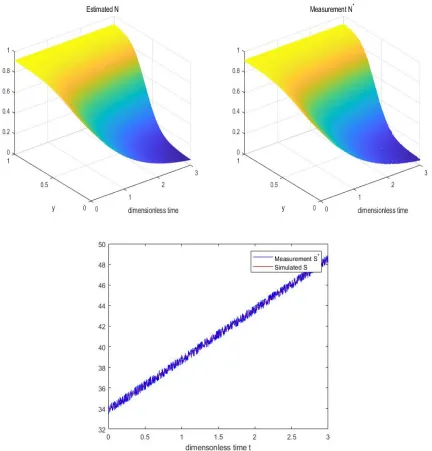
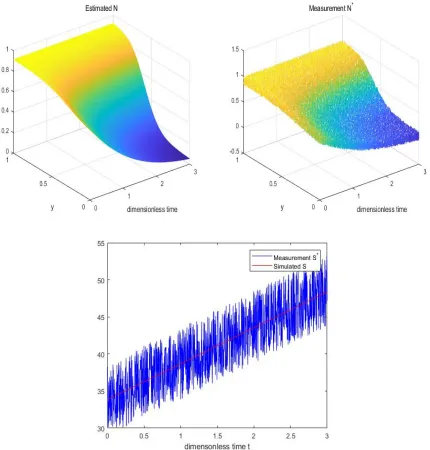
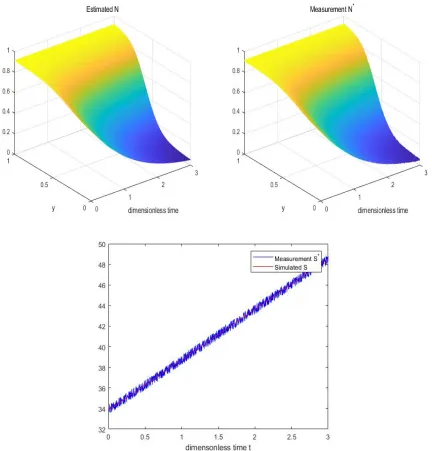
Top left image corresponds to the simulated N (obtained by solving the direct problem by using the
identified values of the parameters). Top right image shows the noisy data fed to the optimization
routine. Bottom row image shows data S∗ (with added noise) and the simulated S. Pattern search
Noise Level Estimated parameters Relative error CPU time 1% (0.0991,0.0491,0.8985) (0.88%,1.67%,0.15%) 2292.28s 5% (0.1028,0.0518,0.9001) (2.80%,3.60%,0.01%) 2370.48s 10% (0.0948,0.04483,0.8939) (5.18%,10.32%,0.67%) 2293.10s Table 5.1: Exact parameters=(0.1,0.05,0.9), grid points=40, time step=0.005
Noise Level Estimated parameters Relative error CPU time
1% (0.1000,0.0500,0.9005) (0.01%,0.18%,0.06%) 8326.84s 5% (0.0957,0.0451,0.8880) (4.22%,9.78%,1.32%) 8014.07s 10% (0.1050,0.0544,0.9053) (5.09%,8.81%,0.59%) 9116.46s Table 5.2: Exact parameters=(0.1,0.05,0.9), grid points=80, time step=0.0025
Tables 5.1 and 5.2 show the summaries of two sets of simulations with varying number of
discretiza-tion points in the mesh (and time steps).Pattern search method is very effective for our problem. As
the tables show that the method is quite robust with respect to relatively high noise level of 10%.
Simulation times are quite reasonable for a derivative-free method, and they stay roughly the same
during the simulations with varying levels of noise.
5.1.2
The Nelder Mead Method
We present the results of some numerical simulations using Nelder-Mead method in this subsection.
In Figures 5.4, 5.5, 5.6 we present results of three simulations with 1%, 5%, and 10% noise levels.
Top left image corresponds to the simulated N (obtained by solving the direct problem by using the
identified values of the parameters). Top right image shows the noisy data fed to the optimization
Noise Level Estimated parameters Relative error CPU time 1% (0.0988,0.0489,0.8987) (1.17%,2.05%,0.14%) 65.12s 5% (0.1062,0.0565,0.9116) (6.21%,13.16%,1.29%) 69.35s 10% (0.1012,0.0505,0.8998) (1.29%,1.05%,0.01%) 46.28s Table 5.3: Exact parameters=(0.1,0.05,0.9), grid points=40, time step=0.005
Noise Level Estimated parameters Relative error CPU time
1% (0.0994,0.0496,0.9000) (0.53%,0.68%,0.01%) 215.53s 5% (0.1004,0.0507,0.9018) (0.46%,1.49%,2.05%) 161.59s 10% (0.1022,0.050,0.8945) (2.27%,0.76%,0.60%) 150.87s Table 5.4: Exact parameters=(0.1,0.05,0.9), grid points=80, time step=0.0025
Tables 5.3 and 5.4 show the summaries of two sets of simulations with varying number of
discretiza-tion points in the mesh (and time steps).The Nelder Mead Method is more effective for our problem.
As the tables show that the method is quite robust with respect to relatively high noise level of 10%.
Simulation times are quite reasonable for a derivative-free method, and they stay roughly the same
during the simulations with varying levels of noise. Comparing with Pattern Search Method, Nelder
Mead Method works better for our problem between two derivative free methods.
5.2
Gradient Method
In this section, we apply Conjugated gradient trust region method and Gradient projection method to
get the solution of the inverse problem of the tumor growth model including the estimated N,Sand
estimated parameters(Cc,Cd,σ).
5.2.1
Conjugated Gradient Trust Region Method
We present the results of some numerical simulations using Conjugated Gradient Trust Region Method
lem by using the identified values of the parameters). Top right image shows the noisy data fed to the
[image:52.612.90.519.115.569.2]optimization routine. Bottom row image shows dataS∗(with added noise) and the simulatedS.
Noise Level Estimated parameters Relative error CPU time 1% (0.1001,0.0502,0.9004) (0.15%,0.46%,0.04%) 380.00s 5% (0.0984,0.0487,0.8978) (1.55%,2.48%,0.24%) 297.68s 10% (0.1120,0.0626,0.9220) (12.07%,25.23%,2.45%) 334.48s Table 5.5: Exact parameters=(0.1,0.05,0.9),grid points=40,time step=0.005
Noise Level Estimated parameters Relative error CPU time
1% (0.1000,0.0501,0.9007) (0.01%,0.37%,0.08%) 543.00s 5% (0.0965,0.0468,0.8947) (3.48%,6.24%,0.58%) 1214.29s 10% (0.0958,0.0427,0.8801) (4.11%,14.53%,2.20%) 1404.43s Table 5.6: Exact parameters=(0.1,0.05,0.9),grid points=80,time step=0.025
Tables 5.5 and 5.6 show the summaries of two sets of simulations with varying number of
discretiza-tion points in the mesh (and time steps). Conjugated Gradient Trust Region Method works well for
our problem. As the tables show that the method is quite robust with respect to relatively high noise
level of 10%. With the increase of grid points and time step, the relative error becomes smaller.
Sim-ulation times are quite reasonable for a derivative-free method, and they stay roughly the same during
the simulations with varying levels of noise.
5.2.2
Gradient Projection Method
We present the results of some numerical simulations using Gradient Projection Method in this
sub-section. In Figures 5.10, 5.11, 5.12 we present results of three simulations with 1%, 5%, and 10%
noise levels. Top left image corresponds to the simulated N (obtained by solving the direct problem
by using the identified values of the parameters). Top right image shows the noisy data fed to the
Noise Level Estimated parameters Relative error CPU time 1% (0.0999,0.0499,0.8992) (0.07%,0.04%,0.08%) 4665.83s 5% (0.0966,0.0472,0.8976) (3.32%,5.45%,0.25%) 4587.15s 10% (0.0902,0.0437,0.8974) (9.74%,12.45%,0.27%) 4849.53s Table 5.7: Exact parameters=(0.1,0.05,0.9), grid points=40, time step=0.005
Noise Level Estimated parameters Relative error CPU time
1% (0.0997,0.0498,0.8994) (0.22%,0.25%,0.05%) 17498.93s 5% (0.0987,0.0492,0.8995) (1.25%,1.50%,0.05%) 19968.62s 10% (0.1013,0.0516,0.9021) (1.39%,3.35%,0.24%) 17813.50s Table 5.8: Exact parameters=(0.1,0.05,0.9), grid points=80, time step=0.025
Tables 5.7 and 5.8 show the summaries of two sets of simulations with varying number of
discretiza-tion points in the mesh (and time steps).Gradient Projecdiscretiza-tion Method is not very efficient for our
problem. As the tables show that the method is quite robust with respect to relatively high noise level
of 10%. With the increase of grid points and time step, the relative error becomes smaller.
Simula-tion times are quite reasonable for a derivative-free method, and they stay roughly the same during the
simulations with varying levels of noise. Comparing with Conjugated Gradient Trust Region Method,
5.3
Analysis
In this section, we compare the results for each method and discuss the benefits and potential problems
of each method as well as initial guess selection.
Firstly, let us discuss about the efficiency of those four optimization methods on our tumor growth
model by comparing CPU use time of each method. Without any doubt, the Nelder-mead method is
the most efficient among those four methods while conjugated gradient trust region method also does
well in efficiency. However, pattern search method and Gradient projection method spend over over
ten times time on getting the estimated data. In addition, it is obvious that each method spends more
time on getting the results with the increase of time steps and grid points.
Secondly we need to compare the accuracy of each method. For accuracy, the Gradient projection
method works the best and the relative error of each parameters required by Gradient projection
method is below 0.1% when the noise level is 1%. For the three parameters in our model, the estimated
cd has the highest relative error among these three parameters. We think that the reason for the case
should be that the exact value of cd is much smaller than the other two parameters. In addition, the
relative errors between exact parameters and estimated parameters is smaller with the increase of time
steps and grid points.
Thirdly, we will discuss the initial guess selection of each method. For initial guess selection, gradient
free methods works better because the initial guess selection in gradient free methods is more free
while we need to choose the initial guess much more close to the exact solution when we apply
gradient methods to our model. The reason for this case should be that the calculation of the gradient
is more demanding for the data when the computer applies optimization method to the objective
Chapter 6
Tumor growth model with an uncertain
parameter
The parametercd which is the (non-dimensionalized) half saturation concentration in the model
de-pends on temperature and PH levels of the environment. Therefore, we consider a model where cd
is a random parameter whose distribution is known beforehand. For example,cd could be uniformly
distributed, i.e.
ξ =cd∼U(c0−q,c0+q)
or follows a normal distribution
ξ ∼N (c0,σξ2)
where the mean value is fixed at c0 in both cases. We can write the model equation system in the
direct problem in an operator form
F(U,P,ξ) =0 (6.1)
whereU= [N,C,V,S]is the vector of state variables andP= [cc,σ]is a vector of control variables
6.1
Inverse problem with an uncertain parameter
Since the model involves a random parameter, we modify the objective function accordingly. The
expectation of the objective functionJ(U,P)in is given by
ˆ J(P) =
Z
J(U,P)p(ξ)dξ (6.2)
where p(ξ)is the probability density function ofξ. The inverse problem is to find parameter ˆPsuch
that
ˆ
J(Pˆ) =min ˆJ(P).
6.2
Numerical solution of the problem
Numerical solution procedure will now be obtained with one additional step: evaluation of the
objec-tive function values will now involve use of a Monte Carlo method. An approximation of the integral
(6.2) using Monte Carlo method is given by
ˆ
J(P)≈ 1 M
M
∑
i=1
ˆ
J(U(ξi),P) (6.3)
where {ξi}Mi=1 is the sequence of samples ofξ. The algorithm for the solution of the optimization
problem is as follows: LetP0be an initial guess of the parameters[cc,σ].
Step 1. Solve the direct problem (6.1) to obtain the state vectorUn.
Step 2. Evaluate the objective function ˆJn=Jˆ(Un,P) (and its gradient) by using finite difference
ap-proximations and Monte Carlo method.
Step 3. Perform the optimization step (use either derivative free or gradient based methods) and get
6.2.1
Results of the numerical experiments using derivative free methods
We test the method by using uniformly and normally distributed random parameterξ in our numerical
experiments by Pattern search method and the Nelder Mead method. For the uniform distribution case,
we take the mean value ofξ (orcd) to be 0.05 andξ ∼U(0.03,0.07). For our next experiment, we
takeξ ∼N (0.05,σ2
ξ) with several different values of the variance σξ in order to observe how the
distribution of theξ affects the identification of the parameters.
Pattern Search Method
We present the results of some numerical simulations for normal distribution and uniform distribution
using pattern search method in this subsection. In Figures 6.1, 6.2, 6.3 we present results of three
simulations with 1%, 5%, and 10% noise levels for normal distribution. In Figures 6.4, 6.5, 6.6
we present results of three simulations with 1%, 5%, and 10% noise levels for uniform distribution.
Top left image corresponds to the simulated N (obtained by solving the direct problem by using the
identified values of the parameters). Top right image shows the noisy data fed to the optimization
routine. Bottom row image shows data S∗ (with added noise) and the simulated S. Pattern search
Noise Level Estimated parameters Relative error CPU time
1% (0.0985,0.9052) (1.46%,0.58%) 8741.59s
5% (0.1610,0.9687) (61.01%,7.63%) 8601.85s
10% (0.0857,0.8789) (14.21%,2.34%) 12788.01s
Table 6.1: Exact parameters=(0.1,0.9), Grid points=40, Time step=0.005, Normal distribution
Noise Level Estimated parameters Relative error CPU time
1% (0.0974,0.8632) (2.50%,4.07%) 30354.50s
5% (0.0975,0.8642) (2.48%,3.97%) 37300.50s
10% (0.0956,0.8615) (4.33%,4.27%) 39793.29s
Table 6.2: Exact parameters=(0.1,0.9), Grid points=80, Time step=0.0025, Normal distribution
Tables 6.1 and 6.2 show the summaries of two sets of simulations with varying number of
discretiza-tion points in the mesh (and time steps).Pattern search method is very effective for the normal
distri-bution. As the tables show that the method is quite robust with respect to relatively high noise level
of 10%. Simulation times are quite reasonable for a derivative-free method, and they stay roughly the
same during the simulations with varying levels of noise. By the results of our numerical experiments,
we can find that the accuracy of estimatedcc is not stable with the change of noise level. The reason
for the case should also result from the small value of exact cc. We can also find that the estimated
values ofNandSare close to the measurement values ofNandS. It means that Pattern search method
Noise Level Estimated parameters Relative error CPU time
1% (0.1131,0.9062) (13.12%,0.69%) 7840.67s
5% (0.0975,0.8828) (2.50%,1.90%) 8313.04s
10% (0.1131,0.9218) (13.12%,2.43%) 7086.78s
Table 6.3: Exact parameters=(0.1,0.9), Grid points=40, Time step=0.005, Uniform distribution
Noise Level Estimated parameters Relative error CPU time
1% (0.1209,0.9221) (20.93%,2.45%) 30995.20s
5% (0.1109,0.9243) (10.93%,2.48%) 32836.14s
10% (0.0936,0.8945) (6.37%,0.60%) 43990.42s
Table 6.4: Exact parameters=(0.1,0.9), Grid points=80, Time step=0.0025, Uniform distribution
Tables 6.3 and 6.4 show the summaries of two sets of simulations with varying number of
discretiza-tion points in the mesh (and time steps).Pattern search method is also very effective for the
uni-form distribution. As the tables show that the method is quite robust with respect to relatively high
noise level of 10%. Simulation times are quite reasonable for a derivative-free method, and they stay
roughly the same during the simulations with varying levels of noise. However comparing with the
results for the normal distribution, the accuracy for normal distribution is better than the accuracy for
uniform distribution.
The Nelder Mead Method
We present the results of some numerical simulations for normal distribution and uniform distribution
using the Nelder Mead method in this subsection. In Figures 6.7, 6.8, 6.9 we present results of three
simulations with 1%, 5%, and 10% noise levels for normal distribution. In Figures 6.10, 6.11, 6.12
we present results of three simulations with 1%, 5%, and 10% noise levels for uniform distribution.
Top left image corresponds to the simulated N (obtained by solving the direct problem by using the
identified values of the parameters). Top right image shows the noisy data fed to the optimization
Noise Level Estimated parameters Relative error CPU time
1% (0.1040,0.9531) (4.00%,5.90%) 20257.15s
5% (0.1011,0.9485) (1.11%,5.40%) 20231.10s
10% (0.1265,0.9647) (26.54%,7.19%) 19630.46s
Table 6.5: Exact parameters=(0.1,0.9), Grid points=40, Time step=0.005, Normal distribution
Noise Level Estimated parameters Relative error CPU time
1% (0.0969,0.9510) (3.04%,5.67%) 74117.46s
5% (0.1280,0.9684) (28.08%,7.60%) 70582.00s
10% (0.1027,0.9452) (2.71%,5.02%) 90744.48s
Table 6.6: Exact parameters=(0.1,0.9), Grid points=80, Time step=0.0025, Normal distribution
Tables 6.5 and 6.6 show the summaries of two sets of simulations with varying number of
discretiza-tion points in the mesh (and time steps).The Nelder Mead Method is very effective for the normal
dis-tribution. As the tables show that the method is quite robust with respect to relatively high noise level
of 10%. Simulation times are quite reasonable for a derivative-free method, and they stay roughly the
same during the simulations with varying levels of noise. By the results of our numerical experiments,
we can find that the accuracy of estimatedcc is also not stable with the change of noise level by the
Nelder Mead Method. The reason for the case should also result from the small value of exactcc. We
Noise Level Estimated parameters Relative error CPU time
1% (0.1024,0.8924) (2.41%,0.84%) 19580.59s
5% (0.1060,0.9056) (6.05%,0.63%) 19283.51s
10% (0.1039,0.8921) (3.99%,0.88%) 19481.40s
Table 6.7: Exact parameters=(0.1,0.9), Grid points=40, Time step=0.005, Uniform distribution
Noise Level Estimated parameters Relative error CPU time
1% (0.1015,0.8856) (1.56%,1.60%) 76235.00s
5% (0.1047,0.9029) (4.74%,0.32%) 73875.62s
10% (0.1038,0.8922) (3.83%,0.87%) 74158.00s
Table 6.8: Exact parameters=(0.1,0.9), Grid points=80, Time step=0.0025, Uniform distribution
Tables 6.7 and 6.8 show the summaries of two sets of simulations with varying number of
discretiza-tion points in the mesh (and time steps).The Nelder Mead Method is also very effective for the
uni-form distribution. As the tables show that the method is quite robust with respect to relatively high
noise level of 10%. Simulation times are quite reasonable for a derivative-free method, and they stay
roughly the same during the simulations with varying levels of noise. However comparing with the
results for the normal distribution, the accuracy for normal distribution is worse than the accuracy for
uniform distribution.
6.3
Analysis and Future Work
By the experimental results, we can find that derivative-free methods are very effective for the tumor
growth model with random parameters. By comparing CPU time of Pattern search method and the
Nelder Mead Method, these two derivative-free methods are similar in efficiency. For accuracy, the
Nelder Mead Method works better for the uniform distribution while Pattern search method works
better for the normal distribution. Although the results by these two methods have a certain error, the
errors are acceptable. For the initial guess, both of two derivative-free methods need an initial guess
growth model with random parameters. In the future, we can also apply more derivative methods such
as Gradient projection method and Conjugated gradient trust region method to the model. In addition,

![Figure 2.2: Evolution of the tumor radius Sτ vs. dimensionless time t. where we used time step = 0.0005 and α = 50 grid points on [0,1].](https://thumb-us.123doks.com/thumbv2/123dok_us/33253.2623/18.612.160.435.373.575/figure-evolution-tumor-radius-st-dimensionless-time-points.webp)
![Figure 2.4: Evolution of concentration C0 vs. dimensionless radius s. where we used time step τ =.0005 and α = 50 grid points on [0,1].](https://thumb-us.123doks.com/thumbv2/123dok_us/33253.2623/19.612.164.435.72.273/figure-evolution-concentration-dimensionless-radius-used-time-points.webp)
![Figure 2.6: Evolution of the tumor radius Sτ vs. dimensionless time t. where we used time step = 0.0005 and α = 100 grid points on [0,1].](https://thumb-us.123doks.com/thumbv2/123dok_us/33253.2623/20.612.165.435.71.271/figure-evolution-tumor-radius-st-dimensionless-time-points.webp)
![Figure 2.8: Evolution of concentration C0 vs. dimensionless radius s. where we used time step τ =.0005 and α = 100 grid points on [0,1].](https://thumb-us.123doks.com/thumbv2/123dok_us/33253.2623/21.612.164.434.72.273/figure-evolution-concentration-dimensionless-radius-used-time-points.webp)
![Figure 2.9: Evolution of velocity V vs. dimensionless radius s. where we used time step τ = 0.0005and α = 100 grid points on [0,1].](https://thumb-us.123doks.com/thumbv2/123dok_us/33253.2623/22.612.164.434.70.272/figure-evolution-velocity-dimensionless-radius-step-grid-points.webp)