The revised GNVQ
Assessing
Published by FEDA
Feedback should be sent to FEDA publications, Citadel Place, Tinwor th Street, London SE11 5EH
Tel: 0207 840 5302/4 Fax: 0207 840 5401 e-mail: [email protected]
Registered with the Charity Commissioners
Editor: Jenny Rhys Proofreader: Jeremy Pinel Designer: Kevin Ashill
ISBN 1 85338 525 5
© 2000 FEDA
You are welcome to copy this document for internal use within your organisation. Other wise, no par t of this publication may be reproduced, stored in a retrieval system, or transmitted in any form or by any means; electronic, electrical, chemical, optical, photocopying, recording or other wise, without prior written permission of the copyright owner.
Contents
Foreword 1
Introduction 2
Step 1: Develop assignment(s) 4 Step 2: Provide a teaching/learning 5 programme
Step 3: Issue assignment(s) and 6 brief students
Step 4: Provide continuing guidance 7 and support
Step 5: Collect completed assignment 7 work
Step 6: Assess the work against 8 the criteria
Step 7: Take part in internal verification 9 Step 8: Return work and provide 10 feedback
Step 9: Record the grading decision 10 Step 10: Decide the overall grade 11
Foreword
The revised GNVQ is being introduced into schools and colleges from September 2000. It will introduce changes that were
recommended by the Capey review of GNVQ assessment and also by Sir Ron Dearing’s review of qualifications for all 16–19-year-olds. The changes are designed to achieve two major objectives. First, to ensure that all GNVQs are easier to implement in schools and colleges. Second, to ensure that the assessment of GNVQs is rigorous and consistent.
This pack is par t of the suppor t provided through FEDA’s GNVQ Suppor t Programme. It is one of five packs designed to help tutors and managers implement revised GNVQ courses:
● Managing the revised GNVQ
● Recruitment, induction and progression
● Teaching, learning and assignment writing
● Assessing the revised GNVQ
Introduction
Assessing the revised GNVQ is the same in principle as any other form of assessment so you can draw on your existing experience of other awards. However, there are impor tant distinctive characteristics of the GNVQ that you need to take into account , which this pack is designed to address.
There are two basic types of vocational unit in the revised GNVQ. The first is the por tfolio (internally) assessed unit, which is usually assessed by the tutor for that unit. Assessment is of a range of evidence for each unit, provided by the candidate and based on the requirements laid down in the specifications. Two-thirds of the units in a typical GNVQ are this type, e.g. four units of a six-unit Foundation or Intermediate GNVQ, or eight units of a 12-unit Advanced GNVQ.
The second type of unit is independently assessed by examiners appointed from outside the centre by the awarding body. Candidates complete preset assignments or other activities, which are then sent to external examiners for assessment.
This pack only deals with the portfolio assessed units.
●
Aims and objectives
The two main aims of this pack are to help you to:
● assess por tfolio assessed GNVQ units to the national standards defined In the unit specifications
● maximise the achievement of your students.
The objectives of the pack are to enable you to:
● outline the key steps to assess a GNVQ por tfolio assessed unit
● recognise the distinctive characteristics and requirements of GNVQ assessment at each stage
● identify good practice principles for each stage
● apply these principles to your own assessment practices.
Structure
The pack is based on a flow char t (Table 1) of the assessment process, which identifies 10 key steps to assessing a GNVQ por tfolio unit. Each step is discussed in more detail in the main body of the pack. These assessment stages are not fundamentally different from other forms of continuous assessment,so you can use any experience you may already have. For example, you can draw on experience gained through current-model GNVQs,
GCSEs, modular A-levels etc.
One of the reasons for revising GNVQs was to make the assessment process more straightfor ward and this has largely been achieved. All assessment is a skilled, professional process requiring skills and practice, but the revised GNVQ provides substantial guidance and clear criteria to help you make your decisions.
Table 1 – Ten steps to assessing revised GNVQs
Step 1
Develop assignment(s)
Step 2
Provide a teaching/learning programme
Step 3
Issue assignment(s) and brief students
Step 4
Provide continuing guidance and suppor t
Step 5
Collect completed assignment work
Step 6
Assess the work against the criteria
Step 7
Take par t in internal verification
Step 8
Return work and provide feedback
Step 9
Record the grading decision
Step 10
Step 1 – Develop
assignment(s)
Your assignments should facilitate the process of gathering evidence and ensure that the quality of evidence supplied by the student is good. In principle the students only have to fulfil the ‘assessment evidence’ requirements, so they can, if they choose, simply work directly from those requirements. However, you will need to prepare assignments and tasks which cover the assessment requirements in order to motivate students and help them to produce the
necessar y evidence.
Assignments need to be carefully planned in order to ensure that the tasks cover the assignment requirements and allow the more able students to achieve higher grades (see Teaching, learning and assignment writing). The fundamental principles of assessment on which GNVQs are based are essentially the same as those for other forms of assessment, so the evidence submitted should be authentic, sufficient and valid.
The key sections in the unit specifications that define the evidence required are:
● ‘assessment evidence’, which sets out the work that has to be submitted to fulfil the requirements for a pass, merit or distinction
● ‘assessment strategies’ – the section of ‘Teacher guidance’ that offers advice on how the evidence can be gathered and what form it should take.
You need to be familiar with these sections to suppor t and assess your students effectively. The content and layout of the unit specifications are explained in detail in Section 1 of Teaching, learning and assignment writing, so you should read that first.
Ensure that the assignment will
result in sufficient evidence
Making sure that students produce sufficient evidence is a key aspect of any assessment process. You do not want to burden your students with unnecessar y work but you need enough evidence to be sure that they have reached the required standard. The revised specifications give detailed guidance as to exactly what evidence the students must submit, so this should substantially reduce anyuncer tainty in this area. However, there are cer tain principles you need to be aware of.
● To achieve a pass (grade E at Advanced level) for a unit a student’s work must cover all the requirements specified in the banner at the top of the assessment and grading grid of each unit. To achieve a higher grade the student must still fulfil the criteria for the lower grades as well as the additional criteria.
● A range of points is available within each grade, in order to allow for differentiation and to reward students for work at the higher end of each grade.
● The only evidence that the student has to supply is that defined in the ‘assessment evidence’ section. The student does not have to provide evidence for ever ything described in the ‘What you need to learn’ section. This must be covered in the teaching programme. The assessment evidence requirement will allow the student to show that she/he has grasped and can apply the requisite knowledge, skill and understanding.
Ten steps to assessing
Ensure that the assignment will
result in valid evidence
The central characteristic of GNVQs is that they require the acquisition and application of knowledge, skills and understanding in and to a broad vocational context. However, remember that GNVQs are not designed to develop and assess occupational competence. The assessment grid in the specifications defines the evidence requirements and is presented in a way which gives you the oppor tunity to design assisnments which take account of local organisations and a wide range of types of evidence.
Ensure that the assignment
provides equal opportunities
and open access
GNVQs lay stress on equal oppor tunities and open access, and you should carefully consider any special needs your students may have. If necessar y, you should customise assignments for par ticular students.
More than one assignment may be
developed to cover the evidence requirements and grading criterion. In par ticular, foundation and intermediate students may find a large assignment over-challenging. For them a series of tasks may be more appropriate.
●
●Also see – Teaching, learning and assignment writing
Step 2: Provide a
teaching/learning
programme
You should prepare and deliver a teaching and learning programme to enable the students to achieve the requirements of the ‘What you need to learn’ section in the unit specifications.
You help your students to fulfil the
assessment requirements by providing teaching and learning oppor tunities that will prepare them for the tasks in the assignment(s), and by
developing their independent learning skills.
●
Step 3: Issue
assignment(s) and
brief students
When issuing assignments you should:
● explain the need to meet the evidence requirements in full
● make sure that the students know the meaning of all technical terms used in the assignment and the ‘assessment evidence’ grid
● outline each task and discuss how to approach it, possible sources of information etc. However, the work must be the students’ own, so you need to think carefully about what you can tell the students about the evidence required and what suppor t can be given.
● outline and discuss the timing and nature of any preplanned activities specifically designed to gather information for tasks
● describe any resources you are providing to help them with the assignment – videos, CD-ROMs, hand-outs, textbook references etc.
● explain the kind of evidence you expect from each task and how you intend to assess it – what form it should take, whether it needs to be wordprocessed etc.
● advise the students how to present the assignment to you in an accessible form
● set a target date for completion of the assignment and interim dates for review
● give an opportunity for questions from the group as a whole and from individual students.
Step 4: Provide
continuing
guidance and
support
Providing continuing guidance and suppor t to the students enables them to complete the assessment requirement.
This can be done through regular meetings with them to discuss their plans and progress. You can formalise this procedure by developing and reviewing a personal learning plan with them, which can significantly reduce the assessment workload by reducing the need for referrals. However, remember that students often need to show independence for higher grades.
Some information is ver y difficult to obtain from public sources and you may want to help your students by organising group activities to access it.
GNVQ units require the students to find out much information for themselves. You can help them by developing their research skills, through providing help with librar y, Internet and resource centre access, etc.
Step 5: Collect
completed
assignment work
You should collect completed assignment work from students on the set target date.
Step 6: Assess
the work against
the criteria
The work should be assessed against the criteria listed in the ‘assessment evidence’ grid. At Foundation or Intermediate level you are deciding whether to refer the work or to award a Pass, Merit or Distinction. At Advanced level you are deciding whether to refer or to award an A, B, C, D or E grade. In addition, a range of points are available for each grade and guidance will be provided on how these can be allocated.
As for any other award, your decisions should be impar tial, accurate and reliable and you need to be sure that the work is authentic, sufficient and valid. Key questions to ask when assessing an assignment are:
Is this the student’s own work?
The unit specifications for the internallyassessed units do not require the evidence to be generated under the super vision of the
assessor. Therefore, you usually have to rely on evidence collected over a long time and from a variety of locations and sources. Fur thermore, some units specify that par t of the evidence is generated through team activities, but each separate student must still satisfy the evidence requirements.
Does this work meet the
criteria in the ‘assessment
evidence’ grid?
Work which does not meet the specified evidence requirements should be referred.
Review the assessment strategies section from ‘Essential information for teachers’ for the unit. This gives additional guidance on the general qualities that distinguish between grades, and on the interpretation of the criteria for each grade. These enable you to make a holistic professional judgement of the quality of the student’s work.
●
Step 7: Take part
in internal
verification
Taking par t in the internal verification procedures is a crucial par t of your role as an assessor. Internal verification helps to establish common assessment standards within your centre and also to ensure that national standards are maintained.
The two main internal verification activities carried out by all assessors are:
● supplying samples of work requested by your designated internal verifier
● par ticipating in internal standardisation activities.
Your internal verifier will usually ask you to supply a sample of assessed work each time you collect an assignment. He or she should then check and confirm your assessment judgements for that sample. You should wait for feedback from the internal verifier before returning the work to your students.
In addition to the sampling process you will usually have to take par t in standardisation exercises in which a group of staff will
individually assess samples of students’ work and compare their judgements. Comparing and discussing the differences is an invaluable means of achieving a common understanding and standard of assessment. This process is fur ther helped where standardised materials are available, and the Qualifications and Curriculum Authority (QCA) is currently developing such materials for each vocational area for use in centres.
External ‘standards moderation’ procedures are the responsibility of the awarding bodies in conjunction with QCA and you will have to comply with these. The procedures will ensure that assessments across centres are consistent.
●
Step 8: Return
work and provide
feedback
Assessed work should be returned as soon as possible together with feedback to the student about per formance. It is good practice to set target dates for returning work to students. Feedback should:
● be directly related to the assessment criteria
● be given in written and, where appropriate or asked for, oral form
● outline the basis for the assessment decision
● include comments on strengths as well as weaknesses
● suggest how the student could improve his/her per formance
● (for referrals) state clearly what needs to be done to complete the assignment and indicate the target resubmission date.
It is good practice to record when oral feedback is given and to annotate student work to indicate that it has been assessed and where the criteria for grading have been met.
●
●Also see – Key skills
Step 9: Record the
grading decision
Step 10: Decide
the overall grade
The grade for the qualifications is determined by the cumulative points for each por tfolio and externally assessed unit.
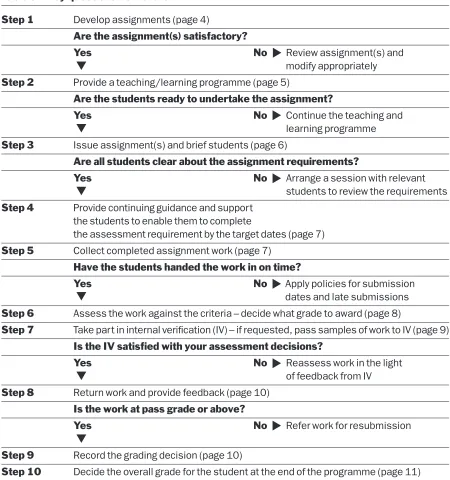
Table 3 – Key questions flow chart
Step 1 Develop assignments (page 4)
Are the assignment(s) satisfactory?
Yes No Review assignment(s) and
modify appropriately
Step 2 Provide a teaching/learning programme (page 5)
Are the students ready to undertake the assignment?
Yes No Continue the teaching and
learning programme
Step 3 Issue assignment(s) and brief students (page 6)
Are all students clear about the assignment requirements?
Yes No Arrange a session with relevant
students to review the requirements
Step 4 Provide continuing guidance and support the students to enable them to complete
the assessment requirement by the target dates (page 7)
Step 5 Collect completed assignment work (page 7)
Have the students handed the work in on time?
Yes No Apply policies for submission
dates and late submissions
Step 6 Assess the work against the criteria – decide what grade to award (page 8)
Step 7 Take part in internal verification (IV) – if requested, pass samples of work to IV (page 9)
Is the IV satisfied with your assessment decisions?
Yes No Reassess work in the light
of feedback from IV
Step 8 Return work and provide feedback (page 10)
Is the work at pass grade or above?
Yes No Refer work for resubmission
Step 9 Record the grading decision (page 10)
Step 10 Decide the overall grade for the student at the end of the programme (page 11)
▼
▼
▼
▼
▼
▼
▼
▼
▼
▼