A new level
RE
The authors
Reform
Reform is an independent, non-party think tank whose mission is to set out a better way to deliver public services and economic prosperity.
We believe that by reforming the public sector, increasing investment and extending choice, high quality services can be made available for everyone.
Dale Bassett
Thomas Cawston
Laurie Thraves
Elizabeth Truss
Contents
Executive summary 5
1 The A-level: an education in demand 6
2 A hollow preparation 9
3 An ersatz education 18
4 Utility, parity, equity 22
5 A new level: renewing the A-level 27
References 29
Executive summary
The rise of the ersatz A-level has stymied independent study and original thought. After successfully becoming a mass market qualification in the 1980s and 1990s, A-levels underwent radical surgery in 2000 that damaged their intellectual integrity. Modularisation and mechanised marking were introduced despite the objections of universities. These changes have not widened participation – instead they have created a generation of “high maintenance students” who struggle to think for themselves. The A-level should be renewed and expanded by putting universities back in charge, and must be offered at all schools – otherwise the most deprived students will be denied an academic route out of poverty.
Intellectual integrity is not the privilege of an exclusive elite. It is the foundation of a good education. Universities, employers and students all crave the independence of mind developed through in-depth study of a coherent academic discipline, demonstrated by the fact that 46 per cent of 16 year olds now study A-levels compared to 33 per cent doing other qualifications.. The A-level is primarily a university entrance exam – 76 per cent of students who do it go on to university. Yet universities are almost entirely marginalised in the process of setting and validating A-levels.
Reform’s study by academics into English, Mathematics, History and Chemistry shows a hollowing of A-levels, particularly since 2000. “Like sat-nav rather than a map” (Mathematics) or “using somebody else’s mind” (English), A-levels do not encourage students to think or show flair. Students are heavily directed in answering questions with rigid marking schemes and “assessment objectives” making it clear exactly what is expected of students.
Interviews with admissions tutors reveal a generation of students who struggle to study independently and think for themselves. The idea that only “elite” universities are suffering is a myth. Reform’s research into some lower-ranking institutions indicates that their students too are capable of more, but are arriving at university less and less well-prepared.
The key change was the wholesale introduction of modular exams in 2000 which saw the quantity and cost of exams doubling. Modularisation has particularly affected linear subjects like Mathematics that need to build on previous experience. Resits have created a group of students who always seek a “second chance”. Mechanised marking has prevented examiners from rewarding clear flows of argument, originality and flair.
Intellectual integrity was traded off against a central drive for wider participation. This has failed. Increases in participation have flagged since the major changes to A-level in 2000, following acceleration in the 1980s and 1990s. If anything the gap between schools in the state and private sectors is widening as the best schools increasingly turn to respected, rigorous qualifications such as the International Baccalaureate and Cambridge Pre-U. Meanwhile the majority of state schools are stuck with a hollower A-level.
The A-level: an education in demand
“Intellectual integrity is not the privilege of an exclusive elite. It is the foundation of a good education.” Professor Francis O’Gorman, Head of English, University of Leeds
A good academic education forms the basis of the most successful elements of Britain’s economy. For the past twenty years the A-level’s popularity has grown in line with an increased global demand for academic skills. It is the most popular choice for school leavers and the main route to university. Surveys consistently show that the vast majority of the public recognise that the A-level is an important qualification to achieve.1
Employers and universities value the preparation for independent study and the ability to think and engage with a subject at a deep level.
Academic excellence is highly prized
Economic developments are fuelling an ever increasing need for academic ability.2 There is demand for a
more educated society and a higher level of personal capability.3 The Leitch Review of Skills projected a 50
per cent increase in the share of highly skilled occupations, such as managers and professionals, and a decrease in low skilled occupations, by 2020.4 The real value of academic excellence is shown by the
Government’s immigration points system, which places a very high value on master’s degrees, PhDs and other academic qualifications above their vocational rivals.5
Employers want the ability to think
In the modern economy employers need school leavers to have developed the ability to think and reason beyond basic literacy and numeracy. Businesses are placing greater emphasis on capabilities of the mind onto which they can add specialist training.6 Professions such as nursing also require the adaptive, critical
and problem-solving skills that academic training can deliver. Vocational skills can be developed on the job; it is the academic grounding that needs to be in place.
Despite the impact of the recession on graduate recruitment, modern economies will have to continue to expand participation in higher education.7 Britain will need more graduates, not fewer; the earnings
premium for graduates has held up despite increasing numbers.8 The academic route remains by far the
most successful path for school leavers to follow. The returns are considerable: a graduate earns £408,000 more over a lifetime than someone with no skills.9
Increased interest in participation from students
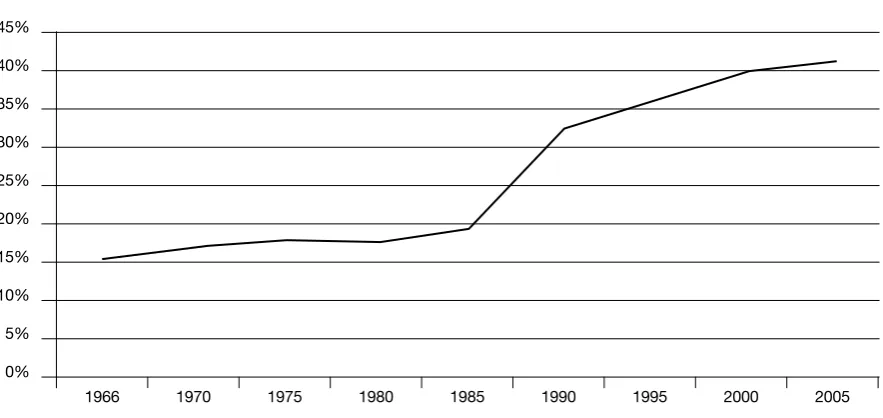
The A-level has become the accepted path for most school leavers. At 16, 46 per cent choose A-levels whereas 33 per cent choose other qualifications.10 Now around 40 per cent of school leavers sit an A-level
examination, double the proportion of the mid-1980s.11 More students recognise the advantage of
further academic education and the chance to focus on a specialist discipline post-16. Students value the A-level as an opportunity to study independently and to become immersed in their chosen subjects. It is right that in the modern mobile economy a substantial number are following an academic route and studying A-levels.
1 For example, Ipsos MORI (2009), Perceptions of A Levels and GCSEs.
2 Barro, R. (2001), “Human capital and growth”, The American Economic Review, Vol. 91 No.2. 3 Haldenby, A. et al. (2008), The mobile economy, Reform.
4 Leitch, S. (2006), Prosperity for all in the global economy – world class skills. 5 UK Border Agency (2009), www.ukba.homeoffice.gov.uk.
6 CBI (2007), Shaping up for the future: The business vision for education and skills. 7 Haldenby, A. et al. (2008), The mobile economy, Reform.
Figure 1: Percentage of school leavers taking A-level examinations
Source: HMSO (1966-1995), Statistics of Education; DCSF (2009), Participation in Education,
Training and Employment by 16-18 year olds in England 12
1966 1970 1975 1980 1985 1990 1995 2000 2005
0% 5% 10% 15% 20% 25% 30% 35% 40% 45%
A-levels’ primary function is as preparation for university. In recent years between 74 and 78 per cent of 19 year olds with achievements at A-level entered higher education.13 The proportion of A-level students
progressing to university has risen dramatically in the past 20 years; in 1985 less than 50 per cent of students with A-level passes went on to read degrees.14
Traditionally the sixth form has gradually introduced students to the rigorous academic study that they can expect at university. Students are encouraged to focus on their chosen subject before progressing to read a degree in their chosen discipline. Studying A-levels should serve to develop a student’s capacity for independent learning, critical thinking and gaining an in-depth understanding of a subject.
The value of A-level – immersion in the subject
Academic, subject-specialised study at university demonstrates that the way to develop logical and critical thinking is to study a rigorous subject in depth. A more rigorous A-level based on subject specialisation, independent study and critical and original thinking would ensure that students can successfully progress onto university. Alternatives such as the International Baccalaureate (IB) do not necessarily provide a more effective preparation for university. The broad curriculum and assessment of the IB diploma, comprised of courses chosen from six subject groups, an extended essay, a module in theory of knowledge and participation in creative arts or sports, does not provide an adult style of education.15
For decades academic achievement has driven social mobility. The expansion of school education in the first half of the 20th century drove the development of meritocracy in Britain. With graduates earning 77 per cent more than non-graduates, access to higher education remains critically important for the life chances of young people from deprived backgrounds.16 Socially mobile societies are the ones where
individuals are empowered and encouraged to develop their own capability, gaining the soft skills that will be vital in the future job market.17 The academic route is still the most effective way for young people to
reach a more secure and rewarding place in society.
Emulating the A-level
British governments often fail to acknowledge the value of the A-level. But other countries use the A-level or design their own similar qualifications. In Singapore, for example, the Cambridge International A-level is the state qualification.18 A-levels remain popular across the Commonwealth, while the
A hollow preparation
The political debate about A-levels has focused on worries about whether today’s students are studying comparable content with those of the past. Reform’s research suggests that debates purely about content obscure a wider issue about how – rather than what – exams are encouraging people to be taught. It is certainly true that the content of some subjects – particularly Mathematics – has diminished. However even subjects that retain much of the superficial content (such as English and History) have seen a hollowing out in the extent to which they are understood and explored. Academics across the university sector suggest that the primary problem is the way that A-level questions and answers are encouraging teachers to teach and students to think.
Reform interviewed academics, including heads of department and admissions tutors from a range of universities, to establish how well A-levels prepare students for further study.20 This indicated that the
problems are not, as is generally believed, limited to the elite universities. Instead, the prescriptive and uninspiring nature of some A-levels is letting down universities from Oxford to Greenwich.
The most popular A-levels
[image:11.595.114.562.399.589.2]A total of 256,622 16-18 year olds took A-levels in 2008 – taking 741,351 papers.21
Figure 2: Most popular GCE A-level subjects for students aged 16-18 years old (2007/08)
Source: Department for Children, Schools and Families (2008), GCE/VCE/Applied and Equivalent Examination Results in England 2007/08
Subject Entries Percentage of candidates
English 80,917 32
Mathematics 57,618 23
General Studies 57,086 22
Psychology 49,434 19
Biological Sciences 48,397 19
History 42,107 16
Art and Design 39,623 15
Chemistry 36,328 14
Business Studies 29,887 12
Geography 27,846 11
Taking the thought out
Reform asked a team of academics in four of the top ten A-level subjects – English, History, Chemistry and Mathematics – to analyse A-level exam papers.22 None of these academics are involved in the setting or
marking of A-levels; they have analysed question papers and marking schemes in terms of their ability to prepare students for university. Each analysis is based on the examination papers for the years 1951 to 2008 and the marking schemes and examiners’ reports where available.
frequency of tests is preventing the study of off-syllabus material. Exams allow candidates less scope for using their own mind, thinking through problems and expressing originality. Subject content is questionable or inappropriate in some areas due to a lack of university input. Marking schemes have become more specific to the extent that examiners’ judgement is no longer considered to be necessary or even desirable. However there are noticeable improvements in students’ presentational skills.
English and Mathematics are the most heavily affected
Reform’s study indicated that these changes have had a more dramatic impact in English and Mathematics than in History and Chemistry. This is worrying as English and Mathematics are the two most popular A-levels and form the heart of learning in the arts and sciences. The reasons given below by academics suggest that the higher empirical content in History and Chemistry may render them less affected by a modular course. In English and Mathematics a more holistic view is required by the student who must formulate a critical response or solve a given problem.
English A-level: 1951 to 2008
Professor Francis O’Gorman, Head of English, University of Leeds
The purpose of English A-level for universities
English literature as a university discipline has changed its identity remarkably. A-level papers from 1950 to the present day naturally offer a window onto the broader changes in the discipline’s identity. To comment on these changes is not necessarily to make any value judgement. Exam papers at school level reflect changes as, more obliquely, they help shape the discipline. Written by graduates of the universities, referring to curricula taught by graduates of the same universities, they are the gateway for others wanting to graduate. Changes in the university conception of what English is, take, accordingly, a long time to establish themselves throughout the whole pedagogical and scholarly system.
The shape, not the level, is the problem
But, bearing the larger shifts in the discipline in mind, can anything be said about standards in the 60 years of A-level questions? About the kinds of teaching that exam papers require and, in their own ways, do themselves? Exam questions are never innocent things. The principles and assumptions behind them are suggestive indicators of the principles and assumptions behind an educational system. To be sure, there is much to admire in the 2008 examinations for English literature. There are challenging questions, a variety of approaches to literature and plenty of opportunities for a good student to shine, assuming that they can do so in the terms the marking scheme recognises. The requirement to read more widely and “off the syllabus”, the varieties of assessment, and the wide range of themes and texts are all encouraging. But there are difficulties too. The difficulties primarily concern not the level of analysis that is being required, but the shape of it. English literature is an analytical subject. It asks for argued, reasoned views about challenging forms of imaginative writing. And it asks for people to think about those texts themselves. These are fundamental principles, and they matter at A-level as much as anywhere else.
Less room for manoeuvre
But in the OCR papers for June 2008 – not untypically – candidates do not have the same freedom to use their own minds. Every question on the Poetry and Prose paper offers a structure, for instance, a guide in the form of instructions beginning “In the course of your answer...” There is a template for what is expected from a successful answer. So, for example:
OCR May 2008
Poetry and Prose (Open Text)
3b) Considering in detail one or two poems or passages from longer poems discuss Byron’s exploration of the experience of exile.
In the course of your answer:
• look closely at the effects of imagery, language and verse form in the example(s) you have chosen;
• comment on ways in which your example(s) relate(s) to the methods and concerns of other poems by Byron.
[30]
Candidates are given a general shape, and general steers. What is being assessed is not simply how they handle the question, but how they handle the guide to how to handle the question. Consider, similarly, this question from the Shakespeare paper:
OCR May 2008
Drama: Shakespeare (Closed Text)
Question
1 Read the following passage from Act 2, Scene 1. How does it contribute to your view of Falstaff in Henry IV (Part 2)?
In the course of your answer:
• look closely at the language, imagery and tone of the passage;
• comment on what the passage suggests about particular aspects of Falstaff’s character in the play.
[30]
Restrictions
Earlier examination papers encourage generalising. They were keen on evaluation (an example question from 1970 being: “Do you agree that Shylock disturbs the artistic unity of The Merchant of Venice?”) and they tempted candidates to write in huge generalisations about the so-called universal “human nature”. Contemporary exams still expect evaluations of some kind or other, and invite belief in universals. Although few university English departments would be keen to sign up either to agreed principles of evaluations or of universals, these are perpetual and tricky issues which A-level students should not be expected to solve. But what is new in recent papers is another set of problems about how to argue. Some 2008 examination papers obliged candidates to make arguments that their knowledge could not even begin to support about literary history. If encouraging enormous generalisations is a regrettable feature of examination papers as a genre (at school or university), 2008 English literature A-level questions were peculiarly risky. “By comparing Tender is the Night”, runs a typical question on OCR’s 2008 Comparative and Contextual Study paper, “with at least one other appropriate text, consider how far you agree with the view that 20th century American prose explores a sense of being cut off from the past”. The problem here is the false position the candidate is put in. The question – and there are others that require similar generalisations – is not the more reasonable “how far do you agree that the two texts explore a sense of being cut off...” but how far 20th century American prose does. The idea of being judicious with evidence and rigorous in conclusions can be grasped only with difficulty through questions that invite candidates to be neither.
The foundation of a good education
It is hard to exaggerate the importance of framing questions well. Candidates are taught in their time at school towards success in answering those questions: they shape the nature of their education. The 2008 A-level English literature exam papers cause problems because, in key areas, they create a challenge to intellectual integrity. That matters – and university English departments struggle to undo the damage. Such integrity is not the privilege of an exclusive elite. It is the foundation of a good education. A-level exam questions in English literature need to encourage proper, independent, self-critical argument within the bounds of what is reasonable to expect at the age of 18. When the questions look as if they may be seeking something other than that, it is a matter in which we should all interest ourselves.
Mathematics A-level: 1951 to 2008
R. A. Bailey, Professor of Statistics, Queen Mary, University of London
From roadmap to sat-nav
The most important change in exams over the period 1951-2008 is that sitting a Mathematics A-level paper now is more like using a sat-nav system than reading a map. If you read a map to get from A to B, you remember the route and learn about other things on the way. If you use a sat-nav you do neither of those things. The questions in the 2008 paper are heavily structured in this way and the result is that students will retain very little knowledge and develop very little understanding.
Questions have evolved over the decades. In 1951 there were almost exclusively single questions; by 1970 most questions were split into numbered sub-parts, with part-marks shown. In 1990 this process went a lot further. Each question was very short, so that the candidates had to keep changing topics. Also, the ratio of words to formulae became much smaller. But by this stage not all papers had been balkanised like this and there was little change from 1990 to 2000.
OCR June 2008
Core Mathematics 3
7. It is claimed that the number of plants of a certain species in a particular locality is doubling every 9 years. The number of plants now is 42. The number of plants is treated as a continuous variable and is denoted by N. The number of years from now is denoted by t.
i) Two equivalent expressions giving N in terms of t are N = A x 2kt and N = Aemt.
Determine the value of each of the constants A, k and m. [4]
ii) Find the value of t for which N = 100, giving your answer correct to 3 significant figures. [2] iii) Find the rate at which the number of plants will be increasing at a time 35 years from now. [3]
Mechanics 1 is less boring but still an ordered list of small tasks. Question 5, below, does not make physical sense. It is possible that the wagons become glued together, giving rise to the scenario in part (i). Otherwise, you need to know about elasticity to calculate the velocities after the collision. Saying “let them be equal and opposite” is not good physics, and it is not possible for all values of the two masses and two initial velocities. Part (ii) is just giving students a bogus equation to solve, just for the sake of solving an equation. Probability and Statistics 1, however, is a good exam.
OCR June 2008
Mechanics 1
5. A railway wagon A of mass 400 kg and moving with speed 5 m s-1 collides with railway wagon B which has mass 3600 kg and is moving towards A with speed 3 m s-1. Immediately after the collision the speeds of A and B are equal. i) Given that the two wagons are moving in the same direction after the collision, find their common speed.
State which wagon has changed its direction of motion. [5]
ii) Given instead that A and B are moving with equal speeds in opposite directions after the collision, calculate a) the speed of the wagons,
b) the change in the momentum of A as a result of the collision. [5]
Compartmentalised not holistic
Another important change is that now there is a wide choice of topics to study for A-level Mathematics. Given that Mathematics is a cumulative subject, with each topic depending on several previous steps, any topic that is studied by some A-level students, but not all, must be re-taught to all of them in their first year at university. The amount of choice in this selection of modules presents a headache for universities. Any topic which is not a compulsory part of A-level has to be taught to all first-year undergraduates, because later topics depend on them.
Considering the content in the syllabuses from 1952, 1960, 1980, 1990 and 2000, the obvious changes are the removal of geometry, both practical and theoretical, and the gradual decreasing importance of proof. There are questions which seem to have been set by people who do not understand the subject. There are some supposedly applied Mathematics questions where either the question or the answer does not make sense in the real world. There are some statistics questions whose basis will encourage bad practice in statistics in later life, whether as a mathematician, a scientist or a policy maker.
Critical thinking and reasoning
The AQA specification for 2010 does not bode well. Under “Key Skills” it says that “the study of mathematics does not easily lend itself to developing the key skill of problem solving”. On the contrary, problem solving is one half of Mathematics, the other being logical argument and proof. When you have solved a number of similar problems then you develop a mathematical theory about them. This problem-solving ability is one of the main skills that has been lost from school Mathematics.
From discovery to contract
The syllabus changes suggest a new approach to marking. The 1952 syllabus is written in normal text, in paragraphs; by 2008, we have a numbered list, with very precise details as well as “curriculum objectives”. From 1952 to 1980, and maybe even until 1990, the syllabus suggests that the examiners intend to find out if the candidates know any Mathematics; in 2000, the syllabus seems more like a contract: you do exactly this, this and this and then we will reward you. On the surface, that approach looks fairer, but it cannot promote genuine learning.
Examiners not trusted
The model answers and mark scheme for the 2000 papers are problematic (for example, “y depends on x” is explicitly allowed but “x affects y” is explicitly forbidden). The mark scheme is rigidly broken down into single marks. One cannot avoid the suspicion that the main reason for the change to the “sat-nav” type of question is to enable consistent marking from people who may not be trusted to actually understand the Mathematics.
History A-level: 1951 to 2008
Ian Moxon, Lecturer in History, University of Leeds
From 1951 until 2000 inclusive the Cambridge A-level examinations in History followed a fairly uniform pattern. A range of papers was set, between 10 and 20 in number, covering the past from antiquity to the 20th century, each asking questions mainly about the history of the western world (England, Europe, the USA, world affairs) in one of several specifically-defined time spans. Conventionally each pupil would take two papers, selected from groupings of papers designed to ensure that, in addition to the history of England, the history of some other part of the world would be studied.
History: an enquiry
The examiners concentrated on the setting of questions by means of which the candidates might be well assessed and differentiated from one another. In distinguishing the A-level History examinations from the O-level ones set in 1960, the writer of the report said of the A-level papers that “the examiner must set questions which will force candidates touse their knowledge, not merely to display it”. It was hoped that candidates would display good judgement and a measure of originality. These criteria may be summarised as seeking the demonstration of individual critical and constructive ability. But application of these criteria was open-minded and flexible: the examiner was not in the business at all of laying down, whether in a marking scheme or in his own head, a definite pattern to which the answer to any question must conform.
A new purpose
Examinations set under the unit-based or modular system which has prevailed since 2001 possess aims and objectives quite radically different from those defined above. It acknowledges that not all those who take History at school will necessarily wish to study it at university. The experience of studying History at school must therefore be rendered a worthwhile activity in its own right, not merely a means to an end perhaps never to be pursued. So too the A-level syllabus and assessment must no longer be merely a stepping-stone or bridge for access to an institution of higher education. The examination should be much more closely integrated with the teaching methods and the teaching methods must be much more explicit about their aims and objectives.
End to mystique
Previously the principal requirement for the achievement of success in the study of A-level History had been the application of a candidate’s intelligence and critical abilities, sharpened by a limited amount of guidance and practice. Now the emphasis is on the practical techniques for studying the past, all of which could be acquired. No longer was there a mystique: anyone could do it provided that they were equipped with the right skills. The study of History has thus become the application of a set of techniques specifically inculcated in stages in schools and systematically assessed at intervals by examination. Everything is specified and everything is determined. Now the syllabus requires not merely two three-hour examinations taken at the end of the course but a programme of assessment consisting of six components spread over two years, by means of which several of the skills required for historical study were to be acquired and developed.
Based on students’ capabilities not on expectations
Chemistry A-level: 1951 to 2008
Compiled by Dr Dewi Lewis, Chemistry Admissions Tutor, University College London in discussion with numerous colleagues and teacher
Assess everything, revise and forget
A key difference between A-level Chemistry exams before and after 2000 is a greater emphasis on frequent assessment with shorter exams and a dramatic increase in total assessment time. The breadth of assessment has also increased; everything has to be covered by some assessment. Frequent assessment favours the “shallow learner”: revise and forget, so students who would have failed horribly in 1950 could well achieve a good mark. Those who have ability would do well under either system.
Rigid papers that lead through the subject
Older papers favoured those who knew immediately how to do questions and penalised those who could not get started. Average candidates were poor at this and avoided the hardest questions, but even the brightest opted for recall questions according to exam reports. Moreover, older papers, by being less prescriptive, led to excess verbosity and poor layout of solutions. Students were given less guidance as to how to go about answering the questions and so this required good understanding, knowledge, writing and exam skills if they wanted to do very well.
In modern questions the scientific knowledge required to answer the questions thoroughly is similar but the questions are presented in a more approachable way that may make them more straightforward to answer. Since the 1970s the structure of the questions started changing in that the questions were broken up into sections. Candidates are led through the exam in a sort of “quiz” or puzzle style, with lots of opportunities to jog their memory that were not available to earlier candidates.
Elegance and discretion
In the past there were more opportunities for elegant solutions: but perhaps less often seen than thought. Examiners had more discretion to decide if something deserved a mark even though it was not necessarily specified in a mark scheme. For example, in the 2008 mark scheme one question gives 2 marks for the correct answer but the student loses a mark through sloppy presentation. But 2 marks can be given to an ambiguous answer. The marker is not allowed to give an opinion.
Content
The breadth of knowledge is greater in later papers but the depth is marginally less. Some topics are no longer taught to make room for new topics that have been included to keep up to date with current trends and development in the subject (e.g. spectroscopy). Phase diagrams have disappeared, which were a fantastic preparation for university Chemistry and other subjects: but are also not included in the “more rigorous” IB and Pre-U. Much is made of the lack of numeracy of students, but we introduced a “remedial maths” course for chemists in 1965 not 1995!
More compulsory, fewer optional questions
Although some calculations in the earlier papers were more demanding, the students could choose not to do them (and according to exam reports many did avoid them). Now there are a number of calculative questions of varying difficulty but they all have to be attempted. More of the older papers could be done by recall and question spotting. For instance, in the 1960 organic Chemistry examination, students needed to have knowledge of about 10 different transformations. Of these six would be asked in the exam every year. Twenty per cent of a 1980s syllabus could be ignored on teacher advice as it rarely came up or you did not have to answer it. In six exam papers now (not two) you cannot avoid anything. So whilst the knowledge may be retained for shorter time it has to be there on exam day.
Better context but less concept
more capable of discussing their science and presenting it. We have an exam now where mediocre students can get an A by being trained but in the past good students could excel in the now defunct “S-level”, whilst often doing comparatively poorly in the A-level.
Practical and presentation skills
The practical exam is more structured today, with the mark scheme being more rigid and the teacher’s input lessened. From our perspective, students do less but this is very dependent on the school and teacher. Now everyone has to perform set pieces. In the past if you had a brilliant practical teacher you were also brilliant at it. When it comes to communication skills, modern students, from day one are able to distil and convey science in the form of talks and posters and discuss material with an academic far better than in the past.
A way forward in Chemistry
We recommend deeper and fewer assessments and that marks from resit exams take precedence. To test the gifted, we should give them practical investigations to do, make them conduct book research and write essays but do not fill the syllabus with now irrelevant material from a previous age. We should also encourage students to use non-exam board specific textbooks; this is the easiest way of making a “student read outside the syllabus”.
Inadequate preparation for all abilities
In research interviews with academics, from both the most highly-rated research universities and teaching universities at the lower end of the league tables, Reform found many common themes in discussing A-levels and readiness for further study. Universities have to engage in “remedial education” to compensate for the defects in school education.23 One lecturer at Imperial College London suggested that three A grades is no
longer a guarantee that students have adequate basic skills.24 Many commented that there was “ignorance”
of what went on in schools and a “disconnection”.
Independent thinking
Students’ lack of ability to think independently was widely remarked on in Reform’s interviews with academics. One English lecturer said that students “don’t welcome opportunities for independent study” or “curiosity-led learning”. She noted that while students may possess subject knowledge they are incapable of making comparisons and drawing out themes.
Unfavourable comparisons were drawn between A-levels and qualifications held by mature students. One History academic noted the difference between students who had studied for an access course – and were well-prepared for higher education – and A-level students who had been “spoon fed” and had to learn how to “learn independently”. She attributed this directly to students being taught to pass exams instead of to “grapple with ideas”. Courses were “too exam-driven” in her opinion; it was “very difficult to get students to think outside the box”.
One English academic remarked that undergraduates spend their first year “floundering”. A Chemistry academic identified significant problems with basic note-taking. But this does not mean that there should be a focus on “functional skills” that prepare students for life. One History academic flagged up a clear tension between the skills required for academic study and the Government’s education policy focused on achieving economic and social objectives.
Declining basic skills
An ersatz education
The key finding of Chapter 2 is that the ability of A-level candidates to think intelligently and across their subject has diminished, particularly in English and Mathematics. Several specific changes in the nature of A-levels are the cause of this. These have turned the qualification into a series of limited and discrete challenges rather than an overall analysis of a subject. The result is the creation of qualifications that have the same superficial contents but an ersatz version of deep academic study.
Modularisation – introducing incoherence
The modularisation of A-levels started in the 1990s. The first modular A-level was introduced in 1991, but before 1996 only 2 per cent of A-levels were modular. This increased to one-fifth in 1996 and 50 per cent in 1998.25 The introduction of Curriculum 2000, in that year, divided all A-levels into six modules.26 This
was despite a 1999 Ofsted report which criticised modular examinations for breaking up the coherence of a course and limiting the ability of teachers to ensure a thorough understanding of the subject.27 A report
by the University of Newcastle found that candidates with average GCSE results could expect to gain a grade C at A-level on a modular course, compared to a grade D on a conventional course.28 David West,
then head of Ofsted’s post-16 division, said that “sometimes links between modules are lost because they are taught by different teachers. The modular approach can also constrain teachers in the way they teach the subject.”29
This compartmentalisation is a particular concern for subjects such as Mathematics which are of a hierarchical nature and rely on building blocks at each level to facilitate advancement.30 As one teacher said
to Reform, “modularisation makes it impossible not to teach to the test”, since it denies teachers and students both the time and the incentive to cover material beyond the core curriculum.
The problems with modularisation have become sufficiently great that most A-levels are now being reformed to consist of only four modules, rather than the current six.31 However, although this change is an
acknowledgement of the problem, it does not solve it.
Resits
With the introduction of modular A-levels in Curriculum 2000 students gained the ability to resit particular units throughout the two year course. Students are now routinely entered for exams in January on the assumption that they will resit them in the summer to achieve a better result.
The ability to resit reinforces the mindset that success at A-level is actually about a narrow achievement in six separate mini-courses. Reform’s interviews with academics have revealed that this has created a reliance on resits amongst undergraduates: many students expect to be able to retake exams in which they feel they have underperformed.
Cost
The changes introduced with Curriculum 2000 – not the rise in student numbers – led to the explosion in the number of individual A-level examinations as shown in Figure 3. This has driven up the cost of A-levels dramatically but the proliferation of assessments has not maintained quality.
25 Times Educational Supplement (1997), “Traditional courses on the way out”, 15 August. 26 Qualifications and Curriculum Authority (2009), www.qca.org.uk.
Source: DCSF and examination board data; Reform calculations
Number of Papers under Curriculum 2000
Number of Papers under pre-Curriculum 2000
Number of Papers on 1990 rate
0 6000000
5000000
4000000
3000000
2000000
1000000
[image:21.595.116.562.121.387.2]1960 1970 1980 1990 2000 2008
Figure 4: Estimated number of papers and total cost for A/AS Level examinations from 197032
Source: Department for Children, Schools and Families; examination board data;
Reform calculations
Candidates Entries Papers Cost
1970 103,000 441,898 643,750 £9,217,992 1990 185,100 615,725 1,388,250 £18,878,128 2000 231,351 672,518 2,168,916 £30,532,317 2008 256,622 741,356 5,455,655 £70,693,952
Mechanised marking
As explained in Chapter 2, students are now examined for meeting prescriptive criteria and reproducing what the examiner is looking for, not for demonstrating a high level of skills. There is now nothing to be gained in looking beyond the checklist of assessment objectives, or indeed thinking originally. Markers’ judgement is no longer considered necessary or even desirable: as discussed in Chapter 2 the opportunity for examiners to reward original, elegant or exceptional answers has been vastly curtailed.33 This is
[image:21.595.110.567.429.514.2]The confusion about the role of the A-level is evident in the wider conflation of academic and vocational disciplines. Successive governments have sought to address Britain’s skills shortage by designing vocational qualifications such as the National Vocational Qualification (NVQ) and the BTEC. However, these qualifications have failed to revive the skills economy or replace well-regarded business-led awards.34
Moreover, the attempt to combine theoretical teaching and practical skills has undermined the value of these qualifications for businesses.
The National Qualifications Framework (NQF) was created to simplify a diverse market of qualifications and break down the distinction between vocational and academic education, and now prevents people from making informed choices about the value of the education they are receiving. Through grouping qualifications together in arbitrary “levels”, the framework reduces all achievement and ability to a number. With different qualities of education represented as an undifferentiated quantity, the NQF is a central driver blurring the boundary between academic and vocational education.35
Conflating academic and vocational curricula has crippled the ability of these qualifications to serve their primary purpose. The result is pseudo-academic vocational courses that do not teach practical skills and pseudo-vocational academic courses that does not require depth of thinking or rigour. Successive governments have sought to make the A-level more varied, broader and more inclusive of vocational requirements. One intended effect of the introduction of the AS-level was to make it easier for more students to undertake a vocational option.36 As discussed below these objectives are most evident in the
new Diploma.
Applied and vocational skills are useful and important. Many school leavers have opted for a vocational route, with the number of 16-year olds taking NVQs or equivalents increasing from 13 to 27 per cent between 2001 and 2007.37 However research by the Centre for Economic Performance has shown that the
economic return from these qualifications is marginal.38 The evidence suggests that these courses are best
delivered by employers and professional bodies.39
“Use of Maths”: a pseudo-qualification
As shown in Chapter 2, Mathematics has perhaps suffered most greatly from the changes to A-levels. It is now set to be subject to further change. The QCA is currently consulting on new criteria for the suite of A-level Mathematics qualifications.40 This consultation, which ends in July, is for new curricula to be taught
from 2011 and 2012.
A desire to increase participation in A-level Mathematics has led to the introduction of the Use of Maths A-level as part of this consultation. This new course focuses on using other subjects to teach about Mathematics in context rather than teaching Mathematics itself. The proposed A-level relies on written exams based on data sheets and contexts delivered to the pupil 14 days before the exam, as well as teacher-assessed portfolio work marked across three themes: “structuring and presenting work”, “using appropriate mathematics” and “working accurately and interpreting mathematics”.41 Use of Maths will encompass
existing Free Standing Mathematics Qualifications (FSMQs), which offer a more targeted and appropriate method to address the decline of higher skills among school leavers.42
34 Costello, M. et al. (2006), Perceptions and Uses of NVQs: A Survey of Employers in England, Department for Education and Skills. 35 Qualifications and Curriculum Authority (2006), The National Qualifications Framework.
36 Qualifications and Curriculum Authority (2009), www.qca.org.uk
37 Department for Children, Schools and Families (2008), Participation in Education, Training and Employment by 16-18 Year Olds in England: 2006 and 2007; Department for Children, Schools and Families (2004), Participation in Education, Training and Employment by 16-18 Year Olds in England: 2002 and 2003.
38 Centre for Economic Performance (2004), The Impact of Vocational Qualifications on the Labour Market Outcomes of Low-Achieving School-Leavers.
In order to target the deficiencies of the current A-level system, such as a lack of critical thinking and an inability to structure arguments, new qualifications have been introduced which attempt to plug the gaps, rather than addressing the heart of the problem within subject teaching and assessment.
“Critical Thinking” A-level
The AS-level in Critical Thinking was introduced in 2000 and is now being offered as a full A-level.43 This
is not the solution. Skills such as logical thinking and structuring arguments can only be properly taught within an academic context. Subject teaching needs to develop these skills, and subject examinations need to assess them; they cannot be learned as an isolated “discipline”.
The Diploma
The new Diploma is widely recognised to be the worst of all worlds. Sir Mike Tomlinson’s report into 14-19 curriculum and qualifications correctly identified some of the main areas of the current system that need to be addressed:
“We want scholarship in subjects to be given room to flourish and we want high quality vocational provision to be available from age 14. These are different, but both, in their own terms, are vital to the future wellbeing of young people and hence our country. We want to bring back a passion for learning, and enable all learners to achieve as highly as possible and for their achievements to be recognised. We must ensure rigour and that all young people are equipped with the knowledge, skills and attributes needed for HE, employment and adult life.”44
But the Diploma – proposed by the report and now being introduced in a modified form – is the wrong solution, failing to address some areas of concern correctly and exacerbating the problems in others. In conflating academic and vocational education the Diploma risks delivering neither effectively. The Education and Skills Committee report on the Diploma observed that “it has not always been clear to what extent the new programmes are intended to be vocational, or applied, or to serve a more general educational purpose”.45 The requirement that at least 50 per cent of all subject content must be “applied learning”,
taking place in a “work-related environment”, undermines the rigorous, academic aspects of the curriculum; insisting on an academic slant and academic assessment for the vocational aspects risks jeopardising the effectiveness of that vocational training.46
The idea behind the Diploma is to create a behemoth that covers all careers options. The result is that it does not do any part well. It attempts to create the illusion of a comprehensive and rounded education – incorporating 10 days’ work experience, for example – but much of this is ersatz.
As shown in Chapter 1, employers’ main concern is that school-leavers have logical thinking and critical reasoning skills. They want rigorous academics, genuine work experience and vocational qualifications that are approved by vendors, employers and professional and trade bodies.
The Diploma attempts to compensate for the academic deficiencies of the current A-level structure by introducing specific units focusing on functional skills, thinking and synoptic assessment, and by requiring a new extended project.47 But these reforms are the wrong way to introduce the necessary change. Instead
of having separate assessment of these skills, they should be incorporated into the fundamental way all subject content and skills are taught and assessed.
Utility, parity, equality
A-levels have changed because politicians and society have wanted them to. The hollowing of A-levels is directly linked to some of the most important trends in UK education – and politics – over the last 30 years.
Education as a means to an end
A defining theme of education policy over the period is the idea that a qualification is a means to a wider social end rather than an end in itself. Government has come to see qualifications as a means to achieve goals of social cohesion and economic growth, and a means to measure the quality of institutions. This utilitarian view is at odds with what should be the spirit of A-levels – the fostering of individual academic enquiry and independent thought as preparation for university.
The dogma of equivalence
An integral part of utilitarianism is the idea that education – for example, a particular A-level – delivers an outcome of fixed value which can be measured and equated to the outcomes of other A-levels and qualifications. Like people invited to sleep in the fabled Procrustean bed, subjects will be sliced and stretched to fit an arbitrary measure of value. This is epitomised by the UCAS points system for university entry and by school league tables, which rank all subjects equally.48
This delivers a world which makes sense to the bureaucratic mind but bears little relation to reality. Mathematics and Media Studies are completely different qualifications with differing “worth” depending on the objective of the person doing the qualification – yet there is a belief that they must be of the same “difficulty” and have the same “value”. Subject interest groups and traditionalists suggest that “easy” subjects should be removed, or given lower value. In the UCAS system, for example, Further Mathematics A-level may be awarded more points than other subjects.49 In reality students and institutions know very
well which qualifications have greatest value in particular marketplaces.
The drive for equivalence is a pervasive and dangerous idea that is undermining the quality of particular A-levels. A-level Further Mathematics is now intentionally designed as “more” maths not “harder” maths, to keep it at the same difficulty level as the regular Mathematics A-level.50
The solution is not to adjust the qualifications framework in order to give greater value to certain qualifications than others. This does not address the problem. In fact the solution is to abandon the idea of equivalence and to allow students, universities and employers to judge the value of qualifications in practice.
The top universities find it hard to differentiate
Universities have already come under criticism for trying to distinguish between a growing number of candidates achieving similar grades. Several universities, including Oxford, Cambridge, UCL, Imperial, Bristol, Nottingham and Birmingham, have introduced their own entrance exams for a number of courses to try to assess particular academic skills that A-levels fail to test, such as critical thinking and problem solving.51 The
Chemistry department at Imperial College is now putting grade requirements on particular A-level modules.52
Acknowledging the need to distinguish between top-performing candidates, a new A* grade is being introduced at A-level. However, universities including Cambridge and Imperial College which have signalled an intention to adopt the new grade have been advised by bodies such as the National Council for Educational Excellence that they should not rush to include it in their admissions criteria.53
48 UCAS (2009), www.ucas.com.
49 Campaign for Science and Engineering (2008), Higher UCAS Points for Science and Mathematics.
50 Qualifications and Curriculum Authority (2009), AS/A-level criteria in mathematics subjects: consultation: “The content of AS level further mathematics should not be dependent on the content of AS level mathematics”.
A central idea of education policy since the 1970s has been to widen participation. This is right if the academic rigour of qualifications is maintained. In that case, the outcome of widening participation is straightforward: a much better educated nation. However the idea has been to change post-16 education so that it is more accessible to people who were not attracted by the previous versions of A-levels. The drive to widen participation has also manifested itself, for example, in the re-designation of polytechnics as universities and the replacement of O-level by GCSE.
Hollow A-levels fail to challenge lower ability students
There is a widespread belief that a reduction in academic rigour was and is necessary to widen participation.54 In interviews with Reform, leading universities have said that although the A-level is no
longer academically challenging enough for their purposes, they think it is helpful for lower performers. In fact, students at the lower end of ability are capable of being stretched more. Reform interviewed admissions tutors at five of the lower-ranking new universities. There was a strong view that students at that level are capable of more in-depth thinking and insight. They reported that their applicants were also not being stretched at school to “think for themselves” and were being entered for less-challenging exams than they were capable of. The failure to have high expectations for these median students was also leading to a decline in academic and basic skills.
There was a consensus across subjects and ability ranges that students could achieve far more. Those who operate in the middle and lower tiers of UK education say that the problem is not students’ potential capabilities. It is specifically the failure of proper teaching combined with a rigid examination system. Academically hollow A-levels are not serving the interests of the less-academically able.
Major change in A-levels has not achieved a great increase in participation
As shown below, the major increases in A-level participation took place from 1988 to 1993 whereas the greatest change in A-levels took place with the introduction of Curriculum 2000 in 2000.55 This demonstrates
[image:25.595.117.562.542.779.2]that the myth that widening participation is responsible for changes in the A-level is false. The A-level was no doubt a minority qualification in the 1960s and 1970s but by the 1990s it was mainstream. There can be no excuse that the changes over the last decade have been driven by more people sitting the exam. The changes in A-levels have not been driven by – and have not driven – an increase in participation.
Figure 5: Under-21 year olds entering HE as a percentage of 18 year olds
Source: Dearing, R. (1997), Report of The National Committee of Inquiry into Higher Education;
HMSO (2001-2007), Participation Rates in Higher Education 1999-200656
Reform has written previously about the greater role of central government and central agencies in education policy since around 1980.57 A-levels have been subject to the same change. The additional finding for
A-levels is that, over a much longer period, universities have steadily withdrawn from their involvement with A-levels, despite the fact that A-levels have remained the key access qualification.
Universities instituted A-levels
Historically universities have played a key role in upholding exam standards; in the first half of the 20th century they took a leading role in setting school examinations. The Oxford and Cambridge exam boards were founded in 1857 and 1858 respectively, and were later joined by other university-backed boards such as the Joint Matriculation Board and the University of London School Examinations Board.58 Examinations
were developed alongside preliminary examinations for undergraduates and were shaped by the requirements of university entry. Academics took principal responsibility for developing examinations.59
Universities also played a key role in regulating the examination system. The Secondary School Examinations Council (SSEC), established in 1917 to co-ordinate the standards of the various examining bodies, had representatives from universities, local education authorities and the teaching profession.60
This link has become weaker over time, with academics giving way to teachers and playing a progressively reduced role in the exam setting process. Responsibility for regulation was also taken away from universities. Upper-secondary education was reoriented away from university entrance by removing the university exam boards from the SSEC.61
Government took control
More recently the role of universities has been supplanted by government. Until 1964 the exam boards responsible for A-levels were overseen by the Secondary Schools Examination Council, which was then replaced by the Schools Council. However the Schools Council was soon criticised for allowing academic standards to decline and was replaced by the Secondary Examinations Council in 1982 and then by the government-led Schools Examination and Assessment Agency in 1988.62 The organisation has been
rebadged several times since then, but remained a government agency.
Universities have steadily withdrawn from involvement in school curricula and examinations due to changing priorities and a shifting of academics’ financial incentives, primarily to research. Kathleen Tattersall, Chair of Ofqual, has observed that:
“The Universities’ own agendas and priorities changed, leading to their gradual withdrawal from direct involvement in the examination system. [Their involvement was replaced by new bodies] which, according to the fashion of the time, combined curriculum and assessment, or qualifications across the academic/vocational spectrum.”63
Currently A-levels are set through a three-stage process. The QCA develops initial criteria for each subject. Then the exam boards produce their specifications: syllabuses and sample papers and mark schemes. Ofqual then approves the specification, regulating to maintain consistency of quality and standards over time.
Regulation without representation
The new Office of the Qualifications and Examinations Regulator (Ofqual) has been entrusted with regulating the quality and standards of qualifications and assessment.64 But this body is dominated by
bureaucrats and professional regulators with little (in some cases no) experience of education. Ofqual’s management group and supervisory committee consists largely of civil servants, exam board members and quangocrats. There are no current academics on the management group or the committee; only one member of the management group has worked in higher education.65
57 Haldenby, A. et al. (2008), The mobile economy, Reform.
58 Tattersall, K. (2008), “The Relationship of Examination Boards with Schools and Colleges: a historical perspective”, speech given to Cambridge Assessment, June.
59 Petch, J. (1953), Fifty Years of Examining.
60 Oxford University Archives (1999), Delegacy of Local Examinations.
61 Wolf, A. (2003), “Sixth-form and undergraduate studies have always been symbiotic, so why are they not more integrated?”,
Times Higher Education, 10 January.
regulation of exams. Ofqual, the new regulator, is intended to be fully independent from government. Although it will report to Parliament rather than Ministers, and its senior management are not Ministerial appointments, the DCSF has placed “observers” on the interim Ofqual board and its committees, potentially inhibiting free discussion and criticism of government policy.66
The result is that academics now have very little involvement at any stage: in determining curricula, in developing exams or in regulating them. Ofqual’s Director of Regulation, whose responsibilities include regulatory policy and the Qualifications and Credit Framework – the raison d’être of Ofqual – has had a career in regulation with no education experience whatsoever, having spent 19 years at Ofwat, the water regulator.67
Academic exclusion
Equally the Qualifications and Curriculum Authority (QCA) reflects the wishes of government rather than academia. Of the 13 members of the board of the QCA – the body responsible for developing curricula – only two work in higher education, and neither are practising subject specialists. Many have backgrounds in the Civil Service, business, children’s services, charities or quangos. There are no academics on the QCA executive.68
There is an active bias against academic expertise in curriculum development. The QCA recruits “associate consultants” to help with this process. These are hired according to eight experience criteria, including “developing and supporting diversity and inclusion policies” and “promoting and developing future curriculum thinking and practices to better meet the needs of the learner”. Only one of the eight criteria refers to subject knowledge at all. But even this requirement – for “specific subject expertise across the national curriculum and national qualifications framework” – precludes academics with an advanced subject specialism.69
Other countries place a high value on academic input
Leading international performers consult academics extensively. In the Netherlands, the Ministry of Education is required to consult a board representing universities when drawing up the National Curriculum.70 In France the National Curriculum Agency, which writes the curriculum, comprises 22
educators including 11 university lecturers.71 In South Korea school leaving exams are developed by
teachers and academics.72 The Finnish matriculation exam is set by a board nominated by the Ministry
of Education on the recommendation of universities.73
Weighing the pig – a rules-obsessed, target-centric culture
Education has responded to many of the culture changes in wider society. As society has become more litigious, every element of life has become more focused on targets and rules, encouraged by those who do not like random variables entering the equation. This has resulted in the removal of discretion and expertise from teaching and marking. There is a pervasive desire for everything to be measured, quantified and compared. The target-obsessed culture is not the preserve of government; businesses have introduced it to monitor the performance of their executives.74 As well as contributing towards the need for equivalence, this
culture has created pressure for every element of learning to be examined. Students can no longer learn just for the sake of it.
66 Boston, K. (2009), “Independent regulator? The signs are not good”, The Independent, 30 April. 67 Ofqual (2009), www.ofqual.gov.uk.
68 Qualifications and Curriculum Authority (2009), www.qca.org.uk. 69 Ibid.
Historically examinations were used to assess individual students. Since 1992 they have been used in league tables and by the Government to assess the performance of schools. This has been exacerbated by the Government producing specific targets to be achieved by “good schools”. The Government has targets for all levels of education from early years to post-18.75
Targets narrow the focus of schools to specific subjects and results, and lead to a proliferation of “teaching to the test”.76 In order to reach targets institutions focus on getting the results at any cost rather than
widening students’ understanding of a particular subject. Learning becomes focused on key facts and figures that will ensure that students reach the required grade. Individuals become reduced to their grade potential with evidence of extra classes for those that are on the borderline between what is classed as a good or bad result.77
Institutions desiring to achieve highly in the league tables have an incentive to choose the easier option.78
This creates pressure on exam boards to dumb down to attract more business from schools and consequently there is a conflict of interest within the bodies that are meant to be the guardians of standards.79 This all leads to the marginalisation of what are seen as difficult subjects. The decline in the
teaching of languages in schools is evidence of this.80
It’s all within the rules
Many of the developments in education and marking have been a result of the battle between reliability – ensuring consistency of and comparison between results – and validity – ensuring that results reflect students’ abilities and knowledge. The desire for reliability and being able to demonstrate that rules and structures have been followed has diminished qualitative assessment. As shown in Chapter 2, A-levels have slowly become focused around step-by-step short answer questions (in the sciences) and rules-based marking (in the arts) which prevent markers from exercising discretion about the quality of an answer. In its most extreme form, multiple choice offers a completely reliable method of assessment, whilst removing any potential for originality, creativity or argument.81
The wrong debate about participation and elitism
All of these policy changes have taken place with a strong undercurrent of anti-elitism. This is entirely artificial as Britain’s elite educational institutions continue to exist and thrive. However there is superficial disapproval of top institutions; the educational establishment does not want to be seen to be relying on academic leaders. The top universities themselves are reluctant to speak out for fear of reinforcing perceptions of elitism.
Equally, traditionalists need to move on from a hackneyed debate about whether the number of university places needs to be reduced. All the evidence suggests that we need more academically qualified students, not fewer.82 As shown in Chapter 1 the largest block of students at 18 are already
those going on to higher education.83
75 Examples include increasing the proportion achieving 5 A*-C GCSEs (and equivalent), including GCSEs in both English and Mathematics, to 53 per cent by 2011 from 46.3 per cent in 2008. Another target is to increase the number of 19 year olds with a Level 3 qualification, from 49.8 per cent now to 54 per cent by 2011.
76 The Daily Telegraph (2008), “Ofsted: Schools ‘teaching to the test’”, 21 July. 77 Smith, D. (2007), Boost your borderline students.
78 The Daily Telegraph (2009), “Schools accused of promoting ‘easy’ computing qualifications”, 28 March.
79 The Daily Telegraph (2006), “Independents rescue falling exam standards”, 2 September. “Martin Stephen, the high master of the school (St Pauls) , said ‘commercial pressures’ were encouraging exam boards to make their standard tests easier.”
A new level: renewing the A-level
Ersatz education will only be challenged by much greater openness, transparency and honesty in the system and by the academic world reclaiming its role. Universities should be responsible for ensuring that the A-level delivers the academic foundations that they need.
Universities should approve A-levels
Universities should “quality assure” individual subject A-levels, cooperating with examination boards to develop them. Universities should be able to veto exam boards’ specifications if they are not sufficiently rigorous or do not require the right content or the development of the correct skills.
Heads of Departments are best suited to the role
In considering where responsibility should lie in universities, the most appropriate level appears to be Heads of Departments, who have a good overview of their subject and are not running entire universities as are Vice Chancellors. Most subjects have groupings of leading academics. For example, if this was applied to the four subjects that Reform has considered specifically, the groups would be as follows:
> Heads of Departments of Mathematical Sciences84
> Council for College and University English85
> Heads of Chemistry UK86
> History has a few groupings such as History UK87 – however no formal grouping of Heads of
Department exists. History academics have indicated to Reform that the establishment of such a group would be desirable.
Reform has investigated a number of other mechanisms including giving the power to specific universities, groups of universities or institutions such as the Royal Society and British Academy. The sense was that the Heads of Department groups present the broadest base for qualifications to be effectively monitored whilst preserving the academic subject-based integrity of the A-level. It also avoids the need for the establishment of yet another quango.
These academic groups would be expected to make their own arrangements to work with the exam boards. They would naturally consult schools and headteachers; many academics are already in touch with sixth forms in their local area. Academics already work with Cambridge Assessment on the Pre-U. The change would restore the link between universities and their entrance exam. Reform’s discussions with universities suggest that they would take pride in having this responsibility and wear it as a badge of honour.
Transfer funding from Ofqual and the QCA to universities to carry this out
It is important that universities have the financial support to carry out this role properly. The funding that is currently supplied to the QCA and Ofqual to carry out its functions with respect to A-levels should be redistributed to schools. Schools would pay exam boards, as at present, for the examinations that their students sit. The exam boards would then pay a levy to the academic group for each subject.
This would be similar to the successful regulatory structures in the water and communications industries. For example Ofwat, the water regulator, is funded through a levy imposed on utilities. This allows the funding, and therefore the regulation, to be entirely independent of government and other interested parties. Some of the initial steps universities should consider taking: