Inspection report
Havant College
© Crown copyright 2004. This report may be reproduced in whole or in part for non-commercial educational purposes, provided that all extracts quoted are reproduced verbatim without adaptation and on condition that the source and date thereof are stated. A report from the Office for Standards in Education (Ofsted) and the Adult Learning Inspectorate (ALI) under section 62 of the Learning and Skills Act 2000. Inspection reports are available on the Ofsted web site (www.ofsted.gov.uk).
Section Page
Basic information about the college
v
Part A: Summary
1
Information about the college 1
How effective is the college? 1
Quality of provision in curriculum and occupational areas 3
How well is the college led and managed? 5
To what extent is the college educationally and socially inclusive? 5 How well are students and trainees guided and supported? 5
Students’ views of the college 6
Other information 7
Part B: The college as a whole
8
Summary of grades awarded to teaching and learning by inspectors 8
Achievement and standards 8
Quality of education and training 10
Leadership and management 13
Part C: Curriculum and occupational areas
17
Science and mathematics 17
Business, administration, management and professional 21
Sports, leisure and tourism 25
Visual arts and media 29
Humanities 33
English and communications 37
Type of college: Sixth Form College
Principal: Maria Edwards
New Road Havant Hampshire Address of college:
PO9 1QL
Telephone number: 023 9248 3856
Fax number: 023 9247 0621
Chair of governors: Bill Archibald
Unique reference number: 130702
Name of reporting inspector: Gloria Dolan HMI
Part A: Summary
Information about the college
Havant College is a sixth form college situated in South East Hampshire. It attracts students from Havant, Portsmouth and a wide geographical area extending to Chichester and Bognor Regis in the East, Petersfield in the North and Fareham in the West. There are four general colleges of further education (FE) and one sixth form college within a 12-mile radius of Havant College. Links have been established between the college, seven 11 to 16
comprehensive schools and eight other local schools. Approximately 85% of students in the Hampshire Learning and Skills Council (LSC) area remain in education or training beyond 16 years of age. The college’s mission statement is ‘to ensure the maximum achievement and fulfilment of all it students by providing high-quality education and training opportunities for all in the local community, thereby sustaining and enhancing the college’s reputation for excellence’.
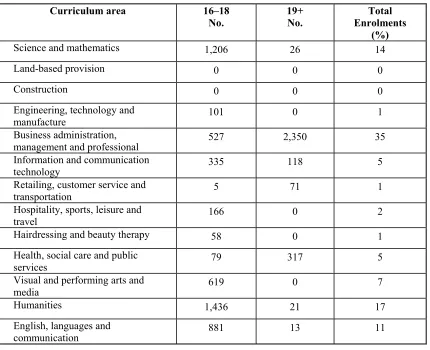
The college provides full-time courses mainly for students aged 16 to 18. Most students take level 3 courses. At the time of the inspection, there were 1,387 full-time students aged 16 to 18 and 14 students aged over 19. Most part-time students are adults and there were 797 aged 19 and over and 5 aged 16 to 18. The number of students from minority ethnic backgrounds is approximately 2% which reflects the local population. Some 55% of full-time students are female. Courses are offered in all areas of learning except land-based and construction. The majority of college provision is funded by the LSC, including a range of leisure courses.
How effective is the college?
The quality of provision is outstanding in science and mathematics and visual arts and media. It is good in business administration, sports, leisure and tourism, humanities and in English, languages and communications. Leadership and management are also good.
Key strengths
• ethos which promotes high aspirations and achievement
• high pass rates on many courses
• percentage of high grades on many general certificate of education (GCE) A2 courses
• high retention rates on level 3 courses
• high standard of student work
• much good teaching
• wide range of GCE advanced-level (A-level) courses and options.
What should be improved
• progress made by students at advanced subsidiary-level (AS level) and GCE A2 relative to their previous attainment at general certificate of secondary education (GCSE)
• retention and pass rates on courses at levels 1 and 2
• meeting the individual needs of students in lessons
• key skills provision
Quality of provision in curriculum and occupational areas
The table below shows overall judgements about provision in subjects and courses that were inspected. Judgements are based primarily on the quality of teaching, training and learning and how well students achieve. Not all subjects and courses were inspected. Inspectors make overall judgements on curriculum areas and on the effectiveness of leadership and management in the range: Outstanding (grade 1), Good (2), Satisfactory (3), Unsatisfactory (4), Very Poor (5).
Area Overall judgements about provision, and comment
Science and mathematics Outstanding. Pass rates at GCE A2 are consistently very good; they are at or above national averages at AS level, outstanding in GCSE
mathematics, but low in GCSE biology. Students’ achievement relative to their prior attainment is good in many subjects. Students’ written work is of a high standard and marking and assessment are excellent. Innovative use of technology in some lessons enhances learning.
Business, administration, management and
professional
Good. Retention and pass rates on most AS-level and GCE A2 courses and higher-level courses are good. There is much good teaching, but some lessons do not fully meet the needs of individual students. Pastoral support and careers advice are good. Students receive prompt, clear and constructive feedback on assignments, but too many national vocational qualification (NVQ) assessments of employed students take place in college.
Sports, leisure and tourism Good. Retention and pass rates are generally good and they are high on the advanced vocational certificate of education (AVCE) travel and tourism course. There is good teaching and learning in sport, but the more able students are not extended sufficiently in some lessons. Students’ progress is monitored effectively, but the marking of some travel and leisure assignments contains insufficient feedback. Good practical sports facilities enhance learning effectively.
Area Overall judgements about provision, and comment
Humanities Good. There are well-sustained, high retention and pass rates on most courses. Much good or better teaching, which uses a range of resources effectively, stimulates student learning. Insufficient attention is given to meeting individual learning needs in lesson planning. There is a good range of level 3 courses and option choices.
English and communications
How well is the college led and managed?
Leadership and management are good. The principal provides strong leadership. Pass and retention rates on AS-level and GCE A2 courses, the main areas of work for the college, are high. Teaching and learning are generally good or better and standards of student work are high. Curriculum management is good in half of the areas inspected and satisfactory in others. Teamwork is good. Governance is outstanding and financial management is sound. Recent management restructuring has enhanced human resources and management
information. Quality review processes are thorough, but self-assessment action plans are often imprecise. The college is not fully meeting its obligations under the Race Relations (amendment) Act. It has made an effective response to the Special Educational Needs and Disability Act 2001 (SENDA), but access to some areas of the college is difficult for people with restricted mobility. Spending on staff development is low. Standards have been established to help review the performance of managers, but not of teaching staff. The college provides good value for money.
To what extent is the college educationally and socially inclusive?
The college’s response to educational and social inclusion is satisfactory. The college responds rapidly to identified needs. Student induction and tutorial programmes highlight issues relating to diversity, equality and active citizenship. The college has a coherent strategy for student support. Students’ additional needs are assessed on entry and are well supported. Partnerships with local schools focus on raising the participation rates of young people aged 16 in full-time education. The college offers a range of basic skills courses that are taught in community and workplace settings. These courses have been highly successful in attracting adults to part-time learning. College policies for equal opportunities, disabilities, race relations and child protection address legal requirements. However, there is no
systematic review and evaluation of the impact of these policies. There is no implementation plan for the race equality policy. The performance of students by ethnicity or gender is not formally reviewed. There has been insufficient staff training on multicultural issues. Considerable resources have been spent on accommodation to improve access to buildings. However, the college site presents many obstacles for people with restricted mobility; some teaching rooms remain inaccessible.
How well are students and trainees guided and supported?
The college provides good support and guidance for students. Effective staff teamwork ensures that students enjoy a seamless service from pre-entry to exit. Impartial and highly effective advice is provided for students on employment opportunities, careers and higher education (HE). The tracking of student destinations is exceptionally detailed and used to the benefit of future students. Learning support services are good and readily available for both full-time and part-time students. Adult students receive support and guidance in the
learning support is available, including help with dyslexia or sensory impairments. The college does not fully evaluate the effectiveness of support. An extensive programme of group tutorials develops students’ social awareness and personal effectiveness. Tutors also review individual student progress against targets and action plans. Parents and guardians are notified promptly if there are any problems. A student welfare adviser offers appropriate help and referral for a range of issues.
Students’ views of the college
Students’ views about the college were taken into account and a summary of their main comments is presented below.
What students like about the college
• supportive and helpful staff
• friendly, relaxed and safe atmosphere
• expert and enthusiastic teachers
• initial guidance and careers advice
• size of college – not too big
• help with studies from learning support
• range of courses
• that the college listens to students’ views.
What they feel could be improved
• number of computers and colour printers
• choice of healthy food
• prices in the refectory
• choice of enrichment activities
Other information
The college inspection report will normally be published 12 working weeks after the formal feedback of the inspection findings to the college. Once published, the college has two months in which to prepare its post-inspection action plan and submit it to the local LSC. The college’s action plan must show what action the college will take to bring about
improvements in response to issues raised in the report. The governors should agree it before it is submitted to the local LSC. The local LSC should send to Ofsted only action plans from colleges that have been judged inadequate or have been awarded a grade 4 or 5 for
Part B: The college as a whole
Summary of grades awarded to teaching and learning by inspectors Aspect and
learner type
Graded good or better (Grades 1 to 3) %
Graded satisfactory (Grade 4) %
Graded less than satisfactory (Grades 5 to 7) %
Teaching 16–18 78 21 1
19+ and WBL* 67 33 0
Learning 16–18 76 22 2
19+ and WBL* 83 17 0
Key: The range of grades includes: Excellent (Grade 1), Very Good (Grade 2), Good (Grade 3), Satisfactory (Grade 4), Unsatisfactory (Grade 5), Poor (Grade 6) and Very Poor (Grade 7).
Achievement and standards
1. Most students are aged 16 to 18. Retention and pass rates for these students have been consistently above national averages over the last three years at level 3. Pass rates for this age group in 2002 and 2003 are in the top 25% of all sixth form college results. The percentage of high grades at GCE A level has increased over the last three years and is particularly strong at GCE A2. Students generally achieve results predicted by their previous attainment at GCSE. The percentage of high grades at GCSE is generally good, but varies according to the subject. Pass rates at levels 1 and 2 for students aged 16 to 18 are good, but retention rates are low. Adult students’ retention and pass rates are still above national averages at levels 2 and 3, but they declined at levels 1 to 3 in 2004.
2. Students demonstrate good skills of analysis and critical evaluation. Oral skills are good and students tackle complex issues with confidence. Progression rates to HE or
employment are monitored carefully each year. Most students who wished to progress to HE, FE or employment did so in 2003.
16 to 18 year olds
percentage of high grades (A or B) at GCE A2 and AS level has increased over the last three years. At GCE A2, high grades have improved from 40.5% in 2001 to 48.4% in 2004. At AS level, high grades have increased from 23.6% to 37% over the same period.
4. Overall pass rates for level 1 and level 2 qualifications are significantly higher than national averages over the past three years. The percentage of high grades at GCSE is generally good, but variable. It is outstanding in mathematics, at 36% above the national average. Many GCSE mathematics students improve their grade from an E to a C grade. The pass rate for the relatively small number of students taking GCSE biology is significantly below average.
5. Retention rates at level 3 have been above national averages since 2001. They are consistently below average at levels 1 and 2, but have improved in 2004.
6. Progression rates to HE or employment are monitored carefully each year. Some 86% of those students who wished to progress to HE did so in 2003. The college manages student attendance very effectively. Class attendance is registered electronically and prompt action is taken in cases of poor attendance. Tutors are punctilious in picking up on late arrivals in lessons and students are encouraged to demonstrate their consideration and respect for others by being on time. Attendance during inspection was 89% which is well above the 80% attendance observed during the previous inspection and above the 85% average
attendance for all sixth form colleges.
7. Many students produce high standards of written work and are developing practical skills well. Students demonstrate good oral skills, are able to sustain and develop arguments effectively and show enthusiasm for their subjects. In art and media, students participate in lively discussions and debates, are highly motivated and demonstrate very good verbal and practical skills. In sport and leisure, students answer questions with confidence and apply themselves well in groups and when developing practical sporting skills. Linguistic
terminology is used confidently and precisely by students in English lessons when analysing poetry, drama and novels. Students demonstrate good understanding and use of professional terminology in business lessons. In science and mathematics lessons, students make
productive use of time and strive to meet demanding standards set by teachers. Students tackle complex information effectively and confidently in humanities. They demonstrate good skills of analysis and critical evaluation.
was very poor at 2%. Key skills in application of number and communication are not offered at level 3.
Adult learners
9. Adult students follow long and short courses at levels 1 to 3. Most students take levels 1 and 2. Pass rates at levels 2 and 3 have been above national averages for the past three years. At level 1, pass rates were above the national average in 2002 and 2003, but slightly below average in 2004. Retention rates at levels 2 and 3 are above national averages. Retention rates at level 1 vary and have been below the national average for two of the last three years. Both retention and pass rates are very high for the small numbers of students taking higher-level courses. Retention and pass rates on short courses have been consistently good, with retention rates around 90% and pass rates well above the national averages for the last three years.
Quality of education and training
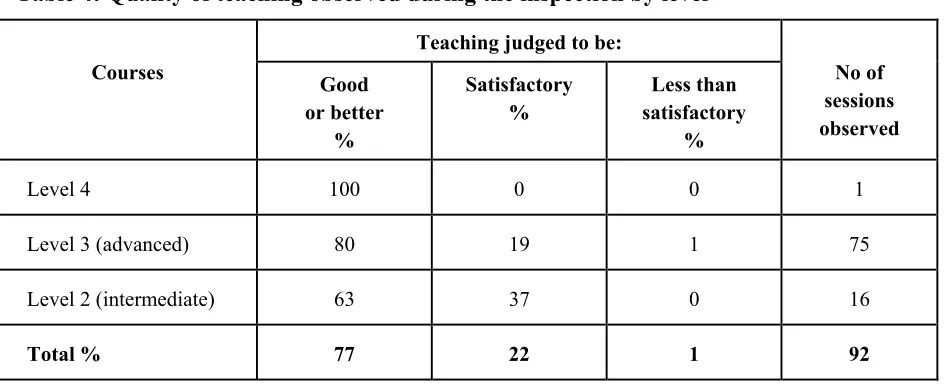
10. Teaching, learning and attainment were graded by inspectors in 92 lessons. The overall quality of teaching was good and it was graded good or better in 77% of lessons observed, satisfactory in 22% and just 1% were graded less than satisfactory. There is a strong link between good teaching and effective learning. Students are attentive, work productively and enthusiastically in most lessons. They participate fully in a range of lesson activities and are highly motivated to develop their learning.
11. Teachers show enthusiasm for their subjects and cover topics comprehensively. Most lessons are clearly structured and have explicitly stated objectives. Teachers stimulate learning in many lessons through good use of a variety of activities and resources which develop and reinforce learning. In most lessons, teachers maintain good momentum and, where appropriate, draw on professional and commercial experiences, for example, in
business, to contextualise learning. In many lessons, group work is well structured with clear timescales set for the achievement of tasks. In visual arts and media, teachers work very effectively as a team during lessons. Their expertise inspires students when they are learning about colour theory and working on still life, for example. Teachers effectively weave
together theoretical and practical aspects of art, film and media. Good use of information and learning technology (ILT) in some science and mathematics lessons enhances learning
students. In all areas of learning, insufficient consideration is given to meeting the individual needs of students in some lessons; particularly the needs of more able students.
12. Teachers are well qualified and have good subject expertise. Nearly all full-time and part-time teachers have teaching qualifications. Teachers on NVQ courses have appropriate assessor and verifier awards. Arrangements for the induction and mentoring of newly qualified teachers are comprehensive. Technical support staff provide good support for both staff and students.
13. Overall, the standard of college accommodation and specialist learning facilities is satisfactory. The college provides a safe and harmonious environment and students’ achievements are celebrated through stimulating displays of their work. Teaching rooms contain informative and attractive displays which provide a clear sense of subject identity and inspiration for students. Classrooms and laboratories are well equipped with computers and data projection facilities. Many classrooms have interactive whiteboards. Facilities for practical sports are good and include two football pitches, an all-weather floodlit pitch and a well-appointed sports hall. Social space for students is satisfactory and well used. Some classrooms are too small for the number of students using them, particularly in media and business.
14. The college has a sound strategy for the development of accommodation which clearly identifies the college’s needs and plans for improvements. A great deal of work has been undertaken to improve access to the entire college site by people with mobility
difficulties and further work is planned. However, the college buildings still present many obstacles to free movement around the site. Chemistry laboratories are inaccessible to users of wheelchairs. Neither the library nor the IT drop-in centre contains height adjustable desks. 15. Students have good access to a wide range of learning resources. The library and IT drop-in centre are well used by students and there are sufficient books, newspapers and periodicals available. The college has a detailed ILT strategy and students have good access to well-maintained computers. The ratio of computers to students is good. The college has made slow progress in developing its intranet site and embedding ILT in classroom teaching. 16. Assessment is fair and accurate on most courses and across all areas of learning. Students receive clear assessment schedules and are aware of assessment requirements. There is particularly thorough and accurate marking in most science and mathematics subjects, where students are given very useful advice on how to improve. Students in art receive detailed weekly assessments of their work on homework and achievement record sheets. They work hard to meet the high expectations of staff. In GCE A2 English language, students respond very positively to the personalised, written feedback that they receive from tutors. Marking in AS-level and GCE A2 literature is particularly effective with
well-designed coversheets linking the assessment objectives to the student’s target grade. There is good attention to accuracy in written English across all subjects.
bi-annual reviews. Students have clear goals and know what they need to do to succeed. There is early identification of students who are underperforming and there are effective procedures for monitoring their progress. Students are encouraged to take responsibility for their own learning through a range of tutorial activities, learning support mechanisms and advice and guidance. Parents and guardians are kept informed of progress, effort and attendance, through reports and parents’ evenings. The college responds quickly to their enquiries. 18. Internal verification on the NVQ management course is not sufficiently effective and too few assessments are carried out in the workplace. Actions to address variations in
marking and the standardisation of coursework have not been completed in AS-level and GCE A2 communications.
19. The college offers mainly advanced level courses for students aged 16 to 18
including 40 subjects at GCE advanced level. AVCE courses in leisure and recreation, travel and tourism, and health and social care are also offered. GCSE mathematics and English are offered to students who do not have a grade C on entry to the college. Level 2 provision is small and it is designed to meet the needs of students who do not qualify for advanced level courses in the first instance. Courses include 10 subjects at GCSE, including vocational GCSEs in business and travel and tourism, and Business Technology Education Council (BTEC) first diplomas in sport and information and communications technology (ICT). Adult education classes are offered in mathematics, accounting, ICT, administration, FE teacher training, English and British Sign Language.
20. Many students participate in additional activities which complement their courses, such as Young Enterprise, community sports leaders awards (CSLA), word-processing qualifications, foreign visits, field trips, and educational visits to local industry, universities, theatres and art galleries. The range of college-wide enrichment activities is narrow and focuses mainly on sporting activities. Students who aspire to careers in medicine benefit from a well-organised and structured work-shadowing programme. However, there is no structured programme of work experience in travel and tourism and links with industry are underdeveloped. Insufficient opportunities exist for enrichment in some humanities subjects. Good use is made of external visits in business, but opportunities for work experience are limited to the full-time administration course.
21. The college has strong links with schools, the local community and employers, particularly in the care sector. The college provides NVQ training and assessment for over 200 adult students employed in care settings. The college has opened a high street training centre offering Learndirect and qualifications in ICT. The college has been highly successful in delivering basic skills courses, both in the workplace and community settings. The college works with schools on two projects which focus on increasing participation and raising the aspirations of young people aged 14 to 16 from deprived areas.
awareness and personal effectiveness. Individual tutorials include reviewing progress against target minimum grades and action-planning students based on information provided in termly subject reports. Students are encouraged to take control of their own learning and decision making.
23. Students receive a comprehensive, impartial and effective information and guidance service, that starts before they enter the college and supports them at all stages of their time in college. A student welfare adviser offers support on a range of financial, transport,
accommodation and personal issues. Appropriate financial help is provided through the Education Maintenance Allowance scheme and the college’s hardship fund.
24. There is good learning support for full-time, part-time and adult students at an individual level. A significant number receive well-focused, short-term help with
organisational and planning skills. More prolonged support is offered for those with dyslexia or related learning difficulties and medical conditions. Drop-in centres are flexible and responsive. A small proportion of students are offered language support for English for speakers of other languages. Initial assessment is carried out during enrolment and includes diagnostic testing for communications and application of number. In addition, a survey of students’ preferred learning styles is also conducted. The latter is shared with students and staff, but contributes little to current teaching and learning in lessons. Referrals for learning support are followed-up early in the academic year. Help is also offered promptly with special adaptive technology for students with sensory impairments.
25. The college monitors student destinations rigorously. Academic achievement is tracked closely, both internally and externally. Gap-year destinations and employment outcomes are also recorded assiduously. This information is used very effectively to help students make decisions about their programme choices, their future careers and to raise their aspirations. There is good progression from the first year to the second year of GCE A-level courses and to HE. Progression from level 2 to level 3 is satisfactory overall, as many level 2 students progress on to vocational courses at other colleges.
26. The impact of learning support is not evaluated systematically. Data are not used to show how effectively learning support improves student performance. Performance is not analysed by different groups of students.
27. Effective child protection procedures are in place. Designated senior managers take responsibility for liaising with the appropriate external agencies to support vulnerable
students. Training has taken place to raise awareness for all staff who have contact with students. The college has a child protection policy and full checks are carried out on all college employees.
Leadership and management
students and to focus on their particular goals, is apparent in the work of staff throughout the organisation. Staff succeed in encouraging high aspirations and high achievement by
students. The main focus is on full-time AS-level and GCE A2 courses for students aged 16 to 18. Pass and retention rates are high on these programmes and in 2003/04 the percentage of students achieving high grades at GCE A2 had risen to 48%.
29. The college also aims to serve the needs of the local community by widening
participation in education and meeting the needs of businesses. These developments are only a small proportion of college activity. However, increasing work is undertaken on basic skills programmes in community venues and local businesses, and the college supports approximately 250 students on NVQs. Most are on care programmes. Partnerships with local primary and secondary schools also help to broaden the study and career horizons of young people.
30. The general academic performance of the college is good. The quality of teaching and learning is a little above that generally seen in inspections of sixth form colleges. The outcomes of the college’s internal observation system slightly overestimated the calibre of teaching and learning. The college has made significant progress in more accurately assessing its standards of teaching by improved staff training and thorough moderation of grading and standards.
31. Pass rates on level 3 courses are above the national average and retention rates are also good. Overall, students achieve AS-level and GCE A2 grades broadly in line with those expected given their entry qualifications, though the level of such performance has improved in recent years. Grades achieved by students in science and mathematics, English literature and some humanities subjects exceed expectations given their prior qualifications. However, retention rates on courses at levels 1 and 2 for students aged 16 to 18 are low and have fluctuated on programmes for adults in recent years. Pass rates in key skills are very low. This work is managed and co-ordinated poorly. A large proportion of level 3 students progress to HE. The college is meticulous in gathering student destination data and uses it effectively in reviewing programmes and marketing courses.
32. Leadership and management are good in the curriculum areas of science and
mathematics, English and visual arts and media. Subject leaders work particularly effectively in visual arts and media, and leadership by teaching team leaders is strong in science and mathematics. Curriculum management is satisfactory in other areas inspected, though some teaching teams are newly constituted after recent restructuring and methods of working have not yet settled. Teaching team leadership in humanities is good. Teamwork within courses and subjects is strong in most areas.
joining the panel validating the self-assessment report of the area. It is intended that governors will link with a different area year by year, so increasing their familiarity with work across the college.
34. In 2004, the principal restructured the management of the college. The restructuring was well founded. It built on the strengths of senior staff and focuses more on important business functions that were relatively weak. These included human resources and management information. Personnel procedures and systems are insufficiently clear and formalised. This is now being addressed through the new post of head of human resources. Problems with software and recording inaccuracies sometimes undermined the validity and accessibility of management information. Increased staffing and the adoption of new software have improved the situation. In the restructuring, programme areas were rationalised into a smaller number of teaching teams.
35. The quality system has clear and comprehensive processes of review. However, action planning for improvement in curriculum areas is often not precise, and the reviews do not always identify this. There is a regular cycle of meetings, with appropriate standard agenda items. Subject teams, for example, meet frequently and discuss operational issues effectively. Communication within teams is generally good. Heads of teaching teams, subject teams and subject leaders set targets for retention rates and achievement based on sound review of previous performance and comparisons with national average rates. Subject reviews feed into area of learning self-assessment reports. Progress against resultant action plans is monitored by heads of teaching teams and an assistant principal. However, such plans are often vague and imprecise in the action identified and in the timescale for it to be undertaken. These plans are not always effective in driving up quality. Self-assessment reports are often extensive, but do not identify major strengths and weaknesses. Most student work is marked well. Programmes for adult students have now been embraced within the college quality system.
36. The college has a strong focus on meeting the needs of individual students. They study in a safe and supportive environment. However, monitoring and promotion of equal opportunities are underdeveloped. The college has produced a clear race equality policy, but has no plan to implement it. Minority ethnic students form a very small proportion of the student body but, even so, little formal monitoring of student performance by ethnic
background, or gender, has taken place. The race equality policy has not been fully reviewed or evaluated. Relatively little staff training has taken place on multicultural issues, though there are clear instances of equal opportunities themes featuring in the curriculum. The college has informed staff about the implications of the Disability Discrimination Act and commissioned a disability audit. It is making clear efforts to meet the requirements of the Act and has spent significant sums to improve access by the installation of ramps and automatic doors. Nevertheless, easy and dignified access to some parts of the building is difficult for students with mobility problems.
are matched to strategic objectives. Expenditure on staff development is small: it was only 0.3% of college income in 2003/04 and is planned to be doubled for 2004/05. Differentiation in teaching and learning was a key staff development priority in 2003/04. However, teachers did not generally carry out differentiation effectively in lessons observed during the
inspection. There has been little management training and no focus on commercial updating for relevant staff. Performance management standards have been introduced to inform the appraisal of managers. However, there is no appraisal or performance review of other staff in the college, although staff development needs of each member of staff are identified.
Part C: Curriculum and occupational areas
Science and mathematics
Overall provision in this area is outstanding (grade 1) Strengths
• very high pass and retention rates on GCE A2 courses
• high pass rates at AS level and GCE A2 relative to prior attainment at GCSE
• outstanding pass rate in GCSE mathematics
• high standard of students’ written work
• enthusiastic, informed and supportive teaching
• rigorous and regular assessment that reinforces learning
• good support for individual students
• strong curriculum leadership.
Weaknesses
• very low pass rates in GCSE biology.
Scope of provision
39. The college offers GCE A2 and AS levels in mathematics, further mathematics, chemistry, biology and environmental science. Geology is offered at AS level. Mathematics and biology are offered at GCSE level and one GCSE mathematics course runs in the evening for adult students. The application of the number key skill qualification at level 2 is
incorporated into the teaching of GCSE mathematics. There are 997 students taking science or mathematics subjects as part of their programme, of which 18 are adults attending in the evening.
Achievement and standards
40. Pass rates on all GCE A2 subjects are very good. For the last three years they have all been above consistently above national averages. In mathematics, physics, biology and chemistry, a high percentage of students achieve grades A and B. For example, in
would be expected from their previous achievement at GCSE. Pass rates at AS level are as good as, or better, than national averages and overall students achieve what would be
expected of them based on their GCSE grades. In 2004, the percentage of students achieving high grades in AS-level biology was 10% above the national average. At both AS level and GCE A2, retention rates are at or above the national average. At GCSE the A* to C grade pass rate in mathematics is outstanding. It has been over 80% over the last two years for students aged 16 to 18 and for those aged over 19. In 2004, it was 37% above the national average. Many students reach this level after one year, having previously only achieved a grade E. In contrast, the achievement of GCSE biology students is very poor. In 2004, only 17% of the 31 students starting the course achieved a grade C or above.
41. Students’ work is of a high standard. Written work, at both GCSE and GCE A level is particularly impressive with students expressing their ideas and difficult concepts clearly. Students’ homework and work done in class is organised sensibly and well presented. Verbal communication skills are good; responses to teachers’ questions are met with articulate, thoughtful answers. Students carry out practical work in science safely and efficiently. They record results and plot graphs accurately and neatly. The most able students are encouraged to compete nationally through the British Physics Olympiad and the UK Senior Mathematical Challenge. In 2004, three students achieved a bronze award in the Physics Olympiad and one student achieved a commendable gold award in mathematics. Attendance and punctuality are very good.
A sample of retention and pass rates in science and mathematics, 2002 to 2004
Qualification Level Completion year:
2002 2003 2004
No. of starts 119 99 121
% retention 82 82 80
GCSE mathematics 2
% pass rate 47 80 82
No. of starts 104 101 101
% retention 98 98 96
GCE A2 mathematics
3
% pass rate 99 96 99
No. of starts 97 88 92
% retention 98 99 98
GCE A2 biology 3
Qualification Level Completion year:
2002 2003 2004
No. of starts 60 58 51
% retention 97 97 100
GCE A2 chemistry 3
% pass rate 98 95 98
No. of starts 42 48 43
% retention 100 98 95
GCE A2 physics 3
% pass rate 90 96 95
No. of starts 191 * 171
% retention 96 * 91
AS-level mathematics
3
% pass rate 86 * 81
Source: ILR (2001 and 2002) college (2003) * data unreliable
Quality of education and training
42. Teaching and learning are very good. Teachers are enthusiastic and very
knowledgeable in their subject and they prepare students thoroughly for public examinations. Students work hard. They are attentive in lessons and make productive use of time when taking part in class activities. Teachers frequently explain methods, concepts and information very clearly. They often support learning by making effective use of interactive whiteboards and digital projectors. In one mechanics lesson, students developed their understanding of motion by observing a computer simulation of a mass oscillating between springs. Values were changed in the simulation and students observed carefully how the motion was affected by factors such as the stiffness of a spring. Students interpreted this information well by sketching graphs of the behaviour. Computers and digital projectors are used effectively in lessons, for example, to illustrate mathematical functions, collect measurements from the motion of a dynamics trolley and to enable students to use computer-based learning material on radio transmission. In less effective lessons, students take notes for longer periods than ideal for less able students and insufficient use is made of discussions and questioning to confirm learning.
have interactive whiteboards. Teachers are well qualified and many have experience of marking and moderating external examinations.
44. Homework is set frequently and students return it promptly. Timely, accurate and detailed marking is undertaken by teachers. They value students’ efforts and the detailed marking and feedback very effectively helps students to improve their performance. The frequent setting and marking of work enables teachers to monitor students’ progress closely and contributes significantly to their motivation and development of self-study skills. There is a clear expectation, created by caring and hard-working staff, that students work hard, attend all lessons and produce their best work.
45. There is a good range of AS-level and GCE A2 subjects. The curriculum is enhanced through many imaginative extra activities. College visits to relevant conferences and industries such as a theme park for mathematicians to examine mechanics, and to a brewery for chemistry students, place college learning in context and also provide useful material for coursework.
46. Support for students academic and pastoral welfare is very good and valued by students. Extra lessons are often provided, for example, revision sessions in the run up to examinations. Formal systems for monitoring students’ progress are highly effective. Students receive regular one-to-one interviews from specialist personal tutors who work in close partnership with the subject lecturers. Procedures for dealing with missed lessons and poor performance are clear and effective in ensuring students attend well and make good progress in their studies. Students who require extra learning support to meet particular learning needs receive regular one-to-one support from specialist learning support tutors. Subject teachers are kept fully informed of the support the students are receiving.
Leadership and management
47. Leadership and management are good. Strong curriculum leadership has created a sustained culture of high standards through the setting and monitoring of demanding targets and procedures. There is a great commitment to ensuring students succeed and teachers work hard to achieve this. Common schemes of work are in place and resources are routinely shared through departments. There are topic tests and results are monitored regularly by heads of teaching teams.
Business, administration, management and professional
Overall provision in this area is good(grade 2) Strengths
• high pass rates on most AS-level and GCE A2 courses
• high retention rates on AS-level and GCE A2 courses
• good or better teaching in the majority of lessons
• good support for students.
Weaknesses
• insufficient attention to students’ individual needs
• some weak internal verification practice.
Scope of provision
49. The college offers AS-level and GCE A2 courses in business studies, economics and accounting. Provision at level 2 consists of a vocational GCSE in business studies. Part-time courses for adults include NVQs in accounting, administration and management, British Sign Language and FE teacher training. There is also a full-time diploma in administration for adult students. Word processing courses are offered as additional qualifications and as part of college-wide enrichment activities. There are approximately 450 full-time students aged 16 to 18 and approximately 80 adults on part-time courses in this area.
Achievement and standards
50. Pass rates on many of the AS-level and GCE A2 courses are good. Retention rates on these courses are also good with some being exceptionally high, for example, a 100% retention rate in GCE A2 accounting. Pass and retention rates are also high on many part-time courses. In 2003, the percentage of students who achieved grades A and B on GCE A2 courses was significantly above the national average with, for example, high grades in AS-level economics 16% above the national average. However, in 2004, the percentage of students achieving high grades declined in all GCE A2 subjects. The number of students achieving high grades at AS level in 2004 showed a significant improvement. For example, the AS-level business high-grade pass rate was 22% higher than the national average. Overall students’ achievements are in line with predictions based on their prior attainment at GCSE. In 2004, students on AS-level business achieved much better grades than those predicted from their GCSE results.
Students’ written work demonstrates a good understanding of business theory and practice. A significant number of students progress on to business-related courses at university.
A sample of retention and pass rates in business, administration, management and professional, 2002 to 2004
Qualification Level Completion year:
2002 2003 2004
No. of starts 19 32 21
% retention 32 59 38
Basic certificate in sign language
2
% pass rate 100 95 50
No. of starts 34 42 41
% retention 91 98 88
AS-level accounting
3
% pass rate 71 66 68
No. of starts 94 122 134
% retention 87 92 93
AS-level business studies
3
% pass rate 94 96 98
No. of starts 46 50 69
% retention 98 90 94
AS-level economics 3
% pass rate 98 87 95
No. of starts 61 62 66
% retention 62 100 97
GCE A-level business studies
3
% pass rate 91 100 97
No. of starts 11 12 15
% retention 100 100 100
GCE A-level accounting
3
% pass rate 91 100 100
Quality of education and training
52. Teaching is good or better in the majority of lessons. In the better lessons, teachers use group and peer work very effectively to reinforce learning, for example, by getting students to test each other and mark each other’s work. Students participate well and many activities are interesting and thought provoking. In these lessons, students are disciplined, attentive and they cope well with the challenging pace and content of the lessons. Teachers are highly effective in using their vocational expertise to motivate their students. In one lesson, the teacher made excellent use of local companies as examples to explain the terms of primary, secondary and tertiary organisations. The use of ILT in teaching and learning is currently being embedded within the teaching team. Where teachers use ILT, they do so with success. Many teachers are external moderators for awarding bodies and receive regular updating on curriculum matters. They put this experience to good use in lessons by raising students’ awareness of what they need to do to achieve high grades in examinations. 53. In the less successful lessons, teachers do not adequately plan for the range of abilities of students. Lesson plans and schemes of work lack specific detail on how teachers aim to respond to different levels of ability. In some lessons, the large class size makes it difficult for teachers to meet individual needs adequately. On level 2 provision for students aged 16 to 18, some students do not work purposefully and are disruptive in lessons. 54. Teachers are well qualified, some with specialist skills that enhance the small teaching team. There are sufficient current textbooks and reference materials available for students. Students make good use of the library and IT facilities. Classrooms are bright, spacious and well equipped with smart boards and digital projectors. Most of the classrooms have computers for students and teachers to use. Some accommodation, however, is too small for the number of students in the class.
55. Students’ work is marked regularly and thoroughly. Students receive prompt, clear and constructive feedback. Students are also asked to assess their own performance and set targets for themselves. Good use is made of external visits for assessment purposes.
Students are required to complete a very well-designed, assessment book which sets realistic but challenging targets for its completion. Teachers keep detailed records of progress. Internal verification of the NVQ management programme is weak. It is mostly carried out within the college rather than the workplace. The NVQ team conducts standardisation events, but there is insufficient discussion about external verification issues or the
development of assessment practice. NVQ workplace assessment is restricted to one half-day during the course and to a restrictive range of assessment methods.
56. Good use is made of external visits to enhance student learning. However, there is little involvement of employers in curriculum development or as guest speakers.
57. Support and guidance for students are excellent. There is good communication between the tutoring staff, learning support and individual subject tutors. Subject tutors are invited to case conferences about students. There are clear records of initial assessment and learning support needs. Students are very well supported and know where to go for advice and guidance. The support can be one-to-one or discrete lessons and support in the lessons. Students are confident to use learning support.
Leadership and management
Sports, leisure and tourism
Overall provision in this area is good (grade 2) Strengths
• high pass rates on AVCE travel and tourism
• high retention rates on most courses
• good teaching and learning in sport
• good practical sports facilities
• very effective monitoring of students progress.
Weaknesses
• insufficient opportunities for more able students to extend their learning
• inadequate written feedback on student assessments in travel and leisure
• ineffective action planning for quality improvement.
Scope of provision
59. The area currently offers the AS-level sports, games and recreation, GCE A2 in physical education, CSLA, vocational GCSE in leisure and tourism and AVCEs in leisure and recreation, and travel and tourism. The provision caters primarily for full-time students aged 16 to 18 taking level 3 courses. There are 376 students in this area of learning. Two thirds of students take sports courses.
Achievement and standards
61. The level of practical skills achieved by sports students is high. They perform with confidence and maturity and respond well to both tutor and peer feedback. For example, a sport leaders’ award lesson involved the students planning and supervising different competition formats for badminton. Students resolved complex issues in groups without reference to the teacher. Generally, the standard of students’ written work is good. 62. Students are generally punctual and the few incidents of lateness are dealt with effectively by teachers. Attendance rates during inspection were high at 89%.
Comprehensive information about students’ destinations is collected systematically and updated regularly. There are high rates of students progressing on to HE or related employment.
A sample of retention and pass rates in sports, leisure and tourism, 2002 to 2004
Qualification Level Completion year:
2002 2003 2004
No. of starts 60 52 49
% retention 60 92 84
CSLA 2
% pass rate 100 100 **
No. of starts * * 17
% retention * * 94
Vocational GCSE in leisure and tourism
2
% pass rate * * 88
No. of starts 63 72 80
% retention 92 93 93
AS-level sports, games and recreation
3
% pass rate 84 93 89
No. of starts 32 36 39
% retention 97 97 97
GCE A2 physical education
3
% pass rate 100 89 97
No. of starts 17 10 21
% retention 94 100 86
AVCE travel and tourism (single award)
3
% pass rate 81 100 89
*course not running **data incomplete
Quality of education and training
63. The standard of teaching and learning is good. Lessons are well planned with comprehensive schemes of work and effective lesson plans. Learning is fun for the majority of students and they develop their skills and knowledge effectively in both theory and practical classes. Strategies to deal with students’ individual needs are signposted on schemes of work. However, these are not sufficiently implemented in lessons. Some more able students are not making full use of their time in lessons or learning at a level and pace most suited to their needs.
64. In one lesson, students were encouraged to use analytical approaches in human resource planning as they considered case studies about job losses in the travel industry. This led to a well-designed activity in which students used information gained from a talk given by a guest speaker, to check that their understanding of the subject was correct. In another good lesson on leadership in sport, students were able to grasp difficult concepts about leadership extremely well. The teacher led a discussion on leadership styles skilfully which stimulated lively debate. Students articulated thoughtful comments and asked searching questions which reinforced their understanding and assisted them to draw correct
conclusions. In a few lessons, a small number of students lack sufficient motivation to be fully involved in all activities.
65. Resources are good. Staff are well qualified and experienced and many undertake useful professional development activities. Most teaching rooms are spacious and well equipped with media projectors, televisions and other learning resources. Displays are used effectively to support learning and to motivate students. The high standard of practical sports facilities include two well-maintained football pitches, a floodlit all-weather pitch used for national hockey matches, and a well-equipped sports hall. Changing facilities are too small and in need of refurbishment. Students use a local leisure centre providing minority sports such as netball and swimming. The book stock for leisure and tourism courses is too limited. 66. Monitoring of students’ progress is good across both departments with many
examples of comprehensive and timely feedback given in lessons. Class exercises are marked quickly and clear guidance on how to improve work is given. Assignment briefs contain clear tasks and guidelines for completion, but written feedback on student
assignments in travel and leisure does not provide students with sufficient detail on how to improve their work. Students’ progress reviews are thorough and focus sharply on target setting and the achievement of at least the targeted minimum grades. There is little assessment of key skills.
68. Pastoral support is good and includes effective guidance for students with personal issues and help in finding appropriate part-time work. Students receive good academic support from teachers both in lessons and outside normal teaching time. Students attend a well-designed programme of weekly tutorials that includes thought-provoking topics such as raising awareness of mental-health problems as well as other important social issues.
Leadership and management
69. Leadership and management are satisfactory. Communications are good within subject teams, but there is insufficient sharing of good practice across the new teaching team. Peer observations are beginning to have a positive impact on the quality of teaching and learning. Team building and co-ordination has improved in travel and leisure and is
satisfactory. Staff are involved in self-assessment, but action planning to address identified issues is not sufficiently clear or effective.
Visual arts and media
Overall provision in this area is outstanding(grade 1) Strengths
• high pass rates
• high retention rates on most courses
• excellent standard of student work
• much good teaching and learning
• very good monitoring and assessment of student work
• very good academic and pastoral support
• highly effective curriculum management.
Weaknesses
• no significant weaknesses.
Scope of provision
71. The college offers GCE A-level courses in art and design, media studies and film studies. Students who have not completed a formal qualification in art at school can take GCSE art and progress to AS level in their second year. After completing AS-level art and design, students have the option of taking an additional AS-level graphics or
three-dimensional option which is started in June and runs alongside their GCE A2 art course in the second year. There are 425 students in this curriculum area.
Achievement and standards
72. Pass rates are high and well above the national averages for all level 3 courses. In 2004, the pass rate for AS-level film, GCE A2 film, GCE A2 art and design and GCE A2 media was 100%. In the same year, the pass rate for AS-level media was 98% and 97% in AS-level art. Retention rates are high on most courses, for example, in 2004, the student retention rate in GCE A2 media and GCE A2 art and design was 98%. Students’
achievements are generally in line with grades predicted from their previous attainment at GCSE. However, in film studies, students achieve much better grades than those predicted from their GCSE results.
73. Students attend regularly and are punctual. The standard of student work is
developing expertise and insight. Teacher expectations are high and they set challenging goals for their students. Courses are structured to build on practical skills as well as the skills of critical evaluation. In art lessons, the emphasis placed upon drawing and sensitive use of colour results in particularly lively student work. In media, students are confident and articulate; they offer informed and considered views to class discussions. Students
effectively integrate the understanding of both theoretical and practical aspects of art, film and media.
A sample of retention and pass rates in visual arts and media, 2001 to 2003
Qualification Level Completion year:
2002 2003 2004
No. of starts 111 107 116
% retention 92 85 91
AS-level media studies
3
% pass rate 86 79 98
No. of starts 58 59 78
% retention 54 51 87
AS-level film/video production
3
% pass rate 93 85 100
No. of starts 112 100 115
% retention 91 76 90
AS-level art studies/fine arts
3
% pass rate 89 75 97
No. of starts 56 63 55
% retention 100 94 98
GCE A2 media studies
3
% pass rate 100 90 100
No. of starts 19 38 22
% retention 100 100 91
GCE A2 film studies
3
Qualification Level Completion year:
2002 2003 2004
No. of starts 37 57 54
% retention 92 84 98
GCE A2 art and design
3
% pass rate 92 84 100
Source: ILR (2001 and 2002), college (2003)
Quality of education and training
74. Teaching and learning are good. Lessons are well planned. Teachers work well together as a team and share good practice. Where staff teach the same group, they work closely together and jointly prepare schemes of work which complement effectively the skills each teacher brings to the course. Courses build on students’ confidence as they increase their skills, both verbal and practical. Teachers are well organised and prepared, so that lessons are filled with activities to keep students motivated and progressing at an optimum rate. Teachers demonstrate extensive, professional knowledge and expertise and are
enthusiastic in their teaching. In one lesson, students were involved in painting an enormous still life of draped textiles over an angular structure. This allowed students to demonstrate their skill in fluid and spontaneous uses of colour. In another lesson, students painted a personal response to the work of a chosen artist. Their approach demonstrated sensitivity and maturity. In less successful lessons, teachers talk too much and do not allow students to contribute fully to the lesson.
75. Teachers are well qualified, and often have industry experience or are examiners and moderators. They use their knowledge effectively to engender professional standards in their students. The art section has an open studio space with good natural light and specialist art rooms for different art activities. However, the open nature of the accommodation sometimes means that there can be distractions such as students walking through areas when teachers are presenting information to the class. A dedicated computer suite is located near to the main studio and there is an in-house art shop for students to buy art materials at wholesale prices. Media and film have 12 digital video cameras and 6 editing suites. Some rooms are too small for the number of students using them, giving restricted views of films and videos. There is poor ventilation in some rooms, and poor soundproofing for adjacent rooms when films are played. In media and film studies, access for students with mobility difficulties is restricted. 76. Monitoring and assessment of student work are very good. Work is assessed and returned promptly. Students are clear about their learning goals and outcomes. Teachers set regular homework and this is assessed and marked promptly. Details of assessment
Completed and assessed work is noted in these each week, so that there is a detailed record of progress and work achieved. They understand their strengths and weaknesses and are given extra help if necessary. There is a large exhibition of student work throughout the college for moderation in the summer term.
77. Courses are carefully planned and monitored and students have opportunities to reflect on personal and social issues that are relevant to them. Students make effective use of facilities for working on their own. Enrichment activities are very good and include visits to galleries, exhibitions, cinemas and workshops undertaken by visiting artists and life drawing sessions. Students also take a photoshop course to increase their IT skills. There are
portfolio-building workshops and interview-technique coaching for university and art college progression. Media and film studies students visit ITV and BBC studios and have outside speakers from the British Board of Film Classification.
78. Academic and pastoral support for students are excellent. Students undertake an initial assessment to identify their individual needs and preferred learning styles. Additional learning support is put in place immediately if needed. Dedicated tutors provide regular personal and group tutorials. Students can attend extra sessions or work through lunchtime or after college if they want to finish some work, and teachers give their time freely to help. There is excellent communication between students and their teachers, and there are frequent opportunities for students to discuss and plan their future career moves. The standard of advice is outstanding.
Leadership and management
79. Leadership and management are good, and curriculum management is highly effective. Teachers feel well supported and regular meetings take place in which staff are involved in actions to implement quality assurance. However, minutes of some meetings are not formalised with specific targets and most contact between staff is informal. Teachers have recently undertaken staff development that focuses on teaching and learning.
Humanities
Overall provision in this area is good(grade 2) Strengths
• well-sustained high pass rates on most courses
• very high retention rates on GCE A2 courses
• much good or better teaching
• good range of subject choice in humanities at level 3.
Weaknesses
• insufficient attention to individual learning needs in lesson planning
• insufficient action to address falling rates of high grades at AS level.
Scope of provision
80. Daytime courses at AS level and GCE A2 are provided across 11 humanities
subjects. Almost all students are full-time students aged 16 to 18. Recruitment has increased in the past three years. At the time of inspection, 974 students were enrolled on humanities courses. Approximately 85% of course enrolments are accounted for by geography, history, law, philosophy, psychology and sociology. Courses are also offered in archaeology, critical thinking, general studies, government and politics and religious studies. Some 60% of enrolments are on AS-level courses.
Achievement and standards
81. Almost all students complete their courses and attain their goals. There are high and well-sustained pass rates in most subjects at GCE A2 and AS levels. At GCE A2, most courses achieved a 95% or higher pass rate. Pass rates exceed national averages on all courses except GCE A2 psychology and AS-level archaeology. Pass rates in these subjects have been below the national average for the last three years. In geography, politics and sociology, the percentage rate of high grades has been maintained above national averages, at both levels, over three years. There has been insufficient action to address the falling rates of high grades. Although high-grade pass rates are still above the national average, there has been a downward trend in the percentage of A and B grades at AS level since 2003. In philosophy and archaeology, it has slipped to well below the national average.
the past three years. In philosophy, the rate has fallen significantly below the national average in 2004.
83. Students’ work is of a high quality. New knowledge is used with confidence and students articulate their understanding of it clearly. They are methodical and respond well to challenges in their learning. Those in their second year of advanced study demonstrate commendable skills in critical analysis and evaluation. Many handle difficult concepts very effectively. In philosophy, students apply themselves well and deal with complex issues of language and mind. Students use computers to assist them in research. They show a good grasp of new technology. Students’ writing skills are well developed and their standards of attainment in coursework and homework assignments are high. There is clear evidence of good progression rates to subject-related courses in HE from humanities subjects.
A sample of retention and pass rates in humanities, 2001 to 2003
Qualification Level Completion year:
2002 2003 2004
No. of starts 145 130 166
% retention 95 90 93
AS-level history 3
% pass rate 93 97 95
No. of starts 59 53 77
% retention 86 89 79
AS-level philosophy
3
% pass rate 82 91 87
No. of starts 80 105 80
% retention 95 95 85
AS-level sociology 3
% pass rate 89 96 100
No. of starts 73 51 47
% retention 100 100 100
GCE A2 geography 3
% pass rate 99 98 100
No. of starts 43 43 59
% retention 100 100 93
GCE A2 law 3
Qualification Level Completion year:
2002 2003 2004
No. of starts 86 118 100
% retention 99 88 95
GCE A2 psychology
3
% pass rate 93 93 93
Source: ILR (2001 and 2002), college (2003)
Quality of education and training
84. There is much good teaching and learning. Staff are well organised, highly
confident teachers. They skilfully integrate varied learning resources imaginatively, to enrich and enhance learning. Students generally demonstrate a good understanding of topics. They work well individually and in groups, are well motivated and enjoy their studies. Teachers draw effectively on contemporary issues to increase the impact and relevance of the topic for students. For example, geography students used data on Hayling Island to investigate
shoreline management and, in psychology, students considered the case of tortured prisoners in military prisons as part of work on Zimbardo’s psychological research. Most lessons have clear objectives and learning is reviewed at the close of the lesson. Insufficient attention is given in lesson planning to meeting the individual learning needs of students. Lesson
planning insufficiently takes account of the needs of very bright students. Students’ preferred learning styles are identified, but not embedded in teaching and learning. Schemes of work do not indicate how the needs of a range of students will be met.
85. There are good levels of resources to support teaching and learning. Well-qualified staff are deployed appropriately according to their specialisms. Not all teaching rooms have enough computers to match the increasing use of IT in learning. Use of IT in the curriculum is progressing. In geography and psychology, good intranet sites have been developed. Students make good use of the library and flexi-learning centres.
86. Assessment and marking of students’ written work is good. Assignments are set regularly and detailed comments which help students to improve their performance are made on scripts. Teachers provide students with further feedback when marked work is returned. Additional assessment of progress takes place in lessons when students work in small groups or on individual tasks. However, insufficient action is taken to respond to individual learning needs at an early stage. Individual GCSE scores are recorded, but the use of targets to
measure progress is not well embedded.
88. Students receive useful guidance in choosing appropriate courses. Staff are readily available and willing to give additional advice and support for learning or with personal matters, as needed. Support staff have good links with personal tutors and regularly monitor the progress made by students. Tutorials cover a good range of topics including aspects of diversity. Additional classes are helpfully provided in some subjects for revision. For example, psychology offers twilight examination preparation and revision sessions.
Leadership and management
89. Curriculum management is adapting quickly to recent changes in the college
structure. Leadership of the learning area is well informed and sensitive to meeting the needs of students and staff. Induction arrangements for new staff are comprehensive. Staff are well supported and part-time staff are fully integrated into teaching teams. Communication is now more effective with time allocated for staff meetings. Subject leaders are beginning to