This book is a result of, and a contribution to, the UNESCO ecohydrology pro-granune, which is a component of IHP-VL lt has been made po"ible as a result of my collaboration with the European Regional Centre for Ecohydrology, under the auspices of UNESCO, L6dz, Poland. This book is also endorsed by Japan-based EMECS (International Center for Environmental Management of Enclosed Coastal Seas) and SCOR (Scientific Committee on Oceanic Research).
ESTUARINE
ECOHYDROLOGY
ERIC WOLANSKI, PhD
,
DSc, FTSE, FIE Aust
AL/stralian InstitL/te of MarinfJ Sci~nceTownsville
Australio
ELSEVIER
Elsevier
Radarweg '1.':),
va
Box :lU, lUUU At:: Amsterdam, The NetherlandsLinacre House, Jordan Hill, Oxford OX2 8DP, UK
first edition 2007
Copyright © 2007 Elsevier B.V. All rights reserved
No part of this publication may be reproduced, stored in a retrieval system or transmitted in any form or by any means electronic, mechanical, photocopying.. recording or otherwise without the prior written permission of the publisher
Permissions may be sought directly from Elsevier's Science & Technology Rights Department in Oxford, UK: phone (+44) (0) 1865 843830; fax (+44) (0) 1865 853333; email: [email protected]. Alternatively you can submit your request online by visiting the Elsevier web site at http://elsevier.com/iocate/permissions, and selecting Obtai/ling perlllission to use Elsroier material
Notice
No responsibility is assumed by the publisher for any injury and/or damage to persons or property QS fl mottcr of products liability, l"legJige11ce 01' othel'wise, or 6:om Dny use or operation of any methods, products, instructions or ideas contained in the material herein. Because of rapid advances in the medical sciences, in particular, independent verificat.ion of diagnoses and drug dosagf'.S should hp m<'lnf'
Library of Congress Cataloging~in~PubHcation Data
A catalog record for this book is available from the Library of Congress
British library Cataloguing in Publication Data
A catalogue record for this book is available from the British Library
ISBN: 978-0-444-53066-0
For information on all Elsevier publications visit our website at books.elsevier.com
Printed and bou.nd in The Netherlands
07 08 09 10 11 10 9 8 7 6 5 4 3 2 1
Working together to grow
libraries in
developing co
untries
W'ovw.elsevier.com
I
www.bookaid.orgI
www.sabre.orgDr. Eric Wolanskil PhOI OSc, FTSE, FIE Auat, is a coastal oceanographer and
a leading scientist at the Australian Institute of Marine Science. He obtained a
B.Sc. degree in civil engineering from the Catholic University of Louvain, a M.5c. degree in civil und geological engineering from Princeton University, and a Ph.D. in environmental engineering from The Johns Hopkins University.
His research interests range from the oceanography of coral reefs, mangroves, and Inuddy estuuries, to the interaction bctween physical and biological
pro-cesses determining ecosystem health in tropical waters. He has more than 300 publications.
He io n fellow of the Australian Academy of Technological Sciences and Engineering, the Instihltion of Engineers Australia, and I' Academie Royale des Sc.iences d'Outre-Mer. He was awarded an Australian Centenary medal for ser-vices in ef,tuarmc and conGtai ocennogrnphy, n Doctornte Honoris Causa from the Catholic University of Louvain, and a Queensland Information TeclUlology and TelecommlUlication award for excellence.
He is the chief editor of Estual'il'lC, Coastal and Shelf Scicncc and Wetlands Ecology alld Managemellt. He is a member of the editorial board of foumnl of Coastal Research, formwl of Ma,-h,e Systems, and Contillelltal Shelf Research. He is a member of the Scientific and Policy COlnmittce of the Ja.pan'a-baocd Intcrnational Centcr for EnvirolUnental Management of Enclosed Coastal Seas. He is an Erasmus Mundus scholar. He is listed in Australia's Who's Who.
1. Introduction
1.1. What is an estuary? 1.2. Humanity and estuaries
1.2.1. Sedimentation from sediment eroded from cleared land in the hinterland
1.2.2. Overfishing and trawling 1.2.3. Destruction of wetlands 1.:2.4. £utrophkation
1.2.5. Pollution
1.2.6. Dams
1.2.7. Dykes: for flood protection
1.2.8. Human health risks
1.3. The future of estuaries and the quality of life of the human population living on its shores
1.4. The solution
1.5. Ecohydrology science: the structure of this book
2. Estuarine water circulation
2.1. The average reSidence time
2.2. The age of water
2.3. Exposure time vs. residence time 2.4. VertiCal m!xlng and StratifiCatiOn 2.5. Lateral stratification, trapping, and shear 2.6. The importance of the bathymetry on flushing
2.7. The Imporrance of flows near rhe river mourh on flushing
2.8. The speCial case of lagoons
3. Estuarine sediment dynamics
3.1. Geomorphological time scales 3.2. Sediment dynamics
3.2.1. The distinction between mud, silt and sand
3.2.2. Sand dynamics 3.2.3. Mud dynamics
3.2.4. Engineering implications
3.2.5. Biological implications
" . \
vi i i Contents
4.
5.
6.
3.1 Net sediment budgets
13.1. The age of estuaries
3.3.2. 3.3.3.
Net erosion or progradation
Formation of mudflats
3.3.4. Formation of tidal wetlands by the vegetation colonizing bare intertidal areas
3.4. The size of the mouth
Tidal wetlands
4.1. Dcscription
4.2. Hydrodynamics
4.3. Walle attenuation by wetland vegetation 1.1. Ecological processes within <:l tidal wctland
4.4.l. Mangroves
4.4.2. Saltmarshes
1.'1.3. Supr.:ltid.:ll mudA.:lts
4.5. Enhancement of estuarine fisheries productivity by outweUing
from tidal wetlands
4.6. Groundwater flow
4.6.1. Mangroves 4.6.2. Saltmarshes -1.7. Physics-biology links
Estuarine food webs
5.l. Simple food webs
5.n Definitions 5.l.2. Clear waters
5.2. The key role of detritus 5.3. The role of ,groundwater
5.4. Link to pelagic food web (fisheries) 5.5. Estuarine ecology
5.6. Over-stressed ecosystems 5.7. Seagrass and coral reefs
Ecohydrology models
6.l. Engineering models 6.2. Ecosystem models
6.2.l. Predator-prey relationship
6.2.2. Estuarine ecosystem models
6.2.3. An estuarine ecohydrology model
6.3. Coral reef ecohydrology model
Contents ix
7. Ecohydrology solutions 125
7.l. Freshwater 125
1.2. tstuanes 126
7.3. Coastal waters 127
7.4. Managing human health threats 128
I.':J. Habitat creation 129
7.5.1. Saltmarshes 129
7.5.2. Mangroves 131
7.5.3. Seagrass 132
7.5.4. Coral reefs 132
7.5.5. Sediment capping 133
7.0. Protection against natural hazards 133
7.7. A future for estuaries and coastal waters? 135
I<eferences 139
Introduction
1.1.
WHAT IS AN ESTUARY?
An estuary receives, occasionally or frequently, an Inflow of bOtll freshwater
and saltwater; it stores these waters temporarily while mixing them. An estuary
is a buffer zone between river (freshwater) and ocean (saltwater) environments
that may be affected by tidal uscillatiuns. Must estuaries were established by the
flooding of river-eroded or glacially-scoured valleys during the Holocene rise of sea level starting about 10,000-12,000 years ago. Because it progressively fills
wilh sedhnenl, an eSluary has an age, akin Lo a living organislll in evolution. It
starts with youth, it matures, and it then becomes old; it can be rejuvenated. The term "estuary" is derived from the Latin word "aestuarium", this means
tidal. This definitiun I::> huwevef ovef-n::striclive because eslUdfies also ocelU· in
conditions with no tides such as the rivers discharging into the tideless Baltic Sea
and the Danube Delta in the tideless Black Sea.
Thel-e have been several definitions of an estuary, such as that of Dio11J"'Ie (1963): "An estuary is an inlet of the sea, reaching into the river valley as far as the upper limit of tidal rise, usually divisible into three seclors: a) a marine 01" lower estuary, in free connection with the open sea; d) a rniddlc estuary, subject to strong salt and freshwater mixing; mld c) an upper or fluvial estuary, characterized by freshwater but subject to daily tidal activity".
There nrc other definition5 of an c3tunry_ For In::;tancc Pt-itchord (1967) defined
an estuary as Ua semi-enclosed coastal body of water, which has a free COHllectioll with the open sea, and within which sea water is measurably diluted with fresh water derived
from land drainage". This definition based on salinity has been accepted for the
last forty years. It excludes a number of coastal water bodies such as hyper-saline tropical lagoons with no perennial inflows; it also seems to exclude seasonally closed lagoons; it explicitly excludes the Baltic Sea, the Seto Inland Sea in Japan, and other brackish seas.
Dalrymple et al. (1992) proposed a definition of an estuary from the point
of view of the fluvial and marine sources of the sediment. Perillo (1995) offered
another definition based on the dilution of freshwater with seawater and the
presence of euryhaline biological species. An estuary can also be defined as the
zone str.etching from the tidal limit to the seaward edge of the tid<'ll plume in
2 Estuarine Ecohydro\ogy
TI1e definition of an estuary in this book combines all these definitions, i.e.
an estuary is a semi-enclosed body of water connected to the sea as far as the
tiuClllinLit UI tht:: S<1lt ultru!)iun limit and receiving freshwater runoff, recogruzlng
that the freshwater inflow may not be perennial (i.e. it may occur only for part
of the year) and that the connection to the sea may be closed for part of the year
(~.~. by " ,alld bar) ami llt"l tlt~ tid.1 illflu~llce Ill"y be negligible. The definition includes fjords, fjards, river mouths, deltas, rias, lagoons, tidal creeks, as well
as the more classical estuaries. lt recognises commonalities with predominantly
brackish areas sLich as the Dahle Sea, dnd fre:shwCllt:r-puur cucl:stCl.I water!) in arkl zones.
It is also difficult to define where an estuary ends. This is usually assumed to
be an abrupt coastline break. However many estudries chall~t: sh<1pe gradually,
thus the transition between river, estuary, coastal embayment and open coast is
gradual and not always obvious. To accommodate these problems, the European
Environm.ental Agency coined lhe word 'TJ.dflsiliollal Wi.th::nt' <1:S "fJudit::~ uJ Smflu.A: water il1 the vicil1ity of river //louths which are partly salil1e il1 character as a result of their
proximity to coastal waters but which are substal1tially influel1ced by freshwater flows". Some of these 'transitional waters' are not ljver Inoulhs nor have subSloJllii:llly
lowered salinity, and they are neither rivers nor open coasts. These are considered
as 'estuaries' in this book.
1.2
.
HUMANITY AND ESTUARIES
Estuaries and continental shelf areas comprise 5.2% of the earth surface, and only 2% of the oceans' volume. However, they carry a disproportionate human
luad. At f'r~s~lIt, abuut 60% uf the wurld'. pupulation lives along the estuaries
and the coast (Lindeboom, 2002). Throughout human history, estuaries have
been amongst the most populated areas over t11e world. This is because people
u~~Ll lllt:lll Cit; tri:Ul~purt ruutt:!~, i:uu...I bec.:au::;e uf their high biological productiVity
sustaining a high level of food production; indeed, coastal waters supply about
90% of the global fish catch (Wolanski et aI., 2004a).
The "Ulnall pupU["tiUll wurldwide i. pre.ently duubling every 30--50 years
(Fig. 1.la) and this increase is lmprecedented in hlUnan history (Fig. l.lb). Because
of internal migration of people away from the hinterland towards the coast, the
popu.lalion is flOW doulJlinb t'vt:ry 20 yean; (ilung lJIany coast::;.
The toll for estuaries and coastal waters is severe; more and more they are
unable to sustain the quality of life that people searched for when migrating
Lv lILt: COa~l ill lhe firt:il place.::. The n:!i:tt:iUlIt:i fur thi::; uegradatiun are many. They include,
1.2.1
.
Sedimentation from sediment eroded from cleared
l
a
nd
in
the
hinterland
Defurestation, overgrazing and other poor farming practices, as well as roads
(a) 7000
_ 6000
'b
.12 5000 1ii "S
'"
&. 4000ii
E
:f
3000/
2000 +--.,--.,---,--.,---,-~
1960 1980 YI;J~r
2000
FIGURE 1.1. Growth of the human population.
(b) 8000
'b
6000:s
~
"5 4000
'"
o'"
c
~
2000~
I
Chapter 1. Introduction 3
O+-~---r--~-'--~~
-12000 -8000 -4000 o
Ye~r before 2006
[image:10.596.93.507.117.645.2]Source: U.S. Bureau of the Census, International Data Base.
FIGURE 1.2. Photographs of (a) land clearing to the edge of a small estuary draining into the
Great Barrier Reef of Australia, (b) cattle overgrazing the banks of the Ord River estuary, Australia, (c) massive land slide from the discharge of mining waste in the upper Fly River
estuary, Papua New Guinea, (d) massive mud flow smothering the coastal plains from a land
:)\jde in the Philippines, likely Initiated by deforestation over steep slopes. photos (a) and (d) dre
4 Estuarine Ecohydrology
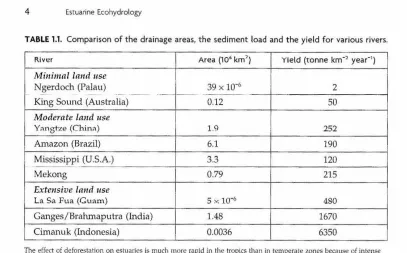
TABLE 1.1. Comparison of the drainage areas, the sediment load and the yield for various rivers.
Rivt:r Area (10' kmJ) Yield (tonne km-) year-I)
Min.imal land lise
N!!.erdoch (Pa~tI) 39 x 10-6 2
. - . - ._- - - -
-King Sound (Australia) 0.12 50
Moderate laud llse
Ya.ngtze (China) 1.9 252
Amazon (Brazil) 6.1 190
Mississippi (USA) 3_3 120
Mekong 0.79 215
Extensive lrmd use
La Sa FLla (Guam) 5 ~ 10-6 480
Ganges/Brahmaputra (India) 1.48 1670
Cimanuk (Indonesia) 0_0036 6350
The effect of deforestation on estuaries is much more rupid in the tropics than in temperate zones because of intense
rainfall in the tropics. The catchments of the Cimanuk and La Sa Fua rivers are small and profoundly modified b}'
human nrtivities. nle Ngerdoch River drains a hilly, forested nrcn. The-sediment yield is Inrgdy determined by the
climate, the topography and human (lctivitie:>, nnd i:> weakly dependent on the catchment ,.iT.e. (Dntn from Wolnn~ki
and Spagna!, 2000; S,Y\>itski el aI., 2005; Victor et aI., 2005).
1;y typically d !i:ll . .:lur vf 10 largtdy hHJ~'p~nu.~lltJy uf ci;ltchITI~nt size and Inainly
dependent on the degree of land clearing in the mountainous part of the river catchment (Table 1.1).
As a rt!sult, th~ shurdij\~ can chang~ frum sandy to muddy, diminishing
the quality of life of the population on its shore (Fig. 1.3). Increased muddiness and turbidity in the estuary result. This smothers the benthos (Fig. 1.4a) and
Llegnttle:s the ecusyst~lIl by decreasing th~ light available for photosynthesis, This
degradation is further increased by dredging (Fig. lAb) and dwnping of dredged mud within the estuary (Fig. 1_4c)_
Lanu clearing abo increa,es peak flood flows by up to 30% and decreases dry season flows, thus exacerbating flooding in the wet season and droughts in the dry season (Wolanski and Spagnol, 2000).
1
.
2
.
2. Overfishing and trawling
[image:11.596.93.500.118.371.2]Chapter 1. Introduction 5
FIGURE 1.3. The coastline of Cairns, Australia, has changed in one century from sandy to muddy
~" ::. rpsult nf l::.nn dp::.ring in thp rivpr,,' r::.trhmpnt An~rtpn frnm Wnl~n<;ki ::.nn f)llkp (JOO?)
1.2.3. Destruction of wetlands
Wetlands are infilled for harbours and marinas (Fig. l.5a), urbanisation including
slums (Fig l.5b), garbage disposal (Fig. l.5c), aquaculture (Fig 15d), end dykes for farming (Fig. 15e). Nearly all estuarine marshes have already been reclaimed
in Japan and in The Netl1erlands, willi resulting loss of organic material to
oxida-tion <'Ind burning <'IS WE'll ('IS a dE'ct'e<'lsE' of soil p1pv~tionr ~ m~jor C<'lI1$P of f1nociine
Drainage of wetlands can lead to acidification problems that result in vegetation
and fish kills (Fig. l.5f; Soukup and Portnoy, 1986).
1.2.4. Eutrophication
Thi6 is the water qu.ality degra.dation caused by excessive nutrients; lnuch of it
is derived from sewage (Fig. 1.6a) and anin1al waste from agricultural feedlots
(Fig. 1.6b). Euh'ophicated waters suffer from a significant reduction in dissolved
oxygen leading to hypoxia (dissolved oxygen concentration, DO, -< 2mg rl) and
[image:12.596.91.513.119.549.2]6 Estuarine Ecohydrology
FIGURE 1.4. Photographs of (a) a coral reef smothered and killed by eroded soil as a result of
land clearing, Airai Bay, Palau, (b) the sediment plume in the lee of a dredger, Townsville,
Australia, (c) discharging drQdgQd mud, Singaporg, (d) habit.;.t d"struction and the sediment
plume from a trawl net, Great Barrier Reef of Australia. Photo (a) was provided by R.H.
Richmond. Photo (d) is modified from Wolanski (2001).
The benthos and resident fauna die when the DO is less than 1 mg r'. When hypoxia occurs, fish, crabs, and shrimp attempt to migrate away. Human-induced hypoxia is widespread in coastal waters worldwide. In the Gulf of Mexico, the discharge of the Mississippi River creates a 'dead zone', i.e. a boltom-tagging, hypoxic water zone (DO:,: 2"'frl) of 8,000-9,000km' in 1985 to 1992, and
increasing to 16,000-20,OOOkm in 1993-2000 (Rabalais et aI., 2002). Hypoxic
waters covel' 84,000km' of the Baltic Sea and 40,OOOkm' of the northwestern
shelf of the Black Sea where historically hypoxia existed but anoxic events became
more frequent and widespread in the 1970s and 19805. Declines in boltom-water dissolved oxygen have been reported for the northern Adriatic Sea, the Kattegat
and Skaggerak, Chesapeake Bay, the German Bight and the North Sea, Long
Island Sound in New York, as well as numerous other estuaries worldwide. Addi-tionally nuisance or harmful algae blooms (HABs) are now common in many estuaries and coastal seas (Fig. 1.6c; Graneli and Turner, 2006). At times this results in severe deficits of dissolved oxygen, leading to hypoxia and anoxia and destruction of whole ecosystems as exemplified by massive fish kills (Fig. 1.6d).
The human activities degrading the Black Sea ecosystem and the Gulf of
Mexico are not just located on the coast. Instead they occur throughout the
drainage basin of, respectively, the Danube River that drains eight European
countries, and the Mississippi River that drains much of the United States
[image:13.596.93.507.104.667.2]Chapter 1. Introduction 7
[image:14.596.91.506.108.576.2](c) (d)
FIGURE 1.5. Photographs of' (a) urbanization that destroyed wetlands of the (oamera River
estuary, Gold Coast, Australia, (b) slums that have infHled wetlands along the Mekong River estuary, Vietnam, (c) a sarcocornia salt marsh near petrochemical industry in Bahia Blanca,
Argentina, that is used for garbage dumping. (d) the wet desert creating by dead and dying shrimp ponds that have destroyed mangrove forests in Chumpon. Thailand, (e) a dyke that destroyed 70% of a mangrove swamp in Trinity Island, Cairns, Australia, (f) a fish kill from acid leac:hat'p frnm t"ir:.in:lep nf;r, wptl;mri npar Ineh;r,m. Au!;tralia_ Photm. (a), (c) and (f) are courtesy
of N. Duke, R. lara and V. Veitch.
8 Estuarine Ecohydrology
FIGURE 1.6. Photographs of (a) a sewage outfall surfacinR in a 'boil' in LaRos lagoon, Nigeria,
(b) a cattle feedlot in Coalinga, California, discharging into creeks the effluent from 120,000
cattle, (c) a harmful algae bloom in Hel Harbour, Poland, as the result of eutrophication,
(d) a massive fill kill in the Neuse River, North Carolina, U.S.A., from the effluent from agnbusiness piggeries. Photos (b) and (d) arc courtesy ot R. Tuner, photo (cl is courtesy of M. Zalewski.
1.2.5. Pollution
l'ollutants include heavy metals, PCBs, radionuclides, hydrocarbons, and a num-ber of chemicals including new synthetic products including endocrine
dis-rupters associated with sewage inputs. Hydrocarbons are particularly long-lived
in muddy estuaries because they become buried in the mud and are released
slowly back to the water, degrading the wetlands and the estuary for years, sometimes decades, after an oil spill (Fig. 1.7a-b). The fate of million of tons of plastic ending in estuaries and the sea is unknown (Thompson et al., 2004). Large plastic items can at worst cause suffocation and entanglement and at
best 'only' disrupt digestion in birds, fish, and mammals. Many "bi
odegrad-able" plastics are composites with materials such as starch that biodegrade and
leave behind nondegradable, microscopic plastic fragments and fibers. These
accumulate in the pelagic zone and sedimentary habitats and are ingested by
marine organisms. The environmental consequences of this contamination are
[image:15.597.92.500.110.652.2](a)
Chapter I. Introduction 9
~.: . .
'
.
----:::;~~
... ".. .
':
~ri!-
.\
~.-~-.~
~
FIGURE 1.7. Photographs of (al mangroves in Angola. with no sign of life 16 years after an oil
spill, (b) 011 slicks oozing from the mud ill dll uil-kill~u IIldll~lUve ill Pdlldilld, UII~ dliU d !idlf
years after the spill, (c) fully silted Koorawatha weir. Australia, (d) a toxic cyanobacterial bloom near the drinking water intake in the Sulejow Reservoir. Poland. Photos are courtesy of K. Burns. Mr. and Mrs. Chanson. and M. Zalewski.
1.2.6. Dams
Dams for flood control, hydroelectricity and for water diversion for human
con-sumption and agriculture change the natural flows. In most countries, possibly all
countries of the world, the impact on estuaries is not considered 1n environmental
impact studies when datns are proposed on rivers. Thus the coastal environlnent,
coastal fisheries, and the local coastal people are regarded as expendable. For
instance, the Alqueva dam on the Guadiana River, Portugal, which forms the
largest man-made reservoir in Europe - notwithstanding Europe's envirOlunental
policies - was completed in 2003-2004 without a detailed audit of its impact on
the estuary and the coastal zone, and without any estuary remediation measures
being planned (Wolanski et ai., 2004a). Such is also the case of the Three Gorges
dam on the Yangtze River in China (Syvitski et aI., 2005). Dams not only change
the river flow rate, they also trap sediment that silts the reservoir and reduces irs
operation life. They commonly receive excess input of nitrogen and phosphorus
from human activities, which stimulate noxious cyanobacterial blooms (Fig. 1.7d).
They also starve the estuary and the coast of sand, thereby exacerbating
[image:16.597.86.514.110.448.2]10 Estuarine Ecohydrology
1.2.7. Dykes for flood protection
These shut off the natural flood plains from the rivers and estuaries. The estuarine
ecosystem is degraded by increased floods, both height and discharge, as a result of the removal of the buffering effect of the flood plains.
1.2
.
8.
Humanhealth risks
The degradaliull uf ~Slu(;ITjes lenu::; tu threats tu 11luIl(m lu::alth (Table 1.2).
TABLE 1.2. Examples of threats to human health arising from the deBradation of estuarine ecosystems.
Drivin~ force Chan~inR. ecoloRical pattern Influence on human health
Pollution from oil, Deterioration of marine Decrease in life
jndustry, naval ecosystems from expectancy, skin
opt::ratiom:i and iInbalances due to dense and eye diseases
sewage discharge ship traffic (Blackl Azov seas,
Caspian Sea)
Biologicallbacterial Effects on fish and algae Typhoid, malaria,
contamination due diphtheria (Central
tohydrological changes Asia)
Biological contamination Gastroenteritis, eye and
of surface water with skin infections (UK,
waste water France, S. Africa)
Biological and Shellfish poisoning, Poisonings, diarrhea,
chemical contamination: wildlife mortalities, dehydration,
harmful (toxic and sunlight penetration headaches, confusion,
nontoxic) algal blooms prevention, oxygen dizziness, memory
from the rapid shortages, reservoirs for loss, weakness,
reproduction and bacteria gastroenteritis, bacterial
localized dontinance of in.fections,
phytoplankton swimming-related
illnesses, neurological
diseases, deaths (Florida, Gulf States,
S. America)
Contamination: Coastal shellfish and Cholera (Peru and
cholera-contalninated fish contammation other 16 countrIes)
sea plankton due to
con tamina ted
8m
ps'hulls
[image:17.596.95.502.293.703.2]Chapter 1. Introduction 11
1.3. THE FUTURE OF ESTUARIES AND THE QUALITY OF LIFE OF THE HUMAN POPULATION LIVING ON ITS SHORES
The people living near estuaries and the coast are experiencing increasing
degra-dation of estuarine water quality and decreasing ecological services delivered
by the estuary. SImultaneously theIr expectatIOns of a high quality of life are
increasingly unrealistic and unfulfilled in view of reduced biodiversity, reduced
productivity, and reduced health of estuaries and coastal waters. Humans are Increasingly movlllg away from the possibIlity of ecologically-sustainable
devel-opment of the coastal zone.
The human impact on the ecological health of estuaries depends on several factors, one of them is water circu1ation. The water Clrculation in some estuaries
is swift and readily flushes away pollutants to the open ocean; other estuaries
are poorly flushed and the pollutants are retained. Unfortunately many estuarine
envIronments that are especially attractive lor human settlements, such as
wet-lands, lagoons, harbours, and fjords, are often poorly flushed and are thus more
prone to pollution or degradation. If the extra load of nutrients and pollutants IS sman enough and the estuary IS rapIdly flushed, the biological productIvity IS
boosted without dramatically modifying the biodiversity (Zalewski, 2002). When
the extra load of nutrients and pollutants is high or the estuary is slowly flushed, the estuary IS degraded 111 terms of water quality, ecologIcal serVIces, and
bIO-diversity. This degradation is not restricted to eshlaries, it can extend to coastal
waters if these are also poorly flushed. Eutrophication and in the worst cases
anoxIa and! or tOXIC algae blooms (red IIdes) can result, e.g. the !:SallIc Sea m
Europe and the Pearl Estuary in China (Gren et ai., 2000).
Better flushed and larger systems also suffer from environmental degradation through eutrophIcatIon, as IS made apparent by some beaches of the North Sea
being covered by foams of decaying algae and protozoa, mainly Phaeocystis and Noctiluca (Lindeboom, 2002).
In extreme cases, estuanes have essentIally become Industnal draIns that are also used for navigation. Such is the case of tbe Pearl Estuary in China and the
Saigon River in Vietnam (Wolanski, 2006a).
ThIS degradatIOn extends 111 coastal waters to seagrass and coral reefs. The percentage of dying reefs is highest in countries with widespread land clearing (50% in Taiwan and Vietnam, 35% in the Philippines; Bourke et aI., 2002). On
a global scale, reefs are as much threatened by pollutIOn from land runoff as
by coral bleaching due to global warming, overfishing and destructive fishing
(Fabricius, 2005; Spalding et aI., 2001).
Unlll now, the solutlOn was belJeved to depend on reducmg the amount
of waste and relying on hard technology, namely the construction of sewage
treatment plants and the modification of farming practices and technology. While this has restored sonle ecological ftmctions in the Rhine and Thanles estuaries,
this technological fix has not restored the ecological health of estuaries in both
developed and developing nations worldwide.
The reasons for failure are simple. Firstly, integrated coastal zone
12 Estuarine Ecohydrology
commonly fail because they deal only with local, coastal issues, and do not co
n-sider the whole river catchment as the fundamental planning unit. It is as if
the land, the river, the estuary, and the sea were not part of the same system.
When dealing with estuaries and coastal waters, in most countries of the world,
possibly all countries, land-use managers, water-resources managers, and coastal
and fisheries managers do not cooperate in practice due to administrative, ec
o-nomic and political constraints, and the absence of a forum where their ideas and
approaches are shared and discussed. A typical case is the river disposal of waste
from industrial swine and poultry production in North Carolina that is basically
not treated nor regulated, possibly because it is seen as neither urban nor rural
waste, and this waste pollutes whole estuaries (Mallin, 2000).
Secol1dly, estuarine environment degradation is often seen as 'normal' and
nothing to be alarmed at. Most people do not demand better ecosystem health
and services, possibly because in poor countries there are no resources to restore
the estuarine health, and ecological issues and quality of life come second to
economic development. In wealthy countries people have not seen their estuaries
in a pristine, healthy state and many believe that what they see is normal. Thirdly, and most commonly, solutions are simply not applied because of
socio-economic constraints but as well because of the inadequacy of national
policies, planning and management structures.
Fil1ally, there is still no cost-effective technology and political will to treat efflu
-ent from diffuse sources in rural activities, except possibly by using wetlands as
filters, a practice that is effective but rarely used (Moore et aI., 2000, 2001 and 2002).
1.4. THE SOLUTION
The problem remains w1fesolved as to how, using only limited financial resources,
to preserve, restore and manage critical habitats, and reduce the load of nutrients,
sediments and pollutants in the face of increasing human population and its
aspirations.
The solution is to adopt ecohydrology as the prinCiple to guide the man
age-ment of the entire river basin from the headwaters down to the coastal zone
(Wolanski et aI., 2004a). Ecohydrology is not wishful thinking of recreating pris
-tine estuaries in spite of huge human populations living on their shores. It is
instead about manipulating estuaries using a combination of physical and bio
-logical interventions to increase the system robustness and its ability to cope
with human stresses, while regulating human activities on land when necessary.
Ecohydrology must be used in parallel to socio-economic imperatives to prevent
managers to hide behind 'manufactured uncertainty' leading to a do-nothing
philosophy that has prevailed for hundreds of years and has led worldwide to
estuarine and coastal water degradation.
Ecohydrology is more than integrated river basin management. It provides
for low-cost teclu10logy for mitigating the impact on the coastal zone of human
activities throughout the river basin, using or enilancing the natural capacity of
(a)
,.
,.
..../
\,
, , .-.'-' ... ~.
..
,...
-.~./~. ", biota(hininoy)
~
....
ecosystem
health
"'. ' -'.'. _.p'"
(b)
Chapter 1. Introduction 13
eSluarlM , wllilunds - , ' _
/ : i';' ... ' I If"
.... f~ .. ,.... rivElrine :
,',,, wcllands :
,
,
,
.
• l' \
I ~ \
: ~_ catchment
: ,',' lloundllry
'. ./
...... ..~' ...
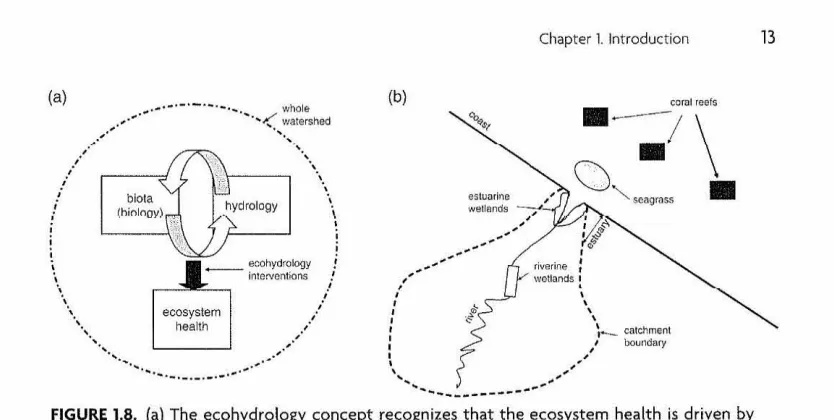
_---FIGURE 1.S. (a) The ecohydrology concept recognizes that the ecosystem health is driven by
links between the biology and the phYSICS, that human activities In the ent1re river catchment
need to be considered, and that the best course of action is to manipulate the system to reinforce its ability to cope with human stresses. (b) The ecosystem does not stop at the tidal limit. It comprises the whole river cCltchment including thlil riVGr Clnd it, riverinQ wQtlands, the estuarine wetlands, and the seagrass and coral reefs in coastal waters. The concept applies also to temperate estuaries where there are no coral reefs but there may be limestone reefs.
human activities. Ecohydrology views the whole river basin as an ecosystem from upland waters to the seas (Fig. 1.8).
The existing i;uJrniIlistrative/urgartiZi:l.t1Ulli:l.luli:l.lli:l.g.elltelll fl'i:l.lItework fUl' es tu-aries is excessively complex and cumbersome to use in practice. For instance there
are at least 54 legal guidelines, acts, laws, and treaties regulating the management
uf Sl.:utt.i::;lt e~tudries (Mt:Lusky dlU.l Ellioll, 2004), This crei:lles duplicalion,
frag-mentation, and confusion in environmental control. Without the unifying theme
of ecohydrology, there is no commonality between the various users/needs and
tILl:' llIi:l.lly i:l.~ellcie~ dllU llli:l.lldbelllenl LUllunilLt::es [01 huntan activities in estuaries
and in the river catchment.
Environmental degradation can only be remedied by restoring some of the
working of the ecosyslelll, helpifl.g lhe partially reslored systenl inlprove itself
naturally, and improving the robustness of the ecosystem and its ability to absorb human stresses. Some of the aquatic ecosystem functions can be restored by a c0111binaliol1 of engineering, hydrology, eco1ogy and phytotechnology (Le. using plants) solutions to improve the robustness of the estuarine ecosystem. The robustness of the estuary is controlled both by a number of parameters,
including the residence Linle, lhe estuarine food webs within the wl'tter coiuInn,
and the buffer effect and the habitats provided by the fringing wetlands (prin-cipally mudflats, saltmarshes and mangroves). In the estuary it is generally not
possible to use only engineering solutions to solve environmental degradation
problems, though in some cases it is possible to diminish the residence time by
dredging, opening new river mouths, and, for dammed rivers, creating artificial
river floods to restore SOlne key natural processes (e.g. seditnent fluGhing; sca
[image:20.596.91.508.109.319.2]14 Estuarine Ecohydrology
biotic integrity. Restoring intertidal wetlands, seagrass and coral reefs is one such key option. For non-robust estuaries the health of the estuary can only be restored by adopting a basin-wide ecohydroJogy solution. This solution requires (1) regulating basin-wide hwnan activities that impact on the river, and (2) manipulating the river ecosystem to decrease its impact on the estuary (Wolanski
et aI., 2U04a). The only option available to restore environmental health 01 the coastal zone (e.g. in the case of toxic algae blooms and dead zones from hypoxia and anoxia) is to adopt a basin-wide ecohydrology solution.
1.5. ECOHYDROLOGY SCIENCE: THE STRUCTURE OF THIS BOOK
It is only after acquiring a sound understandi.ng of an estuary as an ecosystem
that the scientist can confidently propose ecohydrology solutions for managing an
iii;
riverEstuary
coast
coastal wators
tide limit
~ mudflat
IiiTM (.U:IU:uy turbility ma)(lmum
::> H (human health)
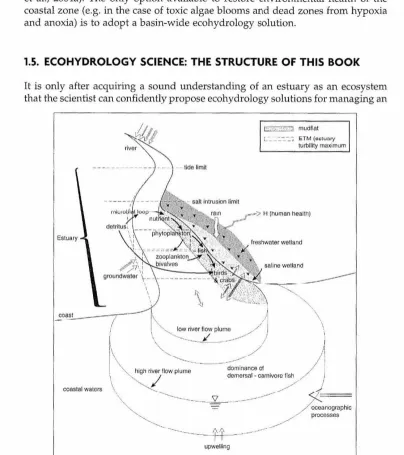
FIGURE 1.9. Sketch ot the dominant pathways of water, fine sediment, nutrients, and plankton
[image:21.596.96.500.224.679.2]Chapter 1. Introduction 15
estuary in an ecologically sustainable manner. By this process, and probably only
by this process, humanity can get away from looking for purely technological
solutions. These have failed throughout human history to maintain e.shlarme
ecosystems and the ecological services that they provided to humanity.
This book provides the public, engineers, scientists and resources managers,
the eeohydrology viewpoint of an estuary as an ecosysteln. This is done by
focusing on its principal components that are the river, the estuarine waters, the sediment, the nutrients, the wetlands and the aquatic food web. The dominant
pathways are shown in Fig. 1.9 and will be described in chapters 2 (estu
ar-ine water circulation), 3 (estuarine sediment dynamics), 4 (estuarine wetlands), 5 (estuarine food webs), 6 (estuarine ecohydrology modeling), and 7 (ecohydrol
-ogy solutions), The aim of each chnptcr is to provide clear, specialist knowledge
to enable an interaction between aquatic, marine, and wetlands biologists, geolo-gists, geomorphologists, chemists, modelers, and ecologists. This book recognizes
that the feedbacks between physical rmd biological processes control the health
of the estuarine ecosystem. Therefore each chapter has been written to focus on the dominant processes relevant to the internal workings of the estuarine
ecosystem. This book views an estuary (Fig. 1.10) from the pOll,t of view of an
ecosystem influenced by both human (land use and water management) and
nat-ural (hydrology, meteorology) factors in the river catchment, and by an oceanic
influence driven both by the physics and the biology.
This book provides a holistic understanding of an estuary as an ecosystem.
It demonstrates how, based on an understanding of the processes controlling the
estuarine ecm:;yoten1 health, one can quantify, or at leCtot qualify, thc robu:Jtness of an estuary - i.e. its ability to cope with human stresses - and how to improve
this robustness. Robustness varies from estuary to estuary. This is the knowledge
needed to be able to design a Inanagement plan for ecologically sustainable
development of an estuary, including remediation measures if the estuary is
already degraded.
river catchment -natural: hydrology & meteorology -human: land-uco, wator manage mont
D
estuarine and coastal water ecohydrology
oceanic influence (physics & biology)
FIGURE 1.10. The estuary and coastal waters as an ecosystem influenced by both natural and human processes In the river catchment, and by an oceanic Influence compriSIng both physics
[image:22.596.126.383.514.671.2]