WORLD PUBLIC RELATIONS FORUM 2012
Information seeking in a disaster – an extended abstract
Barbara Ryan, University of Southern Queensland
Introduction
This presentation comes from my PhD research, for which I completed the data collection in September 2012. My thesis researches information seeking in a disaster. I have focused on the impact phase of disaster, although my research, particularly the interviews, has gathered some information on the warning phase, particularly in slow moving disasters like cyclone and slow flood.
The purpose of my study is to…
…address the gaps in knowledge about how people get information in a disaster and what they want to know.
The literature on information seeking in a disaster…
…really starts with human behaviour in a disaster, which Mileti’s model of warning response summarises:
1. Receiving a warning
2. Believing the warning is credible – warnings can often be disbelieved because it is out of the realm of experience of the subject, something called normalcy bias, which is emerging around Hurricane Sandy where the storm, and its subsequent series of smaller disasters, was outside the experience of most people
3. Confirming the threat – checking with others, in the media or going out to have a look
4. Personalising the threat – trying to work out how it will affect onself, family and property
5. Determining whether protective action is needed 6. Determining whether protective action is feasible 7. Deciding what action to take and taking action.
Information seeking behaviour research was not seriously undertaken until the WTC attacks, with most literature to that point focusing on media or web usage rather than information networks as a whole. There is also far more literature on disaster warnings than post-impact communication or information seeking. The bulk of literature touching on communication comes from agency perspectives, which very similar to the crisis communication research picture.
However, 9/11 changed all that, with a number of very good studies undertaken within two months of that disaster in the US by university-based researchers. Then came a series of projects sponsored by the Centres for Disease Control in which focus group respondents were presented with scenarios on bioterrorism, and terrorism involving radio active materials. In these studies, people were asked to outline their information seeking pathways and also to recount their feelings about what was happening, confirming a link between information seeking rates and anxiety levels.
JCU on cyclones, but these covered wider topics than information seeking, just producing a few gems related to the topic within each study.
What emerged from the literature?:
- People in communities with strong social ties, such as small rural communities, were more likely to find out about a disaster from other people.
- People will learn about the disaster and then go looking for more information before deciding what to do.
- However, people with strong disbelief systems will go about their business – such as during the tsunami warning in Australia in 2007 and Hurricane Katrina, where the population had lived unscathed through a number of big ones. There could be a correlation between this point and the next…
- Visual confirmation as the disaster approaches and arrives is important in the information seeking process, particularly among men.
- The internet will play an important role in the confirmation stage depending on pre-disaster internet access rates.
- The sources people use most will depend on the disaster: o Radio and TV for cyclone or hurricane
o Radio and other people for bushfire
o Visual confirmation and radio for slow moving flood o Visual confirmation and other people for tornado o Other people and television for flash flood o Other people via mobile phone for earthquake
- Urban populations are more likely to use television for information about a disaster - Rural populations are more likely to use radio and other people
- Time of day will also affect the sources used
- Social media seems to be a source of growing importance, but no evidence yet for use in a disaster apart from people outside disaster zones checking on friends and family. - Older people are more likely to learn about disasters from TV while younger people
will learn about it from other people and much later than older people.
- People will want to know first where the disaster is and where it is moving to, and then how to get their family together and safe.
Design: This research considers information seeking pathways and sources during the impact and dislocation periods of a disaster. It uses an information seeking pathway framework developed by Savolainen (1995; 2008).
Interviews were conducted in four Australian communities within 12 months of those communities experiencing a disaster:
- St George in western Queensland, which experienced slow flood - Toowoomba in southern Queensland - flash flood
- Gerogery, near Albury in NSW – bushfire
- Airlie Beach between Mackay and Gladstone - cyclone
51 people were interviewed and were asked how they heard about the disaster, where they then went for more information, what their most used source of information was and what type of information they were seeking. Interviews were conducted between October 2010 and August 2011. Interviewees were recruited by snowball sampling and attempts were made to reflect the demographic of the community in the interviewee sample.
1975 copies of the surveys were letterbox dropped in Wilsonton in Toowoomba and Gailes in Brisbane, both suburbs that reflected missing demographics in the interviews.
Background:
On December 17, 2009, a fire started at the rubbish tip at Walla Walla, 30kms north of Albury, NSW. It was a high fire danger day at 37 degrees Celsius, 10% humidity and winds of 45-60kph and the fire made its way south east to the community of Gerogery, traveling 11kms in one hour (Alexander 2010). Five homes were destroyed, 5,500ha were burnt, a large number of cattle and sheep lost and two firefighters injured ('Fire whirl: The startling Riverina bushfires' 2010).
In south western Queensland, the Balonne and Moonie River systems flooded in March 2010. The flood particularly affected the Balonne Shire community where the Balonne River
peaked at 13.28m at St George on March 6 (Norman 2010). Twenty houses were inundated and the hospital and aged care home evacuated.
Just over two weeks later on Saturday, March 21, category 3 Cyclone Ului crossed the coast at Airlie Beach, passing directly over the town at 1.30am (Bureau of Meteorology 2010). About 30 homes and buildings were damaged, 60,000 households were left without power.
In 2011, a wet summer followed by a heavy rain period resulted in dramatic flash flooding through the mountain city of Toowoomba in Queensland on January 10. Two people died when their car was washed away from a major intersection, and the world saw dramatic water rescues of other people (Holmes, Sullivan & Cummins 2011, pp. 26, 230).
The population of the predominantly agricultural Balonne Shire, in which St George is the major centre, is 4,627 (Australian Bureau of Statistics 2007a). The farming community of Gerogery has a population of 979 (Australian Bureau of Statistics 2007b). Airlie Beach is a tourist town and has a population of 2,751 (Australian Bureau of Statistics 2007c).
Toowoomba has a population of 95,000 people and is an education, health and agricultural centre for the lower portion of western Queensland (Australian Bureau of Statistics 2010). The breakdown of interviews was: St George 13, Airlie Beach 11, Gerogery 13 and Toowoomba 14.
Interview Findings – where people found information: The type of disaster determines both how people first hear about the disaster and how they then seek information.
Bushfire
At Gerogery, the most prevalent primary source of information was other people on mobile or fixed line phone, followed by visuals (seeing the smoke). All of those interviewed at Gerogery checked the smoke regularly during the course of the disaster. Every interviewee contacted other people for information and to pass on information. Nine of the interviewees did not listen to radio at all. Four people turned eventually to radio, listening to ABC local radio, Radio 104.9 and 2AY. Each commented on the inaccuracy of the geographic information and/or the lack of currency of information.
Of the people interviewed, only people in the unaffected Gerogery West area received the automated text/phone messages.
information but that people rang them on mobiles and from those calls they received a form of update.
Cyclone
The largest group of interviewees at Airlie Beach first heard about the cyclone via radio, although this was just over one third of the group. The Bureau of Meteorology was a critical source of information for many of the interviewees from Airlie Beach before the cyclone, with radio becoming the preferred source for ongoing information, particularly post-impact. Radio selection at Airlie Beach was predominantly ABC local radio and SEA FM, evenly spread between respondents.
Information seeking at Airlie Beach stopped either when the power went out late on Saturday March 21 or when radio stations stopped giving live bulletins late at night. Information seeking generally started again the next morning after interviewees had looked around outside after the impact. From that time, radio was the most popular source and those that used radio commented that reporters on the ground and call-ins from people around the area gave them the most valuable information that allowed them to construct a picture of the damaged area and then put into context some time frames for restoration to normality.
Slow flood
In St George, people first heard about the flood from a number of sources but because it was a long expected event, could not remember which source they first heard about it from. Many realised that the river would flood as they saw the water get higher or heard of more rain in upper catchments, then sought information from other people and personal agency contacts, and returned to those sources for regular updates. Agency sources were reported by four people as their confirmation point and six interviewees used agency sources as a constant source. Other people were also a constant source.
As with the bushfire, visuals were an important confirmation tool during slow moving flood. ABC local radio was the main secondary source, although five of those who used radio commented that it was either behind the times or concentrating on the Balonne River with no news of the Moonie. For those isolated from St George but still on the Balonne River, the ABC was an important source of information, particularly those without power.
A number of people reported seeing or hearing of a flood map distributed by Balonne Shire Council. The map was helpful and seemed to contribute to the need for visual confirmation that emerged as a theme across all four disasters.
Flash flood
In the flash flood, the majority of interviewees (10) first heard about the flood from friends, family, neighbours or work colleagues via landline, mobile phone and social media and the remainder learned about it from television news. Once interviewees had learned of the flood, television was key to understanding what happened, but unlike the other disasters, their main source changed after about 24 hours because of the repetition of information coming from television and in some cases, the discovery of official social media sites. Main sources became more diverse - websites, radio, social media and other people.
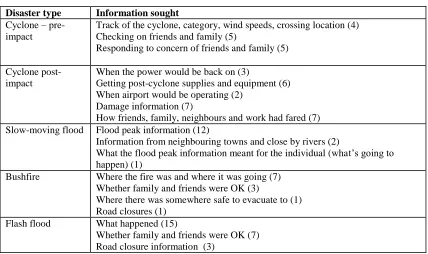
including location of safe places, road closures, how workplaces fared, when the power would be back on, when other places would peak (in the case of a flood).
Table 1 - Information sought
Disaster type Information sought Cyclone –
pre-impact
Track of the cyclone, category, wind speeds, crossing location (4) Checking on friends and family (5)
Responding to concern of friends and family (5)
Cyclone post-impact
When the power would be back on (3)
Getting post-cyclone supplies and equipment (6) When airport would be operating (2)
Damage information (7)
How friends, family, neighbours and work had fared (7) Slow-moving flood Flood peak information (12)
Information from neighbouring towns and close by rivers (2)
What the flood peak information meant for the individual (what’s going to happen) (1)
Bushfire Where the fire was and where it was going (7) Whether family and friends were OK (3)
Where there was somewhere safe to evacuate to (1) Road closures (1)
Flash flood What happened (15)
Whether family and friends were OK (7) Road closure information (3)
Preliminary survey findings:
302 people responded, 277 online and 25 in hard copy. Despite this reasonable size, there were bias problems in the sample, with largest group of respondents people from my demographic – educated females, aged 40-55 years. Even the hard copy survey, which was designed to target people from more disadvantaged socio economic groups and men, did correct this bias as much as I’d hoped. The bias was most likely caused by the convenience sampling approach – budget and time prevented me from securing a true random sample.
The largest group of respondents that had disaster experience were flood-related, but for those who hadn’t experienced a disaster, I asked them what they thought they would do, and should be able to make comparisons between the action and intentions.
- 79.8% Australian
- Majority of Oz respondents Queenslanders - 79.6% female
- 55% experienced disaster in past two years - 82.5% of the experienced were via floods - 6.9% younger than 25
- 19.7% 25-39 years - 39.4% 40-55 years - 26.6% 56-70 years - 7.3% 71 or older
Practical implications:
Mobile phones of critical importance!
Radio needs to be more carefully used, and local knowledge incorporated better.
Word of mouth needs to be tapped into by agencies with mobile phone networks critical to this. Radio should be more proactively used and maps should be a feature of flood
communications. Social media may be more accepted and should grow in importance as a source, particularly in disasters since the January 2010 floods in Queensland.
Originality and value: The focus of disaster communication research has been on the individual’s use of single information sources such as mainstream media or social media, or how agencies have communicated rather than looking at the suite of information sources used. From this research, agencies should be able to develop effective communication strategies.
Research limitations: Interview participants made up a small sample, skewed toward regional areas. They were selected by convenience sampling. In the interviews, disadvantaged demographics (ie those with lower levels of education or income, or the disabled), people aged 18-25 and multicultural populations were under-represented. It is hoped that the survey will correct this.
Keywords: flood, bushfire, cyclone, radio, information-seeking, information source, social media, communication, emergency, disaster.
Alexander, G 2010, Gerogery bushfire, Interview edn, Albury, NSW, 28 June.
Australian Bureau of Statistics 2007a, 2006 Census QuickStats: St George (Qld), Australian Bureau of Statistics, Canberra.
---- 2007b, 2006 Census Quickstats: Gerogery, Australian Bureau of Statistics, Canberra.
---- 2007c, 2006 Census Quickstats: Airlie Beach, Australian Bureau of Statistics, Canberra.
---- 2010, National Regional Profile: Toowoomba (Statistical Subdivision), Australian Bureau of Statistics, Canberra.
Bureau of Meteorology 2010, Severe Tropical Cyclone Ului, Bureau of Meteorology, viewed 15 June, 2010 2010.
'Fire whirl: The startling Riverina bushfires', 2010, Bushfire Bulletin: the journal of the NSW Rural Fire Service, vol. 32, no. 1, pp. 4-6.
Holmes, C, Sullivan, J & Cummins, P 2011, Queensland Flood Commission of Inquiry: Interim Report, Queensland Government, Brisbane.
Norman, S 2010, St George floods 2010, Interview edn, St George, 1 June.
Savolainen, R 1995, 'Everyday life information seeking: Approaching information seeking in the context of "way of life"', Library & Information Science Research, vol. 17, no. 3, pp. 259-94.