Geared for action
Developing the generic financial advice service
Executive summary
1
1 Policy context
3
2 Engagement
6
3 Demand management
34
4 Branding
45
5 Recommendations
54
Further information
59
Acronyms used in this report
60
1
Executive summary
The Thoresen Review team asked the National Social Marketing Centre to examine how effective engagement, brand development and demand management could help deliver a generic financial advice service. In this report, we set out 21 recommendations for action related to these three key elements of service delivery.
The GFA service needs to be a long-term commitment. Its delivery must be underpinned by clear, measurable goals, a compelling message, and a service offer based on a rich understanding of those the service is trying to reach.
Similar to the process the Thoresen Review team has already taken in testing out the concepts in the prototypes to refine the blueprint and design, we recommend this blueprint needs a one year full development phase and we would expect this to be underpinned by a marketing budget in the region of £4 million. This phase will enable a good knowledgebase to be built, researching, testing and piloting the service before national roll-out.
Building on the research-test-pilot approach will also help predict likely demand and enable whoever is responsible for service delivery to create operating procedures for a clear and consistent service that people will recommend to others.
The GFA marketing strategy needs to be developed by experienced marketing professionals. Specialists should be sourced as a priority for key areas, including:
• strategic objective setting; • further segmentation research; • brand strategy;
• new media strategy;
• stakeholder management strategy; • telephone advisory services; and • an evaluation strategy.
We recommend a balanced and sustained deployment of above- and below-the-line marketing spend to ensure maximum success. Above-the-line techniques use mass media to promote brands. Below-the-line techniques can also help build brands, but may also be used for direct response or to stimulate purchase at
point-of-decision. They can include activities such as direct mail and sales promotions, for which a fee is agreed and charged up front.
A ‘one size fits all approach’ should be avoided; instead, the marketing mix and service delivery should be tailored to key population segments (already identified in the Interim Report), once again on the basis of extensive field piloting. You have already asked your geodemographic supplier, Experian, to work up solutions based on this baseline data. You also have a package of research completed on the 12 segments: focus groups, qualitative research with prototype users and quantitative research with control groups. This could be linked to geodemographic mapping to give you a universal yet still segmented audience based on reported attitudes and behaviour. This will give you a more precise tool for understanding the different groups and creating and delivering tailored solutions for each group.
We recommend you draw on a range of experts, including financial capability, financial inclusion and financial advice professionals from all sectors to refine the content of the GFA service and to consumer test it based on evidence from prototype testing. During the development phase, there is a need to make explicit:
• the service that is on offer; • the extent of its remit; • what it can’t do;
• how people can influence how the service is delivered; and
• how they can complain, if necessary.
The days of ’the answer is an advert: now, what was your question?’ have gone. The GFA service will be launched in an era of complex multi-channel and multimedia solutions. Those delivering the service will need to plan for multi-agency, multi-channel delivery. When establishing the implementation team, these requirements need to be factored into management structures and contracts.
The GFA brand promise (we are on your side, we’re not trying to sell you anything, and we’re free) is very attractive, but delivering it means that trust in the impartiality and integrity of GFA is vital. The GFA service delivery agent needs to manage very carefully the choice of partners, and there is a need to articulate clearly the roles of stakeholders, intermediaries, delivery partners, funding partners and referral agents. It will be necessary to build on the Review’s ideas for accreditation and service outcomes by explicitly setting out the standards of conduct you require of partners, how these will be policed over time and the consequences of non-compliance.
We recommend that, as part of the next development phase, you draw up a comprehensive mapping of delivery, promotion and referral partners based on how the GFA service is to be positioned against other public and private sector generic (and preventative) advice offerings.
The GFA brand should be shaped by the needs of the communities GFA will serve. Literacy levels amongst some communities are low. Communications should be guided by extensive market testing and, for example, avoiding words like ‘finance’ in favour of ‘money’. For some communities, it may be necessary to find an alternative to literature-based communications. We recommend briefing a specialist branding agency to create a layered GFA brand – a simple memory trigger, underpinned by details of the functional service offer and emotional benefits, such as the joy of financial worries solved and the happiness of feeling in control.
The GFA brand promise must be met by efficient brand delivery. The tone of GFA communications must be backed up with motivational internal marketing amongst all suppliers, intermediaries and partners to ensure that what is promised is delivered. For example a ‘helpful and friendly’ brand promise must be matched by consistently helpful and friendly delivery.
On completion of a full development phase and the production of a full business case, there should be a phased, regional roll-out of the service across the country. This will allow you to better control any over- or under-heating of demand.
3
1 Policy context
1 Policy context
Financial
inclusion
Financial Services
Industry
Financial capability
(including GFA)
Cross
referral
Positioning
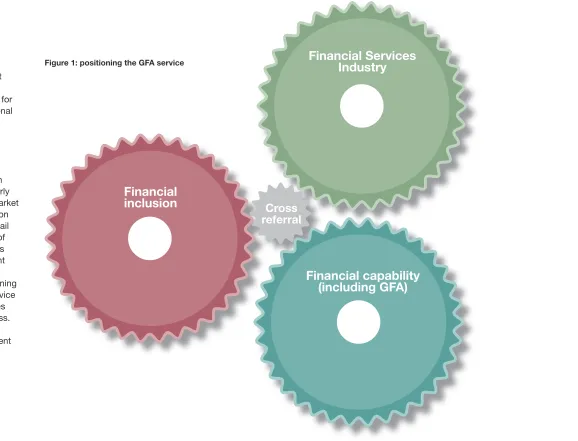
[image:6.842.211.789.83.524.2]Clarity on how a GFA service will fi t with the other major drivers of the Government’s long-term approach for fi nancial capability, including personal fi nance education in schools, and complement the FSA-led National Strategy for Financial Capability, is important for stakeholders as well as users. You should also be clear about where the GFA service sits in relation to wider services, particularly regulated fi nancial advice, other market developments and fi nancial inclusion initiatives. Ongoing work on the retail distribution review, the expansion of fi nancial inclusion work into savings and home insurance and the advent of price comparison websites are important considerations in positioning the service. Marketing the GFA service as complementary to these services is important to its long-term success. Figure 1 illustrates how the GFA service interconnects with the current landscape.
5
Co-ordination
Where necessary (and possible) strong co-ordination between all these programmes will be required to avoid duplication, provide consistent messages, benefit from referrals between services and ensure delivery partners can work on more than one of these areas, where appropriate. Practical measures, such as the implementation of clear protocols for referrals between these services and consistency in the look and feel of consumer materials and contact points, will be necessary to ensure the long-term success of the GFA service.
Joint learning and resources
There is scope for the GFA and other financial capability and inclusion organisations to share learning on working with intermediaries, engaging different target groups, service delivery and joining up central programmes at a local level. The new financial inclusion champions, the face-to-face debt advice work of the Department for Business, Enterprise and Regulatory Reform (BERR) and the money advice projects of the Learning and Skills Council (LSC) will all provide important insight. Other resources, such as the financial capability baseline survey, will also be useful as potential measures of the GFA service’s progress.
New developments
Future developments, financial service industry or government initiatives as well as market forces are all likely to affect demand for the GFA service. Managing demand from such developments will present a challenge for the service. Ongoing horizon scanning and assessment of what this will mean for the service will be necessary.
Conclusion
2 Engagement
Ensuring effective
engagement
These are the ten most important characteristics for designing effective engagement interventions1:
1. Ensure interventions are consumer-focused and driven by theory, evidence and research.
• Understanding of the everyday lives and aspirations of the audience is essential.
• Use theory to ground and inform development learning from previous work.
• Draw from a wide range of different types of evidence. Look beyond the visible iceberg of published evidence to evidence locked in the experience and expertise of practitioners and communities themselves.
• Use a range of research methods to get a rounded understanding of what people do and why they do it.
2. Ensure explicit behavioural goals are in place.
• Make sure that it is possible to express the overall aims of the work in terms of specific behaviour (i.e.: as behavioural goals).
• Avoid reliance on broad and general behavioural goals and instead tailor these to specific sub-groups and segments of the population.
• If there is a need for information, knowledge and awareness goals make sure these can be directly linked to an impact on behaviour – otherwise avoid them.
3. Use segmentation to tailor approaches to different customers.
• Go beyond traditional targeting approaches that rely heavily on demographic and observational data.
• Broaden the approach to use more developed segmentation approaches that include use of psychographic and other data, to develop a deeper understanding of what people feel, think and believe about their lives and the specific issues being considered.
• Avoid blanket messaging. Instead tailor approaches to the different needs of different sub-groups.
4. Use combined approaches (don’t rely on single methods).
• Use multi-intervention approaches.
• Systematically consider the use of the four primary domains of influences:
o educating, informing, building awareness;
o servicing, supporting and practically assisting;
o designing and altering the physical context; and
o requiring, regulating, legislating and controlling.
• Avoid focusing on the individual in isolation. Address the wider social context and wider determinants to address factors outside of the individuals direct control.
5. Work to actively engage individuals and communities.
• Recognise that engagement is far more important than communication.
• Active involvement strengthens development, delivery and evaluation of any intervention.
• Build ‘social value’ into interventions to strengthen the meaningful and valued benefits of the intervention.
6. Invest in multi-sector partnership and mobilising ‘delivery coalitions’.
• Partnership working significantly extends the capacity and capability of interventions.
• Partnerships bring different
perspectives, intelligence, evidence and expertise that can significantly enhance customer understanding and insight generation.
1National Consumer Council (2006), It’s our health: the National Independent Social Marketing Review report, June 2006.
Case study: working in partnership and measuring outcomes Home Office: Vehicle Crime Reduction Action Team
In 199 vehicle crime – theft of and from vehicles – was still the largest single category of recorded crime, accounting for 24 per cent of all crime. In this year the Home Office set up a crime reduction action team to address the government’s target of reducing this type of crime by 30 per cent between 1999 and 2004, a proposed reduction of 31,000 offences.
Partnership activity was a key aspect of the subsequent strategy, and operated at a number of levels. The team set up a specific task group among motoring manufacturers and retailers. A private sector agency was appointed to seek other appropriate partners, who included the AA, the RAC and Halfords. Local partnership activity was co-ordinated by crime prevention officers, and at a national level the Home Office worked with the Association of Chief Police Officers and the Department of the Environment, Transport and the Regions to create a 14-point plan.
Another major strength of the initiative has been the ability to measure outcomes: the team has collected and monitored tracking data.
Unpublished crime data submitted by local police forces gives a detailed and up-to-date picture of car crime across the country. The British Crime Survey also provides a
high-quality data set, giving a nationally representative picture of trends in experiences and perceptions of vehicle crime.
Since the peak in 1995, both the British Crime Survey and police figures show that the number of thefts has fallen considerably. The number of vehicle-related thefts fell by eight per cent between 2004/05 and 2005/06.
7. Commit to a sustained approach, that mobilises resources and assets.
• Avoid isolated one-off interventions. Ensure all smaller-scale time-specific interventions are developed and framed in the context of a broader, longer-term strategy or approach.
• Don’t focus exclusively on financial resources. Build human skills and capacity and work to mobilise communities to help themselves.
• Don’t just focus on ‘deficits’ and problems. Instead, frame interventions around mobilising assets and building latent strengths and capacities within individuals and communities.
8. Use an integrated model to connect national, regional and local efforts.
• Connecting interventions at different levels can significantly enhance potential impact and effectiveness.
• Focus on building links, connections and synergies between work at different levels. Recognise that this will take time, effort and some resources.
9. Build a ‘learning and reflective’ culture.
• The greatest resources available are the people, communities and practitioners involved.
• Valuing and sharing the evidence for effectiveness that rests in people’s experience and expertise is important for strengthening and sustaining work and for motivating people.
• A great deal of evidence and learning never gets published but should be shared in other ways.
10. Invest in coordination (it won’t happen spontaneously).
• Organising and planning interventions can be complex, and investing in coordination is critical.
9
Engagement –
the ‘must haves’
Engagement delivers benefits. Gallup’s research suggests that for all kinds of companies, fully engaged customers – those who score in the upper 15–20 per cent on Gallup’s measure of emotional engagement – deliver a 23 per cent premium over the average customer in terms of share of wallet, profitability, revenue and relationship growth.
Organisations have to be committed for the long term. One of the key mistakes often made by public sector marketing efforts is that organisations want to win the battle and the war in one step, when the evidence tells us this is not the way it works. They often build campaigns and initiatives on assumptions rather than tested, well-honed strategies. They sometimes think that the issues they are dealing with are too complex for simple, concise messages.
In preparing this report, we examined factors that underpinned successful campaigns – and those that were likely to bring failure. We conclude that there are at least three ‘must haves’ for the GFA service, each of which is discussed in more detail below:
1. Clear, measurable goals.
2. Extensive knowledge of the target audience and what moves them.
3. Compelling service offers and messages that connect with, and deliver real benefits to, the target audience.
1. Clear, measurable goals
We all know the importance of setting out clear aims and objectives. Yet too often we start campaigns and engagement strategies without clearly setting out what success will look like, what precise behavioral goals we have and how we are going to measure progress. The GFA service will need to set unambiguous targets that relate to each stage of the AIDA model.The AIDA model
AIDA is an acronym for: awareness, interest, desire and action: it forms a well known model for engaging audiences, and was developed by Howard and Sheth in 19692. The AIDA model has been used to shape many advertising and marketing programmes in the public, private and third sectors. It sets out four processes that people
need to go through before they actually take up a new service.
The first stage involves consumers being aware of what is being offered. This requires an organisation to spend on awareness-raising through advertising and marketing promotions.
The second stage is personal interest: organisations aim to get people to believe that a service may be helpful to them. Again, at this stage, advertising and marketing promotions are the main communications channels, but organisations can also exploit social networks and PR.
The third stage is desire. At this stage it is necessary to convince consumers of a service’s advantages and that it can satisfy their particular needs. Typically, media, PR and direct marketing will all need to be applied.
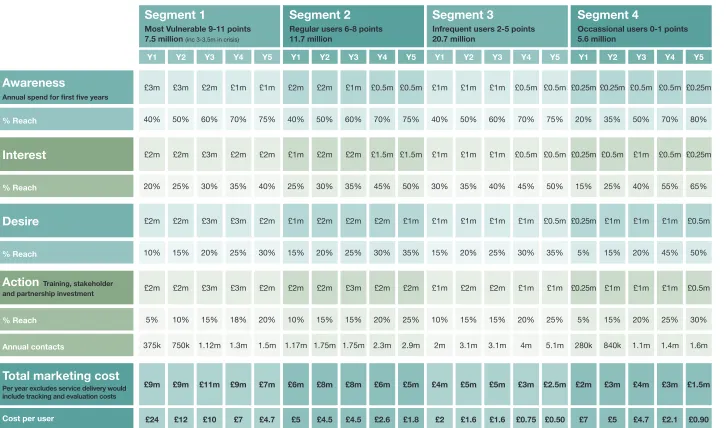
In the last stage of the model, consumers take action: organisations need to convince consumers to use the service and support them in doing so. Excellent marketing materials, word-of-mouth recommendations, ease of access, good follow-up of any ‘hot prospect’, an adequate response to people who express an interest in the service and excellent delivery are all key. We have set out an AIDA investment table for the GFA service (see p.28). But we also recommend that you develop a clear set of key performance indicators (KPIs) for each of the AIDA stages, in conjunction with key partners, stakeholders and intermediaries. Such a process has recently been completed by DEFRA in its plans for the new environment strategy.
2Howard, JA and Sheth, JN (1969), Theory of Buyer Behaviour, New York: Wiley.
Possible KPIs for each AIDA stage
of the GFA marketing strategy
Awareness
• Knowledge level of GFA existence
• Recognition and recall levels of GFA brand, key slogans and straplines
• Correct identification level of GFA service offering
• Positive disposition towards GFA service offering
Information-seeking
• Attitude to finding out more about GFA
• Web searches for GFA
• Telephone directory enquiries for GFA
• Number of enquiries through other routes
Decision to act
• Positive attitude towards contacting GFA
• Ease of access and response rating
• Number of people accessing stakeholder and intermediaries services
Action: visiting GFA
• Level of footfall into service and type of assistance requested
• Number of telephone enquiries and type
• Number of web-based enquiries and type
• Number of referrals and sources
• Number of households in unmanageable debt
Action: behaviour change
• Financial capability survey
• Number of people saving
• Number of people defaulting on mortgages and other loans
• Number of households in unmanageable debt
• Number of people with adequate pension provision
• Decrease in number of calls to crisis services
• Decrease in number of complaints
• Increase in product and service purchases
• Decrease in calls on benefit claims
• Increase trust index
Case study: setting clear, measurable goals
Department for the Environment, Food and Rural Affairs (DEFRA): environment strategy
11
Case study: using SMART objectives and tracking evaluation Inland Revenue’s self-assessment campaign
Persuading other people to do something they don’t really want to do is always a challenge. In fact, so difficult was the task of marketing self-assessment for tax, that by 2002 it was dubbed ‘one of advertising’s poisoned chalices’ by the trade press, and the number of tax returns submitted on time was in decline. The conventional advertising wisdom of the time – that it was best to ‘nag’ people into submitting their returns – was obviously not getting the results government needed.
An innovative response was needed to make self-assessment a success. The Inland Revenue’s starting point was to set objectives that were SMART (specific, measurable, actionable, realistic and time-bound), including to:
• ensure that 90.5 per cent of all returns issued were filed on time; and
• double the take-up of online submissions in 2003, 2004 and 2005.
Faced with these challenging targets, the Department was able to use feedback from ongoing tracking evaluation to get insight into the target audience’s views and behaviour and to get feedback on how marketing campaigns could be improved. In response to the insight gained, a radical proposition was developed for the subsequent advertising campaign: tax doesn’t have to be taxing. Rather than ‘hector’ (the name of the character used in the original campaign) people into submitting returns, the new campaign had an empathic approach. It compared filling in tax returns to other apparently difficult tasks, addressed concerns and provided support.
It is an approach that worked: taxpayers’ concerns about the submission process have eroded during the campaign period, and the objectives listed above were met.
2. Knowledge of the
target audience
Major lessons from a range of subjects (including economics, psychology, sociology and anthropology) have provided us with valuable understanding of consumer behaviour and motivation. Consequently we can be confident that the following factors will need to be considered when developing and promoting the new GFA service.
1. A desire for change must be present in the target audience: Some people will want to change their financial behaviour; others want help but do not want to change.
2. Many people are bad at computation: they don’t understand numbers. Keep GFA simple.
3. People need to feel involved and consulted. Participatory involvement creates bigger behavioral change effects. Wherever possible, involve and consult.
4. People are often motivated to do the ‘right thing’ for the community as well as themselves and their families.
You should aim to get to a point where using the GFA service becomes a behavioural norm.
5. Social relationships, social support and social norms have a strong and persistent influence on behavior.
6. Change is usually a process not an event, and often entails several attempts before success. Be patient and expect a slow start.
7. People can be ‘locked into’ patterns of behavior and need practical help to break them. Make GFA easy to use and attractive to use.
8. Behavioural experience can influence beliefs and values. Move people to behaviour as quickly as possible. Don’t rely on attitude shifts only.
9. Psychological factors, beliefs and values influence how people behave.
11. People’s perception of their own ability to change can either enhance or detract from attempts to change. Instill confidence.
12. People’s perception of their vulnerability to a risk and its severity is key to understanding behavior. Focus on reducing the risks.
13. Perceptions of the effectiveness of the recommended behavioural change are key factors affecting decisions to act. Emphasise the benefits.
14. People influence and are
influenced by their physical and social environments. There is a limit to a person’s capacity to change if the environment mitigates against the desired change. Can GFA be located in people’s everyday lives (for example: in a supermarket?)
15. People are loss averse: they will put more effort into retaining what they have than acquiring new assets. Build this into the KPIs.
16. People often rely on mental shortcuts and trial-and-error to make decisions rather than rational computation. The GFA brand will be a short cut, so it needs to be simple and strong.
17. The more beneficial or rewarding an experience, the more likely it is to be repeated. GFA experience needs to be rewarding.
18. Maintaining positive behaviour can be assisted by reinforcement. Build a relationship with clients that is ongoing.
The GFA marketing strategy will need to take account of these understandings. Figure 2 illustrates the stages that people usually progress through in achieving some positive change such as better financial management of their affairs. This ‘people change’ ladder was developed for Exchange (the Government’s Strategic Communication Programme).
I know about it
I’M INFORMED
I’M AWARE
I ENGAGE
I CONSIDER
I COMMIT
I CHANGE
I PERSIST
I’m inspired
[image:14.842.164.785.345.528.2]13 In addition, the GFA marketing strategy
will need to be based on insight into the target markets it is seeking to help. There are a growing number of good examples of using customer insight to ensure effective delivery in the public sector. Consumer Direct (one of the two contractors used by the Thoresen Review team in its prototype work) used customer segmentation to help the former Department of Trade and Industry become more citizen-focused. Other examples include The Department of Transport world-class THINK! campaign, and the Department of Health Obesity social marketing programme.
Case study: using segmentation to target consumers Consumer Direct
Consumer Direct was launched in 2004. It provides clear, practical, impartial advice to help consumers sort out problems with suppliers, report trading scams, find out how to avoid scams, seek reputable traders and understand their rights. Its primary marketing objective is to be recognised by the public as the first contact point for consumer advice.
But a year after launch, the organisation still had low awareness levels: people were much more aware of established consumer advice organisations. It also emerged that those less likely to complain and those who have a poorer understanding of the rights were harder to attract to the service. To have maximum effect in a vast market with occasional usage, it was important to have an impact against specific audience clusters rather than a scattergun approach.
A quantitative survey helped to define and identify the audience in terms of how much they understood their rights and how much they were likely to complain if their rights were breached. Setting out the results on a matrix, Consumer Direct produced a quadrant of four distinct audiences: unwilling informed; reticent minorities; confident consumers; and ineffective activists.
Consumer Direct then prioritised these segments against its operational objectives and used different channels and messaging across the four segments. The final marketing solution focused primarily on ‘ineffective activists’, as they are predisposed to complaining and responsive to messaging – but they lack knowledge, and so are in need of Consumer Direct’s services.
Reticent
minorities Ineffectiveactivists
Confident consumers
HOW WE INFORMED
CONFIDENCE IN COMPLAINING
Unwilling informed
35%
32%
18%
15%
Case study: making the most of consumer insight Department for Transport’s Think! campaign
The Think! road safety campaign was launched in 2000, with targets of reducing road casualties in Great Britain by 50 per cent for children and by 40 per cent overall between 2000 and 2010. In 2005, even though the campaign already had had significant successes, the Department for Transport undertook a major review of the campaign to see whether it could be made to work even harder.
This review included an environmental analysis and the gathering of data from a wide range of sources to get an insight into consumer thought, values and behaviour. The Department drew on desk research, meetings with key stakeholders and a major piece of original research into customer segmentation. It learned that attitudes towards road safety and driver behaviour are not purely a function of life stage, but are much more locked into an individual’s values, lifestyles, attitudes towards risk and perceptions of danger.
The findings helped inform a rejuvenated campaign strategy, based on the need for focus, a deeper engagement and integration and co-ordination with stakeholders. This new strategy provides the opportunity to build a much closer, more meaningful relationship with those audiences that are most in need of road safety information and to ‘talk with’ rather than ‘shouting at’ them.
Since 2000, excellent progress has been made towards these road safety targets, with casualties in 2004 down by 43% for children and by 2% overall.
“ Don’t try and change people: match GFA with
people’s existing motives and beliefs.”
3. Compelling service offers
and messages
Defining the core service The core proposition of the GFA service has been articulated in the interim review, and there are also some scenario descriptions. Explicit descriptions of the service to be offered are contained in the advice protocols which were developed in conjunction with industry, the third sector and prototype contractors. These will of course need to be designed differently for each marketing channel you eventually use. A continuing task during the development phase to make explicit:
• the service that is on offer;
• the extent of its remit and what it can’t do;
• how people can influence how the service is delivered; and
• how they can complain, if necessary.
This detailed service specification and the now developed rule book setting out the scope, content and objectives of the GFA will need to be fully tested
as part of the pilot stage. If not already included, the rule book should also cover the following two aspects: how the service refers to its partners and stakeholders and how, and under what circumstances, the service is referred to by its stakeholders, intermediaries and partners. We recommend that, building on prototype lessons and experience, during 2008, you develop a clear set of operational rules and procedures, and that you make them available to the public. In developing these rules and procedures, you should consult stakeholders, intermediaries, partners and potential users of the service.
Based on lessons learned during the prototypes two urgent tasks include refining:
• core protocols (similar to those used by NHS Direct) to guide both web-based service delivery and face-to-face provision of advice; and
15 Bricks and clicks
‘Bricks and clicks’ is a term for a business strategy in which a company seeks to integrate an online and a physical presence. It is also known as ‘clicks and mortar’. An example of a company using this approach is the supermarket Waitrose, which operates through its stores and online through Ocado.
The bricks and clicks approach requires the development of multi-channel access for different consumer groups rather than a simple choice between online or face-to-face.
Bricks and clicks is a strategic option, rather than a specific tool3. The
approach would require a series of tests to determine if it is a sound approach for the GFA service. Four key tests are as follows:
1. Core competency – does the service involve a core skill or expertise that new online providers couldn’t match?
2. Can existing supplier networks and distribution channels be used to assure delivery of the service?
3. How does the cost of the bricks and clicks approach compare with that of online-only provision?
4. Is there a value to the brand that can be leveraged by using it online?
We recommend that you work through these tests as part of the recommended full development phase. Bricks could be supplied by partners.
GFA as an infomediary
Because the GFA service is impartial and ‘on the side of the consumer’, it contains the key trust characteristics of an ‘infomediary’ (see for example Henry 2000)4. Traditional intermediaries such as brokers act on behalf of the sellers rather than consumers. In contrast, (commercial) infomediaries might act on behalf of consumers, and will almost certainly be web-based. They take on consumers as clients, gather data about their needs across a wide variety of categories, and then act on behalf of the consumer in advising them.
Infomediaries would go even beyond price comparison brokers like moneysupermarket.com, which have positive reputations and have interesting features like a community forum as a self-help group for financial
problems. But an infomediary gathers specific information about you as a citizen, holds this as a personal record, then predicts and acts proactively to offer you solutions.
However, the GFA service is non-commercial. So, to avoid going beyond its remit, it could build up a ‘client base’ that it runs as an online, data-driven operation that acts as a basis for one-to-one, tailored guidance. Again, we recommend that you test this aspect of the GFA service offer during 2008.
GFA as a provider of telephone advice While GFA will have multi channel delivery, one of the key components will be telephone advice as it will be very popular with some segments of the population – especially those people who do not have access to, or do not feel confident using, online services. In some respects, telephone services of this kind sit as a compromise between a full face-to-face service and a web-based service which will each have a stronger appeal to different segment groups. This element of the service will need to be subject to the same rigorous testing and development as all other elements of the service. It will also need to be developed from a clear specification that has been informed
by prototyping and user input. Lessons from current government telephone advisory services include the need for:
• ongoing investment in the training of staff;
• clear quality standards;
• regular quality inspection and audit;
• the development of unambiguous protocols, algorithms and decision trees;
• clear referral procedures; and
• sustained marketing and promotion of the service.
We recommend that you draw up a full specification for the telephone advice element of the GFA service early in 2008 and set in motion a competitive tendering exercise to appoint a contractor (or contractors) to fully pilot the service and work up a full implementation plan.
Targeting through segmentation The interim review sets out 12 segments of people on a scale of most vulnerable to the consequences of poor financial decision-making, based largely on the FSA baseline survey5. This survey is based on consumer attitude as well as harder data on income, debt, savings, access to a bank account, access to financial advice, and indices of multiple deprivation.
3Gulati, Ranjay and Jason Garino (2000), ‘Get the Right Mix of Bricks & Clicks’, Harvard Business Review, 78 (3), 107–14. 4Henry, Amanda Mitchell (2000), ‘Outside Input for Intranets‘, Knowledge Management (September), 32–36.
Mosaic group B:
happy families
These are young families living in modern housing estates. They earn mid incomes but have big mortgages and credit card debt. They are prone to financial trouble, especially if the main earner is made redundant. GFA positioning for every segment: we’re here for you, we’re on your side.
GFA positioning for Mosaic B: secure your family; come and talk to us about making sure unexpected trouble doesn’t bring disaster; speak to us so you are ready to get the best deal.
GFA marketing mix: channels might be work-placed road shows, phone/web.
Branding proposition: put yourself in charge.
Mosaic group E:
urban intelligence
These are city-based young people with high levels of education and a hopeful and bright future ahead of them. They are likely to have just started working.
GFA positioning for mosaic E: we know its not top priority for you, but for just 30 minutes of your time start thinking about your money and the future. GFA marketing mix: channel might be web mainly. Branding proposition: Life’s exciting; let’s keep it that way; get yourselves set up with some key money management services. You have already asked your
geodemographic supplier, Experian, to work up solutions based on this baseline data. You also have a package of research completed on the 12 segments: focus groups, qualitative research with prototype users and quantitative research with control groups. This could be linked to geodemographic mapping to give you a universal yet still segmented audience based on reported attitudes and behaviour. This will give you a more precise tool for understanding the different groups and creating and delivering tailored solutions for each group.
If time or budget is tight, it may well be that the best option will be to use the 12 segments that you are developing further. You have already created ‘rich descriptions’ – pen portraits – of typical profiles within each of the 12 segments. This work should be ongoing, looking to build upon these profiles and adding detail to show where and how people live, as well as what they do, that will feed into your briefs to specialist marketing agencies. The depth of richness required for, say, a creative brief to an ad agency, is often under estimated.
Applying the Mosaic classification to segmentation
Experian’s Mosaic classification is a commonly used segmentation tool. The classification paints a rich picture of UK consumers in terms of sociodemographics, lifestyles, culture,
1
Mosaic groups F and
G: welfare borderline/
municipal dependency
These are deprived communities living in city centre flats or out-of-town council estates.
GFA positioning for mosaic F and G: you might be struggling day to day; we can help; don’t let it turn into a crisis; come to us for discreet and impartial advice. GFA marketing mix: channels might be face-to-face and locally based,
Branding proposition: regain control with your money
Case study: developing a channel strategy through segmentation HM Revenue and customs (HMRC)
HMRC was formed in 2005, following the merger of the Inland Revenue and HM Customs & Excise. Following the merger, and in response to consumer-based evidence that the Department was not actively managing contact with consumers, leadership decided to develop a channel strategy that would put the consumer at the centre of the new
organisation, benefiting the individual and cutting costs.
One of the major components of the channel strategy was the requirement to differentiate the Inland Revenue’s consumer base. This could only be achieved by using a statistically sound segmentation. Consequently, the customer segmentation output had to be:
• based on robust, accurate statistical techniques;
• relevant to, and actionable for, HMRC’s business;
• characterised by segments that respond differently;
• compatible with the
Department’s IT systems and business processes; and
• manageable, measurable and able to be revised and updated.
After extensive quantitative customer research, HMRC arrived at five segments for individual consumers:
Segment 1 Segment 2 Segment 3 Segment 4 Segment 5
Size % of population
8%
25%
37%
18%
12%
Needs summary
“I am driven by the need for speed and convenience”
“My main requirement is for speed, although I value human interaction. I would move online if it would save me time.”
“I want an accurate record of dealings with IR and don’t care how long it takes. I am more likely to use post and phone than go online”
“I am driven by speed and human interaction but am uncomfortable dealing online.”
“I demand accuracy, my affairs are complex and need to handled face to face. I rarely use the internet.”
If we look at TGI (Target Group Index) based segmentation for the GFA service, ‘hobbyists’ would be very useful as word-of-mouth carriers, and the service’s main targets would tend to be ‘indifferents’ and ‘worriers’.
We understand that hobbyists as word-of-mouth carriers is being looked at by Experian.
Case study: developing a channel strategy through segmentation HM Revenue and customs (HMRC)
CONTINUED Segment 1
Segment 2 Segment 3 Segment 4
Size % of population
28%
18%
39%
15%
Needs summary
“I embrace automation provided it does not remove my ability to talk to someone.”
“Leave me to resolve my tax affairs in my own way, I don’t want tax to distract me from my core business.”
“My affairs are simple, I am not naturally inclined to use technology but have not ruled it out.”
“Fundamentally I want more automation. However given the complexity of my tax affairs I don’t think this is appropriate.”
It also arrived at four segments for business consumers:
Case study: targeting through segmentation
Department for Work and Pensions (DWP): combating benefit fraud
It is estimated that the benefits systems loses around £2 billion a year as a result of fraud and error. To combat this problem, DWP examined the types and lifecycle of benefit fraud and developed a segmentation of the audience based on their findings. It subsequently
developed a communications plan based on appropriate ‘connection’ points.
The Department found that there are three main factors linking benefit
claimants with fraud: time (how long they have been claiming); emotion (how they feel about fraudulently claiming); and reason (the justification they create for cheating). Using these factors, four segments were created, ranging from softer to harder targets, and based on the analogy of a virus.
• Exposed – frightened or worried and relatively new to benefit fraud.
• Incubating – frightened or worried but at any stage.
• Infected – frightened old timers to nervous beginners.
• Carriers – couldn’t care less; old hands at benefit fraud.
These clusters are related in that softer segments often become harder.
The subsequent communications planning task was to determine the most effective means for capturing the target audience at moments and in places dictated by time someone has been claiming, emotion and reason. The emphasis shifted away from high-profile, peak-time television advertising towards localised, street-level advertising and interaction with DWP systems and offices. The challenge beyond that lay in finding sensitive but powerful ways of articulating the message through creative treatment.
19 Overcoming literacy and
numeracy problems
Although varying definitions of literacy make cross-study comparisons difficult, there appears to be agreement that approximately 20 per cent of the population of most developed countries have severe literacy problems and a further 20 per cent have limited literacy6. Some 50 per cent of the population have numeracy problems7.
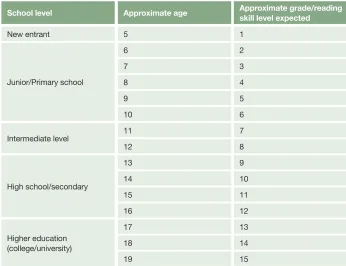
Table 1 shows the reading skill level broadly associated with age cohorts8. The average reading skill level of the
adult population is often overrated, as it drops back by 3–5 grades from the final year of formal education9. Thus, a person who left secondary school at age 15 (approximate reading level of 11) can be expected to have a post-education reading level of 6–8 (pre-high school); a person with a tertiary undergraduate degree (approximate reading level of 15) can be expected to have a post-education reading level of 10–12 (upper high school). The 1996 International Adult Literacy Survey (sponsored by the Organisation for Economic Co-operation and
Development) indicated that the average reading skill level of adults across most developed countries is no better than pre-high school10. In the UK specifically, “more than half the UK adult population was estimated to be performing below the minimum required for coping with the demands of life and work in the knowledge society”11. Table 2 compares the literacy and numeracy of 37-year-olds in 1997, showing that numeracy is a particular challenge for a significant percentage of this cohort.
6Office for National Statistics (2000), ‘International Adult Literacy Survey’ Vol. 2007. London: Office for National Statistics and Adkins, Natalie Ross and Julie L. Ozanne (2005), ‘The Low Literate Consumer’, Journal of Consumer Research,
32 (1), 93 - 105.
7Coben, Diana (2003), ‘Adult Numeracy: Review of Research and Related Literature’, National Research and Development Centre for Adult Literacy and Numeracy.
8Mumford, Mary E. (1997), ‘A Descriptive Study of the Readability of Patient Information Leaflets Designed By Nurses‘, Journal of Advanced Nursing, 26 (5), 985–91; Wallace, Lorraine and Elizabeth Lemon (2004), ’American Academy
of Family Physicians Patient Education Materials: Can Patients Read Them?’, Family Medicine Journal, 36 (8), 571–75, and Hoffman, Tammy, Kryss McKenna, Linda Worrall, and Stephen Read (2004), ’Evaluating Current Practice in the Provision of Written Information to Stroke Patients and Their Carers’, International Journal of Therapy and Rehabilitation, 11 (7), 303–09.
9Shea, Judy, Benjamin Beers, Vanessa McDonald, D.Alex Quistberg, Karina Ravenell, David Asch, and et al. (2004), ’Assessing Health Literacy in African American and Caucasian Adults: Disparities in Rapid Estimate of Adult Literacy in
Medicine (REALM) Scores,’ Family Medicine, 36 (8), 575–81 and Brownson, Kenneth (1999), ’Improving Patient-Education for Poor Readers‘, Nursing Spectrum, 9 (5), 12–24.
10Office for National Statistics (2000), ‘International Adult Literacy Survey’, Vol. 2007. London: Office for National Statistics.
School level
New entrant
Junior/Primary school
Approximate grade/reading skill level expected
1
2
3 Approximate age
5
6
7
4 8
5 9
6 10
Intermediate level 11 7
8 12
High school/secondary
9 13
10 14
11 15
12 16
Higher education (college/university)
13 17
14 18
[image:22.842.70.416.158.424.2]15 19
Table 1: Reading skill level by age cohort as indicated in the literature12
Skills level
Very low
Numaracy %
23
25
25 Literacy %
6
13
38
27 43
Table 2: Test of literacy and numeracy from sample of 3-year-olds13
Low
Average
Good
1702 1711
N (100%)
The substantial personal and social consequences of low literacy levels have been well documented, especially in the health field, for over 25 years14. Those with low literacy levels will go to great lengths to avoid potential embarrassment and shame, thus the barrier is invisible. These people are at risk due to their lack of ability to access, let alone understand support material15.
It is therefore vital that you consider the needs of people with literacy and numeracy problems very carefully when seeking to engage them. All communications for the GFA service should be simple and contain visual elements with simple, clear English.
One way of overcoming literacy difficulties would be to use a celebrity who is appealing and credible to key audiences and who could present your messages to a specific audience in a straightforward, jargon-free way.
12Mumford, Mary E. (1997), ’A Descriptive Study of the Readability of Patient Information Leaflets Designed By Nurses‘, Journal of Advanced Nursing, 26 (5), 985–91; Wallace, Lorraine and Elizabeth Lemon (2004), ’American Academy
[image:22.842.435.785.159.254.2]21
Case study: presenting facts in a straightforward manner DWP’s Giving it to You Straight campaign
Giving it to You Straight sought to encourage people to accept payment of benefits into a bank account, following the Government’s 1999
announcement that it was phasing out paper-based methods of payment. It is a good example of an integrated and well-planned campaign, which inspired action from over 90 per cent of its audience within a short time period and exceeded communications targets.
There were, however, significant barriers to change at the start of the campaign. People felt that choice was being taken away from them, and that little was wrong with their current arrangements. Clearly, consumers needed a large amount of comprehensive, reassuring information quickly to prevent them rejecting the scheme out of hand.
Proposition development research showed that the key to communication lay in presenting the facts in an honest, real and straightforward
manner. This encouraged a rational and accepting response. People needed comprehensive but clear information, tailored to their individual circumstances. Advertising alone could not answer the questions on people’s minds – another form of information provision was required. Mailings were used as the lead response generator and, in effect, were the lead medium, with advertising announcing that people should expect a mailing. A free phone advice line also provided support to back up information provision.
At the start of the campaign, only 43 per cent of people were receiving direct payment. However, by February 2005 this figure had risen to 92 per cent, exceeding the campaign’s overall objective of 5 per cent.
Marketing problem and solution simultaneously
We recommend that for some users you will need to use a device that markets the problem and solution simultaneously, as with the Department of Health’s 5-A-DAY campaign. For the GFA service, the campaign proposition might be focused on preventing ‘crunch points’, such as those moments when consumers ask ‘How am I going to pay this bill?’. The beauty of developing a simple problem and solution device like 5-A-DAY is that it can easily be picked up and used by others. Over time, it can also, if simple and clear enough, enter into the popular vernacular and act as a constant trigger to action.
Delivery channels
Other delivery channels to consider You could also consider engaging people:
• through traveling offices, which can target local shopping centres and deprived areas – as the blood banks do;
• via scheduled visits, for example outside Asda every Thursday;
• through shopping centres during the day;
• by setting up temporary consultancies in working men’s clubs in the evening, or at schools just before time to pick up children, or at large workplaces (all used for healthcare with good results); and
• via employers
[image:24.842.77.607.158.433.2]• via podcasts or new media channels. Table 3: Strengths and weakness of delivery channels
School level
Telephone
Web
Weaknesses Strengths
F2F • High unit costs
• Need pilot to match supply and demand • Personal and intrusive
• F2F puts off people who do not have strong ‘formal’ social skills (working class men) • Reflexive and personal
• Relationship-building • Better for building trust
• More accessible for hard-to-reach communities
• Very strong for in-depth, complex queries requiring high expertise and iterative clarification
• Medium unit cost
• Regulation and standardisation costs • Need to balance scripting with agent freedom • Increases access
• Very convenient for most users • Semi-reflexive
• Semi-anonymous: may suit many people, particularly for socially awkward disclosures
• Low unit costs
• Medium to high maintenance costs • Non-specific responses
• Impersonal response
• Lack of human contact a weakness for some users
• Not reflexive – may be slow to learn and change service delivery
• Less able to deal with complex queries • Provides broad access 24/7
• Highly codified response • Very convenient for users who
have online access • Non-intrusive
• Lack of human contact a strength for some users
23 Making the most of launch
We concur with the interim report that the initial engagement of people with this service will accrue from trigger events in their lives, and that demand growth will come largely from word-of-mouth recommendations. So, demand is likely to be initially slow. If we look at people in terms of their attitudes to financial services, so called ‘worriers’ might respond early, whereas ‘indifferent’ and ‘inadequates’ will, for different reasons, be more reluctant to engage. ‘Inadequates’ are probably the most important long-term audience for the GFA service, but we suspect they will only engage via word of mouth.
The ‘slow start’ leads us to recommend that you launch the GFA service with a ‘big splash’ (something that will act as a platform for media interest, such as a legal change to pensions) to trigger people into seeking advice. The Make Poverty History campaign, for example, was deliberately linked to the G8 summit for this reason.
The first three key tasks at the start of the engagement phase of GFA will be the launch of the service or a pre-launch warm up campaign announcing the coming of the new service. A specific launch plan will need
to be developed in the recommended development phase. The next most critical tasks are to have in place all the service delivery outlets and pre tested systems to capture service user engagement and experience of the service. Service interaction data capture and analysis will be important to allow early adjustments to the marketing and service delivery in the post launch phase of the new service.
The marketing mix
In the UK, £20 billion is spent on advertising every year, and the average person receives around 4,000 advertised messages every day16. It is difficult in this environment for government, or for that matter any message, to cut through and resonate with citizens. However, government has the advantage of having many channels that are not open to the private sector through the huge organisational reach into the lives of most citizens through its extensive network of service providers such as schools and hospitals. The GFA service will need to move beyond just smart advertising to incorporate a full marketing mix if it is to raise awareness of the service and generate active uptake at a sufficient level to have a real impact on the financial capability of the nation.
For example, the probable marketing mix for segment 1 identified in the interim report would be:
• TV advertising in targeted slots and channels;
• national newspaper advertisements in selected tabloids;
• magazine adverts and promotions in selected titles;
• local radio advertising;
• cinema advertising;
• ambient promotions;
• in-store promotions;
• PR promotions in trusted locations;
• local newspaper paid for and fee sheets; and
• website promotions.
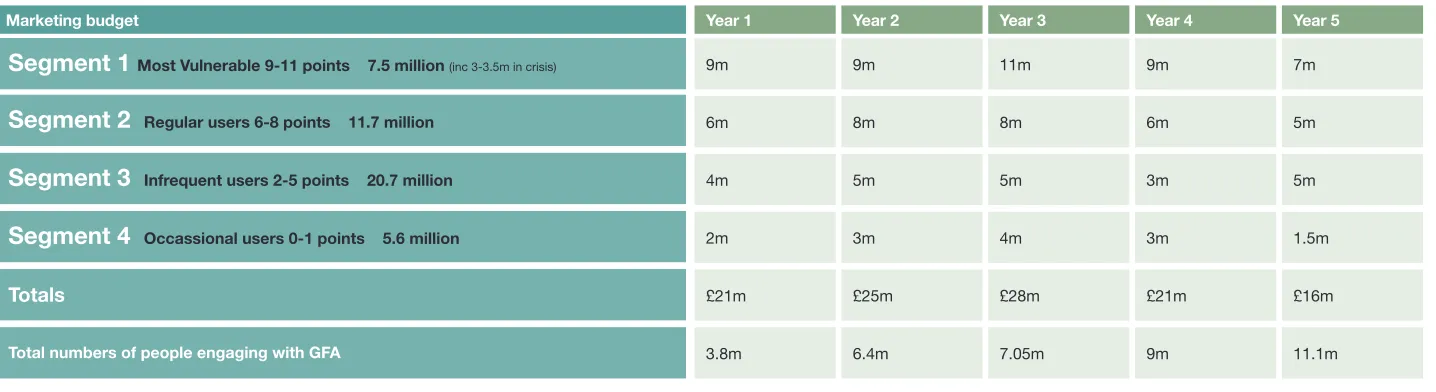
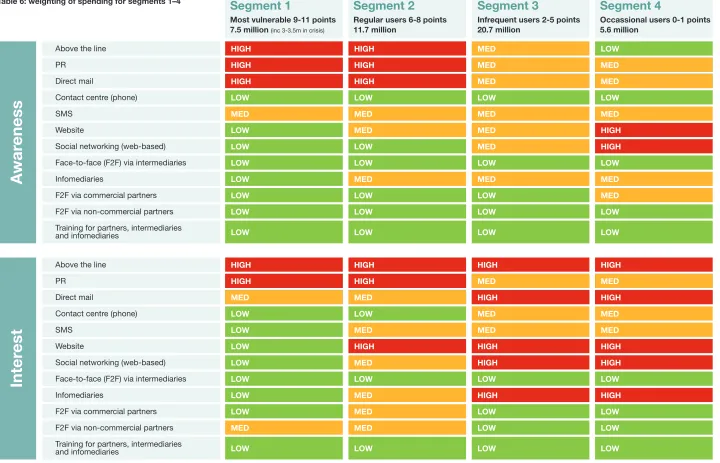
As part of our recommendations for expenditure, we have set out a breakdown of suggested marketing channels and costs for each of the four segments contained in the interim review (see Table 5 p.29 and Table 6 p.30).
16Source: Chartered Institute of Marketing, 2004
A targeted marketing mix – the consumer’s experience
Using the 4Ps marketing mix The 4Ps – or marketing mix model – is a well known framework which helps businesses satisfy the needs of customers while maximising the performance of their organisation. As
Figure 3 illustrates, it consists of a set of decision areas that need to be managed in order to satisfy consumer needs. The model was developed by Jerome McCarthy in 1960 and popularised by Philip Kotler, the American marketing guru, in the 1970s17.
Product/Service
• Are you creating a product or service that your customers want?
• How would you define the product characteristics?
Place/Channels
• How do you make the product or service available at the right place and in the right quantities? • What delivery channels should
you use?
Promotion
• How do you educate your target audience about your product/service? • What blend of advertising, selling
and sales pitches will work most effectively?
• What brand do you want to promote?
Pricing
• How much is the customer willing to pay?
• Do you offer discounts and special offers to attract particular types of customer?
Case study: getting the price right for a free service Devon County Council’s recycling lottery
Domestic waste recycled in Dorset from October to December 200 was up 4. per cent on the same period in the previous year.
Prizes were offered for residents who stuck their contact details into empty bottles, glasses or jars which went into roadside collection boxes or recycling banks.
Lots of people struck lucky, winning National Trust memberships, season tickets to Kingston Maurward Gardens and Animal Park, CD/DVD vouchers, ski-snowboarding lessons and quad bike treks.
25 We recommend you set the GFA service
offering precisely and in a way that research demonstrates will be received favourably by target audiences. Pricing will also need to be considered when making decisions about such issues as the cost to users in terms of time and effort when engaging with the service. You may also want to consider providing an incentive to consumers to use the GFA service. Incentives have been used successfully in a range of government initiatives. For example, HM Treasury’s Saving Gateway pilots, conducted between 2002 and 2007, matched people’s savings or investment account (initially pound-for-pound up to £25 per month, although different rates were subsequently tested). Aimed at lower-income households, the scheme promoted a saving habit and engagement with mainstream financial services. The pilots have shown that once the promotion period is over, many participants continue to save – the incentive of having their savings matched is thus a motivating factor in encouraging people to save long term. Similarly, the Child Trust Fund, launched in 2005, deposits £250 (£500 for those children born into low-income families) into a Child Trust Fund account that
the child will not be able to access until they reach adulthood. The deposit acts as an incentive to encourage parents to put more into the child’s trust fund – up to £1,200 a year. A further incentive is that no tax is paid on money in the fund. When parents make the decision about where to invest they are engaging with financial institutions and GFA could have an important role to play.
The promotion of the GFA service is also key. But, while all the 4Ps are of relevance, some of the most radical changes in delivery mechanisms in the public sector have come about through a focus on place and channels. The development of channel strategies provide mechanisms through which you will be able to consider:
• channel length – should the company engage with customers directly or through intermediaries?
• channel breadth – should there be multiple channels (for example: face-to-face, telephone and internet)?
• promotion – what should be the balance between ‘pushing’ the service to customers and ‘pulling’ by stimulating demand?
Your interim review has come to a number of tentative conclusions regarding the delivery of the service through a mixed model of face-to-face, telephone, web-based services and intermediaries. But the only way to make accurate decisions about the best mix of such approaches is to field test and pilot.
The role of the media
There is a need for buy-in from the media in order for media coverage to reinforce rather than work against the intended communications. However, bear in mind that “news values can often conflict with worthy and accurate public sector agendas”18, and the information presented by mass media outlets is sometimes criticised for its lack of accuracy and tendency to ‘hype’ reports19.
We recommend you develop a full PR and media relations strategy as part of the broader GFA marketing strategy. One of the key aspects of this strategy will be the cultivation of interested and friendly journalists and editors to ensure positive editorial. You should also hold discussions with TV producers of those entertainment shows that are likely to be popular with your target segments, so that you can discuss possible inclusion of the GFA service within storylines.
“ Good communication cuts through the clutter. It
doesn’t add to it. It does this by getting the right
message, in the right medium, delivered by the
right messengers, to the right audience.”
Now Hear This, Fenton Communications
18Kline, Kimberly (2006), ’A Decade of Research on Health content in the Media: The Focus on Health Challenges and Sociocultural Context and Attendant Informational and Ideological Problems‘, Journal of Health Communication, 11 (1),
43–59 (see p.50).
The role of new media You need to factor into the development of the GFA marketing and service delivery strategies the spread and convergence of digital communication technology and the subsequent development of new forms of social networks. Figure 4 shows the complexity of the current media marketplace. Over time this will become
more complex as new forms of media are developed and become more interconnected. People will expect to have the information they want, in a format they want it, at a time when they chose. A single-size, centrally driven, professionally produced and passive citizen consumption of information will become increasingly rare.
So, government strategies must be digitally driven, as an increasing percentage of citizens will be digitally enabled and will look to the internet as a preferred information option. The developments of Web 2.0 will also mean that people will increasingly seek to use smart websites that learn about them and their needs and facilitate the exchange and sharing of experience and knowledge. Web 2.0 is a move to the co-production and multi exchange
of information i.e. blogging, Wikipedia, You tube, Facebook etc.
That said, while more UK citizens are more confident and more connected with new media technology, there are some citizens who have neither the appetite, wealth or ability to use digital media. Figures 5 and 6 show how, at a time when use of personal computers is on the increase, lower-income groups tend to be less
Case study: working with the media Hollywood, Health & Society partnership
Hollywood, Health & Society (HHS) is a partnership between the Centers for Disease Control and Prevention, the National Institutes for Health, the National Cancer Institute and the Norman Lear Center. Together, they provide a one-stop-shop resource for writers, producers and others in search of credible information on a wide range of public health topics.
HHS offers diverse services tailored to entertainment industry needs, specific resources include case examples, quick facts, briefings and consultations with experts, panel discussions, health updates and tip sheets. HHS also collaborates with communication researchers and entertainment industry executives to track and study the content and impact of TV health storylines. It encourages health informing, educating and motivating TV storylines through the Annual Sentinel for Health Awards.
TV Direct SMS Radio Press Cinema Ambient Outdoor Internet
Terrestrial
Local TV Interactivity Sponsorship
Freeview Sky Cable Media piggybacking
Interactivity Ad/sales overlap New Media
Local Regional
Digital Multiplices
Online booking
Community
National
Digital
Connectivity Accountability
Analogue Internet
Nationals
Supplements
Lifestyle Special interest Business press Consumer magazines Regionals
Posters
P.O.S
[image:28.842.442.784.161.354.2]2 technologically literate. So, there is
a danger that some segments of the population, especially older people and socially disadvantaged groups, may have difficulty accessing, or effectively using, the internet20. This digital divide will need to be factored into the development of the GFA marketing strategy. We recommend that, as part of a full marketing plan, you develop a distinct ‘new media’ marketing strategy and test it during 2008. This should involve the development of a clear specification and tendering exercise of a specialist new media supplier (or suppliers) to lead this aspect of the service delivery model.
Recommended expenditure
Investment for each AIDA stage We have set, in Tables 4 and 5, a summary that gives a marketing and engagement investment
recommendation for each stage of the AIDA model22, as applied to the GFA service. These stages are sequential but will overlap. We have given figures for the first five years of the full programme, to give an indication of the scale, pattern and spread of the investment needed.
% agreeing ‘I just don’t understand computers and new technology’
Lower income groups tend to be less technologically savvy
ABC1
28%
38%
C2DE
0 5 10 15 20 25 30 35 40 0 10 20 30 40 50 60 70 80 1998 33% 45% 57% 62% 69%2000 2002 2003 2004
ABC1
28%
38%
C2DE
0 5 10 15 20 25 30 35 40 0 10 20 30 40 50 60 70 80 1998 33% 45% 57% 62% 69%2000 2002 2003 2004
% adults owning a PC
Penetration of personal computers is growing
Figures 5 and 6: the disparity in technological understanding and the increasing use of computers
In 200, 61 per cent of households in Great Britain
could access the internet – an increase of per
cent from the preceding year and 36 per cent
since 2002
21.
20Homewood, Janet (2004), ‘Consumer Health Information Emails: Content, Metrics and Issues’, Aslib Proceedings: New Information Perspectives, 56 (3), 166–79. 21National Statistics, www.statistics.gov.uk
Segment 1
Most Vulnerable 9-11 points .5 million (inc 3-3.5m in crisis)
Segment 2
Regular users 6- points 11. million
Y1
Awareness
Annual spend for first five years
% Reach
£3m £3m £2m
40% 50% 60%
Interest
% Reach
£2m £2m £3m
20% 25% 30%
Action
Training, stakeholder and partnership investment% Reach
£2m £2m £3m
5% 10% 15%
Desire
% Reach
£2m £2m £3m
10% 15% 20%
Annual contacts 375k 750k 1.12m
Total marketing cost
Per year excludes service delivery would include tracking and evaluation costs£9m £9m £11m
Y2 Y3 Y4 Y5
£1m 70% £2m 35% £3m 18% £3m 25% 1.3m £9m £1m 75% £2m 40% £2m 20% £2m 30% 1.5m £m
Y1 Y2 Y3 Y4 Y5 Y1 Y2 Y3 Y4 Y5 Y1 Y2 Y3 Y4 Y5
Segment 3
Infrequent users 2-5 points 20. million
Segment 4
Occassional users 0-1 points 5.6 million
£2m £2m £1m
40% 50% 60%
£1m £2m £2m
25% 30% 35%
£2m £2m £3m
10% 15% 15%
£1m £2m £2m
15% 20% 25%
1.17m 1.75m 1.75m
£6m £m £m
£0.5m 70% £1.5m 45% £2m 20% £2m 30% 2.3m £6m £0.5m 75% £1.5m 50% £2m 25% £1m 35% 2.9m £5m
£1m £1m £1m
40% 50% 60%
£1m £1m £1m
30% 35% 40%
£1m £2m £2m
10% 15% 15%
£1m £1m £1m
15% 20% 25%
2m 3.1m 3.1m
£4m £5m £5m
£0.5m 70% £0.5m 45% £1m 20% £1m 30% 4m £3m £0.5m 75% £0.5m 50% £1m 25% £0.5m 35% 5.1m £2.5m
£0.25m £0.25m £0.5m
20% 35% 50%
£0.25m £0.5m £1m
15% 25% 40%
£0.25m £1m £1m
5% 15% 20%
£0.25m £1m £1m
5% 15% 20%