Basic Skills Capacity in Wales:
Provider and Learner Perceptions
Research
Research document No: 021/2008
Date of issue: June 2008
Audience
Basic Skills Providers, Practitioners and Policymakers in Wales.
Overview
A literature review followed by discussions with 25 basic skills
providers/practitioners and a survey of 200 learners, spread across
Wales. The aims were to gather information on providers’ and
practitioners’ views on the challenges involved in improving basic
skills capacity in Wales, the key implications for policy and practice in
Wales and to identify and discuss any recommendations.
Action
None - for information.
required
Further
Any questions on the evaluation should be addressed to:
information
Jackie McDonald
Research and Evaluation Team
Welsh Assembly Government
Ty’r Afon
Bedwas
Caerphilly, CF83 8WT
Tel: 01443 663807
E-mail: [email protected]
Additional
Further copies may be obtained at the above address.
copies
This document can also be accessed from the Welsh
Assembly Government website at:
http://new.wales.gov.uk/topics/educationandskills
Related
The Report from Stage one is available on request from Jackie
documents
McDonald, as above.
PROVIDER AND LEARNER PERCEPTIONS
A report to the
Department of Education, Lifelong Learning and Skills
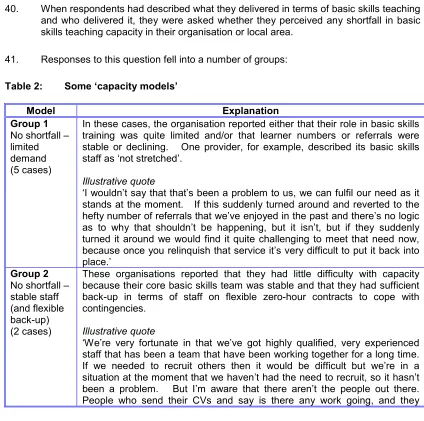
of the Welsh Assembly Government
September 2007
1. Introduction... 1
2. Provider perspectives...54
Introduction...54
Basic skills provision by the sample of providers...65
Staff and qualifications...98
Is there a shortfall in basic skills teaching capacity?...109
The reasons for capacity limitations...1312
The impacts of capacity limitation...2019
Improving the capacity position...2120
Internal development resources...2220
General teacher training...2221
‘Embedding’ with vocational teachers...2221
Mentoring new basic skills teachers...2221
A ‘supply pool’...2221
Improving training supply...2322
Management support and financial acuity...2322
Funding issues...2422
Organisational complexity, partnership and information share...2423
Summary: key provider perspectives on basic skills capacity development...2524
3. Learner perceptions of basic skills courses...2726
Introduction: the survey process...2726
Courses undertaken...2827
Reasons for going on the course...2928
Difficulty in finding a course...3029
Delay in starting the course...3130
Class sizes and teacher continuity...3231
Learner perceptions of course quality...3332
Completion... 35
Achievement of qualifications...3736
Benefits of participation...3837
Key points: a survey of learners...4140
4. Discussion...4342
ANNEX 1: Discussion guide for providers...4645
1. Introduction
1. The Basic Skills Strategy for Wales, ‘Words Talk – Numbers Count’, was published by the Welsh Assembly Government in April 2005, setting out a five year approach to raising standards of literacy and numeracy in Wales. The Strategy is structured by ten priority groups, and ten ‘horizontal themes’, which define the intended beneficiaries and the main areas of intervention of the Strategy.
2. The priority groups are:
1. Early years and the Foundation Stage 2. Pupils under-attaining in schools 3. Families
4. Young people 5. Adult learners
6. Low-skilled people in the workforce 7. Jobseekers
8. Offenders and ex-offenders
9. Other groups at risk of social exclusion 10. ESOL.
3. The ‘horizontal themes’ are:
1. Raising awareness
2. Better identification of learning needs and tracking progress 3. Providing a better range of attractive learning
4. Improving the quality of provision 5. Developing the practitioner workforce 6. Fit-for-purpose qualifications
7. Better help and support for learners 8. Welsh language
9. Working together to maximise impact 10. Better evidence of what works
4. The Strategy is delivered in Wales by the Basic Skills Agency (BSA), which is contracted to do so up to 2008. The BSA publishes an annual Delivery Plan, which lays out projected activities for that year in support of the Strategy and activities are delivered by the BSA, Local Authorities and appointed sub-contractors. National Support Projects (NSPs) have been set up to support many areas of activity. A delivery budget of £12.8m was made available for Basic Skills delivery in 2006-07.
6. However, a first phase of research commissioned by DELLS suggested that capacity to deliver elements of the Basic Skills Strategy directed at adult learners might be insufficient. A report (Rapid Evidence Assessment of current practice in addressing capacity and workforce development issues in basic skills provision, LE Wales for DELLS, February 2007) examined the available evidence on basic skills capacity and its development, using information and data both from Wales, the UK, and beyond.
7. The report, quoting Estyn (the learning inspectorate for Wales), noted that ‘in general, most providers are able to recruit basic skills teachers with suitable experience, though often they do not have specific basic skills teaching qualifications at Level 3 or above. There is, however, a particular shortage of experienced and qualified numeracy teachers, even though numeracy enrolments from students remain relatively low. There are also shortages of experienced and qualified family learning tutors in North West and in South East Wales. Retention of staff is …. a problem, particularly where there are several providers in an area competing for the same pool of staff.’
8. The report suggested that shortages of capacity arise variously because of:
· Difficulties in judging how much capacity is required: lack of strategic information on demand for, and supply of, teaching capacity.
· The low perceived status of basic skills teaching compared with teaching of other subject specialisms.
· The high proportion of basic skills teachers who work on part-time, short-term contracts.
· Low pay in FE compared with teaching in schools.
· Consequent problems in staff retention, particularly where several providers in an area are competing for the same pool of staff.
· Poor or limited access to training or professional development for basic skills teachers.
9. The report also described a number of approaches which had been used to seek to raise basic skills teaching capacity, not necessarily in Wales, but, in some cases, in the UK or other countries. These include:
· Efforts to develop a professional structure for basic skills teaching which includes clear pathways for professional development, with qualifications that map onto a national qualifications framework.
· Marketing programmes to attract new recruits to basic skills teaching, to target existing or retired teachers, and to clarify basic skills career structures and opportunities.
· Bursaries to cover the cost of initial training or continuing professional development.
· Subsidies to providers to compensate them when basic skills teachers take time out to train.
· Attempts to stabilise funding for basic skills teacher training so that the uncertainties of temporary funding are minimised.
10. However, the report’s authors were commissioned, as noted above, to look at existing published material as the basis of their analysis. Clearly, some of this would necessarily be a little dated and some was not specific to Wales. In order to deliver a ‘reality check’ on this initial analysis and to gain more detail, a second phase of research was commissioned which examines the position on the ground and at the present time.
11. The overall aim of this second phase of research was to:
‘Gather responses from basic skills providers, practitioners and learners relating to the research undertaken into addressing capacity issues in basic skills provision’.
12. Contributing to this aim, objectives for the study were set out as:
· Identify key areas of good practice identified by the Rapid Evidence Assessment (REA) report, in discussion with policy staff in DELLS.
· Gather information on providers’ and practitioners’ views on the good practice examples.
· Gather information on providers’ and practitioners’ views on the challenges involved in improving basic skills capacity in Wales.
· Gather feedback on the key implications for policy and practice in Wales identified during the REA.
· Gather information on learners’ experiences of capacity issues and how they impact on learning progression.
· Identify and discus any recommendations receiving notable support or criticism from participants.
· Gather insights on any logistical/operational issues involved in implementing any of the recommendations.
13. The research which is reported in the remainder of this report addresses the aim and objectives of the study. The research had two major practical elements:
· Discussions with 25 basic skills providers/practitioners. These were mainly undertaken face-to-face with the person or people most responsible for basic skills delivery in a range of Further Education, Work Based Learning, and voluntary sector providers spread across the four regions of Wales.
· A survey of 200 learners, again spread across Wales, who had recently undertaken a basic skills course either alongside or as part of another course or as stand-alone basic skills education.
14. The results of this research are reported below in three further Chapters of the report:
· Chapter 3 reports findings from the learner survey.
2. Provider perspectives
Introduction
15. Interviews were held with respondents from twenty-five organisations across Wales. The organisations comprised Further Education Colleges, Work Based Learning providers, and voluntary sector organisations. They were selected from lists of such organisations in Wales supplied to the research contractor by DELLS. To guide the selection, a sampling frame was constructed which approximately reflected the distribution of such organisations by type (FE, WBL or voluntary organisation) within the four Welsh regions. Organisations were contacted in order to seek to ‘populate’ the sampling frame with appropriate cases. There were no absolute refusals to take part but some organisations were unable to take part within the time frame for the study. The organisations which were eventually interviewed were distributed as follows:
Table 1: Distribution of interviewed providers
SE Wales
SW Wales
Mid Wales
North
Wales Total
FE College 5 4 1 4 14
WBL provider 4 3 1 0 8
Voluntary organisation 0 1 0 2 3
Total 9 8 2 6 25
16. Interviews were held on the respondent organisations’ premises. Respondents from FE Colleges were usually the Lifelong Learning Managers or Basic Skills Co-ordinators for the College, sometimes accompanied by their deputies. In WBL providers and voluntary organisations, the respondent usually had a more general title (such as ‘Training Centre Manager’ or ‘Director of Operations’) reflecting a role which extended well beyond the organisation of basic skills tuition.
17. Interviews were preceded by an e-mail to respondents which described the areas which were expected to be covered in the interview in order to allow them to give some prior thought to the ‘capacity’ issue. Interviews themselves were guided by a discussion guide (appended) which structured the discussions according to some main themes:
· What the organisation delivered in terms of basic skills learning.
· Who they employed to manage and undertake their basic skills provision.
· The extent to which they suffered from capacity problems or difficulties.
· What effects such difficulties had on the organisation and learners.
· What they saw as the reasons for difficulties.
18. The points made by respondents were noted down and, in cases where the respondent was agreeable, interviews were audio recorded and subsequently transcribed. The analysis which follows is based on these notes and transcriptions. It will be noted that ‘qualitative’ research of this kind is not expected to and does not deliver statistically significant numerical estimates relating to the social phenomenon (in this case, the question of basic skills capacity) which it investigates. Rather, it ensures that it covers the relevant ground both in terms of respondents (hence, the spread of types and locations of respondents set out in Table 1) and in terms of areas of interest (hence, the discussion guide). In doing so, it is hoped that a fair description of the basic skills capacity issue, as perceived by providers, emerges and that this description will be helpful in developing future policy regarding this issue.
Basic skills provision by the sample of providers
19. All providers were asked to describe their basic skills ‘offer’. A first and basic observation is that there is very little in the responses to this questions which can be regarded as standardised across apparently similar institutions.
20. In Further Education Colleges a range of types of provision were observed:
· Some basic skills provision, a majority of the total, is provided for the ‘captive audience’ of 16-18 year olds and 19+ adult students who attend the College in order to pursue vocational or academic courses of some kind. Students are routinely assessed at an initial interview or on induction. Those with poor basic skills are given basic skills tuition – as stand alone ‘learning support’, in conjunction with Key Skills provision, or as teaching ‘embedded’ into the primary course(s) they are pursuing.
· Some basic skills provision for adults is provide either on College premises (as, say, evening classes) or as ‘outreach’ at a community facility. This provision is advertised in local newspapers, on notice boards, with leaflets, and so on. It is variously described and presented and sometimes associated with other types of learning (typically in ICT skills) in order to sugar the pill and reduce the perceived stigma of needing to improve reading and writing skills.
· Some basic skills provision is delivered as part of a package to local groups in the community, perhaps concerned with health matters or a special interest, and sometimes linked to Communities First activities.
· Some basic skills provision is delivered as Family Learning where (mostly) mothers with young children are engaged in joint basic skills development, often with the incentive that the adult will be better able to read to his/her children and to help with their reading skills.
· Some basic skills learning is combined with Key Skills learning and delivered under an ‘essential skills’ banner.
· ESOL training, mainly for migrant workers is regarded, not surprisingly given the rising numbers of migrants, as an area of growth for those institutions which supply it.
· Some provision results from ‘downward’ linkage into schools such that colleges supply basic skills learning support to school pupils where the College has an existing agreement to deliver vocational learning as part of integrated 14-19 activity.
21. However, the extent to which different Colleges adopt this menu of circumstances for the delivery of basic skills training is hugely varied – with variation both in the number of types of provision which are adopted and in the depth in which adopted types are pursued.
22. The result is that the overall scale of provision is also quite varied between Colleges in ways which are not explained just by the size of the College or of its catchment. The College with the most provision (of the ones interviewed) had sufficient activity to employ a team of over 70 people who were engaged in basic skills delivery, around 10 times the employment level of Colleges which were less active in the basic skills area. Factors which appeared to govern this variation were:
· The pro-activity or otherwise of the individuals responsible for the basic skills area in different institutions.
· Particularly, their acuteness in understanding the availability of funding for different forms of basic skills provision and their willingness to seek expansion and growth when such funding is time bound and there is no certainty of its continuation.
· The extent to which basic skills provision is valued with the institution both at management level and as an embedded activity in the normal run of FE College teaching and training. All institutions formally regard basic skills as a core issue but some respondents suggested that, in practice, basic skills provision was liable to constraint and cutbacks if College budgets were tight and/or if there were doubts as to the commercial viability of provision.
23. The question of capacity is discussed in more detail in later sections of this report, but at this point it is not suggested that variations in levels of activity between FE Colleges are primarily caused by differential availability of basic skills teachers in different College locations. Rather, it seemed that Colleges which took a very pro-active view of basic skills provision also took a pro-pro-active view of teacher recruitment and development which tended to overcome whatever the local limitations in capacity happened to be.
24. Work Based Learning providers have, of course, a narrower role than Colleges. They are commercial organisations usually with expertise in a limited number of curriculum areas. As such, their repertoire of modes of basic skills provision is considerably narrower. As with FE Colleges, these providers assess their learners at an early stage. Those (sometimes a majority of learners) who have low level basic skills are then given teaching and learner support alongside other tuition and training in their main area of skills development. As with Colleges, some of this basic skills work is direct ‘stand alone’ teaching, whilst others is ‘embedded’ as part of the primary course. WBL providers tend to describe their basic skills provision as ‘RoRo’ (Roll-on, Roll-off) in the sense that it does not have a set intake but is continuously delivered with different learners at different stages throughout the year.
responsibility by the organisation concerned and partly to enable individuals to get an NVQ with which they would otherwise struggle. In this case, basic skills provision was on a very small scale. In the second case, the organisation, whilst not delivering, nor being paid to deliver, any basic skills provision, did deliver the key skills modules in communications and application of numbers and reported that these generated significant before-and-after improvement in the basic skills exit assessment.
26. In the voluntary sector, similar diversity (even within a very small number of examples) was observed. At one extreme, the voluntary organisation interviewed delivers a significant volume of direct provision on formal contracts using its own team of full-time staff. At the other extreme, the organisation has no basic skills teaching staff itself but buys in a basic skills teacher from the local College in order to offer a limited amount of basic skills teaching as part of the ‘return to learn’ module in its portfolio of informal and formal learning opportunities.
27. In short, therefore, within and across the three types of provider which were interviewed in the course of the study, there was very great variation in the ways in which basic skills teaching was delivered and in the scale of delivery. In some Further Education institutions, a highly active basic skills/lifelong learning function well supported by institution managers could pursue funding and learners and develop a complex pattern of provision. In other FE institutions, a more minimalist view could be taken with a focus on meeting the basic skills and learning support needs of the College’s core students but with lesser aspirations to develop new markets outside the College. Correspondingly, some WBL providers and voluntary organisations could actively pursue basic skills funding and direct delivery of significant numbers of basic skills outputs whilst others might only deliver basic skills teaching unfunded, as they saw it, and on a very small informal scale in order to assist trainees towards success in their ‘mainstream’ courses.
28. A further characteristic of basic skills provision, particularly when delivered in the community, is that it frequently needs to be tailored to specific learner groups and individuals. Several respondents made it clear that their learners were ‘free to walk’ - if learning experiences did not meet their needs and expectations they terminated their participation - and that basic skills cannot, in some situations, be successfully offered as a ‘you must do this’ form of learning. Rather, the approach, with a community group, is ‘tell us what you want and we’ll help you’. This necessarily introduces a further element of variation into the pattern of basic skills delivery.
29. The description of observed modes of provision might seem just that – descriptive. However, it may have a number of important messages:
· The first is that noted earlier, that it seems unlikely that teaching capability or lack of it in a particular area is strongly explanatory of marked variation in the local scale of provision. The attitudes and aspirations of the provider seem to be much more significant.
it remains the ‘Cinderella’ service which several respondents still assert it to be – and, therefore, one which is constrained in appeal as a professional career choice for teachers. Staff and qualifications
30. If variety and complexity are hallmarks of the pattern of basic skills provision, they are hallmarks, too, of the staffing arrangements which deliver that provision.
31. In the FE Colleges which were interviewed:
· The number of staff reported as being involved in the direct delivery of basic skills learning varied between 2 and 75.
· The average number of staff was 16 (but this is significantly raised by the ‘outlier’ College which reported having 75 staff).
32. In the WBL providers which were interviewed:
· The number of staff involved in delivery varied between 1 and 6.
· The average number was between 3 and 4.
33. In terms of contracts, the most typical picture in Further Education was that, in a unit of around 6-12 basic skills staff, one or two full time permanent co-ordinators would be supported by the remainder of a team who would be employed on a mix of fractional (but permanent) contracts and of part-time, insecure terms involving hourly inputs of between 2 and 12 hours.
34. In Work Based Learning, where contracted provision is delivered, it is more usual to have small teams of more-or-less full-time permanent staff organised by a full-time permanent co-ordinator.
35. The patterns of qualifications held by staff delivering basic skills training were also fairly mixed.
36. In Further Education, the typical picture was of one or two basic skills managers holding a Level 3 or Level 4 basic skills teaching qualification supported by a team which would mostly hold a general teaching qualification (PGCE for example) and a Level 2 basic skills teaching qualification (with the City and Guilds 9285 being most frequently mentioned, though other ‘old’ City and Guilds qualifications, 9281 and 9282, were also recorded). However, there was considerable variation. One College respondent suggested that many of her team were qualified to Masters Degree level in various aspects of learning difficulty. Others recorded that some of their staff had achieved or were working towards the new Level 3 qualification.
37. In WBL providers and the voluntary sector a similar mix was observed: typically, a well-qualified co-ordinator supported by a team of qualified teachers, most, but not all, having a Level 2 basic skill qualification in addition (‘They’ve all got City and Guilds numbers’ was as close as one respondent could get to clarifying the matter). However, whilst it is difficult to quantify the point exactly, it appeared that the average qualification level of basic skills teachers in WBL may be a little lower than the average in FE institutions.
38. Overall, therefore, the picture of basic skills delivery staff and of their qualifications is:
· Varied employment arrangements including staff on permanent full-time and fractional contracts supplemented by part-time hourly paid staff; with balances of use of these arrangements which varied between organisations.
· A qualification profile which is dominated by ‘qualified teacher plus a Level 2 basic skills qualification’ status but which has a sprinkling of better qualified people (often working as team manager/co-ordinator) and some worse qualified (teacher-qualified but without any formal basic skills teaching qualification or, in the case of learning support assistants, without any qualifications beyond their own GCSE or A level qualifications).
39. However, whilst the qualifications profile of the workforce is important, particularly to the expectation that a more ‘professionalised’ basic skill workforce can be developed, several team managers pointed out that experience and personal qualities were often at least as good an indicator of teaching ability in this ‘person sensitive’ area as formal qualifications. And the research observed that operations which had some less qualified people had obtained and maintained the Basic Skills Agency Quality Mark.
Is there a shortfall in basic skills teaching capacity?
40. When respondents had described what they delivered in terms of basic skills teaching and who delivered it, they were asked whether they perceived any shortfall in basic skills teaching capacity in their organisation or local area.
[image:14.595.85.509.352.773.2]41. Responses to this question fell into a number of groups:
Table 2: Some ‘capacity models’
Model Explanation
Group 1 No shortfall – limited demand (5 cases)
In these cases, the organisation reported either that their role in basic skills training was quite limited and/or that learner numbers or referrals were stable or declining. One provider, for example, described its basic skills staff as ‘not stretched’.
Illustrative quote
‘I wouldn’t say that that’s been a problem to us, we can fulfil our need as it stands at the moment. If this suddenly turned around and reverted to the hefty number of referrals that we’ve enjoyed in the past and there’s no logic as to why that shouldn’t be happening, but it isn’t, but if they suddenly turned it around we would find it quite challenging to meet that need now, because once you relinquish that service it’s very difficult to put it back into place.’
Group 2 No shortfall – stable staff (and flexible back-up) (2 cases)
These organisations reported that they had little difficulty with capacity because their core basic skills team was stable and that they had sufficient back-up in terms of staff on flexible zero-hour contracts to cope with contingencies.
Illustrative quote
haven’t got the minimum Level 2 qualification.’ Group 3
No shortfall – limited ambitions or limited funding (6 cases)
These organisations cut their coat to their cloth. Essentially, they limited their delivery aspirations to the funding and teaching capacity which was immediately available to them. This might include not biding for funds when they knew that success would stretch them. It included internal constraints by senior management on basic skills teams’ expansion. It included organisational willingness to grow basic skills work organically – if a teacher became available they might seek to offer additional services but not otherwise. It included the view that basic skills provision could be expanded significantly but central funding would not be forthcoming to fund the expansion.
Illustrative quote
‘I like to be proactive and I wrote a policy which has been taken on board very positively by the ground troops within the college, despite their lack of understanding of Basic Skills. The problem I have in requesting more staff is the lack of understanding by Senior Management of what Basic Skills is, the specialist qualifications required to teach Basic Skills, the selection process and induction process of any staff that are taken on within the college and the fact that as far as Senior Management are concerned, we’re, dare I say, a waste of time. That is my stumbling block.’
Group 4 No shortfall – internal development capacity is strong (4 cases)
These organisations said that, because they had strong internal basic skills teacher training capacity, they could develop staff as and when they needed. For example, experienced learning support assistants could be developed and qualified. Tutors in other departments who expressed interest and capability could be converted into basic skills teachers. Volunteers could be eased inwards into paid, skilled and qualified roles.
Illustrative quotes
‘You don’t get people applying with the full qualifications. What we very often find is that the ones who apply to us are probably part qualified and the majority of the people who come into the team are already working in some shape or form for the College. Occasionally, we recruit somebody from outside but generally it’s somebody internal. And as for their qualifications, we teach the qualifications, all of them, Level 2, Level 3 and Level 4.’
‘I think though it really depends how you use your volunteers and how you nurture them really, and I think that’s what we’ve done more of this year. In the classes there are volunteers as well to assist the tutors, and often they will then develop their skills and then move on to become tutors. We then do the 9297 and the PGCE which helps our staff to move up the ladder.’
Group 5 Yes, shortfall – staff replacement crises (3 cases)
These organisations reported capacity problems mainly in terms of specific instances, the problems which occurred when an individual (usually full-time) member of staff fell ill for a long period or moved on. The result was a period of organisational discomfort until a solution was eventually found. In essence, these organisations were ‘Group 2’ organisations (above) but in which stability failed and flexible back-up was not in place.
Illustrative quotes
‘I haven’t really come up against any major difficulties, except that last year, last September, because I lost this one member of staff it took me a full half term before I could appoint anyone. The people that were available, by the time you got them processed, our advertising and go through the interview process and finding people who could actually fit the hours, because again you’re not offering a full-time contract, you’re offering a partial timetable, which people have to fit around other work. And so inevitably some people turn around and say well actually I can’t do those hours, so you’re forever juggling, and it took a full half term before I could find somebody who could fit into the timetable slots that we were offering.’
‘It’s a major issue with lack of qualified staff, because we had an incident this year where ….. was off for 6 months, and I had terrible trouble getting somebody to replace her. I couldn’t get anyone, I advertised, I used all my contacts, I went to the colleges. In the end I managed to get 3 part-time tutors who could come in and do a couple of hours here and there. So I had somebody from the Workers Educational Association, which was part of the network, I had some contacts from that. I had somebody through ….. College, again I had to pay for. And then I had somebody from Learndirect who came in.’
Group 6 Yes, shortfall – coping with specialisms and
fluctuations in demand (3 cases)
These organisations have no general shortfall in delivering ‘core’ provision. However, they can run into difficulties in two ways. Firstly, they may struggle to deliver particular types of provision (Polish language within an ESOL programme was, for example, mentioned by a number of respondents or Family Learning of Employer Pledge provision may cause difficulties). The basic issue is not that ‘capacity’ is not adequate in total but that particular types of provision may demand particular teaching skills or personal qualities which are not in sufficient supply within that total capacity.
Illustrative quotes
‘The problems for me are that we have an annual programme whereby we identify slots at community centres where classes always run. We have 4 Community Co-ordinators dedicated to different Communities First areas in the locality, and they sort of do a lot of work with existing community groups. So throughout the year we have to plan our full annual programme a year in advance and get it approved in terms of how many are involved, and how many learners we are going to have, and to be able to do the planning effectively. Now throughout the year then, and obviously we need to fill people’s timetables at that point to account for their jobs. So then when people come up later with a need for a short course on Financial Literacy or they want an 8 week course on Confidence Building through speaking and listening, it’s very difficult to staff those, because you can’t have people just floating.’
‘Demand is increasing more and more because of the Employer Pledge, so companies are contacting us needing support and you don’t know how, necessarily how robust this class is going to be, or until you offer the class you don’t know how many learners you’re going to get.’
Yes, shortfall – generic and widespread skills shortage (2 cases)
skills teaching skills extending not only across Wales but across England too.
Illustrative quote
‘Of course we have capacity shortage problems, everybody has, there’s not enough young new up and coming blood coming into Basic Skills. Most of the staff would be 40 plus. And in one area particularly, we’ve had to make a very rapid response to EU in-migration. We have thousands of Poles here. We’ve gone from offering about 4 classes in 2001 to offering 60 plus in 2007. We have had to really look hard to secure ESOL staff, a real problem. We’ve just about done it and in fact they’re a very strong team, but it’s been difficult. People just don’t have the skills and the qualifications and what is it that we can advertise that would attract people in?’
42. This analysis suggests, therefore, that there are quite varied provider positions vis-à-vis basic skills capacity. Some organisations do not have capacity problems because of lack of demand for basic skills learning. Some organisations recognise capacity shortfalls but have various strategies for avoiding the worst effects of this circumstance . Coping strategies include:
· Minimisation of demand – not pursuing all the basic skills teaching avenues which they might if more capacity (and more funding) were available to them.
· Having effective internal recruitment and development resources.
· Reliance on a stable team of staff, ideally with a flexible back-up resource of staff on zero-hours contracts as necessary.
· Patching together some form of back-up when a significant team member leaves or becomes unavailable.
43. A further sub-set of providers, however, revealed a variety of ways and detailed instances in which capacity shortfalls clearly impacted negatively on the volume and effectiveness of their delivery and, in some cases, still do.
44. The picture is, therefore, not one in which lack of capacity presents itself as a dramatic and universal limit to the national strategy for adult basic skills improvements – rather it is one which generates a background of restricted ambition, improvisation, and ‘make do and mend’ against which much of the delivery process takes place.
The reasons for capacity limitations
45. Respondents were probed in more detail as to what they saw as being the underlying drivers of this situation. Their responses are summarised below.
possible in order to maximise the margin on basic skills funding. Some respondents believed that pay was too low in relation to the increasing expectation that staff should have Level 3 or Level 4 qualifications. Others linked low pay with poor progression opportunities. Some comments were:
‘The salary is really poor and tutors have very strong feelings about it. They don’t get paid for meetings, and they notice, so basically there’s a lot of feeling of wanting to do more but on the other hand probably feeling that people are really working for next to nothing. And that’s not because of the pay the college gives but its overall, across the system.’
‘Basic Skills teachers, tutors do an amazing amount of paperwork in their spare time, and nobody, hardly anyone gives them credit for that I think. Because I don’t think unless you actually are in the house of a Basic Skills tutor you don’t really realise just how much is being done and that makes the hourly rate much less than it looks.’
‘Well the other teachers in other subjects that we were paying on an hourly rate were £20.00 odd an hour and then the Basic Skills was £13.00.’
‘Numeracy is difficult as you would expect. Getting people to come and teach numeracy. You have to have Level 4 in numeracy and you’re getting paid £18.00 an hour and you get more money working in industry so you’ll go and work somewhere else.’
‘The rate is not good for the amount of work that’s required, no definitely not. It’s very undervalued and when you look at wages generally its poor. You know I’ve children in their 20s who are doing manual labour for twice my wage. I have a son that will not get out of bed on a Monday morning if he isn’t going to have £500 in his hand at the end of the week on a Friday night.’
‘The biggest bugbear is that there is no professional development. Its still linked to the old system whereby if you’re teaching entry level students, you get paid at entry level rates. So you can come into a college like this and you teach Key Skills which is Level 1 and actually get more money than for teaching Basic Skills. And if you’re teaching A level or you’re teaching any other qualification, you get more again. On basic skills you have to start at a part-time temporary contract. If you’re the main bread earner, to get paid £14.95 an hour for less than 30 hours a week isn’t realistic. You couldn’t survive, so people are not coming into it. This is why you see a large proportion of middle aged women. For a large proportion it’s their second income. It’s flexible, its adaptable, they can fit around their families and so on and so forth. But you’re not going to get very many men for that reason, because they’re going to be the main bread earner and you don’t get very many young people, because there’s no career development, no career path.’
‘And I think this about our Basic Skills staff that you’ve got to believe in what you’re doing and the people that we’re working with. It is about having that empathy with the client group. I think that they get a lot of satisfaction of seeing someone who has never achieved anything in their life and they’ve helped them to achieve something. So it is about job satisfaction as well.’
‘I think it’s not seen as part of teaching salary-wise. I think they are very specialist and you’ve got to be a very certain type of person to do it, especially to deal with the youngsters with all these difficulties and the barriers they’ve got, it’s not just a case of turning up and speaking. You’re dealing with a lot of social problems and issues as well with these people.’
‘It’s more than just the Basic Skills. It’s having that ability to accommodate these people who have only ever experienced failure or rejection, and it’s about dealing with all that mindset and being able to establish that rapport with them. Some teachers are very good at teaching if they’ve got an interested class but when you’ve got behavioural issues or social issues on the scale that we sometimes have, you need special people.’
48. Because of this requirement, there was a wide resentment of the perceived belief that a basic skills teaching job is an option which doesn’t require much specific skill:
‘It’s also still the perception, no matter how much raising awareness that goes on, it’s still the perception, particularly with literacy, not so much with numeracy, that if you can speak English you can teach it. But it’s been recognised now by research that teaching Basic Skills is a highly skilled job and it is not about just passing on the things that you can do. But there’s still this perception that if you speak English you can teach Basic Skills, so anybody can be put in a class to do it.’
‘I’ve been quite shocked recently because some people have come to see me, maybe their art class isn’t doing very well on numbers and they may think that Basic Skills is an easy option and they come to me and say have you got any Basic Skills classes going.’
49. Somewhat undermining this view, however, were some perceptions that current requirements to upskill the basic skills teaching workforce are too stringent:
‘Why do you need a level 4 in teacher training when in Wales the national basic skills standard is to Level 1, the benchmark? But we teach to Level 2 so you should be 1 level above that at which you teach?’
‘This is my big bugbear. We had a standard meeting last week with the other Basic Skills tutors and we were discussing the new qualifications that they’re bringing in, and saying everybody’s got to be trained to at least Level 3, Level 4. Our own opinions of this is that we are going to lose some very, very valuable Basic Skills teachers, because some of the people who actually teach Basic Skills now, the reason that they’re very good at what they do is because they’re not necessarily very academic themselves, and by making everything so academic, up to an A level or degree level or whatever they’re doing and looking in such depth, it’s putting them off.’
Level 4 it wouldn’t help them at all. Which is one of the reasons why I like Level 3.’
‘I have a couple of staff who have been delivering training for 25 years. It scared one of them to death because she doesn’t have a degree. I think that someone who has been around a long time has got a lot of good practical experience. When they’re then talking about well, this Level 4, you’ve got to have this. That can be quite off putting as well, I think.’
‘Another issue at the moment is having qualifications which are fit for purpose. I think the City & Guilds Level 2 is good, but the Level 3 I’m delivering at the moment, I’m having all sorts of issues with it to be honest. There was this City & Guilds Level 3 support qualification, 9483, which was so hard you would need a Degree in English language to be able to do it effectively, or certainly years and years of ESOL experience. So the one that we chose to do was the City & Guilds 9375 but I think it’s also unrealistic and a bit unmanageable and much harder than Level 3 should be.’
50. Some of the resistance to the push towards a better qualified workforce was in the context of recognition that career progression was frequently difficult and that the incentive to move to a higher qualification level was frequently not matched to an opportunity to earn more money, to move into full-time work, or to gain seniority.
‘There’s no structured path for anybody in basic skills teaching whatever the qualification. You’re taken on as a tutor or lecturer and then you get the chance, if you call it a chance, to be a course co-ordinator, and then you maybe have a Programme Area Co-ordination role and there’s very few promotion opportunities after that.
51. The combination of perceived low pay and lack of progression opportunity was perceived as tending to leave the workforce dominated by women, often of older years, content to work on part-time terms:
‘And I think one of the difficulties which I have noticed in the team is that they are mature women. There aren’t youngsters moving into the team, it’s not their preferred professional route.’
‘Unless they want only a small amount of work which may fit with some people, because they may be doing another job. Like we’ve got people working in the Probation Office and then in the evenings they will take a couple of classes on, and that seems to work for them. But that doesn’t make it their main occupation.’
52. A further specific aspect of this concerns rural providers. Views were mixed. One provider saw that a rural location meant that they had a captive workforce often resident in the location because of preference for a rural lifestyle – and happy to trade this off against low pay and limited opportunity. On the other hand, another rural provider saw themselves as losers against urban opportunities.
53. Some limitations in capacity were related to the unavailability of training courses, typically to take teachers towards the new Level 3 requirement. This was somewhat more of a problem for WBL providers than for FE Colleges, the latter frequently having internal capacity to train their own staff to the requirement standard. In one instance, a WBL provider in close proximity to an FE College reported difficulty accessing Level 3 training whilst the College itself reported no difficulty.
54. There were issues, however, not just with the availability of training but with its cost in various ways:
‘I suggest that this isn’t a new issue. They’ve floated these new awards quite some time ago, and I think it’s very telling that we’re still having issues about whether people are doing it or not, and is there sufficiency of people doing it. I think the fact that it’s taken this long to even say whether it’s happening or not tells me that it isn’t working. Because if we’ve got to do it to exist as a centre, the reality of it is that it’s very expensive, very time consuming. As we’ve shrank or reorganised and we’ve got smaller we’ve got less capacity to cover.’
‘Payment for training is an issue as well. There is still a prevalent attitude in many colleges that they will not pay hourly paid staff to turn up for staff training. It is a disgrace, and that’s not just this College it’s many colleges across Wales. Their attitude can sometimes be, you’re lucky to be given training, you should turn up and be grateful.’
‘The problem as well though is releasing people to be able to go on these courses, because you’ve got to get your day-to-day running of courses right. You’ve got to release all your trainers at once, because they don’t stagger it. That’s a real problem for us.’
55. If training costs are sometimes seen as burdensome, then the bureaucracy associated with delivering basic skills is also seen as a constraint on teaching time:
‘The paperwork is phenomenal, because we have to fill in for each learner. On an 8 week programme we have to complete 4 ESF forms, an enrolment form, an exam entry, an OCN registration form, the recommendation for Award or Credit form, so you’re talking about 8 forms per learner.’
‘Well we cannot provide any numeracy currently, that’s one. We cannot cover the demand in the workplace. We have no community provision because we haven’t got the ability to provide it physically. I would suggest that the quality of teaching and learning in Basic Skills throughout the curriculum area, suffers as a consequence of the amount of time that we’re able to spend on preparation and resources and use of time, because in addition to actually providing the teaching, we’ve got the paperwork to deal with.’
‘If you’re not a dedicated tutor you won’t last 2 minutes. Because they have to link everything to the curriculum, they have to do individual learning plans, there’s individual learning the class it’s not a discussion. Everybody is working at their own pace, it is completely tailored to the individual. The amount of paperwork is phenomenal.’
not ‘ring-fenced’ in Colleges and could be and was diverted to other purposes. There was concern that there was no available money to convert fractional contracts into full-time or permanent ones:
‘Most staff are on what we call F4 contracts. We haven’t got any growth in funding to provide them with secure contracts and this is where a lot of the problems lie. We’ve got tutors that are willing to give up full-time jobs to become Basic Skills Tutors. In their own time they’ve done the training but the colleges haven’t got the money to give them the opportunity to come on board or full-time. It’s a catch 22 really. With all the marketing and the development, everybody is working towards the same thing of getting as many learners into Basic Skills training as possible. There are enough learners out there to accommodate full-time or part-time tutors. It’s just the fact that the college hasn’t got the money to employ the tutors.’
57. Insecure funding was also an issue:
‘Funding is always the issue. We’re always just going from one ESF bid to the next. We’ve been lucky in having 8 years of one bid. We’ll be coming up to the end of it next year. We don’t know what happens after that. There’s the whole issue of convergence funding of course, but none of us really know what that entails, and I think it leaves everybody wondering is it just going to be short-term provision, are colleges going to be expected to provide it in the future, or is it going to go elsewhere. Nobody’s really in a position to say we’ll recruit all these full-time, permanent members of staff and we’ll commit ourselves to this kind of provision. It does feel very short-term.’
58. As was the complexity associated with ad hoc funding opportunities:
‘We do have some grants available to us for various initiatives and training sometimes, but they’re so complicated. I haven’t got the time to sit down and go through pages and pages and wait for Finance to come and tell me what we can do and wait. You know, it’s got to be a very simple and straightforward process.’
59. At least one respondent believed that output-driven funding did not appropriately recognise the value in learner development:
‘Funding tends to be output related, rather than, paying for the assessment and progress along the way. It doesn’t recognise what people really need and want when they sign up for a basic skills course.’
60. And there was concern that, whilst abundant funding was available for learning materials, there was constraint on developing the staff to apply those materials:
‘The literature we’ve got is phenomenal. All these resources, you can phone up and you can have up to 10 of this file, that file, the other file, but why aren’t they training anybody to damn well deliver the stuff?’
61. It was also recognised that forecasting difficulties presented a problem when seeking to develop a local basic skills delivery plan:
62. Finally, it is evident, as recognised earlier, that basic skills delivery is inherently complex – many parties involved in delivery, many different target groups, varied funding streams, many different types and levels of courses and qualifications both for basic skills learners and for their teachers – and that the basic skills environment has evolved rapidly in recent years. It might be expected that this complexity would cause some confusion in the basic skills workforce and several interviews suggested that it had. It is difficult to establish a direct connection but it seems at least possible that complexity and change, and the ability to deal with these, are in themselves one explanation of why capacity issues are, as above, differential between different institutions which are ostensibly in the same position, are explained differently, and manifest themselves in different ways:
‘We wanted to deliver Level 3 this year and we couldn’t. City & Guilds were ready to. For some reason it wasn’t launched on the 4th July, it wasn’t launched until October, and then very few people have been able to deliver that this year. The ones that have, had had ESF or other funding in order to be able to do it, so that hasn’t happened for us. The same with the Level 4 literacy. We’re quite happy to run it here, the Level 4, because there isn’t a numeracy one in Wales but there wasn’t enough uptake because people felt that they were waiting to do the Level 3. They thought well if the Level 3’s available, for the majority of them that was more appropriate than jumping straight into Level 4. And of course organisations were looking at the pots of money that they got for professional development, saying well we’re not giving you the Level 4, we want you to do the Level 3 because that’s going to be of more benefit, and then it didn’t happen.’
‘Other colleges buy into Basic Skills big style and they make enormous amounts of money out of it as a business enterprise. There needs to be a realisation from the Welsh Assembly Government and the Basic Skills Agency about the monster that they’ve created and how it’s administered within colleges like ours. I mean I can think of 2 or 3 colleges, there’s 1 person running them and they just run around like headless chickens. What the Basic Skills Agency have done with the Welsh Assembly Government is excellent. They’ve identified a huge need. They’ve got the Leitch Report, they’ve got all sorts of initiatives and incentives as a result of that. And what they are trying to do is first class, is excellent, and I can understand that all of their initiatives or whatever need to be evaluated and monitored, but we can’t teach and do all of that. They have created a monster and in my situation it’s an unwieldy monster. Bigger colleges may be able to cope. I don’t know and I’m certainly not management here, so I don’t know that either. I don’t know except the LLDD and a little bit about how DELLS fund courses.’
‘The other issue is they’re not clear on what is going into this training themselves, from what we can gather. We can get no information on it as to what exactly they want you to do. There’s also rumours that that’s going to change anyway. There’s no clear guidelines for somebody who’s got their teaching certificates, their PGCE etc., if they can APT anything across from it or whether they will have to do it from scratch. And there’s also nothing as to what levels do they want people to do. Plus with the changes that they’re going to bring in, with all the qualifications that they’re bringing in, we don’t know where we’re going to fit in with regards to what training we would need to or what we will eventually be delivering.’
I’ve been involved in the teacher training workshops so we’ve looked at these. The level of grammar for the literacy side and the level of maths that the vocational lecturers are expected to work at is really, really high. A lot of effort needed I think and because they’ve got to do it in their own time we’re not going to get that commitment. Now they’ve withdrawn it for some reason or other. I think it was up and running in England. We weren’t funded for it, then the funding came in and now we’ve heard that England have withdrawn it, and as far as we know there’s nothing in its place.’
63. In summary, therefore, providers ascribe their capacity limitations to a range of interlinked factors, most of which were foreshadowed by the Rapid Evidence Assessment which formed Phase 1 of this research into basic skills capacity:
· Low, uncompetitive pay, particularly when the non-teaching add-ons contained in hourly rates are accounted for.
· The requirement in many basic skills roles for a level of commitment to, and interest in, the basic skills function which is out of the ordinary.
· A mistaken belief that basic skills teaching is not a role which requires a significant professional expertise and, therefore, some perceptions both within and outside learning institutions that ‘basic skills’ is a low-status area of work.
· Somewhat contrary perceptions that the current attempt to professionalise the workforce by requiring more staff to have higher level qualifications (particularly Level 4) may drive out experienced and competent staff.
· Recognition that career progression opportunities in basic skills, often delivered by smallish teams of staff, are extremely limited. This, together with the pay constraint, leads to team membership being dominated by older people, often women, using part-time basic skills teaching hours as supplementary income only.
· Limits to the availability of Level 3 courses, perhaps more for WBL providers than for Colleges, with availability limits compounded with cost and time-away-from-the-job barriers.
· Bureaucracy as a constraint on the time available for actual teaching.
· Funding constraints of various kinds – absolute availability, insecurity, complexity, focus on output-driven funding, over-emphasis on materials at the expense of staffing.
· Difficulty in planning the level of capacity needed given that several areas of demand for basic skills learning (in the community or by employers) can’t be easily predicted.
· Complexity of and change in basic skills mechanisms which results in some institutions and areas generating much more capacity/delivery than others – depending on managerial determination and co-ordinator acuteness as to how far the basic skills agenda can and should be pursued.
The impacts of capacity limitation
students did not, in the main, suffer from poor quality teaching. However, several impacts were variously recognised, including:
· Impacts on the total volume of learners who could be taught. Some institutions regretted their inability to train other than ‘statemented’ students. Others recognised that more students were assessed as having weaknesses in basic skills than they could deal with.
· Impacts on staff with co-ordinators and supervisors describing themselves as ‘fire fighting’ and requiring themselves and others to put in long hours to cover for unforeseen staff absences.
· Instances were identified where tutors with the ‘wrong’ blend of skills or personality were required to do work in areas where they were not wholly comfortable (for example, requiring a tutor who was effective in a College environment to go out into a community facility or employer’s premises where they were less effective).
· Delivery of basic skills tuition in larger groups than the respondent thought was ideal.
· Reduced throughput or delays in delivering the basic skills element of a WBL training course when staffing levels were below the required levels.
· Occasional cancelled classes (but this also occurred not because of lack of teaching capacity but because sufficient numbers of learners couldn’t be recruited to make the class financially viable – the reverse of a ‘capacity’ problem).
65. There were only one or two instances where respondents had a sense that their achievement rates might have suffered because of staffing difficulties; and this view was partially associated with a suggestion that funding rules were driving them to seek to push students of quite limited ability towards higher qualifications than they were capable of in the timescale available.
66. Overall, there was a sense that not withstanding instances, as above, of impacts from capacity problems, most organisations had experienced managers who managed their way round difficulties and avoided major failures with widespread impacts on basic skills learners. If there were ‘widespread impacts’ they were on the numbers of individuals who may have needed learning support but could not be offered it within the limits of funding; rather than that learners who were drawn into basic skills learning received a poor quality of provision (other than as occasional incidents).
Improving the capacity position
brings benefit to the capacity position, or would bring benefits if instituted, are outlined below:
Internal development resources
68. It was clear from interviews that some of the organisations which had the fewest capacity difficulties were those, primarily FE Colleges, which had strong internal development resources. In these cases, they were able to identify individuals, perhaps volunteers, or learning support assistants, or tutors in other subjects who wanted to make a career move into basic skills, who could be assisted towards the status of a qualified basic skills tutor.
69. One FE College respondent also reported that good internal support and development could also help to increase the flexibility of basic skills tutors able to operate comfortably in a variety of settings – to become ‘skilled, multi-environment, multi-experienced and multi-confident’ individuals who could be used to deliver basic skills teaching wherever demand arose.
General teacher training
70. Some respondents saw the long-term solution to the capacity problem as introducing basic skills teaching modules as an integral part of basic teacher certification:
‘I would like to see basic skills awareness as part of all PGCEs. Everybody has to do equality and diversity and disability awareness. Basic skills should be put at least on an equal footing so that all teachers who come into FE had a foundation in recognising basic skills problems and at least the basis for moving into basic skills teaching itself.’
‘Embedding’ with vocational teachers
71. Similarly, respondents saw improvements to capacity as lying in the development of more teachers of vocational subjects with the ability to identify and partially deal with learners’ basic skills difficulties themselves.
72. At least one College reported that they were trying to develop basic skills awareness training and pilot programmes to train vocational tutors in basic skills support; and were backed by management and tutors themselves – but that they were time-constrained in these efforts because of their mainstream commitments.
Mentoring new basic skills teachers
73. Mentoring new or newish basic skills teachers was widely discussed with providers as a route to increasing capacity by reducing the number of teachers who exit basic skills teaching at an early stage. All respondents support this idea. However, equally, all reported that mentoring, with a greater or lesser degree of formality depending on the size of the basic skills team, was already in place. Formal induction, joint teaching (experienced and inexperienced teachers together), and supervisory visits were widely reported. It does not appear, therefore, that there is much margin for gain in this area.
A ‘supply pool’
75. Mostly, it did not find favour, the main counter-argument being that providers would not be happy with tutors who they did not know being put into situations (perhaps with a community group or an employer premises) where they couldn’t predict the outcome or quality of the teaching. In effect, as reported earlier, many providers (particularly in Further Education) maintained their own ‘supply pools’ of staff on zero-hours contracts or who only undertook a small number of zero-hours who could be pressed into service when shortfalls arose.
Improving training supply
76. Several respondents reported that the requirement or wish to improve their tutors’ qualifications could be improved if:
· Level 3 training courses were more readily available to them. This was more likely to be reported by WBL providers than by FE providers.
· Training courses were available on a more frequent basis (so that teachers at an institution did not have to go simultaneously to particular training days but could go sequentially).
· Grants were available to cover the cost of the training itself or of replacement cover (though some institutions reported that such funding had been made readily available, either from internal College budgets for professional development or from external sources).
· Information supply on what basic skills teacher training courses are available were improved. One WBL provider suggested that a central database of basic skills teaching courses, their dates, times and costs, would be of significant help to them.
Management support and financial acuity
77. It was evident in discussions with providers that effective basic skills delivery, with fewer capacity problems and more extensive engagement, was likely to flourish where the senior managements of organisations were strongly supportive of the basic skills function from an educational point of view or, at least, sought to develop basic skills funding as a significant income stream.
78. However, in six (of the total of 25) interviews, basic skills co-ordinators reported that their senior managers had little real interest in basic skills activity, occasionally failed to ring fence basic skills funding, or diverted part-time basic skills teachers into other vocational areas.
79. ‘Funding’ was much more of an issue for those institutions where there was less drive and, perhaps, less skill in recognising and accessing funding opportunities.
unding issues
81. The success of any public policy depends on funding levels. It is not surprising, therefore, that providers discussed funding availability as a constraint in various ways:
· Limiting pay levels and, therefore, recruitment and retention. · In WBL providers, particularly, the requirement to make a
significant margin on basic skills funding may depress pay levels.
· The absolute availability of funding as a constraint on activity levels.
82. However, beyond what are, perhaps, inevitable concerns about funding there is the particular issue of the continuity of funding. The concern can be seen in respondent descriptions such as:
‘Where the employer has signed the Employer Pledge they will pay for the tutor to come in and deliver, so you’re free from the constraints of the accreditation funding, which is fab. The Basic Skills Agency will also give grants, but it’s all so bitty, and what kills me with those sorts of funding streams is that you’ll make brilliant progress and you’ll do excellent work and then they’ll say “right we’ll stop all that now and we’ve got a new fund that you’ll have to bid for”. They don’t seem to consolidate on good practice, which is really frustrating, because it’s “right cancel all that lot now and you can all start the process over again”.
83. As noted earlier, there are also concerns:
· About the complexity of funding with some providers reporting that bidding and application processes are too complicated and time-consuming.
· About funding being too often directed to copious learning materials and less often to staff development and the learner.
· Too frequently directed at final outputs and too infrequently at ‘distance-travelled’ by the learner.
84. Some of these points may, perhaps, not be specifically directed at the capacity issue, or may well apply to many other areas of learner funding, but, in total, they serve to inhibit and complicate the environment in which basic skills teaching takes place and, thereby, inhibit the consistent development of a ‘basic skills profession’ underpinned by certainty of delivery, competitive salaries, and progression opportunities.
85. The simple message may be: allocate more funding to basic skills provision, and, if that is not possible, at least allocate it with more long-term security and less complexity. In this way, basic skills capacity may be built up on the basis of known future funding levels and with less bureaucratic drag.
Organisational complexity, partnership and information share
‘There isn’t really coherence. Things happen in a co-operative way despite central government rather than because of central government. On a local basis things happen despite what WAG is doing. In fact WAG makes it worse. I mean, on the ground, DELLS staff are fine. That’s not the problem. On the ground they’re great. It’s WAG needing to say “OK here’s your structure we’re going to stick with it’’, the departments in WAG stop fighting each other and come up with an agreed and coherent policy, and its not there. We need WAG to say on an area basis, that there will be a lead body for the delivery of ACL and Basic Skills. It could be a college, it could be a Local Authority. You will bring all the money together which is available for the delivery of ACL and Basic Skills. You incorporate Communities First money, incorporate Local Authority Money, incorporate a whole range of other sources of funds, ESF, lottery. And on an area basis you will identify where need is, and you will direct funds as to where they are needed and WAG tells all partners that they will co-operate in that arrangement. Have we had it? No!’
87. Another College provider expressed something of the same sentiment:
‘Basic skills teaching has got to be a job that people want to aspire to. The rewards have to be there. There has to be more commitment from the top to the provision of the service. We’re in an uncertain area now that Basic Skills and ESOL are put in with community education under ACL as to what the direction is that we might be taking. Of course, the emphasis now is on the joined up thinking and provision and so on. There’s all kinds of talk out in the community about is it going to be one provision, are we going to be looking at more control of them, are they going to take over from us. Area X is doing it one way. College Y has done it another way. Area Z did it another way. There seems to be change in the air and that’s quite disconcerting for planning.’
88. Perhaps more encouragingly, another respondent reported that developing area partnership was leading to rather more cohesion:
Across the Area Learning Partnership all the organisations delivering Basic Skills come together. There’s a Strategy Group, there’s an Operational Group and across the partnership we are looking for opportunities to share practice. It has started in a small way but co-operation is taking place across different organisations, so that’s excellent.’
89. Overall, the message is that some providers at least believe that a coherent and stable basic skills policy base and good area planning is required to underpin any hopes of developing the more stable basic skills delivery environment on which long-term workforce planning can take place.
Summary: key provider perspectives on basic skills capacity development
90. In summary, interviews with providers suggest a range of positions with respect to capacity - ranging from those in which the provider has no particular capacity difficulties because of lack of demand for basic skills learning or because they limit their activities only to core requirements to circumstances where a significant shortfall of basic skills teachers places considerable constraint on delivery.
91. In this context, t