UNIVERSITY
OF
SOUTHERN
QUEENSLAND
PSYCHOLOGICAL
THEORIES
AND
THEIR
APPLICABILITY
IN
RESOLVING
ISSUES
WITH
UNAUTHRORISED
COMPUTER
ACCESS
A
Dissertation
submitted
by
Angela
A
M
Howard
For
the
award
of
Master
of
Business
Research
Abstract
Literature
has
shown
that
technical
solutions
are
not
completely
successful
in
securing
information
systems
from
intruders.
Previous
attempts
to
develop
hacker
profiles
are
still
incomplete
and
time
consuming
to
apply.
Prior
studies
in
social
engineering
and
expectancy
theory
have
shown
that
they
can
address
some
of
the
issues
organisations
are
encountering,
especially
in
employees
disclosing
sensitive
organisational
data.
Therefore,
using
these
studies
in
an
organisational
context
may
provide
clues
to
how
the
disclosure
of
information
can
be
contained.
This
aspect
was
posited
in
the
main
research
question:
How
can
education
affect
the
process
of
preventing
social
engineering
to
minimise
the
success
of
unauthorised
intrusion?
While
answering
the
main
research
question,
due
to
time
constraints,
this
study
focussed
only
on
social
engineering
as
the
main
cause
of
disclosing
organisational
data.
This
aspect
was
determined
using
psychological
theories
and
their
applicability
in
resolving
issues
with
unauthorised
computer
access.
Qualitative
approach
was
used
as
the
main
data
collection
technique
and
two
focus
groups
were
employed
in
collecting
data.
The
University
of
Southern
Queensland
was
used
as
the
case
organisation
and
suitable
samples
were
drawn
for
a
2
x
90
‐
minute
focus
group
sessions.
The
qualitative
data
were
analysed
using
two
prominent
text
analysis
applications,
namely,
Leximancer
3.5
and
NVivo
8.
This
qualitative
data
analysis
identified
5
crucial
themes.
These
themes
are
security
awareness,
unauthorised
access,
social
engineering,
policies
and
procedures,
and
education.
It
is
inferred
from
the
data
that
changes
in
the
way
policies
and
procedures
implemented
can
have
marked
improvement
in
security
aspects,
especially
in
containing
the
leakage
of
organisational
data.
Thus,
this
research
can
assert
that
a
change
in
policies
and
procedures
can
have
an
impact
on
unauthorised
access.
New
findings
of
the
study
include
that
staff
are
proactively
looking
for
more
secure
ways
in
their
processing
and
creating
new
procedures
as
they
go,
and
that
there
seems
to
be
a
disconnect
between
access
to
information
systems
and
the
organisational
data.
Future
research
can
expand
on
the
model
created
for
this
research
and
focus
on
expectancy
CERTIFICATION
OF
DISSERTATION
I
certify
that
the
ideas,
data
collection,
data
analysis,
discussion
and
conclusion
reported
in
this
dissertation
are
entirely
my
own
effort,
except
where
otherwise
acknowledged.
I
also
certify
that
the
work
is
original
and
has
not
been
previously
submitted
for
any
other
award,
except
where
otherwise
acknowledged.
__________________________________
_____________________
Signature
of
Candidate
Date
ENDORSEMENT
___________________________________
______________________
Signature
of
Supervisor
Date
___________________________________
______________________
Signature
of
Associate
Supervisor
Date
Acknowledgements
I
would
like
to
use
this
opportunity
to
thank
those
people
who
have
assisted
me
throughout
this
research
dissertation.
My
first
appreciation
goes
to
my
supervisor
Professor
Raj
Gururajan.
It
is
through
his
support
and
expertise
that
I
was
able
to
make
it
through
this
dissertation.
Guiding
me
through
the
early
stages
to
find
my
feet,
making
the
call
to
the
Chief
Information
Officer
was
a
first
step
in
finding
participants
for
the
data
collection,
and
answering
the
many
questions
I
had.
Raj’s
reassurance,
that
I
was
on
the
right
track
with
my
dissertation,
gave
me
the
confidence
to
continue
and
complete
this
dissertation.
I
would
also
like
to
thank
my
Associate
supervisor
Dr
Abdul
Hafeez
‐
Baig,
who
was
always
there
to
provide
support
and
encouragement,
sharing
his
experience
with
focus
groups
and
sitting
in
on
the
focus
groups
to
support
me.
Both
my
supervisors
have
allowed
me
the
freedom
to
find
my
way
while
making
sure
that
I
did
not
get
lost
and
have
nurtured
my
growth
in
developing
my
research
skills.
I
would
like
to
thank
all
staff
members
and
students,
whom
I
cannot
name
due
to
privacy
and
confidentiality,
who
have
participated
in
the
focus
groups,
for
their
generosity
of
sharing
their
experience
and
taking
the
time
to
participate.
I
would
like
to
thank
Liz
Whatson,
for
providing
all
administrative
guidelines
and
kind
reminders
to
keep
me
enrolled
each
semester.
I
would
like
to
thank
Chris
O’Reilly
who,
with
her
proof
reading
and
feedback,
has
supported
me
in
the
last
fiddly
steps
of
completing
this
dissertation.
I
would
also
like
to
thank
Dr
Dave
Roberts,
who
planted
the
seeds
for
this
study
and
encouraged
me
to
combine
my
two
passions,
Information
Technology
and
Psychology.
My
thanks
also
go
to
Dr
Wui
‐
Gee
Tan,
who
pointed
me
towards
books
for
my
literature
review.
However,
much
appreciation
goes
to
my
husband,
Srecko
Howard,
who
has
fully
supported
my
decision
to
undertake
this
study
and
endured
the
stressful
times
when
I
did
not
think
I
could
keep
going.
I
am
very
lucky
to
have
had
his
support
–
without
that
I
would
have
never
started
this
research.
It
was
his
believe
in
me
being
able
to
complete
this
study
that
got
me
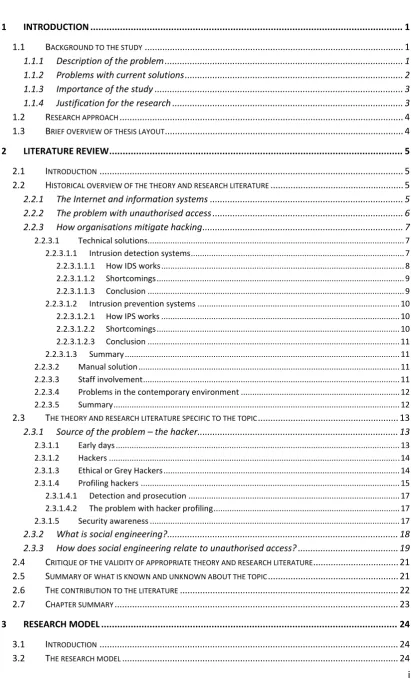
Table
of
Contents
1
INTRODUCTION
...
1
1.1
B
ACKGROUND TO THE STUDY
...
1
1.1.1
Description
of
the
problem
...
1
1.1.2
Problems
with
current
solutions
...
2
1.1.3
Importance
of
the
study
...
3
1.1.4
Justification
for
the
research
...
3
1.2
R
ESEARCH APPROACH
...
4
1.3
B
RIEF OVERVIEW OF THESIS LAYOUT
...
4
2
LITERATURE
REVIEW
...
5
2.1
I
NTRODUCTION
...
5
2.2
H
ISTORICAL OVERVIEW OF THE THEORY AND RESEARCH LITERATURE
...
5
2.2.1
The
Internet
and
information
systems
...
5
2.2.2
The
problem
with
unauthorised
access
...
6
2.2.3
How
organisations
mitigate
hacking
...
7
2.2.3.1
Technical solutions... 7
2.2.3.1.1
Intrusion detection systems ... 7
2.2.3.1.1.1
How IDS works ... 8
2.2.3.1.1.2
Shortcomings ... 9
2.2.3.1.1.3
Conclusion ... 9
2.2.3.1.2
Intrusion prevention systems ... 10
2.2.3.1.2.1
How IPS works ... 10
2.2.3.1.2.2
Shortcomings ... 10
2.2.3.1.2.3
Conclusion ... 11
2.2.3.1.3
Summary ... 11
2.2.3.2
Manual solution ... 11
2.2.3.3
Staff involvement ... 11
2.2.3.4
Problems in the contemporary environment ... 12
2.2.3.5
Summary ... 12
2.3
T
HE THEORY AND RESEARCH LITERATURE SPECIFIC TO THE TOPIC
...
13
2.3.1
Source
of
the
problem
–
the
hacker
...
13
2.3.1.1
Early days ... 13
2.3.1.2
Hackers ... 14
2.3.1.3
Ethical or Grey Hackers ... 14
2.3.1.4
Profiling hackers ... 15
2.3.1.4.1
Detection and prosecution ... 17
2.3.1.4.2
The problem with hacker profiling ... 17
2.3.1.5
Security awareness ... 17
2.3.2
What
is
social
engineering?
...
18
2.3.3
How
does
social
engineering
relate
to
unauthorised
access?
...
19
2.4
C
RITIQUE OF THE VALIDITY OF APPROPRIATE THEORY AND RESEARCH LITERATURE
...
21
2.5
S
UMMARY OF WHAT IS KNOWN AND UNKNOWN ABOUT THE TOPIC
...
21
2.6
T
HE CONTRIBUTION TO THE LITERATURE
...
22
2.7
C
HAPTER SUMMARY
...
23
3
RESEARCH
MODEL
...
24
[image:5.595.112.524.87.777.2]
ii
3.3
T
HE MODEL
...
25
3.3.1
Social
engineering
...
25
3.3.2
System
...
25
3.3.2.1
Procedures manual ... 25
3.3.2.2
Policies ... 26
3.3.2.3
Procedures ... 26
3.3.2.4
Risk management ... 26
3.3.3
Users
...
26
3.3.4
Behavioural
change
...
27
3.4
T
HE RESEARCH QUESTION AND PROPOSITIONS
...
27
3.5
C
HAPTER SUMMARY
...
29
4
RESEARCH
METHODOLOGY
...
30
4.1
I
NTRODUCTION
...
31
4.2
Q
UALITATIVE RESEARCH PHILOSOPHIES...
31
4.3
F
OCUS GROUPS
...
33
4.3.1
Ethical
clearance
...
33
4.3.2
Invitation
document
and
consent
form
...
33
4.3.3
Purpose
of
a
focus
group
...
34
4.3.4
What
is
a
focus
group?
...
34
4.3.5
Reason
for
using
a
focus
group
...
35
4.3.6
Role
of
the
moderator
...
35
4.3.7
Preparation
...
36
4.3.8
How
many
groups
and
saturation
level
...
36
4.3.9
Selection
of
participants
...
37
4.3.10
Ensuring
participation
...
37
4.3.11
Guiding
questions
...
38
4.4
L
EXIMANCER 3.5
...
38
4.4.1
Processing
steps
...
40
4.5
NV
IVO 8
...
47
4.6
C
HAPTER SUMMARY
...
48
5
DATA
COLLECTION
...
50
5.1
I
NTRODUCTION
...
51
5.2
O
BTAINING PERMISSION FROM DEPARTMENT HEADS
...
51
5.3
O
BTAINING PARTICIPANTS AND COMPOSITION OF THE FOCUS GROUPS
...
52
5.4
A
RRANGING THE VENUE
...
54
5.5
S
ECURING PARTICIPANTS
...
54
5.6
E
NSURING PARTICIPANTS’
ATTENDANCE
...
55
5.7
C
ONDUCTING THE FOCUS GROUPS
...
55
5.7.1
Validity...
55
5.7.2
Length
...
55
5.7.3
Consent
...
56
5.7.4
Recording
...
56
5.7.5
Moderator
...
56
5.7.6
Completion
...
56
5.7.7
Reflections
...
57
5.7.8
Transcription
...
57
6
DATA
ANALYSIS
...
59
6.1
I
NTRODUCTION
...
60
6.2
V
ALIDITY
...
60
6.2.1
Content
validity
...
61
6.2.2
Face
validity
...
61
6.2.3
Saturation
of
themes
...
61
6.2.4
Descriptive
validity
...
62
6.2.5
Interpretive
validity
...
62
6.3
C
ONCEPTS
...
62
6.3.1
How
literature
was
used
to
arrive
at
the
concepts
...
62
6.3.2
Propositions
...
63
6.4
F
OCUS GROUP ONE
...
64
6.4.1
Using
Leximancer
3.5
...
64
6.4.1.1
First analysis run ... 65
6.4.1.2
Second analysis run ... 66
6.4.1.2.1
Theme ‘people’ ... 66
6.4.1.2.2
Theme ‘credentials’ ... 70
6.4.1.2.3
Theme ‘password’ ... 73
6.4.1.2.4
Theme ‘systems’ ... 74
6.4.1.2.5
Theme ‘information’ and concept ‘data’ ... 76
6.4.1.2.6
Summary ... 78
6.4.2
NVivo
8
...
80
6.4.2.1
Education – Change procedures ... 81
6.4.2.2
Education – IT competency ... 82
6.4.2.3
Education – Passwords ... 84
6.4.2.4
Education – Using encryption ... 85
6.4.2.5
Existing improvements ... 85
6.4.2.6
Existing improvements to secure practice ... 88
6.4.2.7
Existing policy ... 88
6.4.2.8
Opportunities to improve security ... 88
6.4.2.9
Reasons for sharing credentials – staff ... 89
6.4.2.10
Risk – Bluetooth ... 91
6.4.2.11
Risk – Copyright ... 91
6.4.2.12
Risk – Email content unprotected ... 92
6.4.2.13
Risk – Glitches ... 92
6.4.2.14
Risk – Graduates still have access ... 93
6.4.2.15
Risk – New mobile devices outside purchasing cycle ... 94
6.4.2.16
Risk – Not using encryption ... 94
6.4.2.17
Risk – Security ... 94
6.4.2.18
Risk – Social engineering ... 95
6.4.2.19
Risk – Staff sharing credentials ... 97
6.4.2.20
Risk – Students sharing credentials ... 98
6.4.2.21
Risk – Unauthorised access occurring ... 99
6.4.2.22
Risk – USB keys ... 99
6.4.2.23
Trust ... 100
6.4.2.24
Summary ... 100
6.5
F
OCUS GROUP TWO
...
103
6.5.1
Using
Leximancer
3.5
...
103
6.5.1.1
First analysis run ... 104
6.5.1.2
Second analysis run ... 104
iv
6.5.1.2.2
Theme ‘information’ ... 110
6.5.1.2.3
Theme ‘system’ ... 113
6.5.1.2.4
Theme ‘looking’ ... 115
6.5.1.2.5
Theme ‘induction’ ... 116
6.5.1.2.6
Summary ... 118
6.5.2
NVivo
8
...
119
6.5.2.1
Education – Change procedures ... 120
6.5.2.2
Education – Induction ... 125
6.5.2.3
Education – IT competency ... 127
6.5.2.4
Education – Passwords ... 128
6.5.2.5
Existing improvements ... 129
6.5.2.6
Existing improvements to secure practice ... 131
6.5.2.7
Existing policy ... 131
6.5.2.8
Opportunities to improve security ... 132
6.5.2.9
Reasons for sharing credentials – staff ... 136
6.5.2.10
Risk – Email content unprotected ... 137
6.5.2.11
Risk – Incorrect access levels ... 139
6.5.2.12
Risk – Personal information available ... 141
6.5.2.13
Risk – Social engineering ... 142
6.5.2.14
Risk – Staff sharing credentials ... 145
6.5.2.15
Risk – Students sharing credentials ... 145
6.5.2.16
Risk – Unauthorised access occurring ... 146
6.5.2.17
Trust ... 147
6.5.2.18
Summary ... 148
6.6
C
OMBINED ANALYSIS
...
153
6.7
C
HAPTER SUMMARY
...
155
7
DISCUSSION,
LIMITATIONS,
FUTURE
RESEARCH
AND
CONCLUSION
...156
7.1
D
ISCUSSION
...
156
7.2
L
IMITATIONS
...
160
7.3
F
UTURE RESEARCH
...
160
7.4
C
ONCLUSION
...
162
7.5
S
UMMARY
...
162
8
REFERENCES
...164
APPENDIX
A
‐
ETHICAL
CLEARANCE
...173
APPENDIX
B
–
INVITATION
DOCUMENT
AND
CONSENT
FORM
...175
Table
of
Figures
Figure
1:
Model
‐
minimize
intrusion
with
propositions
(P1a,
P1b,
P1c,
P2a,
P2b,
and
P2c)
24
Figure
2:
Chapter
4
Research
Methodology
...
30
Figure
3:
Leximancer
‐
Project
Control
...
41
Figure
4:
Leximancer
‐
Load
Data
...
42
Figure
5:
Leximancer
‐
Pre
‐
process
...
43
Figure
6:
Leximancer
‐
Concept
Seeds
Identification
...
43
Figure
7:
Leximancer
‐
Edit
Emergent
Concept
Seeds
...
44
Figure
8:
Leximancer
‐
Develop
Concept
Thesaurus
...
45
Figure
9:
Leximancer
‐
Create
Compound
Concepts
...
45
Figure
10:
Leximancer
‐
Code
Concepts
into
Text
...
46
Figure
11:
Leximancer
‐
Generate
Outputs
...
47
Figure
12:
Chapter
5
Data
Collection
...
50
Figure
13:
Chapter
6
Data
Analysis
...
59
Figure
14:
Leximancer
concept
map
‐
Focus
group
one
‐
visible
concepts
...
66
Figure
15:
NVivo
tree
nodes
‐
Focus
group
one
...
81
Figure
16:
Leximancer
concept
map
‐
Focus
group
two
‐
visible
concepts
...
105
Figure
17:
NVivo
tree
nodes
‐
Focus
group
two...
119
Figure
18:
NVivo
‐
Free
nodes
for
both
focus
groups
...
154
vi
Table
of
Tables
Table
1:
University
department
heads
contacted
...
52
Table
2:
Participants
present
at
the
focus
groups
...
53
Table
3:
Leximancer
thematic
summary
from
Figure
14
‐
Focus
group
one
...
67
Table
4:
Leximancer
ranked
concepts
‐
Focus
group
one
...
68
Table
5:
Leximancer
thematic
summary
‐
Focus
group
two
...
106
Table
6:
Leximancer
ranked
concepts
‐
Focus
group
two
...
107
Table
7:
Combined
concepts
...
155
Table
8:
Refined
combined
concepts
...
157