Every teacher matters
RE
FORM
Dale Bassett
Andrew Haldenby
Will Tanner
Kimberley Trewhitt
Every teacher matters
The authors
Dale Bassett is Research Director at Reform.
Andrew Haldenby is Director of Reform.
Will Tanner is a Researcher at Reform.
Every teacher matters
Reform
Reform is an independent, non-party think tank whose mission is to set out a better way to deliver
public services and economic prosperity. Reform is a registered charity, the Reform Research Trust,
charity no. 1103739. This publication is the property of the Reform Research Trust.
We believe that by reforming the public sector, increasing investment and extending choice, high quality services can be made available for everyone.
Every teacher matters
Dale Bassett
Andrew Haldenby
Will Tanner
Kimberley Trewhitt
Contents
Executive summary 5
1. The importance of teachers 7
2. Central and local government have taken responsibility for teacher quality 14
3. Losing the battle 20
4. The path to performance 26
5. A new approach? 35
6. An action plan for great teaching 38
References 41
Appendix 1: Statutory teaching standards 45
Appendix 2: David Young Community Academy performance management regime 51 Appendix 3: Transcription of ‘Supporting quality teaching’ 55
Executive summary
The new Government wants to improve the quality of teaching. In July 2010, the Education Secretary Michael Gove told the Education Select Committee: “The single most important thing in education is improving the quality of the educational experience for each child by investing in higher-quality teaching ... There is simply no way of generating educational improvement more effectively than by having the best qualified, most highly motivated and most talented teachers in the classroom. Everything should be driven by that.”
This is absolutely the right focus. Academic research suggests that the difference in a pupil’s achievement between a high-performing teacher and a low-performing one could be more than three GCSE grades. The Coalition is right to move on from the debate about class size, which has a much smaller impact on pupils’ achievement than teacher quality.
Many teachers in English schools do a great job, delivering engaging, effective lessons and achieving excellent results. However much of this good practice occurs despite the system, not because of it. Teachers are subject to a stifling array of regulations, pressures and restrictions that impact on their freedom to teach. The Department for Education (with its agencies) devotes a remarkable amount of effort and resource to improving the quality of teaching. The Training and Development Agency for Schools (TDA), the National College for Leadership of Schools and Children’s Services and Ofsted employ 3,000 staff, with a combined budget of £1.5 billion per year. But results are very poor. The Children, Schools and Families Select Committee has found that training of teachers after initial qualification is “patchy” with “a number of fundamental problems”. Other research has found that only 25 per cent of teachers report that they are regularly observed in classroom practice, and that two thirds of all continuing professional development (CPD) is “passive” learning – what Professor John Bangs of the Institute of Education has referred to as “death by PowerPoint”. The TDA’s standards for new teachers are vague and little concerned with actual teaching practice. The National College’s compulsory qualification for new headteachers, the National Professional Qualification for Headship (NPQH), is especially weak, despite recent improvements.
In addition to reviewing the academic and empirical research available, Reform has conducted an extensive
series of interviews with headteachers, teachers, governors, and local authority and union officials. Simply put, the best schools do it themselves. Schools that make a success of teachers’ continuous professional development take the training of staff as seriously as any organisation in any sector. They have created their own systems of performance management rather than relying on government’s. They define their own standards for effective teachers separate to the TDA’s. Not only do they improve good teachers, they manage poor teachers effectively, and work successfully with the teaching unions to do so.
Every teacher matters
Executive summary
In order to reduce the ineffective bureaucracy that surrounds teacher quality, the forthcoming Education White Paper should announce the following reforms:
> Government attempts to control teacher quality should end. The Government should strip back the accountability regime: Ofsted should focus solely on the quality of teaching and management and the TDA should focus solely on teacher recruitment and initial training.
> Local authorities should stop providing School Improvement Partners to schools.
Governors should take responsibility for ensuring they are properly equipped to hold heads to account.
> The National College should be privatised, allowing schools to pay directly for its useful
services. Underperforming schools should buy in to the successful National College programmes – National Leaders of Education, Professional Partners and the Improving Teacher Programme – to benefit from the sharing of best practice across schools.
> Universities, in conjunction with business and excellent school leaders, should develop
education-focused MBA-style qualifications to replace the NPQH.
In order to increase the accountability of schools to parents, as a means of strengthening management and performance, Ministers should:
> Remove the various Government interventions into the cost and size of the teaching workforce, in particular the 2003 workforce agreement. Heads should have the freedom to set the right balance between pay, staff numbers and quality, and should be able to demand even greater professionalism from their staff, rewarding them as appropriate. One result would be a fall in the number of teaching assistants, since the value of the rapid growth in their numbers is not supported by the research evidence.
> Encourage genuine parental choice as the best means to provide real accountability. The Government should remove the self-imposed restrictions on the free schools initiative to increase the number of new institutions and allow the effects of choice and competition to work. It is inconsistent to ban the making of profits in schools funded by the taxpayer when the making of profit in publicly-funded hospitals, prisons and care homes is allowed. These recommendations are clearly in line with the new Government’s direction of travel in school reform. But Ministers should realise that their initial proposals are not sufficient to make a significant change to the quality of teaching and so to standards. Ministers’ ideas so far have focused on bringing new teachers into the profession, for example through an expanded Teach First programme. But the key task for improving the education system in the short to medium-term is to improve the quality of the 447,000 existing teachers. Ministers have placed the TDA and the National College under review but they have not challenged the prevailing idea that the improvement of teacher quality should be a responsibility of government rather than schools. Successful public service reform does not aim simply to cut costs. But by removing inefficiency and limiting the role of government to its proper one, it does just that. The measures outlined in this paper will also generate substantial savings over time. These include:
> The annual budget of the National College for Leadership of Schools and Children’s Services (£124 million in 2010-11).
> A substantial part of the budget of the Training and Development Agency for Schools (total
budget £713 million in 2010-11).
> Part of the administration budget of the Department for Education (£177 million in
2010-11).
> A reduction in the cost of teaching assistants. Reform has previously estimated the potential
saving in teaching assistants to be £1.7 billion a year.
1
The importance of teachers
Policymakers and parents have consistently focused on class sizes to try to improve educational outcomes. The evidence, however, suggests that in fact it is teacher quality that is the single biggest influence on pupils’ educational progress. An excellent teacher can improve a pupil’s performance by as much as 53 percentile points, or more than three GCSE grades. Reducing class sizes from 23 to 15 pupils, however, improves the average student’s performance by only eight percentile points. This misconception has driven the school workforce to grow substantially, even as pupil numbers have fallen. There are now 10 per cent more teachers and two-and-a-half times as many teaching assistants as a decade ago. This has been driven principally by the 2003 National Agreement on pay and conditions, which ringfenced 10 per cent of teachers’ time for out-of-classroom preparation and restricted their ability to cover for absent colleagues.
The increasing reliance on teaching assistants has not, in general, impacted positively on the quality of classroom education. A major 2009 study by the Institute of Education found that teaching assistants add little value in most classrooms, and have not substantially decreased the administrative burden for many teachers. Ofsted has warned that often it is the children most in need of the highest quality teaching who are left under the watch of teaching assistants, in the name of boosting staff-to-pupil ratios.
“The quality of an education system cannot exceed the quality of its teachers.” 1
Michael Gove, the Education Secretary, has said that the Government’s focus in schools will be on the quality of teaching: “Teachers and other education professionals will be at the front and centre of the [forthcoming Department for Education] White Paper because everything else we want to achieve flows naturally from the quality of the workforce. And that is the second great principle of education reform – nothing matters more than having great teachers – and great headteachers.” 2
This approach is correct. Despite policymakers’ and parents’ continued focus on staffing levels, a substantial body of academic evidence shows that teacher quality is the single biggest influence on pupils’ educational progress. One study shows that if two eight-year-olds are given different teachers – one a high performer (from the top 20 per cent) and one a low performer (from the bottom 20 per cent) – their performance diverges by 53 percentile points within three years. 3
The most in-depth research, by Professor Eric Hanushek of Stanford University, found that “the average student who has a teacher at the 85th quality percentile can expect annual achievement gains that are 0.22 standard deviations greater than the average student with a median teacher”. 4
These results have been mirrored in the UK by Burgess et al. who in a large-scale analysis found that being taught by a high quality (75th percentile) rather than a low quality (25th percentile) teacher adds 0.425 of a GCSE point5 – almost half an additional grade – per subject to a given student.6 This suggests that a pupil taking eight GCSEs taught by eight “good” teachers will score 3.4 more GCSE points than the same pupil in the same school taught by eight “poor teachers”.7
1 McKinsey & Company (2007), How the world’s best-performing school systems come out on top. 2 Gove, M. (2010), Speech to Westminster Academy, 6 September.
3 McKinsey & Company (2007), How the world’s best-performing school systems come out on top. 4 Hanushek, E. et al. (2005), The Market for Teacher Quality, National Bureau of Economic Research. 5 An increase from one grade to the next, say a B to an A, is one GCSE point.
6 Burgess, S. et al. (2009), Do teachers matter? Measuring the variation in teacher effectiveness in England, Centre for Market and Public Organisation, University of Bristol.
Every teacher matters
The importance of teachers
1
Class size is relatively insignificant
While it is clear that teacher quality makes a significant difference to pupils’ success, the continued focus of parents and policymakers is class size. However, the evidence, both empirical and academic, shows that class size makes almost no difference compared to teacher quality – despite having been the primary driver of policy and in large part being responsible for the doubling of per-pupil education spending witnessed since 1997-98.8
One study shows that the effect of reducing class sizes from 23 to 15 pupils improves the average student’s performance by only eight percentile points – compared to the potential 53 percentile point difference resulting from teacher quality.9
Research has consistently shown a negligible correlation between class size and outcomes. This was demonstrated by a 1995 Ofsted report10 and has been reinforced by subsequent academic work.
The Institute of Education has conducted extensive research into the effects of class sizes on educational outcomes. Their studies suggest that class size may have an impact in Reception year, particularly in literacy, but correlation between class size and performance decreases and becomes statistically insignificant in later years and in other subjects.11
For example, an Institute of Education study for the then Department for Education and Skills on Years 4 to 6 said:
“No evidence was found that children in smaller classes made more progress in mathematics, English or science, even allowing for the characteristics of pupils in small and large classes.”12
Similarly, Hanushek et al. found in their research that “there appears to be little systematic gain from general reduction in class size”,13 while the OECD argues that class size is “only one” of a range of factors which might impact on educational outcomes:
“Other influences include the number of classes or students for which a teacher is responsible, the subject taught, the division of the teacher’s time between teaching and other duties, the grouping of students within classes, the pedagogical approach employed and the practice of team teaching.”14 Comparing countries’ performance in the 2006 PISA league tables, it is clear that it is certainly not the case that larger class sizes automatically lead to lower performance. Korea and Japan have bigger class sizes but do far better at maths than England. Luxembourg, which the OECD cites as having particularly small class sizes, has much lower reading and maths attainment compared to England.15
The OECD has observed that class size “does not seem to have a direct impact” on pupils’ performance in science, for example, pointing out that Japan, Estonia, Korea and Slovenia have above-average science performance despite having above-average class sizes.16
8 Department for Children, Schools and Families (2009), Departmental Report 2009; Department for Education (2010), School Workforce in England; Bassett, D. (2010), Education: Briefing note, Reform.
9 McKinsey & Company (2007), How the world’s best-performing school systems come out on top.
10 See Passmore, B. (1995), “Small is best, but not for everyone”, Times Educational Supplement, 17 November: “[Ofsted’s] report, Class Size and the Quality of Education, published last week, says there is in general no clear link between the number of pupils in a class and the amount they learn. Only in the case of 5 to 7-year-olds, pupils with special needs and those of low ability, do small classes help. Chris Woodhead, chief inspector of schools [said:] ‘We are saying there is no statistically significant correlation between class size and the quality of learning’.”
11 Blatchford, P. et al. (2003), ‘Are Class Size Differences Related to Pupils’ Educational Progress and Classroom Processes? Findings from the Institute of Education Class Size Study of Children Aged 5-7 Years’, British Educational Research Journal, Vol. 29 No. 5.
12 Blatchford, P. et al. (2004), The effects of class size on attainment and classroom processes in English primary schools (Years 4 to 6) 2000-2003, Department for Education and Skills.
13 Hanushek, E. (1998), The Evidence on Class Size, W. Allen Wallis Institute of Political Economy, University of Rochester. 14 OECD (2009), Education at a Glance 2009.
15 Bradshaw, J. et al. (2007), Achievement of 15-year-olds in England: PISA 2006 National Report, National Foundation for Educational Research.
Every teacher matters
The importance of teachers
1
Teaching assistants are not delivering a quality education
Much of the decrease in the pupil-to-adult ratio arises from the increase in teaching assistants, who now number 194,00017 at an annual cost of £1.7 billion in 2009.18
Teaching assistants are not expected to have any specific prior qualifications or experience (although they can be awarded Higher Level Teaching Assistant status). Their roles include administrative and clerical tasks (such as photocopying), preparation for classes, working with specific pupils and supervising classes. There is much evidence, both from Ofsted and academic study by the Institute of Education, which suggests that teaching assistants have a negligible effect on educational outcomes, and may in some cases even harm a child’s education.
Research by the Institute of Education on class sizes for 5 to 7 year olds found that:
“There was no clear evidence for any year, for either literacy or mathematics, that additional staff or additional adults in the class had an effect on children’s progress, and there was no apparent ‘compensation’ effect of having extra adults in the class. This result is consistent with the STAR project,19 where it was found that there was no compensatory effect of having extra staff in larger (regular) classes. It is also supported by other recent research.”20
Extensive use of teaching assistants could even be damaging, particularly in the case of children with Special Educational Needs (SEN). Ofsted has criticised heavy use of teaching assistants to provide additional support for SEN pupils “because children in such circumstances are less likely to succeed than those who have access to experienced, qualified specialist teachers”.21 Similarly, the Institute of Education has reported that “during many in-class observations, it was noticeable how little teachers interacted with pupils supported by TAs”.22
17 Department for Education (2010), School Workforce in England.
18 House of Commons (2009), Public Expenditure: Government Response to the Committee’s First Report of Session 2008–09 (Second Special Report of Session 2008–09), Children, Schools and Families Committee.
19 The Student Teacher Achievement Ratio (STAR) project was a large-scale, four-year, experimental study of reduced class size conducted by the Tennessee State Department of Education. See www.heros-inc.org/star.htm.
20 Blatchford, P. et al. (2003), ‘Are Class Size Differences Related to Pupils’ Educational Progress and Classroom Processes? Findings from the Institute of Education Class Size Study of Children Aged 5-7 Years’, British Educational Research Journal, Vol. 29 No. 5.
21 Ofsted (2006), Inclusion: does it matter where pupils are taught?
Every teacher matters
The importance of teachers
1
The secret life of a teaching assistant
As shown above, there is a substantial body of academic and empirical evidence to suggest that teaching assistants often have a negligible impact on educational outcomes. But while the rapid increase in the number of teaching assistants was intended to facilitate delegation of non-teaching tasks to support staff, there is evidence to suggest that this is not happening enough.
A major 2009 Institute of Education research project conducted for the then Department for Children, Schools and Families found that only around 25 per cent of class teachers agreed that they now spent less time on routine administration. Reasons cited for this included the hours worked by support staff and some teachers choosing to do certain tasks themselves. Several teachers said, for example, that they could not use support staff for photocopying as they reviewed their lesson plans and resources after the previous lesson, by which time the support staff had gone home. Others insisted that classroom displays were an integral part of teaching and learning and so could not be delegated to support staff.23
Further, teaching assistants are often being called upon to fulfil the role of a teacher, in some cases taking full classes for extended periods of time. The IoE/DCSF study concluded that “some support staff have taken responsibility for longer than intended, taking on responsibility for which they were neither trained nor paid”.24 The study showed that in a minority of schools support staff taught whole classes for prolonged periods of several weeks in primary schools and a whole term or more in secondary schools. In secondary schools, support staff were generally given responsibility for lower sets.25
Among support staff who ever took responsibility for whole classes, only 33 per cent (primary) and 24 per cent (secondary) had Higher Level Teaching Assistant status. Less than 5 per cent had Qualified Teacher Status.26 This may be another example of the least able pupils, most in need of expert teaching, being left with the least qualified teacher.
The school workforce
[image:12.595.112.553.522.614.2]Spending on the workforce makes up the largest proportion of the schools budget. On average 78 per cent of a school’s budget goes on staffing. The numbers of teachers and other staff, and their salaries, have increased steadily over the past decade.
Table 1: The growth in the school workforce
Source: Deparment for Children, Schools and Families (2009), School Workforce in England; Department for Education and Skills (2006), School Workforce in England
Number Cost (£ billion)
1999 2009 1999 2009
Teachers 401,200 442,700 11.7 17.2 Teaching assistants 69,600 183,700
1.4* 1.7 Other support staff 79,100 162,200 2.0 Total 549,900 788,600 13.1 20.9
*Breakdown of cost between teaching assistants and other support staff not available for 1999
Every teacher matters
The importance of teachers
1
Boosting the numbers
[image:13.595.111.561.205.236.2]The increase in the number of teachers and classroom staff has been driven by government. The Training and Development Agency for Schools (TDA) is set an annual recruitment target by the Department for Education, which has increased steadily over many years.
Table 2: TDA Initial Teacher Training places target
Source: Department for Education (2010), Initial teacher training available places
1990/91 1995/96 2000/01 2005/06 2010/11*
23,245 29,115 29,715 34,300 35,485
* Provisional
[image:13.595.113.562.369.606.2]This has led to a significant increase in the number of teachers per pupil and the number of classroom staff per pupil.
Figure 1: Pupil-to-teacher and pupil-to-adult27 ratios, England, 1999-2009
Source: Department for Education (2010), School Workforce in England; Department for Education and Skills (2005), School Workforce in England
Staff-to-pupil ratios have increased markedly since the introduction of the 2003 National Agreement on pay and conditions, which heralded the widespread introduction of teaching assistants.
27 Pupil-to-adult ratio includes all teachers and support staff, including teaching assistants, but excludes clerical and administrative staff.
10 12
1997 1998 1999 2000 2001 2002 2003 2004 2005 2006 2007 2008 2009 2010
14 16 18 20 22 24
Secondary Pupil:Teacher
Secondary Pupil:Adult Primary Pupil:Teacher
Every teacher matters
The importance of teachers
1
National pay and conditions agreement
In January 2003 a new National Agreement, “Raising Standards and Tackling Workload”, was signed by the Government and the main teaching unions. The agreement’s aims were to “raise standards” and to “reduce teacher workload” and it detailed numerous changes to teachers’ contracts, to be phased in over time, in order to achieve this, including:
> Routine delegation of administrative and clerical tasks to support staff.
> New work-life balance clauses. > Limits on covering for absent teachers.
> Guaranteed time for planning, preparation and assessment.28
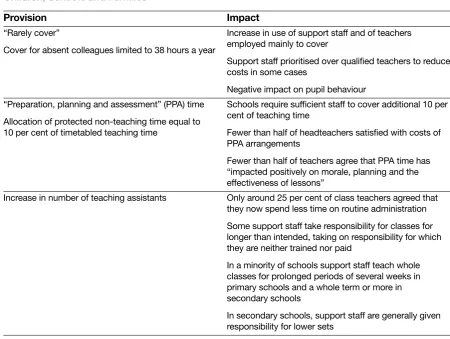
[image:14.595.110.561.337.676.2]Despite the increase in staff numbers they drove, in many cases the reforms do not appear to have had the desired effect, with secondary teachers being more likely to disagree than agree that the reforms had improved their work-life balance and decreased their stress levels.29
Table 3: The impact of 2003 National Agreement
Source: Hutchings, M. et al. (2009), Aspects of School Workforce Remodelling, Deparment for Children, Schools and Families
Provision Impact
“Rarely cover”
Cover for absent colleagues limited to 38 hours a year
Increase in use of support staff and of teachers employed mainly to cover
Support staff prioritised over qualified teachers to reduce costs in some cases
Negative impact on pupil behaviour “Preparation, planning and assessment” (PPA) time
Allocation of protected non-teaching time equal to 10 per cent of timetabled teaching time
Schools require sufficient staff to cover additional 10 per cent of teaching time
Fewer than half of headteachers satisfied with costs of PPA arrangements
Fewer than half of teachers agree that PPA time has “impacted positively on morale, planning and the effectiveness of lessons”
Increase in number of teaching assistants Only around 25 per cent of class teachers agreed that they now spend less time on routine administration Some support staff take responsibility for classes for longer than intended, taking on responsibility for which they are neither trained nor paid
In a minority of schools support staff teach whole classes for prolonged periods of several weeks in primary schools and a whole term or more in secondary schools
In secondary schools, support staff are generally given responsibility for lower sets
Every teacher matters
The importance of teachers
1
The school day and the school year
The nationally-agreed pay and conditions for school teachers prescribe a contractual limit of 1,265 hours of directed time for full-time classroom teachers, which must be spread over a maximum of 195 days (of which five are reserved for training).30
While there is no doubt that the vast majority of England’s teachers work very hard and demonstrate high levels of commitment (often extending to work such as marking and lesson planning being done out of school time), some of the best performing schools demand even better performance and even higher dedication from their staff.
Several academies in England, for example, have done away with the conventional school day and year. Many now start their day early and incorporate breakfast into the school morning. Some have abolished the conventional six-week summer holiday, starting their academic year earlier or breaking the year into more terms with short holidays.31
There are examples of similar practices in successful schools abroad. The American KIPP schools, for example, demand high levels of commitment from their staff. Teachers are required to attend school from 7.15am to 5.00pm daily, as well as teaching one Saturday morning in three and for three weeks during the summer. They are also required to be available by phone during evenings to help pupils with their homework.32 This level of professionalism is integral to the culture of KIPP schools and is regarded a major reason for their success. There is an understanding that to achieve the best (particularly in adverse circumstances), extraordinary levels of commitment are required. Teachers are compensated for this commitment in terms of both salary and a commitment to their professional development.
30 Department for Education (2010), School Teachers’ Pay and Conditions Document 2010. 31 McFarlane, A. (2010), “End of term. Already?”, BBC News Online, 25 October.
2
Central and local government have taken
responsibility for teacher quality
At present, the improvement of teacher quality in English state education is taken as a responsibility of government. Government has created numerous agencies including the Training and Development Agency for Schools, Ofsted and the National College for Leadership of Schools and Children’s Services to deliver this responsibility. Local authorities also have responsibility which they exercise through the provision of services, such as human resources, and personnel, such as School Improvement Partners.
Many teachers in English schools do a great job, delivering engaging, effective lessons and achieving excellent results. However, much of this good practice occurs despite the system, not because of it. Teachers are subject to an array of regulations, pressures and restrictions that impact on their freedom to teach
Training and Development Agency for Schools
The Training and Development Agency for Schools is the national agency and recognised sector body for the training and development of the school workforce.33 Last year it received £743 million in government funding, though the Government has announced a £30 million reduction in TDA funding for 2010-11, taken largely from its PR and recruitment budgets.34 It administers the system of teaching standards set out in the Education (School Teachers’ Qualifications) (England) Regulations 2003.35 This is the most direct way in which central government intervenes in classroom teaching.
Statutory standards: hitting the targets, missing the point
There are 33 “QTS standards” that trainees must meet in order to be awarded Qualified Teacher Status (QTS). There are 41 “core standards” that all teachers should meet “at the end of the induction period and continue to meet them throughout their teaching career”. There are 10 “post-threshold standards” that teachers must meet in order to progress to the upper pay scale.36
Many of these standards are of a vague nature, offering no clarity as to what constitutes having achieved the standard, and no quantifiable target. The first core standard, for example, requires teachers to “have high expectations of children and young people”. One calls on them to “communicate effectively with children, young people and colleagues”, while another requires that they “understand the roles of colleagues such as those having specific responsibilities for learners with special educational needs, disabilities and other individual learning needs, and the contributions they can make to the learning, development and well-being of children and young people”. Only one of the 41 core standards appears under the heading “Teaching and learning”.37
These standards fail against the management acronym of SMART objectives – specific, measurable, attainable, relevant and timely – and it is difficult to see how they are meaningful in a school setting.
33 TDA (2008), Strategic Plan 2008-13.
34 Bell, M. (2010), Revised TDA Remit 2010-11, Department for Education TDA remit letter. 35 Education (School Teachers’ Qualifications) (England) Regulations (2003).
Every teacher matters
Central and local government have taken responsibility for teacher quality
2
Development
The TDA’s stated leadership role is “to support and challenge the whole education sector to strengthen schools’ ability to develop their workforce and manage change more effectively”.38 Aside from the supply of teachers and the regulation of Initial Teacher Training (ITT), the TDA is also responsible for workforce development and reform.
In this role, the TDA promotes and administers a number of programmes in order to “embed sustained training and continuing professional development (CPD) practice in all schools”.39 These include the Effective Practices in CPD programme, which provides support and some small-scale funding for schools to develop their practice and further develop CPD, and the CPD database, intended as an authoritative resource for searching CPD providers and opportunities.40
However, there is relatively low take-up of many TDA programmes and resources. For instance, the Embedding the Links project, which aims to promote the benefits of CPD, performance management and professional standards in workforce development, involves only 400 schools across the country.41
National College for Leadership of Schools and Children’s Services
The National College for Leadership of Schools and Children’s Services42 is responsible for the professional development of leadership in schools and aims to provide training and CPD opportunities, as well as disseminating good practice.43 The 2010-11 budget for the National College was £139.9 million, though £16 million of cuts to its budget have been announced.44 The National College offers networking, events, resources and various professional development courses for school teachers and leaders, including the National Professional Qualification for Headship (NPQH), the Middle Leadership Development Programme and School Business Management diplomas.45
The NPQH is now a mandatory requirement for all new headteachers in state-maintained schools and remains the National College’s “flagship programme”.46
Ofsted
Ofsted is the non-Ministerial government department responsible for inspecting and regulating standards in schools. Up until recently, the Education Act 2005 dictated that schools be inspected on seven main areas. Three of these relate to education; one focuses on leadership and management; the remaining three are: > the spiritual, moral, social and cultural development of the pupils at the school
> the contribution made by the school to the being of those pupils (including emotional
well-being, the contribution made by pupils to society and pupils’ social and economic well-being) > the contribution made by the school to community cohesion.47
In September 2010, Michael Gove, the Education Secretary, announced that from 2011, the school inspections framework would be based on four areas: quality of teaching; leadership; pupils’ behaviour and safety; and their achievements.48
38 TDA (2010), Annual Report and Accounts 2009-10. 39 Ibid.
40 Ibid. 41 Ibid.
42 Formerly the National College for School Leadership.
43 National College of Leadership for Schools and Children’s Services (2010), Annual Report and Accounts 2009-10.
44 Balls, E. (2010), The National College Priorities: 2010-11, Deparment for Children, Schools and Families National College remit letter; Conboy, S. (2010), Supplementary Grant to the National College FY2010-11: School Business Managers – Creating Primary Clusters, Deparment for Children, Schools and Families National College remit letter; Munby, S. (2010), Speech to the National College Annual Leadership Conference 2010, 17 June.
45 National College for Leadership of Schools and Children’s Services (2010), Annual Report and Accounts 2009-10. 46 Ibid.
47 Ofsted (2010), The framework for school inspection.
Every teacher matters
Central and local government have taken responsibility for teacher quality
2
General Teaching Council for England
The General Teaching Council for England (GTC) was the professional body responsible for the regulation and registration of teachers. It was also responsible for the investigation of teacher misconduct and competency procedures. However, in June Michael Gove deemed that it “does little to raise teaching standards or professionalism” and ordered its abolition.49
In 2010-11, the GTC received a £400,000 central grant and a government subsidy on membership amounting to £18 million.50 No replacement body of redistribution of powers has been announced, but Lord Hill, the Schools Minister, has said that the “GTC’s functions should be transferred to other bodies”.51
School Teachers’ Review Body and School Support Staff Negotiating Body
The School Teachers’ Review Body (STRB) was established in 1991 to report to the Government on the statutory pay and conditions of school teachers in England and Wales. Its recommendations cover the duties and working time of school teachers, as well as their remuneration.52 Another body, the School Support Staff Negotiating Body (SSSNB) was established in July 2009 to fulfil a similar function for school support staff, including teaching assistants.53
In October 2010 the new Government announced it will abolish the SSSNB. A statement issued by the Government said: “The government has conducted a review of the future policy direction for determining school support staff pay and conditions, including the role of the SSSNB, and has concluded that the SSSNB does not fit well with the government’s priorities for greater deregulation of the pay and conditions arrangements for the school workforce.”54
The move fits with the Government’s aims to grant schools greater autonomy and independence, allowing heads to determine the recruitment and pay of support staff to be appropriate their school’s circumstances. This reform however is inconsistent with the Government’s decision to retain the STRB. Since support staff account for only around one fifth of the cost of the teaching workforce, this reform alone seems insufficient to give heads effective control over the cost and composition of their staff.
Local authorities
The Education and Inspections Act 2006 gave local authorities (LAs) a key strategic role in the promotion and maintenance of high standards in education, including significant powers to intervene in schools.55 They are responsible for overseeing the performance of schools, their financial stability and the capability of teachers, headteachers and governing bodies. LAs have a number of options available to them in order to intervene in schools:
> Issue formal complaint.
> Appoint new governors. > Create an interim board.
> Require a badly performing school to link up with a well performing school. > Remove the delegation from the school’s budget.
> Close, merge or otherwise reorganize the school. > Request an Ofsted investigation.56
49 Department for Education (2010), Announcement on the future of the General Teaching Council for England, press release, 2 June. 50 GTC (2010), Annual Report and Financial Statement 2009-10; GTC (2010), Annual Digest of Statistics, 2009-10. Teachers pay an annual
registration fee of £36.50, of which £33 is reimbursed to the GTC by the Department for Education. With 567,817 teachers registered by March 2010, this subsidy amounts to over £18 million.
51 Lord Hill of Oareford (2010), Letter to The Times, 14 June. 52 TeacherNet (2009), The role of the School Teachers’ Review Body.
53 www.ome.uk.com/example/School_Support_Staff_Negotiating_Body.aspx. 54 BBC News Online (2010), “School support staff pay body abolished”, 28 October.
55 Education and Inspections Act 2006. A local authority has the power to intervene if the school fails to comply with a warning notice from the local authority, it requires significant improvement or requires special measures.
Every teacher matters
Central and local government have taken responsibility for teacher quality
2
School Improvement Partners
Every LA is required to place a School Improvement Partner (SIP) in the schools it maintains for an average of five days per year (per school).57 SIPs administer the LA’s duties to provide professional challenge, support and monitoring of school performance, and input into the performance management of teachers, staff and the school leadership.58 According to the National Audit Office, the Department for Education spent £23.5 million on the SIP scheme in 2008-09.59
The NASUWT has argued that SIPs fail in their objective as facilitators of the “single conversation” with schools, instead focusing on the “achievement of outcomes designed to satisfy the requirements of the accountability system”.60 This claim that SIPs are ineffective in being both “critical friend” and local authority representative has been substantiated with evidence from both the National Union of Teachers and the National Governors’ Association. In evidence to the Children, Schools and Families Committee, the NUT argued against LA-appointed SIPs, proposing a system in which a “critical friend ... would be appointed solely by the school” and funded by the local authority.61 Similarly, the NGA found that SIPs’ ability to engage effectively with governing bodies was extremely variable.62
The fact that many SIPs are serving headteachers or education professionals means that they can also lack the necessary time and resources to effectively perform their duties. This has been confirmed by Ed Balls, the former Secretary of State, who admitted that it would be “a challenge to ensure that ... we will have the quality of SIPs that schools need”.63 Moreover, many SIPs are unable to give a school more than the obligatory five days per year, even if the school requires extra guidance or support, meaning that the schools that need the most assistance are left wanting.64 Proposals from the last Government to expand the scope and remit of the SIP’s role, including greater responsibilities around brokering support for school improvement from external providers and increasing time spent in the school to up to 20 days a year, would only serve to compound the issues surrounding the recruitment and ongoing completion of duties by SIPs.65
Accountability or mentoring? A confused role
The main problem with the SIP’s role, however, is that he or she is responsible for holding heads to account on behalf of the local authority. Heads can therefore be reluctant to share real problems with them. The National Association of Head Teachers argues that some SIPs act as “proxy inspectors for the local authority, placing unnecessary stress on school leaders and conducting their work in an atmosphere of suspicion and mistrust”.66 This was confirmed to Reform by teachers who described situations where heads would not ask for help with the challenges they were facing from SIPs in case it reflected negatively on them. One serving secondary head who acts as a SIP to two local authority schools told Reform that, while SIPs could be
extremely useful as a “sounding board” for a headteacher, their role as an “apparatchik of the local authority” compromised heads’ willingness to discuss problems openly with their SIP. Heads have told Reform that
SIPs are increasingly focused on compliance, further reducing their value as a support mechanism. A proper accountability role is clearly incompatible with an effective support and mentoring role.
57 National College for Leadership of Schools and Children’s Services (2009), A new relationship with schools: the school improvement partner’s brief. SIPs are however being phased out of good and outstanding schools in line with the Government’s objective of “light-touch” regulation for the best schools.
58 Ibid.
59 National Audit Office (2009), Partnering for School Improvement.
60 House of Commons (2010), School Accountability, Children, Schools and Families Committee. 61 Ibid.
62 Ibid. Mick Brookes, General Secretary of the NAHT said that “school experience of school improvement partners is as variable as their experience of inspection teams,” describing inspection teams as “poor”.
63 Balls, E. (2009), Oral evidence to the Children, Schools and Families Select Committee, 21 October.
64 Cooper, L. (2009), Oral evidence to the Children, Schools and Families Select Committee, 21 October. This is supported by the evidence of Lorraine Cooper, a SIP in Warwickshire, who argued that “one of the issues is that very many SIPs, particularly the external consultant SIPs and head teachers, are not always able to give more time than [the five days], even if it is needed, because they are employed in other work as well.”
65 Ibid.
Every teacher matters
Central and local government have taken responsibility for teacher quality
2
Governing bodies
The responsibilities of governing bodies include setting the strategic direction, objectives and targets of schools, reviewing progress, approving a school’s budget and providing support and challenge to the headteacher. The governing body is responsible for appointing the headteacher and for their management, though it is mandated to appoint an external adviser to assist in the reviewing performance of a head teacher as well, usually in the form of a SIP.67
The governing body, along with the local authority, is responsible for initiating and enacting capability procedures against headteachers. Nine of the 85 functions of governing bodies listed on the Governing Body Decision Planner, a guide to decision-making for governors, refer to teaching quality, teacher competency and performance management.68
The statutory responsibilities of the governing body are detailed in section 21 of the Education Act 2002.69 Governors are required to:
> Manage the school budget, consider the annual budget plan, approve the budget, consider and approve any proposed revisions to the budget plan.
> Decide on how to spend delegated budget depending on any conditions set out in the LA scheme
within the financial year.
> Decide whether to delegate their powers to spend the delegated budget to the headteacher. If so,
they should establish the financial limits of delegated authority.
> Be consulted by the local authority (LA) on significant changes to the LA’s fair funding. > Make sure accurate accounts are kept.
> Determine the staff complement and a pay policy for the school (in accordance with School
Teachers’ Pay and Conditions).
> Act as a ‘critical friend’ to the headteacher by providing advice, challenge and support.
> Establish a written performance management policy to govern staff appraisal, after making sure that
all staff have been consulted.
These statutory obligations necessarily require a certain level of professional expertise, both in regard to ongoing financial management and the performance management of personnel. However, there are no requisite qualifications for governorship and both the Local Government Association and the Audit Commission have found that governors can lack the professional or relevant knowledge.70 For example, 14 per cent of head teachers believe their governing bodies to be “inefficient” due to a lack of knowledge or experience.71
67 Ibid.
68 GovernorNet (2010), Governing Body Decision Planner. 69 Education Act 2002.
70 House of Commons (2010), School Accountability, Children, Schools and Families Committee. Councillor Les Lawrence, Chair, Children and Young People’s Board, Local Government Association, told the Children, Schools and Families Committee that “the complexity and analysis around performance management can be an area not well understood by governing bodies. Similarly, the Audit Commission argued that governors are in need of ongoing financial support.
Every teacher matters
Central and local government have taken responsibility for teacher quality
2
Governor training and support
Governors are under no obligation to complete any form of training or developmental course in order to become a governor, and aside from the governor training guidelines set out by the Department for Education, there is no consistent system of training or support before or after them assuming the post. As a result, the amount and type of training available varies significantly between local authorities.
This variation is exemplified in the practices of three London borough councils. In Tower Hamlets, the Children, Schools and Families Department administers the training and professional development of governors, providing free optional induction sessions and one free top-up session thereafter.72 Hackney, on the other hand, has transferred responsibility of governor training from its Children, Schools and Families Department to its School Improvement Partner programme, hiring SIPs to train governors in addition to their existing role.73 Islington, by contrast, outsources governor training and support to an external company, Cambridge Education @ Islington,74 and through the use of the Modern Governor e-learning resource.75 The incoherence of the governor training system, the lack of training requirement, and the difficulty governors face in taking time off work means that take-up of such training is low.76 In our discussions with governors, Reform was told, even where there are concerns over a headteacher’s performance, the need for
governors to take time off work to deal with the demands of capability proceedings is a major disincentive to taking action. While employers are legally obliged to give governors “reasonable time off” there is no requirement that this is paid, further disincentivising training and procedural duties.77
The limits of governor training can have profound effects on the fortunes of a school. For instance, if governors are not aware of the intricacies of legal procedures, their decisions can be appealed over lack of evidence. Inexperience in long-term financial management can lead to poor financial planning and poor budgetary control. These problems were highlighted in April by the Ministerial Working Group on School Governance, which recommended mandatory training for chairs and greater access to training for other governors.78 These sentiments were echoed by an LA official Reform spoke to, who argued that governors should be required to complete at least an induction course before assuming their role.
Successful operators’ hands are tied
The requirement for every school to have an independent governing body may itself undermine the role of successful operating organisations to hold their schools properly to account. Charities that run multiple academies are nonetheless required to have a separate governing body for each school.79 Moreover it is this governing body, and each independent school, that has an accountability relationship with government, not the central operator. One academy operating group told Reform that if the Government wants to encourage
successful operators to expand, and new operators to enter the market, they should be given the freedom to hold their own schools to account, with the operating organisation then held to account by Government for its performance.
72 http://www.towerhamlets.gov.uk/lgsl/1-50/29_school_governors/training.aspx. 73 The Learning Trust, Hackney (2010), Hackney Governor Training Programme 2010-11.
74 Cambridge Education @ Islington is contracted to provide a number of services to schools in Islington, including governor training, until April 2013; http://islington.camb-ed.com.
75 www.moderngovernor.com. Modern Governor is an e-product operated by Learning Pool. It offers short online course content to governors in subject areas such as “Preparing for Ofsted”, “Understanding School Finance” and “Equality and Diversity”. 76 House of Commons (2010), School Accountability, Children, Schools and Families Committee.
77 www.directgov.gov.uk, Becoming a School Governor.
78 Department for Children, Schools and Families (2010), 21st Century Schools: Implications and Challenges for Governing Bodies: A report from the Ministerial Working Group on School Governance.
3
Losing the battle
The poor management of teaching performance in most schools is perhaps unsurprising given the evidence of a general weakness of management across the schools system. One particular consequence of poor management is that some heads face great challenges in conducting capability proceedings and dealing with trade unions. (It is important to note, however, that good heads do manage these issues successfully, as the next chapter shows.)
One of the main reasons for the deficiency in management ability is simply that headteachers are not taught how to be effective managers. The National Professional Qualification for Headship, a compulsory qualification for first-time heads, focuses on ethos, leadership and vision, but fails to provide heads with the thorough grounding in legal, HR and financial management they need to do their job effectively.
In common with much of the public sector, effective people management in schools appears to be the exception rather than the rule. The 2010 House of Commons Children, Schools and Families Select Committee report Training of Teachers noted that “there is still some way to go in ensuring that the
implementation of the performance management process and the strategic management of professional development is effective across all schools.”80 It has also been reported that only 25 per cent of teachers say that they are regularly observed in classroom practice and that there is inadequate CPD for teachers.81 Ofsted has also observed that “very few schools visited had established a coherent cycle of induction, training and professional development linked to school self-evaluation and performance management for all staff.”82
Poor CPD
Research commissioned by the TDA has reported that professional development in schools remains “erratic, poorly planned and poorly evaluated”.83 The same study noted that CPD is still most commonly undertaken in the form of “passive learning” despite the fact that collaborative approaches are an essential component of effective CPD.84 Open University research has found that only 25 per cent of teachers report that they are regularly observed in classroom practice, and that two thirds of all CPD is “passive learning” – what Professor John Bangs of the Institute of Education has referred to as “death by PowerPoint”.85 Not enough time is spent getting teachers to talk to each other about teaching.
An Open University submission to the House of Commons Children, Schools and Families Committee notes that teachers and senior leaders do not consider the form of current CPD activities to be effective. Few teachers report spending most time in active forms of CPD such as practising the use of pupil materials (17 per cent of those surveyed), extended problem-solving (9 per cent) and demonstrating a lesson, unit or skill (6 per cent). In their responses teachers also report that CPD activities are not sustained or embedded over time.86
80 House of Commons (2010), Training of Teachers, Children, Schools and Families Committee. This has been highlighted in Storey, A. et al. (2008), Schools and continuing professional development (CPD) in England – State of the nation research project, Cambridge University/ Open University.
81 Margo, J. et al. (2008), Those who can?, IPPR.
82 House of Commons (2010), Training of Teachers, Children, Schools and Families Committee. Reiterated by evidence submitted by the Institute of Education to the Children, Schools and Families Committee: “Currently however continuing professional development lacks coherence and focus: it is often an afterthought in school development planning, and there is no quality guarantee. Rather, there is a patchwork of provision by local authorities, HEIs and private (often very small scale) consultancies. The proportion of teacher time devoted to CPD in England is lower than in high performing school systems.”
83 Storey, A. et al. (2008), Schools and continuing professional development (CPD) in England – State of the nation research project, Cambridge University/Open University.
84 Cordingley, P. et al. (2005), The impact of collaborative CPD on classroom teaching and learning. This study reported that “collaborative CPD was linked with improvements in both teaching and learning and many of these were substantial.” Positive outcomes for teachers included increased confidence, increased commitment to new techniques and increased belief in the positive impact they had on children’s ability to learn. Also House of Commons (2010), Training of Teachers, Children, Schools and Families Committee: Liz Francis, Director, Workforce Strategy Directorate, TDA, said: “going out on courses… is rarely the most effective form of professional
development. The most effective development is where someone reflects on their actual teaching, so that the learning is through the job.” 85 House of Commons (2010), Training of Teachers, Children, Schools and Families Committee.
Every teacher matters
Losing the battle
3
Spending on CPD
Schools’ spending on CPD varies greatly, with reported estimates of the proportion of school budgets spent on CPD ranging from 0.25 per cent to 15 per cent.87 Graham Holley, Chief Executive of the TDA, believes the average is 2 to 3 per cent.88
When making decisions about the allocation of CPD within schools, CPD co-ordinators will assess various factors including: the relevance of CPD to the School Improvement Plan, relevance to teachers, the cost of the programme/course, how much has already been spent on CPD, which CPD options offer value for money. There needs to be a more structured approach to CPD as currently it is very difficult to evaluate the impact it has on teachers. As Ofsted has noted, “few of the schools evaluated successfully the impact of CPD on the quality of teaching and on pupils’ achievement because they did not identify the intended outcomes clearly at the planning stage. Schools did not have an effective method for assessing the value for money of their CPD.”89 One of the schools surveyed in Ofsted’s 2006 investigation into CPD “had invested time and resources in improving the way spelling was taught [but] had not devised even a simple way of assessing whether pupils could spell any better at the end of the process”.90
The Open University observes that: “training and development opportunities in CPD evaluation and follow-up for school leaders would provide useful opportunities to plan strategically to more effectively balance and meet the wide range of professional development need in their schools”.91 As Andy Buck has argued: “Great schools are not just about hiring and firing the right people. They have a deep-rooted commitment to developing their staff and spend a disproportionately higher percentage of their budget on providing for continuing professional development and for wider opportunities for their staff.”92
Subject-specific CPD
Subject expertise is crucial in maintaining top quality teachers. Teachers with a passion for and deep knowledge of their subject are more likely to communicate that enthusiasm to pupils, as well as having a better understanding of the subject. In many subjects, updating knowledge with recent developments and the latest work in the field is also necessary.93
CPD has an important role in achieving this. However, the evidence from many representatives of the teaching profession suggests that sources of specialist advice that could support subject-specific CPD are in decline and instead CPD focuses on generic teaching skills.94 Speaking at Reform’s Schools for the future conference, Professor Sir John Holman, former Director of the National Science Learning Centre, noted that “teachers need opportunities to keep up with developments in their subject and to meet other teachers of the same subject to share ideas.”95 Professor Holman also quotes a study by the Wellcome Trust which in 2005 found that 50 per cent of all secondary school science teachers have had no subject knowledge CPD in the last five years.96
87 Ibid. 88 Ibid.
89 Ofsted, (2006), The logical chain: continuing professional development in effective schools. 90 Ibid.
91 House of Commons (2010), Training of Teachers, Children, Schools and Families Committee. 92 Buck, A. (2009), What makes a great school.
93 House of Commons (2010), Training of Teachers, Children, Schools and Families Committee. A memorandum submitted by the Wellcome Trust said: “individual teachers also have a responsibility to keep up to date, both with their subject and with new teaching approaches. This is particularly important for STEM teachers who need to keep pace with scientific discoveries, ICT developments, innovative approaches to teaching and developments in curriculum and qualifications.”
94 Ibid. The Geographical Association said: “Increasingly CPD is school-based and focuses on generic teaching skills. Sources of specialist advice for subject teaching outside the core subjects have dramatically declined. In most local authorities there is no geography adviser, no opportunity for subject CPD and regular meetings of geographers have ceased.”
Every teacher matters
Losing the battle
3
Among teachers there seems to be a consensus that the most effective way to deliver subject-specific CPD is through working with other subject-specific teachers, not just within schools but across regions in order to share ideas and best practice, as well as to observe each other teaching.97 However, many schools create hurdles to this regional interaction (often financial) and instead concentrate on in-school development during single INSET days.98 Regional engagement for instance would require schools to release staff and cover supply, which they are reluctant to do.99
In order to encourage participation in subject-specific CPD, the Wellcome Trust has advocated formally accredited CPD opportunities, even suggesting they become a requirement for teachers to renew their teaching status at periodic intervals.100 However, given that it is also important that CPD is individually tailored, formally accredited courses may not be the most effective method for all.101 New ways of “vertical” subject integration – across age groups, from primary through to university – must be found, allowing teachers to remain immersed in their subject specialism and learn from their colleagues’ expertise.
Ofsted analysis
Ofsted has also reported that only a minority of schools manage performance and the workforce effectively. The most recent evidence is drawn from Ofsted inspections of 23 schools’ efforts to implement the 2003 workforce agreement.102 Ofsted found that only eight of the 23 schools visited could provide evidence of how the work of members of the wider workforce had contributed to improving pupils’ standards and achievement, while only six had established a coherent cycle of induction, training and professional development linked to school self-evaluation and performance management for all staff, including the wider workforce.103
A 2010 Children, Schools and Families Committee report found that “newly qualified teachers with whom we met reported that their schools did not encourage the sharing of teaching practice among their staff, and that they would have very much welcomed more opportunities to shadow and learn from colleagues.”104
Spending where it makes a difference
A 2009 Audit Commission report on school management found weak incentives for schools to improve performance of staff and value for money.105 As a result, while schools can and should adopt management practices that will help them achieve economy and efficiency, insufficient numbers do so. (Value for money in schools is largely about the performance of staff since staffing costs make up the great majority of the school budget.) The Audit Commission found:
> Schools’ accountability for spending is weak. They do not have to report efficiency savings or respond to value for money targets set by the then Department of Children, Schools and Families. > Most school development plans do not consider include details of the cost of the workforce.
> The financial management standard in schools focuses on processes rather than the real
achievement of economy and efficiency.
> Ofsted gives little attention to the deployment of staff in terms of value for money.
97 House of Commons (2010), Training of Teachers, Children, Schools and Families Committee. The Geographical Association said: “There is a strong consensus amongst teachers that the best way to develop their subject teaching is through working with other geography teachers to share ideas, plan together or observe each other teach. Teachers find this is more effective in developing their subject teaching than one-day INSET sessions.”
98 Ibid. The Institute of Physics said: “Many schools construct barriers to subject-related CPD and use most of their resources for general, in-school development. There needs to be either a right or an obligation to carry out subject-related work.”
99 Ibid. The Institute of Physics said: “The IOP provides a range of CPD experiences, ranging from mentoring support for trainees and Newly Qualified Teachers … through traditional residential courses, to the 2,500 teacher-days of twilight sessions … We would recommend a wider adoption of this outreach model, as it overcomes the reluctance of schools to release staff and pay supply cover.”
100 Ibid. The Wellcome Trust said: “One way to encourage this would be to offer more formally accredited CPD opportunities after initial qualification… An example of subject-specific accreditation in the education sector is Chartered Science Teacher status (CSciTeach). This is offered by the Association of Science Education (ASE), and requires individuals to maintain CPD in order to renew their CSciTeach status every five years.”
101 Ibid. The Cambridge Primary Review said that “while initial training must ensure tha all NQTs reach at least the minimum level of competence to take charge of a class in their first year of teaching, the training, support and development they receive thereafter need, as far as this is practicable, to be individually tailored”.
102 Ofsted (2008), The deployment, training and development of the wider school workforce. 103 Ibid
Every teacher matters
Losing the battle
3
> Governors do not play a sufficient role in challenging schools to use resources better.
> Schools have little comparative information on costs or how workforce deployment affects outcomes
for children.
Also, the National Audit Office has found that the standard tool for financial reporting in schools gives little attention to staffing costs in comparison to goods and services.106
Common delays in capability proceedings
When heads need to remove a persistently underperforming teacher, they must follow a detailed capability procedure, entailing several stages of performance review, assessment and feedback. See Appendix 4 for the Government’s model capability procedure.
There are a number of common problems encountered by heads who attempt to place staff in capability proceedings:
> Appeals. There can be multiple appeals against the head’s decision which prolong the process and are costly. Grounds on which one can appeal include too narrow an evidence base or procedures not being followed properly.107
> Sick leave. According to government research, when confronted with capability procedures, 50 per cent of teachers were subsequently off sick. In 60 per cent of cases the illness delayed the procedure and in 20 per cent of cases illness led to termination of the procedure.108 The report claimed that “absence frequently delayed the operation of capability procedures or halted it permanently … the individual went off on long-term sickness absence and ultimately applied for ill-health retirement.”109 > Local authority. Even if a headteacher has the will to increase standards, heads have told Reform
that in some cases the local authority HR officer will argue that he or she has unrealistic expectations and that “satisfactory” is the best that can be reasonably expected.
> Cost. One area of objection to capability procedures can be that a member of senior leadership who does not share a subject specialism with the teacher in question could be regarded as inappropriate to conduct capability procedures for that member of staff. One union representative told Reform that
in these circumstances it could be necessary to buy in the services of a senior subject specialist from elsewhere to collect evidence and help conduct the procedures, at significant cost to the school. > Impact on the school. Research carried out by Wragg et al., in which 57 professional colleagues
who had been working alongside an underperforming peer were surveyed, revealed frustration that the teacher in question had been allowed to take early retirement, or redundancy, or to teach elsewhere. In all responses “it was clear that one underperforming teacher could have a huge impact on whole school”.110
In terms of heads’ own capability to undertake competency procedures, there is low usage of formal procedures. Research done by the Deparment for Children, Schools and Families indicated that in 1999-2000, 65 per cent of headteachers did not have any experience of dealing with a capability issue and that 74 per cent of local authorities had no experience of headteacher capability cases.111 One head told Reform: “You don’t get any training. The first capability is very difficult.”
106 National Audit Office (2006), Improving poorly performing schools in England. 107 Department for Education and Employment (2000), Capability procedures for teachers.
108 Earnshaw, J. et al. (2002), Best practice in undertaking teacher capability procedures, Manchester School of Management (UMIST). 109 Ibid.
110 Wragg, E. et al. (2000), Failing Teachers?.
Every teacher matters
Losing the battle
3
The role of the unions
There is a widespread perception that the teaching unions play a negative role in competency procedures and most importantly that they stop bad teachers from being sacked, keeping them in the teaching system.
The Spectator’s Fraser Nelson is one amongst many commentators concerned that the school system is “run
by unions”.112 Geoffrey Canada, the New York education pioneer, has publicly warned Michael Gove that unions can inhibit innovation:
“This union issue has to be at the forefront if you’re going to bring about reform ... Until the unions come up with a real plan for improving schools that have failed – that doesn’t do what they have done [in the past] – I think they don’t have a really strong argument why they should be in this conversation in terms of what the future is going to be.”113
Concerns over the unions’ role in the education system are legitimate. While some teaching unions try to engage constructively, a militant tendency amongst others threatens to prevent any kind of reform of the system.
Tying heads’ hands
Headteachers are also subject to legal restrictions on the extent to which they can observe their teachers as part of a formal performance management or capability process. Classroom observation for the purposes of performance management is limited to one observation of a maximum of one hour in length per performance management cycle, with a maximum of three hours’ observation permitted per year.114 While it is clear that the best schools do not suffer as a result of these restrictions and successfully integrate observation into the daily life of the school, they are nonethe