Research Report DFE-RR055
14-19
qualifications
strategy
research
Marianne Burgess & John Rodger
This research report was commissioned before the new UK Government took office on 11 May 2010. As a result the content may not reflect current Government policy
CONTENTS
Page
EXECUTIVE SUMMARY i
1 CONTEXT AND METHODOLOGY ...1
2 THE CURRENT 14-19 QUALIFICATIONS LANDSCAPE...8
3 DELIVERY OF STANDALONE VQS/VRQS...17
4 THE VOCATIONAL ROUTE TO HIGHER EDUCATION...35
5 IMPLEMENTING THE 14-19 QUALIFICATIONS STRATEGY ...57
6 RECOMMENDATIONS ...88
REFERENCES ...98
EXECUTIVE SUMMARY
1. In September 2009, York Consulting LLP (YCL) was commissioned by the Department for Children, Schools and Families to undertake research to inform the 14-19 Qualifications Strategy, which set out four main pathways of qualifications: the general route - GCSE and A-Levels; Apprenticeships; Diplomas; Foundation Learning.
2. The focus of the study was the operation, role, and value of Vocational Qualifications (VQs) and Vocationally-Related Qualifications (VRQs) that are currently delivered as standalone qualifications and outside the four pathways.
3. The research activity comprised in-depth consultations with 14-19 partnerships in 10 local authorities (LAs), 50 providers (a mix of schools, colleges and work-based learning providers), 10 HEIs and discussions with learners on VQ/VRQ routes. While the research is essentially qualitative in nature and based on relatively small sample sizes, the consistency of message from the consultees across localities supports confidence in the robustness of key findings.
4. Throughout the report, for simplicity, we refer to VQs and VRQs as a single generic qualification. The distinction between the two is not always clear cut, nor is it directly relevant to our analysis. In terms of scale, the most prevalent VQ/VRQ, observed by some way, was the BTEC Diploma offered by EdExcel. Such is the popularity of this qualification, the majority of consultees would refer to a generic ‘BTEC’ rather than a generic VQ/VRQ.
Context: The 14-19 Qualifications Strategy
5. In 2005, the government published the White Paper 14-19 Education and
Skills, which set out a 10-year programme of reforms to transform the
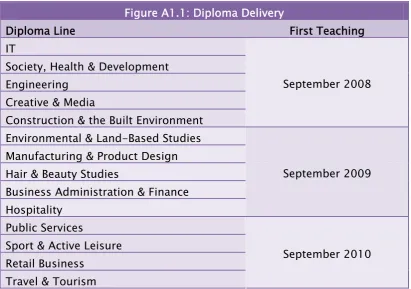
education system for 14-19 year olds in England. This included proposals to reform the qualifications offer, such as introducing Diplomas, a new suite of qualifications, and the expansion of Apprenticeships. Phased implementation of the Diplomas began during the academic year 2008/09. 6. In March 2008, a consultation document on 14-19 qualifications, entitled
Promoting Achievement, Valuing Success: A Strategy for 14-19
Qualifications, was published. This emphasised the complexity of the
The Current 14-19 Qualifications Landscape
7. The existing 14-19 offer in each of the partnership areas consulted as part of this research comprises a range of general, applied, vocational and practical learning options.
8. The general route (GCSEs/A-Level) is well established at 14-16 and 16-19. Provision in schools, in particular, is dominated by the general route, although a growing proportion of learners at 14-16 and 16-19 are now undertaking a general qualification in addition to a qualification from another route (e.g. Diploma) and outside of the four routes (e.g. a standalone VQ/VRQ).
9. Foundation Learning accounts for a smaller proportion of learners than the general route but, nevertheless, entry level and Level 1 provision is also well established. The provision may not yet be under the banner of Foundation Learning, but plans are being developed to move towards the Foundation Learning framework.
10. The proportion of learners in the Diploma route (at 14-16 and 16-19) is small, relative to the other routes and the provision currently outside the four main learning pathways. This reflects the phased roll-out of Diplomas, and lower than anticipated Diploma take-up. Apprenticeship provision accounts for a greater proportion of learners than Diplomas, but is still only a small proportion of learners and, to an extent, reflects a relative shortage of employers to support Apprenticeship places.
11. FE College provision is heavily dominated by standalone VQs/VRQs. In contrast, in work-based learning providers, most provision is Apprenticeships or Foundation Learning / Entry to Employment.
12. A range of factors have been noted as influencing the shape and balance of the 14-19 offer within providers, with the relative influence of these factors varying across partnerships and individual providers.
13. Of critical importance to partnerships and providers it the ability to offer a range of curriculum options which maximise learners’ chances of qualification achievement. It is evident that particular qualifications/ qualification routes are perceived to generate higher levels of learner success rates.
back to the introduction of programmes such as Increased Flexibility (2002) and Young Apprenticeships (2004).
15. In a number of cases, the offer is also determined, at least in part, by the offer of competing providers in the local area. At 16-19 this relates more specifically to the nature of the organisation (provider type and ethos). 16. Partnerships and providers are determined to offer a curriculum that fully
engages all potential learners and meets their needs. This includes learners who are at risk of disengaging from school during key stage 4, or who may otherwise be NEET 16-19. Parental demand can also be a key influence (particularly on school and sixth form college provision).
Delivery of Standalone VQs/VRQs
17. Within the 14-19 phase, VQs/VRQs are available from entry level through to Level 4 and across a wide range of subjects and sectors.
18. At 14-16, there has been rapid growth of VQ/VRQ delivery in schools and through local collaborative arrangements. The majority of areas consulted reported increased VQ/VRQ take-up at 14-16. Typically (although not exclusively), VRQs (e.g. business, travel and tourism) are delivered in school. VQs (e.g. NVQs in construction, hair and beauty) are more likely to be delivered through collaborative arrangements with FE colleges, work-based learning providers or at centres with specialist facilities.
20. 16-19 VQ/VRQ provision typically includes more niche provision (e.g. aviation; gambling operations) and provision at Level 3 than at 14-16. There are also some VQs that have a specific occupational focus, and may be a requirement for entry to employment in particular sectors.
Profile of VQ/VRQ Learners
21. In order to better understand how VQs/VRQs are accommodated in an individual’s programme of learning, we have segmented VQ/VRQ learners into the following broad categories.
14-16
• VQ/VRQ is a core part of the school curriculum for all learners • VQ/VRQ provision is an alternative to GCSEs:
one or more VQs/VRQs are substituted for GCSE options the VQ/VRQ forms part of a specific ‘programme’
the VQ/VRQ has substituted a particular GCSE for a set group of
learners only
• VQ/VRQ acts as curriculum enrichment
16-19
• a Level 1 or 2 VQ/VRQ is their core programme of learning and they plan to go into employment in this area
• a Level 2 VQ/VRQ is their core programme of learning and they plan to go into further education
• a Level 3 VQ/VRQ is their core programme of learning and they wish to go on to pursue employment in this area
• a Level 3 VQ/VRQ is their core programme of learning and they plan to study it further in Higher Education
• a Level 3 VRQ acts as curriculum enrichment.
VQ/VRQ Learner Performance and Progression
23. However, while overall performance has increased, Maths and English achievement has not increased at the same rate. Specifically, some learners who achieve their VQs/VRQs (and possibly other GCSEs) are not achieving Maths and English at Level 2. Many schools have made reference to the use of ALAN1 tests to provide learners with a qualification in Maths and English. On progression to further education or learning at 16-19, some learners may still need to re-sit GCSEs in Maths and English, particularly if they wish to go on to Higher Education (where ALAN tests are not valid for entry). 24. It has been suggested by partnerships and providers that participation rates
16-19 have increased (potentially as much as 10%) as a result of the VQ/VRQ provision available for 14-16 learners. Schools have cited examples of learners who they would not previously have expected to stay in learning (e.g. highly disaffected young people), progressing into further education at 16-19. This suggests VQs/VRQs may be particularly valuable for making progress towards Raising the Participation Age.
25. The progression value of the VQs/VRQs route can be significantly diminished if learners do not achieve Maths and English at Level 2. Concerns have also been raised about the currency of some qualification achieved at 14-16, for progression 16-19.
26. One of the distinguishing features of VQs/VRQs, identified by providers and learners, is their link to employment. However, literacy and numeracy requirements are commonly identified as skills gaps across many sectors, which suggests that while work-focused qualifications are valuable, greater emphasis should perhaps be placed on literacy and numeracy.
The Vocational Route to Higher Education
27. Vocational qualifications provide non-traditional learners with a very effective transmission mechanism to enter Higher Education. In theory, they have access to all parts of Higher Education but, in practice, are concentrated in FE Colleges and post-1992 universities. This, in the main, is determined by the vocational offer and project-based approaches available in these institutions.
28. Vocational learners are increasingly entering pre-1992 universities (including Russell Group Universities), although the numbers are relatively small. They do, however, require Distinctions and may find the support
structure less intensive than they are used to. Their qualification also needs to be from a subject ‘relevant’ to their degree course. Relevance is defined differently by different universities. It is important that vocational learners receive guidance at the point of selecting their qualification and are aware of its currency in the university marketplace.
29. According to admissions advisors, the main disadvantage that potential vocational entrants to Higher Education have, relative to A-Level candidates, is choice. The vocational qualification is specialised and specific to a particular subject. Its currency is not as transferable as A-Levels in the university market; particularly in Russell Group universities. This potentially poses a problem for learners deciding to switch their area of study.
Implementing the 14-19 Qualifications Strategy
30. Discussions with providers and 14-19 partnerships reveal that the value of each of the four pathways are recognised and individuals are able to observe benefits to learners who pursue those particular qualifications.
31. Any rationalisation of VQs/VRQs will inevitably increase the volumes in other pathways. For 14-16, it is likely to impact most on increased Level 1 and Level 2 Diploma participation, although many schools insist that they are more likely to fall back to GCSEs.
Gaps in the Current 14-19 Offer
33. Despite these options for substitution, an overarching issue highlighted by the providers and partnerships consulted is that there are four key gaps in the offer:
• a ‘practical and vocational’ route for learners at key stage 4, who are borderline Level 1 / Level 2 or who have a spiky learning profile i.e. are learning at multiple levels:
• a ‘practical and vocational’ route for learners at 16-19 who have not achieved sufficient at key stage 4 to pursue A-levels or pursue a Level 2 Apprenticeship (e.g. because of the key skills requirement).
• a ‘practical and vocational’ route at Level 2 or 3 for learners at 16-19 who are not yet ready for an Apprenticeship (e.g. lack personal and social skills required for work placement), or are unable to secure an employer placement due to limited availability or because they are too young to work in the sector;
• learners on qualifications at 16-19 that incorporate required industry training but where there are restrictions on learners gaining employment in particular sectors, until they reach the age of 18, or until they have a particular qualification.
Barriers to Implementation
34. While the needs of some learners could be met by the four pathways, partnerships and providers have some key concerns about the 14-19 Qualifications Strategy and a number of the implications associated with rationalising VQ/VRQ delivery.
35. Implications for learner performance - If VQs/VRQs were to be withdrawn or
36. Diploma demand - Diplomas, on the whole, are not regarded as a viable alternative to VQs/VRQs. There are concerns that the value of the Diploma could be affected if learners unsure to this learning style pursue the option. The actual and perceived appropriateness of Diplomas to a wide range of learners is ultimately affecting Diploma take-up. This does not look set to change, unless views regarding the relevance are challenged across partnerships and providers, and better information provided to learners and their parents. It is evident that Diploma take-up is currently constrained by the popularity of alternative qualifications.
37. Loss of a valuable learning style - There is a common view that a valuable
learning style would be lost by rationalising/withdrawing VQs/VRQs, due to some of the particular features of VQs/VRQs (e.g. style of learning, learning environment, incremental progression through levels, industry value).
38. Perceived value of VQs/VRQs relative to other qualifications - The four
qualification pathways of the 14-19 Qualification Strategy are not regarded as substitutes for VQs/VRQs for many learners.
39. Quality of IAG – Partnerships feel that learners are not always receiving full
and impartial IAG. They are not always being provided with sufficient information, advice and guidance about the full range of options available to them. This affects their views of particular pathways, and subsequent decisions they make.
40. Learner engagement and NEET prevention – There is a strongly held view
that limiting the range of VQs/VRQs could damage the ability of providers to engage with learners who are not necessarily low ability, but are at risk of disengaging. They are also regarded as a way of engaging those learners who may be borderline Level 2 achievement at key stage 4. At 16-19, standalone NVQs and VRQs are pursued by learners that are not able to pursue a Diploma or get an Apprenticeship. There is concern among providers about what real alternatives there are for these learners.
41. Implications for learner choice - VQs/VRQs have been introduced to expand
the options available to learners at key stage 4 and in 16-19 provision. While some learners can be accommodated in the four pathways, this will limit choice for learners. There may also be parental opposition.
42. Delivery challenges – Across all provider types in the 14-19 phase, a range
key drivers for VQ/VRQ delivery and reasons for not delivering other types of provision in the four pathways.
43. Our analysis shows that while the four pathways in theory are capable of meeting the needs of the majority of learners, there is, in the main, strong opposition to a significant rationalisation of standalone VQs/VRQs. It is anticipated that this would have an adverse affect on both learner performance and learner choice. There is, however, recognition that the existence of standalone VQs/VRQs will potentially crowd out take-up of the four routes. Without market intervention, it is expected that the relative VQ/VRQ share of the market will continue to grow.
Recommendations
44. The recommendations below reflect consultees’ suggestions about how, and where, VQ/VRQ rationalisation might take place, and actions which will be required to support implementation of the 14-19 Qualifications Strategy. 45. Refine the Structure of the Diploma: Many providers recognised the Diploma
as a valuable qualification, but felt that its current structure did not meet the needs of a significant cohort of learners whose needs are currently met by other VQs/VRQs. Refinements suggested included:
• making it ‘more like a BTEC’ by taking some of the practical elements of the VRQ and the ‘bite-size’ components that learners particularly value;
• introducing a more applied craft/vocational dimension;
• making it more flexible such that there are potentially different routes through the Diploma.
46. Address Misconceptions about the Diploma and Ensure Effective Diploma Delivery: Significant resistance to the Diploma exists among providers, and while some of this is based on experiences of exploring the potential to deliver the Diploma, there is a general underpinning issue about the extent to which there is a cultural willingness and commitment to the Diploma. Consideration should also be given to including VQs/VRQs as the Additional Specialist Learning (ASL element) (rather than GCSEs or A-levels) to make it more attractive to learners and provide them with a more varied Diploma experience. Attention should also be placed on ensuring effective delivery of functional skills.
criteria, a self-selecting rationalisation could be achieved. This would have the double advantage of removing poor quality provision. In addressing quality, this review may also include looking at how functional skills can be integrated into VQs/VRQs.
48. Remove ‘Double’ VQs/VRQs: It has been proposed that schools (in particular) should not be allowed to offer double VQs/VRQs, i.e. those that are equivalent to 4 or more GCSEs, since their currency 16-19 has been questioned. Linked to this is the suggestion that only one vocational qualification should be counted towards the target for achievement of the Level 2 threshold (five GCSEs at A*-C).
49. Head-to-Head Substitution: The head-to-head substitution proposition is that any provider offering a Diploma should not offer a VQ/VRQ in the same subject. There is evidence that this is happening in some areas, although not wide-spread. Amongst some providers, there is an expectation that this ruling will be introduced.
50. Address Exploiting Institutions: There is a general consensus among partnerships that some providers (mainly schools) are exploiting VQs/VRQs to maximise performance. One strategy would be to identify and target those exploiting institutions rather than a blanket withdrawal of particular qualifications.
52. Improve Consistency in Impartial IAG: One of the key themes to emerge from our consultations with teachers, college staff and young people is the paucity of impartial advice and guidance available to young people. Young people choose subject areas, but are largely unaware of the merits of different qualification options available. Young people need access to impartial advice to make better choices and those informing their decisions also need better understanding of the qualification routes.
53. Improving Outcomes at Key Stage 4: Some of the arguments for standalone VQs/VRQs at key stage 4 and 16-19 are linked to learner achievements and outcomes at key stage 4. By placing different emphasis on outcomes achieved by learners at key stage 4, some of these issues could be minimised or eliminated for young people. This includes placing less emphasis on overall achievement at key stage 4, and focusing on learners achieving Maths and English at key stage 4 and developing personal and social skills.
1
CONTEXT AND METHODOLOGY
1.1 In September 2009, York Consulting LLP (YCL) was commissioned by the Department for Children, Schools and Families to undertake research to inform the 14-19 Qualifications Strategy. This report presents the findings of the research.
Context for the Research
The 14-19 Learning Landscape
1.2 In 2005, the government published the White Paper 14–19 Education and
Skills, which set out a 10-year programme of reforms to transform the
education system for 14–19 year olds in England. This included proposals to reform the qualifications offer and in particular, to:
• introduce Diplomas, a new suite of qualifications, which would combine academic and vocational learning to provide an alternative to the traditional GCSE/A-Level route;
• reform GCSEs and A-Levels to reduce the burden of assessment and increase stretch and challenge for the most able;
• introduce a Functional Skills requirement in English and mathematics at Level 2 to ensure young people have the English and mathematics skills to deal effectively with everyday life and the workplace;
• expand the number of Apprenticeships; and
• provide better support for young people working below Level 2.
1.3 Phased implementation of Diplomas began during the academic year 2008/09.
The 2013 Vision
1.4 A consultation document on 14–19 qualifications, entitled Promoting
Achievement, Valuing Success: A Strategy for 14–19 Qualifications was
1.5 An implementation plan: Delivering 14–19 reform: Next Steps was published by DCSF in October 2008. This set out a number of very specific objectives for achieving the more streamlined qualifications offer by 2013.
1.6 In March 2008, DCSF published a consultation paper entitled “Promoting
achievement, valuing success: a strategy for 14-19 qualifications”. This
paper set out the clear intention to move towards a more streamlined qualifications offer for young people aged 14-19. The strategy sets out the intention that by 2013 young people aged 14-19 will access qualifications through four national learning pathways:
• general route – GCSEs and A-levels;
• Diplomas;
• Apprenticeships;
• Foundation Learning.
1.7 These are broad and flexible programmes of study which allow young people to tailor a learning package to fit with their needs and aspirations, whether those be theoretical learning, applied learning or a mixture of the two. All four routes are available for learners aged 16-19 and three routes for those aged 14-16. Apprenticeships are not available to young people under the age of 16, although young apprenticeship provision is currently delivered as a separate programme for the younger group.
1.8 Foundation Learning is currently being phased in. In some areas, provision already sits within the Foundation Learning framework, whereas in other areas, plans to incorporate entry level and level 1 provision into Foundation Learning are not as far developed.
1.9 The four routes are not intended to be mutually exclusive – a learner can work towards qualifications from more than one route. For example, a learner at key stage 4 may take a number of GCSEs, in addition to a Diploma.
Research Focus
1.11 This research focuses on the vocational qualifications (VQs) and vocationally-related qualifications (VRQs)2 that are not currently in the four routes i.e. are delivered as standalone qualifications. It explores provider motivations to deliver these qualifications in the 14-19 phase and the value to learners, employers and Higher Education (HE).
1.12 The objectives of the research are to explore:
• what motivates learning providers to offer particular VQs and VRQs to 14-19 learners;
• the approach providers take in offering the VQs and VRQs (e.g. classroom-based, simulation etc) and how this affects the choices of qualifications they offer;
• what learning providers believe motivates young people to take-up particular qualifications and whether any restrictions operate on choice (perceived or real);
• whether particular VQs and VRQs meet the needs of specific groups of 14-19 learners;
• the views of young people, employers and HE providers about different types of qualifications, in particular high take-up VQs/VRQs and the extent to which they support access to learning, prepare young people for employment and enable progression to further and higher education.
Methodology
1.13 The research activity comprised three strands:
• qualitative in-depth consultations with:
− 14-19 partnership leads/managers/coordinators3 in 10 local authorities (LAs);
− 50 providers across the 10 LAs; − 10 Higher Education Institutions;
2 The term VQ/VRQ refers to a wide range of different qualifications. Throughout the report this
general term is used where appropriate, in addition to other references to specific types of VQs/VRQs e.g. NVQs and BTECs.
• discussions with learners on VQ/VRQ routes (a total of 89 learners across the LAs);
• a review of literature.
1.14 The consistency of picture, irrespective of locality is quite astonishing for this type of qualitative research. This strong consensus reinforces our belief in the robustness of findings and the wider applicability to the national scene.
Research with Providers and Learners
1.15 A purposive sampling approach was adopted to identify the 14-19 partnerships and providers targeted for fieldwork. The 10 LAs were selected to provide:
• coverage of all nine English regions;
• differing levels of involvement in Diploma delivery – the number of Diploma learners at key stage 4 ranges from less than 200 to nearly 2,000;
• a mix of urban and rural authorities;
• a mix of 14-19 consortia arrangements – single consortia and multiple consortia.
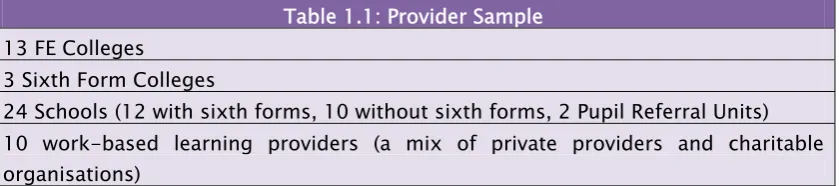
[image:19.595.112.532.584.677.2]1.16 Discussions between YCL staff and each 14-19 Partnership Manager informed the identification of providers for the fieldwork. On average, this included two schools and one or two FE colleges. In some areas, a work-based learning provider and/or a sixth form college also formed part of the sample. The profile of the 50 providers that contributed to the research is presented in Table 1.1 below.
Table 1.1: Provider Sample
13 FE Colleges
3 Sixth Form Colleges
24 Schools (12 with sixth forms, 10 without sixth forms, 2 Pupil Referral Units) 10 work-based learning providers (a mix of private providers and charitable organisations)
1.17 Within each provider, up to three members of staff were consulted. These included staff fulfilling the following roles:
• Sixth Form Colleges – Principal, Vice Principal, 14-19 Manager;
• Schools – Headteacher, Deputy or Assistant Headteacher;
• Work-Based Learning Providers – Chief Executives, Managers.
1.18 In providers where we have consulted with learners, we have also often had the opportunity to speak to course tutors to find out more about delivery of specific qualifications.
1.19 A total of 89 learners have contributed to the research, through one-to-one and focus group consultations. This includes learners aged 14-16 and 16-19, across a range of provider settings (school, FE college, and work-based learning providers). Learners were on a mix of Level 1, Level 2 and Level 3 courses, with differing backgrounds (e.g. low attainment at key stage 4, high achievement at key stage 4) and with different aspirations about future progression (e.g. employment, university, Apprenticeships).
Research with Higher Education Institutions (HEIs)
1.20 Research activity has been undertaken with a sample of 10 HEIs to explore further the routes that learners take from VQs/VRQs into Higher Education (HE) and their experiences of HE. Consultations were undertaken with Principals/Vice Chancellors, admission staff and course tutors. A mix of HEIs were included: pre-92 universities (including Russell Group Universities), post-92 universities and FE colleges delivering Higher Education.
1.21 This element of the study was undertaken as an extension to the main fieldwork and in response to interim findings regarding potential HE progression issues for vocational learners. Consultations were undertaken three months after the core fieldwork with schools and colleges.
Review of Literature and Evidence
Reference to VQs/VRQs
Report Structure
1.24 The remainder of the report is structured as follows:
• Section Two sets out the current and emerging 14-19 qualifications offer;
• Section Three provides an overview of delivery of standalone VQs/VRQs;
• Section Four explores the vocational route to Higher Education;
• Section Five addresses the factors that will affect any implementation of the 14-19 qualifications strategy;
2
THE CURRENT 14-19 QUALIFICATIONS LANDSCAPE
2.1 In this section, we provide an overview of the current and emerging 14-19 qualifications offer in terms of:
• current take-up of qualifications across the four pathways;
• factors influencing provider supply of the 14-19 qualifications offer.
Current Take-Up Across the Four Routes
2.2 The existing 14-19 offer in each of the partnership areas consulted as part of this research comprises a range of general, applied, vocational and practical learning options, across the four pathways set out in the 14-19 Qualifications Strategy and those positioned outside the four routes (i.e. standalone VQs/VRQs).
2.3 While the range of provision observed across the ten participating Local Authorities is broadly similar, more significant variation exists within each LA i.e. across different consortia and individual providers. The availability of Apprenticeships and Diplomas, in particular, is variable within areas by sector, level and locality. This reflects the phased roll-out of Diplomas, and also lower than anticipated Diploma take-up, plus a relative shortage of employers to support additional Apprenticeship places. Nevertheless, over time, this should be more consistent as areas work towards the 2013 entitlement.
2.4 Discussions with 14-19 partnerships and providers together with various literature sources have been used to provide an indication of the scale of take-up of different routes and the factors influencing the take-up. It is difficult to be entirely precise, as there is a certain amount of overlap between the routes (e.g. a learner may be working towards A-levels, in addition to one or more standalone VQs/VRQs) and there is no single source of data4 on take-up. Nevertheless, some clear patterns of take-up at 14-16 and 16-19 have been identified.
4 The main data sources (e.g. DCSF National Pupil Database and LSC Individualised Learner Record)
Provision for the 14-16 Phase
2.5 As would be expected, the general route (GCSEs) is well-established, and appears to account for the vast majority of learners at 14-16. In 2007, virtually all 15 year olds took GCSEs (Ryan, 2008).
2.6 Estimates from the 14-19 partnerships and providers indicate that, overall, a pure GCSE curriculum is the predominant route for learners, though a growing proportion of learners are now undertaking GCSEs in addition to a qualification from another route (e.g. Diploma) and outside of the routes (e.g. a standalone VQ/VRQ). The scale of stand-alone qualification delivery varies by school and can reflect the following three scenarios:
• it may be the case for all learners (e.g. where all learners undertake a BTEC First Certificate in Applied Science);
• it may represent a significant proportion of learners, but not all e.g. where there are a range of options for learners to choose from within their school and the local collaborative offer;
• it may be the case that only a minority of learners (e.g. less than 10%) will be pursuing a Diploma or standalone VQ/VRQ alongside their GCSEs.
2.7 The mix of GCSEs and VQs/VRQs followed by individual learners also varies. Some learners will be on a predominantly GCSE route, however there are also examples of learners who follow purely standalone VQs/VRQs instead of GCSEs. This is described in detail in Section Four.
2.9 The proportion of learners in the Diploma route is small, relative to the other routes and the provision currently outside the four pathways. In the LAs consulted as part of this research, the number of learners participating in Diplomas in each area ranges from 50 to 1,200 in 2009/105. In some LAs, this represents as little as 2% of the key stage 4 cohort. The vast majority of Diploma delivery for 14-16 year olds in the LAs in our sample is at Level 2.
2.10 The choice of qualification routes available to an individual learner can be dependent on the subject/sector, particular at the 14-16 range, as illustrated by the following example from one LA. Learners are not always able to choose from all four pathways.
Collaborative Offer at 14-16
A learner wishing to pursue Hair and Beauty at Level 1 has only the option of the standalone VQ/VRQ, since the Level 1 Diploma is not yet being delivered. At Level 2, however, the learners can choose between the Diploma or a VQ/VRQ alternative in Construction, Hair and Beauty, and Hospitality and Catering.
16-19 Provision
2.11 School sixth form provision is dominated by the general route – typically AS and A2 levels, alongside re-sits in GCSEs. As is the case with the 14-16 provision, the general route is most prevalent in those schools with higher performance. In a number of schools all learners are following the A-level route. In others, as many as 40% of learners are doing a mix of standalone VQs/VRQs (usually BTECs at Level 2 or Level 3) in addition to A-levels. A minority of learners in school sixth forms are undertaking standalone VQs/VRQs (and no A-levels).
2.12 Similarly, in Sixth Form Colleges, the predominant provision is a mix of the general route and standalone VQs/VRQs. This seems to vary depending on the nature of the area and profile of providers in the locality. In some sixth form colleges we visited, up to 50% of learners were pursuing more than one standalone VQ/VRQ. In others, the vast majority of learners were engaged in the general route.
2.13 In school sixth forms and sixth form colleges there is very little, if any, Apprenticeship provision. Only one school sixth form we consulted delivered Apprenticeships.
2.14 FE College provision is heavily dominated by standalone VQs and VRQs outside of the four routes. For example, in one case, up to 80% of 16-19 provision is standalone VQs/VRQs – approximately 150 qualifications in total across 20 subject areas. FE Colleges have consistently noted that VQ/VRQ provision makes up the majority of their offer:
“Standalone vocational qualifications, including BTECs and NVQs, are the ‘bread and butter’ of our provision.” (Curriculum Manager, FE College)
2.15 FE Colleges are also involved in delivery of A-level provision, however there is much more variation in the scale of delivery across our sample of FE Colleges. Two Colleges reported that they have almost stopped offering A-levels due to the provision available in local school sixth forms. Other colleges indicated that between 5% and 20% of their learners are studying A-levels, with those in areas where there is limited school or sixth form college provision, at the upper end of the scale. Some of these learners may be undertaking a VQ/VRQ alongside one or more A-levels.
2.16 For some FE Colleges, this specialisation has been a recent development having historically provided a more mixed offer. A college we consulted with the most significant A-level offer was located in an area where the local schools do not have sixth forms.
2.17 Apprenticeship provision accounts for a greater proportion of learners than Diplomas, but is, nevertheless, still only a small proportion (up to 10% of 16-19 provision in FE Colleges). Most are Apprenticeships at Level 2.
2.19 Among work-based learning providers, most provision is Apprenticeships or Foundation Learning / Entry to Employment. There are very few instances of learners following standalone VQ/VRQ routes. There is significant variation in the offer across work-based learning providers depending on the learner target group. Some are dominated by learners on Apprenticeships, whereas others focus much more on Foundation Learning learners including those who may be disengaged and may have challenging behavioural issues. The latter tend to be charitable provider organisations. Diploma delivery is also low amongst work-based learning providers.
2.20 This pattern of take-up across the four pathways is corroborated by other research. Research into opinions of individuals from the FE sector (Davies, Villeneuve-Smith, McKenzie, & Munoz, 2008) found that those surveyed would prioritise funding for vocational qualifications for young people foremost. Level 2 qualifications for people in work achieved a number two ranking, and Apprenticeships and other types of work-based learning were ranked number three. Diplomas were ranked lower down the list.
Factors Influencing Provider Supply of the 14-19 Offer
2.21 14-19 partnerships typically play some, but variable, roles in shaping the 14-16 offer within their LA. However, their primary influence is on the offer that is delivered collaboratively, with much less influence over the offer within individual schools.
2.22 At 16-19, the situation is somewhat different, particularly for the provision delivered by FE colleges and work-based learning providers, which was funded (pre April 2010) by the LSC. 14-19 partnerships are likely to play a more significant role in the future as a result of the transfer of some 16-19 funding to local authorities from April 2010.
2.23 The structure of the 14-19 offer, made available by providers, is determined by a range of influencing factors; operating differently at 14-16 and 16-19. While the relative influence of individual factors varies by both provider and partnership, the most prevalent are:
(i) learner performance; (ii) curriculum widening;
(i) Learner Performance
2.24Of critical importance to partnerships and providers is the ability to offer a range of curriculum options which maximise learners’ chances of qualification achievement. Learner performance is a key factor influencing the offer at 14-16; particularly in schools. It does not, however, drive the design of the offer in other types of providers and for the 16-19 phase in the way it appears to have done at 14-16, although all providers do monitor learner performance and will review their offer where underperformance is evident.
2.25 14-19 partnerships believe the expansion of VQs/VRQs at Key Stage 4 has been driven by the impact they are perceived to have had on learner performance. For example, in one area with a growing VQ/VRQ profile, performance at key stage 4 has increased from 36% achieving the Level 2 threshold (the equivalent of 5+ A*-C GCSEs) to 52% over the last two years.
2.26 It is evident from discussions with partnerships and providers that particular qualifications/qualification routes (e.g. VQs/VRQs) are perceived to have a greater effect on learner performance than others. For example, some partnerships have noted that the Level 2 Diploma is not particularly effective at improving overall learner performance at key stage 4.
(ii) Curriculum Widening
2.28 School specialisms6 have also influenced expansion of the curriculum, in order to incorporate different types of qualifications reflecting a school’s specialist status. Previous research (QCA, 2006) has also identified that the types of qualifications delivered at key stage 4 are determined by a provider’s specialist status.
2.29 In only one area we visited was there no significant history of standalone VQ/VRQ provision. In order to widen the curriculum, this particular area has responded by introducing Diplomas. They are now, however, reassessing their options vis-a-vis standalone vocational qualifications, as learners taking the Diploma have struggled with the functional skills component.
2.30 The demand for certain types of VQs/VRQs, most notably BTECs, has been driven, in part, by the popularity of such qualifications at 16-19. The role of FE colleges in some of the early VQ/VRQ delivery (e.g. Increased Flexibility) has exposed 14-16 learners to qualifications that were previously primarily undertaken by 16-19 learners.
“BTECs are very well established 16-19, well-regarded and
success rates are very good.” (14-19 Partnership Manager)
2.31 There is a growing trend of VQ/VRQ delivery (mainly BTECs) in school sixth forms and sixth form colleges. There is also some evidence of growth of BTEC delivery in FE Colleges. The increasing supply is driven by demand from learners who seek appropriate progression opportunities after completing a BTEC at key stage 4. In most cases, the VQ/VRQ expansion is at the expense of A-level provision.
(iii) Opportunities across the Local Area and the Nature of the Provider
2.32 In many cases the provision offer is determined, at least in part, by the offer of other competing providers in the local area or consortium. At 14-16, this may take place formally through the 14-19 partnership arrangements, where it is agreed that certain providers will lead on particular qualifications or sectors.
6 The Specialist Schools Programme (SSP) helps schools to establish distinctive identities through
2.33 At 16-19, this relates more specifically to the nature of the organisation (provider type and ethos), where there is recognition of the provision delivered by others. This is most evident in relation to A-level provision. Many schools with sixth forms have identified their primary role as offering an A-level route to those learners who wish to pursue A-levels. FE Colleges reflect this too, with many reporting that the focus of their provision is on vocational and vocationally-related provision since the main providers of general qualifications (typically A-levels) are the schools or sixth form colleges in the local area.
2.34 Work-based learning providers have highlighted their role in providing a vocational offer for all young people. Some, particularly, the charitable organisations, also refer to their ethos of being inclusive and the necessity to put together an offer that best meets the needs of all young people, particularly those who may be hard-to-reach or disaffected.
2.35 In some LAs, there is evidence of increasing recognition of the value to be gained from collaboration. Collaboration across school sixth form provision has helped schools broaden the choice they can offer to learners, improve efficiencies and support the development of specialist facilities.
(vi) Learner and Parent Demand
2.36 Partnerships and providers are determined to offer a curriculum that fully engages all potential learners. This includes those learners who are at risk of disengaging from school during key stage 4, or who may otherwise be NEET 16-19. Ensuring there is a wide curriculum offer is a critical part of the NEET prevention strategy by supporting learners to access provision that sufficiently engages them in learning 14-16 so that they can then identify a route to pursue 16-19.
3
DELIVERY OF STANDALONE VQS/VRQS
3.1 In this section, we provide an overview of the provision delivered outside of the four routes in relation to:
• provision outside the four routes: types of VQs/VRQs;
• profile of VQ/VRQ learners;
• VQ/VRQ learner performance and progression.
Provision Outside the Four Routes
3.2 Providers are involved in delivering a range of provision that sits outside of the four learning pathways. This VQ/VRQ route has expanded over recent years and the expansion appears to be continuing.
3.3 The term VQ/VRQ has been used to refer to standalone qualifications sitting outside of the four routes, which are vocational (VQ) or vocationally-related (VRQ). Vocational qualifications (as opposed to vocationally-related qualifications) can be described specifically in relation to their links to particular occupational sectors. The following definition (QCA, LSC, SSDA and SQA, 2006) describes their intended role.
Definition of Vocational Qualifications
A vocational qualification is: primarily designed to prepare learners for employment or specific occupations by increasing their knowledge, skill or proficiency in related subjects and therefore it has labour market value for entry to an identifiable occupation or set of occupations without additional qualifications. Vocational qualifications also include those designed to give enhanced labour market opportunities for people currently in (or qualified to enter) an identifiable occupation or set of occupations.
3.5 Within the 14-19 phase, VQs/VRQs are most commonly available from entry level through to Level 4 and across a wide range of subjects and sectors. Through this research, we have sought to identify those most commonly delivered and those perceived to be of most value to learners within the 14-19 phase. There are, nevertheless, a wide variety of VQs/VRQs.
[image:33.595.109.526.242.608.2]3.6 In Figure 3.1 we provide some examples of VQs/VRQs most prevalent in the areas we visited. As an illustration, we have attempted to classify by VQ and VRQ.
Figure 3.1: Examples of Typical VQs/VRQs
Qualification Examples
VQs:
National Vocational Qualification (NVQ)
NVQ Level 1 in Catering & Hospitality NVQ Level 2 in Beauty Therapy
NVQ Level 3 in Business & Administration Other Vocational
Awards (e.g. City & Guilds, VTCT)
CACHE Entry Level Certificate in Preparation for Childcare City & Guilds Introductory Certificate in Basic
Construction Skills (Level 1)
VTCT Level 2 Certificate in Hairdressing
IMIAL Level 3 Diploma in Vehicle Maintenance and Repair
VRQs:
Vocational A-levels Performing Arts Engineering
Health & Social Care
BTECs BTEC Entry Level 3 Certificate in Skills for Working Life: Animal Care
BTEC Introductory Diploma in Construction (Level 1) BTEC First Certificate in Sport (Level 2)
BTEC National Diploma in Health & Social Care (Level 3) OCR Nationals OCR Level 1 National in Leisure and Tourism
OCR Level 2 National Award in ICT OCR Level 3 National in Sport
VQs/VRQs at 14-16
BTEC enrolments have soared from 290,000 in 2004 to 775,000 in 2008, and are expected to top 1 million this year. The fastest growth has been in UK schools, where BTECs are now offered in more than 2,500 schools, up from 1,400 in 2005/06, as alternatives to GCSE qualifications.
3.8 We have observed this expansion at the local level, with the majority of areas consulted reporting increased VQ/VRQ take-up 14-16. For example, the VQ/VRQ provision delivered collaboratively in one area has risen from around 200 learners from the key stage 4 cohort in 2007/08 to over 600 learners in 2009/10.
3.9 Most VQs/VRQs for this age group are at entry level, Level 1 or Level 2. The types of VQs/VRQs can be categorised as follows:
• Vocationally-Related Qualifications - These are typically (although not exclusively) delivered in school or a classroom-based setting. They cover sectors/subjects such as IT, travel and tourism, performing arts, sport, business, and creative and media. Those most commonly achieved by learners at this age7 include:
− OCR Level 2 National First Award/Certificate in ICT (29%); − Edexcel Level 2 BTEC First Certificate/Diploma in Sport (12%); − Edexcel Level 2 BTEC First Certificate in Applied Science (6%). Overall, the subjects in which Level 2 VRQs are most predominant for this age range are ICT (41%), leisure, travel and tourism (15%), arts, media and publishing (13%) and science and maths (11%).
• Craft Qualifications – These include NVQs and other qualifications such as the IMIAL Level 3 Diploma in Vehicle Maintenance and Repair and VTCT Level 2 Certificate in Hairdressing. They are more likely to be delivered through collaborative arrangements with FE colleges, work-based learning providers or at skills centres with more specialist facilities. They cover sectors/subjects such as construction, hair and beauty, and motor vehicle.
3.10 Some learners will be pursuing these qualifications under the Increased Flexibility banner, and other learners may be on a Young Apprenticeship8.
7 DCSF, 2008: Data on vocationally-related qualification achievements.
3.11 The VQs/VRQs vary by qualification size. They may be equivalent to one or more GCSEs and are at a range of different levels. Examples of these qualifications, commonly available across the providers, are presented in Figure 3.2 along with details of their GCSE equivalence.
Figure 3.2: VQs/VRQs at 14-16 and their Equivalences
Qualification Equivalence
OCR National Award in ICT at Level 2 2 GCSEs at grades A*-C CACHE Foundation Award in Caring For
Children Level 1 3 GCSEs at grades D-G BTEC First Diploma in Science (Level 2) 4 GCSEs at grades A*-C NVQ Level 1 in Construction 5 GCSEs at grades D-G
VQs/VRQs at 16-19
3.12 Analysis of the 10 partnership areas shows that delivery of standalone VQs/VRQs has not expanded as significantly at 16-19, but has, nevertheless, increased in school sixth forms and sixth form colleges over recent years; a trend that seems set to continue.
3.13 The literature indicates that the proportion of Level 3 learners studying for A-levels has declined over the last seven years. In 2002, 80% of learners achieving a Level 3 qualification did so through the A-level route (Unwin, 2004). In 2007, around 50% of learners in full-time education aged 16-18 were studying for A-levels (Ryan, 2008). However, in 2008, 25% of learners achieving a Level 3 qualifications did so through the vocational route (The Edge Foundation, 2009), suggesting the proportion of Level 3 learners studying A-levels has decreased by at least 5%. The reasons behind this expansion are set out in more detail in Section Five.
• content/focus – some qualifications cover a broad subject area (e.g. BTEC National Diploma in Business), while others are more specialist or niche (e.g. Vehicle Body and Paint Operations). For some sectors, this specialist knowledge is particularly valued by employers. For example, First Diplomas and National Certificates are recognised as developing a good knowledge base for the environment and land-based sector9; • occupational focus – some qualifications provide a general introduction
and overview to a particular sector, while others (e.g. CACHE Childcare) provide learners with specific skills and training required to work in that sector. Some qualifications are particularly valued by employers, such as the BTEC National Diploma in Travel and Tourism, which is highly regarded as preparation for employment in the travel and tourism industry and the NVQ Level 2 and 3 in Retail for the retail industry10;
• qualification size – as is the case at 14-16, VQs/VRQs vary in size. Some may account for a learner’s entire programme of learning, whereas others may be equivalent to, for example, one A-level, and the learner may undertake a number of qualifications side by side.
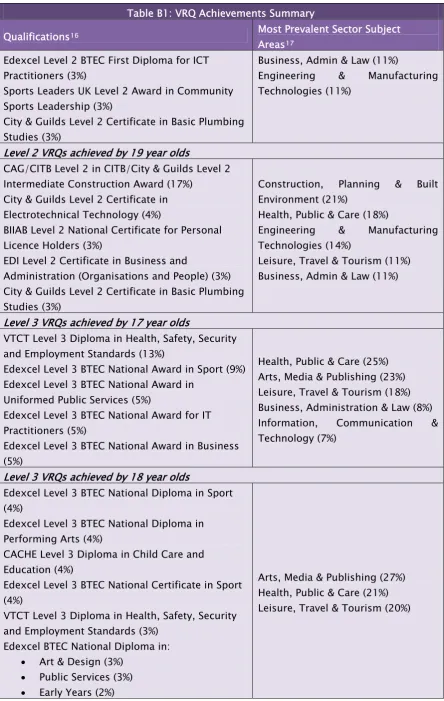
3.15 Data available on VRQ achievements11 by learners at 17, 18 and 19 provides an indication of the scale of take-up of different qualifications and across different sector subject areas. It is important to note that this only includes VRQs, as equivalent data is not available for VQs. The data shows that:
• at Level 2, the CAG/CITB Level 2 in CITB/City & Guilds Level 2 Intermediate Construction Award accounts for nearly a fifth of all VRQs achieved by 17 and 18 year olds;
• the BTEC First Diploma (in a range of subjects) is a predominant qualification at Level 2 for 17 and18 year olds, and likewise the BTEC National Diploma is a predominant qualification at Level 3;
• qualifications in the Health, Public & Care sector are commonly taken at Level 2 and 3, by 17, 18 and 19 year olds;
• qualifications in the Arts, Media & Publishing sector are more common at Level 3 than at Level 2
• qualifications in the Construction, Planning & Built Environment are more common at Level 2 than at Level 3.
9 DDP evidence
0 5 10 15 20 25 30 35
40 Figure 3.3: VRQ Achievements by Sector Subject Area
Level 2 (17 year olds)
Level 2 (18 year olds)
Level 2 (19 year olds)
Level 3 (17 year olds)
Level 3 (18 year olds)
Level 3 (19 year olds)
[image:38.595.78.748.93.429.2]Profile of VQs/VRQs Learners
3.17 In order to better understand how VQs/VRQs are accommodated in an individual’s programme of learning, we have segmented the learner group by considering a range of differentials including:
• level of learning i.e. VQ/VRQ levels (ranging from entry level to Level 3);
• type of VQs/VRQs, recognising that there is a wide range of different qualifications available under the VQs/VRQs banner;
• subject or sector;
• learner motivation to follow a VQ/VRQ programme of learning;
• learner aspirations and future plans.
3.18 A series of learner scenarios are set out in Figures 3.4 and 3.5. These reflect evidence captured from 14-19 partnerships, providers and discussions with a selection of VQ/VRQ learners. The categories are intended to provide an illustration of how the VQ/VRQ is accommodated in the learners’ programme of learning, while recognising that there will be additional variations.
14-16
3.19In some schools a VQ/VRQ may form a core part of the school curriculum for all learners. In other cases, the increase in collaborative provision during the last five to 10 years means that many learners now choose from options which are available within their school and that are available through other local providers.
Figure 3.4: VQ/VRQ Learners at 14-16
(i) VQ/VRQ is a core part of the school curriculum for all learners
In some schools, the vast majority of learners within the school follow a particular VQ/VRQ. This may reflect the school’s specialist status. There is no specific target group of learners and each learner may have limited choice in whether they pursue it or not. VQs/VRQs that are typically delivered in this way include:
• OCR National Award in IT (equivalent to two GCSEs at A*-C)
Figure 3.4: VQ/VRQ Learners at 14-16
(ii) VQ/VRQ provision is an alternative to GCSEs:
(a) one or more VQs/VRQs are substituted for GCSE options, for learners who are expected to be borderline Level 2 in key stage 4. This is a key mechanism to ensure that the learner achieves a qualification. It may be a Level 1 or Level 2 qualification and could be equivalent to as many as four or five GCSEs. The learner will have chosen due to its links to a particular employment sector (e.g. construction, hair and beauty) and practical learning focus. The learner is not necessarily disengaged from learning but may have relatively low motivation and aspirations. The learner is likely to pursue a work-based route 16-19 or undertake a further qualification in the same sector at the local FE college (at Level 2 or perhaps at Level 3). In the longer-term they are likely to aim to move into employment in their chosen sector;
(b) the VQ/VRQ forms part of a specific ‘programme’ (e.g. engagement programme) aimed at engaging the learner who may have shown signs of disengagement at key stage 3. The learners could be, but are not necessarily low ability learners, and may face a range of personal and social issues that are affecting their engagement with learning. The VQs/VRQs could be at entry level, level 1 or level 2, depending on ability;
(c) the VQ/VRQ has substituted a particular GCSE for a set group of learners only. These learners have been identified as those who would benefit from pursuing a VQ/VRQ alternative, rather than the GCSE which their peers will take. For example, in one school learners are placed in 8 groups:
• the top three groups all take the three separate science GCSEs; • the next three groups take the GCSE double science award;
• the final two groups take the BTEC First Diploma in Science (equivalent to 4
GCSEs).
(iii) VQs/VRQs act as curriculum enrichment
3.20 In terms of learner characteristics, several studies ( (NfER, 2006) and (QCA, 2006)) have shown that, at 14-16, learners pursuing vocational qualifications are more likely than their peers to be male, white, in receipt of free school meals, registered for school action or school action plus and to live in urban areas. While this may fit with the profile of learners in categories (ii) (a), (b) and (c), our observation, based on the areas we visited, was that learners in categories (i) and (iii) are typically the most representative.
16-19
3.21At 16-19, learners pursue the VQs/VRQs in a range of contexts as outlined below.
Figure 3.5: VQ/VRQ Learners at 16-19
(i) a Level 1 or 2 VQ/VRQ is their core programme of learning and they plan to go into employment in this area
The learner achieved some qualifications at key stage 4 (perhaps at Level 1 or a few at Level 2) but insufficient to be able to pursue a Level 3 qualification post 16. The learner is now pursuing a Level 2 VQ/VRQ, in an FE College, in a sector they would like to find employment in the future e.g.:
• Level 1 City & Guilds in Professional Cookery • Level 2 NVQ in Construction
• Level 2 NVQ in Hair & Beauty.
They may also be re-sitting English and Maths GCSEs (to achieve Level 2) alongside these courses, or doing a key skills qualification. Following completion of the qualification, they are likely to pursue employment in their chosen sector.
(ii) a Level 2 VQ/VRQ is their core programme of learning and they plan to go into further education
The learner achieved some qualifications at key stage 4 (perhaps at Level 1 or a few at Level 2) but insufficient to be able to pursue a Level 3 qualification post 16. The learner is now pursuing a Level 2 VQ/VRQ e.g.:
• BTEC First Diploma in Health and Social Care • BTEC First Diploma in Sport.
They may also be re-sitting English and Maths GCSEs (to achieve Level 2) alongside these courses, or doing a key skills qualification.
There are also many learners who do three year 16-19 courses in order to support their progression. This may include doing a Level 1 VQ/VRQ in the first year and then a Level 2 VQ/VRQ in the following two years.
Figure 3.5: VQ/VRQ Learners at 16-19
employment.
(iii) a Level 3 VQ/VRQ is their core programme of learning and they wish to go on to pursue employment in this area
The learner has identified the VQ/VRQ due to a particular interest in the sector/subject. Examples include:
• Level 3 BTEC National Diploma in Sport (equivalent to 3 A-levels)
• Level 3 BTEC National Certificate in Construction (equivalent to 2 A-levels).
They may have considered a Diploma (if available in the local area) or Apprenticeship but have opted for the VQs/VRQs as they wish to pursue a route they started 14-16, feel they are not ready to enter employment, or due to limited availability of Apprenticeships in the local area. They are likely to be attending an FE College, a Sixth Form College or a school sixth form. They are likely to progress into employment in this sector following completion of the qualification.
(iv) a Level 3 VQ/VRQ is their core programme of learning and they plan to study it further in Higher Education
The learner has identified the VQ/VRQ due to a particular interest in the sector/subject (as above). They may have considered doing A-levels or a Diploma (but not an Apprenticeship) but have chosen to pursue a BTEC. The BTEC may have been favoured so they can focus more on one specific subject (compared to A-levels) or because they have identified a relevant progression route to Higher Education with the BTEC.
(v) a Level 3 VRQ acts as curriculum enrichment
3.22 Other research (Hayward, 2008) has also identified similar categories and explored the characteristics of learners in two of the categories - curriculum enrichment and core programme of learning:
• curriculum enrichment – a high proportion of learners with combined courses (i.e. A-level plus BTEC) are in school sixth forms and their characteristics are similar to those learners following the pure A-level route;
• core programme of learning - learners studying all types of VQs/VRQs as a core programme of learning are from non-traditional FE backgrounds. They tend to be from lower socio-economic groups, are more likely to come from a non-white ethnic background and are more likely to be disabled.
3.23 Other studies have also identified the characteristics of learners pursuing vocational qualifications at 16-19. VQ/VRQ learners are more likely to have parents that did not undertake a degree (83% of learners studying for a BTEC at age 17 had parents that did not undertake a degree), and negative experiences of school 14-16 (Edexcel, 2009). This is likely to be the case for learners in categories (ii) and (iii) than (iv) and (v).
VQ/VRQ Learner Performance and Progression
Overall Key Stage 4 Achievement
3.24 Evidence from school providers consulted indicates that VQ/VRQ provision is having a positive effect on overall key stage 4 achievement for some learners. This is driven primarily by high achievement levels on VQ/VRQ qualifications. Examples of data from 14-19 partnerships illustrate these high levels of achievement:
• in one partnership area, the pass rate for all provision delivered collaboratively through specialist facilities was 97% for 2008. This includes a range of Level 1 and Level 2 VQs/VRQs for 216 learners; • similarly, in another area, 98% of the 94 learners participating in Level
3.25 Ofsted also found that learners studying VQs/VRQs achieved better than cohorts who did not study VQs/VRQs and better than initially expected (Ofsted, 2007).
3.26 Partnership managers and schools have cited positive knock-on benefits from learners participating in VQs/VRQs. In particular instances, this has been observed to contribute to a combination of improved confidence/application; better performance in other subjects and reduced exclusion.
3.27 This learner engagement benefit is consistent with the findings of the early reviews of the Increased Flexibility provision (Ofsted, 2005) which noted that students responded well to the broader learning opportunities available and that it had resulted in improvements among a large number of students in their attitudes, behaviour and social skills at college and back at school.
Maths and English Achievement at Key Stage 4
3.28 While overall Key Stage 4 performance has been observed to increase, it is clear that Maths and English achievement has not increased at the same rate. Specifically, some learners who achieve their VQs/VRQs (and possibly other GCSEs) are not achieving Maths and English at Level 2.
3.29 A number of different arguments have been posed around the importance and value of Maths and English achievements relative to the value of achieving at least some qualifications during key stage 4.
3.30 Some providers consulted played down the importance of Maths and English for particular groups of learners. While clearly an advantage to secure these qualifications, the key benefit was that learners, through VQs/VRQs, were participating and succeeding in some form of qualification.
“It is clear that many students doing BTEC courses require additional support for English and Maths, which, in the main, they don’t get. For the BTEC to be credible, they have to get
key skills achievement.” (14-19 Partnership Manager)
3.32 Maths and English abilities are, however, also one of the main reasons why the VQ/VRQ route is preferred relative to the Level 2 Diploma; an issue we return to in Section Five.
3.33 Many schools have made reference to the use of ALAN12 tests to provide learners with qualifications in Maths and English. These tests were initially designed for adult learners but are increasingly being used by schools as a backup qualification for those learners who it is felt may not achieve Maths and English GCSE. Some schools are entering all learners into the ALAN tests, while others will enter just those learners who are on the borderline of GCSE achievement. There are concerns about the use of the tests amongst some school staff:
“They get the ALAN test and then wonder why they still have to do the GCSE. The ALAN test is sold to learners as a GCSE but it
isn’t.” (Deputy Headteacher, School with a Sixth Form)
3.34 Furthermore, on progression to further education or learning at 16-19, some learners may still need to re-sit GCSEs in Maths and English, particularly if they wish to go on to Higher Education. The ALAN test is not a recognised qualification by most HEIs.
16-19 Participation
3.35 The evidence and perceptions of the implications of VQs/VRQs on 16-19 participation are mixed. It has been suggested by partnerships and providers that 16-19 participation rates have increased (potentially as much as 10%) as a result of the VQ/VRQ provision available for 14-16 learners.
12 ALAN tests are Adult Literacy and Adult Numeracy tests offered by the Awarding Organisation,
3.36 Indeed, many schools consulted noted that Level 1 VQ/VRQ learners will typically follow that route through to 16-19, having gained confidence from exposure to the local FE College or work-based learning provider. Other research (EdComs, 2007) has also identified the effect of vocational or work-based qualifications on participation 16-19:
The learning is hands-on rather than conceptual; the qualifications are relevant to the world of work they enter; the students can be put on a course at an appropriate level (e.g. Entry level or level 1) where they are more likely to get a pass, as opposed to a Grade D GCSE.
3.37 Providers consulted indicated that progression routes tend to differ depending on the type of VQs/VRQs pursued and the level of learning. The following are typical progression examples:
• learners on the Level 1 NVQ in Hairdressing have continued in this sector 16-19 – either on a Level 2 Apprenticeship in Hairdressing or an FE programme;
• the majority of learners who took a BTEC in media or business alongside their GCSEs have gone on to the local sixth form college to do A-levels or A-levels plus a BTEC, some of whom have longer-term aspirations to go on to Higher Education.
3.38 There is potential therefore that VQ/VRQ provision may be particularly valuable for making progress towards Raising the Participation Age. Schools have cited examples of learners who they would not previously have expected to stay in learning (e.g. highly disaffected young people), progressing into further education at 16-19.
3.40 Some teaching staff challenged the current emphasis placed on the achievement of particular GCSEs and VQs/VRQs, suggesting the emphasis should be on core subjects like English and Maths:
“The key to effective progression is English and Maths, not
BTEC or GCSE.” (Deputy Head, 11-16 school)
3.41FE staff in particular raised issues about the value of some of the qualifications learners are gaining at key stage 4:
“They think they have a passport to Level 3 provision but depending on their combination of qualifications, they can only
access some options at Level 3 and not others.” (Sixth Form
College)
“A small proportion (5%) of Level 2 BTEC students go onto
another Level 2 BTEC.” (FE College)
3.42 Some schools with sixth forms felt that qualifications equivalent to four GCSEs were not appropriate for progression to sixth form provision, and therefore did not deliver these at key stage 4 within the school.
Progression into Employment
3.43 One of the distinguishing features of VQs/VRQs, identified by both providers and learners, is their link to employment. For learners, undertaking a work-focused VQ/VRQ, it can support decisions about future options and provide experience of a particular sector of interest.