Second International Conference on Natural Polymers, Bio-Polymers, Bio-Materials, their Composites, Blends, IPN’s and Gels Polyelectrolytes and Gels: Macro to Nano Scales September 24-26, 2010 Kottayam, Kerala, India
ICNP-2010
THE POTENTIAL OF USING TREATED BETELNUT FIBRES AS REINFORCEMENT FOR TRIBO-BIO POLYMERIC COMPOSITES SUBJECTED TO DRY/WET
CONTACT CONDITIONS
Umar Nirmal, Nadia Jamil, B. F. Yousif, Dirk Rilling & P.V. Brevern
Faculty of Engineering and Technology, Multimedia University, Jalan Ayer Keroh Lama,
75450, Melaka, Malaysia.
Tel: +606 2523007, Fax: +606-2316552 [email protected], [email protected]
ABSTRACT
The current work initiates to use treated betelnut (areca catechu) fibres as reinforcement in polyester composites. Wear and frictional characteristics of T-BFRP composite were investigated against polished stainless steel counterface under dry/wet contact conditions using a BOD machine. The tests were conducted at 2.8 m/s sliding velocity, different applied loads (5N - 200N) and sliding distances (0 - 6.72 km). Fibre mats were orientated anti-parallel (AP) with respect to the sliding
direction of the counterface. The worn surface morphology was studied using a scanning electron microscope (SEM). This work concluded that the wear and frictional performance of the composite were enhanced under wet contact conditions by about 54% and 95% compared to the dry. Specific wear rate under wet test was low compared to the dry test. The composite exhibited high wear performance under both dry/wet contact conditions.
Keywords: Polyester composite, betelnut fibre, sliding wear, friction.
1. INTRODUCTION
Recently, new and more stringent environmental regulations coupled with the depletion of oil resources have evoked a concern among researchers to find a substitute for synthetic fibres in polymeric composites [1]. As an alternative, natural fibres are becoming an attractive alternative due to their advantages over the synthetics such as recyclability, biodegradability, renewability, low cost, light weight, high specific mechanical properties and low density [1-5]. Nowadays, applications of natural fibre reinforced polymeric composites can be found in housing construction material, industrial and automotive parts [6-9].
It is known from the literature that, untreated oil palm [1, 10, 11], sugarcane [12, 13], banana [14] and coir [15] fibres have very poor interfacial adhesion strength with the matrix
by nature. The poor interfacial adhesion is due to foreign impurities/substances which prevent the matrix to bond firmly with the fibres. Interestingly, betelnut fibres have many tiny hairy spots termed trichomes
From the tribological point of view, few works have been pursued on jute [18], cotton [19], oil palm [1, 10, 13], sugarcane [12, 13], coir [15] and bamboo [20, 21] fibres regarding their usage for tribo-polymeric composites. For instance, wear and frictional characteristics of oil palm fibre reinforced polyester composite [1, 10] revealed that oil palm fibres enhanced the wear performance of polyester by three to four folds. This was due to the presence of oil palm fibres at the surface of the composite forming a mixed layer of broken fibre and polyester debris which protected the polyester regions during the sliding.
Considering fibre orientation, the effect of sugarcane fibre has been studied on tribo-characteristics of polyester composites [12]. It has been found that fibre mats oriented parallel to the sliding direction showed lower wear performance than fibres oriented anti-parallel under the same test conditions. This was because in the parallel orientation, the path ahead of the wear debris is exposed, thus easing the fragmentation of fibres and removal of abrasive particles [12]. In anti-parallel orientation, abrasive particles were moving through different interfaces alternately, i.e. there were more hindrance in the path of abrasive particles which constitutes resistance and traps wear debris which in turn, reduces wear.
Contact conditions (dry/wet) have an equal important role which controls the tribo performance of polymeric composites [13-15, 22-27]. It has been reported that tribo performance of some polymeric composites were improved under wet contact condition compared to dry [22, 23]. It is known that increased interface temperature during adhesive dry loading conditions caused high damaged on the composite surface during sliding especially at the resinous regions due to thermo-mechanical loading conditions [11]. As such, the cooling effect introduced by water prevents the pullout of oil palm fibres from the polyester matrix as opposed to dry contact, i.e. wear is only controlled by mechanical loading [11, 28].
In previous work by the participating authors [16, 17], untreated betelnut fibre reinforced polyester (UT-BFRP) composite was used to study the wear and frictional behaviour of the composite under dry contact condition. The work revealed that the average wear and friction coefficient of the composite were reduced by 98% and 73% compared to neat polyester namely when the fibres were oriented parallel to the sliding direction.
Thus, through the author’s knowledge, there is no work reported on polymeric composites based on treated betelnut fibres under dry and wet contact conditions. Hence, the
current work aims to study the effect of treated betelnut fibres on the tribo-behaviour of polyester composites. The interfacial adhesion strength of the treated fibre with the polyester was determined using single fibre pullout test. The sliding wear and frictional characteristics of the developed composite were evaluated using a Block-On-Disc (BOD) machine under dry/wet contact conditions. The tests were conducted at different applied loads (5-200N) and sliding distances (0-6.71km) against a smooth stainless steel counterface with sliding velocity; 2.8m/s.
2. MATERIALS PREPARATION 2.1 Preparation of betelnut fibres
The preparation of betelnut fibres was explained in a past publication done by the author [16]. The length and diameter of individual fibre were in the range of 30-50mm and 150-200µm respectively. However, the prepared fibres were soaked in a 6% Natrium Hydroxide (NaOH) solution mixed with tap water at temperature of 26±5ºC for 48 hours. The fibres were rinsed and left to dry at room temperature before being put in an oven for 5 hours at 45 ºC.
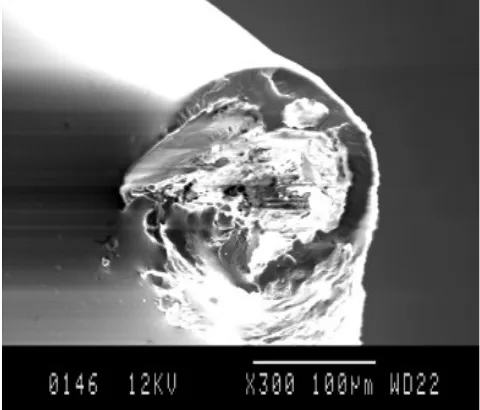
One can see from Fig. 1a & b that significant modifications occurred when betelnut fibre was treated. Very rough fibre surface can be seen on the treated one, Fig. 1b. Moreover, the trichome in Fig. 1b seems to be rougher than in Fig. 1a. This could improve the interaction between the betelnut fibres with the polyester matrix. In previous works [1, 11], the interfacial adhesion of oil palm fibres was highly improved when the fibre was treated with 6% NaOH. For the current work, the effect of treatment on the interfacial adhesion property of betelnut fibre and its effect on the tribological behaviour of the polyester composite will be explained.
Trichome Smooth outer
surface
a) Micrograph of a single untreated fibre
Trichome
Rough outer surface
b) Micrograph of a single treated fibre
[image:3.612.362.560.88.337.2]c) Micrograph of treated fibre mat Fig. 1: Micrographs of betelnut fibre
2.2 Fibre pullout test
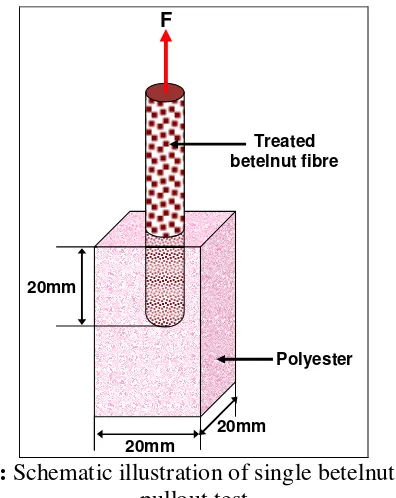
Single fibre pullout tests (SFPT) were conducted on universal test system (100Q Standalone) to determine the interfacial adhesion characteristics of treated betelnut fibre with the polyester matrix. Fig. 2 shows the schematic drawing of the pullout test. Further detail on the sample preparation and the test procedure were explained in the past publication done by the author [16]. The loading speed was 1mm/min. It should be mentioned here that the tensile properties of single betelnut fibre were studied for dry and
wet fibres. Under wet conditions, the fibres were soaked in tap water (hardness 120-130mg/l) for 24 hours and then tested.
F
20mm
20mm
20mm Treated betelnut fibre
Polyester
Fig. 2: Schematic illustration of single betelnut fibre pullout test
The pullout result for single fibre (dry/wet) is presented in Fig. 3a. The figure shows that both trends (under dry/wet) are the same. The maximum stress for the dry fibre is about 280MPa which is almost similar to the single fibre strength. Similarly, the wet fibre reached to about 250MPa. This indicates that there is no pullout of fibre took place during the test. Moreover, the strength is also the same as the single tensile result. This shows that the interfacial adhesion of the treated fibre under dry/wet conditions is very high preventing the pulling out process. The microscopy of the pullout samples are shown in Figs. 3b & c which explain the above results.
0 50 1 00 1 50 2 00 2 50 3 00
0 5 1 0 1 5 2 0 2 5 3 0 3 5 4 0 4 5 5 0 Strain, %
S
tr
es
s,
M
P
a
W et Dry
EDRY
EWET
[image:3.612.339.574.525.715.2]b) Micrograph of fibre breakage after pull-out for dry test
[image:4.612.39.279.41.246.2]c) Micrograph of fibre breakage after pull-out for wet test
Fig. 3: Stress / Strain diagram and corresponding micrographs for single fibre pull-out test under dry/wet
conditions
The main reason of higher interfacial adhesion of the fibre is due to the presents of trichomes and rough surface of the fibre after treating with 6% NaOH. This is a promising result which has not been reported before on natural fibres such as oil palm, sugarcane, coir and jute fibres [1, 10-15, 18, 32].
2.3 Preparation of composite
Unsaturated polyester (Butanox M-60) mixed with 1.5% of Methyl Ethyl Ketone Peroxide (MEKP) as catalyst was selected as a resin for the current work. Treated betelnut fibre reinforced polyester (T-BFRP) composite was
fabricated using hand lay-up technique. In composite preparation, a metal mould (100 x 100 x 12 mm) was fabricated. The inner walls of the mould were coated with a thin layer of wax as release agent. The first layer of the composite was built by pouring a thin layer of polyester. A prepared mat was placed carefully on the polyester layer. Steel roller was used to arrange the mat and eliminate trapped bubbles. This process was repeated until the composite block was built containing 13 layers of fibre mats and 14 layers of polyester. The prepared blocks were pressed at approximate pressure of 50 kPa in order to compress the fibre mats and to force out the air bubbles. The blocks were cured for 24 hours and then machined into specimens in the size of 10 x 10 x 20 mm.
3. TRIBOLOGICAL EXPERIMENTAL PROCEDURE
Fig. 4 shows a schematic drawing of Block-On-Disc (BOD) machine which was used for the current work. Under wet contact condition, water system was adopted at the machine. Water was supplied to the counterface by a pump at a flow rate of 0.4 l/min. Water flowing to the counterface was collected by a container. A filter was placed in the water flow and cleaned from wear debris after each test. Accutec B6N-50 load cell was adapted to the BOD load lever to measure the frictional forces between the specimens and counterface while a weight indicator was integrated in order to capture the frictional forces simultaneously.
Counterface Dead weights
T-BFRP test specimen
Load cell
Weight balance
Pivot
Filter
Water source
Water supply at 0.4 litre/minute Container
[image:4.612.40.280.268.482.2]Pump
Fig. 4: Schematic drawing of a newly developed Block-On-Disc (BOD) Tribological machine operating
under dry/wet contact conditions
[image:4.612.336.584.449.586.2]D F V W N S . ∆
= (Eq. 1)
where;
Ws = Specific wear rate [mm3/N.m] ∆V = Volume difference [mm3] FN = Normal applied load [N]
D = Sliding distance [m]
Fig. 5 illustrates the sliding direction with respect to the fibres mats under dry/wet contact conditions.
Polyester layer Betelnut fibre mat Polyester layer
Sd
(Sd: Sliding Direction)
Fig. 5: Schematic illustration of T-BFRP composite showing the sliding direction
4. RESULTS AND DISCUSSIONS
4.1 Wear performance of T-BFRP composite
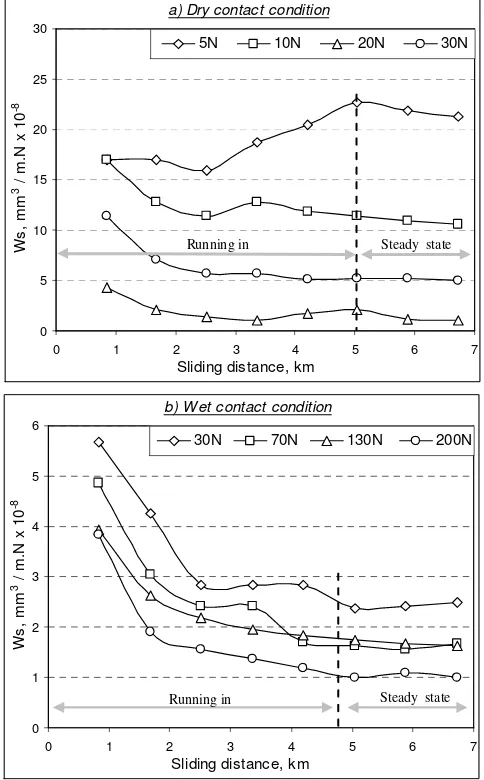
[image:5.612.337.579.137.527.2]Specific wear rate of T-BFRP composite as a function of sliding distance at different applied loads are presented in Fig. 6 under dry/wet contact conditions respectively.
Under dry contact condition; Fig. 6a, specific wear rate (Ws) of the composite has less influence by sliding distance especially at higher range of applied loads. However, at an applied load of 5N, there is an increase in Ws until 5km of sliding distance, i.e. a steady state reached after 5km of sliding distance. On contrary, Fig. 6b shows similar trends of specific wear rate. One can see that the curves are divided into two regions; “running in” and “steady state”. From the figure, as sliding distance builds up, specific wear rate gradually reduces until a steady state transition (6.72km). Surprisingly, the steady state specific wear rate was much shorter (≈ 4.2km) as compared to the dry test (≈
5km); cf. Fig. 6a. The presence of water helped to cool the interface, i.e. reducing the thermo mechanical loading of the composite during the sliding. This enhanced the wear (low values of specific wear rate) namely under wet contact
conditions. From Fig. 6b, one can see that superior improvement on Ws was achieved compared to the dry tests; cf. Fig. 6a. It is suggested that introducing water at the interface served two main purposes; as a cleaning and cooling agent [30, 31]. As such, in wet contact conditions, the specific wear rate of the composite was low by about five times compared to the dry tests.
Fig. 6: Specific wear rate (Ws) of T-BFRP composite vs. sliding distance at different applied loads and 2.8m/s
sliding velocity under dry/wet contact conditions
4.2 Frictional performance of T-BFRP composite
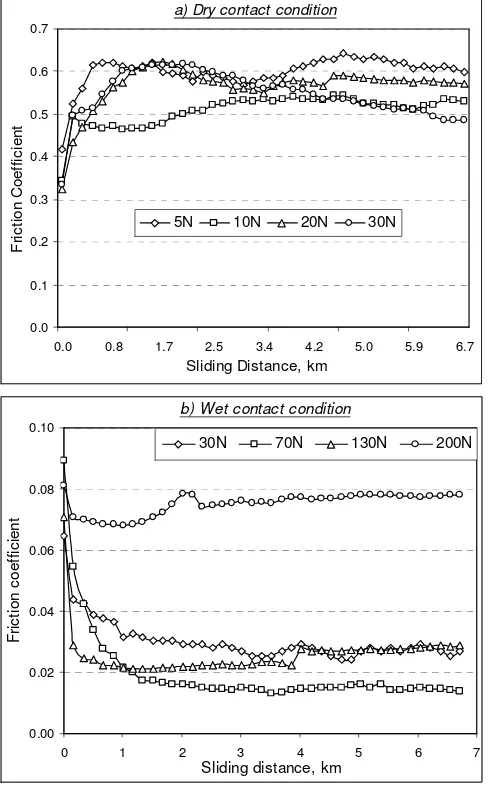
The frictional performance of T-BFRP composite at different applied loads against sliding distances is presented in Fig. 7 under dry/wet contact conditions. In general, Fig. 7a shows that T-BFRP composite exhibits lower friction coefficient values approximately in the range of 0.4 to 0.7 at all applied loads. Fig. 7b however shows a tremendous drop in friction coefficient values as compared to the dry test. One can see that the friction coefficient values were in the range of 0.01 ~ 0.08 respectively. The drastic reduction in friction
a) Dry contact condition
0 5 10 15 20 25 30
0 1 2 3 4 5 6 7
Sliding distance, km
W s , m m 3 / m .N x 1 0 -8
5N 10N 20N 30N
Running in Steady state
b) Wet contact condition
0 1 2 3 4 5 6
0 1 2 3 4 5 6 7
Sliding distance, km
W s , m m 3/ m .N x 1 0 -8
30N 70N 130N 200N
[image:5.612.46.277.187.387.2]coefficient under wet contact condition is due to the presence of water at the interface which assisted to wash away the generated wear debris and to reduce the interaction between asperities in contact during sliding. Similar results were reported on polyester composites based on glass fibre [28, 29].
a) Dry contact condition
0.0 0.1 0.2 0.3 0.4 0.5 0.6 0.7
0.0 0.8 1.7 2.5 3.4 4.2 5.0 5.9 6.7
Sliding Distance, km
F
ri
c
ti
o
n
C
o
e
ff
ic
ie
n
t
5N 10N 20N 30N
b) Wet contact condition
0.00 0.02 0.04 0.06 0.08 0.10
0 1 2 3 4 5 6 7
Sliding distance, km
F
ri
c
ti
o
n
c
o
e
ff
ic
ie
n
t
[image:6.612.41.285.123.516.2]30N 70N 130N 200N
Fig. 7: Friction coefficient of T-BFRP composite vs. sliding distance at different applied loads and 2.8m/s
sliding velocity under dry/wet contact conditions
4.4 Worn surfaces of the composite morphology
4.4.1 Dry contact condition
Fig. 8a shows evidence of fibre debonding micro-cracks associated with generated fine debris. At longer sliding distance (5km), Fig. 8b, the wear mechanism was predominant by plastic deformation, detachment and debonding of fibres. The figure shows the end of fibres which is covered by polyester associated with plastic deformation indicating high intimate contact between asperities (composite and counterface) leading to higher friction coefficient values, cf. Fig. 7a. Due to the side force being anti parallel to the sliding direction, there was
evidence of softened polyester (marked SP) causing higher material removal when the sliding escalates. It was reported that a high friction coefficient is possible when the contact of rubbing was between neat polyester and stainless steel [17]. Moreover, the softened polyester regions had modified the roughness of the counterface (cf. Fig. 10b) compared to the virgin one (cf. Fig. 10a).
De
Cr Fd
a) 1.68km
De
R
Dt Pd Sp
Sp
[image:6.612.341.577.159.516.2]b) 5.0km
Fig. 8: Micrographs of worn surfaces of T-BFRP composite under 30N at different sliding distances for
dry contact condition
(Crack: crack, De: debonding, Dt: detachment, Fd: fine debris, Pd: plastic deformation, R: resinous, Sp:
softened polyester)
4.4.2 Wet contact condition
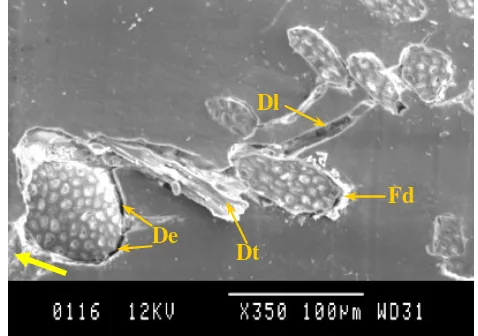
(200N) and shorter sliding distance (1.68km); cf. Fig. 9b; the wear was initiated by debonding of fibres especially the ones close to the resinous regions associated with torn fibres which eventually formed wear debris during the sliding. The wear debris could have left very fine grooves on the worn surfaces of the composite as evidenced in Fig. 9b marked ‘Fg’. When the wear escalates to 6.72km of sliding distance; Fig. 9c, the predominant wear mechanism is due to debonding and delamination of fibre mats. The figures also confirm that there were no signs of fine grooves evidenced on the worn surfaces as the water had washed away the generated wear debris during longer sliding distance, i.e. 6.72km. This may be the main reason why Ws was significantly lower at higher applied loads; 200N which is confirmed by Fig. 6b.
Tf
De
a) 70N, 6.72km
De
Tf De
Fg
b) 200N, 1.68km
De
Dt
Fd Dl
[image:7.612.338.577.37.205.2]c) 200N, 6.72km
Fig. 9: Micrographs of T-BFRP composite under 70N and 200N at different sliding distances for wet contact
condition
(De: debonding, Dl: delamination, Dt: detachment, Fg: fine grooves, Fd: fine debris, Tf: torn fibre)
4.5 Effect of sliding on surface roughness
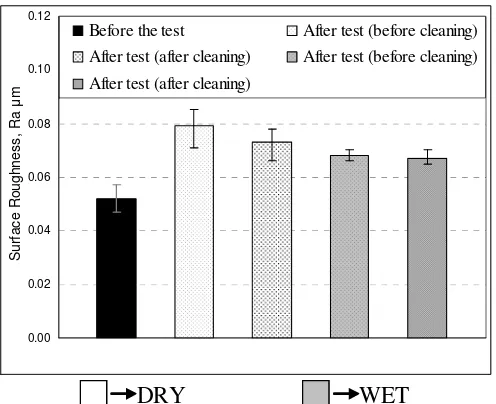
Before test, the average roughness profile of the stainless steel counterface was Ra = 0.052 µm; Fig. 10a. After test under both dry/wet contact conditions, there were slight modifications on the counterface roughness. The roughness profiles of the counterface are presented in Figs. 10b & c. The roughness of the wear track was measured in the presence of film transfer. The film transfer was removed by acetone, where the polyester is soluble in acetone and the results are displayed in Fig. 11.
there were not much changes in the Ra values of the counterface. It can be observed that the wear track roughness after testing before cleaning and after cleaning was not highly remarkable. This could have been because of water introduced at the interface which washed away all trapped wear particles by the T-BFRP composite test specimen during the sliding. In spite to this, the reduction of counterface surface roughness under wet contact condition was about 21% as compared to the dry test.
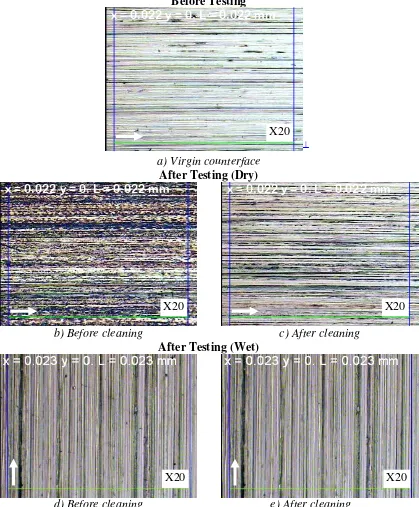
The optical microscopy images of the virgin counterface and after the test are shown in Fig. 12 for dry/wet contact conditions. In Fig. 12b, composite experienced film transfer on the counterface. However, there was much worn polyester debris from the resinous region of the composite which caused greater surface roughness on the counterface due to the fact that the worn polyester debris are brittle by nature. When the composite was subjected to wet contact condition, the counterface was polished with the presence of water during sliding. As a result, there was no evidence of film transfer which is confirmed by Figs. 12d & e. Therefore, this can be the reason why the specific wear rate under wet contact condition for the three orientations was significantly lower compared to the dry test.
5. CONCLUSION
After conducting the experimental work and discussing the results, few points can be drawn as follows:
a) 6% NaOH fibre treatment enhanced the wear resistance of the T-BFRP composite under dry/wet contact conditions compared to the untreated ones which was conducted previously by the participating authors [16]. b) The presence of treated betelnut fibres in the matrix
improved the wear and frictional performance of polyester, i.e. the average wear and friction coefficient was reduced by about 54% and 95% respectively under wet contact conditions compared to the dry.
c) The effect of introducing water at the interface served two main purposes; as a cleaning and cooling agent. As such, the Ws of the T-BFRP composite under wet test were lower by about five times compared to the dry tests.
d) Significant improvement on wear and frictional performance of the T-BFRP composite was achieved under wet contact conditions compared to dry. This was due to the tremendous reduction in the thermo mechanical loading during the sliding in wet contact conditions. In addition, higher loads up to 200N can be applied under wet contact conditions.
e) The wear mechanism under dry contact conditions was predominated by micro-cracks, plastic deformation, debonding and detachment of fibres. Under wet contact conditions, the wear mechanism was predominant by debonding, delamination and detachment of fibres associated with loose and torn fibres.
a) Virgin counterface, Ra = 0.052µm
Dry Contact Condition Wet Contact Condition
[image:9.612.30.575.35.257.2]b) AP-O, Ra = 0.079µm c) AP-O, Ra = 0.068µm
Fig. 10: Roughness average profiles of the virgin counterface and after testing at 30N applied load, 3.36km sliding distance and 2.8m/s sliding velocity under dry/wet conditions
0.00 0.02 0.04 0.06 0.08 0.10 0.12
S
u
rf
a
c
e
R
o
u
g
h
n
e
s
s
,
R
a
µ
m
Before the test After test (before cleaning)
After test (after cleaning) After test (before cleaning)
After test (after cleaning)
DRY WET
[image:9.612.183.431.300.502.2]Before Testing
X20 x = 0.022 y = 0. L = 0.022 mm
a) Virgin counterface After Testing (Dry)
X20 x = 0.022 y = 0. L = 0.022 mm
b) Before cleaning
X20 x = 0.022 y = 0. L = 0.022 mm
c) After cleaning After Testing (Wet)
X20
d) Before cleaning
X20
[image:10.612.106.525.42.549.2]e) After cleaning
REFERENCES
[1] B. F. Yousif, N.S.M. El-Tayeb, High-stress three-body abrasive wear of treated and untreated oil palm fiber reinforced polyester composite, Proc. IMechE Vol. 222 Part J: J. Engineering Tribology, DOI: 10.1243/13506501JET412.
[2] T. Corbiere-Nicollier, B. Gfeller laban, L.
Lundquist, Y. Leterrier, J.A.E Manson, O. Jolliet, “Life cycle assesment of biofibers replacing glass fibers as reinforcement in plastics”, Resour.
Conserv. Recycling 33, 2001, 267-287.
[3] Paul Wambua, Jan Ivens, Ignaas Verpoest, “ Natural fibers: can they replace glass in fiber reinforced plastics?”, Composites Sci. and Tech.
63, 2003, 1259-1264.
[4] S.V Joshi, L.T Drzal, A.K Mohanty, S.Arora,” Are natural fiber composites environmentally superior to glass fibre reinforced
composites?”.Composites, Part A 35, 2004, 371-376.
[5] T.M. Gowda, A. C. B. Naidu and C. Rajput, Some mechanical properties of untreated jute fabric – reinforced polyester composite, Compos. Part A:
Appl. Sci. Manuf. 30(3) (1999) 277 284.
[6] M. Baiardo, Z. Elisa and S. Mariastella, Flax fibre polyester composites, Compos. Part A 35(6) (2004) 703 710.
[7] Takashi Nishino, Koichi Hirao, Masaru Kotera, Katsuhiko Nakamae, Hiroshi Inagaki, Kenaf reinforced biodegradable composite, Composite
Science and Technology, 63(9), 2003, 1281-1286.
[8] Wanjun Liu, Lawrence T. Drzal, Amar K. Mohanty, Manjusri Misra Influence of processing methods and fiber length on physical properties of kenaf fibre reinforced soy based biocomposites,
Composites Part B: Engineering, 38(3), 2007,
352-359.
[9] Masud S. Huda, Lawrence T. Drzal, Amar K. Mohanty, Manjusri Misra, Effect of fiber surface-treatments on the properties of laminated biocomposites from Poly(lactic acid)(PLA) and kenaf fibres, Composites Science and Technology, 68(2), 2008, 424-432.
[10] B. F. Yousif, N.S.M. El-Tayeb, The effect of oil palm fibres as reinforcement on tribological performance of polyester composite, Surface Review and Letters, Vol. 14 No. 6 (2007) 1095-1102.
[11] B.F. Yousif, N.S.M. El-Tayeb, Wet adhesive wear characteristics of treated and untreated oil palm fibres reinforced polyester composites using two POD and BOR techniques, Proc. IMechE, Part J: J.
Engineering Tribology, under review.
[12] N.S.M. El-Tayeb, Abrasive wear performance of untreated SCF reinforced polymer composite, Journal of Material Processing Technology 206 (2008) 305-314.
[13] N. S. M. El-Tayeb. A study on the potential of sugarcane fibers/polyester composite for tribological applications. Wear, Volume 265, Issues 1-2, 25 June 2008, Pages 223-235.
[14] L.A. Pothana, Z. Oommenb, S. Thomas, Dynamic mechanical analysis of banana fibre reinforced polyester composites, Compos. Sci. Technol. 63 (2) (2003) 283-293.
[15] B. F. Yousif. Frictional and Wear Performance of Polyester Composites Based On Coir Fibers, Proc.
IMechE, Part J: J. Engineering Tribology, 2008,
accepted for publication.
[16] Nirmal Singh Gill, B.F. Yousif, Wear and Frictional Performance of Betelnut Fiber Reinforced Polyester (BFRP) Composite, Proc. IMechE, Part J: J.
Engineering Tribology, 2009, 223 (J2), 183-194.
DOI10.1243/13506501/JET516.
[17] B.F. Yousif, Nirnal Singh Gill, Saijod T.W. Lau, Alvin Devadas, The potential of using betelnut fibres for tribo-polyester composites considering three different orientations, Proceedings of IMECE2008
ASME International Mechanical Engineering
Congress and Exposition, November 2-6, 2008,
Boston, Massachusetts, USA, paper ID: IMECE 2008-68648.
[18] A.K. Rana, B.C. Mitra, A.N. Banerjee, Short jute fibre-reinforced polypropylene composite: dynamic mechanical study, J. Appl. Polym. Sci. 71 (1999) 531-539.
[19] S.A.R. Hashmi, U.K. Dwivedi, Navin Chand, Graphite modified cotton fibre reinforced polyester composites under sliding wear conditions, Wear 262 (2007) 1426-1432.
[20] J. Tong, R.D. Arnell, L.-Q. Ren, Dry sliding wear behavior of bamboo, Wear 221 (1998) 37-46.
[21] J.Tong, Y. Ma, D. Chen, J.Sun, L.Ren, Effects of vascular fibre content on abrasive wear of bamboo,
[22] Adelina Borruto, Gianni Crivellone and Filippo Marani, “Influence of surface wettability on friction and wear tests”, Wear, 1998, 222(1), 57-65.
[23] J.Wu and X.H.Cheng, “The tribological properties of kelvar pulp reinforced epoxy composites under dry sliding and water lubricated condition”, Wear, 2006, 261 (11-12), 1293-1297.
[24] Yuji Yamamoto and Tadashi Takashima, “Friction and wear of water lubricated PEEK and PPS sliding contacts”, Wear, 2002, 253 (7-8), 820-826.
[25] M. Sumerb, H. Unala, and A. Mimaroglub. Evaluation of tribological behavior of PEEK and glass fibre reinforced PEEK composite under dry sliding and water lubricated conditions, Wear 265 (2008) 1061-1065.
[26] Sirong Yu, Haixia Hu, Jian Yin. Effect of rubber on tribological behaviors of polyamide 66 under dry and water lubricated sliding, Wear 265 (2008) 361-366.
[27] M. Sumer, H. Unal, A. Mimaroglu. Evaluation of tribological behavior of PEEK and glass fibre reinforced PEEK composite under dry sliding and water lubricated conditions, Wear 265 (2008) 1061-1065.
[28] B.F. Yousif, N.S.M. El-Tayeb, Wear and friction characteristics of CGRP composite under wet contact conditions using two different test techniques, Wear 265, (2008) 856-864.
[29] B. F. Yousif, N. S. M. El-Tayeb, 2007, “Tribological Evaluations of Polyester Composites Considering Three Orientations of CSM Glass Fibres Using BOR Machine”, Applied
Composite Materials, 14(2), 105-116.
[30] Burruto, A., Crivellone, G., and Marani, F. (1998). Influence of surface wettability on friction and wear tests. Wear, 222(1), 57-65.
[31] Wu, J. and. Cheng, X.H (2006). The tribological properties of Kelvar pulp reinforced epoxy composites under dry sliding and water lubricated condition. Wear, 261(11-12), 1293-1297.