Sprinkler systems in schools
Standard Note: SN/SC/5070
Last updated: 15 May 2009
Author: Ben Smith and Gavin Thompson
Section Science and Environment Section; Social and General Statistics
Contents
1 Statistics on fires and sprinkler systems in schools 2
1.1 Cost of fires in schools 2
1.2 Number of fires in schools 2
Deliberate primary fires 2
All fires 2
1.3 Number of schools with sprinkler systems 3
1.4 Costs and benefits of sprinkler systems in schools 3
2 Regulation governing sprinkler systems in schools 4
2.1 Current government position 4
2.2 General provisions for fire safety in schools 4
2.3 Specific guidance on sprinkler systems 5
This information is provided to Members of Parliament in support of their parliamentary duties and is not intended to address the specific circumstances of any particular individual. It should not be relied upon as being up to date; the law or policies may have changed since it was last updated; and it should not be relied upon as legal or professional advice or as a substitute for it. A suitably qualified professional should be consulted if specific advice or information is required.
1
Statistics on fires and sprinkler systems in schools
1.1 Cost of fires in schools
According to the latest available estimates made by Communities and Local Government the average cost of school fires for 2000-04 was £58 million per year.1 Over this period there was an annual average of approximately 1,300 fires in schools attended by fire and rescue services.2 This gives a crude estimate of £43,000 per fire damaged school. CLG also estimated the average human cost of school fires to be £1,000, the average response cost to be £4,600 and the average property damage cost to be £27,7003.
1.2 Number of fires in schools
Deliberate primary fires
[image:2.595.144.442.386.540.2]rted. Statistics on fires in schools are published by Communities and Local Government in its annual publication Fire Statistics, the latest edition of which details fires up to 2006. The table below shows the number of deliberate primary fires4 started in schools in the UK in each year since 1996 and the number of casualties from these fires. Primary fires are reportable fires, or any fires involving casualties, rescues, or fires attended by five or more appliances. An appliance is counted if either the appliance, equipment from it or personnel riding on it, were used to fight the fire. Around 56 per cent of fires in schools are deliberately sta
Table 1:
Deliberate fires Fatal casualties Non-fatal injuries
1996 1,239 0 32
1997 1,066 0 25
1998 856 0 27
1999 1,018 0 35
2000 882 0 21
2001 1,037 0 36
2002 849 0 29
2003 896 0 23
2004 840 0 23
2005 641 0 29
2006 589 0 10
Deliberate primary fires and casulaties in schools, UK
Table 14, Fire Statistics United Kingdom 2006, Communities and Local Government
According to the response to a parliamentary question, the provisional 2007 figure for deliberate primary fires in England is 3485.
All fires
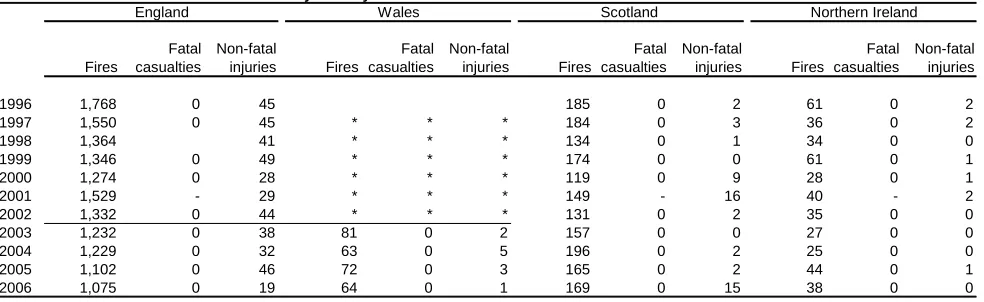
Table 2 on the following page shows the total number of fires attended by local authority fire and rescue services in the UK, broken down by constituent country. The number of fires
1
HC Deb 4 February 2009 c1330W 2
Table 18, Fire Statistics UK 2006, CLG
3
This is a general estimate for the cost of fire damage in public buildings as a whole
4
Fires in Buildings; Caravans, trailers etc; Vehicles and other methods of transport (not derelict); Outdoor storage, plant and machinery; Agricultural and forestry premises and property; Other outdoor structures including post boxes, tunnels, bridges, etc.
5
shown in table 2 is greater than the number shown in table 1 as accidental and secondary fires are included6.
Table 2:
Fires and casualties from fires in schools by country
Fires Fatal casualties Non-fatal injuries Fires Fatal casualties Non-fatal injuries Fires Fatal casualties Non-fatal injuries Fires Fatal casualties Non-fatal injuries
1996 1,768 0 45 185 0 2 61 0 2
1997 1,550 0 45 * * * 184 0 3 36 0 2
1998 1,364 41 * * * 134 0 1 34 0 0
1999 1,346 0 49 * * * 174 0 0 61 0 1
2000 1,274 0 28 * * * 119 0 9 28 0 1
2001 1,529 - 29 * * * 149 - 16 40 - 2
2002 1,332 0 44 * * * 131 0 2 35 0 0
2003 1,232 0 38 81 0 2 157 0 0 27 0 0
2004 1,229 0 32 63 0 5 196 0 2 25 0 0
2005 1,102 0 46 72 0 3 165 0 2 44 0 1
2006 1,075 0 19 64 0 1 169 0 15 38 0 0
Note: * - Prior to 2003 only the combined totals for England and Wales were published
Table 18, Fire Statistics United Kingdom 2006, Communities and Local Government & previous editions Prior to 2000 data published by the Home Office
England Wales Scotland Northern Ireland
According to the response to a parliamentary question, the provisional figure for school fires in England in 2007 is 8297.
1.3 Number of schools with sprinkler systems
There are currently no statistics on the number of sprinkler systems installed in school premises. However, Partnerships for Schools, the body responsible for delivering the Building Schools for the Future programme, plans to centrally record which schools built or refurbished under the programme install sprinkler systems for the 2009/10 financial year. Of the first seven schools built under the programme, only one (the Bristol Brunei Academy) was fitted with a sprinkler system8, although five of the remaining six were refurbishment projects.
1.4 Costs and benefits of sprinkler systems in schools
The chief expenditure arising from sprinkler systems is the initial installation cost. From an analysis of 26 schools9 with such systems, these ranged from 1.4% to 4.48% of total construction costs in primary schools, and from 1.6% to 2.96% in secondary schools, with averages of 2.7% and 2.31% respectively. For a ‘typical’ new primary school, with construction costs of £3.5m, this gives a range of £47,900 and £157,000, and an average of £95,000. The cost of installation in a refurbished school is ‘significantly more expensive than a new build’.
Leaving aside the human casualties avoided, the principal benefit from sprinkler systems is reduced insurance cost. Zurich Municipal Insurance suggested sprinkler installation in schools could reduce their insurance premiums by around 75% per year, and lower the excess close to zero.
6
Secondary fires are defined as those that were not in primary fire locations, were not chimney fires in buildings, did not involve casualties or rescues or were attended by four or fewer appliances. They are reported in less detail than other fires and consequently less information concerning them is available.
7
HC Deb 27 March 2009, c799-800W 8
HC Deb 7 January 2008, c200-1W 9
schools.
Net of running costs, the annual benefit from sprinklers in the 26 schools analysed was found to lie between £6,000 and £10,000 per year. Given the range of installation costs described above, this gives a payback period (i.e. the time taken to recoup the costs of the sprinkler system) of between 23 and 38 years for primary schools, and between 13 and 21 years for secondary schools10.
2
Regulation governing sprinkler systems in schools
2.1 Current government position
For some years there has been a campaign by the Local Government Association, the National Union of Teachers and the Chief Fire Officers Association and others to make sprinkler systems compulsory for new schools and major refurbishments. Two Early Day Motions asking for the change were laid before the publication in 2007 of new Government guidance.11
According to the guidance, it is not mandatory for new or refurbished schools to be fitted with sprinkler systems, but there is a presumption that they will be installed. The Government’s approach was set out in answer to a PQ in October 2008:
Riordan, Linda: To ask the Secretary of State for Children, Schools and Families how many proposals for new schools have been through the planning process since the introduction of the new Building Bulletin 100: Design for Fire Safety in Schools; and in how many cases the fitting of sprinkler systems has been required following the application of the cost and benefit analysis contained in the bulletin.
McCarthy-Fry, Sarah: The Department does not hold information on how many new schools have been through the planning process or on how many new school buildings have sprinkler systems. Planning applications and decisions on whether or not to install sprinkler systems are dealt with at a local level. It is our presumption that all new schools will have fire sprinklers installed but we do not intend to require this. There may be a few cases where local authorities or other promoters of schools consider that sprinklers are not needed. If so, they will need to be able to demonstrate that such schools are low risk and that sprinklers would not represent good value for money.12
2.2 General provisions for fire safety in schools
Approved Document B of the Building Regulations,13 which deals with fire safety, was revised in 2006, largely to take account of the provisions of the Regulatory Reform (Fire Safety) Order 2005.14 Document B states that Building Bulletin 100 should be followed for the design of
10
These figures represent upper bounds, since they are calculated on the premise is that no fires occur during the period. Clearly, if a fire occurs, the benefits of lower insurance excess, reduced disruption, and less significant ‘human’ costs from having a sprinkler system mean the payback period is reduced.
11
EDM 1726, 1 March 2006; EDM 264, 23 November 2006
12
HC Deb 14 October 2008, c1144W 13
Approved Document B - Volume 2 - Buildings other than dwellinghouses (2006 Edition)
14
Building Bulletin 100 (BB100) explains how the general fire safety requirements for all buildings should be met in new schools and extensions to schools.15 Like other buildings open to the public, the policy for schools is based on risk assessment, as laid out in the
Regulatory Reform (Fire Safety) Order 2005. The Order puts the onus on the ‘responsible person’ to assess the risk and take the necessary steps to minimise that risk but it does not impose any particular steps. The DCLG’s fire safety guidance explains:
There are likely to be a range of prevention and protection measures possible in an individual premises and the FSO allows the responsible person to decide which would be most appropriate in the light of the premises and those who may be on them at any one time.
Providing the fire safety measures are adequate to mitigate the potential risk, it is for the responsible person to decide from the range of available options.16
For hotels and guest houses, a higher level of safety measures is likely to be required. Even here, however, sprinklers are not compulsory. Guidance for providers of small scale accommodation makes the point:
Question: Will I need to fit a new fire alarm system, fire escapes, fire doors, sprinklers and so on?
Answer: What you need will depend on your business and your premises. The law does not require any particular measures to be in place. What it does say is that you must adequately manage the overall risk.17
The guidelines for schools require responsible people, that is, the client, the local authority and the design team, to make an assessment of the risk of a fire starting and the possible consequences of a fire in terms of danger to the occupants and fabric of a building and disruption to the work of the school.
2.3 Specific guidance on sprinkler systems
The guidance in BB100 stresses the importance of sprinkler systems, especially their role in protecting against the effects of arson, but it does not require that they should be fitted. The decision as to whether to install a sprinkler system in a new school or major refurbishment will depend on factors including the:
• probability of different fire scenarios;
• consequences of the fire scenarios;
• location of the buildings;
• how accessible they are;
• vulnerability to intruders through the perimeter of the site;
• whether there is public access to the site;
15
Building Bulleting 100: Design for fire safety in schools, Department for Children Schools and Families, 2007
16
DCLG web page, Fire resilience- frequently asked questions 17
• vulnerability of the construction to fire involvement;
• capabilities of the security system;
• whether facilities for waste disposal and storage are well away from the buildings to prevent an external hazard coming into contact with the fabric of the building;
• whether there is previous history of vandalism and arson (existing schools only);
• how long it takes the Fire and Rescue Service to reach the buildings and fight the fire; and
• availability of water supply.18
The assessment will decide whether a school is at high, medium or low risk from fire. Having made a risk assessment, a cost-benefit analysis should be carried out, with the assistance of an interactive tool supplied on a CD-Rom with updates published on the DCSF fire safety website.19 The final decision as to whether a sprinkler system represents good value for money is assisted by a cost-benefit analysis tool, also contained in the CD Rom.20 Only in the case of low risk schools does the Government envisage the possibility of a decision not to install a sprinkler system. Detailed guidance on the design of a sprinkler system is also available.21
The Building Research Establishment carried out an impact assessment on the procedure in October 2007, which concluded that the policy ‘produced a significant positive net present value and therefore is good value for money in whole life cost terms’.22
18
Building Bulleting 100: Design for fire safety in schools, Department for Children Schools and Families, 2007, p26
19
Teachernet website, Fire safety for schools; Fire Risk Analysis Tool July 2007 20
Cost Benefit Analysis Tool August 2007 21
Sprinklers for Safety: Use and Benefits of Incorporating Sprinklers in Buildings and Structures, BAFSA 2006
22