Recent Developments in
Employee Development Schemes
by
Dorothy Berry-Lound, Valerie Rowe
and Professor David J Parsons
Contents
Page
Executive Summary
... i
Section 1: Introduction
Introduction and context. ... 1Objectives ... 2
Methodology... 2
The report structure... 5
Section 2: Employee Development Schemes in Context
Introduction ... 6The origins of EDS ... 6
What are Employee Development Schemes?... 7
Principles into practice ... 8
Employer developments in EDS... 9
What works in EDS ... 10
What difference does EDS make? ... 11
Policy development and linkages ... 12
An exploration of EDS models ... 13
Overview ... 15
Section 3: A Profile of Organisations with EDS
Introduction ... 18How many organisations have an EDS? ... 18
What are organisations with EDS likely to look like? ... 20
A profile of survey respondents ... 20
A profile of the case study organisations... 29
Overview ... 29
Contents - continued
Page
Section 4: Planning and Implementation
Introduction ... 32
Introduction of EDS in case study organisations ... 32
The aim of schemes ... 34
Eligibility and actual provision ... 39
Overview ... 41
Section 5: EDS in Practice
Introduction ... 42Support provided under an EDS ... 42
Financial support and links with ILAs ... 45
Vocational or non-vocational? ... 49
Involvement of other organisations ... 54
Usage of the scheme ... 56
Overview ... 62
Section 6: The Benefits of EDS
Introduction ... 64EDS and wider quality initiatives ... 64
The benefits of EDS for the organisation... 66
Barriers to an organisation securing greater benefit... 68
Benefits to users of EDS ... 70
Future developments in EDS ... 74
Overview ... 76
Section 7: Conclusions and Issues for Consideration
Introduction ... 77A summary of key findings ... 77
EDS models and approach ... 79
External funding ... 80
Co-ordination and networking ... 81
The need for guidance on EDS ... 82
Executive Summary
Introduction
Employee Development Schemes (EDS) are schemes that provide employees with access to opportunities for personal development not directly linked with their current role and responsibilities. The concept of EDS has attracted considerable interest in the human resource (HR) practitioner literature in the UK since the early innovations in the automotive sector here.
There are now a variety of guides on EDS aimed at HR professionals, managers and trade union officials. However these tend to lack a robust empirical basis, suffering from the often inconsistent approaches to what constitutes a formal approach to EDS within organisations and the dearth of coherent evidence on the impact of EDS on organisations and individuals.
This current research aimed to update the Department for Education and Skills’ (ex- Department for Education and Employment –DfEE) current information about EDS, and how they are developing and operating. The goal was to go beyond updating the preliminary mapping evidence drawn from an earlier study1, and in particular to address some of the information gaps set out in that report.
Context and objectives
The research had four clear objectives:
i) To estimate the number of employers currently offering EDS to their employees;
ii) To identify trends in how EDS has been developing in recent years;
iii) To assess the potential benefits of running an EDS for the employer and for individual employees;
iv) To provide case studies to:
• illustrate differential practice in EDS implementation and organisation;
• help develop further a typology of schemes; and
• to provide qualitative evidence on the extent to which schemes are monitored and evaluated by organisations and by funding bodies.
There is no single source of information on which organisations do (or do not) support EDS. For this reason the research took a multi-faceted perspective on collating evidence on EDS support by employers, including an extensive review of the human resource (HR) literature and enquiries of a range of intermediary
1
The Role Of Employee Development Schemes In Increasing Learning At Work. The HOST Consultancy. DfEE Research Report RR73, 1998.
agencies, some based on existing knowledge or previous research, others on ad hoc
‘leads’.
It should be noted that, based on earlier research, the following definition was used in initial discussion with employers:
EDS may be called various things but all have some common characteristics:
• They are employer-led - but sometimes involving a joint decision-making group including staff and/or trade unions;
• They are an employee benefit and usually apply to all employees irrespective of level of educational attainment;
• They focus on training that is not required for current jobs - which should be provided under an organisation’s conventional staff training arrangements;
• They usually provide for a fixed limit of finance for an employee to attend an external course of their choice (often at a community or Further Education college) on a part-time or evening basis, or provide access to open learning facilities that the employer may have on site;
• Usually these schemes are specific to individual firms, but sometimes groups of employers may band together to support such an initiative;
• The outcomes may be qualification (e.g. GCSE in Italian) but are often not linked to qualifications and are seen to benefit the employer and employee by keeping the latter interested and able to learn.
This definition was used to clarify and guide the process of identification of potential EDS in organisations. It was not used to filter in or out schemes that did or did not meet all the terms of this definition. Thus, a largely pragmatic, ‘inclusive’ approach to identification of schemes that purported to be EDS was adopted. This was necessary to fulfil the wider aims of the research above.
Some 482 potential EDS organisations were identified and sent a postal
questionnaire; a further 22 organisations were identified too late for inclusion in the survey. One telephone reminder was used with non-respondents. The total response rate was 35 per cent (including refusals).
A total of 25 in-depth employer case studies were also conducted. Full, detailed write-ups of these case studies are available on request from HOST Policy Research2.
For the reasons already described, the evidence collected during the course of this research does not allow us to extrapolate statistically the distribution of EDS to the general population of employers. Moreover, the findings are based principally on the
2
HOST Policy Research, PO Box 144, Horsham West Sussex RH12 1YS. Tel; 01403 211440. E-mail: [email protected]
postal survey returns and case studies, together with the contacts with intermediary agencies and desk-based work. This does not allow us to judge how representative they are across the entire population of EDS. Nevertheless this research, together with the cumulative experience of previous work and findings (described in section 2), encompasses a wide spectrum of employers’ and agencies’ experiences of EDS, and as such the findings are thought to be significant within the context of recent developments in EDS.
Key findings
The difficulty in identifying organisations with EDS makes an estimation of total schemes in existence tentative at best. The best estimate is that around 1,500 employers in England are involved with EDS at the present time, although the bounds of uncertainty around this estimate must be considerable.
The research does however strongly suggest a contraction in the total number of schemes over the last three-four years. While an estimate of the extent of this contraction is similarly fraught with uncertainty, the available evidence points to a decline of the order of a quarter or more.
• The previous HOST research suggested that in 1997-98 TECs interviewed at the time felt that the momentum for involvement in EDS was growing. On the basis of the apparent growth in EDS at that time, it was thought that by mid-2000 there might be up to a projected 3,000 or so employers involved in EDS. This ‘momentum effect’ is far less obvious from the current research results and instead of an expansion there appears to have been a contraction in numbers of EDS overall. Nonetheless, there has been a dramatic rise in the number of organisations with fewer than 200 employees taking up EDS since 1997-98 but this growth appears to have dissipated of late, a result primarily of changes in TEC funding policies in the run-up to the formation of the national and local Learning and Skills Councils (LSCs).
• EDS appear to be more prevalent in retail, finance, pharmaceuticals, utilities, banks, schools, colleges, automotive industries and manufacturing. There is little evidence of systematic EDS arrangements in local authorities, health care Trusts, tourism, hotel and catering, transport and communications and construction.
• Many schemes have been introduced largely as a result of funding incentives rather than business planning. The case studies, however, illustrate some good practice in linking EDS to business objectives.
• The majority of schemes are run only for employees although some of the most innovative have started to include access for family members and more occasionally suppliers. The main reasons for introducing an EDS are raising skill levels, encouraging staff commitment, motivation and loyalty and
encouraging learning in the work environment. For the majority of survey respondents, the purpose of having the EDS has not changed since it began. Where changes have occurred, they have been, for example, to include or
exclude health-related content of schemes such as membership of sports clubs.
• Although in most cases all employees are eligible for the EDS, some organisations are constrained by budgets and have to limit the number of employees who can participate in one year. In some of these firms repeat use by learners is actively discouraged – potentially limiting the longer-term gain to the organisation.
• Running an EDS often involves a complex mix of on-site and external learning. Almost two thirds of surveyed organisations provide access to on-site learning facilities/centres. Only one organisation in seven provides full fee payment for external courses.
• Providing learning guidance is an important feature of effective EDS, and many TECs contracted with their local careers service provider, or even local consultants, to provide guidance support. Just under 40 per cent of
organisations also support EDS with an internal guide on learning resources.
• Funding arrangements vary considerably and the case studies demonstrate the great range of fee and payment structures that exist today. There are issues for consideration in how to support and enable organisations to
continue with their EDS once ‘pump-priming’ funding ceases, particularly if no evaluation of the success or otherwise of the scheme has been carried out (as was found to be the case in most instances).
• Whilst past research has suggested that EDS is most effective when it is clearly additional to other work-related learning opportunity, over a quarter of survey respondents restrict their EDS to vocational courses only.
• In addition to funding levels, the case study experience suggests that the way schemes are run is an important influence on their sustainability. In some cases it seems to be the quality of EDS co-ordination and learner support, and the flexibility of access and internal ‘championing’ of the initiatives by employee ‘peers’ which are more important than the level of funding. Just under half of respondents encourage participants to move on from non-vocational courses to non-vocational.
• Take-up rates are highly variable. In many cases, raised staff awareness had led to an increase in the usage of the scheme. The survey results suggest that where there is open access to EDS, participation shows few contrasts in level across occupational groups.
• Information on EDS benefits - to organisations and individual participants – is weakly developed in most schemes. Where evaluations have been conducted they focus on processes rather than impact, and the available benefit
evidence is often only anecdotal.
• Large numbers of survey respondents are involved in various training or quality initiatives, but most found it difficult to answer the extent to which their EDS supports these.
• From the employers’ perspective, the benefits to employees were increased confidence and improved learning skills. The main perceived benefit to organisations is increasing staff skill and knowledge levels. Boosting or sustaining staff motivation and loyalty were also seen as common organisational benefits – especially in the manufacturing sector.
• Additional benefits identified over time include increased communication, staff identifying with a company culture, and a rise in profitability/efficiency.
• Whilst some employers felt there were no barriers to securing greater benefit from their EDS, over two thirds cited budget and time. Shift work was also an issue. Some respondents indicated a problem in motivating staff to
participate in the EDS.
• Employees themselves report a range of benefits of EDS, most notably
improved confidence within and outside the workplace – notably among lower skilled staff. The only barrier to participation identified by employees was time, as many had considerable domestic commitments.
EDS models and approach
The case studies suggest great diversity in the organisation, rationales and expectations of EDS. There are those organisations that only allow vocational courses to be undertaken within their EDS, with varying levels of budget and support. In these cases, where the EDS is effectively being used as part of what would be considered normal work-related training, the potential additionality of the scheme is limited. This does not mean that these schemes do not work for the organisations running them, or that effective learning is not taking place, but that they do not match the EDS principles and practice as set out earlier.
On the other hand, many of the more successful schemes3 are aimed essentially at personal development with organisational gain a ‘knock-on’ benefit from this. These often involve a wide choice of non-vocational and vocational options. Even here, however, participation can be limited due to restricted budget and resources within the organisation.
The evidence from the case studies suggests that most organisations, in seeking to establish EDS, have little appreciation of what the concept - or its implementation - involves.
There is also an apparent lack of coherence among the case study schemes
reviewed in how their scope and funding links to work-based learning standards, and
3
As defined by employers’ own assessments based on sustained participation and learning progression.
in particular Investors in People, or to support through learndirect provision or Individual Learning Accounts (ILAs).
External funding
In many respects, funding is a central issue in the development of EDS as a tool in helping businesses to build a workforce that is capable of continued learning and adaptation. The results show that, even among those organisations engaged in EDS, ‘budget and time’ are the main perceived barriers for organisations in securing real and sustainable benefit from an EDS.
This is a complex issue since few organisations chose to cost or evaluate wider issues in supporting EDS - or the benefits arising. Where cost data can be secured, it relates commonly only to external courses or related EDS budgets. Even these data lack comparability, since the ‘level’ of support will vary with the mix of EDS provision between on-site learning through open learning or coaching (usually not costed) and external courses. Added to this there are contrasts between
organisations in what - if any - amount of cost is recovered from employees (either in their time or cash commitment), and any levels of subsidy on start-up or access provided by publicly-funded or other bodies.
For external provision in EDS, in 1998 the typical amount of employer support per employee was around £50 per capita a year on external courses. This was generally irrespective of the level or mode of learning although in some cases funding was restricted to courses linked to qualifications. The boost to EDS take-up at the time suggested ‘pump-priming’ has helped promote EDS and brought EDS arrangements into smaller organisations. For SMEs, in part this pump priming seems to have reduced the perceived risks that managers may have felt was associated with a novel approach to workplace learning. However, it is by no means clear that such support is sufficient - or even appropriate - to promote longer term commitment to the process of EDS. In particular, there seems to have been limited sustainability by those organisations which had taken full advantage of the pump-priming funds, without any real business rationale having been developed.
Co-ordination and networking
Group EDS arrangements account for a large proportion of the organisations that have access to EDS. They accounted for around a third of all schemes in 1998, although the proportion has fallen since. These group arrangements do seem to present a unique set of issues - and these have been largely ignored in past empirical evidence. Related to the issue of external funding is the need for clear central co-ordination amongst such network schemes. Often funded and ‘co-ordinated’ through TECs, organisations in group EDS seem to have become
involved merely to access the funds, and have often mistakenly believed that TECs would both broker and facilitate the networks. In some cases, EDS networks seem to have been effectively taken over by individual provider bodies to support their own funding needs rather than employer or employee requirements.
In too many group arrangements, there seems rarely to be clear ownership of these schemes by participating organisations - a factor which compounds the difficulties
commonly seen in ‘mainstreaming’ the activity when development funds run out. Volatility of funding in group schemes presents special problems for their
sustainability.
If group schemes are to continue to be a feature of EDS development, further work on their characteristics, success factors, development and benefits is needed. Some principles or code of practice for employer commitment, standards or guidelines for coordinators etc. would be useful. It may be that such schemes have inherently different goals and scope than single organisation arrangements, suggesting,
perhaps, some pilot-level development activity that is more robustly monitored than has often been the case in the past.
Good practice and lessons for public policy
The results of this research provide a positive picture of how EDS can provide a real focus at the workplace for encouraging wider participation in learning. They show EDS has come a long way since the pioneering days of the Ford Employee
Development and Assistance Programme (EDAP), and the duration of many of these schemes and the continuing levels of employee participation benefits are testament to the early proponents of EDS.
The research suggests that a cadre of convinced firms, following good practice, has been developed - and seems to have grown, albeit slowly, over the years. However, this experience has done little to promote much wider take-up of EDS. Experimental initiatives by many of the former TECs and CCTEs amongst others in the mid and late 1990s, helped kick-start EDS in some SMEs but were often resourced and managed in such a way that other employers were unable to benefit - or learn very much - from their experience.
The research suggests that EDS can provide leverage for stimulating learning among adults in the workplace - and especially among hard to reach groups of adults. However, EDS as a process may have reached, or be close to, the optimum level at which it can readily sell itself to employers. Without some stimulus to
overcome this inertia few employees are likely to have access to new EDS arrangements.
For those concerned with public policy and how workplace learning relates to wider policy goals such as social inclusion and developing or sustaining employability, there is a need to look closely at the role EDS can play in providing a workplace focus for enhanced learning. For those concerned to use EDS as a vehicle to support other vocational education and training (VET) initiatives and goals, a useful starting point would be clear, consistent and comprehensive guidelines on good practice and effective development of EDS for employing organisations. Such guidelines would certainly be timely, and could build on the employer evidence that emerges from this study and elsewhere by setting out:
• Background to, and examples of, effective EDS in practice
• A clearly argued business rationale for more employers becoming involved, with case study illustrations;
• Links to sources of funding and organisational guidance, and how these relate to other workplace learning initiatives;
• Approaches and models to EDS arrangement, and how these relate to different organisational circumstances and needs;
• Practical advice of developing and running sustainable schemes, and getting the best value from them;
• How to monitor arrangements, the scope and quality of learning arising and how to use this to demonstrate added value;
• Building EDS participation through evaluation and continuous improvement.
Looking at the guidance already available, some of this information is already available to trade union officers, but relatively little to managers or HR specialists at the workplace. Appropriate guidance and promotion would help to fill this gap - and provide for valuable links to other VET initiatives.
1: Introduction
Introduction and context
1.1 Employee Development Schemes (EDS) are schemes that provide employees with access to opportunities for personal development not directly linked with their current role and responsibilities. The concept of EDS has attracted considerable interest in the human resource (HR) practitioner literature since the early innovations in the automotive sector. There are now a variety of guides aimed at HR
professionals, managers and trade union officials. However these tend to lack a robust empirical basis, suffering from the often inconsistent approaches to what constitutes a formal approach to EDS within organisations and the dearth of coherent evidence on the impact of EDS on organisations and individuals.
1.2 Earlier research for the then Department for Education and Employment (DfEE) showed there was much less evidence on employee benefit, learning process outcomes and post-EDS learning pathways, and even less on the distribution and characteristics of EDS1. In general, little has been added since then to the
information on characteristics and distribution.
1.3 It is against this background of imperfect and essentially fragmented (or outdated) evidence that this current research aimed to update DfES’s current information about EDS, and how they are developing and operating. The goal was to go beyond updating the preliminary mapping evidence drawn from the earlier research, and in particular to address some of the information gaps set out in that report.
1.4 To tackle this, the research required a combination of methods that could provide sufficient breadth for sound mapping of take-up and characteristics of EDS within organisations, set against an extensive and in-depth analysis of experience of those who run, and benefit from, EDS arrangements.
Objectives
1.5 The research had four clear objectives as follows:
i) To estimate the number of employers currently offering EDS to their employees;
ii) To identify trends in how EDS has been developing in recent years;
iii) To assess the potential benefits of running an EDS for the employer and for individual employees;
iv) To provide case studies to :
• illustrate differential practice in EDS implementation and organisation;
1
The Role of Employee Development Schemes in Increasing Learning at Work. The HOST Consultancy. DfEE Research Report 73, 1998.
• help develop further a typology of schemes; and
• to provide evidence on the extent to which schemes are formally evaluated by organisations and by funding bodies.
Methodology
1.6 The methodology for the study had of necessity to be broad-ranging but at the same time as robust as possible, given the information gaps and potential difficulties of conducting the research identified at the outset of the study.
1.7 To this end, a four-stage methodology was developed:
• Stage 1 - Preliminary liaison, planning and secondary research;
• Stage 2 - Mapping current EDS arrangements and distribution to include a cross-TEC, cross-NTO and cross-agency review and validation;
• Stage 3 - Design and conduct of a national EDS sample survey of employers identified from Stage 2;
• Stage 4 - Identification and conduct of EDS case studies;
Stage 1 - Preliminary liaison and secondary research
1.8 This stage included, as background research, an intensive review of available evidence and literature. This included bibliographic searches, web review, and telephone discussions with key agencies to identify any recent or ongoing research.
The key agencies included:
• CIPD;
• Employment NTO (other NTOs were included in Stage 2); • FEDA;
• Investors in People UK;
• Lifelong Learning Partnerships; • QCA/SQA;
• NTO National Council; • TEC National Council; • UfI/learndirect.
1.9 Co-ordinators of Union Learning Funds (ULF) were also approached to establish evidence of EDS activity in this area.
Stage 2 - Mapping current EDS arrangements
1.10 There is no single source of information on which organisations do (or do not) support EDS. Previous surveys have drawn heavily on TEC/CCTE experience of EDS arrangements. Although this was then a valuable source of information, it had several limitations - it was effectively limited to TEC funding knowledge, and TEC intelligence was weak where there was not an explicit EDS funding focus. A few
TECs were also reluctant to be involved, something experienced in this research in the run-up to LSC hand-over.
1.11 For this reason, the current research took a multi-faceted perspective on collating evidence on EDS support by employers, using, as a starting point, the existing HOST database of over 200 employers in single or composite EDS
arrangements. This was augmented by an extensive and methodical review across a range of intermediary agencies, piecing together local, sectoral and other lists of employers - or groups of employers - with EDS arrangements in (or potentially in) place and involving:
• A press release inviting organisations to participate in the survey;
• A telephone survey of workplace development or lifelong learning managers (or related staff) in TECs/CCTEs to collate available information and update the HOST database;
• A parallel review of NTO knowledge;
• A letter to all co-ordinators of Lifelong Learning Partnerships, and a response proforma for them (or stakeholders) to identify known EDS arrangements in their areas.
To this was added the information collated from Stage 1.
Stage 3 - National EDS sample survey of employers
1.12 A postal questionnaire approach was adopted, mainly because the range of evidence to be collated did not lend itself to a structured telephone survey. The design of the questionnaire reflected the need for comparability with the earlier HOST research, and for additional content required to meet the current objectives.
1.13 The previous HOST estimate for the likely numbers of organisations with schemes showed a projected population of over 2,000 employers (including group schemes, thought to account for over a third of all firms). The results also suggested a mid and late 1990s expansion of schemes, suggesting that, by mid 2000, there might be up to 3,000 organisations in active schemes. This figure was seen to be the most appropriate starting point for planning the approach to sampling and at the outset it was thought that up to 1,000 or more organisations with EDS might be identified and sampled.
1.14 To begin with, all organisations on HOST’s original database were telephoned to ensure they still had an EDS and that HOST had up-to-date contact details. There was a significant drop-out from these original firms, some due to mergers or changes in management, but the majority because of the withdrawal of TEC funding. Only some 94 out of the original 200 remained, strongly suggesting, at the outset, some contraction in total numbers of schemes rather than the expansion projected from the findings of the previous research.
1.15 Further confirmation of a contraction was provided by the fact that identification of additional organisations proved a long, laborious exercise. Some employers were suggested by TECs, but there was little else forthcoming from the discussions with key agencies, or indeed from the literature review.
1.16 Each possible organisation identified was telephoned to ensure an EDS did exist, and to obtain contact details and a preliminary discussion with the EDS co-ordinator to notify them of the survey and request their participation. Based on the earlier research, the following definition was used in initial discussion with
employers:
EDS may be called various things but all have some common characteristics:
• They are employer-led - but sometimes involving a joint decision-making group including staff and/or trade unions;
• They are an employee benefit and usually apply to all employees irrespective of level of educational attainment;
• They focus on training that is not required for current jobs - which should be provided under an organisation’s conventional staff training arrangements;
• They usually provide for a fixed limit of finance for an employee to attend an external course of their choice (often at a community or Further Education college) on a part-time or evening basis, or provide access to open learning facilities that the employer may have on site;
• Usually these schemes are specific to individual firms, but sometimes groups of employers may band together to support such an initiative;
• The outcomes may be qualification (e.g. GCSE in Italian) but are often not linked to qualifications and are seen to benefit the employer and employee by keeping the latter interested and able to learn.
1.17 This definition was used to clarify and guide in the process of identification of potential EDS in organisations. It was not used to filter in or out schemes that did or did not meet all the terms of this definition. Thus, a largely pragmatic, ‘inclusive’ approach to identification of schemes that purported to be EDS was adopted, mainly to be in a better position to fulfil the aims of the research above.
1.18 To summarise, a total of 482 potential EDS organisations were identified and sent a questionnaire (a figure well down on the original projected sample); a further 22 organisations were identified too late for inclusion in the survey. One telephone reminder was used with non-respondents. The total response rate was 35 per cent (including some refusals). The survey results in this report are based on 126 responses.
Stage 4 - Identification and conduct of EDS case studies
1.19 The need for understanding of how well EDS arrangements work - for both organisations and individuals - needed more than the information collected about the trends, current operation, development, focus and outcomes of schemes in Stage 3. In particular, although the survey collated a wide cross-section of experience on
benefits to employers and employees, more in-depth work was needed with organisations to understand the determinants of these benefits, and why certain arrangements work especially well for some organisations and end-users. To address these, 25 in-depth employer case studies were conducted.
1.20 The case studies followed the methodological model established in the earlier DfEE research, and included where appropriate, interviews with:
• an appropriate senior manager to review strategic issues of the EDS role;
• the most senior manager concerned with HRD practice - the Personnel or Training Manager (Head) in larger firms, but a manager with HR functions in others;
• the EDS co-ordinator - usually separate from either of the above in effective EDS arrangements;
• appropriate employee representatives in the firms - either chairs of the EDS user groups (where constituted), trade union convenors/shop stewards (where appropriate), or others; and
• recent EDS participants, mainly to review learning outcomes and actual or proposed pathways (e.g. to qualifications/higher level qualifications).
1.22 These case studies have been written up fully and are available from HOST Policy Research on request (HOST Policy Research, PO Box 144, Horsham, West Sussex RH12 1YS. Tel. 01403 211440. E-mail: [email protected]).
The report structure
1.23 Following this introduction, section 2 considers the results of the literature review setting EDS in context and exploring the concepts of EDS models. Section 3 considers the issue of how many organisations operate EDS, and sets out a profile of survey respondents and case study organisations. Sections 4 to 6 set out the survey results with illustrations from the case studies. The final section establishes some conclusions and areas for consideration.
2: Employee Development Schemes in Context
Introduction
2.1 Past research provides a useful backcloth for the empirical evidence which is the focus of this report. Drawing on an updated1 review of past research on workplace practice and innovation, this section looks at:
• The origins of EDS;
• Evidence of scheme organisation and participation by employers; • Common principles underpinning EDS practice at the workplace; • Employer take-up and development of EDS in the 1990s;
• Policy development and links; • An exploration of EDS models.
The review starts with an overview of how this research base has helped to define what EDS are and how they operate.
The origins of EDS
2.2 The preliminary planning for this project confirmed how confused many
practitioners were about what constituted an EDS at the workplace. A useful starting point is consequently to look again at the origins of EDS. The empirical evidence suggests the foundations are in the automotive sector in the US. These schemes were often jointly developed by managers and other employees to provide the whole workforce with access to opportunities for personal and skills development not directly linked with their current role and responsibilities.
2.3 In the UK, the first - and most highly publicised - scheme was the Ford Employee Development and Assistance Programme (EDAP).2 Launched in 1989, this had many of the hallmarks of the EDS developed in its US parent. In particular, EDAP combined learning opportunities with certain welfare and counselling facilities. The scheme has gone on to be customised across all of Ford’s UK plants, and has been profiled as the most successful joint trade union-management collaboration in EDS across the UK.3 Subsequent EDS developments in the UK - which has a different tradition of welfare support at the workplace - have tended to focus on employees’ access to personal learning opportunities.
2.4 EDAP attracted widespread interest in the personnel profession in the early 1990s. However, at a time of recession, with personnel practice often centred on downsizing, the concept was slow to spread in practice. An early development focus was in other major auto manufacturers, and some multi-national enterprises (MNEs) in other sectors. However, data from the (then) Institute of Personnel Management suggested that, four years after the launch of EDAP, there were probably only 50 EDS in the UK - predominantly among larger manufacturing employers.
What are Employee Development Schemes?
2.5 Evidence on the characteristics of EDS is limited. Most is based on ad hoc
reviews and case study research - often small in scale. The evidence that does exist shows that, below a superficial similarity in EDS provision in organisations, there are considerable variations in approach. All schemes are voluntary in focus, but outside this there are exceptions to most of the now accepted criteria for what constitutes an EDS. This research has adopted a wide, ‘inclusive’ definition, see section 1, to analyse the gamut of variations on these criteria.
2.6 Most schemes apply to all full- and part-time employees, but some restrict eligibility to particular occupational groupings or to staff after a probationary period within the organisation. Some schemes go much wider in coverage to apply to sub-contract staff and those on study or maternity leave. A few have successfully
experimented with extending coverage to families of employees. Some schemes have differential levels of support for different categories of staff.
2.7 The pioneer schemes for EDS centred on support of non-vocational learning - largely under the influence of trade union bargaining, which was keen to support wider workforce learning. Subsequent developments have often lost this focus. The 1998 review for DfEE4 included activities supported under specific TEC initiatives. This showed a rising number of EDS programmes which did encourage non-vocational learning (specifically in knowledge or skills which may be of no direct relevance to the current job activities of the participant). In contrast, some schemes had a vocational bar to provision.
2.8 The workplace evidence is highly fragmented and this makes it difficult to provide a broader picture of practice. However, it does show great diversity. The level of workplace support varies widely between organisations. For example:
• Simple schemes, with annual budgets for out-of-hours employee learner support, geared predominantly at access to further and community-based education;
• More comprehensive programmes, combining a range of internal learner support, counselling and provision, with financial support for off-site provision and study programmes.
2.9 Early schemes originated as single company arrangements. An early extension of the concept was a group scheme bringing together a number of organisations and involving common management by an appointed agency. This was pioneered5 by the Derbyshire Enterprise Development Initiative (DEDI), launched in 1992 and supported by three TECs, an FE college and a local authority. The research
evidence suggests that enterprises can now be involved in EDS in one of four ways:
• Single company schemes - organised, resourced and managed within a single organisation. This includes schemes run on an autonomous basis by
organisations but with some co-funding of learning activity - predominantly through TECs in the mid and later 1990s;
• Co-ordinated schemes which are jointly managed under a co-operative arrangement, often drawing together organisations in a single area, trading estate or supply-chain;
• Single industry schemes - a variant of co-ordinated schemes - which focus on organisations in a single sector of activity. Examples include the
DfES-supported EDS in the glass manufacture and distribution sector,6 and a sub-regional scheme in agriculture and related industries jointly resourced by ATB Landbase;7
• Multi-employer schemes - usually set up by local business support agencies such as TECs and CCTEs, and providing promotion and support to a range of employers seeking to be involved. Kent TEC’s8Return to Learn initiative was among the best known and largest multi-employer schemes.
2.10 Group schemes seemed to be largely driven by external funding opportunities and were unusual before the mid 1990s. Consequently, an early review of the role of EDS in employers’ initiatives to develop people at work9 found little evidence of such group mechanisms. However, it suggested considerable potential for ‘pre-competitive’ collaboration in this area across small and medium-sized enterprises (SMEs).
Principles into practice
2.11 The picture is of largely organic development of EDS by organisations in the UK, later stimulated in some areas and sectors by TEC/CCTE or ESF initiative
funding. There are no agreed standards and little consistency in workplace practice. However, in 1999, the TUC set out some defining principles in a workplace guide to EDS:10
• EDS schemes centre on voluntary participation by employees in training or other structured learning activities which are additional to that needed in their current work role;
• Schemes have a common entitlement to participation to all those eligible to take part - generally this is the whole workforce;
• Participation can involve a variety of learning pathways, but this is generally in employees’ own time;
• The focus for learning opportunities is on self-directed personal development, although many schemes may provide some guidance to employees on choice;
• The schemes are based on cost-sharing - with individual participants contributing their own time and sometimes meeting additional costs of the courses they have picked, and employers paying the whole or a proportion of enrolment/teaching fees and study materials or learning resources.
These principles were developed jointly by HOST and the TUC, drawing on good practice observed in the earlier national review for DfEE.
2.12 Other common features of schemes, such as collaborative arrangements with providers or business support agencies, are thought to add to the efficiency of schemes but are not ‘core’ principles or essential to their operation.
Employer developments in EDS
2.13 After a slow start, the EDS concept seems to have started to spread more widely in the mid-1990s. The evidence suggests this was largely under the stimulus of local action by TECs and LECs and, more recently, by some sector bodies.11
2.14 Although a number of high profile examples provide important exceptions, monitoring by the former International Consortium of Employee Development suggests that it is only in the last five years that schemes have become more
widespread among SMEs. Unlike the spread among larger organisations, this seems to have had little to do with networking among HR professionals and collective
bargaining, and has owed more to local innovation and promotion programmes by TECs and CCTEs.
2.15 Until the late 1990s, quantitative evidence on employer take-up was poor and based on largely speculative assessments. This showed:
• National estimates12 (DfEE, IPM) were suggesting that, as late as mid 1993, around 50 UK enterprises were operating EDS schemes - almost entirely single company schemes;
• Two years later, DfEE13 were estimating that numbers had risen seven-fold to 350 - but this was still seen as mainly on the initiative of single organisations;
• A revised DfEE estimate at the end of 1995 placed the figure at 450 organisations;14
• A review in 1997 identified around 400 organisations with EDS support in just nine TEC areas,15 suggesting a substantial expansion in employer activity, although the authors made no attempt to estimate national participation from these data.
2.16 The only systematic research and estimates of recent take-up stem from the 1998 survey by HOST for DfEE.16 This suggested that, on evidence provided by TECs and NTOs, over 2,000 organisations in England and Wales were involved in single company or group EDS arrangements. The sharp expansion - over four-fold in just three years - was put down largely to TEC initiatives in this area. However, the report cautioned that around a third of these EDS supporters were very small SMEs, in two group schemes where the EDS processes lacked transparency.
What works in EDS ?
2.17 The essentially fragmented research on EDS has emphasised more practical aspects in the development of schemes. Consequently, the various studies that have been carried out give a poor picture of the scale and pattern of take-up, but some evidence of what it is that helps such schemes to work more effectively within organisations. Looking across this material, a number of common characteristics emerge:
• The commitment of senior managers - and their active championing of EDS - is essential to success,17 and in helping to change corporate culture on training to one where self-direction is an important process;
• The focus and value of the schemes need to be effectively promoted to the direct beneficiaries - employees. Without this, take-up in organisations can be
marginal (10% or less). With it, take-up has been reported by some evaluation studies to exceed 40 per cent.19 A recurrent success factor seems to be that the internal marketing of the scheme also needs to ‘sell’ EDS as a distinct product - one which links to other staff development initiatives in the organisation, but is not lost within them;
• To be successful, most schemes need to engage employees, many of whose experience of structured learning is some time in the past. Some will have few or no academic qualifications. Many will have had unsuccessful or even sour experiences of structured learning. A few may lack the basic literacy and language skills. Schemes consequently need to be supported by high quality advice and guidance to prospective participants, and access to basic skills diagnosis and on-line and/or community provision to address this;20
• Employees need to have a direct stake in the management of the scheme. This can be achieved through direct involvement of trade unions in the delivery and resourcing arrangements21 - or by having a range of employees directly involved in, or leading, its administration.22 Case studies of successful EDS repeatedly show how effective trade union engagement can build value and participation;23
• Some EDS initiatives have been able to develop more cost-effective delivery by forging links with particular providers - usually, but not exclusively, colleges of Further Education. This has proven especially valuable for smaller organisations where there may be limited resources to manage and supply schemes with diverse learning opportunities. However, in all cases, provision should be led by employee-defined needs;
• Co-ordination is also seen as an important ingredient in success. The
experience here varies considerably between single employer schemes, where smaller organisations have reported this to take ‘only an hour or so a week’,24 to group schemes, where well-resourced and expert co-ordination are vital to the administration of EDS;
• Many EDS initiatives have found provision for employees to be especially successful when drawing on flexible distance and open learning methods. The cost of hardware and learning software is now often so inexpensive that all but the smallest workplace can afford to set up a small PC-based learning centre for out-of-hours or remote access for employees.
2.18 Perhaps the most important success factor is recognising that EDS works best where those involved in managing and resourcing it understand the need for its ongoing promotion and support. Some research25 has shown early employee suspicion about management motives for introducing EDS. This calls for clear positioning within the organisation and a commitment that job-specific training will not diminish as a result of EDS participation. It also requires openness about the intent behind the initiative, and anticipated value to the organisation and individuals.
What difference does EDS make?
2.19 Until the late 1990s, there was very little evidence of the impact of EDS on both participating enterprises and employees. The 1998 review suggested that, where evidence did exist, it was largely anecdotal in nature, with little systematic research evidence on impact.
2.20 The 1998 survey26 and case study research for the TUC27 suggested that effective EDS arrangements:
• Provide an important ingredient in managers’ ability to enhance confidence, morale and commitment among employees;
• Contribute towards their ability to handle change effectively at the workplace;
• Help communications and teamwork at the workplace;
• Support the development of a learning capacity at the workplace which enhances the image of, and commitment to, more vocational or job-related training;
• Help to build greater adaptability and flexibility among employees, and greater potential for delegating responsibility to employees;
• Contribute towards developing or sustaining higher productivity or quality standards at the workplace.
2.21 The evidence from TEC evaluations of EDS support has tended to be weak. However, some of these have suggested that the initiative has reached smaller organisations that have opted out of vocational education and training, and drawn them back into the TEC’s sphere of influence.28 This evidence needs to be treated with some caution. Indeed, the extended survey evidence from this project suggests limited sustainability within the TEC experience - an issue explored in more detail later in the report.
2.22 For employees participating in EDS, the messages have also been difficult to synthesise, but past research29 has suggested that:
• EDS can be a very effective way of kindling an enthusiasm for learning among lower occupation (or unqualified) staff, and even for tackling basic skills needs of employees, in a non-threatening way;
• It helps to build confidence in staff that they are able to benefit from learning, with many going on to more vocationally-orientated learning and skills
development after participating in EDS;
• That the self-directed learning which EDS supports can help individuals feel more a part of a process of change in organisations than victims of it. Some case studies have reported it increases employee confidence in their
employability.
2.23 The diverse case study evidence regularly reports that EDS seem to enhance employees’ self-confidence and often helps to build a better community involvement and image of the organisation. Significantly, where there is statistical evidence,30,31 the results show that high proportions of users intend to continue to use the scheme to access learning opportunities outside working hours. Evidence of actual
progression and longer-term impact on employees is weak, and some researchers have suggested that the lack of longitudinal studies among users compromises this.32
Policy development and linkages
2.24 As this evidence base shows, much of the past research on EDS has stemmed directly or indirectly from DfEE/DfES funding. However, government policy on the support and stimulation of work-based learning through EDS has been viewed by some as lacking coherence. DfEE support in the mid 1990s was largely innovation linked or experimental in focus and centred on TEC piloting of EDS to smaller organisations.33 For government, the EDS mechanism to date seems to have been seen as a vehicle in building individual commitment to learning - especially for introducing those with few or no qualifications, or absent from education for a long time, to education and training.34
2.25 A number of the more innovative TECs in this area also saw this as a
cornerstone to their strategies for building lifelong learning and boosting vocational and other educational attainment among those in work. For some, however, support seems to have waned with TEC-centred pilot funding.
2.26 A contemporary policy influence was the potential for EDS to open doors to other areas of more vocationally-orientated training and skills development. This was probably an important influence on the allocation of development funds to selected TECs and to a small number of (then) Industry Training Organisations to support the early development of EDS in organisations. A total of 18 TECs and CCTEs in England have received these development funds since 1995.
2.27 The linkage of EDS to more recent VET initiatives remains obscure. A few of the TEC evaluations explored the nature of links between EDS and the Investors in People Standard.35 Others have suggested an indirect benefit to the take-up of NVQs - both in terms of employer commitment and individual participation.36 Some of this research has also commented that EDS can positively support equality of opportunity in organisations,37 although the basis for this seems to centre not on differentiated provision but on open access - a central principle of EDS.
2.28 A potential link for EDS has been to Individual Learning Accounts (ILAs). The principles of this were explored in a DfEE-funded review.38 Although seen here as an important source of underpinning funding and policy integration, there has been no systematic research to explore issues such as practical linkages, focus and
additionality with respect to the link between EDS and ILAs. This issue of ILAs and EDS is returned to in later in the report in the context of the current research.
2.29 Since the Moser Report,39 an important issue for government in stimulating workplace learning has been the contribution to be made to improving adult basic skills. The Moser targets for raising basic skill levels by 2010 included an
assumption of a workplace boost to address evidence from the International Adult Literacy Survey40 that the employability of over three million people currently at work may be held back by very weak basic skills levels. Research to provide the empirical evidence of how EDS can support this is very weak - none being reported in the then DfEE’s recent reviews of improving adult basic skills.41,42 However, research
recently published by the Basic Skills Agency43 on workplace innovations shows the longest standing EDS in the UK - EDAP - has had significant impact on adult basic skills at the Ford Body Plant in Dagenham. Although this may be the only robust empirical evidence of the basic skills-EDS link, several of the case studies have made, or are beginning to make, formal links with internal basic skills needs and provision, EDS and vocational achievement.
2.30 Another important potential policy linkage is the role EDS provision can make in building workplace guidance and delivery of non-vocational learning within
learndirect. Early evaluation evidence here centred on the advisory services44 and showed no evidence of systematic links to EDS provision.
2.31 In general, the policy links over the last six to seven years seem to be latent rather than explicitly developed - an issue returned to later in the report.
An exploration of EDS models
2.32 There has been surprisingly little work undertaken to model EDS processes. That which has most relevance is more firmly associated with work done since the late 1950s (in the US) and the late 1970s (in the UK) on learning organisations - and lacks distinctiveness on the EDS dimension within this. The earlier HOST work for DfEE - and subsequently for the TUC - sets out broad focus and operating principles of EDS, but this did not go so far as modelling activity.
2.33 The empirical evidence, as brought together here, suggests great diversity in practice. There is even some scepticism, by those well placed to critically review EDS processes, that some of the activity so defined is a substitution for vocational
training activity and effort that would otherwise be conducted through mainstream work-related training. The earlier research has also shown that much of this variance centres on two key elements:
i. The extent to which EDS arrangements are driven by specific business development goals or individual employees’ personal development needs. This suggests a continuum of practice, from business-centred to individual development-centred. Although the value of the latter may well be a business aspiration (e.g. supporting employees’ learning and change management capabilities, staff
motivation and commitment, etc), its focus is on EDS outcomes which are centred on the individual, not the organisation; and
ii. The level of investment in the EDS arrangements. In this, and to allow for the diversity of delivery and administration arrangements, we would include EDS co-ordination, in-house materials and external (including course) support. The
investment may combine internal (i.e. company and employee) investments, and those contributed by development or underpinning funding from external agencies - including any subsidised provision from FE or adult education.
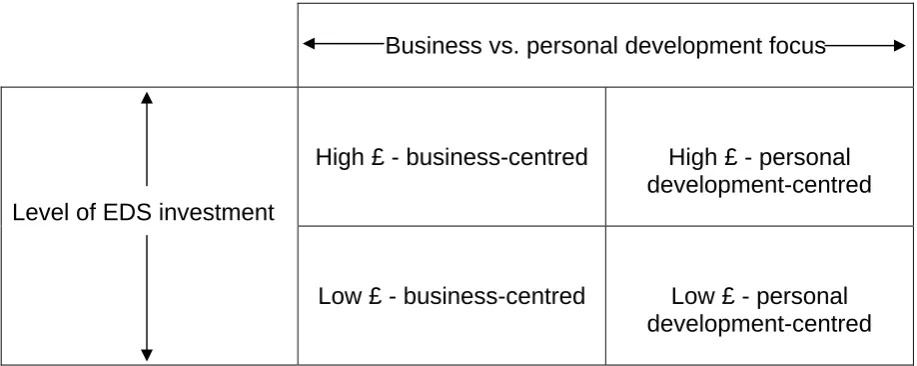
2.34 This suggests a simple four-segment model - as characterised in Figure 2.1. It suggests that EDS arrangements might be classified in four types:
[image:25.595.66.525.474.657.2]• Business driven with high investment per employee; • Business driven with relatively low levels of investment; • Individual development driven with high investment; and • Individual development driven with low investment.
Figure 2.1: A prospective model of EDS arrangements
Business vs. personal development focus
High £ - business-centred High £ - personal development-centred Level of EDS investment
Low £ - business-centred Low £ - personal development-centred
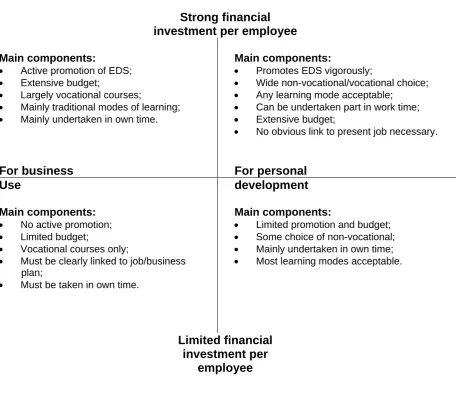
2.35 Taking this one step further, Figure 2.2 develops the likely key elements within these four possible scenarios.
Figure 2.2: EDS models
Strong financial investment per employee
Main components:
• Active promotion of EDS;
• Extensive budget;
• Largely vocational courses;
• Mainly traditional modes of learning;
• Mainly undertaken in own time.
Main components:
• Promotes EDS vigorously;
• Wide non-vocational/vocational choice;
• Any learning mode acceptable;
• Can be undertaken part in work time;
• Extensive budget;
• No obvious link to present job necessary.
For business For personal
Use development
Main components: • No active promotion;
• Limited budget;
• Vocational courses only;
• Must be clearly linked to job/business plan;
• Must be taken in own time.
Main components:
• Limited promotion and budget;
• Some choice of non-vocational;
• Mainly undertaken in own time;
• Most learning modes acceptable.
Limited financial investment per
employee
Overview
2.36 There would seem to be no lack of research evidence on the development of EDS. However, with the exception of a small number of company-specific studies, the evidence is mostly small-scale and often based on post-hoc reviews of employer and employee experience. Only the 1998 DfEE survey went any way towards mapping activity. However, in that study, weak workplace monitoring meant little could be told about overall levels of employer take-up, or the appeal of EDS to different sorts of employers or business circumstances. This remains an important information gap.
2.37 What emerges is an essentially fragmented picture of the development of EDS - stemming from a combination of essentially organic development in the early 1990s, mixed with selective TEC promotion since. Neither stimulus seems to have provided the foundations for the evidence on benefits to employers and employees that any more coherent approach to policy support through government would need.
References
1 D J Parsons, N Cocks and V Rowe, The Role of Employee Development Schemes in Increasing Learning at Work. The HOST Consultancy. DfEE Research Report 73, 1998.
2 Ford EDAP, Employee Development and Assistance Programme: Ford Statistics, EDAP Central Office, 1999.
3 TUC, Employment Development Schemes. Briefing Paper for the TUC National Training Network. Trades Union Congress, 1998.
4 D J Parsons, op cit, 1998.
5 M Corney, Employee Development Programmes: Current Practice and New Directions, NCE Briefing No 2, National Commission on Education, 1995.
6 A Hearsum, Glass Industry Employee Development Schemes: Final Report, Glass Training Ltd, 1996.
7 P Field, Opening Doors: The Lifelong Learning Project Evaluation Final Report, Research Partnership, 1997.
8 Kent TEC, Evaluation Report on Kent TEC’s Return to Learn Scheme, Parts 1 and 2, Kent TEC, 1997.
9 H Metcalf, Releasing Potential: Company Initiatives to Develop People at Work, Policy Studies Institute, 1991.
10 TUC, Guide to Workplace Development of EDS, Trades Union Congress, 1999. 11 D J Parsons, op cit, 1998.
12 NIACE, Workplace Learning: Case Studies and Good Practice from Around the UK, National Association for Adult and Continuing Education, 1994.
13 DfEE, Employee Development Schemes: A Contribution to National Prosperity, Conference Report, DfEE, 1995.
14 DfEE, Employee Development Schemes: What Impact Do They Have? Lifelong Learning Factsheets, DfEE, 1996.
15 DfEE, The Initial Experience: Successful Strategies for Employee Development, DfEE, 1996. 16 D J Parsons, op cit, 1998.
17 Nottingham Trent University and Nottingham Business School, EDS Project Evaluation Report, 1998.
18 N Williams, An Evaluation of EDS in Three TEC Areas, DfEE, 1995.
19 D J Parsons, H Fried-Booth, Learning Organisation Development Work, HOST Consortia Research Report No 18, 1997.
20 NIACE, Using EDS as Innovative Workplace-based Social Partnerships in Learning: Development of Transnational Training Materials, National Institute for Adult and Continuing Education, 1998.
21 J Houghton, Meeting the Joint Challenge for Unions and Management: Paper to IPA Seminar, 1992.
22 DfEE, op cit, 1995.
23 D J Parsons and V Rowe, Trade Unions and Employee Development Schemes: A TUC Guide to Building Workplace Employment Development Schemes, Trades Union Congress and University for Industry, 1999.
24 Learning from Experience Trust, EDS Realising Untapped Talents, Essex TEC, 1997. 25 DfEE, The Initial Experience: Successful Strategies for EDS, DfEE, 1996.
26 D J Parsons, op cit, 1998.
27 D J Parsons and V Rowe, TUC-UfI Case Studies Good Practice in Trade Union-Management Collaboration in Employees, University for Industry, 1999.
28 South East Cheshire TEC, Supporting Individual Lifelong Learning: Final Evaluation, 1997. 29 D Firth and G Goffey, Employee Development Schemes: The Benefits of Participation for
Employees in Small Organisations, DfEE, 1998. 30 Kent TEC, op cit, 1997.
31 N Williams and H Ackroyd, EDS in Sheffield: Interim Report, Sheffield TEC, 1996. 32 Nottingham Trent University and Nottingham Business School, op cit, 1998. 33 D J Parsons, op cit, 1998.
34 HMSO, Lifetime Learning: A Consultation Document, DfEE, Scottish Office and Welsh Office, 1995.
35 R Moore, L Dixon and D Crayk, Main Evaluation Report on Heart of England TEC EDS, Trades Union Research Unit, 1995.
36 A Hearsum, op cit, 1996.
37 J Payne, An External Evaluation of Passport to Learning, SOLOTEC, 1996.
38 P Ashby, Employee Development and Individual Learning Accounts: Making the Fit, Full Employment UK, 1998.
39 DfEE, A Fresh Start, Report of the Working Group on Post-School Basic Skills, London, 1999. 40 DfEE, National Adult Learning Survey, 1997.
41 G Brooks et al, Assembling the Fragments: A Review of Research on Adult Basic Skills, DfEE Research Report No 220, 2001.
42 J Bynner, Improving Adult Basic Skills: Benefits to the Individual and to Society, DfEE Research Report No 251, 2001.
43 D J Parsons, D Bell and J Embleton, Workplace Practitioners and Support of Basic Skills, Basic Skills Agency, 2000.
44 S Bysshe and D J Parsons, Evaluation of Learning Direct, DfEE Research Report, 1999.
3: A profile of organisations with EDS
Introduction
3.1 As explained briefly in section 1, the sample for the survey element of the research was obtained by a number of different approaches, as no clear sample frame for organisations with EDS exists. Part of the remit was to consider previous estimates from earlier research and establish a profile of organisations. Thus this section begins with a review of the sampling process and profile of organisations contacted in order to come to some conclusions about size, structure, and the
number of EDS that potentially exist. It then goes on to consider the profile of survey respondents and case study organisations.
3.2 It was recognised at the outset that although the methodology described in section 1 above was as exhaustive and far-reaching as possible, the relative paucity of systematic data and research on EDS participation, benefits and implementation, meant that the evidence collected during the course of this research does not allow us to extrapolate statistically the findings to the general population of employers. The findings from the sample survey and case-studies, which encompass a wide
spectrum of experiences of employers and agencies involved with EDS, are however thought to be significant within the context of recent developments in EDS.
How many organisations have an EDS?
3.3 The methodology adopted for this research yielded a large list of organisations with possible EDS in place that were then telephoned to be verified and included in the survey.
3.4 At the outset, HOST’s own database of 200 was trimmed down to 94 as, over the period since 1997/98, many organisations no longer operate schemes owing to staff changes, mergers, withdrawal of TEC funding and some apparent confusion with ILAs (seen by some employers to have replaced EDS - an important point returned to later in the report). These were augmented by a further 388 organisations with EDS identified through the main contacts already described, giving a minimum total of 482 potential EDS in existence. Difficulties with Data Protection prevented some TECs from providing detailed information but extrapolation based on a comparison of previous estimates and this research experience, means there may be a further 300 organisations with EDS that could not be contacted because of this.
3.5 Whilst all TECs were contacted, there was apparent confusion in some instances whether the TEC was supporting EDS or not. This was confirmed during the course of the case study work. A cautious estimate would suggest as many as 200
organisations who may be receiving support of this kind that could not be contacted via TEC sources.
3.6 Another issue within TECs was where funding had been originally provided but now withdrawn, and little record appeared to be kept within TECs of the
organisations that had been involved. In one case, for example, The Learning and
Business Link Company (formerly Kent TEC) had funded 480 organisations with EDS in the past, but funding was now withdrawn. They were unable to provide a list of organisations, and advertisements in local newspapers failed to attract responses. Assuming a similar rate of attrition as that encountered with the HOST database, where just over 50 per cent had dropped out of running EDS since they were last contacted, it is safe to assume that as many as 200 organisations at least in the Kent area may still have a scheme in place. Other TECs may be in similar situations, but few have the numbers that Kent could demonstrate, the average being 50
employers. Again, it is possible to make an assumption that as many as 200 organisations may be in a similar situation.
3.7 Many other organisations were also identified that had secured European funding to support organisations establishing EDS. Again, it would be safe to assume that there are other organisations in the same position that were not contacted. A best estimate here would be another 100 organisations being supported in this manner.
3.8 This suggests overall around 700 firms with EDS arrangements not otherwise accounted for in this research2, alongside the 800 or so known to more definitely be involved with EDS3.
3.9 Taking the two figures together would suggest a tentative estimate of around 1,500 organisations with EDS. This figure compares with the previous estimate of 1,970 to 2,275 four years ago, and suggests some attrition, perhaps of the order of 25%, has taken place, mainly due to TEC drop-out effects.
3.10 This estimate has necessarily relied heavily on intermediary or self-reporting by organisations. The survey evidence suggests that organisations identified by
intermediary bodies (e.g. TECs, NTOs) as having EDS arrangements often have practices and processes which do not support the underpinning principles of EDS (see the definition in section 1 and issues explored in section 2). If this is the case, the estimate may include large numbers of organisations that are running schemes rather optimistically labelled as EDS. There is also national evidence from the Ford EDAP-funded NIACE award that many organisations putting themselves forward as exemplars in EDS fell a long way short of the underpinning principles.
3.11 A few further words of caution with regard to the current estimate:
• The estimate of EDS participation amongst organisations not identified by participating TECs is highly speculative;
2
Derived as follows: Not identified by TECs but likely to exist: approx 200; Possible organisations with EDS in the Kent area: approx 200; Possible organisations around the country (with the ‘Kent experience’): approx 200;and organisations being supported by other bodies not identified: approx 100.
3
Derived as follows: Prevented from access owing to Data Protection: 300; Organisations identified with EDS and surveyed: 482; Organisations identified too late to be included: 22.
• A more cautious estimate might assume that the lack of feedback from
advertising in Kent would suggest a much higher level of drop-out in what was a very large scheme;
• EDS support by other ‘not identified’ co-ordinating bodies might be much more focused than for the TEC parallels, in which case the estimate of around 100 firms supported in this way would be exaggerated;
• To set against this, there is the possibility that post-TEC funding erosion levels are not as high as estimated, in which case the estimate of 1,500 organisations is overly cautious.
What are organisations with EDS likely to look like?
3.12 The employer survey suggests that some organisations would appear to be more likely than others to have an EDS. The earlier research suggested that many of the TECs promoting take-up of EDS targeted SMEs, and especially those with fewer than 100 employees. At that time, they were seen to be less than successful, as nearly two thirds of survey respondents employed more than 200 staff, and nearly half had more than 1,000 employees.
3.13 However, that research did establish that EDS can be applied and work
effectively even in smaller firms and the sampling exercise and survey for the current project now suggests organisations with EDS are most likely to have less than 100 employees, although larger fi