International Journal of Innovative Technology and Exploring Engineering (IJITEE) ISSN: 2278-3075, Volume-8 Issue-9, July 2019
This article reveals the essence of the assessment of teachers’ activities. The authors show the importance of a comprehensive assessment of this activity. Today, comprehensive assessment of the activities of teachers is an urgent problem that determines the purpose of the work - the development of a model for evaluating the activities of teachers in an educational organization. The degree of development of this issue depends on the quality of education in general. Therefore, the authors not only developed a model for assessing the activities of teachers, but also conducted a study that revealed the results of introducing a rating model into the activities of an educational institution. On the basis of the results obtained in the future, work in an educational organization for the evaluation of the activities of teaching staff will be improved.
Index Terms: assessment model of teachers' activities, educational organization, students.
I. INTRODUCTION
There are a number of fundamental contradictions that actualize the need to develop a model for assessing the activities of teachers at school: between the need for prompt diagnosis of the activities of teachers at schools and the existence of serious problems in determining adequate criteria for its assessment; between the needs for developing a model for evaluating the activities of teachers and the lack of a holistic, scientifically based diagnostic system in the process of evaluating the activities of teachers; between high demands on the quality of teachers' activities and the low level of development of criteria for evaluating their activities.
Revised Manuscript Received on July 06, 2019.
D.S. Kostylev, State budgetary educational institution of higher education «Nizhny Novgorod State University of Engineering and Economics», Nizhny Novgorod, Russian Federation.
E.A. Kostyleva, State budgetary educational institution of higher education «Nizhny Novgorod State University of Engineering and Economics», Nizhny Novgorod, Russian Federation.
N.G. Perevozchikova, State budgetary educational institution of higher education «Nizhny Novgorod State University of Engineering and Economics», Nizhny Novgorod, Russian Federation.
S.D. Sirotyk, Federal State Budget Educational Institution of Higher Education «Togliatti State University», Togliatti, Russian Federation. A.L. Lazutina, Minin Nizhny Novgorod State Pedagogical University, Nizhny Novgorod, Russian Federation.
O.I. Vaganova, Minin Nizhny Novgorod State Pedagogical University, Nizhny Novgorod, Russian Federation.
Z. V. Smirnova, Minin Nizhny Novgorod State Pedagogical University, Nizhny Novgorod, Russian Federation.
[1] One of the main provisions of educational activities in an educational institution is human resources. Since the activity of a teacher is particularly important, it is necessary to organize an internal control system, which consists in controlling the quality assurance system for graduates. [2] The activity of the teacher combines the main processes, such as educational, scientific, industrial activity and additional education. [3] Resource management is an internal process factor, and therefore it is important to build a clear system of teacher activity control. [26] With Russia's entry into a single European educational space, the level of educational activity is assessed using a rating. [4] The objectives of introducing a rating system allows assessing quality of teacher training: ensuring systematic feedback; motivation for the systematic independent work of teachers during the school year. [27] Also, increasing the reliability of data of operational diagnostics of educational process; objectification of the quality assessment of teacher training. [28], [29] This includes introducing an element of competition based on the ranking of teachers, obtaining differentiated and diverse information on the performance of training. [10]
II. LITERATUREREVIEW
The rating system is a set of regulatory and methodological documents that provides management of systematic, rhythmic and productive teaching and research activities of teachers to build their experience of self-education and independent work. [5] The rating system allows for effective monitoring and evaluation of teacher advancement in the educational space. [27] In the context of the modernization of Russian education, it is of particular importance to increase the efficiency of the professional activities of teachers, which is the most important link in the overall management system of an educational organization. [6] Rating as a system for assessing pedagogical activity according to formal parameters has indisputable advantages - clarity of indicators, ease of implementation and, at the same time, it is almost impossible to arbitrarily inflate or underestimate assessment. [7] This makes the score-rating system the most promising technology for assessing the professional activity of the teaching staff of an educational institution. [13] Rating assessment operates on the basis of several principles: openness and transparency of
rating determination;
accounting of individual professional development of
Development of a Model for Assessing the
Activities of Teachers in an Educational
Organization
teachers; increasing the internal self-assessment capacity of each teacher. [8] The professional activity of a teacher is a special kind of social activity aimed at transferring sociocultural experience from the older generations to the younger ones through training and education. [15] This activity is subject to rating. [19] And in order for a rating to be high, his professional activity must be built on the ability to interact with his family, the pedagogical community, and public organizations. [11] In modern socio-economic conditions, public relations become an actual direction of the teacher’s activity. [17] Public relations currently refer to technologies for creating and introducing an image of an object (ideas, services, personalities, organizations) into the value group of a social group, with the goal of securing this image as necessary in life. [18] The organization of this type of activity by a teacher contributes to the promotion of his innovative product or idea in the eyes of the public and social groups, creating a positive image of the teacher as a socially active person. [12], [14] It should be noted that the program-target approach to the rating assessment of the activities of pedagogical workers allows for a qualitative and quantitative assessment of the professional activities of school teachers. [20] The teacher should be not only a qualified subject teacher, but also a creative educator. [14] The problem of evaluating the performance of pedagogical staff in the school has not been sufficiently studied. [16] To clarify and elaborate it is necessary to refer to the analysis of its structure which can be represented as a unity of purpose, content of the process and result.
III. METHODOLOGY
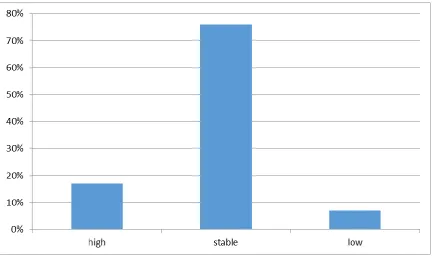
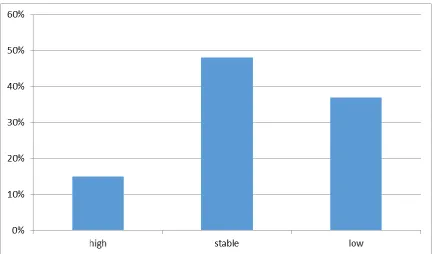
The paper presents the development of a model for assessing the activities of teachers. The model was introduced into the activities of an educational institution in 2018. To test its effectiveness, the authors conducted a study, due to which the positive impact of the development introduced by us was revealed. The study involved 48 teachers of the gymnasium No. 67 of Nizhny Novgorod. According to the results of the rating, the level of professional activity of teachers was shown: 15 teachers demonstrated a high level of professional activity, gaining from 30 to 40 points; 31 teachers showed a stable level (20-29 points) and 2 people have a low level of pedagogical activity (10-19 points). Indicative is the fact that none of the teachers showed a result of less than 9 points. In the gymnasium there is no teaching staff with a critical level of professional activity. In order to show how much better the results of 2018 are, the indicators of 2017 are presented in the work.
IV. ANALYSISANDDISCUSSION
International Journal of Innovative Technology and Exploring Engineering (IJITEE) ISSN: 2278-3075, Volume-8 Issue-9, July 2019
strengthening of mental and physical health (RB). The third block of the model characterizes the resulting component of the model. We see the results of the introduction of the model: the creation of an information bank that comprehensively reflects the activities of not only the teacher, but also the gymnasium as a whole; the urge to improve the activities and development of the gymnasium following the results of the teachers receiving objective information about the performance of their own labor; stimulating activities that improve the image of the teacher and improve the rating of the
gymnasium; presentation of uniform integrated criteria for assessing the level of professional competence and the performance of each teacher; promoting the objective distribution of the incentive part of the wage fund; self-assessment of teachers; self-assessment of the gymnasium's activities in order to determine the possible rating in the educational space of the city and region. We analyzed the coefficient of the level of professional activity of teachers of the gymnasium in 2018. The results are shown in figure 1.
Figure 1 The coefficient of the level of professional activity of teachers of the gymnasium in 2018
The results presented in the diagram indicate that the introduction of the model was successful, and thanks to this introduction the teachers have quite high indicators. According to the results of the rating, a sufficiently high level
[image:3.595.87.522.184.440.2]Figure 1 The coefficient of the level of professional activity of teachers of the gymnasium in 2017
As we can see, the results of 2018 are several times better than the results of the previous year.
V. CONCLUSION
Thus, we have established that rating in the modern education system plays a big role, helping to raise the level of education in general. Therefore, to improve the activities of teachers in gymnasium No. 67, we developed a model for rating the activities of teachers. A study conducted in 2018 to identify the level of professional activity of a teacher showed that 15 teachers showed a high level of professional activity, gaining from 30 to 40 points; 31 teachers showed a stable level (20-29 points) and 2 people have a low level of pedagogical activity (10-19 points). Indicative is the fact that none of the teachers showed a result of less than 9 points. In the gymnasium there is no teaching staff with a critical level of professional activity. 77% of teachers have a stable level of professional activity. The study showed the positive impact of the model we developed on the educational process in the gymnasium. Therefore, on the basis of this model, further activities of the educational institution will be built. The goal was achieved - a model for evaluating the activities of teachers in an educational organization was developed. The model for the gymnasium number 67 of the city of Nizhny Novgorod was designed. The introduction of the model into the educational process showed that each of the study participants felt a positive result. The work of teachers has improved. This
REFERENCES
1. N.S. Abramova, O.I. Vaganova, L.I. Kutepova (2018) Development of
educational and methodological support in the context of the implementation of information and communication technologies. Baltic Humanitarian Journal, t. 7. no. 2 (23). pp. 181-184.
2. D. Ajeenkya, Y. Patil, N. Gagandeep, R. Gopal (2014) A Study on Total
Quality Management in Higher Education. International Journal of
Management. Vol. 5(5). pp. 1-6.
3. M.V. Arkhipova, E.E. Belova, Y.A. Gavrikova, N.A. Lyulyaeva, E.D.
Shapiro (2018) Blended learning in teaching EFL to different age groups. Advances in Intelligent Systems and Computing, Vol. 622, pp. 380-386.
4. A.Z. Ibatova, N.V. Ippolitova (2018) Structuring the Content of
Disciplines in Higher School Using a Block-Modular Rating System for
Future Oil and Gas Engineers, International Journal of Civil
Engineering and Technology, Vol. 9(3), pp. 394–399.
5. M. Barber, K. Donnelly, S. Rizvi, L. Summers (2013). An avalanche is
coming. Higher Education and the revolution ahead, 73. http://www.studynet2.herts.ac.uk/intranet/lti.nsf/0/684431DD8106AF 1680257B560052BCCC/$FILE/avalanche-is-coming_Mar2013_1043 2.pdf
6. I.B. Bicheva, O.M. Filatova (2017) Formation of the teacher-leader in
the educational process of the university. Vestnik of Minin University, no. 3(20); pp. 5.
7. G. Braine, (2013). Non-native educators in English language teaching.
Routledge. https://doi.org/10.4324/9781315045368
8. M.N. Bulaeva, O.I. Vaganova, M.N. Gladkova (2018) Activity
technologies in a professional educational institution. Baltic
Humanitarian Journal, t. 7. no. 3 (24). pp. 167-170.
9. M.N. Bulaeva, O.I. Vaganova, M.I. Koldina, A.V. Lapshova, A.V.
Khizhnyi (2018) Preparation of bachelors of professional training using MOODLE. Popkova E.G. (ed.) The Impact of Information on Modern Humans. Springer, Vol. 622, pp. 406-411.
International Journal of Innovative Technology and Exploring Engineering (IJITEE) ISSN: 2278-3075, Volume-8 Issue-9, July 2019
International Journal of Mechanical Engineering and Technology, Volume 9, Issue 4, pp. 1001-1007.
13. M.M. Kutepov, O.I. Vaganova, A.V. Trutanova, (2017). Possibilities of
health-saving technologies in the formation of a healthy lifestyle. Baltic Humanitarian Journal, Vol. 6(3), 210-213.
14. L.K. Ilyashenko (2018) Pedagogical Conditions of Formation of
Communicative Competence of Future Engineers in the Process of
Studying Humanitarian Disciplines, International Journal of Civil
Engineering and Technology, Vol. 9(3), pp. 607-616.
15. S.M. Markova, А.К. Narcosiev (2018) Professional education of
vocational school students. Vestnik of Minin University, Vol. 6, no. 3.
Р.3.
16. S.M. Markova, E.P. Sedykh, S.A. Tsyplakova, V.Y. Polunin (2018)
Perspective trends of development of professional pedagogics as a science. Advances in Intelligent Systems and Computing, Vol. 622; pp. 129-135.
17. E.V. Myalkina, E.P. Sedhyh, V.A. Zhitkova, V.A. Vaskina, O.I. Isaykov
(2018) University resource center as an element of social development of the region. Vestnik of Minin University, Vol. 6, no. 3. Р. 1.
18. A. Pavlov, A. Kindaev, I. Vinnikova, E. Kuznetsova, (2016). Crop
insurance as a means of increasing efficiency of agricultural production
in Russia. International Journal of Environmental and Science
Education, Vol. 11(18), pp. 11863-11868.
19. T.V. Perova, E. A. Kuznetsova, I. S. Vinnikova, S.N. Kaznacheeva, E.A.
Chelnokova (2017). Essence of the role and characteristics of the operating conditions of enterprises before and after the transition to market relations from a macroeconomic position. International Journal of Applied Business and Economic Research, Vol. 15(12), pp. 103-112.
20. M.P. Prokhorova, A.A. Semchenko (2018) Involving of trainees-future
teachers of professional training in project activities in the discipline. Vestnik of Minin University, Vol. 6, no. 2. p. 6.
21. Z.V. Smirnova, M.L. Gruzdeva, O.G. Krasikova (2017) Open electronic
courses in the educational activities of the university. Vestnik of Minin University, no. 4(21), p. 3.
22. Z.V. Smirnova, O.G. Krasikova (2018) Modern tools and technologies
for assessing learning outcomes. Vestnik of Minin University, Vol. 6, no. 3. Р. 9.
23. Z.V. Smirnova, O.I. Vaganova, A.V. Trutanova (2017) Final state
certification as a way to comprehensive assessment of competences. Karelian Scientific Journal, Vol. 6, no. 3(20), pp. 74-77.
24. Z.V. Smirnova, M.V. Mukhina, L.I. Kutepova, M.M. Kutepov, O.I.
Vaganova (2018) Organization of the research activities of service majors trainees. Advances in Intelligent Systems and Computing, Vol. 622, pp. 187-193.
25. S.A. Tsyplakova, M.N. Grishanova, E.A. Korovina, N.M. Somova
(2016) Theoretical bases of designing of educational systems. Azimuth of Scientific Research: Pedagogy and Psychology, Vol. 5. No. 1 (14). Pp. 131-133.
26. O.I. Vaganova, A.V. Gladkov, A.V. Trutanova (2017) Formation of
professional competencies of bachelors in the conditions of e-learning. Baltic Humanitarian Journal, Vol. 6. no. 2 (19). pp. 190-193.
27. O.I. Vaganova, L.K. Ilyashenko (2018) The main directions of
implementation technologies of student-centered education in high school. Vestnik of Minin University, Vol. 6, no. 3. p.2.
28. O.I. Vaganova, M.I. Koldina, A.V. Trutanova (2017) Development of
the content of vocational and pedagogical education in the context of the
implementation of the competence approach. Baltic Humanitarian
Journal, vol. 6, no. 2(19), pp. 97-99.
29. O.I. Vaganova, Zh.V. Smirnova, S. M. Markova, Zh. V. Chaikina, M. N.