Abstract: The rhythm of modern life and the widespread dissemination of digital technology leads us to the need to review traditional education systems. Opportunities for realizing the potential inherent in electronic training systems are revealed only if they are used. Expanding the range of educational materials used due to the possibility of multimedia tools allows improving the quality and speed of assimilation of the material. The possibilities of e-learning using multimedia technologies increase the visibility and attractiveness of educational content. Also, these technologies make it possible to demonstrate in the educational process such material that previously due to its nature (complexity, high cost, inaccessibility) could not be widely used
Effective use of the opportunities provided by the Internet allows you to implement incredibly flexible and adaptive training programs. The student’s access to educational material at any convenient time from any convenient point allows the formation of the most effective curriculum program, which increases the digestibility of educational material.
Keywords : Education, E-Learning, Student.
I. INTRODUCTION
T
he accelerating processes of globalization, the development of a common information space, as well as the active introduction of digital technologies in all spheres of life have led to a revision of traditional approaches to education. The emergence of the concept of e-learning itself became possible immediately with the widespread introduction of personal computers in everyday life, and if at first only individual courses on personal computers were referred to e-learning, now the range of e-learning opportunities has grown many times over [1-2]. A significant factor in the widespread advancement of e-learning technologies has been the creation of a robust technical and information infrastructure for educational institutions with developed information and educational environment, the general availability of both the global Internet network and local communication networks. All this made it possible toRevised Manuscript Received on October 10, 2019 * Correspondence Author
Kateryna Kruty, Department of Preschool and Primary Education, Vinnytsia Mykhailo Kotsiubynskyi State Pedagogical University, Vinnytsia, Ukraine
Larysa Zdanevych, Department of Preschool Pedagogy, Psychology and Professional Methods, Khmelnytskyi Humanitarian-Pedagogical Academy, Khmelnytskyi, Ukraine
Olha Demianenko, Foreign Languages Department, V.O. Sukhomlynskyi Mykolaiv National University, Mykolaiv, Ukraine
Natalia Pakhalchuk, Department of Preschool and Primary Education, Vinnytsia Mykhailo Kotsiubynskyi State Pedagogical University, Vinnytsia, Ukraine
Lyudmyla Perminova, Department of Natural and Mathematical Science and Speech-Language Therapy, Kherson State University, Kherson, Ukraine
effectively and reasonably unconstrainedly eliminate the spatial and temporal barriers to access to knowledge and create useful tools for processing and exchanging information.
Why is e-education so important? In the present era, the level of scientific and technological progress has reached a state where the amount of information coming into the sphere of production and science significantly exceeds the previously available. Moreover, the volumes of knowledge accumulated by humankind are multiplying exponentially [3-5].
E-learning is understood as the organization of educational activities using information technology, technical means, including telecommunication networks, which ensure the transmission of necessary information through communication channels, and the interaction of students and teachers. Such an organization of training relies on the use of information and communication technologies, such as computer-based learning technologies, interactive multimedia, web-based learning, online learning, etc.
E-learning systems often contribute to solving several problems in the field of education, for which there are appropriate tools:
reliable system of accumulation of knowledge (information databases and knowledge bases, electronic libraries, etc.);
effective knowledge processing technologies (search information systems, information-analytical, expert-analytical, design, editorial and other information systems);
reliable knowledge dissemination scheme (Internet, distance education system).
Reliable accumulation of knowledge is primarily realized due to the fact that the role of the keeper and accumulation of knowledge is shifted to electronic knowledge bases, which eliminates the loss of accumulated knowledge due to the human factor. In fact, the human role is redirected from storage to controlling relevance and updating data in the information database. This contributes to the reliability of the storage and enhancement of accumulated knowledge, although it creates additional difficulties in the procedures for tracking their relevance. The most significant effect of the introduction of electronic education is manifested in the search and processing of accumulated information systems. Modern electronic search engines allow you to detect the necessary information both from and anywhere in the world [6]. An undoubted plus is a convenience of working with electronic information, and the ability to systematize and process this using analytical and expert systems can also reduce the subjectivity in data
analysis.
E-Learning Methods in Students’ Education
The significant role of the data distribution system is also difficult to underestimate, remote access to the necessary knowledge, and the ability to work with them at any convenient time at any convenient point can significantly increase the effectiveness of electronic learning systems [7].
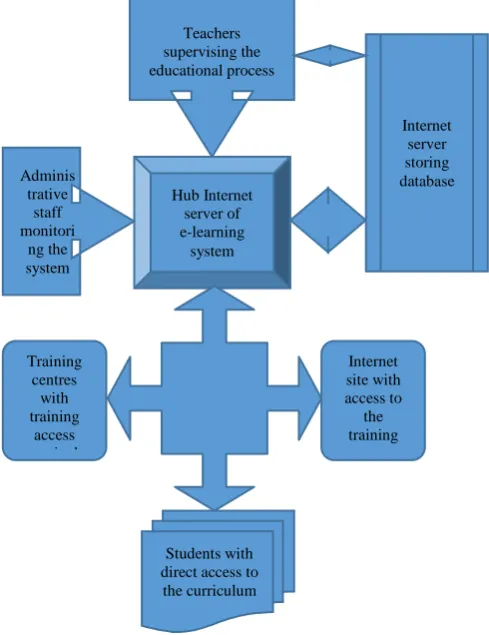
[image:2.595.46.291.185.503.2]Speaking about e-learning, one cannot but notice its main advantage - the ability to implement the distance learning system effectively. Without the use of e-learning systems, such schemes are almost impossible to achieve. An embodiment of such a circuit is shown in Fig. 1.
Fig. 1.The implementation scheme of the distance learning system based on the nodal server of the e-learning
system.
Such a system is not the only possible one, but at the same time, it fully realizes the potential inherent in the e-learning methodology. In the scheme, the nodal Internet server stores the entire e-learning system and provides access to its resources to various users. At the same time, this option implements a separate database, access to the information of which is available only to the teaching staff, which allows updating the data and updating the information used in training programs.
Broadband access through the Internet allows you to implement both individual training centres with access to training courses, and provide individual access to individual students to selected courses, for example, access to a repository with dissertation works. Also, when implementing this scheme, it is possible to organize separate Internet sites with educational materials in the public domain.
II. FEATURES OF E-LEARNING COURSES
When asking about the appropriateness of e-learning, and as a particular case of distance e-learning, one should take into account all the potential opportunities this technique provides:
1) The individual rate of learning - allows you to take into account in the training course, within reasonable limits, the speed of knowledge of educational materials, depending on the personal characteristics and circumstances of each student.
2) Freedom and flexibility of training - the student has the opportunity to choose any of the courses provided, as well as independently calculate the dates and duration of classes.
3) Accessibility of training - regardless of geographical and other location, the student has the opportunity to receive education remotely at any university that supports these technologies, which allows satisfying the educational needs of each person.
4) The speed of interaction - increases the effectiveness of the relationship between the teacher and the student due to the feedback system, which is undoubtedly an integral element of the educational process.
5) Technological process of the educational process - the use in the educational process of the latest achievements of information and telecommunication technologies, the possibility of operational updating of the training course.
6) Social equality - implies the same opportunities for obtaining distance education regardless of the place of residence, state of health, nationality and material condition of the student.
7) Creativity - favourable conditions for the student's expression in the learning process.
Naturally, like any methodology, along with the advantages of the e-learning system, there are also disadvantages, which should also be described:
1) Possible there is no verbal interaction between the student and the teacher, i.e. there are no moments associated with an individual approach to learning and the educational process. If the work goes only with the use of e-learning, without the direct presence of a teacher, who emotionally colours the material and contributes to the perception of the content, this is undoubtedly a significant minus.
2) E-learning lacks a part of individual psychological factors that is characteristic of classical education. Education requires even more rigorous self-discipline, and the result of training to a greater extent depends on the independence of the student.
3) The possibility of constant access to sources of educational materials (electronic textbooks, video materials, etc.) is required, and for this we need a serious technical base, including high-speed access to the Internet.
4) Reducing the role of practical exercises, seminars, which are necessary for successful consolidation of the material and better assimilation of it.
Hub Internet server of e-learning
system Adminis
trative staff monitori
ng the system
Teachers supervising the educational process
Internet server storing database
Students with direct access to the curriculum Training
centres with training
access terminals
Internet site with access to
5) Ineffective use of the capabilities of multimedia materials, and as a result, a decrease in the quality of e-learning or inadequacy with current requirements and standards due to insufficient qualifications of the specialists who prepared the training course.
6) The very nature of e-learning excludes the possibility for a student to express their knowledge and skills in oral form, which can cause sparse learning of the material and many other problems.
Undoubtedly, all of this should be taken into account when developing and implementing e-learning systems [8].
Moreover, the form of implementation of the distance learning system may be different:
• teaching in the present phase. Opportunities for traditional teaching can be expanded by using multimedia modules to implement learning. Students are provided with relevant information. It should be noted that the training event is temporally and spatially dependent;
• self-organized learning supported by multimedia material. In this case, students are not accompanied by a teacher. Students should take elements from training modules independently from the training network. The study is independent of spatial distribution and time;
• distance courses. With this form of learning, all phases of teaching and learning are supported remotely based on Internet technology. Teacher support and practical exercises can be implemented interactively based on web technologies. Learning is independent of spatial distribution and time.
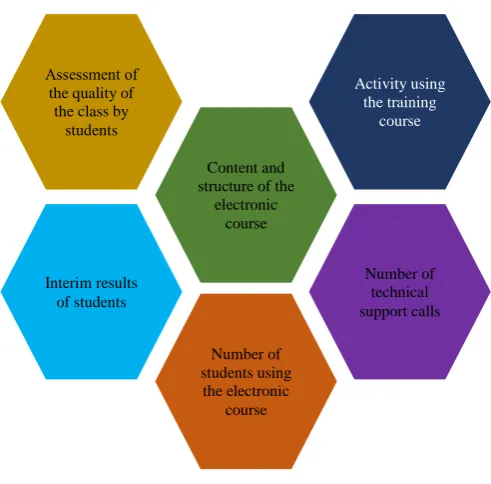
[image:3.595.46.292.441.683.2]Considering the advisability of an electronic training course, it is advisable to be guided by the scheme presented in Fig. 2.
Fig. 2.Monitoring the feasibility of an e-learning course. The analysis allows you to evaluate how the number of knowledge students receive when using this course, and the amount of material and non-material costs of maintaining it.
III. METHODOLOGY
Consider the primary forms of e-learning that can be used in preparing students.
Blended (Hybrid Learning). A technique in which the benefits of traditional learning are combined with the present phase and the distance phase of e-learning. At the same time, blended learning combines both educational forms in a standard curriculum.
Learning Communities. Groups of students and teachers with the same goals and/or specific interests can create a universal system of knowledge (base) about a particular subject area. Each member of the learning community can supplement the system with their materials, so the system is modernized and expanded.
Content Sharing. In this case, websites are used that allow for the exchange of training materials. These are commercial (material incentives are used in the preparation of educational content) and ordinary offers.
Virtual Classroom. In the case of using a virtual audience, the Internet is a means of communication between geographically separated students and teachers. Thus, a virtual audience makes possible a synchronous form of learning, and fully realizes the benefits of distance e-learning. Web Based Collaboration. The concept of web collaboration describes the collaboration of a group of students using the Internet, under the supervision of teachers. This technique allows you to eliminate the shortcomings of practical classes for students in the implementation of e-learning
System "Interactive board" (Whiteboard). Comparable to a blackboard or lecture poster. Allows students and teachers the opportunity to create and analyze drafts and designs collaboratively. To do this, they have at their disposal a variety of tools for remote access to a shared knowledge base. This technique is also applicable as a compensation mechanism to reduce the share of practical exercises.
At the same time, all these approaches can be applied in the e-learning system, but each of them will solve its own separate problem and not be used independently, but as part of the overall integrated e-learning system.
The work of the student and teacher with the electronic educational course can be schematically depicted in the form of Fig.3.
Each of the stages of interaction with the training course allows you to monitor further the actions taken by both the student and the teacher, which makes it possible to accumulate statistical data with their subsequent analysis. The diagram displays the general learning process and is applicable to any e-learning methodology. The accumulation of data on electronic training courses allows you to identify weaknesses that reduce the overall effectiveness of this system.
An important nuance is the ability of a teacher to evaluate student actions, as well as student access to this assessment for the possibility of both introspection and feedback on the effectiveness of the training course from the point of view of the student.
Content and structure of the
electronic course Аssessment of
the quality of the class by
students
Activity using the training
course
Interim results of students
Number of students using the electronic
course
Fig. 3.Monitoring the feasibility of an e-learning course. When developing an e-learning course, it will be useful to
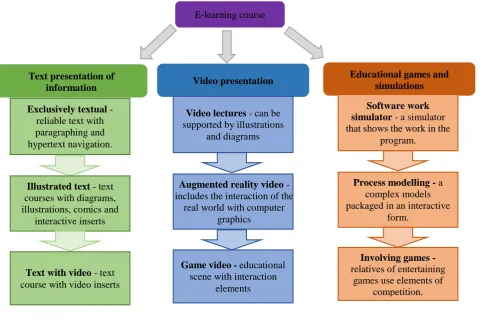
determine in what format this course can be presented [9]. Fig. 4 shows the main options for submitting material for such a course. The capabilities of electronic methods allow you to use almost all means of transmitting information, both visual and audio. At the same time, the visual component expands significantly and allows using not only textual and graphical methods of presenting information but also the possibilities of augmented reality or virtual simulation [10].
The introduction of e-learning methods in the educational process has led to the need to evaluate their effectiveness because the introduction of new methods alone does not guarantee an increase in the quality of the educational process. Here it is worth noting the opportunity to present the educational process with a mathematical, symbolic formula, taking into account the personal properties and qualities of the student, which looks like this:
where - didactic (educational) process; - learning motivation;
- learning activities of the student;
- the managerial activity of the teacher or technical training tools.
This formula determines that the learning process can be effective only provided that the student has educational motivation for the subject being studied, independently and fully fulfils the educational activity that is adequate to the learning goal, and, finally, this activity is controlled externally by methods that guarantee a given quality of education.
Fig. 4. Monitoring the feasibility of an e-learning course. E-learning
course
Training material data
Selected e-learning
course
Selected student
data
Student actions
Activities analysis data
Data for peer review
Expert assessment Teacher
Registration of an e-learning
course
Database of e-learning
courses
Student connection to the
course
Database of e-learning
courses
Student action analysis Database of
student activities Formation expert assessment
Text presentation of information
E-learning course
Exclusively textual - reliable text with paragraphing and hypertext navigation.
Illustrated text - text courses with diagrams, illustrations, comics and
interactive inserts
Text with video - text course with video inserts
Video presentation
Video lectures - can be supported by illustrations
and diagrams
Augmented reality video - includes the interaction of the
real world with computer graphics
Game video - educational scene with interaction
elements
Educational games and simulations Software work simulator - a simulator that shows the work in the
program.
Process modelling - a complex models packaged in an interactive
form.
Involving games - relatives of entertaining
[image:4.595.51.540.435.758.2]Evaluation of the effectiveness of the electronic training course is vital in deciding on the feasibility of its further support. Of course, a preliminary assessment of the course is important, but the assessment after its testing in practice, when it is possible to take into account the performance of students and their subjective assessment of the course itself, can be considered the most significant.
Assessment of learning satisfaction.
Conducted based on a survey of students after completing the course. This indicator allows you to evaluate the effectiveness of the training course itself. Each student evaluates their satisfaction with the training carried out on a 5-point system. The following is a calculation of satisfaction according to the formula:
where m is the total number of students who completed training, is the score set by each student for the quality of the training course, is the maximum possible score.
Knowledge increment.
Evaluation of the results of the introduction of an electronic training course can be effectively assessed by increasing the number of correctly completed tasks, for this, you can use the formula:
where is the average number of correctly completed
tasks, n is the number of students in the group, is the score of the i-th students.
You should also take into account the standard deviation of the results using the formula:
IV. EXPERIMENT
The essence of the experiment was that, according to the general program, the same teacher conducted separate classes in two study groups, one of which was chosen as an experimental and the other as a control. Each of the groups consisted of 18 students.
The control group was trained according to a standard curriculum without involving electronic training courses; students were not forbidden to use additional third-party information resources, including electronic ones.
The experimental group was trained according to the electronic course “Personal electronic training place” developed by the teacher, using a large number of video materials, electronic interactive textbooks were also involved.
Testing of students of both groups was carried out exclusively in electronic form. Besides, after the course, students of the experimental group were questioned to determine the overall satisfaction with the training course
(Table 1).
Table- I: Learning Satisfaction Results
Student 1 2 3 4 5 6 7 8 9 10 11 12 13 14 15 16 17 18
Rating 3 5 4 4 3 3 4 5 3 5 5 4 5 4 3 5 4 4
The data allows us to analyze how highly students rated the quality of the course:
That allows us to conclude that there is high satisfaction with the proposed training course.
Measuring the increment of knowledge will be to determine the level of education by conducting testing before and after graduation, which includes 20 tasks. The characteristic of the student (sign) in this case is the number of correctly solved problems. The results of measurements of the level of knowledge in the control and experimental groups before and after the experiment are shown in Table 2. Three levels of knowledge were identified (L = 3): satisfactory (the number of solved problems is less than or equal to 12), good (the number of solved problems is strictly greater than 12, but less than or equal to 15) and high (the number of solved problems is strictly greater than 15) - they are presented in the table.
After that, the results were aggregated to the previously selected levels, characterized by frequency.
Table- II: The results of measurements of the level of knowledge in the control and experimental groups. Number of correctly solved
problems before the e-learning course
Number of correctly solved problems after the e-learning
course
Control group Experimental group Control group Experimental group
14 11 10 13
12 13 11 16
17 16 15 14
15 14 18 18
12 11 12 14
8 8 8 18
18 9 16 14
20 20 19 19
14 11 10 19
17 13 20 15
15 15 8 15
19 11 20 16
9 17 11 20
6 16 13 16
6 9 5 14
10 17 12 19
9 16 13 12
For example, based on the data in table 1, for the control group before the start of the experiment, the number of its members who received a score belonging to one or another range: m1 = 15 (that is, 15 students of the control group before the start of the experiment showed a satisfactory level of the competency under consideration), m2 = 5, m3 = 8. The results are presented in Table 3.
Table- III: The results of measurements of the level of knowledge in the control and experimental groups.
Knowle dge level
Conditio ns
Before the e-learning course
After the e -l e a r n i n g
c o u r s e Contr
ol group
Experim ental group
Contr ol group
Experim ental group Satisfac
tory
n <=12 8 7 9 2
Good 12 > n <=15
4 5 4 7
Great 15 > n <=20
6 6 5 9
In order to quantify the results, the average number of correctly completed tasks for the control and experimental groups was calculated after the experiment. Using the formulas presented above, the following results were obtained:
For the control group
For the experimental group
V. RESULTANDDISCUSSION
Thus, the experiment showed that the average number of correctly completed tasks of the final test by students in the experimental group is 2.66 more than in the control group, and the spread in the number of correctly completed tasks in the experimental group as a whole is 1.76 less than in the control group.
The application of the electronic educational course methodology increased the level of knowledge by 21% and reduced the scatter in the number of correctly completed tasks by 34%, the satisfaction rating with the course presented was 81%.
Most students noted the high availability for understanding the processes shown in the course materials in the video, interactive textbooks also showed their effectiveness, allowing students to re-study the training material if necessary, as well as providing additional information from open sources on the Internet.
VI. CONCLUSION
In modern conditions, when the knowledge base of humanity doubles annually, it is extremely important to ensure the possibility of high-quality and effective assimilation of educational material. Electronic training systems in these conditions are moving from the category of exotic novelties to the category of a necessary and indispensable tool.
REFERENCES
1. Bashynska, M. Baldzhy. L. Ivanchenkova, L. Skliar, O. Nikoliuk, G. Tkachuk, Game Risk Management Methods for Investment Portfolio Optimization, International Journal of Recent Technology and Engineering, Volume-8 Issue-2, 2019, pp. 3940-3943 DOI: 10.35940/ijrte.B1729.078219
2. OV Sagan, MS Haran, OM Liba, Formation of the methodical-informatic competence of primary school teachers, Information Technologies and Learning Tools, 65 (3), pp. 304-315 3. Dobina T., Haidukevych K., Panchenko S., Petrova I., Sabadash J.
Effectiveness Analysis of Entrepreneurship Model of Development Qualities of Future Managers, Journal of Entrepreneurship Education, 2019, Volume 22, Issue 3, pp. 1-6
4. Andreea-Maria Tirziu, Catalin Vrabie, Education 2.0: E-Learning Methods, Procedia - Social and Behavioral Sciences, 186, October 2014, DOI: 10.1016/j.sbspro.2015.04.213
5. Peter Grabusts, The possibilities of clustering learning methods in student education, May 2019, DOI: 10.17770/sie2019vol5.3723 6. Phuoc Dai Huu Nguyen, Thinh Van Duong, E-Learning methods in
XXI century, Conference: Proceedings of the XXI- The international scientific conference of young engineers, March 2016
7. Andreea-Maria Tirziu, Catalin Vrabie, Education 2.0: universities' e-learning methods, April 2015, DOI: 10.13140/RG.2.1.3452.3280 8. Marta Woźniak-Zapór, Mariusz Grzyb, Sebastian Rymarczyk,
E-learning in student education, January 2013, DOI: 10.5937/skolbiz1301012W
9. A. Babkin, Analysis of Assessment Methods for Students’ Educational Achievements, June 2015, DOI: 10.12737/11934