International Journal of Innovative Technology and Exploring Engineering (IJITEE)
ISSN: 2278-3075,
Volume-8 Issue-12, October 2019
Robo Car for Military Application
Gitanjali Suresh, Nidhi Poddar, Lavanya M, Suganya S, Venkateswaran K
Abstract— Military and battlefield applications are in an accelerated pace due to its demand fueled by government investment. In this paper a modern approach is presented for surveillance at border and remote areas using multifunctional robot based on Bluetooth technology and ARM Cortex M4. It will control both an autonomous and manually controlled robots using wireless technologies. The applications of this multisensory robot is used to detect human, bombs and metallic weapons at remote and war field areas and share the live feed and the location to the operator. Instead of having people get close to hazards such as unattended objects robots are used. An autonomous operation is performed to control using ultrasonic sensor acting as an obstacle detector. In this paper the robotic vehicle is designed for reconnaissance as well as surveillance under certain circumstances. The use of ARM Cortex M4 as the main controller helps in tight integration of system peripherals thereby reducing area and development costs in comparison with existing conventional wireless security robots.
Keywords—UGV; ARM Cortex M4; Surveillance; Metal Detection; Embedded Systems; Bluetooth
I. INTRODUCTION
Plenty of human lives are associated with this hazardous procedure of surveillance. Surveillance is a perilous activity. There is dependably a danger of getting captured in spying. Robots are unmanned gadgets and can be controlled from a remote area. Likewise, a ton of blow-back can be diminished by utilizing robots in military applications Without gambling human life, robots can supplant people in some perilous obligation administration.
In military administrations, there are a few regions wherein a portion of the errands include more serious hazard and peril, and hence, those assignments must be performed without the military workforce, exclusively by the robots. There are various types of robots that are explicitly utilized for doing exceptional assignments in military applications. Numerous resistance associations take the assistance of robots in a perilous condition to complete a dangerous activity that is impossible by any officer.
Revised Manuscript Received on October 05, 2019.
Gitanjali Suresh, Dept. of Electronics and Communication CMR Institute of Technology Bangalore, [email protected], [email protected], [email protected]
Nidhi Poddar, Dept. of Electronics and Communication CMR Institute
of Technology Bangalore, [email protected],
[email protected], [email protected]
Lavanya M, Dept. of Electronics and CommunicationCMR Institute of
Technology Bangalore, [email protected],
[email protected], [email protected]
Suganya S, Dept. of Electronics and Communication CMR Institute of
Technology Bangalore, [email protected],
[email protected], [email protected] Venkateswaran
K,Dept. of Electronics and Communication CMR Institute of Technology
Bangalore, [email protected],
[email protected], [email protected]
These robots utilized in the barrier are normally utilized with sensors, cameras for live gushing, incorporating circuits frameworks and the Grippers. These days, with the improvement of innovation, a few robots with extremely extraordinary incorporated frameworks work constantly and correctly [1].
An unmanned ground vehicle (UGV) works with the help of contact with the ground and without a locally available humans. UGVs can be utilized for different types of applications where it might be badly designed, risky, or difficult to have a human administrator present. For the most part, a lot of sensors are fitted in the vechicle to watch the nature, and self-sufficiently settle on choices about its conduct or it may pass the data to a human administrator at an different area that will be controlled by the vehicle through teleoperation.
This project goes for structuring a UGV which will be physically constrained by giving route directions dependent on the video sign got from the camera mounted on the UGV. The client can screen the war field territory by controlling the development of the vehicle by an Android application. At the point when the client contacts the position directly in the Android application, the sign from the framework is gotten remotely through a Bluetooth module in the robot and is additionally moved to the microcontroller. The microcontroller is customized so that after accepting the comparing signal from the Bluetooth, it sends the order sign to an motor driver that drives the arrangement of engines to move the vehicle in the ideal course.
This robot is helpful to discover landmines in the ground by detecting them while pushing the car forward. A metal finder mounted before UGV is utilized to locate the metal item which is covered underground. After accepting the sign from the finder, the microcontroller gives out a humming sound and furthermore consistently associates with the collector to move the vehicle in an ideal heading or way. When a metal is identified, the GPS location is sent to the controlling gadget [1][2][3].
II. EXISTING SYSTEMS
Specialists have been endeavoring to reverse the proportion with the end goal that a solitary administrator can control various UGVs during military tasks. To achieve this objective, enhancements should be made in the human-robot Interaction (HRI) that happens while an administrator is responsible for the UGV.
A UGV is a ground conveyance ,controlled, versatile that as its name attests does not convey an administrator. The main major UGV improvement exertion in the US was the SHAKEY which was created in the late 1960s to fill in as a testbed for Defense Advanced Research Projects Agency (DARPA) established computerized reasoning. The SHAKEY framework was designed by a wheeled stage with a steerable TV camera that could acknowledge direction of English sentence . The program was resolved to fruitless because of in the absence of self-sufficiency framework (Gage, 1995). It was reexamined in the mid-1980s as the Autonomous Land Vehicle (ALV) program. The ALV was an eight-wheeled off-road vehicle that was just ready to accomplish the specified rates of around 3 km/hr first and foremost design was exceptional to accomplish up to 70 km/hr on the parkway. This program was prompted for the commencement of the Reconnaissance, Surveillance, and Target Acquisition (RSTA) application for UGVs. This capacity was used in war zone leaders as that has the immediate detecting ability without jeopardizing human staff. Two RSTA undertakings built up the Ground Surveillance Robot and the Advanced Teleoperator Technology Tele-Operator Dune Buggy. Recent projects are concentrating more on creating lightweight, man-versatile portable robots for performing tasks in urban territories, for example, passage, sewer, and shelter surveillance missions. . A marsupial robot is a bigger UGV that can convey one smaller UGVs either appended to or inside. Marsupial robot endeavors are additionally included in the reconciliation and dispatch of both a UAV and UGV solitary robot [4].
[image:2.595.312.542.174.330.2]A. DRDO Daksh
Fig. 1. DRDO Daksh [5]
Daksh (Fig. 1.) is a battery-worked remote-controlled robot on wheels that was made with an essential capacity of bomb recuperation. It was created by the Defense Research and Development Organization can explore staircases, arrange soak slants, toe vechicles and explore limited passages to handle risky materials. It tends to be remotely controlled over a scope of 500 m in the observable pathway . The majority of its body is comprised of steel, and it adds to the heaviness of the robot which thus influences its speed and execution [5].
[image:2.595.48.272.499.751.2]B. Guardium
Fig. 2. Guardium [6]
Guardium (Fig. 2.), produced by G-NIUS, is designed by an Israeli based unmanned ground vehicle (UGV) .It is used to combat and guard against invaders in Gaza's border. It can be used in either autonomous or teleoperated mode. These modes can be used for human interaction . The vehicle designed is 2.95 meters long, 1.8 meters wide and 2.2 meters high and it weighs 1.4 tons. The vehicle is well equipped with different types of sensors .With its powerful sensors installed in its equipment it can be used to detect and avoid any unpredicted obstacles with the help of its its infrared camera that helps to identify any invaders in the dark [6].
C. Packbot
International Journal of Innovative Technology and Exploring Engineering (IJITEE)
ISSN: 2278-3075,
Volume-8 Issue-12, October 2019
Fig. 3. iRobot 510 PackBot [7]
III. COMPONENTS
A. Microcontroller
The microcontroller used in this project is TivaTM TM4C123GH6PM as shown in Fig. 4. [8]. The Tiva™ C Series ARM Cortex-M4 microcontrollers provide top integration and advanced performance.
[image:3.595.303.546.51.225.2]
Fig. 4. TivaTM TM4C123GH6PM Microcontroller [8]
For applications requiring extraordinary preservation of intensity, the TM4C123GH6PM microcontroller highlights a battery-supported Hibernation module to proficiently shut down the TM4C123GH6PM to a low-control state during expanded times of idleness. With a catalyst/shut down sequencer, an ongoing counter (RTC), various wake-from-rest alternatives, and committed battery-supported memory, the Hibernation module positions theTM4C123GH6P microcontroller consummately for battery applications. What's more, the TM4C123GH6PM microcontroller offers the benefits of ARM's broadly accessible advancement devices, System-on-Chip (SoC) framework IP applications, and an enormous client network. Also, the microcontroller uses ARM's Thumb®-good Thumb-2 guidance set to lessen memory prerequisites and, in this manner, cost. At long last, a significant part of the TM4C123GH6PM microcontroller code is perfect with the Tiva™ C Series product offering, giving adaptability crosswise over plans [8].
B. DC Motors
The wheels of the robotic car have been implemented using 4 gearless dc motors as shown in Fig. 5.
[image:3.595.46.291.301.455.2]
Fig. 5. DC Motor
It chips away at the way that a current carrying conductor put in a magnetic field encounters a power which makes it turn. Down to earth DC Motor comprises of field windings to give the attractive transition and armature which goes about as the conductor. The contribution of a brushless DC motor is current/voltage and its yield is torque. DC motor essentially comprises of two principal parts. The turning part is known as the rotor and the stationary part is called the stator. The rotor pivots regarding the stator.. The revolution turns around the course of current through the rotor windings, provoking a flip of the rotor's attractive field, driving it to continue pivoting [9][10].
C. L298N motor driver
L298N module is the easy way for controlling the motor using the microcontroller. It consists of two H-bridge driver circuits connected internally. The high current signal is used for drive the motors.
Fig. 6. An L298N motor driver [11]
[image:3.595.303.549.455.660.2]D. Ultrasonic sensor
An Ultrasonic sensor is a device that can be used for the separation of an item by utilizing sound waves. It operates separation by sending different sound waves with a particular frequency and tuning that frequency to ricochet back. By recording the elapsed time between the sound wave bobbing back, it is conceivable to ascertain the separation between the sensor and the object.
Since it is realized that sound goes through the air at around 344 m/s (1129 ft/s), the effort aside for the sound wave to return and increase it by 344 meters (or 1129 feet) to locate the aggregate round trip separation of the sound wave. Round-trip implies that the sound wave voyaged
multiple times the separation to the item before it was distinguished by the sensor. Fig. 7. shows an ultrasonic sensor.
Distance Covered = Speed of sound X Time Taken 2
[image:4.595.317.536.62.382.2]It incorporates the 'trip' from the sonar sensor to the item and the 'trip' from the article to the Ultrasonic sensor (after the sound wave bobbed off the item). To discover the separation to the article, essentially divide the round-trip separation to half. However, it is important to understand that a few articles probably won't be distinguished by ultrasonic sensors. This is on the grounds that a few articles are molded and situated so that sound wave ricochets off the item and are redirected far from the ultrasonic sensor. It is additionally feasible for the article to be little to reflect enough solid wave back to the sensor to be coordinated. Different items can assimilate the sound waves all together (material, covering, and so on.), which implies that there is no chance to get for the sensor to recognize them precisely [13].
Fig. 7. An Ultrasonic sensor HC-SR04 [15]
E. Bluetooth
Bluetooth module utilized in this task is HC-05 as appeared in Fig. 8. HC-05 is a Bluetooth module which is intended for its remote correspondence. This module can be utilized in an ace or slave design. It has range up to <100m which specifically relies on transmitter and reciever, environment, geographic and urban conditions.
This module is interfaced with the microcontroller by utilizing the UART and the information is transmitted as parcels. The way for the information transmission and gathering is shaped by utilizing the pins of Tx and Rx of HC
Fig. 8. Bluetooth module HC-05 [12]
F. GPS Module
Fig. 9. GPS module NEO 6M-0-001 [14]
The GPS module utilized in this venture is NEO 6M-0-001 as appeared in Fig. 9. The NEO-6M GPS module is used as total GPS collector with an implicit of 25 x 25 x 4mm artistic reception apparatus, and gives a solid satellite hunt ability. It has a worked in EEPROM to spare setup parameter information when the primary power is closed down incidentally. It is outfitted with power and flag pointer lights and information reinforcement battery [14].
The NEO-6M GPS module consists of four pins: VCC, RX, TX, and GND. This module includes microcontroller by means of sequential correspondence utilizing the TX and RX pins. The Transmitter stick of the module ought to be associated with the Rx stick of the microcontroller. The Rx stick of the module is connected with the Tx stick of the microcontroller. To get crude GPS information you simply need to begin a sequential correspondence with the GPS module utilizing Software Serial. At first, a lot of data in the GPS standard language, NMEA. Each line you get in the sequential screen is an NMEA sentence. NMEA represents National Marine Electronics Association, and in the realm of GPS, it is a standard information organization bolstered by GPS makers. This crude information is hard to see subsequently convert those NMEA messages into a decipherable and valuable organization, by sparing the characters successions into factors. This library makes it easy to get data on the area in an organization that is valuable and straightforward [15].
G. Metal Detector
[image:4.595.58.283.439.606.2]International Journal of Innovative Technology and Exploring Engineering (IJITEE)
ISSN: 2278-3075,
Volume-8 Issue-12, October 2019
substituting attractive field. At the point when a piece of the metal is adjacent to the loop, vortex current will be initiated in the metal item and this creates its very own attractive field. On the off chance that an additional loop is utilized to gauge the attractive field, the attractive field can be changed and detected because of the metal article. The metal finders are utilized to detect the weapons, bombs, landmines, and so forth on the war field.
A metal detector contains a loop of wire known as the transmitter coil. At this point when power moves through the loop, a magnetic field is produced aroud its surrounding. Thus, a magnetic field is initiated in the coil. It's this second magnetic field, around the metal, that the identifier grabs. The metal indicator has a second coil of wire in its head (known as the recipient loop) that are associated with a circuit containing an amplifier. As we move the detector about over the bit of metal, the magnetic field delivered by the metal slices through the coil. Along these lines, as we move the detector over the metal, power courses through the collector coil, making the loudspeaker beep [16][17][18]. The metal identifier that we have utilized in this project is shown in Fig. 10.
[image:5.595.59.290.414.554.2]When there is no metal found near the coil, the output voltage is 0V. In the presence of the metal the output varies from 1-3V. This analog output is given to the microcontroller and the analog output is mapped to digital values using ADC. Once the range of the digital value in the presence of the metal is observed, the same range is used in the main program to activate the GPS module in order to send the location.
Fig. 10. A metal detector sensor module
H. Power Supply
The basic steps involved in the designing the system is
Determining the total current that the system sinks with the supply.
Determining the voltage rating required for the different
components.
In this project a 4 AA rechargeable Duracell alkaline battery is used to provide 6V for the dc motor, 9V battery for metal detector and a power bank for the microcontroller (Fig. 11.).
Fig. 11. Battery sources
IV. WORKING
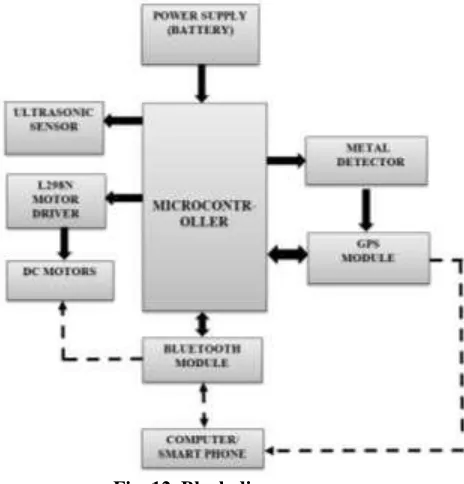
Controller Unit: The microcontroller is the core of the robot. The microcontroller utilized in this project is TivaTM TM4C123GH6PM. Every single module is interfaced with it and thus it controls the robot as per the output of different sensors.
Power supply: The Robo Car needs 12V DC contribution for appropriate working.12V battery is mounted on the robot for portable applications.
Wireless Communication module: This module is used to control the movement of the robot. Here, a Bluetooth module is utilized to control the Robo Car remotely. It additionally gets the output from different sensors and modules appended to the robot. This module has a scope of 100 meters.
Mechanical sensors: A ultrasonic sensor is utilized to estimate the distance from an obstacle. This sensor is set at the back of the robot to keep it from impacting the hindrances when going in reverse since there is no camera at the back.
Fig. 12. Block diagram
Metal detector: The metal detector is used to locate the metal item which is covered underground. The metal finder distinguishes the item between extents 1cm to 6 cm.
[image:5.595.306.538.417.659.2] Motor Driver: It acts as an interface between the microcontroller and the DC motor. It goes about as a present intensifier which takes the low input current signal and transforms it into a higher signal that can be used to drive a motor. The motor driver utilized in this project is L298N which has a double H-connect setup.
GPS module: GPS (Global Positioning System) Once the information is obtained, the position is determined and is sent serially. The data from serial has information like latitude, longitude, altitude, time position etc. Neo 6M GPS Module is utilized in this robot which is interfaced with microcontroller utilizing the serial interface. When the metal has been recognized, this module is utilized to send the longitude and latitude utilizing the Bluetooth to the operating device.
[image:6.595.331.520.59.143.2]The working of the robot, for the most part, depends on the order given by the client from the application Bluetooth Terminal HC-05 on a cell phone. The robot is outfitted with fundamental sensors and peripheral devices expected to drive and to detect different ecological information which can be utilized for observation of that region. The flow of operation is shown in Fig. 13.
Fig. 13. Flow Diagram
V. RESULT
[image:6.595.308.527.178.288.2]Once the RESET button is pressed on the microcontroller, the following message appears on the HC-05 Bluetooth Terminal in the smart phone of the user (Fig. 14.).
Fig. 14. Screenshot 1: Function Menu
[image:6.595.47.285.307.651.2]As the user moves the car in different directions by entering the respective characters as indicated in the Figure 5.1a, an indication of the same is displayed on the terminal as shown in Fig. 15.
Fig. 15. Screenshot 2: Car in action
While moving the car backward, if there is an obstacle at a distance less than 15 cm, the distance from the obstacle is displayed on the screen and the car stops on its own. Hence, the user is given a warning to change the path. (Fig. 16.).
Fig. 16. Screenshot 3: Obstacle detection
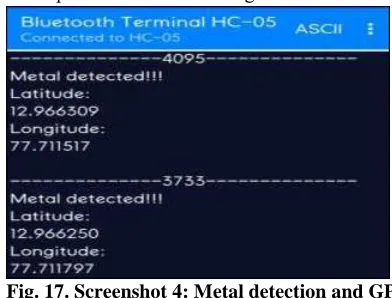
Once the metal is detected anywhere in the path of the car, the longitude and latitude of that location is sent to the users’ smart phone as is shown in Fig. 17.
Fig. 17. Screenshot 4: Metal detection and GPS location
VI. CONCLUSION
[image:6.595.310.547.353.486.2] [image:6.595.328.524.531.680.2]International Journal of Innovative Technology and Exploring Engineering (IJITEE)
ISSN: 2278-3075,
Volume-8 Issue-12, October 2019
Versatile mechanical technology assumes an inexorably significant job in military issues and managing potential explosives.
In this prototype, we have executed a mechanical vehicle for observation and surveillance that can be either remotely worked physically or self-governing. In military administrations, there are a few territories where a portion of the undertakings include more serious hazard and peril, and along these lines, those errands must be performed without military staff, exclusively by the robots. Moreover, it can likewise identify metals which thusly can be utilized for the location of ground mines and weapons. The area of the metals identified is likewise imparted to the administrator to guarantee the wellbeing of the military workforce on the ground.
Along these lines, mechanical autonomy help address the difficulties presented by the phantom of urban psychological oppression. Military applications are a developing business sector for versatile robotic technology and will keep on developing.
VII. FUTURE SCOPE
The functionalities of this project can be broadened further by the expansion of a couple of more segments like gas sensors for the location of harmful gases, fire sensors, sound sensors, water sensors, temperature sensor, night vision camera, an automated arm to explode bombs and for pick and spot work, and so on.
The Bluetooth module utilized in the task is HC-05 which is an exemplary Bluetooth v2.0 with an Enhanced Data Rate of 3 Mbps. This can be moved up to the Bluetooth 5 that will be useful for connectionless administrations.
Since Wi-Fi and Bluetooth are somewhat correlative in their applications and utilization, Wi-Fi innovation can be utilized rather expand to square kilometers to provide internet access.
Security and watch functionalities have likewise stretched out into the private part. Subsequently, an improved form of Robo Car, cannot exclusively be utilized for military applications yet can likewise be stretched out to the private part.
ACKNOWLEDGMENT
The authors would like to earnestly thank the CMR Institute of Technology for their consistent help and consolation.
REFERENCES
1. Michael Shneier Robert Bostelman’ Literature Review of Mobile Robots for Manufacturing’ ,Intelligent Systems Division Engineering Laboratory, May 2015
2. S. G. Tzafestas, Introduction to Mobile Robot Control: Elsevier,
2014.
3. Jordan Bray-Miners, Chris Ste-Croix, and Andrew Morton Human –
Robot Interaction Literature Review , Human systems® Incorporated ,May 2012
4. Tomasz Czapla,Technology Development of Military Applications of
Unmanned Ground Vehicles,Vision Based System for UAV applications.pp 293-309.
5. Daksh Remotely Operated Vehicle (ROV),url:
https://www.army-technology.com/projects/remotely-operated-vehicle-rov-daksh/
6. https://www.armyrecognition.com/israel_israeli_wheeled_armoured_
vehicle_/guardium
7.
https://www.army-technology.com/projects/irobot-510-packbot-multi-mission-robot/
8. Tiva™ TM4C123GH6PM Microcontroller data sheet
9. [ https://www.magneticinnovations.com/dc-motor-how-it-works/
10.
https://www.electrical4u.com/dc-motor-or-direct-current-motor/
11.
https://robu.in/product/l298n-2a-based-motor-driver-module-
good-quality/?gclid=EAIaIQobChMIh8buxaHj4QIVwYiPCh0ArgVo EAY YASABEgKmyPD_BwE
12.
https://www.electronicwings.com/sensors-modules/bluetooth-module-hc-05-
13.
https://www.electronicwings.com/sensors-modules/bluetooth-module-hc-05-
14.
https://www.maxbotix.com/articles/how-ultrasonic-sensors-work.html
15.
http://wiki.sunfounder.cc/index.php?title=Ublox_NEO-6M_GPS_Module
16. https://www.electronicshub.org/metal-detector-circuit/
17.
https://www.gadgetronicx.com/metal-detector-circuit-diagram-ic555/
18.
![Fig. 2. Guardium [6]](https://thumb-us.123doks.com/thumbv2/123dok_us/8165339.250784/2.595.48.272.499.751/fig-guardium.webp)
![Fig. 3. iRobot 510 PackBot [7]](https://thumb-us.123doks.com/thumbv2/123dok_us/8165339.250784/3.595.303.549.455.660/fig-irobot-packbot.webp)
![Fig. 8. Bluetooth module HC-05 [12]](https://thumb-us.123doks.com/thumbv2/123dok_us/8165339.250784/4.595.317.536.62.382/fig-bluetooth-module-hc.webp)