International Journal of Innovative Technology and Exploring Engineering (IJITEE) ISSN: 2278-3075, Volume-9 Issue-1, November 2019
Energy Efficient Clustering using MMHC
(Modified Multi-Hop Clustering)
Vimala M, Rajeev Ranjan
Abstract- In recent years, the WSN has been widely used for building the DSS (Decision Support System) for solving the real-world problem. Moreover, out of several fields, one of the interesting field that requires DSS is monitoring of agriculture environment. Nowadays, Monitoring agriculture environment has become one of the essential field. A smart WSN system is capable of collecting as well as processing the huge data by monitoring the soil conditions, weather situation and others. Hence, IoT (Internet of Things) is employed in order to enhance the productivity and efficiency in the agriculture sector. IoT integrates the various technology such as RFI (Radio Frequency Identification), cloud computing, end-user applications and middleware system. Hence, it is obvious to obtain the higher efficiency for DC (Data Collection). In this paper shared based algorithm known as MMHC (Modified Multi-Hop Clustering) is proposed , this algorithm has three stage i.e. assembling , coupling and removing the redundant nodes. In this modified more than one node can be selected in the other two stage and the more than one node can be removed in third stage, this in terms helps in achieving higher efficiency. Later in order to evaluate the algorithm and prove the efficiency of our proposed algorithm, Comparative analysis is done with the Leach protocol based on the several parameter and it clearly shows that our model outperforms the Existing i.e. Leach algorithm.
Keywords: Clustering, Shared Algorithm, MMHC, Wireless networks.
I. INTRODUCTION
In India, agriculture is considered to be the backbone; almost 70 % of country population in India earns mostly form the agriculture [1]. In recent the several technology has allowed the farmers to adopt the technologies and helps in producing the more efficient agriculture. These technologies mainly follows the various steps such as collecting the data, processing the data of given inputs. Moreover, these technologies helps in reducing the manual work [2].
In recent years, we have seen that the term IoT has been widely popular in the network technology; IoT is a technology that helps in integrating the things and network to connect, interact and exchange the data as well. IoT helps to extend the internet connectivity that exist beyond the SD (Standard Devices) such as tablets, smartphones laptops etc. When embedded with the IOT technology these standard devices can easily interact and communicate over the internet hence in terms it can also be controlled as well as Monitored [3].
IoT has played one of the prominent role in agriculture in order to empower farmers, this is done by using the automation technologies and decision tools [4, 5]. Recent studies in IoT has more focused on the constraints as well as challenges for the large-scale pilots in given agriculture and food sector,
Revised Manuscript Received on November 05, 2019.
Vimala M, Assistant Professor at Department of Computer Science, University of Agriculture Sciences, and Bangalore.
Dr. Rajeev Ranjan, Associate Professor in the School of Computer Science and Applications at REVA University, Bangalore, India.
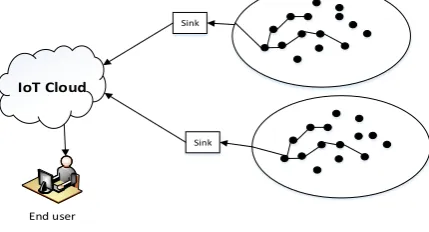
Other issued that are discussed such as data governance, privacy and security. However the communication technology was only limited to the conventional method that applies the low bit range communication technologies. The given below figure depicts the typical diagram of IoT, in here at first the given WSN senses the data and sensed data is sent to the BS (Base Station or Sink). Later the data is sent to the IoT Cloud and whenever the user requests the data is retrieved or it can be retrieved by using the automate application.
End user
IoT Cloud
Sink
[image:1.595.313.528.266.382.2]Sink
Figure 1 Typical IoT architecture
In recent years WSN (Wireless Sensor Network) is widely used for the food production and smart agriculture with more focused on the precision agriculture, environmental monitoring [6]. Main properties of WSN is that it is self-configure, self-diagnosis self -heal and self-organize, this property of WSN has made it obvious for the food industry and smart agriculture. In general, WSN is nothing but the integration of power sources, microcontrollers, sensors and RFT (Radio Frequency Transceiver). Moreover, IOT is capable of integrating several technologies such as RFI (Radio Frequency Identification), WSN, Cloud Computing, middleware system.
Moreover, sensor network is used for the various applications and day by day, the implementation in the agricultural environment has been increased. In agriculture, the main application is to monitor the crops in order to detect the environmental conditions; this plays an essential role in cultivation [7]. Wireless sensing network helps in reducing the data collection and the time required to monitor the agriculture environment.
However, there are few constraints in applying the IoT – WSN based technology in the agriculture field, constraints such as battery of the WSN has the limited amount of energy and it has huge impact on the WSN lifetime. Apart from battery life, several constraints such as communication range, Communication bandwidth, and this issue can be solved using the clustering process. Clustering is the process of gathering the several nodes to the clusters and these clusters have cluster head, the clustering method is used in wireless sensing network in order to utilize the energy. Several clustering algorithm
Hence, the basic as well as critical challenge in WSN is to design and develop the energy efficient model that can be efficient as well as cost effective [8]. In order to achieve the efficient model several protocol, which is discussed in the next section, is proposed. However, these protocols lacks Hence, In order to provide the energy efficient clustering we have proposed a protocol known as MMHC (Modified Multi-Hop Clustering), the proposed algorithm works on the shared methodology which helps in choosing more than one node at time. Hence once the redundant node is found, multiple redundant nodes can be selected and remove at a time. This saves a lot of time and energy.
Our research work is organized in a way that previous research of various author has been briefly discussed in section 2. In section 3, proposed methodology of this research is presented which helps in removing the redundant nodes. In order to prove the accuracy of our algorithm it is implanted and results as well as comparative analysis of the work is presented in section 4.
II. LITERATURE SURVEY
One of the Classic method in clustering in proposed in [9], in this the WSN is organized into the clusters along with the DA (Data Aggregation) for communication reduction among the sensor nodes distance. Here, the normal nodes forwards the packets to CH(Cluster Head) since CH node needed to receive the AD(Aggregated Data) from the given member nodes and later it is forwarded to the base station. On the other side, CH is rotated between the given nodes for balancing the load of the network. Disadvantage of this algorithm is that it induces the additional overhead; hence, DSC protocol is introduced [10]
In this paper, the HEED protocol [11] chooses the CH with the help of interaction among the neighboring nodes. Moreover, HEED protocol produces uniform distribution of CH (Cluster Head). In addition, it maximizes the life cycle of the WSN. However, in order to execute the process of iterative approach to the whole, information of exchange energy is required and the other issue with this protocol is that it is comparatively expensive than the other protocol. Hence, to overcome the above issue paper [12] presented the EECS protocol. Here, the candidate picks the CH (Cluster Head) according to the provided threshold value, and then CH is selected with the help of comparison of nodes. Moreover, while clusters are formed node computes the cost function value, which is associated with the CH (Cluster Head) and later CH joins along with the optimum value, this help in improving the cluster load. Methodology named PEGASIS protocol is proposed [13], this method takes the help of the greedy algorithm in order to organize the given nodes into a particular chain. Here, each node tries to communicate along with the adjacent nodes. Later, unique CH is selected in order to communicate with the BS each round. This Protocol helps in reducing the energy consumption and communication. However, heavy loads is placed on the nodes near BS. Moreover, if the node in the chain does not have energy it becomes obvious to reconstruct the chain.[14] proposed a protocol named as EUCA is proposed and this protocol introduces the computation as well as it compares the energy between the nodes to choose the CH. However, these ordinary nodes joins the cluster, this is done by considering the several factors such as CH energy cluster Loads, CH distance.
[15] Focused on LEACH i.e. a clustering based routing, which reduces the energy usage by sharing the load to the entire node at various point in time. Here each node has burden to acquire the data from the nodes in given cluster, transmitting the aggregate signal to BS. The algorithm is said to be the distributed. ECPF named protocol is proposed, which helps in terminating the selection process this in terms helps in achieving the longer lifetime. However, quality of service was not achieved in this method. Hence, [16] proposes an EE (Energy Efficient) distribute clustering protocol is proposed, this protocol is mainly used for the application which requires the prolong network lifetime, scalability. Here quassi-stationary networks is assumed in which nodes have the equal significance. [17] Proposed a fuzzy logic approach for event detection using wireless sensor network. We considered fire detection as an example in our event detection system. Our proposed fuzzy logic approach effectively handles the uncertainty and vagueness present in the environment data. The proposed event detection method improves the accuracy of event detection by processing multiple sensors data. Our approach shows that the wireless sensor network is a very promising system for event detection with low false alarm rate. More accurate, useful and comprehensive information can be gathered by deploying sensors at multiple points. The rules can be easily adjusted and modified based on the environmental parameters.
III. PROPOSED METHODOLOGY.
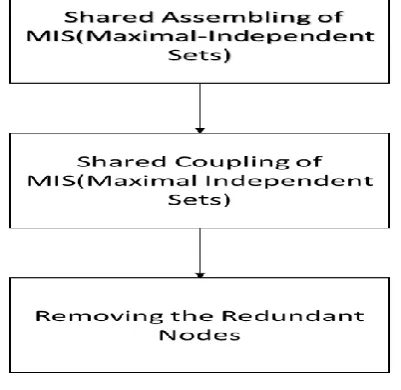
[image:2.595.326.527.535.730.2]The proposed algorithm is named as the MMHC (Modified Multi Hop Clustering) algorithm in U = (X, Y). MMHC algorithm is the coloring algorithm; in this case, we usually use the four different color for denoting. The white, black, grey, blue color nodes are denoted as 𝑊𝑐, 𝐵𝐾𝐶, 𝐺𝑐, 𝐵𝑐 respectively. At first all the nodes are 𝑊𝑐 along with their unique id, initially the notification is sent to the given neighbors in 2d hops, this is done in order to achieve the initial LV (Local Variable) values. Once it is done then the first stage follows as described. MMHC algorithm contains has three stage, they are shared assembling, shared coupling, shared removing of the redundant nodes.
International Journal of Innovative Technology and Exploring Engineering (IJITEE) ISSN: 2278-3075, Volume-9 Issue-1, November 2019
The above flowchart shows the flow of our proposed work, here it has three stage, first stage is assembling all the nodes, since it is shared algorithm it can select more than one node at a time . whereas in second stage the nodes are coupled the nodes, more than single node can be selected .Moreover, in the third stage nodes which are redundant are removed , multiple nodes are removed at a time.
First stage: Shared-assembling of maximum-IS (Independent sets)
Step1: given the 2D hops, send the START messages to the neighbors for the initialization of the local variables. Step2: Step 1 is repeated for the every 𝑊𝑐 node 𝑏
Step3: The value of degree is compared i.e. degree(𝑎) with the degree(𝑏), here𝑎 ∈ 𝐶2𝑑(𝑏).
Step 4: if the value of degree (b) is bigger than the value of degree (a) then
Color a as 𝐵𝐾𝐶 and each node in 𝐶2𝑑(b) receives a 𝐵𝐾𝐶 message.
Step5: for each node b , 𝐵𝐾𝐶 message from node a is received.
Step6: In 𝑁𝐼_2𝑑(𝑏) or 𝑁𝐼(𝑏), 𝑎’𝑠 color is updated.
Step7: In case, if the color of (𝑏) is𝑊𝑐 and the distance between the two nodes is at most d hops then
Color the node as 𝐺𝑐 and each node in 𝑁2𝑑(𝑏) receives a 𝐺𝑐message.
Step8: every node 𝑏, node a sends the receiving 𝐺𝑐message. Step9: color of the given node u in 𝑁𝐼_2𝑑(𝑏) and color in 𝑁𝐼(𝑏) is updated.
The above algorithm is Shared assembling Maximal-IS (Independent Sets),Moreover since it is shared algorithm, in a single round more than one node can be selected in each round. Moreover, it is restricted that 𝐺𝑐node in 𝐶2𝑑(𝑎) is chosen as a dominator in a single round. Moreover to obtain the scenario in case of each 𝑊𝑐 node b , all the competitors node be 𝐺𝑐 in 𝐶2𝑑(𝑏).
𝑁𝐼(𝑎):Information about the given node that are d most hops away from the node a
𝑁𝐼_2𝑑(𝑎): Details about the node whose distance are 𝑑 to 2𝑑 from 𝑎
𝐶𝑁(𝑎): The given number of components node 𝑎 belongs to 𝐶𝐶(𝑎): Cost of nodes collection that helps in connecting with other given component.
Second Stage: Shared Coupling of Maximal-IS (Independent sets)
Step1: 𝐶𝑁(𝑏) is initialized. Step2: In the nth round,
𝑃𝑛 =
𝑃𝑛−1 + 1 2
(1)
𝑃0= 2𝑑 + 1 (2)
Step 3: nodes in 𝐷𝑃𝑛(𝑏) and compute the cost (v) .
Step 4: Once the 𝐶𝑜𝑠𝑡(𝑏) is known, nodes of 𝐷𝑃𝑛(𝑏) receives the 𝐶𝐶 message
In case of either node i.e. V𝐵𝐾𝐶or 𝐵𝑐 𝑎 ∈ 𝑏. While the 𝐶𝐸 message is received from the given node.
Step5: 𝐶𝑁(𝑎) is sent along with the distance that exist between the two given node.
While the 𝐶𝐼 is received from the given node. Step6: In connector (a),cost(b) is stored.
While 𝐶𝐶 message is received from the given node u along with the described parameter cost (b):
Step7: If in a given connector (a), cost (b) is largest among the given elements, then send notification as a “yes” else send the notification as “no”.
While 𝐵𝑐 message is received from the given node v along with the parameter a (id);
Step8: a‟s color is updated.
Step9: In case if the distance among the node v and node u is at most 𝑃𝑛 then the CN (a) to b (id).
Step 10: UC along with the parameter b (id) to the given nodes in 𝐶𝑃𝑛(𝑎) , this gives the indication to change the CN.
Step11: In𝐶𝑃𝑛(𝑎), CU is sent indicating them to re-compute the cost.
While UC is received from the node b along with the𝑝𝑎𝑟𝑎𝑚𝑒𝑡𝑒𝑟_𝑛𝑢𝑚:
Step12: CN (a) is changed to num.
Step13: Along with the𝑝𝑎𝑟𝑎𝑚𝑒𝑡𝑒𝑟_𝑛𝑢𝑚, UC is sent. Once the shared-Maximal Independent set is chosen, second stage deals with the assembling the maximal independent sets, this stage uses the method of divide and conquer. Since we have proposed the modified algorithm, i.e. shared coupling of Maximal-IS (Independent Set), each node runs the algorithm locally. Hence, in each iteration multiple nodes can be selected in a single round. Based on the cost function, connectors are selected; several terms are used in a second stage that are described below.
CC (Cost Computation): This message is used in order to compute the cost vale.
CI (Cost Information): This message is used in order to inform the neighbor.
CCR (Cost Compare): This message is used by the 𝐺𝑐 nodes to compare the cost value with the others.
𝑩𝒄: This massage is used to send the response once the node is colored 𝐵𝑐.
UC (Update Computation): This message is generated in order to update the value of CN.
CU (Cost Update): This message is used for informing the 𝐺𝑐 nodes to re-compute the cost.
CE: The message is used for estimating the cost
Third Stage: Shared Removing Redundant
In every round, in case of the 𝐵𝐾𝐶 node𝑏, which helps in connecting the 𝐵𝑐 node:
Step1: Message 𝐴𝐷 is sent by the node b to the 𝐺𝑐 nodes in the given𝑁𝑑(𝑏).
Step2: In Case if RN message is not received by b, message RN along with the v‟s id is received to given nodes in 𝑁2𝑑(𝑏).
Step3: In Case if RN message is not receive by b then color b as 𝐺𝑐 and along with v‟s id 𝐺𝑐2 message is received by the nodes in 𝑁𝑑 𝑏
In each round, in case of the 𝐺𝑐 node a, while receiving the message of AD.
Step4: checking 𝑁𝐼(𝑎) and if multiple dominators are observed then “Yes” response
While 𝐺𝑐2 message is received along with the id Step5: 𝑢’𝑠 local variables is updated
For each and every 𝐵𝑐 node a, while 𝐺𝑐2 message is received along with id,
Step6: In case if the distance between the given node a and the node along with id is single hop then step 9
Step7: In case if 𝑎 connects only to the single 𝐵𝑐 node then Step8: color b as 𝐵𝐾𝐶.
Step9: exit
Once the assembling and coupling is done, there will be many redundant nodes. Hence in the above stage i.e. in third stage removing the redundant nodes takes place.
This stage has the following notification involved.
AD: This is used in order to check whether alternative dominators exist or not.
𝑮𝒄𝟐: This message is sent along with 𝑖𝑑 .
RN: Once the redundant node is found, the message is sent. However, the essential task is to check whether the given 𝐵𝐾𝐶 node is redundant node or not. As the third stage shows that in case of any 𝐵𝐾𝐶 node v that connects the single 𝐵𝑐 node, v sends AD message to the given 𝐺𝑐 neighbors that exists within the d hop and enquires whether the given local variable 𝑁𝐼 includes all the given nodes. In case, if the 𝑁𝐼 has several dominators, positive reply is sent else the negative response is observed, this clearly indicates that given node v is redundant. Moreover, the proposed algorithm follows the shared attribute; this means that more than a single node can be discarded in a single round,
IV. RESULT AND COMPARATIVE ANALYSIS
In this section, we evaluate our algorithm to prove the accuracy of our algorithm. In here, system configuration used in this research is windows 10 enterprises operating system along with 64-bit quad core processor, 2GB NVDIA graphics packed with 16 GB of RAM. .NET simulator known as sensoria simulator is used which uses the C sharp programming language. The Simulation is conducted based on the several parameters for energy efficiency, network lifetime and henceforth we compared this parameter with existing LEACH based algorithm. The sensor nodes used is 500, 1000, 1500 and 2000.
Network Parameter Value
Size of the network 50m * 50m
sensor nodes used 500, 1000,
1500,2000
Base Station used 2
Energy(Initial) of the sensor nodes 0.2 J Radio-ed (energy dessipiation) 50 nj/bit
Data –PL(Packets Length) 2000 bits
Transmission speed 100 bit/s
Bandwidth 5000 bit/s
Consumption of Idle energy (Eelec) 50 nj/bit Data packet-PD(Processing Delay) 0.1 ms
Amplification energy (Emp) 100 pJ/bit/m2
Network Energy
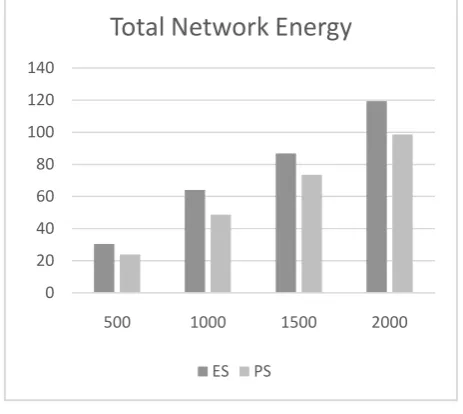
In general, Energy is nothing but the quantitative attribute that needs to be transferred to the given object for performing the particular work. Energy is one of the essential parameter when the task is performed. Less the energy is required to perform better the model is, hence we considered the parameter of network energy. In below diagram the comparatively analysis is shown between the
[image:4.595.311.543.272.479.2]existing system and our proposed model i.e. MMHC (Modified Multi-Hop Clustering).When the graph is observed we see that in case of 500 nodes the energy require is 30.534 joule whereas proposed model requires 23.855j to perform i.e. our proposed method is slightly better than the leach done. In case of 1000 nodes, the energy required for the existing system is 64.054 whereas proposed model requires 48.705 j to complete the process i.e. our proposed model performs marginally better than the existing one. Similarly, in case of 1500 and 2000 nodes the existing system take 86.746 and 119. 403 joule respectively whereas proposed model takes 73.578 and 98.626 joule this shows that as the nodes increases the amount of energy required by the existing system increases rapidly as well as marginally whereas in our model with the increase in nodes the amount of energy required increases gradually. The above phenomena clearly indicates that our model requires less amount of energy and this proves the efficiency of our algorithm.
Figure 3 Total Network Energy
Number of Failed Nodes
As the Multi-Hop clustering takes place, it is obvious that several number of nodes might fail to perform. Hence, it is one of the parameter that is considered in order to evaluate our algorithm. The below graph shows the comparative analysis of leach protocol with the MMHC protocol. The value considered here is taken as the average. In below graph we see that when the simulation is done for 500 nodes, nearly 57.85 nodes fails whereas in case of proposed model only 29.16 nodes fails. IN case of 1000 nodes the existing system i.e. leach nearly 95.36 nodes (in average) fails to perform whereas our proposed model performs much better than and only 20.02 nodes fails. Similarly, for 1500 nodes the number of failed nodes are 197.755 whereas in proposed model the failed number of nodes are only 31.767. Similarly in case of 2000 nodes, nearly 264.9 nodes fails to perform whereas in case of proposed system, the number of models failed is 29.256. The comparatively analysis based on the number of failed nodes clearly indicates that our algorithm outperforms the LEACH algorithm. In graph, we see that as the number of nodes increases the failed number of nodes increases rapidly and
marginally whereas in
MMHC the number of failed nodes increases gradually.
0 20 40 60 80 100 120 140
500 1000 1500 2000
Total Network Energy
International Journal of Innovative Technology and Exploring Engineering (IJITEE) ISSN: 2278-3075, Volume-9 Issue-1, November 2019
Figure 4 Number of Failed Nodes
Communication Overhead
In networking, Communication overhead is the number of packets that has to be transmitted from one particular node to the another node is node is communication overhead, this includes the overhead of routing table and routing process as well. The less the communication overhead is the more efficient is the model of the network. Hence in this research work we have considered as one of the parameter to evaluate the algorithm as shown in the below graph. In case of 500 nodes, LEACH protocol 0.2108 and in case of proposed system it is 0.025 i.e. it is marginally less than the existing system, when it is 1000 nodes the communication overhead of existing system is 1.147 whereas proposed system has 0.051. In case of 1500 and 2000 nodes the communication overhead is 5.122 for LEACH protocol whereas MMHC protocol has the communication overhead of 0.1024. from the above phenomena and below graph it is observed that as the number of nodes increases the Communication Overhead also increases for both Leach as well as MMHC protocol. However when compared the MMHC protocol has the less communication overhead when compared to the leach protocol.
Figure 5 Communication Overhead
Number of Active Nodes
This is one of the key parameter that has been considered in order to prove the efficiency four algorithm. In the below graph we have presented the number of active nodes that is functioning at different nodes, this will again give the clear picture of MMHC protocol. In the below graph we see that
[image:5.595.306.548.187.364.2]for 500 nodes, the number of active nodes are o 442.15(in average) where as in LEACH protocol the active nodes are nearly 470. i.e. around 28 nodes are more active than the existing one. In case of 1000 nodes, the nodes active are 904.63 and in proposed the nodes active are 969.97 i.e. 65 more nodes are active when compared to the existing one. Similarly, in case of 1500 and 2000 nodes the active nodes are 1302.24 and 1735.1 respectively whereas MMHC protocol registers the 1468.23 and 190.74 active nodes. Hence, it is observed there is quite handsome margin in case of number of active nodes.
Figure 6 Number of Active Nodes
Number of Rounds
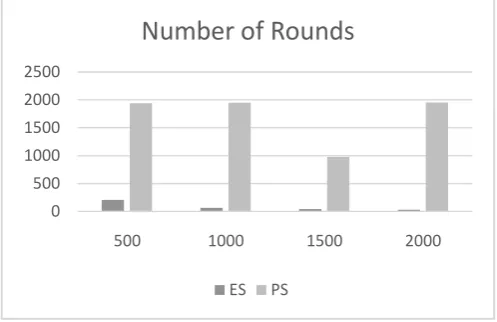
Number of rounds is considered as one of the essential parameter to evaluate the MMHC protocol. The comparative analysis in terms of number of rounds shows that how many rounds are performed by the existing one and proposed one. In below graph, in case of 500 nodes the number of round is 208 whereas MMHC protocol performs 1941 rounds which is marginally high. In case of 1000 nodes, the number of nodes active are 66 whereas in MMHC protocol 1948 rounds are performed. Similarly, in case of 1500 and 2000 nodes the number of round is 45 and 30 respectively whereas the MMHC protocol with the shared methodology performs 975 and 1952 rounds respectively.
Figure 7 Number of Rounds
0 50 100 150 200 250 300
500 1000 1500 2000
Number of Failed Nodes
ES PS
0 1 2 3 4 5 6
500 1000 1500 2000
Communication Overhead
ES PS
0 500 1000 1500 2000 2500
500 1000 1500 2000
Number of Active Nodes
ES PS
0 500 1000 1500 2000 2500
500 1000 1500 2000
Number of Rounds
[image:5.595.52.286.518.683.2] [image:5.595.304.553.558.719.2]V. CONCLUSION
In order to extend the network lifetime of wireless sensor network, this research work proposes an energy efficient algorithm named as MMHC (Modified Multi-Hop Clustering). In order to achieve the efficiency our algorithm is evolved in three stages i.e. Assembling the nodes, coupling the nodes and removing the nodes, these three stages are based on the shared algorithm i.e. in the first two stages more than single nodes can be selected to perform whereas in third stages more than single redundant nodes can be removed. Our algorithm outperforms the leach algorithm in terms of various parameter such as communication overhead, Number of rounds, number of active and number of failed nodes. By observing the result, analysis we see that total energy consumed by our algorithm is comparatively less than the leach algorithm. In terms of Communication overhead, number of rounds and communication, overhead our method outperforms the leach protocol.
Henceforth we conclude our research work by stating that though our protocol outperforms the leach algorithm but in future, several research can be carried based on our research work.
REFERENCE
1. http://www.economicsdiscussion.net/articles/importance-of-agriculture-in-indian-economy/2088.
2. E. Fernando, S. Assegaff and A. H. H. Rohayani, "Trends information technology in E-agriculture: A systematic literature review," 2016 3rd International Conference on Information Technology, Computer, and Electrical Engineering (ICITACEE), Semarang, 2016, pp. 351-355.
3. S. R. Prathibha, A. Hongal and M. P. Jyothi, "IOT Based Monitoring System in Smart Agriculture," 2017 International Conference on Recent Advances in Electronics and Communication Technology (ICRAECT), Bangalore, 2017, pp. 81-84.
4. M. T. Lazarescu, "Design of a WSN Platform for Long-Term Environmental Monitoring for IoT Applications," in IEEE Journal on Emerging and Selected Topics in Circuits and Systems, vol. 3, no. 1, pp. 45-54, March 2013.
5. R. Nukala, K. Panduru, A. Shields, D. Riordan, P. Doody and J. Walsh, "Internet of Things: A review from „Farm to Fork‟," 2016 27th Irish Signals and Systems Conference (ISSC), Londonderry, 2016, pp. 1-6.
6. E. Quesada, M. V. Maigler, A. Barbado, J. Valverde, J. Portilla and T. Riesgo, "Environmental wireless sensor network deployment in food industry: From theory to practice," Design of Circuits and Integrated Systems, Madrid, 2014, pp. 1-6.
7. M. R. M. Kassim and A. N. Harun, "Applications of WSN in agricultural environment monitoring systems," 2016 International Conference on Information and Communication Technology Convergence (ICTC), Jeju, 2016, pp. 344-349.
8. W. Naruephiphat and C. Charnsripinyo, "Clustering Techniques in Wireless Sensor Networks," 2009 International Conference on New Trends in Information and Service Science, Beijing, 2009, pp. 1273-1278.
9. Wendi B.Heinzelman, Anantha P. Chandrakasan, Hari Balakrishnan, e for Wireless Microsensor Networks[J]. IEEE TRANSACTIONS ON WIRELESS COMMUNICATIONS, VOL. 1, NO. 4, OCTOBER 2002.660-670.
10. Bajaber F, Awan I. Dynamic/Static Clustering Protocol for Wireless Sensor Network, In Second UKSIM European Symposium on Computer Modeling and Simulation, 2008. EMS '08, 2008; 524-529.
11. Younis O., Fahmy S., HEED: a hybrid, energy-efficient, distributed clustering approach for ad hoc sensor networks[J]. IEEE Transactions on Mobile Computing,2004, 3( 4) : 366- 379. 12. CHEN Guihai, LI Chengfa, YE Mao, et al. EECS: an
energy-efficient clustering scheme in wireless sensor networks. Journal of Frontier s of Computer Science and Technology, 2007, 1(2) : 170- 179.
13. Lindsey S,Raghavendra C S., PEGASIS: Power-Efficient gathering in sensor information systems[C], Proc.Of the IEEE Aerospace Conference Montana:IEEE Aerospace and Electronic Systems Society. 2002: 1125-1130.
14. ZHANG Changsen, XING Juan, ZHAO Shangqing. Energy-efficient uneven clustering algorithm Computer Engineering and Applications [J], 2016,52(7)06-109.
15. W.R. Heinzelman, A. Chandrakasan, H. Balakrishnan, "Energy-Efficient Communication Protocol for Wireless Microsensor Networks", In Proceedings of the 33rd Annual Hawaii International Conference on System Sciences, pp. 10–19, 2000. 16. Taheri, H., Neamatollahi, P., Younis, O. M., Naghibzadeh, S., &
Yaghmaee, M. H. (2012). An energy-aware distributed clustering protocol in wireless sensor networks using fuzzy logic. Ad Hoc
Networks, 10(7), 1469–1481.
https://doi.org/10.1016/j.adhoc.2012.04.004.
17. Manjunatha, P., Verma, a. K., & Srividya, a. (2008). Multi- Sensor Data Fusion in Cluster based Wireless Sensor Networks Using Fuzzy Logic Method. 2008 IEEE Region 10 and the Third International Conference on Industrial and Information Systems, 1–6. https://doi.org/10.1109/ICIINFS.2008.4798453.
AUTHORS DETAILS
Vimala M is a research scholar at school of Computer Science and Applications, REVA University, Bangalore. She is working as Assistant Professor at Department of Computer Science, University of Agriculture Sciences, and Bangalore. Her area of interest is Wireless Sensor Networks, Graph theory and Theory of Computation.