Abstract: Soil stabilization with liquid asphalt is considered as a sustainable step towards roadway construction on problematic subgrade soil, there are no requirements to import good quality materials or to implement energy consumption, but to mix the readily available soil with liquid asphalt through the cold mix technique. In this work, expansive soil obtained from Manali, Chennai was mixed with asphalt emulsion, lime, and combinations of lime and asphalt emulsion (combined stabilization) and tested in the laboratory for California bearing ratio in dry and soaked conditions. Field trial sections have been prepared with the same combinations and subjected to plate bearing test. The influence of combined stabilization on the structural properties in terms of load bearing capacity and deformation under both testing techniques have been monitored and analyzed. It was concluded that 17% of asphalt emulsion and 6% lime can furnish a suitable combined stabilization process from the structural properties requirements point of view. Keywords – Asphalt emulsion, stabilization, subgrade lime, strength
I. INTRODUCTION
The implementation of liquid asphalt and cold mix technique in the stabilization of soil for subgrade construction has been a wide field of research since the sustainability issue is being discussed. However, the research work on combined stabilization is scares and scattered [1]. The implementation of lime, gypsum and cement as additives to the soil-cutback mix has been studied by Sarsam [2], an improvement in the strength property in terms of California bearing ratio (CBR) at the soaked testing condition was reported. The possibility of stabilizing expansive clayey soil with emulsified asphalt and lime was investigated by Al-Khashab and Al-Hayalee [3], several samples of soil-lime mixtures were prepared at different percentages and then emulsified asphalt was added in different amounts. The test results showed that lime-emulsified asphalt stabilization had increased the plasticity of clayey soil and the optimum moisture content. The specific gravity, absorption values, swell-percent and swelling pressure, maximum dry density were decreased.
Revised Manuscript Received on October 22, 2019.
R.Venkatakrishniah, Department of Civil Engineering, Bharath Institute of Higher Education and Research, Chennai , India. Email: [email protected]
P. Dayakar, Department of Civil Engineering, Bharath Institute of
Higher Education and Research, Chennai , India. Email:
K. Venkat Raman, Department of Civil Engineering, Bharath Institute of Higher Education and Research, Chennai , India. Email: [email protected]
The impact of lime to improve village road section where clay is dominant has been investigated by Aydin and Adnan [5], the lime stabilization in field condition was performed with 5% of lime and was applied as a 30 cm thick single layer. The plate loading test was used to determine the field test. It was found that the modulus of subgrade reaction increased as a result of lime stabilization, the wet CBR value of 5% of lime added to the brown clay at age 28 days increased 21 times when compared to the natural soil.
The structural properties of asphalt stabilized soil in terms of rutting and shear resistance was investigated by Sarsam and Barakhas [6], it was concluded that the addition of cut-back asphalt decreases the strain % ϵ of asphalt stabilized soil by 65% at 7% asphalt content, while it increases the resilient modules (MR) of stabilized soil by 300% at 7% asphalt content. The effect of lime stabilization on engineering properties and strength characteristics of an expansive soil was investigated by Alomgir and Siddique [7]. It was found that maximum dry density, free swell and free swell index and linear shrinkage of the treated soil decreased considerably with the increase in lime content. Depending on the lime content, curing age and the unconfined compressive strength, California bearing ratio (CBR) of the treated samples increases as compared with the untreated sample.
Prasada et al. investigated the improvement of road by lime and geotextile as reinforcement Marine clay was used in this investigation, it was found in the field test by using static plate load tests that the ultimate load carrying capacity for settlement was 282.837 kN/m2 load with the settlement of 1.32 mm and 763.661 kN/m2 with the settlement of 1.12 mm for natural and stabilized soil respectively.
Bunga et al. studied the possibility of stabilizing clay soil with emulsified asphalt [10], while Soliman and Shalaby studied the elastic behavior of fine-grained subgrade soils under traffic loading [11]. The aim of this investigation is to implement the combined stabilization in which to add lime to the soil so that the constituent clay particles will react chemically with the lime and change its swelling and elastic properties, while the asphalt emulsion will support the damp proofing properties and control the collapsibility issue. The influence of such stabilization on the structural properties of the soil in terms of CBR and plate bearing test will be investigated.
Experimentation on Stabilization of
Problematic Clays by using Lime and Asphalt
Emulsion
II. MATERIALSANDMETHODS
A. Subgrade Soil
Soil was brought from Manali, Chennai city. A scoop was utilized to expel the top soil of 30 cm thickness and the dirt was gotten from a profundity of 1.0–1.5 m underneath the normal ground level. The physical properties of the dirt are shown in Table 1.
Such properties have been resolved according to ASTM testing techniques [12]. The concoction structure of the dirt is appeared in Table 2. Figure 1 shows the grain size circulation of the dirt, while Figure 2 displays the standard delegate compaction bend.
B. Asphalt Emulsion
This kind of black-top furnishes simple virus blending in with soil, and at last a homogenous blending is acquired. Properties of black-top emulsion utilized are given in Table 3 as provided by treatment facility.
C. Lime
In this study, hydrated lime was used. The major chemical and physical properties of lime are shown in Table 4. D. The Use of Additives for Combined Stabilization To improve the properties of soil emulsion mixture under absorbed condition, it was decided to use lime as an additive material for combined stabilization in addition to emulsified asphalt. The optimum percentage of lime additive for the soil emulsion mix was obtained based on trial specimens with different lime percentages.
E. CALIFORNIA BEARING RATIO (CBR) TEST
Specimen's Preparation
[image:2.595.312.541.50.766.2]The CBR test was conducted to study the effect of adding emulsified asphalt and lime on the strength of soil. In this test, eight groups of specimens have been prepared. Two specimens were prepared using untreated soil with optimum moisture content of 20%, another two specimens were prepared with optimum percentage of fluid content (17% emulsion asphalt+3% water). Such percentage of emulsion was obtained based on many trial specimens with various combinations of water and asphalt percentages, and the optimum case was selected to be 17% asphalt+3% water. The third group consists of two specimens prepared with the optimum percentage (4%) of lime as tested under soaked and dry test condition. The fourth group consists of two specimens prepared with combined stabilization (6% lime +3% water +17% asphalt emulsion).
[image:2.595.330.514.56.345.2]Table 1: Physical Properties of the Soil.
Figure – 1 Grain Size Distribution Curve of the Soil.
[image:2.595.309.546.383.725.2]Table 2: Chemical Composition of the Soil.
Table 3: Properties of Asphalt Emulsion.
Table 4: Chemical Composition of Lime.
At that point the each dirt example is included with required dampness content and blended altogether pursued by the expansion of fluid black-top. The dirt liquid was blended by scouring between palms for 5 min with the goal that the blend has a homogenous character. The blend was took into consideration air circulation for 2 h at room temperature before compaction as prescribed by Sarsam et al.[15]. At the point when lime was executed, the lime was added to the dry soil and blended, at that point the necessary level of water was presented and blended altogether by hand, the blend was permitted to solution for 1 h at room temperature and was secured with a plastic sheet before compaction. At the point when joined adjustment was actualized, the necessary measure of black-top emulsion was added to the restored soil-lime blend and blended, at that point took into account air circulation as clarified previously. The test was directed after the technique prescribed by the ASTM D 1883 [12]. The testing method for the splashed and unsoaked conditions was as depicted beneath.
F. Dry Test
The specimens were kept after compaction for curing at room temperature for 7 days in the mould. To represent the actual field conditions, only the top surface of the specimens was subjected to curing as was recommended by Sarsam [2]. Then the specimen was assembled, and the load-penetration data were recorded. Load deformation curves were drawn and CBR ratios at 2.54 and 5.08 mm penetrations were reported. G. Soaked Test
The specimens were allowed to cure at room temperature for 7 days and then they were soaked in water for 4 days at room temperature. Then the soaked specimens were removed from water, allowed to drain for 15 min, and tested at room
temperature. Load deformation curves were drawn and CBR ratios at 2.54 and 5.08 mm penetrations were reported. H. Preparation of the Site for Static Plate Bearing Test
A series of tests were conducted on selected field sites. Prior to the preparation of the soil surface for testing, the top soil of 30 cm depth was discarded from the site to reach the original soil because the top layer contains impurities which are not considered as representative of the original soil of the site. The area selected for conducting the field test was about 200 m2 after leveling the ground properly. The total area selected was divided to four sections, each section of size (10×5) m2. Section one represent untreated soil, the second section is the asphalt emulsion stabilized soil, and the third section is the lime stabilized soil, while the fourth section is the combined stabilized soil. Generally, the preparation procedure would be of five steps for each section: (spreading, mixing, aeration, compaction and curing). For the first section, the soil was pulverized and the required amount of water was sprinkled, then the soil was mixed with water and then compacted using the sheep foot modified roller.
For the second section, the natural soil was pulverized, the required amount of water (3%) was added, and then the asphalt emulsion (17%) was spread. The soil was mixed and the site was left for aeration for 2 h, and then compacted using the same roller. The site was allowed to cure for a period of 7 days before testing. For the third section, the soil was pulverized, and the required amount of lime of 4% was spread over the section, then 20% of water was sprinkled, and the soil was mixed with water and lime, then the site was left to allow for the initial chemical reaction between the soil and lime for 1 h and ½ h, and then, the layer was compacted. The site was allowed to cure for a period of 7 days before testing.
Finally, for the fourth section, the soil was pulverized, and the required amount of lime of 6% was spread over the section, then 3% of water was sprinkled, the mixture was left for 1.5 h to allow the chemical reaction between soil and lime, then the asphalt emulsion (17%) was spread, and the soil was mixed with its combined materials (water, lime, and emulsion). I. Plate Bearing Test (PBT)
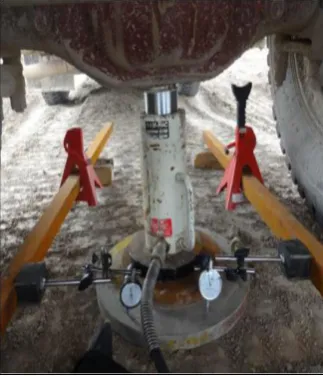
The standard method for a field plate load test is given by the American Society for Testing and Materials ASTM, according to ASTM D1196, [12]. The test allows the determination of the relationship between the applied pressure and the displacements. Three circular steel bearing plates of 25 mm in thickness and varying in diameter from 22.5–30.5–45.5 cm have been employed for the test.
[image:3.595.49.290.284.360.2]was applied on the circular plate and maintained for a minimum period of 3 min so that it will be in close contact with the surface to be tested, then the static load was applied to give a deflection of 2.61 mm. After that, the load was reset to the zero and then increased at a moderately rapid rate in uniform increment until it reaches the maximum load and then, the load was released till zero reading. This testing method was used to evaluate the stiffness of subgrade soils in each of the untreated soil, stabilization with emulsified asphalt, soil stabilization with lime, and combined stabilization with emulsified asphalt and lime.
Fig. 3: Plate Bearing Test Assembly
III. RESULTSANDDISCUSSIONS
A. Influence of Stabilization on California Bearing Ratio
It can be noticed that an increment in the CBR values could be detected for all stabilized samples as compared with untreated soil. This may be attributed to the increase in the shear strength of the soil specimens when using asphalt emulsion or lime or a combination of both. Figure 4 presents the load-penetration curves obtained from the CBR test in dry condition. The lime treated soil exhibits the highest load sustaining capabilities as compared to other additives[30]-[34].
The load-penetration curve rises sharply at the early stage of loading up to 2.5 mm penetration, then the rate decreases with further loading for all the mixes tested. Similar behavior could be detected regarding the influence of additives (lime and emulsion) on the strength property of the soil. It can be noticed that there is no significant variation in the strength behavior and resistance to deformation between combined stabilization and asphalt stabilization at soaked condition[28]-[30]. The significance of adding lime to the soil is that the constituent clay particles of the soil will react chemically with the lime and change its swelling and elastic properties, while the asphalt emulsion will support the damp proofing properties and control the collapsibility issue. It can be observed that although the implementation of lime additive into the combined stabilized mixture shows better strength
stabilization process, it exhibits similar strength behavior to asphalt stabilized at absorbed test, this may be attributed to that asphalt emulsion will cover each particle of lime and soil with thin film which will restrict further chemical reaction between lime and soil.
Table 5 presents the summary of the CBR values of the soil specimens at 2.54 and 5.08 mm penetrations. It can be noted that the CBR values are higher at 2.54 mm penetration than those computed at 5.08 mm for both of dry and soaked test conditions, and for all of the mixes tested. The CBR values decreases by 55, 53, and 40% after soaking for (combined, lime, and asphalt) stabilization respectively at 2.54 mm penetration. Similar findings were reported by Sarsam and Ibrahim [16]. The CBR values of the asphalt stabilized soil at 2.54 mm penetration increases by 34% at dry test condition when lime was introduced forming a combined stabilization, however, no significant variation could be detected at soaked condition when lime was introduced to form a combined stabilization. When soil was mixed with lime alone, a Pozzolanic or cementing action took place when lime reacted chemically with available silica and alumina in soil to form "natural cement" composed of calcium alumina-silicate complex compound. This increment was due to the formation of cementations compounds between the silicates and aluminates from lime and soil. This result agrees well with findings of Soliman and Shalaby [11].
[image:4.595.305.526.401.567.2]Fig. 5: Load-Penetration Curve at Soaked Test. B. Influence of Stabilization on Plate Bearing Strength
Plate bearing test is needed to find the load-settlement relationship that can determine the settlement of the untreated and stabilized soil and subsequently to calculate the (k) (modulus of subgrade reaction). The plate load test is a field test for determining the ultimate load carrying capacity of soil and the maximum settlement under an applied load.
[image:5.595.306.545.54.105.2]The test was implemented in the field at the four prepared sections. Figure 6 exhibits the load-settlement relationship under the static plate bearing test for all of the sections investigated, the recorded plastic settlement is presented at the Y-axis.
Table 5: CBR Test Results for Untreated and Stabilized Soil.
Fig. 6: Load settlement Relationship under Static Plate Bearing Test.
Table 6: Recorded Maximum Settlement of the Plate due to Maximum Applied Stress for Soil.
The natural (untreated) soil exhibits the highest settlement among other sections, the settlement increases sharply after the application of 220 kPa, which indicates the initiation of failure cracks. When asphalt emulsion was implemented as a stabilizing agent, the settlement was decreased by 69% under the same load. When lime was implemented as a stabilizing agent, the settlement was minimal when compared to other sections and decreased by 86% as compared to untreated soil. On the other hand, when the combined stabilization was implemented, the settlement was decreased by 78% as compared to untreated soil. Similar findings on the effect of lime on compressibility were reported by Amiralian et al. [17].
Table 6 presents the recorded maximum settlement due to maximum applied stress for the soil sections investigated, the minimum settlement was reached when using lime as stabilization agent (soil+6% lime). This may be attributed to Pozzolanic reaction between lime and clay particles, although this could not be considered as a durable mixture when there is a possibility of flushing the site with rain water. The combined stabilization may furnish the required strength and durability since emulsified asphalt works to water-proof the particles, and prevents the entry of further water into the soil; it was also found that the presence of some wax in emulsion resulted in the production of very rigid films between particles[18]-[22].
[image:5.595.50.288.426.502.2] [image:5.595.49.289.498.721.2]Table 7 Modulus of Subgrade Reaction (k)
IV. CONCLUSION
Based on the laboratory and field testing program, the following conclusions could be obtained.
1. There is no significant variation in the strength behavior and resistance to deformation between combined stabilization and asphalt stabilization at soaked condition.
2. The CBR values decrease by 55, 53, and 40% after soaking for (combined, lime, and asphalt) stabilization respectively at 2.54 mm penetration.
3. The untreated soil exhibits the highest settlement among other sections, the settlement increases sharply after the application of 220 kPa, which indicates the initiation of failure cracks.
4. The settlement decreases by 69, 86, and 78% when asphalt emulsion, lime, and combined stabilization have been implemented respectively.
5. The failure stress was increased by 25, 37.5, and 12.5% after implementation of asphalt emulsion, lime, and combined stabilization respectively.
6. The modulus of subgrade reaction (k) was increased by 16.6, 400, and 220% after implementation of asphalt emulsion, lime, and combined stabilization respectively.
REFERENCES
1. Iyappan L., Dayakar P., Identification of landslide prone zone for
coonoortalukusing spatial technology, International Journal of Applied Engineering Research,V-9,I-22,PP-5724-5732,Y-2014.
2. Kumar J., Sathish Kumar K., Dayakar P.,Effect of microsilica on high
strength concrete, International Journal of Applied Engineering Research,V-9,I-22,PP-5427-5432,Y-2014.
3. Dayakar P., Vijay Ruthrapathi G., Prakesh J., Management of
bio-medical waste, International Journal of Applied Engineering Research,V-9,I-22,PP-5518-5526,Y-2014.
4. Swaminathan N., Dayakar P., Resource optimization in construction
project, International Journal of Applied Engineering
Research,V-9,I-22,PP-5546-5551,Y-2014.
5. Venkat Raman K., Dayakar P., Raju K.V.B.,An experimental study
on effect of cone diameters in penetration test on sandy soil,
International Journal of Civil Engineering and
Technology,V-8,I-8,PP-1581-1588,Y-2017.
6. Saritha B., Chockalingam M.P.,Photodradation of malachite green
DYE using TIO2/activated carbon composite,International Journal of Civil Engineering and Technology,V-8,I-8,PP-156-163,Y-2017
7. Shendge R.B., Chockalingam M.P., Saritha B., Ambica A.,Swat
modelling for sediment yield: A case study of Ujjani reservoir in Maharashtra, India,International Journal of Civil Engineering and Technology,V-9,I-1,PP-245-252,Y-2018
8. Chockalingam M.P., Balamurgan V.,Modernisation of an existing
urban road-sector in Chennai, a case study report,International
Journal of Civil Engineering and
Technology,V-8,I-8,PP-1457-1467,Y-2017
9. Saritha B., Chockalingam M.P.,Adsorption study on removal of basic
dye by modified coconut shell adsorbent, International Journal of Civil Engineering and Technology,V-8,I-8,PP-1370-1374,Y-2017
10. Saritha B., Chockalingam M.P.,Adsorptive removal of heavy metal
chromium from aqueous medium using modified natural
adsorbent,International Journal of Civil Engineering and
Technology,V-8,I-8,PP-1382-1387,Y-2017
11. Chockalingam M.P., Palanivelraja S.,Retrospective analysis of a
theoretical model used for forecasting future air quality near the north Chennai thermal power plant,International Journal of Civil Engineering and Technology,V-8,I-8,PP-1457-1467,Y-2017
12. Saritha B., Chockalingam M.P.,Photodegradation of methylene blue
dye in aqueous medium by Fe-AC/TiO2 Composite,Nature
Environment and Pollution
Technology,V-17,I-4,PP-1259-1265,Y-2018
13. Shendge R.B., Chockalingam M.P., Kaviya B., Ambica A.,Estimates
of potential evapotranspiration rates by three methods in upper Bhima Basin, In Maharashtra, India,International Journal of Civil Engineering and Technology,V-9,I-2,PP-475-480,Y-2018
14. Shendge R.B., Chockalingam M.P.,The soil and water assessment
tool for Ujjani Reservoir,International Journal of Mechanical Engineering and Technology,V-9,I-2,PP-354-359,Y-2018
15. Shendge R.B., Chockalingam M.P.,A review on soil and water
assessment tool,International Journal of Mechanical Engineering and Technology,V-9,I-2,PP-347-353,Y-2018
16. Sachithanandam P., Meikandaan T.P., Srividya T.,Steel framed multi
storey residential building analysis and design,International Journal of Applied Engineering Research,V-9,I-22,PP-5527-5529,Y-2014
17. Meikandaan T.P., Ramachandra Murthy A.,Study of damaged RC
beams repaired by bonding of CFRP laminates,International Journal of Civil Engineering and Technology,V-8,I-2,PP-470-486,Y-2017
18. Meikandaan T.P., Ramachandra Murthy A.,Retrofittng of reinforced
concrete beams using GFRP overlays,International Journal of Civil Engineering and Technology,V-8,I-2,PP-423-439,Y-2017
19. Meikandaan T.P., Ramachandra Murthy A.,Flexural behaviour of RC
beam wrapped with GFRP sheets,International Journal of Civil Engineering and Technology,V-8,I-2,PP-452-469,Y-2017
20. Meikandaan T.P., Murthy A.R.,Experimental study on strengthening
of rc beams using glass Fiber,International Journal of Civil Engineering and Technology,V-9,I-11,PP-959-965,Y-2018
21. Meikandaan T.P., Hemapriya M.,Use of glass FRP sheets as external
flexural reinforcement in RCC Beam,International Journal of Civil Engineering and Technology,V-8,I-8,PP-1485-1501,Y-2017
22. Saraswathy R., Saritha B.,Planning of integrated satellite township at
Thirumazhisai,International Journal of Applied Engineering
Research,V-9,I-22,PP-5558-5560,Y-2014
23. Saritha B., Ilayaraja K., Eqyaabal Z.,Geo textiles and geo synthetics
for soil reinforcement,International Journal of Applied Engineering Research,V-9,I-22,PP-5533-5536,Y-2014
24. Ambica A., Saritha B., Changring G., Singh N B., Rajen M., Salman
Md.,Analysis of groundwater quality in and around Tambaram taluk, Kancheepuram district,International Journal of Civil Engineering and Technology,V-8,I-8,PP-1362-1369,Y-2017
25. Arunya A., Sarayu K., Ramachandra Murthy A., Iyer
N.R.,Enhancement of durability properties of bioconcrete
incorporated with nano silica,International Journal of Civil Engineering and Technology,V-8,I-8,PP-1388-1394,Y-2017
26. Ilayaraja K., Krishnamurthy R.R., Jayaprakash M., Velmurugan
P.M., Muthuraj S.,Characterization of the 26 December 2004 tsunami deposits in Andaman Islands (Bay of Bengal, India),Environmental Earth Sciences,V-66,I-8,PP-2459-2476,Y-2012
27. Ilayaraja K.,Morphometric parameters of micro watershed in
Paravanar sub-basin, Cuddalore District,International Journal of Civil Engineering and Technology,V-8,I-8,PP-1444-1449,Y-2017
28. Ilayaraja K., Singh R.K., Rana N., Chauhan R., Sutradhar N.,Site
suitability assessment for residential areas in south Chennai region using remote sensing and GIS techniques,International Journal of Civil Engineering and Technology,V-8,I-8,PP-1468-1475,Y-2017
29. Ilayaraja K., Reza W., Kumar V., Paul S., Chowdhary R.,Estimation
of land surface temperature of Chennai metropolitan area using Landsat images,International
Technology,V-8,I-8,PP-1450-1456,Y-2017
30. Chitra R.,Experimental study on beam using steel fiber and
latex,International Journal of Civil Engineering and
Technology,V-8,I-8,PP-1395-1403,Y-2017
31. Chitra R.,Analysis of traffic and management at Kovilambakkam
intersection,International Journal of Civil Engineering and Technology,V-8,I-8,PP-1433-1443,Y-2017
32. Aswathy M.,Experimental study on light weight foamed
concrete,International Journal of Civil Engineering and
Technology,V-8,I-8,PP-1404-1412,Y-2017
33. Aswathy M.,Wastewater treatment using constructed wetland with
water lettuce (Eichornia Crasipies),International Journal of Civil Engineering and Technology,V-8,I-8,PP-1413-1421,Y-2017
34. Kiruthiga K., Anandh K.S., Gunasekaran K, Assessment of
influencing factors on improving effectiveness and productivity of construction engineers, 2015, International Journal of Applied Engineering Research, V - 10,I -17,p -13849-13854.
AUTHORSPROFILE
R.Venkatakrishniah Associate Professor,
Department of Civil Engineering, Bharath Institute of Higher Education and Research, Chennai , India.
P . Dayakar Associate Professor, Department of Civil Engineering, Bharath Institute of Higher Education and Research, Chennai , India.
K. Venkat Raman Assistant Professor, Department