Channel Estimation and
Self-Interference Cancellation in
Full-Duplex Communication
Systems
Abbas Koohian Mohammadabadi
May 2019
A thesis submitted for the degree of Doctor of Philosophy of The Australian National University
3 6 . 6 < : , . < 0 + , 3 0 5 , : 4 ( 9 * /
; / , ( < : ; 9 ( 3 0 ( 5 5 ( ; 0 6 5 ( 3 < 5 0 = , 9 : 0 ; @
;OL(5<SVNVPZHJVU[LTWVYHY` YLÅLJ[PVUVMV\YOLYP[HNL
0[JSLHYS`WYLZLU[ZV\YUHTL V\YZOPLSKHUKV\YTV[[V!
-PYZ[[VSLHYU[OLUH[\YLVM[OPUNZ
;OL(5<SVNVYLTHPUZWYVWLY[`VM[OL<UP]LYZP[`;VWYLZLY]L [OLH\[OLU[PJP[`VMV\YIYHUKPKLU[P[`[OLYLHYLY\SLZ[OH[ NV]LYUOV^V\YSVNVPZ\ZLK
7YLMLYYLKSVNV
;OLWYLMLYYLKSVNVZOV\SKIL\ZLKVUH^OP[LIHJRNYV\UK ;OPZ]LYZPVUPUJS\KLZISHJR[L_[^P[O[OLJYLZ[PU+LLW.VSKPU LP[OLY74:VY*4@2
)SHJR
>OLYLJVSV\YWYPU[PUNPZUV[H]HPSHISL[OLISHJRSVNVJHU IL\ZLKVUH^OP[LIHJRNYV\UK
9L]LYZL
;OLSVNVJHUIL\ZLK^OP[LYL]LYZLKV\[VMHISHJR IHJRNYV\UKVYVJJHZPVUHSS`HUL\[YHSKHYRIHJRNYV\UK
3VNVHUKHWWYV]HSZJHUILVI[HPULKMYVTIYHUK'HU\LK\H\
+LLW.VSK
*4@2 9.) 74:4L[HSSPJ 74:
)SHJR
*4@2 9.) 74:7YVJLZZ)SHJR 7YLMLYYLKSVNV )SHJR]LYZPVU
9L]LYZLK]LYZPVU
Any application of the ANU logo on a coloured background is subject to approval by the Marketing Office. Please send to [email protected]
(5<
3VNV<ZL.\PKLSPULZ
Research School of Electrical, Energy, and Materials Engineering
College of Engineering and Computer Science
The Australian National University
c
Abbas Koohian Mohammadabadi (2019).
Declaration
The contents of this thesis are the results of original research and have not been submitted for grant of a higher degree to any other university or institution.
The work in this thesis has been published or has been submitted for publication as journal papers or conference proceedings. These papers are:
Journal articles:
J1. A. Koohian, H. Mehrpouyan, A. A. Nasir, S. Durrani, and S. D. Blostein,
“Su-perimposed signaling inspired channel estimation in full-duplex systems,”EURASIP
Journal on Advances in Signal Processing, vol. 2018, no. 1, p. 8, Jan. 2018. [On-line]. Available: https://doi.org/10.1186/s13634-018-0529-9.
J2. A. Koohian, H. Mehrpouyan, A. A. Nasir, and S. Durrani, “Joint chan-nel and phase noise estimation for mmWave full-duplex communication systems,” EURASIP Journal on Advances in Signal Processing, vol. 2019, no. 1, p. 18, Mar 2019. [Online]. Available: https://doi.org/10.1186/s13634-019-0614-8
Conference paper:
C1. A. Koohian, H. Mehrpouyan, A. A. Nasir, S. Durrani, and S. D. Blostein, “Residual self-interference cancellation and data detection in full-duplex
commu-nication systems,” in Proc. IEEE ICC, May 2017, pp.1–6.
Prepared for submission: The following manuscript has also been prepared based
on the material of this thesis for future submission.
A. Koohian and S. Durrani, “Self-interference suppression in full-duplex massive
MIMO communication,” To be submitted
The following publication is also the result from my PhD study but is not in-cluded in this thesis:
A. Koohian, H. Mehrpouyan, M. Ahmadian, and M. Azarbad, “Bandwidth
effi-cient channel estimation for full-duplex communication systems,” in Proc. IEEE
ICC, Jun. 2015, pp. 4710–4714.
The research work presented in this thesis has been performed jointly with Assoc. Prof. Salman Durrani (The Australian National University, Australia), Dr. Hani Mehrpouyan (Boise State University, USA), Dr. Ali Nasir (King Fahd University of Petroleum and Minerals, Saudi Arabia), and Prof. Steven D. Blostein (Queen’s University, Canada). The substantial majority of this work was my own.
Abbas Koohian
Research School of Electrical, Energy, and Materials Engineering The Australian National University,
Acknowledgements
The work presented in this thesis would not have been possible without the support of a number of individuals and organizations and they are gratefully acknowledged below:
• First and foremost, I would like to thank my wife and my dearest friend
Nozhan for her understanding, patience, kind care, and encouragement. I would also like to thank my father Ata, and my mother Shahrbanoo, for always having my back and supporting me in every possible way. They have always been great sources of inspiration to me.
• I would like to express my sincere thanks to my supervisors, Assoc. Prof.
Salman Durrani, and Dr. Hani Mehrpouyan and Dr. Ali Nasir. I am very much grateful of their guidance, support and encouragement throughout my PhD studies. They have taught me incredibly valuable lessons both in my research and personal life. I have had many in-depth research discussions with them, which made my whole PhD journey more enjoyable. They have been great role models for me, and I will never forget the pleasure of spending precious research time with them.
• I would also like to thank Dr. Taneli Riihonen (Tampere University of
Tech-nology, Finland). I had many meaningful research discussions with him and was taught a fair bit of knowledge in statistics, and signal processing by him. He has always been welcoming and easily approachable for research discussions.
• It is my great pleasure to study in the Communications research group at the
Research School of Electrical, Energy, and Materials Engineering. I would
like to thank everyone for making this group a friendly and relaxing research environment. In particular, I would like to thank Assoc. Prof. Xiangyun (Sean) Zhou and Dr. Nan (Jonas) Yang for giving me the opportunity to de-liver tutorials for digital communication and wireless communication courses.
• Thanks must go to the Australian government and the Australian National
Abstract
Full-duplex (FD) wireless communications, along with millimeter wave (mmWave), and massive multiple-input multiple-output (MIMO) are key technologies for future communication networks, known as 5G networks. The main challenge in exploit-ing the full potential of FD communication systems lies in cancellation of strong self-interference (SI) signal. In particular, since SI cancellation requires accurate knowledge of both SI and communication channels, bandwidth efficient channel es-timation techniques are of practical interest. Furthermore, SI cancellation encoun-ters new challenges, once FD technology is combined with mmWave or massive MIMO technologies. This is because FD communication at mmWave frequencies needs to be able to deal with fast phase noise (PN) variation, and FD massive MIMO base station (BS) requires simultaneous cancellation of SI and multi-user interference (MUI).
The first half of this thesis investigates channel estimation techniques to simul-taneously estimate both SI and communication channels for FD communication at microwave and mmWave frequencies. We first consider FD communication at microwave frequencies and inspired by superimposed signalling, we propose a novel bandwidth efficient channel estimation technique for estimating the SI and com-munication channels. To evaluate the performance of the proposed estimator, we derive the lower bound for the estimation error, and show that the proposed esti-mator reaches the performance of the bound. In contrast to microwave frequencies, at mmWave frequencies the challenge lies in jointly estimating the channels and tracking the fast varying PN process. We address this problem by proposing an Extended Kalman filter to jointly estimate the channels and track the PN process. We derive a lower bound for the estimation error of PN at mmWave, and nu-merically show that the mean square error performance of the proposed estimator approaches the lower bound.
The second half of this thesis focuses on the SI cancellation and data detection
List of Acronyms
ADC analog to digital converter
BCRLB Bayesian Cram´er-Rao lower bound
BER bit error rate
BPSK binary phase-shift keying
BS base station
CSI channel state information
DC digital cancellation
DL downlink
EKF extended Kalman filter
EM expectation maximization
FIM Fisher information matrix
FD full duplex
FDD frequency division duplexing
HD half duplex
i.i.d. independent and identically distributed
LHS left hand side
LMS least mean square
LoS line of sight
LGMs linear Gaussian models
LTE long term evolution
MAP maximum aposterior probability
ML maximum likelihood
MSE mean square error
MMSE minimum mean square error
mmWave millimeter wave
MIMO multiple-input multiple-output
MUI multi-user interference
M-PSK M phase-shift keying
NLoS non-line of sight
OFDM orthogonal frequency division multiplexing
PN phase noise
ix
RF radio frequency
RHS right hand side
SI self-interference
SINR signal to interference plus noise ratio
SIR signal to interference ratio
SNR signal to noise ratio
SISO single-input single-output
TDD time division duplexing
UL uplink
Notations and Symbols
j √−1
a Scalar
a Column vector
A Matrix
[A]m,n Element in the mth row and nth column of A
(·)T Vector and matrix transpose operator
(·)† Vector and matrix complex conjugate transpose operator
det(A) Determinant of a square matrix
diag(a) Square matrix with a as the main diagonal
Tr(A) Trace of a square matrix
k · k Euclidean norm of a vector
0N All-zeros column vector of lengthN
0N×N All-zeros matrix of lengthN ×N
1N All-ones column vector of length N
1N×N All-ones matrix of lengthN ×N
IN Identity matrix of size N×N
E[·] Expectation operator
<{·} Real part
={·} Imaginary part
Hadamard product
RN N dimensional real vector space
RN×M N ×M dimensional real matrix space
CN N dimensional complex vector space
CN×M N ×M dimensional complex matrix space
fY(·) The probability density function (PDF) of a random variable Y
pX(·) The probability mass function (PMF) of a random variable X
CN(µ, σ2) A complex Gaussian distribution with mean µand variance σ2
z∗ Complex conjugate of complex number z
|z| The absolute value of complex numberz
xiii
g(·) Function of real or complex number
ejθ The multivariate complex exponential function
P
∼i Summation over all possible values except i
Contents
Declaration i
Acknowledgements iii
Abstract v
List of Acronyms vii
Notations and Symbols xi
List of Figures xix
List of Tables xxi
1 Introduction 1
1.1 Background . . . 1
1.1.1 Full Duplex Communication . . . 2
1.1.2 Millimeter Wave Communication . . . 4
1.1.3 Massive MIMO . . . 6
1.2 Research Challenges and Motivation . . . 7
1.2.1 Channel Estimation . . . 9
1.2.1.1 Channel Estimation at Microwave Frequencies . . . 9
1.2.1.2 Channel Estimation at mmWave Frequencies . . . 11
1.2.2 SI Cancellation and Data Detection for FD Communication 12
1.2.2.1 Blind Data Detection for Point-to-Point FD System 13
1.2.2.2 SI Cancellation for Cellular Network with FD
Mas-sive MIMO Base Station . . . 14
1.3 Overview and Contributions of Thesis . . . 16
1.3.1 Questions to be Answered . . . 17
1.3.2 Thesis Contributions and Organization . . . 17
2 Superimposed Signaling Inspired Channel Estimation in Full-Duplex Systems 23 2.1 System Model . . . 24
2.2 Channel Estimation for FD Systems . . . 25
2.2.1 Problem Formulation . . . 26
2.2.2 Identifiability Analysis . . . 27
2.2.3 Proposed Technique . . . 29
2.3 EM-Based Estimator . . . 31
2.3.1 Lower Bound on the Estimation Error . . . 33
2.3.2 Complexity Analysis . . . 34
2.4 Simulation Results . . . 35
2.4.1 Minimum Energy Needed for Channel Estimation . . . 36
2.4.2 Comparison with Data-Aided Channel Estimation . . . 38
2.4.3 Effect of Power of SI Signal . . . 41
2.5 Conclusions . . . 42
3 Joint Channel and Phase Noise Estimation for mmWave Full-Duplex Communication Systems 43 3.1 System Model . . . 44
3.1.1 Mathematical Representation of Received Vector . . . 46
3.1.2 Mathematical Representation for Joint Channel and PN Es-timation . . . 47
3.2 Joint Channel and PN Estimation . . . 49
3.2.1 Symbol Detection . . . 51
3.2.2 Lower Bound of Estimation Error . . . 51
3.2.2.1 Complexity Analysis of EKF . . . 53
Contents xvii
3.3.1 MSE Performance . . . 55
3.3.2 Comparison With Unscented Kalman Filter . . . 57
3.3.3 Residual SI Power . . . 57
3.3.4 BER Performance . . . 58
3.4 Conclusions . . . 59
4 Data Detection in Full-Duplex Communication Systems 61 4.1 System Model . . . 62
4.2 Blind Data Detection in FD Communication . . . 63
4.2.1 MAP Detector . . . 63
4.3 Superimposed Signaling for Resolving the Ambiguity of Blind Data Detection . . . 65
4.3.1 Why Superimposed Signalling? . . . 65
4.3.2 Modified System Model . . . 66
4.3.3 Power Normalization . . . 66
4.4 Simulation Results . . . 67
4.4.1 Symmetric Modulation Set . . . 68
4.4.2 Minimum Required Energy for Superimposed Signalling . . . 69
4.4.3 BER Performance . . . 70
4.5 Conclusion . . . 71
5 Self-Interference Suppression in Full-Duplex Massive MIMO Com-munication 73 5.1 System Model . . . 74
5.2 Spatial Suppression of SI and MUI . . . 75
5.2.1 Problem Formulation . . . 75
5.2.2 General Solution . . . 77
5.3 Simulation Results . . . 77
5.3.1 Validation . . . 78
5.3.2 Comparison with Existing Work . . . 78
5.3.3 BER Performance . . . 79
6 Conclusions and Future Research Directions 83
6.1 Conclusions . . . 83
6.2 Future Research Directions . . . 85
Appendices Appendix A 87 A.1 Proof of Theorem 2.1 . . . 87
A.2 Proof of Propositions 2.2 and 2.3 . . . 91
A.2.1 Proof of E-Step . . . 91
A.2.2 Proof of M-step . . . 93
A.3 Proof of Proposition 2.4 . . . 94
Appendix B 97 B.1 Proof of Proposition 3.2 . . . 97
B.2 Proof of Proposition 3.1 . . . 98
B.3 Derivation of Unscented Kalman Filter (UKF) . . . 99
Appendix C 103 C.1 Proof of Proposition 4.1 . . . 103
C.2 Proof of Proposition 4.2 . . . 104
Appendix D 107 D.1 Proof of Proposition 5.1 . . . 107
D.2 Proof of Theorem 5.1 . . . 108
List of Figures
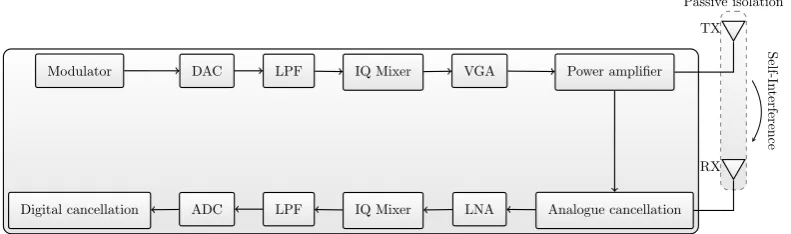
1.1 Transceiver structure of a FD device, where DAC: digital to analog
converter, LPF: low pass filter, VGA: variable gain amplifier, LNA:
low noise amplifier, and ADC: analog to digital converter. . . 3
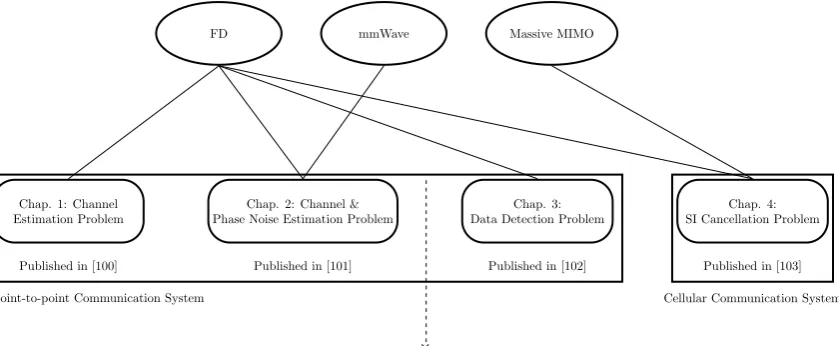
1.2 Overview of the thesis and its contributions . . . 16
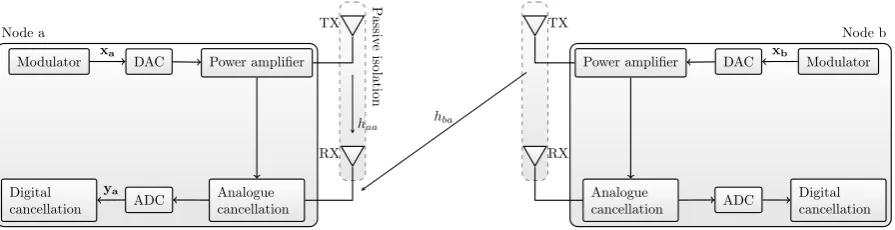
2.1 Illustration of full duplex communication between two transceivers, each with a single transmit and a single receive antenna. ADC = analog to digital converter, DAC = digital to analog converter. TX
= transmit. RX = receive. . . 24
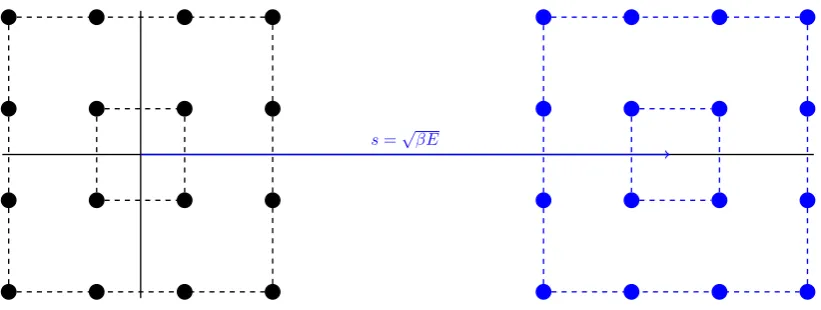
2.2 Effect of the proposed technique on the constellation of 16-QAM. The resulting constellation is shifted along the horizontal axis, i.e.,
it is asymmetric around the origin. . . 30
2.3 MSE performance of the proposed channel estimator for different
values of β for Eb/N0 = 0 dB, N = 128 and SIR = −50 dB. . . 37
2.4 MSE performance of the proposed channel estimator vs. Eb/N0 for
β = 0.2, N = 128 and SIR =−50 dB. . . 38
2.5 MSE performance of the proposed technique. . . 39
2.6 BER performance of the proposed technique. . . 41
2.7 Effect of SI power level on the BER performance of the proposed
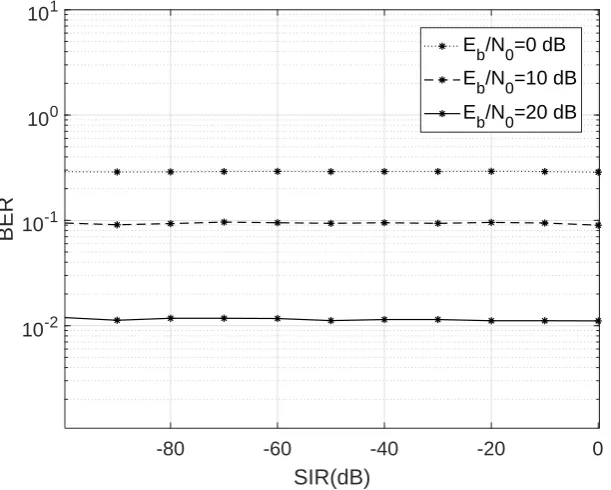
technique. . . 42
3.1 System model block diagram of FD communication, where AC stands for analogue SI cancellation, DC stands for digital SI cancellations,
ejθ[lr/rb/t/SI] represents the PN at thelth antenna. . . . 45
3.2 Time diagram of modified EKF. . . 51
3.3 MSE performance for PN variances σ2
r = σt2 = σSI2 = 10−4,10−5
and different QAM modulations for a 2×2 FD MIMO system with
SIR= 0 dB. . . 55
3.4 MSE performance of the UKF and proposed EKF for PN variances
σ2
r =σt2 =σSI2 = 10
−4,10−5 and 8-QAM modulation for a 2×2 FD
MIMO system with SIR= 0 dB. . . 56
3.5 The residual SI power PSI after digital cancellation. . . 58
3.6 BER performance of the proposed system for a 2× 2 MIMO FD
system with different QAM modulations. . . 59
4.1 Full Duplex System with single transmit and receive antenna. The
single antenna at each node is shown separately for the transmission
and reception for ease of illustration. . . 62
4.2 Effect of superimposed signalling on the modulation constellation of
M = 4-PSK. . . 67
4.3 Posterior function f(xbi|ya) at
Eb
No = 15 dB. . . 68
4.4 Posterior function f(xbi|ya) for different values of β . . . 69
4.5 BER performance of FD communication system with different
avail-ability of channel estimates. . . 70
5.1 A FD massive MIMO BS servingU UL and K DL users. . . 75
5.2 Empirical PDF of eigenvalues of HH∗. . . . 78
5.3 Residual SI power versus number of transmit antennas for a FD
massive MIMO BS. . . 79
List of Tables
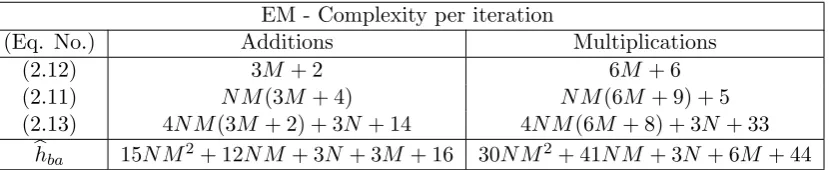
2.1 Complexity analysis of the EM estimator. . . 35
3.1 Important symbols used in Chapter 3. . . 46
3.2 Complexity of each step of EKF algorithm. . . 52
Chapter 1
Introduction
1.1
Background
The next generation of wireless communication networks, i.e., 5G networks, are promising faster, more reliable, and better quality communications [1–3]. 5G net-works are expected to allow for many new wireless applications, which were deemed impossible with older generation networks [4–6]. It is expected that these net-works will be significantly different from their predecessor netnet-works and introduce a paradigm shift in wireless communication research [7–9]. This paradigm shift requires technologies to revolutionize the performance of the current networks in terms of data rates, latency, connectivity, and energy efficiency. This expected technological leap then allows for the realization of important applications such as internet of things (IoT), and virtual reality [10]. In this regard, many technolo-gies have been proposed for 5G networks and among the most prominent ones are full duplex, millimeter wave (mmWave), and massive multiple-input multiple-out (MIMO) technologies [11–13].
In the remainder of this chapter we first review each of these technologies in-dividually. We then identify the scope of this thesis, and subsequently, review the literature of the problems that will be discussed in this thesis. Finally, this section is concluded by discussing contributions and organization of this thesis.
1.1.1
Full Duplex Communication
Traditionally, communication systems are designed to communicate in half duplex (HD) mode. This means that separate time and frequency resources are allo-cated to transmission and reception [14]. This separation in time and frequency is achieved by using time division duplexing (TDD), and frequency division duplexing (FDD), respectively. However, the inefficiency of allocating different resources to transmission and reception has encouraged research in FD communication, where devices are allowed to transmit and receive over the same temporal and spectral resources [15,16]. FD communication can potentially double the spectral efficiency of future wireless communication systems [17–19].
FD communication has been used in the context of wired communication, where an interference signal is generated due to the electromagnetic coupling between the receive and transmit wires [20]. This electromagnetic coupling creates a channel, which is known as the echo channel, and is normally weaker than the commu-nication channel [20, 21]. In the context of wireless commucommu-nication however, the interference is due to in-band transmission and reception. The transmitted signal intended for the destination node is also received by all the receiver antennas of the transmitter. Consequently, the interference channel is significantly stronger compared to wired communication. This interference channel is known as self-interference (SI) channel and it is a major obstacle in realising the full potential of wireless FD communication systems, i.e., doubling the spectral efficiency [22–25].
Fig. 1.1 shows the transceiver structure of a FD communication device as proposed in [26]. The transmitter chain of the structure contains similar functional blocks to a HD device, and includes a digital to analog converter (DAC), low pass fil-ter (LPF), IQ mixer, variable again amplifier (VGA), and power amplifier blocks. However, in comparison to hardware architecture for HD devices, the receiving chain additionally includes analog and digital cancellation blocks to deal with the strong SI signal. The figure also illustrates a link between the transmit and receive chains. This link is necessary to reliably feed the self-interference signal back to the receive chain, and subsequently use this reliable signal to cancel the SI signal received through the receiving antenna, i.e., the wireless channel.
1.1 Background 3
Modulator DAC LPF IQ Mixer VGA Power amplifier
Digital cancellation ADC LPF IQ Mixer LNA Analogue cancellation TX
RX Passive isolation
Self-In
[image:27.595.128.524.108.225.2]terference
Figure 1.1: Transceiver structure of a FD device, where DAC: digital to analog con-verter, LPF: low pass filter, VGA: variable gain amplifier, LNA: low noise amplifier, and ADC: analog to digital converter.
power compared to the intended signal. This is because the SI signal travels a smaller distance in orders of centimetres to reach the receiving antenna, as opposed, to the intended signal which might be travelling hundreds of meters to reach the receiving antenna. If this strong SI signal is left untreated it will saturate the ADC and result in total loss of the intended signal. For example, if 8-bit ADC is used, the quantization error is approximately given by 48 dBm. On the other hand, the received SI power can be in order of 100 to 150 dB [15, 27]. This means that the received SI power will dominate the quantization error, and the accuracy of the ADC is predominantly determined by the received SI power.
propose a direct conversion FD transceiver architecture to suppress the SI signal using an analog circuit. In the proposed FD architecture of [26, 29], the SI signal is fed back to the receiver chain via a wired link. This fed-back SI signal is then used to cancel the SI signal receive through the wireless channel before the ADC block. Furthermore, a transceiver architecture is proposed for FD communication in [30], where the wired link that feeds back the SI signal shares oscillator with the receiver chain. The proposed architecture is then shown to have a better robustness to oscillator impairments compared to the architecture proposed by [26, 29].
Depending upon the design, passive suppression and analog cancellation can
provide about 40 − 80 dB cancellation in total [31], which is not sufficient for
reliable communication. Hence, in practice, the SI is cancelled in multiple stages, beginning with passive suppression and followed by cancellation in the analog and digital domains.
1.1.2
Millimeter Wave Communication
MmWave networks are expected to explore the large unprecedented frequency bands available at mmWave to provide fast and directional communication [34]. For example, the available unlicensed spectrum at 60 GHz is ten times larger than the spectrum used for 4G cellular communication, which can be used to provide faster communications compared to the current cellular and WiFi networks [35]. A number of successful experiments with mmWave communication has persuaded the regularity bodies such as U.S. Federal Communication Commission (FCC) to allow for the use of mmWave spectrum for 5G communications [36].
MmWave communication is one of the key technologies, which allows many important fantasy applications, such as IoT, drive-less cars, and smart cities, to become realities [34]. However, there are certain impairments associated with mmWave communication that can significantly affect quality of reliable commu-nications at mmWave band frequencies [35–37]
Con-1.1 Background 5
sequently, a communication system operating at mmWave frequencies requires to rely more on line-of-sight (LoS) communication, which is not always feasible due to physical constraints. A large body of research investigates the problem with short effective range for mmWave communication [38–40]. The principle idea be-hind the proposed techniques is to explore the small size of antennas at mmWave frequencies to pack more antennas into the antenna array. Once antenna arrays are constructed for mmWave communication, then beamforming can be used to increase the effective communication range at mmWave frequencies. However, two types of beamforming have received more attention compared to the other types due to their simplicity and practical feasibility: (i) analog beamforming [40], and (ii) hybrid beamforming [38, 39]. Analog beamforming does not require channel knowledge and it involves using phase shifters to steer the signal into the de-sired direction. Despite, the simplicity of analog beamforming techniques, they can only steer the transmission in a single direction. Hybrid beamforming allows for directional transmission in multiple directions, however, they require channel knowledge. Hybrid beamforming is achieved by using analog and digital beamform-ing techniques in combination. The advantage of hybrid beamformbeamform-ing techniques compared to fully digital beamforming techniques is that they allow for directional communication with less complexity [38].
Secondly, the oscillators designed to operate at mmWave frequencies suffer from a large phase noise (PN) [41, 42]. If the oscillator PN is not accurately tracked and eliminated, it will have detrimental effect on the communication performance at mmWave frequencies. This is because PN causes the constellation diagram to rotate [43]. This rotation in turn results in erroneous detection. For a HD single-input single-out (SISO) system the PN problem at mmWave bands has been thoroughly investigated in [44], where the authors derive the lower bound for the PN estimation error and show that the proposed estimation algorithm reaches the performance of the derived bound. A joint channel and PN estimation algorithm is proposed in [43] for a HD MIMO communication system. The performance of the estimator proposed in [43] for HD MIMO system is improved in [45] by using a soft-input estimator.
because without an accurate PN tracking mechanism, accurate channel knowledge cannot be obtained.
1.1.3
Massive MIMO
Massive MIMO is a physical layer technology, which proposes to deploy a large antenna array at base stations (BS) to serve smaller number of users in the down-link [46, 47]. Massive MIMO systems are expected to significantly improve the performance of current MIMO systems. Furthermore, the use of large antenna ar-rays at BS allows for effective way of dealing with the wireless channel impairments including fast fading effect [46].
Massive MIMO systems promote network architectures, where minimum pro-cessing is required by the users. This is achieved by using TDD and assuming channel reciprocity for downlink and uplink [47]. In this case, only the BS needs to know the channels, and since the uplink and downlink channels are the same, beamforming matrices can be designed at the BS to direct the communication in the downlink and remove the interference in the uplink. The advantage of this net-work architecture is that the complexity of the system only grows with the number of users and is independent of number of BS antennas.
1.2 Research Challenges and Motivation 7
The second associated problem with massive MIMO systems, which is of practical importance, is the problem of low complexity channel estimation and data detec-tion algorithms [53, 54]. The importance of low complexity algorithms for massive MIMO systems is two fold, not only they need to be low complexity to be feasible for large antenna systems, but also they need to be low complexity to limit the power consumption of the system [54]. For this reason, linear processing is more desirable for massive MIMO systems [47].
In the following section, we discuss the focus of this thesis. In particular, we show how this thesis considers solutions for the problems involving FD, mmWave, and massive MIMO technologies.
1.2
Research Challenges and Motivation
While this thesis primarily focuses on FD communication, it also investigates the FD communication at mmWave frequency bands, and FD massive MIMO BS. In the remainder of this section we present the problems that will be discussed in this thesis and their relevant literature review.
In this thesis, we focus on the SI cancellation and data detection after the
passive suppression and analog cancellation, termed residual SI. Since, the
effec-tiveness of any digital interference cancellation technique depends strongly on the quality of the available channel estimates for both the SI and desired communi-cation channels [55–57], we first study the channel estimation problems for FD communication., and then study the problems of residual SI cancellation and data detection based on available channel estimates.
Section 1.1.1 has identified that the main obstacle in enabling FD communica-tion in 5G networks is the SI cancellacommunica-tion. We focus on the SI cancellacommunica-tion and data detection after the passive suppression and analog cancellation, termed resid-ual SI. Since, the effectiveness of any digital interference cancellation technique depends strongly on the quality of the available channel estimates for both the SI
and desired communication channels [55–57], we first study the channel estimation
at microwave frequencies, we formulate the first problem considered in this thesis as follows:
• Problem 1: Bandwidth efficient channel estimation techniques for FD com-munication systems.
Section 1.1.2 has highlighted oscillator PN as an important issue associated with HD mmWave communication systems. However, this issue is compounded for FD communication systems. This is because for FD communication the channel estimation and PN tracking needs to be done in the presence of a strong SI signal. In addition, since PN is a hardware impairment the algorithms developed for PN tracking for HD devices cannot be used for FD devices, which have fundamentally different hardware architecture as shown in Fig. 1.1. Consequently, we formulate the second problem considered in this thesis as follows:
• Problem 2: Joint channel and PN estimation algorithms for FD communica-tion at mmWave frequencies.
Once the channels are estimated then they are used to: (i) cancel the strong SI to below the receiver noise floor, and (ii) detect the desired communication
symbols. For this reason, this thesis also investigates the problem ofSI cancellation
and data detection based on the availability of channel estimates. In particular, since obtaining accurate channel estimates is not always feasible, this thesis seeks to address the following problem:
• Problem 3:Data detection for FD communication using statistical properties of the channels.
1.2 Research Challenges and Motivation 9
• Problem 4:Precoder design for joint SI and MUI suppression for FD massive MIMO BS.
We can put the considered problems in this thesis into two groups: (i) channel estimation problems, and (ii) SI cancellation and data detection problems. In the remainder of this section, we review the literature of the four problems presented here, and provide background and motivation for each problem.
1.2.1
Channel Estimation
Accurate channel estimates are fundamentally important for reliable wireless com-munication [58–62]. The accuracy of these estimates becomes even more important in FD communication [15, 55, 63]. This is because these estimates serve two pur-poses. On the one hand, the estimate of communication channel is needed to reliably detect the transmitted symbols, and on the other hand, the SI channel estimation is needed to cancel the residual SI signal at the baseband.
The channel estimation for FD communication at microwave frequency differs substantially from the channel estimation at millimeter wave (mmWave) communi-cation [64,65]. This is because the mmWave channel suffers from the rapid variation of phase noise (PN) [66]. In this thesis we first consider the channel estimation at microwave frequencies, where the channel is not affected by the random varia-tion of the PN. Given the importance and emergence of mmWave communicavaria-tion systems, we then study the joint channel and PN estimation problem at mmWave frequencies.
In what follows the literature of channel estimation techniques for FD commu-nication at microwave and mmWave is reviewed.
1.2.1.1 Channel Estimation at Microwave Frequencies
symbols, and both the known pilot and unknown data symbols from the other intended transceiver. Another approach was proposed in [70] where a sub-space based algorithm was developed to jointly estimate the residual SI and communica-tion channels, using known pilots.
Bandwidth efficient channel estimation techniques for FD communication can be inspired from the HD counterparts. A bandwidth efficient channel estimation
technique in HD systems is superimposed training [71, 72]. The authors of [72]
propose a superimposed training based channel estimation technique for HD com-munication. The proposed technique alleviates the need to explicit time slots al-location for channel estimation, by superimposing a periodic low power training sequence onto the data symbols. The downside of this approach is that some power is consumed in superimposed training which could have otherwise been allocated to the data transmission. This lowers the effective signal-to-noise ratio (SNR) for the data symbols, and affects the bit error rate (BER) at the receiver.
In contrast to data-aided and superimposed training based channel estimation
techniques, blind techniques avoid the use of pilots altogether by exploiting
statis-tical and other properties of the transmitted signal [73–78]. A blind channel esti-mation technique for HD communication systems is proposed in [73]. The authors consider a single-input multiple-output (SIMO) system, and through identifiability analysis show that blind estimation can only recover the channel coefficients up to a scaling factor, i.e., ambiguous channel estimation. This means that the channel phases cannot be fully recovered. To overcome the ambiguity problem, semi-blind approaches, where the HD channel is estimated using the combination of known pi-lots and unknown data symbols, are proposed in [79, 80]. Moreover, in the context of cooperative communication blind and semi-blind channel estimation techniques have been proposed in [74, 75], for a HD two way relay network, respectively.
The above literature review motivates the study of bandwidth efficient channel
estimation techniques for FD communication. Furthermore, it indicates that this
study should include an investigation of ambiguity problem, which is associated with
1.2 Research Challenges and Motivation 11
1.2.1.2 Channel Estimation at mmWave Frequencies
Recently, SI channel measurements have been carried out for FD communication at mmWave frequencies [81, 82]. The measurements indicate that, as opposed to the microwave frequency band, the SI channel at mmWave has a non-line-of-sight (NLoS) component, which cannot be cancelled using passive and active analog suppression techniques. This partial suppression of the SI signal results in a large residual SI signal at baseband, which is still significantly higher than the receiver noise floor [81]. Digitally cancelling the residual SI signal at the baseband, requires tracking the large and rapidly changing oscillator PN [66, 83]. The existing tech-niques for residual SI signal cancellation at baseband assume a very steady oscillator PN [70, 84–86], and hence, they cannot be used for FD mmWave communication.
The authors in [66] consider a FD communication system, where the digital SI cancellation is hampered by oscillator PN. However, the authors assume that the PN stays constant over a number of orthogonal frequency division multiplex-ing (OFDM) symbols. This assumption is in contrast to fast variation of PN at mmWave communication [43]. Furthermore, channel and PN estimation problems for FD communication is also investigated in [87], where the authors propose two separate maximum likelihood (ML) estimators for channel and PN estimation. The proposed ML estimators require two separate set of piloting. This makes them less bandwidth efficient compared to the joint channel and PN estimation techniques. In addition, the authors of [84] assume a slow varying PN process, which is a valid assumption for FD communication at microwave frequency. For a single-input single-output (SISO) FD communication system the PN estimation problem is considered in [86]. Beside the SISO system assumption, there are two other limiting factor associated with the proposed PN estimator in [86]. Firstly, the ML based estimator is complex and cannot be directly applied to more general sys-tem models, such as MIMO FD communication syssys-tem, and secondly, the authors assumptions about the PN process is only valid when the PN variations are small.
The above mentioned works motivate the study of joint channel and PN
esti-mation problem for FD communication system at mmWave frequency band, where
1.2.2
SI Cancellation and Data Detection for FD
Commu-nication
Ultimate goal of any communication system is to reliably detect the transmitted symbols to allow robust end-to-end communication [88–90]. For this reason, once the channels are accurately estimated, for reliable data detection, the SI signal needs to be suppressed to below the receiver noise floor. However, the desired SI suppression cannot be achieved using a single cancellation technique. For instance, for small-cells in Long Term Evolution (LTE), the maximum transmit power is
typically 23 dBm (200 mW) and the typical noise floor is −90 dBm [91]. Ideally,
this requires a total of 113 dB SI cancellation for realizing the full potential of FD systems [91]. While passive and active RF cancellation can provide some cancellations, the residual SI can still be relatively strong in the baseband digital signal. For example, for the LTE small-cell example, it can be as high as 50 dB assuming state-of-the-art passive suppression and analog cancellation provide 60 dB of the total required SI cancellation of 113 dB. Thus, accurate digital SI cancellation is also required to bring the SI as close to the noise floor as possible.
However, achieving effective digital SI cancellation might not always be feasible. This can be due to the lack of availability of accurate channel estimates. In this case, it is important to investigate data detection techniques for FD communication, which only require statistical properties of the channels instead of accurate channel estimates. The detection techniques that work with empirical statistical knowledge of the channels do not need channel estimation and SI cancellation stages. Hence, they can save both bandwidth and processing power.
1.2 Research Challenges and Motivation 13
in-band transmission (in the DL) and reception (in the UL) [92, 93].
This thesis studies the SI cancellation and data detection for both
point-to-point FD communication, and cellular network with FD massive MIMO BS. In what follows the SI cancellation and data detection literature for these systems is
reviewed.
1.2.2.1 Blind Data Detection for Point-to-Point FD System
Conventionally, for data detection, the SI signal is cancelled using a replica of the SI signal and available SI channel estimates, which are obtained through pilot-based estimation techniques [15, 28, 29, 84].
For SI cancellation and data detection in a SISO FD communication system, the authors of [15, 16] propose an initial HD phase, in which the transmitting node is switched off, while pilots are sent from the receiving node for SI channel estimation. The SI channel is then estimated using a least square (LS) based estimator. The LS-based channel estimates are subsequently used to cancel the residual SI signal at the baseband and detect communication signals. However, not only does the initial HD phase for SI channel estimation waste the bandwidth, but it also introduces processing delays. The associated problem with the initial HD phase needed for SI cancellation for FD SISO system proposed by [15, 16], is resolved in [67]. The authors of [67] allow for the transmitting node to transmit during the SI channel estimation phase, however, they treat the intended received signal as noise, which significantly degrades the quality of channel estimates and subsequently the reliability of the detected symbols. The reliability of the detected symbols is improved in [94, 95], by obtaining the SI channel estimates through an adaptive least mean square (LMS) algorithm. Although, in contrast to [15,16], the proposed SI cancellation and data detection technique does not need an initial HD phase, the proposed algorithm requires many iterations to converge.
technique in [70] still requires significant processing to obtain the estimates of both SI and communication channel. This in turn adds undesirable processing delays.
Blind data detection techniques, where the data symbols are detected with-out obtaining channel estimates, have been investigated for HD communication systems [96–98]. In [96], an iterative sequential Monte Carlo based method is pro-posed for blind data detection in the presence of PN in HD communication. The authors have shown how blind detection cannot recover the phase of the transmit-ted data symbols, and have used some channel estimates to remove this ambiguity. In [97], the authors propose to use cyclic prefix to avoid the ambiguity of blind data detection for HD OFDM systems. Finally, the authors of [98] consider blind detection problem for a HD two way relay network, and investigate the ambiguity problem associated with it.
The above mentioned works clearly show that the channel estimation and SI can-cellation stages require significant processing and bandwidth resources. This makes
the problem of data detection using statistical properties of the channels, instead of
actual channel estimates (blind data detection), of great practical importance and
interest. Furthermore, any such study also needs to address the ambiguity problem
associated with blind data detection.
1.2.2.2 SI Cancellation for Cellular Network with FD Massive MIMO
Base Station
Point-to-point communication systems are considered in the reviewed works in Section 1.2.2.1. However, the SI cancellation for FD MIMO communication systems in the context of cooperative and cellular communications has been studied in [92, 99–102].
1.2 Research Challenges and Motivation 15
have hundreds of antennas. The authors of [99] take a non-linear approach in designing precoder matrix for MIMO FD relays to jointly perform beamforming and SI suppression. However, the proposed non-linear approach, which is based on non-convex optimization is computationally complex for massive MIMO BS with large number of antennas.
Recently, in the context of cellular communication, the problem of linear pre-coder design to suppress both SI and MUI for massive MIMO BS has been investi-gated [100–102]. In this context, the existing solutions in the literature [100–102], assume the number of transmit antennas is greater than the number of receive an-tennas and heuristically design the precoding matrices based on the transmission of zeros to all or a subset of the receive antennas. In [102], the authors consider a FD massive MIMO BS, which serves a number of single antenna HD users. A transmit precoder is designed by first adding a number of zeros to the vector of data symbols and making it as large as the number of transmit antennas. Then zero forcing (ZF) based precoder is designed by exploiting the added zeros, such that the receive antenna array receives all the zeros. This work is extended to HD users with MIMO users in [103], which uses the same design procedure for trans-mit precoder design. Furthermore, the authors of [101] consider an FD massive BS with MIMO FD users, and design precoder matrix to suppress both SI and MUI in two stages. First, assuming that a subset of receive antennas receives zeros, a precoder matrix is designed such that the transmit vector lies in the null space of the interfering channel. Second, a precoder matrix is designed such that the overall effect of applying the first and second precoder matrices removes MUI. However, these works lack a well-established mathematical foundation to allow validating their core central assumptions. In particular, the assumption of being able to send zeros to all or a subset of receive antennas cannot be validated using any existing framework.
The above works motivate the study of precoding design in FD massive BS to
provide a rigorous mathematical foundation for the design of linear low complexity
precoders.
FD mmWave Massive MIMO
Chap. 1: Channel Estimation Problem
Chap. 2: Channel & Phase Noise Estimation Problem
Chap. 3: Data Detection Problem
Chap. 4: SI Cancellation Problem
Published in [100] Published in [101] Published in [102] Published in [103]
Point-to-point Communication System Cellular Communication System
[image:40.595.68.488.103.276.2]Channel Estimation for FD Communication Data Detection and SI Cancellation for FD Communication
Figure 1.2: Overview of the thesis and its contributions
1.3
Overview and Contributions of Thesis
Fig. 1.2 presents an overview of the thesis. The content of this thesis can be divided into two halves. In the first of half of the thesis the channel estimation problems for FD communication systems are studied. The second half of the thesis is dedicated to the study of SI cancellation and data detection techniques for FD communication systems. In particular, this thesis seeks to provide solution to the existing problems in the literature. More specifically, as outlined in Section 1.1, the following problems are studied in this thesis:
• Problem 1: Bandwidth efficient channel estimation techniques for FD com-munication systems.
• Problem 2: Joint channel and PN estimation algorithms for FD communica-tion at mmWave frequencies.
• Problem 3:Data detection for FD communication using statistical properties of the channels.
1.3 Overview and Contributions of Thesis 17
1.3.1
Questions to be Answered
Solutions to the above mentioned problems will answer the following open ques-tions:
Q1. Can both SI and communication channels be estimated without sending data-aided pilot sequences?
Q2. Can the inherent ambiguity of blind channel estimation techniques for FD communication be resolved?
Q3. What is the lower bound on the estimation error estimating both SI and communication channels in a FD communication system?
Q4. How can we jointly estimate the channel and a fast varying PN process for FD communication at mmWave frequencies?
Q5. What is the lowest achievable mean square error (MSE) for joint channel and PN estimation for mmWave FD communication?
Q6. Can the transmitted symbols be detected without SI and channel estima-tion stages, solely based on the available statistical properties of the SI and communication channels?
Q7. Can transmit precoders be designed to jointly cancel SI and MUI for FD-enabled massive MIMO by sending zeros to all or a subset of receive antennas?
1.3.2
Thesis Contributions and Organization
The first part of this thesis focuses mainly on channel estimation techniques for FD communication (Chapters 2 and 3), while in the second part of the thesis (Chapters 4 and 5), the focus is on SI cancellation and data detection for FD communication.
only the statistical properties of the SI and communication channels are known. Chapter 5 studies the precoder design for both SI and MUI suppression for FD-enabled massive MIMO BS. The chapter-wise summary of the contributions is given as follows:
Chapter 2 – Superimposed Signalling Inspired Channel Estimation in Full-Duplex Systems
In Chapter 2, we consider the problem of bandwidth efficient channel estima-tion in a SISO FD communicaestima-tion system. We propose a new technique for chan-nel estimation and residual SI cancellation in FD systems. Our approach draws inspiration from (i) blind channel estimation techniques in that we examine the condition for identifiability of channel parameters in FD systems, and (ii) super-imposed signalling in that we superimpose (i.e., add) a constant real number to each constellation point of the modulation constellation. However, our proposed technique is distinct from superimposed signalling. In superimposed signalling, the superimposed signal is typically a periodic training sequence that is added to the data signal after the data symbols are modulated. Hence, the additional power of the superimposed signal is only used for channel estimation. In our proposed tech-nique, the superimposed signal is a constant (non-random) signal and the objective is to shift the modulation constellation away from the origin, which we exploit for estimating the SI and communications channels without ambiguity. In addition, the additional power of the superimposed signal is used for both modulating the data symbols and channel estimation, which does not reduce the effective SNR as in superimposed signalling. The novel contributions are as follows:
• We derive the condition for blind identifiability of channel parameters in a
FD system (cf. Theorem 2.1) and show that symmetric modulation constel-lations with respect to the origin cannot be used for ambiguity-free channel estimation in a FD system. Based on Theorem 2.1, our proposed technique is able to resolve the inherent ambiguity of blind channel estimation in FD communication via shifting the modulation constellation away from origin.
• Using the proposed technique, we derive a computationally efficient
1.3 Overview and Contributions of Thesis 19
error, which depends on the energy used for shifting the modulation constel-lations, and use it to find the minimum signal energy needed for accurate channel estimation in a given FD communication system.
• We use simulations to compare the performance of the proposed technique
against that of the data-aided channel estimation method, under the condi-tion that the pilots use the same extra power as the shift. Our results show that the proposed technique performs better than the data-aided channel es-timation method both in terms of the MSE of channel eses-timation and BER. In addition, the proposed technique is robust to an increasing SI power.
The results in Chapter 2 have been presented in the following publication [104], which is listed again for ease of reference:
J1. A. Koohian, H. Mehrpouyan, A. A. Nasir, S. Durrani, and S. D. Blostein,
“Superimposed signaling inspired channel estimation in full-duplex systems,”EURASIP
Journal on Advances in Signal Processing, vol. 2018, no. 1, p. 8, Jan. 2018. [On-line]. Available: https://doi.org/10.1186/s13634-018-0529-9.
Chapter 3 – Joint Channel and Phase Noise Estimation for mmWave Full-Duplex Communication Systems
In Chapter 3, we consider the problem of joint channel and PN estimation for a mmWave FD MIMO communication systems. We assume that oscillator PN varies from one communication symbol to another. This assumption best captures the fast variation of PN at mmWave frequencies [43]. The main contributions of this work are as follows:
• We construct a state vector for the joint estimation of the channel and PN,
and propose an algorithm based on extended Kalman Filtering (EKF) tech-nique to track the fast PN variation at mmWave band.
• We derive the lower bound on the estimation error of the proposed estimator,
• We present simulation results to show the MSE and BER performance of a mmWave FD MIMO system with different PN variances, and
signal-to-interference-ratios (SIR). The results show that for a 2×2 FD system with
64−quadrature amplitude modulation (QAM), and PN variance of 10−4, the
residual SI power can be reduced to −25 dB and −40 dB, respectively, for
SIR of 0 and 15 dB.
The results in Chapter 3 have been presented in the following publication [105], which is listed again for ease of reference:
J2. A. Koohian, H. Mehrpouyan, A. A. Nasir, and S. Durrani, “Joint chan-nel and phase noise estimation for mmWave full-duplex communication systems,” EURASIP Journal on Advances in Signal Processing, vol. 2019, no. 1, p. 18, Mar 2019. [Online]. Available: https://doi.org/10.1186/s13634-019-0614-8
Chapter 4 – Data Detection in Full-Duplex Communication Systems In Chapter 4, we focus on the received signal after the passive and RF cancella-tion stages in a point-to-point FD communicacancella-tion system. Different from existing works, we propose a data detection technique based on superimposed signalling which does not require any channel estimates. We show that superimposed sig-nalling can overcome the inherent ambiguity of blind data detection problem when channel estimates are not used. The main contributions of this work are:
• We formulate a maximum a posterior (MAP) detector, based on the
poste-rior probability distribution (PDF) function of the data, to detect the data symbols in FD communication with no need for obtaining channel estimates (blind detection).
• We show that if the modulation constellation is symmetric around the origin,
1.3 Overview and Contributions of Thesis 21
• We compare the BER performance of the proposed detection method to that
of the conventional channel estimation-based detection method, where the un-known channels are first estimated and then the data signal is detected, under the constraint of same average energy over a transmission block. The results show that the proposed method outperforms the conventional method. Since the proposed method does not require any channel estimates, it enhances bandwidth and power efficiency.
The results in Chapter 4 have been presented in the following publication [106], which are listed again for ease of reference:
C1. A. Koohian, H. Mehrpouyan, A. A. Nasir, S. Durrani, and S. D. Blostein, “Residual self-interference cancellation and data detection in full-duplex
commu-nication systems,” in Proc. IEEE ICC, May 2017, pp. 1–6.
Chapter 5 – Self-Interference Suppression in Full-Duplex Massive MIMO Communication
In Chapter 5, we consider a single-cell multi-user scenario with a FD massive MIMO BS. In particular, we focus on the problem of SI suppression via spatial precoding. The main contributions of this work are:
• We develop a mathematical foundation for spatial suppression of SI and MUI.
• We prove that in order to suppress both SI and MUI, the number of transmit
antennas must be greater than or equal to the sum of the number of receive antennas and the number of UL user equipments (UEs). In addition, we rig-orously show that the problem of simultaneous suppression of SI and MUI has a solution with probability 1. This validates previous heuristic assumptions in the literature [100–102].
• We also study the precoder design for a special case, when the number of
transmit antennas is equal to the sum of the number of receive antennas and the number of UL UEs.
• The simulation results demonstrate the validity of the proposed framework
The results in Chapter 5 have been prepared for submission in the following manuscript [107], which is listed again for ease of reference:
J3. A. Koohian and S. Durrani, “Self-interference suppression in full-duplex
massive MIMO communication,” to be submitted.
Chapter 2
Superimposed Signaling Inspired
Channel Estimation in
Full-Duplex Systems
Residual SI cancellation in the digital baseband of an FD communication system requires an accurate knowledge of the SI channel. Furthermore, robust data detec-tion requires a reliable estimate of the communicadetec-tion channel. Hence, in contrast to HD communication, where only the communication channel is estimated, both SI and communication channels need to be estimated for reliable end-to-end FD com-munication. Obtaining accurate estimates for both SI and communication channels via piloting wastes a significant portion of the sacred bandwidth. Blind channel estimation techniques estimate the channel with no piloting and are more band-width efficient compared to their piloting counterparts, but they have an inherent ambiguity problem.
This chapter of the thesis investigates the problem of bandwidth efficient chan-nel estimation for FD communication. In particular, it mathematically studies the ambiguity problem associated with blind channel estimation techniques for FD communication, and shows how this ambiguity can be resolved. In addition, this chapter proposes a novel bandwidth efficient channel estimation techniques to estimate both the SI and communication channels with no ambiguity.
The remainder of this chapter is organised as follows. The system model is
Modulator DAC Power amplifier Power amplifier DAC Modulator
Digital
cancellation ADC
Analogue cancellation
Analogue
cancellation ADC
Digital cancellation
xa xb
ya
Node a TX Node b
RX
TX
RX
P
assiv
e
isolation
hba
[image:48.595.62.510.103.218.2]haa
Figure 2.1: Illustration of full duplex communication between two transceivers, each with a single transmit and a single receive antenna. ADC = analog to digital converter, DAC = digital to analog converter. TX = transmit. RX = receive.
presented in Section 2.1. The bandwidth efficient channel estimation problem and the proposed technique are formulated in Section 2.2. The EM estimator and the lower bound on the channel estimator error are derived in Section 2.3. The per-formance of the proposed technique is assessed in Section 2.4. Finally, conclusions are presented in Section 2.5.
2.1
System Model
Consider the channel estimation problem for a SISO FD communication system
between two nodesaandb, as illustrated in Fig. 2.1. Transceiver nodesa andbare
assumed to have passive suppression and analog cancellation stages and we only consider the digital cancellation to remove the residual SI, i.e., the SI, which is still present after the passive suppression and analog cancellation. We consider the received signal available at the output of the analog to digital converter (ADC).
The received signal at node a is given by1
ya=haaxa+hbaxb+wa, (2.1)
where xa , [xa1,· · · , xaN]
T
, xb , [xb1,· · ·, xbN]
T
are the N ×1 vectors of
2.2 Channel Estimation for FD Systems 25
mitted symbols from nodes a and b, respectively,ya ,[ya1,· · · , yaN]
T
is the N×1
vector of observations, wa is the noise vector, which is modeled by N
indepen-dent Gaussian random variables, i.e., fWa(wa) = CN(0, σ
2I
N), and haa, hba are the residual SI and communication channel gains, respectively. Furthermore, we
model haa and hba as independent random variables that are constant over one
frame of data and change independently from frame to frame [55]. Finally, N is
the number of transmitted symbols in a given communication packet, i.e., the size of communication packet.
Remark 2.1 Including all the hardware impairments and unknown parameters in mathematical modeling of parameter estimation problem in FD communication
re-sults in a highly non-linear system model, which may not have a tractable solution.
The current approach is to separate the estimation of the linear and non-linear parameters [56, 84]. In this work, we focus on the estimation of linear parameters,
while the estimation of non-linear parameters can be the topic of future works.
Modulation Assumptions and Definitions: In this thesis, we assume that the transmitted symbols are all equiprobable and call the set A , {x1, x2, ..., xM},
which contains an alphabet of M constellation points, a modulation set. Let K ,
{1,· · · , M}denote set of indices of the constellation points.
We define E as the average symbol energy of a given constellation, i.e.,
E ,EXk[|xk|
2] =
PM
k=1|xk|2
M , (2.2)
where xk ∈ A. Note that the average symbol energy can be related to the average
bit energy as Eb ,E/log2(M).
2.2
Channel Estimation for FD Systems
2.2.1
Problem Formulation
Without loss of generality, we consider the problem of baseband channel estimation
at node a only (similar results apply at node b). In formulating the problem, we
make the following assumptions: (i) the transmitter is aware of its own signal, i.e.,
xa is known at node a, which is a commonly adopted assumption in the
litera-ture [15, 23], (ii) the interference channel haa, and the communication channel hba
are unknown deterministic parameters, (iii) the transmit symbol from node b is
modelled using a discrete random distribution, and (iv) we observe N independent
received symbols.
The blind channel estimation problem requires the knowledge of the joint prob-ability density function (PDF) of all observations, which is derived from the condi-tional PDF of a single observation. Given the system model in (2.1), the condicondi-tional PDF of a single observation is given by
fYai(yai|xbi;haa, hba) =
1 πσ2 exp
−1
σ2|yai −hbaxbi −haaxai|
2
, (2.3)
where i ∈ I , {1,· · · , N}, yai is the i
th received symbol, and x
ai and xbi are the
ith transmitted symbols from nodesa and b, respectively.
The marginal PDF of a single observation is then found by multiplying (2.3) by the uniform distribution pXbi(xbi) =
1
MI{A}(xbi), and summing the results over all
the possible values of xbi, where,I{A}(x) = 1 if x∈ A and 0 otherwise. Therefore,
we have
fYai(yai;haa, hba) = X
∀xbi
fYai(yai|xbi;haa, hba)pXbi(xbi)
= 1
M πσ2
X
∀xbi exp
−1
σ2 |yai−hbaxbi−haaxai|
2
I{A}(xbi)
= 1
M πσ2 M X k=1 exp −1
σ2 |yai−hbaxk−haaxai|
2
, (2.4)
where the last step follows from the fact that I{A}(xbi) = 1 if and only if xbi =xk,
2.2 Channel Estimation for FD Systems 27
and we observe N independent observations, the joint PDF of all the observations
is given by
fYa(ya;haa, hba) =
N
Y
i=1
fYai(yai;haa, hba)
=
1 M πσ2
N N Y i=1 M X k=1 exp −1
σ2 |yai−hbaxk−haaxai|
2
. (2.5)
where we substitute the value of fYai(yai;haa, hba) from (2.4).
Using (2.5), we can state the channel estimation problem as shown in the propo-sition below.
Proposition 2.1 The blind maximum likelihood (ML) channel estimation problem in a SISO FD system is given by
arg max haa,hba
fYa(ya;haa, hba), (2.6)
where fYa(ya;haa, hba) is given by (2.5).
In the next subsection, we show that (2.6) does not have a unique solution if modulation sets which are symmetric around the origin are used.
2.2.2
Identifiability Analysis
In this subsection, we present the identifiability analysis for the blind channel estimation problem in (2.6), which allows us to determine when ambiguity-free channel estimation is possible. For ease of analysis, we first define θ , [haa, hba] and rewrite (2.5) as
fYa(ya;θ) =
1 M πσ2
N N Y i=1 M X k=1 exp −1
σ2|yai−θ(1)xai−θ(2)xk|
2
, (2.7)
where θ(1) andθ(2) represent the first and second elements of θ.
Definition 2.1 [109, Definition 5.2] IfYis a random vector distributed according to fY(y;θ), then θ is said to be unidentifiable on the basis of y, if ∀y there exists
θ0 6=θ for which fY(y;θ) = fY(y;θ0).
Remark 2.2 Definition 2.1 states that θ and θ0 (θ 6=θ0) cannot be distinguished from a given set of observations if they both result in the same probability density
function for the observations. This implies that if θ is unidentifiable, then it is
impossible for any estimator to uniquely determine the value of θ.
In order to present the main result in this subsection, we first give the definitions of a symmetric modulation constellation [110] and a bijective function [111].
Definition 2.2 We mathematically define modulation constellation as the graph of the function f(xk) =xk, wherexk ∈ A ∀k ∈ K. Then a modulation constellation is
symmetric with respect to the origin if and only if f(−xk) =−f(xk) ∀xk∈ A [110].
Definition 2.3 LetC andDbe two sets. A function fromC toDdenotedt :C → D
is a bijective function if and only if it is both one-to-one and onto.
The above definition states that a bijective function is a function between the elements of two sets, where each element of one set is paired with exactly one element of the other set and there are no unpaired elements. Note that a bijective function from a set to itself is also called a permutation [111].
In this work, we define and use the bijective function g: K → K, i.e., g is a
one-to-one and onto function on K → K. Using this bijective function, we present
the main result as below.
Theorem 2.1 There exists aθ0 6=θfor which the joint probability densityfYa(ya;θ) given by (2.7)is equal tofYa(ya;θ
0
)∀ya, if and only if there exists a bijective
func-tion g: K → K, such that xk
xg(k) =c∀k∈ K, where c6= 1is a constant and |c| = 1,
i.e., the modulation constellation is symmetric about the origin.
Proof: We prove the result in Theorem 2.1 in three steps. First, we assume
θ0 6= θ for which fYa(ya;θ) =fYa(ya;θ
0
) ∀ya exists, and show that it leads to a
bijective function g satisfying xk
xg(k) =c ∀k ∈ K. Then, we assume that a bijective
function g satisfying xk
xg(k) = c ∀k ∈ K exists, and show that there exists a θ
0
6
2.2 Channel Estimation for FD Systems 29
for which fYa(ya;θ) =fYa(ya;θ
0
) ∀ya. Finally, using Definition 2.2, we show that
the condition xk
xg(k) =c∀k ∈ K is equivalent to the modulation constellation being
symmetric with respect to the origin. The details are in Appendix A.1.
Remark 2.3 From Theorem 2.1, we can see that since the modulation constella-tions, such as M-QAM, satisfy the definition of symmetric modulation
constella-tions in Definition 2.2, the blind channel estimation problem in (2.6) does not have a unique solution and suffers from an ambiguity problem.
2.2.3
Proposed Technique
In this subsection, we present our proposed technique to resolve the ambiguity problem in (2.6).
The rationale behind the proposed technique comes from the fact that Theo-rem 2.1 shows that symmetry of the modulation constellation with respect to the origin is the cause of the ambiguity. A simple way to achieve constellation
asym-metry2 is to add a constant s to each element of A. The resultant asymmetric
shifted modulation constellation is formally defined as follows:
Definition 2.4 The asymmetric shifted modulation constellation, A, is defined as
A,{xk+s, ∀xk ∈ A, s∈R+}, (2.8)
where R+ is the set of positive real numbers.
In the rest of the thesis, we also use xk =xk+s to denote the kth element of
A.
For illustration, Fig. 2.2 shows the effect of the proposed technique on the 16-QAM constellation. We can see that the resulting modulation constellation is shifted along the horizontal axis, which increases the average energy per symbol of
the modulation constellation. This increase in the average energy per symbol can
be justified as follows: in reality it is inevitable to use some extra energy to estimate